TELUS Overhauls GenAI Deployment Strategy to Combat Stagnant Adoption ROI
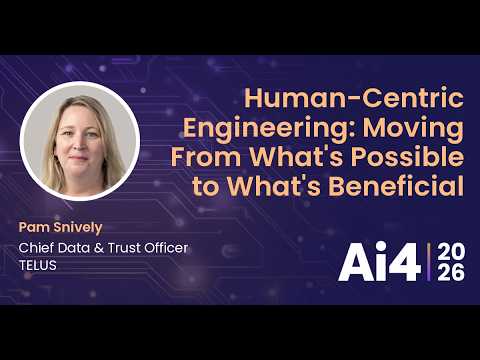
Human-Centric Engineering: Moving From What's Possible to What's Beneficial With TELUS — Ai4

Ai4

AI projects fail to deliver promised financial returns because enterprises neglect human trust and data foundations in favor of rapid automation.

AI-assisted summary of Human-Centric Engineering: Moving From What's Possible to What's Beneficial With TELUS — original source. Check the original for full context.

Source published:

Detailed notes

## Background Published by Ai4 on YouTube on August 16, 2026, this presentation features Pam Snively, Chief Data & Trust Officer at TELUS. According to the page description, the session explores how human-centric engineering bridges technical delivery and user confidence by integrating ethical guidelines, compliance, risk assessments, and engineering standards to drive AI adoption.

## TL;DR Pam Snively addresses the current AI ROI crisis, arguing that stagnant adoption stems from a fundamental deficit in human trust rather than technical limitations. To overcome user resistance, TELUS operationalizes trustworthy AI as a hard engineering discipline, embedding Responsible AI Architects into development, boosting workforce AI literacy, and pioneering crowd-sourced purple-teaming with tools like Fortify. Snively emphasizes that organizations must actively and transparently communicate their safety guardrails to empower users and rebuild trust. Ultimately, centering human values across the engineering lifecycle serves as both an ethical imperative and a primary business differentiator.

## Atmosphere & style The presentation carries an authoritative, pragmatic, and forward-thinking tone, balancing sharp industry critiques with constructive solutions. Snively speaks with calm executive confidence, transforming abstract ethical discussions into concrete technical strategies. The narrative moves from a stark recognition of widespread AI skepticism toward an empowering vision of human-centric design, leaving the audience with an inspiring call to treat human alignment as the ultimate form of innovation.

## Key takeaways - [00:04](https://www.youtube.com/watch?v=zCCMdCMbdGE&t=4s) Pam Snively points out that four years into the generative AI boom, the technology is failing to deliver the promised return on investment (ROI) for society and businesses. - [00:04](https://www.youtube.com/watch?v=zCCMdCMbdGE&t=4s) Early adopters who replaced human workers with AI systems are quietly hiring those workers back as adoption stalls. - [02:48](https://www.youtube.com/watch?v=zCCMdCMbdGE&t=168s) According to the 2025 Edelman Trust Barometer, trust has surpassed technical ability, access, and motivation as the primary barrier to AI adoption. - [02:48](https://www.youtube.com/watch?v=zCCMdCMbdGE&t=168s) Human-centric engineering must be treated as a hard, quantitative engineering discipline integrated directly into the software development lifecycle rather than an abstract philosophy. - [05:38](https://www.youtube.com/watch?v=zCCMdCMbdGE&t=338s) TELUS's three-part framework for sustainable AI requires engineering technical trustworthiness, building in human perspectives, and loudly communicating governance efforts. - [07:33](https://www.youtube.com/watch?v=zCCMdCMbdGE&t=453s) AI tools amplify existing architecture and data defects rather than fixing bad enterprise data or broken structures. - [07:33](https://www.youtube.com/watch?v=zCCMdCMbdGE&t=453s) Data governance needs to shift from restrictive lockdown to an operational enabler that democratizes clean data access. - [08:49](https://www.youtube.com/watch?v=zCCMdCMbdGE&t=529s) Responsible AI Architects translates high-level ethical guidelines into concrete technical specifications alongside metrics like latency and uptime. - [12:04](https://www.youtube.com/watch?v=zCCMdCMbdGE&t=724s) Structured enterprise training on core model logic and human decision boundaries led to a 41% increase in self-reported data and AI literacy across TELUS's workforce. - [15:07](https://www.youtube.com/watch?v=zCCMdCMbdGE&t=907s) TELUS operationalized internal risk testing by opening purple-teaming processes to all 100,000+ employees, identifying non-obvious operational edge cases. - [15:07](https://www.youtube.com/watch?v=zCCMdCMbdGE&t=907s) Insights from employee crowd-sourced stress testing inspired TELUS to build Fortify, an automated enterprise red-teaming tool that benchmarks AI model safety. - [15:07](https://www.youtube.com/watch?v=zCCMdCMbdGE&t=907s) Fortify benchmarks highlight distinct safety-versus-usability trade-offs across major commercial models, such as Anthropic's Claude versus xAI's Grok. - [18:27](https://www.youtube.com/watch?v=zCCMdCMbdGE&t=1107s) Being technically trustworthy is insufficient on its own; organizations must actively and loudly communicate their safety controls to overcome user anxiety. - [21:04](https://www.youtube.com/watch?v=zCCMdCMbdGE&t=1264s) Leaders must reframe AI from an unstoppable force happening to people into a controllable tool where humans retain agency. - [22:06](https://www.youtube.com/watch?v=zCCMdCMbdGE&t=1326s) TELUS became the first company to develop a generative AI tool certified under ISO Privacy by Design standards. - [23:41](https://www.youtube.com/watch?v=zCCMdCMbdGE&t=1421s) Integrating human-centric values into technical engineering is the core innovation required to unlock adoption resistance and achieve true AI ROI.

## Detailed walkthrough ### [00:04](https://www.youtube.com/watch?v=zCCMdCMbdGE&t=4s) Introduction to TELUS and the AI ROI Crisis

Pam Snively, Chief Data & Trust Officer at TELUS, introduces herself and outlines the sprawling footprint of the company. Originating as one of Canada's "big three" telecom giants, TELUS has expanded globally into health services across almost every international jurisdiction, AI/technology and business process outsourcing, as well as a lesser-known global agriculture and consumer goods business. Across all these domains, TELUS manages vast streams of data that present massive opportunities for artificial intelligence. However, Snively immediately pivots to an uncomfortable reality reverberating through the tech world: four years into the generative AI boom, the technology is simply not delivering the promised return on investment (ROI) for society or businesses.

Snively frames the current state of AI adoption as "driving in the right direction, but starting to get stuck in traffic." The industry is witnessing a visible backlash, social unrest, and corporate backtracking, including companies that rushed to replace staff with AI only to quietly rehire human workers. To clear this congestion and widen the road for real value creation, TELUS has focused on solving the root cause of this stagnation: user confidence and trust. Tech leaders must stop viewing AI in isolation and begin addressing the actual humans the technology is meant to serve.

- TELUS operates across telecom, global health, tech/AI outsourcing, and agriculture/consumer goods. - Four years into the recent AI wave, returns on investment remain largely unrealized. - Early adopters who laid off workers in favor of AI systems are actively hiring them back. - "We're driving in the right direction, but we're starting to get stuck in traffic."

---

[02:48](https://www.youtube.com/watch?v=zCCMdCMbdGE&t=168s) The Trust Deficit and Human-Centric Engineering

Citing the 2025 Edelman Trust Barometer, Snively highlights a striking fact: trust issues have surpassed technical intimidation, lack of access, or lack of motivation as the single biggest barrier to AI adoption. Users no longer struggle with how to use AI tools or understanding their theoretical appeal; rather, they fundamentally distrust the outputs, the underlying corporate motives, and whether the technology serves their best interests. Snively warns that the AI revolution is failing precisely because industry leaders are failing people, leaving massive potential on the table in healthcare, economic productivity, and business efficiency while risking brand destruction and wasted capital.

The solution requires a fundamental mindset shift toward **human-centric engineering**. Snively emphasizes that workplace adoption serves as the primary battleground for AI acceptance. By treating an enterprise as a microcosm of broader society, organizations can refine internal tools, values, and practices before scaling them outward to customers. Human-centric engineering is not a "warm and fuzzy philosophy" or vague aspirational talk about removing bias; it must be approached as a hard, quantitative engineering discipline integrated directly into the software development life cycle.

- Edelman's 2025 Trust Barometer identifies trust as the primary bottleneck to AI scaling. - Failing to build trust leads to stagnant adoption, severe brand damage, and wasted R&D capital. - Organizational culture acts as a societal microcosm where trustworthy practices must first be proven. - "Human-centric engineering... is not a warm and fuzzy philosophy... It is a rigorous engineering discipline."

---

[05:38](https://www.youtube.com/watch?v=zCCMdCMbdGE&t=338s) The Three Pillars of Trustworthy AI

To establish sustainable AI operations, Snively lays out a three-part strategic framework. The first component is **engineering trustworthiness** through disciplined data foundation work and specialized technical roles. The second component is **building the human perspective into the system**, which begins with organization-wide data and AI literacy programs. Together, these two pillars make a company objectively trustworthy.

However, being trustworthy is only half the battle. The third critical component is **bridging the trust gap** by communicating loud and clear to all stakeholders. Organizations must actively demonstrate their safety measures, risk mitigations, and alignment with human values, because employees, customers, and citizens will not adopt or rely on tools they do not understand or trust.

- **Pillar 1:** Engineer trustworthiness into systems from day one. - **Pillar 2:** Incorporate human perspectives via continuous AI literacy and internal feedback loops. - **Pillar 3:** Loudly communicate governance and safety efforts to build actual stakeholder confidence.

---

[07:33](https://www.youtube.com/watch?v=zCCMdCMbdGE&t=453s) Re-Engineering Data Foundations and Governance

Addressing the least glamorous side of artificial intelligence, Snively critiques the tech industry's habit of paying lip service to data while under-resourcing the underlying data structures. Without a modern, well-engineered data foundation, organizations cannot progress beyond proof-of-concept (POC) projects or achieve true ROI. AI does not fix broken enterprise architecture or bad data quality; it amplifies and accelerates those defects.

Furthermore, leadership must reframe its approach to data governance. Rather than treating governance as pure lockdown, strict control, or administrative bureaucracy, it must be structured as an enabler of responsible data use. As technology becomes democratized, access to clean, well-governed data must be democratized alongside it so that innovation is not stifled. Paradoxically, leverage generated by AI tools themselves can streamline complex data governance tasks, making it easier to prepare data pipelines for production models.

- Data governance must shift from pure lockdown/control to active operational enablement. - AI tools do not solve underlying data errors—they amplify existing architecture failures. - Unlocking accessible, democratized data is required to move past endless POCs to enterprise scale.

---

[08:49](https://www.youtube.com/watch?v=zCCMdCMbdGE&t=529s) The Role of Responsible AI Architects

Snively argues that a modern Responsible AI team cannot consist solely of ethicists, policy makers, reviewers, or compliance officers. While those perspectives are essential, the team must explicitly include specialized engineers and developers. Responsible AI demands must be treated as core technical specs—evaluated with the same rigor as latency, uptime, and system scalability—rather than post-hoc reviews conducted after a model is built.

At TELUS, **Responsible AI Architects** translate high-level ethical guidelines into concrete technical specifications. Operating directly within the engineering lifecycle, these specialists evaluate system architectures, model limitations, and integration vulnerabilities. They measure robustness against adversarial attacks, apply statistical techniques to evaluate algorithmic fairness, and modify training data sampling or fine-tuning techniques to eliminate bias at the source.

- Governance advocates and system engineers must sit in the same room or be the same individuals. - Responsible AI requirements are technical development specifications akin to latency and uptime. - Responsible AI Architects evaluate limitations, test adversarial resilience, and adjust training data methodologies directly within model pipelines. - "They don't just ask if a model structure should be built. They architect how it is built safely, respectfully, transparently, responsibly."

---

[12:04](https://www.youtube.com/watch?v=zCCMdCMbdGE&t=724s) AI Literacy and the Microcosm of the Workforce

Shifting to the second strategic pillar, Snively discusses embedding the human perspective by prioritizing data and AI literacy across the entire workforce. TELUS implemented structured literacy programs that go far beyond simple prompt engineering. These courses demystify how models work, outline their fallibility, and define explicitly where and how humans must remain the decision-makers. Following the deployment of this curriculum, TELUS recorded a 41% improvement in self-reported data and AI literacy across its 100,000+ employees.

Snively notes that a 41% surge in confidence is particularly impressive when evaluated against the Dunning-Kruger effect, where increased domain knowledge often causes individuals to realize how much they have yet to learn. Furthermore, a company’s employee base serves as a perfect market sample—a microcosm representing the diverse cultural backgrounds, anxieties, and tech readiness of society at large. Equipping employees with AI literacy empowers them to provide early warning signals and feedback regarding potential product flaws.

- TELUS achieved a 41% increase in workforce data and AI literacy through structured training. - Programs focus on fundamental system logic, model limitations, and human-in-the-loop decision boundaries rather than basic prompt tips. - A diverse workforce operates as a real-time testing ground reflecting broader market sentiment and societal fears.

---

[15:07](https://www.youtube.com/watch?v=zCCMdCMbdGE&t=907s) Democratizing Risk Testing: Purple Teaming and 'Fortify'

To operationalize internal trust and crowd-source vulnerability discovery, TELUS developed an award-winning "purple teaming" methodology. Combining traditional red-teaming (adversarial attacks) and blue-teaming (defense and mitigation), TELUS democratized the practice by inviting all 100,000+ employees to actively test, attempt to break, and help rebuild their generative AI systems. Frontline workers from HR, customer support, and sales identified non-obvious risks and edge cases that fell completely outside the imagination of specialized security teams.

This crowd-sourced approach directly inspired TELUS to build and commercialize an automated red-teaming product called **Fortify**. Fortify integrates a standardized Generative AI safety benchmark, linking enterprise red-teaming results directly to published academic safety research. Snively shares a finding from a recent benchmark report generated by the Fortify team: different commercial LLMs display drastic variations in how they trade off usability for safety. For instance, Anthropic's Claude heavily emphasizes safety guardrails, yielding markedly different behavior under test conditions compared to xAI's Grok.

- TELUS opened its purple-teaming process to all 100,000+ employees to stress-test generative AI deployments. - Insights from employee stress-testing led to the development of **Fortify**, an enterprise automated red-teaming tool. - Benchmark testing via Fortify reveals distinct safety-versus-usability trade-offs across different foundation models (e.g., Claude vs. Grok).

---

[18:27](https://www.youtube.com/watch?v=zCCMdCMbdGE&t=1107s) Bridging the Trust Gap: Being Loud About Governance

Concluding part 1 of her talk, Snively stresses that being trustworthy does not automatically make an organization trusted. She shares a personal anecdote from the early days of generative AI rollout at TELUS: despite her team working tirelessly to ensure a new internal GenAI tool was completely safe and vetted, the morning after its release, Snively's inbox was flooded with anxious emails from employees. Staff voiced intense worry over brand reputation, data safety, and customer impact, asking: "Pam, do you know about this? Is it safe?"

This experience taught TELUS a critical lesson: organizations must be proactive and "loud" about their safety efforts. Today, TELUS never releases a tool or discusses AI internally without explicitly detailing the human-centric safeguards, technical specs, and risk mitigations built into the system. Validating user concerns, addressing potential harms head-on, and transparently communicating risk controls are necessary to bridge the trust gap and achieve true technology adoption.

- Being technically trustworthy is useless if stakeholders are unaware of the safeguards in place. - Initial internal tool releases generated wave of employee anxiety despite rigorous backend safety testing. - TELUS now couples every internal AI communication or launch with explicit breakdowns of its safety and governance controls. - "We learned then that not only do we have to be doing the right thing, being trustworthy... but we had to be loud about it."

<FollowUp label="Would you like a detailed walkthrough of Part 2 of this transcript when available?" query="Summarize part 2 of the transcript for Human-Centric Engineering: Moving From What's Possible to What's Beneficial With TELUS."/>

[21:04](https://www.youtube.com/watch?v=zCCMdCMbdGE&t=1264s) Empowering People and Reclaiming Agency Over AI

As an industry, tech leaders have massively underperformed by framing artificial intelligence as an unstoppable force happening *to* people rather than a tool under human control. Pam Snively argues that we must shift the public mindset from seeing AI as a storm hitting them to recognizing it as a powerful tool they can actively participate in and help shape. We frequently hear language describing AI as if it were the only entity with agency—saying "AI is coming at us" or "AI is doing this or that." In reality, humans hold agency over the systems they build, and organizations have a fundamental responsibility to advocate for and empower the end users if they want to fulfill the technology's true promise.

To bridge this gap, organizations must do the work to be inherently trustworthy while actively engaging the public to earn their trust. This dual obligation requires shifting both language and mindset, ensuring people feel included in the development and governance of AI solutions rather than overwhelmed by them.

[22:06](https://www.youtube.com/watch?v=zCCMdCMbdGE&t=1326s) TELUS's Approach to Transparency, Engagement, and Standards

TELUS recognized early on that AI requires deliberate communication, having implemented a formal Responsible AI framework back in 2019. To better understand public hopes and fears, the company launched an annual trust survey and publishes an annual AI report freely on its website. TELUS doesn't just gather this feedback to listen; they amplify those public voices and translate what they learn into concrete engineering actions. Additionally, TELUS launched dedicated social media channels focused on data and trust to maintain a consistent dialogue, while continuously evolving their website to offer clear, approachable explanations about how AI is deployed across their business.

On the global stage, TELUS strategically contributes to ethical AI forums like the UN AI Skills Coalition and the Hiroshima AI Process, aligning its practices with international standards like ISO. In fact, TELUS became the first company to develop a generative AI tool certified under ISO Privacy by Design standards. Feedback from internal sales teams confirms that this relentless commitment to human-centric responsibility directly resonates with customers and serves as a key market differentiator.

- TELUS established a formal Responsible AI framework in 2019. - Public input is gathered via an annual trust survey and an annual public AI report. - Dedicated data and trust social media channels facilitate ongoing public dialogue and feedback. - Global participation includes the UN AI Skills Coalition and the Hiroshima AI Process. - TELUS developed the first Generative AI tool to achieve ISO Privacy by Design certification.

[23:41](https://www.youtube.com/watch?v=zCCMdCMbdGE&t=1421s) Human-Centric Design as the Ultimate Innovation

Putting people at the heart of technology is not a distraction from technical progress—it *is* the innovation itself. We already possess the advanced data and technology required to solve the world's most pressing challenges and pressing business issues, but those solutions will fail if people remain an afterthought. By building a culture of innovation, committing meaningfully to ethical principles, and embedding human-centered values directly into the engineering lifecycle, organizations get halfway to building lasting trust. Achieving total success requires applying these standards industry-wide and communicating them broadly.

Reframing AI around human values is the key to overcoming user adoption resistance, bridging the technical delivery gap, and ultimately realizing the full return on investment (ROI). "Putting people at the heart of your technology isn't a distraction from innovation. It is the innovation," Snively concludes, urging the industry to build an era of AI that delivers tangible benefits for everyone.

## Notable quotes > [00:04](https://www.youtube.com/watch?v=zCCMdCMbdGE&t=4s) We're driving in the right direction, but we're starting to get stuck in traffic. — Pam Snively

> [02:48](https://www.youtube.com/watch?v=zCCMdCMbdGE&t=168s) Human-centric engineering... is not a warm and fuzzy philosophy... It is a rigorous engineering discipline. — Pam Snively

> [08:49](https://www.youtube.com/watch?v=zCCMdCMbdGE&t=529s) They don't just ask if a model structure should be built. They architect how it is built safely, respectfully, transparently, responsibly. — Pam Snively

> [18:27](https://www.youtube.com/watch?v=zCCMdCMbdGE&t=1107s) We learned then that not only do we have to be doing the right thing, being trustworthy... but we had to be loud about it. — Pam Snively

> [23:41](https://www.youtube.com/watch?v=zCCMdCMbdGE&t=1421s) Putting people at the heart of your technology isn't a distraction from innovation. It is the innovation — Pam Snively

## Mentioned Pam Snively, TELUS, Edelman Trust Barometer, Fortify, Anthropic, Claude, xAI, Grok, UN AI Skills Coalition, Hiroshima AI Process, ISO

## Video description Pam Snively - Chief Data & Trust Officer, TELUS

How does human-centric engineering bridge the gap between technical delivery and user confidence? Implementing trustworthy AI practices is the right thing to do - and a market differentiator that accelerates adoption. Learn how to align ethical guidelines, compliance demands, rigorous risk assessments, and engineering standards to become truly trustworthy. Attendees will take away an understanding of the power of the ‘voice of the customer’ in developing solutions that benefit people - as well as their business. By transparently employing rigorous safeguards and customer-centric innovation, organizations can overcome adoption resistance and embrace AI that benefits all.

[Source](https://www.youtube.com/watch?v=zCCMdCMbdGE)

中文简报

TELUS调整生成式AI部署策略,应对应用与投资回报停滞 AI项目未能兑现承诺的财务回报,是因为企业为了追求快速自动化而忽视了人类信任与数据基础。 Pam Snively深入探讨了当前的AI投资回报危机,指出应用停滞的根源在于人类信任的根本缺失,而非技术限制。为化解用户抵触,TELUS将构建可信AI落实为一门严格的工程学科,在开发流程中引入负责任AI架构师,提升员工的AI素养,并借助Fortify等工具率先推行众包紫队测试。Snively强调,企业必须积极且透明地沟通其安全防护机制,以赋能用户并重建信任。归根结底,在整个工程生命周期中以人类价值为核心,不仅是伦理上的必然要求,更是核心的商业差异化优势。 TELUS 首席数据与信任官 Pam Snively 指出,生成式 AI 热潮已历时四年,但仍未兑现预期的商业与社会 ROI,许多早期急于用 AI 替代人工的企业如今正悄然重新雇佣员工。 (0:04) 2025 年 Edelman 信任度调查显示,信任缺失已超越技术能力与访问门槛,成为 AI 落地的首要瓶颈;以人为本的工程必须作为严格的量化工程学科深度嵌入开发全周期。 (2:48) AI 会加速放大底层架构与数据缺陷,因此数据治理需从被动封锁转向运营赋能,并通过“负责任 AI 架构师”将伦理要求转化为与延迟、可用性同等的硬性技术规范。 (8:49) 仅在技术上做到可信并不能自动赢得用户信任,企业必须主动公开并高调沟通其治理与防护措施,借助全员红蓝紫队测试等手段弥合信任差距。 (18:27)

Reading summary

Pam Snively, Chief Data & Trust Officer at TELUS, argues that generative AI's stalled return on investment stems from a severe trust deficit rather than technical limitations, requiring organizations to integrate human-centric ethics directly into engineering workflows. The AI Adoption Bottleneck and Trust Deficit (0:04) Four years into the generative artificial intelligence boom, the technology is failing to produce its promised returns for businesses and society. Industry adoption has run into significant friction, marked by corporate backtracking where early adopters laid off personnel only to quietly rehire them. Citing the 2025 Edelman Trust Barometer, Snively states that distrust of outputs, underlying corporate motives, and safety has surpassed technical complexity or lack of access as the primary obstacle to AI scaling. Addressing this shortfall requires treating the workplace as a microcosm of society to test and establish trustworthy practices before introducing them to the public. Treating Responsible AI as Hard Engineering (7:33) To build fundamentally trustworthy systems, organizations must shift away from treating data governance as administrative lockdown and instead use it to democratize access to clean data pipelines. Snively notes that artificial intelligence cannot repair flawed architecture and instead accelerates and amplifies underlying data errors. Furthermore, ethical oversight cannot rely solely on post-hoc reviews by ethicists or compliance officers. At TELUS, specialized Responsible AI Architects embed directly into the software development life cycle, treating ethical requirements—such as fairness benchmarks, bias mitigation in training data, and resilience against adversarial attacks—as quantitative technical specifications equivalent to system latency and uptime. Workforce Literacy and Democratized Testing (12:04) Embedding the human perspective across an enterprise requires comprehensive education rather than surface-level prompt engineering. Structured curricula at TELUS focusing on model fallibility and human-in-the-loop decision boundaries yielded a 41% increase in self-reported data and AI literacy across more than 100,000 employees. To operationalize internal trust, TELUS opened its purple-teaming security process to frontline workers across human resources, sales, and support, surfacing edge cases that traditional security teams missed. This crowdsourced methodology formed the basis of Fortify, a commercial automated red-teaming tool whose benchmark tests demonstrate marked differences in how foundation models like Anthropic's Claude and xAI's Grok trade off safety against usability. Bridging the Trust Gap Through Communication (18:27) Technical rigor alone does not guarantee user adoption. Snively recounts that despite rigorous backend safety testing on an early internal tool, its rollout prompted immediate anxiety from staff regarding data security and brand reputation. TELUS concluded that organizations must be explicitly vocal about their safeguards, accompanying every release with clear breakdowns of governance controls and risk mitigations. Externally, the company maintains public trust surveys, dedicated communication channels, and participation in international forums like the UN AI Skills Coalition, ultimately developing what Snively reports as the first generative AI tool certified under ISO Privacy by Design standards. Snively concludes that placing human values at the core of AI development is not a barrier to progress but the central innovation required to overcome user resistance and capture the technology's full economic value. However, the framework's broad success relies on moving past isolated efforts to secure industry-wide adherence to shared engineering and transparency standards.

精炼阅读摘要

TELUS 首席数据与信任官 Pam Snively 指出,生成式 AI 热潮已发展四年,但普遍未能为企业与社会带来预期回报,核心障碍在于信任危机;解决之道在于推行严谨的“以人为本工程学”,将伦理与安全要求转化为软件开发生命周期中的量化技术规范。 AI 投资回报瓶颈与信任赤字根源 (0:04) Snively 表示,当前 AI 落地正面临如同交通拥堵般的停滞期,部分激进采用 AI 替代人工的企业甚至开始低调重新雇佣人类员工。引用 2025 年 Edelman 信任度调查报告(Edelman Trust Barometer),缺乏信任已超越技术畏难、访问受限或动力不足,成为阻碍 AI 规模化落地的首要瓶颈。用户与员工并非不会使用工具,而是对模型输出的可靠性、企业动机以及技术是否服务于自身利益抱有深层怀疑,从而引发品牌受损与资本浪费。 为突破僵局,TELUS 主张推行“以人为本的工程学”(Human-Centric Engineering)。该理念并非泛泛的道德宣言或去偏见口号,而是贯穿系统开发全生命周期的硬核量化工程学科。Snively 强调,企业工作场所是整个社会的微观缩影,组织必须先在内部验证并固化以人为本的工具与价值观,方能安全推向外部市场与终端客户。 重塑数据底座与设立负责任架构师 (7:33) 在技术层面上,Snively 批评业界普遍口头重视数据却在底层架构上投入不足。AI 系统无法自动修复缺陷架构或不良数据,反而会加速并放大这些错误;缺乏现代化的数据底座,企业将永远被困在概念验证(POC)阶段而无法产生实际投资回报。因此,数据治理必须摆脱单纯的事后封锁与官僚式审批,转变为推动安全、民主化数据访问的赋能工具,同时借助 AI 自身来精简数据治理流程。 针对负责任 AI 的落地,TELUS 拒绝将团队局限于伦理学家和合规审查人员,而是设立了“负责任 AI 架构师”(Responsible AI Architects)。该角色将宏观伦理准则转化为具体的系统技术规范,与延迟、系统可用性及扩展性同等严格评估。他们嵌入模型开发全生命周期,通过统计技术测试模型局限性、调整训练数据采样与微调机制以从源头消除偏见,并严密评估对抗性攻击下的系统韧性。 全员素养建设与众包式紫队测试 (12:04) 以人为核心的第二支柱在于全员深度参与。TELUS 针对 10 万余名员工推行了系统化的数据与 AI 素养计划,内容跳出基础的提示词工程技巧,深入拆解模型运行逻辑、系统不可靠性以及必须保留人类决策权的边界。培训推行后,员工自评的数据与 AI 素养提升了 41%,为企业提供了源自多元背景员工的实时市场情绪与潜在产品漏洞反馈。 在风险排查上,TELUS 将红队(攻击)与蓝队(防御)相结合,向全体 10 万多名员工开放了“紫队”测试机制,动员人力资源、客服及销售等一线员工尝试攻击并完善系统,成功捕捉到专业安全团队极易遗漏的边缘风险案例。基于此经验,TELUS 孵化并商业化了自动化红队测试工具 Fortify,并依据基准测试证实不同基础模型在安全性与可用性之间存在显著权衡差异(如 Anthropic 的 Claude 与 xAI 的 Grok 在严格防御与可用表现上各具特征)。 主动弥合信任断层与对接国际标准 (18:27) Snively 强调,企业做到在技术上“客观可信”并不等同于“被利益相关者信任”。她回顾了 TELUS 早期推出内部生成式 AI 工具的经历:尽管后台进行了严密审查,但由于发布时未做充分解释,次日便收到了大量来自员工对数据安全与品牌声誉的焦虑邮件。这促使 TELUS 形成固定规程:所有 AI 工具的部署与内部沟通,必须明确公布其内嵌的以人为本安全机制与风险缓释方案,通过主动沟通弥合信任鸿沟。 在外部透明度与行业合规方面,TELUS 早在 2019 年便建立了负责任 AI 框架,每年开展公众信任度调查并发布公开 AI 报告,同时设立专门社媒渠道倾听公众意见并将其反哺至工程实践。此外,TELUS 积极参与联合国 AI 技能联盟和广岛 AI 进程,并开发了全球首个通过 ISO“由设计保障隐私”(Privacy by Design)标准认证的生成式 AI 工具,将透明度和合规性转化为面向企业客户的市场竞争优势。 Snively 总结认为,行业应当扭转将 AI 视作施加于人类的不可抗力的宿命论叙事,重新确立人类对技术系统的主导权;将人置于技术研发的核心并非创新的阻碍,其本身就是创新的关键本质。只有将以人为本的工程实践深度嵌入全行业,并辅以高度透明的公众沟通,企业才能消弭用户的采纳阻力,最终兑现人工智能的真正价值与商业回报。

Detailed notes — zh

## Background 本视频由 Ai4 频道于 2026 年 8 月 16 日在 YouTube 发布,主讲人为 TELUS 首席数据与信任官 Pam Snively。视频简介指出,演讲聚焦于如何通过“以人为中心的工程学”弥合技术交付与用户信心之间的鸿沟,阐述了将伦理准则、合规要求、风险评估与工程标准有机结合的实践路径,旨在帮助企业通过透明保障与以客户为中心的创新消除采纳阻力并实现业务共赢。 ## TL;DR Pam Snively 指出当前 AI 行业遭遇投资回报率(ROI)幻灭的根源在于“信任赤字”,企业必须转向严谨的“以人为中心的工程学”。她提出了可信 AI 的三大核心支柱:将负责任 AI 架构师深度融入开发全流程并将伦理转化为硬核技术规范;推行全员 AI 素养培训并依托全员“紫队”对抗演练(进而孵化出安全基准工具 Fortify)以注入多元人类视角;以及主动公开安全防护机制,弥合“具备可信度”与“赢得实际信任”之间的鸿沟。TELUS 通过长期的治理框架、ISO 认证与公众双向互动证明,将人类置于技术中心本身就是驱动采纳与兑现商业价值的创新核心。 ## Atmosphere & style 整场演讲兼具宏观的战略视野与扎实的工程落地细节,彻底摒弃了科技圈常见的概念炒作与空洞的伦理说教。Snively 运用“行业堵车”的生动隐喻与早期内部工具上线引发恐慌的真实教训切入,语言沉稳干练、条理清晰且极具说服力。叙事节奏从行业信任危机的冷峻剖析,逐步推进至系统化的工程解法与对人类技术能动性的坚定呼吁,给听众带来兼具清醒反思与务实力量的专业沉浸感。 ## Key takeaways - [00:04](https://www.youtube.com/watch?v=zCCMdCMbdGE&t=4s) AI 行业面临 ROI 幻灭与采纳阻力,爱德曼 2025 信任晴雨表显示信任赤字已成为阻碍 AI 规模化落地的首要壁垒,而非技术门槛或访问权限。 - [05:38](https://www.youtube.com/watch?v=zCCMdCMbdGE&t=338s) 破解信任危机需践行“以人为中心的工程学”,其核心在于三大支柱:工程化可信度、在工作中融入人类视角、弥合认知鸿沟以赢得信任。 - [05:38](https://www.youtube.com/watch?v=zCCMdCMbdGE&t=338s) 以人为中心的工程学不是空洞的道德哲学,而是将数据伦理和公平性要求转化为实打实的技术指标与开发规范。 - [07:27](https://www.youtube.com/watch?v=zCCMdCMbdGE&t=447s) 数据治理是构建可信 AI 的基石,AI 不会修复破碎的系统或数据缺陷,只会成倍放大既有数据问题。 - [07:27](https://www.youtube.com/watch?v=zCCMdCMbdGE&t=447s) 传统事后审查的伦理委员会模式已不足以应对风险,必须引入“负责任 AI 架构师”,将安全性与公平性内置于系统设计与全生命周期中。 - [12:04](https://www.youtube.com/watch?v=zCCMdCMbdGE&t=724s) 企业是外部社会的微观缩影,TELUS 通过系统化培训使全员 AI 素养与自评信心提升 41%,为技术演进构建了多元视角的早期预警雷达。 - [15:07](https://www.youtube.com/watch?v=zCCMdCMbdGE&t=907s) TELUS 创新推行全员“紫队”演练机制,开放 10 万名员工众包对抗测试系统,并据此经验孵化出企业级红队自动化评估平台 Fortify。 - [19:05](https://www.youtube.com/watch?v=zCCMdCMbdGE&t=1145s) 系统本身“具备可信度(trustworthy)”与“赢得利益相关者信任(trusted)”存在鸿沟,必须主动、透明、大声地向用户沟通安全防护举措。 - [21:04](https://www.youtube.com/watch?v=zCCMdCMbdGE&t=1264s) 科技行业必须扭转“AI 正在席卷取代一切”的被动宿命论叙事,重塑公众心智,让人类重新确立掌控并塑造技术的能动性。 - [22:06](https://www.youtube.com/watch?v=zCCMdCMbdGE&t=1326s) TELUS 积极参与联合国 AI 技能联盟与广岛 AI 进程,并打造了全球首个通过 ISO 31700-1“由设计赋予隐私”认证的生成式 AI 工具。 - [23:41](https://www.youtube.com/watch?v=zCCMdCMbdGE&t=1421s) 将人类置于技术中心并非创新的干扰项,它本身就是创新,是消除采纳阻力并最终兑现商业 ROI 的核心路径。 ## Detailed walkthrough ### [00:04](https://www.youtube.com/watch?v=zCCMdCMbdGE&t=4s) AI 的 ROI 幻灭与信任危机:行业为何“陷入堵车” TELUS 首席数据与信任官 Pam Snively 首先介绍了公司的多元业务版图。TELUS 起步于加拿大三大电信巨头之一,如今业务已拓展至覆盖全球几乎所有司法管辖区的 TELUS Health(健康服务)、全球 AI 与业务流程外包(BPO)技术服务,以及规模相对较小但同样面向全球的农业与消费品业务。拥有庞大业务和海量数据的 TELUS 正积极投身 AI 浪潮,然而行业整体却迎来了不容忽视的杂音与头条新闻——AI 并未带来预期的投资回报率(ROI)。 在生成式 AI 革命爆发数年后,行业并未如愿实现当初许诺给企业与社会的飞速增长。Snively 用生动的交通隐喻指出,行业大方向或许没有错,但眼下已经“堵在路上”(stuck in traffic):许多最初急于用 AI 替代人工的企业开始重新雇回员工,市场上充斥着反弹、社会动荡与技术恐惧。2025 年爱德曼信任晴雨表(Edelman Trust Barometer)的数据直接揭示了症结所在:**信任问题已成为阻碍 AI 规模化落地的最大壁垒**,其影响甚至超过了使用意愿、技术准入或对复杂技术的畏难情绪。用户不是不会用或用不上,而是根本不信任模型输出、不信任开发企业的动机,也不相信 AI 能真正为自身利益服务。如果无法赢得信任,AI 革命便注定遭遇阻碍。技术领袖必须进行深刻的思维转变,转向“以人为中心的工程学”(Human-Centric Engineering)。 - **爱德曼 2025 信任晴雨表核心结论**:阻碍 AI 采纳的首要因素是信任赤字,而非技术门槛或访问权限。 - **失控的潜在代价**:技术停滞、投资浪费、品牌声誉受损以及严重的社会反弹。 - **变革核心**:AI 落地必须以职场和内部组织为前沿阵地,将组织视为社会的微观缩影,从内到外建立可信实践。 --- ### [05:38](https://www.youtube.com/watch?v=zCCMdCMbdGE&t=338s) 构建可信 AI 的三大支柱与人本工程学架构 为了实现可持续的商业成功并走出 ROI 困局,Snively 提出了驱动 AI 落地的三大核心支柱:通过工程手段构建可信度(Engineer trustworthiness)、在工作中融入人类视角(Build human perspective into your work),以及弥合认知差距以赢得实际信任(Bridge the trust gap)。 ```mermaid flowchart TD accTitle: 人本工程学可信 AI 三大支柱体系 subgraph P1["支柱一:工程化可信度"] D["敏捷数据治理底座"] --> E["负责任 AI 架构师"] E --> S["将伦理转化为技术规格"] end subgraph P2["支柱二:融入人类视角"] L["全员 AI / 数据素养提升"] --> M["组织微观样本反馈"] M --> T["全员紫队对抗测试"] end subgraph P3["支柱三:弥合信任鸿沟"] O["技术安全合规落地"] --> C["主动、透明、高频沟通"] C --> TR["从‘具备可信度’到‘赢得信任’"] end P1 --> TR P2 --> TR ``` Snively 特别澄清,“以人为中心的工程学”绝非一种“温暖而模糊的空洞哲学”(not a warm and fuzzy philosophy)。行业常常停留在“消除偏见”、“保持公平”等抽象愿景上,但缺乏落地机制。真正的解决方案是一门严谨的工程学科——将数据伦理转化为实打实的技术规范,并通过提升全员素养与透明沟通,使技术既具备硬核的内在可信度,又能真正获得用户的心理认同。 - **支柱一(工程化可信度)**:夯实数据基础,将负责任 AI 标准作为系统开发指标。 - **支柱二(融入人类视角)**:推行全员数据与 AI 素养培训,利用多元化员工群体作为社会的真实测试样本。 - **支柱三(弥合信任鸿沟)**:打破“做了好事却没人知道”的被动状态,高调、透明地向利益相关者展示安全防护措施。 --- ### [07:27](https://www.youtube.com/watch?v=zCCMdCMbdGE&t=447s) 支柱一:将可信赖度转化为硬核工程规范 构建可信度的基石在于最不光鲜却最关键的数据治理。许多人热衷于谈论 AI,对数据却只是口头应付,不愿投入资源搭建稳固的数据底座。Snively 强调:“AI 不会修复破碎的系统或解决数据问题,它只会将问题无限放大。”("AI does not fix broken systems or address data issues. It amplifies them.")现代数据治理的目标绝非单纯的权限封锁与控制,而是为了实现数据的敏捷化、民主化与安全赋能。 在负责任 AI 团队的建设上,Snively 主张必须打破传统模式:团队绝不能仅仅由政策制定者、伦理学家或事后审查人员组成,而必须引入“负责任 AI 架构师”(Responsible AI Architects)。可信赖度应当与系统延迟(Latency)、可扩展性(Scalability)以及正常运行时间(Uptime)一样,成为硬性的系统开发指标(Development spec)。 ``` ┌────────────────────────────────────────────────────────┐ │ 传统伦理委员会 vs. 负责任 AI 架构师 │ ├──────────────────────────┬─────────────────────────────┤ │ 传统伦理 / 审查委员会 │ 负责任 AI 架构师 (TELUS 模式) │ ├──────────────────────────┼─────────────────────────────┤ │ 事后审查模型输入与输出 │ 全生命周期参与系统设计与架构 │ │ 提出抽象的合规与伦理建议 │ 将道德原则翻译为硬性技术规范 │ │ 仅评估系统“应不应该建” │ 架构系统“如何安全合规地构建” │ │ 依赖人工抽检与流程审批 │ 实施对抗防御、数据重采样与防越狱 │ └──────────────────────────┴─────────────────────────────┘ ``` - **架构师核心职能**:分析系统集成点与模型局限性,针对滥用和对抗性攻击提升模型鲁棒性,运用统计学方法评估算法公平性,并在训练阶段介入数据重采样与方法调整。 - **前置工程化**:安全与公平必须内置于模型架构之中,而非事后评估修补;这不仅能有效降低创新风险,还能加速产品上市并避免品牌声誉损失。 --- ### [12:04](https://www.youtube.com/watch?v=zCCMdCMbdGE&t=724s) 支柱二:提升全员 AI 素养,把企业作为社会的微观缩影 要让 AI 真正融入业务,必须将人类视角注入技术设计,而这首先始于全员数据与 AI 素养的建设。员工如果对流程和工具心存疑虑、缺乏理解,就绝不会主动使用或构建 AI 方案。TELUS 实施的系统化培训计划不仅教授提示词技巧(Prompt engineering),更深入讲解系统运行逻辑、局限性、系统可能出错的场景,以及人类必须作为最终决策者的关键节点。 这项全员素养计划启动以来,TELUS 员工的数据与 AI 认知度及自评信心大幅提升了 41%。Snively 指出,在 AI 领域信息瞬息万变、容易引发达克效应(Dunning-Kruger effect,即学得越多越感到自身知识不足)的当下,能够实现 41% 的信心提升是一项惊人的成果。更重要的是,由开发者、HR、营销、客服等多元角色组成的庞大员工群体,恰恰是外部社会各阶层文化背景、技术适应度与焦虑情绪的“活体样本”(living sample)。 - **41% 的素养与信心提升**:员工对掌握 AI 工具的理解力显著增强,决策速度与执行力大幅改善。 - **微观社会的杠杆价值**:利用企业内部跨职能团队的认知多样性,作为外部市场的早期预警雷达,捕捉潜在的设计漏洞与社会偏见。 --- ### [15:07](https://www.youtube.com/watch?v=zCCMdCMbdGE&t=907s) 全员“紫队”演练与内部产品 Fortify 的诞生 为在实践中践行“人本工程”,TELUS 打造了一套屡获殊荣的“紫队”(Purple Teaming)演练机制。紫队将红队(攻方对抗测试)与蓝队(守方防御修复)敏捷融合,在同一流程中实现漏洞发现与即时修复。令人瞩目的是,TELUS 将紫队测试向全公司超过 10 万名员工全面开放,邀请全员参与系统对抗测试,“帮助我们破坏并重建系统”。 这种全员参与的方式挖掘出了专业安全团队、开发人员或风险专家凭空想象不到的奇异漏洞,同时极大地激发了员工的敬业度与信任感。基于内部紫队积累的丰富攻防经验,TELUS 进一步将这些能力自动化,孵化并推出了面向外部的企业级红队测试工具——**Fortify**。该工具直接对接公开发表的大规模前沿安全基准研究,为企业提供了清晰可靠的安全基准参照。 ```mermaid flowchart LR accTitle: TELUS 紫队机制与 Fortify 孵化路径 subgraph Internal["内部实践:全员紫队 (Purple Teaming)"] R["红队攻击测试"] <--> B["蓝队防御修复"] P["100,000+ 员工众包参与"] --> R end subgraph External["产品化沉淀:Fortify 平台"] A["提炼攻防经验与自动化算法"] --> F["Fortify 红队评估工具"] S["对接前沿 GenAI 安全基准"] --> F end Internal --> External ``` - **大语言模型(LLM)的价值观差异**:Fortify 团队发布的生成式 AI 安全基准报告显示,不同模型在安全性与可用性的权衡上差异显著(例如 Claude 更加突出 Anthropic 对安全性的强约束,而 Grok 等模型在安全测试与可用性之间的平衡策略则截然不同),这充分印证了“技术绝非价值中立”(Tech is not neutral)。 - **从原则到设计规范**:多数企业虽然发布了 AI 伦理原则,但极少将其转化为系统设计规格;TELUS 通过将原则工程化,确保在快速迭代中牢牢把控风险。 --- ### [19:05](https://www.youtube.com/watch?v=zCCMdCMbdGE&t=1145s) 支柱三:弥合信任鸿沟——“具备可信度”不等于“赢得信任” 在阐述第三项支柱时,Snively 分享了 TELUS 早期遭遇的深刻教训:**系统本身“具备可信度”(Being trustworthy)与“赢得利益相关者信任”(Being trusted)完全是两码事**。在生成式 AI 刚兴起时,TELUS 团队倾注心血完成了一款大型内部 GenAI 工具的安全加固与可信架构设计。然而在工具上线次日清晨,Snively 的收件箱和即时通讯软件瞬间被海量员工质疑淹没。 员工们焦急地询问:“Pam,你知道这个工具上线了吗?它安全吗?会不会破坏公司品牌?会不会伤害我们的客户?它到底用了什么数据做训练?”尽管团队在幕后早已做好了极其周密的测试与防护,但由于没有提前主动向员工沟通这些保障措施,依然引发了巨大的恐慌。这让团队意识到,光是埋头做正确的事远远不够,必须“大声宣布”(be loud about it),将合规与防护措施清晰地呈现给用户。 - **核心认知转变**:技术团队不仅要消除潜在伤害,更要具备直面用户恐惧的勇气,向用户清晰解释企业是如何防范风险的。 - **TELUS 现行准则**:在企业内部,凡发布任何 AI 工具或探讨 AI 项目,必同步向全员透明披露其背后的负责任架构与人本工程保障机制,确保企业微观环境中的信任得以维系。 ### [21:04](https://www.youtube.com/watch?v=zCCMdCMbdGE&t=1264s) 重塑公众心智:从“被动承受 AI 风暴”到“主动掌控技术能动性” 整个科技行业在引导公众认知方面一直表现欠佳,甚至可以说是“严重不达标”。长久以来,业内总是充斥着“AI 正在席卷而来”、“AI 正在取代或改变一切”的被动叙事,仿佛 AI 成了唯一拥有主动权和能动性的主体,而公众只能像面对一场无法逃避的风暴一样被动承受。我们必须彻底扭转这种公众心智,帮助人们建立全新的认知:AI 是一件强大的工具,公众不仅能够参与其中,更有能力去塑造、定义并使用它。 构建 AI 系统的人类自身才真正拥有对技术的能动性,整个行业必须以这种思维方式去沟通与思考。如果要兑现 AI 所承诺的巨大潜能与价值,技术开发者和企业就肩负着不可推卸的责任去为使用者发声并为他们赋权。这不仅意味着要在技术底层建立值得信赖的安全机制,更需要主动走向公众、开展深入互动,以确保企业不仅在实质上做到“值得信任(trustworthy)”,而且能在公众感知中真正“赢得信任(trusted)”。 ### [22:06](https://www.youtube.com/watch?v=zCCMdCMbdGE&t=1326s) TELUS 的负责任 AI 实践:透明度、公众参与与国际标准认证 TELUS 早在 2019 年就正式确立了负责任 AI 治理框架(Responsible AI Framework)。团队很早就意识到,AI 绝非普通技术,它需要企业在应用方式和技术哲学上进行极为审慎、主动的对外沟通。为了深入了解大众的真实想法与关切,TELUS 推出了年度《信任调查报告》(Trust Survey)和《AI 年度报告》(Annual AI Report),并在官方网站上向公众免费公开。企业不仅倾听公众的希望与担忧,更将这些反馈转化为具体的工程改进举措;同时,TELUS 开设了专门聚焦“数据与信任”的社交媒体官方渠道,以便公众能持续了解动态并自由互动,官方网站也在持续改版,力求用通俗易懂、接地气的语言清晰阐述 AI 的实际用途。 在国际合作与行业标准层面,TELUS 积极向致力于伦理 AI 的全球治理倡议贡献力量,包括深度参与联合国 AI 技能联盟(UN AI Skills Coalition)以及“广岛 AI 进程”(Hiroshima AI Process)。在合规与标准化上,TELUS 坚持对标国际 ISO 标准,并成为全球首家推出通过 ISO“由设计赋予隐私”(Privacy by Design,ISO 31700-1)认证的生成式 AI 工具的企业。这一整套战略并不深奥,但需要持之以恒的精细化运营;一线销售团队的反馈直接印证了这一路线的商业价值——客户在采购技术时极其看重企业对伦理责任与人类现实情境的承诺。 ```mermaid flowchart TD accTitle: TELUS 负责任 AI 治理与信任闭环流程 accDescr: 展示 TELUS 如何通过公众倾听、工程实践、国际合规与商业落地构建完整的负责任 AI 闭环。 subgraph Listen ["倾听与公众共建"] A["年度 AI 报告 & 信任调查"] --> B["数据与信任专线社媒"] B --> C["通俗易懂的透明化公开信息"] end subgraph Engineering ["工程落实与国际标准"] D["工程生命周期落地改进"] E["ISO Privacy by Design 认证"] F["参与 UN / 广岛 AI 进程"] end subgraph Value ["价值交付与采纳"] G["消除客户与用户采纳阻力"] H["达成商业 ROI 与全员获益"] end Listen --> Engineering Engineering --> Value ``` - **治理先驱**:TELUS 自 2019 年起便设立了正式的负责任 AI 框架,构建起早期的自律与治理机制。 - **双向沟通机制**:通过公开的《AI 年度报告》、信任调查以及数据与信任专属社媒矩阵,将公众声音转化为工程研发输入。 - **全球权威认证**:深度参与联合国 AI 技能联盟与广岛 AI 进程,并打造了首个获得 ISO“由设计赋予隐私”认证的生成式 AI 工具。 - **一线商业验证**:销售团队反馈表明,在商业谈判中,明确展示对人类福祉与社会责任的承诺已成为赢得企业级客户信任的核心差异化优势。 ### [23:41](https://www.youtube.com/watch?v=zCCMdCMbdGE&t=1421s) 以人为本即是创新本身:消除采纳阻力与兑现投资回报 构建这一整套负责任的治理体系工作量极大,但它绝非冗余负累,而是不可或缺的前提。今天的人类拥有前所未有的技术与海量数据,足以解决世界上最紧迫的全球性问题以及企业面临的最严峻业务挑战。然而,要想真正释放这项技术的全盘价值,就绝不能把“人”当回事后的补丁或被动的受体。企业必须在内部建立以人为本的创新文化,切实承诺伦理原则,并将以人为中心的价值观直接嵌入到底层的工程生命周期之中。 “将人置于技术的中心并不是创新的干扰项,它本身就是创新(Putting people at the heart of your technology isn't a distraction from innovation. It is the innovation)。”这正是弥合技术交付与用户信任鸿沟的唯一路径。唯有通过透明且严谨的人本工程实践,企业才能从根本上消除市场与终端用户的采纳阻力,真正兑现 AI 项目预期的投资回报率(ROI),从而开创一个让全社会所有人共同受益的 AI 新时代。 ## Notable quotes > [00:04](https://www.youtube.com/watch?v=zCCMdCMbdGE&t=4s) stuck in traffic — Pam Snively > [05:38](https://www.youtube.com/watch?v=zCCMdCMbdGE&t=338s) not a warm and fuzzy philosophy — Pam Snively > [07:27](https://www.youtube.com/watch?v=zCCMdCMbdGE&t=447s) AI does not fix broken systems or address data issues. It amplifies them. — Pam Snively > [12:04](https://www.youtube.com/watch?v=zCCMdCMbdGE&t=724s) living sample — Pam Snively > [15:07](https://www.youtube.com/watch?v=zCCMdCMbdGE&t=907s) 帮助我们破坏并重建系统 — Pam Snively > [15:07](https://www.youtube.com/watch?v=zCCMdCMbdGE&t=907s) Tech is not neutral — Pam Snively > [19:05](https://www.youtube.com/watch?v=zCCMdCMbdGE&t=1145s) Pam,你知道这个工具上线了吗?它安全吗?会不会破坏公司品牌?会不会伤害我们的客户?它到底用了什么数据做训练? — TELUS 员工 > [19:05](https://www.youtube.com/watch?v=zCCMdCMbdGE&t=1145s) be loud about it — Pam Snively > [23:41](https://www.youtube.com/watch?v=zCCMdCMbdGE&t=1421s) Putting people at the heart of your technology isn't a distraction from innovation. It is the innovation — Pam Snively ## Mentioned Pam Snively, TELUS, TELUS Health, 爱德曼信任晴雨表 (Edelman Trust Barometer), Fortify, Claude, Anthropic, Grok, 联合国 AI 技能联盟 (UN AI Skills Coalition), 广岛 AI 进程 (Hiroshima AI Process), ISO 31700-1 ## Video description Pam Snively - Chief Data & Trust Officer, TELUS How does human-centric engineering bridge the gap between technical delivery and user confidence? Implementing trustworthy AI practices is the right thing to do - and a market differentiator that accelerates adoption. Learn how to align ethical guidelines, compliance demands, rigorous risk assessments, and engineering standards to become truly trustworthy. Attendees will take away an understanding of the power of the ‘voice of the customer’ in developing solutions that benefit people - as well as their business. By transparently employing rigorous safeguards and customer-centric innovation, organizations can overcome adoption resistance and embrace AI that benefits all. [Source](https://www.youtube.com/watch?v=zCCMdCMbdGE)

Source quotes

[0:04] Pam Snively: stuck in traffic [5:38] Pam Snively: not a warm and fuzzy philosophy [7:27] Pam Snively: AI does not fix broken systems or address data issues. It amplifies them. [12:04] Pam Snively: living sample [15:07] Pam Snively: 帮助我们破坏并重建系统 [15:07] Pam Snively: Tech is not neutral [19:05] TELUS 员工: Pam,你知道这个工具上线了吗?它安全吗?会不会破坏公司品牌?会不会伤害我们的客户?它到底用了什么数据做训练? [19:05] Pam Snively: be loud about it [23:41] Pam Snively: Putting people at the heart of your technology isn't a distraction from innovation. It is the innovation

Source quotes

[0:04] Pam Snively: We're driving in the right direction, but we're starting to get stuck in traffic. [2:48] Pam Snively: Human-centric engineering... is not a warm and fuzzy philosophy... It is a rigorous engineering discipline. [8:49] Pam Snively: They don't just ask if a model structure should be built. They architect how it is built safely, respectfully, transparently, responsibly. [18:27] Pam Snively: We learned then that not only do we have to be doing the right thing, being trustworthy... but we had to be loud about it. [23:41] Pam Snively: Putting people at the heart of your technology isn't a distraction from innovation. It is the innovation

Original transcript

[0:04] I'm Pam Snively. I'm chief data and trust officer  at Talis. Talis is a uh large Canadian telecom um [0:12] as its origin. So one of the big three telecoms  in Canada. Uh and then we also have a global [0:18] Telus health service that is in I think just  about every jurisdiction of the world. Um we [0:24] have a global uh AI and technology and  business process outsourcing business as [0:30] well. And they we also have a lesserk known uh  AI agriculture sorry not AI just uh agriculture [0:37] business um agriculture and consumer goods  which is also global um considerably smaller. [0:43] So lots of uh lots of interesting activities  lots of really interesting data at Telus and lots [0:48] of um enormous opportunities with AI. So, thank  you for having me here today. It's getting louder. [1:00] We're hearing the rumblings. We're seeing the  headlines. AI isn't delivering the ROI that we [1:07] expected. It's an uncomfortable truth for many of  us. Four years into the AI revolution, we haven't [1:16] made the rapid gains that we were promised,  that we promised, and that we were promised. [1:22] That return on investment hasn't happened for  our society or for our businesses. In many ways, [1:28] we're driving in the right direction, but we're  starting to get stuck in traffic. We've already [1:33] seen businesses who were quick to lay off people  in favor of AI start to hire them back. And we're [1:40] seeing a backlash, market and social unrest, fear  even about what AI is really going to deliver. [1:48] So, how do we address those challenges? How do  we clear the traffic? Widen the road so to speak. [1:54] At Telus, we've been investing heavily in  our AI journey. And I want to share with [1:58] you some of the strategies we've employed  that have led to success with AI for us. [2:06] Based on our experience to date on academic  research that we've read or been part of [2:11] and on rigorous surveying and sampling, what has  become crystal clear is that to be successful, [2:19] we need to address user confidence and more  broadly we need to address trust. We have to [2:26] consider the people AI is meant to serve. At  Telus, we've been focused on that internally, [2:33] but I firmly believe that the tech industry,  all industry, has to focus on it together [2:39] if we're actually going to innovate and scale the  way we want to and if we're going to see that ROI. [2:48] Let's look at some of the data. According to  the 2025 Edelman trust barometer, trust issue, [2:56] trust issues are the biggest barrier to AI  adoption. bigger than motivation, access, or even [3:03] technical intimidation. So, think about that. It's  no longer that people don't know how to use AI [3:09] or that they don't have access to it or that they  don't see the theoretical appeal. It's that they [3:15] do not trust it. They do not trust the outputs.  They do not trust the motivations or the motives [3:21] of the companies building it or using it. They  do not trust that it serves their best interests. [3:28] So why would they use this technology they don't  trust? Why would they participate in scaling it? [3:37] The AI revolution is failing because we are  failing people. We have failed to earn their [3:42] trust. The stakes here could not be higher. If  we get it right, AI has staggering capacity to [3:48] revolutionize our businesses, reshape the  future of health care, skyrocket global [3:54] economic productivity. If we don't get it  right, we risk backlash, stagnant adoption, [4:02] or catastrophic damage to brand reputation, not  to mention the wasted dollars in investment. [4:09] While we can continue the way we have been going  right now, it's not the best path for any of us. [4:14] We cannot and will not be successful in this next  era of technology without trust being built into [4:19] the very architecture of our systems. We need  a massive mind shift as technology leaders. [4:27] We must adopt AI in a way that is grounded in  human centric engineering. If we don't, we fail. [4:35] Not just as individuals, but as organization,  not just as individual organizations, [4:40] but as industry. And if we fail [4:44] as then as members of society, we also miss out on  data's ultimate potential for good. data and AI. [4:53] So where do we start? Edelman's research actually  noted that AI acceptance hinges on the workplace. [5:00] And we've really found this to be true at  Telus. That means that the front lines of the [5:05] AI revolution are the internal tools and processes  and values that our organizations employ. [5:13] If we treat our organization as a microcosm,  if we think of it as a microcosm of society, [5:18] those practices then can scale to benefit  our customers and ultimately our society. [5:25] I want you to walk away today knowing how to build  trustworthy and trust earning practices into your [5:30] AI business because they will be a gamecher and  they will support support sustainable success. [5:38] I'm going to talk about three key components.  First, we need to engineer trustworthiness. [5:46] Engineer trustworthiness. We call this  human- centric engineering. And no, [5:51] it's it's not a a warm and fuzzy philosophy that  I'm talking about here. I know we hear a lot of [5:56] vague aspirational sentiments about uh  from, you know, from many advocates about uh [6:04] you know, removing bias, being fair. We  want AI to serve humanity. Of course we do. [6:11] Of course, we want that, but that's  often as far as the discussion goes. [6:15] Today, I'm talking about a rigorous engineering  discipline, human- centric AI engineering. [6:23] Second, build the human perspective into  your work. This starts with prioritizing [6:30] data and AI literacy in your organization.  That might not seem intuitive, but it works. [6:35] We cannot expect our employees to build or use  AI responsibly if they aren't increasingly AI [6:41] literate and learning all the time. These  first two things will make you trustworthy. [6:50] Then you have to become trusted. So the third  component is to bridge the gap, the trust gap. [6:57] the gap between what we are building and what  people know and see to communicate loudly [7:04] those first two efforts to your stakeholders to  ensure that the trustworthiness you've built in [7:10] fosters the actual trust required to realize AI's  potential again we cannot expect employees to [7:17] trust a tool or platform they don't understand  and the same is true of our customers and of [7:21] citizens people in general I have so much more to  say on all of these three things so let's dig In [7:27] let's start with the foundation  engineering trustworthiness [7:33] one of the least glamorous aspects of AI is  the management of its very lifeblood data. [7:39] Everyone wants to talk about AI and many  people pay lip service to data but very [7:45] few are focusing on the resourcing necessary  to build the foundation the data foundation [7:50] that will support the transformation  transformational AI we're all after [7:55] without engineering our data structures we will  never scale never get past PC's never see that roe [8:04] reframe your thinking about  data governance it is not about [8:10] pure control. It's not about locking down. It's  about enabling the responsible use of data. [8:16] Invest here. As technology is becoming  more democratized, more accessible, [8:22] so too must our data or innovation is stifled and  scaling becomes impossible. Every technologist in [8:30] this room knows AI does not fix broken systems  or address data issues. It amplifies them. [8:38] Thankfully, AI is making  a lot of this work easier. [8:42] So, embrace AI in your data governance  to help with your AI projects. [8:49] More on engineering trustworthiness. This is  the harder stuff. If you want your customers and [8:55] communities you operate in to trust the output of  a system, you must be able to prove its integrity. [9:02] Your responsible AI team can't just be policy  makers. can't just be ethicists, can't just [9:08] be reviewers and testers. You you do need all  of those things, but you also need engineers. [9:16] And we heard a little bit about this if people  weren't here for the first panel this morning [9:19] talking about how important it is to  have engineers and AI governance folks [9:22] in the same room. I I actually advocate in ma  many cases they need to be the same people. [9:30] Again, make no mistake, we need to engineer  trustworthiness. It is a development spec [9:36] just like latency, scalability, uptime.  What's become clear over the la last few years [9:42] is that the demands of responsible AI  require dedicated specialized expertise. [9:48] A responsible AI team is far more than an  ethics committee reviewing inputs and outputs. [9:54] These specifically specially trained professionals  are AI architects that integrate human centric [10:00] values directly into the engineering life cycle.  These experts translate your data principles [10:06] and data ethics into concrete technical  spec specifications for an AI system. [10:14] In other words, they don't just ask  if a model structure should be built. [10:19] They architect how it is built safely,  respectfully, transparently, responsibly. [10:28] At Telus, our responsible AI architects aren't  only checking for bias and fairness and outputs. [10:34] They analyze AI system architectures, models, and  integration points to evaluate limitations and [10:41] implementation specific vulnerabilities and risks.  They measure measure model robustness against [10:47] misuse and adversarial attacks. They identify  technical improvements to hardened systems [10:53] and they apply statistical approaches to evaluate  algorithmic fairness implementing interventions [10:58] that can include adjusting the data sampling data  samples and modifying a the training methods um [11:05] to reduce bias or or other risks. These aren't  things that are done at the end. They can't be [11:13] they simply can't be. They are built into the  model into the system. They are engineered, [11:18] not assessed. If your team isn't built this  way, my advice is to rethink your team. [11:27] Increasingly, not just regulators, but  citizens are looking at how systems are built, [11:33] how they're built, what goals  and values were programmed in. [11:37] They're looking for trustworthy system  design in order to trust the outputs. [11:44] When you empower and integrate a team like  I've described of responsible AI architects, [11:49] you are derisking your innovation, speeding  your time to market and avoiding brand damage. [11:58] So I've talked about the engineering work  and I've used the term human centric. [12:04] Where do we get that human input? And I'm  not talking about the human in the loop. [12:09] I'm talking about ensuring that humans are driving  this technology that the human impact and human [12:16] perspective drive the design specs. This is  the second part of our recipe to build trust. [12:23] This starts with prioritizing data and AI  literacy across your entire organization. [12:31] AI is in part extraordinary  because it is widely accessible [12:36] and we want to see it widely adopted across our  employee bases. We all want to see that adoption. [12:41] We found that our team members won't build with it  if they don't trust our processes and our tools. [12:47] And we can't reasonably expect people to trust or  properly utilize a tool they do not understand. [12:51] It's that simple. When we deploy  structured data and AI literacy programs, [12:57] we aren't just teaching people how to use a  prompt. We're explaining how the system works, [13:02] how we should use it, where it's fallible, and  where and how a human must be the decision maker. [13:09] We're democratizing data and AI culture to empower  our team members to make better decisions faster [13:15] and to be able to act on them. At Talis, since  our formalized data and AI literacy program began, [13:21] we've seen a 41% improvement in data and  AI literacy across our employee base. [13:27] That's actually better than it sounds. 41%  improvement in anything is pretty good. Um, [13:33] but when we think about what's going on with  AI right now, we often the more we learn, [13:38] we know this to be true. The more we learn,  the often the uh less we think we know. That's [13:42] the Dunning Krueger effect. So there's so much  that is going on with AI right now. So much more [13:48] to learn every single day. So, a confidence  factor, self-described confidence factor of [13:53] 41% from our employees saying they're 41% more  confident given what's come flooding into their [13:58] into their inboxes and into their um mindset.  That's actually staggering in today's environment. [14:05] This internal skills building provides  a really profound strategic advantage. [14:12] It helps us understand our broader stakeholders  and perspectives. Think about the people who make [14:17] up your company. If you have a larger company,  your developers, your marketers, your HR managers, [14:24] your salespeople, your customer ser  support reps, they are a living sample [14:29] of the very community communities in which your  business operates. They are often a perfect [14:35] microcosm that mirrors to a large degree the  diverse cultural backgrounds, anxieties, hopes, [14:42] and varying levels of tech readiness found in  society. They provide really valuable market [14:48] insights and early warning signals of potential  challenges. Use them. Leverage that diversity. [14:57] With a human-centric engineering foundation and  and a data and AI literate team, you ensure your [15:02] workplace has established effective internal  controls so they can innovate in speed at scale. [15:07] And let me give you a a concrete example of what  this might look like. We've developed to tell us [15:12] an award-winning purple teaming approach to  test our generative AI systems for risks. [15:17] So purple teaming combines red teaming and blue  teaming to be agile. It's a collaborative method [15:23] designed to identify weaknesses, vulnerabilities  and gaps in generative AI systems um through [15:29] adversarial testing and then it addresses them  in the same process with relevant mitigations. [15:36] And when I say collaborative system and when I  say democratizing data when I talk about that [15:40] I really mean it because what we did with  purple team at Talis is we made it open to [15:45] every single team member in the organization.  We have well over a 100,000 team members. [15:51] We invite anyone and everyone to  help us break and rebuild our system. [15:57] So that is really to help us design our system.  And this teaming means that we find and fix risks, [16:04] vulnerabilities that are beyond the experience,  even beyond the imagination of our security teams, [16:10] our very accomplished security teams, our  developers, and our risk professionals. [16:15] The diversity of thought and the dispersed  commitment to building responsibly is invaluable. [16:21] Purple teaming simultaneously  builds organizational lit literacy [16:26] and it also just happens to drive employee  engagement. People love that they're involved. [16:34] Philosophically, this is the right thing to do,  but it also makes really great business sense. [16:39] Our purple teaming methodology was so impactful  at Telus that it led us to develop a product [16:44] called Fortify. We were able to automate much  of our learning from purple teaming and build [16:48] it into the Fortify tool. A perfect example  of inside out or internal to external scaling. [16:55] Fortify is a red teaming tool that integrates  a standardized Genai safety benchmark [17:01] that ties enterprise redeeing directly  to published large-scale safety research [17:06] and that gives it a defensible reference  point for exactly what good looks like. [17:11] And the powerful tool came out of a very  human- centric approach to engineering [17:16] the incorporation of the human perspective  in the most literal sense. I just wanted to [17:21] add like an interesting aside though perhaps not  surprising to many of us is that the recent Genai [17:26] safety benchmark report that the Fortifi team came  out with actually documented really interesting [17:32] significant variance in how different LLMs balance  safety testing and usability with a bunch of their [17:39] test and use cases. So we can expect claude for  example to reflect anthropics focus on safety and [17:45] make different trade-offs between usability and  safety than for example Grock. So the returns we [17:50] got on the risks and the suggested mitigations  were quite different based on the LLMs. [17:56] I raised this because the data is is fascinating.  It's I just found it really interesting but it [18:00] also really drives home how important it is to  consider the values, principles and perspectives [18:06] we are building into our tools. We know by now the  tech is not neutral. Almost every company I know [18:14] has adopted AI principles, but very few of  them actually act on them or execute them [18:20] in a concrete way and fewer still use them  as design specs. This is what we need to do. [18:27] These are ours and we exercise them hard because  we know the risks are big. AI is constantly [18:35] changing. It's exciting. Super exciting. But  it's also scary. And let's be real about that. [18:42] People want to know how AI could benefit society  and they want to know how it could hurt society. [18:49] They want to know how it could benefit them and  how it could hurt them. And we have to address [18:55] the genuine concerns that people raise head on.  And as an industry, we haven't done that yet. [19:05] This brings us to the final part of  the solution that to address trust. [19:10] Communicating all these efforts to stakeholders  to be truly human- centric, accountable, [19:14] transparent and fair. We have to show the benefits  to stakeholders, but we also have to address fears [19:21] highlighting our efforts to keep our data  and AI development safe and responsible. [19:27] Your team and your customers want to know how  can you remove the parts of AI that might hurt me [19:32] and have you and we have to be courageous  enough to address those questions. [19:37] I want to talk about a lesson we learned really  early on about being trustworthy and being trusted [19:43] and why they are not the same thing. Soon after  the launch of Genai uh to the general public [19:49] back in the early days I'd say we shared our  first big Genai tool with our team members [19:56] we had worked really really hard to  ensure it was trustworthy and safe. [20:01] Nevertheless, the morning after it was released  I was inundated with emails and pings, concerns, [20:09] questions in a way that I had never  before experienced in all of my career. [20:13] Our team members wanted to be sure that I was  aware of what was happening. Pam, do you know [20:17] about this? Is it safe? Will it harm our brand?  Will it hurt us? Will it hurt our customers? [20:22] What have we properly tested it? What data  went into it? We had we had been all over it. [20:29] But we learned then that not only do we have to be  doing the right thing, being trustworthy, we were, [20:35] but we had to be loud about it. We had to be  seen to be doing it right in order to be trusted. [20:41] Now at Telus, every single time we talk about  AI or release any tool to our team members, [20:47] we never do it without without talking about how  we are ensuring it's responsible and humanentric. [20:54] So we learned that we have to  keep the trust with our team [20:57] our team members in the microcosm of our company.  What does this mean externally for all of us? [21:04] We have to find a way to help shift the public  mindset from AI is this storm that is happening to [21:11] me to AI is a powerful tool that I can participate  in and I can potentially be part of shaping and [21:18] using. And as an industry again we haven't done  a great job. We've massively underperformed here. [21:25] We talk about AI coming at us. AI  doing this, AI doing that all the time [21:31] as if it is the only thing with agency.  We have agency over the AI we are building [21:37] and we have to talk about it that way  and we have to think about it that way. [21:41] If we want to deliver AI innovation that delivers  on the promise that we have on the promise that we [21:47] all know is there then we have a responsibility to  advocate for and empower the people using it. Why? [21:55] By doing the work to be trustworthy  that we've already discussed, [21:59] but also by working to engage people to ensure we  are trusted too. Sorry, that was a how not a why. [22:06] Um, we have had a formal responsible AI  framework in place at Telus since 2019. [22:13] uh we knew early on that it was  a technology that was going to [22:16] require deliberate communication  regarding our use and our philosophy [22:21] to help us better understand people's  perspectives in deeper detail. We launched [22:25] um our trust survey trust survey and our annual  AI report which we publish on our website [22:31] free available not only are we listening to  public hopes and fears but we're amplifying [22:36] those voices and taking engineering action  based on what we learn. We've launched social [22:41] media cam channels dedicated to data and trust  enabling the public to hear from us consistently [22:47] but also engage with us as they want. We we want  to continually invol in evolve our website to [22:53] make information on our use of AI easier to find  and clear and in clear uh approachable language. [23:02] We strategically contribute to global forums  dedicated to ethical AI use such as the UN [23:08] AI skills coalition and the Hiroshima AI process.  We commit to international standards ISO. In fact, [23:16] we were the first company to uh develop a Genai  tool that was ISO privacy by design certified. [23:23] Our strategy isn't complicated, but  it does require relentless care. [23:28] Every single time we talk about AI tech, we talk  about our commitment to responsibility to the [23:33] human context and the feedback from our sales  teams says that this matters to our customers. [23:41] Is this a lot? Yes. Is it too much?  No. Is it necessary? Absolutely. [23:51] We have the technology and data to solve the  world's most pressing problems. to solve your [23:56] business's biggest pro challenges. But if we want  to capture the true value of this technology, [24:03] we cannot treat people as an afterthought. If  we focus on the culture of innovation within [24:08] our organizations, if we commit meaningfully  to ethical principles and we embed those human- [24:12] centered values directly into our engineering  life cycle, we're already halfway there. [24:18] If we do it industrywide and then we  talk about it loudly, we're there. [24:24] My message to you today is simple. Putting  people at the heart of your technology [24:28] isn't a distraction from innovation. It  is the innovation. That is exactly how we [24:34] bridge the gap between the technical delivery  and user trust, overcome adoption resistance, [24:40] and finally deliver the ROI and an era of AI  that can benefit all of us. Thanks very much.