USA TODAY Co. Deploys AI Evaluator Agents to Replace Manual Reviews
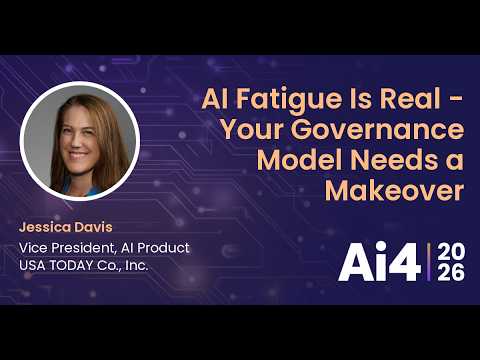
Ai4
Manual human-in-the-loop verification triggers judgment fatigue and fails against non-deterministic models, requiring automated supervising evaluations to enforce accuracy standards.
AI-assisted summary of AI Fatigue Is Real - Your Governance Model Needs a Makeover With USA TODAY Co., Inc — original source. Check the original for full context.
Source published:
Detailed notes
## Background Published on YouTube by Ai4 on August 20, 2026, this conference presentation features Jessica Davis, Vice President of AI Product at USA TODAY Co., Inc. The session addresses the growing issue of AI fatigue caused by manual review bottlenecks and outlines how organizations can modernize governance through automated AI evaluations.
## TL;DR Jessica Davis argues that enterprise AI fatigue stems from judgment exhaustion when employees are expected to manually review every non-deterministic output. To resolve this, USA TODAY Co. moved governance from 'in-the-loop' manual checks to 'on-the-loop' automated AI evaluations supported by an empirical Risk-Value Matrix. A newsroom case study demonstrates how deploying a supervising evaluator agent boosted public records generation accuracy from a stalled 75% to over 99% while shortening release cycles from months to days. Davis concludes that enterprise leaders must clearly define the distinct role of human judgment rather than forcing workers to babysit AI systems.
## Atmosphere & style The presentation carries an empathetic, candid, and highly pragmatic tone, opening with a frank acknowledgment of widespread workplace burnout and the gap between AI hype and real operational strain. Davis speaks with steady authority, grounding complex governance theory in tangible newsroom realities. The session feels like an empowering, actionable masterclass that bridges the gap between high-stakes editorial trust and modern AI product management.
## Key takeaways - [00:04](https://www.youtube.com/watch?v=bWbMQo1G_L8&t=4s) Enterprise AI fatigue stems from a fundamental disconnect where AI has transformed daily workflows, but organizational expectations and workloads have remained static. - [00:04](https://www.youtube.com/watch?v=bWbMQo1G_L8&t=4s) The breakdown in manual human-in-the-loop review is driven by judgment fatigue rather than process fatigue, as humans cannot maintain critical scrutiny across every single generation. - [04:14](https://www.youtube.com/watch?v=bWbMQo1G_L8&t=254s) Traditional enterprise governance fails with generative AI because static frameworks designed for deterministic code cannot handle non-deterministic model outputs. - [04:14](https://www.youtube.com/watch?v=bWbMQo1G_L8&t=254s) Modern governance requires moving from human-in-the-loop to automated AI evaluations that supervise models 'on-the-loop' from above. - [04:14](https://www.youtube.com/watch?v=bWbMQo1G_L8&t=254s) A major industry gap exists in non-tech sectors like news media, where leaders often lack awareness of automated evaluation frameworks despite operating in high-trust environments. - [06:58](https://www.youtube.com/watch?v=bWbMQo1G_L8&t=418s) Aligning product delivery speed with governance risk mitigation requires establishing a shared empirical core through a formal Risk-Value Matrix. - [08:23](https://www.youtube.com/watch?v=bWbMQo1G_L8&t=503s) Relying strictly on prompt engineering and manual debugging stalled public records generation accuracy at roughly 75% due to persistent hallucinations. - [08:23](https://www.youtube.com/watch?v=bWbMQo1G_L8&t=503s) Deploying a dedicated supervising AI evaluator trained on vetted samples raised FOIA generator accuracy to over 99% across the majority of US states. - [08:23](https://www.youtube.com/watch?v=bWbMQo1G_L8&t=503s) Evaluation-driven development compressed feature release cycles and compliance deliberation from months down to weeks and days. - [11:04](https://www.youtube.com/watch?v=bWbMQo1G_L8&t=664s) Future enterprise governance depends on leadership clarity to define where automated systems can be trusted so human expertise is reserved for high-impact community needs.
## Detailed walkthrough ### [00:04](https://www.youtube.com/watch?v=bWbMQo1G_L8&t=4s) AI Fatigue and the Flaws of Manual "Human-in-the-Loop" Review
Opening the session toward the end of the conference day, Jessica Davis introduces herself as the Vice President of AI Product at USA TODAY Co., which encompasses USA TODAY alongside 200 local newsrooms across the United States, making it America's largest publisher. Having founded the company's AI governance program four years earlier to safeguard responsible AI adoption across newsrooms and sales teams, Davis frequently encounters widespread burnout across the enterprise. Common complaints like "I can't keep up," "I'm tired," and "When does the time savings come?" reflect a growing sense of AI fatigue. When polling the room on whether AI delivers on its promised return on investment and time savings, the audience is evenly split between those who save time and those for whom AI has merely introduced additional work. While AI tools have reshaped workflows, organizational expectations have not adjusted, leaving workers buried under more tasks than ever.
In high-trust environments like journalism where accuracy is paramount, workers are plagued by the persistent question: "Is this AI content right?" Reviewing every single generation creates an unsustainable burden. Davis clarifies that when governance models collapse under this pressure, the failure is not "process fatigue" but "judgment fatigue." While human-in-the-loop validation is vital because models can make mistakes, relying on individuals to maintain constant vigilance and bring critical judgment to every single output is simply not humanly possible. This dynamic quietly transformed daily job responsibilities without adjusting operational expectations. Addressing this is fundamentally a leadership challenge rather than a technical one, requiring organizations to pause and evaluate whether they are working for the AI or if the AI is working for them.
- **Scale of Operation:** USA TODAY Co. operates USA TODAY and 200 local newsrooms across the US. - **Core Dilemma:** The gap between shifted workflows and static expectations is the root cause where employee fatigue lives. - **Human Burden:** Treating human review as a mandatory filter for every individual output leads directly to judgment exhaustion.
[04:14](https://www.youtube.com/watch?v=bWbMQo1G_L8&t=254s) Why Static Governance Fails and the Missing Layer of AI Evaluations
Reviewing AI outputs is difficult because teams must simultaneously evaluate multiple criteria: accuracy as table stakes, usefulness, user adoption, safety, and fairness. Traditional enterprise governance frameworks were designed for a static software world, where code behaves deterministically. Generative AI, however, is non-static and non-deterministic; submitting the exact same prompt multiple times can yield entirely different results. Consequently, static governance practices inevitably buckle under the variability of large language models. Davis argues that the solution is not to insert human judgment inside the execution loop for every output, but to establish AI evaluations as the missing layer that operates "on the loop above at the top." This approach requires technical and non-technical leaders to align upfront on what success looks like—slowing down briefly before speeding up.
While AI evaluations are standard in specialized tech environments, non-tech industries remain largely unaware of them. Davis highlights her research from the City University of New York (CUNY) Executive Program, where she spent nine months interviewing global newsroom leaders about their AI product workflows. Strikingly, very few organizations were actively experimenting with AI evaluations, and most had never even heard of the practice. This finding revealed a critical industry-wide gap: non-tech organizations that rely heavily on institutional trust need concrete frameworks to determine precisely when human judgment must intervene versus when automated evaluations can reliably supervise output quality.
```mermaid flowchart TD accTitle: Evolution of AI Governance Architecture
subgraph Legacy["Legacy Static Governance (In-the-Loop)"] A["LLM Output"] --> B["Human Reviewer"] B -->|"Exhausting Manual Check"| C["Approved Content"] end
subgraph Modern["Modern Automated Governance (On-the-Loop)"] D["Pre-defined Standards"] --> E["Supervising Evaluator Agent"] F["LLM Outputs"] --> E E -->|"Automated Eval (>99% Acc.)"| G["Validated Content"] E -.->|"Flagged Exceptions"| H["Human Escalation"] end ```
[06:58](https://www.youtube.com/watch?v=bWbMQo1G_L8&t=418s) Aligning Product, Governance, and the Risk-Value Matrix
Within an enterprise, functional tension often emerges between product teams and governance teams. Product leaders are tasked with driving business outcomes and rapid delivery, whereas governance teams focus on mitigating risk, monitoring compliance, and ensuring safety. To resolve this friction, USA TODAY Co. placed empirical data at the center of both disciplines, supported directly by AI evaluation benchmarks.
By establishing a structured Risk-Value Matrix, the organization created a formal mechanism to navigate enterprise risk thresholds. When product initiatives demonstrated exceptionally high business value paired with specific evaluation metrics, teams established a clear escalation path to executive leadership to deliberately raise the acceptable risk tolerance. Grounding these governance debates in objective evaluation data transformed the operational pace, accelerating release cycles from months of deliberation down to weeks and days.
| Organizational Function | Primary Focus | Role in AI Transformation | |:--- |:--- |:--- | | **Product Team** | Business outcomes and velocity | Drives transformation and user value delivery | | **Governance Team** | Risk mitigation and compliance | Measures safety, fairness, and adherence to standards | | **Shared Data Core** | AI evaluations and empirical metrics | Enables objective Risk-Value escalation to leadership |
[08:23](https://www.youtube.com/watch?v=bWbMQo1G_L8&t=503s) Case Study: Automating FOIA Request Generation with a Supervising Agent
Davis illustrates the transformative impact of automated evaluations through a real-world newsroom project involving the Freedom of Information Act (FOIA) and state-level public records laws. Journalists routinely rely on public records requests to hold government officials accountable, but navigating the divergent legal requirements and submission procedures across all 50 states is complex and time-consuming. Newsrooms asked the AI product team to build a system capable of batch-generating accurate, legally sound records requests that government agencies would accept.
For over nine months, the team labored through traditional prompt engineering and iterative testing, yet the model repeatedly hallucinated government email addresses and legal specifics. Whenever one bug was resolved, another emerged, leaving the tool stuck at an unacceptable 75% accuracy rate—a fatal flaw since a single inaccuracy leads agencies to outright reject requests. The breakthrough occurred when the team moved away from manual prompt tweaking and deployed a dedicated supervising agent loaded with over 100 sample public records requests to evaluate generations programmatically. This evaluation-driven debugging boosted accuracy to over 99% across the majority of US states. Furthermore, when journalists requested new features, such as formatting requests for specialized agency web forms, the team was able to ship fully evaluated updates within days rather than months.
- **Initial Roadblock:** Over 9 months of manual tuning stalled at approximately 75% accuracy due to hallucinated contact details and complex multi-state legal requirements. - **Evaluation Mechanism:** Built a supervising AI agent trained on 100+ vetted sample public records requests to systematically evaluate and score outputs. - **Outcome:** Pushed accuracy to over 99% across most states and reduced feature development cycles from months to days.
[11:04](https://www.youtube.com/watch?v=bWbMQo1G_L8&t=664s) The Leadership Mandate: Continuous Monitoring and Defining the Human Role
Looking ahead, Davis outlines the ongoing modernization of enterprise governance, emphasizing the transition from single-tool implementations to continuous, cross-enterprise monitoring. While USA TODAY Co. successfully proved the evaluation model on individual tools like the FOIA generator, scaling automated monitoring across the entire enterprise software suite remains an active priority.
Davis concludes by emphasizing that the future of governance relies on high-level leadership clarity rather than technical tooling alone. Executives must clearly define what distinct role only humans can play, allowing organizations to stop "babysitting" every output and instead deploy human judgment where readers, customers, and communities need it most.
- **Current Enterprise Goal:** Expanding automated evaluation and monitoring capabilities across all enterprise AI tools. - **Core Leadership Question:** Identifying where systems can be trusted independently so human experts can focus exclusively on high-impact editorial and community needs.
## Notable quotes > [00:04](https://www.youtube.com/watch?v=bWbMQo1G_L8&t=4s) I can't keep up — Jessica Davis
> [00:04](https://www.youtube.com/watch?v=bWbMQo1G_L8&t=4s) I'm tired — Jessica Davis
> [00:04](https://www.youtube.com/watch?v=bWbMQo1G_L8&t=4s) When does the time savings come? — Jessica Davis
> [00:04](https://www.youtube.com/watch?v=bWbMQo1G_L8&t=4s) Is this AI content right? — Jessica Davis
> [00:04](https://www.youtube.com/watch?v=bWbMQo1G_L8&t=4s) process fatigue — Jessica Davis
> [00:04](https://www.youtube.com/watch?v=bWbMQo1G_L8&t=4s) judgment fatigue — Jessica Davis
> [04:14](https://www.youtube.com/watch?v=bWbMQo1G_L8&t=254s) on the loop above at the top — Jessica Davis
> [11:04](https://www.youtube.com/watch?v=bWbMQo1G_L8&t=664s) babysitting — Jessica Davis
## Mentioned Jessica Davis, USA TODAY Co., Inc, USA TODAY, City University of New York (CUNY) Executive Program, Freedom of Information Act (FOIA)
## Video description Jessica Davis - Vice President, AI Product, USA TODAY Co., Inc.
AI fatigue is real and your governance model may be making it worse. As AI scales, manual review creates bottlenecks, not quality. I'll share how USA TODAY Co. is modernizing governance with automated AI evaluations: structured standards that scale without the burden. Leave with a practical framework for stronger accountability and less manual overhead. If the old model isn't holding, this talk is for you.
[Source](https://www.youtube.com/watch?v=bWbMQo1G_L8)