Runway Targets Factory Robotics as Video AI Cuts Hardware Training Data
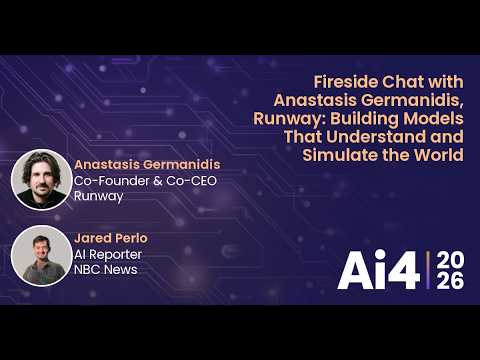
Fireside Chat with Anastasis Germanidis, Runway: Building Models That Understand and Simulate the — Ai4

Ai4

Pre-training foundation models on real-world human video solves physical data scarcity in robotics by providing a deep physical prior that adapts to new hardware in hours.

AI-assisted summary of Fireside Chat with Anastasis Germanidis, Runway: Building Models That Understand and Simulate the — original source. Check the original for full context.

Source published:

Detailed notes

## Background Published on YouTube by Ai4 on August 22, 2026, this fireside chat features Runway Co-Founder and Co-CEO Anastasis Germanidis in conversation with NBC News AI reporter Jared Perlo. The session examines how generative video models are transforming into general world models capable of understanding physics, geometry, and human behavior across robotics, autonomous systems, and interactive media like Runway Characters.

## TL;DR Anastasis Germanidis explains that Runway's work represents an expansion from creative video generation into general foundation world models that understand the physical world. By pre-training on human video, these models drastically reduce the data required to train robotic hardware, acting both as high-fidelity physical simulators and as action models for manipulation. Meanwhile, consumer applications are advancing through real-time conversational avatars and emerging world-model-driven games that combine language models for high-level narrative with video models for physics simulation. Ultimately, Germanidis positions data-driven world models as essential simulators to unlock reinforcement learning in messy physical domains where symbolic models struggle.

## Atmosphere & style The dialogue carries a thoughtful, technical, and grounded tone, contrasting the hype around artificial general intelligence with the practical engineering hurdles of physical simulation. Jared Perlo steers the exchange with incisive questions on long-horizon memory and commercial reality, while Germanidis responds with calm, measured authority rooted in Runway's multi-year research history. The discussion feels like an intimate, high-stakes technical briefing, methodically demystifying how cinematic video generation is evolving into the sensory engine for embodied robotics and real-time interactive media.

## Key takeaways - [00:04](https://www.youtube.com/watch?v=Pm8JbTjfSQw&t=4s) Runway's shift into world models is an expansion of its creative tools, driven by the discovery that scaling video generation models consistently improves their underlying grasp of real-world physics. - [03:22](https://www.youtube.com/watch?v=Pm8JbTjfSQw&t=202s) Generalization is the central bottleneck in robotics; pre-training on vast archives of human video provides a physical cold-start that bypasses physical hardware data scarcity. - [03:22](https://www.youtube.com/watch?v=Pm8JbTjfSQw&t=202s) Using a base video foundation model enables rapid hardware adaptation, requiring only one to two hours of embodiment-specific data to adapt to a new robot form factor. - [06:45](https://www.youtube.com/watch?v=Pm8JbTjfSQw&t=405s) Robotics enterprises utilize world models in two primary ways: as high-fidelity synthetic evaluation simulators and as action models directly outputting low-level hardware control policies. - [07:41](https://www.youtube.com/watch?v=Pm8JbTjfSQw&t=461s) For human interaction, real-time world models like Runway Characters enable on-the-fly conversational avatars and interactive games without relying on pre-rendered animations or branching scripts. - [09:32](https://www.youtube.com/watch?v=Pm8JbTjfSQw&t=572s) Long-horizon spatial and temporal memory is a primary research hurdle, with environmental persistence following predictable scaling laws as compute and training data increase. - [11:14](https://www.youtube.com/watch?v=Pm8JbTjfSQw&t=674s) Next-generation gaming experiences will leverage a hybrid architecture where LLMs orchestrate high-level narrative and quests while world models render the dynamic physical environment. - [13:09](https://www.youtube.com/watch?v=Pm8JbTjfSQw&t=789s) While reinforcement learning thrives in code and math due to fast sandbox environments, real-world domains require data-driven world models to serve as learned simulators. - [17:06](https://www.youtube.com/watch?v=Pm8JbTjfSQw&t=1026s) Developing general world models requires end-to-end control of foundational pre-training, as fine-tuning third-party base models introduces strict performance and architectural ceilings. - [17:06](https://www.youtube.com/watch?v=Pm8JbTjfSQw&t=1026s) Near-term physical AI deployments will center on enterprise logistics and manufacturing world action models, arriving well ahead of general-purpose household humanoid robots.

## Detailed walkthrough ### [00:04](https://www.youtube.com/watch?v=Pm8JbTjfSQw&t=4s) From Creative Video Generation to Real-World Foundation Models

Jared Perlo opens the session by highlighting the growing momentum around world models, noting that Runway—one of the pioneers in generative AI video based in New York—has had a front-row seat to the rapid evolution of modern AI. Addressing Runway's reputation in Hollywood and cinematic video generation, Perlo asks Anastasis Germanidis about the company's shift toward building world models. Germanidis clarifies that this transition is an "expansion" rather than a pivot away from their creative tools. Runway's creative suite is currently used by more than 50 million people, and the team continues to see that user base accelerate.

Germanidis contextualizes Runway's journey as an applied AI research lab operating for roughly eight years. From the early days of releasing their first text-to-video models around 2022 and 2023, the team observed a foundational trend: as video generation models are scaled up, their intrinsic understanding of real-world physics improves in a remarkably consistent manner. While video synthesis serves as an expressive engine for storytelling, independent filmmaking, and accelerating Hollywood studio workflows, the exact same underlying neural architectures serve a broader purpose. Runway's overarching objective is to build foundation models for the physical world, creating a unified architecture capable of unlocking applications across creative media, physical AI, autonomy, and life sciences.

```mermaid flowchart TD accTitle: Dual Paths of Runway's Foundation World Model subgraph CoreModel["Foundation World Model"] A["Large-Scale Real-World Video Data"] --> B["Base World Model<br/>(Physics & Geometry Understanding)"] end subgraph Creative["Human & Creative Stream"] B --> C["Creative Tool Suite<br/>(50M+ Creators & Studios)"] B --> D["Real-Time Characters & Interactive Media"] end subgraph PhysicalAI["Physical AI Stream"] B --> E["Robotics & Autonomy Simulators"] B --> F["Embodied Action Models (Pose & Motion)"] end ```

---

[03:22](https://www.youtube.com/watch?v=Pm8JbTjfSQw&t=202s) Generalization in Robotics: Learning Physical Tasks from Human Video

Turning to robotics, Perlo asks how Runway's world models interface with physical systems and help robots develop greater dexterity and generalized capability. Germanidis identifies "generalization" as the central hurdle in physical autonomy. A truly generalized autonomous system must handle unfamiliar environments, manage unexpected physical edge cases, and solve a wide variety of tasks on the fly from instructions or demonstrations, mirroring human adaptability rather than remaining locked into a narrow, pre-programmed routine.

```mermaid flowchart LR accTitle: Video-to-Robotics Training Pipeline subgraph ColdStart["Base Training"] A["Vast Human Video Archive"] --> B["Base Model Cold-Start"] end subgraph Adaptation["Hardware Post-Training"] B --> C["New Robot Embodiment"] D["1–2 Hours Hardware Data"] --> C C --> E["Generalized Task Execution"] end ```

The core obstacle in robotics research is data scarcity. Training robots purely on physical robotic telemetry is bottlenecked by the availability of physical hardware. Runway circumvents this bottleneck by leveraging the vast scale of web video capturing humans interacting with the real world and exhibiting diverse physical phenomena. Using this video corpus to cold-start model training provides a deep physical prior, drastically reducing the amount of embodied robotic data needed during post-training:

- **Data Efficiency via Pre-Training**: Pre-training on real-world human video allows models to understand task mechanics and object dynamics before ever touching a robot. - **Rapid Embodiment Adaptation**: In Runway's internal experiments, fine-tuning their base video model onto an entirely unseen robot hardware configuration required only "on the order of like an hour or two" of embodiment-specific data. - **Cross-Modality Support**: This base foundation enables seamless adaptation across diverse hardware form factors, from single-task domestic cleaners (like Roombas) to bimanual manipulation arms and full humanoid robots.

---

[06:45](https://www.youtube.com/watch?v=Pm8JbTjfSQw&t=405s) Robotics Deployments: Simulation and Action Prediction

When asked about customer adoption across the robotics landscape, Germanidis shares that Runway is actively collaborating with robotics companies across manufacturing, industrial logistics, and domestic humanoid settings. Commercial uptake centers on two primary modalities:

1. **World Models as Simulators**: Robotics teams use Runway's models to generate synthetic real-world data and run evaluation benchmarks inside a high-fidelity visual and physical simulation, avoiding the expense, wear-and-tear, and safety hazards of physical real-world testing. 2. **World Models as Action Models**: Instead of just outputting future frames, the foundation model is adapted to directly predict low-level control policies and hardware actions—such as predicting the precise kinematic trajectory and poses of bimanual robotic arms to manipulate target objects.

---

[07:41](https://www.youtube.com/watch?v=Pm8JbTjfSQw&t=461s) World Models for Humans: Real-Time Interactive Games and Runway Characters

Germanidis explains that Runway categorizes world models into two complementary application domains: world models for training autonomous machines, and world models built directly for human interaction. For human end-users, real-time world models enable interactive experiences that are impossible to build with static, hand-coded software. Rather than executing pre-scripted game logic, a user can prompt for an entire interactive game environment on the fly, seamlessly navigating and manipulating the rendered world in real time.

A primary manifestation of this capability is Runway Characters, an interactive model variant powering lifelike, real-time conversational video avatars. Powered by Runway's underlying foundation video model, the system generates real-time visual and conversational responses dynamically:

- **Interactive Education**: Facilitates face-to-face conversational learning agents; Germanidis notes that research consistently demonstrates face-to-face visual interaction substantially improves information retention. - **Enterprise Customer Support**: Delivers responsive, visually expressive virtual customer service interfaces. - **Dynamic Gaming NPCs**: Powers non-player characters in interactive gaming that converse and react visually without pre-rendered animations or branching decision trees.

---

[09:32](https://www.youtube.com/watch?v=Pm8JbTjfSQw&t=572s) The Challenge of Long-Horizon Persistence and Consistency

Perlo raises the issue of spatial and temporal persistence, asking how Runway ensures environmental continuity—such as guaranteeing that if an agent or camera does a full 360-degree pan or leaves a room, details like a specific painting on the wall or text written on a whiteboard remain intact upon return.

Germanidis acknowledges that long-horizon consistency is one of the foundational research hurdles in world modeling today, comparing it directly to how large language models (LLMs) gradually scaled their context windows and execution horizons over time. Runway evaluates models using strict spatial memory benchmarks (e.g., verifying that fine details on a whiteboard persist after an agent exits and re-enters a room). While current generative world models cannot yet sustain a fully coherent, one-hour continuous gaming session without drift, Germanidis emphasizes that consistency is improving predictably as they scale compute and refine training data.

[11:14](https://www.youtube.com/watch?v=Pm8JbTjfSQw&t=674s) Scaling Physics, Memory, and Future Gaming Experiences

Today's world models often present technical demos where an interaction lasts only about a minute, which is far from an ideal gaming session. However, these limitations are predictably improving over time. Runway evaluates models systematically across core physical domains—testing how accurately they understand solid mechanics, fluid dynamics, and optics, and verifying whether model outputs align with real-world captured footage. Performance across both physical fidelity and long-term memory or persistence adheres closely to established scaling laws: as compute and training data increase, performance gains follow predictably.

Looking ahead toward practical gameplay, the industry currently sits in an impressive demo phase that does not yet rival traditional game engines. Despite this, the first compelling consumer experiences built on top of world models are likely to arrive within the next year. A particularly promising vector of development involves coupling large language models (LLMs) with world models. In this hybrid paradigm, LLMs orchestrate high-level elements—generating narratives, character backstories, and quest scenarios—while world models generate the underlying interactive physical environment, moving beyond raw context-length hurdles toward genuinely engaging experiences.

```mermaid flowchart LR accTitle: Hybrid LLM and World Model Game Engine Architecture subgraph Narrative ["High-Level Logic (LLMs)"] A["Scenarios & Quests"] B["Character Dialogue & Lore"] end subgraph Simulation ["Environment Engine (World Models)"] C["Physics, Fluid Dynamics & Optics"] D["Interactive Real-Time Environment"] end Narrative --> Simulation ```

- **Benchmarked Capabilities**: Solid mechanics, fluid dynamics, optical properties, and temporal persistence. - **Scaling Behavior**: Physics comprehension scales predictably with added compute and training dataset volume. - **Consumer Horizon**: Production-ready, engaging consumer experiences are anticipated within roughly 12 months.

---

[13:09](https://www.youtube.com/watch?v=Pm8JbTjfSQw&t=789s) Superintelligence and Simulators Learned from Data

As frontier labs and prominent tech figures increasingly proclaim that humanity is nearing or has crossed the singularity, the discussion around superintelligence often overlooks a fundamental limitation of current LLMs. While LLMs exhibit superhuman feats in formal domains—such as disproving mathematical conjectures that stood unsolved for 70 years or writing complex code—they still stumble over basic real-world common-sense tasks. A notable example cited was Anthropic’s experiment with Claude attempting to run a simulated vending machine business, where the model made poor commercial choices and rapidly lost money due to a lack of grounded, real-world intuition.

This performance divergence stems from the availability of ground-truth execution environments. Coding and mathematics thrive under reinforcement learning (RL) because millions of virtual container environments can instantly execute code, assess failure or success, and provide direct reward signals. In contrast, messy real-world domains—such as biology and human physiology—lack neat mechanistic simulators. Running RL directly in the physical world is prohibitively expensive, slow, and non-scalable. World models solve this bottleneck by functioning as data-driven simulators trained directly on raw perceptual observations, unlocking scalable RL for physical and unpredictable domains.

- **The RL Scaling Discrepancy**: Formal domains (code/math) provide instant sandbox rewards; real-world interaction lacks pre-built simulators. - **The Core Value of World Models**: Serving as learned environmental simulators trained from observational data where hardcoded rules do not exist. - **Real-World Pitfalls**: Highlighting failure modes like Claude's vending machine experiment to illustrate gaps between symbolic reasoning and embodied intuition.

---

[17:06](https://www.youtube.com/watch?v=Pm8JbTjfSQw&t=1026s) Startups, Pre-Training Bottlenecks, and Enterprise Robotics

Despite the surge of interest and new world model startups launching constantly, many new entrants take shortcuts by fine-tuning or post-training existing public video models. Building genuine general world models requires end-to-end control across the entire stack: investing heavily in foundational pre-training as well as owning the downstream application layer. Teams that rely solely on post-training third-party base models run into severe architectural and capability ceilings.

When considering deployment milestones over the coming year, enterprise robotics stands out as the most immediate breakthrough area. World action models (WAMs)—world models tailored to predict and output robot action trajectories—are positioned to enter commercial logistics and manufacturing facilities to perform revenue-generating tasks. While household humanoid robots remain further out on the timeline, progress in physical robotics powered by world models is advancing substantially faster than standard industry forecasts suggest.

- **Architectural Imperative**: Pre-training ownership is essential; fine-tuning generic base video models introduces hard bottlenecks. - **Near-Term Industrial Focus**: World action models targeting logistics and manufacturing deployments. - **Long-Term Timelines**: Controlled enterprise and industrial automation will precede domestic, general-purpose consumer humanoid robots.

## Notable quotes > [00:04](https://www.youtube.com/watch?v=Pm8JbTjfSQw&t=4s) as video generation models are scaled up, their intrinsic understanding of real-world physics improves in a remarkably consistent manner — Anastasis Germanidis

> [00:04](https://www.youtube.com/watch?v=Pm8JbTjfSQw&t=4s) build foundation models for the physical world, creating a unified architecture capable of unlocking applications across creative media, physical AI, autonomy, and life sciences — Anastasis Germanidis

> [03:22](https://www.youtube.com/watch?v=Pm8JbTjfSQw&t=202s) on the order of like an hour or two — Anastasis Germanidis

> [03:22](https://www.youtube.com/watch?v=Pm8JbTjfSQw&t=202s) Pre-training on real-world human video allows models to understand task mechanics and object dynamics before ever touching a robot. — Anastasis Germanidis

> [07:41](https://www.youtube.com/watch?v=Pm8JbTjfSQw&t=461s) world models for training autonomous machines, and world models built directly for human interaction — Anastasis Germanidis

> [09:32](https://www.youtube.com/watch?v=Pm8JbTjfSQw&t=572s) long-horizon consistency is one of the foundational research hurdles in world modeling today — Anastasis Germanidis

> [11:14](https://www.youtube.com/watch?v=Pm8JbTjfSQw&t=674s) as compute and training data increase, performance gains follow predictably — Anastasis Germanidis

> [11:14](https://www.youtube.com/watch?v=Pm8JbTjfSQw&t=674s) LLMs orchestrate high-level elements—generating narratives, character backstories, and quest scenarios—while world models generate the underlying interactive physical environment — Anastasis Germanidis

> [13:09](https://www.youtube.com/watch?v=Pm8JbTjfSQw&t=789s) World models solve this bottleneck by functioning as data-driven simulators trained directly on raw perceptual observations, unlocking scalable RL for physical and unpredictable domains. — Anastasis Germanidis

> [17:06](https://www.youtube.com/watch?v=Pm8JbTjfSQw&t=1026s) Building genuine general world models requires end-to-end control across the entire stack: investing heavily in foundational pre-training as well as owning the downstream application layer. — Anastasis Germanidis

## Mentioned Anastasis Germanidis, Jared Perlo, Runway, NBC News, Ai4, GWM-1, Runway Characters, Anthropic, Claude, Roomba

## Video description Anastasis Germanidis - Co-Founder & Co-CEO, Runway Jared Perlo - AI Reporter, NBC News

AI video models are evolving into systems that can understand, represent and simulate the physical world. Runway's GWM-1 brings real-time understanding of physics, geometry and human behavior — already powering the largest world model deployment in production through Runway Characters. As world models mature, they open new foundations for robotics, autonomy and scientific discovery. Join Anastasis Germanidis, co-CEO of Runway, in conversation with Jared Perlo of NBC, on what it takes to build general world models and where the technology is headed next.

[Source](https://www.youtube.com/watch?v=Pm8JbTjfSQw)

中文简报

Runway瞄准工厂机器人:视频AI大幅缩减硬件训练数据 在真实世界的人类视频上预训练基础模型,通过提供可在数小时内适配新硬件的深层物理先验,解决了机器人领域的物理数据稀缺问题。 Anastasis Germanidis解释称,Runway的工作代表着从创意视频生成向理解物理世界的通用基础世界模型拓展。通过在人类视频上进行预训练,这些模型大幅减少了训练机器人硬件所需的数据,既能作为高保真物理模拟器,又能作为用于操作控制的动作模型。与此同时,消费端应用也在向前推进,包括实时对话化身,以及将用于高层叙事的语言模型与用于物理模拟的视频模型相结合的新兴世界模型驱动游戏。最终,Germanidis将数据驱动的世界模型定位为关键模拟器,用以在符号模型难以应对的复杂物理领域中释放强化学习的潜力。 Runway 将战略拓展至世界模型(World Models),团队发现扩大视频生成模型规模能持续提升其对物理规律的内在理解,从而赋能创意媒体、具身智能与机器人等领域。 (0:04) 机器人技术的核心瓶颈在于泛化能力与硬件数据稀缺;通过海量真实人类视频进行冷启动预训练,模型仅需 1 至 2 小时的具体形态数据即可快速适配全新机器人硬件。 (3:22) 企业在机器人领域主要以两种方式应用世界模型:一是充当高保真合成评估仿真器,二是作为动作模型(Action Models)直接输出底层硬件控制策略与运动轨迹。 (6:45) 在人机交互方面,Runway Characters 等实时世界模型正驱动无需预渲染动画或脚本分支的动态对话虚拟人;同时与 LLM 结合的混合架构正为下一代可交互游戏奠定基础。 (7:41) 强化学习在缺乏沙盒环境的物理现实领域难以扩展,而基于感知数据训练的世界模型能够充当可学习的仿真器,率先在工业制造与物流机器人中实现商业化落地。 (13:09)

Reading summary

Runway co-founder Anastasis Germanidis argues that scaling video generation architectures creates foundational world models that internalize physical reality. Runway positions these systems as unified engines for creative media, real-time human interaction, and physical robotics by using observational video to simulate environments and predict physical actions. Video Scaling as a Physical Foundation Model (0:04) Germanidis frames Runway’s expansion from generative video into world models as a natural scaling progression rather than a pivot, noting that the company's creative tools continue to serve over 50 million users. As video generation architectures scale up, their internal comprehension of physics—including solid mechanics, fluid dynamics, and optical properties—improves predictably alongside compute and data volume. Runway's core technical strategy is to develop a single foundation model architecture for the physical world. Rather than maintaining fragmented models for different industries, the team aims to use the same underlying physical understanding to power studio media workflows, interactive simulations, physical AI, and life sciences. Solving Robotics Data Scarcity through Video Pre-Training (3:22) Germanidis identifies generalization across unfamiliar environments and unexpected edge cases as the primary hurdle in robotics. Because physical hardware telemetry is scarce and expensive to collect, Runway circumvents the robotics data bottleneck by pre-training base models on large-scale web video of human physical interactions. This imparts an initial physical prior before models interact with physical hardware. In internal testing, adapting this base model to an unseen robotic configuration required only one to two hours of embodiment-specific data. Runway collaborates with robotics companies across manufacturing, logistics, and domestic humanoid domains across two formats: as high-fidelity visual and physical simulators for synthetic testing, and as 'world action models' that directly output kinematic trajectories and low-level control policies. Interactive Media and the Long-Horizon Persistence Hurdle (7:41) For human end-users, world models enable dynamic environments and interactive conversational avatars, such as Runway Characters, targeted at education, customer support, and non-scripted video game characters. However, Germanidis identifies spatial and temporal persistence as an ongoing technical hurdle, akin to early context window limits in large language models. Current systems cannot maintain environment coherence—such as preserving whiteboard text after leaving and re-entering a room—over hour-long sessions, leaving most technical demos capped around one minute. Germanidis anticipates that strict benchmarks and continued scaling will resolve these drift issues. He forecasts that compelling consumer experiences will emerge within roughly 12 months, specifically through hybrid pipelines where large language models manage high-level logic, lore, and quest scenarios while world models render the underlying real-time physical simulation. Data-Driven Simulation for Real-World Reinforcement Learning (13:09) Germanidis notes that while language models achieve superhuman results in formal domains like mathematics and coding, they frequently fail at grounded, real-world tasks—pointing to Anthropic's experiment where Claude quickly lost money trying to operate a simulated vending machine business. Formal domains progress rapidly under reinforcement learning because lightweight virtual containers offer instant, ground-truth reward signals, whereas messy real-world physical and biological domains lack programmable mechanistic simulators. Because direct physical trial-and-error is slow, hazardous, and expensive, world models provide value by acting as learned simulators trained purely on raw observational data. This framework allows systems to run scalable reinforcement learning for complex physical tasks without requiring pre-programmed simulation rules. Germanidis cautions that startups fine-tuning third-party base video models will encounter hard architectural limitations, arguing that genuine world models require complete ownership of foundational pre-training. Near-term commercial deployments are expected to focus on world action models performing revenue-generating logistics and manufacturing tasks, while general-purpose consumer humanoid robots remain further out.

精炼阅读摘要

Runway联合创始人Anastasis Germanidis指出,视频生成技术正在向理解与模拟现实的“世界模型”拓展;依托海量人类视频预训练获取的物理常识,该模型可充当数据驱动的现实模拟器与动作控制架构,从而解决机器人跨场景泛化难题,并为实时人机交互和物理强化学习提供关键支撑。 架构拓展:从视频生成迈向物理模型 (0:04) Runway将其研发重点从服务于影视创意的视频生成工具,拓展至通用的物理世界基础模型。Germanidis介绍,Runway作为一个运营约八年的应用AI实验室,其创意工具套件已覆盖超过5000万创作者及好莱坞制作团队。团队在研发文本到视频基础模型的过程中观察到一个确定性趋势:随着计算资源与数据规模的扩展,底层视频架构对现实世界物理特性的理解呈现出一致且可预测的提升。 基于这一发现,Runway将相同的底层神经网络视作理解几何与物理世界的通用引擎,使其不再仅用于影视镜头合成,而是作为统一的基础架构拓展至物理AI、自主系统及生命科学领域。模型通过大规模真实视频学习固体力学、流体力学与光学特性,为构建高保真度的物理环境模拟提供了底层支持。 破解机器人瓶颈:视频冷启动与动作预测 (3:22) 在物理具身与机器人领域,跨环境泛化与突发边界状况是长期以来的核心障碍,而单纯依赖机器人实体遥测数据面临严重的采集瓶颈。Runway通过互联网上记录人类与现实世界交互的海量视频对模型进行冷启动预训练,使模型在接触实体硬件前便具备对任务机制与物体动态的深层物理先验。根据Runway的内部实验,在完成真实视频冷启动后,基础模型仅需“一至两小时左右”的特定硬件配置数据,即可迅速适配到从未见过的全新机器人本体上,支持从家用单任务清洁机(如Roomba)到双臂机械手乃至人形机器人等多种形态。 在商业落地方面,Runway正与工业制造、物流和家用机器人企业展开合作,主要采取两类应用路径:一是作为高保真视听与物理模拟器,为机器人生成合成真实数据并运行虚拟基准评测,以规避实操磨损与安全风险;二是作为“世界动作模型”(WAMs),直接预测低层级控制策略与运动轨迹,例如精准规划双臂机械手抓取和操作目标物体时的位姿与运动学路径。 实时交互拓展与长时一致性挑战 (7:41) 面向人类用户,实时世界模型打破了预设脚本的静态软件形态,允许用户通过提示词即时生成可交互操控的虚拟环境。例如,Runway基于底层视频模型推出了“Runway Characters”交互变体,用于驱动高保真的实时对话式数字人化身,可应用于面对面教育交互、企业客服以及无需预先渲染或决策树分支的游戏非玩家角色(NPC)。 然而,环境的长时空间一致性与持久记忆仍是当前的核心研发挑战。例如当智能体转身360度或离开房间返回后,确保墙壁挂画或白板字迹等细节完好如初仍具难度。Germanidis坦承,目前的生成式世界模型大多停留在约1分钟的技术演示阶段,尚无法维持长达1小时且不产生漂移的连续交互游戏。他将这一瓶颈比作大型语言模型(LLM)逐步扩展上下文窗口的历史过程,并指出物理保真度与长时一致性正严格遵循算力扩展定律稳步改善。预计在未来一年内,业内有望结合LLM(主导高阶剧情、对话与任务逻辑)与世界模型(负责底层物理环境即时生成),推出首批成熟的消费级互动体验。 数据驱动模拟器:弥合符号与物理鸿沟 (13:09) 面对前沿实验室关于超级智能即将来临的论调,Germanidis指出当前LLM存在底层认知局限:模型虽在形式化符号领域表现出超人类能力(如破解存在70年的数学猜想或编写复杂程序),但在现实常识任务中仍频现脱节。他援引Anthropic的一项实验指出,Claude在模拟运营自动售货机业务时,因缺乏真实的具身常识直觉而迅速亏损。 这种分歧的根本原因在于环境反馈机制的不同。编程与数学能够在毫秒级的虚拟沙盒容器中进行千万次并发执行,通过确定的胜负结果为强化学习(RL)提供即时奖励信号;然而物理和生物现实环境缺乏明确的代码化规则,直接在真实物理世界中进行强化学习成本极高且极度缓慢。世界模型的关键价值在于能够从纯感知观测数据中学习构建环境模拟器,在缺乏预制规则的物理与非结构化领域中构建可微分的沙盒,从而为物理AI的大规模强化学习训练打开通道。 Germanidis总结强调,构建通用的世界模型必须全栈掌控从底层预训练到应用层的完整链条,单纯微调第三方基础视频模型会面临不可逾越的架构天花板。在落地时间线上,能够直接预测动作轨迹的世界动作模型将在未来一年内率先进入制造与仓储物流环境执行创收任务;尽管家庭通用人形机器人的落地尚需更长时间,但由世界模型驱动的工业自动化进展已明显快于行业普遍预期。

Detailed notes — zh

## Background 该内容由频道“Ai4”于 2026 年 8 月 22 日发布在 YouTube 平台上。视频记录了 NBC 科技记者 Jared Perlo 与 Runway 联合创始人兼联席 CEO Anastasis Germanidis 展开的炉边对谈,重点探讨了 AI 视频模型如何演变为能够理解、表征并模拟真实物理世界的通用世界模型(GWM-1),以及该技术在实时交互数字人、机器人具身智能与未来科学探索中的核心价值与应用前景。 ## TL;DR 对谈系统梳理了 Runway 从顶尖 AI 视频生成工具向通用物理世界模型演进的战略逻辑与技术突破。Anastasis 阐述了如何利用海量人类视频数据实现机器人动作策略的“冷启动”与极速硬件跨模态适配,并解析了世界模型作为“环境模拟沙盒”与“直接动作预测模型(WAMs)”的双重落地形态。同时,对谈探讨了 Runway Characters 实时数字人交互、时空一致性白板测试评测基准,以及世界模型作为数据驱动型模拟器,补足 LLM 物理常识短板以通向超级智能的关键路径。 ## Atmosphere & style 整场炉边对谈节奏明快、专业严谨且富有产业纵深感。记者 Jared Perlo 提问犀利且直击痛点,聚焦行业炒作、长时程持久性等技术瓶颈,而 Anastasis Germanidis 的回应则沉稳理性、直面局限,以详实的实验规律与工程洞察打破概念泡沫。交流在务实的工程拆解与宏大的具身智能未来愿景之间自然流转,给观众带来兼具理论深度与战略清醒的高浓度思想碰撞感。 ## Key takeaways - [00:04](https://www.youtube.com/watch?v=Pm8JbTjfSQw&t=4s) Runway 从视频生成工具向通用世界模型的演进并非业务转型,而是能力扩张;模型规模扩大使底层网络涌现出对物理规律的理解,终极目标是构建通用的物理现实基础模型。 - [03:22](https://www.youtube.com/watch?v=Pm8JbTjfSQw&t=202s) 针对机器人真机数据匮乏与泛化瓶颈,Runway 采用海量人类物理交互视频作为冷启动数据,使基础模型仅需 1 至 2 小时微调即可极速适配全新机器人硬件形态。 - [06:45](https://www.youtube.com/watch?v=Pm8JbTjfSQw&t=405s) 工业界采纳世界模型主要分为两大路径:一是作为高逼真度环境模拟器(Simulators)进行策略仿真与评测,二是作为动作模型(Action Models)直接输出控制信号。 - [07:41](https://www.youtube.com/watch?v=Pm8JbTjfSQw&t=461s) 实时世界模型正在重塑人类交互软件,衍生产品 Runway Characters 实现了高逼真、零延迟的实时面对面互动,重点落地于沉浸式教育、智能客服与动态游戏 NPC。 - [09:32](https://www.youtube.com/watch?v=Pm8JbTjfSQw&t=572s) 长期时空一致性与持久性(Persistence & Consistency)是世界模型的核心瓶颈,Runway 通过“白板测试”等基准持续追踪与优化模型在长时程视角切换下的拓扑记忆能力。 - [11:14](https://www.youtube.com/watch?v=Pm8JbTjfSQw&t=674s) 固体力学、流体力学与光学等物理规律严格遵循 Scaling Law;未来世界模型与大语言模型将深度协同,由 LLM 负责逻辑剧情规划,世界模型负责实时物理环境渲染与交互。 - [13:09](https://www.youtube.com/watch?v=Pm8JbTjfSQw&t=789s) 迈向超级智能的瓶颈在于现实世界缺乏机制模拟器,导致强化学习无法安全在线探索;直接从真实数据中训练的世界模型成为数据驱动型模拟器,是现实世界强化学习扩展的基石。 - [17:06](https://www.youtube.com/watch?v=Pm8JbTjfSQw&t=1026s) 单纯依赖开源视频模型进行后训练微调存在无法突破的认知上限,世界模型的真正技术壁垒在于端到端掌控底层的大规模预训练基础模型。 - [18:32](https://www.youtube.com/watch?v=Pm8JbTjfSQw&t=1112s) 世界模型的下一阶段关键演进是世界动作模型(World Action Models),未来一年内将率先在仓储物流与智能制造等企业级场景中实现规模化商业落地。 ## Detailed walkthrough ### [00:04](https://www.youtube.com/watch?v=Pm8JbTjfSQw&t=4s) 从视频生成到通用世界模型:Runway 的战略演进 对谈由 NBC 科技记者 Jared Perlo 开场,他提到当天上午的主题演讲刚刚围绕“世界模型”(World Models)展开了高层次讨论,而 Runway 联合创始人兼联席 CEO Anastasis Germanidis 也是嘉宾之一。作为发源于纽约、深耕行业约 8 年的应用 AI 研究实验室,Runway 早已凭借其突破性的 AI 视频生成工具闻名于好莱坞及影视创意圈,许多观众甚至早已在院线电影中体验过由其技术驱动的视觉效果。当被问及几年前宣布向世界模型迈进是出于何种“转型”(Pivot)考量时,Anastasis 纠正并强调这并非业务调头,而是一次自然的“能力扩张”。 Anastasis 指出,Runway 现有的创意工具套件已拥有超过 5000 万用户,且用户规模与使用频次仍在迅猛攀升。早在 2022 至 2023 年发布首个文本生成视频(Text-to-Video)模型时,团队就发现了一个关键底层规律:随着视频生成模型参数规模的扩大与迭代训练,模型对真实世界物理规律(Physics)的理解呈现出极其稳定且持续的进化。这表明底层模型的潜能远不止于创意表达、辅助电影创作者或帮制片厂加速工作流,它同样能够赋能自主系统(Autonomy)、生命科学以及所有依赖与物理现实交互并从中学习的领域。Runway 的终极目标正是“构建面向真实世界的最强基础模型”(build the best foundation models for the real world),创意生成与具身智能不过是这一统一底层架构在不同维度的应用落地。 ```mermaid flowchart TD accTitle: Runway 世界模型技术演进与应用分发架构 subgraph Core["底层基础世界模型"] A["大规模真实世界视频数据<br>+ 物理交互现象"] --> B["通用基础世界模型<br>(General World Model)"] end subgraph Tracks["两大应用生态与落地场景"] B --> C["物理与自主系统 (Physical AI)"] B --> D["人类交互体验 (Interactive for Humans)"] C --> C1["机器人动作策略 (Action Models)"] C --> C2["高逼真物理模拟器 (Simulators)"] D --> D1["实时提示词生成游戏 / 环境交互"] D --> D2["Runway Characters 实时虚拟人"] end ``` - **发展历程与体量**:Runway 创立约 8 年,目前创意工具套件用户量已突破 5000 万,持续保持高速增长。 - **物理认知涌现**:在 2022—2023 年推出首个文生视频模型期间,研发团队便观察到模型规模扩展(Scaling)与物理理解能力提升之间存在强正相关。 - **核心定位**:Runway 是一家应用 AI 研究实验室,致力于通过统一的基础架构同时支撑创意生成与物理现实 AI(Physical AI)。 --- ### [03:22](https://www.youtube.com/watch?v=Pm8JbTjfSQw&t=202s) 破解机器人泛化瓶颈:视频数据冷启动与快速硬件适配 谈及世界模型与机器人(Robotics)领域的交集,Anastasis 直指当前具身智能的核心痛点在于“泛化能力”(Generalization)。传统机器人往往被局限在特定硬件、特定环境与预设任务中,无法像人类那样仅凭简单指令或少量演示就能临场应对突发意外与复杂多变的现实环境。如果完全依赖机器人自身硬件采集真机数据进行训练,数据规模就会被物理硬件的可用数量死死卡住,导致极其高昂的采集成本与漫长的迭代周期。 Runway 提出的破局方案是以海量人类第一/第三方视角视频作为训练的“冷启动”(Cold Start)基石。人类已经记录了海量展示各种物理规律、复杂动作与工具交互的高清视频。模型通过这些视频预先掌握对物理环境的常识理解后,再利用少量的机器人专业数据进行微调(Fine-tuning)或后训练(Post-training),即可在显著降低机器人数据需求的同时达到同等甚至更高的任务表现。这种跨硬件形态的泛化能力极为惊人:在实验中,将训练好的底座模型微调适配到从未见过的全新机器人硬件构型上,通常仅需“一到两个小时左右”(on the order of like an hour or two)的新硬件数据即可完成迁移,彻底打破了为扫地机器人(Roomba)、双臂机械手或人形机器人各自分立训练基础模型的固有范式。 - **泛化定义**:系统能像人类一样即时理解新演示并解决新任务,从容应对未曾预见的环境变化与物理扰动。 - **数据冷启动优势**:利用现成的人类行为与物理视频打破硬件数据采集瓶颈,大幅削减后训练所需的真机数据量。 - **极速硬件适配**:基础模型适配全新机器人硬件形态仅需约 1 至 2 小时的专用数据微调,展现出极强的跨模态适应力。 --- ### [06:45](https://www.youtube.com/watch?v=Pm8JbTjfSQw&t=405s) 商业落地双轨制:从物理模拟器到动作预测模型 在谈到产业界的实际采纳情况时,Anastasis 透露 Runway 正与涵盖智能制造、仓储物流、家庭服务以及人形机器人等多个维度的机器人厂商展开深度合作。工业与商业客户对 Runway 世界模型的使用主要划分为两大核心路径:其一是作为高逼真度的“环境模拟器”(Simulators),其二是作为直接生成控制信号的“动作模型”(Action Models)。 作为模拟器时,世界模型能够在虚拟空间中生成海量拟真交互数据,使研发团队能够在软件闭环中高频评估机器人在复杂物理场景中的策略表现,免去了在物理真机上反复试错可能带来的设备损坏风险;而作为动作模型时,底座模型可以直接输出控制策略,例如在双臂协同操作(Bimanual manipulation)场景中,模型能够根据视觉输入直接预测并规划机械臂各关节在下一时刻的空间位姿(Pose)与运动轨迹。这种“既能做推演沙盒,又能直接操纵机体”的双重属性,赋予了世界模型极高的工业通用价值。 - **两大工业用途**: - **模拟与评测沙盒**:生成合成数据并在仿真环境中完成机器人策略的安全验证,替代昂贵的真机物理实测。 - **动作预测输出**:直接输入场景视觉,预测多自由度机械臂或人形机器人的具体运动姿态与执行动作。 - **覆盖领域**:横跨智能制造装配、仓储物流分拣、家庭服务场景及通用人形机器人任务。 --- ### [07:41](https://www.youtube.com/watch?v=Pm8JbTjfSQw&t=461s) 实时世界模型与 Runway Characters:重塑人类交互界面 除了赋能无人物理系统的自主决策,世界模型的另一大核心受众是人类本身。Anastasis 阐述了世界模型为人类交互软件带来的颠覆性体验:传统软件依赖硬编码逻辑,而基于世界模型的实时生成系统能够实现“完全按需提示生成”(Prompt for it)的游戏与交互环境,用户可以在动态生成的物理空间中实时漫游并施加交互动作。 在这一方向上,Runway 推出了代表性产品——“Runway Characters”,这是其基础视频世界模型驱动的一个实时虚拟人衍生版本。它代表了目前业内逼真度最高的实时视频数字人交互水平,能够与用户展开零延迟的面部与语音实时互动。该技术在教育培训(已有大量认知研究表明面对面互动能极大提升学习记忆留存率)、智能客户支持以及游戏非玩家角色(NPC)构建中展现出巨大的实用价值,真正实现了在交互过程中实时、动态地生成高保真视觉与行为信息。 - **双受众模型**:世界模型明确服务于两大场景——用于训练机器人/自主系统的“机器向模型”,以及用于驱动实时沉浸体验的“人类向模型”。 - **Runway Characters 特性**:基于底层视频基础模型构建的高保真、超逼真实时视频虚拟人,支持流畅自然的面对面即时交互。 - **核心落地场景**: - **沉浸式教育**:利用面部交互提升知识吸收与长效记忆保留(Retention)。 - **客户服务**:提供具备丰富微表情与情感共鸣的拟人化客服代理。 - **动态游戏 NPC**:摆脱预录脚本与死板分支树,实时响应玩家行为。 --- ### [09:32](https://www.youtube.com/watch?v=Pm8JbTjfSQw&t=572s) 时空一致性攻坚:从白板测试到长时程持久世界 对谈深入到了世界模型研发中最具挑战性的理论与工程瓶颈——“长期一致性与持久性”(Persistence & Consistency)。主持人 Jared 举例说明:如果用户在虚拟世界中操控角色做了一个 360 度转身,必须确保墙上的挂画在视野转回时依然完好无损地留在原位。Anastasis 赞同这是构建世界模型的核心关隘,并将其类比为大语言模型(LLM)在发展过程中上下文窗口(Context Window)与长时程任务规划能力的演进。 Runway 团队建立了一套严格的评测基准来追踪模型在长时程下的物理保真度,例如经典的“白板测试”(Whiteboard Test):在房间内的白板上写入特定文字或图表,镜头移出房间完成一系列长镜头调度后再重新切回,评测模型能否精确保留白板上的每一个字符细节与空间拓扑关系。尽管 Anastasis 坦承当前行业技术尚未达到能够稳定支撑“一小时以上完全连贯、绝无漂移的沉浸式游戏持久体验”的水平,但随着训练算力的大规模扩展(Scaling Compute)以及训练数据质量的持续提纯,模型在跨长时段维持几何拓扑、材质光影与物体持久存在性方面的指标正处于稳健的上升通道中。 - **核心评测标准(白板测试)**:通过让相机视角离开特定信息载体(如写有文字的白板)后再返回,量化评估模型对细节文字与物体拓扑的记忆与复原能力。 - **技术现状与展望**:尽管长达 1 小时级别的完全持久性实时世界仍在攻坚阶段,但算力扩展规律(Scaling Law)与数据优化已被验证能持续拉长时空一致性的时间窗口。 ### [11:14](https://www.youtube.com/watch?v=Pm8JbTjfSQw&t=674s) 物理规律的 Scaling Law 与游戏体验演进:世界模型与 LLM 的协同 当前的交互式世界模型大多只能维持大约一分钟的体验,这显然无法支撑起完整的游戏玩法,但这种局限性正在被可预测地打破。Runway 建立了大量的专项评估基准,系统性地测试模型在固体力学(solid mechanics)、流体力学(fluid dynamics)以及光学(optics)等物理规律上的理解深度,并将其与真实世界拍摄的视频素材进行严格比对。研究表明,世界模型完全遵循 Scaling Law(缩放定律):随着计算量与高质量训练数据规模的提升,模型在物理规律模拟、空间持久性(persistence)以及长期记忆方面的表现都会呈现出确定性的跃升。 面对主持人关于“未来数月或一年内,玩家能否体验到长达 5 到 10 分钟实时生成游戏”的追问,行业目前仍处于展示技术潜力的“Demo 阶段”,生成的质量与控制度尚未达到传统游戏引擎的水准。然而,突破正在加速到来,预计未来一年内就会出现第一批基于世界模型打造的高品质消费级互动体验。更具潜力的路径在于将世界模型与大型语言模型(LLM)进行深度结合:LLM 负责动态生成剧情脉络、剧本分支、角色设定与世界观背景,而世界模型则负责实时构建沉浸式的物理环境并响应用户的底层交互。 ```mermaid flowchart TD accTitle: LLM与世界模型协同驱动交互体验架构 subgraph NarrativeLayer["叙事与认知层 (LLM)"] A["生成剧情故事与任务分支"] --> B["驱动NPC角色设定与世界观背景"] end subgraph EnvironmentLayer["物理与环境仿真层 (World Model)"] C["实时物理环境渲染"] --> D["交互响应与空间一致性维护"] end subgraph UserExperience["玩家终端"] E["实时生成的高沉浸互动游戏"] end NarrativeLayer --> EnvironmentLayer EnvironmentLayer --> UserExperience ``` - **物理评测维度**:涵盖固体力学、流体力学与光学渲染,与真实实拍画面进行逼真度对齐。 - **扩展性验证**:算力与数据的规模扩展能够线性提升世界模型的物理一致性与长期记忆保留能力。 - **技术协同分工**:LLM 承担“大脑”职能(编剧与逻辑规划),世界模型承担“引擎”职能(物理生成与空间渲染)。 --- ### [13:09](https://www.youtube.com/watch?v=Pm8JbTjfSQw&t=789s) 迈向超级智能的瓶颈:模拟器缺失与基于世界模型的强化学习 近期硅谷前沿实验室频繁探讨“超级智能”(Superintelligence)与“奇点”(Singularity)的到来,甚至有科技领袖宣称人类已经置身于奇点之中。然而,当前的前沿 AI 模型呈现出一种极为奇特的割裂与矛盾:一方面,LLM 在编程、高级数学等抽象任务上展现出“超人类”的惊人水平,甚至能够证伪困扰数学界 70 年未解的数学猜想;另一方面,一旦面对需要与真实物理世界交互的基础任务,模型往往会以极其低级、令人惊讶的方式溃败。 这种割裂的典型案例是 Anthropic 曾针对 Claude 进行的一项商业实验——让模型尝试运营自动售货机业务(vending machine business),结果模型迅速做出了一系列糟糕的商业决策并亏损殆尽。模型之所以缺乏对现实世界的直觉与常识,其底层根源在于“模拟器”的存在与否:在代码与数学领域,人类可以轻松构建数百万个沙盒容器(containers)来执行代码并即时验证输出,从而获得清晰无歧义的奖励信号,实现强化学习(RL)的大规模扩展;但在现实世界、生物系统(如缺乏人体精密机械机制模型)或复杂商业环境中,人类根本无法构建出完美的机制模拟器,直接在现实世界中进行在线强化学习(Online RL)成本高昂且极度危险。因此,直接从海量现实观测数据中训练出的世界模型,本质上就是通往复杂物理环境的“数据驱动型模拟器”,它是将强化学习扩展到现实世界、进而通向通用超级智能的核心基石。 - **LLM 的现实短板**:擅长形式逻辑与符号推理,但缺乏物理世界常识与现实直觉(如自动售货机运营实验的失败)。 - **强化学习的依赖条件**:在可构建完美模拟器的沙盒环境(如代码编译、棋类)中 RL 迭代极快,而在不可精确建模的现实领域则面临瓶颈。 - **世界模型的核心价值**:绕过人工手写规则模拟器的局限,直接从真实数据中习得环境运作法则,为现实任务提供可扩展的 RL 训练场。 --- ### [17:06](https://www.youtube.com/watch?v=Pm8JbTjfSQw&t=1026s) 行业炒作与技术壁垒:为何掌控底层预训练模型至关重要 针对当前世界模型领域初创企业层出不穷、估值飙升的“虚火”与炒作现象,世界模型作为长期研究范式必然会持久存在,但行业中很多新玩家严重低估了“底层预训练(Pre-training)”与“全栈模型掌控力”的技术壁垒。目前市场上许多新成立的初创公司,其做法仅仅是获取现有的开源视频生成模型,然后针对特定世界模型应用场景进行微调或后训练(Post-training)。 这种“拿来主义”的套路存在致命缺陷:后训练的能力上限完全被底层基础模型(Foundation Model)的原始架构和特征表达所锁死。真正的 AI 前沿实验室必须具备端到端(End-to-End)的技术研发能力,既要亲自从零开始做大规模预训练、构建底层的物理世界基座模型,又要深度掌控最上层的商业化应用落地场景,二者缺一不可。那些缺乏底层预训练能力、仅依赖微调的团队,将在技术演进中遭遇被严重低估的模型性能瓶颈。 - **行业格局现状**:每隔两周就有新的世界模型初创公司涌现,概念热度与估值居高不下。 - **关键技术瓶颈**:微调现有视频模型无法突破基础模型的物理认知上限。 - **核心竞争力构成**:全栈掌控底层预训练基础模型研发,并打通垂直应用场景的部署闭环。 --- ### [18:32](https://www.youtube.com/watch?v=Pm8JbTjfSQw&t=1112s) 未来展望:世界动作模型(World Action Models)与具身智能落地 尽管将前沿 AI 技术部署到真实世界的时间节点向来存在较大的不确定性,但世界模型的下一阶段关键跨越已经十分明朗——即“世界动作模型”(World Action Models,WAMs)。这类模型专门针对机器人动作预测进行了适配与进化,能够直接理解环境并规划、预测机器人的物理执行轨迹。 在未来一年左右的时间里,世界动作模型将率先在物流仓储(logistics)和工业制造(manufacturing)等企业级场景中实现实质性商业落地,承担起能够直接产生商业收入的实用任务。尽管像人形机器人(Humanoid robots)走进千家万户这种消费级场景还需要更长时间的打磨,但受益于世界模型性能的指数级迭代,整体机器人与具身智能技术的演进速度将会“远超大多数人的预期”。 - **核心演进方向**:从纯粹的环境模拟进化为能够预测机器人动作的“世界动作模型”(WAMs)。 - **首批落地领域**:物流与智能制造等封闭/半封闭的企业级工业场景,优先完成商业化变现。 - **具身智能预期**:家用人形机器人仍需时日,但世界模型对泛机器人行业的赋能节奏正在全面提速。 ## Notable quotes > [00:04](https://www.youtube.com/watch?v=Pm8JbTjfSQw&t=4s) 构建面向真实世界的最强基础模型 — Anastasis Germanidis > [03:22](https://www.youtube.com/watch?v=Pm8JbTjfSQw&t=202s) 在显著降低机器人数据需求的同时达到同等甚至更高的任务表现 — Anastasis Germanidis > [03:22](https://www.youtube.com/watch?v=Pm8JbTjfSQw&t=202s) 通常仅需一到两个小时左右的新硬件数据即可完成迁移 — Anastasis Germanidis > [06:45](https://www.youtube.com/watch?v=Pm8JbTjfSQw&t=405s) 既能做推演沙盒,又能直接操纵机体 — Anastasis Germanidis > [07:41](https://www.youtube.com/watch?v=Pm8JbTjfSQw&t=461s) 完全按需提示生成 — Anastasis Germanidis > [11:14](https://www.youtube.com/watch?v=Pm8JbTjfSQw&t=674s) 世界模型完全遵循 Scaling Law(缩放定律):随着计算量与高质量训练数据规模的提升,模型在物理规律模拟、空间持久性以及长期记忆方面的表现都会呈现出确定性的跃升 — Anastasis Germanidis > [11:14](https://www.youtube.com/watch?v=Pm8JbTjfSQw&t=674s) LLM 负责动态生成剧情脉络、剧本分支、角色设定与世界观背景,而世界模型则负责实时构建沉浸式的物理环境并响应用户的底层交互 — Anastasis Germanidis > [13:09](https://www.youtube.com/watch?v=Pm8JbTjfSQw&t=789s) 直接从海量现实观测数据中训练出的世界模型,本质上就是通往复杂物理环境的数据驱动型模拟器,它是将强化学习扩展到现实世界、进而通向通用超级智能的核心基石 — Anastasis Germanidis > [17:06](https://www.youtube.com/watch?v=Pm8JbTjfSQw&t=1026s) 后训练的能力上限完全被底层基础模型的原始架构和特征表达所锁死 — Anastasis Germanidis > [18:32](https://www.youtube.com/watch?v=Pm8JbTjfSQw&t=1112s) 整体机器人与具身智能技术的演进速度将会远超大多数人的预期 — Anastasis Germanidis ## Mentioned Anastasis Germanidis, Jared Perlo, Runway, NBC News, GWM-1, Runway Characters, Anthropic, Claude, Roomba ## Video description Anastasis Germanidis - Co-Founder & Co-CEO, Runway Jared Perlo - AI Reporter, NBC News AI video models are evolving into systems that can understand, represent and simulate the physical world. Runway's GWM-1 brings real-time understanding of physics, geometry and human behavior — already powering the largest world model deployment in production through Runway Characters. As world models mature, they open new foundations for robotics, autonomy and scientific discovery. Join Anastasis Germanidis, co-CEO of Runway, in conversation with Jared Perlo of NBC, on what it takes to build general world models and where the technology is headed next. [Source](https://www.youtube.com/watch?v=Pm8JbTjfSQw)

Source quotes

[0:04] Anastasis Germanidis: 构建面向真实世界的最强基础模型 [3:22] Anastasis Germanidis: 在显著降低机器人数据需求的同时达到同等甚至更高的任务表现 [3:22] Anastasis Germanidis: 通常仅需一到两个小时左右的新硬件数据即可完成迁移 [6:45] Anastasis Germanidis: 既能做推演沙盒,又能直接操纵机体 [7:41] Anastasis Germanidis: 完全按需提示生成 [11:14] Anastasis Germanidis: 世界模型完全遵循 Scaling Law(缩放定律):随着计算量与高质量训练数据规模的提升,模型在物理规律模拟、空间持久性以及长期记忆方面的表现都会呈现出确定性的跃升 [11:14] Anastasis Germanidis: LLM 负责动态生成剧情脉络、剧本分支、角色设定与世界观背景,而世界模型则负责实时构建沉浸式的物理环境并响应用户的底层交互 [13:09] Anastasis Germanidis: 直接从海量现实观测数据中训练出的世界模型,本质上就是通往复杂物理环境的数据驱动型模拟器,它是将强化学习扩展到现实世界、进而通向通用超级智能的核心基石 [17:06] Anastasis Germanidis: 后训练的能力上限完全被底层基础模型的原始架构和特征表达所锁死 [18:32] Anastasis Germanidis: 整体机器人与具身智能技术的演进速度将会远超大多数人的预期

Source quotes

[0:04] Anastasis Germanidis: as video generation models are scaled up, their intrinsic understanding of real-world physics improves in a remarkably consistent manner [0:04] Anastasis Germanidis: build foundation models for the physical world, creating a unified architecture capable of unlocking applications across creative media, physical AI, autonomy, and life sciences [3:22] Anastasis Germanidis: on the order of like an hour or two [3:22] Anastasis Germanidis: Pre-training on real-world human video allows models to understand task mechanics and object dynamics before ever touching a robot. [7:41] Anastasis Germanidis: world models for training autonomous machines, and world models built directly for human interaction [9:32] Anastasis Germanidis: long-horizon consistency is one of the foundational research hurdles in world modeling today [11:14] Anastasis Germanidis: as compute and training data increase, performance gains follow predictably [11:14] Anastasis Germanidis: LLMs orchestrate high-level elements—generating narratives, character backstories, and quest scenarios—while world models generate the underlying interactive physical environment [13:09] Anastasis Germanidis: World models solve this bottleneck by functioning as data-driven simulators trained directly on raw perceptual observations, unlocking scalable RL for physical and unpredictable domains. [17:06] Anastasis Germanidis: Building genuine general world models requires end-to-end control across the entire stack: investing heavily in foundational pre-training as well as owning the downstream application layer.

Original transcript

[0:04] We are keeping the world model love going.  We started the keynote this morning. First [0:09] keynote was a panel on Anastasis was also on  that where we kind of approached world models [0:14] from a very high level. And I'm really excited  about this opportunity to learn more about what [0:19] Runway is doing. So Runway is one of the leading  AI video generation and now world model companies [0:26] based in New York growing very quickly have  been around for a couple of years. So I think [0:31] it's very exciting Anastasis has had a front  row seat to the recent waves of AI development. [0:37] So I think maybe just to to get started if people  in the room do know Runway potentially more from [0:44] your video generation work or you know your work  with Hollywood. I'm sure many people in this room [0:47] have probably seen a movie created with Runway's  technology. I'm curious if you could just start [0:52] off by addressing a little bit of your embrace  of world models. I think maybe you announced [0:56] that shift or that direction a couple of years  ago, but what made you pivot into that and then [1:01] what are you working on today with your foundation  model? Yes, so I would say I would call it more [1:07] of an expansion of the the work that we're  doing on the pivot like the creative tools [1:12] that we have a a large kind of creative tool suite  used by more than 50 million people at the moment. [1:19] That's still very actively growing and we're  seeing a lot of increasing usage for that. [1:23] Just to give some context Runway's an applied  AI research lab. We've been around for about 8 [1:29] years now and for most of the time we've been  focused on scaling video generation models [1:35] and something that we realized very early on is  that as we scale those models and as we train the [1:40] next generation of them, they improve in their  ability to understand physics very consistently. [1:46] And so as we saw early signs of that back  in 2022 or 2023 when we released our first [1:52] text to video model, we realized that you know,  there's obviously immense opportunity to use [1:58] video generation models to for creative  expression to tell new kinds of stories [2:03] to empower more filmmakers or to work  with studios to make their workflows [2:08] to to to to basically make their workflows faster.  There is also a big opportunity in using the same [2:14] underlying models to accelerate progress in  autonomy in life sciences in domains that have to [2:22] do with the interacting and learning directly from  observations of the real world. And so ultimately [2:29] our goal is to build the best foundation models  for the real world and there is and if we do so [2:36] then there is all those applications that that are  unlocked by it. So whether that's creativity or [2:42] or physical AI, those are just different ways in  which you can use the same underlying models and [2:47] same underlying architectures. Awesome. Thank you.  And I know the last session in this room was about [2:52] the business case for world models. It's exciting  to see world models kind of gain more interest and [2:57] more currency, more sessions at this conference.  But maybe if we can dive in a little bit deeper, [3:02] Runway's been working on robotics applications  in particular or thinking about how robotics [3:07] could gain dexterity or you know,  just advance in general terms of [3:13] capabilities by using your world model.  So I'm curious if you could explain a [3:17] little bit more about how your world models  interface with the robotics world these days. [3:22] So the main challenge we're trying to solve with  [snorts] the video models and the the extension [3:28] of of them in world models is this idea of  generalization. So generalization means that [3:35] a robot or an autonomous system can handle like  all the unexpected scenarios and all the different [3:41] environments where it might be put into and can  solve a wide diversity of tasks similar to how [3:47] a human would. It's not just specialized on on  task, particular environment, particular setting, [3:53] but it's able to handle kind of the complexity of  the real world and and and and kind of basically [4:00] uh solve new tasks on the fly just like  a human would learn on the fly by just [4:04] either by instruction or by demonstration. Um and  the biggest problem with actually training models [4:11] to do that uh is like if you're only focusing on  using robotics data to train a model to to power [4:18] your robot, it's very difficult to scale the data  collection. You're basically bounded by the amount [4:23] of hardware you have available. Um but if you  can leverage all the kind of the the vast scale [4:30] of kind of video that uh kind of human has already  captured uh of humans performing different tasks [4:37] in the world of many kinds of scenarios of physics  of physical phenomena and leverage that to as [4:43] like a to to cold start uh a model training that  basically uh then gets fine-tuned or post-trained [4:50] specifically in robotics, then you're able you  require much less robotics data to uh get the same [4:57] level of performance. Uh and so we truly believe  that video models are the best the best starting [5:02] point to building uh robotics models because  there is just so much similarity between learning [5:09] directly from humans and how they perform tasks  and how a robot would perform the same tasks. [5:15] So, on the robotics note, uh there are many  different modalities of robots. You know, [5:20] you could have like a Roomba, you could have a  lawn care robot, you could have a humanoid robot. [5:24] How are you and Runway thinking about optimizing  your models or thinking about how your models [5:29] could be used for training or um being applied  to those different modalities of robots? [5:36] It goes back to this idea of generalization.  Um if you if you have a powerful underlying [5:41] foundational model and base model, you can  fine-tune it with very limited amount of data to [5:47] um for a new um robotic embodiment. So we've we've  done experiments where we take our base model [5:55] that's trained on real world video plus some  robotics data and then we we then fine-tune it [6:01] on a new robot hardware type that it has not  seen before and we see that it only requires [6:07] kind of on the order of like an hour or two  to actually adapt to this new robot hardware. [6:13] And so that's that's kind of the the the benefit  of using this this powerful base model is that you [6:21] can then adapt to a new modality to a new hardware  with much less amount of data than you otherwise [6:27] would if you had to train from scratch on the  Roomba or or the bimanual setting or the humanoid [6:35] kind of hardware. Got you. Are you  seeing uptake from various customers on [6:41] I don't using your world model because of its  adaptability there? What's the uptake like? [6:45] Yeah, so there is a few different use  cases that we're seeing. We're working with [6:50] robot kind of robotics companies across  manufacturing, logistics, also kind of household, [6:59] humanoid tasks and we're seeing that our models  are useful both as simulators essentially helping [7:06] generate data and helping those companies evaluate  how well the robot models perform inside the [7:11] simulation of the world model instead of doing  that in the real world. But we're also seeing [7:17] our models being used as what's called action  models. So that means that you're you're able [7:23] to take our foundation model and then you're  able to make it predict actions. So it predicts [7:27] the pose of the if you have a manual arm setting,  you can predict like how should each of those arm [7:35] arms move to to perform a specific action. So  it's it's quite versatile in that way. Awesome. So [7:41] maybe speaking of versatility, we can pivot to uh  the world models current approach with characters. [7:47] So, I was very interested and intrigued to learn  about Runway's characters. Maybe if you could [7:51] just provide a brief overview of what that means,  how that fits into Runway's world model approach. [7:58] So, generally the way we think about world  models is it has two different audiences. It has [8:02] world models for humans and world models for  training kind of robotic or autonomous systems. [8:07] World models for humans, what they enable is  new kinds of interactive experiences that are [8:12] very difficult to create with traditional  software. So, if you want to have a game that's [8:18] generated on the fly, that where you can navigate  an environment and take actions in with it, [8:22] that's basically you can prompt for  it. You can prompt for any kind of [8:26] kind of game. You can do that with with with a  real-time world model. Similarly, we we have this [8:34] characters model which is a variant of  our world model and it essentially allows [8:40] real-time conversation with a virtual character.  It's it's the kind of the most lifelike [8:48] avatar video avatar model that's powered by  our foundation video model. And we're seeing [8:54] kind of use cases across education. If you want to  learn about any kind of concept, there is a lot of [8:59] studies that have shown that basically interacting  face-to-face leads to much better retention of [9:04] information. It's used in customer support. It's  used in games to power kind of NPC characters. [9:13] So, we see the the applications of those real-time  models to be quite quite varied and kind of across [9:19] different kinds of interactive software that  involves generating information on the fly, [9:24] generating visual information on the fly. Awesome.  So, I think this probably piggybacks off of that [9:32] line of questioning a little bit, but I'm really  fascinated by the idea of like persistence in [9:36] world models, which is maybe at the heart of  creating a model of the world. It's you know, [9:40] if you are a character in a world model and you  do a 360 and I don't know there's a painting on [9:46] the wall. You want to make sure that that painting  is in the same place when you complete the 360. Um [9:51] I'm curious how you and Runway are approaching  that idea of persistence and maybe that idea of [9:56] real-time video generation is, you know, critical  to that or how you're making sure that your [10:01] models, you know, reliably duplicate I don't know  that image on the wall or just making sure that [10:07] if you're generating video for several minutes  at a time, how do you make sure that everything, [10:11] you know, remains in continuity? Yeah, so  I that's one of the biggest challenges I [10:16] think of world models is this idea of maintaining  consistency over kind of a long period of time and [10:22] it's it's kind of quite analogous to um you  know, how LMs over time have improved in the time [10:30] horizon that they can execute a given task. Um we  there's a lot of tests that you can do which is [10:36] kind of resemble what you mentioned where you have  a like a whiteboard has some specific information, [10:41] some specific text. You leave you leave the room,  you get you get back into the room. Like you want [10:47] all the details like the specific text to be to  be maintained and those are basically evaluations [10:53] that we run as as we improve our video models.  I think we're not we're not quite there in terms [10:58] of having a one-hour consistent experience where  you can play a game and have like the environment [11:03] remain remain persistent but we're seeing  continuous improvement as we're as we're scaling [11:09] as we're scaling the computer of those  models as we as we further improve the data. [11:14] The you know, it it wouldn't be an ideal game  experience if you could only play for a minute [11:18] which is a lot of the world models today but  that's something that we see predictably improves. [11:24] And if we look at you know, we have a lot of  different evaluations that we run where we test [11:29] how well does this model understand kind of  solid mechanics or fluid dynamics or optics [11:35] and does that match what you would you  know like real world capture footage [11:40] and we've seen there is essentially that follows  scaling laws quite well so like as you increase [11:45] the computing data that you put in those models  you actually get predictably better performance [11:50] on those physics tasks and the same goes for  kind of persistence and and memory. I see so [11:56] where do you think maybe a year from now and  to put you on the hot seat but if I don't know [12:01] I want to play a video game for 5 10 minutes  something like that you know in the future with [12:04] this sort of real time generation do you think we  could see something like that in the next couple [12:09] months next year where do you think the trajectory  of of the industry is kind of on on track board? [12:14] Yeah it's very likely that we're going to see  the first great consumer experiences built on [12:20] on top of world models in the coming year right  now we're still in the I think as an industry [12:24] in the more demo phase of like you can do this  and it's and it's an impressive technical demo [12:30] but it doesn't yet match the level of like  quality of like a traditional game engine [12:37] but I do think there is yeah there is a lot  of progress being made there there is also [12:42] ways in which you can combine the world models  with LLMs where you know LLMs can generate the [12:49] the scenarios the characters the kind of overall  kind of backstory of the world that you're [12:54] entering and world models generate the actual  environment and allow you to interact with it [13:00] and so we're making a ton of progress in actually  making those experiences a lot more fun and a [13:04] lot more interesting beyond solving those like  technical challenges around kind of long context. [13:09] Interesting the LLM world model intersection  would love to learn more about that. Um [13:16] maybe broadening our scope a little bit I think  people who have been paying attention to the AI [13:20] space and especially the frontier labs in the Bay  might have heard many people in I don't know the [13:26] past couple months, increasingly reference this  idea of super intelligence, which I think like [13:31] world models can mean a million different things  from a million different people. I think even just [13:36] this week as we saw increased cyber capabilities,  I think Sam Altman said we might be in the [13:41] singularity. I think Elon said we're already past  the singularity. You know, all these magnates are [13:44] saying we're in the singularity, which seems to me  close to artificial super intelligence. And I know [13:49] you wrote a blog post not too long ago about super  intelligence, the path to super intelligence. [13:55] Uh I haven't heard too much about kind of the  intersection of super intelligence and world [13:58] models. So, curious if you could just share your  views on that. Yeah, so there's obviously been [14:04] like a remarkable amount of progress in coding,  in math, in in a lot of domains with LLMs. [14:13] And that has led to like kind of a lot of wild  extrapolation about where we're going to be [14:17] in like a few years. I think there is, you know,  there is this interesting contrast right now where [14:23] those models are so amazing at at those tasks.  And yet they fail in like very surprising ways [14:30] into in every time it comes to like in tasks that  involve interacting with a real world in some way. [14:36] So, when it comes to for example, there was this  this great experiment that Anthropic did with [14:44] Claude trying to run a vending machine business.  And it failed it it basically lost a ton of money [14:49] very quickly. It made some very poor business  decisions. And so there is this real world [14:54] wisdom and real world intuition that somehow  the models are still missing while they're [14:59] able to perform very like superhuman tasks.  Like able to still uh disprove like you know, [15:07] conjectures that have been unsolved for 70 years.  Yet they fail at those kind of basic tasks that [15:14] kind of anyone can do. And my explanation for  that is that for tasks where you can build a [15:20] perfect simulator, so for example, for coding  tasks, you can you can build a million you know [15:27] a million kind of containers and try to execute  some code, see what the result of that execution [15:33] is if the if your program is successful perform  a task or not and get back a reward signal [15:38] that you use to improve your model. Like for  those domains where we have perfect simulators, [15:44] we can scale reinforcement learning like  quite very easily and that leads to like [15:50] very quick jumps in performance. For any area  where we don't have this perfect simulator, [15:56] you you you don't have this luxury of being  able to scale reinforcement learning as easily. [16:02] And so, world models are essentially simulators  that you train directly from data. If you don't [16:08] exactly know you know how to simulate a specific  environment or a task and build the right RL [16:14] environment for it, then you need to learn it  directly from observations and directly from data. [16:19] And so, for the you know, tasks that involve  interacting with the unpredictable world [16:23] that involve trying to solve problems in  domains where we don't have those simulators [16:29] like in biology where you know, we don't have  a great mechanistic model of the human body, [16:34] that's where world models I expect will be very  critical to actually making significant progress [16:39] there because otherwise if you want to build you  know, you either have to deal have to use very [16:48] imperfect simulators or you have to actually try  to do online reinforcement learning in the real [16:53] world which is very costly, very expensive and  you cannot scale it in the same way that we scaled [17:00] RL in in coding and math. Awesome. Thank you.  Well, you know, we don't have too much time left, [17:06] but I also want to ask maybe you know, from  the the critical side of things or you know, [17:10] if people squint their eyes, there's lots of  hype around world models. I think there's been [17:13] several panels and several events on world models  here. Valuations soaring through the roof. Uh [17:20] Should people be at all critical or at all  skeptical of the hype around world models? [17:25] Do you see any hype kind of in your day-to-day  of, you know, developing world models? Or do [17:29] you think this really is a trend that's going to  persist for the next year, 5 years, maybe decade? [17:34] Uh I definitely think that this this this field  is here to stay. Um it is definitely the case [17:40] that right now there is a new world model startup  starting, you know, every every other week. Um [17:45] I do think what one thing that gets underestimated  is the importance of pre-training and being able [17:49] to own the whole model layer. Um a lot of  companies are starting up now and they're [17:54] taking an existing video model, for example, and  then post-training it a bit to for a particular [17:59] kind of world model application. And that's uh  you're really limited by like the underlying [18:05] base model underlying foundation model. So, as  a lab, I think it's very important to be able to [18:10] do this end-to-end, to both do the pre-training  and build the underlying foundation model. And [18:16] uh own the application layer as well of like  where does this this model actually gets deployed. [18:21] Um and so that's that's I think one thing  that, you know, might be um in in in some [18:26] of those kind of new new labs might might be a  a bottleneck that is underestimated right now. [18:32] Awesome. Well, I think we're just about  out of time. So, maybe I'll just ask one [18:35] last quick question. A year from now, you know,  assuming we're back on the stage here in Vegas, [18:39] what's one thing that you're really excited  about kind of the trajectory within Runway? [18:43] Something you're really excited about  working on in the world model realm. [18:48] Yeah, so timing for real-world deployment  is always uh it's it's it's always has large [18:53] uncertainty bars, but I do think it's it's  very likely that we're going to see uh [18:58] world models, and specifically world action  models, which are world models that are adapted to [19:03] predict the robot actions, uh deployed in actual  enterprise enterprise setting um in logistics or [19:10] manufacturing um to to and actually scale to  perform, um, a useful revenue generating task. [19:18] Um, I think it will take longer for, for example,  for humanoid robots to be deployed in a household, [19:24] uh, but I do think we're going to see progress  in robotics as a result of this of this, [19:30] uh, improvement in performance in world  models, uh, much faster than people expect. [19:34] Awesome. Well, I look forward to running it back,  checking in again a year from now. Thank you so [19:38] much for everybody, uh, here for listening and a  round of applause again for Anastasis Germanidis.