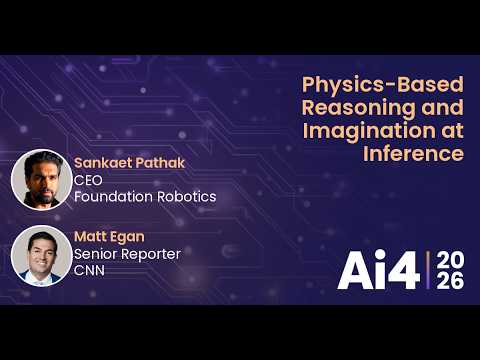
Foundation Robotics Deploys Humanoids in Ukraine as It Seeks $60K Worker Replacements
Ai4
CEO Sankaet Pathak argues that armed humanoid robots and edge-based physics models will displace blue-collar labor over a turbulent 15-year transition while eliminating reliance on synthetic training data.
## Background
Published on YouTube by the channel Ai4 on August 22, 2026, this video features a conversation between Foundation Robotics CEO Sankaet Pathak and CNN Senior Reporter Matt Egan. The session explores how physics-grounded world models and hierarchical AI architectures enable humanoid robots to perform imaginative rollouts and model-based reasoning directly on edge hardware.
## TL;DR
Sankaet Pathak shares his vision for Foundation Robotics, detailing how edge-based world models ("Cortex") allow humanoid robots to simulate physical futures for zero-shot task execution. He discusses real-world deployments across automotive assembly, port logistics, and military reconnaissance, including field tests in Ukraine. Pathak also critiques U.S. hardware supply chain gaps and artificial "cosplay" training data, while addressing the geopolitical ethics of defense robotics and the inevitable labor market disruptions ahead.
## Atmosphere & style
The conversation carries a pragmatic yet ambitious tone, blending high-level vision with sharp industry critique. Pathak speaks with unflinching candor—balancing visionary goals like building robot-constructed cities with grounded assessments of supply chain hurdles and job displacement. Egan's reporter-driven questioning keeps the dialogue focused on real-world impact, creating an engaging, serious-minded discussion about the immediate and long-term realities of embodied AI.
## Key takeaways
- [00:04](https://www.youtube.com/watch?v=Rr9orQ5nuiE&t=4s) Sankaet Pathak transitioned from fintech to founding Foundation Robotics to accelerate humanity toward a Type 1 civilization through humanoid automation.
- [00:04](https://www.youtube.com/watch?v=Rr9orQ5nuiE&t=4s) Foundation Robotics' long-term goal is building the first robot-constructed city in America, funded by near-term revenue from industrial and defense deployments.
- [02:37](https://www.youtube.com/watch?v=Rr9orQ5nuiE&t=157s) In its first year, Foundation's robots assisted in manufacturing over 24,000 vehicles and supported container transport operations at shipping ports.
- [02:37](https://www.youtube.com/watch?v=Rr9orQ5nuiE&t=157s) The company is developing reconnaissance robots that use 3D Gaussian splatting to map building interiors, reducing urban combat risks for soldiers.
- [06:58](https://www.youtube.com/watch?v=Rr9orQ5nuiE&t=418s) Pathak distinguishes robotic world models from video generators, emphasizing that robotics requires grounded physical dynamics rather than mere visual persistence.
- [06:58](https://www.youtube.com/watch?v=Rr9orQ5nuiE&t=418s) The edge-based Cortex AI architecture acts like a prefrontal cortex, predicting physical outcomes seconds to minutes ahead to enable zero-shot task execution.
- [10:06](https://www.youtube.com/watch?v=Rr9orQ5nuiE&t=606s) Severe domestic supply chain bottlenecks—such as high copper coil costs and rare earth magnet shortages—threaten U.S. hardware independence.
- [10:06](https://www.youtube.com/watch?v=Rr9orQ5nuiE&t=606s) Foundation rejects staged 'cosplay data' from human demonstration facilities, requiring 50,000 to 500,000 hours of authentic industrial operating data.
- [14:13](https://www.youtube.com/watch?v=Rr9orQ5nuiE&t=853s) The heavy humanoid robot Phantom is undergoing field testing in Ukraine for cargo handling, resupply, and scout mapping.
- [14:13](https://www.youtube.com/watch?v=Rr9orQ5nuiE&t=853s) Pathak explicitly commits to equipping robots with kinetic capabilities if requested by the U.S. government, viewing deterrence as essential for defense.
- [18:17](https://www.youtube.com/watch?v=Rr9orQ5nuiE&t=1097s) Humanoid robotics will render many traditional blue-collar physical jobs obsolete, mirroring the labor shifts of the First Industrial Revolution.
- [19:26](https://www.youtube.com/watch?v=Rr9orQ5nuiE&t=1166s) The most intense economic transition and labor disruption period is projected to span the next 10 to 15 years.
- [19:26](https://www.youtube.com/watch?v=Rr9orQ5nuiE&t=1166s) Long-term automation is expected to lower production costs and expand global economic output, ultimate raising global living standards.
## Detailed walkthrough
### [00:04](https://www.youtube.com/watch?v=Rr9orQ5nuiE&t=4s) Accelerating Humanity to a Type 1 Civilization
Matt Egan opens the conversation by asking Sankaet Pathak why he walked away from financial technology to focus on humanoid robotics. Pathak explains that building companies is inherently difficult, so founders should pursue what deeply motivates them rather than simply attempting to maximize income on Wall Street. For him, the driving vision is making sci-fi capabilities a real-world reality to dramatically accelerate human progress.
Pathak recounts daydreaming during Christmas family gatherings in December 2023 about autonomous robots building, maintaining, and managing entire cities and critical infrastructure. That obsession led directly to founding **Foundation Robotics**. While humanoid forms are critical for tasks like house construction, farming, and defense, Pathak emphasizes that reaching Foundation's ultimate milestone—building the first robot-constructed city in America—requires creating immense practical economic value today in industrial and defense sectors to fund the necessary technological roadmap.
- Sankaet Pathak left fintech to work on technologies that accelerate humanity toward becoming a Type 1 civilization.
- The company was sparked by a persistent daydream in December 2023 regarding automated infrastructure management.
- Foundation Robotics' ultimate self-stated goal is to build and manage the first entire city in America constructed by robots.
- Current operations focus heavily on heavy industrial environments and defense to generate the near-term revenue needed to fund long-term R&D.
---
[02:37](https://www.youtube.com/watch?v=Rr9orQ5nuiE&t=157s) Real-World Deployments: Auto Manufacturing, Ports, and Reconnaissance
Addressing current and near-term commercial deployments, Pathak explains that Foundation's robots excel at heavy materials handling and autonomous navigation. Moving items from point A to point B in logistic centers, factories, and defense facilities sounds mundane, but severe labor shortages make it a massive value driver. Last year, during their first small-scale deployment, Foundation's robots helped build over 24,000 cars in automotive manufacturing plants by handling material transport, picking, and precision parts racking.
Beyond moving physical goods, the robots possess advanced mapping and autonomous navigation capabilities. Foundation is actively developing an end-to-end reconnaissance system for defense applications. Soldiers are frequently injured entering unknown buildings; Foundation's robots can enter first, climb stairs, and map the interior environment. The systems output RGB maps, standard grid maps, and 3D Gaussian splatting maps—which mimic how human eyes visualize space—providing high-precision tactical data before personnel step inside. Similar spatial mapping capabilities are simultaneously deployed for large-scale port operations.
- **Automotive impact:** Assisted in the manufacturing of over 24,000 vehicles during the company's first year of small-scale deployment.
- **Port logistics:** Partnered with port operators to handle container transport and part-racking workflows across vast terminals.
- **Defense reconnaissance:** Developing systems to map unknown urban interiors using 3D Gaussian splats to protect soldiers from ambushes.
- **Future expansion targets (5-10 year horizon):** Construction, city-wide logistics, data center infrastructure setup, and agricultural farming.
- **Labor economics:** A fully loaded U.S. factory worker costs ~$60,000 annually per shift. A robot working three continuous shifts provides massive cost efficiency and fills critical unfilled roles.
---
[06:58](https://www.youtube.com/watch?v=Rr9orQ5nuiE&t=418s) Cortex Architecture and Edge-Based World Models
When asked about **Cortex**, the AI system powering Foundation's robots, Pathak clarifies critical industry definitions around "world models." He contrasts video generation tools (like Runway) and pure simulators with embodied robotics models. Video generators prioritize persistent visual generation (such as ensuring a whiteboard's text remains unchanged when returning to a room), whereas robotics requires grounded semantic and physical intuition—learning how physical objects interact much like children learn by bumping into things.
Foundation's research centers on building edge-deployable world models that provide predictive "physics imagination." The goal is allowing the robot to accurately forecast physical reality 30 seconds to several minutes into the future during action execution. Because these predictions must run directly inside the control feedback loop, the model must sit locally on the robot's hardware rather than relying on cloud diffusion. Cortex combines language and semantic layers to enable true zero-shot task execution without prior explicit training data for that exact action.
- Video generation models focus on visual frame persistence; robotic world models focus on physical dynamics and semantic spatial intuition.
- Cortex operates as an edge-based model mimicking the human prefrontal cortex to enable real-time "physics imagination."
- Predicts physical state changes 30 seconds to several minutes ahead during continuous action execution.
- Enables zero-shot generalization, allowing robots to parse natural language instructions and execute unlearned tasks.
---
[10:06](https://www.youtube.com/watch?v=Rr9orQ5nuiE&t=606s) Supply Chain Bottlenecks and Non-Cosplay Pre-Training Data
Pathak delivers a candid critique of the dual bottlenecks threatening American robotics: hardware supply chain constraints and flawed AI data practices. On the hardware front, he expresses frustration over severe U.S. supply chain deficiencies. Copper coils can cost 100 to 1,000 times more in America than in China, rare earth magnets remain almost impossible to source reliably domestically, and venture capital remains resistant to funding fundamental infrastructure like U.S. lithium-ion refineries—preferring instead to fund Chinese-built actuators.
On the AI side, Pathak rejects the industry trend of funding "data factories," where human operators perform staged tasks under studio conditions. He labels these effort "cosplay data," arguing that artificial setups cannot capture the complex physical realities of heavy manufacturing—comparing it to expecting a actor on *Grey's Anatomy* to perform real surgical procedures. Having solved model architecture challenges over the past two years, Foundation's primary data bottleneck is acquiring 50,000 to 500,000 hours of authentic, real-world ("non-cosplay") operational data to pre-train the foundational actor models for planning, replanning, and precision control.
- Copper coils in the U.S. cost between 100x and 1,000x more than in China due to domestic processing gaps.
- Rare earth magnets and domestic lithium refining represent critical single-point failures for American hardware independence.
- Dismisses staged human demonstration facilities ("data factories") as producing useless "cosplay data" that fails in real industrial deployments.
- Requires 50,000 to 500,000 hours of real-world operational data to pre-train Cortex actor models for task precision and replanning.
---
[14:13](https://www.youtube.com/watch?v=Rr9orQ5nuiE&t=853s) Defense Applications, Ukrainian Field Testing, and Ethical Realities
Addressing their heavy humanoid robot **Phantom**, Pathak confirms units have been sent to Ukraine strictly for real-world testing. He addresses the controversial decision to embrace defense contracts and potential weaponization, contrasting Foundation's position with companies like Boston Dynamics. Currently, Phantom handles logistics, cargo transport, and building reconnaissance. However, Pathak asserts that if requested by the U.S. government to equip robots with kinetic capabilities, Foundation would comply without hesitation.
Reflecting on his childhood in a country historically vulnerable to aggression, Pathak argues that genuine peace is achieved exclusively through strength, quoting historical precedents. From an ethical standpoint, he contends that precise robotic target engagement is far more humane than indiscriminate bombing that destroys entire city blocks. He emphasizes that if Western defense-oriented robotics companies do not build these capabilities, totalitarian adversaries will, leaving Western nations exposed.
- Phantom units are actively undergoing field testing in Ukraine focused on logistics and reconnaissance.
- Primary military applications center on non-combat risk reduction: cargo loading/unloading, logistics resupply, and scout mapping.
- Pathak explicitly commits to arming robots if requested by the U.S. government, viewing deterrence and precision strike as morally superior to imprecise aerial bombardment.
- Asserts that Foundation Robotics is one of the very few Western humanoid robotics companies willing to partner directly with defense institutions.
---
[18:17](https://www.youtube.com/watch?v=Rr9orQ5nuiE&t=1097s) Labor Market Disruption and Advice for the Next Generation
When asked about the impact on human workers, Pathak acknowledges plainly that humanoid robotics will make significant portions of traditional blue-collar jobs obsolete. Drawing historical parallels, he compares this transition to the first industrial revolution (textiles and steam engines) and subsequent technological shifts that disrupted physical and clerical labor markets. He anticipates a highly disruptive transition period lasting decades as economic structures adjust.
Pathak advises young people entering the workforce to avoid optimizing for repetitive physical tasks that machines can automate. Instead, they should cultivate adaptative problem-solving skills, technological literacy, and domain expertise in areas that direct, manage, or synthesize automated systems.
- Humanoid robots will inevitably render many repetitive blue-collar physical jobs obsolete.
- Compares the upcoming economic shift to the 60-year disruption period during the First Industrial Revolution.
- Advises the next generation to focus on high-level adaptability, system orchestration, and skills immune to physical automation.
[19:26](https://www.youtube.com/watch?v=Rr9orQ5nuiE&t=1166s) Navigating Disruption, Job Loss, and the Long-Term Benefits of Embodied AI
Sankaet Pathak addresses the inevitable social and economic disruption that cutting-edge technologies bring, observing that society has gradually improved at pivoting disruptive breakthroughs toward productive outcomes for humanity. While discussing how to prepare the next generation, he shares a common anecdote about friends asking for advice regarding their children's career paths. Pathak reassures them that parents of children aged five or younger have nothing to worry about, as the initial societal disruptions will have largely settled by the time those kids grow up. Instead, he highlights that the true friction will occur over the next 10 to 15 years, admitting that it would be disingenuous to pretend this transition won't be messy.
Despite the coming turbulence, Pathak remains deeply optimistic. Drawing from his discussions with national leaders and policymakers, he notes that officials are taking a thoughtful approach to managing the shift. He emphasizes that minimizing the disruptive period is essential, warning that failing to do so could lead to severe societal unrest or "a mutiny" driven by people's legitimate fear of becoming a permanent underclass. Ultimately, Pathak compares the AI revolution to the First Industrial Revolution's impact on the textile industry. Although initial automation eliminated specific roles, the overall textile market expanded drastically, making goods cheaper and employing far more people today than ever before. He concludes that advanced robotics will lower costs, elevate global quality of life, and extend higher living standards well beyond America.
- Sankaet Pathak notes that society is now utilizing roughly two-thirds of the time it used to take to adapt disruptive technology into productive human outcomes.
- The most challenging economic transition period is projected to take place over the next 10 to 15 years.
- Historical precedent shows that while the First Industrial Revolution eliminated initial textile jobs, it vastly increased overall employment in textiles due to lower costs and expanded market demand.
- A key motivation for managing the transition thoughtfully is preventing widespread public fear of becoming a permanent underclass.
## Notable quotes
> [00:04](https://www.youtube.com/watch?v=Rr9orQ5nuiE&t=4s) making sci-fi capabilities a real-world reality to dramatically accelerate human progress. — Sankaet Pathak
> [00:04](https://www.youtube.com/watch?v=Rr9orQ5nuiE&t=4s) build and manage the first entire city in America constructed by robots. — Sankaet Pathak
> [02:37](https://www.youtube.com/watch?v=Rr9orQ5nuiE&t=157s) helped build over 24,000 cars in automotive manufacturing plants by handling material transport, picking, and precision parts racking. — Sankaet Pathak
> [02:37](https://www.youtube.com/watch?v=Rr9orQ5nuiE&t=157s) A fully loaded U.S. factory worker costs ~$60,000 annually per shift. A robot working three continuous shifts provides massive cost efficiency — Sankaet Pathak
> [06:58](https://www.youtube.com/watch?v=Rr9orQ5nuiE&t=418s) predicts physical state changes 30 seconds to several minutes ahead during continuous action execution. — Sankaet Pathak
> [10:06](https://www.youtube.com/watch?v=Rr9orQ5nuiE&t=606s) Copper coils can cost 100 to 1,000 times more in America than in China — Sankaet Pathak
> [10:06](https://www.youtube.com/watch?v=Rr9orQ5nuiE&t=606s) cosplay data — Sankaet Pathak
> [10:06](https://www.youtube.com/watch?v=Rr9orQ5nuiE&t=606s) expecting a actor on Grey's Anatomy to perform real surgical procedures. — Sankaet Pathak
> [14:13](https://www.youtube.com/watch?v=Rr9orQ5nuiE&t=853s) if requested by the U.S. government to equip robots with kinetic capabilities, Foundation would comply without hesitation. — Sankaet Pathak
> [14:13](https://www.youtube.com/watch?v=Rr9orQ5nuiE&t=853s) precise robotic target engagement is far more humane than indiscriminate bombing that destroys entire city blocks. — Sankaet Pathak
> [14:13](https://www.youtube.com/watch?v=Rr9orQ5nuiE&t=853s) if Western defense-oriented robotics companies do not build these capabilities, totalitarian adversaries will, leaving Western nations exposed. — Sankaet Pathak
> [18:17](https://www.youtube.com/watch?v=Rr9orQ5nuiE&t=1097s) humanoid robotics will make significant portions of traditional blue-collar jobs obsolete. — Sankaet Pathak
> [18:17](https://www.youtube.com/watch?v=Rr9orQ5nuiE&t=1097s) avoid optimizing for repetitive physical tasks that machines can automate. Instead, they should cultivate adaptative problem-solving skills — Sankaet Pathak
> [19:26](https://www.youtube.com/watch?v=Rr9orQ5nuiE&t=1166s) true friction will occur over the next 10 to 15 years, admitting that it would be disingenuous to pretend this transition won't be messy. — Sankaet Pathak
> [19:26](https://www.youtube.com/watch?v=Rr9orQ5nuiE&t=1166s) failing to do so could lead to severe societal unrest or "a mutiny" driven by people's legitimate fear of becoming a permanent underclass. — Sankaet Pathak
## Mentioned
Sankaet Pathak, Matt Egan, Foundation Robotics, Cortex, Phantom, Runway, Grey's Anatomy, CNN, Boston Dynamics, Ukraine, China, America
## Video description
Sankaet Pathak — CEO, Foundation Robotics
Matt Egan — Senior Reporter, CNN
What if humanoid robots could imagine possible futures before acting—just like humans do? The talk will include a deep dive into why today’s dominant approaches, from imitation learning to model-free reinforcement learning, struggle to scale toward general-purpose embodied intelligence. It will illustrate a new hierarchical architecture in which a physics-grounded latent world model bridges high-level planning and low-level whole-body control, enabling true model-based reasoning directly on the robot at control frequency. The session will explain how this system learns physics and task rewards from human videos, performs rapid imaginative rollouts in latent space, and selects actions through internal forward simulation—without external simulators or rote trajectory memorization. Attendees will gain a clear understanding of how physics-based reasoning unlocks faster adaptation, stronger generalization, and dramatically reduced real-world data requirements. Join this talk to explore a fundamentally different path toward scalable, embodied AI.
Foundation Robotics在乌克兰部署人形机器人,瞄准替代6万美元年薪工人
CEO Sankaet Pathak认为,武装人形机器人和边缘物理模型将在动荡的15年转型期内取代蓝领劳动力,同时消除对合成训练数据的依赖。
Sankaet Pathak分享了他对Foundation Robotics的愿景,详细阐述了基于边缘的世界模型(“Cortex”)如何让人形机器人模拟物理未来以实现零样本任务执行。他讨论了在汽车组装、港口物流和军事侦察领域的实际部署,包括在乌克兰的实地测试。Pathak还批评了美国硬件供应链的短板和人造“cosplay”式训练数据,同时探讨了国防机器人的地缘政治伦理以及未来不可避免的劳动力市场冲击。
Sankaet Pathak 离开金融科技领域创立 Foundation Robotics,旨在推动人类向 I 型文明迈进,其终极目标是在美国建造首个完全由机器人建造和管理的城市,并通过工业与国防领域的实际部署为研发提供资金。 (0:04)
在首年小规模部署中,Foundation Robotics 的机器人已协助制造了超过 24,000 辆汽车,并应用于港口集装箱物流;同时团队正利用 3D Gaussian splatting 开发室内侦察系统,以降低士兵在未知建筑中的作战风险。 (2:37)
针对具身智能架构,Pathak 强调机器人世界模型不同于追求视觉画面的视频生成器,其自研端侧系统 Cortex 能在前额叶层面预测数秒至数分钟的物理真实动态,实现零样本任务泛化。 (6:58)
Pathak 指出美国硬件供应链存在严峻瓶颈,铜线圈成本高出中国百倍且稀土磁铁供应困难;此外他坚决摒弃实验室摆拍的“Cosplay 数据”,强调 Cortex 预训练需要 5 万到 50 万小时真实的工业运营数据。 (10:06)
Pathak 确认重型人形机器人 Phantom 已在乌克兰进行物流与侦察实地测试,并表示如果美国政府提出需求,公司将毫不犹豫地为机器人装载打击能力以实现威慑与精准打击。 (14:13)
Reading summary
Foundation Robotics founder Sankaet Pathak argues that commercializing humanoid robotics requires deploying edge-based physical world models in heavy industry to generate revenue, while confronting severe Western hardware supply chain vulnerabilities and significant impending labor disruption.
Industrial Deployments and Near-Term Labor Economics (2:37)
Foundation Robotics focuses its initial deployments on industrial materials handling and autonomous navigation to build cash flow for long-term objectives, including Pathak's ultimate ambition of constructing robot-built cities. In its first small-scale deployment, the company's robots assisted in manufacturing more than 24,000 vehicles by handling material transport, picking, and precision racking. Pathak identifies severe labor shortages as the primary commercial driver, noting that a fully loaded U.S. factory worker costs approximately $60,000 annually per shift, whereas robots can operate across three continuous shifts.
Edge World Models Enabling Physical Predictive Imagination (6:58)
Pathak distinguishes robotic world models from generative video models like Runway, noting that while video systems prioritize visual frame persistence, robotics demands grounded semantic and physical intuition. Foundation's AI architecture, Cortex, is designed to run locally on the robot's edge hardware rather than relying on cloud diffusion. Operating within the low-latency control feedback loop, Cortex provides a predictive 'physics imagination' that forecasts physical state changes 30 seconds to several minutes into the future, enabling zero-shot task execution from natural language instructions without task-specific prior training.
Hardware Bottlenecks and Rejection of Cosplay Data (10:06)
Pathak identifies the American hardware supply chain as a critical vulnerability, pointing out that domestic copper coils cost 100 to 1,000 times more than in China, while domestic rare earth magnets and lithium refining remain critically constrained. Concurrently, Pathak criticizes venture-backed 'data factories' that collect staged human demonstrations in studio settings, dismissing these outputs as 'cosplay data' that fails to reflect heavy industrial realities. He states that model architectures are largely solved, making the primary bottleneck the collection of 50,000 to 500,000 hours of authentic, real-world operational data required to pre-train Cortex for complex planning and replanning.
Defense Deployments and Willingness to Arm Robots (14:13)
Foundation has deployed its heavy humanoid robot, Phantom, for field testing in Ukraine, currently limited to logistics, cargo loading, and interior reconnaissance using 3D Gaussian splatting to map hazardous buildings for soldier safety. Unlike competitors that avoid military collaboration, Pathak embraces defense contracting and explicitly commits to arming Foundation's robots if requested by the U.S. government. Pathak argues that deterrence maintains peace and contends that precision robotic targeting is morally superior to indiscriminate aerial bombardment.
Navigating Transitional Labor Disruption and Societal Risk (18:17)
Pathak acknowledges that humanoid robots will inevitably make traditional blue-collar physical labor obsolete, forecasting a disruptive economic transition over the next 10 to 15 years. Drawing parallels to the First Industrial Revolution, he notes that while mechanization ultimately lowered consumer costs and created larger overall industries, failure by policymakers to manage the near-term displacement could trigger severe societal unrest or political backlash from workers fearing permanent displacement. He advises incoming workers to cultivate adaptability and systems orchestration rather than focusing on automatable manual tasks.
Pathak's roadmap hinges on two contentious premises: that Western robotics can overcome profound domestic manufacturing cost disadvantages against foreign supply chains, and that society can navigate a 10-to-15-year window of severe blue-collar displacement without triggering widespread unrest or backlash against weaponized and autonomous systems.
## Background
该内容由 YouTube 频道 Ai4 于 2026 年 8 月 22 日发布,主要内容为 CNN 资深记者 Matt Egan 与 Foundation Robotics 首席执行官 Sankaet Pathak 的对谈。视频说明指出,这场演讲深入探讨了基于物理学的推理与想象在推理阶段的应用,介绍了一种结合高层规划与底层全身控制的层级化架构,展现了具身人工智能领域的全新发展路径。
## TL;DR
对谈围绕 Foundation Robotics 的创业愿景及其技术路线展开。创始人 Sankaet Pathak 分享了离开金融科技领域、致力于通过具身智能推进人类迈向“1 型文明”的初衷,以及未来建造新城的宏大构想。同时,内容重点阐述了如何借助物理隐空间世界模型实现无须外部仿真器的实时“想象”与推理,克服传统模仿学习的局限,从而大幅降低数据需求并提升机器人的泛化与适应能力。
## Atmosphere & style
对谈充满了前瞻性的科幻色彩与极客式的创业热情,主持人与嘉宾之间的交流自然而富有深度。Pathak 的分享既有对人类文明未来的宏大憧憬,又落脚于严谨扎实的技术架构细节,呈现出一种充满野心且富有感染力的思想碰撞氛围。
## Key takeaways
- [00:04](https://www.youtube.com/watch?v=Rr9orQ5nuiE&t=4s) Sankaet Pathak 表示自己离开金融科技行业是为了专注于能加速人类迈向“1 型文明”的伟大事业,创立 Foundation Robotics 的长远愿景是在美国从零开始建起第一座全新城市。
## Detailed walkthrough
### [00:04](https://www.youtube.com/watch?v=Rr9orQ5nuiE&t=4s) 创业愿景:从 1 型文明到构建第一座新城
访谈由主持人 Matt Egan 对 Foundation Robotics 首席执行官 Sankaet Pathak 的问候拉开序幕。主持人提及 Pathak 过去曾表示离开金融科技(Fintech)行业的原因在于只希望专注于能够加速人类迈向“1 型文明”(Type-One Civilization)的工作,并询问人形机器人如何契合这一宏大目标。Pathak 坦言创业极为繁重且充满挑战,与其在华尔街赚取更多财富,不如选择真正能激发自身热情、将科幻概念落地变为现实的伟大使命。
Pathak 重点讲述了他在 2023 年 12 月圣诞节期间的“发日间梦”经历。当时他在与家人聚会时完全无法集中注意力听人交流,脑海中不断构思着机器人未来构建、管理与维护基础设施的图景。这种执念最终促成他在几月后创立了 Foundation Robotics。公司的长远愿景是在美国从零### 创业初衷与“一型文明”愿景
在对谈开头,主持人 Matt Egan 提及 Sankaet Pathak 此前放弃 Fintech(金融科技)领域的经历。Pathak 解释道,创办公司极
Sorry, something went wrong. Please try your request again.
## Notable quotes
> [00:04](https://www.youtube.com/watch?v=Rr9orQ5nuiE&t=4s) 只希望专注于能够加速人类迈向“1 型文明”(Type-One Civilization)的工作 — Sankaet Pathak
## Mentioned
Sankaet Pathak, Matt Egan, Foundation Robotics, CNN, Ai4
## Video description
Sankaet Pathak — CEO, Foundation Robotics
Matt Egan — Senior Reporter, CNN
What if humanoid robots could imagine possible futures before acting—just like humans do? The talk will include a deep dive into why today’s dominant approaches, from imitation learning to model-free reinforcement learning, struggle to scale toward general-purpose embodied intelligence. It will illustrate a new hierarchical architecture in which a physics-grounded latent world model bridges high-level planning and low-level whole-body control, enabling true model-based reasoning directly on the robot at control frequency. The session will explain how this system learns physics and task rewards from human videos, performs rapid imaginative rollouts in latent space, and selects actions through internal forward simulation—without external simulators or rote trajectory memorization. Attendees will gain a clear understanding of how physics-based reasoning unlocks faster adaptation, stronger generalization, and dramatically reduced real-world data requirements. Join this talk to explore a fundamentally different path toward scalable, embodied AI.
[Source](https://www.youtube.com/watch?v=Rr9orQ5nuiE)
[0:04] Sankaet Pathak: making sci-fi capabilities a real-world reality to dramatically accelerate human progress.
[0:04] Sankaet Pathak: build and manage the first entire city in America constructed by robots.
[2:37] Sankaet Pathak: helped build over 24,000 cars in automotive manufacturing plants by handling material transport, picking, and precision parts racking.
[2:37] Sankaet Pathak: A fully loaded U.S. factory worker costs ~$60,000 annually per shift. A robot working three continuous shifts provides massive cost efficiency
[6:58] Sankaet Pathak: predicts physical state changes 30 seconds to several minutes ahead during continuous action execution.
[10:06] Sankaet Pathak: Copper coils can cost 100 to 1,000 times more in America than in China
[10:06] Sankaet Pathak: cosplay data
[10:06] Sankaet Pathak: expecting a actor on Grey's Anatomy to perform real surgical procedures.
[14:13] Sankaet Pathak: if requested by the U.S. government to equip robots with kinetic capabilities, Foundation would comply without hesitation.
[14:13] Sankaet Pathak: precise robotic target engagement is far more humane than indiscriminate bombing that destroys entire city blocks.
[14:13] Sankaet Pathak: if Western defense-oriented robotics companies do not build these capabilities, totalitarian adversaries will, leaving Western nations exposed.
[18:17] Sankaet Pathak: humanoid robotics will make significant portions of traditional blue-collar jobs obsolete.
[18:17] Sankaet Pathak: avoid optimizing for repetitive physical tasks that machines can automate. Instead, they should cultivate adaptative problem-solving skills
[19:26] Sankaet Pathak: true friction will occur over the next 10 to 15 years, admitting that it would be disingenuous to pretend this transition won't be messy.
[19:26] Sankaet Pathak: failing to do so could lead to severe societal unrest or "a mutiny" driven by people's legitimate fear of becoming a permanent underclass.
Original transcript
[0:04] Thanks for doing this. Thanks for uh
agreeing to to talk to all of us here.
[0:08] Um I think everyone would love to hear more about
your company and your vision. Um you've said in
[0:15] the past that you left fintech because you only
want to focus on work that accelerates humanity
[0:22] to be a type one civilization. I'm wondering if
you can just sort of talk to us about how these
[0:29] humanoid robots that your company is building
fit into this ambitious goal that you have.
[0:37] Uh yeah, I mean generally what I learned
is that building companies is hard. So, um,
[0:43] you can do what motivates you the most.
And actually, what gets me up is, uh,
[0:48] getting very fired up about an exciting mission
and, uh, trying to accomplish that over, uh,
[0:54] I don't know, maybe if I worked at
Wall Street making more money. Um,
[0:58] so I decided that I wanted to spend the rest
of my life doing those kinds of things. And
[1:04] I think now more than ever, it's finally
possible to be able to kind of make
[1:10] sci-fi not sci-fi and make it actually happen.
And majority of those things I think will
[1:15] greatly accelerate humanity. the area where I got
most excited about and so much so uh in December
[1:21] 2023 um I was uh u at Christmas with family and I
would not pay attention to any conversation just
[1:29] kept on daydreaming was this notion that one day
um uh robots would be able to build infrastructure
[1:36] uh and also manage it and maintain it and do all
these different things and that obsession uh and
[1:42] daydream continued for months and I decided that
maybe I should try to do something about about it
[1:47] and um decided to start foundation and the goal
with foundation by and large is uh we are uh we're
[1:54] building robots for heavy industrial work. So
humanoids are one form of robot that are extremely
[2:00] important if you want to be able to build homes
and uh build and uh essentially manage cities and
[2:05] things like farming and defense. Uh there are
other forms of robots that are also important
[2:10] but uh from now till we get to the point where
we can actually build a first city in America
[2:15] which is our big self-stated goal. Uh there are a
bunch of technologies that need to be created and
[2:20] you have to be able to finance your way there
and the only way you do that is by creating
[2:23] real utility and value. So today majority of our
focus ends up being uh defense and industrial work
[2:30] and a lot of that is to be able to build the
robots and capabilities needed to be able to
[2:34] build these very giant cities. Okay. So, so let's
get into to your business. Um, you mentioned
[2:42] sci-fi. So, can you explain the use cases,
the specific use cases for these AI powered
[2:49] robots that your company's building? I mean, h how
are they being deployed today and and what are the
[2:55] use cases that might feel like science fiction,
but you believe will actually become a reality
[3:00] in the next 10 years? I mean the things that we're
working on right now are um I think we're getting
[3:05] to a place where our robots can by and large do
a couple of things uh almost anywhere. So one is
[3:12] be able to move materials around which uh as it
turns out if you go to factories or even if you go
[3:18] to logistic centers or you go uh into the defense
industrial complex a lot of the work that people
[3:24] are doing is just moving and transporting things
from point A to point B. It sounds very mundane
[3:29] but there is a lack of labor force there in itself
and you can get a lot done by just doing that. Um
[3:34] which means today uh we we do a bunch of materials
handling work and also pick place racking type
[3:41] work in auto manufacturing. So uh we helped build
over 24,000 cars last year which was the first
[3:47] year of our very tiny deployment and this year
uh our goal is to ship more and more robots. Um,
[3:54] and we also have contracts with port operators
to be able to pretty much do the same thing,
[4:00] carry materials from point A to point B and uh,
in some cases some slightly more precise things
[4:07] that you have to do around it, which is racking
and racking. You also to rack a part inside. Um,
[4:12] so there are tons of jobs in just doing that.
Uh, the other kinds of use cases are now a
[4:18] robots can uh, autonomously navigate and map an
environment. So that alone is a capability have
[4:24] has has massive value. Um uh so currently we are
building an end toend reconnaissance system. So
[4:31] today soldiers get heard uh frequently going
into buildings that are unknown. So we want
[4:37] robots to be able to go in first be able to take
stairs and map the entire environment. um uh
[4:44] RGB map, obviously your grid map, but then also
your Gaussians map, which looks similar to how
[4:50] our eyes see the world. And with that, our goal is
give people give soldiers very precise information
[4:56] about where things are. But those capabilities
are also very helpful. Again, as you go back to
[5:01] operating a port, when you have to go from one
remote end of the port to another, you need a
[5:05] robot that can navigate itself and understands the
map quite well. Um currently we're heads down on
[5:11] those kinds of use cases. Uh we think those create
just tremendous value in the economy generally
[5:16] uh uh solve for a massive need that exists across
different industries both defense and industrial.
[5:21] So auto manufacturing port logistics defense
logistics those are the focuses. Did you say
[5:27] 24,000 cars were made? Well we didn't make the car
entirely but we helped make 24,000 cars. Okay. So
[5:34] autos ports defense now. Yeah. What about the
use cases going forward the next 5 to 10 years?
[5:45] Where where else is it going? Um I I mean
construction uh a lot of um city logistics and um
[5:54] uh farming farming is challenging for a
very interesting reason which is today the
[6:01] cost of labor over there is extremely low. So you
need robots that can uh uh be very economically um
[6:11] uh feasible to be able to do that versus
if you go to a factory in the US a fully
[6:15] loaded u cost of a one one factory worker is about
$60,000. So uh if if a robot can do three shifts
[6:24] uh you are demonstrating not only you're adding
more capacity uh for these people to be able
[6:28] to build more goods and services because they
already have a shortage of labor uh but then on
[6:34] top of that you can do it at a cheaper price. So
I think it's going to take some time to be to the
[6:39] equation to be reversed there but but I think that
would happen. uh the areas that like we didn't I
[6:44] I didn't anticipate uh when I started the company
but a lot of the infrastructure projects around uh
[6:50] data centers uh that would also become a big part
of the use cases uh in the near future. Okay.
[6:58] Can we talk about the technology? Um can you
tell us about Cortex the AI architecture powering
[7:05] your robots? Um and and can you just explain
to the audience how world models AI is
[7:11] making these robotic advances possible? Yeah,
I mean um so ju just some like technical
[7:18] differentiation different people consider um
there are different kinds of world models. So
[7:25] some people call simulators world models. Some
people call video generation tools like uh
[7:31] uh runway right before this uh a world model. Um
and uh it seems like now everyone awkwardly is
[7:38] trying to nudge those as a use case into robotics
which uh you have slightly different problems. So
[7:43] what what what Runby really needs to be able
to build for their original use case is a very
[7:48] persistent layer of video generation that to their
point if you leave a room and come back what was
[7:54] written on the whiteboard it's exactly the same.
It doesn't change. Um the problem set you want to
[7:59] optimize for robotics is slightly different. You
want to be able to build a semantic intuition. So
[8:03] very similar to how we as kids build by bumping
into objects and over time learning how the
[8:09] physics of the world really works. Uh some kind of
intuition around it and then I can just read text
[8:15] and I can do not everything like like an expert
but I can do majority of the stuff quite well. Um
[8:23] so we focus our time and energy in building out
that. So the biggest question on the research side
[8:29] that uh we've been obsessed with trying to answer
is how big of a world model do you need to be able
[8:33] to build that gives you enough predictive ability
to be able to look a minute maybe 2 minutes
[8:40] even 30 seconds out into the future so that
whatever is the length of the action you need
[8:46] to perform that's next right next to whatever you
had just done you know how the world's going to
[8:51] shape as you do that. Um so we more so call that
like uh uh physics imagination than anything else
[8:58] which is a kind of a world model and our goal
is we want that world model because it needs to
[9:03] be uh uh somewhat predictive and somewhat reactive
because that is the big differentiation between a
[9:09] diffusion model that does video generation for
graphics and another one that does for robots. Um
[9:16] you want that to sit on the edge. So you want
you really want that to sit on the robot.
[9:20] If it cannot sit on the robot, you cannot
realistically perform actions because you really
[9:24] need that in the feedback loop. It's not something
it generates and forgets. Uh so a lot of our focus
[9:29] and energy on the cortex side is um pretty pretty
much building this like prefrontal cortex and pre
[9:38] preoter cortex equivalent of what humans have.
um which by and large is being able to take
[9:46] a language and have some kind of a semantic
layer that lets you take that language in
[9:53] zeroot which means you have gotten no training
data for that task whatsoever and um still be
[10:00] able to do that task reasonably well. So
as you're you're building these robots and
[10:06] the world models, what are the biggest bottlenecks
and obstacles that you're facing as you continue
[10:14] to build out this business? Uh I mean this is
a very complex business like everything's very
[10:19] interdependent. Uh so if I we have 9 minutes I
could go for an hour about the bottlenecks uh that
[10:26] we're facing on a regular basis. Um let me kind
of like focus on something that is very very
[10:32] minute and then I'll focus on something like very
very big. Uh what keeps me up at night is uh uh
[10:38] a coil of copper is about 100 times more expensive
sometimes thousand times more expensive in America
[10:44] than it is in China. What keeps me up at night is
for the life of me I cannot find a good supplier
[10:49] that can consistently give me rare earth magnets
in America. Uh what keeps me up at night is you
[10:54] cannot get good lithium-ion refinery. uh to be set
up. I cannot get a single venture capitalist to
[11:00] be excited about building a lithium refinery
in America, which I get it people like it's
[11:07] not the most fancy thing, but they would fund an
actuator which is built by China 90% of the time,
[11:13] but they would not fund what builds that
actuator, which is just crazy. And if like
[11:18] if I were in fintech or I was in investment
banking, uh this to me this is the next SpaceX.
[11:26] This is the there's no good reason for if you
go cost by cost and I have done that because
[11:31] I'm an obsessive person of exactly what is it that
costs you to be able to get copper built in the US
[11:38] versus China. There are some Chinese subsidies
but our labor isn't that expensive for it to be
[11:42] 100 to a thousandx more expensive here than it is
there. um that is a big bottleneck because that
[11:48] does make it so we are an all-American robot
that is also serving the defense industry but
[11:55] there are parts we're slamming to get
that don't actually come from the US um
[12:00] so that that in itself is a bottleneck now you
zoom all the way out uh leave that piece aside
[12:05] for a second uh for last two years our biggest
bottleneck was what is the right data recipe
[12:12] and the model architecture recipe on the AI side
that could lend itself well to be able to process
[12:20] a lot of atcale data that doesn't have to be
teleyoperated data to get these capabilities. Uh
[12:27] we finally cracked the code on that. So now
over there our big challenge is how do we get
[12:35] 50,000 to 500,000 hours of non what I call
non-costplay data which is data that was not
[12:43] created in a data factory which my peers are
very excited to announce with every single
[12:47] venture round that they do that everyone's
now doing a data factory they're all fake jobs
[12:52] like there's nothing that's happening in
there that is going to happen in a factory
[12:56] you could have the best script writer Grey's
Anatomy cannot teach you how to be a doctor.
[13:02] It's just that plain and simple. The same way it
cannot teach a robot how to build a car. There's
[13:06] just no two ways to it. So right now my big
bottleneck is again supply chain on the data side.
[13:11] What we really nailed down the last two years
is we've built a robot that is really good,
[13:16] quite reliable, probably the best actuators.
It's waterproof, dustproof, it's very strong.
[13:22] But those are two ends of the spectrum um that
I think are the big big bottlenecks. And then
[13:26] the lazy answers are oh I need more compute blah
blah blah blah blah. The reality is today like
[13:33] you don't have data deficit unless the data
you're talking about is this right like a
[13:38] large portions of our AI layer can get quite
good just with the data on the internet.
[13:44] But the pieces that really matter
which is planning, replanning,
[13:48] um task precision, all of that which is
the actor layer of the model architecture,
[13:53] all of that needs non-costplay data at the
foundation model pre-training level. Um and uh
[14:00] that is definitely like another big bottleneck.
I think that would be solved before my um
[14:05] my uh copper um steel magnet and lithium issue
would be solved. Okay. So, you mentioned that
[14:13] you've built these robots that are quite good.
That's the Phantom that you're talking about. So,
[14:20] I understand that you've sent units, these
Phantom units to Ukraine for for testing.
[14:27] Just for testing. Just for testing. What can you
tell us about how these these robots are working
[14:35] in the real world battlefield? And you
relatedly, it it seems as though your
[14:40] company's taking a different approach from Boston
Dynamics and others in the field in terms of uh
[14:47] using humanoid robots in these defense Yeah.
settings. Uh can you just talk about why
[14:54] you're leaning into um the military defense use
cases and and what do you say to those who have
[15:01] ethical concerns about Yeah. using robots
potentially lowering the threshold uh to going to
[15:08] war. Well, so taking the sensationalist piece out
for a second, today our robots are not uh fighting
[15:14] wars. So that's not what they're doing in the
defense complex in itself. There's a large part of
[15:21] war that is just making sure the person
who's sitting in the foxhole has supplies.
[15:27] Making sure they don't just leave
that foxhole and they get shot at.
[15:31] making sure the fossil they're entering in
is safe. Uh all of that work needs to happen
[15:36] around them. So a lot of our focus has been those
things which is being able to carry materials
[15:41] outside to inside, inside to outside, load load a
truck, unload a truck, be able to reconnaissance,
[15:47] the thing that I talked about, map a building,
map an environment that's unknown so that a
[15:51] human doesn't have to go in first. Um so those
are the big things we're focused on. Now if
[16:00] the US government came to us tomorrow and said
we need you to put real guns in hands of these
[16:06] uh robots as well and put them out
in the battlefield. We will do it
[16:11] and that is the point of friction to some people
but I can explain why we would do it and why
[16:15] you shouldn't have a point of friction
around this. Every single time I say that,
[16:19] people look at me as if like, I don't know, I'm
Oenheimer or something and I'm building this
[16:23] atomic bomb. And the reality is it's quite the
opposite. If your concerns around war are ethical,
[16:30] would you rather want a drone dropping a bomb on a
building and taking out three buildings next to it
[16:36] and everybody in that building or would you rather
want a robot that can walk into that building and
[16:40] go to the target? I would much rather want the
ladder. I cannot stop wars. You cannot. Nobody
[16:45] can. And this idealistic position is like very
privileged to be able to say, "Oh, I wish there to
[16:52] be no wars." Yeah, no [ __ ] So, so do I. So does
everybody else. Like that's not really the issue.
[16:57] There are wars. They're going to be wars. The
question is, can we make them more precise? And
[17:01] to the credit of the Western government, doesn't
matter which party you really believe in. It's
[17:07] it's the elephant or the donkey. It really
doesn't matter. Something in the middle.
[17:11] The reality is we have gotten better at it.
We have become more precise. We have become
[17:16] better and better and more just and more
empathetic in being able to execute things
[17:20] that are really scary. There are real national
security concerns that do warrant us to defend
[17:26] ourselves and go to war. I was born in a country
that was really bad at protecting itself and was
[17:31] paged for generations again and again and again
and again. And if you read history, the lesson you
[17:35] really learn is for you to have peace, you have
peace through strength. You do not have peace
[17:41] with no weapons. That just doesn't happen.
So if the US government comes to us and says
[17:47] we need you to arm these robots,
that means 99.9999% of the time,
[17:53] what that implies is they want to take it
to the next level in precision. And we want
[17:59] to be supportive of that. And the reality is if
foundation dies today, if we stopped existing as
[18:04] a company, there's not a second humanoid company
in the entire western world that would do that.
[18:11] And that is unethical. Me building robots that
can potentially carry weapons, I don't think is
[18:17] okay. I think we have time for maybe one more
question. Um, you know, I've talked to people
[18:21] at this conference and around the conference who
are nervous about the labor market implications
[18:29] of AI and and robots and and some of them are also
not just concerned about their own professions,
[18:34] but what their kids are going to do, what fields
they're going to get into. And I'm just wondering
[18:39] whether or not the you believe that the
robots that you're building are going to make
[18:45] a significant amount of bluecollar jobs obsolete
and what your advice is for young people as they
[18:52] try to navigate this disruptive environment.
Um short answer is yes. A robots will make
[18:59] some kind of blue collar jobs uh obsolete just
like the first industrial revolution did with
[19:06] textile um and with engines
and the second one did um
[19:11] or more things and the third one did with
more desk jobs all these different things
[19:16] uh that will happen and I think there will
be a period that's highly disruptive uh
[19:20] like again first industrial revolution I think
was 60 years second was about half that third
[19:26] was about like 2/3 that um so we are getting
better as society to be able to take these very
[19:33] disruptive technologies and then quickly point
them to a more productive outcome for humanity.
[19:39] Uh but there's going to be a disruptive u part to
this. Uh and I have friends who ask me say well
[19:46] uh you're in this field what do you think my kid
should do? Well the reality is if your kids's like
[19:50] 5 years or younger you have nothing to worry
about because any disruption will be solved for
[19:55] by that time. The issue is the next 10 to 15 years
is the one that is going to be a little bit messy.
[20:01] And I'd be lying to you if like I I I think that
would not be the case. I think there's going to be
[20:05] some movement there. I'm very optimistic. Uh I do
spend a very tiny portion of my time talking to uh
[20:12] people who uh run this country as well. And um
it seems like everyone's been quite thoughtful
[20:18] about it. Um and I'm very optimistic that we
can have a much smaller disruptive period than
[20:24] we would otherwise. Uh, and I think that's like
very very needed because if that doesn't happen,
[20:28] the alternative to that is pretty much a mutiny.
So, uh, because people are very afraid of just
[20:34] being a permanent underclass. And I think
there's some real legitimate fears around that.
[20:37] Uh, but from what I can tell, the short answer
is I think I I think we're going to do a good
[20:42] job navigating it. But yes, it will eliminate some
some jobs just like how industrial revolution one
[20:47] eliminated some jobs in textile. But guess what?
We employ significantly more amount of people in
[20:52] textile today than we did back then. And that's
because the market got bigger, the goods got
[20:56] cheaper, quality of life got great. Like that is
all going to happen. Majority of the people do not
[21:01] have the quality of life that we have in America.
And guess what? That would change. Okay. Well,
[21:06] thank you so much for uh making the time to talk
to us. Thank you for having me. Thanks for coming.