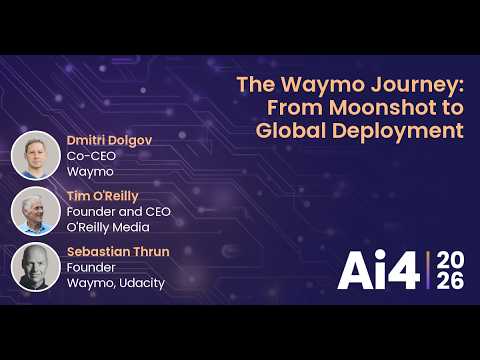
Waymo Driver Reaches 500k Rides Weekly as Autonomous AI Scales Up
Ai4
Waymo achieves a 17-fold reduction in serious injuries while expanding to 15 cities through tight hardware-software integration and regulatory partnerships rather than software licensing.
## Background
This YouTube video was published by Ai4 on August 22, 2026. The description outlines a panel session moderated by Tim O'Reilly featuring Waymo co-founders Sebastian Thrun and Dmitri Dolgov, exploring Waymo's evolution from an audacious 2009 Google moonshot into a global commercial autonomous ride-hailing service.
## TL;DR
Moderated by Tim O'Reilly, Waymo leaders Sebastian Thrun and Dmitri Dolgov reflect on the company's journey from early Google time trials and DARPA challenge roots to operating over 500,000 weekly trips across 15 US cities. Dolgov details the immense technical hurdles of physical AI, emphasizing safety thresholds, latency limits, and the reliance on massive data scaling through the Waymo Foundation Model. The discussion covers Waymo's multi-pillar architecture, business expansion strategy, and Thrun's insights on flying taxis and humanoid robotics. The panel concludes with a strong call to action for physical AI builders and advocates for treating regulators as collaborative partners rather than obstacles.
## Atmosphere & style
The session carries a reflective, highly collaborative, and visionary atmosphere, blending nostalgic tech-history anecdotes with grounded engineering pragmaticism. O'Reilly guides the conversation with steady industry curiosity, allowing Thrun's passionate optimism to balance Dolgov's structured, disciplined perspective. Watching the discussion feels like a rare, insider look into the birth of autonomous vehicles, building from early playful experimentation to a serious, forward-looking reflection on the future of physical AI.
## Key takeaways
- [00:04](https://www.youtube.com/watch?v=wBm_shEsADs&t=4s) Waymo started in 2009 as Project Chauffeur and has evolved over nearly two decades from an audacious lab experiment into a commercial autonomous ride-hailing leader.
- [02:09](https://www.youtube.com/watch?v=wBm_shEsADs&t=129s) In a 2009 Google executive time trial, autonomous vehicles took the top two spots on the leaderboard ahead of 42 human-driven laps.
- [03:22](https://www.youtube.com/watch?v=wBm_shEsADs&t=202s) Waymo reached key milestones including its first driverless ride in 2015 using the 'Firefly' prototype and commercial ride-hailing deployment in 2020.
- [03:22](https://www.youtube.com/watch?v=wBm_shEsADs&t=202s) Waymo operates across 15 US cities, providing roughly 500,000 trips weekly across 5 million miles and logging over 200 million fully autonomous miles.
- [05:08](https://www.youtube.com/watch?v=wBm_shEsADs&t=308s) The 2005 DARPA Grand Challenge served as a major catalyst, convincing leaders like Larry Page of the commercial viability of self-driving cars.
- [06:39](https://www.youtube.com/watch?v=wBm_shEsADs&t=399s) Autonomous driving represents one of the hardest AI challenges due to extreme safety requirements, messy physical environments, and strict real-time latency limits.
- [06:39](https://www.youtube.com/watch?v=wBm_shEsADs&t=399s) Key lessons for AI builders include the validity of Rich Sutton's Bitter Lesson, the exponential difficulty of achieving additional 'nines' of reliability, and the central role of rigorous evaluation frameworks.
- [10:12](https://www.youtube.com/watch?v=wBm_shEsADs&t=612s) Waymo developed the Waymo Foundation Model—a generative world model that combines physical trajectory prediction with semantic understanding.
- [11:04](https://www.youtube.com/watch?v=wBm_shEsADs&t=664s) Aviation autonomy faces even higher regulatory and safety hurdles than ground transport due to society's lower tolerance for aviation accidents.
- [11:04](https://www.youtube.com/watch?v=wBm_shEsADs&t=664s) While humanoid robotics attracts massive investment, challenges remain regarding safety around humans, and humanoid controls are not ideal for vehicle automation.
- [13:43](https://www.youtube.com/watch?v=wBm_shEsADs&t=823s) Waymo views itself as a technology provider partnering with OEMs and operational fleets rather than manufacturing custom vehicle platforms completely in-house.
- [13:43](https://www.youtube.com/watch?v=wBm_shEsADs&t=823s) Waymo's safety and technology ecosystem relies on three tightly integrated pillars: The Driver (onboard hardware/software), The Simulator (testing), and The Critic (validation).
- [16:31](https://www.youtube.com/watch?v=wBm_shEsADs&t=991s) Innovators should view regulators as collaborative partners sharing the common goal of safety, which accelerates constructive public deployment.
- [19:07](https://www.youtube.com/watch?v=wBm_shEsADs&t=1147s) While digital AI dominated recent progress, physical AI—applying machine intelligence to real-world mechanical systems—is entering an exponential phase of rapid advancement.
## Detailed walkthrough
### [00:04](https://www.youtube.com/watch?v=wBm_shEsADs&t=4s) Introduction and Waymo’s Quiet Success
Moderator Tim O'Reilly opens the session by asking the audience how many of them have ridden in a Waymo autonomous vehicle, noting that not enough hands are up. He shares that Waymo represents one of the greatest success stories in artificial intelligence, evolving over 20 years from an audacious research experiment into a commercial reality providing millions of autonomous rides.
O'Reilly highlights how Waymo stands out in Silicon Valley by quietly executing without relying on the typical hype machine. He introduces the speakers: Sebastian Thrun, founder of Google X and leader of the original Google self-driving car project, and Dmitri Dolgov, co-CEO of Waymo and one of the original project co-founders who now oversees the development of the Waymo Driver.
---
[02:09](https://www.youtube.com/watch?v=wBm_shEsADs&t=129s) The Early Days: The 2009 Google Executive Time Trial
Sebastian Thrun takes the audience back to 2009 when he and Dmitri Dolgov started Project Chauffeur. To build internal credibility within Google, Dolgov built a race car version of an autonomous vehicle and invited Google's top executives to a time trial competition.
The human executives raced against the autonomous system to set the fastest lap times. When the competition wrapped up, the autonomous vehicles took the top two spots on the leaderboard, while human drivers occupied the remaining 42 spots. Dolgov jokingly reassures the audience that the event was "totally safe," calling those early years the most fun and productive period of his professional career.
---
[03:22](https://www.youtube.com/watch?v=wBm_shEsADs&t=202s) The Carmel-to-Cambria Challenge and Strategic Milestones
Dmitri Dolgov shares an anecdote illustrating the speed of development in the project's early days. The team set a goal to complete 10 distinct 100-mile routes across the Bay Area without a single human intervention.
On their first attempt along the California coast from Carmel to Cambria, the car required several disengagements. While riding in the vehicle, Dolgov adjusted code on his laptop on the way back to the start. They re-attempted the route immediately and completed the entire drive autonomously.
- **2015 ("0 to 1" Moment):** Waymo achieved its first fully autonomous ride on public roads without a driver, steering wheel, or pedals using the custom-designed "Firefly" vehicle.
- **2020:** Waymo launched fully autonomous commercial ride-hailing operations.
- **Current Scale (as of session):** Waymo operates across 15 US cities, completing ~500,000 trips per week across 5 million weekly miles.
- **Safety Metrics:** Over 200 million fully autonomous miles driven, demonstrating a ~17x reduction in serious injuries compared to human drivers in operating areas.
---
[05:08](https://www.youtube.com/watch?v=wBm_shEsADs&t=308s) The DARPA Grand Challenge and Government's Role
Tim O'Reilly prompts the speakers to discuss the role of government funding in technological breakthroughs, referencing the early DARPA Grand Challenges.
Thrun reflects on the early 2000s, noting how the US military sought autonomous logistics solutions due to improvised explosive devices (IEDs) causing casualties in Iraq and Afghanistan. DARPA created a competitive challenge inviting top universities to navigate desert terrain.
- **2004 DARPA Grand Challenge:** The top-performing vehicle covered only about 7 miles before catching fire.
- **2005 DARPA Grand Challenge:** Thrun's Stanford team completed roughly 140 miles through the desert autonomously.
- **Key Takeaway:** This 2005 milestone served as the catalyst for figures like Larry Page to recognize the long-term commercial viability of autonomous driving.
---
[06:39](https://www.youtube.com/watch?v=wBm_shEsADs&t=399s) Technical Realities and Three Core Lessons for AI Builders
Addressing audience members working in AI and robotics, Dolgov explains why autonomous vehicles represent one of the hardest technical problems in artificial intelligence. He breaks down three core challenges:
1. **Extreme Safety Requirements:** High performance thresholds where errors carry physical consequences.
2. **Messy Physical Environments:** Dynamic continuous variables that cause out-of-distribution edge cases and feedback loops.
3. **Strict Latency Limits:** Systems must process and react in real-time; at freeway speeds, a vehicle covers roughly 100 feet per second, making milliseconds critical.
Dolgov shares three key takeaways for AI developers:
- **The Bitter Lesson Holds:** Architectures and methods that leverage massive data scale consistently outperform hand-engineered heuristics.
- **Focus on the "Nines":** Building a working prototype represents only the first 1% of the problem. Achieving each additional "nine" of reliability (99%, 99.9%, etc.) is ten times harder.
- **Evaluation (Eval) is King:** Models and architectures evolve rapidly, but robust metrics and evaluation frameworks are essential to avoid development blind spots.
---
[10:12](https://www.youtube.com/watch?v=wBm_shEsADs&t=612s) Agentic Interaction and the Waymo World Model
Discussing how autonomous vehicles interact with human environments, Dolgov highlights the convergence of large language models (LLMs), vision-language models (VLMs), and generative world models. Autonomous driving requires understanding physical dynamics as well as complex semantic and social interactions with human drivers and pedestrians.
To support this, Waymo developed the **Waymo Foundation Model**—a multimodal, controllable generative world model that combines physical prediction with the broad semantic understanding learned from large-scale digital models.
---
[11:04](https://www.youtube.com/watch?v=wBm_shEsADs&t=664s) Physical AI Frontiers: Flying Taxis and Humanoid Robots
Thrun discusses his post-Waymo ventures in physical AI, including his work starting around 2010 with Larry Page on electric vertical takeoff and landing (eVTOL) aircraft (a initiative that evolved into Whisk, now owned in large part by Boeing).
Thrun notes that aviation autonomy faces higher regulatory and certification bars than ground vehicles because public tolerance for aviation accidents is substantially lower. He highlights international progress, pointing to commercial passenger drone operations by EHang in China, and predicts personal air transport could become common in cities like Las Vegas in the coming decades.
When O'Reilly asks about humanoid robots:
- Thrun acknowledges the massive investment in humanoids (noting ~64% of humanoid robotics companies are based in China), driven by the argument that infrastructure is built for human forms.
- Thrun remains cautious, stating he has yet to see a humanoid robot navigate staircases with sufficient reliability to operate safely around children.
- Dolgov adds that while humanoids are an interesting form factor, converting human-centric physical controls is not the optimal way to solve autonomous driving or general physical automation tasks.
---
[13:43](https://www.youtube.com/watch?v=wBm_shEsADs&t=823s) Business Models and the Three Pillars of Waymo's AI Ecosystem
O'Reilly contrasts Waymo's direct fleet operations with alternative industry strategies like Tesla's focus on consumer vehicles or licensing models.
Dolgov describes Waymo as a technology company focused on building the "world's most trusted driver." Waymo collaborates with vehicle OEMs for manufacturing and hardware integration, as well as operational partners, rather than building custom vehicle platforms in-house.
Looking forward, Waymo aims to deploy the Waymo Driver across multiple applications beyond ride-hailing, including local deliveries, long-haul trucking, and personally owned vehicles, catering to an overall global market projected to reach 20 trillion miles driven per decade.
Dolgov notes that simple software licensing or open-sourcing models do not easily fit autonomous driving because safety requires a tightly integrated ecosystem built on three pillars:
1. **The Driver:** Onboard sensors, computing, and real-time execution software.
2. **The Simulator:** Off-board testing environment for complex scenarios.
3. **The Critic:** Rigorous evaluation and validation systems ensuring strict safety metrics before deployment.
---
[16:31](https://www.youtube.com/watch?v=wBm_shEsADs&t=991s) Speed of AI Progress and Partnering with Regulators
Tim O'Reilly brings up Rich Sutton's "Bitter Lesson"—the observation that compute and scale beat human-designed knowledge—and asks why Waymo's deployment took 20 years if AI scales rapidly.
Thrun explains that the extended timeline was driven by near-zero tolerance for error in safety-critical systems. However, he cautions against using past development timelines to predict the future, emphasizing that physical AI is entering an exponential curve where achievements that once took two decades will soon take a fraction of that time.
Thrun concludes by urging AI developers to reframe their relationship with regulatory bodies:
> "Very early on in the project we recognized that the regulators are actually our best friends and we treated them as such... You want safety, we want safety... How can we innovate on that basis?"
Rather than viewing regulators with hostility, Thrun notes that proactive collaboration helped establish constructive safety frameworks that allowed autonomous vehicle technology to progress safely into public deployment.
[19:07](https://www.youtube.com/watch?v=wBm_shEsADs&t=1147s) Regulators as Friends and the Frontier of Physical AI
Addressing common developer and industry anxieties about government oversight, Sebastian Thrun offers a reframing of how creators should view regulatory bodies. While many innovators often feel that "regulators are against us" and view policy constraints as an active hindrance, Thrun recommends that everyone think about regulators as their### The Role of Regulators and the Horizon of Physical AI
Reflecting on the often contentious relationship between tech innovators and governing bodies, the panel addresses the common industry perception that regulators act as adversaries. The speakers challenge this narrative directly, encouraging the audience to reframe their perspective and "think about regulators as your friend because they actually are." The underlying premise is that regulation serves a vital function in establishing trust and ensuring safety standards, particularly when deploying transformative technologies into public spaces.
Rather than viewing regulatory oversight as a hindrance, the discussion highlights the current era as an "absolutely incredible and unique" moment marked by compounding technological advances. Progress across multiple distinct domains is currently moving along exponential trajectories; when these fields intersect, they amplify one another to accelerate total innovation. While the past two years have been largely defined by explosive breakthroughs in purely "digital AI," the speakers emphasize that the immediate future belongs to the physical domain.
The conversation concludes with an energetic call to action focused on the emergence of "physical AI"—systems like autonomous vehicles that apply digital intelligence to navigate and interact with the real world. For engineers, builders, and entrepreneurs operating in this space, the message is clear: the foundational groundwork has been laid, and the moment to go out and "build some amazing stuff" is right now.
- **Key Takeaway on Regulation:** Innovators are advised to treat regulatory bodies as collaborative partners rather than obstacles to progress.
- **Next Technological Frontier:** Transitioning from software-driven digital AI toward real-world "physical AI" applications.
## Notable quotes
> [02:09](https://www.youtube.com/watch?v=wBm_shEsADs&t=129s) totally safe — Dmitri Dolgov
> [03:22](https://www.youtube.com/watch?v=wBm_shEsADs&t=202s) 0 to 1 — Dmitri Dolgov
> [06:39](https://www.youtube.com/watch?v=wBm_shEsADs&t=399s) The Bitter Lesson Holds — Dmitri Dolgov
> [06:39](https://www.youtube.com/watch?v=wBm_shEsADs&t=399s) Focus on the "Nines" — Dmitri Dolgov
> [06:39](https://www.youtube.com/watch?v=wBm_shEsADs&t=399s) Evaluation (Eval) is King — Dmitri Dolgov
> [13:43](https://www.youtube.com/watch?v=wBm_shEsADs&t=823s) world's most trusted driver — Dmitri Dolgov
> [16:31](https://www.youtube.com/watch?v=wBm_shEsADs&t=991s) Very early on in the project we recognized that the regulators are actually our best friends and we treated them as such... You want safety, we want safety... How can we innovate on that basis? — Sebastian Thrun
> [19:07](https://www.youtube.com/watch?v=wBm_shEsADs&t=1147s) think about regulators as your friend because they actually are — Sebastian Thrun
> [19:07](https://www.youtube.com/watch?v=wBm_shEsADs&t=1147s) absolutely incredible and unique — Sebastian Thrun
> [19:07](https://www.youtube.com/watch?v=wBm_shEsADs&t=1147s) build some amazing stuff — Sebastian Thrun
## Mentioned
Ai4, Boeing, China, DARPA, DARPA Grand Challenge, Dmitri Dolgov, EHang, Firefly, Google, Google X, Iraq and Afghanistan, Larry Page, Las Vegas, O'Reilly Media, Project Chauffeur, Rich Sutton, Sebastian Thrun, Tesla, Tim O'Reilly, Udacity, Waymo, Waymo Driver, Waymo Foundation Model, Whisk
## Video description
Dmitri Dolgov - Co-CEO, Waymo
Sebastian Thrun - Founder, Waymo, Udacity
Tim O'Reilly - Founder and CEO, O'Reilly Media
In 2009, a small team set out to prove that cars could drive themselves. Today, that "moonshot" is a commercial reality. Join Waymo co-CEO Dmitri Dolgov and the industry veteran Sebastian Thrun—two of the program’s original founders—for a rare conversation on the evolution of autonomous driving. This session, moderated by Tim O'Reilly, will explore the audacious vision that started it all and the strategic pivots required to turn a lab experiment into a global service. While Thrun has since moved on to new frontiers, Dolgov has remained at the helm for over 15 years, guiding Waymo’s current trajectory as the world leader in autonomous mobility. Gain a dual perspective on the breakthroughs of the past and Waymo’s current expansion.
自动驾驶AI加速规模化,Waymo Driver每周行程达50万次
Waymo通过软硬件深度整合与监管合作而非软件授权拓展至15座城市,同时将严重伤害事故减少至原先的十七分之一。
在Tim O'Reilly的主持下,Waymo领袖Sebastian Thrun与Dmitri Dolgov回顾了公司的发展历程:从早期的Google计时赛与DARPA挑战赛渊源,到如今在全美15座城市每周提供超过50万次出行服务。Dolgov详细阐述了物理AI面临的巨大技术挑战,强调了安全阈值、延迟极限以及依托Waymo基础模型(Waymo Foundation Model)进行海量数据扩展的重要性。讨论内容涵盖Waymo的多支柱架构、业务扩张战略,以及Thrun对空中出租车和人形机器人的见解。圆桌讨论最后向物理AI的开发者发出强烈呼吁,并主张将监管机构视为合作伙伴而非绊脚石。
Waymo 自 2009 年 Project Chauffeur 项目起步,目前已在美国 15 座城市实现常态化运营,每周提供约 50 万次行程,累计完全无人驾驶里程超 2 亿英里,严重伤害事故率相比人类驾驶降低约 17 倍。 (3:22)
联合首席执行官 Dmitri Dolgov 总结了自动驾驶 AI 研发的三大核心启示:利用规模化数据的“苦涩的教训”持续有效、系统可靠性每增加一个“9”难度提升十倍,以及严格的评测(Eval)体系是避免盲点的关键。 (6:39)
Waymo 打造了多模态可控生成式世界模型 Waymo Foundation Model,融合物理轨迹预测与通用语义理解,并通过车载 Driver、仿真器 Simulator 和验证评估体系 Critic 三大支柱保障技术落地。 (10:12)
创始人 Sebastian Thrun 表示物理 AI 正步入指数级加速发展阶段,呼吁技术开发者将监管机构视为追求安全的合作伙伴与“最好的朋友”,通过积极协作推动前沿技术在现实世界落地。 (16:31)
Reading summary
Waymo has transitioned autonomous driving from early research moonshots into scaled commercial deployment by pairing data-driven physical AI with rigorous safety validation and institutional collaboration. Drawing on two decades of development, Sebastian Thrun and Dmitri Dolgov argue that real-world physical automation requires tight hardware-software integration and aligned regulatory partnerships rather than ungrounded digital heuristics or adversarial posturing.
From Research Milestones to Commercial Ride Scale (3:22)
The foundation for autonomous vehicles emerged from the DARPA Grand Challenges in the early 2000s, where military interest in reducing logistics casualties prompted competitive desert trials. After a 2004 trial saw the top vehicle travel only seven miles before catching fire, Sebastian Thrun's Stanford team completed a 140-mile desert course in 2005, convincing technology leaders of commercial viability. This spurred Project Chauffeur in 2009, early executive track demonstrations, and challenging field tests like the Carmel-to-Cambria coastal route.
Waymo marked its zero-to-one milestone in 2015 with the driverless, pedal-free 'Firefly' vehicle on public roads, followed by the formal launch of fully autonomous commercial operations in 2020. As of the session, Waymo operates across 15 US cities, serving roughly 500,000 trips across 5 million miles per week. Over its cumulative record of more than 200 million autonomous miles driven, Waymo reports an approximate 17-fold reduction in serious injuries compared to human drivers in its operational zones.
Technical Realities and Core AI Lessons (6:39)
Dmitri Dolgov outlines autonomous driving as one of artificial intelligence's most demanding physical challenges due to severe safety risks, unpredictable physical environments with dynamic edge cases, and strict latency bounds—noting that at freeway speeds, vehicles travel approximately 100 feet per second. To navigate these constraints, Waymo utilizes the Waymo Foundation Model, combining vision-language models, large language models, and generative world models to predict physical dynamics and interpret nuanced human social interactions.
For practitioners in robotics and AI, Dolgov highlights three guiding principles: the Bitter Lesson holds, meaning scalable data-driven architectures consistently surpass hand-engineered heuristics; solving the 'nines' of reliability is nonlinear, where a working prototype is merely the initial 1% and each successive decimal point requires ten times more effort; and evaluation infrastructure ('Eval is king') remains the critical anchor to prevent hidden regressions as underlying models shift.
Ecosystem Architecture Versus Simple Software Licensing (13:43)
Rather than manufacturing custom vehicles in-house or relying on broad software licensing, Waymo positions itself as building the 'world's most trusted driver,' partnering with automotive OEMs for hardware integration and operational execution. Dolgov explains that simple open-sourcing or detached software licensing fails in safety-critical driving because safety demands a unified three-pillar structure: the Driver (onboard compute, sensors, and execution code), the Simulator (large-scale off-board scenario generation), and the Critic (rigorous safety evaluation and validation frameworks).
This operating model is designed to support an addressable global transportation market projected at 20 trillion miles driven per decade. Waymo plans to deploy its core system across multiple transportation vectors beyond urban ride-hailing, including local delivery logistics, long-haul trucking, and personally owned consumer vehicles.
Regulatory Alignment and Expanding Physical AI (16:31)
Addressing industry tensions surrounding government oversight, Thrun urges builders to view regulators as partners rather than adversaries, noting that Waymo established early progress by aligning with agencies on shared safety benchmarks. Although building safety-critical ground systems required two decades, Thrun asserts that cross-disciplinary physical AI is now entering an exponential compounding curve, dramatically reducing the timeline needed for future breakthroughs.
However, expanding physical AI into new form factors involves distinct hurdles. In aviation autonomy, such as electric vertical takeoff and landing (eVTOL) aircraft developed by ventures like Wisk, regulatory certification requirements are substantially stricter due to zero public tolerance for air accidents. Similarly, both speakers express caution regarding humanoid robotics; Thrun notes unresolved reliability issues on everyday obstacles like staircases, while Dolgov questions whether replicating human physical control schemes is an optimal path for practical physical automation.
While Waymo has proven that autonomous fleets can surpass human safety benchmarks in commercial city transit, the broader frontier of physical AI remains gated by extreme safety thresholds, regulatory certification challenges in aviation, and the technical complexity of achieving high-order reliability beyond structured road environments.
## Background
该视频由频道 Ai4 于 2026 年 8 月 22 日发布在 YouTube 平台。根据页面简介,这是一场由奥莱利媒体创始人兼 CEO Tim O'Reilly 主持的深度对话,特邀 Waymo 联合 CEO Dmitri Dolgov 与自动驾驶先驱 Sebastian Thrun,共同探讨 Waymo 如何从 2009 年 Google 内部的先锋“登月”实验,演进为如今全球领先的全无人自动驾驶商业服务体系。
## TL;DR
对话系统回顾了 Waymo 从早期受 DARPA 挑战赛启发、启动 Project Chauffeur,到推出无方向盘 Firefly 原型车并最终实现每周 50 万次纯无人商业出行的演进历程。针对公认难度极高的物理 AI(Physical AI)落地,Dmitri 总结了严苛安全门槛、长尾复杂环境与超低时延三大天堑,并提出了坚信算力规模扩展(The Bitter Lesson)、攻坚可靠性指标中的“9”以及“评测即王道(Eval is King)”的核心工程法则。此外,嘉宾们深入剖析了融合视觉语言模型与动力学规律的 Waymo 基础世界模型,审视了人形机器人与飞行汽车的技术边界,并强调将车载驱动、仿真与严苛裁判紧密结合,以及主动与监管机构构建互信伙伴关系,是推动物理 AI 迎来指数级爆发的关键支柱。
## Atmosphere & style
全场对话务实沉稳且极具工程深度,洋溢着一种摒弃浮躁炒作、专注技术长跑的硬核极客气质。两位开创者在重温早期沿海公路现场改代码、赛道圈速对决人类高管等趣事时充满默契与情怀,而在探讨安全容错率与物理 AI 规律时则严谨敬畏,整场访谈兼具历史复盘的厚重感与启迪未来的前瞻洞察力。
## Key takeaways
- [00:04](https://www.youtube.com/watch?v=wBm_shEsADs&t=4s) Waymo 是 AI 领域的典范成功案例,摒弃硅谷常见的炒作营销模式,历经十余年工程深耕,成功将实验室研究转化为数百万次规模的全无人商业出行服务。
- [02:09](https://www.youtube.com/watch?v=wBm_shEsADs&t=129s) 2009 年初创期团队保持了极高的迭代敏捷度,曾通过自动驾驶赛道圈速击败众多 Google 高管赢得内部资源,并在沿海公路测试遇挫后于车内现场重写代码通关。
- [04:04](https://www.youtube.com/watch?v=wBm_shEsADs&t=244s) 从 2015 年无方向盘踏板的 Firefly 原型车到 2020 年商业化落地,Waymo 目前每周运送 50 万单,相比人类驾驶员将严重伤害事故率降低了约 17 倍。
- [05:08](https://www.youtube.com/watch?v=wBm_shEsADs&t=308s) DARPA 挑战赛是自动驾驶产业化的重要催化剂,2005 年斯坦福 Stanley 穿越荒漠的壮举直接坚定了 Larry Page 等科技领袖对该技术商业前景的信心。
- [06:39](https://www.youtube.com/watch?v=wBm_shEsADs&t=399s) 物理 AI 落地面临近乎零容错的安全门槛、混乱物理长尾场景与毫秒级低延迟要求,解决这些难题必须依赖可扩展的算力与数据(苦涩的教训)。
- [06:39](https://www.youtube.com/watch?v=wBm_shEsADs&t=399s) 做出演示原型仅解决了前 1% 的问题,可靠性每增加一个“9”(如 99% 到 99.9%)攻关难度陡增 10 倍,必须构建科学严密的评测体系(Eval is King)来指导迭代。
- [09:40](https://www.youtube.com/watch?v=wBm_shEsADs&t=580s) Waymo 研发了多模态生成式世界模型(Waymo Foundation Model),将前沿视觉语言模型(VLM)掌握的社会语义常识与底层物理动力学规律深度融合。
- [11:04](https://www.youtube.com/watch?v=wBm_shEsADs&t=664s) 物理 AI 具有多样化形态,人形机器人并非解决所有场景的最优解,在特定场景下专用形态(如直接电子线控驱动的无人车、低空飞行器)更具工程效率与安全性。
- [13:44](https://www.youtube.com/watch?v=wBm_shEsADs&t=824s) Waymo 自身定位为提供驾驶大脑的科技公司而非整车制造厂,其全栈能力由车载驱动(Driver)、云端超大规模仿真(Simulator)与严苛裁判评估(Critic)三大支柱紧密咬合构成。
- [16:31](https://www.youtube.com/watch?v=wBm_shEsADs&t=991s) 自动驾驶因对错误极端零容忍而经历了长达 20 年的蓄力,但随着物理 AI 步入指数级增长轨道,过去数十年的技术演进在未来可能在数月内被压缩重演。
- [16:31](https://www.youtube.com/watch?v=wBm_shEsADs&t=991s) AI 创业者应当转变思维,将监管机构视作推进安全落地的合作伙伴与盟友,而非阻碍创新的对立面。
- [19:07](https://www.youtube.com/watch?v=wBm_shEsADs&t=1147s) 继前几年数字 AI 迎来爆发式突破后,融合多模态与实体系统的物理 AI(Physical AI)将成为下一个核心竞技场与重大历史机遇。
## Detailed walkthrough
### [00:04](https://www.youtube.com/watch?v=wBm_shEsADs&t=4s) 拒绝炒作的 AI 典范与无人驾驶先驱登场
主持人 Tim O'Reilly(奥莱利媒体创始人兼 CEO)在开场时询问现场有多少人体验过 Waymo。看到举手的人寥寥无几,他直言“这还远远不够”,并称乘车体验具有真正的“变革性颠覆意义”。他透露 Waymo 预计将于次年全面落地拉斯维加斯。在 Tim 看来,Waymo 是整个人工智能领域最伟大的成功案例之一:20 年前它还只是一个看似不可思议的先锋研究项目,如今已承载了数百万次全无人出行服务。更令人钦佩的是,与硅谷惯常充斥的“炒作机器”不同,Waymo 几乎没有过度营销,而是十几年如一日默默执行,最终演变成一种现象级技术。
随后,Tim 隆重请出了两位开创该事业的核心元老:Google X 创始人、Google 自动驾驶项目早期奠基人、如今持续探索具身智能与物理 AI 的行业老将 Sebastian Thrun,以及从项目第一天起就参与其中、现任 Waymo 联合 CEO 的 Dmitri Dolgov。Dmitri 一直坚守在自动驾驶一线超过 15 年,主导研发了每一台 Waymo 车辆的核心大脑——Waymo Driver 全无人自动驾驶 AI 系统。
### [02:09](https://www.youtube.com/watch?v=wBm_shEsADs&t=129s) 创业初期:从“大战 Google 高管”到沿海公路的代码逆袭
Sebastian Thrun 回顾了 2009 年项目起步(内部代号 Project Chauffeur)时的趣事。为了在 Google 内部赢得管理层的信任与资源支持,Dmitri 亲自打造了一辆具备赛车性能的自动驾驶汽车,并邀请了 Google 高管层中所有好胜心强的“霸气高管(Alpha Males)”前来赛道进行圈速对决。结果极具戏剧性:经过一整天的比拼,最终排行榜前两名全被自动驾驶机器人占据,随后的 42 个名次才是人类高管。
Dmitri 笑称那段日子安全始终是第一位的,回想起来宛如初创团队最纯粹的“蜜月期”,是其职业生涯中最快乐的时光。小团队高度聚焦,每天的迭代速度惊人。当时团队设立了一个极具挑战的目标:在旧金山湾区跑完 10 条各长达 100 英里的严苛路线,且全程零人为接管。首次挑战加州海岸线从卡梅尔(Carmel)到坎布里亚(Cambria)的路线时,系统表现欠佳,中途出现了数次人工干预脱离。团队没有气馁,Dmitri 坐在返程的车内膝上放着电脑现场排错、修改算法并重写代码。当他们掉头回到起点再次挑战时,车辆便一气呵成、完美通关。
### [04:04](https://www.youtube.com/watch?v=wBm_shEsADs&t=244s) 关键里程碑:从 Firefly 原型到千万里程的超级安全记录
Dmitri 梳理了 Waymo 演进史中的几个关键转折点。2015 年迎来了真正的“从 0 到 1”时刻:Waymo 首次在公开道路上运行了完全没有人类司机的自动驾驶车辆——专门定制研发的 Firefly(萤火虫)原型车,该车甚至直接取消了方向盘和刹车油门踏板。此后团队又攻坚了五年,于 2020 年正式开启全无人商业化运营。
如今,Waymo 已在美国 15 座城市部署了全自动驾驶运营网络,其商业化规模与安全表现已达到坚实的“超人级别(Superhuman)”水准:
- **服务规模**:每周提供约 50 万次商业出行,每周行驶里程达 500 万英里。
- **运行总量**:累计已完成超过 2 亿英里的全无人纯商业自动驾驶里程。
- **安全表现**:在其实际运营区域内,相比人类驾驶员,导致严重人身伤害的事故率降低了约 17 倍(17x reduction)。
```mermaid
flowchart LR
accTitle: Waymo 发展里程碑演进图
subgraph S1["实验室起步 (2009)"]
A["Project Chauffeur<br/>启动研发与赛道测试"]
end
subgraph S2["从零到一 (2015)"]
B["Firefly 原型车<br/>公开道路无方向盘试乘"]
end
subgraph S3["商业落地 (2020)"]
C["全无人商业运营<br/>Phoenix 率先落地"]
end
subgraph S4["规模化扩展 (当前)"]
D["覆盖美 15 城<br/>周运送 50 万单 / 严重事故降 17 倍"]
end
A --> B --> C --> D
```
### [05:08](https://www.youtube.com/watch?v=wBm_shEsADs&t=308s) 历史追溯:DARPA 挑战赛与政府催化剂的角色
Tim O'Reilly 强调,在自动驾驶的成功史中,政府的前瞻引导往往被外界忽略。Sebastian Thrun 对此深表赞同,并回顾了 2000 年代初期的伊拉克和阿富汗战争背景。当时简易爆炸装置(IED)对美军士兵造成了巨大杀伤,美国国防高级研究计划局(DARPA)因此设立大奖赛,号召全球顶尖高校探索荒漠环境下的自主地面机动技术。
2004 年在加州巴斯托(Barstow)举行的首届比赛极其惨烈,表现最好的一辆车也仅仅开了约 7 英里便起火瘫痪。但仅过了一年,在 2005 年第二届大奖赛中,Sebastian 率领的斯坦福车队(Stanley)就成功在无任何人员干预的情况下穿行了约 140 英里的荒漠。Sebastian 指出,正是这个转折时刻让来到现场的 Larry Page 等具备远见与资本的科技领袖意识到,无人驾驶技术完全有望成为现实的商业技术。
### [06:39](https://www.youtube.com/watch?v=wBm_shEsADs&t=399s) 实体 AI 的三重天堑与给 AI 开发者的核心法则
针对多数从事通用 AI 研发的从业者,Tim 提问:自动驾驶作为公认难度极高的 AI 实体落地项目,究竟能给当下 AI 浪潮带来哪些启示?Dmitri 指出,自动驾驶技术之所以极其艰难,除了法规和供应链等非技术因素外,主要在于三个核心技术瓶颈:
1. **极其苛刻的安全门槛**:容错率几乎为零。
2. **嘈杂混乱的物理世界**:连续变量极多,现实世界中的长尾场景极易导致分布漂移(Out of Distribution)并引发恶性反馈回路。
3. **极低的时延要求**:一切必须实时响应。在高速公路行驶时,车辆每秒飞驰约 100 英尺(约 30 米),几毫秒的运算延迟都会直接关乎生死。
结合十几年的工程实践,Dmitri 总结了三条核心经验法则:
- **坚信“苦涩的教训”(The Bitter Lesson)**:在每一轮技术浪潮中,能够支持大规模扩展计算与海量数据的架构和方法,最终都会战胜依赖人工定制特征的方案。
- **关注指标中的“9”(Think About the Nines)**:做出演示原型或 Demo 仅解决了前 1% 的问题;之后在性能和可靠性上每增加一个“9”(如从 99% 到 99.9%),攻关难度就会陡增 10 倍。必须据此构建团队组织、流程与架构,做好打持久战的准备。
- **评测即王道(Eval is King)**:行业热衷于追逐最新的模型架构,但“架构会过时,数据虽重要,没有科学严密的评估体系(Eval)和度量指标(Metrics),开发就如同盲人摸象”。
### [09:40](https://www.youtube.com/watch?v=wBm_shEsADs&t=580s) 长期智能体(Agent)与 Waymo 世界模型的融合
在探讨多智能体交互与行为预测时,Tim 提到自动驾驶车辆本质上是一个长期运行(Long-running)的实体智能体,不仅要应对乘客,还需预测路上所有行人和车辆的行为。
Dmitri 透露,当前最具前景的前沿方向正是**语言模型/视觉语言模型(VLM)与世界模型(World Models)的深度融合**。在物理驾驶中,系统既需要理解底层的物理与动力学规律,又必须掌握语义、社会规则及互动博弈逻辑(即“我采取动作后,周围环境与其他动作者会产生何种反应”)。Waymo 为此研发了 **Waymo 基础模型(Waymo Foundation Model)**——一个多模态、高度拟真且完全可控的生成式世界模型,它将前沿 VLM 获取的通用常识语义,与物理世界的运动预测深度统一在了一起。
```mermaid
flowchart TD
accTitle: Waymo 基础模型与闭环生态
subgraph DataWorld["物理世界与常识融合"]
A["物理动力学规律<br/>(摩擦力/时延/运动轨迹)"]
B["高阶社会语义常识<br/>(行人意图/手势交互/交通社会博弈)"]
end
subgraph CoreModel["Waymo 基础模型 (Foundation Model)"]
C["多模态生成式可控世界模型"]
end
subgraph ThreePillars["Waymo 三大核心支柱"]
D["车载驱动 (Driver)"]
E["仿真世界 (Simulator)"]
F["严苛裁判评估 (Critic)"]
end
A --> C
B --> C
C --> D
C --> E
E --> F
F -->|验证反馈回路| D
```
### [11:04](https://www.youtube.com/watch?v=wBm_shEsADs&t=664s) 物理 AI 的不同形态:飞行汽车与人形机器人的现实审视
Sebastian 随后分享了他在航空出行领域的探索。2010 年他与 Larry Page 创立了探索空中交通的公司(后大部分业务并入波音旗下合资公司 Wisk),其逻辑在于升至 500 英尺高空后便不再有地面障碍物阻隔,能实现更快捷高效的点对点直线飞行。尽管适航审定与航空级安全监管的标准比地面严苛数倍,但目前中美两国均展现出巨大动力(如中国亿航 EHang 的商业化运营)。他预测未来数十年内,到访拉斯维加斯的旅客可能直接乘坐个人飞行器飞抵酒店。
当被问及人形机器人与自动驾驶车辆这类特定形态机器人的优劣时,Sebastian 幽默地表示:“我们从未想过要在 Waymo 驾驶座上放一个人形机器人来开车,因为直接剪断动力转向与刹车线、用电子线控去驱动车辆显然合理得多。”他提到目前全球人形机器人企业有约 64% 在中国,其核心立论在于人类世界(从门把手到楼梯水龙头)皆是按人体工学打造的;但从实用角度看,目前尚无任何一款人形机器人能以绝对可靠的安全性上下楼梯并让人放心把孩子托付其身旁。Dmitri 亦认为物理 AI 会有多种共存形态,人形绝非解决所有场景的最优解。
### [13:44](https://www.youtube.com/watch?v=wBm_shEsADs&t=824s) 商业模式:构建生态系统与“三大核心支柱”
在商业模式探讨中,Tim 对比了特斯拉依靠量产私家车铺路、Uber 依赖技术授权等模式,询问 Waymo 选择自营车队的考量。Dmitri 澄清 Waymo 并不想成为重资产的整车制造厂,其定位是一家打造“全球最值得信赖的驾驶大脑”的科技公司,通过开放合作构建 AV 生态:
- **生态合作**:与主机厂伙伴合作造车,在制造、供应链和运营维护端深度协同。
- **应用延展**:现阶段聚焦于网约车出行(Ride-hailing),未来将平滑扩展至货运卡车(Trucking)、本地配送(Deliveries)及个人私家车(Personally Owned Vehicles)。面对全球每年 13 万亿英里(预计到本年代末增至 20 万亿英里)的人类驾驶大盘,各种细分模式都将共存。
针对能否将 Waymo Driver 像通用大模型 API 一样开放授权的问题,Dmitri 认为短期内并不现实。自动驾驶是一套高度集成的全栈系统,由紧密咬合的**三大核心支柱**构成:
1. **车载驱动系统(The Driver)**:包含传感器套件、车载计算芯片以及终端算法。
2. **仿真系统(The Simulator)**:在云端构建高度拟真的超大规模并行仿真环境。
3. **评估裁判(The Critic)**:对智能体的各项安全及驾驶行为做极高精度的评测与校验。
脱离了硬件、仿真与严苛评估的任何单一模型组件,都无法直接在物理世界中保障安全落地。
### [16:31](https://www.youtube.com/watch?v=wBm_shEsADs&t=991s) 苦涩教训下的指数级跃迁与监管者协作之道
针对 Rich Sutton 在 2019 年提出的“苦涩的教训”(算力与数据规模最终压倒人工专家规则),Tim 抛出疑问:既然规模法则如此强大,为何自动驾驶经历了 20 年长跑才得以成型?
Sebastian 解释,这完全是由对错误的极端零容忍决定的——LLM 出现幻觉,人们笑笑就过去了;但如果自动驾驶把红灯幻觉成绿灯,就会危及生命。然而,过去 20 年的沉淀并不意味着未来依然缓慢,随着物理 AI 步入指数级增长轨道,过去需要 20 年的技术积累在未来可能在 2 至 3 年乃至数月内被压缩重演。
最后,Sebastian 给在场的 AI 创业者分享了一条至关重要的心智法则:**将监管机构视作同盟而非敌人**。他谈到,在很多 AI 团队抱怨政策与监管时,Waymo 自初期起就主动与监管部门建立建设性伙伴关系。“监管者要安全,我们也要安全;监管者希望促进行业创新,我们也渴望创新。”通过主动沟通展示技术演进与安全边界,监管者能够成为自动驾驶与前沿 AI 落地过程中最坚定的盟友。
### [19:07](https://www.youtube.com/watch?v=wBm_shEsADs&t=1147s) 与监管机构合作及物理 AI 的未来前景
在讨论的尾声,发言者探讨了如何正确看待监管机构的作用。大家常常会觉得监管机构总是站在对立面,甚至阻碍创新,但发言者建议创业者和技术人员应当改变这种思维定式,将监管机构视为合作伙伴与朋友,因为在推进安全和合规落地方面,监管方的要求本质上是在为技术的健康普及护航。
谈及当前的时代背景,发言者情绪高涨地表示,当下正处于一个极其不可思议且独特的历史节点。数个领域的指数级技术进步正在相互叠加与放大,创造出前所未有的创新浪潮。虽然过去几年人们见证了数字 AI(Digital AI)领域的突破性爆发,但在接下来的几年里,以自动驾驶为代表的物理 AI(Physical AI)将成为下一个核心战场。他鼓励所有相关领域的从业者抓住这个时代机遇,去创造和构建出更多令人惊叹的产品。
- **核心观点**:监管机构并非创新的阻碍,而应被视为推动技术安全落地的合作伙伴。
- **时代趋势**:继过去两年数字 AI 迎来突破后,未来几年将是物理 AI(Physical AI)快速爆发与应用的关键时期。
## Notable quotes
> [00:04](https://www.youtube.com/watch?v=wBm_shEsADs&t=4s) 这还远远不够,乘车体验具有真正的变革性颠覆意义。 — Tim O'Reilly
> [02:09](https://www.youtube.com/watch?v=wBm_shEsADs&t=129s) 经过一整天的比拼,最终排行榜前两名全被自动驾驶机器人占据,随后的 42 个名次才是人类高管。 — Sebastian Thrun
> [02:09](https://www.youtube.com/watch?v=wBm_shEsADs&t=129s) 安全始终是第一位的,回想起来宛如初创团队最纯粹的‘蜜月期’,是我职业生涯中最快乐的时光。 — Dmitri Dolgov
> [06:39](https://www.youtube.com/watch?v=wBm_shEsADs&t=399s) 在每一轮技术浪潮中,能够支持大规模扩展计算与海量数据的架构和方法,最终都会战胜依赖人工定制特征的方案。 — Dmitri Dolgov
> [06:39](https://www.youtube.com/watch?v=wBm_shEsADs&t=399s) 做出演示原型或 Demo 仅解决了前 1% 的问题;之后在性能和可靠性上每增加一个‘9’,攻关难度就会陡增 10 倍。 — Dmitri Dolgov
> [06:39](https://www.youtube.com/watch?v=wBm_shEsADs&t=399s) 架构会过时,数据虽重要,没有科学严密的评估体系和度量指标,开发就如同盲人摸象。 — Dmitri Dolgov
> [11:04](https://www.youtube.com/watch?v=wBm_shEsADs&t=664s) 我们从未想过要在 Waymo 驾驶座上放一个人形机器人来开车,因为直接剪断动力转向与刹车线、用电子线控去驱动车辆显然合理得多。 — Sebastian Thrun
> [13:44](https://www.youtube.com/watch?v=wBm_shEsADs&t=824s) Waymo 并不想成为重资产的整车制造厂,其定位是一家打造‘全球最值得信赖的驾驶大脑’的科技公司。 — Dmitri Dolgov
> [16:31](https://www.youtube.com/watch?v=wBm_shEsADs&t=991s) LLM 出现幻觉,人们笑笑就过去了;但如果自动驾驶把红灯幻觉成绿灯,就会危及生命。 — Sebastian Thrun
> [16:31](https://www.youtube.com/watch?v=wBm_shEsADs&t=991s) 监管者要安全,我们也要安全;监管者希望促进行业创新,我们也渴望创新。 — Sebastian Thrun
> [19:07](https://www.youtube.com/watch?v=wBm_shEsADs&t=1147s) 继过去两年数字 AI 迎来突破后,未来几年将是物理 AI 快速爆发与应用的关键时期。 — Sebastian Thrun
## Mentioned
Waymo, Dmitri Dolgov, Sebastian Thrun, Tim O'Reilly, O'Reilly Media, Google, Google X, Project Chauffeur, Firefly (萤火虫原型车), Waymo Driver, Waymo Foundation Model, DARPA, Stanley (斯坦福无人驾驶赛车), Larry Page, Rich Sutton, 亿航 (EHang), Wisk, 波音 (Boeing), 特斯拉 (Tesla), Uber, Udacity
## Video description
Dmitri Dolgov - Co-CEO, Waymo
Sebastian Thrun - Founder, Waymo, Udacity
Tim O'Reilly - Founder and CEO, O'Reilly Media
In 2009, a small team set out to prove that cars could drive themselves. Today, that "moonshot" is a commercial reality. Join Waymo co-CEO Dmitri Dolgov and the industry veteran Sebastian Thrun—two of the program’s original founders—for a rare conversation on the evolution of autonomous driving. This session, moderated by Tim O'Reilly, will explore the audacious vision that started it all and the strategic pivots required to turn a lab experiment into a global service. While Thrun has since moved on to new frontiers, Dolgov has remained at the helm for over 15 years, guiding Waymo’s current trajectory as the world leader in autonomous mobility. Gain a dual perspective on the breakthroughs of the past and Waymo’s current expansion.
[Source](https://www.youtube.com/watch?v=wBm_shEsADs)
Source quotes
[0:04] Tim O'Reilly: 这还远远不够,乘车体验具有真正的变革性颠覆意义。
[2:09] Sebastian Thrun: 经过一整天的比拼,最终排行榜前两名全被自动驾驶机器人占据,随后的 42 个名次才是人类高管。
[2:09] Dmitri Dolgov: 安全始终是第一位的,回想起来宛如初创团队最纯粹的‘蜜月期’,是我职业生涯中最快乐的时光。
[6:39] Dmitri Dolgov: 在每一轮技术浪潮中,能够支持大规模扩展计算与海量数据的架构和方法,最终都会战胜依赖人工定制特征的方案。
[6:39] Dmitri Dolgov: 做出演示原型或 Demo 仅解决了前 1% 的问题;之后在性能和可靠性上每增加一个‘9’,攻关难度就会陡增 10 倍。
[6:39] Dmitri Dolgov: 架构会过时,数据虽重要,没有科学严密的评估体系和度量指标,开发就如同盲人摸象。
[11:04] Sebastian Thrun: 我们从未想过要在 Waymo 驾驶座上放一个人形机器人来开车,因为直接剪断动力转向与刹车线、用电子线控去驱动车辆显然合理得多。
[13:44] Dmitri Dolgov: Waymo 并不想成为重资产的整车制造厂,其定位是一家打造‘全球最值得信赖的驾驶大脑’的科技公司。
[16:31] Sebastian Thrun: LLM 出现幻觉,人们笑笑就过去了;但如果自动驾驶把红灯幻觉成绿灯,就会危及生命。
[16:31] Sebastian Thrun: 监管者要安全,我们也要安全;监管者希望促进行业创新,我们也渴望创新。
[19:07] Sebastian Thrun: 继过去两年数字 AI 迎来突破后,未来几年将是物理 AI 快速爆发与应用的关键时期。
Source quotes
[2:09] Dmitri Dolgov: totally safe
[3:22] Dmitri Dolgov: 0 to 1
[6:39] Dmitri Dolgov: The Bitter Lesson Holds
[6:39] Dmitri Dolgov: Focus on the "Nines"
[6:39] Dmitri Dolgov: Evaluation (Eval) is King
[13:43] Dmitri Dolgov: world's most trusted driver
[16:31] Sebastian Thrun: Very early on in the project we recognized that the regulators are actually our best friends and we treated them as such... You want safety, we want safety... How can we innovate on that basis?
[19:07] Sebastian Thrun: think about regulators as your friend because they actually are
[19:07] Sebastian Thrun: absolutely incredible and unique
[19:07] Sebastian Thrun: build some amazing stuff
Original transcript
[0:04] How many of you out here have ridden in a Whimo?
Not enough of you. It's a really transformative
[0:12] experience. I believe they'll be fully
rolled out in Las Vegas next year. So,
[0:17] if you're back here next year, be sure to try
it because Whimo represents really one of the
[0:22] greatest success stories in artificial
intelligence. You know, 20 years ago,
[0:27] it was an audacious research project, but it's
already now grown into millions of autonomous
[0:32] rides. And one of the things that's most striking
to me as a longtime observer of technology is
[0:39] just how much they've done it without the hype.
Silicon Valley has been an enormous hype machine.
[0:47] uh today, you know, Whimo rolled out just quietly
executing on and on and on until today they're
[0:56] just really a phenomenon. So, but today we have
the opportunity to hear that journey from two of
[1:01] the people who helped make it possible. Sebastian
Throne is best known for founding Google X,
[1:06] but he als he led the original Google self-driving
car project, which laid the foundation for what
[1:11] would become Whimo. and he's uh since continued to
advance the frontiers of robotics and physical AI
[1:18] which I think is a really important frontier as
an entrepreneur researcher and CEO. Now Dimmitri
[1:25] Dolgov is the co-CEO of Whimo but he's been part
of the journey from the very beginning because
[1:29] he was also one of the founders of the Google
self-driving car project and today he leads
[1:34] the development of the Whimo driver the fully
autonomous AI system that's at the heart of
[1:39] every Whimo vehicle. Please join me in welcoming
Sebastian Throne and Dmitri Dolov. Let's start
[1:45] with a little bit of history. You know, let's
take us back to the early days. Uh, you know,
[1:49] maybe we'll start with you, Sebastian. Demetri,
you can pile on. And then Demetri, I'd love you
[1:54] to kind of walk through the journey since, you
know, what were the the breakthroughs? What were
[1:59] the turning points? What were the hardest things?
And then after we go through some history, we'll
[2:04] start talking about what's what we can learn,
what people here can learn from your journey.
[2:09] So over to you Sebastian. So history 2009 Dimmitri
and I started Chaffur. Early on Dimmitri built
[2:19] a race car version of a self-driving car.
Yeah. And to get credibility inside Google,
[2:25] we invited all these alpha males in the sea suite
of Google to race this car, do a time trial. And
[2:33] then we showed them how the car would race itself.
And when the day was over, the top two spots were
[2:39] taken by robots and the next 42 spots were taken
by people. Yeah, that's that's that's a vivid
[2:47] illustration of where we're we're at. It
brings back memories. Thanks, Sebastian. Yeah,
[2:52] this was uh totally safe, by the way. Absolutely
safe. Yeah, safety first. Uh since day one,
[2:58] uh yeah, those early days, we can write a book
about all the all the fun stuff and all the crazy
[3:03] stuff. This was the first couple of years when we
started. It was like probably the most fun I had
[3:10] in my professional life. It's like the honeymoon
period of a startup. Just make small team focused,
[3:17] learning a ton, making incredible progress.
How much you can build in a day. It was just
[3:22] mind-blowing. I remember one of the goals we had
in the early days uh that we set for the team was
[3:28] to drive 10 routes. Each one was 100 miles long
all over the Bay Area. And we had to do each one
[3:33] from beginning to end with no human intervention.
Uh so the very first one we attempted was I think
[3:39] it was from Carmel to Cambria going down the coast
California and you know we tried it for the first
[3:45] time. I was in the car. It didn't do a great job.
We had a few disengages. We drove all the way to
[3:50] the end. We figured we try again. So we started
heading home and I was there in the car with a
[3:55] computer. I changed a few things. I wrote some
code. We got back to the top. We tried it again.
[3:59] We succeeded. Just mind-blowing progress. So
this was uh early days. Then we started building
[4:04] towards a product. Uh we had our zero to1 moment.
I would say in maybe 2015. Uh this was our very
[4:10] first fully autonomous ride where we put a car on
public roads with no human behind the wheel. In
[4:17] fact, the car didn't even have a steering wheel
and pedals. It was this custom design vehicle
[4:21] that we called the Firefly. Uh then it took us
another five years to get to the start of a fully
[4:27] autonomous commercial operations. That was 2020.
And then today, Whimo uh has fully autonomous cars
[4:33] in 15 cities across the US. We're driving about
half a million or serving about half a million
[4:39] trips per week, driving about 5 million miles. And
the Whimo driver is doing that uh with a strongly
[4:47] superhuman safety record. We've driven well over
200 million fully autonomous miles. and we're
[4:52] seeing about a 17x reduction in serious injuries
compared to human drivers in the places where we
[4:59] operate. That's an amazing testament to the power
of uh AI. Thank you. Yeah. Uh I want to just pick
[5:08] up two elements on that history really quickly.
Um you know before that 2009 race car incident,
[5:15] there was the DARPA Grand Challenge. I just would
like to highlight the role of government which so
[5:20] often gets uh written out of the story when it's
actually plays a pretty enormous role. Do you have
[5:26] any reflections on that? Yes. So this is now going
way back in the early 2000s. The US government
[5:33] wanted to see autonomy in the battlefield. We were
heavily engaged in Iraq, Afghanistan and IEDs,
[5:40] improvised explosive devices became big troop
killers of our people. uh and they came up with
[5:47] this ingenious idea to to make a competition
and invited the best universities in the world
[5:52] to showcase if they could drive through a desert
environment. Uh started in Basau, California. The
[6:00] the very first race was in 2004. Tells you how
old I am. Um and the best functioning car drove
[6:07] about 10 miles or seven miles before it went
up in flames. The second one was 2005 and we
[6:13] managed to get roughly 140 miles. Um, completely
autonomous, no person inside through a desert. And
[6:20] that was the moment I think that was kind of the
birth moment of the modern self-driving car when
[6:24] people of means and vision like Larry Page who's
there started to recognize that this could one day
[6:30] be a viable commercial technology and thanks to
Dimmitri it is. Yeah. So the people here may how
[6:39] many of you here are involved in robotics? Any of
you? So no, not really. So here's a question then.
[6:47] What can people here who are working in a you
know AI today learn from your journey? You know
[6:56] it seems to me that you may have had the hardest
deployment in AI. Safety is absolutely critical.
[7:03] Uh but this also just you know you've had to
deal with regulation you've had to deal with
[7:09] uh you know uh supply chain you've had all of the
you you have any issue that any of these people
[7:16] have you've had probably 10x or 100x so what can
they learn from your past so I think you're right
[7:27] uh autonomous vehicles I tend to see as one
of the most difficult AI problems and you know
[7:35] setting aside the non-technical aspects on the
technical side there's three main things that
[7:42] make it so one you mentioned safety Tim uh the bar
on performance is just incredibly high secondly of
[7:50] course you're operating in the physical world the
physical world is messy it's noisy there's many
[7:56] continuous variables that kind of you pull you
out of distribution or create you know unpleasant
[8:00] feedback cycles and the third thing is that
latency really matters. Everything has to happen
[8:05] in real time and when you're driving at freeway
speeds we're covering about 100 ft in a second.
[8:11] So milliseconds do matter. Uh lessons you know
one thing that we see over over again maybe I'll
[8:19] give three. One is that the bitter lesson holds
continues to hold with every wave of technology.
[8:24] uh the lesson of building on architectures and
methods that support scale and support data is
[8:32] super important. Uh secondly, that's kind of maybe
more of a general lesson is you know whenever
[8:39] you're building something hard uh you know then
think about the nines. Think about how many nines
[8:45] you get to get to the real product. when you
do a prototype or do a demo that's you know
[8:50] the first 1% of the problem and then every other
nine whether we're talking about performance or
[8:55] we're talking about reliability uh gets 10 times
harder. So think about you know where you want to
[9:01] end up what your product requires and build your
processes build your technology build your team
[9:07] especially the leadership team so that you can go
the distance and then maybe the last thing I'll
[9:11] mention briefly if you're building AI whether it's
physical AI other eval is king right architectures
[9:18] you know everybody likes to talk about the latest
ideas in the field and uh you know architectural
[9:23] breakthroughs architectures come and go data is
hugely important but without eval without metrics,
[9:30] you're kind of flying blind. So, invest in eval in
invest in metrics and that's the foundation of the
[9:35] whatever AI we're going to be building. Strikes
me that might be one or two other things that
[9:40] might be relevant. One is a you actually have a
longunning agent in some sense. You know, the cars
[9:48] are actually sitting around uh you know, they've
got a basic mission, but then they're also inter
[9:54] waiting and interacting you with with with new
humans. But they've also then got to anticipate
[10:00] what other humans are going to do. Do you see any
lessons there for the future of agentic software
[10:07] agents uh where you've learned something about
interaction absolutely prediction? Yeah. And in
[10:12] fact for the physical world and then there you can
expand on that. One of the most interesting things
[10:17] that I'm seeing happening is the convergence of
the work on language models or visual language
[10:24] models and world models. And you gave a really
good motivating case for that, right? Driving
[10:30] you have to understand how the world works. That's
the physics and dynamics of it. But you also have
[10:35] to understand this semantic, social interactive
aspects of it, right? You take an action in the
[10:41] world and the world reacts. So this is what we've
been building at Whimo called the Whimo foundation
[10:46] model and it's really you know a multimodal highly
realistic uh controllable generative world model
[10:53] that pulls in the semantics from the general
world knowledge that all of the digital BLMs
[10:59] have been acquiring over the years and have
been so successful at. Yeah. So, Sebastian,
[11:04] uh, I wanted to ask you a little bit about your
journey since Whimo and since the well, or rather
[11:10] since the Google self-driving car project. You've
worked on flying taxis, uh, you know, flying cars,
[11:15] you worked on robotics in various ways. So, you're
deep into this physical AI world. Um, can you
[11:21] tell us a little bit about what's happening at
the frontier there now? Yeah. So roughly 2010,
[11:27] Larry Page and I started a alternative company
where the idea was to effectively build a flying
[11:32] car. And it's it's not a flying car with wheels.
It's more like a drone, but the idea was if you go
[11:39] 500 ft up near um then there's just no obstacles
anymore. So you can go in a straight line faster,
[11:44] more economical. That we sold large parts to
Boeing called Whisk now. And there's in this
[11:50] country about four or five very credible companies
in that space and they're all uh working on the
[11:56] regulatory framework on safety on certification
which for aviation is a higher hurdle than on the
[12:01] ground because general tolerance on the general
public for aviation accidents is lower than for
[12:06] car accidents. There's also a lot of motion
in China now. There's a company called E-Hang
[12:11] that's commercially operating already um in China.
I would not be surprised if some decades from now
[12:18] when you come to Vegas, you would not be on the
ground anymore, but you take your personal drone
[12:23] and it brings you all the way to a hotel. What
do you guys think about uh humanoid robots versus
[12:30] the kind of robots that you guys are actually
actively building? Well, I I can tell you we never
[12:36] tried to put a humanoid robot into a way more and
self-driving car. it felt a little bit wrong given
[12:40] that you can just snip the wires to the power
steering and to the power brake and and actuate
[12:46] the car that way. Um there's as everybody knows
a massive interest especially in China about 64%
[12:52] of human companies are Chinese today in this new
field and they have a very good argument uh that
[12:58] there's 100 years we instrumented the world for
people like all the way from the steering wheels
[13:02] to faucets to door handles they're all dimensioned
for us so why not just utilize that um environment
[13:10] infrastructure investments for robotics um it's
still a bit of a research topic I have not yet to
[13:17] a humanoid that can reliably go up and down
staircases reliably. So that I would be happy
[13:22] to have my children next to it. I haven't seen
that yet. I think this is going to be one of
[13:26] the manifestations of AI, one of the form factors
of AI in the physical world. I don't believe it's
[13:31] the right give a good example of that's not the
right way to solve the autonomous vehicle problem.
[13:35] I don't believe it's going to be the right form
factor to tackle the mole. I think there's going
[13:38] to be multiple ones, but that one is I think uh
has its place. Yeah. So let's talk about business
[13:44] models a bit. Whimo, you own your own fleet. Uh,
you know, someone like Tesla is kind of betting
[13:52] on the fact that they're putting it into the cars
that individuals drive. And then presumably, I'm
[13:57] not quite sure what their plan would be if they
were going to roll out a, you know, a competitor,
[14:02] but it could obviously be a version, you know,
Uber could be licensing. You know, there's all
[14:07] these possible business models. How do you think
about why the one you've chosen is the best one?
[14:14] Well, we think of Whimo as you know a technology
company and with a goal of building the world's
[14:22] most trusted driver and how we go about deploying
that driver. We're we're being practical. So right
[14:30] now we are doing you know we're very focused on
right hailing uh there the strategy is to build
[14:37] an AV ecosystem right we're very focused and we
want to play to our strength which is you know
[14:43] AI and the way driver uh and we partner we partner
with com car companies we don't want to build our
[14:50] own car we partner with other companies on the
manufacturing and the supply chain as well as
[14:54] the operational side of the house and then beyond
that we want to have the way driver deployed in
[14:58] other applications which is not just right hailing
right there's 13 trillion miles driven worldwide
[15:03] with a ter horable terrific safety record it's
increasing to 20 trillion by end of the decade
[15:09] so we want to be right healing deliveries trucking
personally own vehicles and I think the business
[15:16] model and the ecosystems and the partnerships that
we weave together in all of those will be a little
[15:20] bit different so you could conceive of a future
in which you really in the same way that you know
[15:26] LLMs today are uh made available to developers.
You could you could see the Whimo driver becoming
[15:33] a platform for other kinds of businesses. I
think some parts of what we're building being
[15:40] a platform, I think there's some future there. I
don't want to be too prescriptive. I think it's
[15:45] too early. The analogy of you build a thing and
you license it or you open source that I don't
[15:51] think quite works because it's the ent driver.
It's not just the models or the software you put
[15:55] in the car. is the hardware, sensors, computers,
software that runs in the car, software that runs
[16:02] in the cloud, the whole machinery for building the
driver, uh, evaluating it. So, we kind of often
[16:09] talk about our AI ecosystem bu being formed around
three key pillars. The driver, the simulator,
[16:16] and the critic. And all of that has to be, you
know, validated to an extremely high degree of
[16:22] safety before you actually put that agent out in
the physical world. So I think it's a much more
[16:26] complicated story because you can't just take one
component and without the rest of it. You know you
[16:31] mentioned the bitter lesson earlier. Uh how many
people here are familiar with the concept of the
[16:36] bitter lesson? Another may it's really important.
It's it's this fundamental idea from a paper in
[16:43] 2019 that basically if you look at the progress in
AI raw scale empowered big data has outperformed
[16:52] uh you know specialized human expertise and uh you
know I think a lot about this because my company
[16:59] is a company that's devoted to capturing and
sharing human expertise and as it gets absorbed
[17:07] into AI models Yet your story also shows that
despite the bitter lesson, you know, there's no
[17:16] fast takeoff of Whimo, right? It's been a 20-year
journey. And so this notion that AI will some the
[17:22] bitter lesson is just going to lead to some kind
of fast takeoff seems uh to be at odds with the
[17:30] reality of the world. Do you have any reflections
on that either of you? It is a 20-year journey
[17:35] because of the extreme low tolerance to errors.
Like if a large language model hallucinates,
[17:41] we shrug and move on. If a self-driving car
were hallucinate a red light for a green light,
[17:47] we would not like that. It might actually hurt a
person. Um, I would not necessarily look at the
[17:53] past as a predictor for the future. We live in
an exponential era and the progress has become
[17:59] exponential. And as a result, what might have
taken 20 years in the past will soon take three,
[18:07] four, five years, two years, one year. And we're
seeing this in many areas of technology today. Um,
[18:13] and it's going to embrace safety related
physical AI as much as it does virtual
[18:17] AI. Yeah. All right. Um, do you have any other
reflections that would be of interest to this
[18:25] audience of people? You asked about lessons.
I have one lesson I want to get rid of here
[18:30] which is about regulators. Very early on in the
project we recognized that the regulators actually
[18:35] our best friends and we treated them as such.
We would meet with them and say look you guys
[18:38] are amazing. You and I want the same thing. Uh
you want safety we want safety. Obviously it's
[18:44] in everyone's interest to be safe and then you
want innovation as much as we want innovation.
[18:48] So how how can we innovate in that basis at
least when I was on the helmet of the company
[18:53] um we had an incredibly positive relationship
and reception with regulators who constructively
[18:58] thought about how can we safely evolve this
technology and I saying this because many
[19:02] of my friends in AI have a different attitude
they basically say we hate Washington we hate
[19:07] regulators they're against us and why it might
feel like this I would recommend everybody to
[19:12] think about regulators as your friend because
they actually are well I would say yeah respond
[19:19] to that I say the times right now are absolutely
incredible and unique progress on so many fronts
[19:28] is exponential and all of those exponential curves
when combined together just amplify the progress
[19:36] that can be made and we've seen incredible
progress in the digital AI in the last two
[19:41] years I think the next few years are going to
be also in addition to that about physical AI
[19:46] So if you're in the space, go build some amazing
stuff on the app. All right. Thank you very much.