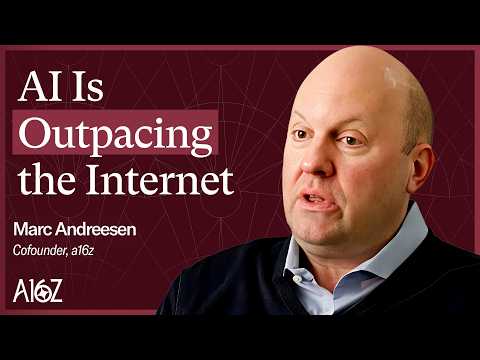
Andreessen Backs Rival AI Strategies on Collapsing Model Costs
a16z
Hyper-deflation in token prices allows applications to orchestrate multiple models locally, undermining the long-term economic moats of major foundation labs.
## Background
Published on YouTube by a16z on January 7, 2026, this AMA-style conversation features co-founder Marc Andreessen explaining why AI is the largest technology shift of his career. The discussion covers falling model costs, pricing strategies, the geopolitical race between the US and China, regulatory challenges, and how venture capital portfolios navigate these rapid changes.
## TL;DR
Marc Andreessen frames the current AI boom as the culmination of an 80-year technological evolution that is scaling at an unprecedented rate by leveraging the pre-existing internet as a carrier wave. He highlights a dual-model future where massive 'god models' coexist with highly capable, hyper-deflated smaller models like China's open-source 'Kimmy.' The conversation dives deep into the geopolitical rivalry with China, the self-inflicted regulatory traps of Europe and California, and the shifting dynamics between startups and incumbents. Ultimately, Andreessen explains how venture capital firms leverage portfolio diversification to bet on multiple conflicting strategies in a rapidly changing market.
## Atmosphere & style
The conversation has the intellectual, reflective, and slightly irreverent vibe of a seasoned Silicon Valley veteran holding court, blending deep historical tech analogies with sharp geopolitical realities. Andreessen's dynamic with the host is comfortable and conversational—likened to an 'old married couple' when discussing his partnership with Ben Horowitz—balancing high-stakes economic predictions with self-deprecating humor about venture capital failures and his reluctance to travel to Mars. It feels intellectually stimulating, grounded in real-world market data, and highly pragmatic about the messy but inevitable future of automation.
## Key takeaways
- [00:00](https://www.youtube.com/watch?v=xRh2sVcNXQ8&t=0s) There is a stark divide between public panic over AI and actual consumer behavior, which shows rapid, enthusiastic adoption.
- [01:22](https://www.youtube.com/watch?v=xRh2sVcNXQ8&t=82s) The AI boom is the culmination of a decades-long academic struggle between hyper-literal 'adding machine' computers and brain-modeled neural networks.
- [09:11](https://www.youtube.com/watch?v=xRh2sVcNXQ8&t=551s) Unlike the physical rollout of the internet, AI scales at near-light speed because it can be instantly downloaded over existing global networks.
- [12:28](https://www.youtube.com/watch?v=xRh2sVcNXQ8&t=748s) The cost of intelligence is collapsing faster than Moore's Law, driving massive elastic demand for 'tokens by the drink.'
- [16:12](https://www.youtube.com/watch?v=xRh2sVcNXQ8&t=972s) Smaller, cheaper models like China's 'Kimmy' are rapidly replicating the capabilities of massive frontier models, enabling local deployment on consumer hardware.
- [26:53](https://www.youtube.com/watch?v=xRh2sVcNXQ8&t=1613s) The global AI race is primarily a two-horse race between the US and China, shifting Washington's policy focus from restrictive regulations to active competition.
- [28:04](https://www.youtube.com/watch?v=xRh2sVcNXQ8&t=1684s) DeepSeek's sudden breakthrough proved that highly efficient, frontier-level open-source models can be built outside of traditional tech giants with far fewer resources.
- [32:45](https://www.youtube.com/watch?v=xRh2sVcNXQ8&t=1965s) While federal restrictions have eased, a chaotic patchwork of state-level bills threatens to stifle interstate AI innovation.
- [37:33](https://www.youtube.com/watch?v=xRh2sVcNXQ8&t=2253s) Draconian rules like the EU AI Act have severely damaged European tech competitiveness, serving as a warning against copycat bills like California's SB 1047.
- [41:51](https://www.youtube.com/watch?v=xRh2sVcNXQ8&t=2511s) Startups are moving away from pricing by token cost, instead pricing based on the replacement value of human labor or productivity gains.
- [52:44](https://www.youtube.com/watch?v=xRh2sVcNXQ8&t=3164s) Leading AI application startups are not shallow wrappers; they orchestrate dozens of specialized models and backward-integrate with proprietary data.
- [56:59](https://www.youtube.com/watch?v=xRh2sVcNXQ8&t=3419s) Unlike operating companies, venture capital firms can hedge strategic uncertainty by aggressively backing opposing theories simultaneously.
- [01:08:44](https://www.youtube.com/watch?v=xRh2sVcNXQ8&t=4124s) Society has experienced recurring waves of technological panic for 500 years, yet real-world utility and 'revealed preferences' always win out.
- [01:16:47](https://www.youtube.com/watch?v=xRh2sVcNXQ8&t=4607s) Delusions of grandeur in VC are quickly shattered by the brutal reality of failed investments and the daily reminders of passing on legendary companies.
## Detailed walkthrough
### [00:00](https://www.youtube.com/watch?v=xRh2sVcNXQ8&t=0s) The Unprecedented Takeoff of AI
The current wave of artificial intelligence companies is experiencing a revenue takeoff rate that is entirely unprecedented in tech history. Unlike previous cycles that relied on speculative future value, these companies are seeing actual customer demand translate directly into dollars landing in bank accounts. While the capabilities are already staggering, the products themselves are still in their infancy. The form and shape of the tools people use today will likely look vastly more sophisticated in five to ten years.
This rapid evolution presents trillion-dollar strategic and economic questions rather than settled answers. In the venture capital landscape, this uncertainty is an advantage. While a traditional company can be crippled if it bets on the wrong strategic direction, venture capital firms can hedge by aggressively investing in multiple competing strategies simultaneously.
* **The Paradox of Public Perception:** There is a stark divide between what people say about AI and what they actually do. "If you run a survey or a poll of what, for example, American voters think about AI, it's just like they're all in a total panic... 'It's going to kill all the jobs. It's going to ruin everything.' If you watch the revealed preferences, they're all using AI."
---
### [01:22](https://www.youtube.com/watch?v=xRh2sVcNXQ8&t=82s) The 80-Year Revolution
The current AI boom is not a sudden, isolated event, but rather the culmination of an 80-year-old technological debate. This is the largest technological revolution of our time—surpassing the scale of the internet and drawing comparisons to foundational milestones like the microprocessor, the steam engine, electricity, and the wheel.
To understand how we got here, one must look back to the 1930s and the very invention of the computer. At the time, the pioneers of computation debated two distinct paths. The first path modeled computers after "adding machines" or mechanical cash registers—hyper-literal mathematical processors. This was the path championed by companies like IBM (the successor to the National Cash Register Company of America). It built the multi-trillion-dollar computer industry we know today, spanning from mainframes to smartphones. However, these machines were fundamentally incapable of interacting with humans on human terms, such as understanding natural speech or language.
The second, alternative path was modeled on human cognition and neural networks. The first academic paper on neural networks was published in 1943 by Warren McCulloch and Walter Pitts.
* **The Shirtless Pioneer:** A striking artifact of this era is a 1946 television interview available on YouTube featuring Warren McCulloch. Speaking from his beach house—inexplicably shirtless—McCulloch vividly described a future where computers would be built on the model of the human brain.
* **The Academic Rump Movement:** Because the adding-machine model won the commercial race, neural network research was relegated to a fringe academic movement. Originally called "cybernetics" before being rebranded as "artificial intelligence," the field suffered eight decades of excessive optimism followed by crushing disappointment, including a notable boom-and-bust cycle in Silicon Valley during the 1980s. By 1989, AI was widely considered a dead-end academic backwater.
---
### [05:09](https://www.youtube.com/watch?v=xRh2sVcNXQ8&t=309s) The ChatGPT Crystallization
The long winter ended abruptly with the "ChatGPT moment" around Christmas of 2022. Decades of theoretical concepts and research suddenly crystallized into a working reality. Today, this technology is highly democratized; state-of-the-art models like ChatGPT, Grok, Gemini, Sora, Veo, Suno, and Udio are instantly accessible to anyone with an internet connection.
Silicon Valley has responded with an incredible rush of enthusiasm, showcasing its unique ability to rapidly recycle talent and capital from previous tech waves into the next frontier. This ecosystem is constantly fueled by jaw-dropping breakthroughs. On one side, new academic research papers detailing unexpected capabilities emerge daily; on the other, a constant stream of startups continues to push the boundaries of what is possible. While the journey will be messy, prone to overpromising, and occasionally hindered by high infrastructure costs, the underlying consumer and business demand remains incredibly robust.
---
### [09:11](https://www.youtube.com/watch?v=xRh2sVcNXQ8&t=551s) The Carrier Wave of the Internet
A common criticism of the AI boom is that while revenues are immense, the capital expenditures required to build and run these models are equally staggering. To understand the economics, it helps to compare AI to the rollout of the internet.
The internet required a massive, decades-long physical lift. Fiber-optic cables had to be laid in the ground, cell towers erected, and billions of smartphones, tablets, and laptops manufactured and shipped. The internet was invented in the 1960s and 1970s, but consumer dial-up didn't arrive until the early 1990s, residential broadband didn't scale until the 2000s (largely after the dot-com crash), and mobile broadband didn't truly arrive until around 2010. Even the original 2007 iPhone ran on a sluggish 2G network.
AI, by contrast, does not require building a new physical network. It uses the pre-existing internet as a "carrier wave," allowing it to deploy to over five billion connected people at near-light speed.
* **Frictionless Proliferation:** "You couldn't download electricity... you couldn't download indoor plumbing... but you can download AI."
* **Creative Monetization:** AI companies are proving to be far more creative with pricing than traditional SaaS or consumer internet companies. Instead of capping their upside with low-cost subscriptions, many are successfully introducing high-value tiers ranging from $200 to $300 per month for advanced consumer access.
[12:28](https://www.youtube.com/watch?v=xRh2sVcNXQ8&t=748s) The Enterprise Value of AI and "Tokens by the Drink"
On the enterprise side of artificial intelligence, the fundamental question is simple: "what is intelligence worth?" Companies are already seeing direct business payoffs from infusing AI into their operations. Even in the most prosaic use cases, businesses are successfully raising customer service scores, increasing upsells, reducing churn, and running marketing campaigns more effectively. Beyond these operational improvements, companies are embedding AI into new products—such as making cars talk—which makes "everything in the world kind of light up and start to get really smart." The leading AI infrastructure companies are experiencing tremendous pull and growing their revenues incredibly quickly, signaling an incredible product-market fit.
The core business model of this new era is highly compelling: "tokens by the drink," where customers purchase units of intelligence per dollar. Crucially, the price of AI is falling much faster than Moore's law. The per-unit costs of all inputs into AI are collapsing, creating a state of "hyper-deflation" that is driving a massive, elastic growth in demand. In any commodity-like market, "the number one cause of a glut is a shortage and the number one cause of a shortage is the glut." While there have been physical shortages of GPUs, infrastructure chips, and data center capacity, humanity's history shows that physically replicable shortages are always solved by massive replication. With hundreds of billions—or even trillions—of dollars currently "going into the ground," the per-unit costs for AI companies are going to drop like a rock over the next decade, creating highly favorable macroeconomic forces.
- **AWS GPU Optimization:** AWS recently noted they have been able to extend the useful life of their GPUs to seven-plus years, allowing for better optimization than in previous hardware cycles.
- **Cost Dynamics:** Hyper-deflation of per-unit token costs is triggering a massive demand response due to high market elasticity.
[16:12](https://www.youtube.com/watch?v=xRh2sVcNXQ8&t=972s) The Battle of Big vs. Small Models and the Rise of "Kimmy"
While much of the current data center buildout is oriented around training and serving massive "god models," a parallel "small model revolution" is occurring. Tracking the capability of leading-edge models over time reveals a consistent "chase function": within six to twelve months, a much smaller, cheaper model emerges that matches the capabilities of the previous giant model. A striking recent example is the open-source model "Kimmy" (spelled Kim Mi) out of China. According to recent benchmarks, the latest reasoning version of Kimmy has replicated the reasoning capabilities of GPT-5. While GPT-5 cost an astronomical amount of money to develop and serve, Kimmy can run locally on just "one MacBook or two MacBooks."
This rapid laddering allows businesses to deploy highly capable reasoning models locally without paying massive hosting fees, even as frontier labs like OpenAI push forward to GPT-6. While some industry experts believe everything will eventually run on giant models because users will always want the highest possible intelligence, the counterargument is that most economic tasks do not require an Einstein. "A 120 IQ person is great. You don't need a, you know, 160 IQ, you know, PhD in, you know, string theory." The AI industry is likely to structure itself similarly to the computer industry: a small handful of giant "supercomputer" models at the top, cascading down to a massive volume of smaller models running on individual chips inside every physical item in the world.
- **Kimmy Model:** A leading open-source reasoning model from China that replicates GPT-5 level capabilities on consumer hardware like MacBooks.
- **Industry Structure:** A top-heavy tier of "god models" supported by a massive, highly proliferated long-tail of embedded micro-models.
[19:51](https://www.youtube.com/watch?v=xRh2sVcNXQ8&t=1191s) The Evolution of AI Chip Architecture and the Nvidia "Bat Signal"
The chip industry historically moves from shortages to gluts. Nvidia is an outstanding company that fully deserves its current profits, but its massive valuation has become "the bat signal of all time to the rest of the chip industry" to advance AI hardware. Competitors like AMD are mounting campaigns, hyperscalers are building their own custom silicon, and Chinese firms are developing native chip ecosystems. Within five years, AI chips will be cheap and plentiful compared to today.
The dominance of GPUs (Graphical Processing Units) in AI is actually a "historical happenstance." Classically, PCs relied on a CPU (the brain) and a GPU (for 3D graphics, CAD/CAM, and Photoshop). Nvidia fought the GPU wars for 30 years to win a highly competitive, relatively low-margin graphics market. However, two highly lucrative, massively parallel applications emerged that perfectly fit the GPU architecture: cryptocurrency about 15 years ago, and AI about four years ago. If engineers were designing AI chips from scratch today, they would not build a full GPU; they would build dedicated AI chips specifically adapted for AI workloads to maximize economic efficiency. Startups are now designing these dedicated chips from scratch, and while building a chip company is difficult, they may succeed independently or be acquired by larger players looking to scale them.
- **Legacy PC Architecture:** Historically split between Intel's x86 CPUs and Nvidia's graphics-focused GPUs.
- **Parallel Computation Apps:** Cryptocurrency and AI emerged as the two killer apps that perfectly mapped to parallel GPU architectures.
- **Global Chip Competitors:** Major players from Korea, Japan, and China are actively building out native AI chip ecosystems to challenge US dominance.
[24:15](https://www.youtube.com/watch?v=xRh2sVcNXQ8&t=1455s) Geopolitics and Chinese Open-Source Models
The rise of highly advanced Chinese open-source models like Kimmy has caught the attention of policymakers in Washington, D.C. Given China's historical tendency to perform "unnatural things" to capture market share in sectors like solar panels and electric vehicles, there are growing concerns about whether they are intentionally flooding the AI ecosystem with open-source models to eventually dominate the global technology stack.
[24:53](https://www.youtube.com/watch?v=xRh2sVcNXQ8&t=1493s) The Geopolitical Reality: A New Cold War with China?
The discussion begins with a look at the vigorous debate in the US and globally regarding whether we have entered a new Cold War with China, and how hostile the Western stance should be. While there is a strong case to be made that this is a 21st-century equivalent of the US-USSR rivalry, the counterargument is that the current situation is far more complex. Unlike the Soviet Union, which was never deeply intertwined with the US from a trade standpoint—largely because the USSR "never really made anything that anybody else needed" besides weapons, wheat, and oil—China is deeply embedded in global supply chains.
Almost every physical product brought to market by an American company, from toys and cars to smartphones and computers, contains componentry manufactured in China. This tight economic interlinkage might be viewed through an Adam Smith lens as a force for peace, since both nations rely heavily on one another. Furthermore, the Chinese governance model is highly dependent on maintaining high employment to prevent civil unrest, which is the Chinese Communist Party's (CCP) ultimate fear. Because the American consumer represents roughly a third of global consumer demand, China desperately needs the US export market; a sudden cutoff would bankrupt Chinese factories and trigger mass unemployment.
- **US vs. USSR Trade Contrast**: The USSR primarily exported wheat and oil, whereas China exports a vast array of physical goods and critical components.
- **Global Consumer Demand**: The American consumer accounts for approximately one-third of global consumer demand, making the US market vital for Chinese economic stability.
[26:53](https://www.youtube.com/watch?v=xRh2sVcNXQ8&t=1613s) The Three Dimensions of the US-China Rivalry
Despite these economic ties, the bipartisan consensus in Washington DC over the last decade has been that the US must take China seriously as a geopolitical foe. This rivalry plays out across three distinct dimensions:
1. **The Military Dimension**: High-alert concerns over potential conflict in the South China Sea and around Taiwan.
2. **The Economic Dimension**: Debates surrounding the de-industrialization of the US, potential re-industrialization, and reducing dependence on Chinese manufacturing.
3. **The AI Dimension**: A geopolitical and economic race where cutting-edge AI is essentially only being built in the US and China.
Because the rest of the world either cannot or does not want to build leading-edge AI, it has become a "two-horse race." The critical question for Washington is whether American AI or Chinese AI will proliferate across the rest of the globe.
[28:04](https://www.youtube.com/watch?v=xRh2sVcNXQ8&t=1684s) China's AI Ecosystem and the Rise of DeepSeek
China is fully in the game on both software and hardware. In the software arena, several primary players have emerged, including DeepSeek, Alibaba's Qwen model, Moonshot's Kimmy, Tencent, Baidu, and ByteDance. On the hardware side, China is working incredibly hard to catch up on chips, led by Huawei. A common understanding in the US is that the next version of DeepSeek has been delayed because the Chinese government instructed the company to build it exclusively on Chinese chips to force the domestic chip ecosystem to mature.
The release of DeepSeek was a "supernova moment" that caught many by surprise. It was remarkable for several reasons:
- **Efficiency**: It took capabilities previously reserved for massive cloud-based models and shrunk them so they could run on smaller, local hardware.
- **Open Source**: It was released as open source, which is unusual given China's lack of a strong open-source history.
- **Idiosyncratic Origin**: It did not come from a major university, state lab, or tech giant, but rather from a highly successful quantitative hedge fund whose founder decided to build AI.
The atmospherics suggest that DeepSeek's breakthrough even surprised the Chinese government, coming completely "out of left field." This has been highly encouraging for the broader AI field, suggesting that superstar researchers and massive institutional backing are not strictly necessary—"smart kids can just build this stuff."
[31:24](https://www.youtube.com/watch?v=xRh2sVcNXQ8&t=1884s) Policy Shifts and the Myth of the One-Horse Race
DeepSeek's success kicked off a trend of Chinese companies releasing open-source models. While cynics in DC view this as "dumping"—an attempt to subsidize production and commoditize the AI industry to prevent the West from building a profitable sector—it also signals that China is a formidable competitor.
This realization has fundamentally shifted the policy landscape in Washington. Two years ago, there was a heavy push within the US government to restrict or outright ban certain AI developments. However, "it's very easy for a country that is the only game in town to have those conversations. It's quite another thing if you're actually in a foot race with China." The realization that this is a two-horse race has dramatically improved the federal policy outlook, shifting the focus away from ruinous restrictions that would prevent the US from beating China.
[32:45](https://www.youtube.com/watch?v=xRh2sVcNXQ8&t=1965s) The Threat of Fragmented State-Level Regulation
While the threat of destructive federal legislation has decreased, the battleground has shifted to the state level. Under the US system of federalism, states are moving forward with their own rules. Currently, observers are tracking roughly 1,200 AI-related bills across all 50 states, introduced by both Democrats and Republicans. This state-level push is driven by a mix of well-meaning concern and political opportunism from ambitious local legislators looking to attach themselves to a hot-button issue.
This patchwork of state laws is highly problematic because technology and AI are inherently interstate. "There's no AI company that just operates in California or just operates in... Colorado or Texas." While the federal government has the authority to regulate interstate commerce, it has yet to fully assert itself. An attempt to negotiate a moratorium on state-level AI regulation—reserving that power exclusively for the federal government—was part of a "one big beautiful bill" deal that ultimately blew up at the last minute. Critics felt the moratorium was too much of a stretch, but active discussions continue in DC to find a way for the federal government to take the lead.
- **State Bills Tracked**: Approximately 1,200 AI-related bills are being tracked across the 50 states.
- **Colorado's Retraction**: Colorado passed a highly draconian AI regulation bill last year over the furious objections of the Denver and Boulder startup ecosystems, and state lawmakers are already trying to reverse course.
[36:59](https://www.youtube.com/watch?v=xRh2sVcNXQ8&t=2219s) The Shadow of the EU AI Act and SB 1047
The most prominent legislative battle occurred in California over SB 1047. This bill was heavily modeled after the European Union's AI Act, which was passed about two years ago. The speaker argues that the EU AI Act has effectively "killed AI development in Europe to a large extent." The European regulations are so draconian that even major American tech giants like Apple and Meta are choosing not to launch their leading-edge AI capabilities in European markets, serving as a stark warning for US policymakers.
### [37:33](https://www.youtube.com/watch?v=xRh2sVcNXQ8&t=2253s) The European Regulatory Trap and the California Copycat
The European approach to technology has fallen into a classic regulatory trap. There is a prevailing attitude in Europe that "if we can't be the leaders in innovation, at least we can be the leaders in regulation." This mindset has led to ruinous, self-harming policies like the GDPR, which the European Union is now desperately trying to unwind after realizing the damage done to their own competitiveness. The most pessimistic people regarding Europe's future are actually European entrepreneurs who fled to the United States, furious over the regulatory environment. This struggle was highlighted by former Italian Prime Minister Mario Draghi in the "Draghi report" on European competitiveness, which detailed how overregulation is actively holding the region back, particularly in AI.
Despite Europe's clear regulatory regrets, California inexplicably attempted to copycat the EU AI Act through Sacramento's political machinery. This bill, which passed both houses of the state legislature before being vetoed at the last minute by the governor, would have completely killed AI development in California. Most destructively, it sought to assign downstream liability to open-source developers.
Under such a framework, an independent developer, academic, or startup could release an open-source model that works perfectly. If, five years later, a third party integrates that model into a nuclear power plant and a meltdown occurs, the original developer could be held legally liable. This "completely insane" approach would have entirely destroyed open-source development, academic research, and early-stage startups in the state. While federal regulators seem to understand these dangers, state-level politicians continue to play with fire.
- **The Draghi Report:** A comprehensive report on European competitiveness by Mario Draghi, outlining how overregulation in areas like AI holds Europe back.
- **Downstream Liability:** The proposed California law would have held original open-source creators legally liable for any future, downstream misuse or failures of their models.
- **Bipartisan Tech Agenda:** Andreessen Horowitz operates a highly focused, bipartisan "little tech agenda" aimed strictly at protecting the freedom of startups to innovate.
- **The Collective Action Problem:** While every venture firm and tech company should theoretically fight these regulatory overreaches, most do not, forcing industry leaders to step up and "take responsibility for our own destiny."
---
### [41:51](https://www.youtube.com/watch?v=xRh2sVcNXQ8&t=2511s) The Trillion-Dollar Question of AI Pricing
The question of whether AI should be priced based on usage (utility/tokens) or per seat is one of the "trillion-dollar questions" that will shape the future of market value. Currently, a fascinating dynamic is playing out. The major tech companies, locked in an intense cloud war (AWS vs. Azure vs. Google Cloud), have chosen to distribute their highly advanced, proprietary AI models as utility-based cloud services. Instead of keeping their "magic AI secret and captive" to use solely for their own businesses, they have made it available to anyone on the planet "by the drink."
For startups, this usage-based pricing is a massive blessing. It eliminates giant fixed R&D costs, allowing founders to easily tap into intelligence tokens from OpenAI, Anthropic, Google, or Microsoft for relatively small amounts of money. While this model works exceptionally well for cloud providers reporting massive revenue growth, it is not necessarily the optimal pricing strategy for downstream applications.
- **Pricing by Value vs. Cost:** A core principle of sophisticated pricing is to avoid pricing by cost (tokens) and instead price by the business value delivered.
- **Replacement Value:** Startups are exploring pricing models based on the cost of the human labor the AI replaces, such as a coder, doctor, lawyer, or paralegal.
- **Marginal Productivity:** Companies are experimenting with pricing based on a percentage of the productivity uplift generated by the symbiotic relationship between a human professional and an AI assistant.
- **The Virtue of High Prices:** High prices are an underappreciated "gift for the customer" because higher margins allow vendors to invest heavily in R&D, making the product better and faster.
---
### [47:01](https://www.youtube.com/watch?v=xRh2sVcNXQ8&t=2821s) The Open Source vs. Closed Source Debate
The battle between open-source and closed-source AI models remains entirely open. While some market observers periodically worry that proprietary models are hitting a capability ceiling, researchers inside the major labs remain highly optimistic. They have "800 new ideas" and are constantly discovering new ways to scale and improve their proprietary models. At the same time, open-source models continue to make astonishing leaps, frequently releasing highly optimized, smaller form-factor models like "Kimmy" that pack incredible capabilities.
Beyond raw performance, open source serves a vital educational purpose. It allows computer science professors, students, independent engineers, and "somebody in a basement at night with a startup idea" to look under the hood and learn exactly how state-of-the-art AI is built. This rapid proliferation of knowledge prevents AI expertise from being bottled up inside just two or three massive corporations. Currently, the extreme supply-demand imbalance has made top-tier AI researchers incredibly scarce, commanding compensation packages that rival those of professional athletes.
- **Rapid Progress:** Both closed-source labs and open-source communities are maintaining a breakneck pace of innovation, defying rumors of a plateau.
- **Educational Proliferation:** Open-source models act as a primary textbook for the next generation of AI developers, accelerating global technical literacy.
- **Talent Premium:** The shortage of elite AI researchers has driven their market value to heights comparable to professional sports stars.
[49:45](https://www.youtube.com/watch?v=xRh2sVcNXQ8&t=2985s) The Rapid Spread of AI Expertise and the Dual-Model Future
The speed at which young talent is mastering artificial intelligence is unprecedented. Some of the absolute best AI minds in the world today are only 22, 23, or 24 years old. Because the modern wave of AI is so new, "by definition they haven't been in the field that long" and could not have been lifelong experts. Instead, they have rapidly come up to speed over just the last four or five years. This rapid acquisition of expertise suggests that a massive wave of highly skilled talent will continue to flood the industry in the coming years, accelerating the spread of technical know-how globally.
Because of this fast-moving talent pool, the landscape remains a highly competitive race. The long-term market structure will likely accommodate both massive frontier models and a high volume of smaller models. Under this "pyramid industry structure," there will always be a highly lucrative business for whatever represents the absolute smartest, most capable AI—almost regardless of how much it costs to build and run. Simultaneously, a giant volume market of smaller, cheaper models will proliferate everywhere to handle day-to-day tasks.
- **Demographics of AI Talent:** Top-tier experts are frequently in their early 20s, having mastered the field in under five years.
- **Pyramid Market Structure:** The top of the pyramid is occupied by the single smartest "god model" (highly valued regardless of cost), while the base consists of a massive volume of smaller, ubiquitous models.
[50:38](https://www.youtube.com/watch?v=xRh2sVcNXQ8&t=3038s) The Rise of New Incumbents and the Next Generation of Foundation Models
The dynamic between incumbents and startups has shifted radically over the last two years. Established tech giants like Google, Meta, Amazon, and Microsoft are playing incredibly hard and aggressively. Alongside them, older startups like Anthropic and OpenAI have matured into what are now considered "new incumbents." Even within the last two years, brand-new companies have emerged and achieved instant incumbent status. A prime example is Elon Musk's xAI, as well as Mistral AI in France. Mistral stands out as a highly successful "European continental AI champion," serving as the exception that proves the rule regarding Europe's general struggle to produce tech giants.
Meanwhile, a brand-new wave of foundation model startups is already underway. Venture capital is actively funding these fresh attempts, including Safe Superintelligence (SSI) founded by Ilya Sutskever (who left OpenAI), a new venture by former OpenAI CTO Mira Murati, and World Labs founded by Stanford professor Fei-Fei Li to build "world foundation models." Beyond these core technology players, there is a massive explosion of AI application startups taking these models and deploying them into specific domains like law, medicine, education, and creative fields.
- **New Incumbents:** Companies like Anthropic, OpenAI, xAI, and Mistral have rapidly solidified their positions at the top.
- **European Exception:** Mistral AI is highlighted as the continental champion succeeding despite Europe's broader tech headwinds.
- **Newly Funded Foundation Startups:**
- Ilya Sutskever's new company (Safe Superintelligence).
- Mira Murati's new venture.
- Fei-Fei Li's World Labs (focused on spatial intelligence and world models).
[52:44](https://www.youtube.com/watch?v=xRh2sVcNXQ8&t=3164s) The Fallacy of the "GPT Wrapper" and the Reality of Deep Tech Applications
A common critique of AI application companies—such as the popular AI-powered code editor Cursor—is that they are merely "GPT wrappers." This pejorative term implies that these startups are shallow, pass-through shells that purchase API tokens "by the drink" from providers like Anthropic or OpenAI without building any defensible, long-term value. However, the reality on the ground is proving to be the exact opposite. The leading application companies are proving to be highly sophisticated, full-fledged deep technology operations.
Instead of relying on a single API, advanced application companies orchestrate dozens of different models custom-tailored to specific product features. Over time, a single application might call upon 50 or 100 different models. Furthermore, these startups are backward-integrating by building their own proprietary models. Because they possess the deepest domain-specific data and user insights, they are best positioned to train models optimized for their exact use cases. They also heavily leverage open-source models to bypass the expensive economics of buying proprietary API intelligence from cloud providers. Some of these leading application startups are even quietly venturing into large-scale model development.
- **Cursor Example:** Cursor operates as an AI-first Integrated Development Environment (IDE) that has moved far beyond simple API wrapping.
- **Model Orchestration:** Advanced apps utilize dozens of specialized models rather than relying on a single general-purpose LLM.
- **Backward Integration:** Startups are training their own proprietary models and adopting open-source alternatives to control their economics and technology stack.
[55:02](https://www.youtube.com/watch?v=xRh2sVcNXQ8&t=3302s) The Trillion-Dollar Question of Catching Up and the DeepSeek Moment
The last two years have yielded a major revelation: keeping a permanent lead in AI is incredibly difficult. A few years ago, the consensus was that OpenAI was so far ahead that catching up would be impossible. Then Anthropic caught up, though skeptics hand-waved this because Anthropic's founders came from OpenAI and "had all the secrets." However, xAI proved the skeptics wrong by catching up to state-of-the-art OpenAI and Anthropic levels in less than 12 months from a standing start.
This trend of rapid catching-up became even more pronounced with the "DeepSeek moment" out of China in early 2025. In a matter of months, about four Chinese companies effectively caught up to Western frontier performance. These are "trillion-dollar questions, not answers," but they suggest that once someone proves a capability is possible, it is not as difficult or resource-intensive for others to replicate it. This reality might make investors slightly more skeptical of the long-term economic moats of the giant foundation model players, but it makes them incredibly bullish on the startup ecosystem, application companies, and the competitive pressure driving American innovation forward.
- **xAI's Velocity:** Elon Musk's xAI reached state-of-the-art performance with Grok in under a year.
- **The DeepSeek Moment:** Occurring around January or February of 2025, DeepSeek and other Chinese firms proved that catching up to frontier models requires far fewer resources than initially assumed.
- **Economic Moats:** The ease of replication challenges the assumption of a permanent, defensible lead for any single tech giant.
[56:59](https://www.youtube.com/watch?v=xRh2sVcNXQ8&t=3419s) The Venture Advantage: Betting on Contradictory Strategies
For an operating company, facing open strategic and economic questions is highly dangerous. A company must choose a single, coherent strategy to deploy its capital and personnel, or it risks collapsing into chaos. Venture capital firms, however, enjoy a unique structural advantage: "we can bet on multiple strategies at the same time." Andreessen Horowitz (a16z) is aggressively investing in opposing theories, backing big models and small models, proprietary pre-trained models and open-source models, foundation technologies and applications, as well as consumer and enterprise plays.
This portfolio approach is not merely a hedge; it is a recognition that the world is messy and multiple approaches will likely succeed simultaneously. If one strategy fails, the firm still has representation in the winning alternative. This is why having massive, unresolved industry questions brings "a big smile" to a venture capitalist's face, as the uncertainty directly plays to their structural advantage.
> "The portfolio approach, the nature of it is like we are aggressively basically... investing behind every strategy that we've identified that we think has a plausible chance of succeeding, even when that's contradictory to another strategy that we're investing in."
[58:39](https://www.youtube.com/watch?v=xRh2sVcNXQ8&t=3519s) The "Old Married Couple" and the Power of Controversial Marketing
When asked what he and co-founder Ben Horowitz "disagree and commit" on, the speaker jokes that they are like an "old married couple" where "the romance is long dead" and they are constantly "in the park squabbling." Despite the constant debates, their partnership works because they are both open to persuasion and almost always arrive at the same conclusion naturally, leaving very few lingering disagreements.
The most frequent and nuanced topic they debate is the public footprint of the firm. There is a constant tension regarding how outspoken and controversial they should be. Historically, taking bold, brave, and sometimes controversial public stances has been an incredible competitive advantage for attracting top-tier founders. Founders appreciate the demonstration of courage and feel they know who a16z is before they even walk through the door. While this active outbound marketing strategy has worked incredibly well since the firm's inception, it also introduces public externalities and complications that require constant, careful navigation by their communications team.
- **Partnership Dynamic:** Ben Horowitz and the speaker debate constantly but rarely have unresolved "disagree and commit" deadlocks.
- **The Marketing Edge:** Being outspoken and taking controversial stands acts as a powerful beacon for founders who value courage and transparency.
- **Externalities:** High public visibility brings external pressures, which the firm manages through a dedicated outbound and communications team led by Eric Worenberg.
[01:02:04](https://www.youtube.com/watch?v=xRh2sVcNXQ8&t=3724s) Communicating with Washington and the "Andreessen Horowitz" Monolith
Andreessen Horowitz is tripling down on its strategy of being a leader in articulating the critical tech and business issues of the day. A significant portion of their communications is deliberately aimed at Washington, D.C. Policy makers sitting 3,000 miles away in the nation's capital often rely on East Coast newspapers that harbor a deep-seated dislike for Silicon Valley. To counter this, the firm broadcasts informed points of view on technology. They frequently meet people in D.C. who tell them, "Yeah, I... most of what I know about this topic I learned from you guys because I listened to the podcast, I read the articles, I watched the YouTube channel." While they are on the front foot with this strategy, Marc Andreessen and Ben Horowitz still go back and forth on exactly how many "third rail" topics they should touch and how frequently, ultimately trying to moderate their approach.
The host jokes that, as Elizabeth Taylor once said, as long as they spell the name right, press is usually good—especially when it comes to "little tech." He also notes that after 30-plus years of working together, the relationship between Marc and Ben has become so intertwined that some people refer to Marc as "Andreessen and Horowitz" combined into a single person.
- **Target Audience:** Washington policy makers who are otherwise isolated from Silicon Valley's perspective.
- **Partnership Longevity:** Marc Andreessen and Ben Horowitz have been working together for over 30 years.
[01:03:39](https://www.youtube.com/watch?v=xRh2sVcNXQ8&t=3819s) Navigating Technology Waves: From the Internet to Crypto and AI
Reflecting on the firm's reorganization around AI and the launch of American Dynamism (AD) two years prior, Andreessen believes they made the right calls. The foundational theory of venture capital is that real money is made during fundamental architecture shifts in the technology landscape. When a massive shift occurs, it triggers a period of intense creativity where aggressive startups can win categories before slow-moving incumbents can react. Without these transitions, startups struggle because big companies inevitably dominate. The best venture firms in history, such as Kleiner Perkins and Sequoia, succeeded because they aggressively navigated from wave to wave over 30, 40, or 50 years.
Andreessen recalls arriving in Silicon Valley in 1994 when there was no dedicated "internet venture capital firm." However, Kleiner Perkins recognized the internet as a massive architectural shift, despite critics calling it crazy and claiming no one could make money on it. KP backed Netscape, Amazon, Google, and @Home (which made home broadband work), successfully transitioning from their 1970s roots in minicomputers.
In contrast, Andreessen expresses bewilderment at the many venture capitalists who deliberately chose to sit out the crypto wave between the release of the Bitcoin white paper in 2009 and the "crypto wars" of 2021. He questions how a VC can choose to ignore a major new technology wave, asking, "Is that not the job?" While those VCs looked briefly smart during the recent regulatory crackdowns, they look less smart now that crypto is exciting again due to policy changes. The same dynamic is playing out in AI, where some firms are jumping in headfirst while others are sitting back. Andreessen warns that firms in the 1980s that failed to make the jump to the internet eventually petered out.
- **Venture Capital Thesis:** Wealth in VC is generated by fundamental technological architecture shifts.
- **Historical Example:** Kleiner Perkins successfully transitioned from minicomputers in the 1970s to the internet in the 1990s.
- **Intersections of Tech:** AI is acting as a massive driver for other sectors, including American Dynamism (energy and materials), biotech (drug discovery and healthcare), and crypto.
[01:08:44](https://www.youtube.com/watch?v=xRh2sVcNXQ8&t=4124s) The History of Automation Panics and "Revealed Preferences"
While critics worry that AI will eliminate jobs, the physical-world sectors of American Dynamism—such as energy and data center construction—are experiencing unprecedented demand for labor. Addressing the speed of technology adoption, Andreessen points out that society has experienced recurring waves of total panic and freakout over new technology for over 500 years. The printing press was feared because of its role in the rise of Protestantism, and the last 200 years have seen continuous automation panics. The foundational panic of Marxism was a fear that automation would eliminate jobs, centralize wealth in the hands of a few, and leave everyone else miserable—an argument Andreessen notes "was wrong then is wrong now."
Even in the 1960s, a massive AI job panic occurred during the Lyndon B. Johnson administration. In 1964, a group of leading academics and public figures formed the "Committee for the Triple Revolution" and sent a manifesto to the White House warning that the march of technology had to be stopped. Similar panics occurred over outsourcing in the 2000s and robots in the 2010s (which was highly ironic because robots barely worked then and still struggle now). Recently, Prince Harry headlined an AI pause letter warning that AI would ruin everything. Andreessen argues that Silicon Valley must respect these fears rather than be cynical. Like "the dog that caught the bus," tech founders wanted to work on things that matter, and now they must responsibly explain and defend their work.
To understand how society actually feels about AI, Andreessen points to the classic social science distinction between what people say (stated preferences) and what they do (revealed preferences). If you run a survey or poll, American voters express total panic, claiming AI is terrible and will destroy all jobs. However, if you observe their actual behavior, they are downloading AI apps, using ChatGPT at work, and using it to resolve personal arguments.
- **1964 Manifesto:** The "Committee for the Triple Revolution" warned the Johnson White House about automation destroying society.
- **Stated vs. Revealed Preferences:** Surveys show high anxiety about AI, but consumer behavior shows rapid, widespread adoption of AI tools in daily life.
[01:14:07](https://www.youtube.com/watch?v=xRh2sVcNXQ8&t=4447s) The Divergence Between Public Debate and Real-World AI Adoption
There is a fascinating gap between what people say about AI in public and how they actually use it in their private lives. People are quietly integrating tools like ChatGPT into their most intimate and practical daily scenarios. For instance, someone might copy and paste a difficult text exchange with their partner into ChatGPT, asking the AI to explain what their partner is thinking and how to reply so they are "not mad at me anymore." Others use it to diagnose skin conditions, or to save their bacon at work when they run out of time to prepare a Monday morning report.
Despite the hand-wringing in public discourse, the actual data shows that people not only use this technology, but they love it and are adopting it as fast as they possibly can. This public debate will likely ping-pong back and forth for a while, but real-world utility will ultimately win out. This technology is following the classic adoption curve of every major historical innovation: it proliferates broadly, freaks everyone out, and then, within five to twenty years, everyone looks back and says, "Thank God we've got it. Wouldn't life be miserable if we didn't have this?"
The host shares a funny real-world anecdote confirming this trend. Just the previous week on a flight, he watched the passenger sitting next to him actively prompting ChatGPT to "help me draft an escalation letter to United for the delay on this flight." The host joked to himself, "Sir, you are on the flight right now. Like at least wait until it's over," though he admitted the AI-crafted email was likely excellent.
[01:15:48](https://www.youtube.com/watch?v=xRh2sVcNXQ8&t=4548s) Lightning Round: Changing Minds and Cryogenics
Transitioning into a fun, rapid-fire lightning round, the host asks what the speaker has changed his mind on recently, offering bonus points if the influence came from someone younger. The speaker notes that changing his mind is a "routine experience" that happens almost every day, usually regarding what is possible. While he struggles to recall a specific anecdote on the spot, he notes that these shifts are frequently sparked by something a very young person writes or says, calling it a "good way to stay young."
When asked if he plans to be cryogenically frozen, the speaker gives a definitive "not with current cryogenic technology." He points out that the track record of the industry is not great and the existing stories are "somewhat horrifying," though he leaves the door open for the future with a cautious "we'll see."
[01:16:47](https://www.youtube.com/watch?v=xRh2sVcNXQ8&t=4607s) Staying Grounded and the Humility of Venture Capital
Addressing how he stays grounded when his own influence has the potential to distort reality around him, the speaker acknowledges that the "reality warping effect" is a genuine concern. Coming from a Midwestern background, he notes that Midwesterners are "either are very humble or we're really good at faking it," making the topic somewhat difficult to discuss. He admits there is a major advantage to this warping effect—namely, "being able to get people to do what you want them to do"—but says staying anchored in truth is vital.
To stay grounded, he relies on forthright partners like Ben Horowitz who readily tell him when he is wrong. More importantly, the venture capital business itself is highly exposed to reality, which quickly shatters any delusions. You can have long, elaborate, highly analytical theories about an investment, only for reality to "smack you square in the face" and prove your analysis completely wrong.
The host recalls a favorite quote from a previous interview, noting that when a VC invests in a company that fails, it quietly goes bankrupt; but when they pass on a company that goes on to do fantastically well, they have to hear about it every single day for the next 30 years. The speaker laughs and agrees, noting that every great VC has a story of a legendary company sitting right in their office that they passed on. Having constant reminders of your giant mistakes in the *Wall Street Journal* and on CNBC is incredibly effective for "the old humility factor." Additionally, he jokes that he has "the entire internet ready to tell me that I'm an idiot" on a regular basis.
- **The Humility of VC:** Delusions do not last long because investments either work or they do not, exposing intellectual errors quickly.
- **The Ultimate Frustration:** The most humbling moments are when superior analysis leads to a decision that turns out to be completely wrong, resulting in "value subtract" rather than value add.
[01:20:06](https://www.youtube.com/watch?v=xRh2sVcNXQ8&t=4806s) Traveling to Mars
For the final question, the host asks if the speaker would ever go to Mars if the opportunity arose. The speaker responds with a prompt "probably not," joking that he is "barely willing to leave my house," let alone California. He would, however, gladly visit Mars via virtual reality.
Despite his own reluctance to make the trip, he believes Elon Musk will pull it off and would not be surprised to see routine trips back and forth within a decade. While the speaker will stay behind, he knows many people who are eager to go. The host enthusiastically volunteers himself for the journey, joking that his frequent long-haul flights around the world have fully prepared him for the six-month journey to Mars.
## Notable quotes
> [00:00](https://www.youtube.com/watch?v=xRh2sVcNXQ8&t=0s) If you run a survey or a poll of what, for example, American voters think about AI, it's just like they're all in a total panic... 'It's going to kill all the jobs. It's going to ruin everything.' If you watch the revealed preferences, they're all using AI. — Marc Andreessen
> [09:11](https://www.youtube.com/watch?v=xRh2sVcNXQ8&t=551s) You couldn't download electricity... you couldn't download indoor plumbing... but you can download AI. — Marc Andreessen
> [12:28](https://www.youtube.com/watch?v=xRh2sVcNXQ8&t=748s) the number one cause of a glut is a shortage and the number one cause of a shortage is the glut. — Marc Andreessen
> [16:12](https://www.youtube.com/watch?v=xRh2sVcNXQ8&t=972s) A 120 IQ person is great. You don't need a, you know, 160 IQ, you know, PhD in, you know, string theory. — Marc Andreessen
> [37:33](https://www.youtube.com/watch?v=xRh2sVcNXQ8&t=2253s) if we can't be the leaders in innovation, at least we can be the leaders in regulation. — Marc Andreessen
> [56:59](https://www.youtube.com/watch?v=xRh2sVcNXQ8&t=3419s) The portfolio approach, the nature of it is like we are aggressively basically... investing behind every strategy that we've identified that we think has a plausible chance of succeeding, even when that's contradictory to another strategy that we're investing in. — Marc Andreessen
> [01:15:48](https://www.youtube.com/watch?v=xRh2sVcNXQ8&t=4548s) not with current cryogenic technology. — Marc Andreessen
> [01:20:06](https://www.youtube.com/watch?v=xRh2sVcNXQ8&t=4806s) probably not — Marc Andreessen
## Mentioned
Marc Andreessen, Ben Horowitz, a16z, IBM, Warren McCulloch, Walter Pitts, ChatGPT, Grok, Gemini, Sora, Veo, Suno, Udio, AWS, Nvidia, AMD, Kimmy, OpenAI, DeepSeek, Alibaba, Qwen, Moonshot, Tencent, Baidu, ByteDance, Huawei, Apple, Meta, Mario Draghi, Anthropic, Google, Microsoft, Mistral AI, Safe Superintelligence, Ilya Sutskever, Mira Murati, Fei-Fei Li, World Labs, Cursor, Kleiner Perkins, Sequoia, Elon Musk
Marc Andreessen argues that artificial intelligence is driving an unprecedented technological and economic shift enabled by collapsing compute costs and instant distribution over existing internet infrastructure. In his view, this transition has formed an intense two-horse race between the United States and China where software leads compress rapidly and ill-conceived domestic regulation poses the greatest risk to Western leadership.
Infrastructure Economics and Collapsing Token Costs (12:28)
Unlike the internet, which required decades of physical infrastructure buildouts like laying fiber-optic cables and erecting cell towers, AI leverages existing networks as a carrier wave to reach over five billion connected users frictionlessly. Andreessen notes that this distribution is paired with an unprecedented revenue takeoff and flexible monetization, with companies moving beyond low-cost SaaS subscriptions to implement high-value tiers between $200 and $300 monthly.
On the enterprise side, Andreessen asserts that token input costs are experiencing hyper-deflation, falling significantly faster than Moore's law. While physical shortages in data center capacity and GPUs persist, he argues that physically replicable shortages historically cycle into gluts. He points to hyperscalers like AWS extending GPU operational life cycles past seven years and global competitors developing alternative silicon as indicators that per-unit intelligence costs will fall dramatically over the coming decade.
Frontier God Models Versus Ubiquitous Small Models (16:12)
Andreessen anticipates an industry structure resembling a pyramid rather than a winner-take-all monopoly. At the top sits a capital-intensive tier of frontier 'god models' providing supreme reasoning capacity regardless of serving costs. Beneath this frontier exists a massive, proliferating ecosystem of smaller, cheaper models capable of handling everyday economic tasks, which Andreessen contends rarely require peak theoretical intelligence.
This bifurcated architecture is driven by a consistent chase dynamic where smaller open-source releases match giant proprietary models within six to twelve months. As an example, Andreessen cites the Chinese open-source model Kimmy, which reportedly replicated GPT-5 level reasoning while running locally on consumer hardware like MacBooks. Concurrently, he rejects the notion that downstream startups are shallow 'GPT wrappers,' pointing to tools like Cursor that orchestrate dozens of specialized models, incorporate open-source weights, and backward-integrate custom architectures using domain-specific data.
The US-China Duopoly and Rapid Frontier Convergence (28:04)
The geopolitical landscape has crystallized into a direct two-horse race between the US and China, marked by profound trade entanglements that differentiate it from the US-Soviet rivalry. Andreessen highlights that China's reliance on American consumer demand creates economic interdependence, even as competition escalates across military spheres, manufacturing, and AI supremacy. He characterizes the early 2025 release of DeepSeek as a catalyst proving that achieving frontier reasoning capabilities does not require infinite capital or massive institutional incumbency.
This rapid convergence—further demonstrated by xAI reaching state-of-the-art parity in under 12 months—challenges the assumption that frontier foundation labs enjoy durable competitive moats. While some Washington policymakers suspect open-source releases represent subsidized dumping to undermine Western software margins, Andreessen observes that the reality of foreign competition has favorably shifted federal policy away from restrictive domestic moratoriums.
Regulatory Fragmentation and the European Precedent (32:45)
While federal rhetoric has pivoted toward competitiveness, Andreessen views state-level legislative action as an acute domestic threat, with observers tracking roughly 1,200 AI-related bills across 50 states. He argues that fragmented local mandates threaten an inherently interstate technology, citing Colorado's recent legislative reversal and California's vetoed SB 1047. In particular, Andreessen warns that assigning downstream liability to open-source developers for third-party model misuse would effectively paralyze academic research and early-stage software development.
Andreessen points to Europe as a cautionary precedent, arguing that the EU AI Act and GDPR institutionalized a regulatory mindset that severely curtailed the continent's tech competitiveness, as highlighted in Mario Draghi's competitiveness report. With major US firms withholding frontier releases from European markets, Andreessen contends that American policymakers must assert federal preemption to avoid replicating European stagnation.
Unresolved questions center on whether frontier foundation model labs can sustain durable economic defensibility given rapid open-source replication and hyper-deflating token costs. Furthermore, while Andreessen highlights a sharp divide between public anxiety regarding labor disruption and the rapid adoption revealed in private consumer behavior, navigating the resulting political friction and fragmented state legislation remains the industry's most delicate operational challenge.
[0:00] Marc Andreessen: If you run a survey or a poll of what, for example, American voters think about AI, it's just like they're all in a total panic... 'It's going to kill all the jobs. It's going to ruin everything.' If you watch the revealed preferences, they're all using AI.
[9:11] Marc Andreessen: You couldn't download electricity... you couldn't download indoor plumbing... but you can download AI.
[12:28] Marc Andreessen: the number one cause of a glut is a shortage and the number one cause of a shortage is the glut.
[16:12] Marc Andreessen: A 120 IQ person is great. You don't need a, you know, 160 IQ, you know, PhD in, you know, string theory.
[37:33] Marc Andreessen: if we can't be the leaders in innovation, at least we can be the leaders in regulation.
[56:59] Marc Andreessen: The portfolio approach, the nature of it is like we are aggressively basically... investing behind every strategy that we've identified that we think has a plausible chance of succeeding, even when that's contradictory to another strategy that we're investing in.
[75:48] Marc Andreessen: not with current cryogenic technology.
[80:06] Marc Andreessen: probably not
Original transcript
[0:00] this new wave of AI companies is is
[0:01] growing revenue like just like actual
[0:03] customer revenue, actual demand
[0:05] translated through to dollars showing up
[0:07] in bank accounts at like an absolutely
[0:08] unprecedented takeoff rate. We're seeing
[0:10] companies grow much faster. I'm very
[0:12] skeptical that the form and shape of the
[0:14] products that people are using today is
[0:15] what they're going to be using in 5 or
[0:16] 10 years. I think things are going to
[0:17] get much more sophisticated from here.
[0:19] And so I think we probably have a long
[0:20] way to go. These are trillion dollar
[0:21] questions, not answers. But once
[0:23] somebody proves that it's capable, it
[0:25] seems to not be that hard for other
[0:27] people to be able to catch up, even
[0:28] people with far less resources. When a
[0:30] company is confronted with fundamentally
[0:32] open strategic or economic questions,
[0:34] it's often a big problem. Companies like
[0:36] need to answer these questions and if
[0:38] they get the answers wrong, they're
[0:39] really in trouble. Venture, we can bet
[0:41] on multiple strategies at the same time.
[0:42] We are aggressively investing behind
[0:44] every strategy that we've identified
[0:46] that we think has a plausible chance of
[0:47] working. If you want to understand
[0:49] people, there's basically two ways to
[0:50] understand what people are doing and
[0:51] thinking. One is to ask them and then
[0:53] the other is to watch them. And what you
[0:55] often see in many areas of human
[0:57] activity, including politics and many
[0:59] different aspects of society, the
[1:00] answers that you get when you ask people
[1:02] are very different than the answers that
[1:03] you get when you watch them. If you run
[1:04] a survey or a poll of what, for example,
[1:07] American voters think about AI, it's
[1:08] just like they're all in a total panic.
[1:10] It's like, "Oh my god, this is terrible.
[1:11] This is awful. It's going to kill all
[1:12] the jobs. It's going to ruin
[1:13] everything." If you watch the revealed
[1:14] preferences, they're all using AI.
[1:22] A lot of folks have sent questions ahead
[1:23] of time and and what I what I've done is
[1:25] kind of curated into a few different
[1:26] sections uh in in an AMA this morning
[1:29] with uh with Mark. So, what we thought
[1:30] we'd do is cover uh four big topics. So,
[1:32] AI and what's happening in the markets,
[1:34] policy and regulation, um all things
[1:37] 816Z, and then we've got a a fun
[1:39] catchall which we're we're calling
[1:40] sandbox of things if we get to it. So,
[1:43] starting first maybe with uh with the
[1:44] biggest question. We're sitting in the
[1:46] middle of the AI revolution. Mark, what
[1:48] inning do you think we're in and and
[1:49] what are you most excited about?
[1:51] >> First of all, I I would say this is the
[1:52] biggest tech technological revolution of
[1:54] my life. Um and you know, hopefully I'll
[1:56] see more like this in the next whatever
[1:58] 30 years, but I I mean this is the big
[2:00] one. Um and just in terms of order of
[2:02] magnitude, like this is clearly bigger
[2:03] than the internet. Um like the the the
[2:06] comps on this are things like the
[2:08] microprocessor and the steam engine and
[2:10] electricity. So that this is a really
[2:11] this is a really big one. um the wheel.
[2:14] Um the reason this is so big, I mean
[2:17] maybe obvious to folks at this point,
[2:19] but I'll just go through it quickly. So
[2:21] um if you kind of trace all the way back
[2:23] to the 1930s, uh there's a great book
[2:25] called Rise of the Machines that kind of
[2:26] goes through this. Um if you trace all
[2:27] the way back to the 1930s, there was
[2:29] actually a debate among the people who
[2:30] actually invented the computer. Um and
[2:32] it was this this sort of debate between
[2:34] whether computer they kind of understood
[2:35] the theory of computation before they
[2:37] before they they actually built the
[2:38] things. Um and um they they had this big
[2:41] debate over whether the computer should
[2:42] be basically built in the image of what
[2:44] at the time were called adding machines
[2:45] or calculating machines where you know
[2:47] think of sort of essentially cash
[2:49] registers. Um IBM is actually the
[2:51] successor company to the national cash
[2:52] register company uh of America. Um and
[2:55] so like and and and that was of course
[2:57] the path that the industry took which
[2:58] was building these kind of hyper literal
[3:00] you know mathematical machines you know
[3:02] that could execute mathematical
[3:03] operations billions of times per second
[3:05] but of course had no ability to kind of
[3:06] deal with human beings the way humans
[3:08] like to be dealt with and so you know
[3:10] couldn't understand you know human
[3:11] speech human language um and so forth
[3:13] and and that's the computer industry
[3:14] that got built over the last 80 years
[3:16] and that's the computer industry that's
[3:17] built all the wealth of uh uh and and
[3:19] financial returns of the computer
[3:20] industry uh over the last 80 years you
[3:22] know across all the generations of
[3:24] computers from mainframes through to
[3:25] smartphones. Um but but they knew at the
[3:28] time they knew in the 30s actually they
[3:29] understood the basic structure of the
[3:30] human brain. They understood they had a
[3:32] theory of sort of human cognition and
[3:33] and and actually they had the theory of
[3:35] neural networks. Um and so they they had
[3:37] this theory that um the there's actually
[3:39] the first neural network uh paper
[3:41] academic paper was published in 1943 you
[3:43] know which was over 80 years ago which
[3:45] is extremely amazing. Um there's an
[3:49] interview you can read an interview or
[3:50] you can watch an interview on YouTube
[3:51] with uh these two authors Makulla and
[3:53] Pitts and you can watch an interview I
[3:55] think with Makulla on YouTube from like
[3:57] I don't know 1946 or something. He was
[3:59] like on TV you know in the in the
[4:01] ancient past and it's literally like
[4:02] it's amazing interview because it's like
[4:03] him in his beach house and for some
[4:04] reason he's not wearing a shirt um and
[4:07] he's like you know talking about like
[4:08] this future in which computers are going
[4:09] to be you know built on on the model of
[4:11] a human brain through through neural
[4:12] networks. Um and and that was the path
[4:15] not taken. And basically what happened
[4:16] was right the computer industry got
[4:18] built in the in the image of of like the
[4:19] adding machine. Um but and the neural
[4:22] network basically didn't happen but the
[4:23] neural network as an idea continued to
[4:25] be explored in academia um and sort of
[4:27] advanced research by sort of a rump you
[4:29] know movement that was originally called
[4:31] cybernetics and then became known as as
[4:32] artificial intelligence uh basically for
[4:34] the last 80 years and and and
[4:36] essentially it didn't work like
[4:37] essentially it was basically decade
[4:39] after decade after decade of excessive
[4:40] optimism uh followed by disappointment.
[4:43] When I was in college in the 80s, there
[4:44] had been a famous kind of AI boom bust
[4:47] uh cycle in the 80s in venture and in
[4:49] Silicon Valley. Um I mean it was tiny by
[4:51] by modern standards, but it it at the
[4:53] time was a big deal. Um and um you know
[4:55] by the time I got to college in '89 um
[4:57] in computer science departments, AI was
[4:59] kind of a backwater field and everybody
[5:00] kind of assumed that it was never going
[5:01] to happen. But the scientists kept
[5:03] working on it to their credit and they
[5:04] they they built up this kind of enormous
[5:06] reservoir of of concepts and ideas and
[5:08] then basically we all saw what happened
[5:09] with the CHIGPT uh moment. all of a
[5:12] sudden it it sort of crystallized. It's
[5:14] like oh my god, right? It turns out it
[5:15] works. Um and and so you know that
[5:18] that's the moment we're in now. And then
[5:19] you know really significantly that was
[5:20] what you that was less than three years
[5:21] ago, right? That was the summer of 20 it
[5:23] was the the Christmas of 22. So, we're
[5:26] sort of three year we're we're sort of
[5:27] three years in um to, you know,
[5:30] basically what is effectively
[5:32] effectively an 80-year revolution um of
[5:35] actually being able to deliver on all
[5:36] the promise that the that the people on
[5:38] the all the on the alternate path, the
[5:39] sort of human cognition model path, you
[5:41] know, kind of saw from the very
[5:42] beginning and and then, you know, the
[5:44] great news with this technology is it's
[5:45] already it's kind of ultra democratized.
[5:47] you know, the best AI in the world is
[5:49] available. Launch at GPD or Grock or
[5:50] Gemini or or um you know, these other
[5:52] you know, these other products that you
[5:53] can just use um and you can just kind of
[5:56] see how they work and you know, same
[5:57] thing for video, you can see with Sora
[5:59] and VO kind of state-of-the-art uh with
[6:01] that you can see with music, you can see
[6:03] you know uh Suno and IDO and so forth.
[6:05] Um and so like you know we're basically
[6:08] seeing that happen and now and now
[6:09] Silicon Valley is responding with this
[6:11] just like incredible rush of enthusiasm.
[6:14] And you know, really critically this
[6:15] gets to the magic of Silicon Valley,
[6:17] which is, you know, Silicon Valley long
[6:19] since has ceased to be a place where
[6:20] people make silicon that, you know,
[6:22] that's that not long ago moved out out
[6:23] of the out out of California and then
[6:24] ultimately out of the US, although we're
[6:26] trying to bring it back now. Um but but
[6:28] but the great kind of virtue of Silicon
[6:30] Valley o over the last you know over the
[6:32] last you know 80 years of its existence
[6:34] is its ability to kind of uh recycle
[6:36] talent from previous waves of technology
[6:38] and new waves of technology uh and then
[6:40] inspire an entire new generation of
[6:41] talent you know to basically come join
[6:43] the you know join the project. Um and so
[6:45] Silicon Valley has this recurring
[6:46] pattern of being able to reallocate
[6:48] capital and talent and build enthusiasm
[6:49] and build critical mass and build
[6:50] funding support and build you know human
[6:52] capital and build you know everything
[6:54] enthusiasm um you know for each new wave
[6:56] of technology. So, so that's what's
[6:58] happening with AI. Um, you know, I I
[7:01] think probably the biggest thing I could
[7:02] just say is like I'm surprised I think
[7:04] essentially on a daily basis of what I'm
[7:06] seeing. Um, uh, and and you know, we
[7:08] we're we're in the fortunate position to
[7:10] kind of get to see it from from two
[7:11] angles. Uh, you know, one one is we
[7:13] track the underlying science and and,
[7:15] uh, and kind of research work very
[7:16] carefully. And so I would say like every
[7:18] day I see a new AI research paper that
[7:20] just like completely floores me um of
[7:22] some new capability um or some new
[7:24] discovery uh or some new development
[7:25] that I that I would have never
[7:27] anticipated that I I'm just like wow I
[7:28] you know I can't believe this is
[7:30] happening. And then um on the other side
[7:31] of course you know we see the flow of
[7:33] all of the new uh products uh and all
[7:35] the new startups. Um and you know I
[7:37] would say we're routinely um you know
[7:39] kind of seeing things and again kind of
[7:40] have my my jaw on the floor. Um, and so,
[7:43] you know, it feels like we we we've
[7:45] unlocked this giant vista. Um, I do
[7:47] think it's going to kind of come in fits
[7:49] and starts. Um, you know, the these
[7:50] things are messy processes. Um, you
[7:53] know, you know, this is an industry that
[7:54] kind of routinely gets out over risks
[7:56] and overpromises. Um, and and so, you
[7:58] know, there, you know, there will
[7:59] certainly be points where it's like,
[8:00] wow, you know, this isn't working as
[8:02] well as people thought, or you know,
[8:03] wow, this turns out to be too expensive
[8:04] and the economics don't work or
[8:05] whatever. But, you know, against that, I
[8:07] would just say the capabilities are
[8:08] truly magical. And and by the way, I
[8:10] think that's the experience that
[8:11] consumers are having when they use it.
[8:12] And I think that's the experience that
[8:13] businesses are having for the most part
[8:15] when they uh you know, when when they're
[8:16] working on their pilots and and looking
[8:18] at adoption and and and then and then it
[8:20] translates to the underlying numbers. I
[8:21] mean, we're we're just seeing a this new
[8:23] wave of AI companies is is growing
[8:25] revenue like just like actual customer
[8:27] revenue, actual demand uh translated
[8:29] through to dollars showing up in bank
[8:30] accounts. Um you know, at like an
[8:32] absolutely unprecedented takeoff rate.
[8:34] We're seeing companies grow much faster.
[8:36] um uh you the the key leading AI
[8:38] companies and the companies that have
[8:39] real breakthroughs um and have real have
[8:41] very compelling products are growing
[8:42] revenues that you know kind of faster
[8:44] than any any way I've certainly ever
[8:45] seen before. Um and so like just just
[8:48] from all that it kind of feels like it
[8:49] has to be early. Like it it's kind of
[8:51] hard to imagine that we've like we we've
[8:53] topped out in any way. It feels like
[8:54] everything is still developing. I mean
[8:56] quite frankly it feels like the products
[8:57] to me it feels like the products are
[8:59] still super early. Like I'm I'm I'm very
[9:01] skeptical that the form and shape of the
[9:03] products that people are using today is
[9:04] what they're going to be using in five
[9:05] or 10 years. I think I think things are
[9:06] going to get much more sophisticated
[9:08] from here. Um and so I think we probably
[9:10] have a long way to go.
[9:11] >> Maybe on that that topic. So one of the
[9:12] big knocks is yes the revenue is immense
[9:15] but the expenses seem to also be keeping
[9:18] pace. So like what are people missing as
[9:19] a part of that discussion and topic?
[9:21] >> Yeah. So just start with just like core
[9:23] business models, right? Um and so you're
[9:25] right. There's basically this industry
[9:26] basically has two two core business
[9:28] models. consumer business model and the
[9:29] quote unquote enterprise uh or
[9:31] infrastructure business model. Um you
[9:33] know look on the on the consumer side we
[9:35] we just live in a very interesting world
[9:36] now where where the internet exists and
[9:38] is fully deployed right. Um, and so I'll
[9:41] give you an example. Sometimes people
[9:42] ask us like, "Is AI like the internet
[9:43] revolution?" It's like, well, a little
[9:44] bit, but like the thing with the
[9:46] internet was we had to build the
[9:47] internet. Like we we like we had we had
[9:49] to actually build the network and we
[9:51] actually had to, you know, and
[9:52] ultimately it involved enormous amount
[9:54] of fiber in the ground and it involved
[9:55] enormous numbers of like mobile cell
[9:56] towers and, you know, enormous number
[9:57] of, you know, shipments of of of
[9:59] smartphones and tablets and and and
[10:01] laptops in order to get people on the
[10:03] internet. Like there was this like just
[10:04] like incredible physical lift um, you
[10:06] know, to do that. And and by the way,
[10:08] people forget how long that took. Uh
[10:09] right, the the the you know, the
[10:11] internet itself is a invention of the
[10:13] 1960s, 1970s. Um the consumer internet,
[10:16] you know, was a new phenomenon in the
[10:17] early '90s. Um but, you know, we didn't
[10:20] really get broadband to the home until
[10:21] the 2000s. You know, that really didn't
[10:23] start rolling out actually until after
[10:24] the com crash, which is fairly amazing.
[10:26] And then we didn't get mobile broadband
[10:27] until like 2010. And and people actually
[10:30] forget the original iPhone dropped in
[10:32] 2007. It didn't have broadband. it was
[10:34] on a it was on a narrowband 2G network.
[10:37] Um it did not have high speed like it
[10:40] did not have anything resembling
[10:40] high-speed data. Um and so it wasn't
[10:42] really until you know really about 15
[10:44] years ago that we even had mobile
[10:45] broadband. So so the internet was this
[10:47] massive lift but but the internet got
[10:49] built right and smartphones
[10:51] proliferated. And so the point is now
[10:52] you have 5 billion people on planet
[10:54] earth that are on some version of you
[10:56] know mobile broadband internet right um
[10:58] and you know smartphones all over the
[10:59] world are selling for you know as little
[11:00] as like 10 bucks. Um and you know you
[11:03] have these you know amazing projects
[11:04] like geo and India that are bringing you
[11:06] know you know the sort of the remaining
[11:07] you know kind of the remaining
[11:08] population of of planet earth that
[11:10] hasn't been online until now is coming
[11:11] online. So, you know, so we're talking
[11:13] five billion, six billion, you know,
[11:14] people and and then the consumer, the
[11:17] reason I go through that is the consumer
[11:18] AI products could basically deploy to
[11:20] all of those people basically as quickly
[11:21] as they want to adopt, right? Um, and so
[11:24] sort of the internet's the carrier wave
[11:26] for AI to be able to proliferate at kind
[11:28] of light speed uh uh into the broad base
[11:30] of the global population. And and that's
[11:32] a let's just say that's a potential rate
[11:33] of proliferation of a new technology
[11:35] that's just far faster than has ever
[11:36] been possible before. Like what you
[11:38] know, like you couldn't download
[11:40] electricity, right? you you couldn't
[11:41] download, you know, you couldn't
[11:43] download indoor plumbing. Um, you know,
[11:45] you couldn't download television, but
[11:46] you can download AI. Um, and and and
[11:48] this is what we're seeing, which is the
[11:50] AI consumer, you know, the AI consumer
[11:52] killer applications are growing at at at
[11:53] an incredible rate. Um, and then and
[11:56] then they're monetizing really well. Um,
[11:58] and and again, you know, we we I
[11:59] mentioned this already, but like
[12:00] generally speaking, the monetization is
[12:02] is very good. Um, by the way, including
[12:04] at higher price points. Um, one of the
[12:06] things I like about the um, you know,
[12:07] about watching the AI wave is the AI
[12:09] companies I think are are more creative
[12:10] on pricing than the SAS companies and
[12:12] the consumer internet companies were.
[12:13] And so it's it's for example now
[12:14] becoming routine to have $200 or $300 t
[12:17] per month tiers uh, for consumer AI
[12:19] which I which I think is very positive
[12:20] because I I think the I think a lot of
[12:23] companies cap their kind of opportunity
[12:25] by by capping their pricing uh, kind of
[12:26] too low and I think the AI companies are
[12:28] more willing to push that which I think
[12:29] is good. So anyway, so that you know I
[12:32] think that's reason for like I would say
[12:33] you know considerable rational optimism
[12:35] for the scope of of consumer revenues
[12:36] that we're going to be talking about
[12:38] here. And then on the enterprise side,
[12:40] you know, there the question is
[12:41] basically just, you know, what is
[12:43] intelligence worth, right? Um, and you
[12:45] know, if you have the ability to like
[12:47] inject more intelligence into your
[12:48] business and you have the ability to do,
[12:50] you know, even the most prosaic things
[12:51] like raise your customer service scores,
[12:53] uh, you know, increase upsells, um, uh,
[12:55] you know, or reduce churn or if you have
[12:57] the ability to, um, you know, run
[12:58] marketing campaigns more effectively,
[13:00] um, you know, all of which AI is
[13:01] directly relevant to, like, you know,
[13:02] these are like direct business payoffs,
[13:04] um, you know, that people are seeing
[13:05] already. Um, and then if you have the
[13:07] opportunity to infuse AI into new
[13:09] products and all of a sudden, you know,
[13:11] all of a sudden your car talks to you,
[13:13] um, and everything in the world kind of
[13:14] lights up and starts to get really
[13:15] smart. Um, you know, you know, what's
[13:17] that worth? And and again there you just
[13:18] you you kind of observe it and you're
[13:20] like, wow, the the leading AI
[13:21] infrastructure companies are growing
[13:22] revenues incredibly quickly. Um, you
[13:24] know, the pull is really tremendous. Um,
[13:26] and so, you know, again there it's just
[13:28] it feels like this just like incredible
[13:30] uh, you know, product market fit. Um and
[13:33] and and the core business model, right,
[13:34] is is is actually quite quite
[13:36] interesting. The core business model is
[13:37] is is basically is basically tokens by
[13:39] the drink, right? And so it's it's sort
[13:41] of tokens of intelligence uh you know,
[13:42] per dollar. And oh, and then by the way,
[13:45] this is the other fun thing is if you
[13:46] look at what's happening with uh the
[13:47] price of AI, the price of AI is falling
[13:50] much faster than Moore's law. And when I
[13:53] could go through that in great detail,
[13:54] but basically like all of the inputs
[13:56] into AI on a perunit basis, the costs
[13:58] are collapsing. Um and and and and then
[14:01] as a consequence there's kind of this
[14:02] hyperdelation of per unit cost and then
[14:04] that is like driving you know just like
[14:06] you know a more than corresponding level
[14:08] of demand growth you know with with with
[14:10] elasticity. Um and so you know even
[14:12] there we're like it feels like we're
[14:14] just at the very beginning of kind of
[14:15] you know figuring out exactly how you
[14:17] know expensive or cheap this stuff is
[14:18] getting. I mean look there's just no
[14:20] question tokens by the drink are going
[14:21] to get a lot cheaper from here. Um
[14:23] that's just going to drive I think
[14:24] enormous demand. Um and then everything
[14:26] in the cost structure is going to get
[14:27] optimized right? Um and so you know when
[14:29] when people talk about like you know the
[14:31] chips or you know whatever you know kind
[14:33] of the unit input costs for building AI
[14:35] you know you now have these like m the
[14:38] losses of blind demand are are going to
[14:40] are going to kick in right um what's the
[14:42] you know in any market that has sort of
[14:44] commodity like characteristics you know
[14:45] the number one cause of a of a of of a
[14:47] glut is a shortage and the number one
[14:48] cause of a shortage is the glut right um
[14:50] and so you have you know to the extent
[14:52] you have like shortage of GPUs or
[14:54] shortage of whatever infest chips or
[14:56] shortage of you know whatever data
[14:57] center case, you know, if you look at
[14:59] just the history of humanity building
[15:01] things in response to demand, you know,
[15:03] if there's a shortage of something that
[15:04] can be physically replicated, it it does
[15:06] get replicated. Um, and so there's going
[15:08] to be like just enormous build out of
[15:10] all I mean there is there's just
[15:11] hundreds of billions or at this point
[15:12] trillions of dollars maybe going into
[15:14] the ground um in all these things. And
[15:16] so the the per unit cost of the AI
[15:17] companies are going to drop like a rock
[15:19] um you know over the course of the next
[15:21] decade. Um and so like I yeah I mean the
[15:24] economic questions of course are very
[15:26] real and of course there's you know
[15:27] microeconomic questions around around
[15:29] all these businesses but the the sort of
[15:30] macro forces have been at least here I
[15:32] think are very strong um and and yeah I
[15:34] I just given the underlying value of the
[15:37] of of this technology to both the
[15:39] consumers the enterprise users. Um, and
[15:41] given the just like incredibly
[15:43] aggressive discovery that's happening of
[15:44] of all the ways that people can use this
[15:46] in their lives and in their businesses,
[15:47] like it's just it's really hard for me
[15:48] to see how it both doesn't grow a lot
[15:50] and generate just enormous revenue.
[15:52] >> Yeah. And actually, I think it was like
[15:53] two or three weeks ago where AWS was
[15:55] saying like the the GPUs that they've
[15:56] been using, they've been able to extend
[15:58] back to even like seven plus years. So
[16:00] like the shelf life also of the GPUs
[16:02] that they're using is now extending in
[16:05] ways of which they can optimize better
[16:07] than maybe perhaps the last couple of of
[16:09] cycles. as well. Is that the right way
[16:11] to think about it as well?
[16:12] >> Yeah, that's right. And then and then
[16:14] that's one that's that's one really
[16:15] important question and observation and
[16:16] and then by the way that also gets to
[16:18] this other kind of question um where
[16:20] there's different theories on it. Um
[16:21] which is basically big models versus
[16:23] small models.
[16:24] >> Um and so a a lot of the data a lot of
[16:26] the data center build is oriented around
[16:28] hosting um training and and and and
[16:30] serving the the big the big models, you
[16:31] know, for for all the obvious reasons.
[16:33] Um but there's also the small the small
[16:35] model revolution is happening at the
[16:36] same time and and and and if you just
[16:38] kind of track you know you can get get
[16:39] the various research firms have these
[16:40] charts you can get um but if you just
[16:42] kind of track the if you track the
[16:44] capability of the leading edge models
[16:45] over time what you find is after 6 or 12
[16:47] months there's a small model that's just
[16:48] as capable um and so there there there's
[16:51] this kind of chase function that's
[16:52] happening which is the capabilities of
[16:54] the big models are basically being
[16:55] shrunk shrunk down uh and provided at at
[16:58] at at smaller size and then therefore
[17:00] smaller cost you know quite quickly. So,
[17:02] I I'll just give you the the most recent
[17:03] example that just got hit over the last
[17:04] two weeks. And again, this is a thing
[17:05] that's just kind of shocking. Um is
[17:07] there's this Chinese company that has a
[17:09] um well, I forget the name of the
[17:11] company, but it's it's uh the company
[17:12] that produces the model called Kimmy,
[17:13] which is spelled Kim Mi, which is one of
[17:15] the leading open source models out of
[17:16] China. Um and uh the new version of
[17:19] Kimmy is a reasoning model that is at
[17:21] least according to the benchmark so far
[17:23] is basically a replication of the
[17:25] reasoning capabilities of GPT5, right?
[17:27] and and and these new models of GPT5
[17:29] were a big advance over GPT4 and of
[17:31] course GPT5 costs a tremendous amount of
[17:33] money to to develop and to serve and all
[17:34] of a sudden you know here we are
[17:35] whatever 6 months later and you have an
[17:37] open source model called Kimmy and I
[17:39] think I don't know if they had it's
[17:40] either shrunk down to be able to run on
[17:41] either it's like one MacBook or two
[17:43] MacBooks um right um and so you can all
[17:46] of a sudden if you have like an applica
[17:48] you if you're a business and you want to
[17:49] have a reasoning model that's GPT5
[17:50] capable um but you you know you're
[17:52] whatever you're not going to pay the
[17:54] whatever GPT5 cost or you're not going
[17:55] to want to have it be hosted and you
[17:57] want to run it locally, um, you know,
[17:59] you can do that. Um, and and and again,
[18:01] that's just like another just it's just
[18:02] like another, you know, it's another
[18:04] breakthrough. Like it's just it's
[18:05] another another Tuesday, another huge
[18:06] advance. It's like, oh my god. And then
[18:08] of course, it's like, all right, well,
[18:09] what is OpenAI going to do? Well,
[18:10] obviously they're going to go to GPT6,
[18:12] right? Uh, and you know, right? And so
[18:14] there there's this kind of lattering
[18:15] that's happening where the entire
[18:17] industry is moving forward. Um, the big
[18:18] models are getting more capable. The
[18:19] small models are kind of chasing them.
[18:21] Um uh and then um and then the small
[18:23] models provide you know completely
[18:24] different way to deploy um you know at
[18:26] at at at very low price points. Um and
[18:30] so yeah I think and and you know we'll
[18:31] we'll see what happens. I mean there
[18:32] there are some very smart people in the
[18:34] industry who think that ultimately
[18:35] everything only runs in the big models
[18:36] because obviously the big models are
[18:37] always going to be the smartest and so
[18:38] therefore you're always you know you're
[18:40] always going to want the most
[18:40] intelligent thing because why would you
[18:42] ever want something that's not the most
[18:43] intelligent thing for any application.
[18:45] You know the counterargument is just
[18:46] there's a huge number of tasks that take
[18:47] place in the economy and in the world
[18:49] that don't require Einstein. you know,
[18:50] where, you know, where, you know, 120 IQ
[18:53] person is great. You don't need a, you
[18:54] know, 160 IQ, you know, PhD in, you
[18:56] know, string theory. You just like have
[18:58] somebody who's competent and capable and
[19:00] it's great. Um, and so, you know, I I,
[19:02] you know, and I we've talked about this
[19:03] before. I tend to think the AI industry
[19:05] is going to be structured a lot like the
[19:06] computer industry ended up getting
[19:08] structured, which is you're going to
[19:09] have a small handful of basically the
[19:11] equivalent of supercomputers, which are
[19:12] these like giant, you know, kind of we
[19:14] call god models that are, you know,
[19:15] running in these giant data centers. Um
[19:17] and then and then you know I I I I I'm
[19:20] not like convinced on this but my my
[19:21] kind of working assumption is what
[19:22] happens is then you have this cascade
[19:24] down of smaller models all ultimately
[19:26] all the way the very small models that
[19:27] run on embedded systems right run on run
[19:29] on individual chips inside every you
[19:31] know physical item in the world. Um and
[19:33] that you know the smartest models will
[19:35] always be at the top but the volume of
[19:37] models will actually be the smaller
[19:38] models that proliferate out and right
[19:39] that's what happened with microchips. uh
[19:41] it's what happened with computers which
[19:42] became microchips and then it's what
[19:44] happened with operating systems and with
[19:45] with a lot of everything else that we
[19:46] built in software. Um so you know I tend
[19:49] to think that's what will happen. Um
[19:51] just quickly on the chip side um again
[19:53] like chips you if you look at the entire
[19:56] history of the chip industry uh uh
[19:58] shortages become gluts um and you get
[20:00] just you know like anytime there's a
[20:02] giant profit pool in a in a new chip
[20:04] category um you know somebody has a lead
[20:06] for a while and kind of gets you know um
[20:08] let's say the the the profits
[20:10] appropriate to what we u what we call
[20:12] robust market share um but in time what
[20:15] happens right is that that draws
[20:16] competition and of course you know that
[20:18] that that's happening right now. So
[20:19] Nvidia's, you know, Nvidia is an
[20:21] absolutely fantastic company, fully
[20:22] deserves the position that they're in,
[20:23] fully deserves the profits that they're
[20:24] generating, but they're now so valuable,
[20:26] generating so many profits that it's the
[20:28] bat signal of all time to the rest of
[20:29] the chip industry to figure out how to
[20:30] advance the state-of-the-art AI chips.
[20:32] Um, and that's, by the way, and that's
[20:34] already happening, right? And so you've
[20:35] got other major companies like AMD
[20:36] coming at them, and then you've got
[20:38] really significantly, you've got the
[20:39] hyperscalers building their own chips.
[20:41] Um, and so, you know, a bunch of the big
[20:43] a bunch of those kind of big tech
[20:44] companies are building their own ships.
[20:45] Um, and of course then the Chinese are
[20:46] building their own ships as well. Um and
[20:48] so it's just it's like pretty likely in
[20:50] 5 years that that you know AI chips will
[20:52] be you know cheap and plentiful at least
[20:54] in comparison to the situation today. Uh
[20:56] which again I think will you know will
[20:57] tend to be extremely positive for the
[20:59] economics of of the kinds of companies
[21:00] that we invest in.
[21:02] >> Yep. And that startups are also starting
[21:04] to go after new chip design as well
[21:06] which is exciting.
[21:06] >> Yeah. Well, that's the other thing is
[21:07] yeah, you have these disruptive startups
[21:09] and actually that just for a moment on
[21:10] the chips, they were not really big
[21:11] investors in chips because it's kind of
[21:12] a big it's kind of a big company thing,
[21:14] but um it's a little bit of historical
[21:16] happen stance that AI is running on
[21:18] quote unquote GPUs um you know which GPU
[21:20] stands for graphical processing unit. So
[21:23] um and basically just for people who
[21:24] haven't tracked this there were
[21:26] basically two kinds of chips that made
[21:27] the personal computer happen. the
[21:29] so-called CPU central processing unit
[21:31] which classically was the Intel x86 x86
[21:33] chip that's kind of the brain of the
[21:34] computer and then there was this other
[21:36] kind of chip called the GPU or graphical
[21:38] processing unit that was the sort of
[21:39] second chip in every PC that does all
[21:41] the graphics um and you know and this is
[21:44] graphics you know 3D graphics for gaming
[21:45] or for CAD CAM or for you know anything
[21:47] else you know Photoshop or for anything
[21:49] that involves you know lots of visuals
[21:50] and so the the kind of canonical
[21:52] architecture for a personal computer was
[21:54] a CPU and a GPU by the way same thing
[21:56] for smartphones um but by the way. And
[21:58] over time, you know, these have kind of
[22:00] merged and so like a lot of CPUs now
[22:01] have GPU capability built in. Actually,
[22:03] a lot of GPUs now have CPU capability
[22:05] built in. So this, you know, this has
[22:06] gotten fuzzy over time, but like that
[22:07] that was like the classic breakdown. But
[22:09] the fact that that was the classic
[22:10] breakdown, you know, kind of meant that
[22:12] while Intel had a you know, monopoly for
[22:13] a long time on CPUs, um there was this
[22:16] other market of GPUs which Nvidia um you
[22:18] know basically fought the GPU wars for
[22:20] 30 years and and and came out the winner
[22:22] like what was the best company in the
[22:23] space. But it was like a hyper
[22:25] competitive market for graphics
[22:26] processors. it was actually not that
[22:28] high margin and it was actually not that
[22:29] big. And then basically it just it
[22:31] turned out that there were two other um
[22:34] forms of computation that were
[22:35] incredibly valuable that happened to be
[22:37] massively parallel uh in how they
[22:39] operate which which happened to be very
[22:41] good fits for the GPU architecture. And
[22:43] those two basically highly lucrative
[22:45] additional applications were
[22:46] cryptocurrency starting about you know
[22:48] 15 years ago and then AI starting about
[22:50] you know whatever four years ago. Um,
[22:53] and so and and Nvidia like I would say
[22:56] very cleverly set itself up with an
[22:58] architecture that works very well for
[22:59] this, but it's also just a little bit of
[23:01] a twist of fate that it just turns out
[23:03] that if AI is the killer app, it just
[23:04] turns out that the GPU architecture is
[23:06] the best legacy architecture is devoted
[23:08] to it. And I go through that to say like
[23:09] if you were designing AI chips from
[23:11] scratch today, you wouldn't build a full
[23:13] GPU. you would build dedicated AI chips
[23:15] that were much more much more
[23:17] specifically adapted to AI um and would
[23:19] have I I think would just be much more
[23:20] economically efficient and you know John
[23:22] to your point there there there are
[23:24] startups that are actually building
[23:25] entirely new kinds of chips uh oriented
[23:27] specifically for AI and you know we'll
[23:30] have to see what happens there you know
[23:31] it's hard to build a new chip company
[23:32] from scratch um you know it's possible
[23:34] that one or more of those startups makes
[23:35] it on their own um and some of them are
[23:37] you know doing very well um it's also
[23:39] possible of course that they get bought
[23:41] um you know by big companies that that
[23:42] have the ability to scale them. Um, and
[23:45] so, you know, you know, we'll see
[23:46] exactly how that unfolds. Um, and of
[23:48] course, we'll also, by the way, see, you
[23:50] know, the Koreans are going to play here
[23:52] for sure. Um, uh, the Japanese are going
[23:54] to play. Um, and then, you know, the
[23:56] Chinese in a major way, uh, as well.
[23:58] And, you know, they have their own, you
[23:59] know, native chip ecosystem that they're
[24:00] that they're building up. And so there
[24:02] there there there are going to be many
[24:03] choices of AI chips in the future. Um,
[24:05] and it's going to be that, you know,
[24:06] that'll be a giant battle that'll be a
[24:08] giant battle that we observe very
[24:09] carefully. um and that we uh make sure
[24:12] that our our companies basically are
[24:13] able to take full advantage of.
[24:15] >> While while on the topic of of
[24:17] international um we you mentioned Kimmy
[24:19] earlier. So it seems like some of the
[24:21] best open source models today are from
[24:22] China. Should this be worrisome to to
[24:25] folks? How are you thinking and talking
[24:27] about this topic with with folks in DC?
[24:29] I know you were just there last week.
[24:31] How much of this is a concern for uh US
[24:34] companies particularly just having seen
[24:37] the rise of China do unnatural things in
[24:40] solar markets, car markets? Um are they
[24:44] kind of flooding the ecosystem so that
[24:45] they can eventually kind of take share
[24:47] and and increasingly uh own the the
[24:49] ecosystem?
[24:51] >> Yeah. So uh you know a couple things. So
[24:53] one is you know you know you want to
[24:54] start these discussions by just kind of
[24:56] saying like you know look there's
[24:57] there's vigorous debate in in the US and
[24:58] around the world of look like you know
[24:59] how much are we in a new cold war with
[25:01] China you know and exactly like how
[25:03] hostile you know should should we view
[25:04] them and it you know it's very tempting
[25:06] by the way it's very tempting and I
[25:07] think it's a very good case made that
[25:08] we're in like a new cold war that's like
[25:10] that in a lot of ways is like the US
[25:12] versus USSR um in the in the 20th
[25:14] century um you know it is the counter
[25:17] argument would be it is more complicated
[25:18] than that because the US and the USSR
[25:20] were never really intertwined from a
[25:21] trade standpoint Um and and a big part
[25:23] of that quite frankly was the USSR never
[25:25] really made anything that anybody else
[25:27] needed I guess other than weapons. Um
[25:29] but like you know the USSR's primary
[25:31] exports were literally like you know
[25:33] literally like wheat and and oil. Um
[25:36] whereas of course China exports just a
[25:38] tremendous number of physical things
[25:40] right um including like a huge part of
[25:43] like the entire supply chain of parts
[25:44] that basically go into everything that
[25:46] American manufacturers you know kind of
[25:47] make right and so by the time a US you
[25:50] know whatever by the time an American
[25:51] company brings a toy to market right or
[25:53] a uh you know or a car um or anything or
[25:56] a computer or a smartphone or whatever
[25:57] like it's got a lot of componentry in it
[25:59] that was made in China so there so there
[26:00] is a much tighter in interlinkage
[26:03] between the the American and Chinese
[26:04] economies than there as the American and
[26:06] Soviet economies and you know may maybe
[26:08] you know Adam Smith or whatever might
[26:09] say you know that's good news for peace
[26:10] and that you know both countries need
[26:12] each other by the way the other part of
[26:13] that argument is that the Chinese
[26:15] basically the Chinese you know the
[26:16] Chinese governance model is based on
[26:17] high employment um you know because you
[26:20] know if if if you know at least all the
[26:22] geopolitical people say if China ended
[26:23] up with like 25 or 50% unemployment that
[26:25] would cause civil unrest which is the
[26:26] one thing that the CCP doesn't want and
[26:29] so the corresponding part of the trade
[26:30] pressure is China needs the American
[26:32] export market you know the American
[26:34] consumer is like a third of the global
[26:35] economy. Uh a third of global consumer
[26:37] demand. Um and so you know China needs
[26:39] the US export market or it has high all
[26:41] of a sudden a lot of its factories would
[26:43] go kind of instantly bankrupt and you
[26:44] know would cause mass unemployment and
[26:45] unrest in China. So so anyway like you
[26:47] know we there is this complicated it's a
[26:49] it's a complicated intertwined um
[26:51] relationship. Um having said that you
[26:53] know the the mood in DC basically for
[26:56] the last 10 years on a bipartisan basis
[26:58] um has been that we need to take we the
[27:00] US need to take China more seriously as
[27:02] a geopolitical foe. And you know under
[27:04] under under that school of thought
[27:06] there's sort of the sort of you know
[27:07] there's there's the military dimension
[27:09] which is you know the sort of the you
[27:11] know the the risk of some kind of war in
[27:12] the South China Sea the risk of some
[27:14] kind of war around around Taiwan and so
[27:16] that you know that that has everybody in
[27:17] Washington on high alert um you know
[27:19] there's also this this economic question
[27:21] around the kind of de-industrialization
[27:23] of the US potential re-industrialization
[27:24] and what that means about you know
[27:26] dependence on China and then and then
[27:28] there's and then there's this this this
[27:29] AI question um and and the AI question
[27:32] is an economic question but It's also
[27:33] like a geopolitical question which is
[27:35] okay you know basically AI is
[27:37] essentially only being built in the US
[27:38] and in China. Um you know the rest of
[27:40] the world either you know can't build it
[27:43] or doesn't want to which which we could
[27:44] talk about. So it's basically US versus
[27:46] China. Um and then AI is going to
[27:48] proliferate all over the world and is it
[27:50] going to be American AI that
[27:51] proliferates all over the world or is it
[27:52] going to be Chinese AI that proliferates
[27:54] all over the world and so and I was
[27:55] saying just generally across party lines
[27:58] in DC this you know the the things I
[28:00] just went through are kind of how they
[28:01] look at it. Um and and the Chinese are
[28:04] in the game and so the you know the
[28:05] Chinese are in the game for sure you
[28:07] know with software u you know deepseek
[28:09] you know was kind of the big you know
[28:10] kind of fire the starting gun in the
[28:11] software race and now you've got I think
[28:13] it's I think you've got four it's like
[28:15] deepsek uh which is a deep so deepseek
[28:18] is an AI model from actually a hedge
[28:19] fund um in uh in China um it's a little
[28:22] bit uh kind of took a lot of people by
[28:24] surprise um then Quen is the model from
[28:26] Alibaba. Kimmy is from another startup.
[28:28] Oh, called Moonshot. The company's
[28:30] called Moonshot. Um, and then there's,
[28:32] you know, and then, um, you know,
[28:33] there's also Tencent and BU. Um, and,
[28:35] um, by Dance, um, you know, that are all
[28:37] primary, you know, companies doing a lot
[28:38] of work in AI. Um, and so, you know,
[28:40] there's somewhere between three to six,
[28:42] you know, kind of primary AI companies.
[28:43] And then there's, you know, tremendous
[28:44] numbers of of startups. Um, and so, you
[28:47] know, they're in the race on on, uh, you
[28:48] know, they're in the race on on on
[28:50] software. Um, they are, you know,
[28:52] working to catch up on chips. They're
[28:53] not there yet, but they're working
[28:54] incredibly hard to catch up. And just as
[28:56] an example of that, you know, the at
[28:58] least the common understanding um you
[29:00] know, in the US is that the reason you
[29:02] haven't seen the new version of DeepSeek
[29:03] yet is that basically the Chinese
[29:04] government has instructed them to build
[29:05] it only on Chinese chips um as a as a
[29:08] motivator to get the Chinese chip
[29:09] ecosystem up and running. Um and and
[29:11] then the main chip company there is
[29:12] Huawei, although there could be more in
[29:14] the future. Um and then there's um so
[29:17] you know, so so so there's that and then
[29:19] and then there's everything to follow
[29:20] which is basically AI in kind of robotic
[29:22] form, right? And so there there's this
[29:24] basically global technological economic
[29:27] robotics competition that's kicking off.
[29:29] Um and u you know China kind of starts
[29:31] out ahead on robotics because they're
[29:32] just ahead on so many of the so many of
[29:34] the components that go into robots u
[29:37] because the you know the sort of like I
[29:38] said this the kind of entire supply
[29:39] chain of like electromechanical things
[29:41] you know basically moved from the US to
[29:43] China 30 years ago and and has never
[29:45] come back. So so so that's kind of the
[29:47] the the the DC lens on it. Um and and I
[29:50] would say you know DC is watching it uh
[29:51] you know quite carefully. Um uh the the
[29:54] the the big kind of supernova moment
[29:56] this year was the deepseek release. The
[29:58] deepseek release was surprising on a
[29:59] number of fronts. Um one was just how
[30:02] good it was and again along this line of
[30:04] it took the capability set that were
[30:06] running in large models in the cloud and
[30:07] kind of shrunk it um onto a um you know
[30:10] into into a uh into a a sort of a a
[30:14] reduced size you know a smaller version
[30:15] of sort of equivalent capabilities that
[30:17] you could run on small amounts of local
[30:18] hardware. Um and so there was that and
[30:20] then it was also a surprise that it was
[30:22] released as open source uh and
[30:23] particularly open source from China
[30:25] because China China does not have a long
[30:26] history of open source. Um and then um
[30:29] it was also a surprise um that it
[30:31] actually came from a hedge fund. Um so
[30:33] it didn't come from a big R&D you know
[30:35] sort of university research lab. It
[30:36] didn't come from a you know from a big
[30:38] tech company. it it came from a hedge
[30:39] fund and it it like as as far as we can
[30:42] tell it it basically is this somewhat
[30:44] idiosyncratic situation where you just
[30:45] have this incredibly successful quant
[30:47] hedge fund with all these you know super
[30:48] geniuses um and the the founder of that
[30:50] hedge fund you know basically decided to
[30:52] build AI um and you know at least
[30:54] external indications are this was a
[30:56] surprise to even even the Chinese
[30:57] government it's it's impossible to prove
[30:59] you know what the Chinese government was
[31:00] surprised by or not but you know there's
[31:02] at least the atmospherics are that this
[31:03] was not exactly planned this was not a
[31:05] national champion tech company at the
[31:07] time that Deepseek was released it was
[31:08] it sort of came out of left field which
[31:10] by the way is very encouraging for the
[31:11] field that it was possible for somebody
[31:13] to do that kind of who was unknown right
[31:14] because it kind of means that maybe you
[31:16] don't need all these you know super
[31:17] genius superstar researchers maybe
[31:19] actually smart kids can just build this
[31:20] stuff which I think is is the direction
[31:22] things are headed um and so that kicked
[31:24] off I would say like this kind of I I
[31:26] don't know copycat's the wrong word but
[31:28] that that was sort of it feels like the
[31:29] success of deepseek and the success of
[31:31] deepseek from China as open source kind
[31:33] of kicked off a sort of trend in China
[31:35] releasing these open source models um
[31:37] you know Look, the cynics, you know, in
[31:39] DC would say, you know, yeah, like
[31:41] they're dumping, right? The the they're
[31:43] obviously dumping. They're trying to,
[31:44] you know, they see that the West has
[31:45] this opportunity to build this China
[31:46] industry. You know, they're trying to
[31:48] commoditize it right out of the gate.
[31:49] You know, there's probably something to
[31:51] that. Um, you know, the the Chinese
[31:52] industrial economy does have a history
[31:54] of, you know, sort of, let's say,
[31:55] subsidized production that leads to
[31:57] selling, you know, selling things below
[31:59] cost in some cases. Um, but I think also
[32:01] it's it like I think that's almost too
[32:04] cynical of a view also because it's just
[32:05] like all right wow like they're really
[32:06] in the race like open source closed
[32:08] source whatever like that you know
[32:10] they're actually really in the race. Um,
[32:11] you know, we we've talked in the past, I
[32:13] think, on on on LP calls about, you
[32:15] know, these policy fights that, you
[32:16] know, we've been having in DC for the
[32:17] last two years. And, you know, there was
[32:18] a big pretty pretty big push within the
[32:20] US government, you know, two years ago
[32:22] to basically, you know, restrict, uh,
[32:24] you know, or outright ban, you know, a
[32:25] lot of AI. Um, and, you know, it's very
[32:27] easy for a country that is the only game
[32:30] in town to have those conversations.
[32:31] It's quite another thing if you're
[32:32] actually in a foot race with China. Um,
[32:34] and so I think actually the the the the
[32:37] policy landscape in DC has I would say
[32:39] has improved dramatically as a
[32:41] consequence of sort of an awareness now
[32:43] that this is actually a two- horse race,
[32:44] not a one-horse race.
[32:45] >> For sure. Yeah. Actually on on the point
[32:47] I'll I'll jump ahead here to policy and
[32:48] regulation just because it seems like uh
[32:51] the current stance on on 50 different
[32:54] set of AI laws by state seems like a
[32:57] catastrophic
[32:58] uh way to to put us effectively with a
[33:02] uh or one of our our hands tied behind
[33:04] our our back here in terms of the the AI
[33:06] race. What's a state of plan on that?
[33:08] Are folks recognizing that that would be
[33:10] catastrophic for progress and
[33:12] development? Where do most people at
[33:14] least stand on that topic today?
[33:16] Yeah. So it's a little bit complicated.
[33:18] So I'll rewind to say like two years ago
[33:19] I was very worried about like really
[33:21] ruinous federal federal legislation on
[33:23] AI and there was there was we you know
[33:24] we engaged you know kind of very heavily
[33:26] at that point which we've talked about
[33:27] in the past and I think the good news on
[33:28] that is I think the risk of that sitting
[33:30] here today is very low. Um I there's
[33:32] very little mood in DC on either side of
[33:34] the aisle uh to really you know
[33:36] essentially there's very little there's
[33:38] very little interest in doing anything
[33:39] that would prevent us from beating
[33:40] China. Um so so you know on the federal
[33:44] side things things are much better now.
[33:46] There there will there will be issues
[33:47] and there are tensions in the system but
[33:48] like things are looking looking pretty
[33:50] good. Um that has translated Jen to your
[33:53] point that's translated a lot of the
[33:54] attention to the states and basically
[33:55] what's happened is you know under our
[33:57] system of of federalism uh you know the
[33:59] states get to pass their own laws on a
[34:00] lot of things. Um and so uh yeah,
[34:02] basically you know a lot of you know and
[34:04] and you know with these things it's
[34:05] always a combination. A lot of
[34:06] well-meaning people are trying to figure
[34:07] out what to do at the state level and
[34:08] then of course there's a lot of
[34:09] opportunism where AI is just the hot
[34:11] topic. And so if you're a you know
[34:13] aggressive up and cominging state
[34:14] legislator or whatever in some state and
[34:16] you want to run for governor and then
[34:17] president you know you want to kind of
[34:18] attach yourself to the heat. Um and so
[34:20] there's like a political motivation to
[34:21] to do state level stuff. Um yeah and
[34:24] sitting here today like we're tracking
[34:25] on the order of,200 bills across the 50
[34:27] states. And by the way, um, not just the
[34:29] blue states, also the red states. Um,
[34:31] and so, you know, I'm I've, you know,
[34:33] for the last like 5 years or whatever, I
[34:34] spent a lot of time complaining about,
[34:36] uh, you know, kind of what Democratic
[34:37] politicians are threatening to do to
[34:38] attack. There's also a lot of
[34:39] Republicans, like Republicans are not a
[34:42] block on this. And there are quite a few
[34:43] like local Republican officials in
[34:44] different states, um, that that also, I
[34:46] think, have, you know, let's say, you
[34:48] know, misinformed or ill-advised, um,
[34:50] views and are trying to put together,
[34:51] uh, put out bad bills. um you know it's
[34:55] a little bit weird that this is
[34:56] happening and that you know the federal
[34:58] government does have regulation of
[34:59] interstate commerce um and you know
[35:01] technology AI kind of by definition is
[35:03] interstate like you know there's there's
[35:05] no AI company that just operates in
[35:07] California or just operates in you know
[35:09] Colorado or Texas um you know AI of all
[35:13] technologies AI is obviously something
[35:14] this this sort of national in scope um
[35:16] you know it's sort it's sort of obvious
[35:18] that the federal government should be
[35:19] the regulator not not not the states um
[35:21] but but the federal government need
[35:22] needs to assert itself needs to step in.
[35:24] There there was actually an attempt to
[35:26] do that. There was a um there was an
[35:28] attempt to add a moratorium of state
[35:30] level AI regulation that basically would
[35:32] would reserve the right of the federal
[35:34] government to regulate AI and sort of
[35:35] prevent the states from moving forward
[35:36] with these bills. That was I think part
[35:38] of the negotiation for the quote one big
[35:40] beautiful bill and then that that there
[35:42] was a deal behind that and that deal
[35:43] kind of blew up at the at the last
[35:44] minute and that moratorium didn't happen
[35:46] and and you know in fairness the critics
[35:48] of that moratorum it probably was a was
[35:50] it was probably too much of a stretch.
[35:52] Well, it was I'm sorry. It was
[35:53] definitely too much of a stretch to get
[35:54] enough support to pass, but it was also
[35:55] probably too much of a stretch in terms
[35:57] of restricting the states from certain
[35:58] kinds of regulation that they really
[35:59] should be able to do. So, so it just it
[36:01] didn't quite come together. Um, there's
[36:03] a very active we're having very active
[36:04] discussions in DC right now about kind
[36:06] of the next, you know, the kind of the
[36:08] next turn on that. Um, you know, the
[36:09] administration is I would say the
[36:11] administration is very supportive of of
[36:12] the idea of of the federal government
[36:13] being in charge of this as part of it
[36:15] being an actual, you know, 50-st state
[36:17] issue. Um, and and and an issue of
[36:19] national importance. Um, and then, you
[36:21] know, I'd say most most Congress people
[36:24] on both sides of the aisle, you know,
[36:25] kind of get this. Um, so we just we we
[36:27] kind of have to figure out a way to, you
[36:28] know, to land this, but but I think
[36:30] that'll happen. Um, some of the state
[36:32] level bills are wild. Um, the the
[36:35] Colorado passed a very draconian uh
[36:38] regulation bill uh last year. Um, and
[36:41] against like furious objections from the
[36:43] local startup ecosystem in in in around
[36:45] Denver and Boulder. Um, and actually
[36:47] they're they're now actually trying to
[36:48] reverse their way out of that bill. um
[36:50] you know a year later some of the the
[36:52] nuance of it like the algorithmic
[36:53] discrimination and like how to mitigate
[36:55] like what were some of the the extreme
[36:57] versions of what they they had proposed.
[36:59] >> Yeah. So the really draconian one was
[37:00] the the one that we really fought hard
[37:02] was the one in California which was
[37:03] called SB1047 and it wasn't it it it was
[37:05] basically it was modeled basically after
[37:07] the was called the EU AI act. So the
[37:09] European Union's AI act. Okay. And this
[37:11] is the backdrop to all the US stuff
[37:13] which is the EU passed this bill called
[37:14] the AI act I don't know whatever two
[37:16] years ago and it basically has killed AI
[37:18] development in well it's actually killed
[37:19] AI development in Europe to a large
[37:21] extent. Um and then it even it it's so
[37:24] draconian that even even big American
[37:26] companies like Apple and Meta are not
[37:28] launching leading edge AI capabilities
[37:29] in their products in Europe. Like that
[37:31] that's how that's how like draconian
[37:33] that bill was. And it's it's sort of a
[37:34] classic it's a classic kind of European
[37:36] thing where they like you know like they
[37:38] just thought that you know they they
[37:39] have this kind of view that it's just
[37:41] like well you know we if we can't be the
[37:42] leader they literally say this by the
[37:44] way if we can't be the leaders in
[37:44] innovation at least we can be the
[37:46] leaders in regulation. Um and and and
[37:48] then they pass this like incredibly you
[37:50] know kind of ruinous uh selfharm you
[37:53] know kind of thing and then you know a
[37:54] few years pass and they're like oh my
[37:55] god what have we done and so they're you
[37:57] know they're kind of going through their
[37:58] own version of that. Um, by the way, you
[38:01] know, I I you know, when I talk about
[38:03] Europe, I I tend to be very dark about
[38:04] the whole thing. I will tell you the
[38:05] darkest people I know about Europe are
[38:06] the European entrepreneurs who moved to
[38:08] the US. Um, are just like absolutely
[38:11] furious about what's happening in in in
[38:13] Europe on this stuff. Um, but but even
[38:15] there, like it it's it's so bad in
[38:16] Europe, like they they shot themselves
[38:17] in the foot so badly that there's
[38:19] actually a process now at the at the EU
[38:20] to try to unwind that. They're trying to
[38:22] unwind the GDPR. So u anyway for people
[38:25] tracking Europe uh Mario Draghi um is
[38:27] the former I guess prime minister of
[38:28] Italy did this thing about a year ago
[38:30] called the Draghy report which is the
[38:31] report on European competitiveness and
[38:33] he kind of outlined kind of in great
[38:35] detail all the ways that Europe was
[38:36] holding itself back and part of it was
[38:37] overregulation areas like AI. So so
[38:39] they're trying to reverse out of that or
[38:41] making gestures you know we'll we'll see
[38:43] what happens. Um
[38:46] it in the middle of all that, California
[38:48] sort of inexplicably decided to
[38:49] basically copycat the EU AI act and try
[38:51] to apply it to California. Um which
[38:53] might strike you as completely insane.
[38:55] To which I would say yes, welcome to
[38:56] California. Um uh and um you know, it
[38:59] was this basically this like Sacramento
[39:01] political dynamic that kind of got got
[39:03] crazy. Um it would have you know
[39:05] completely killed you know AI
[39:06] development in California. Um
[39:09] unfortunately our governor vetoed it at
[39:10] the last minute. Um it did pass both
[39:12] houses legislature that he vetoed at the
[39:14] last minute. Um it to Jen to your point
[39:16] it would have done for it would have
[39:18] done a whole bunch of things that were
[39:18] ruinously uh bad. But one of the things
[39:20] it would have done is it would have
[39:21] assigned downstream liability um uh to
[39:24] open source developers. Um and so you
[39:28] know we talked about you know this
[39:29] Chinese open source thing. Okay so you
[39:30] got Chinese out there with open source.
[39:31] Now you're gonna have American companies
[39:32] that have open source AI. And by the way
[39:34] you're also going to have American
[39:35] academics and just like independent
[39:36] people in their nights and weekends
[39:38] developing open source. um you know
[39:40] which is a key way that all this
[39:41] technology proliferates and and so this
[39:43] this law would have assigned downstream
[39:44] liability to any misuse of open source
[39:46] to the original developer of the open
[39:47] source and so you know you're an
[39:50] independent developer or you're an
[39:51] academic or you're a startup you develop
[39:53] and release an AI model the AI model
[39:55] works fine the day you release it it's
[39:56] great but like 5 years later it gets
[39:58] built into a nuclear power plant and
[39:59] then there's a meltdown of the nuclear
[40:00] power plant and then somebody says oh
[40:02] it's the fault of the AI um the the the
[40:05] the legal liability for that nuclear
[40:08] meltdown or for anything any other
[40:09] practical real world thing that would
[40:11] follow in the out years would then be
[40:12] assigned back to that open source
[40:13] developer. Of course, this is completely
[40:15] insane. It would completely kill open
[40:17] source. It would completely kill
[40:18] startups doing open source. It would
[40:20] completely kill academic research like
[40:21] in its entirety. Um, you know, anything
[40:23] in the field. Um, and so, you know, that
[40:25] like that's the level of playing with
[40:27] fire. Um, you know, kind of that these
[40:29] state level politicians have become
[40:30] enamored with. Um, like I said, I think
[40:32] the good news is the feds understand
[40:33] this. I suspect that this is going to
[40:35] get resolved, but it but it does need to
[40:36] get resolved because, you know, just as
[40:38] a country, it just doesn't make any
[40:39] sense to let let the states kind of
[40:41] operate suicidally like this. Um, and so
[40:44] that's what we're doing. You know, we we
[40:46] talk about this, we call this our little
[40:47] tech agenda. Um, we're extremely focused
[40:49] on on on the freedom and starters
[40:50] innovate. We are not trying to argue,
[40:53] you know, many many other issues. We
[40:54] operate in a completely bipartisan
[40:56] fashion. We have extensive um support,
[40:58] you know, on both sides of the aisle and
[41:00] for both sides of the aisle. Um, so it's
[41:02] it's a truly bipartisan effort. um very
[41:04] policy based and you know I think very
[41:06] much aligned with the interests of the
[41:07] country uh broadly um and so that is
[41:11] what we're doing and then and then the
[41:12] other question we get we we get actually
[41:13] you know in some cases from LP but in a
[41:15] lot of cases actually from employees um
[41:17] is like okay why us right like you know
[41:20] you know with with any sort of you know
[41:22] policy question like this there's always
[41:23] this collective action question which is
[41:25] just like you know tragedy of the
[41:26] commons which is in theory like
[41:28] everybody every venture firm every tech
[41:30] company whatever should be weighing in
[41:31] on these things in practice what happens
[41:32] is mo most them just simply don't. Um,
[41:34] and so at some point it falls on
[41:36] somebody's shoulders to fight these
[41:37] things. And we we we Ben and I just
[41:39] basically concluded that the stakes here
[41:41] were just way too high. You know, if if
[41:42] we're going to be the industry leader,
[41:44] we just have to take responsibility for
[41:46] our own destiny. You know, for better or
[41:48] for worse, I think that's the cost of
[41:49] doing business uh for being the leader
[41:50] in the field right now.
[41:51] >> Before we get off the topic of of AI, I
[41:53] want to go back to one question that
[41:54] that was submitted in. So, do you think
[41:56] usage based or utility is a right way to
[41:58] price an AI compared to seeds?
[42:01] Ah that is a fantastic question. So this
[42:03] is one of these giant this is in my my
[42:05] list of what I call the trillion dollar
[42:06] questions u where you know depending on
[42:08] how this is answered will drive you know
[42:09] trillions of dollars of market value. So
[42:11] yeah so usage based pricing it's it's
[42:13] actually
[42:15] it's actually fairly amazing if you
[42:16] think about this from a startup
[42:17] standpoint from a venture standpoint
[42:19] it's actually fairly amazing what's
[42:20] happened and I'm trying I'm not really
[42:21] talking about this in public because I
[42:23] don't really I because I don't want it
[42:24] to stop. I think it's actually quite
[42:25] amazing. Um, which is you have these
[42:28] technology companies, you know, these
[42:30] big tech companies with these like
[42:31] incredible R&D capabilities that are
[42:32] building these big models, these big AI
[42:34] models with this incredible, you know,
[42:35] new new kind of new new kind of
[42:37] intelligence. And then it it turns out
[42:39] that they were already in a war. They
[42:41] were already in the cloud war, right?
[42:42] And so they were already in the war for
[42:44] kind of cloud services. And this is like
[42:45] AWS versus Azure versus uh Google Cloud.
[42:48] Um, you know, and then all the all these
[42:50] other all these other cloud efforts. And
[42:51] so what what what what actually happened
[42:53] was they sort of like there's an
[42:55] alternate universe in which they
[42:57] basically just kept all of their magic
[42:58] AI secret and captive and just used it
[43:00] in their own business um or used it to
[43:03] just compete with more companies um you
[43:05] know in more in more categories but
[43:06] instead what they've done is they've
[43:08] basically you know if I commod
[43:10] commoditize is too strong a word but
[43:12] they they have they have proliferated
[43:13] their magic new technology through their
[43:15] cloud business um which is which is this
[43:17] business that just has these like
[43:19] incredible scale you know kind of kind
[43:20] of components to But um you know and
[43:22] sort of this hyper competition between
[43:23] the providers and these you know these
[43:25] these prices that that come down very
[43:26] fast. Um, and so you've got like the
[43:28] most magic new technology in the world
[43:29] and then it's basically being served up
[43:31] by those companies in in in a as a cloud
[43:34] business and made made basically
[43:35] available to everybody on the planet to
[43:37] just click and use and for like
[43:38] relatively small amounts of money and
[43:40] then on on a usage basis which means and
[43:42] usage is great for startups because you
[43:44] it means you can start easily right you
[43:45] the the the you know there's very you
[43:47] know there's basically no fixed co for a
[43:49] startup building an AI app they don't
[43:50] have giant fixed cost because they could
[43:51] just tap into the open AI or anthropic
[43:53] or Google or Microsoft or whatever you
[43:55] know cloud you know tokens by the you
[43:57] know, intelligence tokens by the drink
[43:58] offering and just get going. Um, and so
[44:00] it's it's kind of this this from this
[44:02] from the startup standpoint, it's like
[44:03] this marvelous thing where like the most
[44:04] magical thing in the world is available
[44:06] by the drink. You know, it's absolutely
[44:07] amazing. Um, uh, I, you know, and, you
[44:11] know, that model, you know, by the way,
[44:12] that model's working and those companies
[44:13] are happy and they're growing really
[44:14] fast and they're, you know, happily
[44:15] reporting massive cloud revenue growth
[44:17] and, you know, they they're happy with
[44:18] the margins and so forth and so, you
[44:20] know, I think generally it's working.
[44:21] Um, and those businesses are, I think,
[44:23] likely to get much larger. Um and so I
[44:25] think you know generally that's going to
[44:26] work but but to to to the question like
[44:28] that doesn't mean that the optimal
[44:30] pricing model for for example all of the
[44:32] applications should be tokens by the
[44:34] drink and in fact very much I think not
[44:35] the case. Um you know we spend a lot of
[44:38] time working we actually have you know
[44:39] dedicated you know experts on on pricing
[44:41] in our firm. We spend a lot of time with
[44:42] our companies working on pricing because
[44:44] it's you know it's really this magical
[44:45] art and science that that a lot of
[44:47] companies don't take don't take
[44:48] seriously enough. So we spend a lot of
[44:49] time with other companies on this. And
[44:50] of course, you know, a core principle of
[44:53] pricing is you don't want to price by
[44:54] cost if you can avoid it. You want to
[44:56] price by value, right? Like you want to
[44:58] price you price where you're getting a
[44:59] percentage of the business value um of,
[45:01] you know, especially when you're selling
[45:02] two businesses, you want to price as a
[45:04] percentage of the business value that
[45:05] you're getting. And so so you do have
[45:07] some AI startups that are that are
[45:09] pricing by the drink for certain things
[45:10] that they're doing, but you have many
[45:11] others that are exploring other pricing
[45:13] models. uh you know some that are just
[45:15] like replications of SAS pricing models
[45:17] but you also have other companies are
[45:18] explor exploring pricing models for
[45:19] example of well if the AI can actually
[45:22] do the job of a coder or the AI could do
[45:24] the job of a doctor or a nurse or a
[45:27] radiologist or a lawyer or a parallegal
[45:29] right or whatever or a teacher. Um you
[45:32] know basically can you can could can you
[45:34] price by value and can you get a
[45:35] percentage of the value of what of what
[45:37] of of of what otherwise would would
[45:39] would have been you know would have been
[45:40] literally a person. um you know or or by
[45:42] the way equivalently can you price by
[45:44] marginal productivity. So if you can
[45:45] take a human doctor and make them much
[45:47] more productive because you give them
[45:48] AI, you know, can you price as a
[45:50] percentage of kind of the productivity
[45:51] uplift, uh, you know, from the from from
[45:53] the from the augment, you know, the comb
[45:55] symbiotic relationship between the the
[45:56] human being and and the AI. Um, and so I
[45:59] I think what we see in startup land is
[46:00] like a lot of experimentation happening
[46:02] on on these pricing models. And I and I
[46:04] and I think again I I think that's like
[46:06] super healthy. Um, I I you know, I was
[46:08] in this little speech on this is like
[46:10] high prices are really underappreciated.
[46:11] High prices are often a favorite of the
[46:13] customer. It's actually really funny. A
[46:14] lot of like the naive view on pricing is
[46:16] the lower the price, the better it is
[46:17] for the customer. The the more
[46:18] sophisticated looking at it is higher
[46:20] prices are often good for the customer
[46:21] because a higher price means that the
[46:22] vendor can make the product better
[46:23] faster, right? Like you can actually
[46:27] companies with higher prices, higher
[46:28] margins can actually invest more in R&D
[46:30] and they can actually make the product
[46:31] better. Um and you know most people who
[46:33] buy things aren't just looking for the
[46:34] cheapest price. They want something
[46:35] that's really that's going to work
[46:37] really well. Um and so often high
[46:39] prices, you know, the customer doesn't
[46:40] ever say this. it'll never show up in a
[46:43] survey. Um, but but the high price can
[46:45] actually be a gift for the customer
[46:46] because it can make the vendor better,
[46:47] can make the product better, and
[46:48] ultimately make the customer better off.
[46:49] And so I I'm I'm very encouraged by the
[46:52] degree to which the AI entrepreneurs are
[46:53] willing to run these experiments. And I,
[46:55] you know, we'll have to see where it
[46:56] pans out. But at least so far, I feel I
[46:57] feel good about the the uh, you know, at
[46:59] least the attitude of the industry about
[47:00] it.
[47:01] >> Awesome. I actually uh I was, as you
[47:03] were gone through, I had probably 10
[47:04] more follow-up questions, but I'm
[47:05] actually going to go back to um a topic
[47:07] you had uh briefly, the trillion dollar
[47:09] questions. Will open source or close
[47:11] source win? Feels like we we've come out
[47:14] on this this debate or where do you
[47:16] where do you put that?
[47:17] >> No, I think this is still open. I I
[47:19] think this is still very open. Um you
[47:21] know that like the the the closed source
[47:22] models keep getting better. Um uh by the
[47:25] way if you generally if you just like
[47:27] take the temperature of the people
[47:28] working at the big labs who work on the
[47:30] big proprietary models like generally
[47:31] what they'll tell you is progress is
[47:33] continuing at a very rapid pace. Um you
[47:35] know there's there's this you know
[47:36] there's this periodic concern that kind
[47:37] of shows up on online which is or in the
[47:39] in the market which is like you know
[47:40] maybe the capabilities these models are
[47:42] topping out um and you know there's
[47:43] certain there's there's certain areas in
[47:45] which you know there's there's you know
[47:46] people are working but like the people
[47:48] working at the big labs are like oh no
[47:49] we have like 800 new idea like we have
[47:51] tons of new ideas we have tons of new
[47:52] ways of doing things. We we might need
[47:54] to find new ways to scale but like we we
[47:56] have a lot of ideas on how to do that.
[47:58] We know a lot of ways to make these
[47:59] things better and you know we're
[48:00] basically making new discoveries all the
[48:01] time. So like I would say you know
[48:03] generally the people working in the like
[48:04] across all the big labs are are pretty
[48:06] optimistic. Um and so like I I think the
[48:08] big models are going to continue to get
[48:10] better you know very quickly here and
[48:11] then you know overall um and then the
[48:13] open source models continue to get
[48:14] better. Um and like I said you know you
[48:16] know every every every I don't know
[48:18] every month or something there's like
[48:19] another big release of like something
[48:20] like this Kimmy thing. Um where it's
[48:22] just like wow like you know that's
[48:23] amazing and you know wow they really
[48:24] like shrunk that down and got that
[48:26] capability on a very small form factor.
[48:27] Um uh and so um yeah that's the case and
[48:31] then you know I maybe just the third
[48:32] kind of thing to bring up is um the
[48:34] other really nice benefit of open source
[48:36] um is that uh open source is the thing
[48:38] that's easy to learn from right um and
[48:41] so if you're a you know computer sc if
[48:43] you're a computer science professor who
[48:44] wants to teach a class on on CS on AI or
[48:47] if you're a computer science student
[48:48] that's trying to learn about it or if
[48:50] you're just like a normal engineer in a
[48:52] normal company trying to learn this new
[48:53] thing um or just somebody in your you
[48:56] know by the way somebody in basement at
[48:57] night with a startup idea. Um the
[48:59] existence of these of these
[49:00] state-of-the-art open source models is
[49:02] amazing because that's the education
[49:03] that you need. Like they actually these
[49:05] open source models actually show you how
[49:06] to do everything. Um right. Um and so
[49:09] like and and what that's leading to
[49:11] right is the proliferation of the
[49:13] knowledge about how to build AI is like
[49:14] expanding very fast. Um again as
[49:17] compared to a counterfactual world in
[49:18] which it was all basically bottled up in
[49:20] two or three big companies. And so, you
[49:22] know, the open source thing is also just
[49:24] proliferating knowledge and then that
[49:25] knowledge is generating a lot of new
[49:26] people. Um, and so I I you know, you
[49:29] know, as you guys have all seen sitting
[49:30] here today, AI researchers are at an
[49:32] enormous premium. You know, AI
[49:34] researchers today are getting paid more
[49:35] than professional athletes. Um, right?
[49:37] Like, you know, and that's right, that's
[49:39] a supply demand imbalance there. There
[49:40] aren't enough of them to go around. But,
[49:42] you know, again, shortages create glut.
[49:45] um the the number of the number of smart
[49:47] people in the world who are coming up to
[49:49] speed very quickly on how to build these
[49:50] things u I mean some of the best AI
[49:52] people in the world are like 22 23 24
[49:54] like they you know kind of by definition
[49:56] they haven't been in the field that long
[49:57] you know you know they they can't have
[49:59] been experts their whole lives right so
[50:00] you know they they kind of have to have
[50:02] come up to speed over the course of the
[50:03] last four or five years and and if if
[50:05] they if they've been able to do that
[50:06] then then there's going to be a lot more
[50:07] in the future that are going to do that
[50:09] um and so just the the the sort of
[50:11] spread of the level of expertise on this
[50:12] technology is happening now very quickly
[50:14] Um, so I yeah, I mean I think it's still
[50:16] like I said, I think it's I think it's
[50:18] still a race. And and by the way, you
[50:19] know, look, the long-term answer may
[50:20] well just be both. Um, you know, like I
[50:23] said, if you if you believe my pyramid
[50:25] industry structure, then there will then
[50:26] there will certainly be a large business
[50:28] of whatever is the smartest thing almost
[50:30] regardless of how of how much it costs.
[50:32] Um, and then there but there will also
[50:34] be this just giant volume market of of
[50:36] smaller models everywhere, which which
[50:37] is what we're also seeing.
[50:38] >> Yep. Yep. The another question you had
[50:40] posed at at that point in time was will
[50:42] incumbents versus startups went and at
[50:44] that point in time I think there was a
[50:45] mixed bag of where the incumbents were
[50:48] approaching AI. I think that's radically
[50:50] changed in the last two years. Um and
[50:52] then on the counter example the the
[50:54] blossoming of startups increasingly now
[50:58] maybe migrating into the incumbent
[50:59] category just how big they since that
[51:01] time. You you want to take that uh
[51:03] question and and give uh your assessment
[51:05] of where where the state of the world
[51:06] is?
[51:07] >> Yeah. Yeah. So, I mean, look, you know,
[51:08] big companies that are definitely, you
[51:10] know, playing hard. You know, Google's
[51:11] playing hard. Meta's playing hard. Um,
[51:13] Amazon, um, Microsoft, um, you know,
[51:15] there's a bunch of these companies that
[51:16] are, you know, that are kind of in in in
[51:18] there, um, you know, very aggressively.
[51:19] And then you've got these, you know,
[51:20] what we call the new incumbents like
[51:21] Anthropic and and, uh, and Open AI. Um,
[51:24] but you also have like, you know, even
[51:26] in the last two years, you've had this
[51:27] birth of all of a sudden like brand new
[51:28] companies that are almost instant
[51:29] incumbents. And you, you could say XAI
[51:31] is one of those. Uh, ML, by the way, ML
[51:34] is the great outlier to my Europe thing
[51:36] from earlier. like Mald is actually
[51:37] doing very well as sort of the European
[51:39] kind of uh you know French national
[51:42] European uh continental you know kind of
[51:43] AI champion um sort of the you know the
[51:46] exception that proves the rule um but
[51:48] you know there's there's a bunch of
[51:49] these now that are like you know doing
[51:50] quite well and are kind of becoming new
[51:51] incumbents um and then of course there's
[51:53] tons of startups by the way there's and
[51:54] then there's there's actual foundation
[51:56] model startups right and so you know we
[51:57] funded uh you know we funded Ilas out of
[52:00] open AAI to do a new foundation model
[52:01] company we funded Miriam Maratti also
[52:03] out of open AI we funded Faith Ali out
[52:05] of Stanford to do a world
[52:06] foundation model company and so you know
[52:08] there you know there's there are new
[52:09] swings all all you know all early but
[52:11] very promising um for to kind of build
[52:14] you know new incumbents quickly um and
[52:16] so you know that's all happening and
[52:17] then and then you know what and then on
[52:19] top of that there's just this giant
[52:20] explosion of AI application companies
[52:22] right and so there there's basically
[52:23] companies that then usually startups
[52:25] that basically take the technology and
[52:27] then you know field it in a specific
[52:28] domain whether that's law or medicine or
[52:30] education or you know creativity um or
[52:34] or or or whatever Um but again here it's
[52:37] just like it's amazing kind of how how
[52:39] sophisticated things are getting very
[52:41] quickly. So
[52:44] talk about the application companies for
[52:45] a moment. So like an application company
[52:46] like classic example is like a cursor is
[52:48] like an application company. So they
[52:49] take the core AI capability which they
[52:52] purchase by the drink from you know
[52:53] anthropic or open AI or Google um you
[52:55] know to tokens by the drink and then
[52:57] they they they build a code basically a
[52:59] code editor what we used to call an IDE
[53:02] um integrated development environment or
[53:03] basically like a a software creation
[53:05] system um so they build like an AI
[53:07] coding system um on on top of the
[53:10] anthropic or open AAI or whatever you
[53:11] know kind of kind of big models feel
[53:13] that and that the the critique of those
[53:14] companies in the industry has been oh
[53:16] those are what are called called GPT
[53:17] rappers is kind of the pjorative And the
[53:19] idea basically being is well they're not
[53:21] actually like they're not actually doing
[53:22] anything that's going to preserve value
[53:24] because the the actual the the whole
[53:26] point of what they're doing is they're
[53:27] surfacing AI but it's not their AI. The
[53:29] the AI that's being surfaced is from
[53:30] somebody else. And so these are kind of
[53:32] these pass pass through shell things
[53:33] that ultimately won't have value. It
[53:35] actually turns out what's happening is
[53:36] kind of the opposite of that which is
[53:38] the the leading uh AI application
[53:40] companies like Cursor I mean f first of
[53:42] all what they're discovering is they
[53:43] they're not just using a single AI
[53:45] model. they're actually they actually as
[53:46] these products get more sophisticated
[53:48] they actually end up using many
[53:49] different kinds of models that are kind
[53:50] of customtailored to the specific
[53:52] aspects of how these products work. Um
[53:55] and so they may start out using one
[53:56] model but they end up using a dozen
[53:57] models and then in the fullness of time
[53:58] it might be 50 or 100 different models
[54:00] for different aspects of the product. A
[54:02] and then B they end up building a lot of
[54:03] their own models. Um and so they they a
[54:06] lot of these the leading edge
[54:07] application companies are actually
[54:08] backward integrating and actually
[54:09] building their own AI models because
[54:11] because they have the deepest
[54:12] understanding of their domain. and
[54:13] they're able to build the model that's
[54:15] best suited to that. Um, and then by the
[54:17] way, also AI open source, they're also
[54:19] able to pick up and run an open source
[54:21] models. Um, and so if they don't like
[54:23] the economics of of buying intelligence,
[54:25] you know, by the drink from a from a
[54:27] from a cloud service provider, you know,
[54:29] they can pick up one of these open
[54:30] source models and implement it instead,
[54:31] which, you know, which these companies
[54:32] are also doing. Um, and so the the best
[54:34] of the best of the AI application
[54:36] companies are they are actually
[54:38] full-fledged deep technology companies
[54:39] actually building their own AI. Um and
[54:42] so that you know that's I think
[54:43] >> small models though right Mark when you
[54:45] think about god models versus small
[54:46] models as you were describing that but
[54:47] that would be small would you categorize
[54:49] that as a small
[54:49] >> well some of them I mean we I will let
[54:52] them I will let them announce you know
[54:53] whatever they're doing whenever it's
[54:54] appropriate but some of them are now
[54:55] also doing big model development um and
[54:58] again this this is also part of what
[54:59] this is also part of the learning just
[55:00] in the last two years well so like
[55:02] here's a big learning just from the last
[55:04] two years which is very interesting
[55:05] which is two years ago or three years
[55:06] ago for sure you would have said wow
[55:07] open AI is like way out ahead um and
[55:10] like it's probably going to be
[55:11] impossible for anybody to catch up and
[55:12] then it's like okay well Anthropic
[55:13] caught up and so but you know they came
[55:14] out of open AI and so they had all the
[55:16] secrets you know whatever and so knew
[55:17] how to do it and so okay they caught up
[55:19] but surely nobody can catch up after
[55:20] them and then very quickly after that
[55:22] there were a raft of other companies
[55:23] that caught up very fast and and XAI is
[55:26] maybe the best example of that which is
[55:27] like you know XAI you know Elon's
[55:30] company XAI is the company name gro is
[55:32] the consumer product version of it um
[55:34] XAI basically caught up to you know
[55:36] state-of-the-art openai anthropic level
[55:37] in in like less than 12 months from a
[55:39] standing start right and So, and again
[55:42] that that kind of argues against any
[55:43] kind of permanent lead, right, by by any
[55:45] one incumbent that's just going to
[55:47] basically be able to lock the entire
[55:48] market down like if you can catch up
[55:49] like that. And then and then as we as
[55:51] we've discussed the you know the China
[55:52] part is all new in the last year, right?
[55:54] The deepseek uh this the deepseek moment
[55:57] I think was in January or February of
[55:58] this year, right? So less than 12 months
[56:00] ago. Um and so and now you've got like
[56:02] four Chinese companies that have
[56:04] effectively caught up. And so, you know,
[56:06] so it's like, all right, I mean, again,
[56:07] this is these are these are trillion
[56:09] dollar questions, not answers. But it's
[56:10] just like, wow, okay, like it's one of
[56:13] these things where once somebody proves
[56:14] that it's capable, it seems to not be
[56:16] that hard for other people to be able to
[56:18] catch up, even people with far less
[56:19] resources. Um, and so, you know, I don't
[56:22] know what that does. Maybe it makes you
[56:23] slightly more skeptical in the long run
[56:25] economics of of the big players. On the
[56:27] other hand, maybe it makes you like more
[56:28] bullish about the startup ecosystem. Uh,
[56:30] it certainly should make you more
[56:31] bullish about uh startup application
[56:33] companies, right? being able to do
[56:35] interesting things, which is why we're
[56:36] so excited about that. Um, you know, it
[56:38] should make you probably, you know, a
[56:40] bit more excited about about certainly
[56:41] about China. Um,
[56:44] on the other hand, the Chinese
[56:45] competition putting pressure on the
[56:47] American system to not screw itself up
[56:48] is very positive. So, it should probably
[56:50] make you a little bit more bullish on
[56:51] the US. Um, and so, yeah, I think, you
[56:53] know, the these are, yeah, these are
[56:55] yeah, these are are live dynamics and I
[56:56] I think we still need more time to pass
[56:58] before we know the exact answer. I
[56:59] should say this, but sometime because
[57:00] sometimes I don't sometimes I freak
[57:02] people out when I say these are open
[57:03] questions. Um, when a company is
[57:06] confronted with fundamentally open
[57:08] strategic or economic questions, it's
[57:09] often a big problem because a company
[57:12] needs to have a strategy and the
[57:14] strategy needs to be very specific. Um,
[57:16] and a company has to make like very
[57:18] specific concrete choices about where it
[57:20] like deploys investment dollars and
[57:21] personnel and like the strategy has to
[57:23] be like logical and coherent or the
[57:25] company kind of collapses into chaos.
[57:26] And so like companies like need to
[57:28] answer these questions and if they get
[57:29] the answers wrong, they're really in
[57:30] trouble. Um, venture We have our issues
[57:34] and venture but a huge advantage that we
[57:36] have is we don't have to we we can bet
[57:38] on multiple strategies at the same time
[57:40] right um and and we are doing this so we
[57:42] are betting on big models and small
[57:44] models and prepared train models and
[57:45] open source models right and and you
[57:47] know and foundation models and
[57:48] applications right uh and consumer and
[57:51] enterprise and so the portfolio approach
[57:53] the nature of it is like we we are
[57:55] aggressively basically uh we we are
[57:58] aggressively investing behind every
[57:59] strategy that we've identified that we
[58:01] think has a plausible chance of
[58:03] even when that even when that's
[58:04] contradictory to another strategy that
[58:06] we're investing in and one is just like
[58:08] the world's messy and probably a bunch
[58:09] of things are going to work and so like
[58:10] there's not going to be clean yes or no
[58:11] answers to a bunch of this like a lot a
[58:13] lot of the answers to this I think are
[58:14] just going to be and answers but the
[58:15] other is like if one of these strategies
[58:17] doesn't work like you know we're not
[58:19] we're not trying to hedge per se but you
[58:21] know we're going to have representation
[58:22] in the portfolio of the alternate
[58:24] strategy and and so we're going to have
[58:25] mult multiple ways to win. So anyway,
[58:27] that's that's the goal. That's the
[58:28] theory of why we are, you know, kind of
[58:31] taking the approach in the space that
[58:32] we're taking. Um, and that's why I have
[58:34] a big smile on my face when I say that
[58:35] there are these big open questions
[58:36] because I think that actually works to
[58:37] our advantage.
[58:39] >> It's a good seg uh to A16Z questions
[58:42] because we we've gotten a few in so far
[58:43] and and uh we had a few that uh were
[58:46] were sent in ahead as well. So uh I'll
[58:48] start one with a with a broad topic.
[58:50] What is something you and Ben disagree
[58:52] and commit on?
[58:55] disagree commit. Um, you know, we agree.
[58:58] I mean, we we Ben I was going to say,
[58:59] you know, we're an old married couple,
[59:00] so we argue argue constantly, but we've
[59:02] been
[59:03] >> where the romance is dead.
[59:05] >> The romance is long dead. Yes. Yes. Yes.
[59:07] Yes. The light the fire the fire has
[59:09] long since gone out. Um, but um uh yes,
[59:14] if you Yes. We're in the park squabbling
[59:15] all the time. Um so, um yeah, I mean, so
[59:20] look, we debate everything. We we argue
[59:21] about everything. We that that said like
[59:23] you know one of the things that's made
[59:24] our partnership work is like we do we do
[59:25] tend to come to the same conclusion like
[59:27] each of us is open to being persuaded by
[59:28] the other one and so we we end up coming
[59:30] you know we end up coming to the same
[59:31] conclusion most of the time. Um so I
[59:33] would say there there aren't like a
[59:34] there aren't I said specifically sitting
[59:36] here today there are like zero issues
[59:37] where I'm sitting here and I'm like I
[59:39] can't believe you know I just I can't
[59:40] believe I'm you know I'm putting up with
[59:41] this crazy thing on on his on his part
[59:44] that he's doing um that I really
[59:45] disagree with but I feel like I have to
[59:46] commit to or I I don't think vice versa.
[59:48] Um and so so we don't have any of those.
[59:50] Um, you know, quite honestly, the
[59:52] biggest thing I say the biggest thing
[59:54] that I that he and I the biggest thing
[59:56] that he and I discuss, this this by the
[59:59] way, this is not this is not the most
[60:00] important thing we're doing, but it is a
[60:01] topic since somebody asked the question.
[60:03] The biggest thing he and I discuss where
[60:04] I I don't know, maybe I'm always like
[60:06] second guessing myself or I I I never
[60:08] quite know where I should come out on it
[60:09] that he and I talk about a lot is just
[60:11] like basically the public footprint of
[60:13] the company. Um so like our pres our
[60:16] presence in the our presence in the
[60:17] world in terms of like public statements
[60:19] uh controversy um uh you know uh how we
[60:23] vocalize and express our views on things
[60:26] um and I would just say there like you
[60:27] know there's a real there's a tension
[60:29] there's a real it's you know maybe
[60:30] obvious but like a very important
[60:31] tension like generally speaking the more
[60:34] out there we are and the more outspoken
[60:35] we are and the more controversial we are
[60:37] the better for the better for the
[60:38] business in the sense of the
[60:39] entrepreneurs love it. Uh the the the
[60:43] founders want to work with is very clear
[60:45] at this point. The founders want to work
[60:47] with uh uh people who basically are
[60:50] brave and controversial and take
[60:52] controversial stands uh and articulate
[60:54] things clearly and and they want that
[60:55] for a bunch of reasons. One is because
[60:56] it's a demonstration of courage which
[60:58] they appreciate. But the other is
[60:59] because it it it it teaches them who we
[61:01] are before they even meet us. Um and and
[61:03] and that has just proven to be just like
[61:05] this incredible competitive advantage.
[61:07] you know, long long-term LPs will know
[61:08] like this is why we started with a very
[61:10] active marketing strategy from the very
[61:11] beginning and like it completely worked.
[61:13] Like the the whole thing was if we're
[61:14] able to broadcast our message and we're
[61:16] able to basically be very clear in what
[61:18] we believe even to the point where it's
[61:20] controversial, like the best founders in
[61:22] the world are going to understand us
[61:23] before they even walk in the door,
[61:24] right? And they're going to they're
[61:25] going to know us even before they've met
[61:26] us as opposed to everybody else in
[61:28] venture, at least at the time, that was
[61:29] basically just like keeping everything
[61:31] quiet. Um where they, you know, the
[61:33] founder just has no idea who these
[61:34] people are and what they believe. And so
[61:35] that that like worked incredibly well.
[61:37] It continues to work incredibly well. Um
[61:39] it's by the way it's you know it's
[61:41] generally true across the industry. It's
[61:42] it's it's like generally the case. On
[61:44] the other hand, there are externalities
[61:46] to being you know publicly visible and
[61:47] and and and to being controversial um on
[61:50] many fronts. Um we are I would say this
[61:53] we are we're very much we're trying very
[61:54] hard to thread this needle. So like
[61:55] we're we're not backing off of generally
[61:57] being a a company that does a lot of
[61:58] outbound. we, you know, we Eric
[62:00] Worenberg and the team that he's built,
[62:01] you know, that we've talked to you guys
[62:02] about in the past, um, you know, is I is
[62:04] already off to the races. Um, you know,
[62:06] we're we're going to, you know, we're
[62:07] tripling down on the idea of basically
[62:09] being the leaders and articulating the
[62:10] tech and business issues that matter.
[62:12] You know, the, you know, the issues for
[62:13] sure that people need to be able to
[62:15] understand. Um, and and that's proven to
[62:17] be very effective. By the way, a fair
[62:19] amount of our coms are actually aimed at
[62:20] Washington. Um because again it's like
[62:23] if you're a policy maker in Washington
[62:24] and you're sitting there 3,000 mi away
[62:27] and your entire information source is
[62:29] like East Coast newspapers that hate
[62:30] Silicon Valley. Like that's bad. Um and
[62:33] so you know our ability to like
[62:34] broadcast, you know, inform points of
[62:36] view on technology. We just we meet
[62:38] people in DC all the time um who say,
[62:40] "Yeah, I you know, most of what I know
[62:41] about this topic I learned from you guys
[62:42] because I listened to the podcast, I
[62:44] read the articles, I watched the YouTube
[62:45] channel." Um and so, you know, we're
[62:46] we're going to continue to do that. And
[62:48] so we, you know, over over over overall
[62:49] we have a, you know, we're kind of on
[62:51] our front foot on that stuff. But yeah,
[62:52] he he and I do he and I do go back and
[62:54] forth a bit on exactly how, yeah, how
[62:56] many third rail topics should we touch?
[62:57] Um, and uh and how frequently. And I I
[62:59] would say we're we're we are trying to
[63:01] we are trying to moderate that.
[63:03] >> As Elizabeth Taylor said, as long as I
[63:04] spell our name right, um, it's
[63:07] oftentimes could be good in most
[63:10] scenarios, particularly when it comes to
[63:11] little tech. uh double uh and also I
[63:14] think embedded in that question is
[63:16] probably uh some degree of of uh uh the
[63:18] relationship that you and Ben have which
[63:20] is now going on 30 plus years at this
[63:22] point. Uh so much so that that Mark has
[63:24] become uh one person representing both
[63:27] uh some people refer to Mark as Andre
[63:29] and Horowitz no lost the mark have
[63:32] combined just into one person. Uh
[63:35] >> yes
[63:36] >> that's the result of 30 plus years
[63:37] working together. Okay. Um, so it's been
[63:39] 2 years since you've reorganized around
[63:41] AI, launched AD. What do you think you
[63:43] got most right? Uh, and in hindsight, is
[63:46] there anything that you underestimated
[63:48] or or missed in that decisioning
[63:49] process?
[63:51] >> No, I mean, look, we made we made plenty
[63:52] of mistakes. I think those were I think
[63:54] those were the right calls. I mean, AI
[63:55] was like I said, like you know, the
[63:57] whole theor back up the whole theory of
[64:00] venture the whole theory of venture that
[64:01] we've had from the beginning is that you
[64:02] know, many people before us have had as
[64:04] well. that's very correct I think is the
[64:06] whole theory is like the money adventure
[64:08] is made when there's like a a
[64:09] fundamental architecture shift like when
[64:11] there's like a fundamental change in the
[64:12] technology landscape. Um and and that's
[64:14] been true for you know adventure
[64:16] basically forever. Um uh and and the
[64:18] reason is because if you have a
[64:19] fundamental change in technology then
[64:21] you have this period of creativity in
[64:23] which you can have basically aggressive
[64:24] you know very aggressive kind of people
[64:26] you know kind of start these new
[64:27] companies and and they have this kind of
[64:28] shot to kind of come in and you kind of
[64:30] win categories before big companies can
[64:32] respond. um if there's no fundamental
[64:34] change in technology, it's very hard to
[64:36] make startups work because the big
[64:37] companies just end up doing everything.
[64:38] And so you so venture kind of, you know,
[64:40] sort of lives or dies on on the basis of
[64:42] these of these waves of these
[64:44] transitions. Um and and so there's
[64:47] always there there's always this
[64:48] question. It's always this question. I
[64:49] mean, I would just say the best venture
[64:51] capital firms in history, I I think are
[64:53] the ones that were the most aggressive
[64:55] at being able to navigate from wave to
[64:56] wave, right? And and and look, I was a
[64:58] beneficiary of this when I came to
[64:59] Silicon Valley in ' 904. you know that
[65:01] there was no venture firm in 1994 that
[65:03] was like the internet venture capital
[65:04] firm like that it just didn't exist. Um,
[65:07] but there were a set of venture capital
[65:08] firms at the time, you know, at the time
[65:10] our our firm Kleiner Perkins that said,
[65:11] "Oh, this is a new architecture. This is
[65:13] a new technology change. It seems
[65:15] totally crazy. Everybody says you can't
[65:17] make money on it. Whatever, whatever.
[65:18] These kids are nuts." But like, we're
[65:20] going to make those bets. Um, and so
[65:22] they were willing to invest. And by the
[65:23] way, you know, KP in the in the in the
[65:25] '90s invested not only in us, but also
[65:26] in Amazon and then Google and like in,
[65:28] you know, company after company after
[65:30] company. They invested in at home, which
[65:31] basically made made home broadband work.
[65:34] um you know they invested in in a fleet
[65:35] of companies and they were a venture
[65:37] capital firm that had started in the
[65:38] 1970s around really around what was at
[65:40] the time called Minicomputers which was
[65:42] like a you know three generations of
[65:43] techn technology back and they had
[65:45] navigated from wave to wave um and and
[65:47] you know the same thing is true for
[65:48] Sequoia the same thing is true for
[65:50] basically any successful venture firm
[65:51] has been in business for you know 30 or
[65:53] 40 or 50 years and so I I think in this
[65:56] business like of all businesses like you
[65:57] you just you need you need to get onto
[65:59] the new thing um you know it it was I
[66:01] mean quite honestly it was I pretty
[66:04] amazing that most of the venture
[66:05] ecosystem just decided to sit crypto
[66:07] out. Um and and the number of VCs that
[66:11] we talked to between call it, you know,
[66:13] the release of the Bitcoin white paper
[66:14] in 2009 to the beginning of the crypto
[66:16] war in 2021 who just basically said,
[66:18] "Oh, we're not going to do crypto." It
[66:20] was fairly it's I I like I don't I I
[66:22] never quite know what to do with the VC
[66:23] who says, "Oh, there's a new wave of
[66:24] technology and I'm very deliberately not
[66:26] going to participate in it." And I'm
[66:27] always like like, "Is that not the job?"
[66:31] Right? Like so so so like I was fairly
[66:33] amazed by the VCs that didn't make the
[66:35] jump uh to crypto. You know they they
[66:37] looked briefly smart during the crypto
[66:38] wars I would say of the last you know
[66:40] three or four years and I think they
[66:41] they probably look maybe a little bit
[66:42] less smart now. Um you know AI is
[66:45] another one of these where there are
[66:46] certain firms that are are jumping all
[66:47] over it and there are certain firms that
[66:49] are just kind of sitting back and
[66:50] letting it happen. Um and um and and by
[66:52] the way there were certain firms that
[66:54] never made it to the internet. I mean
[66:55] there were there were firms that were
[66:56] very well known in the 80s um and very
[66:57] successful that just like did not make
[66:59] the jump uh to the internet and
[67:00] basically just petered out. And so
[67:02] anyway long-winded way of saying I think
[67:03] I think in this business of all
[67:04] businesses you have to jump you have to
[67:05] jump on the new wave. Um and I and I
[67:07] think we got the magnitude of it of it
[67:09] right that this is like a fundamental
[67:10] fundamental transformation inside the
[67:11] firm. Um you know AD is you know AD is
[67:14] doing great. Um AD AD itself I believe
[67:16] is also a beneficiary of AI. um right
[67:19] because in in two ways one is a lot of
[67:21] the kinds of products that AD companies
[67:23] build themselves benefit from AI and
[67:25] then also AI is a driver of demand in
[67:27] other sectors of AD like like energy and
[67:29] materials. Um and so I you know I think
[67:32] that that generally is is very
[67:34] consistent and you know is working well.
[67:36] Um by the way you know crypto's back
[67:38] back to being a you know I would say an
[67:41] exciting industry as a consequence of
[67:42] all the policy changes. Um and then and
[67:44] then there's even going to be I think
[67:45] intersections. I I think there's
[67:47] actually going to be quite a few
[67:47] intersections between AI and crypto. Um
[67:50] and then and then biote you know biotech
[67:51] also bio and healthcare I think are
[67:54] obviously going to be transformed by AI
[67:55] both on the healthcare side and on the
[67:57] actual drug discovery side and you know
[67:59] and that's underway. And so any anyway
[68:00] so like the the the individual efforts
[68:02] in the firm feel good um and suitable
[68:04] for the time the inter the interactions
[68:06] between the teams um and the kind the
[68:08] the hybrid ideas you know the companies
[68:10] that are coming at these things from
[68:12] multiple angles uh you know feels really
[68:14] good um you know maybe the correlarying
[68:16] question is like you know what do we
[68:17] feel like we're missing right now um and
[68:19] I I think the answer is really not like
[68:21] I don't I don't think like right now
[68:22] we're not missing a vertical like I I
[68:24] don't like as of right now like there
[68:26] there's not like a specific vertical of
[68:27] like I don't know whatever that like
[68:29] where we just like, oh, we just need,
[68:30] you know, we need the equivalent of a
[68:31] new of a new unit or the equivalent of a
[68:32] new um you know, new fund or whatever. I
[68:34] don't I don't see that at the moment. I
[68:36] think it's more executing extremely well
[68:37] in the verticals that we have in front
[68:38] of us. Um and um and then, you know,
[68:40] being the best possible partner to the
[68:41] to the portfolio companies.
[68:44] >> Yeah. Actually, on the point of of AD,
[68:46] um because uh AI is creating and there's
[68:50] a lot of talk around AI taking jobs,
[68:52] etc. Ironically enough, the jobs in AD
[68:55] sectors have never been more in demand
[68:57] in the physical world related to energy,
[68:59] related obviously to data center build,
[69:01] etc. So like the the pendulum it seems
[69:03] like also is uh is swinging from just an
[69:05] accelerant standpoint from from a
[69:07] society uh point of view. Um you talked
[69:10] about the importance of society also
[69:12] needing to be ready for tech adoption.
[69:14] Like have you seen that accelerating of
[69:15] recently? what's your sentiment of of
[69:17] how to actually um increase that just to
[69:20] also make sure the convergence of of
[69:23] adoption also falls in line with with
[69:25] how quickly tech is is actually being
[69:26] implemented.
[69:27] >> Yeah. So, you know, look, we've talked
[69:29] about this before, but um you know,
[69:31] look, for a very long time, tech was
[69:32] just not a very relevant look, if you go
[69:36] back over like whatever 300 years, like
[69:38] there's just like recurring waves of
[69:40] like total panic and freakout caused by
[69:42] new technology. Or even you go back 500
[69:43] years, you go back to the printing
[69:44] press, you know, which basically was
[69:46] handin-hand with the the sort of
[69:47] creation of Protest Pro Protestantism,
[69:48] which really changed things. Um, and
[69:50] then um, you know, you you go back to
[69:53] um, you know, there there were just
[69:54] always kind of, you know, continuous
[69:55] panics there. You know, there have been
[69:56] m there have been multiple ways of
[69:57] automation panics for the last 200
[69:59] years. You know, a lot of the
[70:00] foundational panic under Marxism was
[70:02] basically a fear of of of of the
[70:04] elimination of jobs through the
[70:05] application of automation. um uh you
[70:08] know a lot of the same arguments you
[70:09] hear today about like AI is going to
[70:10] centralize all the wealth in a handful
[70:12] of a few people and everybody else is
[70:13] going to be poor and emiserated like
[70:14] that that basically is what Markx used
[70:16] to say um which I think was by the way
[70:19] wrong then is wrong now we can talk
[70:21] about but um you know and then even like
[70:23] in the 1960s there was this whole panic
[70:24] around around AI um uh replacing all the
[70:27] jobs there was this there's this great
[70:29] uh it's long long forgotten but it was a
[70:30] big deal at the time during the Johnson
[70:32] administration you read these AI pause
[70:34] letters today you know that this one
[70:35] that just came out a few weeks ago that
[70:37] Prince Harry uh headlined of all people.
[70:40] Um and um uh uh you know he talks about
[70:43] AI is going to ruin everything and it's
[70:45] like and 1964 there was basically a
[70:48] group of like the leading lights in
[70:50] academia science and uh you know um kind
[70:53] of public affairs that there was this
[70:54] thing called the triple committee or the
[70:56] committee for the triple revolution. If
[70:57] you do a Google search on it's like
[70:59] committee for the triple revolution
[71:00] Johnson white house or whatever you'll
[71:02] this thing will pop up. Um and you know
[71:05] it was a very similar kind of manifesto
[71:06] of like we need to stop the march of
[71:07] technology today or we're going to ruin
[71:09] everything. Um and and then you know
[71:11] even in the course of the last 20 years
[71:12] there was like a big panic around um
[71:15] actually outsourcing in the 2000s was
[71:17] going to take all the jobs and then it
[71:18] was actually robots weirdly enough in
[71:20] the 2010s which is amazing because
[71:22] robots didn't even work in the 2010s and
[71:23] they kind of you know still don't. Um
[71:26] but uh you know there's a panic around
[71:27] that and now there's kind of whatever
[71:28] level of AI panic. Um and so like you
[71:31] know I would just say like look that you
[71:32] know the way I would describe it is you
[71:34] know we in Silicon Valley have always
[71:36] wanted the work that we do to matter. Um
[71:37] you know we spend most of our time quite
[71:39] honestly with people telling us that
[71:41] everything that we're doing is stupid
[71:42] and won't work. Um like that's the
[71:44] default position. Um you know and then
[71:46] basically that flips at some point into
[71:48] panic about how it's going to ruin
[71:49] everything. Um you know it's it's easy
[71:52] sitting out here to be cynical about
[71:54] that. Um especially when you kind of see
[71:55] the patterns over time. I you know my
[71:58] view is we need to be actually very
[71:59] respectful of that and we need to be
[72:00] very aware of that and and basically
[72:02] that we you know I use the metaphor with
[72:04] the dog that caught the bus like we
[72:05] always wanted to work on things that
[72:06] matter we are working on things that
[72:08] matter uh people in the rest of society
[72:10] actually really do care about these
[72:11] things um and you know and it's our
[72:13] responsibility to think that all through
[72:15] very carefully and to do a good job um
[72:17] you know both not just building the
[72:18] technology but also explaining it you
[72:19] know look you know I think we have a
[72:21] real obligation to uh you know to to
[72:22] really explain ourselves and engage on
[72:24] these issues um in terms of how to
[72:26] measure how going you know it's it's
[72:27] sort of the classic social science
[72:29] question um uh which is like okay if you
[72:32] want to understand basically you know
[72:34] patterns of people there's basically two
[72:36] ways to understand what people are doing
[72:37] and thinking um one is to ask them and
[72:41] and then the other is to watch them um
[72:42] and like every social every social
[72:44] scientist like every sociologist will
[72:46] will will will tell you this which
[72:47] basically is you can you can ask people
[72:50] right and and the way you do that right
[72:51] is like you know surveys focus groups
[72:53] polls um you know what they think Um but
[72:56] then but then you can watch them and you
[72:58] can do what's you know called reveal
[72:59] preferences. They're just observe
[73:00] behavior which is you can actually watch
[73:01] their behavior and and and what you
[73:03] often see in many areas of human
[73:04] activity including politics and many
[73:06] different aspects of society and culture
[73:08] over time is the answers that you get
[73:09] when you ask people are very different
[73:11] than the answers that you get when you
[73:12] watch them. Um and the reason is because
[73:15] like I mean you could have a bunch of
[73:17] theories as to why this is the Marxists
[73:19] claim that people have false
[73:20] consciousness. the the the the somewhat
[73:22] the explanation I believe is just people
[73:23] have opinions on all kinds of things
[73:25] particularly when they're in a context
[73:26] where they get to express themselves um
[73:28] and they'll have a tendency to kind of
[73:29] express themselves in very heated ways
[73:30] and then if you just watch their
[73:32] behavior they're often a lot calmer um
[73:34] and a lot more measured and a lot more
[73:35] rational in in what they do and so the
[73:37] AI that's playing out in AI right now
[73:39] which is if you pull if you run a survey
[73:41] or a poll of what for example American
[73:44] voters think about AI it's just like
[73:45] they're all in a total panic it's like
[73:47] oh my god this is terrible this is awful
[73:48] it's going to kill all the jobs it's
[73:49] going to ruin thing. The whole thing, if
[73:51] you watch the revealed preferences,
[73:53] they're all using AI. So, they're like,
[73:56] they're downloading the apps. They're
[73:59] using chat GPT in their job. They're,
[74:01] you know, having an argument. You You
[74:03] see this online all the time now. I'm
[74:04] having an argument with my boyfriend or
[74:06] girlfriend. I don't understand what's
[74:07] happening. I take the text exchange. I
[74:09] cut and paste it into chat GPT and I
[74:10] have chat GPT explain to me what my
[74:12] partner is thinking and tell me how I
[74:13] should answer so that he's, you know, he
[74:15] or she is not mad at me anymore, right?
[74:16] So, or like, you know, I have this
[74:18] thing, you know, I have a skin, you
[74:19] know, I have a skin condition and
[74:20] doctors, you know, da da da, and I take
[74:22] a photo and I and I'm finally like
[74:23] learning about my own health or I use it
[74:26] in my job like I, you know, I had to get
[74:27] this report ready for Monday morning and
[74:29] I ran out of time and like it, you know,
[74:30] chat GPT really saved my bacon. Um, and
[74:33] so people in their daily lives are I
[74:35] would, you know, just you just look at
[74:37] the just look at the data you just like
[74:38] they are not only using this technology,
[74:40] they love this technology. Um, and they
[74:42] love it and they're adopting as fast as
[74:43] they possibly can. So I I tend to think
[74:46] we're going to the public discussion of
[74:47] this is going to ping pong back and
[74:48] forth for a while because there is this
[74:50] divergence between what people are
[74:51] saying what people are doing. Um but but
[74:53] I do think that the what people are
[74:54] doing part is is is obviously the part
[74:56] the part ultimately that wins and and
[74:57] and I think this by the way I think this
[74:59] technology is going to be exactly the
[75:00] same as every other one. Um which is the
[75:02] thing that's going to happen here is
[75:03] this is just going to proliferate really
[75:04] broadly. It's going to freak everybody
[75:05] out and then you know 20 years from now
[75:07] everybody's going to be like oh thank
[75:08] god we've got it. Like wouldn't life be
[75:10] miserable if we didn't have this? um and
[75:12] or you know 5 years from now or or one
[75:15] year from now you know people are going
[75:16] to reach that conclusion. Um so I'm I'm
[75:19] very optimistic about where this lands.
[75:20] It's just that you know there will be
[75:21] turbulence along the way.
[75:22] >> I'm I'm smiling because I also witnessed
[75:24] that in the wild. Literally late last
[75:26] week I was on the plane. The guy next to
[75:27] me was talking to his chat. I could see
[75:30] him and he was like help me draft an
[75:32] escalation letter to United for the
[75:34] delay on this flight. I was like sir you
[75:35] are on the flight right now. Like at
[75:37] least wait until it's over.
[75:42] It was very good though. I'm sure he had
[75:43] a great email crafted as a as a part of
[75:45] that. Uh so, okay, I'm going to switch
[75:48] gears to uh a few fun questions that
[75:50] that were sent in uh that uh is intended
[75:52] to be a lightning round. So, so uh what
[75:55] what is something you've changed your
[75:56] mind on recently? Bonus points if it was
[75:57] someone younger than you.
[75:59] >> I mean, it's like every day. Um it's
[76:01] just like it's just a constant, you
[76:03] know, it's it's almost all like what's
[76:05] in the realm of the possible. Um, I I'm
[76:07] I'm terrible at specific examples, so I
[76:08] don't I don't have one like ready at
[76:09] hand, but like like I said, it's just
[76:11] it's it's always Yeah. No, it's it's
[76:13] often somebody showing up. It's either
[76:14] something somebody writes or something
[76:16] somebody says. Um, and yeah, it's almost
[76:18] Yeah, it's very frequently somebody
[76:19] who's very young. Um, and um, yeah, it's
[76:22] just like I would say it's a it's a
[76:23] routine experience.
[76:24] >> Good way to stay young. Um, do you plan,
[76:28] speaking of young, do you plan to be
[76:29] cryogenically frozen?
[76:32] Not with current not with current
[76:34] cryogenic technology. Um the uh the the
[76:37] the track record of that is not great.
[76:39] Um uh and um the stories are somewhat
[76:42] horrifying, but uh you know, we'll see.
[76:44] >> We'll see. You got we still got some
[76:46] time.
[76:47] >> Um how do you stay grounded when your
[76:49] influence itself may distort reality
[76:51] around you?
[76:53] >> Yeah. So
[76:55] I was just say the good news, you know,
[76:56] I would say the good news on several
[76:57] front. So one is look the concern is
[76:59] real. Um, and it's hard for me to it's
[77:01] hard for me to talk about with sort of
[77:02] my Midwestern, you know, kind of, you
[77:04] know, Midwesterners, we we either are
[77:06] very humble or we we're really good at
[77:07] faking it, but um, uh, you know, it's
[77:09] hard to talk about, but requires some
[77:11] introspection. But yeah, I mean, look,
[77:12] the the reality warping effect is
[77:13] definitely real. Um, by the way, there
[77:15] is a very big advantage to the reality
[77:17] warping effect, um, which is being able
[77:18] to get people to do what you want them
[77:19] to do. Um, so that, you know, there is
[77:23] there is another side to it. Um but it
[77:26] you know it is a concern in terms of
[77:27] like having an actual accurate
[77:29] understanding of what's happening. I
[77:30] guess I would say two things. I would
[77:31] say one is um you know I mean one is
[77:33] just you know my partners I think are
[77:35] quite you know including Ben are quite
[77:36] forthright um in telling me when I'm
[77:38] wrong but you know more generally like
[77:39] we're just we are very exposed to
[77:41] reality. Um and so and this and again
[77:44] you know you mentioned I don't know it's
[77:45] a way to stay younger, make sure their
[77:47] hair never grows back or whatever. It's
[77:48] just like you know we run these
[77:50] experiments you know cuz we make these
[77:51] decisions about whether to invest or not
[77:52] invest and we work with these companies
[77:53] and all their things and like you know
[77:55] reality kicks in quickly. You know the
[77:57] the the delusions don't last very long
[77:59] in this business. Um because like you
[78:01] know these these things either work or
[78:02] they don't. Um and you know you have
[78:04] these like long elaborate you know
[78:06] discussions about you know theories on
[78:07] this and that and the other thing and
[78:08] then reality just like completely smacks
[78:10] you square in the face you know like you
[78:12] idiot right you know like you know what
[78:14] were you you like you know this is like
[78:16] the you know the ultimate frustration of
[78:18] the business which is also very
[78:19] motivating which is the number of times
[78:20] that you think that you've applied
[78:21] superior analysis and then you've either
[78:23] invested or not invested based on that
[78:24] analysis and it turns out it was just
[78:26] you the analysis was just completely
[78:27] wrong right um and you know you just
[78:29] like completely overrated your ability
[78:31] to epistemically you know kind of
[78:32] analyze these things you just you know
[78:33] basically inflicted harm like I always
[78:36] the question is always you know it's
[78:37] sort of you know any activity that we do
[78:39] is it value add or is it actually value
[78:41] subtract right and and and I think in
[78:43] this business of all businesses is kind
[78:45] of like that and and that applies to all
[78:46] of my own contributions as well so so
[78:49] there is that and then and then I would
[78:50] say um you know maybe the final thing is
[78:51] just like I do have the entire internet
[78:53] ready to tell me that I'm an idiot so
[78:55] that also
[78:58] that also doesn't doesn't hurt and it
[79:00] and it does on a regular basis
[79:04] on on the point of uh your alluding to
[79:06] earlier about uh decisions on investing
[79:08] in companies. My favorite line I think
[79:09] it was from the uh the Cheeky Point
[79:11] interview that you did uh was you know
[79:14] when you invest in a company it doesn't
[79:15] go well at least it goes bankrupt right
[79:17] if it does if it does well and it does
[79:20] fantastically well you hear about it
[79:21] every single day
[79:24] >> for the rest of your life. Yeah. For the
[79:25] next for the next 30 years.
[79:29] validity smacking you in the face saying
[79:31] you fool.
[79:32] >> You had it. It's literally It's
[79:34] literally you had it in your office. All
[79:35] you had to do is say yes.
[79:38] And by the way, and this is the thing
[79:39] like every great VC like if you this is
[79:42] this is the stories that you know the
[79:43] VCs tell each other. Every great VC
[79:45] basically has this history of like my
[79:47] god I had it was in my office. The thing
[79:48] was in my office and I said no and if I
[79:50] had just said yes. Um and so it's yeah
[79:53] it's very hard to um yes the constant
[79:55] reminders in the Wall Street Journal and
[79:56] on CNBC every day that you made a giant
[79:58] mistake um is yes very good very good
[80:00] for the the old humility factor.
[80:02] >> Yeah very humbling helps you stay
[80:04] grounded uh all the time. Uh last
[80:06] question do you plan to go to Mars if
[80:08] and when that opportunity presents
[80:09] itself?
[80:11] >> Probably
[80:13] not.
[80:16] >> My subliminal Zoom background wasn't uh
[80:19] sending the positive vibes. This is what
[80:21] it
[80:21] >> Well, I'm not even willing to leave
[80:22] California. Um,
[80:25] so I'm barely willing to leave my house.
[80:28] So, um, uh, yeah, I may maybe by maybe
[80:31] by VR.
[80:32] >> Yeah.
[80:32] >> Um, and then we'll see what happens. I
[80:34] mean, look, having said that, I think
[80:35] Elon's going to pull it off. Um, and so
[80:37] I think, you know, I don't know. I don't
[80:39] know. I don't want to predict. This is
[80:40] not a prediction, but I, you know, I
[80:42] would not be surprised if within a
[80:43] decade there's routine trips back and
[80:44] forth. Um, so, uh, yeah, we may, uh,
[80:47] this this may actually become a a
[80:49] practical question. And and by the way,
[80:50] I do know a lot of people who are
[80:51] probably going to go,
[80:53] >> myself included. Put me on that.
[80:55] >> Oh, fantastic.
[80:56] >> The the flights around the world have
[80:58] prepared me for the six-month journey to
[81:00] Mars, so I will be just fine.