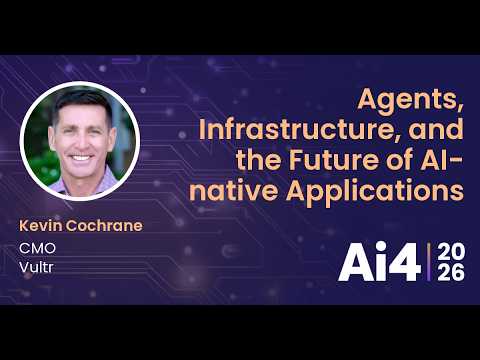
Vultr CMO Cochrane Urges Decentralized Compute for Enterprise AI
Ai4
Enterprise adoption of agentic AI requires decentralized CPU and GPU infrastructure located near workloads rather than centralized mega-clusters built solely for model training.
## Background
Published on YouTube by the Ai4 channel on August 23, 2026, this presentation features Kevin Cochrane, CMO at Vultr. According to the page description, the talk addresses how enterprises must rethink their infrastructure, data ownership, and AI stack to shift from cloud-native to AI-native architectures and successfully deploy agentic AI at scale.
## TL;DR
Kevin Cochrane outlines the transition from cloud-native to AI-native infrastructure, arguing that the industry is at the beginning of a 30-year compute super cycle. Rather than focusing solely on centralized mega-clusters for model training, enterprise implementation relies on decentralized inference, heterogeneous CPU and GPU clusters, and platform engineering. By treating AI infrastructure as an invisible utility and choosing cost-optimized hardware stacks, organizations can break through productivity bottlenecks and safely integrate agentic microservices into existing applications.
## Atmosphere & style
The presentation is delivered in an energetic, inspirational, and authoritative tone, blending high-level architectural insight with personal endurance anecdotes. Drawing parallels between running seven marathons on seven continents and the marathon of enterprise AI adoption, Cochrane builds an engaging narrative that moves from early hype to pragmatic strategy. The talk feels forward-looking yet grounded, framing technical infrastructure choices through a lens of perseverance, discipline, and practical business outcomes.
## Key takeaways
- [00:04](https://www.youtube.com/watch?v=55BMFwlxydI&t=4s) Kevin Cochrane opens by recounting his experience running seven marathons on seven continents, using it as a metaphor for the long-term journey of AI deployment.
- [00:43](https://www.youtube.com/watch?v=55BMFwlxydI&t=43s) AI infrastructure is at the beginning of a 30-year super cycle that shifts from centralized training to an open, decentralized architecture over time.
- [00:43](https://www.youtube.com/watch?v=55BMFwlxydI&t=43s) The industry passed through the initial hype around LLMs and RAG into a productivity bottleneck, which is now being solved through agentic AI.
- [00:43](https://www.youtube.com/watch?v=55BMFwlxydI&t=43s) Enterprise focus is shifting away from building trillion-parameter frontier models to running production inference using open-source foundation models.
- [00:43](https://www.youtube.com/watch?v=55BMFwlxydI&t=43s) While frontier model training relies on massive, remote data centers near abundant energy, enterprise inference requires compute close to application workloads.
- [10:03](https://www.youtube.com/watch?v=55BMFwlxydI&t=603s) Designing for real-world enterprise inference requires decentralized, distributed GPU clusters located where existing workloads operate.
- [10:03](https://www.youtube.com/watch?v=55BMFwlxydI&t=603s) CPUs play a critical role alongside GPUs by providing sandboxes to execute code safely and managing contextual data for reasoning models.
- [10:03](https://www.youtube.com/watch?v=55BMFwlxydI&t=603s) Enterprise infrastructure must integrate CPU and GPU clusters to link application code, context, and model weights for local execution.
- [12:31](https://www.youtube.com/watch?v=55BMFwlxydI&t=751s) To stretch budgets, enterprise IT leaders should adopt heterogeneous infrastructure tailored to specific application cost and performance demands.
- [12:31](https://www.youtube.com/watch?v=55BMFwlxydI&t=751s) Organizations can choose full-stack NVIDIA clouds on Vultr for maximum performance or AMD GPU infrastructure for cost-sensitive internal apps.
- [14:59](https://www.youtube.com/watch?v=55BMFwlxydI&t=899s) Platform engineering teams need to create reusable, composable infrastructure templates to replace bespoke 'snowflake' AI deployments.
- [14:59](https://www.youtube.com/watch?v=55BMFwlxydI&t=899s) AI infrastructure should act as an invisible utility so developers can deploy applications without manually configuring GPUs, CPUs, or network topology.
## Detailed walkthrough
Here is a detailed, faithful walkthrough based on the transcript provided:
[00:04](https://www.youtube.com/watch?v=55BMFwlxydI&t=4s) A Global Marathon Journey and the Start of the AI Super Cycle
Kevin Cochrane opens his talk by sharing that he woke up early to go for a run along the Las Vegas Strip, reflecting on the four-year collective journey of building, scaling, and deploying AI applications to drive tangible business outcomes. Drawing on his passion for running, Cochrane recounts participating in the World Marathon Challenge, where he ran seven marathons in seven days across all seven continents. That grueling adventure kicked off in Cape Town, flying to Antarctica to race across a blue ice glacier before immediately returning to Cape Town because six marathons still lay ahead.
He draws a direct parallel between that endurance challenge and the current state of AI infrastructure. Whenever asked if the industry has overinvested in AI, his response is firm: "We are just getting started." The industry is at the beginning of a 30-year "super cycle"—a historical shift in compute architecture that starts centralized before evolving into an open, decentralized model over time. We are only entering the second epoch of the third great compute super cycle, meaning the initial "Antarctica" marathon has just concluded and the true work of enterprise implementation is beginning.
- Cochrane's career in technology began in 1983 when his father sold Wang and Compaq computers, bringing home a heavy 50-pound Compaq luggable that Cochrane used to learn BASIC programming at age 11.
- In 1993, he began building his first websites, going on to spend three decades pioneering web application infrastructure for enterprises and public sector agencies.
- Just as the previous super cycle democratized access to information through the World Wide Web, the current cycle aims to transform business operations through agentic AI.
[00:43](https://www.youtube.com/watch?v=55BMFwlxydI&t=43s) Breaking Through the Productivity Bottleneck to Enterprise Inference
Every technology epoch passes through the familiar Gartner Hype Cycle. The first marathon of the AI journey began with the arrival of Large Language Models (LLMs) and multimodal architectures, followed by enthusiasm for Retrieval-Augmented Generation (RAG) pipelines and vector databases to feed models more context. However, the industry eventually drifted into a "trough of disillusionment" when enterprise leaders realized there was a gap between high-powered models and actual measurable business productivity.
With the shift to agentic AI, enterprises are breaking through that productivity bottleneck. Instead of relying purely on massive central clusters to train trillion-parameter models, the focus is shifting to enterprise adoption and building out cloud architectures tailored for production inference. While frontier research labs and hyperscalers continue to build out 50,000-GPU scale-out mega-clusters, typical enterprises do not need to spend their capital training custom 1-to-2.4-trillion parameter frontier models from scratch; instead, they will leverage open-source foundation models and put them to work on real business processes.
- Cochrane shares an anecdote about driving through northern Norway toward Tromsø—the departure point for Svalbard in the Arctic Ocean—passing Narvik where he saw no humans for hours, only reindeer.
- Suddenly, 30 minutes after losing all cellular service, he encountered the massive Nscale data center operating off local hydropower in the remote wilderness.
- While remote facilities near abundant energy sources are useful for training frontier models, enterprise inference demands compute positioned near application workloads rather than thousands of miles away from major interconnects.
[10:03](https://www.youtube.com/watch?v=55BMFwlxydI&t=603s) Architecting Decentralized Inference with Integrated CPU and GPU Clusters
Designing for real-world enterprise inference requires a fundamentally different architecture than frontier model training. Just as web applications deliver code and content to edge locations close to end-users, enterprise AI requires decentralized, distributed GPU clusters located right where existing application workloads operate.
Furthermore, Cochrane emphasizes that "the CPU is back." Running agentic AI requires more than bare GPUs; agents need CPU-based sandboxes to execute code and microservices safely. Reasoning models also depend heavily on massive contextual data that must be marshaled and managed by CPUs. Consequently, enterprise infrastructure must combine CPU and GPU clusters into an integrated pipeline linking application code, content, and model weights to serve employees and customers locally on mobile devices and web browsers.
- Enterprise AI agents function as microservices consumed inside existing application user interfaces.
- The primary rule for this new era is to architect for real-world outcomes using decentralized, heterogeneous compute clusters spanning both CPU and GPU hardware.
[12:31](https://www.youtube.com/watch?v=55BMFwlxydI&t=751s) Managing Budgets through Infrastructure Efficiency and Heterogeneity
While early market pioneers prioritized speed-to-market and burned capital to launch frontier models, enterprise IT leaders operate under strict budget constraints. Enterprise capital must stretch across net-new innovation as well as application modernization, embedding AI services into existing legacy platforms.
To optimize performance per dollar, Cochrane advocates for adopting heterogeneous infrastructure tailored to specific workload demands. Rather than treating all workloads identically, organizations can match each application to the appropriate hardware stack:
- For high-performance workloads where speed is paramount and cost is secondary, enterprises can run a full-stack NVIDIA cloud built on Vultr infrastructure.
- For cost-sensitive internal applications where "good enough" performance maximizes ROI, organizations can opt for AMD full-stack GPU infrastructure on Vultr to deliver high performance per dollar.
[14:59](https://www.youtube.com/watch?v=55BMFwlxydI&t=899s) Platform Engineering and Simplifying AI Infrastructure into a Utility
To scale AI-native applications, enterprises must build internal platforms through dedicated platform engineering teams. Infrastructure, server, storage, and networking operations teams need to uplevel their skills, creating reusable, composable infrastructure artifacts for downstream software developers. Cochrane criticizes the status quo across the cloud landscape, stating that in almost every provider, "every single AI infrastructure deployment is a snowflake."
Cochrane contends that AI infrastructure should be treated as a invisible utility rather than a complex hurdle. Developers writing code or working in tools like Claude should be able to click deploy without worrying about underlying GPU/CPU selection, network topology, or storage attachments. The platform engineering team's pre-baked templates should automatically handle performance tuning, security, data pipelines, and governance in the background.
- Developers should spend their energy optimizing business operations, personalizing customer experiences, and improving retention rather than managing infrastructure complexities.
- Enterprise delivery pipelines must evolve beyond code deployment to seamlessly integrate AI model delivery and automated context-rich data pipelines.
- Cochrane closes by inviting attendees to join him at the conference run club the following morning for a run down the Las Vegas Strip toward The STRAT.
## Notable quotes
> [00:04](https://www.youtube.com/watch?v=55BMFwlxydI&t=4s) We are just getting started. — Kevin Cochrane
> Every application ever built needs to be rebuilt - with agentic AI at the core. — Kevin Cochrane
> [10:03](https://www.youtube.com/watch?v=55BMFwlxydI&t=603s) the CPU is back. — Kevin Cochrane
> [14:59](https://www.youtube.com/watch?v=55BMFwlxydI&t=899s) every single AI infrastructure deployment is a snowflake. — Kevin Cochrane
## Mentioned
Kevin Cochrane, Vultr, Ai4, Wang, Compaq, BASIC, Gartner Hype Cycle, Nscale, NVIDIA, AMD, Claude, Las Vegas Strip, World Marathon Challenge, Cape Town, Antarctica, Narvik, Tromsø, Svalbard, The STRAT
## Video description
Kevin Cochrane - CMO, Vultr
Every application ever built needs to be rebuilt - with agentic AI at the core.
Moving from cloud-native to ai-native means a new architecture for unlocking enterprise data to safely, securely deliver personalized experiences and services at scale.
And delivering business outcomes requires delivering those experiences to employees and customers globally, wherever they live and work.
To build the Agentic Enterprise, enterprises need to rethink their infrastructure strategy, own their data, and own their AI stack.
In this session, we’ll explore a new infrastructure approach to unlock enterprise AI - and how agents can help.
Vultr CMO Cochrane呼吁企业AI采用去中心化算力
企业采用智能体AI需要部署在工作负载附近的去中心化CPU与GPU基础设施,而非仅为模型训练构建的集中式超大规模集群。
Kevin Cochrane概述了从云原生向AI原生基础设施的转变,认为该行业正处于长达30年的计算超级周期的开端。企业的实际落地并非单纯依赖于用于模型训练的集中式超大规模集群,而是依托于去中心化推理、异构CPU与GPU集群以及平台工程。通过将AI基础设施视为隐形的公共服务并选择成本优化的硬件栈,企业机构能够打破生产力瓶颈,并将智能体微服务安全地整合到现有应用程序中。
Kevin Cochrane 以七大洲马拉松为喻,指出 AI 基础设施正处于 30 年计算超级周期的起点,未来将从集中式架构演变为开放且去中心化的模式。 (0:04)
企业正通过 Agentic AI 突破大模型与 RAG 的生产力瓶颈,重心从耗巨资训练万亿参数前沿模型,转向利用开源基础模型支撑实际业务推理。 (0:43)
落地企业级推理需要贴近现有业务负载的分布式 GPU 集群;同时 CPU 也重回关键地位,负责为 Agent 提供安全执行沙箱并调度上下文数据。 (10:03)
平台工程团队应消除定制化的“雪花式”部署,将底层硬件与网络拓扑抽象为像水电一样的通用设施,让开发者能专注于业务创新与用户体验。 (14:59)
Reading summary
Vultr executive Kevin Cochrane argues that enterprise AI has moved past early frontier model training into a multi-decade architectural cycle focused on production inference. He contends that businesses must transition from centralized training clusters to decentralized, heterogeneous infrastructure managed as an invisible platform utility.
Shifting from Centralized Training to Enterprise Inference (0:43)
Cochrane frames generative AI's trajectory through the Gartner Hype Cycle, noting that initial enthusiasm for large language models, multimodal systems, and retrieval-augmented generation (RAG) pipelines ended in a trough of disillusionment as leaders struggled to convert raw model capabilities into measurable business productivity. While frontier research labs and hyperscalers continue building 50,000-GPU clusters to train models spanning 1 to 2.4 trillion parameters, Cochrane asserts that standard enterprises do not need to spend capital pre-training models from scratch. Instead, enterprise value lies in leveraging open-source foundation models for agentic workflows tied to existing operations.
This shift fundamentally changes infrastructure placement. Cochrane points to remote facilities powered by abundant local energy—such as the Nscale hydroelectric data center near Narvik in northern Norway—as viable locations for intensive training workloads. However, he argues that enterprise inference cannot tolerate long distances from core user bases and must instead be placed near application workloads and major interconnects.
Integrating Distributed CPU and GPU Architectures (10:03)
To serve real-world enterprise inference, Cochrane advocates for decentralized architectures that mirror modern web delivery systems, distributing GPU compute close to where users and application workloads reside. In this design, AI agents operate as microservices embedded directly within existing application user interfaces across mobile devices and web browsers.
Cochrane also emphasizes that "the CPU is back," arguing that agentic AI cannot function efficiently on standalone GPUs. Agents require CPU-based sandboxes to safely execute code and microservices, while emerging reasoning models rely on CPUs to organize and marshal large contextual data sets. Enterprise infrastructure must therefore combine CPU and GPU clusters into unified pipelines that link model weights, application code, and enterprise data.
Optimizing Budgets Through Heterogeneous Compute Stacks (12:31)
Unlike early AI pioneers that burned capital to achieve speed-to-market, enterprise IT leaders operate under strict budget limits, balancing net-new AI initiatives against the ongoing modernization of legacy systems. To improve performance per dollar, Cochrane recommends deploying heterogeneous hardware stacks tailored to specific workload requirements rather than using a single uniform configuration.
Under this approach, enterprises can run full-stack NVIDIA infrastructure on Vultr for external or latency-critical workloads where maximum performance justifies higher costs. Conversely, organizations can deploy AMD GPU infrastructure on Vultr for internal, cost-sensitive use cases where standard performance satisfies operational requirements, thereby maximizing return on investment.
Standardizing Deployments Through Platform Engineering (14:59)
Scaling AI applications across an enterprise requires moving away from the status quo where, according to Cochrane, "every single AI infrastructure deployment is a snowflake." He argues that server, storage, networking, and operations teams must evolve into platform engineering groups that create reusable, composable infrastructure templates for software developers.
In Cochrane's view, AI infrastructure should operate as an invisible utility. Developers using coding tools or interfaces like Claude should be able to deploy applications without manually configuring GPUs, CPUs, network topologies, or storage connections. Platform engineering templates should handle performance tuning, security, governance, and automated data pipelines in the background, allowing developers to focus on refining business logic, personalization, and customer retention.
Cochrane forecasts that the industry is only at the beginning of a 30-year compute super cycle that will ultimately decentralize AI infrastructure in the same manner the web democratized information. However, his thesis assumes enterprises can successfully master internal platform engineering and that open-source models will remain sufficient to power production business agents without reliance on proprietary frontier models.
精炼阅读摘要
Vultr 首席营销官 Kevin Cochrane 提出,人工智能行业正处于长达 30 年计算“超级周期”的第二阶段,企业重心已从集中式超大规模模型训练转向去中心化的生产级推理;为突破技术与业务价值之间的生产力瓶颈,企业必须采用融合 CPU 与 GPU 的异构分布式架构,并通过平台工程将基础设施转化为开发者不可见的公用事业。
计算超级周期演进与企业推理落地 (0:04)
Kevin Cochrane 认为,当前的 AI 基础设施投资并未过热,而是刚刚拉开序幕。回顾计算发展史,从 1983 年其接触重达 50 磅的 Compaq 移动电脑并学习 BASIC 编程,到 1993 年万维网兴起推动信息民主化,技术架构普遍遵循从集中式向开放去中心化演进的 30 年周期规律。他判断,当下的行业正从类似于跑完南极冰川马拉松的起步阶段,跨入第三次计算超级周期的第二时代。在这一阶段,大语言模型与多模态架构在经历高德纳技术成熟度曲线初期的狂热后,曾因模型能力与企业实际生产力之间的脱节而陷入“幻灭期的低谷”。
突破该生产力瓶颈的关键在于从“模型训练中心主义”转向“智能体 AI”(Agentic AI)和企业生产级推理。Cochrane 指出,尽管前沿研究实验室与超大规模云厂商仍在持续构建配备 50,000 块 GPU 的超大规模集群以训练拥有 1 万亿至 2.4 万亿参数的前沿模型,但普通企业无需耗费巨资从零训练万亿级模型。正如他在挪威北部荒原偶遇依托丰富水力发电运营的 Nscale 偏远数据中心一样,偏远设施适用于模型预训练,而企业推理必须摆脱数千英里外的物理距离,转向靠近真实业务工作负载的位置。
分布式推理与 CPU-GPU 融合架构 (10:03)
针对企业实际推理环境的架构设计,Cochrane 强调必须彻底脱离单一的前沿训练思维。类似于传统 Web 应用将代码和内容推送到靠近终端用户的边缘节点,企业级 AI 同样要求将去中心化、分布式的 GPU 集群直接部署在现有业务应用运行的区域,以减少延迟并融入生产环境。在这一演进中,企业 AI 智能体本质上是作为微服务组件,嵌入在既有的应用用户界面内部进行调用。
在此背景下,Cochrane 明确提出了“CPU 正式回归”的观点。他主张运行智能体 AI 绝非单纯依赖裸 GPU 算力:智能体需要基于 CPU 的安全沙箱来运行业务代码和微服务,同时具备深度推理能力的模型需要处理并组织庞大的上下文数据,而这些密集的数据调度工作必须依赖 CPU 完成。因此,新时代的核心基础设施原则是构建集成了应用代码、业务内容与模型权重的混合流水线,协调 CPU 与 GPU 的协同工作,从而在移动端和浏览器本地直接服务员工与客户。
预算约束下的异构算力选型策略 (12:31)
与早期不惜成本、快速烧钱抢占市场的前沿模型探索者不同,当下企业 IT 决策者普遍面临着严格的预算约束。企业的技术资本不仅要用于支持全新的 AI 创新,还必须分配给既有传统平台的现代化改造,将 AI 服务无缝嵌入存量系统。面对这一财务现实,Cochrane 认为基础设施不能采用“一刀切”的配置方式,而应转向精细化的异构计算策略,根据特定工作负载的实际业务价值与性能要求精准匹配硬件。
Cochrane 建议企业依据投资回报率采取分层方案:对于追求极致响应速度、将延迟视为关键瓶颈且对成本相对不敏感的高性能核心场景,企业可以在 Vultr 等平台上选用全栈 NVIDIA 云基础设施;而对于大量对成本敏感的内部运营应用,只要性能“足够好”即可带来显著投资回报,企业则应考虑采用全栈 AMD GPU 基础设施,以此在预算可控的前提下实现每美元性能产出(Performance per Dollar)的最大化。
平台工程推动基础设施公用事业化 (14:59)
为了实现 AI 原生应用的规模化交付,Cochrane 呼吁企业必须建立专门的平台工程团队。目前各主流云服务商的现状饱受批评,几乎“每一次 AI 基础设施部署都像是一片独一无二的雪花”(Snowflake),存在严重的碎片化与过度定制问题。企业内部的底层系统、服务器、存储和网络运维团队必须实现技能升级,将复杂的底层资源抽象并打包为可复用、可组合的标准化基础设施构件。
在理想状态下,AI 基础设施应当演进为如同水暖电气般隐形的公用事业。当下游软件开发者使用 Claude 等工具编写业务逻辑或代码时,应当能够实现一键部署,完全不必为底层的 GPU/CPU 搭配、网络拓扑结构配置或存储挂载而分心。平台工程团队预设的自动化模板应在后台静默完成性能调优、安全防护、数据流水线治理和合规控制,从而使开发人员能够将精力完全集中在优化业务运营、提供个性化用户体验和提升客户留存上。
Cochrane 描绘了企业 AI 从粗放的模型军备竞赛走向注重落地架构、成本效益与开发体验的务实路径。不过,该论述的核心前提在于开源基础模型完全能够满足企业级智能体的主体需求,且假设企业具备组建平台工程团队以统一纳管异构算力的组织能力;至于在传统多云混合环境下,企业如何克服跨云数据迁移壁垒以及应对遗留软件系统的兼容性改造挑战,演讲中并未展开更深入的技术论证与风险评估。
Detailed notes — zh
## Background
该内容由 Ai4 频道于 2026 年 8 月 23 日发布在 YouTube 平台,收录了 Vultr 首席营销官(CMO)Kevin Cochrane 的主题演讲。页面描述指出,所有应用都需要围绕智能体 AI 重新构建,企业必须从云原生升级为 AI 原生架构,通过重塑基础设施战略并掌握自身数据与 AI 技术栈,以在全球范围内安全、规模化地交付业务成果与个性化体验。
## TL;DR
Kevin Cochrane 提出计算机算力正迎来为期 30 年的新一轮超级周期,行业已从前沿大模型训练的狂热期(第一阶段)正式跨入创造实际业务价值的企业级推理阶段(第二阶段)。他强调绝大多数企业不需要盲目复制 5 万张 GPU 的集中式训练超级集群,而应采用贴近用户与业务边缘的去中心化分布式推理架构。随着智能体安全沙箱与实时上下文调度需求爆发,CPU 宣告强势回归,企业应灵活结合 NVIDIA 与 AMD 异构算力以平衡极致性能与成本效益,并通过平台工程消除复杂的“雪花式”配置,将 AI 基础设施转化为开箱即用的标准化公用事业。
## Atmosphere & style
演讲风格充满运动激情与技术远见,讲者以自身跑遍七大洲的极限马拉松经历和挪威极地公路见闻为引,生动构建出技术长跑的叙事弧线。整场分享在回顾 40 年计算浪潮的从容中透着直面“AI 幻灭期低谷”的务实与清醒,语言通俗干练、摒弃空洞炒作,带给听众一种拒绝算力焦虑、重归业务本质与工程理性的笃定感。
## Key takeaways
- [00:04](https://www.youtube.com/watch?v=55BMFwlxydI&t=4s) AI 发展正处于约 30 年一轮的计算“超级周期”起点,过去几年的大模型狂热仅是七个发展阶段中的第一阶段,行业正正式进入释放实质业务价值的阶段。
- [00:04](https://www.youtube.com/watch?v=55BMFwlxydI&t=4s) 计算架构的历史演进始终遵循从“高度中心化系统”向“开放且去中心化的分布式架构”发展的基本规律。
- [02:03](https://www.youtube.com/watch?v=55BMFwlxydI&t=123s) 大语言模型在早期狂热后已进入 Gartner 炒作周期的“幻灭低谷”,企业面临高额基础设施投资与实际业务生产力转化之间的效能断层。
- [05:48](https://www.youtube.com/watch?v=55BMFwlxydI&t=348s) 全球仅有少数前沿实验室需要构建 50,000 张 GPU 的超大规模集中式集群训练基座模型,绝大多数企业盲目复制这一路线是不切实际的。
- [05:48](https://www.youtube.com/watch?v=55BMFwlxydI&t=348s) 企业 AI 落地的核心诉求是利用开源模型驱动业务增长,基础设施重心必须从集中式训练转向去中心化、靠近用户和边缘的“分布式推理架构”。
- [09:49](https://www.youtube.com/watch?v=55BMFwlxydI&t=589s) CPU 在 AI 时代宣告强势回归:智能体(Agent)的工具调用与安全沙箱执行均运行在 CPU 上,且海量实时业务数据的检索调度也高度依赖 CPU 算力。
- [09:49](https://www.youtube.com/watch?v=55BMFwlxydI&t=589s) AI 原生应用需实现“应用代码、业务数据内容与开源大模型”三位一体的集成,依赖 CPU 与 GPU 深度协同的异构算力底座。
- [12:01](https://www.youtube.com/watch?v=55BMFwlxydI&t=721s) 企业必须面向效能与成本效率(Architect for Efficiency)进行基础设施设计,在有限的 IT 预算内最大化投资回报率。
- [12:01](https://www.youtube.com/watch?v=55BMFwlxydI&t=721s) 通过引入异构计算矩阵,企业可在核心业务中采用全栈 NVIDIA GPU 追求极致低延迟,并在成本敏感的内部工具中采用全栈 AMD GPU 最大化性价比。
- [14:48](https://www.youtube.com/watch?v=55BMFwlxydI&t=888s) 行业亟需告别难以复用、高度复杂的“雪花式”AI 基础设施配置,将算力、存储与网络封装为像水电一样开箱即用的标准化公用事业。
- [14:48](https://www.youtube.com/watch?v=55BMFwlxydI&t=888s) 通过平台工程实现底层基础设施的自动化与合规调配,让开发者从底层运维泥潭中解脱,全心聚焦于业务运营优化与个性化客户体验。
- [14:48](https://www.youtube.com/watch?v=55BMFwlxydI&t=888s) 企业应将传统的云原生 CI/CD 代码交付流水线全面升级,构建能够一体化协同交付“代码、数据内容与 AI 模型”的现代化管线。
## Detailed walkthrough
### [00:04](https://www.youtube.com/watch?v=55BMFwlxydI&t=4s) 晨跑拉斯维加斯与南极冰川:AI 超级周期的第一场马拉松
Kevin Cochrane 以当天清晨在拉斯维加斯大道(Las Vegas Strip)上的晨跑作为开场。在酷热的奔跑中,他回顾了过去四年整个行业共同经历的 AI 应用构建、扩展与落地历程,并得出一个深刻的结论:“我们才刚刚启程。”作为一名资深跑者,Kevin 分享了自己完成“7 天 7 大洲 7 场马拉松”(World Marathon Challenge)的极限经历。这场全球征程的第一站便是从开普敦飞往南极洲,在冰蓝色的冰川与极端严寒中跑完首场马拉松。然而,当冲过南极终点线的那一刻,真正的考验才刚刚开始——队员们必须立刻登机飞回开普敦,因为后面还有整整六场跨大洲的马拉松等待完成。
这与当下的企业 AI 发展轨迹如出一辙。作为在全球运营 33 个数据中心区域的云基础设施提供商 Vultr 的 CMO,Kevin 经常被问及一个核心问题:“我们在 AI 领域的投资是否已经过热甚至过剩了?”他的回答始终非常明确:“我们才刚刚进入我所称的‘超级周期’(Super Cycle)的起点。”
- 计算机计算架构经历着约 30 年为一轮的超级周期,每次都会经历从“高度中心化系统”走向“开放且去中心化分布式架构”的演进。
- 每个 30 年超级周期包含 7 个发展阶段(Epochs),好比 7 场跨越全球的马拉松。
- 过去几年由大模型技术引发的第一阶段狂热,仅仅对应着南极洲的第一场马拉松;随着第一阶段在今年收尾,行业正式进入能够产生实质业务价值的第二场马拉松。
---
### [02:03](https://www.youtube.com/watch?v=55BMFwlxydI&t=123s) 三十年计算机浪潮与大语言模型的“幻灭低谷”
Kevin 回顾了自己从 1983 年接触计算机以来的历程。当时他的父亲销售王安电脑(Wang Laboratories)和康柏(Compaq)电脑,并把重达 50 磅的康柏便携式电脑(Compaq Luggable)带回家——对于当时体重只有 45 磅的小孩而言,这台机器比他还重,但他借此自学了 BASIC 编程。随后他在 1993 年开发了人生第一个网页,并在接下来的三十年里见证并参与了上一轮 Web 应用基础设施的大爆发。上一轮超级周期通过万维网实现了信息与服务的普惠化,而当前的第三轮超级周期则正在通过智能体 AI(Agentic AI)重塑整个数字世界。
每一轮技术浪潮都遵循经典的 Gartner 炒作周期(Gartner Hype Cycle)。AI 浪潮的第一场马拉松始于大语言模型(LLM)和多模态模型的涌现,随后企业界通过 RAG(检索增强生成)流水线和向量数据库为模型注入上下文。然而,行业随后不可避免地跌入了“幻灭期的低谷”(Trough of Disillusionment)——尽管前沿模型能力极其强大,但在企业实际落地中却出现了明显的效能断层:投资巨大却迟迟无法转化为可衡量的生产力与业务回报。
```mermaid
flowchart TD
accTitle: 从前沿大模型训练向企业生产级推理的范式转移
subgraph S1["第一阶段:前沿模型训练模式 (集中式)"]
A["50,000+ GPU 超级集群"] --> B["超大规模万亿参数模型训练"]
B --> C["偏远可再生能源站点 (高延迟)"]
end
subgraph S2["第二阶段:智能体企业推理架构 (分布式)"]
D["去中心化分布式 GPU 集群"] --> E["CPU 执行沙箱 + 数据管线"]
E --> F["边缘/就近部署 AI 原生应用"]
F --> G["驱动企业业务实际产出与个性化体验"]
end
S1 -.->|"范式转移:跨越生产力断层"| S2
```
---
### [05:48](https://www.youtube.com/watch?v=55BMFwlxydI&t=348s) 告别 5 万卡训练集群:企业需要的是“分布式推理架构”
企业不能也不应该盲目复制前沿实验室(Frontier Labs)的发展路径。在早期的第一阶段中,整个算力产业的焦点几乎全部放在扩展超大规模 GPU 集群上,以供少数头部实验室训练 1 万亿至 2.4 万亿参数的基座模型。然而,绝大多数企业根本不需要也不可能耗费巨额资金去构建包含 50,000 颗 GPU 的超级集群;企业的核心诉求是利用现有的开源基础模型来驱动营收增长和实际业务结果。
为了说明这种错位,Kevin 分享了自己在挪威北部自驾跑比赛时的见闻。在穿过纳尔维克(Narvik)驶向特罗姆瑟(Tromsø,前往斯瓦尔巴群岛的出发港)的路上,有两个小时沿途完全荒无人烟,只有成群的驯鹿,手机信号在半小时前就已彻底中断。然而,就在这片冰冷偏僻的极地荒野中,却矗立着依托当地水力发电建立的巨型数据中心(Nscale)。这种设施对于前沿实验室训练基础模型而言是完美的,但对于需要毫秒级响应、紧密连接业务系统和用户的企业应用而言却完全不适用。
- 前沿实验室关注集中式超大规模训练,全球仅有 12 到 24 家顶级机构需要这种架构。
- 企业 AI 落地需要的是“推理架构”(Inference Architecture),其部署模式类似于现代 Web 应用——必须将算力分散并就近部署在用户工作、生活以及应用服务运行的各个节点。
- 推理集群必须走向去中心化与分布式,深度融入企业现有的全球网络与业务边缘。
---
### [09:49](https://www.youtube.com/watch?v=55BMFwlxydI&t=589s) CPU 的强势回归与“代码-内容-模型”集成管线
在构建企业级推理集群时,行业正在走出“唯 GPU 论”的误区,Kevin 明确指出:“CPU 正式宣告回归(The CPU is back)。”在智能体 AI(Agentic AI)体系中,智能体并不是凭空运行的,它们需要一个隔离的安全沙箱来执行具体操作与工具调用,而这个沙箱正是运行在 CPU 之上的;与此同时,具备深度思考与推理能力的大模型需要海量实时上下文,这些业务数据的调度、提取、组装与传输同样高度依赖 CPU 算力。
此外,AI 应用的本质仍然是“应用”。无论是员工使用的内部系统还是客户交互的前端门户,智能体最终都是作为微服务组件嵌入在 Web 浏览器或移动端 App 的具体体验中。这意味着企业基础设施必须兼顾运行传统业务代码的 CPU 集群与处理模型推理的 GPU 集群。
```mermaid
flowchart LR
accTitle: 智能体应用的三位一体集成架构
subgraph Pipeline["企业 AI 原生应用支撑体系"]
direction TB
C1["应用代码 (Code)"]
C2["业务数据与上下文 (Content)"]
C3["领域/开源大模型 (Models)"]
end
subgraph Compute["异构算力协同底座"]
direction TB
CP1["CPU 算力:负责业务逻辑、Agent 执行沙箱与数据流调度"]
GP1["GPU 算力:负责实时推理、嵌入向量化与逻辑生成"]
end
Pipeline --> Compute
Compute --> App["交付全球低延迟、个性化的员工/客户终端体验"]
```
---
### [12:01](https://www.youtube.com/watch?v=55BMFwlxydI&t=721s) 降本增效与异构计算:平衡 NVIDIA 与 AMD 算力矩阵
进入 AI 原生时代,企业必须掌握三大核心原则。第一是“面向真实业务结果进行架构设计”,即以去中心化、CPU 与 GPU 协同的分布式推理为核心;第二是“面向效能与成本效率进行架构设计(Architect for Efficiency)”。在早期阶段,具有雄厚资本的玩家可以为了争夺“最先发布模型”的时间窗口而不计成本地烧钱,但普通企业拥有严格的 IT 预算约束,且这笔预算不仅要支撑全新的 AI 探索,还必须分担传统业务系统的现代化改造。
为了在有限的预算内最大化投资回报率(ROI),企业必须引入异构计算基础设施(Heterogeneous Infrastructure):
| 业务场景类型 | 优化目标 | 推荐基础设施方案 |
|:--- |:--- |:--- |
| **外部核心业务 / 极致性能诉求** | 最大化推理吞吐量与极低延迟 | 在 Vultr 基础设施上运行全栈 **NVIDIA** GPU 云算力 |
| **内部工具 / 成本敏感型工作负载** | 最大化性价比(Performance per Dollar) | 在 Vultr 基础设施上采用全栈 **AMD** AI 算力集群 |
根据工作负载的具体特征,灵活搭配 CPU 与不同厂商的 GPU,是避免预算失控、实现规模化落地的关键策略。
---
### [14:48](https://www.youtube.com/watch?v=55BMFwlxydI&t=888s) 告别“雪花式”配置:将 AI 基础设施转化为标准化公用事业
第三个核心原则是“实现 AI 原生应用的规模化交付”。企业需要将过去二十年积累的云原生(Cloud-native)运维经验与知识体系全面升维到 AI 原生(AI-native)阶段。企业应当通过平台工程(Platform Engineering)团队,提升传统服务器、存储和网络运维人员的技能,将底层的算力配置、网络优化和数据管线封装为一套可复用的技能集与标准构件。
Kevin 尖锐地批评道:在当今市场上除了 Vultr 之外的大多数云服务商中,“每一次 AI 基础设施部署都像一片独特的‘雪花’(Snowflake)——高度复杂且难以复用。”这种高昂的复杂性与摩擦成本必须被彻底消除。AI 基础设施应当像水和电一样,成为一种开箱即用的公用事业(Utility)。下游开发者在使用如 Claude 等各类 AI 工具构建应用时,不应该被迫去关心底层究竟调用了哪款 GPU、哪款 CPU、怎样的存储架构或网络拓扑,而应当只需轻点“一键部署”,系统即可合规、自动地调配好所有底层资源。
- 让开发者从底层的算力配置与基础设施泥潭中解脱出来,将 100% 的精力聚焦在优化业务运营、提供个性化客户体验、提升用户留存率等商业核心目标上。
- 将原本用于代码快速交付的 CI/CD 流水线,全面扩展升级为涵盖“代码、数据内容与 AI 模型”的高效一体化交付管线。
- Kevin 在演讲最后向与会者发出邀请,欢迎大家参加次日清晨沿拉斯维加斯大道跑向同温层酒店(The STRAT)的跑步俱乐部活动,在运动中继续探讨 AI 原生时代的未来。
## Notable quotes
> [00:04](https://www.youtube.com/watch?v=55BMFwlxydI&t=4s) 我们才刚刚启程。 — Kevin Cochrane
> [00:04](https://www.youtube.com/watch?v=55BMFwlxydI&t=4s) 我们才刚刚进入我所称的‘超级周期’(Super Cycle)的起点。 — Kevin Cochrane
> [05:48](https://www.youtube.com/watch?v=55BMFwlxydI&t=348s) 企业不能也不应该盲目复制前沿实验室(Frontier Labs)的发展路径。 — Kevin Cochrane
> [09:49](https://www.youtube.com/watch?v=55BMFwlxydI&t=589s) CPU 正式宣告回归(The CPU is back)。 — Kevin Cochrane
> [12:01](https://www.youtube.com/watch?v=55BMFwlxydI&t=721s) 面向真实业务结果进行架构设计 — Kevin Cochrane
> [12:01](https://www.youtube.com/watch?v=55BMFwlxydI&t=721s) 面向效能与成本效率进行架构设计(Architect for Efficiency) — Kevin Cochrane
> [14:48](https://www.youtube.com/watch?v=55BMFwlxydI&t=888s) 每一次 AI 基础设施部署都像一片独特的‘雪花’(Snowflake)——高度复杂且难以复用。 — Kevin Cochrane
> [14:48](https://www.youtube.com/watch?v=55BMFwlxydI&t=888s) 实现 AI 原生应用的规模化交付 — Kevin Cochrane
## Mentioned
Kevin Cochrane, Vultr, Ai4, Las Vegas Strip, World Marathon Challenge, Wang Laboratories, Compaq, Compaq Luggable, BASIC, Gartner Hype Cycle, Nscale, NVIDIA, AMD, Claude, The STRAT
## Video description
Kevin Cochrane - CMO, Vultr
Every application ever built needs to be rebuilt - with agentic AI at the core.
Moving from cloud-native to ai-native means a new architecture for unlocking enterprise data to safely, securely deliver personalized experiences and services at scale.
And delivering business outcomes requires delivering those experiences to employees and customers globally, wherever they live and work.
To build the Agentic Enterprise, enterprises need to rethink their infrastructure strategy, own their data, and own their AI stack.
In this session, we’ll explore a new infrastructure approach to unlock enterprise AI - and how agents can help.
[Source](https://www.youtube.com/watch?v=55BMFwlxydI)
Source quotes
[0:04] Kevin Cochrane: 我们才刚刚启程。
[0:04] Kevin Cochrane: 我们才刚刚进入我所称的‘超级周期’(Super Cycle)的起点。
[5:48] Kevin Cochrane: 企业不能也不应该盲目复制前沿实验室(Frontier Labs)的发展路径。
[9:49] Kevin Cochrane: CPU 正式宣告回归(The CPU is back)。
[12:01] Kevin Cochrane: 面向真实业务结果进行架构设计
[12:01] Kevin Cochrane: 面向效能与成本效率进行架构设计(Architect for Efficiency)
[14:48] Kevin Cochrane: 每一次 AI 基础设施部署都像一片独特的‘雪花’(Snowflake)——高度复杂且难以复用。
[14:48] Kevin Cochrane: 实现 AI 原生应用的规模化交付
Source quotes
[0:04] Kevin Cochrane: We are just getting started.
Kevin Cochrane: Every application ever built needs to be rebuilt - with agentic AI at the core.
[10:03] Kevin Cochrane: the CPU is back.
[14:59] Kevin Cochrane: every single AI infrastructure deployment is a snowflake.
Original transcript
[0:04] Thank you so much for that warm welcome. And
speaking of warm, in preparation for today's
[0:11] uh speaking session here, I wound up waking
up really early and I decided to take a run uh
[0:18] down the Las Vegas strip. And boy was it warm.
Now, over the course of that run, I happen to
[0:26] give a lot of thought to what journey we've all
been on together over the past four years as
[0:33] we've been building and scaling AI applications
and looking to deploy them to drive real results
[0:40] in our business. And as I was thinking about that
journey, it struck me that we're only just getting
[0:47] started. Now, as I mentioned, I went on a run.
I'm actually a runner. And so maybe just to tell
[0:53] you a little bit about myself, one of my things
that I'm really proud of and having excited to do
[1:00] was very recently a number of years ago, I had
the opportunity to run all around the world.
[1:05] Now in my line of business, I fly all around the
world and I typically run around the world as I'm
[1:11] going to different conferences and working with
different customers and supporting them across all
[1:16] of our 33 global data center regions. But also
I ran a special race which is called the seven
[1:24] continents where I literally ran seven marathons
in seven days across all seven continents.
[1:33] And the journey actually started by flying from
Cape Town to Antarctica and running on a blue ice
[1:39] field, a glacier. And what a tough run. That was
a difficult marathon. But at the end of the day,
[1:47] you can see the picture of me actually finishing
the race right there in the picture. At the end
[1:52] of the day, after that marathon, we had to get on
the plane and then we had to fly back to Cape Town
[1:57] because the real race was just beginning
and we still had six more marathons to go.
[2:03] Now in my role I get asked a lot of questions
about AI infrastructure and there isn't any
[2:10] question that I get asked more frequently than
are we overinvested in AI and my response is
[2:19] always very simple. We are just getting started.
We are at the start of what I call a super cycle.
[2:28] And we have been through super cycles before. Each
super cycle, I would argue, is a 30-year cycle
[2:38] where we are pioneering new compute architectures
that start first as centralized systems and then
[2:45] become more open and more decentralized
over time. We are only at the start of the
[2:53] third super cycle and each super cycle can be
divided into seven epochs, seven marathons.
[3:02] And I argue that the first marathon, similar to my
first marathon in Antarctica, just ended this year
[3:11] and we are now at the stage of the next race,
the next marathon. because in this stage we
[3:18] could actually do real meaningful work. Now my
career actually started way back in 1983. I was
[3:24] a small little kid and my dad used to actually
sell weighing computers and compact computers and
[3:29] I actually was one of those little kids that was
lucky enough that when my dad came home for work,
[3:34] he actually had one of those compact luggables. It
weighed more than me. I think I weighed 45 pounds.
[3:39] This thing weighed like 50 pounds. But he'd take
it home and I'd set it up and I actually learned
[3:44] how to program basic. Now obviously I wasn't the
most amazing programmer when I was like 11 years
[3:51] old but it got me started on a journey such that
later in life I started building my first websites
[3:57] in 1993 believe it or not and then ultimately
spent the past three decades going through the
[4:03] last super cycle popularizing the buildout of web
application infrastructure to power modern-day
[4:10] enterprises and public sector agencies. And what's
exciting to me is just like the prior super cycle
[4:19] where we changed the world by democratizing
access to services and information through
[4:25] the worldwide web. We're now doing that again with
agentic AI. Now every one of these epochs, every
[4:34] one of these stages in this journey we're going
through together goes through that traditional
[4:39] Gartner hype cycle. And in the early the first
marathon in our journey, it really got started
[4:47] when we saw the emergence of LLMs and multimodal
models. And then we got really excited when we
[4:53] could add more context to these models with
things like rag pipelines and vector databases.
[5:00] Now, unfortunately, we did go through, I
would argue, a trough of disillusionment.
[5:06] We were having these powerful models that
were able to do all these amazing things,
[5:11] but there was a real gap in the enterprise.
What were the productivity that they were
[5:17] driving? What were the actual outcomes that were
actually happening? And the great news is today
[5:25] we have finally broken through that productivity
bottleneck. We can now bridge that gap
[5:31] between the promise and the outcomes because now
with aentic AI, we can actually put AI to work
[5:40] to change our business processes to power product
employee productivity and again to start driving
[5:48] real business results. This is the shift from
moving to largecale training clusters to actual
[5:58] enterprise adoption and buildout of compute
architectures AI infrastructure in the cloud
[6:05] to drive production inference. Now in this early
market, that first part of the race, everyone in
[6:13] our industry focused on building out largecale
GPU clusters with a scale out architecture
[6:21] so frontier labs and hyperscalers could build
all of the models that we're leveraging today.
[6:29] And still to this day you see a tremendous
amount of innovation focused on scaling up
[6:37] individual GPU clusters for purposes of training
1 trillion 2.4 four trillion uh parameter models.
[6:46] Enterprises, I hate to say this, are not going to
be in the business of spending all of their time
[6:55] and money building out 50,000 GPU mega clusters to
train frontier models. Enterprises need to drive
[7:05] business results and need to invest capital
to drive the revenue. At the end of the day,
[7:11] what enterprises will do is enterprises will take
existing open-source models and put them to real
[7:19] work. Now, in this early era, I want to give
you a good example of this because in my space,
[7:26] everyone is building out these massive
clusters still and so are we, by the way. Um,
[7:31] but most recently, I was actually taking a trip to
go run a race uh in the northern realms of Norway.
[7:39] And in the northern realms of Norway, there's a
town called Trono, which is the departure point
[7:44] for uh going to Spalbart, an archipelago
with the far north of the Arctic Ocean.
[7:51] And I was driving to Trumso, past a town called
Narvik, and two hours of getting out of Narvik,
[7:58] I haven't seen a single human being. I
saw a lot of reindeer. That's about it.
[8:04] And in the middle of this beautiful drive, all of
a sudden I see this massive data center, Ncale,
[8:13] this incredible data center. I
didn't have cell phone connectivity.
[8:18] I had lost cell phone connectivity 30
minutes prior to seeing this building.
[8:23] But somehow because there was hydro power, they
put a big data center. Now for enterprises,
[8:32] is this where you're going to be running
your enterprise workloads? The answer is no.
[8:36] Is it good, however, for training
a frontier lab? Absolutely.
[8:42] But again, the frontier labs and training a model
and building out a 50,000 GPU cluster is not what
[8:49] is going to power enterprise inference. It's not
going to power uh actual driving business results.
[8:55] So what we need to architect now is we need to
architect not for the needs of frontier labs
[9:02] a limited number of 12 24 companies that are
building all of the open source models that we
[9:08] know and love. We need to architect for enterprise
inference and that is a different architecture
[9:14] because that means that we need to deploy
separate clusters of GPUs not in 50,000
[9:20] realm clusters. We need to actually deploy GPU
clusters where our application workloads run.
[9:28] Just like with web applications, we deploy code
and content to where people live and work. We need
[9:36] to distribute inference and inference clusters and
make them decentralized and put them everywhere
[9:44] where we're running applications that are
serving our customers and serving our employees.
[9:49] This is a new architecture, an inference
architecture, and it's modeled very similar to how
[9:56] we build and deploy traditional web application
architectures. Now, when we're looking at
[10:03] inference clusters, it's also important to
note that deploying inference means you're
[10:09] not only deploying GPUs. We need to put the
GPUs to work so that they can do real work.
[10:17] And what that means is all of your inference
clusters also need to incorporate the CPU.
[10:24] The CPU is back. In a Gentic AI, your agents need
a sandbox to execute. That sandbox is a CPUbased
[10:34] sandbox. Your agents need access to data so that
they can have the context in order to give a
[10:40] an informed response. This is what reasoning
models do. they need massive amounts of context.
[10:47] That data is also something that needs to be
marshaled and delivered and runs on a CPU. So when
[10:54] you're architecting for enterprise inference,
you need the combination of CPU clusters
[11:01] and GPU clusters, not in one location in Norway
that's thousands of miles away from the nearest
[11:07] interconnect, but you need it everywhere you're
currently deploying your application code.
[11:14] And remember the application code still
matters. So when you're actually building an
[11:20] AI application, it is an application. There is an
experience. An experience that your customers are
[11:27] accessing, an experience that your employees
are accessing. The agents themselves are just
[11:32] a set of microservices that are getting consumed
in an actual application experience that you're
[11:38] delivering in the web browser or on a mobile
phone. So the CPU clusters to run your application
[11:45] code also need to be put into the mix and you
need an integrated pipeline of code, content,
[11:52] and models in order to change how you're actually
delivering applications to your workforce.
[12:01] So the lesson number one going into this new
era is to architect for realworld outcomes.
[12:08] And architecting for real world outcomes means
architecting for inference. It means architecting
[12:14] for decentralized distributed computing. It means
architecting clusters of compute that span a range
[12:23] of CPU and GPU types in order to deliver your
enterprise workloads. It's also important to
[12:31] note the next lesson is that you also need to
architect for efficiency. Efficiency matters.
[12:38] In the early days of the market, it was all
about time to market advantage for the next
[12:43] frontier model to come out. And there's a lot of
very well capitalized players that could afford
[12:49] to burn a lot of that capital in order to be
the first to market with the latest model.
[12:55] Enterprises, you all have a budget and your budget
is not necessarily growing exponentially even
[13:03] though business requirements are. And that budget
needs to pay not only for net new innovation,
[13:10] but it also needs to pay for application
modernization where you're actually embedding
[13:15] new AI services into the existing experiences
that you're already delivering to your customers.
[13:22] And if you're thinking about cost efficiency
and how you manage that budget and manage your
[13:28] investments, you need to look at heterogeneous
infrastructure to support your business needs.
[13:37] There may be certain applications where
you want to optimize for performance
[13:42] and then you're willing to pay top dollar to
get the best possible performance. And in those
[13:49] particular cases, you might prefer to run a full
stack Nvidia cloud on Vulture infrastructure.
[13:59] But there may be other applications
where performance can be good enough
[14:05] and you are optimizing for the performance per
dollar to make certain that you can actually
[14:13] support multiple applications
maybe for internal consumption
[14:18] in which case you might actually prefer to opt for
an AMD full stack AI infrastructure compute GPU
[14:25] on vultures heterogeneity matters. Because as an
enterprise, you need to look at the workflow type.
[14:33] What's the optimal mix of CPU and GPUs and what is
the mix of CPUs and GPUs that's going to deliver
[14:41] the performance that you need at the cost that
you require in order to best manage your budget.
[14:48] So having both options AMD and Nvidia is very very
critical. The next lesson is that we also need to
[14:59] scale the delivery of AI native applications.
And that means that all of the existing
[15:07] infrastructure, all of the existing knowledge
that we have built up over the past two decades
[15:13] for cloudnative applications needs to be
uplevelled to deliver AI native applications
[15:19] putting AI at the core. And in order to do this,
we need to invest in building internal platforms
[15:27] through a platform engineering team and take our
infrastructure operations and cloud services team
[15:35] and level up their skill sets, the server
engineers, the storage engineers, the network
[15:40] engineers, and enable the platform engineering
teams to build a set of reusable skills
[15:47] and composable artifacts that can be made
available to every downstream developer
[15:54] who's using any sort of you know AI harness like
cloud so that when they're building an application
[16:02] all they have to do is click deploy and all of
the cost and the complexity of the infrastructure
[16:10] what GPUs what CPUs what networking what storage
what locations they shouldn't have to worry about
[16:18] in the current day and age and I would argue in
every other cloud provider other than Vulture,
[16:24] every single AI infrastructure deployment
is a snowflake. Everything is a snowflake.
[16:32] The cost and complexity of AI infrastructure
needs to go away. AI infrastructure is a utility.
[16:41] No developer should be thinking anything about
infrastructure when they're writing their code.
[16:48] Developers should focus on business results,
business outcome, and all of the spin up
[16:54] of all of the infrastructure, the
optimization of the performance,
[16:58] the optimization of the networking, the
attachment of all the data pipelines.
[17:02] It should just happen automatically because
it's a pre-baked set of skills from the
[17:08] platform engineering team that meets all
of your internal governance requirements.
[17:15] AI infrastructure should not be a snowflake. AI
infrastructure should not be front and center in
[17:20] any developer's mind. Our mission at Vulture
is to simplify AI infrastructure to make it a
[17:27] utility so that every single developer can
just click and run and not worry about it.
[17:33] Because what you want your developers doing is
you want your developers focused on optimizing
[17:38] operations, personalizing customer experiences,
or doing things to enhance customer loy
[17:44] loyalty and retention. You want your developers
focused on driving realw world applications
[17:50] that power your actual business. And so, like I
said, all of the past prior art that we've done
[17:57] to instrument pipelines for the fast efficient
delivery of code, we now need to extend
[18:05] to have the corresponding pipeline for the fast
efficient delivery of AI models to power that code
[18:12] and integrate all of the data pipelines so that we
can have all of the context required in order for
[18:20] those applications to deliver the personalized
experience. experiences that are going to drive
[18:24] our business success. So, with that, uh,
I'm excited to be on this journey with you.
[18:29] And if you all happen to be going to the Run
Club tomorrow, I would love to see you on the
[18:34] Las Vegas grip. It will be hot, but we'll have
a very good time and I'd love to continue the
[18:41] conversation with you while we do some miles
running down to the Strat. Thank you so much.