Uber Halts Token Runaway With Open Models and AI Pods
Ai4
Uber CTO Praveen Neppalli Naga says multi-model routing and agentic workflows flattened AI costs while adoption quadrupled.
AI-assisted summary of Building an AI-Native Company at Global Scale with Praveen Neppalli Naga, Uber and Nathan Bomey — original source. Check the original for full context.
Source published:
Detailed notes
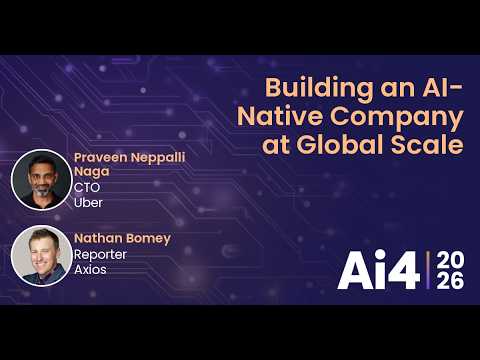
## Background Published on YouTube by the Ai4 channel on August 21, 2026, this fireside session features Uber CTO Praveen Neppalli Naga in conversation with Axios reporter Nathan Bomey. The discussion explores what it takes to embed AI at true global scale, measure meaningful ROI across technical and non-technical operations, and navigate the expanding future of autonomous transportation.
## TL;DR Praveen Neppalli Naga explains how Uber shifted past unconstrained 'token maxing' by optimizing agentic engineering through prompt caching, smart model routing, and embedded cross-functional 'Agentic Pods.' The discussion highlights practical AI integrations across Rides, Eats, and the Earner Companion, backed by Uber's custom open-source Agent Detection and Response (ADR) security platform. Looking to physical AI, Uber details its multi-partner autonomous vehicle strategy and hybrid marketplace, which balances flexible human driver supply with dedicated robotaxi fleets to achieve sustainable unit economics.
## Atmosphere & style The session strikes a crisp, pragmatic, and collegially candid tone, blending journalistic probing with grounded technical candor. Nathan Bomey keeps the dialogue energetic with playful commentary on tech hype, while Praveen counters with thoughtful, understated realism about the engineering headaches and CISO security anxieties of autonomous agents. The dynamic feels authentic and unpretentious, moving smoothly from deep infrastructure trade-offs to lighthearted banter about competitor apps.
## Key takeaways - [00:04](https://www.youtube.com/watch?v=5SSDLni677w&t=4s) The era of unconstrained 'token maxing' has ended, prompting Uber to manage agentic budget shocks through prompt caching, smart defaults, and mixed model routing—quadrupling adoption while flattening costs. - [04:00](https://www.youtube.com/watch?v=5SSDLni677w&t=240s) Automating isolated, single-step tasks yields negligible value; true ROI comes from deploying cross-functional 'Agentic Pods' to re-engineer complex, end-to-end business workflows. - [05:51](https://www.youtube.com/watch?v=5SSDLni677w&t=351s) Uber avoids superficial AI features by targeting high-utility product touchpoints: voice booking for quick Rides decisions, multi-item grocery parsing for Eats, and real-time earning guidance for drivers. - [08:00](https://www.youtube.com/watch?v=5SSDLni677w&t=480s) Multi-billion-parameter LLMs ingest nuanced driver behavioral histories and marketplace context to improve dispatch matching and ETA accuracy beyond traditional deep learning. - [09:45](https://www.youtube.com/watch?v=5SSDLni677w&t=585s) To secure autonomous agents without stifling engineering velocity, Uber created and open-sourced Agent Detection and Response (ADR) and quarantined Tier-1 consumer data in air-gapped sandboxes. - [13:02](https://www.youtube.com/watch?v=5SSDLni677w&t=782s) Uber pivoted from proprietary autonomous vehicle R&D to a multi-partner global ecosystem, deploying roughly $10 billion into fleet management, charging infrastructure, and depot operations. - [14:05](https://www.youtube.com/watch?v=5SSDLni677w&t=845s) Through Uber Labs, the company uses its global operational scale to curate edge-case L4 driving data, solving the primary training bottleneck for its autonomous vehicle partners. - [15:33](https://www.youtube.com/watch?v=5SSDLni677w&t=933s) A hybrid marketplace pairing autonomous fleets with flexible human drivers solves the peak-demand utilization problem, expanding total market demand rather than cannibalizing human earner income. - [17:57](https://www.youtube.com/watch?v=5SSDLni677w&t=1077s) Declining sensor and vehicle costs are steadily improving autonomous unit economics, while fragmented regional regulations favor partnering with local autonomy champions over a single global supplier. - [19:09](https://www.youtube.com/watch?v=5SSDLni677w&t=1149s) In automated last-mile logistics, Uber relies on partner networks, viewing step-climbing sidewalk robots as often more practical than aerial drones for dense urban fulfillment.
## Detailed walkthrough ### [00:04](https://www.youtube.com/watch?v=5SSDLni677w&t=4s) Introduction and Moving Past the "Token Maxing" Era
The fireside session opens with an introduction highlighting Uber's transition into an AI-native organization, operating at a global scale where millions of passengers, drivers, and couriers interact with its platform daily. Praveen Neppalli Naga, Chief Technology Officer at Uber since joining in 2015, leads the company's engineering, science strategy, and technical execution. Axios reporter Nathan Bomey kicks off the conversation by playfully probing whether Praveen can "dance around these questions," to which Praveen jokes back that while he technically could dance, the audience would be thoroughly disappointed: "I have a lot of boring engineering and AI."
Nathan pivots immediately to Praveen's widely circulated commentary declaring that the era of "token maxing" is over, asking whether the industry has just exited a Jurassic period of unconstrained model consumption. Praveen explains that he did not invent the phrase, but used it to describe the very real, practical budget shocks companies faced when autonomous agents took off faster than expected. While Uber had budgeted for standard AI initiatives, the rapid shift toward multi-step agentic workflows rapidly exhausted early spending allocations. Rather than instituting heavy-handed curbs that would stifle innovation, Uber treated token consumption as an engineering optimization challenge:
```mermaid flowchart TD accTitle: Uber AI Cost Optimization Strategy subgraph S1["Engineering Interventions"] A["Prompt Caching"] B["Smart Model Defaults"] C["Frontier + Open-Weight Routing"] end subgraph S2["Platform Results"] D["4x Agentic Adoption"] E["Flattened & Dropping Costs"] end S1 --> S2 ```
- **Prompt Caching:** Implemented system-wide caching to prevent repetitive API calls for common queries and prompts across engineering workflows. - **Smart Defaults:** Established baseline default models so everyday tasks avoid defaulting to the most expensive frontier foundation models. - **Model Diversity:** Blended top-tier proprietary frontier models with cost-effective open-weight alternatives (such as Meta's Llama and Moonshot AI's Kimi). - **Scale and Cost Trajectory:** Over five months, agentic workflow adoption quadrupled across thousands of Uber engineers while total expenditure flattened and began to decline.
---
[04:00](https://www.youtube.com/watch?v=5SSDLni677w&t=240s) Shifting from Simple Tasks to End-to-End Agentic Workflows
Nathan notes that around the tech sector, some executives have lamented employees utilizing enterprise AI licenses for trivial queries like checking the weather, asking how Uber ensures responsible and impactful usage. Praveen recalls that when Uber's CEO mandated a strategic pivot to become an "agentic AI company," early usage naturally started with low-hanging fruit—drafting emails, polishing grammar, and generating isolated code snippets. However, Praveen emphasizes that automating discrete, single-step tasks yields negligible business value. The true transformative unlock happens when organizations elevate from individual tasks to re-engineering end-to-end organizational workflows that bridge cross-functional silos.
To operationalize this, Uber created dedicated "Agentic Pods." The company selected 30 of its top AI engineers and paired them directly with operational and business domain specialists across finance, operations, and marketing. Rather than relying on top-down directives, these engineers sat with subject-matter experts to map real-world friction points, organizational handoffs, and operational bottlenecks, embedding custom autonomous agents directly into those multi-step workflows.
- **Task vs. Workflow Mindset:** Moving engineering focus from generating isolated functions to automating complex, cross-departmental business processes. - **Agentic Pod Composition:** High-density pairings of elite AI engineers with functional domain specialists in finance, marketing, and operations. - **Decentralized Innovation:** Direct pairing allowed staff closest to the operational friction to design agents that eliminated administrative and decision-making drag.
---
[05:51](https://www.youtube.com/watch?v=5SSDLni677w&t=351s) Embedding Practical AI into Rides, Eats, and the Earner Experience
Addressing prior remarks by Uber COO Andrew Macdonald regarding the scarcity of impactful consumer-facing AI features across the industry, Praveen explains that Uber deliberately avoids "slapping AI onto a product" merely for novelty. Instead, the company concentrates on practical, high-friction user surfaces across its three primary offerings:
```mermaid flowchart LR accTitle: AI Integration Across Uber Product Verticals subgraph R["Rides App"] R1["Fast Decision-Making"] R2["Voice Interaction"] end subgraph E["Uber Eats"] E1["30+ Item Grocery Carts"] E2["Complex Multi-Item Search"] end subgraph D["Earner Platform"] D1["AI Earner Companion"] D2["Demand & Offer Guidance"] end ```
Praveen highlights that in the rides app, consumers require instant, low-friction decisions regarding price and ETA rather than extended browsing interfaces, making voice-based interactions a natural fit. In contrast, Uber Eats grocery orders involve complex 30-item baskets where multi-item parsing and predictive replenishment provide tangible utility. On the supply side, drivers and couriers spend up to eight hours a day inside the app. For them, Uber developed an "Earner Companion" agent that analyzes real-time marketplace demand to recommend optimal driving zones, evaluate incoming trip offers, and maximize earning efficiency.
Nathan jokes about the classic user grievance where an app displays a 5-minute ETA that stretches to 10 minutes upon booking. Praveen explains that while traditional deep learning handled basic routing, traffic, and pricing, large language models (LLMs) with billions of parameters now ingest nuanced driver behavioral histories, acceptance probabilities, and contextual marketplace parameters to make matching algorithms and ETA calculations significantly more accurate.
---
[09:45](https://www.youtube.com/watch?v=5SSDLni677w&t=585s) Security Guardrails and Agent Detection and Response (ADR)
Discussing recent cybersecurity incidents across the AI landscape—including vulnerabilities reported across platforms like Hugging Face, Anthropic, Meta, and OpenAI—Nathan asks how Uber protects sensitive consumer data when deploying autonomous agents. Praveen admits the intrinsic tension between his role as an innovation-focused CTO and his security responsibilities:
> "The my other side of the CTO, which is my CISO, is really scared, right? I have like the one thing that keeps me up at night is the security of these things. You don't know what they do... and what the agent does."
Rather than locking down tooling and stifling engineering velocity, Uber's information security team engineered and recently open-sourced their proprietary **Agent Detection and Response (ADR)** platform. Because agents can autonomously interpret prompts, crawl external networks, and inadvertently expose credentials or secrets, monitoring high-volume agent sessions is essential. ADR utilizes specialized language models to evaluate execution sessions at scale, distinguishing benign activity from potentially malicious behaviors.
- **Data Classification & Isolation:** Sensitive Tier-1 (L1) consumer data is strictly gated from unrestricted agent access. - **Air-Gapped Sandbox Execution:** When agents interact with sensitive internal data environments, they are quarantined in contained execution hosts stripped of external internet access to eliminate leakage risks. - **Open-Source Tooling:** Uber open-sourced ADR after finding commercial market offerings insufficiently mature for enterprise agent monitoring needs.
---
[13:02](https://www.youtube.com/watch?v=5SSDLni677w&t=782s) Physical AI and Uber's Autonomous Vehicle Fleet Strategy
Turning to physical AI and autonomous vehicles (AVs), Nathan looks back at Uber's 2016 self-driving initiatives and notes the dramatic strategic pivot toward partnering with roughly 25 autonomous vehicle developers globally. When asked if this approach is simply throwing darts at a wall, Praveen clarifies that the industry has evolved from basic research into commercialization. Instead of confining autonomous capabilities to a proprietary in-house stack, Uber is establishing a global multi-partner ecosystem featuring companies such as Waymo, Nuro, Wayve, WeRide, Pony.ai, and Baidu across North America, Europe, and the Middle East.
Praveen outlines a multi-billion-dollar commitment—deploying approximately $10 billion into autonomous infrastructure and ecosystem enablement. This includes solving the physical complexities of fleet management, centralized charging depots, cleaning, and maintenance for thousands of autonomous vehicles. Furthermore, Praveen highlights that AV development has shifted from an algorithmic engineering bottleneck into a data curation challenge. Because autonomous models navigate common driving paths easily but struggle with rare edge cases, Uber established **Uber Labs** to perform L4 data collection across its global footprint, feeding rich real-world training data back to AV partners to accelerate their edge-case learning.
---
[15:33](https://www.youtube.com/watch?v=5SSDLni677w&t=933s) Marketplace Hybrid Supply and the Economics of Autonomous Fleets
Nathan raises the competitive landscape, comparing pure-play AV software developers like Waymo and Tesla—where Elon Musk champions nationwide Full Self-Driving (FSD) robotaxi fleets—against ride-hailing networks and rental car companies vying for fleet management roles. Praveen details why Uber’s hybrid marketplace engine represents an essential layer for autonomous fleet economics:
```mermaid flowchart TD accTitle: Uber Hybrid Marketplace Dynamics A["Baseline Autonomous Fleet"] --> C["Uber Marketplace Engine"] B["Flexible Human Driver Supply"] --> C C --> D["Peak Demand: Humans Fill Troughs"] C --> E["Off-Peak: High AV Utilization"] C --> F["Lower Rideshare Prices"] F --> G["Expanding Total Market Demand"] ```
Praveen explains that autonomous fleets are capital-intensive and require near-constant utilization to remain commercially viable. Dedicated AV operators face structural profitability issues during demand troughs and capacity shortages during sudden demand spikes. Uber’s dynamic marketplace solves this via **hybrid supply**: during demand surges, flexible human drivers absorb the spillover, while routing algorithms steer autonomous vehicles to high-density zones to sustain maximum utilization. Praveen points to operational deployments in San Francisco, Los Angeles, and Phoenix, where introducing autonomous vehicles has expanded overall rideshare demand across all categories rather than cannibalizing human drivers. As autonomy scales, falling per-mile costs will expand total addressable rideshare demand, creating a non-zero-sum market with room for multiple platform and vehicle operators.
[17:57](https://www.youtube.com/watch?v=5SSDLni677w&t=1077s) Autonomous Vehicle Economics and Global Partner Strategy
Addressing the broader shift toward autonomous mobility and whether consumers will eventually stop owning cars altogether, Praveen Neppalli Naga explains that hardware and safety sensor kits remain significantly expensive today. However, Uber is already witnessing a steady downward cost curve across vehicles and sensor suites. As hardware expenses decline, consumer ride prices will drop in tandem, creating the unit economics necessary to operate a sustainable, profitable business at scale.
When asked whether Uber intends to whittle down its roster of roughly 25 autonomous vehicle partners to just a handful, or if Uber prefers managing autonomous fleets rather than owning the core vehicle technology, Praveen emphasizes that the global landscape demands a diverse, localized partner ecosystem. Different geographic markets feature unique road conditions, local regulations, and domestic champions. Because the global addressable market is massive and fragmented across distinct national environments, Uber focuses on aggregating regional leaders rather than consolidating down to a single global supplier.
- **AV Cost Dynamics:** High upfront costs for specialized vehicles and safety-critical sensor suites are actively decreasing, paving the way for lower end-user pricing and profitable autonomous operations. - **Global Deployment Footprint:** Uber collaborates with distinct regional autonomy leaders based on local market strengths, including WeRide and Pony.ai in the Middle East, Wayve in London, and Nuro in the delivery space.
```mermaid flowchart TD accTitle: Uber Global AV Platform Strategy subgraph MarketDynamics["Cost & Deployment Drivers"] A["Sensor & Vehicle Costs Decline"] --> B["Lower Consumer Ride Pricing"] B --> C["Sustainable Platform Profitability"] end subgraph RegionalEcosystem["Global Partner Integration"] D["Uber Platform"] D --> E["WeRide & Pony.ai<br/>(Middle East)"] D --> F["Wayve<br/>(London)"] D --> G["Nuro & Specialized Fleets<br/>(Autonomous Delivery)"] end ```
[19:09](https://www.youtube.com/watch?v=5SSDLni677w&t=1149s) Last-Mile Logistics: Drones, Sidewalk Bots, and Competition
Turning to airborne drone delivery and ground-based robotic couriers, Praveen outlines that Uber maintains the same collaborative partnership model rather than building proprietary hardware in-house. While drone and robotic delivery face complex regulatory hurdles, airspace rules, and privacy considerations, several dedicated companies are investing heavily in the space, and Uber intends to integrate their capabilities into its network.
Responding to an anecdote about an Amazon delivery drone spotted flying over a neighborhood in Detroit, Praveen acknowledges Amazon as a perennial innovator in last-mile fulfillment. However, he highlights that the true challenge of last-mile delivery centers on optimizing speed, safety, and physical accessibility. In dense downtown urban cores, sidewalk delivery bots may play an even larger role than aerial drones. Solving friction points like ascending staircases—such as modern robots designed to climb steps—represents the critical engineering frontier for automated neighborhood delivery.
- **Regulatory & Privacy Hurdles:** Drone and sidewalk robotics face significant local municipal oversight and privacy constraints, making specialized delivery partnerships ideal for Uber. - **Urban Form Factors:** Ground-based bots capable of handling steps and urban streetscapes often present a more practical last-mile delivery solution in downtown environments than aerial drones.
[20:10](https://www.youtube.com/watch?v=5SSDLni677w&t=1210s) Axios Rapid Fire: The Lyft App on Uber CTO's Phone
In keeping with the Axios tradition of ending fireside sessions with "one fun thing," the interviewer catches Praveen unprepared by putting him on the spot with a lighthearted question: whether he currently has the rival Lyft app installed on his personal phone.
Praveen readily admits that he does indeed have Lyft on his phone. When asked for his honest appraisal of the competitor's product, he responds with good-humored diplomacy and a smile, noting that "they do a good job" and playfully adding, "I like the pink color," drawing the fireside chat to a cheerful close.
## Notable quotes > [00:04](https://www.youtube.com/watch?v=5SSDLni677w&t=4s) I have a lot of boring engineering and AI. — Praveen Neppalli Naga
> [00:04](https://www.youtube.com/watch?v=5SSDLni677w&t=4s) token maxing — Praveen Neppalli Naga
> [04:00](https://www.youtube.com/watch?v=5SSDLni677w&t=240s) agentic AI company — Praveen Neppalli Naga
> [04:00](https://www.youtube.com/watch?v=5SSDLni677w&t=240s) Agentic Pods — Praveen Neppalli Naga
> [05:51](https://www.youtube.com/watch?v=5SSDLni677w&t=351s) slapping AI onto a product — Praveen Neppalli Naga
> [05:51](https://www.youtube.com/watch?v=5SSDLni677w&t=351s) Earner Companion — Praveen Neppalli Naga
> [09:45](https://www.youtube.com/watch?v=5SSDLni677w&t=585s) The my other side of the CTO, which is my CISO, is really scared, right? I have like the one thing that keeps me up at night is the security of these things. You don't know what they do... and what the agent does. — Praveen Neppalli Naga
> [15:33](https://www.youtube.com/watch?v=5SSDLni677w&t=933s) hybrid supply — Praveen Neppalli Naga
> [20:10](https://www.youtube.com/watch?v=5SSDLni677w&t=1210s) one fun thing — Nathan Bomey
> [20:10](https://www.youtube.com/watch?v=5SSDLni677w&t=1210s) they do a good job — Praveen Neppalli Naga
> [20:10](https://www.youtube.com/watch?v=5SSDLni677w&t=1210s) I like the pink color — Praveen Neppalli Naga
## Mentioned Praveen Neppalli Naga, Nathan Bomey, Andrew Macdonald, Elon Musk, Uber, Axios, Ai4, Uber Eats, Uber Labs, Agent Detection and Response (ADR), Meta, Llama, Moonshot AI, Kimi, Hugging Face, Anthropic, OpenAI, Waymo, Nuro, Wayve, WeRide, Pony.ai, Baidu, Tesla, Amazon, Lyft
## Video description Praveen Neppalli Naga - CTO, Uber Nathan Bomey - Reporter, Axios
As AI becomes foundational to how businesses operate, industry leaders have shifted from experimentation to execution. This fireside explores what it takes to embed AI at true scale, from engineering to non-technical functions, how to asses meaningful ROI, and how advances in AI and autonomy are shaping the future of transportation – with the potential to positively impact millions of people's lives around the world.
[Source](https://www.youtube.com/watch?v=5SSDLni677w)