Insilico Cuts Drug Discovery Time to 13 Months With China R&D and AI
Ai4
Generative AI and localized infrastructure slash preclinical development timelines from years to months, while wet-lab validation and human clinical trials remain the ultimate bottleneck.
## Background
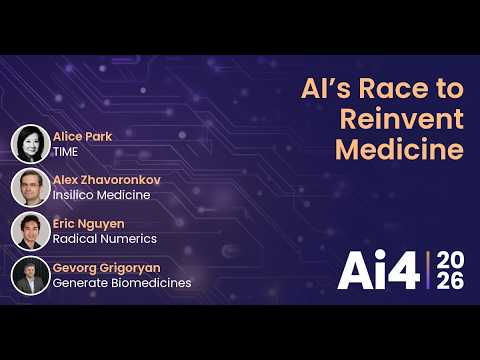
Published on YouTube by Ai4 on August 21, 2026, this video features a panel discussion moderated by Alice Park of TIME, featuring Alex Zhavoronkov, Eric Nguyen, and Gevorg Grigoryan. According to the description, industry leaders discuss how AI is transforming drug discovery, design, and validation, separating reality from hype in life sciences R&D.
## TL;DR
Panelists explore the integration of frontier AI in medicine, highlighting how biological AI acts as a crucial dual-use tool for global security and biodefense. They detail how AI dramatically cuts pre-clinical drug development timelines down to 13 months, bridging early-stage discovery to developmental candidates. However, human clinical trials remain bound by strict regulatory frameworks and animal-model limitations, making high-throughput wet-lab validation and closed-loop reinforcement learning essential for validating novel biological constructs.
## Atmosphere & style
The panel carries an authoritative, intellectually rigorous, and forward-looking tone characteristic of an elite industry keynote. Moderated smoothly by Alice Park, the dynamic between the speakers is collaborative and grounded, balancing high-stakes discussion of national security and biodefense with pragmatic clinical realities. Listening to the conversation feels focused, realistic, and visionary as leaders candidly navigate the boundary between AI acceleration and physical biological constraints.
## Key takeaways
- [00:04](https://www.youtube.com/watch?v=X7D0xUb0ruQ&t=4s) Artificial intelligence represents the next fundamental transformation in life sciences, shifting drug discovery, design, and development beyond traditional medicinal chemistry into AI-driven platforms.
- [20:53](https://www.youtube.com/watch?v=X7D0xUb0ruQ&t=1253s) Biological AI acts as a vital tool for biodefense and national security, serving as an asymmetric defense mechanism capable of countering synthetic biological threats.
- [20:53](https://www.youtube.com/watch?v=X7D0xUb0ruQ&t=1253s) Unlike nuclear technologies, biological risks can be directly mitigated by leveraging stronger generative AI and synthetic biology tools.
- [20:53](https://www.youtube.com/watch?v=X7D0xUb0ruQ&t=1253s) Conventional drug discovery programs from scratch typically require 4.5 years and hundreds of millions of dollars to produce developmental candidates.
- [20:53](https://www.youtube.com/watch?v=X7D0xUb0ruQ&t=1253s) Relocating R&D operations to China reduces developmental candidate timelines to roughly 2.5 years.
- [20:53](https://www.youtube.com/watch?v=X7D0xUb0ruQ&t=1253s) Combining local R&D infrastructure with frontier AI tools accelerates candidate discovery to an average of 13 months across 31 candidates, with a record speed of 9 months.
- [23:06](https://www.youtube.com/watch?v=X7D0xUb0ruQ&t=1386s) AI significantly reshapes the early 'valley of death' by lowering initial failure rates and speeding up pre-clinical design and candidate selection.
- [23:06](https://www.youtube.com/watch?v=X7D0xUb0ruQ&t=1386s) Human clinical trials cannot be bypassed by AI because biological responses in humans frequently diverge from animal models.
- [26:39](https://www.youtube.com/watch?v=X7D0xUb0ruQ&t=1599s) Validating completely novel, non-natural biological entities requires physical ground-truth testing in wet labs, making laboratory throughput the main bottleneck.
- [26:39](https://www.youtube.com/watch?v=X7D0xUb0ruQ&t=1599s) The next frontier in generative genomics relies on tightening the feedback loop between wet-lab testing and AI models using post-training and reinforcement learning.
## Detailed walkthrough
### [00:04](https://www.youtube.com/watch?v=X7D0xUb0ruQ&t=4s)### [00:04](https://www.youtube.com/watch?v=X7D0xUb0ruQ&t=4s) Opening Remarks and the Next Transformation in Medicine
Alice Park introduces the panel at AI4 2026, setting the stage by noting how medicine has historically advanced through monumental breakthroughs—ranging from the initial discovery of antibiotics to the sequencing of the human genome. She emphasizes that artificial intelligence represents the next fundamental transformation in life sciences, changing how drugs are discovered, designed, and clinically developed.
She introduces three industry leaders pioneering this shift: Alex Zhavoronkov (Founder and CEO of Insilico Medicine), Eric Nguyen (Co-Founder and CEO of Radical Numerics), and Gevorg Grigoryan (Co-Founder and CTO of Generate Biomedicines). Park frames the discussion around transitioning beyond traditional medicinal chemistry and biologics toward AI as a core platform, posing the overarching question of whether AI will simply refine existing modalities like small molecules and proteins or spawn
[20:53](https://www.youtube.com/watch?v=X7D0xUb0ruQ&t=1253s) Biodefense, Dual-Use AI, and Asymmetric Protection
The discussion opens with an emphasis on biological AI as an ultimate force for good in managing human health and treating disease, though the speakers acknowledge critical national security implications. Comparing AI applications in life sciences to cybersecurity and defense, the panel highlights that while nations readily invest in defense when falling behind in cyber domains, biodefense investment currently lags behind despite growing urgency.
The speakers delve into the concept of dual-use technologies, using nuclear power as a classic contrast. Unlike nuclear weapons—where a larger bomb or reactor cannot mitigate the impact of an attack—biological risks present a distinct dynamic. The threat of a biological event (whether natural or man-made) can be directly countered using stronger synthetic biology and generative AI tools. Maintaining rapid advancement in biological AI is therefore framed as a core pillar of national and global security.
- Traditional drug discovery programs from scratch take roughly 4.5 years and tens to hundreds of millions of dollars to reach the developmental candidate stage.
- Relocating R&D operations to China reduces this timeline to approximately 2.5 years.
- Integrating frontier AI tools on top of local infrastructure cuts the timeline further to an average of 13 months across 31 developmental candidates, with a record speed of 9 months.
---
[23:06](https://www.youtube.com/watch?v=X7D0xUb0ruQ&t=1386s) Overcoming the Valley of Death and Navigating Clinical Realities
Addressing the traditional "valley of death" where promising compounds fail due to high costs and unpredicted safety issues, Alex Zhavoronkov details how AI reshapes early-stage drug development. While AI dramatically accelerates the pre-clinical journey from initial design to candidate selection—and lowers early failure rates compared to historical benchmarks—the transition to human clinical trials enters a strictly regulated phase.
Once a candidate reaches animal safety and efficacy milestones, the pace aligns with standard regulatory frameworks. Clinical trials cannot be bypassed, as human biological responses often deviate from animal models. The current strategy focuses on scaling pre-clinical discovery, generating robust clinical data, and leveraging AI to optimize every stage until potential regulatory shifts allow faster approvals in the coming years.
---
[26:39](https://www.youtube.com/watch?v=X7D0xUb0ruQ&t=1599s) Testing Novel Entities and Closed-Loop Learning
Eric Nguyen addresses the challenge of validating novel biological constructs that have never existed in nature. Because physical ground truth remains essential, AI primarily functions as a tool to drastically narrow the search space from vast theoretical possibilities down to actionable leads.
While heuristics such as structural similarity and evolutionary patterns guide initial predictions, wet-lab validation remains the main throughput bottleneck. The next frontier in generative genomics involves tightening the feedback loop between real-world laboratory testing and AI models via post-training and reinforcement learning, moving closer toward high-precision, prompt-based biological generation.
## Mentioned
Alice Park, Alex Zhavoronkov, Eric Nguyen, Gevorg Grigoryan, Insilico Medicine, Radical Numerics, Generate Biomedicines, AI4, TIME, China
## Video description
Alice Park - Senior Health Correspondent, TIME
Alex Zhavoronkov - Founder and CEO, Insilico Medicine
Eric Nguyen - CEO, Radical Numerics
Gevorg Grigoryan - Co-Founder and CTO, Generate Biomedicines
AI is beginning to transform how new medicines are discovered, designed, and validated, from biological modeling and molecule design to autonomous experimentation and clinical development. This opening keynote brings together leaders from the companies defining the next era of life sciences R&D to discuss what is real today, what remains hype, and how AI could accelerate the path from scientific insight to patient impact.
Insilico借助中国研发与AI将药物发现周期缩短至13个月
生成式AI与本地化基础设施将临床前开发周期从数年缩短至数月,而湿实验验证与人体临床试验仍是最终瓶颈。
与会嘉宾探讨了前沿AI在医学领域的融合,强调生物AI作为全球安全与生物防御关键两用工具的作用。他们详细阐述了AI如何将临床前药物开发周期大幅缩短至13个月,实现从早期发现到确定开发候选化合物的跨越。然而,人体临床试验仍受制于严格的监管框架和动物模型局限,使得高通量湿实验验证与闭环强化学习对于验证新型生物结构而言不可或缺。
人工智能正引领生命科学领域的根本性变革,推动新药研发从传统药物化学与生物制剂模式转向以 AI 为核心的全新研发平台。 (0:04)
生物 AI 在生物防御与国家安全中起到了关键的不对称防御作用;与核风险不同,潜在的生物威胁可以直接利用更强大的生成式 AI 与合成生物学工具加以应对和化解。 (20:53)
结合前沿 AI 工具与本地研发基础设施,团队将传统需耗时 4.5 年的候选分子发现周期大幅压缩至平均 13 个月,在 31 个候选物中创下了最快 9 个月的纪录。 (20:53)
尽管 AI 显著重塑了早期研发并降低了跨越“死亡之谷”的失败率,但由于人体与动物模型的生物反应存在差异,严格的人体临床试验仍无法被 AI 直接替代。 (23:06)
Reading summary
Artificial intelligence is dramatically compressing pre-clinical drug discovery timelines, but clinical validation and wet-lab testing remain essential bottlenecks governed by biological complexity and regulatory standards.
Compressing Pre-Clinical Discovery Timelines (20:53)
Traditional drug discovery programs built from scratch historically require approximately 4.5 years and tens to hundreds of millions of dollars to produce a developmental candidate. While moving research and development operations to China can shorten this window to roughly 2.5 years, layering frontier artificial intelligence tools onto local infrastructure accelerates the process even further. Across 31 developmental candidates, this integrated approach reduced timelines to an average of 13 months, achieving a record turnaround of 9 months.
Navigating Clinical Realities and Regulatory Frameworks (23:06)
According to Insilico Medicine founder Alex Zhavoronkov, AI significantly reduces early-stage failure rates and lowers the cost of bridging the traditional drug development "valley of death." However, candidates entering the clinical phase must conform to standard regulatory regimes once they satisfy animal safety and efficacy thresholds. Because human biology often behaves differently from animal models, clinical trials cannot be bypassed, leaving developers to focus on scaling pre-clinical discoveries and optimizing data gathering until regulatory standards evolve.
Wet-Lab Bottlenecks and Closed-Loop Validation (26:39)
Eric Nguyen of Radical Numerics points out that when AI designs completely novel biological entities absent from nature, physical ground truth must still be established empirically. Generative models currently act as search mechanisms that reduce astronomical theoretical spaces into practical leads, but wet-lab testing remains the primary throughput bottleneck. The emerging focus in generative genomics centers on closing this gap by connecting laboratory results directly back to AI models through post-training and reinforcement learning loops.
Asymmetric Biodefense and Dual-Use Risks (20:53)
The panel underscores that while biological AI offers immense therapeutic potential, it carries serious dual-use national security implications. In contrast to cyber defense—which receives substantial state funding—biodefense initiatives currently lag behind. The speakers contrast biological defense with nuclear technology: unlike nuclear weapons, where a larger bomb cannot neutralize an attack, biological threats can be actively mitigated using advanced synthetic biology and generative AI systems, making sustained domestic technological progress vital for defense.
While generative AI successfully accelerates initial drug discovery and provides a defensive mechanism against emerging biological threats, the pace of delivering vetted treatments to patients remains bounded by wet-lab validation throughput and human clinical trial requirements.
## Background
本视频由 Ai4 于 2026 年 8 月 21 日发布在 YouTube 平台。内容为一场题为“AI 重塑医药研发竞赛”的开场主题圆桌,由《时代周刊》高级健康记者 Alice Park 主持,邀请了英矽智能(Insilico Medicine)创始人 Alex Zhavoronkov、Radical Numerics 联合创始人 Eric Nguyen 与 Generate:Biomedicines 联合创始人 Gevorg Grigoryan,共同探讨 AI 在生物建模、分子设计、临床研发及自主实验中的落地现状与未来加速路径。
## TL;DR
圆桌嘉宾深度拆解了 AI 如何从科学洞察与工程流程两个维度重塑现代制药范式。Alex Zhavoronkov 分享了 Insilico 利用端到端 AI 将临床前候选药物研发周期从传统 4.5 年压缩至平均 13 个月的实战成果,并阐述了以延长人类健康寿命为核心的抗衰老药物开发;Eric Nguyen 与 Gevorg Grigoryan 则分别探讨了生成式基因组模型(如 EVO)设计生命的突破、生物安全防御与核技术的本质差异,以及生成式生物学模块化工程化的路径。讨论最后指出,湿实验物理验证仍是决定成败的金标准,构建真实世界实验反馈与强化学习的闭环是生物 AI 迈向零样本生成的下一代前沿。
## Atmosphere & style
全场对话兼具前沿技术的宏大视野与制药工业的严谨理性,交流节奏明快且极富信息密度。主持人提问精准犀利,不仅触及技术突破也直指伦理风险与监管瓶颈;三位领军人物在分享真实管线数据与底层模型时坦诚而务实,既不回避生物复杂性与研发高壁垒,又充满用技术改写人类健康命运的坚定信念,观感既硬核又启人心智。
## Key takeaways
- [00:04](https://www.youtube.com/watch?v=X7D0xUb0ruQ&t=4s) AI 正在从根本上重塑药物发现、分子设计及临床研发流程,成为生命科学开启下一场医学转型的核心驱动力。
- [02:17](https://www.youtube.com/watch?v=X7D0xUb0ruQ&t=137s) 评估 AI 在制药领域的真实影响需拆解为两大维度:攻克生物系统极端复杂性的科学挑战,以及在多维度上下文中打通制造、临床与监管的流程挑战。
- [04:56](https://www.youtube.com/watch?v=X7D0xUb0ruQ&t=296s) 人体是一个高度复杂的多模态系统,AI 正在从单独优化 DNA/RNA/蛋白质等单一模态,迈向理解药物在人体全系统中的相互作用与动态行为。
- [04:56](https://www.youtube.com/watch?v=X7D0xUb0ruQ&t=296s) Insilico 探索通过建立衰老时钟模型锁定兼顾疾病与衰老的双重靶点,将抗衰老与延长健康寿命作为 AI 医疗的核心战略目标。
- [09:12](https://www.youtube.com/watch?v=X7D0xUb0ruQ&t=552s) 生成式生物学致力于将工程学的可编程性与模块化理念引入生命科学,通过沉淀经过临床验证的安全有效模块并复用,摆脱传统单次英雄式研发模式。
- [12:10](https://www.youtube.com/watch?v=X7D0xUb0ruQ&t=730s) 基因组基础模型 EVO 已能从零设计具备真实功能的噬菌体基因组,鉴于生命可编程性会降低生物武器制造门槛,行业必须确立设计与防御一体化战略。
- [20:53](https://www.youtube.com/watch?v=X7D0xUb0ruQ&t=1253s) 核技术与生成式生物学存在本质差异:核武器无法用更大的核武器来抵消,但对抗生物威胁唯有依赖更强大的生成式生物学与合成生物学工具,因此绝不能放慢技术发展步伐。
- [23:15](https://www.youtube.com/watch?v=X7D0xUb0ruQ&t=1395s) AI 大幅压缩了临床前研发的周期与成本:传统大药企从零到临床前候选化合物(DC)需 4.5 年,而 AI 全面驱动模式下平均仅需 13 个月,极限纪录可缩短至 9 个月。
- [23:15](https://www.youtube.com/watch?v=X7D0xUb0ruQ&t=1395s) 尽管临床前可以大幅提速,但进入人体临床试验后受制于严格监管与生物转化复杂性无法轻易压缩周期,未来需依赖 AI 产生更丰富真实数据以驱动审批机制变革。
- [26:39](https://www.youtube.com/watch?v=X7D0xUb0ruQ&t=1599s) 当前 AI 在生物分子发现中的核心作用是大幅缩小浩瀚的搜索空间,而未来的关键前沿在于通过强化学习和后训练将湿实验反馈数据融入闭环系统以迭代模型。
## Detailed walkthrough
### [00:04](https://www.youtube.com/watch?v=X7D0xUb0ruQ&t=4s) 开场介绍:AI 与生命科学的交汇
主持人 Alice Park(《时代周刊》高级健康记者)向观众致意,为 Ai4 2026 大会拉开序幕。她回顾了医药发展史上的里程碑:从最初发现抗生素,到人类基因组图谱的绘制,每一个突破都从根本上重塑了人类对生命科学的认知与可能性的边界。如今,人工智能(AI)正作为核心驱动力,开启下一场深刻的医学转型,重塑药物发现、分子设计及临床研发的全流程。
Alice 隆重介绍了本次开场圆桌的三位领军人物:
- **Alex Zhavoronkov(英矽智能 Insilico Medicine 创始人兼 CEO)**:生成式 AI 加速药物研发领域的先驱者。
- **Eric Nguyen(Radical Numerics 联合创始人兼 CEO)**:带领团队构建通用生物智能(General Biological Intelligence),主导了全球首个使用大语言模型进行 DNA 设计的基础模型 EVO。
- **Gevorg Grigoryan(Generate:Biomedicines 联合创始人兼 CTO)**:设计了该公司的生成式生物学平台,致力于解决 AI 面临的最复杂难题——生物系统建模。
```mermaid
flowchart LR
accTitle: 药物研发历史演进与 AI 的介入
subgraph S1["传统时代"]
A["天然产物模仿<br/>(如阿司匹林)"] --> B["药物化学与小分子"]
end
subgraph S2["现代生物医药"]
B --> C["大分子生物药/疫苗"]
C --> D["细胞与基因疗法"]
end
subgraph S3["AI 时代"]
D --> E["端到端 AI 驱动研发<br/>(靶点、设计与临床)"]
end
```
---
### [02:17](https://www.youtube.com/watch?v=X7D0xUb0ruQ&t=137s) 研发范式变迁与 AI 的角色定位
Alice 回顾了药物研发的历史演进:从最初模仿自然界(如阿司匹林的发现),到进入药物化学的小分子时代,再到生物制剂、疫苗,以及如今的细胞和基因疗法。而今,AI 已经渗透进靶点发现、分子生成乃至临床试验等各个环节。她向嘉宾抛出核心问题:AI 在药物研发中扮演的角色,究竟只是在现有的小分子与大分子框架下进行优化演进,还是在开创一种全新的药物类别与研发机制?
Gevorg Grigoryan 率先作答。他指出要评估 AI 的真实影响,必须将制药难题拆分为两个维度:
1. **科学挑战(Scientific Challenge)**:生物系统的复杂性极高。AI 不仅在分子生成与设计端取得了巨大突破,更深远的价值在于解析人体生理学的内在运行机制。
2. **流程挑战(Process Challenge)**:药物研发包含科学验证、生产制造(CMC)、未满足的临床需求评估以及监管互动等极其繁杂的环节。AI 的关键潜力在于将这些分散的多维度上下文信息在同一时空中融合联动。
---
### [04:56](https://www.youtube.com/watch?v=X7D0xUb0ruQ&t=296s) 从可编程生命到抗衰老药物管线
Eric Nguyen 阐述了 Radical Numerics 的愿景:利用 AI 大模型直接对生命的基底——DNA 进行“读取、编写与编程”。就像大语言模型处理自然语言一样,当 AI 能够直接操纵和工程化生命物质时,这不仅关乎医药研发,更引发了关于“何为人类”以及“我们希望 AI 为人类做什么”的深层思考。他强调,目前行业大多停留在优化单一模态(单独设计一种蛋白质、RNA 或 DNA),而人体是一个高度复杂的“多模态系统”。理解药物在人体全系统中的相互作用与动态行为,是 AI 正在迈向的下一个前沿领域。
随后,Alice 转向 Alex Zhavoronkov,风趣地提到 Alex 的西装外套上印满了公司的研发管线。Alex 介绍,Insilico Medicine 主要专注于传统制药中占比最大的小分子药物领域,目标是从全流程加速研发。他展示了西装上的具体管线进展:
- 拥有 **31 个进入临床前候选化合物(Developmental Candidates, DC)阶段** 的药物资产。
- 临床试验阶段包括 **1 个 III 期临床、3 个 II 期临床、8 个 I 期临床**。
- 将一个药物推进到临床前候选化合物阶段,大约需要经过 **1200 个具体步骤(1.2k steps)**,而 AI 正在对其中每一个步骤进行系统性加速。
Alex 强调,Insilico 的核心使命不仅是提速研发,而是攻克全人类共同面临的根本问题——**衰老(Aging)**。他指出,人体每一毫秒都在走向疾病与死亡,Insilico 建立衰老时钟模型,寻找既调控疾病又驱动衰老的“双重靶点”,开发小分子药物以治疗具体疾病为切入点,最终目标是实现抗衰老药物的再利用。
---
### [09:12](https://www.youtube.com/watch?v=X7D0xUb0ruQ&t=552s) 生成式生物学:模块化与可预测性
讨论深入到“生成式生物学(Generative Biology)”的定义。Gevorg 解释,Generate:Biomedicines 之所以以此命名,核心就在于将现代工程学中的“可编程性(Programmability)”与“模块化(Modularity)”引入生命科学。目前的制药流程更像是一次性的“英雄式探索”,每一次研发都是从零开始的发明;而工程学之所以能够实现规模化,是因为采用了经过充分测试且可复用的标准化组件。生成式生物学就是要让生物学流程可引导、模块化、可重复且可扩展。
针对 Alice 提出的“脱靶效应(Off-target effects)与体内毒性难以预测”的痛点,Gevorg 提出了两项解决路径:
- **机器学习结合大规模实验测量**:算法无法凭空产生洞察,必须依靠海量的高通量测量数据来训练预测模型,端到端预测靶向结合力、脱靶风险、成药性、生产可行性以及无毒性。
- **模块复用机制**:借助工程化理念,将已在临床验证安全有效的分子模块沉淀下来并在后续药物中复用,从而无需在每个新项目中重新试错。
```mermaid
flowchart TD
accTitle: 生成式生物学与工程化制药流程
subgraph Predict["预测与学习层"]
M1["海量实验测量数据"] --> M2["机器学习预测模型"]
M2 --> M3["多属性评估<br/>(靶向性/成药性/无毒性)"]
end
subgraph Modular["工程化落地层"]
E1["标准化分子模块库"] --> E2["模块化装配与设计"]
E2 --> E3["临床验证"]
E3 -- "复用成功经验" --> E1
end
M3 --> E2
```
---
### [12:10](https://www.youtube.com/watch?v=X7D0xUb0ruQ&t=730s) 生成式基因组学:设计生命与防御的双刃剑
Alice 将话题引向生成式基因组学(Generative Genomics),调侃 Eric 的团队能够拼接出自然界从未存在过的 DNA,甚至被戏称为“科幻异形电影中的反派角色”。
Eric 坦然回应,并向听众介绍了其团队研发的 **EVO 与 EVO 2** 基因组基础模型。科学家们利用 EVO 成功在实验室中从零生成了第一个完全由 AI 设计、且具备真实生物学功能的完整病毒基因组——一种噬菌体(Bacteriophage)。
- 尽管该噬菌体对人体完全无害(仅侵染细菌),但“AI 凭空造出活病毒”的消息依然引发了巨大的公众恐慌与安全担忧。
- Eric 指出,能够精准编程和设计生命功能的技术,同样也会大幅降低制造致命危险生物制品的门槛。
- 基于这一双刃剑属性,Radical Numerics 确立了**“设计(Design)与防御(Defense)一体化”**的战略:在利用 AI 攻克人类疾病的同时,必须将最前沿的技术主动部署在生物安全与防御系统上。二者是一体两面、不可割裂的。
---
### [15:08](https://www.youtube.com/watch?v=X7D0xUb0ruQ&t=908s) 伦理边界、监管治理与生命延长的宏大价值
Alice 引发了对行业治理的深思:当前 AI 操纵生命底层规律的能力,与 20 世纪 70 年代重组 DNA 技术诞生时的“阿西洛马会议(Asilomar Conference)”时期高度相似。当时科学家们自发达成共识并设立了临时研究禁令,以待社会建立起伦理防线。她询问三位嘉宾,面对当前的 AI 制药前沿,监管者与社会领袖最应关注什么?
Alex Zhavoronkov 直言,**延长健康寿命(Healthspan)应当是 AI 医疗最核心的目标**:
- 经过 250 年的现代药理学研究,在合理饮食、运动及日常体检(他幽默地概括为“听妈妈的话” DYT, Do What Your Mother Told You)之外,目前尚无任何一款药物能够确凿证明可以让健康人平均多活哪怕一年。
- 像 GLP-1 这类新兴的代谢调节药物,或许有望成为首个为健康人群延寿一年的潜在长寿疗法。
- **震撼的数字量化**:如果能让人类平均寿命延长 1 年,全球 83 亿人将新增 **83 亿个“生命年(Life Years)”**,折算下来相当于创造了 **1.1 亿至 1.15 亿个完整人生(Lifetimes)**——这比人类有史以来所有战争死亡人数的总和还要多。
- 他呼吁建立可持续的商业模式,以 20 至 30 年为尺度,坚持开发兼顾疾病治疗与抗衰老的双重疗法。
Eric Nguyen 紧接着指出,行业需要**“言行合一(Put money where your mouth is)”**:许多前沿 AI 实验室在罗列 AI 的极端灾难风险时,除了网络安全外,生物安全风险往往被排在第一位。然而,目前的讨论大多充斥着末日预警和恐吓言论,实际落地的建设性行动严重不足。他主张行业必须从空泛的恐慌炒作转向“以解决方案为导向”的实质性防御建设。
### [20:53](https://www.youtube.com/watch?v=X7D0xUb0ruQ&t=1253s) 生物 AI 的双重用途与国家生物防御:核武器与生物技术的本质区别
在探讨生物 AI 的潜在危险时,嘉宾们并未回避安全顾虑,但均表达了坚定的乐观态度。Eric Nguyen 强调,虽然生物 AI 具有潜在危险性,但它终将从根本上重塑人类管理健康与治疗疾病的方式,成为一股造福人类的力量。他将生物 AI 比作网络安全等关乎国家防御的核心技术:当一个国家在网络安全领域感到落后时,必然会全力投入;而在当前的生物防御(Biodefense)方面,尽管行业意识到了紧迫性与滞后现状,实际落地的行动和战略投资依然远远不足。
Gevorg Grigoryan 对此表示赞同,并针对“军民两用/双重用途技术”(Dual-use Technologies)提出了极其深刻的辨析。人们在谈及双重用途时往往会本能地联想到核技术——核能既能制造核反应堆,也能制造毁灭性的核武器。但 Gevorg 指出,核技术与生成式生物学存在本质区别:“你无法用一颗更大的核弹或一座核反应堆去抵消核弹带来的灾难;但面对无论是自然发生还是人为制造的生物威胁,更先进的合成生物学与生成式生物学工具恰恰是最强有力的防御手段。”因此,在审慎设立安全红线的同时,绝不能人为放慢生成式生物学的发展步伐,因为真正的生物安全正是源自这些前沿科技本身。
- **乐观愿景**:生物 AI 将彻底改变疾病治疗方式与健康管理体系。
- **生物防御现状**:国家层面的生物防御意识已然觉醒,但资金投入与实质行动仍明显滞后。
- **核技术 vs. 生物技术**:核武器无法用更大的核武器来防御,但生物威胁(天然瘟疫或人造袭击)能够且必须依赖更强大的生成式生物学与合成生物学工具来进行防御与化解。
---
### [23:15](https://www.youtube.com/watch?v=X7D0xUb0ruQ&t=1395s) 跨越“死亡之谷”:从 4.5 年到 13 个月的临床前候选药物革命
主持人 Alice Park 将讨论引向制药行业臭名昭著的“死亡之谷”(Valley of Death)——由于临床试验极其昂贵且耗时繁琐,动辄耗资数十亿美元,大量极具前景的化合物因无法有效预测其安全性和有效性而在进入人体试验前夭折。对此,Alex Zhavoronkov 结合 Insilico Medicine 的实战数据,详细拆解了 AI 如何重塑临床前研发:
```mermaid
flowchart TD
accTitle: 药物研发阶段周期对比与临床监管瓶颈
subgraph Preclinical["临床前研发阶段:从零到确定候选药物(DC)"]
direction TB
A["传统大药企研发模式<br/>耗时约 4.5 年 / 数千万至数亿美元"] --> B["研发中心迁移至中国模式<br/>耗时缩短至 2.5 年(节省 2 年)"]
B --> C["AI 全面驱动研发模式<br/>平均 13 个月,极限纪录仅 9 个月"]
end
subgraph Clinical["人体临床试验阶段:强监管与不可压缩的生物规律"]
direction TB
D["候选药物(DC)确认<br/>完成动物安全与有效性验证"] --> E["进入人体临床试验(I/II/III 期)<br/>'跟随车流速度前行',监管严格把关"]
E --> F["未来监管演进(5-6 年后)<br/>AI 产生更丰富数据,推动加速审批机制"]
end
C --> D
```
在传统大药企(Big Pharma)的标准流程中,一个研发项目从零起点推进到确定“开发候选药物”(Developmental Candidate, DC,即进入人体临床前夕的关键节点),通常需要 4.5 年时间并耗费数千万乃至数亿美元。如果药企将研发团队部署至中国等高效率生态圈,该周期可缩减至 2.5 年;若进一步叠加最前沿的 AI 算法,周期能再度压缩一年以上。Alex 透露,Insilico 创下的最快纪录仅为 9 个月,而在累计研发的 31 款候选药物中,平均耗时仅为 13 个月。更关键的是,研发速度的提升并未牺牲质量,其临床前失败率显著低于历史基准。
然而,一旦跨过候选药物节点并在动物模型中证实了安全性与有效性,研发便进入了高度监管的深水区。Alex 生动地比喻道,此时研发团队必须“随着车流的速度前行”,因为这里有严格的“交通警察”(监管机构)。由于生物系统的高度异质性,动物体内的生物学假说往往无法直接推导至人体,加之不同个体对同种药物的反应千差万别,人体临床试验绝不可被绕过。眼下的策略是在临床前阶段借助 AI 进行规模化筛选,在临床阶段生成尽可能多的真实数据以支持决策;或许在未来 5 到 6 年内,监管机构能够在 AI 数据的支撑下推进政策解绑与加速审批。
- **传统研发周期**:0 到 DC 阶段耗时 4.5 年,成本达数千万至数亿美元。
- **中国生态加速**:将研发中心转移可将周期缩短至 2.5 年(节省 2 年)。
- **AI 赋能极限**:前沿 AI 将平均研发周期降至 13 个月(Insilico 31 个候选分子平均值),最快纪录仅 9 个月。
- **临床试验壁垒**:进入人体试验后受限于严格法规与生物学转化复杂性,无法单方面加速,需依赖扎实的临床数据积累。
---
### [26:39](https://www.youtube.com/watch?v=X7D0xUb0ruQ&t=1599s) 验证前所未有的生命分子:缩小搜索空间与闭环反馈的前沿
面对如何测试和验证自然界中“前所未有”(Never existed before)的生成式基因组设计这一挑战,Eric Nguyen 坦言,这正是 AI 介入生物学时的核心瓶颈所在。在生命科学中,衡量设计的终极金标准(Ground truth)唯有物理实验——必须能够在湿实验室内将其真实合成、制造出来并测定其功能。
虽然研发人员可以借助一系列启发式规则(Heuristics)进行初步评估——例如对比其与天然分子的相似度、比对已知的三维结构特征等,但物理实验的通量依然是刚性约束。从本质上看,AI 在当前生物发现中的核心作用是急剧缩小庞大的搜索空间:在浩瀚的潜在分子宇宙中,AI 能精准剔除无效区域并圈定最具价值的候选者。
```mermaid
flowchart LR
accTitle: 生成式生物学 AI 发现与湿实验闭环优化流程
A["浩瀚的分子搜索空间<br/>(所有潜在可能序列)"] --> B["生成式 AI 模型初筛<br/>缩小搜索范围 / 启发式评估"]
B --> C["物理湿实验合成与验证<br/>功能测定(真实金标准)"]
C --> D["真实世界数据反馈<br/>强化学习 / 后训练微调"]
D --> B
```
Eric 指出,行业的终极目标是希望实现类似大语言模型输入 Prompt 即可精准生成有效分子的“零样本生成”,但目前技术尚未成熟。当前生物 AI 最重要的技术前沿,在于通过强化学习(Reinforcement Learning)或后训练(Post-training)机制,将湿实验室测得的真实世界反馈数据无缝融入模型的迭代闭环中。随着这种闭环能力的成熟,AI 将为发现更高效拯救人类生命的新药带来巨大飞跃。在对谈尾声,Alice Park 总结道,生物医药的 AI 变革仅仅揭开了序幕,一个关乎人类健康的全新时代正拉开帷幕。
- **终极金标准**:分子的最终功能必须依赖湿实验室的物理合成与功能测定来验证。
- **AI 核心价值**:大幅收窄化学与生物序列的搜索空间,快速锁定高概率候选目标。
- **技术下一前沿**:引入真实实验反馈机制,通过强化学习和后训练优化模型,构建生成与验证的闭环系统。
## Notable quotes
> [09:12](https://www.youtube.com/watch?v=X7D0xUb0ruQ&t=552s) 目前的制药流程更像是一次性的‘英雄式探索’,每一次研发都是从零开始的发明;而工程学之所以能够实现规模化,是因为采用了经过充分测试且可复用的标准化组件。生成式生物学就是要让生物学流程可引导、模块化、可重复且可扩展。 — Gevorg Grigoryan
> [12:10](https://www.youtube.com/watch?v=X7D0xUb0ruQ&t=730s) 能够精准编程和设计生命功能的技术,同样也会大幅降低制造致命危险生物制品的门槛。在利用 AI 攻克人类疾病的同时,必须将最前沿的技术主动部署在生物安全与防御系统上。二者是一体两面、不可割裂的。 — Eric Nguyen
> [15:08](https://www.youtube.com/watch?v=X7D0xUb0ruQ&t=908s) 延长健康寿命(Healthspan)应当是 AI 医疗最核心的目标。 — Alex Zhavoronkov
> [15:08](https://www.youtube.com/watch?v=X7D0xUb0ruQ&t=908s) 如果能让人类平均寿命延长 1 年,全球 83 亿人将新增 83 亿个‘生命年’,折算下来相当于创造了 1.1 亿至 1.15 亿个完整人生——这比人类有史以来所有战争死亡人数的总和还要多。 — Alex Zhavoronkov
> [15:08](https://www.youtube.com/watch?v=X7D0xUb0ruQ&t=908s) 许多前沿 AI 实验室在罗列 AI 的极端灾难风险时,除了网络安全外,生物安全风险往往被排在第一位。然而,目前的讨论大多充斥着末日预警和恐吓言论,实际落地的建设性行动严重不足。 — Eric Nguyen
> [20:53](https://www.youtube.com/watch?v=X7D0xUb0ruQ&t=1253s) 你无法用一颗更大的核弹或一座核反应堆去抵消核弹带来的灾难;但面对无论是自然发生还是人为制造的生物威胁,更先进的合成生物学与生成式生物学工具恰恰是最强有力的防御手段。 — Gevorg Grigoryan
> [23:15](https://www.youtube.com/watch?v=X7D0xUb0ruQ&t=1395s) 在传统大药企的标准流程中,一个研发项目从零起点推进到确定开发候选药物通常需要 4.5 年。若叠加最前沿的 AI 算法,Insilico 累计研发的 31 款候选药物平均耗时仅为 13 个月,创下的最快纪录仅为 9 个月。 — Alex Zhavoronkov
> [23:15](https://www.youtube.com/watch?v=X7D0xUb0ruQ&t=1395s) 一旦跨过候选药物节点并在动物模型中证实了安全性与有效性,研发便进入了高度监管的深水区。此时研发团队必须‘随着车流的速度前行’,因为这里有严格的‘交通警察’。 — Alex Zhavoronkov
> [26:39](https://www.youtube.com/watch?v=X7D0xUb0ruQ&t=1599s) 在生命科学中,衡量设计的终极金标准唯有物理实验——必须能够在湿实验室内将其真实合成、制造出来并测定其功能。 — Eric Nguyen
## Mentioned
Alice Park, Alex Zhavoronkov, Eric Nguyen, Gevorg Grigoryan, Ai4, TIME (时代周刊), Insilico Medicine (英矽智能), Radical Numerics, Generate:Biomedicines, EVO / EVO 2, Asilomar Conference (阿西洛马会议), GLP-1
## Video description
Alice Park - Senior Health Correspondent, TIME
Alex Zhavoronkov - Founder and CEO, Insilico Medicine
Eric Nguyen - CEO, Radical Numerics
Gevorg Grigoryan - Co-Founder and CTO, Generate Biomedicines
AI is beginning to transform how new medicines are discovered, designed, and validated, from biological modeling and molecule design to autonomous experimentation and clinical development. This opening keynote brings together leaders from the companies defining the next era of life sciences R&D to discuss what is real today, what remains hype, and how AI could accelerate the path from scientific insight to patient impact.
[Source](https://www.youtube.com/watch?v=X7D0xUb0ruQ)
Source quotes
[9:12] Gevorg Grigoryan: 目前的制药流程更像是一次性的‘英雄式探索’,每一次研发都是从零开始的发明;而工程学之所以能够实现规模化,是因为采用了经过充分测试且可复用的标准化组件。生成式生物学就是要让生物学流程可引导、模块化、可重复且可扩展。
[12:10] Eric Nguyen: 能够精准编程和设计生命功能的技术,同样也会大幅降低制造致命危险生物制品的门槛。在利用 AI 攻克人类疾病的同时,必须将最前沿的技术主动部署在生物安全与防御系统上。二者是一体两面、不可割裂的。
[15:08] Alex Zhavoronkov: 延长健康寿命(Healthspan)应当是 AI 医疗最核心的目标。
[15:08] Alex Zhavoronkov: 如果能让人类平均寿命延长 1 年,全球 83 亿人将新增 83 亿个‘生命年’,折算下来相当于创造了 1.1 亿至 1.15 亿个完整人生——这比人类有史以来所有战争死亡人数的总和还要多。
[15:08] Eric Nguyen: 许多前沿 AI 实验室在罗列 AI 的极端灾难风险时,除了网络安全外,生物安全风险往往被排在第一位。然而,目前的讨论大多充斥着末日预警和恐吓言论,实际落地的建设性行动严重不足。
[20:53] Gevorg Grigoryan: 你无法用一颗更大的核弹或一座核反应堆去抵消核弹带来的灾难;但面对无论是自然发生还是人为制造的生物威胁,更先进的合成生物学与生成式生物学工具恰恰是最强有力的防御手段。
[23:15] Alex Zhavoronkov: 在传统大药企的标准流程中,一个研发项目从零起点推进到确定开发候选药物通常需要 4.5 年。若叠加最前沿的 AI 算法,Insilico 累计研发的 31 款候选药物平均耗时仅为 13 个月,创下的最快纪录仅为 9 个月。
[23:15] Alex Zhavoronkov: 一旦跨过候选药物节点并在动物模型中证实了安全性与有效性,研发便进入了高度监管的深水区。此时研发团队必须‘随着车流的速度前行’,因为这里有严格的‘交通警察’。
[26:39] Eric Nguyen: 在生命科学中,衡量设计的终极金标准唯有物理实验——必须能够在湿实验室内将其真实合成、制造出来并测定其功能。
Original transcript
[0:04] Good morning everyone. How's everyone doing? Yes.
All right. I am Alice Park. I write about health
[0:13] and medicine for time and I am very excited to
be here to kick off AI for 2026. Medicine has
[0:22] always advanced through breakthroughs. From
the discovery of antibiotics to the mapping
[0:28] of the human genome, each has changed what
is possible. Today, artificial intelligence
[0:36] is driving the next transformation, changing how
we discover, design, and develop new medicines.
[0:45] It's my pleasure to sit down this morning
with three of the people who are leading that
[0:51] transformation. Alex Zaronov is the founder and
CEO of Insilico Medicine, pioneering the use of
[1:01] generative AI to accelerate drug discovery. Eric
Newan is co-founder and CEO of Radical Numeric,
[1:11] an AI research lab building general biological
intelligence. He led the team behind EVO,
[1:20] the first model to enable DNA design with large
language models. And we'll be getting into that
[1:27] to talk a little bit about what the implications
are there. Gavor Gregorian is co-founder and chief
[1:34] technology officer of Generate Biio Medicines
where he architected the company's AI platform
[1:41] to tackle one of AI's hardest challenges,
biology. So, please join me in welcoming Alex,
[1:50] Eric, and Gabbor. All right. Well, welcome and I'm
really looking forward to the discussion. I think
[1:57] the time is right and there's a lot of momentum
building, but there's still a lot of challenges
[2:02] and still a lot of questions that need to be
answered. So hopefully we'll get into a rich
[2:06] discussion here and and sort of lay the groundwork
for what's coming when we think about how AI can
[2:11] really transform the medicines uh that we use
and develop in coming years. Uh if we look back
[2:17] on drug development, we can categorize broad
categories. We started with trying to imitate
[2:24] nature, right? A lot of the first medicines came
from nature. Uh if we think about things like
[2:29] aspirin and that was our inspiration. Uh we tried
to perfect it, understand it better. We moved into
[2:37] so medicinal chemistry became the thing. We moved
into refining that with uh biologics uh things
[2:45] like vaccines and now increasingly cellbased and
gene therapies. So now of course we're entering
[2:52] an era when AI based strategies are involved
in nearly every aspect of drug development
[2:57] from target identification all the way through to
perhaps even testing and development of the drug.
[3:04] So I'd like to ask each of you when you look at
the impact that AI is having on drug development,
[3:11] how would you categorize what role AI as a
platform will have? Are we going to continue
[3:18] to further evolve small molecules, biologics,
or are we looking at an entirely new class and
[3:26] an entirely new way of developing drugs? And I
know each of you might have slightly different
[3:31] perspectives on that. So, Gavororic, since you're
uh right next to me here, let's start with you.
[3:36] Thanks, Alice. Uh, and thanks for having us.
It's a great question. I think, you know,
[3:40] to think about what the impact of AI really will
be, I think it's it's useful to step back and say,
[3:45] well, what's actually hard? what's what's sort of
challenging about making medicines and I think of
[3:49] it in two categories. One there's a scientific
challenge and then there is the the kind of the
[3:55] the the process of making medicines is very hard
and both of those need to be addressed. So for for
[4:00] a scientific from the scientific side biology is
complex AI is making a lot of impact in how we can
[4:07] better design molecules. Um, and that's incredibly
important. But where we need to be sort of seeing
[4:14] things to change is for AI to really help unravel
how biology is actually happening. What's what's
[4:21] sort of human physiology really like and that's I
think is what's going to unlock its maximum impact
[4:27] uh on the scientific side. On the process side,
you know, there's a lot of different things that
[4:32] need to come together in order to make a drug from
obviously the scientific but also manufacturing,
[4:38] also medical need, u regulatory interactions.
I think AI has a lot of potential to create
[4:45] sort of have all of that context come together
in one place in time. Um, and we we very much
[4:51] need to see that change as well. Okay, Eric,
your thoughts on that? And I know you might
[4:56] have a slightly different perspective here
and tell us a little bit first of all about
[5:00] um your work at uh Radical Numeric. Absolutely. So
Radical Numeric is an AI research lab and we train
[5:10] AI to be able to read, write, and basically
make DNA programmable. And so think of large
[5:17] language models acting on language. Now we're
training it on the direct substrate of life. And
[5:23] when you think about giving AI the potential to
basically to manipulate and engineer life itself,
[5:31] I think this opens up a lot of questions not just
about medicine, but what it means to be human and
[5:37] what means to essentially what do we want AI
to do for us as humans? Um, and so for AI to
[5:45] be working in medicine and drug development,
I think we're just at the tip of the iceberg.
[5:50] I think we've thought a lot about for example how
to make a specific drug uh one modality at a time
[5:55] like a protein or an RNA or DNA but being able to
understand how a drug is going to behave in such a
[6:03] complex system like our body those are going to be
the next frontiers that inherently is a multimodal
[6:09] system and right now we're really just optimizing
one modality one piece of the pie at time and so
[6:16] I think that's going to be a big step that AI can
really transform from how we're thinking about it
[6:21] now. Hey, Alex. Um, I know you're looking at
a more probably traditional approach of small
[6:30] molecules and working with small molecules. And
I want to point out I don't I know none of you
[6:35] can see this, but on Alex's jacket there, he's
got um a list of his [laughter] of his pipeline
[6:42] um starting from phase three right at the top. So
tell us about your perspective on this when you
[6:47] look at how how you've taken AI into um the way
in and looking at how we can develop drugs for the
[6:55] next generation. Sure. So um at Enilico you're
right we are focusing mostly on small molecule
[7:01] drugs. Uh that's actually the class of drugs that
is the largest uh currently in the industry. uh
[7:07] and our job uh from the very beginning was to
accelerate this process of drug discovery and
[7:13] development. So now yes on my jacket I've got uh
31 developmental candidates. So we actually have
[7:21] um 31 drugs uh that we've developed to the level
of kind of one stage before human clinical trials.
[7:29] Now I've got one phase three uh three phase twos
and eight phase ones. Uh so actually the drugs
[7:37] have reached human patients uh not yet approved
but uh kind of getting there. Um every time you
[7:46] launch a drug to a developmental candidate to this
uh wonderful point before human clinical trials uh
[7:54] you complete approximately 1.2,000 steps and every
one of those steps can be accelerated with AI.
[8:02] uh and you have to be good at all of those steps
in order to deliver a good drug. But what you
[8:08] probably need to know about in silica, so we are
focused on aging. So one of the most important
[8:15] diseases or biological processes that all of
you have so you're you you might not have cancer
[8:21] or diabetes or Alzheimer's but all of you have
aging and uh uh every second every millisecond
[8:28] there is an aging clock ticking at every level
of your body. uh bringing you closer to death
[8:34] and diseases. So we build models that understand
uh aging from the time you are born to the time
[8:41] you die, identify therapeutic targets that are
implicated on aging and disease at the same time
[8:47] and then develop small molecules for a specific
disease with a hope to repurpose uh this drug one
[8:53] day for aging. So I think that this is a bigger
story than just acceleration of drug discovery.
[9:00] Okay. And we're going to come back to the issue
of longevity, I think, and um finding ways to
[9:07] slow and even reverse aging, which is obviously
a very hot topic now in health. But um Gavorg,
[9:12] I want to come back to you and and talk a little
more in depth about generative biology. Um what is
[9:18] generative biology and how is that really going
to transform the way we develop medicines for
[9:23] the next, you know, few decades? Yeah, of course,
great question. So, you know, we obviously think
[9:28] about that a lot at Generate. In fact, that's why
we called ourselves generate. Um, I think to me
[9:33] it's actually related to a a point that Eric just
brought up. It's this point of programmability.
[9:39] The way we make medicines today, every drug is
kind of a heroic one-off effort uh to to to sort
[9:47] of treat a particular section of the population.
But what if it were possible to do this more
[9:53] programmatically in a more repeatable and scalable
fashion? We can look at other disciplines where
[9:58] that's already the case and there's a lot of that
is true in engineering. How does that happen?
[10:03] Well, we have reusable parts. We have methods
that you know that are tested and reused. So,
[10:08] it's not like every device is a denovo invention
of something fundamentally new. It brings together
[10:15] components components that are tested. So I think
that's kind of we we think of of of generative
[10:21] biology is fundamentally about programmability
about being able to guide processes biological
[10:27] processes in the human system in a desired fashion
but also importantly doing so with modularity with
[10:34] repeatability and with scalability in mind. So
does that mean one of the big issues with um drug
[10:40] development are side effects right offtarget and
side effects that are in many cases unpredictable
[10:46] and that you can't even understand or expect until
you see them in vivo in a living model so which is
[10:52] why we have animal models all of that uh will this
approach help us to better understand and break
[10:58] down and predict I guess even what some of those
might be and therefore reduce them and develop
[11:04] drugs that are a little more efficient and more
precise. I think so and from from two perspectives
[11:09] on the one hand machine learning is enabling us to
build predictive models of some of these offtarget
[11:15] interactions. Um now that has to be coupled with
massive measurement because machine learning sort
[11:20] of can't create insights out of out of thin air.
It needs to have measurable data in order to draw
[11:26] inferences from. Um but that's one side of it. Be
able to anticipate end to end all of the different
[11:32] concerns that a drug needs to meet. It needs to
hit its target. It needs to not do other things.
[11:36] It needs to be manufacturable. It needs to be
non-toxic, etc., etc. On the other hand, I think
[11:43] again like the point of modularity is that maybe
we don't have to discover that each time. So we
[11:48] can use our predictive capabilities at the end of
the day. We observe what happens in the clinic and
[11:52] if something works, we learn from that by let's
say reusing a similar module um for for a future
[11:59] drug. So I think it's a combination of concepts
of modularity which really comes from engineering
[12:04] with the predictive aspect that machine learning
is enabling today. Okay. So uh Eric we're going
[12:10] to go from generative biology to generative
genomics. Um and as you mentioned you are
[12:16] looking at creating new life putting DNA together
in ways that nature didn't think of. [laughter] So
[12:23] clearly, you know, you've got a positive side
to that in that you can potentially look at
[12:28] um previously unprecedented ways of developing
drugs. Um on the negative side, I think you've
[12:33] been called uh the villain in an alien movie,
which kudos to whoever came up with that comment,
[12:39] but um and Hollywood of of course feeds into all
of that. So tell us about that fine line and what
[12:47] generative genomics means and then we can get
into a little bit of a discussion about what the
[12:53] implications are for um and the responsibility uh
embedded in that power the ability to you know do
[13:01] what you do at radical numeric. Yeah. So for some
context for the audience, uh our team is known for
[13:08] creating these models called EVO and EVO 2, which
were these large foundation models trained on DNA.
[13:15] And it showed that for the first time you can
generate DNA that functions in the real world,
[13:19] right? And so what scientists actually did um
la just last year was use EVO to create the
[13:26] first whole genome from scratch using AI. So, it
was an organism that actually functioned in the
[13:32] lab and turns out it was a virus. It's called
the bacteria phase, which when you tell folks
[13:40] AI was able to generate a virus, it scares the
heck out of people. Now, in this case, it was a
[13:46] harmless virus. It can only attack bacteria. But
to Alice's point about creating a fine line of
[13:54] when science can be helpful for human health and
when science can be used to potentially create
[14:00] something dangerous or be misused as a potential
boweapon. And so this was a key turning point for
[14:07] us as a company at Radical to make sure that our
technology is both applied to human health, right?
[14:13] being able to understand how disease functions in
our body, how to make drugs for it, but also to
[14:19] use that same frontier technology and actively
deploy it on the defense side. So pushing both
[14:25] on design and defense because in our minds these
are both of one of the same thing just different
[14:32] sides of the coin. The same technology that lets
you program, design, function with DNA into an
[14:40] organism also lowers the barrier to make something
super dangerous. And so that's why we think it's
[14:47] uh inseparable and then in fact necessary for
a single entity which in the past has not both
[14:53] worked on design and defense. And so as a company
that's what we want to push the frontier on. Make
[14:59] sure this technology is both safeguarded as well.
Okay. So let's consider that and and how we tackle
[15:08] those issues when all of you are working in ways
that are going to create um ways that we alter
[15:15] right human processes alter processes in biology
in ways that we've never done before and with an
[15:21] efficiency probably and uh power that we've never
had before. back 1970s, you know, the recominant
[15:30] DNA. This reminds me of that period when the
ability to sort of put together DNA in quote
[15:37] unquote non-natural ways uh raised a lot of social
and ethical concerns as well among the scientific
[15:44] community and about a day's drive from here
scientists voluntarily um famously met at Ayamar
[15:51] and uh you know came up with kind of guidelines
I guess is the best way to call it to uh really
[15:58] navigate the research what kind research should be
done, how it should be done and how it should be
[16:03] monitored and the gist of that was that there was
a temporary moratorum on some types of research
[16:10] before we as a society could wrap our heads around
you know how we dealt with the implications of
[16:16] that. So I wanted to ask each of you as you look
at this new frontier of AI based medicines and
[16:22] new ways of um really manipulating uh biological
processes where you think we should like what's
[16:30] the most important thing we should be looking at
or having our you know political leadership social
[16:37] cultural leaders um talk about and where you think
uh how we can start that conversation to to get
[16:43] ahead of this and make sure Eric as you said that,
you know, this is work done for good rather than,
[16:51] you know, the villain in an alien movie. So, Alex,
maybe we can start with you since you're pretty
[16:56] far along with some of the the drugs that you
already have in Yeah. Well, I think that if you
[17:02] are going to consider just one most important
aspect of the application of AI uh or AI and
[17:10] healthcare, it should be aging. Because currently
after you know 250 years of pharmacological
[17:19] research we don't have a single drug that can help
you live one year of life longer than average if
[17:28] you are already optimizing dieting exercising
doing regular diagnostics uh and uh as I like
[17:35] to call it dyt do what your mother told you uh
so not a single year of life you can gain by
[17:43] taking a drug for your entire life. Nothing has
been conclusively proven to work. Uh so GLP1s
[17:51] uh the um new class of drugs that um help you
modulate your weight and metabolism may be the
[17:59] first longevity therapeutics that may give you a
year of life even for a healthy person. Maybe like
[18:04] remember my words. I think there's going to be
papers on that. So what we need to focus on is how
[18:10] to give people one year of life or more to average
life expectancy and healthy productive lives.
[18:17] Because actually if you think about the scale
you give one year of life to everybody on the
[18:22] planet you generate 8.3 billion life years that is
110 115 uh million life lifetimes at current life
[18:33] expectancy. that is more lifetimes than uh all the
people have been that have been killed in all the
[18:41] wars ever fought. So the impact of giving you
one year of life to everyone for free of highly
[18:49] high quality productive life it's massive and I
think that we might get there. We just need to
[18:56] um uh create very sustainable business models like
we're trying to build it in silica that can last
[19:03] for you know 20 30 years with that mission
of developing dualpurpose therapeutics that
[19:10] might help you uh fight a disease and aging at the
same time because again aging is the problem that
[19:16] all of you have because it will take everything
away from you uh regardless of how you how hard
[19:21] you try. So currently there is no way for us to
go for continuous improvement. Uh regardless of
[19:28] what we do, how hard we work, we decline and die
and get a lot of diseases. It's never pretty. So
[19:34] how do we extend healthy productive life should
be the most important focus of everyone I think.
[19:41] Eric, your thoughts on that since I think
you're really at the forefront of um pushing
[19:47] the boundaries of how we think about right what
can what can be possible if we're creating new
[19:53] life. Um where do you think we need to be focusing
our efforts in terms of which stakeholders uh you
[20:00] would like to see involved in the conversation?
Yeah, I'd say folks should be putting money where
[20:10] their mouth is. Um, I think you hear a lot of the
frontier labs, AI labs for example, talk about the
[20:18] most pressing scenarios that AI could potentially
do harm. They mentioned cyber security, but the
[20:24] number one is actually biological risk. And so
there's a lot of talk and interest from folks
[20:31] creating these doomsday scenarios, but then
not much action behind it. And so I think the
[20:37] conversation needs to go a little step further
in what do you do about it and how do you make
[20:41] this a solutionoriented conversation versus just
a scare tactic, right? And I think that's what we
[20:47] want to move away from as a company and to both
highlight not just the things that are possibly
[20:53] dangerous with biological AI, but obviously we
want to highlight the positive. And ultimately,
[20:58] I'm an optimist. This is going to change how we
manage our health, how we treat human disease, and
[21:05] it's going to be a force for good ultimately. And
we need those wins. and folks like Alex are really
[21:11] driving the forefront of pushing uh innovative
medicines to to market but also the technology
[21:19] in some ways it's like other AI applications
um that are critical to let's say a nation in
[21:28] terms in terms of security in defense and so when
a c when a country is feeling behind on say cyber
[21:35] security well they invest into it and so I'd right
now where where we're at, we're certainly behind
[21:42] on the defense and biodefense side of things and
and yet we are not acting on it and so I think
[21:48] there is a desire from folks to act on it but yet
to be much action or investment behind it. Okay,
[21:56] good. Do you agree with that? I would just Yes.
And I would like to maybe add one one quick
[22:02] comment. I think you know the notion of dual use
technologies is of course not new, right? Everyone
[22:07] knows that there are technologies could be used
for good or for bad. And kind of the stereotypical
[22:12] example we almost can't help it that comes up in
our heads is always nuclear, right? You can build
[22:18] a nuclear bomb or you can build a nuclear reactor.
And I think there's a very important distinction
[22:23] between that case and many other cases of dual use
and biological research and and generative biology
[22:30] which is that you can't mitigate the effects
of a nuclear bomb with a bigger nuclear bomb
[22:35] or a nuclear reactor. But you can mitigate the
impact of a biological attack whether natural or
[22:42] from an adversary with stronger kind of synthetic
biology and generative biology tools. Which is why
[22:49] I absolutely agree. I think we have to be we have
to be very thoughtful about how to you know draw
[22:54] lines where we probably should be very careful
but really try to not slow down our advancements
[23:02] in that space because that's that's where our
security comes from whether with from natural
[23:06] disasters or or man-made disasters. Okay. Now
earlier um Gavorg you touched upon how uh AI is
[23:15] really going to change the way we even test uh new
compounds and [clears throat] and raises uh new
[23:20] questions about our current system which is very
tedious, very expensive. It costs billions mainly
[23:27] because uh it costs so much to do those human
clinical trials and ensure safety and efficacy.
[23:34] Um, so Alex, I want to start with you since
you're closer to that uh to that point and we're
[23:41] all familiar with the valley of death, you know,
where many many promising compounds just don't
[23:47] make it to human trials because of the expense
and um because of sort of our inability to really
[23:53] foresee and predict the best way to test them
for safety and efficacy. So, how is AI changing
[24:00] that and in the trials that you are envisioning
and conducting right now? Um, tell us about how
[24:08] that's going to transform the way we test for
these drugs and could it potentially reduce
[24:13] the cost and help us to bring more candidates
to trials in a more efficient way? Sure. So,
[24:21] I'll give you a very concrete example. uh usually
within a traditional drug discovery approach. If
[24:27] you are let's say a big pharmaceutical company and
you want to start a program uh that you want to
[24:33] reach uh the point this wonderful point called
developmental candidate one step before human
[24:38] clinical trials from zero. Uh it usually costs
you about 4.5 years in time and tens or even
[24:47] hundreds of millions of dollars. uh if this big
pharmaceutical company moves its R&D site to China
[24:56] uh that time frame becomes 2 and a half years.
So you actually uh save two years by being in
[25:03] China and then on top of that if you use frontier
AI technology uh you can save additional one year
[25:10] or even more. So my record was nine months uh to
average across 31 developmental candidates is now
[25:19] 13 months. Um so we cut a pretty substantial
time from zero to developmental candidate but
[25:27] also increased the quality of the drug. So so far
the failure rate has been lower than historical
[25:35] standards. But after this wonderful point
called developmental candidate after you have
[25:41] demonstrated safety and efficacy in animals uh
you're moving with the speed of traffic you cannot
[25:47] really accelerate because you are in a highly
regulated zone where you have traffic cops and
[25:53] you cannot really go around human clinical trials
and I don't recommend doing that because it's very
[25:59] important to to ensure safety in humans uh and
then efficacy and until you start running clinical
[26:06] trials and understand that you know people don't
respond to the same drug the same way that um you
[26:14] know sometimes biological hypothesis from animals
doesn't translate it to humans. You don't even
[26:19] know right? So you just need to scale uh at the
pre-clinical level go into clinic generate as much
[26:26] data and then try to accelerate at every point
in time and maybe in like five years six years we
[26:33] will be able to deregulate uh so regulators might
be able to give us uh you know faster approvals.
[26:39] Okay so we're at time Eric I want to give you the
last word here. um how how do you test something
[26:46] that has never existed before? How do you wrap
your head around that? How do we do that with
[26:53] generative genomics? How do you create a trial to
test and ensure that it's safe and and efficacious
[26:59] when you're really in new territory? That's a
good question and it is a bottleneck in working
[27:05] with AI in in biology. Ultimately, the ground
truth is when you physically can manufacture
[27:12] or build it in a lab and test for its function.
And so when you're creating something new, you
[27:17] have heruristics kind of like how you might have
heristics in training other types of models in AI,
[27:23] but ultimately you have to test it. So there are
things you can do for some of these horistics like
[27:29] look at how similar it is to nature, compare it
to structure, things you've seen in the past,
[27:34] but ultimately a bottleneck and constraint is
actually testing it in the lab. In in many ways,
[27:41] you can still think of how we're working with
AI in this space is to limit that and narrow
[27:48] the search space, right? In discovery, you're
looking for all these possible things that could
[27:52] exist and pick up the ones that are useful. With
AI tools, you're basically narrowing that search
[27:58] space smaller and smaller and smaller, right? And
ultimately, you want to get to a point where maybe
[28:03] you zero it just like it prompted in language,
but we're not there yet. But that loop right
[28:09] being able to incorporate the feedback from the
real world um via reinforcement learning or post
[28:14] training what what have you that is sort of one
of the next frontiers and opportunities that you
[28:19] see a lot of folks going at and I think indeed
you will see a lot of lift in being able to find
[28:25] drugs that ultimately will help humans uh much
faster. Okay. Well, we're at time we we could
[28:33] keep going all day but um fortunately we have to
wrap up. So, Alex, Eric, Gabborg, thank you very
[28:38] much. We are clearly just at the beginning of a
very important and very interesting story. So,
[28:44] we all look forward to following your work in
the years to come. Thank you so much. Thank you.