Lockheed Martin deploys 3,000 AI agents to monitor defense data
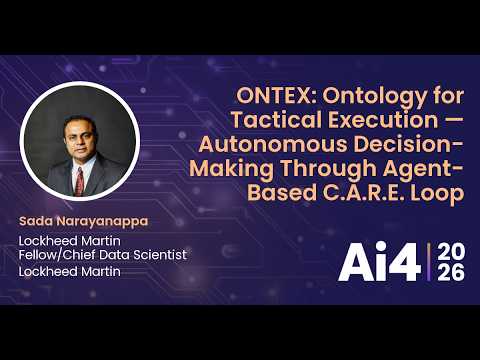
ONTEX: Ontology for Tactical Execution - Autonomous Decision-Making Through Agent-Based C.A.R.E — Ai4

Ai4

Lockheed Martin is unifying its legacy software data using Databricks and ontology models to let 3,000 AI agents automatically govern supply chain and defense operations.

AI-assisted summary of ONTEX: Ontology for Tactical Execution - Autonomous Decision-Making Through Agent-Based C.A.R.E — original source. Check the original for full context.

Source published:

Detailed notes

## Background Published on YouTube by Ai4 on August 18, 2026, this presentation features Sada Narayanappa, Lockheed Martin Fellow and Chief Data Scientist. The page description outlines how ontologies, knowledge graphs, and AI agents in the ONTEX framework can transform fragmented enterprise data into a governed, explainable decision intelligence platform.

## TL;DR Sada Narayanappa demystifies ontologies by linking their origins to Aristotle and highlighting their essential role in providing contextual grounding for modern agentic AI. He presents Lockheed Martin's platform architecture, which combines a Databricks Medallion data pipeline with a four-step C.A.R.E. governance loop—Classify, Assess, Resolve, and Enact—to monitor data and power roughly 3,000 AI agents. Key implementation takeaways include starting with Minimal Viable Ontologies (MVOs) in bounded domains, leveraging graph platforms like Amazon Neptune, and utilizing standard semantic tools like OWL, RDF, SWRL, and SHACL to enforce enterprise rules.

## Atmosphere & style The session is informative, engaging, and structured like a pragmatic technical presentation aimed at enterprise leaders. Sada maintains an approachable and lighthearted tone, opening with an audience poll and dropping historical humor about Socrates before diving into sophisticated architecture diagrams. The atmosphere reflects a balance of deep technical expertise and real-world strategic advice, offering a clear glimpse into how cutting-edge AI frameworks are deployed at scale.

## Key takeaways - [01:37](https://www.youtube.com/watch?v=tKRMzpgI4ns&t=97s) Ontologies serve as a shared conceptualization that allows complex mental models, taxonomies, and business rules to be transmitted clearly across systems. - [02:00](https://www.youtube.com/watch?v=tKRMzpgI4ns&t=120s) The intellectual origins of ontology date back to Aristotle, who formalized theories of existence and how related concepts coexist. - [04:00](https://www.youtube.com/watch?v=tKRMzpgI4ns&t=240s) The resurgence of ontologies is heavily driven by agentic AI, which requires deep domain context and constraints to avoid hallucinating. - [04:40](https://www.youtube.com/watch?v=tKRMzpgI4ns&t=280s) The fundamental purpose of building an enterprise ontology is to drive sound decision-making and construct historical knowledge graphs for forecasting and auditability. - [06:28](https://www.youtube.com/watch?v=tKRMzpgI4ns&t=388s) Lockheed Martin leverages Databricks and a Medallion Architecture (Bronze, Silver, Gold layers) to unify massive disparate data streams across hundreds of legacy applications. - [07:50](https://www.youtube.com/watch?v=tKRMzpgI4ns&t=470s) Data updates trigger an automated multi-agent governance workflow called the C.A.R.E. loop (Classify, Assess, Resolve/Restore, Enact) to handle anomalies. - [09:30](https://www.youtube.com/watch?v=tKRMzpgI4ns&t=570s) To monitor and repair enterprise data automatically, Lockheed Martin is deploying approximately 3,000 specialized AI agents. - [11:20](https://www.youtube.com/watch?v=tKRMzpgI4ns&t=680s) Organizations should start with Minimal Viable Ontologies (MVOs) in bounded domains like Supply Chain or HR rather than attempting to model the entire enterprise at once. - [12:40](https://www.youtube.com/watch?v=tKRMzpgI4ns&t=760s) Multi-disciplinary ontologies are hosted using Amazon Neptune, drawing design patterns from large knowledge graph structures like DBpedia and Wikipedia. - [14:00](https://www.youtube.com/watch?v=tKRMzpgI4ns&t=840s) A semantic layer operates as a logical layer providing explicit business meaning, while technology standards like OWL, RDF, SWRL, and SHACL expose rules and constraints to AI agents.

## Detailed walkthrough ### [00:04](https://www.youtube.com/watch?v=tKRMzpgI4ns&t=4s) Introduction and Industry Audience Poll

Sada Narayanappa introduces himself as a Chief Scientist focusing heavily on ontologies for the past one to two years. He sets the agenda for a brief presentation covering what ontologies are, an audience poll, an architectural deep dive into building an enterprise ontology platform for next-generation AI, and three key operational takeaways.

To gauge the audience's familiarity, Sada polls the room: * **~30%** of attendees have heard of or are familiar with ontologies. * **~10%** have actively initiated an ontology platform in their organization. * **~10%** admit to knowing nothing about ontologies at all.

---

[01:37](https://www.youtube.com/watch?v=tKRMzpgI4ns&t=97s) Philosophical Roots and the Definition of Ontology

Sada demystifies ontologies by explaining that anyone who communicates has already used one. At its core, an ontology is a **shared conceptualization** used to transmit a mental model to another mind. It encompasses language, taxonomies, synonyms, and established procedures. Effective communication occurs when the listener understands the exact concept held in the speaker's mind, a mechanism even a child relies on to communicate thoughts.

Tracing its intellectual heritage, Sada notes that ontology dates back to **Aristotle in 384 BC**, who investigated the purpose of existence, what does not exist, and how related things coexist. Aristotle was mentored by **Plato**, whose own teacher, **Socrates**, famously asked so many probing questions that he was executed via hemlock poison. Sada jokes that while asking questions back then was a capital offense, he welcomes audience questions at the end of the presentation.

``` Socrates (Asked too many questions -> Hemlock) │ Plato (Promoted dialectic reasoning) │ Aristotle (384 BC -> Formalized theory of existence / Ontology) ```

---

[04:00](https://www.youtube.com/watch?v=tKRMzpgI4ns&t=240s) Grounding Ontologies in Agentic AI and Decision-Making

The resurgence of ontologies is heavily driven by **agentic AI**. Autonomous agents require deep context to function without hallucinating; this context is buried within structured enterprise data, while meaning resides inside documents. An ontology brings together aggregated data, processes, procedures, and domain constraints to ensure agents operate reliably.

However, Sada emphasizes that organizations shouldn't build ontologies just for the sake of doing so, nor merely to create static dashboards. **The true purpose of an ontology is to drive sound enterprise decision-making.** Ontologies inform the structure and rules that produce **knowledge graphs**—historical models that allow organizations to forecast future outcomes, make sound decisions, learn from mistakes, and feed those lessons back into the system.

---

[06:28](https://www.youtube.com/watch?v=tKRMzpgI4ns&t=388s) Platform Architecture: Medallion Data Pipeline & C.A.R.E. Loop

Sada details the strategic architecture implemented at Lockheed Martin, an enterprise with **160,000 employees** across multiple industries generating massive daily data across hundreds of legacy applications (e.g., SAP, Aegis for manufacturing, Windchill PLM). To unify these disparate data streams, Lockheed Martin utilizes a **Medallion Architecture** built on **Databricks**:

* **Bronze Layer:** Ingests raw, unrefined data directly from source systems. * **Silver Layer:** Cleanses, standardizes, and structures the data for broader consumption, including agentic AI. * **Gold Layer:** Fine-tunes and aggregates data specifically for advanced analytics and enterprise modeling.

``` Raw Systems Bronze Layer Silver Layer Gold Layer ┌──────────┐ ┌────────────┐ ┌────────────┐ ┌────────────┐ │ SAP │ ───> │ │ │ │ │ │ │ Aegis │ ───> │ Raw Data │ ──>│ Cleansed │ ──>│ Analytics │ │ Windchill│ ───> │ │ │ Data │ │ Ready │ └──────────┘ └────────────┘ └────────────┘ └────────────┘ ```

When data changes occur in Databricks, the system detects updates within seconds. An automated multi-agent governance loop—termed the **C.A.R.E. loop**—evaluates and acts on these changes:

* **Classify (C):** Detects data updates and determines if inconsistencies or anomalies exist. * **Assess (A):** Evaluates organizational risks associated with detected data issues. * **Resolve / Restore (R):** Isolates the anomaly to bring data back to a consistent state. * **Enact (E):** Automatically triggers actions or escalations to resolve data conflicts.

Key architectural metrics and future roadmap details include: - **~3,000 AI agents** identified and being deployed to monitor, classify, and repair data automatically. - The pipeline currently operates in **read-only mode**, but plans are in place to enable automated write-back to source systems within the next year.

---

[10:28](https://www.youtube.com/watch?v=tKRMzpgI4ns&t=628s) Lessons Learned and Deployment Strategy

Reflecting on deployment challenges, Sada shares key strategic takeaways for organizational leaders:

1. **Avoid Decision Avoidance:** Executives frequently delay decisions until backed into a corner. Ontologies streamline and accelerate decision-making processes while documenting past choices—both good and bad—so errors can be systematically audited and corrected. 2. **Start with MVOs (Minimal Viable Ontologies):** Rather than attempting to remodel the entire enterprise at once, focus on bounded operational domains such as **Supply Chain Intelligence**, **HR**, or **Finance**. This aligns directly with Gartner's recommended approach to establish domain understanding before scaling to mission-critical systems. 3. **Graph Infrastructure & Design Patterns:** Lockheed Martin hosts multi-disciplinary ontologies on **Amazon Neptune**, using federated SPARQL/Cypher queries to search across domains. They explicitly mirror the design patterns of massive knowledge graphs like **DBpedia** and **Wikipedia** to extract cross-domain knowledge efficiently.

---

[14:00](https://www.youtube.com/watch?v=tKRMzpgI4ns&t=840s) Q&A: Standards, Semantic Layers, and Expressing Rules

An audience member asks about standard formats for describing ontologies and exposing them to AI agents operating inside clean rooms or data lakes.

Sada clarifies that a semantic layer is not a physical intermediary, but a **logical layer** that assigns explicit business meaning to data (e.g., distinguishing a raw date value from an "Age" concept). An ontology encapsulates business rules, constraints, and process flows—much like a restaurant's unique recipe for chicken tikka masala, which relies on specific ingredients, steps, and rules.

Sada outlines the standard technology stack used to expose ontologies to agents: * **OWL (Web Ontology Language) & RDF / RDFS:** Industry standards for formal ontology representation and data triples. * **SWRL (Semantic Web Rule Language):** Used to express domain rules and logical inferencing. * **SHACL (Shapes Constraint Language):** Used to define structural constraints and validate data integrity.

## Notable quotes > [04:00](https://www.youtube.com/watch?v=tKRMzpgI4ns&t=240s) The true purpose of an ontology is to drive sound enterprise decision-making. — Sada Narayanappa

## Mentioned Sada Narayanappa, Lockheed Martin, Aristotle, Plato, Socrates, ONTEX, Databricks, SAP, Aegis, Windchill PLM, Amazon Neptune, DBpedia, Wikipedia, Gartner, OWL, RDF, RDFS, SWRL, SHACL

## Video description Sada Narayanappa - Lockheed Martin Fellow/Chief Data Scientist, Lockheed Martin

AI is becoming smarter, yet enterprise decisions remain fragmented. What if the missing ingredient isn't another model, but a shared understanding of the enterprise? This session explores how ontologies can transform fragile, disconnected systems into an intelligent enterprise. Using ONTEX—a semantic framework combining ontologies, knowledge graphs, and AI agents—we'll examine a new approach to governed, explainable decision intelligence and ask a fundamental question: Are we building enterprise AI the right way?

[Source](https://www.youtube.com/watch?v=tKRMzpgI4ns)

中文简报

洛克希德·马丁部署3000个AI智能体监控国防数据 洛克希德·马丁正利用Databricks和本体模型统一其传统软件数据,使3000个AI智能体能够自动治理供应链和国防业务。 Sada Narayanappa 将本体论的渊源追溯至亚里士多德,深入剖析了本体的概念,并强调了其在为现代智能体AI提供上下文支撑方面的关键作用。他介绍了洛克希德·马丁公司的平台架构,该架构结合了 Databricks 奖牌式数据管道与包含分类(Classify)、评估(Assess)、解决(Resolve)和执行(Enact)的四步 C.A.R.E. 治理闭环,用以监控数据并驱动约3000个AI智能体。关键落地经验包括:从有界域内的最小可行本体(MVO)起步,利用 Amazon Neptune 等图平台,并借助 OWL、RDF、SWRL 和 SHACL 等标准语义工具来执行企业规则。 本体(Ontology)作为跨系统传递心智模型和业务规则的共享概念化工具,其复兴主要由智能体 AI(Agentic AI)驱动,旨在通过提供深层领域上下文与约束来避免模型幻觉。 (4:00) 构建企业本体的核心目标是辅助决策并形成历史知识图谱,用于未来预测、决策审计以及经验复盘。 (4:00) 洛克希德·马丁基于 Databricks 勋章架构(Bronze、Silver、Gold 层)整合海量异构数据,并计划部署约 3,000 个 AI 智能体执行 C.A.R.E. 治理闭环(分类、评估、解决/恢复、执行)以自动监控与修复数据异常。 (6:28) 专家建议企业避免一次性建模整个企业,而应从供应链或人力资源等边界明确的领域构建最小可行本体(MVO)起步。 (10:28)

Reading summary

Chief Scientist Sada Narayanappa argues that enterprise ontologies are essential for grounding autonomous AI agents, transforming fragmented operational data into structured knowledge graphs that accelerate and improve enterprise decision-making. Grounding Autonomous Agents in Enterprise Knowledge (4:00) Narayanappa defines an ontology as a shared conceptualization—encompassing vocabularies, taxonomies, and procedures—that transmits a precise mental model across minds or systems. While philosophical inquiries into ontology date back to Aristotle in 384 BC, modern interest is driven primarily by agentic AI. Autonomous agents require deep contextual grounding to avoid hallucinations, drawing structural context from enterprise records and operational meaning from documentation. The speaker emphasizes that organizations should not construct ontologies merely to assemble static dashboards. Instead, ontologies provide the formal definitions and constraints required to build enterprise knowledge graphs. These graphs preserve historical operational data, enabling organizations to forecast future outcomes, evaluate operational decisions, and systematically learn from past errors. Medallion Architecture and the C.A.R.E. Governance Loop (6:28) To implement these concepts at scale, Lockheed Martin unifies disparate data across hundreds of legacy applications—including SAP, Aegis for manufacturing, and Windchill PLM—for an enterprise of 160,000 employees. The data foundation utilizes a Databricks Medallion architecture, moving information from raw ingestion (Bronze) to standardized, cleansed structures (Silver), and finally to analytics-ready enterprise aggregations (Gold). When data changes are detected in Databricks, an automated multi-agent governance workflow termed the C.A.R.E. loop processes the update within seconds: Classifying anomalies or inconsistencies, Assessing organizational risk, Resolving or Restoring the anomaly to a consistent state, and Enacting remediation actions or escalations. Narayanappa reports that approximately 3,000 AI agents are identified and being deployed to automate these governance tasks. Incremental MVO Deployment and Semantic Web Standards (10:28) Narayanappa advises against attempting to model an entire enterprise simultaneously, recommending that organizations avoid decision delays by starting with Minimal Viable Ontologies (MVOs) in bounded domains such as HR, Finance, or Supply Chain Intelligence. This staged progression mirrors guidance from Gartner to establish domain mastery prior to expanding into mission-critical systems. Technically, Lockheed Martin hosts multidisciplinary ontologies on Amazon Neptune, leveraging federated SPARQL and Cypher queries based on design patterns from large-scale graphs like DBpedia and Wikipedia. Narayanappa clarifies that the semantic layer serves as a logical model rather than a physical intermediary, relying on established Semantic Web standards: OWL and RDF/RDFS for conceptual modeling, SWRL for business rules and logical inferencing, and SHACL to enforce structural data validation constraints. Lockheed Martin's automated multi-agent governance pipeline currently functions exclusively in read-only mode to safeguard core systems, with the organization planning to introduce automated write-back capabilities into source applications within the coming year.

精炼阅读摘要

洛克希德·马丁首席科学家Sada Narayanappa指出,本体论作为传递共享概念模型的逻辑架构,是智能体AI消除幻觉并赋能自主战术决策的核心基石;该机构通过Medallion数据管道与C.A.R.E.多智能体闭环,在复杂制造体系中推进实时数据治理与战术执行自动化。 本体论内核与智能体决策驱动价值 (4:00) Sada Narayanappa阐述道,本体论的本质是一种“共享概念化”(shared conceptualization),其思想渊源可追溯至公元前384年亚里士多德对存在与关联的系统化探究。在企业级场景中,本体论的再次兴起直接受智能体AI(Agentic AI)所驱动。自主智能体若要在复杂业务中运行而不产生幻觉,必须依赖深度的上下文环境;这些上下文既沉淀在结构化业务数据中,也蕴含在文档语义内部。本体论通过将汇聚的数据、操作流程、业务规程与领域约束结合,为智能体提供了高保真行动依据。 Narayanappa强调,企业构建本体论绝非为了单纯展示静态仪表盘,其核心目的在于驱动稳健的企业决策。本体论定义了构建知识图谱的底层架构与规则体系;依托知识图谱构建的历史模型,组织不仅能够推演预测未来并指导战术决策,还能追溯并审计过去的决策失误,进而将经验持续反哺至系统形成学习闭环。 Medallion架构与CARE治理闭环 (6:28) 洛克希德·马丁拥有跨越多个行业的16万名员工,每天在SAP、Aegis制造系统、Windchill产品生命周期管理(PLM)等数百个遗留软件中产生海量异构数据。为打通这些数据孤岛,团队在Databricks上构建了Medallion数据架构,划分为三层管道:Bronze层负责直接接入源系统的未经加工原始数据;Silver层进行数据清洗、标准化与结构化,以供包含智能体在内的系统消费;Gold层则执行精细化聚合,专项用于高阶分析与全企业业务建模。 当底层数据发生变动时,系统可在数秒内捕获更新,并激活C.A.R.E.多智能体自主治理闭环:首先通过“分类”(Classify)识别数据更新并判定是否存在异常,其次通过“评估”(Assess)测定异常对组织的潜在风险,随后通过“解决与恢复”(Resolve / Restore)隔离异常以重构一致状态,最后通过“执行”(Enact)自动触发处置动作或事件升级。据Narayanappa介绍,目前团队已规划并部署约3000个AI智能体用于自动监控与数据修复;该管线现阶段以只读模式运行,计划在未来一年内拓展出向源系统自动回写数据的功能。 最小可行本体路线与图谱基础设施 (10:28) 在落地策略与工程挑战方面,Narayanappa指出企业管理层常因顾虑而拖延做决策,而本体论能够固化并加速决策流程,同时记录历史决策以便事后审计与纠错。在建设范围上,他建议企业切勿试图一次性重构整个企业,而应遵循Gartner的建议,优先在边界清晰的受限业务域内构建“最小可行本体”(Minimal Viable Ontologies, MVOs),例如率先深耕供应链智能(Supply Chain Intelligence)、人力资源(HR)或财务领域。 在底层基础设施方面,洛克希德·马丁选用Amazon Neptune承载跨领域的复杂本体模型,利用SPARQL和Cypher联邦查询支撑跨域知识检索。在知识工程设计模式上,该系统借鉴了DBpedia与Wikipedia等大型知识图谱的设计范式,从而在多学科工程体系中高效提取并链接跨域知识。 语义逻辑分层与W3C规则技术规范栈 (14:00) 针对如何向数据安全岛或数据湖内的AI智能体开放本体的疑问,Narayanappa澄清指出,语义层并非物理数据存储层,而是一个赋予原始数据明确业务含义的逻辑层(例如将孤立的日期数据明确定义为业务属性中的“年龄”)。本体论完整封装了业务规则、流程约束与因果关系,其作用类似于精确界定了原料配比、操作流程与加工规则的餐饮配方。 在技术规范层面上,该平台全面依托行业通用的W3C语义网技术栈:采用OWL(Web本体语言)和RDF/RDFS定义形式化本体模型与底层数据三元组;利用SWRL(语义网规则语言)编写具体的业务规则与逻辑推理逻辑;并借助SHACL(形状约束语言)定义结构约束条件,以此自动化检验数据完整性并防止数据结构异常。 现场调研显示,虽然约30%的参会者了解本体概念,但仅有约10%的企业已启动本体平台建设。洛克希德·马丁的C.A.R.E.智能体治理系统目前仍受限于只读模式,向源系统自动回写的功能仍处于未来一年的路线图阶段;在扩大最小可行本体覆盖面的同时,如何在缺乏人工干预下确保智能体写回操作的数据安全与系统可靠性,仍是该体系迈向完全自主战术执行的关键考验。

Detailed notes — zh

## Background 本文整理自洛克希德·马丁公司研究员兼首席数据科学家 Sada Narayanappa 于 2026 年 8 月 18 日在 YouTube 频道 Ai4 上发表的演讲。视频内容围绕企业级语义框架 ONTEX 展开,探讨了如何结合本体论、知识图谱与智能体 AI 解决传统企业系统碎片化的问题,以实现可控且可解释的智能决策自动化。 ## TL;DR 演讲首先从哲学术语切入,将本体论定义为用于传达思维模型的“共享概念化”体系,并指出其是智能体 AI(Agentic AI)获取业务上下文与规程约束的核心基石。为了解决 Lockheed Martin 内部海量且孤立的数据难题,团队构建了基于 Databricks 奖牌架构的 ONTEX 语义系统,实现毫秒级数据变更感知。依托该架构,近 3,000 个专用 AI 智能体通过 C.A.R.E.(分类、评估、恢复、执行)闭环控制机制,推动企业决策支持从传统的可视化仪表盘向全自动化的业务修复与执行演进。 ## Atmosphere & style 整场演讲呈现出专业严谨与幽默风趣交织的专业研讨氛围。主讲人通过现场问卷互动拉近与听众的距离,善于运用生动的比喻与历史哲学梗将极其抽象的技术概念通俗化。语言风格兼具前沿科技的前瞻性与大型军工企业落地实践的沉稳踏实,给观众带来兼具理论深度与实操启发的听讲体验。 ## Key takeaways - [00:04](https://www.youtube.com/watch?v=tKRMzpgI4ns&t=4s) 本体论本质上是“共享的概念化”,用于将人类脑海中的心理模型精准传达给他人。 - [00:04](https://www.youtube.com/watch?v=tKRMzpgI4ns&t=4s) 从历史脉络来看,本体论的概念最早可追溯至公元前 382 年亚里士多德对“存在本质”的哲学思考。 - [00:40](https://www.youtube.com/watch?v=tKRMzpgI4ns&t=40s) 智能体 AI(Agentic AI)的兴起是驱动本体论重新成为行业焦点的核心力量。 - [00:40](https://www.youtube.com/watch?v=tKRMzpgI4ns&t=40s) 智能体 AI 需要结合数据聚合、完整的业务流程、规程与约束条件,才能避免产生幻觉并高效运转。 - [00:40](https://www.youtube.com/watch?v=tKRMzpgI4ns&t=40s) 企业构建本体论的终极目标在于辅助决策(Decision-Making),而非仅仅制作可视化仪表盘。 - [00:40](https://www.youtube.com/watch?v=tKRMzpgI4ns&t=40s) 本体论为知识图谱构建提供规范,知识图谱结合历史数据预测未来,且错误决策的经验会被反馈以持续优化系统。 - [06:28](https://www.youtube.com/watch?v=tKRMzpgI4ns&t=388s) 洛克希德·马丁打造了名为 ONTEX 的架构,并基于 Databricks 构建了涵盖铜牌、银牌、金牌层的奖牌架构。 - [06:28](https://www.youtube.com/watch?v=tKRMzpgI4ns&t=388s) ONTEX 架构在感知到毫秒级数据变更后,会触发 C.A.R.E.(分类、评估、恢复、执行)闭环控制机制。 - [06:28](https://www.youtube.com/watch?v=tKRMzpgI4ns&t=388s) 洛克希德·马丁已梳理并正在部署近 3,000 个专有智能体来监控数据变更,系统目前处于“只读模式”。 ## Detailed walkthrough 以下是针对该视频演讲内容的详细逐段还原与总结: ### [00:04](https://www.youtube.com/watch?v=tKRMzpgI4ns&t=4s) 认识本体论:跨越两千年的沟通桥梁 洛克希德·马丁(Lockheed Martin)研究员兼首席数据科学家 Sada Narayanappa 开启了他的演讲。在过去一两年中,他一直专注于本体论(Ontologies)的研究。在简短问询现场听众对本体论的了解程度后(约 30% 听说过,10% 在企业内落地了本体论平台,10% 完全不了解),他用极其通俗的一句话给本体论下了定义:**本体论本质上是“共享的概念化”(shared conceptualization),是你为了向他人传达自己脑海中的心理模型(mental model)而构建的机制**。 只要你在日常沟通中挑选语言、词汇、分类层级(taxonomy)、同义词,并遵循特定的表达流程,你就在使用本体论。无论是一个想要表达想法的小孩,还是商业系统,都在依赖这套概念集。从历史根源来看,本体论可以追溯到公元前 382 年的亚里士多德时代。当时哲学家们开始思考“存在的本质与目的”——无论是通过自我描述、排除非存在物,还是探讨与其他事物的共存关系,在理性的追问下,本体论的概念应运而生。演讲者还幽默地提及了哲学脉络的传承:亚里士多德继承自柏拉图,柏拉图的老师苏格拉底因提问过多而被处死(喝毒鸩),“在那个时代问太多问题会被杀掉,但今天大家提问我会非常欢迎”。 ### [00:40](https://www.youtube.com/watch?v=tKRMzpgI4ns&t=40s) 智能体 AI 的基石与“决策”导向 本体论在近几年重新成为行业焦点,核心驱动力在于**智能体 AI(Agentic AI)**的兴起。AI 智能体若要准确理解人类的意图,就必须获取上下文。然而,企业的数据沉淀在各系数据库中,而语义(meaning)则埋藏在文档里。智能体不仅需要数据聚合,更需要一套完整的业务流程、规程和约束条件(constraints),才能避免产生幻觉并高效运转。 演讲者强调,人们不会为了做本体论而做本体论,其终极目标是**辅助决策(Decision-Making)**: * 本体论为知识图谱(Knowledge Graphs)的构建提供了结构与规范; * 知识图谱利用历史数据预测未来,从而帮助企业做出明智的决策; * 即使做出了错误的决策,系统也能将经验反馈回去,持续迭代未来的决策质量。 因此,企业落地本体论必须牢牢锚定在“业务目的”上。虽然很多团队习惯将本体论成果仅用于制作可视化仪表盘(Dashboard),但这其实是本体论最次要的用途,其最核心的价值在于直接喂给 AI 智能体去执行自动化操作。 ``` [原始数据源] ──> (本体论 + 约束规程) ──> [知识图谱] ──> [智能体AI / 决策支持] ``` ### [06:28](https://www.youtube.com/watch?v=tKRMzpgI4ns&t=388s) ONTEX 架构与 C.A.R.E. 闭环控制 以洛克希德·马丁公司为例,企业内部拥有极度庞杂且碎片化的系统。公司拥有 16 万名员工,跨越多个业务领域,每天在 SAP、PLM 系统 Windchill 以及各类制造与管理平台中产生海量数据,这些数据往往被孤立在各个系统内部。 为了打破孤岛,他们打造了名为 **ONTEX** 的架构,基于 Databricks 构建了**奖牌架构(Medallion Architecture)**: 1. **铜牌层(Bronze Layer)**:实时接入各个源系统的原始数据; 2. **银牌层(Silver Layer)**:对原始数据进行清洗与标准化,供包括智能体 AI 在内的多种场景使用; 3. **金牌层(Gold Layer)**:针对高级分析与决策进行深度微调。 基于该架构,系统做到了毫秒级的数据变更感知。一旦源头数据发生变动,自动化智能体就会启动 **C.A.R.E.** 循环机制: * **C (Classify / 分类)**:检测并分类数据是否存在不一致或异常; * **A (Assess / 评估)**:评估该异常可能带来的业务风险; * **R (Restore / 恢复)**:定位系统中的异常根源并修复数据一致性; * **E (Enact / 执行)**:触发自动化修复措施或进行必要升级。 目前洛克希德·马丁已经梳理并正在部署近 **3,000 个专有智能体**来监控这些数据变更。当前的系统仍处于“只读模式”(Read-only),预测到下一年,该系统将能够### 现场互动与本体的本质定义 在讲座开场,Lockheed Martin 首席科学家 Sada Narayanappa(现场自我介绍音近 Salana Arnapa)首先对参会者进行了现场背景调查:约 30% 的听众了解本体(Ontology),10% 的听众已经在企业内启动了本体平台建设,另有约 10% 表示此前完全不了解。 为了消除听众对“本体”这一概念的陌生感,他用最通俗的话总结道:“本体用一句话来说,就是为了将你心中的思维模型传达给他人而建立的共享概念化体系。”无论你在沟通中选择何种语言、词汇、分类法(Taxonomy)、同义词,还是规范沟通的流程与步骤,本质上都在使用本体。只要对方精准理解了你想表达的含义,就说明你选对了语言和词汇。甚至连牙牙学语的小孩在表达想法时,也会使用一套特定概念,因此每个人在日常生活中都在使用本体。 * **哲学术语渊源**:本体的概念可追溯至公元前 382 年的亚里士多德(Aristotle),当时人们开始思考存在的本质——通过描述自己、明确“什么不是存在”以及与其他事物如何共存,学术上的本体概念应运而生。 * **哲学脉络调侃**:亚里士多德继承了导师柏拉图(Pl ## Notable quotes > [00:04](https://www.youtube.com/watch?v=tKRMzpgI4ns&t=4s) 本体论本质上是“共享的概念化”(shared conceptualization),是你为了向他人传达自己脑海中的心理模型(mental model)而构建的机制 — Sada Narayanappa > [00:04](https://www.youtube.com/watch?v=tKRMzpgI4ns&t=4s) 本体用一句话来说,就是为了将你心中的思维模型传达给他人而建立的共享概念化体系 — Sada Narayanappa > [00:04](https://www.youtube.com/watch?v=tKRMzpgI4ns&t=4s) 在那个时代问太多问题会被杀掉,但今天大家提问我会非常欢迎 — Sada Narayanappa ## Mentioned Sada Narayanappa, Lockheed Martin, ONTEX, C.A.R.E., Databricks, SAP, Windchill, Aristotle, Plato, Socrates, Medallion Architecture ## Video description Sada Narayanappa - Lockheed Martin Fellow/Chief Data Scientist, Lockheed Martin AI is becoming smarter, yet enterprise decisions remain fragmented. What if the missing ingredient isn't another model, but a shared understanding of the enterprise? This session explores how ontologies can transform fragile, disconnected systems into an intelligent enterprise. Using ONTEX—a semantic framework combining ontologies, knowledge graphs, and AI agents—we'll examine a new approach to governed, explainable decision intelligence and ask a fundamental question: Are we building enterprise AI the right way? [Source](https://www.youtube.com/watch?v=tKRMzpgI4ns)

Source quotes

[0:04] Sada Narayanappa: 本体论本质上是“共享的概念化”(shared conceptualization),是你为了向他人传达自己脑海中的心理模型(mental model)而构建的机制 [0:04] Sada Narayanappa: 本体用一句话来说,就是为了将你心中的思维模型传达给他人而建立的共享概念化体系 [0:04] Sada Narayanappa: 在那个时代问太多问题会被杀掉,但今天大家提问我会非常欢迎

Source quotes

[4:00] Sada Narayanappa: The true purpose of an ontology is to drive sound enterprise decision-making.

Original transcript

[0:04] Hello, good morning and uh thank you for being  here. My name is Salana Arnapa as I said and I'm a [0:08] chief scientist and focusing on ontologies for  last one or two years now and uh today what my [0:15] plan is to present to you about ontology and get  a poll on where you are in the industry talking [0:23] about ontologies and then give you a little bit  more in-depth more than what we usually share [0:29] in the public on the architecture of ontology  and where we are creating that platform. form for [0:37] delivering next generation of AI and then also I  will talk about three main things in terms of what [0:45] I have learned in deploying this ontology platform  challenges as well and then would like to get [0:52] I would plan to do it for 17 minutes here and then  um have one or two questions. Is it all right? [1:01] Very cool. Um, how many of you have heard about  ontology or wa that's more than what I know. [1:10] Cool. And how many of you initiated  ontology as a platform in your organization? [1:18] Very cool. That's about 10%  of them and uh maybe 30% are [1:23] knowing about ontology. And how many of  you don't know anything about ontology? [1:28] All right, cool. about 10%  of you that's great. Um so um [1:37] just in one sentence if I want to talk about  ontology and if you think that you have not [1:43] done ontology in the past or if you have never  done it I just want to prove it to you that [1:47] you always done it right. um ontology  in its shortest form, it is the shared [1:54] conceptualization that you want to bring together  to communicate your mental model to someone else. [2:01] So if you're communicating, if you're picking  a language, if you're picking words, taxonomy, [2:06] synonyms, and the way how you communicate and  you have a procedure about how you do that, [2:13] it's ontology. Ontology is to communicate what you  have in your mind to using words and languaging [2:22] through words or some language to communicate  your idea to the other person and you did that [2:28] effectively if the other person understands what  you're talking about. So the understanding is [2:37] if the understanding is communicating what you're  thinking exactly communicates the other person [2:43] you have chosen the right language and the  words that's about ontology. So therefore [2:48] every one of you have used onthtology that's why  I wanted to prove to you even a kid who wants [2:53] to communicate certain things uses a p set of  concepts to communicate what it is thinking right [2:59] and [snorts] ontology face dates back to Aristotle  382 BC when they started thinking about what's the [3:06] purpose of my existence looks like right and  this is my theory when they started thinking [3:11] about what is the theory of existence either  I can understand it through my own description [3:19] or I can say what is not an existence and  also what it means to coexist with the other [3:26] related things and when I start thinking about  intellectually inquiring about those concepts the [3:32] ontology concepts will emerge right and ontology  was created by Aristotle his teacher Plateau [3:40] promoted it plateau's teacher was Socrates  as you know Socrates asked too many questions [3:45] So he got killed with a uh hemlin. So here at  that time when they ask too many questions they [3:51] will kill you. But here in this questions if you  have questions I will appreciate you. So at the [3:55] end we'll have couple of questions. So if you have  any questions I'll more than happy to answer that. [4:00] So when we started this ontology work couple years  back it became more prominent right now as you [4:06] can see. It's because of the agentic AI. If the  agents needs to understand what we communicate, [4:14] it needs a context. The context is buried in our  data and the meaning is buried in our documents. [4:21] So when agents work, they need to have a  proper context. Not only the data aggregation, [4:28] most people think that's ontology. Yes, it is  part of it. But in addition to data aggregation, [4:33] you need to have a process procedures  and the set of constraints that you [4:38] need to bring it together to give it to the  agents so that the agents do not hallucinate [4:44] and they actually work effectively.  That is the purpose of ontology. Now [4:53] when we think of ontologies also we  don't go home and do ontologies do do we? [4:58] We never did that. Right? Why do  we do this ontology? So there's [5:00] a fancy thing that's come along  that's what I've seen so far is [5:04] let's do ontology for my business right the  reason why we do ontology is to make a decision [5:10] ontologies feeds to the structure and the process  in which we can create knowledge graphs right so [5:18] knowledge graphs is the history using the history  I can look at the future and make sound decisions [5:25] using those sound decisions we may make a mistake  even if you were to make a mistake use that [5:30] knowledge and the experience to feed it back to  make better decisions in the future. Right? So um [5:37] my first point here in terms of executive  summary is even today people would want to do [5:44] ontology but the purpose of that ontology is to  make decisions. Therefore it should be grounded [5:50] in your purpose. Why is it that you want to do  ontology is to create that knowledge. And then [5:58] second thing is as I mentioned that the ontologies  are created for effective use of AI agents. Now [6:08] that is true but most of the times ontology  concepts are created for creating dashboards [6:14] which is okay as one one form of output for it  or creating a knowledge in terms of what it is [6:21] but making decisions is lot more important.  Right? And then um I'll talk I'm going to talk [6:28] about the strategic deployment of ontology.  What I have seen in terms of locked Martin [6:33] um so here's what we have what you're seeing on  the board is we used to have data data platforms. [6:43] We used to have different this is an example  of one set of three platforms that we have [6:50] and there are many more. Imagine hundreds of  applications that existed today and even more is [6:55] coming up every day because of the AI. Right? So  what you see here is we have several systems SAP [7:03] ao for manufacturing and uh windshill is another  uh PLM system product lifetime management system. [7:10] We have many of these systems working across  four different 160,000 employees across many [7:16] different industries generating data each day and  that data is left within those systems. What we [7:25] are doing in terms of ontology is we are bringing  a medallion architecture. Medallion architecture [7:30] is I'm going to talk about that just quite a  bit. bringing all these different data systems [7:35] and integrated fashion using data bricks as a  technology and then creating a data aggregation. [7:44] Now when the data changes and so let  me back up here I talked about the med [7:50] metallion architecture. Medallion architecture  is when this raw data comes through the system [7:55] we call it as a bronze layer. It's a raw  data and that first level of data is cleansed [8:02] to make it into a silver layer that's used for  many other purposes including agentic AI as well. [8:09] The next level is the gold layer that's fine-tuned  for providing analytics. Now when the data changes [8:17] we have set up the data bricks environment  in such a way that whenever there's a single [8:22] data changes within few seconds that data change  is detected in the system and some agents will [8:30] detect it and classify is this data inconsistent  in some way. That is the classify part of it. And [8:38] then once if you classify it you assess the risk  if there's anything wrong with it. That is the [8:44] assessing. If there's nothing wrong okay and  then we just put the data in the right place. [8:48] Next thing is if there is something wrong  we need to resolve find the anomaly in the [8:54] system such that the data is consistent  and some agents is going to loop through [8:58] and then automatically either escalate that  inconsistency in the data or make it automatic fix [9:06] and enacting is the part of it. So what I talked  about is classify assess and then restore and um [9:14] enact that's what I we call it as a care loop c a  r e that stands for it and then all these things [9:21] if we have to do that manually it takes forever  therefore we would like to make it automated [9:28] each of the agents who look at these changes in  the system we have close to about 3,000 agents [9:34] right now identified which we are implementing  that looks through each of these changes [9:40] and triggers a action to automatically  fix these any data inconsistencies [9:46] and also use it to create any feedback into the  system. Right now we don't have a system that [9:53] feeds back to the source system. It's only read  only. In the future, probably in uh next year [10:00] when we have the system up and running, it'll feed  it back to the original source system as well. [10:08] And uh right side what you see is the dashboards.  Dashboard is the least of the effective use of [10:12] ontology. The most effective use of ontology  is to feed it to the agents. And I'm I'm I'm [10:18] sorry to belabor this. I had to internalize  it multiple times myself. So um again um [10:28] these are some of the conclusion  paths that I have seen. um [10:33] when I had even today when we have different teams  come together they want to create ontology give me [10:40] an ontology so it's pretty cool right I mean  the thing is why do you want an ontology you [10:45] want to make decisions what are the key decisions  that you want to make and you want to identify [10:49] what are the key critical bottlenecks that you  have to make those decisions and meaningfully [10:54] and you can make these decisions if you have the  knowledge right so knowledge is ontology leads to [10:58] your knowledge graph and the knowledge leads to  making wise decisions and what we have seen is [11:05] by implementing ontology we have seen significant  reduction in the way how we are making decisions [11:13] when I started all these things I thought you know  we are doing all this thing for making decisions [11:19] we are not should we make good decisions there's  one thing that's not making that's only worse than [11:27] not making good decision what is not making  a decision. Right? So all the executives and [11:33] leaders, they just avoid making decisions.  They until you squeeze them to a corner where [11:38] they are forced to make a decision and they say,  "Okay, I don't have a choice. I make a decision." [11:42] Regardless of it, they have an excuse to say  whether it's a good decision or a bad decision, [11:46] they make a decision. With ontology, you can  have these decisions made with the process as [11:52] well. Right? And then we have made we  are making decisions much faster than [11:56] what we have done in the past. We are making  wise decisions. When we make bad decisions, [12:01] we also document it. We can go back and fix it as  well. And [snorts] then when you take on when we [12:08] take we took on this ontology, we thought that we  are um bringing out of the ocean, right? And then [12:15] we thought let's look into small set of use  cases that we can implement that minimal viable [12:22] ontologies that they can implement. for example,  supply chain intelligence or HR or even um [12:30] finance. Those are the set of disciplines that  we started looking into. not exactly implementing [12:36] ontology the mission critical systems and we  have seen pretty significant improvements in [12:42] the way how people are adapting these ontologies  and that would be my recommendation as well and [12:50] after the fact that we I went and looked into  Gartner their recommendation is also to create [12:55] the minimal viable ontology to pick it just  to understand the domain of it and then um [13:02] in the future when we have this ontology is set  and done. We want to create a reinforcement loop [13:08] and also new models are coming through,  new language models are coming through [13:13] and then how can we implement and escalated all  the way to the mission critical systems as well. [13:19] We don't have it today. So we are deploying most  of the ontologies are of different disciplines [13:25] on a Neptune on Amazon server and we are using  uh federated queries to run across and then [13:33] just recently I came across one of the largest um [13:37] um knowledge graph that you see is DBPedia or  Wikipedia and they have the similar concepts [13:43] and the architecture that they use to go across  the querying multiple um domains to inquire the [13:50] data and create and extract knowledge and we are  mimicking the same design patterns. With that um [14:00] I will open up for any questions that you might  have. I said that I was going to give you three [14:04] minutes but here I'm being more generous to give  you four minutes. One of the issues I feel like is [14:11] that everyone's kind of creating their own thing  and uh you know in the case of where you may have [14:16] like a clean room or you may have a data lake  or something like that and you want to bring in [14:22] someone's ontology to power an aentic  experience within that data lake. [14:28] Um are there like any standards around describing  ontology? Is it just a document that that [14:35] you you contrive based on your process? How are  you actually exposing the ontology to the agents? [14:42] Sure. Um so in the industry ontology is described  using multiple different formats. Owl is one of [14:50] the formats that you use. RDF is another format  how you can describe and in the past that you have [14:56] if you're a technologist you have done model based  engineering or even conceptual model those are all [15:02] people say that conceptual model or religious  ontologies say that conceptual model is not [15:07] an ontology but if you look at the conceptual  model and you can decide or describe a meaning [15:14] of the data using that conceptual model that  means it has semantics towards it therefore [15:18] you're already using ontologies in different forms  S so for to answer your question we are using [15:25] industry standard RDFs for describing the  ontology and when you think of ontologies [15:30] people say there's ontology and there is semantic  layer and what is semantic layer there's always [15:35] a question there is is there some kind of a  semantic layer that exists is there kind of some [15:39] fishes going on carrying a meaning no the way how  I understand is semantic layer is a logical layer [15:44] that exist that gives you the meaning if you if  you were to describe your date of and call it as [15:52] a age. you will be able to go back and say no this  is not age this is data but that's putting meaning [15:56] to the data right so your ontology consists of  your structure your documents how you describe [16:04] your business the constraints your constraints may  be different think of the hotel or a restaurant [16:10] which is cooking a chicken tikka masala your  recipe may be different from other restaurant [16:15] right so therefore it has ingredients structure  and the process and your own recipe towards it [16:21] and you You can do it in any other format but  the standard is owl and rdf and swirl is the [16:27] way how you can describe the rules and shatter  is the way how you can describe the constraints. [16:33] Those are the tools that we are using. We are out  of time. Thank you so much Sara you guys after.