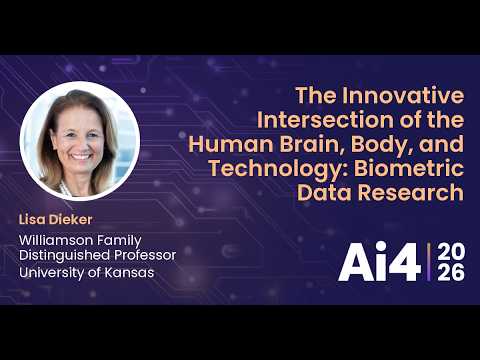
Dieker Deploys Biometric AI Dashboards to Stem Teacher Attrition
Ai4
Tracking educator physiological stress six months before burnout through wearable sensors can prevent the 50% five-year attrition rate costing districts $20,000 per lost teacher.
## Background
Published by Ai4 on YouTube on August 17, 2026, this presentation features Lisa Dieker, Williamson Family Distinguished Professor at the University of Kansas. The talk explores how emerging technologies—ranging from biometric dashboards to socially assistive robots and virtual simulators—can integrate neurophysiological and emotional data into multimodal AI systems to support teacher preparation and personalize student learning while keeping humanity at the core.
## TL;DR
Lisa Dieker addresses the educator retention crisis by proposing a 'teaching plus technology' framework that measures and supports the invisible physical and cognitive strain on classroom teachers. She presents research initiatives including Project RAISE, the Debriefscape coaching dashboard, and the Flight ICA communication analyzer, which leverage wearable biometrics, eye-tracking, and responsive AI avatars to provide 24/7, privacy-first feedback for both educators and students with disabilities. By tracking non-verbal kinetics and physiological stress markers, these tools aim to prevent educator burnout and double student engagement. Ultimately, Dieker reframes the educational technology paradigm, arguing that AI should stand for 'amplified humanity' designed to deepen empathy and care.
## Atmosphere & style
The presentation is warm, impassioned, and emotionally grounded, striking an inspiring balance between cutting-edge computational research and genuine vulnerability. Dieker engages the audience with conversational humor, relatable anecdotes, and poignant personal stories about her neurodivergent son and her childhood teacher. The viewing experience feels deeply humanistic and energizing, shifting the narrative away from cold automation toward compassionate, technology-assisted empowerment.
## Key takeaways
- [00:04](https://www.youtube.com/watch?v=bPU9tXtdOMQ&t=4s) The future of education should focus on 'teaching plus technology' rather than framing educators and technological tools as opposing forces.
- [03:01](https://www.youtube.com/watch?v=bPU9tXtdOMQ&t=181s) Teachers make approximately 1,500 micro-decisions daily under high cognitive and emotional strain, yet their biometric states remain largely unmeasured compared to other high-stress professions.
- [03:01](https://www.youtube.com/watch?v=bPU9tXtdOMQ&t=181s) Teacher attrition is severe, with 50% leaving within five years and replacements costing around $20,000 each, highlighting the need to identify burnout patterns months before educators quit.
- [05:50](https://www.youtube.com/watch?v=bPU9tXtdOMQ&t=350s) Virtual classroom simulation platforms like Mursion provide avatar-based practice environments where novice teachers can build muscle memory and fail safely without risking student harm.
- [05:50](https://www.youtube.com/watch?v=bPU9tXtdOMQ&t=350s) Project RAISE combined biometric Polar armbands and an adaptive AI agent (ZB) to double communication skills and task engagement in elementary special education students.
- [08:58](https://www.youtube.com/watch?v=bPU9tXtdOMQ&t=538s) Debriefscape treats biometric and video telemetry like HIPAA-protected data, keeping it local on the teacher's machine for private, self-directed reflection rather than administrative evaluation.
- [08:58](https://www.youtube.com/watch?v=bPU9tXtdOMQ&t=538s) Flight ICA delivers automated, 24/7 coaching feedback on verbal patterns, vocal modulation, and facial expressions to illuminate subconscious teaching habits.
- [12:48](https://www.youtube.com/watch?v=bPU9tXtdOMQ&t=768s) Kinetics and eye-tracking research demonstrate that expert teachers use open body language and scan the room when disciplining, whereas novices often display tense posture and fixate solely on disruptions.
- [16:14](https://www.youtube.com/watch?v=bPU9tXtdOMQ&t=974s) Educational AI should serve as an integrated dashboard monitoring teacher fatigue and student engagement to retain educators and elevate learning.
- [17:27](https://www.youtube.com/watch?v=bPU9tXtdOMQ&t=1047s) The ultimate promise of AI in education is 'amplified humanity,' acting as an empathy amplifier to help humans understand and care for one another more deeply.
## Detailed walkthrough
### [00:04](https://www.youtube.com/watch?v=bPU9tXtdOMQ&t=4s) Teaching Plus Technology: The Power of Believing in Students
Lisa Dieker opens her presentation by inviting the audience into an interactive exercise, prompting attendees to turn to a neighbor and share the name and grade of their favorite teacher, followed by identifying their favorite technology. When comparing how both make people feel, the human connection of the teacher evokes a fundamentally deeper emotional resonance. Dieker argues that educational discourse often falls into a false dichotomy of teachers versus technology; the true future lies in "teaching plus technology" rather than treating them as opposing forces.
Highlighting the quote, "A teacher's job is to help you believe in yourself," Dieker anchors this philosophy in a personal story about her son. In the third grade, despite Dieker being a professor of special education, her son was diagnosed with dyslexia, dysgraphia, and Tourette syndrome. Because dedicated educators believed in him and provided extensive support, he channeled his energy into gymnastics, earning a bronze medal on the rings at the Junior Olympic Gymnastics National Championships. Though he once admitted, "I wasn't college material, but teachers believed in me," he went on to graduate from college and recently got married. That transformative human impact underscores why technology must be designed to understand and support all humans—especially the educators at the heart of learning.
[03:01](https://www.youtube.com/watch?v=bPU9tXtdOMQ&t=181s) The Unmeasured Toll on Teachers and the Cost of Attrition
While technology and biometrics are routinely deployed to monitor athletes, airline pilots, and military personnel, the physical and emotional toll on classroom educators remains virtually unmeasured. Dieker introduces "Jamila," a composite middle school teacher waking up at 6:15 a.m. to face between 20 to 150 students while sleep-deprived, caffeinated, and running on high stress. Teachers make approximately 1,500 micro-decisions a day—deciding whether to intervene, call home, email, or adjust pacing—yet schools track only student test scores, attendance, and behavior, leaving the teacher's biometric state entirely unaddressed.
This lack of support fuels a nationwide retention crisis. In urban and high-poverty school environments, students have a brand-new, first-year teacher in nine out of twelve school years, with 50% of all teachers leaving the profession within their first five years or transferring to less stressful, affluent districts. Replacing a single exiting teacher like Jamila costs an estimated $20,000. Dieker emphasizes that her team's research at the University of Kansas focuses on identifying the biometric patterns of teacher mind and body six months before they decide to leave, shifting educators from "teacher tired" to "teacher inspired" through proactive intervention.
- **1,500 daily decisions**: Estimated cognitive load and decision-making volume required of a classroom teacher each day.
- **50% five-year attrition**: Half of new teachers leave the profession within five years.
- **$20,000 turnover cost**: Financial cost to a school district each time a teacher leaves and must be replaced.
- **9 out of 12 years**: Number of years students in poverty/urban settings are taught by novice first-year teachers.
[05:50](https://www.youtube.com/watch?v=bPU9tXtdOMQ&t=350s) Virtual Simulators and Student Biometrics in Project RAISE
Over twenty years ago, Dieker co-patented one of the earliest virtual classroom simulators using digital avatars (now licensed through the company Mursion). In this environment, novice teachers can experience challenging scenarios—such as a student avatar acting out or using profanity—allowing them to fail safely and develop instructional muscle memory so that "teachers learn and never harm children." Expanding from simulation into real-world applications, Dieker's team developed Project RAISE, creating an early AI agent named ZB for elementary students with disabilities.
```mermaid
flowchart TD
accTitle: Biometric-Driven Multimodal Feedback Architecture
accDescription: Flow diagram showing how biometric and video data are captured, processed privately on local devices, and turned into real-time or debrief feedback.
A --> E
B --> D
B --> E
C --> D
D --> G
E --> F
E --> G
```
Project RAISE paired an interactive avatar with non-intrusive Polar armbands (worn by over 350 students, with only two opting out) to monitor physiological stress patterns. Students coded the robot independently and with peers. Inside the classroom, the AI agent ZB mirrored student emotional states and adapted its behavior in real time; when a child's heart rate spiked from frustration, ZB offered calming interventions like, "Take a deep breath. I believe in you," while offering periodic positive affirmations as stress stabilized. The study demonstrated statistically significant gains, doubling students' communication skills and doubling their on-task classroom behavior.
- **Mursion simulator**: Avatar-based practice platform allowing teachers to rehearse classroom management and instructional delivery without risking student harm.
- **Project RAISE & Agent ZB**: Open-source initiative utilizing Polar biometric bands and responsive AI avatars to support elementary special education students.
- **Doubled communication & task engagement**: Quantitative gains observed when students collaborated with and received biometric-responsive feedback from the AI agent.
[08:58](https://www.youtube.com/watch?v=bPU9tXtdOMQ&t=538s) Debriefscape and Flight ICA: 24/7 Non-Evaluative Teacher Coaching
Dieker details their latest open-source project supporting middle school STEM teachers working with students with disabilities. Through a platform called Debriefscape, educators wear biometric devices while teaching, allowing them to review their own physiological data alongside video recordings. Emphasizing privacy, Dieker treats biometric telemetry like HIPAA-protected medical records: video footage and physiological readings remain local to the teacher's machine, ensuring data is used exclusively for personal reflection and coaching rather than administrative evaluation.
To augment Debriefscape, the team developed and recently filed a patent for Flight ICA (Instructional Communication Analyzer). This open-source coaching tool provides automated, multi-stream feedback on instructional delivery, tracking spoken language patterns, voice modulation, and facial expressions without requiring multiple cumbersome software tools. By revealing subtle habits—such as inadvertently frowning when calling on a struggling student or repeating generic praise like "good job" during misbehavior—Flight ICA gives teachers immediate, personalized, 24/7 coaching that traditional, once-a-month human coaching cannot match.
- **Debriefscape**: Privacy-first platform that synchronizes teacher video recordings with wearable biometric stress markers for self-directed coaching.
- **Flight ICA (Instructional Communication Analyzer)**: Automated tool analyzing verbal syntax, vocal tone modulation, and facial cues in real time.
- **Supportive vs. Evaluative**: Technology intentionally structured as an objective, non-judgmental mirror rather than a punitive supervisory metric.
[12:48](https://www.youtube.com/watch?v=bPU9tXtdOMQ&t=768s) Non-Verbal Kinetics, Gaze Patterns, and the Classroom Dashboard
Dieker expands on the untapped potential of non-verbal analytics in education, noting that while temporal foundation models (like Google's athletic tracking) and motion capture have been applied to music conductors and Olympic athletes, teacher kinetics have been largely ignored. Early experiments with Xbox Kinect tracking revealed marked differences between expert and novice educators. Master teachers use calm, open body language and welcoming, expansive gestures when praising students ("like a virtual hug"), whereas novices often display tense, constricted posture or closed-off gestures that confuse middle schoolers.
```
+--------------------------+------------------------------------------+------------------------------------------+
| Dimension | Master / Expert Teacher | Novice / First-Year Teacher |
+--------------------------+------------------------------------------+------------------------------------------+
| Gesture During Redirection | Calm, open posture; non-verbal composure | Tense, aggressive, or erratic gestures |
| Gaze During Discipline | Scans room while directing ("bad date") | Stares down misbehaving student directly |
| Positive Reinforcement | Expansive, welcoming "virtual hug" | Constrained, flat physical affect |
| Classroom Awareness | Proactively monitors perimeter | Fixates on single points of disruption |
+--------------------------+------------------------------------------+------------------------------------------+
```
Eye-tracking research underscores this contrast. Referencing National Science Foundation-funded findings, Dieker notes that "a good teacher is like a bad date": when addressing classroom disruption, master teachers do not lock eyes with the offending student; they issue a calm directive while scanning the rest of the room to maintain overall awareness. In contrast, novice teachers fixate entirely on the disruptive student, inadvertently signaling to the rest of the class that supervision has lapsed. Dieker envisions an integrated, multimodal car-style dashboard that surfaces both teacher fatigue and student engagement levels without intrusive hardware.
[16:14](https://www.youtube.com/watch?v=bPU9tXtdOMQ&t=974s) Human-Centric AI: Understanding the Mind and Body to Keep Teachers
Concluding the first portion of the talk, Dieker poses a fundamental question: what if the future of AI in education is not about artificial intelligence itself, but about deepening our understanding of human beings? By capturing the multimodal signals of stress, cognitive overload, and emotional fatigue, technology can empower teachers, students, and families to understand their physical and psychological needs before burnout occurs.
Dieker closes with the adage, "To teach is to touch a life forever," reiterating that retaining great teachers directly enables student achievement:
> "When we understand teachers better, they stay. When we understand kids better, they learn. And when both happen, [learning thrives]."
[17:27](https://www.youtube.com/watch?v=bPU9tXtdOMQ&t=1047s) Amplified Humanity and the Power of Caring for One Another
The ultimate promise of educational technology is to transform schools into environments where every single person can thrive—a goal that mirrors what everyone desires for society at large. Rather than replacing the human element, technology serves as a powerful instrument to better understand the most important entity in the equation: the human being. The true potential of artificial intelligence lies in its capacity to help people care for one another more deeply and effectively, echoing the empathy of the foundational teachers who shape our early lives.
Reflecting on her own journey, Lisa Dieker shares a poignant photograph from her second-grade class, playfully challenging the audience to guess which child she is. She recounts that during second grade, her brother was institutionalized—an intensely stressful period in her childhood that ultimately inspired her lifelong career in special education. Her teacher at the time, Mary Queener, intuitively sensed her emotional distress and made a point to stand right beside her in that class photo. While Mary Queener has since passed away, Dieker had multiple opportunities to express her gratitude over the years. She urges the audience to reach out—via a quick email or a phone call—to thank the influential teachers they held in mind throughout the session. In closing, she reframes the technological narrative around a central thesis: the future of AI is not artificial intelligence, but amplified humanity.
- **AI as an Empathy Amplifier:** Technology and biometric data are framed not as cold automation, but as tools that help humans understand, support, and care for one another more effectively.
- **Personal Origins in Special Education:** Dieker traces her entry into special education back to the stress of her brother being institutionalized during her second-grade year and the compassion shown by her teacher, Mary Queener.
- **Call to Action:** Audience members are encouraged to reconnect with and thank the educators who made a lasting personal impact on their lives.
- **Core Reframing:** Proposes that the acronym "AI" should ultimately stand for "amplified humanity."
## Notable quotes
> [00:04](https://www.youtube.com/watch?v=bPU9tXtdOMQ&t=4s) A teacher's job is to help you believe in yourself. — Lisa Dieker
> [00:04](https://www.youtube.com/watch?v=bPU9tXtdOMQ&t=4s) I wasn't college material, but teachers believed in me. — Lisa Dieker's son
> [05:50](https://www.youtube.com/watch?v=bPU9tXtdOMQ&t=350s) teachers learn and never harm children — Lisa Dieker
> [05:50](https://www.youtube.com/watch?v=bPU9tXtdOMQ&t=350s) Take a deep breath. I believe in you. — ZB
> [08:58](https://www.youtube.com/watch?v=bPU9tXtdOMQ&t=538s) good job
> [12:48](https://www.youtube.com/watch?v=bPU9tXtdOMQ&t=768s) a good teacher is like a bad date — Lisa Dieker
> [16:14](https://www.youtube.com/watch?v=bPU9tXtdOMQ&t=974s) To teach is to touch a life forever. — Lisa Dieker
> [16:14](https://www.youtube.com/watch?v=bPU9tXtdOMQ&t=974s) When we understand teachers better, they stay. When we understand kids better, they learn. And when both happen, [learning thrives]. — Lisa Dieker
> [17:27](https://www.youtube.com/watch?v=bPU9tXtdOMQ&t=1047s) the future of AI is not artificial intelligence, but amplified humanity. — Lisa Dieker
## Mentioned
Lisa Dieker, University of Kansas, Junior Olympic Gymnastics National Championships, Mursion, Project RAISE, ZB, Polar, Debriefscape, Flight ICA (Instructional Communication Analyzer), Google, Xbox Kinect, National Science Foundation, Mary Queener
## Video description
Lisa Dieker - Williamson Family Distinguished Professor, University of Kansas
What happens when the human brain, body, and AI collide in educational settings? This talk explores how emerging technologies from biometric dashboards to socially assistive robots can support student learning and educator preparation. This project will provide insights from several research-based projects highlighting how AI can enhance learning outcomes in any discipline. Attendees will learn how simulation, emotion recognition, and neurophysiological and biometric data can be integrated into AI multimodal data to personalize instruction while keeping the human at the center. The talk will illustrate how humor, empathy, and innovation, integrated with AI and humans, can reshape the future of learning. Join this session to laugh, learn, and leave inspired to integrate body, heart, and technology. Leave with new ways of thinking about integrating mind and body into your AI systems.
Special education researcher Lisa Dieker argues that artificial intelligence should function as "amplified humanity," using biometric telemetry, kinetic tracking, and non-evaluative feedback to mitigate educator burnout and enhance learning rather than replace teachers.
Quantifying Educator Cognitive Load and Attrition (3:01)
While biometric monitoring is widely applied to elite athletes, military personnel, and pilots, educator stress remains largely unmeasured despite severe workplace demands. Dieker reports that classroom teachers manage an estimated 1,500 micro-decisions each day, spanning pacing, student interventions, and family communications, while coping with sleep deficits and elevated stress. Standard administrative metrics track only student test scores, attendance, and disciplinary incidents, leaving teacher physiological strain unmonitored.
This systemic oversight contributes to acute retention challenges, particularly in urban and high-poverty schools where students face first-year teachers in nine out of twelve academic years. Nationwide, half of all teachers exit the profession within their first five years or move to less stressful districts, creating an estimated replacement cost of $20,000 per departing educator. Research conducted at the University of Kansas aims to address this attrition by identifying biometric indicators of physical and mental exhaustion six months prior to a teacher's decision to resign.
Biometric Support and Avatars in Special Education (5:50)
Dieker advocates deploying biometric tools and simulated environments to prevent educational harm and reinforce student emotional regulation. Building on early work co-patenting virtual classroom simulators—now licensed through Mursion, where educators rehearse crisis management using digital avatars—Dieker's team developed Project RAISE. The open-source initiative deployed non-intrusive Polar armbands to track physiological stress across more than 350 elementary students with disabilities as they engaged in robotics and coding tasks.
When a student's heart rate spiked from frustration, an integrated AI agent named ZB responded with real-time calming prompts, such as breathing exercises and encouraging affirmations, followed by positive reinforcement once vitals stabilized. According to study findings, students who interacted with the biometrically responsive agent achieved statistically significant improvements, doubling both their communication skills and on-task engagement.
Privacy-First Telemetry for Automated Teacher Coaching (8:58)
To translate biometric insights into educator support, Dieker's team created Debriefscape, an open-source platform tailored for middle school STEM teachers instructing students with disabilities. Educators wear sensors while teaching and review their physiological stress markers synchronized alongside class video. To prevent punitive administrative misuse, Dieker treats biometric telemetry under standards analogous to HIPAA privacy protections, confining video and physiological logs strictly to local hardware for self-directed reflection.
Debriefscape is augmented by Flight ICA (Instructional Communication Analyzer), a patented, open-source tool that continuously monitors speech cadence, vocal modulation, and facial expressions. The system detects subtle pedagogical habits—such as reflexive scowling when calling on struggling students or repeating generic praise during classroom disruptions—delivering immediate, objective coaching that Dieker notes traditional monthly supervisory observations cannot match.
Analyzing Non-Verbal Kinetics and Gaze Dynamics (12:48)
Educational research has historically neglected physical kinetics, even as motion tracking and temporal foundation models have advanced in athletics and performance arts. Utilizing Xbox Kinect sensors, Dieker's research team identified distinct physiological and kinetic variations between novice and veteran teachers. Master educators exhibit open, expansive body language and welcoming gestures, whereas novice teachers frequently project physical tension or constricted postures that confuse middle school students.
Gaze patterns reveal similar contrasts under National Science Foundation-funded eye-tracking investigations. When disciplining students, experienced teachers deliver directives calmly while actively scanning the classroom perimeter to preserve situational awareness—a technique Dieker compares to a "bad date" who avoids prolonged eye contact. Conversely, novice teachers lock eyes exclusively with the disruptive student, unintentionally signaling to the remainder of the room that active supervision has lapsed. Dieker envisions combining these kinetic and gaze insights into an integrated classroom dashboard that monitors fatigue and engagement without intrusive hardware.
Dieker frames the integration of biometrics and machine learning not as automated oversight, but as an empathetic mechanism to detect stress before it culminates in teacher departure. She urges stakeholders to move past binary debates over technology replacing educators, emphasizing that technological investments succeed only when they deepen human connection and support educator well-being.
## Background
本内容由 YouTube 频道 Ai4 于 2026 年 8 月 17 日发布,主讲人为堪萨斯大学 Williamson Family 杰出教授 Lisa Dieker。根据页面描述,该演讲探讨了人脑、身体与 AI 在教育场景中的深度交汇,展示如何通过生物识别仪表盘、社交辅助机器人、虚拟化身模拟及多模态数据等前沿技术支持学生学习与教师培养,并强调以人为本、将同理心与技术深度融合的未来教育愿景。
## TL;DR
Lisa Dieker 教授指出当前教育界应摒弃“教师与技术对立”的二元思维,转向“教学加技术共生”的协同模式。针对全美普遍存在的教师职业倦怠与流失危机,研究团队结合生物识别传感器与 AI,开发了 Project RAYS 智能体 ZB、Debriefscape 隐私型 AI 教练及 Flight ICA 教学沟通分析器等多模态工具,以实时监测并支持师生的身心与非语言行为。演讲最后强调,教育 AI 的核心使命并非炫技,而是作为一面镜子深化对人类自身的理解与关怀,从而全面放大教育中的人性温度。
## Atmosphere & style
整场演讲兼具严谨的学术洞察与极强的情感共鸣,主讲人以幽默风趣且充满温情的叙事风格牢牢抓住全场观众。从特教母亲陪伴患病儿子的坚韧历程,到小学二年级遭遇家庭变故时恩师给予的默默守护,多段真实动人的个人回忆为冰冷的技术数据注入了深厚的人文底色。观看过程既能感受到前沿生物识别与 AI 研发带来的前瞻震撼,又时刻浸润在对一线教育者的深切敬意与关怀之中,令人动容且深受启发。
## Key takeaways
- [00:04](https://www.youtube.com/watch?v=bPU9tXtdOMQ&t=4s) 教育技术的核心命题并非“教师与技术的对立”,而是“教学与技术的共生”,技术应当作为放大与支撑教师人文关怀的工具。
- [01:43](https://www.youtube.com/watch?v=bPU9tXtdOMQ&t=103s) 教师对学生的坚信与关怀能够彻底改变学生的人生轨迹,生物识别与 AI 的使命应是帮助我们更好地理解各类学生并支持一线教师。
- [03:02](https://www.youtube.com/watch?v=bPU9tXtdOMQ&t=182s) 现有教育数据系统普遍忽视讲台上的教师状态,导致高流动性、巨大经济损失以及严重的认知负荷与身心耗竭。
- [05:46](https://www.youtube.com/watch?v=bPU9tXtdOMQ&t=346s) 研究团队通过虚拟化身(Avatar)模拟器让新手教师在无风险环境中打磨教学技能,并借此试验生物传感器与 AI 监测。
- [07:00](https://www.youtube.com/watch?v=bPU9tXtdOMQ&t=420s) Project RAYS 开源项目利用低侵入性硬件监测特殊儿童的心率与压力,通过 AI 智能体 ZB 实时提供情绪安抚与正向反馈,使沟通能力和专注行为翻倍提升。
- [08:58](https://www.youtube.com/watch?v=bPU9tXtdOMQ&t=538s) Debriefscape 项目遵循类 HIPAA 医疗级隐私规范与本地计算原则,为教师提供 24/7 在线、基于实证且无裁判性质的个性化 AI 教学教练。
- [11:17](https://www.youtube.com/watch?v=bPU9tXtdOMQ&t=677s) Flight ICA 工具可即时分析教师的语音声调、语言模式与面部微表情,揭示师生互动盲区并纠偏无效的机械化反馈。
- [13:23](https://www.youtube.com/watch?v=bPU9tXtdOMQ&t=803s) 专家型教师与新手教师在肢体语言上存在显著差异;“优秀教师犹如糟糕约会”理论指出大师在处理违纪时会用余光扫视全班而非死盯违纪者。
- [16:36](https://www.youtube.com/watch?v=bPU9tXtdOMQ&t=996s) 教育 AI 的终极价值在于成为一面镜子,通过多模态生物识别深度理解人类的身心负荷与情感需求,从而实现“放大人类温度”(Amplified Humanity)。
## Detailed walkthrough
### [00:04](https://www.youtube.com/watch?v=bPU9tXtdOMQ&t=4s) 教学与技术的融合:从最喜欢的老师谈起
Lisa Dieker 教授以一个极具互动性的问题拉开了演讲序幕。她邀请现场观众寻找身边的同伴或独自思考两个问题:第一,“谁是你最喜欢的老师?他/她叫什么名字,教你几年级?”;第二,“你最喜欢的技术是什么?”当观众完成交流后,她抛出了核心思考:在回忆这两者时,究竟哪一个能带给你更深层、更温暖的心理感受?答案显而易见是老师。
Dieker 教授指出,当前教育领域陷入了一个非此即彼的误区,总是试图在“教师”与“技术”之间二选一。然而未来的核心命题绝不是“教师与技术的对立”(Teachers vs. Technology),而是“教学加技术的共生”(Teaching + Technology)。正如一句至理名言所说:“教师的天职是帮助你相信自己。”技术应当作为放大和支撑这种人文关怀的工具,而非替代品。
```mermaid
flowchart LR
accTitle: 教育技术融合演进图
subgraph Old["过去二元对立思维"]
T["教师"] vs["VS"] Tech["技术"]
end
subgraph New["未来协同共生模式"]
Teach["教学核心理念"] --> Plus["+"]
BioTech["生物识别与 AI 技术"] --> Plus
Plus --> Goal["深度理解人类与个性化支持"]
end
```
---
### [01:43](https://www.youtube.com/watch?v=bPU9tXtdOMQ&t=103s) 特教母亲的见证:相信的力量与教师的不可替代性
为了阐释“相信”对学生成长的深远影响,Dieker 教授分享了一段极为动人的个人经历。她的儿子在小学三年级时被诊断出同时患有阅读障碍(Dyslexia)、书写障碍(Dysgraphia)和抽动秽语综合征(Tourette's Syndrome)。即便作为一名特殊教育领域的教授,面对这样的诊断也感到措手不及。然而,正是因为老师们和家人从未放弃、始终相信他的潜力,孩子的人生轨迹彻底改变。
在持续的支持与鼓励下,儿子凭借体操特长展现出非凡韧性,高三时在青少年奥林匹克运动会吊环项目上斩获铜牌。随后他顺利进入大学并取得学位,并在演讲前四周与一生的挚爱步入婚姻殿堂。Dieker 教授动情地强调,那位触动过你、我以及她儿子的老师,拥有改变一生的力量。现代 AI 与生物识别技术的核心使命,应当是帮助我们更好地理解所有人——无论是残障人士、普通人还是天赋异禀的运动员,并将目光投向长期被忽视的群体:身处一线的教师,实现从“教师心力交瘁”(Teacher Tired)向“教师备受启发”(Teacher Inspired)的跨越。
---
### [03:02](https://www.youtube.com/watch?v=bPU9tXtdOMQ&t=182s) 被忽视的教师状态:Jamila 的困境与教师流失危机
在现代学校体系中,几乎所有针对数据采集的系统都在围绕学生运转,却唯独遗漏了讲台上的教师。Dieker 教授以虚构的典型教师“Jamila(贾米拉)”为例展开剖析:Jamila 每天清晨 6 点 15 分起床,睡眠不足,端着一杯咖啡,怀着巨大的压力去面对 20 到 30 名小学生,如果是初中老师则要面对多达 150 名学生。当她踏入校门时,管理系统对其生理与心理状态一无所知——不知道她此刻是焦虑、沮丧、孤单还是满怀期待。
这种对教师身心状态的漠视带来了严峻的现实危机:
- **高流动性恶性循环**:全美 50% 的新教师会在入职前五年内离职,或转岗到压力较小的富裕学区;在城市和贫困地区学校,学生在 12 年的基础教育中,平均有 9 年面对的都是第一年入职的新手教师。
- **高昂的经济成本**:教师流失代价沉重,Jamila 每离职一名并重新招聘替代者,学区就要承受高达 20,000 美元的直接损失。
- **巨大的认知负荷**:一名教师平均每天要做出 1,500 项即时决策(是否干预某个学生、是否联系家长、如何调整课堂节奏等)。
- **测量维度的极度不平衡**:系统精确测量学生的考试成绩、出勤率和课堂行为,运动员、飞行员、军人都有完备的生理监控体系,而教师在承受高压后,年终往往只能得到 1% 的微薄薪资涨幅,缺乏任何身心状态层面的反馈与支持。
Dieker 教授团队的研究目标就是通过生物识别数据,提前 6 个月捕捉教师身心状态的变化模式,从而在倦怠发生前提供干预支持,挽留优秀师资。
---
### [05:46](https://www.youtube.com/watch?v=bPU9tXtdOMQ&t=346s) 虚拟化身模拟器:在无风险环境中打磨教学与监测生理状态
为了在不伤害真实学生的前提下提升教师技能,Dieker 教授与计算机科学家、数学家在 20 多年前共同研发了首个利用虚拟化身(Avatar)培训教师的模拟系统(现由 Mursion 公司持有专利许可)。在模拟器中,新教师可以沉浸式体验极具挑战性的课堂场景——例如后排的虚拟学生甚至可以当面做出不礼貌动作或爆粗口。堪萨斯大学通过这种模拟训练,确保新手教师在真正进入现实课堂前就已经千锤百炼,“在模拟中学习,绝不伤害真实儿童”。
随着该平台的成熟,研究团队进一步将生物识别传感器与 AI 结合,将模拟环境打造成监测教师与学生身心状态的前沿试验场,全面探索人类学习与表现的底层规律。
---
### [07:00](https://www.youtube.com/watch?v=bPU9tXtdOMQ&t=420s) Project RAYS:智能体 ZB 与学生生物识别数据应用
在面向学生端的研究中,Dieker 教授介绍了开源项目 Project RAYS。研究团队早在当前大模型代理流行之前,就为小学资源教室中的特殊需求儿童开发了一款名为“ZB”的 AI 智能体。最初系统采用面部表情分析,但团队很快发现主流面部识别软件严重缺乏残障儿童的样本数据,于是果断转向使用极低侵入性的硬件监测。
```mermaid
flowchart TD
accTitle: Project RAYS 生物反馈交互闭环
subgraph Data["数据采集与情绪映射"]
Arm["Polar 臂带监测心率与压力模式"] --> Agent["智能体 ZB 实时感知"]
AvatarHeart["虚拟化身胸前爱心同步镜像学生情绪"]
end
subgraph Feedback["实时 AI 情绪支持"]
Agent --> HighStress{"心率上升 / 高压状态?"}
HighStress -- 是 --> Calming["语音引导:深呼吸,我相信你"]
HighStress -- 否 / 心率回落 --> Affirming["每隔一分钟给予温和肯定"]
end
subgraph Outcome["实验成果"]
Affirming --> Comm["沟通能力显著提升 100%"]
Affirming --> Task["专注课堂行为提升 100%"]
end
```
在超过 350 名学生的实测中,仅有 2 名学生不愿佩戴 Polar 生理监测臂带。学生首先自主为机器人 ZB 编写代码,随后 ZB 进入真实课堂,根据学生的生物识别生理模式进行自适应交互:
- 当检测到学生心率飙升、处于高度应激状态时,ZB 会即时安抚:“深呼吸,我相信你”;
- 当学生心率平稳回落时,ZB 会约每隔一分钟提供积极肯定的正向反馈。
初步研究数据表明,在这种生理数据驱动的智能陪伴下,**学生的沟通技能水平翻倍**,同时**专注课堂任务的行为(On-task Behavior)也提升了一倍**,因为孩子们迫切希望在自己的虚拟伙伴 ZB 面前展现出最好的一面。
---
### [08:58](https://www.youtube.com/watch?v=bPU9tXtdOMQ&t=538s) 教师端生物识别与 Debriefscape:保护隐私的个性化 AI 教练
在面向教师端的研究中,团队推进了一项针对初中理科与数学教师(支持残障学生融合教学)的长期开源项目。该体系由三部分组成:培训教练的指导法、面向教师的免费教学资源,以及核心分析系统 **Debriefscape**。
在该项目中,Jamila 同样佩戴类似 Polar 的生理监测设备。针对教师生物识别与课堂录像的高敏感性,Dieker 教授确立了严格的隐私伦理原则:
- **类比 HIPAA 医疗级隐私规范**:生物识别数据如同个人医疗档案,系统不直接对数据进行裁判性定性,而是交由教师自主查看与反思。
- **本地化隐私计算**:录像分析软件在本地完成音画与生物信号拼接,云端及研究团队**绝不保留教师的视频原件**,视频完全留存在教师或专属教练的本地电脑中。
- **设备无关与多模态追踪**:系统支持教师按需追踪上百种指标(如嘴角上扬次数、眨眼频率、视线位移、心率波动等)。
Dieker 教授在演讲中透露,团队刚刚提交了最新的专利申请:打造一个 **24/7 全天候在线、基于实证研究、个性化且纯支持性(Non-evaluative/Non-judgmental)的 AI 专属教练**,彻底打破传统教学督导每月仅能巡课一次的高成本壁垒。
---
### [11:17](https://www.youtube.com/watch?v=bPU9tXtdOMQ&t=677s) Flight ICA 与教学仪表盘:语言模式、声调及面部微表情即时分析
为了让教师不仅了解自己的身体生理状态,还能掌握自己的言语输出与心智表达,团队开发了名为 **Flight ICA**(Instructional Communication Analyzer,教学沟通分析器)的开源工具。该系统无需经过十几个繁琐软件的二次处理,可实现即时录音与秒级自动化分析:
```mermaid
flowchart LR
accTitle: Flight ICA 多模态分析流程
subgraph Capture["多模态即时捕获"]
Audio["语音声调与语言模式"]
Face["面部微表情与肌肉运动"]
Bio["生理传感器应激数据"]
end
subgraph Engine["Flight ICA 实时分析引擎"]
Audio & Face & Bio --> Engine
end
subgraph Feedback["即时洞察仪表盘"]
Engine --> D1["师生互动盲区预警<br/>(例如:针对特定学生的不自觉皱眉)"]
Engine --> D2["机械化语言纠偏<br/>(例如:无意义机械重复'Good job')"]
end
```
该工具能精准揭示教师在日常教学中难以自省的盲区:
- **微表情与行为反馈失调**:系统能提示教师“每当特定学生发言时,你的眉头会习惯性紧锁”,从而帮助教师意识到学生随后的抵触情绪往往源于教师自身的无意识微表情。
- **无效机械反馈纠偏**:自动识别教师是否在学生出现违纪动作时,依然下意识地机械重复“做得好(Good job)”。
Dieker 教授借用汽车与飞机仪表盘的比喻指出,未来的教学环境应当配备双向的数据仪表盘,直观呈现教师当前的精力槽状态(心力充沛或耗竭)、疲惫挫败感,以及学生的专注度或无聊程度,让日常教学调整变得透明且科学。
---
### [13:23](https://www.youtube.com/watch?v=bPU9tXtdOMQ&t=803s) 破解教师非语言行为:大师与新手的身体语言及“糟糕约会”理论
Dieker 教授指出,教育界过去数十年来几乎从未系统研究过教师的“非语言肢体行为”,而这一领域在交响乐指挥和专业竞技体育中早已被深度探索。为此,她甚至积极接洽 Google,希望将其用于奥运选手的“人类时序基础模型”(Temporal Human Foundation Model)迁移应用到教师群体中,对比专家型教师(Master Teacher)与新手教师(Novice Teacher)在肢体语言上的巨大鸿沟。
早先利用 Xbox Kinect 动作捕捉技术的研究揭示了极为生动的对比:
- **课堂纪律指令**:当学生违纪时,特级教师会身体后撤、手部下压并平稳示意“请坐下”,展现出掌控力;而新手教师往往伴随着慌乱的前倾指责。
- **给予正向表扬**:面对精彩回答时,特级教师会张开双臂做出如同“虚拟拥抱”般的接纳姿态;而新手教师的肢体语言往往依旧紧绷拘谨,导致学生无法准确解读教师的情感意图。
| 教学场景 | 特级专家教师 (Master Teacher) | 新手教师 (Novice Teacher) |
|:--- |:--- |:--- |
| **学生出现违纪行为** | 视线迅速扫视全班其他学生,仅用余光与手势下达指令(“糟糕约会”模式) | 视线死死锁定违纪学生并当面严厉训斥 |
| **全班学生心理反应** | 违纪者迅速平复,其余学生不敢借机起哄 | 全班意识到老师注意力被完全牵制,趁机在其他角落违纪 |
| **表扬优异表现** | 肢体开放,如同给予“虚拟拥抱”传递温暖 | 肢体紧绷闭合,言语表扬与肢体形态脱节 |
美国国家科学基金会(NSF)的一项研究提出了极富幽默感的**“优秀教师犹如糟糕约会”(A good teacher is like a bad date)理论**:当遇到学生捣蛋时,大师级教师绝不会死死盯着违纪学生,他们一边下达口令“请坐好”,一边视线快速游移打量全班其他角落,如同在相亲约会中漫不经心地寻找“下一个约会对象”;而新手教师则会死盯着眼前的违纪者反复争吵,给全班其他学生制造了“老师被牵制,我们可以开始捣乱了”的空档,最终陷入疲于奔命的灭火恶性循环。这种非语言行为模型同样适用于护士、空中交通管制员等所有高压职业。
---
### [16:36](https://www.youtube.com/watch?v=bPU9tXtdOMQ&t=996s) 教育 AI 的真正未来:利用技术深度理解人类
在演讲第一部分的尾声,Dieker 教授提出了一个发人深省的核心哲学问题:**“如果教育 AI 的未来根本与‘人工智能’本身无关呢?”**
她强调,AI 的终极价值在于成为一面镜子,帮助我们更透彻地理解人类自身——理解教师的应激源、理解学生的认知断点、理解家庭的情感需求,甚至理解此时此刻在座每一个人的身心状态。如果多模态生物识别技术能够精准捕捉人在何时、何地、因何产生压力并给予温和调节,教育生态将发生根本性的蜕变:
- 深入理解教师的身心负荷,教师才能选择留任;
- 深入理解学生的真实状态,深度学习才会发生;
- 唯有身心、情感与技术实现深度融合,“教育即是触动并铭刻一生”(To teach is to touch a life forever)的崇高愿景才能真正成为现实。
### [17:27](https://www.youtube.com/watch?v=bPU9tXtdOMQ&t=1047s) 技术的终极使命与以人为本的关怀
教育技术的终极愿景是让学校成为每个人都能蓬勃发展的场所,而这正是全社会的共同期盼。科技的核心价值并不在于机器本身,而在于帮助我们更好地理解最核心的要素——人类自身。在演讲者看来,AI 最强大的力量或许恰恰在于赋予我们更好地关爱彼此的能力,就像每个人在童年时期所遇到的那位温暖的老师一样。
演讲者分享了一张自己二年级时的班级老照片。当时她的哥哥被送入了专门机构接受照料(institutionalized),家庭处于极度艰难与充满压力的境地,而这段刻骨铭心的经历也正是她日后选择投身特殊教育(Special Education)领域的根源。在那张合影中,她的老师 Mary Queener 敏锐地察觉到了小女孩内心的脆弱与不安,默默选择站在了她的身边给予陪伴。虽然 Mary Queener 老师如今已经逝世,但演讲者庆幸自己生前曾多次当面向她表达感激。
演讲在深情与希冀中收尾:她呼吁在场的每一个人,如果当年影响自己至深的那位老师依然健在,不妨给他们发一封邮件或打一通电话表达谢意。演讲者留下了发人深省的最终思考:“如果 AI 的未来,本质上是为了放大我们的人性呢?”("What if the future of AI is actually amplified humanity?")
- **特殊教育的情感起点**:哥哥在作者二年级时被送入机构照护,家庭压力促使她日后成长为特殊教育专家。
- **教育者的敏锐共情**:Mary Queener 老师通过细微的关怀与肢体陪伴,在学生最艰难的童年时期给予了关键的精神支撑。
- **AI 与人性的未来融合**:将人工智能的算力与多模态感知能力,转化为深化人际关怀与“放大人类温度”(Amplified Humanity)的核心动能。
## Notable quotes
> [00:04](https://www.youtube.com/watch?v=bPU9tXtdOMQ&t=4s) 谁是你最喜欢的老师?他/她叫什么名字,教你几年级? — Lisa Dieker
> [00:04](https://www.youtube.com/watch?v=bPU9tXtdOMQ&t=4s) 教师的天职是帮助你相信自己。 — Lisa Dieker
> [05:46](https://www.youtube.com/watch?v=bPU9tXtdOMQ&t=346s) 在模拟中学习,绝不伤害真实儿童 — Lisa Dieker
> [07:00](https://www.youtube.com/watch?v=bPU9tXtdOMQ&t=420s) 深呼吸,我相信你 — ZB
> [13:23](https://www.youtube.com/watch?v=bPU9tXtdOMQ&t=803s) 优秀教师犹如糟糕约会 — Lisa Dieker
> [16:36](https://www.youtube.com/watch?v=bPU9tXtdOMQ&t=996s) 如果教育 AI 的未来根本与‘人工智能’本身无关呢? — Lisa Dieker
> [16:36](https://www.youtube.com/watch?v=bPU9tXtdOMQ&t=996s) To teach is to touch a life forever — Lisa Dieker
> [17:27](https://www.youtube.com/watch?v=bPU9tXtdOMQ&t=1047s) What if the future of AI is actually amplified humanity? — Lisa Dieker
## Mentioned
Lisa Dieker, 堪萨斯大学 (University of Kansas), Mursion, Project RAYS, ZB, Polar, Debriefscape, Flight ICA, Google, Xbox Kinect, 美国国家科学基金会 (NSF), Mary Queener
## Video description
Lisa Dieker - Williamson Family Distinguished Professor, University of Kansas
What happens when the human brain, body, and AI collide in educational settings? This talk explores how emerging technologies from biometric dashboards to socially assistive robots can support student learning and educator preparation. This project will provide insights from several research-based projects highlighting how AI can enhance learning outcomes in any discipline. Attendees will learn how simulation, emotion recognition, and neurophysiological and biometric data can be integrated into AI multimodal data to personalize instruction while keeping the human at the center. The talk will illustrate how humor, empathy, and innovation, integrated with AI and humans, can reshape the future of learning. Join this session to laugh, learn, and leave inspired to integrate body, heart, and technology. Leave with new ways of thinking about integrating mind and body into your AI systems.
[Source](https://www.youtube.com/watch?v=bPU9tXtdOMQ)
Source quotes
[0:04] Lisa Dieker: 谁是你最喜欢的老师?他/她叫什么名字,教你几年级?
[0:04] Lisa Dieker: 教师的天职是帮助你相信自己。
[5:46] Lisa Dieker: 在模拟中学习,绝不伤害真实儿童
[7:00] ZB: 深呼吸,我相信你
[13:23] Lisa Dieker: 优秀教师犹如糟糕约会
[16:36] Lisa Dieker: 如果教育 AI 的未来根本与‘人工智能’本身无关呢?
[16:36] Lisa Dieker: To teach is to touch a life forever
[17:27] Lisa Dieker: What if the future of AI is actually amplified humanity?
Source quotes
[0:04] Lisa Dieker: A teacher's job is to help you believe in yourself.
[0:04] Lisa Dieker's son: I wasn't college material, but teachers believed in me.
[5:50] Lisa Dieker: teachers learn and never harm children
[5:50] ZB: Take a deep breath. I believe in you.
[8:58] good job
[12:48] Lisa Dieker: a good teacher is like a bad date
[16:14] Lisa Dieker: To teach is to touch a life forever.
[16:14] Lisa Dieker: When we understand teachers better, they stay. When we understand kids better, they learn. And when both happen, [learning thrives].
[17:27] Lisa Dieker: the future of AI is not artificial intelligence, but amplified humanity.
Original transcript
[0:04] I'm going to share with you some of the
research we've been doing on innovative
[0:07] biometrics and where we're going and looking at
teacher and student state of mind and body. So,
[0:12] some really fun things to think about. So,
I'm going to do something maybe a little less
[0:16] conventional. If you're not sitting near someone,
you can think by yourself, but I'm going to ask
[0:20] you to start with the very first thing is to
think about who was your favorite teacher.
[0:27] So, if you could turn to somebody next to them,
if you had a favorite teacher, what was their name
[0:31] and what grade? You got 30 seconds. Go. What
was their name and what was their grade? [sighs]
[0:37] If you're by yourself, you can just remember them.
What do you like about them? There's a point here.
[0:48] All right. My second question. You can
turn and talk or think on your own.
[0:51] What is your favorite technology? What's your
favorite technology? Give you about 10 seconds.
[1:05] All right. There's a point to be made here. Let
me show you with that point. Which one made you
[1:09] feel better? The teacher or the technology? Okay.
So, I think we have a new question in our field
[1:16] to think about. The future is really not about
teachers versus technology, but about teaching
[1:24] plus technology. And I think that's one of the
mistakes we keep making. We'll do this or we'll do
[1:29] that. And I think it's the blending of those. And
you'll see why that matters. So there's a great
[1:33] quote here that says, "A teacher's job is to help
you believe in yourself." Think about that. That
[1:39] person you were thinking of helped you believe
in yourself. Why does this matter? Well, let me
[1:43] give a personal reason. This is a picture of my
own son in third grade diagnosed with dyslexia,
[1:49] disgraphia, and Tourette's syndrome. I'm a
professor in special education. I wasn't prepared
[1:55] for even that. And yet, you would think, okay,
what's that future going to mean? Well, teachers
[2:00] believed in him. We believed in him. There was
a lot of support. And this is a picture of him
[2:05] as a senior in high school getting the bronze
medal in the Junior Olympics on the ranks.
[2:10] Okay. Thank you. Yeah, he gets a round of
applause. I can't even do a pull up. Okay. Um,
[2:14] this is him in college and he says, "I wasn't
college material, but teachers believed in me.
[2:20] I had a skill as a gymnast. Went on
to college, got his college degree,
[2:24] and I will not cry. But just four weeks ago,
he got married to the woman of his life."
[2:30] Yeah, that's a big applause for him. But that
teacher that touched you, touched me, touched him,
[2:37] touches everybody. Yet what's interesting is the
future in my opinion is using technology to better
[2:45] understand all humans. People with disabilities,
people with abilities, people are gifted athletes.
[2:51] But guess what? We don't talk enough about
teachers. So the research I'm going to share with
[2:55] you today is really going through this image here
of moving from teacher tired to teacher inspired.
[3:02] I want you to think about what a teacher does all
day long. They get thousands of pieces of data
[3:07] and their brain is supposed to make that
happen. Guess what? AI can do that. Yet,
[3:11] what's fascinating in the work that
we're doing at the University of Kansas
[3:14] is we've learned we measure almost
everybody in school except the teacher.
[3:21] And yet, here's what's interesting. Meet Jamala.
Jamala is getting up at 6:15 to face 20 to 30
[3:27] kids. If she's a middle school teacher, she's
going to face 150 kids. She's already didn't get
[3:32] enough sleep. She's got a cup of coffee, but she's
already highly stressed out. And we don't know
[3:37] if this is the day Jamil is going to leave. And
yet, when she walks to that door, we know nothing
[3:44] about her biometric state of her mind or her body.
We don't know if she's frustrated, she's happy,
[3:48] she's looking forward to it, she's lonely, she's
stressed, and we just don't take that data. But
[3:53] here's what keeps me up at night. I think this
will keep you up at night. Nine out of 12 years,
[4:00] kids in urban and poverty environments
have a brand new first year teacher
[4:05] because they either leave 50% of all
teachers leave in the first five years
[4:09] or they go to a more fluent district where there's
less stress. And yet, what's interesting is here's
[4:15] what's happening to our kids. And that's why
we're measuring teaching. When that teacher that
[4:21] you had in your life built a relationship with
you, they worked with you, they gave you hope.
[4:28] But if every year I have the most
stressed out human on the planet,
[4:30] what hope is there? And the cost, did you
know just for Jamila to walk out the door
[4:36] and somebody else to walk in the door, it
is a $20,000 problem. If AI could fix that,
[4:44] we've got a lot going on. So here's what we know.
Tamila is going to make today 1,500 decisions.
[4:51] That's a lot. Do I help this kid? Do I not? Do
I call home? Do I email? And yet, we're going to
[4:56] measure the test scores of our kids. We're going
to measure the kids' behavior, the attendance. We
[5:00] are not going to tell her anything except at the
end of the year, she maybe gets a 1% pay raise.
[5:06] And yet, what's interesting is we measure
so many professions. We measure athletes. We
[5:10] measure pilots. We measure our wonderful military
service personnel. But teachers, not so much.
[5:16] So the work we're trying to do and I'm going
to show you the research all free and open
[5:20] source by the way if you want to use it. So again
that's always a great thing to say is we're trying
[5:24] to figure out what is the state of teacher
mind and body six months before they leave.
[5:30] What are those patterns? So either we can help
them leave and not start in the first place
[5:35] or we can get them to stay. So if you
haven't thought about this Olympic athletes
[5:40] on the left do you see what we do? We measure
everything. But when Jamla walks in the classroom,
[5:46] we say, "Good luck. Have a great day." So what am
I doing? What have I learned? So this is where I'm
[5:50] really going to get into the meat of all the
research that we've done. So for the last 15
[5:54] years, I'm going to share with you a little bit
about simulation, a little bit about our AI agents
[5:58] for studentf facing and biometrics. Then I'm going
to take you to teacher facing and where we're
[6:03] going in the future. And our one goal in our team
is to understand human performance and learning,
[6:09] which AI is going to let us do that like we've
never done it before. All right. So, you may or
[6:13] may not have heard of this, doesn't matter. I held
the patent for this work with a computer scientist
[6:17] and a mathematician. We created the first
simulator a little over 20 years ago to train
[6:22] teachers with avatars. It's now with a company
called Mersion. If you've heard of Mercion,
[6:27] um they hold the the um they hold the license
for that patent. And basically in this simulator,
[6:33] Jamila can walk in or you could walk in as a
middle school teacher and the young lady in the
[6:37] middle in the back of that classroom can double
flip you off and cuss you out if you'd like.
[6:41] So, we like to say at the University of Kansas,
our teachers learn at and never harm children
[6:48] because they practice here first. But here's
what's interesting. Now that we have a simulator
[6:51] like we do for a flight simulator, a military
simulator, we can start to use AI to look at the
[6:56] biometric state of teacher mind and body. And we
also have implications for this for learning. So,
[7:00] the first one, student learning. This is a project
called Project Rays. You can Google it later if
[7:05] you want. I have a a QR code of the slides at the
end. You are welcome to use any of this. It's free
[7:10] open source. What we did way before it was cool to
build an agent, we built an AI agent for kids with
[7:16] disabilities in elementary classroom. His name
was ZB. We used facial analysis, which we stopped
[7:23] using when we learned people with disabilities
were not in facial analysis software. Something
[7:27] to think about. And we let that avat a avatar
mirror the stress of the students. So when the
[7:34] students were sad, the heart showed sadness. When
the students were happy, the heart showed sadness.
[7:39] And we then also measured this students learning
and their biometric data by putting a simple
[7:44] device on their arm called a polar but we used
with our athletes at the University of Kansas. We
[7:50] had over 350 students only two wouldn't wear it.
So again very non-intrusive. They wore the polar.
[7:57] Why did they wear the polar? Because they
we were looking at their stress patterns.
[8:01] We then are going to take this to teachers.
They first came in and they coded a robot ZB
[8:06] and they learned to do it by
themselves without teacher help.
[8:10] They were wearing the biometric device and they
got to bring a friend in to help them code the
[8:13] robot and they decided then we looked at their
biometric data. Then ZB came in their classroom
[8:20] and the agent responded based on their biometric
pattern. So if the student was really stressed,
[8:26] ZB would say things like, "Take a deep breath.
I believe in you." if their heart rate went up,
[8:32] when their heart rate went down, ZB just slowly
about every minute would say something affirming
[8:36] to them. Something every teacher wishes
they could do for every kid all day long.
[8:40] AI agents and biometrics can do that. What did we
learn from that preliminary study and then I'll
[8:44] talk about our teaching study is we learned that
we were able to double kids communication skills
[8:50] at a significant level. We were able to double
their on task behavior because they wanted to
[8:54] be good for their friend ZB. So again, a
great way to look at biometrics. The next
[8:58] project I'm going to share with you, we're in
our last year of this study. All open source,
[9:02] free to use. You're welcome to look at any of it.
It's a study to help Jamila, who's teaching middle
[9:08] school math or science, work with their kids with
disabilities. But I want to talk specifically
[9:12] about the biometric piece that I think has great
implications for everybody in the AI era and can
[9:18] be used in any discipline where anyone teaches.
So think about that. It could be your HR person,
[9:24] could be any discipline you're looking at. So
again, free open source. This project has three
[9:28] parts. We teach coaches how to coach. We give
teachers free resources to be better teachers.
[9:33] But debriefscape is a part that I want to
highlight. So guess what teachers wear?
[9:38] We have Damela wear a biometric device just like
our kids. So now we do know that Jamela came in
[9:45] and she is really stressed out today. Okay, we
have some data from her. But again, we don't
[9:50] interpret the data. We ask Jamala to look at her
data herself. We believe the biometric data we're
[9:55] taking on teachers is like HIPPA data. Your doctor
doesn't put it out in the news and tell everybody,
[10:01] the doctor talks to you privately about that
data and lets you make decisions with you.
[10:05] And so here's what it looks like. Any video
I recorded of a teacher in the classroom,
[10:10] I can tag the specific behavior the teacher wants
to work on. Okay, that's still human in the loop.
[10:17] However, where it gets really exciting is the
device that Jamila's wearing. If she wants to
[10:22] be facial tracking, which is almost impossible
to do in real classrooms because it's so messy.
[10:27] Um, if she's wants me to analyze
her facial expressions, it will
[10:31] automatically do that. And here's the secret
part. We will never get a copy of the video.
[10:38] This software stitches everything, but the
video stays private on the computer of that
[10:44] teacher or that coach. But now it's a device
agnostic tool that we could have a 100 things
[10:50] that Jamla wants to see. I want to see my how
many times my mouth moves up, my my eyes move,
[10:56] my face blame wants, we could provide her in that
classroom. So imagine this is the newest thing.
[11:03] Patent was filed yesterday so I can talk about
it. So imagine every teacher had an AI coach
[11:10] available 24/7, research informed, non-judgmental,
personalized, not evaluative, but supportive.
[11:17] Okay, so Jamela now has all this biometric data
she can look at and she can look at the specific
[11:22] tag. But now with the new software, we can start
to measure even other things besides what we have
[11:30] to do manually. So, it's called Flight ICA, which
stands for instructional communication analyzer.
[11:36] And it's a free, not a free, it's an open-
source coaching tool for right now for us
[11:41] that we're aligning with what I just showed you to
automatically analyze everything she says to kids.
[11:48] So now, not only does she get data about her body,
she gets data about what's coming out of her mouth
[11:53] and her mind. Eventually, we'd like to go to
EEG caps, but we'll talk about that another day,
[11:58] another time. So, what does this do? It
basically records. It instantly analyzes. So,
[12:03] we don't have to put it through 17 different
pieces of software. She instantly gets feedback
[12:08] and data on her language patterns, her
voice modulation, and her facial cues.
[12:14] So, she knows that every time Lisa starts talking,
she frowns and wonders why Lisa's misbehaving.
[12:21] Well, or every time Lisa says something, she
says the same thing to me each time. Good job.
[12:26] Good job. But what? I was hitting the kid next to
me. So again, helping teachers make those kind of
[12:31] decisions. And why is that important? Why are
we adding that layer to the work we're doing?
[12:35] Because real coaching is expensive. I might see a
coach once a month. Whereas AI could be something
[12:42] that gives me biometric feedback and voice
feedback daily. So let's think about your car.
[12:48] Some of you drove here. Pilot flew here. When you
got in front of that car, there was a dashboard.
[12:53] So I want you to imagine where we're going in
the future. There's a dashboard in front of you.
[12:57] on that dashboard is this teacher's empty, this
teacher's full, this teacher is frustrated,
[13:02] this teacher's tired, this kid is bored. We could
have data dashboards from AI and biometrics in
[13:09] both directions. Again, I don't want people
hooking kids up to all kinds of crazy things,
[13:14] but AI is getting to the level it can look at your
facial analysis without putting anything on you.
[13:19] And so, how do we build that in what we're
doing? So, here's the work we're trying to do.
[13:23] This is where we're going in the future. really
excited about this using any biometric I can
[13:27] get my hands on. I have tried them all. So if
you want questions about which device and why,
[13:31] how much do they cost, how do you get the data,
we have looked under every rock. We are equally
[13:37] interested. This is going to shock you. No one
has ever looked at teacher non-verbal behavior.
[13:47] Isn't that crazy? If you think about it,
and we've been doing this for decades,
[13:51] and yet what we do know is it's been looked at
in music because music conductors hands are very
[13:56] important. So, I've been driving Google crazy
by wanting to look at their, if you haven't
[13:59] seen their new temporal human foundation model,
they're using it for Olympic athletes. I'm like,
[14:04] use it for teacher Olympic athletes. Let's find
out what expert versus novice teachers do. Let
[14:10] me give you an example. I think you're going to
find this fascinating. In our early work in the
[14:13] simulator, we were using the Google connect the
connect and we were looking uh the Xbox connect
[14:19] and we were looking at teachers arm movements.
And here's what's fascinating is a master teacher
[14:26] when you're in trouble, you know what they do?
You need to sit down. Guess what a novice does.
[14:37] And yet what's fascinating is when a master
teacher loves something you do, guess what they
[14:42] do? That was the best answer. It's like they give
you a virtual hug. And guess what a novice does?
[14:49] That was the best answer. And yet we wonder why
middle school kids sometimes struggle with teacher
[14:54] A versus teacher B. Well, I thought this means you
like me. I thought this means you hate me. I don't
[14:59] know what it means because you all don't know what
it means. And if I have the first year teacher
[15:03] over and over again, I can't learn. Eyetracking
is really exciting. Who do teachers look at? Very
[15:08] little data, but we're really interested in trying
to crack that. We think the metaverse glasses
[15:13] might allow us to look at teacher point, but
we got to get somebody to help us hack into
[15:16] those. So, if you want to be a hacker, uh, we're
interested in that, and that's something we think
[15:20] about. But here's what's interesting. The only
research we've seen from the National Science
[15:24] Foundation says that a good teacher is like a
bad date. It's one of my favorite quotes from
[15:30] the article and it says, "A master teacher
never looks at you when you're in trouble.
[15:36] They say,"I need you to sit down." And they're
checking the rest of the room to figuring out who
[15:40] they got to date next. Guess what a novice does?
I've asked you to sit down for the last time.
[15:47] And the rest of the room goes, "Yes, she's here.
So, I'm going to misbehave. And now I'm putting
[15:51] out that fire and that fire." So, are there
stressors we could help people understand? If we
[15:56] can understand it in teaching, we can understand
it in nursing, we can understand it in air
[16:01] traffic controllers, we can understand it in high
stress jobs and it's something we want to think
[16:06] about. So in our opinion, integrating data using
biometrics and multimodal data streams is critical
[16:13] because at the end of the day, this is what Tamila
is going to get. She's going to get a dashboard
[16:18] that gives her all kinds of data. So,
does she get up tomorrow at 6:00 a.m.
[16:22] 15 minutes early and read over this dashboard and
say, "I'm going to help the red kid or the green
[16:26] kid or the blue. I don't know. I'm just going
to quit because I don't know what to do next."
[16:30] So, again, remember, we measure everything in
school except the human doing the teaching.
[16:36] So, here's a question. It's kind of where
I'm going to take us to the end of this.
[16:40] What if the future of AI and education is
not about artificial intelligence at all?
[16:49] What if it's about helping us better understand
humans, teachers, students, families,
[16:56] each of you sitting in this chair today? If we
could better understand when we're stressed, where
[17:01] we're stressed. We have devices, but they're all
I've got this one, you got that one. I don't know
[17:07] what it means. What if it means if I'm stressed
sitting here? Maybe I should had lunch earlier.
[17:10] Those are the things we can't figure out yet.
But if we can figure that out, I think it's
[17:14] where we need to go. So remember to teach is to
touch a life forever. Because when we understand
[17:21] teachers better, they stay. When we understand
kids better, they learn. And when both happen,
[17:27] schools become a place where everyone can thrive.
[snorts] That's what we all want in society
[17:32] because technology can help us better
understand the most important person, the human.
[17:37] So the power of AI may in my opinion be that
it helps us better care take care of each other
[17:44] just like that teacher did that you thought of
in our in my opening. So I'm going to end with an
[17:50] image and then one last thought. This is a picture
of me in second grade. I won't tell you which one
[17:56] I am. You'll have to figure that out or ask me
later. But my brother was initutionalized when
[18:00] I was in second grade and it was very stressful.
It's why I'm a special ed person today. And yet
[18:05] that teacher knew I needed her to be next to me in
that picture. And her name is Mary Queener. She's
[18:12] unfortunately passed away, but I got a lot of
chance to say thank you to her. I hope the teacher
[18:17] you thought of today, you'll send an email or give
them a call if they're available and thank them
[18:21] because really what I think is what if the
future of AI is actually amplified humanity. A.