## Background
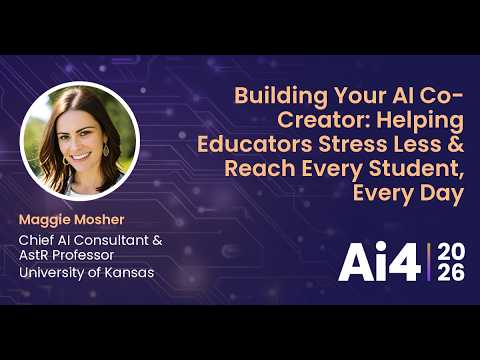
Published on YouTube by Ai4 on August 19, 2026, this session features Maggie Mosher, Chief AI Consultant and Assistant Research Professor at the University of Kansas. The presentation focuses on reframing AI from a feared competitor into a fatigue-reducing co-creator to help educators offload administrative heavy lifting, differentiate learning safely within FERPA and COPPA guidelines, and reconnect with their students.
## TL;DR
Maggie Mosher argues that education is at a crisis point where teachers spend only 43% of their time actually teaching, making AI co-creators essential for offloading paperwork, email triaging, and schedule management. She introduces pedagogical applications like real-time lesson differentiation, ELI6 prompt strategies, and tools such as Suno, NotebookLM, and Goblin Tools to support diverse learners. To guide responsible adoption, Mosher presents her ETHICS framework, which emphasizes validation, energy impact, context, and addressing demographic biases in AI training data. Ultimately, she advocates shifting from traditional memorization tests to authentic, project-based assessments that teach students to critically evaluate AI output.
## Atmosphere & style
The presentation carries an energetic, authentic, and deeply personal tone as Mosher shares her lived experiences as a twice-exceptional educator who utilizes Meta smart glasses to help pace her rapid speech. Her approach balances realistic empathy for overwhelmed, budget-constrained teachers with an encouraging, practical vision for technology. The narrative moves from the emotional weight of educator burnout to an empowering call to action, creating an inspiring and supportive atmosphere for classroom innovation.
## Key takeaways
- [00:04](https://www.youtube.com/watch?v=VAHhoMVx5tQ&t=4s) Maggie Mosher opens her talk by highlighting the role of human inspiration and transformative technology, introducing her resource site inspiredby.ai to help educators access AI tools.
- [00:04](https://www.youtube.com/watch?v=VAHhoMVx5tQ&t=4s) Educators are facing an unprecedented crisis point, spending only 43% of their time actually teaching due to high administrative and compliance burdens.
- [06:42](https://www.youtube.com/watch?v=VAHhoMVx5tQ&t=402s) AI should be viewed as a fatigue-reducing 'co-creator' that excels at infinite patience, instant scaffolding, and real-time differentiation without replacing human empathy.
- [06:42](https://www.youtube.com/watch?v=VAHhoMVx5tQ&t=402s) To prevent overwhelm, teachers are encouraged to adopt just one new AI tool per month, utilizing free platforms like Suno, NotebookLM, Brisk AI, School AI, and Gemini for Education.
- [08:57](https://www.youtube.com/watch?v=VAHhoMVx5tQ&t=537s) Mosher outlines the 'ETHICS' framework (Evaluate & Validate, Human & Societal Impact, Inner Workings, Context & Governance, Safety & Fairness) to guide responsible AI adoption in schools.
- [08:57](https://www.youtube.com/watch?v=VAHhoMVx5tQ&t=537s) Energy consumption and prompt design impact the environment; well-crafted prompts reduce unnecessary server compute compared to repeated unguided attempts.
- [08:57](https://www.youtube.com/watch?v=VAHhoMVx5tQ&t=537s) Current AI models often lack diverse cultural perspectives, such as indigenous tribal knowledge, highlighting the need to examine safety and fairness beyond standard FERPA/COPPA compliance.
- [12:39](https://www.youtube.com/watch?v=VAHhoMVx5tQ&t=759s) Tools like Goblin Tools, Gemini, and Claude help offload administrative heavy lifting, including email triaging, tone adjustment, and co-teaching schedule merging.
- [12:39](https://www.youtube.com/watch?v=VAHhoMVx5tQ&t=759s) In the classroom, students can use AI for preliminary critique, but must pitch their final revisions and defend why they accepted or rejected specific AI suggestions.
- [12:39](https://www.youtube.com/watch?v=VAHhoMVx5tQ&t=759s) Traditional worksheets and simple memorization tests are obsolete; assessment must shift toward authentic, project-based tasks mapped to learning standards.
- [18:18](https://www.youtube.com/watch?v=VAHhoMVx5tQ&t=1098s) AI co-creators exist to protect educator energy and reclaim time, ensuring teachers can focus on their core passion of inspiring students.
## Detailed walkthrough
### [00:04](https://www.youtube.com/watch?v=VAHhoMVx5tQ&t=4s) Rethinking Inspiration and the Need for a Game-Changer
Maggie Mosher opens her talk by adjusting to the room's acoustics and inviting the audience to reflect on who inspired them to get where they are today. She polls the room by show of hands, asking whether that inspiration came from a teacher, a politician, a leader in their field, an innovator, or even technology itself. Noting that many people are inspired by a combination of human leadership and transformative tech, she introduces her resource website, inspiredby.org. Mosher shares that all presentation slides and materials are accessible via a QR code on the site, which she specifically built as a "twice-exceptional" individual—someone who is gifted yet lives with neurodivergence and multiple medical disabilities.
Because her brain processes thoughts extremely fast, Mosher speaks at a rapid pace and often uses Meta smart glasses to help pace herself. She explains how AI was an absolute game-changer for her personal communication, recalling her early start in 1999 with "ALICE," a primitive, clunky chatterbot that nevertheless allowed her to articulate complex ideas she previously struggled to voice. Transitioning to the broader state of education, Mosher argues that educators today face a crisis point and urgently need their own game-changer to alleviate an unprecedented burden. Drawing on her 25 years in special education—managing caseloads of 28 students with extensive IEPs and only one or two paras—she highlights the intense pressure modern teachers face.
- Teachers work grueling schedules, yet a surprisingly low **43% of their time** is actually spent teaching, with the majority consumed by paperwork, IEP compliance, parent emails, and administrative meetings.
- The goal of leveraging AI is to shift heavy administrative burdens back to technology, allowing educators to focus on their core passion: connecting with and inspiring students.
[00:402] AI as a Co-Creator: Scaffolding, Differentiating, and Free Educational Tools
Mosher frames AI strictly as a "co-creator" rather than a teacher replacement, emphasizing that technology cannot replicate human compassion, deep personal background knowledge, or the nuanced empathy required to interact meaningfully with students. However, AI excels at tasks requiring infinite patience, instant differentiation, and instant scaffolding. For instance, AI can flawlessly translate materials into any language in real time; Mosher shares how a free AI agent smoothly translated complex lessons for her Chinese summer students. It can also assist with generating ideas for IEPs and 504 plans or scaffolding grade-level materials down to a student's specific comprehension level—such as using the classic prompt strategy "Explain Like I'm Six" (ELI6) to adjust readability instantly.
To demonstrate the impact of early targeted support, Mosher recalls teaching a student with Down syndrome from kindergarten onward; by fourth grade, the student performed at grade level in reading, writing, and math, no longer qualifying for an IEP. Looking ahead to how AI tools can sustain such growth, Mosher offers a reassuring piece of advice for overwhelmed teachers: choose **just one new tool per month**. She highlights several accessible, free AI applications tailored for specific pedagogical styles, noting that all resources on her site are tagged for quick access (e.g., searching "agent" or "chat" to build custom tools without needing coding skills).
- **Suno:** Generates free educational songs out of any text prompt for music-centered learning.
- **NotebookLM (formerly Gemini Notebook):** Converts curated study documents into interactive audio podcasts or verbal study assistants.
- **Brisk AI, School AI, Magic School AI, and Gemini for Education:** Free platforms capable of differentiating lessons, creating videos for absent students with medical needs, and delivering instant student feedback.
- Mosher co-hosts the podcast *AI Advocates* with Lisa Decker, delivering 5-minute episodes that review free, FERPA-, COPPA-, and HIPAA-compliant AI tools specifically for budget-constrained rural educators.
[08:57](https://www.youtube.com/watch?v=VAHhoMVx5tQ&t=537s) The "ETHICS" Framework and the Human/Societal Impact of Prompting
Before integrating AI into any school routine, Mosher strongly advocates establishing a clear ethical framework to avoid unintended missteps. She outlines her personal mnemonic framework, **ETHICS**, designed to keep usage responsible and transparent across both K-12 and higher education:
1. **Evaluate & Validate:** Always fact-check output and require AI tools to cite source links for every document retrieved.
2. **Human & Societal Impact:** Consider resource efficiency and energy consumption. A well-constructed prompt allows a student to generate an precise image in a single attempt; an unguided student might take 32 attempts in Canvas, wasting significant computing power and energy.
3. **Inner Workings:** Understand model architectures—knowing when to choose a standard Large Language Model (LLM) versus a Large Multimodal Model (LMM) that handles images, video, and audio.
4. **Context & Governance:** Identify local, state, and national policy decision-makers. Mosher shares an example from her work with the Center for Reimagining Education, where they established student advisory boards: second-graders were thrilled about AI possibilities, whereas high school sophomores quietly used AI while worrying about getting into trouble.
5. **Safety & Fairness:** Go beyond basic FERPA/COPPA compliance to examine training data representation. Drawing on her upbringing near the Navajo Reservation, Mosher notes that mainstream AI models lack indigenous cultural perspectives and tribal knowledge because they were primarily built by a non-diverse demographic of white male engineers.
[12:39](https://www.youtube.com/watch?v=VAHhoMVx5tQ&t=759s) Offloading Heavy Lifting and Redefining Classroom Assessment
Mosher walks through specific ways teachers can use AI to automate time-consuming logistics. Using tools like **Goblin Tools**, teachers can paste in rough or tense email drafts, de-identify student names, adjust the tone to be polite or professional, and receive a refined response—saving Mosher over 45 minutes a week on administrative correspondence. She uses Gemini to triage her overwhelming daily inbox of roughly 3,800 emails and relies on agents like Claude to organize co-teaching schedules, merge conflicting calendars, and build structured rest breaks into her workday.
In the classroom, Mosher uses AI to draft lesson plans, generate initial progress reports, and provide immediate formative feedback. Rather than hiding AI from students, she has first-graders submit their work to AI for critique, refine their work based on the feedback, and present three items to her: the initial draft, the AI suggestions, and their final revision. Students must pitch their final product and defend why they accepted or rejected specific AI suggestions, training critical thinking above all else. Closing her presentation, Mosher emphasizes that the era of traditional worksheets and simple memorization tests is officially over. Educators must shift to authentic, project-based assessments that require real-time application. By feeding state standards and active learning constraints into AI—such as asking it to design a movement-based collaborative game using chairs, paper, and laptops—teachers can effortlessly map creative, hands-on lessons directly to required learning objectives.
- Mosher manages her own weekly AI news update on her website using a custom automated AI agent that tracks newly released free tools and platform updates, which she personally fact-checks before publishing.
- The fundamental challenge facing educators is no longer deciding *if* AI will transform teaching, but ensuring educators remain intentional enough to guide these transformations to inspire the next generation of innovative thinkers.
[18:18](https://www.youtube.com/watch?v=VAHhoMVx5tQ&t=1098s) Preserving Educator Energy and Closing Thoughts
Maggie Mosher wraps up her presentation by emphasizing the heavy burden that educators carry on a daily basis. Acknowledging that teachers wear "many hats" and already have enough demanding tasks on their plates, she advocates for using AI co-creators as a practical solution to reduce fatigue and streamline time-consuming administrative work. Rather than adding complexity to a busy schedule, these tools are designed to handle heavy lifting—such as drafting communications, merging schedules, and customizing lesson plans—allowing teachers to reclaim precious time and energy.
She directs the audience back to her website, **inspiredby.ai**, where attendees and viewers can access all the resources, blueprints, and materials discussed throughout the session. Closing on an encouraging and emotional note, Mosher expresses deep gratitude for the dedication of educators in every classroom. She reminds the audience of their profound impact, noting that teachers "are making a difference in the lives of the people who are going to change our world," and urges them to lead the way in helping students learn to navigate and use AI tools "effectively and accurately."
- **Resource Website:** [inspiredby.ai](https://inspiredby.ai) (provides access to session materials, AI frameworks, and practical blueprints).
- **Core Message:** AI should serve as a fatigue-reducing co-creator to offload heavy administrative tasks so educators can focus on student connection.
- **Call to Action:** Empower students to learn and use AI safely, accurately, and effectively in their educational journey.
## Notable quotes
> [00:04](https://www.youtube.com/watch?v=VAHhoMVx5tQ&t=4s) ALICE — Maggie Mosher
> [00:04](https://www.youtube.com/watch?v=VAHhoMVx5tQ&t=4s) 43% of their time — Maggie Mosher
> [18:18](https://www.youtube.com/watch?v=VAHhoMVx5tQ&t=1098s) are making a difference in the lives of the people who are going to change our world — Maggie Mosher
## Mentioned
Maggie Mosher, Ai4, University of Kansas, inspiredby.org, inspiredby.ai, ALICE, Meta smart glasses, Suno, NotebookLM, Gemini Notebook, Brisk AI, School AI, Magic School AI, Gemini for Education, Gemini, AI Advocates, Lisa Decker, Center for Reimagining Education, Canvas, Goblin Tools, Claude, FERPA, COPPA, HIPAA
## Video description
Maggie Mosher - Chief AI Consultant & AstR Professor, University of Kansas
Exhausted by the lack of planning time and the pressure to meet every student's needs? It’s time to reframe AI from a feared competitor to a fatigue-reducing co-creator. This session cuts through the tech hype to give you a practical blueprint for your classroom with your own developed generative or agentic AI. Learn how to offload heavy lifting, like drafting emails, merging schedules, and lesson planning, so you can focus on what matters: connecting with students. Discover the “Break-Down-Barriers Approach” to purposefully selecting and building AI tools that solve real classroom problems, helping you collaborate seamlessly with peers, even when common plan time is non-existent. Build your own ultimate co-creator with the newest AI tools within a secure FERPA & COPPA compliant platform, safely personalizing learning for every student without burning out.
Maggie Mosher 呼吁学校引入 AI 工具以减轻教师负担
教育工作者仅将 43% 的工作日时间用于教学,需要自动化 AI 共创者处理行政事务并重塑课堂专注度。
Maggie Mosher 指出,当前教育正处于危机节点,教师仅有 43% 的时间真正用于教学,因此利用 AI 共创者来分担文书工作、邮件分流和日程管理显得至关重要。她介绍了实时差异化教学、ELI6 提示词策略等教学应用,以及 Suno、NotebookLM 和 Goblin Tools 等支持多样化学习者的工具。为了引导负责任的工具引入,Mosher 提出了 ETHICS 框架,强调结果验证、能源影响、应用情境以及应对 AI 训练数据中的人口统计偏差。最后,她主张从传统的死记硬背式测试转向真实的项目制评估,以培养学生批判性评估 AI 输出内容的能力。
针对教师仅将 43% 的时间用于实际教学的繁重现状,Maggie Mosher 提倡将 AI 定位为缓解疲劳的“共创者”(co-creator),以技术分担行政与合规负担,重燃教学连接。 (0:04)
为避免教学负担过载,教师可采用每月仅学习一款新工具的策略,利用 Suno、NotebookLM 和 Brisk AI 等免费平台快速实现即时分层教学与学习脚手架搭建。 (6:42)
Mosher 提出了负责任采纳 AI 的“ETHICS”框架,涵盖输出验证、算力能耗影响、模型架构理解、政策治理以及补充原住民等多元文化代表性的公平安全审查。 (8:57)
教师可借助 Goblin Tools、Gemini 与 Claude 优化邮件语气并整合排课,同时课堂评估应告别传统练习册,转向要求学生对 AI 生成反馈进行辩护与修订的真实项目式任务。 (12:39)
Reading summary
Special education specialist Maggie Mosher argues that educators should adopt artificial intelligence as an administrative and pedagogical co-creator to alleviate severe professional burnout, streamline compliance tasks, and enable real-time personalized instruction.
Alleviating Administrative Burden to Restore Teaching Time (0:04)
Drawing on 25 years of experience managing special education caseloads of up to 28 students with minimal paraprofessional support, Mosher reports that teachers spend only 43% of their working hours actually teaching. The majority of educators' time is absorbed by paperwork, IEP compliance, administrative meetings, and high volumes of correspondence. She asserts that the primary objective of educational AI should be absorbing these operational burdens so teachers can refocus on direct student mentorship.
Mosher details several practical workflows for administrative offloading. To manage daily logistics, she uses Goblin Tools to anonymize student data and adjust tone in emails, which she notes saves over 45 minutes per week. She relies on Gemini to triage an inbox receiving roughly 3,800 emails daily, and deploys Claude to resolve co-teaching scheduling conflicts and insert mandatory rest periods into educators' daily schedules.
Differentiating Instruction and Scaffolding Learning
Mosher emphasizes that AI functions strictly as a co-creator rather than a substitute for educators, noting that models cannot replicate human empathy, compassion, or individualized background knowledge. However, generative tools provide infinite patience for targeted tasks such as instant language translation, drafting IEP and 504 accommodation strategies, and adjusting readability through prompting techniques like Explain Like I'm Six (ELI6).
To prevent technological overwhelm, Mosher advises educators to integrate just one new tool per month. She highlights several free applications suited to varying pedagogical needs, including Suno for generating educational music, NotebookLM for converting study materials into audio discussions, and platforms like Brisk AI, School AI, Magic School AI, and Gemini for Education to generate feedback and catch-up materials. Through her podcast with Lisa Decker, Mosher also assesses tools for rural districts under FERPA, COPPA, and HIPAA privacy constraints.
Guiding AI Deployment via the ETHICS Framework (8:57)
Before bringing AI into schools, Mosher recommends adopting the five-part ETHICS framework. The first component, Evaluate and Validate, mandates fact-checking and explicit source citations. Human and Societal Impact emphasizes prompt efficiency to conserve computational power and energy, contrasting a single guided prompt with a student making dozens of wasteful image generation attempts in Canvas. Inner Workings requires staff to understand structural differences between text-only Large Language Models and multimodal models.
The framework's remaining components address organizational and cultural oversight. Context and Governance requires identifying policy stakeholders, informed by Mosher's observation that high schoolers often hide AI usage out of fear of disciplinary action while younger students embrace it openly. Finally, Safety and Fairness pushes past basic regulatory compliance to scrutinize training data representation; Mosher observes that mainstream models frequently exclude indigenous and tribal perspectives because development teams have historically lacked demographic diversity.
Rethinking Student Assessment and Active Pedagogy (12:39)
With generative AI readily accessible, Mosher contends that traditional worksheets and rote memorization tests are obsolete. Instead, she advocates for authentic, project-based assessments that require students to critically evaluate machine outputs. In her own practice, she requires students as young as first grade to submit initial drafts to AI, review its feedback, and present their final work alongside an explicit defense of why they accepted or rejected specific algorithmic suggestions.
Mosher also utilizes AI to rapidly align creative, physical classroom activities with official state standards. By inputting specific learning goals alongside everyday constraints—such as designing collaborative movement games using chairs, paper, and laptops—teachers can bypass manual lesson-mapping and deliver interactive instruction.
Mosher concludes that the central issue facing education is no longer whether AI will alter teaching, but whether educators will actively steer its adoption to preserve their own energy and guide students to evaluate machine intelligence critically. She directs teachers to inspiredby.ai for open-access frameworks and updates.
精炼阅读摘要
特殊教育专家 Maggie Mosher 指出,面对繁重的行政与合规负担,现代教师仅有 43% 的时间用于实际教学;她主张将人工智能定位为“协创者”(co-creator)而非教师替代品,通过承担机械性文书与流程任务来缓解职业倦怠,使教育者能重新聚焦于学生的个性化培养。
精力危机与协创定位 (0:04)
根据 Maggie Mosher 结合自身 25 年特殊教育经验(曾面临一人管理 28 名需执行个别化教育计划(IEP)的学生且仅配有一至两名助教的境况)的观察,当代教师正承受空前的职业压力。数据显示,教师目前仅有约 43% 的时间投入于课堂教学,其余大部分精力被海量文书、IEP 合规审查、家长邮件及行政会议消耗。作为一名兼具神经多样性与多种身体疾患的“双重特异”(twice-exceptional)人士,Mosher 回顾了自己自 1999 年使用早期聊天机器人 ALICE 辅助表达的经历,认为当前深陷重负的教育体系同样亟需技术工具来扭转工作负担。
Mosher 明确将人工智能界定为教学“协创者”,强调技术永远无法替代人类教师。AI 不具备人类的同理心、深厚的个人阅历以及师生互动中复杂的情感洞察力;引入技术的核心目标在于将繁琐的行政杂务转移给机器,使教师能将有限的精力和时间重新投向关怀、启发学生这一核心使命。
差异化脚手架与实用工具
在具体教学应用中,Mosher 强调人工智能具备无限耐心、即时差异化调整与动态构建认知脚手架的能力。AI 能够实时进行跨语言精准翻译(如辅助中国暑期交流生理解课程),协助设计 IEP 与 504 计划,并通过“像对我六岁时那样解释”(ELI6)等提示词策略,迅速将教材难度降至特定学生的认知水平。Mosher 援引教学实例指出,一名唐氏综合征学生在从幼儿园起接受持续精准干预后,至四年级时其阅读、写作和数学均达到同级基准,顺利脱离 IEP 资助资格。
针对面临技术焦虑的教师,Mosher 建议采取“每月仅尝试一款新工具”的渐进策略。她列举了多款免编程、零门槛且符合 FERPA、COPPA 与 HIPAA 隐私法规的免费工具:利用 Suno 将文本生成教学歌曲以辅助音乐型学习;通过 NotebookLM 将学习资料转化为互动式播客或口语助教;借助 Brisk AI、School AI、Magic School AI 和 Gemini for Education 实现差异化备课、为因病缺勤学生录制讲解视频并提供即时反馈。此外,她与 Lisa Decker 共同主持播客《AI Advocates》,专门向预算紧张的乡村教师推广免费且合规的教学工具。
“ETHICS”伦理与模型治理 (8:57)
为防范盲目应用 AI 带来的风险,Mosher 提出了适用于 K-12 与高等教育的“ETHICS”伦理框架。该框架涵盖五项准则:第一,评估与验证(Evaluate & Validate),要求严格核查生成内容并强制要求模型附带原始来源链接;第二,人类与社会影响(Human & Societal Impact),关注算力消耗与能源效率,例如精心构建的提示词可让学生单次生成合规图像,而无指导的盲目尝试可能在 Canvas 中调用多达 32 次,造成算力与能源浪费;第三,理解内部机制(Inner Workings),要求使用者根据任务需求清晰区分标准大型语言模型(LLM)与多模态模型(LMM)的适用边界。
在政策与公平层面,第四项准则强调情境与治理(Context & Governance),明确各级政策主体的权责。Mosher 在“重塑教育中心”(Center for Reimagining Education)组建学生咨询委员会的实践显示,小学二年级学生对 AI 表现出高度探索热情,而高二学生在暗中使用时则普遍担忧违规受罚;第五项准则聚焦安全与公平(Safety & Fairness),Mosher 结合其在纳瓦霍族保留地(Navajo Reservation)附近的成长经历指出,主流模型主要由单一背景的白人男性工程师构建,导致训练数据普遍缺失原住民文化视角与部落知识,因此技术合规必须延伸至代表性层面的检视。
流程自动化与评估模式重塑 (12:39)
在日常教学行政管理中,Mosher 展示了运用 AI 缩减耗时流程的具体方案。通过 Goblin Tools,教师可对家校沟通草稿进行学生身份脱敏,并将生硬措辞自动润色为专业且礼貌的语调,每周可节省超过 45 分钟的行政沟通时间。面对每天约 3,800 封的邮件负荷,她利用 Gemini 进行邮件分级归类,并依赖 Claude 排定协同教学日程、合并冲突安排并在工作日强制嵌入休息间歇。此外,她在其资源网站上运行自定义自动化 AI Agent 追踪最新免费工具并经人工核实后发布。
在课堂评价环节,Mosher 断言传统的填鸭式试卷与死记硬背式测验已彻底过时,教学评估必须转向真实情境下的项目制考核。在她的实际教学中,小学一年级学生须将作业提交给 AI 接受批评,随后自主修改,并向教师提交初稿、AI 建议与最终版三份材料,现场答辩其采纳或拒绝特定 AI 建议的理由,以此锻炼批判性思维。通过向模型输入课程标准与限制条件(例如利用椅子、纸张和笔记本电脑设计合作性运动游戏),教师可高效将活动设计精准映射到教学目标。
Maggie Mosher 总结认为,教育界当前面临的根本命题已不再是权衡是否接纳人工智能,而是教师如何主动引导技术转型以启发下一代思考者。尽管 AI 能通过自动化分担日程、邮件与教案起草等繁重工作来保留教师精力,但算法中的文化代表性缺陷、地区政策差异以及不同学段学生的使用顾虑,依然是教育系统规模化应用 AI 过程中亟待解决的现实障碍。
Detailed notes — zh
## Background
该内容由频道 Ai4 于 2026 年 8 月 19 日在 YouTube 平台发布。视频记录了堪萨斯大学首席 AI 顾问兼助理教授 Maggie Mosher 的主题演讲,简介指出演讲旨在打破科技炒作,为教育工作者提供实用蓝图,通过构建生成式与智能体 AI(Agentic AI)来分担邮件起草、排程和备课等繁重行政琐事,进而在合规前提下实现个性化教学并避免职业倦怠。
## TL;DR
Maggie Mosher 结合自身特教经验与“双重特异(2e)”背景,主张将 AI 定位为教师减负增效的“共创者”,以接管占教师每周 57% 精力的行政杂务。她推荐了一系列符合 FERPA、COPPA 等隐私规范的免费教学与办公工具(如 NotebookLM、Mizou、Goblin.tools),并系统提出了用于评估 AI 落地风险的 ETHICS 伦理框架。此外,她展示了如何将 AI 融入项目制学习(PBL)的课标对齐,并设计了“初稿—AI反馈—终稿答辩”的作业流程,将考核重心转向学生的批判性思维与决策能力。
## Atmosphere & style
整场演讲真诚坦率且极具同理心,主讲人语速明快、充满干劲,毫不掩饰自己身为神经多样性与残疾人士的真实挑战,瞬间拉近了与台下教师的距离。现场氛围既务实接地气,又带着特教工作者特有的温情与坚韧,从对繁重行政压力的集体共鸣,层层递进到用技术反哺教育本质的坚定号召,带给听众强烈的赋能感与情感慰藉。
## Key takeaways
- [00:04](https://www.youtube.com/watch?v=VAHhoMVx5tQ&t=4s) 主讲人 Maggie Mosher 结合自身“双重特异”(2e)与神经多样性背景,分享了 AI 作为思维组织与表达工具对其职业生涯的深远影响。
- [02:18](https://www.youtube.com/watch?v=VAHhoMVx5tQ&t=138s) 教师每周仅约 43% 的时间用于面对面教学,其余 57% 被繁重的行政文书和合规流程吞噬,教育行业急需减负手段。
- [02:18](https://www.youtube.com/watch?v=VAHhoMVx5tQ&t=138s) 应将 AI 定位为教师的“共创者”(Co-Creator)而非替代者:AI 负责提供即时学习支架搭建与多语言翻译,教师专注于情感连结与人文关怀。
- [02:18](https://www.youtube.com/watch?v=VAHhoMVx5tQ&t=138s) 建议教师避免技术焦虑,保持“每个月只选择并尝试一款免费工具”的渐进式探索节奏。
- [05:41](https://www.youtube.com/watch?v=VAHhoMVx5tQ&t=341s) 教育工具的选择必须严格遵守 FERPA、COPPA 和 HIPAA 等数据隐私合规标准,保障学生个人信息安全。
- [05:41](https://www.youtube.com/watch?v=VAHhoMVx5tQ&t=341s) AI 工具能针对不同教学风格赋能:如用 Suno 制作教学歌曲、NotebookLM 转化播客互动、Gemini for Education 自动生成居家补课视频等。
- [08:51](https://www.youtube.com/watch?v=VAHhoMVx5tQ&t=531s) 提出 AI 伦理落地的 ETHICS 评估框架,从验证(Evaluate)、社会影响(Human)、原理(Inner Workings)、治理(Context)到公平安全(Safety)全方位规范应用。
- [13:29](https://www.youtube.com/watch?v=VAHhoMVx5tQ&t=809s) 通过 Gemini 筛选优先级并结合 Goblin.tools 自动起草得体回信,每周可节省大量处理家长和行政邮件的时间。
- [13:29](https://www.youtube.com/watch?v=VAHhoMVx5tQ&t=809s) 重构作业评估机制:要求学生提交“初稿 + AI 修改建议 + 最终定稿”并答辩取舍理由,培养核心决策力与批判性思维。
- [16:15](https://www.youtube.com/watch?v=VAHhoMVx5tQ&t=975s) 传统死板测验已失效,教师可借助 AI 自动将生动有趣的项目制学习(PBL)与官方教学大纲标准进行逆向匹配与补漏。
- [18:18](https://www.youtube.com/watch?v=VAHhoMVx5tQ&t=1098s) 引导下一代有效且准确地运用 AI 是当代教育者的核心使命,通过人机协同才能切实减轻疲劳并赋能未来人才。
## Detailed walkthrough
### [00:04](https://www.youtube.com/watch?v=VAHhoMVx5tQ&t=4s) 开场互动与“双重特异”背景
主讲人 Maggie Mosher 首先邀请全场观众思考一个曾经启发过自己的人。她现场调查了大家的灵感来源:是有启发性的老师、政界人物、行业领袖、创新者,还是某种科技?现场许多人举手表示自己同时受到特定人物与科技的启发。为了让每位参会者都能获取所有演示文稿和资料,她展示了个人平台 `inspiredby.org` 的二维码,并坦诚分享了创建该网站的初衷——她自己是一名“双重特异”(Twice-Exceptional / 2e)人士,既拥有超常智力天赋(Gifted),同时也是神经多样性人群(Neurodivergent),并伴有多项身体残疾。
由于大脑运转极快、语速飞快,她平时甚至需要佩戴智能眼镜来提醒自己放慢节奏。这种特殊的思维方式使她过去很难将自己脑海中惊艳的想法清晰表达给大众。因此,AI 的出现对她而言是一场彻底的变革。她回忆起 1999 年第一次使用早期聊天机器人 A.L.I.C.E. 的经历,虽然当时的系统非常笨拙简陋,但它第一次让那些难以清晰言说的复杂思路得以准确组织并呈现出来。
- 网站平台:`inspiredby.org` 提供演讲中的所有课件、智能体配置教程与免费资源检索。
- 个人背景:堪萨斯大学(University of Kansas)助理教授、首席 AI 顾问,拥有 25 年以上特殊教育从业经验。
- 早期技术体验:1999 年初次接触 A.L.I.C.E. 机器人,借助 AI 弥合思维表达与沟通的鸿沟。
---
### [02:18](https://www.youtube.com/watch?v=VAHhoMVx5tQ&t=138s) 教育危机与 AI “共创者”的定位
当前教育领域正面临前所未有的职业危机与繁重负担。根据特殊教育的实际情况,Mosher 曾一个人管理多达 28 名持有复杂个别化教育计划(IEP)的学生,而全班仅配备一两名助教(Paraprofessionals)。更严峻的行业现实是,教师每周的实际工作时长中仅有约 43% 是真正用于面对面教学的,其余大量精力都被繁重的行政琐事吞噬——包括撰写合规文件、个别化教育计划、教案、回复家长邮件以及组织会议等。没有人是因为热爱做案头工作而成为教师的,大家踏入这一行业的初心是为了启发每一个孩子。
Mosher 提出,应当将 AI 重新定义为教师的“共创者”(Co-Creator),而不是竞争对手或完全替代者。AI 无法替代教师的同理心、对学生复杂成长背景的深刻理解以及真实的情感连结;但 AI 拥有常人难以企及的无限耐心,能够为班上每一位学生进行即时学习支架搭建(Scaffolding),或在瞬间实现无瑕疵的多语言互译。
```mermaid
flowchart TD
accTitle: 教师与AI共创分工模型
subgraph S1["人类教师核心职责(核心价值)"]
A1["情感连结与人文关怀"]
A2["真实教学洞察与决策"]
A3["理解学生复杂文化背景"]
end
subgraph S2["AI 共创者承接重担(效率引擎)"]
B1["即时多语言翻译与支架搭建"]
B2["繁琐邮件起草与日程合并"]
B3["IEP/504 策略与差异化备课建议"]
end
S2 -->|"卸载 57% 行政与事务负担"| S1
```
- 教师精力现状:每周仅约 43% 的时间在教学,其余 57% 被行政文书、邮件和合规审查占用。
- 差异化支持案例:曾有一名唐氏综合征学生在四年级时读写与数学达到年级水平,不再符合公立特教 IEP 资助标准,教师借助个性化 AI 工具为其长远发展持续提供支持。
- 教学原则:不要试图一口气掌握所有工具,建议教师保持节奏,“每个月只选择并尝试一款免费工具”。
---
### [05:41](https://www.youtube.com/watch?v=VAHhoMVx5tQ&t=341s) 免费合规工具库与实际教学场景
针对教师没有额外经费的普遍痛点,Mosher 与 Lisa Decker 共同创办了播客节目《AI Advocates》,专门向教育工作者推荐免费且符合 FERPA(家庭教育权利和隐私权法案)、COPPA(儿童在线隐私保护法)和 HIPAA(健康保险可携性与责任法案)的合规工具,每期节目时长仅约 5 分钟。
不同学科和教学风格的教师可以按需选用专属工具:
- **Suno**:适合倾向通过音乐和韵律开展教学的老师,可将任意教学内容快速生成原创歌曲。
- **NotebookLM(前身为 Gemini Notebook)**:能将教师指定的特定教学资料一键转化为播客形式的语音对话,并支持学生通过自然语言进行语音交互。
- **Gemini for Education**:可将当天的教案直接转化为精美教学视频,一键发送给因病或医疗需求无法到校的学生实现居家补课。
- **Brisk AI / SchoolAI / MagicSchool AI**:提供免费的作业批改支持与即时形成性评估反馈。
- **协同办公智能体**:在两名协同教学(Co-teaching)老师完全没有共同备课时间的情况下,通过 AI Agent 自动比对日程表,智能找出全天碎片化碰头时间。
---
### [08:51](https://www.youtube.com/watch?v=VAHhoMVx5tQ&t=531s) AI 伦理落地架构:ETHICS 评估框架
为了避免因盲目使用 AI 引发合规与伦理风险,Mosher 强调在学生或教师动手前必须确立结构化评估流程,并提出了通用的 **ETHICS** 框架:
| 维度 | 对应原则 | 实践细节与要求 |
|:--- |:--- |:--- |
| **E** | **Evaluate & Validate**<br>(评估与验证) | 验证 AI 输出的准确性与数据安全性;要求 AI 列出引用来源并提供原始链接以供核查。 |
| **H** | **Human & Societal Impact**<br>(人类与社会影响) | 关注算力能耗与环保;教会学生精准提示词技巧(1次精准生成 vs 32次试错能耗相差巨大)。 |
| **I** | **Inner Workings**<br>(底层工作原理) | 理解技术边界;清楚大语言模型(LLM)与大型多模态模型(LMM)在文字、音画输出上的区别。 |
| **C** | **Context & Governance**<br>(情境与治理规则) | 明确各级学区与州政策要求。让学生参与规则制定(如二年级委员会对 AI 充满好奇,十年级委员会更关注使用边界与违规风险)。 |
| **S** | **Safety & Fairness**<br>(安全与公平代表性) | 检查训练数据的文化包容度。Mosher 指出在纳瓦霍保留地周边长大的经验表明,主流模型缺乏原住民等特定群体语料,需警惕文化偏见。 |
---
### [13:29](https://www.youtube.com/watch?v=VAHhoMVx5tQ&t=809s) 繁琐事务卸载与批判性思维培养
在日常重担卸载方面,平台 **Mizou** 是创建班级免费智能体(且符合 FERPA/HIPAA/COPPA)的优选方案。面对日常成百上千封待处理邮件,Mosher 采用流水线方式应对:首先利用 Gemini 对每日大量邮件进行优先级筛选;随后使用 **Goblin.tools**,在去除敏感个人身份信息(De-identify)后自动生成得体回信草稿,还能自由调节语气(如“更加礼貌”或“更加职业化”),仅此一项每周就能省下至少 45 分钟。日常行程调度与强制休息规划则交给 Claude 协同助手完成。
```mermaid
flowchart LR
accTitle: 学生批判性AI交互评估流程
A["学生初稿"] --> B["AI 充当首轮评审<br>(提供优缺点反馈)"]
B --> C["学生权衡修改<br>(决定采纳/拒绝建议)"]
C --> D["提交三合一成果并答辩<br>(初稿 + AI修改版 + 最终稿)"]
```
在学生能力培养上,Mosher 将 AI 作为学生的“第一轮评审员”。学生完成作业后先输入 AI 获取初步评价,然后进行针对性修正。提交作业时,学生必须向老师同时提交三个版本:**原始初稿**、**AI 的修改建议**以及**最终定稿**。学生还需要像职场提案一样向老师进行口头陈述,阐明自己为何采纳了某条 AI 建议、又为何拒绝了某条建议。这种教学设计将考核重点从死记硬背转移到关键决策与**批判性思维**(Critical Thinking)上。
---
### [16:15](https://www.youtube.com/watch?v=VAHhoMVx5tQ&t=975s) 重构评估方式与项目制学习(PBL)的自动化标准对齐
“真正的问题已经不再是 AI 是否会改变我们的教学方式——无论我们是否意识到,它都已经彻底重塑了教育。”传统的纸质测验与死板练习册已彻底失效,因为学生能瞬间用 AI 生成标准答案。教师必须转向真实、注重应用情境的评估方式。
Mosher 分享了她将项目制学习(PBL)与教学大纲标准无缝对齐的实践:她将全年中所有好玩、有趣且被实践验证有效的课堂活动输入 AI,并指令其与课程标准进行逆向匹配。AI 不仅证明了这些生动项目完全能覆盖所有课标要求,还精准指出了知识点漏洞("你遗漏了这一项,需要补全")。她甚至会让 AI 结合教室里的现有教具(如椅子、笔记本电脑、铅笔和纸张),设计出调动全班动起来协作的课堂游戏。
面对技术的高速迭代,Mosher 依靠自己配置的 AI Agent 追踪全球最新的教育科技资讯,每周自动抓取限免教育工具与政策变动,并在人工校验后更新至网站,让教师免于在海量信息中疲于奔命。
### [18:18](https://www.youtube.com/watch?v=VAHhoMVx5tQ&t=1098s) 致谢教育工作者与拥抱 AI 赋能的未来
作为教育工作者,日常工作本身就已经极其繁重,每个人身上都肩负着多重角色与责任(“carry many hats as educators”)。正是因为大家的时间与精力如此宝贵,才更需要借助 AI 成为减轻疲劳、协同共创的助手。Maggie Mosher 在演讲尾声再次向与会者展示了获取相关工具与资料的资源网站链接,鼓励教师们将这些方法应用到实际教学设计与日常繁琐事务的处理中。
最后,Maggie 向在场的每一位教育者表达了由衷的敬意与感谢。她深情地指出,老师们在各自的课堂上为每个孩子所付出的努力,正在切实改变着那些未来将改变世界的人们的生活。她呼吁教育工作者们积极引导并帮助下一代有效且准确地学习和掌握 AI,共同创造更优质的教学未来。
- **教育者的多重角色**:教师日常承担着繁杂的教学、沟通与管理职责,合理利用 AI 工具能够有效分担重担。
- **赋能未来一代**:教师不仅在传授知识,更在塑造未来改变世界的人才,引导学生“有效且准确地”(effectively and accurately)应用 AI 至关重要。
## Notable quotes
> [16:15](https://www.youtube.com/watch?v=VAHhoMVx5tQ&t=975s) 真正的问题已经不再是 AI 是否会改变我们的教学方式——无论我们是否意识到,它都已经彻底重塑了教育。 — Maggie Mosher
> [02:18](https://www.youtube.com/watch?v=VAHhoMVx5tQ&t=138s) 应当将 AI 重新定义为教师的“共创者”(Co-Creator),而不是竞争对手或完全替代者。 — Maggie Mosher
> [02:18](https://www.youtube.com/watch?v=VAHhoMVx5tQ&t=138s) 没有人是因为热爱做案头工作而成为教师的,大家踏入这一行业的初心是为了启发每一个孩子。 — Maggie Mosher
> [02:18](https://www.youtube.com/watch?v=VAHhoMVx5tQ&t=138s) 不要试图一口气掌握所有工具,建议教师保持节奏,每个月只选择并尝试一款免费工具。 — Maggie Mosher
> [08:51](https://www.youtube.com/watch?v=VAHhoMVx5tQ&t=531s) 1次精准生成 vs 32次试错能耗相差巨大。 — Maggie Mosher
> [13:29](https://www.youtube.com/watch?v=VAHhoMVx5tQ&t=809s) 将考核重点从死记硬背转移到关键决策与批判性思维上。 — Maggie Mosher
> [18:18](https://www.youtube.com/watch?v=VAHhoMVx5tQ&t=1098s) 老师们在各自的课堂上为每个孩子所付出的努力,正在切实改变着那些未来将改变世界的人们的生活。 — Maggie Mosher
> [18:18](https://www.youtube.com/watch?v=VAHhoMVx5tQ&t=1098s) 引导并帮助下一代有效且准确地学习和掌握 AI,共同创造更优质的教学未来。 — Maggie Mosher
## Mentioned
Maggie Mosher, Lisa Decker, 堪萨斯大学 (University of Kansas), inspiredby.org, A.L.I.C.E., AI Advocates, Suno, NotebookLM, Gemini for Education, Brisk AI, SchoolAI, MagicSchool AI, Mizou, Goblin.tools, Claude, Gemini, ETHICS 评估框架, FERPA, COPPA, HIPAA, IEP (个别化教育计划)
## Video description
Maggie Mosher - Chief AI Consultant & AstR Professor, University of Kansas
Exhausted by the lack of planning time and the pressure to meet every student's needs? It’s time to reframe AI from a feared competitor to a fatigue-reducing co-creator. This session cuts through the tech hype to give you a practical blueprint for your classroom with your own developed generative or agentic AI. Learn how to offload heavy lifting, like drafting emails, merging schedules, and lesson planning, so you can focus on what matters: connecting with students. Discover the “Break-Down-Barriers Approach” to purposefully selecting and building AI tools that solve real classroom problems, helping you collaborate seamlessly with peers, even when common plan time is non-existent. Build your own ultimate co-creator with the newest AI tools within a secure FERPA & COPPA compliant platform, safely personalizing learning for every student without burning out.
[Source](https://www.youtube.com/watch?v=VAHhoMVx5tQ)
[0:04] Maggie Mosher: ALICE
[0:04] Maggie Mosher: 43% of their time
[6:42] Maggie Mosher: co-creator
[6:42] Maggie Mosher: Explain Like I'm Six
[6:42] Maggie Mosher: just one new tool per month
[8:57] Maggie Mosher: ETHICS
[8:57] Maggie Mosher: Evaluate & Validate
[8:57] Maggie Mosher: Human & Societal Impact
[8:57] Maggie Mosher: Inner Workings
[8:57] Maggie Mosher: Context & Governance
[8:57] Maggie Mosher: Safety & Fairness
[18:18] Maggie Mosher: are making a difference in the lives of the people who are going to change our world
Original transcript
[0:04] I'm too loud. Let me know by a hand in the back if
[0:07] you can't hear me. I think it's
a little close, but we're okay.
[0:10] Um, I'm going to start by asking you to think
for a moment about a person who inspired you.
[0:18] Think for a moment of anyone who inspired you.
Raise your hand if that person was a teacher.
[0:25] Raise your hand if that person
was someone in politics.
[0:31] Raise your hand if that person
was a leader of their field.
[0:36] No. Raise your hand if that
person was an innovator.
[0:40] Raise your hand if that person was technology.
[0:45] So, some of you, like me, were inspired
by both a person and a technology.
[0:52] Um, and some of you were just inspired
by a person who maybe was a leader.
[0:56] But, we are all inspired by someone for a reason.
So, all of you lucky people in the room today,
[1:03] because you were inspired by someone, you will
have all of these um handouts and all the slides
[1:09] are on this QR code on my website, which
is called inspiredbi, inspiredby.org. It's
[1:17] a site that I set up for everyone in my talks,
because I am someone who's twice exceptional.
[1:23] So, most of you know who that is, but if you're in
industry, you probably don't. It means I'm gifted,
[1:28] but I'm also neuro- neuro- diverse. I have
multiple um medical disabilities as well. So,
[1:34] I speak really quickly. Um, I actually use meta
glasses normally to slow myself down, because my
[1:41] brain goes so fast. It's one of the reasons AI was
a game changer for me, because essentially, I talk
[1:50] in a way that most people don't understand. But,
I have these amazing ideas. So, I started using
[1:56] AI for the very first time. I used Alice. She was
super clunky in 1999. Does anybody remember Alice?
[2:04] Yeah, awful AI. Like totally different than what
we have now. But for me, Alice was a game-changer.
[2:11] Why? Because she let me be able to say things in
a way that I couldn't articulate. And I would say
[2:18] for most of us in the education field, we are at a
time that's a crisis where we need a game-changer.
[2:25] We need someone to help take away the
unprecedented burden we have as educators.
[2:30] I've been an over an educator for
over 25 years in special education.
[2:34] I've had 28 kids on my caseload all with
extensive IEPs and one or two paras. So,
[2:39] I know what it's like to have a lot going
on and to not know how to deal with it.
[2:46] I found the statistic extremely
interesting, but teachers work an a week.
[2:53] If they ever tell you get your summers
off, you know that's a total lie.
[2:57] 43% of that time is actually spent teaching.
Where's the rest of it spent? That's why we got
[3:03] into this field. We got into the field to teach.
We didn't get into the field to do paperwork,
[3:07] to do IEPs, to do governments, to do
lesson plans, to do parent emails,
[3:11] to do conferences. We got it into it because we
wanted to inspire those kids. We wanted to teach.
[3:18] So, how can we let AI do the part we don't like to
do so that we can do the part we love, reach every
[3:25] student in our classroom? There's a lot of ways AI
can do this for us. I call it a co-creator because
[3:31] it's not a person. So, it's not going to present
for me. It's not going to do my learning for me.
[3:36] It's not going to do my interacting with students
when it's meaningful for me because AI cannot do
[3:43] certain things well. Like it does not understand
the nuances of a student and their backgrounds.
[3:49] It It understand the compassion I have for each
of their backgrounds. It cannot understand the
[3:55] background I have that I apply to each of them,
no matter how well it's trained. What can it do?
[4:02] It has the patience I do not have to scaffold for
every single person in my room. It can translate
[4:08] immediately into any language flawlessly. This
summer I taught students students from China
[4:14] and I was shocked at how well my free AI agent
translated for them to exactly what they would
[4:20] say. It can also do things like help with IEPs,
504s, not writing them, giving you ideas for them,
[4:29] giving you some ideas to help you to come up with
more ideas. It can also differentiate in the split
[4:36] second. It can do um with one of our former deans
of the education department um is over here in the
[4:44] corner and he likes to say his favorite prompt
is the ELI act like I am or teach me like I am
[4:52] and I always say teach me like I'm a six
six-year-old. Goes right down to a grade level. I
[4:57] have a student with Down syndrome who I've taught
um since kindergarten. She did not in fourth
[5:03] grade qualify for an IEP anymore because she was
reading and writing and doing math at grade level.
[5:09] So what do you do? You know she's going to
need an IEP later but she doesn't qualify.
[5:14] So we were in a conversation about what
is the rest of her life going to be like
[5:19] and I was talking them about well, if we could get
her some great AI, it's going to be a lot easier.
[5:25] So we taught her some things. We used to things
like back then we didn't have Magic School as much
[5:29] but I today Magic School or School AI or the
free ones are awesome. Gemini for education.
[5:35] I'm going to give you a list of all the
free ones that I love in a moment. It's
[5:38] going to be overwhelming. Choose one, just
one a month. That's it. Don't go over that.
[5:42] But there's a lot of them because some of us
are people who need to teach through music. So
[5:47] Suno is going to be your favorite because it makes
free songs out of anything you put in there. Some
[5:51] of us are going to be people who need to teach
through exact resources. And so, Gemini notebook,
[5:58] um, used to be called Notebook LM, now it's Gemini
LM. It's going to be the best resource cuz it can
[6:03] do it in podcast. It can take just the information
I want and interact with the students verbally.
[6:09] All of those are free resources. So, we need
to know which resource we can steal for what.
[6:15] But, the good news is you all have my
website, so I put that all in a map for you.
[6:20] So, anything you click on the search field of my
website, inspiredbi.org, it will find for you.
[6:25] You can click the word agent, it'll show you how
to set up your own free agent in any platform
[6:30] you want. You can click the word chat, it'll
tell you how to create chatbots. All of that's
[6:35] available to you for a reason because we should
not have to figure out what is safe, secure,
[6:40] and helpful for our students. That's something we
don't have time for. So, I tried to help you out
[6:44] with that. It's helpful for people who are gifted
like me because you can take them and send them on
[6:50] a different path when they've already figured out
the answer and want to tell everyone what it is.
[6:55] It helps with struggling students. It can
help with anyone who's not present that day.
[7:01] A lot of medical needs, um, aren't always able
to be at school. It can take anything you've
[7:06] taught that day, you can put it into Gemini
for education, it'll turn it into a video.
[7:11] You just take your lesson, it'll make a video,
you send that video home, and it teaches them
[7:15] through the video. So, there's so many things
we can do that we didn't have the capacity to do
[7:20] before or it would take us a really long time
if we wanted to. But, it essentially can reach
[7:24] every single student. It can provide feedback
immediately. I often let Gemini or Brisk, if you
[7:31] use Brisk AI or School AI or Magic School AI, any
of the free versions, I don't pay for anything.
[7:36] I have a podcast called AI Advocates and
it goes through with Lisa Decker. It goes
[7:40] through all the free AI available to teachers
and it tells you about it in about 5 minutes.
[7:45] And the reason we started that was because all
these teachers kept coming to us and saying,
[7:49] "I don't have money. I'm in rural Kansas. I want
to be able to use AI, but I need it to be safe,
[7:54] secure." So, all the AI we discuss, we talk about
is FERPA, COPPA, HIPAA compliant. And it's free.
[8:00] Why is that helpful? Because we don't want you to
have to be searching all over the place to find
[8:05] the AI that works for you. And we want you to be
able to do AI in a way that makes sense to you.
[8:11] My website was created by my own AI agent.
I fact-checked everything, but essentially
[8:16] I did none of the building. I didn't even
code it. I just had my AI agent create it.
[8:22] I also use my AI agent to schedule because
co-teaching is really effective when we've got
[8:28] essentially two amazing educators in a room that
have no time to plan together. The AI agent can
[8:33] find the time throughout the day when they can
meet up without you having to figure it out.
[8:39] It can also make time for connections across
schools by just giving calendars and schedules.
[8:44] It will determine when you guys can meet, what
days you have the same days off. It can be
[8:50] really helpful in a lot of different ways. I do
recommend though that before you do anything with
[8:57] any student or teacher, you start with a framework
when you're dealing with AI. Why are frameworks
[9:02] so important? Because if you don't know what you
don't know, you're going to do something wrong.
[9:08] So, you have to start with, "Okay, what's
I use the word ethics for my framework."
[9:12] And it's easy for me to remember and I want my
students to be ethical in their use of anything.
[9:17] But this word ethics works for anything. It
doesn't have to be just AI. It can be anything
[9:21] that you're dealing with. But the first one is to
evaluate and validate. So, how do I know that this
[9:26] is the best AI for me? How do I know this one's
safe? How do I know when I should use this one?
[9:31] We have to evaluate and validate that AI. How
do I know its actual sources are true and real?
[9:37] You can ask AI to cite its sources and give you
a link to every single place that it found that
[9:43] document, and it will. So, how do I know that the
information's correct? How do I apply that tool?
[9:49] The next one is the human and societal
impact, and I use this all the time for
[9:52] the teachers who are naysayers against AI. Why?
Because essentially, when I'm talking about AI,
[9:59] I always say, you know, if I teach
a student to prompt really well,
[10:04] they can create a picture using one prompt one
time. And I've taught them really well. That
[10:09] same prompt in Canvas to make that same picture
would have taken them eight times the energy that
[10:16] they did that one. However, if I don't teach them
how to prompt well, guess what? 32 times later,
[10:21] they'll get the picture they want. That's a whole
lot of wasted energy. So, if you have people who
[10:27] are like, I don't know about the AI world, I don't
want to get involved, I want to save the planet,
[10:31] that's why you need to get involved to save
the planet. Because we have to teach them
[10:35] how to use it appropriately, how to protect our
resources. That's that human and societal impact.
[10:42] They [snorts] need to know the inner workings. You
do need need to know that a large language model
[10:47] only gives out a certain output, whereas a
large multimodal model gives me videos, gives me
[10:53] pictures, gives me words, so that
they can choose which model they want.
[10:59] You have to know the context and the governance.
Who in your state, in your nation, in your school,
[11:05] who's in charge of deciding what you can and
can't do? How can you influence their decisions?
[11:11] In two of our K-12 schools that Rick and I worked
in through the Center for Reimagining Education,
[11:16] they created a second grade board and a sophomore
board for AI. And I will tell you, they are
[11:21] very different in what they thought initially
about AI. The second graders were so excited.
[11:26] Uh the sophomores were like, "I'm going to get
in trouble if I use this?" Um so, they were all
[11:31] using it. They just didn't want to say they were
using it. So, I do think it's important to know
[11:37] exactly who says what and why in the governance in
your context. And then what's safe? What's fair?
[11:46] Safety and fairness aren't just about is it FERPA,
COPPA, HIPAA compliant? It's also about is it
[11:52] actually have anywhere in it the voice of
the person I'm asking the question about?
[11:59] I grew up near the Navajo reservation. I
will tell you the AI was not trained by
[12:03] any of the tribes where I live. It was
trained by a very specific population.
[12:09] So, if I ask it questions about where
I'm from, it's going to be wrong
[12:13] because it doesn't know my culture, it doesn't
know my background, it doesn't know our tribes.
[12:18] So, if you're asking AI questions, make sure it's
the questions it can actually answer or start to
[12:24] get your voices into AI by using it. Because
if our voices aren't in it, guess what? It's
[12:29] going to be mostly the white male engineer minds.
Um, so we need to get some more voices into AI.
[12:39] Here is my slide that I said would be
overwhelming, but it has all the free
[12:42] favorites that I have for teachers and
it is a lot. One of them up at the top,
[12:48] Mizzou, it's not Mizzou University. I'm from
the University of Kansas, so we don't go there.
[12:53] But it is a great one for creating your
free agent for your classroom. Totally free.
[12:58] And it is FERPA, HIPAA, COPPA compliant.
[13:03] There's a difference and don't worry, all these
slides are on my website. So, if you missed it,
[13:06] it'll come again. There's a difference between
the AI and the educator's role. Make sure your
[13:14] teachers know that difference. What can an
educator do well? What can AI do well? What is
[13:20] the middle point where we merge and do everything
well together? And how do I figure that out?
[13:29] And then again, make sure it does your
heavy lifting for you. So, essentially,
[13:34] what can AI do that's the tasks that you really
don't have time for? Goblin Tools does a great job
[13:40] after you de-identify of you put in the email, it
creates a beautiful response. You can even decide
[13:46] how polite or uh professional you want it to be,
your response. And then you put back in the names
[13:51] when you get it back. You don't even have to sign
in for Goblin Tools. It's a website. It's already
[13:56] up there. So, that every week saves me at least
45 minutes just using those for email responses.
[14:03] Again, I read the email to make sure that I say
what I want to say, but what it helps me with is
[14:09] I read the response from Goblin Tools instead of
the email so that I know, okay, what did I respond
[14:14] to? How do I want to respond? Before, I would
miss little things in emails because I get emails.
[14:19] I think I get 3,800 emails a day. That's a lot of
emails. So, I use Gemini to tell me which ones I
[14:25] have to respond to and don't have to respond to,
but then I use Goblin Tools to help me respond.
[14:30] So, knowing what you can do, merging and
organizing your schedules. I have Claude co-worker
[14:35] do that for me. It tells me where I need to be
and when I need to be there. It actually helped
[14:39] me finally figure out how to take a break in my
day. I never had a break. I just kept going from
[14:42] one thing to another and another. And that can get
stressful over time, but it helped me figure out
[14:47] that break schedule. It can generate lesson plans.
Again, it can make the plan, you do the teaching,
[14:53] you make the changes. Don't let it do it for
you. It can make progress reports. Always check
[14:58] those before you send them out to parents.
It can differentiate anything that you have.
[15:03] It can give immediate formative feedback to your
students. I actually have it be my first grader. I
[15:09] have them put whatever they want into AI to grade
it and tell them what they did well and what they
[15:13] didn't do well. Then they have to fix it. They
have to turn into me both. What they had before,
[15:19] what AI changed, and then their final product.
Why? Because I want them to pitch that product to
[15:26] me like they would for an employer. I want them to
get up there and talk to me about what they did,
[15:30] why they chose to say yes to what AI recommended,
why they chose not to. Why that decision matters
[15:36] is because critical thinking is the one
skill that's going to matter no matter what.
[15:40] This is the slide I use for the AI naysayers
just to make sure that they get on board.
[15:46] And then this one is just to kind of show you
scheduling complexities that AI can narrow
[15:50] down to. But since we only have about 4 minutes
left, I'm going to take you on very quickly to
[15:56] how to essentially make sure that you have that
feedback in the loop, that people in meetings you
[16:02] have both ideas, no matter what your profession
is, if you're humanities, if you're STEM, you've
[16:07] got ways to take AI and make it meaningful in your
classroom. But I want to leave you with one thing.
[16:15] The real question isn't whether AI will transform
how we teach, it already has, whether we knew it
[16:21] or not. We can't assess in the same way. We
cannot just give a test and expect them not
[16:26] to just use the AI to create the answers. We can't
give worksheets. I hated worksheets to begin with.
[16:31] So yay for being done with worksheets. We now
have to give ideas for assessment that are real,
[16:38] that are meaningful, that take something and make
them be able to apply it right then and there.
[16:45] I took all my standards and I said, here's
what I want to do throughout the year.
[16:49] Make it fit those standards. Okay, I took all of
my project-based learning and said, you're meeting
[16:54] these standards, these standards, these standards.
Guess what? If I do everything I want to do that's
[16:58] fun, I still met all the standards. I just didn't
know it. So take what you like to do, what you
[17:03] know works for your students, stick it in there.
No matter your grade level, no matter if you're
[17:08] at a university of higher education or you're
K-12, it doesn't matter, it works for everyone.
[17:13] Do what you know works, and it'll show you how
that meets your goals. And it'll tell you where
[17:17] your holes are. It'll say, "Oh, you missed this.
You got to figure out how to put that in there."
[17:21] And then ask it things like, "Okay, do that
in a way that gets everyone up and moving
[17:26] as I have in my classroom. I have chairs, I
have laptops, I have pencils, and I have paper.
[17:31] Make a collaborative game that's going to get
everyone learning." It does an amazing job.
[17:37] The question isn't whether we'll be intentional
enough to shape these changes because we
[17:42] need to inspire these innovative thinkers.
That's what the question matters right now.
[17:48] Is AI's already here? It's already doing what
it's going to do. It's already evolving too
[17:53] fast for me to keep track of. I have an AI agent
for that. It gives me weekly, "Here's what's going
[17:58] on today in AI." It also tells me every time one
of the paid for sites becomes free for teachers,
[18:04] so I can hurry up and go sign on for that. I
try to put all of that in my weekly AI news
[18:09] on the website. I have an agent that does it. I go
through and check it to make sure it's accurate.
[18:14] But all of that information shouldn't be
something we have to constantly search for to find
[18:18] because we've got enough to do on our jobs. We
are busy people. We carry many hats as educators.
[18:26] So again, here is that Oh, I'm going to go
back one. Here is that website inspired by
[18:31] where you can get all of that information. And I
appreciate everything you all do for every student
[18:37] in every classroom that you teach. Please know
that you are making a difference in the lives
[18:45] the people who are going to change our world. So
if you would please help those people to learn
[18:51] I effectively and accurately. Thank you.