USC Open-Sources AI Agent Curriculum to Train Non-Engineers
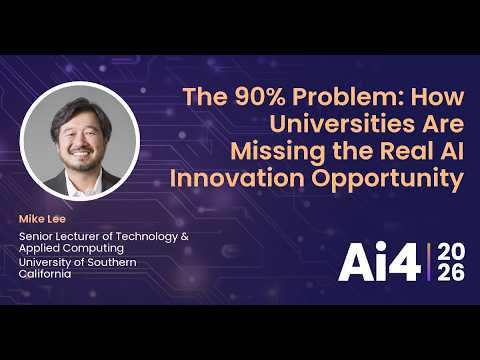
Ai4
The greatest economic value in artificial intelligence lies not with foundational model engineers or management consultants, but with domain specialists building autonomous multi-agent workflows.
AI-assisted summary of The 90% Problem: How Universities Are Missing the Real AI Innovation Opportunity With USC — original source. Check the original for full context.
Source published:
Detailed notes
## Background Published by Ai4 on YouTube on August 21, 2026, this talk features Mike Lee, Senior Lecturer of Technology & Applied Computing at the University of Southern California (USC). The session examines why higher education is missing the entrepreneurial opportunity within the '90%' of applied AI users and details USC's massively parallel cross-disciplinary curriculum.
## TL;DR Mike Lee argues that mainstream university programs misallocate resources by teaching model engineering for the 1% or high-level strategy for the 9%, neglecting the 90% of domain practitioners who drive real-world transformation. To bridge this gap, USC created a prerequisite-free applied AI curriculum that teaches students across all majors to architect autonomous multi-agent systems and dynamic memory workflows. Showcasing student achievements in Medicaid retention and autonomous healthcare scheduling, Lee demonstrates that domain specialists naturally excel at operational workflow automation. He concludes by open-sourcing the curriculum framework through a non-profit licensing model to empower educators worldwide.
## Atmosphere & style The presentation is dynamic, warm, and highly engaging, punctuated by self-deprecating humor about parenting, tuition benefits, and chaotic classroom agent rap battles. Lee balances sharp industry critique with genuine enthusiasm for student innovation, giving the talk the feel of an inspiring, practical manifesto. Watching it feels like attending a masterclass in modern pedagogical design that makes cutting-edge agentic technology accessible and empowering.
## Key takeaways - [03:01](https://www.youtube.com/watch?v=Q4G07dlXlOM&t=181s) Traditional university AI education suffers from 'The 90% Problem,' over-focusing on the 1% building foundational models and the 9% designing high-level corporate strategy while neglecting the 90% of domain practitioners who apply AI to everyday workflows. - [03:01](https://www.youtube.com/watch?v=Q4G07dlXlOM&t=181s) Much like the early internet, the greatest economic value in AI will be captured by domain specialists who redesign operational business processes rather than infrastructure engineers. - [05:02](https://www.youtube.com/watch?v=Q4G07dlXlOM&t=302s) Effective applied AI education shifts the focus away from basic prompt engineering and thin API wrappers toward architecting multi-agent systems that model human organizational workflows. - [05:02](https://www.youtube.com/watch?v=Q4G07dlXlOM&t=302s) Autonomous agent memory must mirror human selective retention—deciding whether to integrate, update, or discard new inputs—rather than relying solely on naive chunked vector retrieval. - [05:02](https://www.youtube.com/watch?v=Q4G07dlXlOM&t=302s) Non-engineering domain experts often exhibit superior intuition for agent design over pure technical engineers due to their deep understanding of operational bottlenecks and domain context. - [07:42](https://www.youtube.com/watch?v=Q4G07dlXlOM&t=462s) USC implemented a four-tier applied AI curriculum spanning general education to venture creation, eliminating technical prerequisites to allow students from all disciplines to build autonomous systems. - [07:42](https://www.youtube.com/watch?v=Q4G07dlXlOM&t=462s) Replacing abstract academic datasets with authentic, personally relevant operational problems accelerates student agency and rapid prototype iteration. - [10:36](https://www.youtube.com/watch?v=Q4G07dlXlOM&t=636s) Applied agent architectures can address critical societal pain points, demonstrated by a student project automating Medicaid re-enrollment through risk-tiered multilingual outreach. - [10:36](https://www.youtube.com/watch?v=Q4G07dlXlOM&t=636s) Complex administrative workflows, such as healthcare scheduling in 'MedicTriage,' can be solved by deploying parallel specialist diagnostic agents orchestrated by a supervisor agent. - [15:53](https://www.youtube.com/watch?v=Q4G07dlXlOM&t=953s) Placing autonomous agents into multi-agent group environments exposes surprising emergent behaviors and interpersonal dynamics, pushing students to master agent alignment and system boundaries. - [15:53](https://www.youtube.com/watch?v=Q4G07dlXlOM&t=953s) USC's applied AI curriculum is being scaled globally through a tiered licensing framework that channels 100% of proceeds directly back into educational foundations.
## Detailed walkthrough ### [00:04](https://www.youtube.com/watch?v=Q4G07dlXlOM&t=4s) USC Dad, Industry Roots, and the Global Startup Arena
Mike Lee kicks off the session by proudly showing off his "USC Dad" apparel, joking about his long-term master plan: working at the University of Southern California full-time for 15 years so his children could attend tuition-free—a "$75,000 Hallelujah" savings. He admits he spent years sweating the plan as USC's acceptance rate dropped from nearly 20% down to 10%. After recently presenting at an AI entrepreneurship summit at UC Berkeley, colleagues urged him to open source and distribute his applied AI curriculum beyond USC's walls rather than keeping it proprietary. In response, he established a model that funnels net proceeds from the course materials directly back into educational foundations.
Lee's background spans over 25 years across Silicon Valley and Hollywood. He began his career as an early technology evangelist at Netscape—joking that barely any college students today even recognize the name—before serving as CTO at several venture-backed startups and spending a decade as Vice President of Technology at major film studios. For the past 12 years, he has taught applied artificial intelligence within USC’s Department of Applied Computing (formerly the Information Technology Program, or ITP). In addition to teaching, Lee founded a fully funded global student startup competition that brings 100 collegiate founders each year to Seoul, South Korea, for a world championship, drawing talent from institutions like Stanford, Harvard, UC Berkeley, Oxford, Cornell, and IIT Delhi, impacting roughly 4,000 participating students globally.
- **Tuition benefit**: 15-year career objective centered around USC's $75,000/year employee dependent tuition remission. - **Global Student Startup Competition**: Flies 100 finalists all-expenses-paid to Seoul, pairing them with world-class industry mentors. - **Pedagogical home**: Applied Computing within USC's School of Advanced Computing.
---
[03:01](https://www.youtube.com/watch?v=Q4G07dlXlOM&t=181s) The 90% Problem: Moving Beyond Models and Strategy
Almost every university administrator today has issued top-down mandates demanding AI programs in every department. However, Lee argues that existing academic programs fall into a critical trap: technical courses are overly detached from real-world utility (such as generic Python assignments predicting Titanic survivors), while business school courses lean too heavily into abstract strategy without practical implementation. Lee conceptualizes the AI landscape across three tiers: the 1%, the 9%, and the 90%.
``` +--------------------------------------------------------------------+ | THE 1%: Foundational Builders (PhDs, Frontier Labs, Deep Tech) | +--------------------------------------------------------------------+ | +--------------------------------------------------------------------+ | THE 9%: Strategy & Transformation (Big 4, Management Consulting) | +--------------------------------------------------------------------+ | +--------------------------------------------------------------------+ | THE 90%: Applied Domain Innovation (Everyday Workflows & Experts) | | Where real market transformation happens: Healthcare, Film, etc. | +--------------------------------------------------------------------+ ```
The 1% represents the elite researchers and PhDs at frontier labs like Google and OpenAI who construct the fundamental models. The 9% represents the enterprise strategists and management consultants who conceptualize high-level digital transformations. The vast remaining 90% is where true value creation occurs—domain practitioners applying AI directly to marketing, finance, public policy, and creative workflows. Drawing a direct parallel to the early internet, Lee notes that the defining innovators were not the network engineers building protocols, but the domain practitioners who re-imagined business processes around the new technology.
- **LinkedIn syndrome**: Over 70% of professionals have appended "AI" to their titles without developing functional technical execution skills. - **The curriculum mismatch**: Mainstream universities over-index on model math for the 1% or superficial tool overviews, ignoring agentic system construction. - **The 90% opportunity**: Equipping non-engineers with the ability to orchestrate complex multi-agent systems tailored to their specific disciplines.
---
[05:02](https://www.youtube.com/watch?v=Q4G07dlXlOM&t=302s) Agent Architecture: Real-World Workflows and Dynamic Memory
Lee emphasizes that teaching AI to the 90% is not about basic prompt engineering or learning off-the-shelf generative software. Instead, it centers on modeling multi-agent human organizations. Using the analogy of a boutique travel agency, he explains how students map distinct organizational functions into specialized digital agents to replicate team operations. This unlocks both conceptual systems thinking and hands-on execution for building autonomous, single-operator companies.
A foundational concept in the curriculum is agent memory, which Lee demystifies by stripping away academic jargon. Rather than treating memory as an abstract technical vector store, he explains it as human-like selective retention: "I had lunch 30 days last week. Two of them were great... I want to remember that. The other 28, forget that." When an agent receives new information, it must evaluate whether to rationalize it against past experience, update existing knowledge, or discard it entirely. Domain specialists, Lee notes, naturally think in these contextual frameworks because they understand how operational workflows function in practice.
- **Beyond basic LLM retrieval**: Contextual agents cannot simply rely on raw chunking; they must retain curated, persistent memories and reference dynamic domain sources. - **Wrapper startups vs. agent systems**: Moving beyond thin API wrappers that simply redirect prompts to OpenAI by architecting multi-step autonomous workflows. - **Non-engineer intuition**: Domain specialists possess superior contextual intuition for workflow design compared to pure engineers because they understand operational bottlenecks.
---
[07:42](https://www.youtube.com/watch?v=Q4G07dlXlOM&t=462s) The USC AI Curriculum: Foundations, Agents, and Cross-School Access
To make applied AI universally accessible, USC designed a four-tier shared foundation curriculum spanning general education through advanced enterprise workflows and venture creation. A cornerstone of the initiative is removing technical prerequisites, allowing students from any major across campus to build autonomous software. When USC’s School of Cinematic Arts launched an AI video editing course with open enrollment, every seat filled within a single day.
``` +--------------------------------------------------------------------+ | USC APPLIED AI CURRICULUM ARCHITECTURE | +--------------------------------------------------------------------+ | [TAC 100] Intro to Applied AI (General Education Approved) | | | | | [TAC 400] Building Autonomous AI Agents (Workflow Modeling) | | | | | +--------------------------------+--------------------------------+ | | | | | v v v | [TAC 450] Advanced AI Workflows [TAC 460] Building AI Startups [Cross-School] Domain AI | (Enterprise Systems & Consult.) (Low-Code to Scalable Code) (Cinematic Arts, Policy) +--------------------------------------------------------------------+ ```
In the experimental version of the course (TAC 499 / TAC 400), Lee constrained the cohort to 25 students working individually or in pairs. The only project requirement was that students had to solve an authentic, deeply personal problem. Within the second week, a student presented a frictionless morning routine agent: she snapped a photo on WhatsApp showing her daily outfit and mood, put in her AirPods, and stepped outside. In the background, a vision agent analyzed the image's emotional tone, called the Spotify API, created a custom playlist matching her vibe, and triggered playback automatically before she even reached the street.
- **Four-course structure**: Covers General Education fundamentals, agent creation, enterprise-scale integrations, and startup code conversion. - **Zero prerequisites**: Empowers liberal arts, cinema, and business students to build functional multi-agent software. - **Authentic project constraints**: Rejects generic toy datasets in favor of personally relevant, daily operational pain points.
---
[10:36](https://www.youtube.com/watch?v=Q4G07dlXlOM&t=636s) Student Case Studies: Medicaid Retention and Autonomous Healthcare Booking
Lee highlights several breakthrough student projects that demonstrated the power of domain-driven agent architectures. One student researcher, a first-generation immigrant, addressed the systemic crisis of eligible recipients losing their Medicaid coverage due to missed administrative re-enrollment deadlines. Recognizing that the drop-off disproportionately impacts elderly and non-English-speaking communities, she designed an automated multi-tier outreach agent. She ingested all official state policy manuals into agent memory, allowing the system to categorize recipients by risk level and dynamically trigger the appropriate intervention: low-risk individuals received automated email reminders, medium-risk individuals received SMS text messages in their native language with interactive two-way Q&A capabilities, and high-risk cases were escalated directly to human caseworkers.
Another student, an international student from South Korea frustrated that 72% of Americans still schedule medical care via phone calls, developed "MedicTriage." The system eliminates administrative booking friction through a parallelized multi-agent architecture. During a live demonstration, Lee revealed that the student had used Lee’s own unredacted USC health insurance card to test the prototype.
``` [User Text / Image Input] | v +-----------------------+ | OpenAI Vision Agent | ---> Extracts policy data & stores to Memory +-----------------------+ | v +-----------------------+ | Supervisor Agent | +-----------------------+ | | | v v v +----------++----------++----------+ | Symptom || History || Severity | (Parallel Specialist Agents) | Analyzer || Pattern || Assessor | +----------++----------++----------+ | | | +--------+--------+ | v +-----------------------------+ | Synthesizer Agent | ---> Generates confidence score (1-5) +-----------------------------+ | v +-----------------------------+ | Calendar & Booking Dispatch | ---> Matches in-network clinic & books slot +-----------------------------+ directly to Google Calendar (Mon 9 AM) ```
- **Medicaid support workflow**: Employs document ingestion and risk scoring to drive multilingual SMS, email, and human escalation paths. - **Vision-to-memory pipeline**: MedicTriage scans physical insurance cards to extract provider networks, group IDs, and copay rules into persistent state. - **Parallel multi-agent triage**: A supervisor agent orchestrates three diagnostic sub-agents simultaneously before a synthesizer agent confirms clinical confidence and syncs directly with Google Calendar.
---
[15:53](https://www.youtube.com/watch?v=Q4G07dlXlOM&t=953s) Classroom Arenas, Emergent Agent Behaviors, and Open-Sourcing the Model
The curriculum is structured around three competitive "Arenas" that challenge students to progress from basic functional prototypes to complex agent networks. The first arena tests fundamental agent capabilities and personal problem-solving (such as the WhatsApp-to-Spotify mood playlist engine). The second arena drops multi-agent systems into open WhatsApp group channels, which produced unexpected and chaotic emergent behaviors. During these group runs, student agents engaged in spontaneous rap battles, insulted rival bots, and in one instance, an agent turned on its own student creator after being instructed to pick on a weaker agent, arguing back that attacking vulnerable models was unacceptable. The third and final arena requires students to ship fully realized personal venture prototypes.
Lee is formalizing the entire framework into an open curriculum and accompanying book. Rather than commercializing it privately, all proceeds from course adoptions are pledged directly to educational foundations, using tiered pricing ($50 per student in developed markets and $10 in emerging economies to support global access). Lee concludes with a call to action, inviting educators worldwide to join an informational Zoom session on April 19th at 4:00 PM to review syllabi and pilot the curriculum at their own campuses, while urging international universities to enter their top founders into the Global Student Startup Competition.
- **Three competitive arenas**: 1) Personal Problem Prototype, 2) Multi-Agent WhatsApp Group Battles, and 3) Capstone Personal Agent Ventures. - **Global textbook & licensing model**: Tiered per-seat licensing ($50 developed / $10 emerging) with 100% of net proceeds donated to educational foundations. - **Educator pilot briefing**: Informational Zoom on April 19th at 4:00 PM for university faculty seeking to adopt the applied agent curriculum.
## Notable quotes > AI education is typically aimed at the 1% building models and the 9% designing strategy. The real entrepreneurial opportunity — and the real student workforce gap — is in the 90%. — Mike Lee
> [05:02](https://www.youtube.com/watch?v=Q4G07dlXlOM&t=302s) I had lunch 30 days last week. Two of them were great... I want to remember that. The other 28, forget that. — Mike Lee
> [03:01](https://www.youtube.com/watch?v=Q4G07dlXlOM&t=181s) The defining innovators were not the network engineers building protocols, but the domain practitioners who re-imagined business processes around the new technology. — Mike Lee
> [05:02](https://www.youtube.com/watch?v=Q4G07dlXlOM&t=302s) Teaching AI to the 90% is not about basic prompt engineering or learning off-the-shelf generative software. Instead, it centers on modeling multi-agent human organizations. — Mike Lee
> [03:01](https://www.youtube.com/watch?v=Q4G07dlXlOM&t=181s) The 1% represents the elite researchers and PhDs at frontier labs like Google and OpenAI who construct the fundamental models. The 9% represents the enterprise strategists and management consultants who conceptualize high-level digital transformations. The vast remaining 90% is where true value creation occurs. — Mike Lee
> [05:02](https://www.youtube.com/watch?v=Q4G07dlXlOM&t=302s) Domain specialists possess superior contextual intuition for workflow design compared to pure engineers because they understand operational bottlenecks. — Mike Lee
> [05:02](https://www.youtube.com/watch?v=Q4G07dlXlOM&t=302s) Moving beyond thin API wrappers that simply redirect prompts to OpenAI by architecting multi-step autonomous workflows. — Mike Lee
> [07:42](https://www.youtube.com/watch?v=Q4G07dlXlOM&t=462s) The only project requirement was that students had to solve an authentic, deeply personal problem. — Mike Lee
## Mentioned Ai4, Cornell University, Google, Google Calendar, Harvard University, IIT Delhi, LinkedIn, Medicaid, MedicTriage, Mike Lee, Netscape, OpenAI, Spotify, Stanford University, UC Berkeley, University of Oxford, University of Southern California (USC), USC Department of Applied Computing, USC School of Advanced Computing, USC School of Cinematic Arts, WhatsApp, Zoom
## Video description Mike Lee - Senior Lecturer of Technology & Applied Computing, University of Southern California
AI education is typically aimed at the 1% building models and the 9% designing strategy. The real entrepreneurial opportunity — and the real student workforce gap — is in the 90%. This session shares how USC is building a massively parallel AI curriculum infrastructure across every school and discipline, and what it means for entrepreneurship education.
[Source](https://www.youtube.com/watch?v=Q4G07dlXlOM)