## Background
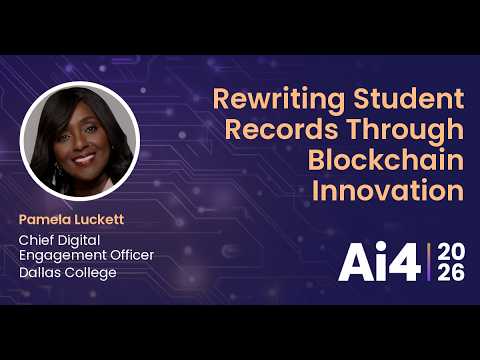
This session was presented by Pamela Luckett, Chief Digital Engagement Officer at Dallas College, and published on YouTube by Ai4 on August 19, 2026. According to the page description, the talk reveals how blockchain technology can transform traditional transcript systems into living, portable, and student-owned credentials that move seamlessly across education and career pathways.
## TL;DR
Pamela Luckett presents Dallas College's innovative hybrid blockchain record-keeping model designed to give learners direct ownership and control over their official academic transcripts. Prompted by historical disruptions like the sudden shutdown of ITT Tech, Dallas College developed a system where credentials are held in digital wallets and can be instantly verified or shared without risking institutional lockout. Luckett outlines live production workflows, verification mechanisms against tampering, and key value pillars including faster employment access and institutional resilience. She provides a 12-month implementation roadmap alongside metrics showing over 195,000 registered students and 284,000 transcript shares since 2019.
## Atmosphere & style
The presentation carries an inspiring, forward-looking, and barrier-busting tone grounded in real-world educational equity. Luckett presents with clear executive leadership, combining high-level institutional philosophy with crisp, practical live demonstrations of the learner dashboard and tamper-verification system. Watching the session feels both pragmatic and visionary, transitioning from cautionary real-world precedents to concrete, scale-tested technological solutions.
## Key takeaways
- [00:04](https://www.youtube.com/watch?v=4rEQZvIhrzM&t=4s) Pamela Luckett calls for a fundamental shift in record-keeping, transforming transcripts from static PDFs into portable, learner-owned digital assets.
- [00:04](https://www.youtube.com/watch?v=4rEQZvIhrzM&t=4s) Dallas College serves over 130,000 students annually, with dual-credit students making up 39% to 40% of the student body, making transcript access a vital priority.
- [03:06](https://www.youtube.com/watch?v=4rEQZvIhrzM&t=186s) The sudden 2016 closure of ITT Technical Institute highlights how traditional transcripts leave learners vulnerable when institutions collapse.
- [03:06](https://www.youtube.com/watch?v=4rEQZvIhrzM&t=186s) Dallas College adopted a hybrid model using blockchain technology to issue credentials directly to student-controlled digital wallets.
- [07:02](https://www.youtube.com/watch?v=4rEQZvIhrzM&t=422s) Students interact with a three-step workflow—Issue, Hold, Share—where downloading a copy creates an unofficial transcript, but direct system sharing maintains official status.
- [07:02](https://www.youtube.com/watch?v=4rEQZvIhrzM&t=422s) The platform includes drag-and-drop verification that flags tampered files instantly and offers an audit trail tracking when recipients view documents.
- [11:42](https://www.youtube.com/watch?v=4rEQZvIhrzM&t=702s) Student-owned credentials provide faster employment access, broad credential portability, resilience against system outages or closures, and direct student agency.
- [11:42](https://www.youtube.com/watch?v=4rEQZvIhrzM&t=702s) National trust frameworks developed by organizations like Lumina Foundation, AACRAO, and NASPA allow institutions to adopt decentralized credentials without starting from scratch.
- [14:11](https://www.youtube.com/watch?v=4rEQZvIhrzM&t=851s) Luckett presents a four-phase, 12-month pilot roadmap (Planning, Preparation, Launch, Evaluation) for higher education institutions deploying blockchain records.
- [14:11](https://www.youtube.com/watch?v=4rEQZvIhrzM&t=851s) Since 2019, Dallas College has registered over 195,000 students on the platform and completed over 284,000 official transcript shares.
- [14:11](https://www.youtube.com/watch?v=4rEQZvIhrzM&t=851s) Higher education institutions are urged to replace legacy transcript workflows with a learner-centered model built on three principles: Own it, Hold it, Share it.
## Detailed walkthrough
Here is a detailed, faithful walkthrough of the transcript.
---
[00:04](https://www.youtube.com/watch?v=4rEQZvIhrzM&t=4s) Rethinking Transcript Ownership and Dallas College's Mission
Pamela Luckett introduces a fundamental shift in educational record-keeping: a student transcript should not be an artifact that a learner has to chase down, but a living credential that they truly own. Rather than treating official transcripts as static PDFs tucked away behind institutional firewalls, she proposes transforming them into portable, lifelong assets. She emphasizes that this initiative is not technology for its own sake, but a conversation centered on trust, mobility, access, and institutional responsibility. While the institution remains responsible for issuing and verifying credentials, the learner should hold, control, and share proof of their learning whenever and wherever it matters most.
Luckett grounds this vision in her institution, Dallas College, one of the largest community college systems in Texas, serving over 130,000 students annually across seven campuses and satellite community sites. Referring to Chancellor Dr. Justin Lonon, she notes that Dallas College is in the "barrier-busting business"—focusing not only on getting students into and through college, but also supporting their employment, transfer, and economic mobility after they leave. Because of this massive scale—where dual-credit students alone make up 39% to 40% of the student body—transcript friction and access issues represent very real, daily challenges for working adults and transfer students alike.
- **Dallas College Scale:** Serves over 130,000 students annually across 7 campuses and satellite sites.
- **Dual-Credit Population:** Dual-credit students account for roughly 39% to 40% of the total student body.
- **Leadership Philosophy:** Guided by Chancellor Dr. Justin Lonon's emphasis on being in the "barrier-busting business."
[03:06](https://www.youtube.com/watch?v=4rEQZvIhrzM&t=186s) The ITT Tech Precedent and the Hybrid Blockchain Model
To highlight the vulnerability of traditional record-keeping, Luckett reflects on September 6, 2016, when ITT Technical Institute suddenly shut down all its campuses permanently. Thousands of students woke up connected to an institution that no longer existed. Although they had paid tuition, completed courses, and earned credits, proving their learning became an uphill battle because their academic records depended entirely on a collapsed institution. This event raised a core question: if learning belongs to the student, why should access to official proof rely solely on the institution?
To resolve this issue, Dallas College adopted a hybrid model. Under this architecture, the institution retains the authority to issue credentials, but the student gains full ownership, viewing and sharing them at will without needing to request transcripts from the school repeatedly. The official record is delivered directly to a digital wallet backed by blockchain technology. Luckett explains that blockchain functions as a shared, immutable digital record distributed across multiple computers rather than a single network. By repurposing the underlying technology of cryptocurrencies, Dallas College built a functional application where official transcripts permanently reside on the blockchain.
- **Historical Catalyst:** The sudden shutdown of ITT Technical Institute on September 6, 2016.
- **Hybrid Architecture:** Institutional issuance combined with student ownership via a digital wallet.
- **Underlying Technology:** Distributed, immutable blockchain architecture ensuring resilience and tamper resistance.
[07:02](https://www.youtube.com/watch?v=4rEQZvIhrzM&t=422s) Live Demonstration of the Learner Experience and Verification
Walking through screen captures of the live production system from a student’s point of view, Luckett demonstrates the simple three-step workflow: issuance by the institution, holding in a digital wallet, and instant sharing by the student. Within the student dashboard, learners can view, share, or download their transcript. She explicitly notes that downloading a local copy turns it into an unofficial transcript; official status is preserved only when shared directly within the secure digital system.
When sharing, students have two main options: sending the credential directly to another academic institution or emailing it to any individual or entity using a private email address. Demonstrating with a test account in the live environment, Luckett showcases sending a transcript to her own email. The platform features an integrated audit trail, allowing students to check whether a recipient has received or viewed their document. On the receiving end, the recipient gets an official notification with instructions and a drag-and-drop tool to authenticate the document against the blockchain. Luckett demonstrates how altering a single character—such as inserting a letter "T"—causes the system's verification check to fail immediately, alerting the recipient that the transcript was tampered with. Once viewed by the recipient, the student's dashboard updates with the exact date of viewing, restoring agency back to the learner.
- **Three-Step Workflow:** Issue, Hold, Share.
- **Official vs. Unofficial:** Shared inside the digital system retains official status; downloading creates an unofficial copy.
- **Verification Mechanism:** Drag-and-drop file check verifies authenticity or flags tampered documents instantly.
- **Student Transparency:** Live tracking dashboard shows recipients and exact timestamps of when a transcript was viewed.
[11:42](https://www.youtube.com/watch?v=4rEQZvIhrzM&t=702s) The Four Value Pillars and National Framework Alignment
Luckett outlines four key benefits unlocked by student-owned credentials:
1. **Faster Employment Access:** Students can instantly supply verified credentials the moment an employer requests them.
2. **Portability:** The technology easily extends beyond transcripts to host diplomas, workforce certifications, and other micro-credentials.
3. **Resilience:** If an institution closes, merges, or experiences system outages, the learner maintains uninterrupted control over their verified record.
4. **Student Agency:** Learners gain complete autonomy over when, where, and with whom they share their qualifications.
She reassures higher education leaders that adopting this approach does not require starting from scratch. National efforts and standards have been actively developed for years by organizations such as the Lumina Foundation, AACRAO (American Association of Collegiate Registrars and Admissions Officers), and NASPA (National Association of Student Personnel Administrators). These existing trust frameworks enable institutions to move confidently from theoretical models to pilots and full organizational implementations.
- **Key Benefits:** Speed to employment, credential portability, institutional resilience, and learner agency.
- **National Partners & Frameworks:** Lumina Foundation, AACRAO (American Association of Collegiate Registrars and Admissions Officers), and NASPA (National Association of Student Personnel Administrators).
[14:11](https://www.youtube.com/watch?v=4rEQZvIhrzM&t=851s) Implementation Roadmap and Proven Success Metrics
For institutions looking to deploy learner-owned record systems, Luckett outlines a disciplined, four-phase 12-month pilot roadmap:
- **Months 1–3 (Planning):** Assemble a cross-functional team across IT, admissions, and academic affairs; define success metrics; establish governance; select a target pilot cohort.
- **Months 4–6 (Preparation):** Configure the environment; integrate transcript systems; design the user experience; build external and internal communication plans, ensuring alignment with state registrar consortia.
- **Months 7–9 (Launch):** Roll out the blockchain solution while providing dedicated support for participating students and administrative staff.
- **Months 10–12 (Evaluation):** Analyze adoption metrics, assess the student experience, evaluate success against baseline goals, and determine readiness to scale.
To demonstrate that students are eager for digital credential management, Luckett shares key performance figures from Dallas College’s implementation since 2019. Over 195,000 students have registered on the platform, executing more than 284,000 official transcript shares. She concludes with a call to action for higher education institutions to move past incremental improvements to legacy transcript workflows and build a modernized, learner-centered ecosystem around three core principles: **Own it** (direct issuance), **Hold it** (secure wallet storage), and **Share it** (instant verification anywhere).
- **Implementation Timeline:** 12-month phased pilot strategy (Planning, Preparation, Launch, Evaluation).
- **Dallas College Adoption Metrics (Since 2019):**
- **Registered Students:** Over 195,000 students registered on the platform.
- **Transcripts Delivered:** Over 284,000 transcript shares executed.
- **Core Call to Action:** "Own it, Hold it, Share it."
## Notable quotes
> [00:04](https://www.youtube.com/watch?v=4rEQZvIhrzM&t=4s) barrier-busting business — Pamela Luckett
> [03:06](https://www.youtube.com/watch?v=4rEQZvIhrzM&t=186s) if learning belongs to the student, why should access to official proof rely solely on the institution? — Pamela Luckett
> [14:11](https://www.youtube.com/watch?v=4rEQZvIhrzM&t=851s) Own it, Hold it, Share it. — Pamela Luckett
## Mentioned
Pamela Luckett, Dallas College, Ai4, Dr. Justin Lonon, ITT Technical Institute, Lumina Foundation, AACRAO, NASPA
## Video description
Pamela Luckett - Chief Digital Engagement Officer, Dallas College
What if student records were not just files but living, intelligent credentials that opened doors the moment learning happened? In this session, I will reveal how blockchain is poised to dismantle outdated transcript systems and replace them with trusted, portable, student-owned records that move seamlessly across education, careers, and opportunity pathways. This discussion will spotlight real use cases, bold prototypes, and the new trust framework that will define the next era of learner data. Attendees will walk away with a clear vision of what is possible, a roadmap for institutional readiness, and the inspiration to lead this transformation. If you are ready to experience how credentials are being transformed, you do not want to miss this session.
达拉斯学院将19.5万份学生档案迁移至区块链
转向基于分布式账本的学生自主数字钱包,可防止凭证丢失,并在院校倒闭等危机中加快就业安置。
Pamela Luckett 介绍了 Dallas College 创新的混合区块链档案管理模式,该模式旨在让学习者直接拥有并掌控自己的官方成绩单。受 ITT Tech 突然倒闭等历史变故的启发,Dallas College 开发了一套系统,将学历凭证保存在数字钱包中,无需承担因院校关闭而无法获取凭证的风险,即可实现即时验证或分享。Luckett 概述了实际生产环境的工作流程、防篡改验证机制,以及包括加速就业和增强机构韧性在内的核心价值支柱。她还展示了一份为期 12 个月的实施路线图,并公布了相关运营数据:自 2019 年以来,已有超过 19.5 万名注册学生,成绩单分享次数达到 28.4 万次。
达拉斯学院(Dallas College)每年服务逾13万名学生(其中双学分学生占39%至40%),首席数字参与官 Pamela Luckett 呼吁打破传统档案壁垒,将成绩单从静态 PDF 转型为学生真正拥有的便携式数字资产。 (0:04)
针对2016年 ITT Technical Institute 倒闭导致学生难以证明学业的教训,达拉斯学院引入区块链混合架构,将具有防篡改特性的官方凭证直接发放至学生控制的数字钱包。 (3:06)
系统支持“发放、持有、共享”(Issue, Hold, Share)工作流,提供即时识别篡改的拖拽式验证工具与接收审计追踪;在系统内直接共享可保持官方效力,本地下载则转为非官方副本。 (7:02)
自2019年推行以来,该平台已吸引超过19.5万名学生注册,完成逾28.4万次成绩单共享,并为其他高校验证了分为规划、筹备、启动与评估四个阶段的12个月落地路线图。 (14:11)
Reading summary
Pamela Luckett of Dallas College argues that academic transcripts must transition from static records locked behind institutional firewalls into portable, learner-owned digital assets. By adopting a hybrid blockchain architecture, higher education institutions can guarantee credential authenticity while granting students permanent control over their educational records.
Overcoming Institutional Dependency Through Blockchain (3:06)
Traditional higher education record-keeping creates friction and vulnerability for students whose proof of learning remains tied to institutional administrative systems. Luckett points to the September 6, 2016, closure of ITT Technical Institute as an operational turning point: thousands of students suddenly struggled to verify completed courses and tuition payments because the institution holding their records ceased to exist. For Dallas College—an institution serving over 130,000 students annually, where dual-credit learners represent 39% to 40% of enrollment—institutional dependency presents daily hurdles for student mobility.
To resolve this vulnerability, Dallas College instituted a hybrid model that separates credential authority from credential custody. Dallas College retains exclusive rights to issue and verify credentials, while delivering the permanent, tamper-resistant transcript directly into a student's digital wallet using distributed blockchain architecture.
Verification Mechanics and the Learner Dashboard (7:02)
The user experience centers on a three-part lifecycle: issue, hold, and share. From their digital dashboards, students can review records and dispatch them directly to target academic institutions or external email addresses. Luckett emphasizes that official status is retained exclusively when shared directly inside the digital platform; downloading a local copy immediately converts the file into an unofficial transcript.
Recipients verify credentials using an integrated drag-and-drop tool that authenticates the record against the blockchain ledger. In platform tests, altering even a single character in the document triggers an immediate verification failure. The platform also gives students complete visibility into document delivery, providing an audit trail with exact timestamps of when a recipient accesses the credential.
Four Pillars and National Standards Alignment (11:42)
Luckett structures the case for student-owned records around four institutional and learner benefits: accelerated graduate hiring, credential portability encompassing degrees and micro-credentials, institutional resilience during administrative outages or closures, and enhanced learner agency.
Rather than requiring colleges to build proprietary standards, the model aligns with existing frameworks established by higher education organizations, including the Lumina Foundation, the American Association of Collegiate Registrars and Admissions Officers (AACRAO), and NASPA. Luckett notes these mature trust frameworks provide the structural scaffolding necessary to transition blockchain implementations from conceptual pilots into standard operations.
Pilot Roadmap and Dallas College Adoption Metrics (14:11)
For institutions deploying decentralized record systems, Luckett outlines a disciplined 12-month pilot roadmap structured into four distinct phases: cross-functional team assembly and governance in months 1–3; system configuration and alignment with state registrar consortia in months 4–6; targeted cohort rollout and user support in months 7–9; and adoption analysis and scaling evaluation in months 10–12.
Implementation data from Dallas College indicates sustained adoption since the platform launched in 2019. More than 195,000 students have registered accounts and conducted over 284,000 official transcript shares, demonstrating practical student demand for direct credential ownership.
Dallas College demonstrates that learner-owned blockchain credentials can function effectively at institutional scale. However, the model's broader transformative potential depends on sustained coordination with state registrar consortia and receiving institutions to ensure cross-institutional acceptance of decentralized records.
## Background
该视频由 Ai4 频道于 2026 年 8 月 19 日发布在 YouTube 平台上。达拉斯学院(Dallas College)首席数字化参与官 Pamela Luckett 在演讲中阐述了如何利用区块链技术颠覆陈旧的成绩单体系,将其转化为由学习者终身掌控、高度可移植且即时可信的活体凭据,并为高等院校提供了清晰的准备与实施路线图。
## TL;DR
达拉斯学院首席数字化参与官 Pamela Luckett 深刻反思了传统院校中心化档案的脆弱性,提出基于区块链的“院校颁发、学生持有、自主共享”成绩单混合模型。该方案让学生在数字钱包中拥有防篡改的官方凭证,支持一键拖拽验证真伪并提供全流程查阅审计追踪,极大加速了求职背景审查与转学互认。自 2019 年上线以来,达拉斯学院已累积超 19.5 万名注册学生与 28.4 万次数字分享,充分验证了从“电子化传输”跨越到“学习者数据自主权”的可行性。Luckett 进一步给出了跨职能推进的四阶段落地路线图,呼吁教育界依托全美标准生态,共同构建面向未来的教育信任基础设施。
## Atmosphere & style
整场演讲兼具深厚的人文关怀与务实的技术落地感,Luckett 的讲授沉稳而充满号召力。她从 ITT Tech 倒闭导致学籍灭失的震撼痛点切入,随后以流畅的现场系统实操和翔实数据展现创新方案,论证环环相扣。听众不仅能感受到达拉斯学院为底层学生“打破壁垒”的坚定信念,更能清晰把握从试点到规模化推广的具体路径,是一场极具感染力与实践指导意义的高校数字化转型分享。
## Key takeaways
- [00:04](https://www.youtube.com/watch?v=4rEQZvIhrzM&t=4s) 达拉斯学院倡导将官方成绩单从锁在院校防火墙后的静态档案,重塑为学习者终身掌控与随身携带的“活体凭证”(living credential)。
- [00:04](https://www.youtube.com/watch?v=4rEQZvIhrzM&t=4s) 达拉斯学院每年服务超 13 万名学生且双学分高中生占比近 40%,繁琐低效的传统成绩单流转模式直接阻碍了学生的升学、转学与就业流动。
- [03:06](https://www.youtube.com/watch?v=4rEQZvIhrzM&t=186s) 2016 年 ITT Tech 突然倒闭导致数千名学生无法自证学业成果,深刻暴露了将学籍数据完全捆绑于单一中心化机构的系统性风险。
- [03:06](https://www.youtube.com/watch?v=4rEQZvIhrzM&t=186s) 达拉斯学院提出“混合模型”,院校保留官方凭证的颁发与背书权力,而学生借助区块链数字钱包获得凭据的终身持有权与自主分发权。
- [06:54](https://www.youtube.com/watch?v=4rEQZvIhrzM&t=414s) 区块链凭证支持跨校直连与邮件多渠道分享,并配备全流程审计追踪功能,彻底消除了成绩单投递后的“信息黑洞”。
- [06:54](https://www.youtube.com/watch?v=4rEQZvIhrzM&t=414s) 接收方无需对接复杂接口,仅需将文件拖拽至验证平台即可基于链上哈希完成防篡改校验,任何细微恶意修改都会被瞬间拦截。
- [11:42](https://www.youtube.com/watch?v=4rEQZvIhrzM&t=702s) 学习者自有凭证带来四大核心价值:加速雇主背景审查、实现各类证书便携化、强化抵御院校变故的机构韧性,以及确立学习者数据主权。
- [11:42](https://www.youtube.com/watch?v=4rEQZvIhrzM&t=702s) AACRAO、NASPA 与鲁米那基金会等全美权威机构已铺就通用标准与互认框架,高校无需从零摸索,可直接开展概念验证与落地试点。
- [14:31](https://www.youtube.com/watch?v=4rEQZvIhrzM&t=871s) 区块链系统落地绝非单纯的 IT 升级,必须由教务处、招生办与学生事务部门深度协同,并遵循“从小处着手、公开推进、拥抱标准”的四阶段路线图。
- [16:30](https://www.youtube.com/watch?v=4rEQZvIhrzM&t=990s) 达拉斯学院自 2019 年部署以来已吸引超 19.5 万名学生注册并完成逾 28.4 万次数字分享,充分印证了学生对数字化自主权的高接纳度。
- [16:30](https://www.youtube.com/watch?v=4rEQZvIhrzM&t=990s) 高校的核心使命应从单纯的 PDF/邮件式“电子化分发”升级为兼具便携性、安全性和即时验证能力的“学习者数据自主权”。
- [17:49](https://www.youtube.com/watch?v=4rEQZvIhrzM&t=1069s) 未来教育生态围绕“拥有(Own it)、持有(Hold it)、共享(Share it)”构建,将从底层根本性重塑转学互认、技能重塑与企业招聘等全链路机制。
## Detailed walkthrough
### [00:04](https://www.youtube.com/watch?v=4rEQZvIhrzM&t=4s) 重新构想成绩单:从静态档案到学习者自有的活体凭证
达拉斯学院(Dallas College)首席数字化参与官 Pamela Luckett 提出了一个核心理念:成绩单不该是学生必须四处追讨的繁琐文件,而应由学习者真正拥有。她倡导重新定义官方成绩单——它不再是锁在防火墙后面的静态 PDF 或纸质档案,而是能够伴随学习者一生的“活体凭证”(living credential)。这场变革并非“为了技术而技术”,其根基在于信任、准入、流动性以及院校责任,并由安全且不可篡改的区块链技术提供支撑。Luckett 向所有人抛出一个根本问题:当学生完成了学业并获得知识时,这项“学习证明”的控制权究竟该属于谁?她的答案非常坚定——学习者应当拥有它、持有它,并在最重要的时刻自由分享;与此同时,教育机构仍恪守其作为凭证颁发与验证者的核心职责。
作为德克萨斯州规模最大的社区学院之一,达拉斯学院对成绩单流转中的痛点有着极其切身的体会。该校每年服务超过 130,000 名学生,拥有 7 个校区以及多个深入社区核心的卫星教学点。正如学院校长 Justin Lonon 博士常说的,学校致力于“打破壁垒”(in the barrier busting business),不仅帮助学生顺利入学、完成学业,更关注他们毕业后的就业、转学及经济流动机会。在庞大的学生群体中,有 39% 至 40% 属于双学分(Dual Credit)高中生,此外还涵盖大量学分互认转学生与在职成年人,繁琐的成绩单流转问题对他们影响深远。
```mermaid
flowchart TD
accTitle: 传统成绩单模式与区块链数字钱包模式对比
subgraph Traditional["传统模式 (院校中心化)"]
T1["学生完成学习"] --> T2["成绩记录存入学校防火墙"]
T2 --> T3["学生反复向学校申请"]
T3 --> T4["学校向第三方寄送/发送静态文件"]
end
subgraph Hybrid["混合创新模式 (学习者自有)"]
H1["院校颁发官方凭证"] --> H2["凭证存入区块链数字钱包"]
H2 --> H3["学习者终身掌控与自主分享"]
H3 --> H4["接收方一键验证防篡改性"]
end
```
---
### [03:06](https://www.youtube.com/watch?v=4rEQZvIhrzM&t=186s) ITT Tech 倒闭的反思与混合所有制模型的诞生
Luckett 带领现场观众回顾了 2016 年 9 月 6 日发生的标志性事件:知名营利性大学 ITT Technical Institute 突然永久关闭其所有校区。这并非假期停课或临时紧急状态,而是彻底倒闭。成千上万的学生一觉醒来,发现自己所关联的母校已不复存在。他们修完了课程、支付了学费、赚取了学分,但由于学业记录完全依赖于一个已经崩溃的机构,他们陷入了无法自证学业成果的困境。这一历史时刻引发了达拉斯学院的深思:“如果学习成果属于学生,为什么获取官方证明的权利却完全取决于院校?”
为了解决该痛点,达拉斯学院提出了“混合模型”(Hybrid Model)。在这个模型中,院校负责官方颁发成绩单,但成绩单直接进入由区块链技术支持的“数字钱包”,由学生自主持有。学生无需在每次需要成绩单时再回到学校提出申请。Luckett 解释道,区块链本质上是一种跨多台计算机存储信息的共享数字账本,突破了单一中心化网络的局限。达拉斯学院借鉴了加密货币底层的分布式信任机制,开发出了一套将官方成绩单运行在区块链之上的实际应用。
- **2016 年 9 月 6 日教训**:ITT Technical Institute 倒闭导致数千名学生因院校主体消失而难以调取并证明自己的学分与学历。
- **混合模型核心机制**:院校保留颁发与背书权力,学生获得数字资产的终身持有权与即时分发权。
---
### [06:54](https://www.youtube.com/watch?v=4rEQZvIhrzM&t=414s) 系统实操演示:从数字钱包持有、自主分享到防篡改验证
Luckett 在现场展示了达拉斯学院系统的真实操作界面截图。系统业务流程高度精炼,分为三大环节:院校颁发官方凭证、学生在数字钱包中持有、学生按需自主分享。在学生端仪表盘中,学生不仅可以查看已颁发的成绩单,还可以选择将其下载(系统明确提示:一旦下载到本地脱离系统,该文件将转变为“非官方”副本),而只要在系统内直接进行链上流转,其官方权威性便始终有效。
```mermaid
flowchart LR
accTitle: 区块链成绩单流转与验证流程
subgraph IssueShare["颁发与分享"]
A["达拉斯学院<br/>颁发官方凭证"] --> B["学生数字钱包<br/>(官方记录)"]
B --> C{"选择分享方式"}
C -->|"直接对接"| D["目标大学/院校"]
C -->|"邮件发送"| E["雇主/第三方个人"]
end
subgraph VerifyTrack["验证与追踪"]
E --> F["接收方下载凭证"]
F --> G["拖拽至验证平台"]
G --> H{"链上一致性校验"}
H -->|"未修改"| I["✅ 验证通过 (Dallas College 官方颁发)"]
H -->|"遭篡改"| J["❌ 验证失败 (文件已失效)"]
E -.-> K["学生端审计追踪<br/>(查看接收与查阅时间戳)"]
end
```
在分享方式上,学生拥有两种选择:一是直接流转给认证的高等院校,二是通过输入任意私人或机构邮箱直接发送。Luckett 现场展示了将官方成绩单发送到个人测试邮箱(`thedrill@gmail.com`)的完整过程。系统为学生提供了强大的“审计追踪功能”(Audit Feature),学生可以在仪表盘清晰看到接收方是否已经查阅文件以及具体的查阅日期。对于接收方而言,邮件会附带下载链接与视频指引,接收方只需将凭证文件“拖拽”(drag and drop)至验证窗口,底层区块链便会瞬间校验该文件是否被篡改。Luckett 还展示了恶意篡改测试:她在凭证中随意多加了一个字母“T”,系统在重新验证时立刻报错拦截,明确提示该文档遭到篡改、无法通过验证。
- **分享渠道灵活性**:支持院校系统间直连互转,也支持向任意第三方电子邮箱发送具有官方效力的数字凭证。
- **全流程审计可见性**:消除成绩单寄送后的“信息黑洞”,学生可实时追踪接收方的查阅动态与时间戳。
- **极简拖拽式验证**:第三方无需对接复杂接口,拖拽文件即可完成基于链上哈希的防篡改真伪核验。
---
### [11:42](https://www.youtube.com/watch?v=4rEQZvIhrzM&t=702s) 四大核心价值与国家级标准生态
通过这套机制,达拉斯学院总结了学习者自有凭证带来的四大核心变革力量:
1. **更快的就业准入(Faster Access to Employment)**:在雇主提出资质要求的瞬间,求职者能够当场提供可被即时验证的官方凭证,极大缩短求职背景审查周期。
2. **真正的便携性(Portability)**:不仅限于成绩单,该底层框架未来可无缝承载职业技能证书(Certifications)、学位文凭(Diplomas)等各类学业与技能成果。
3. **强大的机构韧性(Resilience)**:即便发证院校未来发生合并、破产、更名或系统故障,学习者依然独立持有且能证明自己的真实官方学籍记录。
4. **学习者掌控权(Learner Agency)**:将数据主权交还给学生,由学生全权决定何时、何地以及向谁分享自己的隐私与教育资产。
Luckett 强调,这绝非达拉斯学院孤立的单打独斗,其他高校也完全无需从零开始摸索。鲁米那基金会(Lumina Foundation)协同美国大学成绩注册官与招生官协会(AACRAO)以及美国高等教育学生事务管理者协会(NASPA)等全美权威机构,已经在底层标准、通用框架和质量对话上深耕多年。“跑道已经铺就”,教育界当前的责任是从宏观框架大步迈向概念验证(Pilot)与全校级落地实施,实现从“院校中心化记录”到“学习者自有记录”的历史跨越。
- **AACRAO 与 NASPA 协作**:全美注册官协会与学生事务协会已打通标准框架,确保跨校、跨系统凭证互认的合规性与规范性。
- **从试点到落地**:改革路径主张采取为期 3 个月的渐进式、纪律严明的先锋试点,而非盲目推进激进颠覆。
### [14:31](https://www.youtube.com/watch?v=4rEQZvIhrzM&t=871s) 区块链成绩单的四阶段落地路线图与跨职能协同
高校在落地基于区块链的学生记录系统时,不能将其视为单纯的 IT 升级项目,而必须从一开始就建立跨职能团队。在启动的前三个月(规划阶段),首要任务是组建涵盖各部门的核心团队,明确衡量成功的关键指标,理顺数据治理机制,并挑选出最适合试点的初始学生群体。Pamela Luckett 特别强调,这类转型必须有教务处、招生办以及学生事务团队的深度参与,绝不能仅仅交由技术部门主导。
随后的三个月(准备与配置阶段)则聚焦于系统打通与环境配置。高校需要将现有的成绩单与学籍系统同区块链基础设施对接,精心设计学习者交互体验(Learner Experience),并同步制定详尽的沟通与培训计划。Luckett 指出,沟通计划对于项目的成败至关重要,它不仅要覆盖校内所有相关部门,还必须延伸到校外——特别是州内的教务长与招生官联盟(Registrar & Admissions Consortium)。唯有让外部接收机构及早理解并认可这一机制,数字凭据的互认通道才能真正顺畅。
在后续的六个月里,项目将依次进入系统发布与评估扩容阶段。第三个季度正式上线区块链解决方案,为使用该系统的学生和教职工提供全方位的支持与运维保障;第四个季度则专注于衡量采纳率指标、评估学生使用体验并复盘成效,从而判定系统是否具备向全校乃至更大范围规模化推广(Scale)的条件。Luckett 将这一推进哲学凝练为九个字:“从小处着手,公开推进,拥抱标准”("Start small, move publicly, and choose standards.")。
```mermaid
flowchart LR
accTitle: 区块链学生成绩单四阶段实施路线图
subgraph S1["阶段一:规划(1-3月)"]
A["组建跨职能团队"] --> B["确立治理与试点群体"]
end
subgraph S2["阶段二:配置(4-6月)"]
C["对接学籍系统与配置"] --> D["设计体验与内外沟通"]
end
subgraph S3["阶段三:发布(7-9月)"]
E["上线区块链方案"] --> F["师生支持与运维"]
end
subgraph S4["阶段四:评估(10-12月)"]
G["监测采纳与体验指标"] --> H["评估并准备规模化推广"]
end
B --> C
D --> E
F --> G
```
- **第一阶段(规划期)重点**:打破部门壁垒,明确治理架构与试点范围,界定项目成功标准。
- **第二阶段(准备期)重点**:系统环境配置、底层学籍系统打通、学习者体验设计、跨机构(如州内教务联盟)沟通与全员培训。
- **第三阶段(发布期)重点**:区块链方案正式上线,提供面向学生和行政人员的落地支持。
- **第四阶段(评估期)重点**:追踪用户采纳度、评估学习者反馈,为全量规模化推广奠定基础。
---
### [16:30](https://www.youtube.com/watch?v=4rEQZvIhrzM&t=990s) 达拉斯学院的实践数据与向“学习者自主权”的跃迁
变革的契机已经到来,因为当代学生对全流程的数字化访问有着天然的预期。达拉斯学院(Dallas College)自 2019 年部署该平台以来的真实运行数据充分印证了这一点:平台上已有超过 195,000 名学生注册,累计完成了逾 284,000 次成绩单数字分享。这些数据表明,学生的数字分享行为早已形成,教育机构根本无需费力去说服学生“数字化访问是否重要”,学生早已心知肚明。
面对已经成熟的用户习惯,高校面临的核心命题在于:是仅仅满足于“数字传输/分发(Digital Delivery)”,还是跨越到真正的“学习者数据自主权(Learner Ownership)”。达拉斯学院的责任不仅在于发送一份电子文件,更在于打破阻碍学生发展的制度与技术藩篱,借助区块链的可移植性、安全性和即时验证能力,为学生打造更持久、更强大、以学习者为中心的数字资产体系。
- **平台注册规模**:自 2019 年实施以来,达拉斯学院已累积超过 19.5 万名注册学生。
- **数字凭据分享量**:已成功交付并分享超过 28.4 万次成绩单。
- **核心转变路径**:从单纯的 PDF/邮件式“电子化分发”,升级为兼具便携性(Portability)、安全性(Security)与即时验证(Instant Verification)的学习者主权凭据。
---
### [17:49](https://www.youtube.com/watch?v=4rEQZvIhrzM&t=1069s) 行动号召:拥有、持有与共享的未来教育生态
在演讲的尾声,Luckett 向在场的所有教育管理者发出了明确的行动号召。每所高校当前都站在十字路口:是继续对几十年前形成的陈旧成绩单流程修修补补,还是从零设计一套能够满足未来 20 年学习者需求的新型记录系统?她将面向未来的微观交互逻辑概括为三个环环相扣的动作:
1. **拥有它(Own it)**:学校直接将具有官方效力的成绩单所有权发放给学生本人。
2. **持有它(Hold it)**:学生将凭据存放在受可信、安全、不可篡改技术保障的数字钱包中,数据可随学生流动并跨机构迁移。
3. **共享它(Share it)**:学习者可以随时随地将凭据发送给任何机构或雇主,并支持秒级即时验证。
当底层成绩单的形态发生根本性改变时,教育与职场的下游全链路——包括学分互认与转学、企业招聘、技能重塑、产教融合以及终身学习——都将迎来连锁重塑。Luckett 呼吁大家立即行动,正如她所说:“这不是一个我们需要被动等待的未来,而是一个我们可以亲手构建的未来”("This is not a future to wait for, but it is a future that we can build."),号召整个教育界携手共建以学习者为核心的全新信任生态。
## Notable quotes
> [00:04](https://www.youtube.com/watch?v=4rEQZvIhrzM&t=4s) 当学生完成了学业并获得知识时,这项“学习证明”的控制权究竟该属于谁? — Pamela Luckett
> [00:04](https://www.youtube.com/watch?v=4rEQZvIhrzM&t=4s) in the barrier busting business(致力于打破壁垒) — Justin Lonon
> [03:06](https://www.youtube.com/watch?v=4rEQZvIhrzM&t=186s) 如果学习成果属于学生,为什么获取官方证明的权利却完全取决于院校? — Pamela Luckett
> [11:42](https://www.youtube.com/watch?v=4rEQZvIhrzM&t=702s) 跑道已经铺就 — Pamela Luckett
> [14:31](https://www.youtube.com/watch?v=4rEQZvIhrzM&t=871s) Start small, move publicly, and choose standards.(从小处着手,公开推进,拥抱标准) — Pamela Luckett
> [14:31](https://www.youtube.com/watch?v=4rEQZvIhrzM&t=871s) 从小处着手,公开推进,拥抱标准 — Pamela Luckett
> [17:49](https://www.youtube.com/watch?v=4rEQZvIhrzM&t=1069s) 拥有它(Own it)、持有它(Hold it)、共享它(Share it) — Pamela Luckett
> [17:49](https://www.youtube.com/watch?v=4rEQZvIhrzM&t=1069s) This is not a future to wait for, but it is a future that we can build.(这不是一个我们需要被动等待的未来,而是一个我们可以亲手构建的未来) — Pamela Luckett
## Mentioned
达拉斯学院 (Dallas College), Pamela Luckett, Justin Lonon, ITT Technical Institute, 鲁米那基金会 (Lumina Foundation), 美国大学成绩注册官与招生官协会 (AACRAO), 美国高等教育学生事务管理者协会 (NASPA), 区块链 (Blockchain), 双学分课程 (Dual Credit), 数字钱包 (Digital Wallet)
## Video description
Pamela Luckett - Chief Digital Engagement Officer, Dallas College
What if student records were not just files but living, intelligent credentials that opened doors the moment learning happened? In this session, I will reveal how blockchain is poised to dismantle outdated transcript systems and replace them with trusted, portable, student-owned records that move seamlessly across education, careers, and opportunity pathways. This discussion will spotlight real use cases, bold prototypes, and the new trust framework that will define the next era of learner data. Attendees will walk away with a clear vision of what is possible, a roadmap for institutional readiness, and the inspiration to lead this transformation. If you are ready to experience how credentials are being transformed, you do not want to miss this session.
[Source](https://www.youtube.com/watch?v=4rEQZvIhrzM)
Source quotes
[0:04] Pamela Luckett: 当学生完成了学业并获得知识时,这项“学习证明”的控制权究竟该属于谁?
[0:04] Justin Lonon: in the barrier busting business(致力于打破壁垒)
[3:06] Pamela Luckett: 如果学习成果属于学生,为什么获取官方证明的权利却完全取决于院校?
[11:42] Pamela Luckett: 跑道已经铺就
[14:31] Pamela Luckett: Start small, move publicly, and choose standards.(从小处着手,公开推进,拥抱标准)
[14:31] Pamela Luckett: 从小处着手,公开推进,拥抱标准
[17:49] Pamela Luckett: 拥有它(Own it)、持有它(Hold it)、共享它(Share it)
[17:49] Pamela Luckett: This is not a future to wait for, but it is a future that we can build.(这不是一个我们需要被动等待的未来,而是一个我们可以亲手构建的未来)
Source quotes
[0:04] Pamela Luckett: barrier-busting business
[3:06] Pamela Luckett: if learning belongs to the student, why should access to official proof rely solely on the institution?
[14:11] Pamela Luckett: Own it, Hold it, Share it.
Original transcript
[0:04] I want to begin with a simple idea uh that a
transcript should not be something that a student
[0:12] has to chase. Uh it should be something that
really that we are proposing that a learner should
[0:20] actually own. Today we're going to rethink the
official transcript not as a static document uh
[0:30] not as a PDF sitting behind a firewall uh but as
a living credential that can move with a learner
[0:38] for life. Uh this is not uh a technology talk for
the sake of technology. It is a conversation uh
[0:48] that is grounded in trust, access, mobility and
institutional responsibility backed by a secure
[0:59] immutable technology. So when a student earns
learning the question that I pose to everyone is
[1:07] who should control that proof of learning? My
answer is clear. The learner should actually
[1:16] own it. They should be able to hold it and
they should be able to share it whenever it
[1:23] matters most while also recognizing
that the institution is responsible
[1:30] for issuing and verifying whatever the credentials
are. So we're not losing sight of that.
[1:37] Before I tell you where we are going, I want
you to understand why Dallas College has been
[1:44] leaning into this work for years. We are one
of the largest community colleges in Texas. We
[1:51] serve over 130,000 students annually with seven
campuses. We also have satellite sites that are
[2:00] situated within the heart of our various
communities. I like to say if anyone knows
[2:07] our chancellor Dr. uh Justin London he always
says that we are in the barrier busting business
[2:14] that means that we are helping students get
to Dallas College get through Dallas College
[2:21] and also looking at what happens when they
actually leave. So once they leave, we are
[2:26] concerned with uh their employment or whether or
not they're transferring or just economic mobility
[2:34] opportunities. And because of our scale, every
transcript painoint becomes very real for us.
[2:43] uh students transferring credit, working adults,
uh proving credentials, dual credit students, and
[2:49] I want to say that we serve over 39% to 40% of our
students are dual credit students. So all of these
[2:58] particular things and issues when they transpire
with their transcript, all of these things matter.
[3:06] But if I can, I want to take you back to 2016.
If everyone remembers September 6, 2016. Can
[3:16] you remember where you were in 2016? But that was
when ITT Technical Institute they actually closed
[3:26] their doors. It wasn't for a holiday. It wasn't
[clears throat] for an emergency. It was forever.
[3:34] Thousands of students woke up connected
to an institution that no longer existed.
[3:40] They had completed courses. They had
paid tuition. They had earned credits.
[3:47] But for many of them, proving that that learning
that they had acquired became a very difficult
[3:54] uh position for them because the record was solely
dependent upon an institution that had collapsed.
[4:03] That moment raised a very uh important question to
our institution and that is if learning belongs to
[4:11] the student why does access to the official
proof depends solely on the institution.
[4:21] The future must be built around a hybrid approach.
approach that focuses on the institutional
[4:29] issuance of the credential but also leading
to students owning their credentials.
[4:38] So imagine a different model.
[4:42] Imagine a hybrid model. A model that enables
institutions to issue a transcript, but also
[4:50] enables the student to own it with the ability to
view it and to share it anytime that they need it.
[5:01] They don't have to come back to the institution
to request a transcript. Hm. In this model,
[5:09] the institution issues the transcript directly
to the student, but the transcript lives inside
[5:16] a digital wallet, a digital wallet that is backed
by blockchain technology. In just for a second,
[5:27] I'll remind everyone that blockchain is
really a shared uh digital record that
[5:34] stores information across multiple computers
as opposed to just being on one single network.
[5:43] It's what we think about when we think about
cryptocurrency. the actual blockchain is the
[5:50] technology that enables cryptocurrency to actually
work. So we flipped that idea and we actually
[5:58] built an actual application that the transcript
will actually live on blockchain technology.
[6:10] And I'm sorry because I'm just talking
and I forgot to click to click my slides.
[6:14] Y'all didn't even tell me how how y'all not
going to tell me. [laughter] All right. So
[6:27] when we imagine this particular technology
[6:34] and we talked about the fact that the
reason why we wanted to continue this work
[6:41] today's transcript like I said is held by
the school and we really want to make sure
[6:47] that we provide a particular solution that is
meeting the students where they are uh today.
[6:54] So, what I wanted to do just because of time
sake, I wanted to be able to show you what
[7:02] uh through screen captures what our system
actually looks like from an actual student's view
[7:09] because the flow is very simple. First, the
institution will issue the official credential.
[7:15] The second, the student actually holds the
actual transcript, but it's in a digital wallet.
[7:22] And then third, the student is actually able
to actually share that particular transcript.
[7:28] And so what happens is is that once the actual
student is actually set up on the system,
[7:34] they are actually able to actually see their
actual transcript. And as you can see from
[7:40] the screen capture, we have a transcript that has
already been issued. And for time's sake, I went
[7:45] ahead and I requested the transcript. And in that
particular view, you'll see that the student has
[7:51] options where they can view their transcript.
They have an option to share their transcript
[7:58] and they can actually download their
transcript. But I do want to make note
[8:02] that when the student downloads the transcript,
the transcript then does become unofficial. So,
[8:09] as long as they're sharing the transcript within
the system, the system is an official transcript.
[8:18] So, here you're able to see this is a a copy
of what an official transcript would look like
[8:24] for the student when the student shares it with
whatever institution or entity that they would
[8:29] want to share it with. It looks just like
an official paperbased transcript for us.
[8:35] And to be able to share that particular
transcript, it is very easy for the student.
[8:40] The student has two options. Either they
can share the transcript with an institution
[8:46] or they can share it with anyone with a private
email, whatever entity with an email that they can
[8:53] share that with. So I have a screen capture that
shows I just picked a university whether you can
[8:58] show it. For me, because this is a production
even though I have a test account, I'm in live
[9:04] environment. And I said this is a test so that I
remember not to commit commit sent submit on that.
[9:11] Uh but then also you have another option where
you can actually email the actual transcript. So
[9:17] you're emailing an official transcript to whatever
entity that you have that email address for.
[9:24] So I emailed a transcript to myself to the
drill@gmail.com address. And what's wonderful
[9:33] about this is that not only is the student able
to send their transcript or share their transcript
[9:39] with anyone, there's a audit feature with this as
well. The student can actually go back to see, hm,
[9:45] did that person actually view the transcript? Did
they get it? So, I did one screen capture when
[9:54] I sent it to myself and you see no activity was
found because I had not received that transcript
[9:59] yet. But as soon as the transcript is shared, the
sender, the receiver actually receives an email
[10:09] and that email then provides that person with
a lot of information about their receiving
[10:14] an official credential. In our case, it was an
official transcript and it tells that particular
[10:20] person to download the transcript. It gives them a
video of how they can authenticate the transcript,
[10:26] which is very easy. when they download it,
they just drag and drop it and it will just
[10:32] authenticate whether or not that particular
transcript had been tampered with or not.
[10:37] So that one you can see verification was complete
and the transcript was issued by Dallas College
[10:43] to whoever the actual receiver was. Now I also
went in and I took that particular document and I
[10:52] tampered with it. I just put a T in there [clears
throat] and then I went and I verified it again.
[10:59] So it came back and it told me, hey, something
is wrong with this transcript. It is no longer
[11:06] a verified document because something has
happened with it has been tampered with.
[11:12] So, what I like about this is that now that I went
in and I looked at that particular transcript,
[11:19] when I go back in as an actual learner or a
student, when I go back into my dashboard,
[11:24] now you can see that it tells that student that,
hey, that person who you sent that email that that
[11:29] shared that transcript with, they actually viewed
it and it'll tell you the date that that actual
[11:34] transcript was viewed. So, this is now putting
agency back into the hands uh of our students.
[11:42] So the question is why does this matter or what
does this unlock? First is faster access to
[11:50] employment. A student can provide a verified proof
at the moment in which an employer actually asks
[11:57] for the actual credential. Second, it is portable.
A learner can share the official record. And I
[12:04] say official record, but I want to say that this
could be any record. It could be a certification.
[12:10] It could be diplomas, it could be whatever you
want. We started with an official uh transcript.
[12:17] Um and then third is the resilience
part of that. If an institution changes,
[12:23] if they merge, if they close, uh if any
experience with the system is disrupted,
[12:29] the learner still holds their official
record. And then a fourth is the agency.
[12:37] We are now putting this into the hands of
the student where now the student controls
[12:42] when to share, where to share and with whom to
share their documents with. Now this is where
[12:49] the conversation becomes transformational. We
are not just modernizing the transcript process.
[12:56] We are creating a more durable layer for
education, employment, and lifelong learning.
[13:06] Now the good news for everyone that's in this room
is that you don't have to start from ground zero.
[13:13] This work has already started. Luminina
Foundation along with some national partners
[13:19] with ACRO which is the American Association
for Collegiate Registars and Admission Officers
[13:24] and also NASPA the National Association
of Student Personnel Administrators.
[13:31] uh they have spent years years advancing
the standards talking about frameworks
[13:38] and looking and having quality conversations
that make this kind of work possible.
[13:45] So this is not a wild leap into the unknown.
The runway has been built and the opportunity
[13:53] is now for institutions like ours to take the next
responsible step. move from frameworks to pilots
[14:02] to organizational implementations and from
institutional records to learner own records.
[14:11] So here is a practical way in which this can
actually be done. Uh if you look at this as
[14:21] um not as a massive transformation but as a very
disciplined pilot for the first three months
[14:31] you can actually plan build a crossf functional
team. Define what your success is going to look
[14:38] like clarify your governance and then select the
right population that you want to actually pilot
[14:46] this with. I want to reiterate how important it
is to develop a crossf functional team because
[14:52] this is not just a technology initiative that is
led by it. You need a crossf functional team. uh
[15:00] the next three months I would say you're going to
prepare you're going to configure the environment
[15:07] you will connect the transcript systems uh you
will design the learner experience you will
[15:13] create communication plans and training plans
the communication plan is going to be critical
[15:20] because you want to make sure that everyone
in your institution understands the initiative
[15:25] not only the internal teams but you want
to think about external internal especially
[15:31] if you have a consortium that uh that is comprised
of registar officers and admissions officers in
[15:39] your state. You want to make sure that you have
a communication plan that you're communicating
[15:44] the initiative with them as well. The next three
months would revolve around launching the actual
[15:51] solution that is built on blockchain technology.
uh you want to be able to launch the solution,
[16:00] support the students, uh support the staff that
are actually utilizing the solution. And then your
[16:06] next three months you're going to spend evaluating
this your uh metrics, measuring your adoptions, uh
[16:13] looking at the success, looking at student
experience, and being ready to see are we ready
[16:19] to scale what we've done. My message is simple.
Start small. move publicly and choose standards.
[16:30] So this is why I believe the moment is now.
Students already expect digital access.
[16:40] Since we implemented this in 2019, we have nearly
over 195,000 students that have registered in the
[16:49] platform and there have been over 284,000
transcript shares that have been delivered.
[16:58] The behavior is already there. Students are
already sharing record records digitally.
[17:04] So the question is whether we're
going to just stop at digital delivery
[17:10] and we're going to move to true learner
ownership that focuses on portability,
[17:18] security, and instant verification. For
Dallas College, these numbers tell us
[17:25] that we're not trying to convince students
that digital access matters. They already
[17:30] know it matters. Our responsibility is to make
the experience more powerful, more permanent,
[17:38] and more learner centered by removing barriers
that are preventing them from progressing.
[17:49] So here's the call to action. So I want to make
sure I leave everyone with a call to action.
[17:55] Every institution in this room has a choice. We
can continue to improve on yesterday's transcript
[18:01] process or we can design a record system that
learners will need for the next 20 years. Own it.
[18:12] Issue the official transcript
directly to the student. Hold it.
[18:17] puts the transcript in a wallet that is backed by
a trustworthy, secure, immutable technology that
[18:26] can crawl, that can be sent across institutions or
wherever that particular learner needs it to be.
[18:34] Share it. Let the learner send it anywhere,
anytime with instant verification.
[18:41] When the transcript changes, everything
downstream is going to change from transferring,
[18:49] hiring, reskilling, workforce partnerships,
lifelong learning. This is not a future to
[18:55] work for, wait for, but it is a future that we can
build. So, let's build this ecosystem together.
[19:03] I want to thank you for this particular time
and I welcome the opportunity to continue
[19:09] the conversation on how we can build learner
own records for our students. Thank you.