HBCU Presidents Build Sovereign AI Platforms to Shield Student Data
Ai4
Universities must develop in-house AI platforms and reshape administrative workflows to preserve data sovereignty and prevent students from becoming passive technological consumers.
## Background
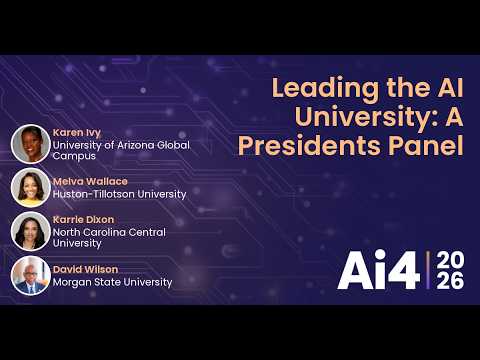
This content was published on YouTube by Ai4 on August 17, 2026. The page description outlines a panel featuring Karen Ivy from the University of Arizona Global Campus alongside university presidents Melva Wallace of Huston-Tillotson University, Karrie Dixon of North Carolina Central University, and David Wilson of Morgan State University.
## TL;DR
In this panel, university leaders discuss the strategic integration of AI into higher education and administrative operations. The discussion covers practical steps taken by HBCUs, such as building Morgan State's sovereign AI platform Obsidian and establishing specialized AI institutes. The panelists emphasize balancing exponential technological advancements with ethical frameworks, student privacy, critical thinking, and essential human-centric soft skills.
## Atmosphere & style
The panel maintains an engaging, visionary, and collegial atmosphere, balancing high-level executive insight with personal humor and lived experiences. The dialogue feels candid and collaborative, with speakers building off each other's perspectives to address the real-world complexities and anxieties of digital transformation. A shared sense of institutional pride and urgency underpins the conversation, leaving a tone that is both grounded and forward-looking.
## Key takeaways
- [00:04](https://www.youtube.com/watch?v=ztqpT01MztQ&t=4s) The panel represents the first time university CEOs and chancellors have assembled at the conference to discuss leading higher education institutions through an AI transformation.
- [00:04](https://www.youtube.com/watch?v=ztqpT01MztQ&t=4s) Huston-Tillotson University founded the annual HBCU AI Conference to proactively bring higher education institutions together around artificial intelligence.
- [00:04](https://www.youtube.com/watch?v=ztqpT01MztQ&t=4s) Morgan State University is on the verge of becoming classified as a Very High Research Activity (R1) university, making it only the second HBCU in history to achieve this status.
- [00:04](https://www.youtube.com/watch?v=ztqpT01MztQ&t=4s) North Carolina Central University houses three specialized research institutes focused on biomedical research, biomanufacturing, and artificial intelligence.
- [08:11](https://www.youtube.com/watch?v=ztqpT01MztQ&t=491s) University leaders face a dual mandate to graduate AI-literate students while modernizing internal administrative operations so staff and faculty embrace these technologies.
- [08:11](https://www.youtube.com/watch?v=ztqpT01MztQ&t=491s) Leading through AI requires a top-down vision and strategy to shift campus culture rather than treating AI as merely an IT upgrade.
- [08:11](https://www.youtube.com/watch?v=ztqpT01MztQ&t=491s) Morgan State built its own sovereign AI platform, Obsidian, to maintain agency over institutional data by sanitizing internal data and removing personally identifiable information before interacting with LLMs.
- [08:11](https://www.youtube.com/watch?v=ztqpT01MztQ&t=491s) Morgan State approved its first B.S. in Digital Engineering and incorporated AI threads across all traditional disciplines.
- [18:09](https://www.youtube.com/watch?v=ztqpT01MztQ&t=1089s) A key demonstration of Gemini's real-time predictive infrastructure capabilities convinced leadership that AI would necessitate a complete paradigm shift across higher education.
- [21:37](https://www.youtube.com/watch?v=ztqpT01MztQ&t=1297s) Morgan State shifted its vision away from legacy enterprise software by leaving the CIO post vacant for two and a half years to recruit leadership capable of executing campus-wide AI strategy.
- [24:16](https://www.youtube.com/watch?v=ztqpT01MztQ&t=1456s) NCCU addresses AI equity and access by investing $7.6 million into a 5,000-square-foot AI hub, supported by a $1 million gift from Google.
- [29:11](https://www.youtube.com/watch?v=ztqpT01MztQ&t=1751s) Top administrative concerns around AI management include data security, student privacy, and ransomware threats holding institutional data hostage.
- [29:11](https://www.youtube.com/watch?v=ztqpT01MztQ&t=1751s) University leaders stress that AI adoption must preserve human critical thinking and judgment rather than letting automated tools erode fundamental intellectual capabilities.
- [33:54](https://www.youtube.com/watch?v=ztqpT01MztQ&t=2034s) Institutions prepare students for uncreated jobs by balancing technical literacy with core human soft skills like conflict resolution, adaptability, and interpersonal communication.
- [38:50](https://www.youtube.com/watch?v=ztqpT01MztQ&t=2330s) Panelists conclude that while AI can enhance workflows, it can never replace true human intelligence, creativity, critical thinking, or empathy.
## Detailed walkthrough
### [00:04](https://www.youtube.com/watch?v=ztqpT01MztQ&t=4s) Panel Introduction and Presidents' Backgrounds
The panel opens with an emphasis on the unique framing of this session: while many topics have been covered at the conference over the past four years, this marks the first time that university CEOs and chancellors have assembled on stage to discuss leading higher education institutions through an AI transformation. Because these leaders head complex organizations, the strategies they employ to execute AI integration are directly applicable to corporate and enterprise digital transformations.
Dr. Melva K. Wallace introduces herself as the seventh president and CEO of Huston-Tillotson University. She humorously points out a common geographic misconception, clarifying that Huston-Tillotson is located in Austin, Texas—not Houston—which places it squarely in the "Silicon Valley of the South." She highlights Austin's unique culture, from tech executives clad in their signature black T-shirts to the city’s historical evolution, noting that Huston-Tillotson is the third oldest business in Austin (following Scholz Garten and the *Austin American-Statesman*). Huston-Tillotson recently celebrated its 150th anniversary and has taken a proactive stance in tech leadership by founding the annual HBCU AI Conference to bring institutions together around artificial intelligence.
Dr. David K. Wilson, the 10th president of Morgan State University in Baltimore, Maryland, introduces his institution as the third-largest HBCU in the United States. Morgan State leads the state of Maryland in producing Black graduates across 30 disciplines and ranks first nationally in producing Black graduates across 10 disciplines—including ranking number one in Black electrical engineering graduates and number three in Black engineering graduates overall across all fields. He shares that eight years prior, the National Trust for Historic Preservation designated Morgan State as a National Treasure; out of 69 such designated sites in the country, Morgan State is the only entire university campus to receive this honor. Furthermore, Dr. Wilson announces that Morgan State is on the verge of becoming classified by Carnegie as a "Very High Research Activity" (R1) university, which will make it only the second HBCU in history to achieve R1 status.
Dr. Karrie G. Dixon introduces herself as the 13th chancellor of North Carolina Central University (NCCU), having recently celebrated two years in her role following a prior chancellorship. Located in Durham within the Research Triangle Park—a hub often described as the Silicon Valley of North Carolina—NCCU serves approximately 9,500 students. Founded in 1910 and celebrating 116 years of existence, NCCU houses three specialized research institutes focused on biomedical research, biomanufacturing, and artificial intelligence. Additionally, NCCU holds the distinction of being the only HBCU in North Carolina with a law school, boasting 160 sitting judges across the country among its alumni.
- **Federal Statute & Title III Origin:** Dr. Wilson explains that the term "HBCU" (Historically Black Colleges and Universities) is defined in federal law. In 1966, the U.S. Department of Education created Title III funding to make strategic investments, explicitly establishing the statutory distinction between historically Black institutions and predominantly Black institutions (PBIs) to govern eligibility for federal support.
- **Top Wage Outcomes:** Dr. Wallace notes that Huston-Tillotson is ranked as the number one HBCU in the country for placing graduates into the highest-wage jobs immediately following graduation.
---
[08:11](https://www.youtube.com/watch?v=ztqpT01MztQ&t=491s) Defining Leadership in an AI-Driven University
When asked what it truly means to lead an AI university, Dr. Wallace compares the current landscape to the song *"Ball of Confusion."* She describes sitting down with corporate CEOs in Austin who admit they cannot accurately predict their 5-year workforce needs or specify what skills graduates will require because companies themselves are actively struggling to navigate AI implementation. While some corporations have reduced staff in favor of AI agents, many remain uncertain about the net operational impact within their ecosystems. Consequently, university leaders face a dual mandate: they must graduate AI-literate students while simultaneously modernizing their internal employment and administrative ecosystems so that staff and faculty embrace the same technologies.
Dr. Dixon emphasizes that leading through AI requires university CEOs to set a top-down vision and strategy for campus culture rather than treating AI as merely an IT upgrade. When taking office at NCCU, Dr. Dixon prioritized operational efficiency and internal controls by directly consulting lead executives at tech giants like IBM and Lenovo. Learning from corporate practices, NCCU adapted AI into its own administrative operations. For example, the university's HR department utilizes AI to screen hundreds of job applications per vacancy, rapidly matching candidates' skill sets to open positions. She stresses that the remote pivots forced by COVID-19 broke down longstanding technological hesitation across higher education, creating the momentum necessary to embrace modern AI integration.
Dr. Wilson framed the present moment as a call for institutional boldness, declaring that higher education leaders must ensure their institutions are "not renters in the future of this nation and of the world." To maintain agency over their data and technology, Morgan State took the bold step of building its own sovereign AI platform, named **Obsidian**. By establishing strict data guardrails, Morgan State sanitizes internal data to strip out personally identifiable information (PII) before interacting with large language models (LLMs). This architecture not only enhances administrative workflows and degree completion tracking, but it also allows students to gain hands-on experience building the platform itself.
- **Historical Perspective on Tech Disruption:** Dr. Wallace reflects on historical shifts in technology, recalling how educators once warned students they "wouldn't always have a calculator" or how early news broadcasts on the *Today Show* treated the launch of the World Wide Web with skepticism. She highlights that AI adoption is happening exponentially faster than any prior technological shift, creating a mix of excitement and anxiety across multigenerational campus populations.
- **Academic Program Expansion:** Dr. Wilson shares that Morgan State's board of trustees recently approved its first Bachelor of Science degree in Digital Engineering, alongside incorporating AI threads across all traditional disciplines, including English, philosophy, architecture, and engineering.
---
[18:09](https://www.youtube.com/watch?v=ztqpT01MztQ&t=1089s) Industry Partnerships and the "Aha Moment"
Discussing strategic execution, Dr. Wallace emphasizes that building partnerships with external industry is built into the historical DNA of HBCUs. With 12,000 tech attendees gathered at the conference, she calls on corporate leaders to establish deep, bidirectional partnerships with university faculty and students—offering research opportunities, tech integration, and direct pipelines to employment.
Dr. Wilson shares his personal "aha moment" that crystallized the transformative power of AI. He describes being invited to an executive immersion experience in New York City hosted by Google at their pavilion, alongside government officials and fellow university leaders, right before the public release of Gemini. During the demonstration, Google presented a use case detailing how Gemini was deployed across the New York City subway system to analyze complex infrastructure data and accurately predict where underground structural or mechanical breaks were likely to occur. Seeing complex physical predictive modeling executed in real time convinced him that AI would fundamentally reshape every sector, necessitating a complete paradigm shift in higher education leadership.
<FollowUp label="Want me to summarize the key strategies for building sovereign campus AI like Morgan State's Obsidian?" query="Summarize the key strategies and architecture details for building a sovereign campus AI like Morgan State's Obsidian platform as discussed in the panel."/>
Here is a detailed, faithful walkthrough covering the second part of the panel discussion:
### [21:37](https://www.youtube.com/watch?v=ztqpT01MztQ&t=1297s) Expanding AI’s Scope: Morgan State’s Strategic Shift
President David Wilson describes how a revelation about AI’s broader predictive capabilities transformed his leadership approach at Morgan State University. After realizing that campus technology discussions were stuck focusing narrowly on Enterprise Management Systems (EMS), he initiated a major institutional pivot toward a broader vision. Rejecting candidates for Vice President and CIO who were focused only on present systems, he left the position open for two and a half years until hiring a leader from Arizona State University who had worked with MicroPro.
Together, they initiated a three-hour cabinet-level conversation to imagine what an AI-driven equivalent of the intranet would look like across the entire university. This resulted in a comprehensive proposal presented to his extended cabinet of roughly 50 leaders, creating alignment between AI strategy, the institutional mission, and Morgan State's strategic plan.
- President Wilson left the VP/CIO role vacant for 2.5 years to avoid hiring a leader focused purely on legacy enterprise software.
- The extended cabinet at Morgan State University comprises approximately 50 people.
### [24:16](https://www.youtube.com/watch?v=ztqpT01MztQ&t=1456s) Ensuring Equity, Access, and Campus-Wide Readiness
Chancellor Karrie Dixon outlines how North Carolina Central University (NCCU) ensures AI innovation is paired with equity. To avoid creating "a divisive line on campus" between the haves and have-nots, NCCU approaches AI as a shared responsibility across all departments—from academic curricula and IT efficiency to campus security and cybersecurity.
She highlights a major milestone: a $7.6 million investment in a 5,000-square-foot AI institute and hub funded partially by a $1 million gift from Google, with a ribbon cutting planned for the upcoming Monday. Additionally, Chancellor Dixon created a Vice Chancellor-level position, bringing on Dr. Kuldeep Rawat to lead innovative business and industry partnerships in the Research Triangle Park area. NCCU actively engages the broader region through events, such as a spring conference that drew over 750 participants across K–12, community colleges, and industry.
- **Google Investment:** NCCU received a $1 million gift from Google toward its $7.6 million, 5,000-square-foot AI hub.
- **Leadership Appointment:** Dr. Kuldeep Rawat joined NCCU as Vice Chancellor to lead AI innovation and industry partnerships.
- **Regional Impact:** NCCU's spring AI conference brought together over 750 attendees from K–12 education, higher education, and industry.
### [29:11](https://www.youtube.com/watch?v=ztqpT01MztQ&t=1751s) What Keeps University Leaders Up at Night
When asked what keeps them up at night regarding AI management, the panelists share their primary concerns. President Melva Wallace points to data security, student privacy, and the rise of ransomware, humorously recalling how "ransom used to mean you were in a building underground blindfolded," whereas institutions now face threats like holding data hostage for Bitcoin. Chancellor Dixon echoes these safety concerns, noting that "technology is moving faster than we can build trust around it," while giving a nod to Dr. Sibande Grady, who leads AI efforts at NCCU.
President Wilson frames his primary concern as an "intellectual struggle." Drawing on his personal story of growing up in abject poverty in rural Alabama—where he didn't attend school full-time until seventh grade and taught himself to read by kerosene light using *Look* and *Life* magazines pasted on the walls—he stresses the necessity of preserving human brainpower. He warns that AI must not erode critical thinking or judgment, emphasizing that students cannot emerge with minds like a sponge where "the minute they get challenged, everything falls to the floor."
- President Wilson grew up in rural Alabama, did not attend school full-time until the seventh grade, and went on to earn two degrees from Harvard University.
### [33:54](https://www.youtube.com/watch?v=ztqpT01MztQ&t=2034s) Preparing Students for Uncreated Jobs and Preserving Human Skills
The discussion pivots to how higher education prepares students for future careers that do not yet exist. President Wilson emphasizes building a strong, malleable foundation based on judgment, adaptability, and fundamental reasoning skills, stating, "AI may be everywhere, but we don't want judgment to be rare." Chancellor Dixon adds that leaders must relieve student anxiety by reframing AI as an enhancing tool rather than a replacement for human thought and creativity.
President Wallace highlights how Huston-Tillotson University (HT) leans into its faith-based values to eliminate fear and foster innovation. She notes key contributions from HT board member Chris Hyams (CEO of Indeed.com), who teaches an AI course on campus, and global AI ethics expert Mimi Styles. Alongside technological literacy, HT emphasizes core human soft skills—such as team building, conflict resolution, time management, facing objections, and basic interpersonal courtesy. Moderator Karen Ivy shares her work as a Fulbright Specialist at the University of Zagreb in Croatia, focusing on keeping the "human in the loop."
- **Industry Collaboration:** Chris Hyams, CEO of Indeed.com and HT board member, teaches an AI course on campus.
- **Ethics Guidance:** HT collaborates with global AI ethics leader Mimi Styles to guide ethical AI integration.
### [38:50](https://www.youtube.com/watch?v=ztqpT01MztQ&t=2330s) Lightning Round: Myths, Predictions, and Leadership Lessons
The panel closes with a fast-paced lightning round touching on core beliefs, common misconceptions, and leadership insights regarding AI:
* **What AI can never replace:** The panelists agree that AI cannot replace true human intelligence, critical thinking, creativity, human judgment, or kindness. As President Wallace notes, "The first word of AI is artificial, so there you have it."
* **The biggest myth about AI:** Panelists agree the biggest misconception is that one must be highly technologically savvy to use AI tools effectively.
* **Universities in 5 years:** President Wilson predicts higher education will reassert itself as a leader in embedding emerging technology into curricula, effectively equipping graduates for "the future of work and the work of the future."
* **Key leadership lessons:**
* Chancellor Dixon notes that "technology is faster than trust," requiring intentional trust-building.
* President Wallace highlights the necessity of bringing everyone along and maintaining flexibility: "A decision you make this week about AI... you may have to revisit that in a month or so."
* Moderator Karen Ivy emphasizes that no single institution can succeed alone, underlining the necessity of continuous learning and strategic partnership.
## Notable quotes
> [08:11](https://www.youtube.com/watch?v=ztqpT01MztQ&t=491s) not renters in the future of this nation and of the world — David Wilson
> [08:11](https://www.youtube.com/watch?v=ztqpT01MztQ&t=491s) Ball of Confusion — Melva Wallace
> [29:11](https://www.youtube.com/watch?v=ztqpT01MztQ&t=1751s) ransom used to mean you were in a building underground blindfolded — Melva Wallace
> [29:11](https://www.youtube.com/watch?v=ztqpT01MztQ&t=1751s) technology is moving faster than we can build trust around it — Karrie Dixon
> [33:54](https://www.youtube.com/watch?v=ztqpT01MztQ&t=2034s) AI may be everywhere, but we don't want judgment to be rare — David Wilson
> [38:50](https://www.youtube.com/watch?v=ztqpT01MztQ&t=2330s) The first word of AI is artificial, so there you have it. — Melva Wallace
> [38:50](https://www.youtube.com/watch?v=ztqpT01MztQ&t=2330s) the future of work and the work of the future — David Wilson
> [38:50](https://www.youtube.com/watch?v=ztqpT01MztQ&t=2330s) technology is faster than trust — Karrie Dixon
> [38:50](https://www.youtube.com/watch?v=ztqpT01MztQ&t=2330s) A decision you make this week about AI... you may have to revisit that in a month or so. — Melva Wallace
## Mentioned
Karen Ivy, Melva Wallace, Karrie Dixon, David Wilson, University of Arizona Global Campus, Huston-Tillotson University, North Carolina Central University, Morgan State University, Scholz Garten, Austin American-Statesman, HBCU AI Conference, U.S. Department of Education, Title III, IBM, Lenovo, Obsidian, Google, Gemini, MicroPro, Kuldeep Rawat, Sibande Grady, Chris Hyams, Indeed.com, Mimi Styles, University of Zagreb, Look, Life, Today Show
## Video description
Karen Ivy - Department Head, Technology Professions, University of Arizona Global Campus
Melva Wallace - President & CEO, Huston-Tillotson University
Karrie Dixon - Chancellor, North Carolina Central University
David Wilson - President, Morgan State University
HBCU校长打造主权AI平台以保护学生数据
大学必须开发内部AI平台并重塑行政工作流程,以维护数据主权,防止学生沦为被动的技术消费者。
在本次研讨中,高校领导探讨了将人工智能战略性融入高等教育与行政运营的议题。讨论涉及HBCU采取的切实举措,例如摩根州立大学(Morgan State)构建主权AI平台Obsidian以及设立专业AI研究院。与会嘉宾强调,必须在技术的指数级飞跃与伦理框架、学生隐私、批判性思维以及至关重要的以人为本的软技能之间保持平衡。
多位高校校长首次齐聚峰会探讨高等教育的 AI 转型,指出高校不仅要培育具备 AI 素养的人才,还需自上而下推动内部行政与运营的现代化。 (0:04)
摩根州立大学(Morgan State)构建了自主主权 AI 平台 Obsidian,在调用大语言模型(LLM)前清洗脱敏个人身份信息(PII),确保机构对自身数据的控制权。 (8:11)
北卡罗来纳中央大学(NCCU)推进投资达 760 万美元(含 Google 资助的 100 万美元)的 AI 中心建设,促进技术公平并为全校及周边区域提供资源支持。 (24:16)
面对未来尚未出现的新兴职业,校长们呼吁在全学科融入 AI 的同时坚守人类判断力与批判性思维,避免核心认知与思考能力被技术削弱。 (33:54)
Reading summary
Historically Black College and University (HBCU) presidents are navigating artificial intelligence as an enterprise-wide institutional overhaul, balancing proprietary technological infrastructure and industry partnerships against urgent concerns regarding data security and the preservation of human critical reasoning.
Developing Sovereign Infrastructure and Modernizing Administration (8:11)
Rather than approaching AI as a routine IT upgrade, university leaders are treating adoption as an executive-level strategic imperative. At Morgan State University, President David K. Wilson held the Vice President and CIO vacancy open for two and a half years to identify leadership aligned with broader AI capabilities rather than legacy enterprise management systems. To safeguard university data, Morgan State developed Obsidian, a sovereign campus AI platform that sanitizes internal records to remove personally identifiable information before querying large language models. The system optimizes administrative workflows and student degree tracking while engaging students directly in platform development.
At North Carolina Central University (NCCU), Chancellor Karrie G. Dixon prioritized operational alignment by consulting technology executives at IBM and Lenovo. NCCU integrated AI directly into administrative processes, such as using automated screening in human resources to match high volumes of applicant credentials to vacancy requirements. Panelists noted that the operational disruptions of COVID-19 helped dismantle longstanding campus resistance to new software, establishing an administrative precedent for accelerated digital modernization.
Capital Investments and Industry Partnerships (18:09)
Capitalizing on their regional ecosystems, campus leaders are formalizing cross-sector alliances to fund infrastructure and academic initiatives. Located in Durham's Research Triangle Park, NCCU developed a 5,000-square-foot AI institute and hub backed by a $7.6 million investment, which includes a $1 million gift from Google, alongside appointing Dr. Kuldeep Rawat as Vice Chancellor to oversee industry partnerships. Chancellor Dixon reported that an NCCU regional AI conference gathered more than 750 participants across K–12 schools, community colleges, and private industry.
In Austin, Texas, Huston-Tillotson University established the annual HBCU AI Conference to unite peer institutions around emerging technologies. President Melva K. Wallace integrated corporate leadership into campus instruction, bringing Indeed CEO and board member Chris Hyams to teach an AI course, alongside consulting global AI ethics specialist Mimi Styles. President Wilson cited an executive briefing by Google—which demonstrated Gemini predicting structural failures across New York City subway infrastructure—as evidence that predictive AI models will compel every sector to fundamentally restructure operational models.
Safeguarding Critical Reasoning and Data Privacy (29:11)
Campus leaders identified operational exposure to cyber threats and cognitive reliance as significant institutional risks. President Wallace highlighted escalating vulnerabilities surrounding student data privacy and ransomware, contrasting historic physical ransom demands with modern extortion involving Bitcoin. Chancellor Dixon noted that institutional trust lags behind technological development, emphasizing the need for comprehensive safety frameworks across academic and campus security divisions.
President Wilson characterized the cognitive impact of AI as a major intellectual challenge. Drawing on his background of overcoming extreme poverty and delayed schooling in rural Alabama to earn degrees from Harvard University, he cautioned against allowing automation to displace human brainpower. He argued that universities must cultivate durable human judgment and analytical discernment so that students do not become intellectual sponges unable to withstand analytical challenges.
Curricular Adaptation for an Unpredictable Workforce (33:54)
Because corporate executives frequently cannot forecast their specific five-year workforce demands, university presidents are structuring curricula around adaptability. Morgan State's board of trustees approved a new Bachelor of Science in Digital Engineering while embedding AI instruction across non-STEM disciplines, including English, philosophy, and architecture. Huston-Tillotson balances technical fluency with foundational human skills, emphasizing conflict resolution, team building, objection handling, and interpersonal courtesy.
The panel dispelled the common misconception that effective AI utilization requires deep programming expertise. Addressing student anxiety, leadership emphasized framing AI as an assistive instrument rather than a substitute for original thought. Moderator Karen Ivy noted that ongoing educational integration requires keeping human judgment central to technological oversight.
The panel concluded that higher education must actively drive the future of work rather than passively reacting to enterprise technologies. However, leaders emphasize that because institutional policies and software capabilities shift rapidly, governance frameworks will require ongoing, monthly reassessments alongside sustained efforts to close the gap between technological capabilities and campus-wide trust.
精炼阅读摘要
在Ai4大会的高校校长论坛上,来自三所传统黑人大学(HBCU)的领导者指出,高校推进人工智能转型不仅是信息技术的升级,更是一场兼顾技术主权、治理架构重构与校企深度融合的系统性变革;他们强调,高校在加速引入AI的同时,必须筑牢批判性思维与人类核心素养的护城河。
确立制度主权与自上而下的AI治理架构 (8:11)
North Carolina Central University(NCCU)校长Karrie G. Dixon强调,推动AI整合要求大学最高领导层自顶向下确立校园文化与制度战略,而非仅仅将其视作孤立的IT升级。NCCU借鉴IBM和Lenovo等科技企业实践优化内部行政,例如在人事部门利用AI筛选职位申请者并快速匹配技能。Morgan State University校长David K. Wilson则提出,高校领导者必须确保自身在未来技术版图中“不做租客”,为此该校自研了名为Obsidian的主权AI平台。该平台在调用大型语言模型前,会经过严格数据脱敏以剔除个人身份信息(PII),既保护了数据资产,又为学生提供了直接参与底层架构构建的实操机会。
为推动全校范围的协同变革,Wilson在物色负责技术的副校长兼首席信息官(CIO)时,因拒绝接纳局限于传统企业管理系统(EMS)的人选,坚持让该职位空缺了两年半,直至聘入具备前瞻视野的领导者。随后,校方通过长达数小时的高层研讨,向约50人组成的扩大会议提交了AI战略方案,将技术升级与大学使命和长期战略规划全面对齐。
深化区域产业联动与基础设施建设 (18:09)
多位校长指出,与产业界构建深度双向合作是HBCU的历史传统。NCCU借助地处北卡罗来纳州三角研究园的区位优势,设立了投资达7.6 million美元、占地5,000平方英尺的人工智能研究院与创新中心,其中包含来自Google的1 million美元捐赠,并设立副校长级别岗位统筹产业对接。该校举办的区域性AI会议吸引了来自K-12教育、社区学院及企业界的750余名代表参会。
在得克萨斯州奥斯汀,Huston-Tillotson University依托当地科技生态,发起创办了年度HBCU人工智能大会。该校邀请校董兼Indeed首席执行官Chris Hyams在校授课,并与全球AI伦理学者Mimi Styles合作探索伦理规范。Wilson分享称,他在Google活动中亲眼见证了Gemini模型实时预测纽约市地铁系统物理与机械结构故障的案例,这种复杂的实时物理预测彻底改变了他对技术颠覆性的认知,坚定了高校必须全面拥抱产业前沿的决心。
捍卫人类判断力与核心软实力的不可替代性 (29:11)
谈及AI发展带来的潜在风险,校长们虽然关注数据安全、学生隐私及勒索软件等外部威胁,但更为警惕认知层面的侵蚀。Wilson结合自身在阿拉巴马州农村贫困环境中自学成才并最终获得哈佛大学双学位的成长经历,指出高校的核心使命是保护人类智力与逻辑推理。他提出“AI可能无处不在,但判断力绝不能变得稀缺”,警告不能让学生的思维退化为未经推敲、遇挑战即垮塌的“海绵”。
与会领导者达成共识:AI绝无法取代真正的人类智慧、批判性思维、创造力、道德判断与善良。Huston-Tillotson University校长Melva K. Wallace表示,学校在推进技术素养的同时,着重加强团队协作、冲突化解、时间管理与人际沟通等软技能培养。Dixon也指出,校方需要消除师生的技术焦虑,明确将AI定位为辅助人类思想与创新的工具,而非替代品。
推动全员普惠准备与跨学科课程重构 (24:16)
为防止校园内部在技术获取上产生分化与鸿沟,NCCU将AI治理延伸至学术课程、IT效率、网络安全及校园安保等全部部门,强调AI素养应当普惠全体师生。在学科体系建设方面,Morgan State校董会批准了数字工程理学学士学位,同时将人工智能知识线索全面织入英语、哲学、建筑及传统工程学等各类学科,以此拓宽文理教育的适应面。
针对普遍存在的社会认知,与会校长指出,目前关于AI最大的误区是“必须具备高深的技术功底才能有效使用工具”。Wilson预测,未来五年内高等教育界将重塑自身作为技术融合引领者的角色,让各专业毕业生具备适应未来新兴工种的复合能力。
与会校长强调,“技术的演进速度往往快于信任的建立”,面对AI快速迭代带来的多代际群体适应压力,管理层必须保持高度的灵活性,随时准备调整既定决策并持续协同推进。如何在深度应用前沿算法提升行政效能与教学质量的同时,有效捍卫自主数据主权并维系人际核心价值,是当前高等教育转型必须持续应对的根本挑战。
Detailed notes — zh
## Background
该视频由 Ai4 频道于 2026 年 8 月 17 日发布在 YouTube 平台。视频记录了一场题为“引领 AI 大学:校长论坛”的高端对话,由亚利桑那大学全球校区的 Karen Ivy 博士主持,邀请了休斯敦-蒂洛森大学校长 Melva Wallace、北卡罗来纳中央大学校监 Karrie Dixon 与摩根州立大学校长 David Wilson,共同探讨高等教育机构在 AI 时代的领导力转型与实践。
## TL;DR
论坛中,三位来自传统黑人大学(HBCU)的掌舵人深入分享了各自在 AI 浪潮中的战略布局,包括摩根州立大学自研主权 AI 系统“Obsidian”与北卡罗来纳中央大学打造 760 万美元 AI 研究所的普惠实践。针对瞬息万变的劳动力市场,校长们强调大学应推动全学科课程与 AI 的深度融合,同时积极开展产教合作以培养学生的未来适应力。他们也直言不讳地表达了对网络勒索安全风险、信任建立滞后以及过度依赖技术导致学生丧失“智力磨砺”与批判性思维的深层忧虑。全场最终凝聚共识:AI 永远无法替代人类的真正智力、判断力与人文温度,高校必须在拥抱技术的同时坚守育人初心。
## Atmosphere & style
整场对话兼具战略前瞻性与深厚的人文关怀,现场氛围在坦诚幽默与深邃沉思之间自如切换。Wilson 校长借由个人童年煤油灯下求学的动情叙事,为技术讨论注入了极具张力的人生厚度,而 Wallace 校长的风趣比喻与 Dixon 校长务实利落的治理经验则相得益彰。聆听这场讨论既能感受到面对技术颠覆时的敏锐危机感,又能体会到教育领袖们对人类判断力与跨界协同所怀抱的从容与笃定。
## Key takeaways
- [00:04](https://www.youtube.com/watch?v=ztqpT01MztQ&t=4s) 传统黑人大学(HBCU)正走在高等教育AI转型前沿:摩根州立大学与北卡罗来纳中央大学(NCCU)等高校依托深厚的工程与科研积累,深度融合产业生态,引领全美AI教育与科研布局。
- [08:11](https://www.youtube.com/watch?v=ztqpT01MztQ&t=491s) 摩根州立大学打造“主权AI”系统:自研“Obsidian”主权AI平台,在严格防范个人敏感信息泄露的同时,让学生直接参与系统工程架构,并将AI能力渗透至从数字工程到人文社科的各门学科。
- [08:11](https://www.youtube.com/watch?v=ztqpT01MztQ&t=491s) 高校面临学生培养与管理提效的双重转型挑战:大学既要在企业界自身摸索用工需求的迷茫期培养“AI原生代”学生,又需汲取科技巨头经验,在HR招聘与行政流程中利用AI降本增效。
- [21:37](https://www.youtube.com/watch?v=ztqpT01MztQ&t=1297s) 打破传统EMS系统桎梏,重构全校AI战略顶层设计:高校管理者必须跳出传统企业管理系统(EMS)的局限思维,延揽具备前瞻视野的CIO,将AI深度融入学校长期战略规划。
- [24:16](https://www.youtube.com/watch?v=ztqpT01MztQ&t=1456s) 践行“AI属于每一个人”的普惠教育理念:NCCU依托北卡三角研究园产业优势并获Google资助,打造760万美元规模的AI研究所,打破学科壁垒,推动跨专业、全员AI赋能及区域社区辐射。
- [29:11](https://www.youtube.com/watch?v=ztqpT01MztQ&t=1751s) 网络安全威胁与信任建立滞后成为高校管理的核心隐忧:面对日益猖獗的网络勒索与数据泄露风险,领导者指出技术的演进速度远快于人类建立信任的速度,构建负责任的AI信任体系迫在眉睫。
- [29:11](https://www.youtube.com/watch?v=ztqpT01MztQ&t=1751s) 警惕过度依赖AI导致“智力磨砺”的丧失:教育者担忧AI的泛滥会削弱学生的独立思考与批判性思维能力,强调高等教育必须保持对学生思维肌肉的严谨磨砺,防止认知能力退化。
- [34:00](https://www.youtube.com/watch?v=ztqpT01MztQ&t=2040s) 为尚不存在的未来岗位育人,坚守判断力与底层认知:在AI时代,技术虽无处不在但绝不能让“健全判断力”成为稀缺品,高校应聚焦培养学生的应变力、创新力与底层认知韧性。
- [34:00](https://www.youtube.com/watch?v=ztqpT01MztQ&t=2040s) AI时代更需回归传统“软实力”与人文温度:高校强调在拥抱技术的同时坚守团队协作、沟通调解与人际善意,确保技术演进始终保持“人类在回路中”(Human-in-the-loop)的人文精神。
- [38:50](https://www.youtube.com/watch?v=ztqpT01MztQ&t=2330s) AI时代的领导力启示在于破除迷思、动态应变与跨界协同:打破“精通技术才能使用AI”的误解,管理者需在快速迭代中保持耐心与敏捷复盘意识,依靠跨界深度合作与终身学习驾驭变革。
## Detailed walkthrough
### [00:04](https://www.youtube.com/watch?v=ztqpT01MztQ&t=4s) 开场介绍与嘉宾大学背景
主持人(Karen Ivy 博士)为本场大学校长与校监论坛拉开帷幕。她指出,虽然过去的峰会讨论了诸多 AI 前沿技术,但在以往的会议中,极少能将大学的真正“CEO”——校长们汇聚一堂,共同探讨如何领导一所“AI 大学”以及高等教育如何进行全面的 AI 转型。这些大学掌舵人的管理与转型经验,对任何正在经历数字化与 AI 变革的企业或机构都具有极强的借鉴意义。
随后,各位嘉宾依次作了自我介绍与背景概述:
位于得克萨斯州奥斯汀的 Huston-Tillotson University(休斯顿-蒂罗森大学)第七任校长兼首席执行官 Melva K. Wallace 博士幽默地提醒观众,学校虽然名字带“休斯顿”,但实际坐落在“南方硅谷”奥斯汀——“如果你以为我们在休斯顿,那你就得多开两个半小时车了”。她开玩笑说奥斯汀满街都是身穿黑色 T 恤的“科技青年”(Tech Bros)。该校刚刚迎来建校 150 周年,是奥斯汀市历史第三悠久的商业实体(仅次于 Scholz 啤酒花园和《奥斯汀美国州民报》)。该校创办了全美 HBCU AI 大会,致力于汇聚全美历史悠久的黑人学院与大学共同探讨 AI 与前沿科技。
紧接着,位于马里兰州巴尔的摩的 Morgan State University(摩根州立大学)第十任校长 David K. Wilson 博士介绍了学校的深厚积淀。摩根州立大学是全美第三大 HBCU,拥有 30 个培养马里兰州最多非裔毕业生的专业学科,并在 10 个学科方向上培养的非裔毕业生数量位列全美第一。学校在全美非裔电气工程师培养上位居首位,在全部工程学科的非裔工程师产出中排名前三。约八年前,美国国家历史保护信托基金会将摩根州立大学指定为“国家宝藏”(National Treasure),全美仅有 69 处地点获此殊荣,而摩根州立是全美唯一一所整座校园都被列为国家宝藏的大学。此外,摩根州立大学即将在卡内基高等教育分类中晋升为 R1 级顶尖研究型大学(Very High Research Activity),成为全美历史上第二所获此评级的 HBCU。
Wilson 博士向现场观众普及了 HBCU(Historically Black Colleges and Universities,传统黑人大学)的法定背景:该称谓在 1966 年正式写入联邦法规(Title III),专门用于指代历史上成立并专为非裔群体提供高等教育的高校,与单纯的“以非裔学生为主的大学”(Predominantly Black Institutions)在法律定义和战略投资上有严格区分。
- **Huston-Tillotson University**:位于得州奥斯汀,建校 150 周年,创办了全美首个“HBCU AI 大会”。
- **Morgan State University**:全美第三大 HBCU,工程学科全美领先(非裔电气工程第一、整体工程前三),即将获得卡内基 R1 顶级科研高校评级,全美唯一全校区被列为“国家宝藏”的大学。
- **HBCU 法定渊源**:1966 年美国教育部设立 Title III 资助计划时正式确立法律定义。
### [05:56](https://www.youtube.com/watch?v=ztqpT01MztQ&t=356s) 领导力与高校的 AI 探索:North Carolina Central University 的实践
North Carolina Central University(北卡罗来纳中央大学,简称 NCCU)第十三任校监 Karrie G. Dixon 博士登台发言。她热情地调动了午后略显沉闷的会场气氛。Dixon 博士刚上任两年,这是她第二次担任大学校监。她自豪地表示,NCCU 正在引领北卡罗来纳州的 AI 发展浪潮,全校正充满活力地将 AI 深度融入整个校园生态。
NCCU 始建于 1910 年,已有 116 年历史,目前在校生规模约为 9,500 人且持续增长。学校坐落于被称为“北卡硅谷”的三角研究园(Research Triangle Park, RTP),得天独厚的地理位置吸引了大量来自全美各地的学生和家庭。NCCU 校内建有三大研究所,分别聚焦生物医学、生物制造以及人工智能。此外,NCCU 是北卡罗来纳州唯一拥有法学院的 HBCU,其法学院已在全美培养出 160 位现任法官。
- **NCCU 办学规模**:在校生约 9,500 人,建校 116 年。
- **三大科研机构**:涵盖生物医学(Biomedical)、生物制造(Biomanufacturing)及人工智能(Artificial Intelligence)。
- **政法影响力**:北卡州唯一拥有法学院的 HBCU,走出 160 位现任法官。
### [08:11](https://www.youtube.com/watch?v=ztqpT01MztQ&t=491s) 何为“引领 AI 大学”:迷茫、效率与主权 AI 布局
当主持人向三位领导者抛出核心问题——“掌舵一所 AI 大学究竟意味着什么?”时,三位校长给出了既接地气又具战略高度的见解。
Melva K. Wallace 博士引用老歌《混乱之球》(Ball of Confusion)形容当下的形势。她经常与奥斯汀各大科技企业的 CEO 们交流,询问他们“未来五年需要什么样的劳动力?我们需要为你们培养怎样的毕业生?”,而企业高管们的答复往往是“我们自己也毫无头绪,因为我们也在摸索 AI 浪潮”。当前企业生态在尝试引入 AI 智能体(AI Agents)甚至裁员调整,但效果依然充满不确定性。因此,大学不仅要培养兼具 AI 素养和伴随 AI 成长的新一代学生,同时还要推动大学自身员工生态与管理体系拥抱 AI。在技术日新月异、工具快速迭代的背景下,这既是一场“大混战”,也是前所未有的机遇。
Karrie G. Dixon 博士强调,校领导必须具备明确的战略远见。上任之初面对内部管理和运营效率的挑战,她带领内阁团队主动走访了三角研究园的 IBM、联想(Lenovo)等科技巨头,直接向高管们请教业界如何利用 AI 实现降本增效。随后,NCCU 将这些业界实践引入学校运营中。例如在人力资源(HR)招聘方面,学校每个岗位通常会收到数百份简历,利用 AI 可以精准、高效地匹配核心技能并筛选候选人。Dixon 博士指出,疫情迫使高等教育(尤其是过去在技术上较为滞后的部分 HBCU)加速数字化转型,而面对如今的 AI 浪潮,学校已无法回避,必须全面拥抱以提升效能。
David K. Wilson 博士则将当下定义为大学展现魄力的“领导力时刻”。他激情洋溢地指出,摩根州立大学绝不能在未来的发展中沦为旁观者:“我们希望确保自己拥有未来的一部分,绝不当国家和世界未来的‘租客’(not renters in the future)”。为此,摩根州立大学迈出了极其大胆的一步——自主研发名为“Obsidian”的**主权 AI(Sovereign AI)**系统。这一举措获得了包括英伟达(NVIDIA)在内的全美科技界的广泛认可。Obsidian 构建了严格的数据安全护栏,杜绝直接将敏感数据上传到公开大模型(LLM),而是进行严格的脱敏和隐私保护,以此提升学生毕业路径规划等行政与教学效率。更重要的是,学生不仅是在课堂上学习 AI,而是直接深度参与 Obsidian 系统的架构与工程建设。摩根州立大学已在全校课程中渗透 AI,不仅最新批准设立了数字工程(Digital Engineering)理学学士学位,还将 AI 融入从英语、哲学到工程与建筑学的每一门学科。
```
┌────────────────────────┐
│ Morgan State University│
│ "Obsidian" 主权 AI │
└───────────┬────────────┘
│
┌───────────────────────┼───────────────────────┐
▼ ▼ ▼
┌──────────────┐ ┌──────────────┐ ┌──────────────┐
│ 数据脱敏与 │ │ 学生实战参与 │ │ 跨学科课程 │
│ 安全护栏(PII)│ │ 架构与系统建设│ │ 融入(数字工程│
└──────────────┘ └──────────────┘ │ /人文/建筑) │
└──────────────┘
```
- **双重转型挑战**:高校既要培养面向未来的“AI 原生代”学生,又要在内部推动教职员工与行政业务的 AI 赋能。
- **业务效率优化**:NCCU 汲取 IBM、联想经验,在 HR 招聘筛选等高繁琐场景中规模化落地 AI。
- **主权 AI “Obsidian”**:自建私有化安全模型,杜绝 PII(个人身份信息)泄露,学生直接参与系统设计与工程落地。
- **全学科渗透**:摩根州立大学新设数字工程学士学位,并在文史哲及理工建筑各学科全面注入 AI 相关内容。
### [16:09](https://www.youtube.com/watch?v=ztqpT01MztQ&t=969s) 历史的回响、跨界合作与灵光一现时刻
Wallace 博士以生动的历史类比补充了观点。她谈到小学六年级时,数学老师曾严厉地告诫:“你不可能一辈子都随身带个计算器”,然而如今人手一部智能手机;她还提到早期《今日秀》(The Today Show)节目介绍万维网(World Wide Web)时主持人那副疑惑“这玩意能存在多久”的滑稽模样。技术的演进一次次证明了不可逆的趋势,而当下 AI 普及与渗透的速度远超以往任何时代——年长的教职员工、财务与人事部门的人员,需要与 18 岁的年轻学生以人类历史上从未有过的最高速度共同学习与接纳新技术,这既令人兴奋,也令人畏惧。
谈及与产业界的合作,Wallace 博士指出,Huston-Tillotson University 始终将深度产教融合刻在基因里。该校在全美 HBCU 中排名第一,能够让毕业生在毕业后立即获得最高起薪。作为地处奥斯汀的高校,他们积极参与如 Ai4 这类汇聚 12,000 名行业精英的盛会,寻求企业合作伙伴,为学生争取高薪实习和就业机会,同时让师资队伍和科研生态为企业的技术探索提供智力支持。
在谈到究竟何时迎来被 AI 震撼的“灵光一现(Aha moment)”时,David K. Wilson 博士分享了一段亲身经历。他曾受邀前往谷歌位于纽约市的展厅参加沉浸式体验活动,当时谷歌正准备发布 Gemini 模型,并向少数政府官员与大学校长展示其前沿应用。当谷歌展示如何使用 Gemini 实时监测和预测纽约市庞大复杂的地下地铁网络中潜在的轨道破损与断裂点时,Wilson 博士直言自己被彻底震撼(blown away),深刻意识到这项技术将对社会运转和大学教育产生颠覆性的变革。
- **历史技术对照**:计算器与万维网的历史争议印证了技术不可阻挡的浪潮,当下的核心挑战在于跨代际人员的急速适配。
- **高薪就业表现**:Huston-Tillotson University 凭借奥斯汀科技圈紧密合作,在全美 HBCU 中毕业生即时起薪排名第一。
- **Wilson 校长的顿悟时刻**:在纽约谷歌展厅见证 Gemini 预测纽约地铁地下轨道系统故障的实际案例,彻底认识到 AI 的颠覆性力量。
### [21:37](https://www.youtube.com/watch?v=ztqpT01MztQ&t=1297s) 摩根州立大学的远见:从传统企业系统迈向全校 AI 架构
摩根州立大学校长 David Wilson 回顾了自己在实地考察列车轨道预测性维护技术后受到的震撼。他意识到整个社会过去往往只是以一种浮于表面、追求即时满足的心态在使用新技术,缺乏全局性战略眼光。回到学校后,他针对摩根州立大学的技术现状委托开展了一项评估研究。报告结果“极其坦诚且直言不讳”,指出学校的技术水平远远落后于应有水准,且当时的 IT 视角全部局限在传统的企业管理系统(Enterprise Management System, EMS)上,根本无法理解更深层次的智能技术变革。
为了找到真正具备未来视野的技术领袖,Wilson 校长宁可将副校长兼首席信息官(CIO)的职位空缺整整两年半,因为期间面试的所有候选人都只懂得“回头看”或固守当下,满脑子都是 EMS。直到他从亚利桑那州立大学成功延揽到一位曾与技术先锋企业合作过的专家。在一次长达三个小时的校务委员会深度探讨中,Wilson 明确提出了自己的愿景:“我想要的不是当年的计算器,而是 AI 时代的‘校内互联网’(Intranet)。”这位新任 CIO 随后提交了一份五到七页的战略规划书,在拥有约 50 人的扩大会议上引发了强烈共鸣,从而正式将 AI 战略与摩根州立大学的长远愿景及战略规划深度绑定。
### [24:16](https://www.youtube.com/watch?v=ztqpT01MztQ&t=1456s) 北卡罗来纳中央大学的公平普惠 AI 战略与产业生态
北卡罗来纳中央大学(NCCU)校长 Karrie Dixon 深入阐述了大学在推进 AI 创新时如何坚守教育公平。Dixon 校长强调,学校向全校传达的核心理念是“NCCU 的 AI 属于每一个人”,将 AI 融入校园文化是成功的最佳策略。为了避免校园内部形成“谁在使用、谁在受训、谁被落下”的技术阶级鸿沟与知识孤岛,NCCU 致力于打破学科壁垒,推动跨领域的全面融合。
Dixon 介绍了学校获得 Google 100 万美元捐赠支持的全新 AI 研究所,该项目总投资达 760 万美元、建筑面积达 5,000 平方英尺,即将举行剪彩仪式,旨在打造北卡罗来纳州的 AI 核心枢纽。为了强化领导力,学校设立了主管创新的副校长职位,并邀请 Kuldeep Rawat 博士加盟,依托北卡研究三角园区(Research Triangle Park)的地缘优势,深化与工商业界的深度合作。Dixon 指出,无论是文理各学科课程、IT 运维部门,还是校园警察队伍在网络安全和社区安防中的应用,全校都在全方位培养具备“AI 就绪”(AI-ready)能力的毕业生。面对部分资深教师对新技术的焦虑与恐惧,学校通过系统性培训帮助教师掌握负责任、符合伦理的教学工具;此外,NCCU 举办的 AI 大会吸引了来自 K-12 基础教育、社区学院及产业界超过 750 名代表参会,共同探索负责任的 AI 落地路径。
- **NCCU AI 中心投资规模**:获得 Google 100 万美元捐赠,总建设投资 760 万美元,占地 5,000 平方英尺。
- **全学科课程融入**:不局限于计算机或特定理工专业,全校所有学科课程与职能部门均要求融入 AI 能力培养。
- **广泛的区域辐射**:春季 AI 研讨会汇聚了超过 750 位跨教育阶段与行业领域的从业者。
```
NCCU 全校 AI 普惠战略架构
===========================================================
核心理念:"AI 属于每一个人 (AI for Everyone)"
-----------------------------------------------------------
[ 硬件与研究枢纽 ] [ 顶层领导与产业合作 ]
NCCU AI 研究所 副校长 (Dr. Kuldeep Rawat)
($7.6M / 5,000 sq ft) 对接研究三角园区 (RTP) 产业生态
-----------------------------------------------------------
[ 校园文化与教学赋能 ] [ 跨部门与社区辐射 ]
全学科 AI 课程融入 IT 效能优化 / 智慧校园安防
资深教师伦理与应用培训 750+ 人规模的区域教育与产业大会
===========================================================
```
### [29:11](https://www.youtube.com/watch?v=ztqpT01MztQ&t=1751s) 校长们的深夜之忧:网络勒索、信任滞后与“智力磨砺”的消逝
在回答“在 AI 管理中最让你夜不能寐的事情是什么”时,三位校长分享了各自的隐忧。休斯敦-蒂洛森大学校长 Melva Wallace 直言网络安全是最大的心头大患。她幽默地调侃道,在她的传统认知里,所谓的“绑架勒索”是把人蒙上双眼关在地下室、手拿当天报纸拍照向家属要赎金;而如今黑客却直接锁死全校数据勒索比特币。面对席卷多所大学的网络安全危机,以及瞬息万变的技术合作伙伴甄别挑战,学校必须时刻保持戒备。Dixon 校长对此深表认同,指出“技术的演进速度远远超过了人类建立信任的速度”,如何在追赶技术浪潮的同时在师生心中构建对 AI 的信任,是极为艰难的平衡。
Wilson 校长则将网络安全之外最大的担忧归结为人类“智力磨砺”(Intellectual struggle)的丧失。他动情地回忆起自己在阿拉巴马州极度贫困的农村度过的童年——直到七年级他才得以接受全日制学校教育。小时候在简陋的木屋里,他只能借着微弱的煤油灯光,在母亲用《Look》和《Life》杂志糊成的墙壁上认字摸索。正是这种艰苦卓绝的智力磨砺锻炼了他的大脑思维肌肉,支撑他一路逆袭成为高中第一名并最终斩获哈佛大学的两个学位。Wilson 深刻忧虑 AI 的过度依赖会剥夺年轻一代的批判性思维与独立判断力:“我们绝不希望学生毕业时的大脑像海绵一样松软无力,一旦遭遇真实挑战,所有知识便散落一地。”
### [34:00](https://www.youtube.com/watch?v=ztqpT01MztQ&t=2040s) 为尚未存在的岗位育人:批判性思维、软实力与人类温度
面对“如何为当下尚不存在的未来岗位培养学生”这一前瞻课题,三位校长给出了多维度的解答。Wilson 校长指出,教育的基石是赋予学生强大的思考力、创新力、适应力与健全判断力,使他们拥有既坚实无比又极具延展性的底层认知基础,以便在未来瞬息万变的环境中随时应变转型。他意味深长地总结道:“在 AI 时代,技术或许无处不在,但我们绝不能让判断力成为稀缺品。”Dixon 校长补充道,必须消除学生对“AI 取代工作”的恐慌心理,引导他们将 AI 视为放大人类创造力与判断力的增强工具,而非替代品。
Wallace 校长则从教会大学的育人使命出发,鼓励学生消除对未知未来的恐惧,积极成为未来世界的创造者。她分享了校董会成员、Indeed.com 首席执行官 Chris Hyams 亲自在校园讲授 AI 课程的生动案例,并介绍了全球知名黑人女性 AI 伦理专家 Meme Styles 为学校带来的伦理实践指导。更为关键的是,休斯敦-蒂洛森大学在 AI 时代坚决回归“传统软实力”——团队协作、时间管理、冲突调解、应对异议,乃至最基础的“互道早安”与人际善意。主持人 Karen Ivy 博士也呼应了这一点,分享了自己在克罗地亚萨格勒布大学担任富布莱特专家的经历,强调在技术演进中始终保持“人类在回路中”(Human-in-the-loop)的人文精神至关重要。
### [38:50](https://www.youtube.com/watch?v=ztqpT01MztQ&t=2330s) 闪电问答与领袖箴言:技术之上的理性与耐心
在最后的闪电问答环节中,嘉宾们就核心议题给出了精辟有力的回答:
- **AI 永远无法取代什么?**
- Wilson 校长毫不犹豫地回答:“人类的智力与真正的思考能力”,指出即便当前关于模型“幻觉”的探讨层出不穷,机器也永远无法拥有真正的人类思维。
- Wallace 校长直言:“AI 的第一个单词就是‘人工’(Artificial)”,提醒大家时刻谨记其人工制造的本质。
- Dixon 校长与 Ivy 博士则共同强调了“人类判断力、创造力、批判性思维与人性的善良”。
- **关于 AI 最大的迷思是什么?**
- “你必须精通技术才能使用它。”嘉宾一致认为这是外界对 AI 门槛最大的误解。
- **五年后大学将扮演怎样的角色?**
- 大学将重新成为引领者,把前沿技术有机融入各学科课程体系,培养出深刻理解“未来的工作与工作的未来”并为此做好充分准备的优秀毕业生。
- **AI 带来的核心领导力启示:**
- Dixon 校长重申:“技术的迭代速度快于信任的建立”,领导者必须在推进技术的同时全力构建信任生态。
- Wilson 校长分享了“必须带领所有人共同前进”的理念,并建议领导者在决策时保持极大的耐心与包容度,就像应对疫情时一样:“你本周针对 AI 做出的决策,很可能在一个月后就必须重新审视。”
- Wallace 校长与主持人 Ivy 总结强调,没有任何单一个体或大学能够独自成功,战略性的跨界协同与终身学习是拥抱 AI 时代的唯一坦途。
## Notable quotes
> [00:04](https://www.youtube.com/watch?v=ztqpT01MztQ&t=4s) 如果你以为我们在休斯顿,那你就得多开两个半小时车了 — Melva K. Wallace
> [08:11](https://www.youtube.com/watch?v=ztqpT01MztQ&t=491s) 我们希望确保自己拥有未来的一部分,绝不当国家和世界未来的‘租客’ — David K. Wilson
> [16:09](https://www.youtube.com/watch?v=ztqpT01MztQ&t=969s) 你不可能一辈子都随身带个计算器 — Melva K. Wallace
> [21:37](https://www.youtube.com/watch?v=ztqpT01MztQ&t=1297s) 我想要的不是当年的计算器,而是 AI 时代的‘校内互联网’ — David K. Wilson
> [24:16](https://www.youtube.com/watch?v=ztqpT01MztQ&t=1456s) NCCU 的 AI 属于每一个人 — Karrie G. Dixon
> [29:11](https://www.youtube.com/watch?v=ztqpT01MztQ&t=1751s) 技术的演进速度远远超过了人类建立信任的速度 — Karrie G. Dixon
> [29:11](https://www.youtube.com/watch?v=ztqpT01MztQ&t=1751s) 我们绝不希望学生毕业时的大脑像海绵一样松软无力,一旦遭遇真实挑战,所有知识便散落一地。 — David K. Wilson
> [34:00](https://www.youtube.com/watch?v=ztqpT01MztQ&t=2040s) 在 AI 时代,技术或许无处不在,但我们绝不能让判断力成为稀缺品。 — David K. Wilson
> [38:50](https://www.youtube.com/watch?v=ztqpT01MztQ&t=2330s) 人类的智力与真正的思考能力 — David K. Wilson
> [38:50](https://www.youtube.com/watch?v=ztqpT01MztQ&t=2330s) AI 的第一个单词就是‘人工’ — Melva K. Wallace
> [38:50](https://www.youtube.com/watch?v=ztqpT01MztQ&t=2330s) 你必须精通技术才能使用它。 — Karrie G. Dixon
> [38:50](https://www.youtube.com/watch?v=ztqpT01MztQ&t=2330s) 你本周针对 AI 做出的决策,很可能在一个月后就必须重新审视。 — David K. Wilson
## Mentioned
Karen Ivy, Melva K. Wallace, David K. Wilson, Karrie G. Dixon, Kuldeep Rawat, Chris Hyams, Meme Styles, Huston-Tillotson University, Morgan State University, North Carolina Central University (NCCU), University of Arizona Global Campus, Ai4, Google, Gemini, NVIDIA, IBM, Lenovo (联想), Indeed.com, Obsidian, Research Triangle Park (三角研究园), Scholz 啤酒花园, 《奥斯汀美国州民报》, HBCU AI 大会, 美国国家历史保护信托基金会, 卡内基高等教育分类, Title III, 《混乱之球》 (Ball of Confusion), 《今日秀》 (The Today Show), 亚利桑那州立大学, 《Look》杂志, 《Life》杂志, 哈佛大学, 萨格勒布大学, 富布莱特项目 (Fulbright)
## Video description
Karen Ivy - Department Head, Technology Professions, University of Arizona Global Campus
Melva Wallace - President & CEO, Huston-Tillotson University
Karrie Dixon - Chancellor, North Carolina Central University
David Wilson - President, Morgan State University
[Source](https://www.youtube.com/watch?v=ztqpT01MztQ)
Source quotes
[0:04] Melva K. Wallace: 如果你以为我们在休斯顿,那你就得多开两个半小时车了
[8:11] David K. Wilson: 我们希望确保自己拥有未来的一部分,绝不当国家和世界未来的‘租客’
[16:09] Melva K. Wallace: 你不可能一辈子都随身带个计算器
[21:37] David K. Wilson: 我想要的不是当年的计算器,而是 AI 时代的‘校内互联网’
[24:16] Karrie G. Dixon: NCCU 的 AI 属于每一个人
[29:11] Karrie G. Dixon: 技术的演进速度远远超过了人类建立信任的速度
[29:11] David K. Wilson: 我们绝不希望学生毕业时的大脑像海绵一样松软无力,一旦遭遇真实挑战,所有知识便散落一地。
[34:00] David K. Wilson: 在 AI 时代,技术或许无处不在,但我们绝不能让判断力成为稀缺品。
[38:50] David K. Wilson: 人类的智力与真正的思考能力
[38:50] Melva K. Wallace: AI 的第一个单词就是‘人工’
[38:50] Karrie G. Dixon: 你必须精通技术才能使用它。
[38:50] David K. Wilson: 你本周针对 AI 做出的决策,很可能在一个月后就必须重新审视。
Source quotes
[8:11] David Wilson: not renters in the future of this nation and of the world
[8:11] Melva Wallace: Ball of Confusion
[29:11] Melva Wallace: ransom used to mean you were in a building underground blindfolded
[29:11] Karrie Dixon: technology is moving faster than we can build trust around it
[33:54] David Wilson: AI may be everywhere, but we don't want judgment to be rare
[38:50] Melva Wallace: The first word of AI is artificial, so there you have it.
[38:50] David Wilson: the future of work and the work of the future
[38:50] Karrie Dixon: technology is faster than trust
[38:50] Melva Wallace: A decision you make this week about AI... you may have to revisit that in a month or so.
Original transcript
[0:04] Welcome to this wonderful discussion involving
our university presidents and chancellors
[0:09] of our awesome universities. In this conference,
we have had several topic and subjects discussed,
[0:19] but one of the things that we had not
done, at least for the last 4 years
[0:23] where I had been involved, is to have the leaders,
the CEOs of the universities to be present. And
[0:31] for them to share their topics regarding what they
are doing in the artificial intelligence space,
[0:38] what it means to lead an organization
when it comes to an AI university.
[0:44] And also realizing that they are indeed the
CEOs of their university, what they share can
[0:52] be transitioned and applied to any organization
as well that is going into AI transformation.
[1:00] So, for you to know exactly who they are and
what they do, I would like to ask each one of
[1:07] them to do an introduction of themselves. And so,
first off, next to me is Dr. Melba K. Wallace.
[1:15] She is president and CEO of Houston-Tillotson
University. Give us a short introduction and a
[1:23] little bit about your university as well. Sure. Uh
I am Melba K. Wallace and I serve as the seventh
[1:28] president and CEO of Houston-Tillotson University.
No, we are not in Houston, we are in Austin.
[1:35] Just in case you were coming to see me, uh you'd
say, "Oh, I'm coming to Houston and I'll see you."
[1:40] I'd say, "No, you will not. You will be 2 and
1/2 hours away." Uh and we're in Austin, Texas,
[1:46] the Silicon Valley of the South, a lot of amazing
things. Anybody from Austin, Texas here, raise
[1:50] your hand. That's where all of the tech bros are.
If you see a black T-shirt walking around Austin,
[1:56] it is the Austin uniform. Um and so we are you
know, we're embracing AI at Huston-Tillotson.
[2:04] We just celebrated 150 years. We're the
third oldest business in the city of Austin.
[2:11] Um the first two is Scholz Beer Garden and then
the Austin American Statesman and then education.
[2:17] Uh you can tell about uh the makeup of
Austin by way of starting with beer,
[2:23] uh telling the news, and then educating. And so
I still think we are there today when it comes to
[2:29] AI. Our university has a um founded the HBCU AI
conference and we bring the HBCUs in to discuss
[2:38] uh AI and all things uh technology. So that's
a little bit about what we're doing uh at HT.
[2:46] And we're going to find out even more, right? As
we get into this photo conversation. I have the
[2:51] joy of attending the artificial intelligence
conference that was hosted by Dr. Wallace and
[2:57] simply awesome. And it's just to the point of
what each of these universities and leaders do,
[3:03] we wanted to bring them to the stage so the
whole world can find out as well. And so up next,
[3:08] Dr. David K. Wilson, president of Morgan State
University. Dr. Wilson, tell us a little bit more.
[3:15] Thank you. Thank you very much. Uh it's really
an honor to be here with two of my colleagues
[3:20] in the presidency, uh President Wallace and
Chancellor Dixon and Dr. Hill, thank you very
[3:25] much for the invitation. Uh I'm David K. Wilson,
the 10th president of Morgan State University.
[3:32] Uh Morgan is located in Baltimore, Maryland.
Uh we are the third largest HBCU in the nation.
[3:40] Um we offer 30 disciplines at Morgan where
we are number one in the state of Maryland
[3:45] in producing black graduates and 10 disciplines
where we are number one in the United States in
[3:51] producing black graduates. Uh we're number
one in producing black electrical engineers
[3:57] and number three in producing black engineers in
all fields. Uh Morgan about eight years ago was
[4:04] designated a national treasure in this country uh
by the National Trust for Historic Preservation.
[4:11] There are 69 sites that have been
designated as national treasures
[4:15] and Morgan State University is the only entire
campus that has been so designated. And last,
[4:22] um we are on the verge of becoming a very high R1
research university. Uh we expect that when the
[4:30] next announcement is made by Carnegie that Morgan
will become only the second HBCU in history to be
[4:38] classified as a very high research university.
That's worth the hand clap right there. Yes.
[4:47] I wanted to take a moment because I know that we
have several HBCU alumni in the audience, but any
[4:53] presidents, can you tell this wonderful audience
HBCU explain that terminology. What does it mean?
[5:01] Uh yes, ma'am. Um it it's an acronym for
historically black colleges and universities.
[5:08] Um and by the way, that is embedded in federal
statute. And so in 1966, the US Department
[5:16] of Education wanted to figure out a way uh to
make some strategic investments in what was called
[5:23] black colleges. And so they basically said that
they would give rise to something called Title
[5:30] III. And they wanted to distinguish between where
that investment would go then versus future. And
[5:37] they said going forward, it would only be eligible
to those institutions who {quote} and {unquote}
[5:45] are historically black colleges university Mhm.
Meaning not predominantly black as we see today.
[5:53] So, we are right there in federal statute.
[5:56] Fantastic. We have also here on stage
Dr. Karrie G. Dixon. She is Chancellor
[6:02] of North Carolina Central University. Dr.
Dixon. Thank you. Good afternoon, everyone.
[6:11] Okay, are you awake out there? This is This is
[laughter] I know this is after lunch and this is
[6:15] an exciting panel. We're going to make sure that
you all are engaged, but um I am very happy to be
[6:21] here with such a distinguished panel of colleagues
and I lead North Carolina Central University as
[6:28] the 13th Chancellor. I just celebrated 2 years at
the university. This is my second chancellorship
[6:35] at a university and North Carolina Central
University is leading AI in North Carolina. That's
[6:42] right. I can say that with strong confidence. Um
and what we are doing, the energy is there. We are
[6:50] um looking at ways that we are integrating AI
across the entire campus, which you'll hear
[6:55] more about. Um but North Carolina Central was
founded in 1910, so we just celebrated 116 years
[7:03] of existence. And what is also unique about NCCU
is we have three research institutes on campus.
[7:12] We are focused on biomedical, biomanufacturing, as
well as artificial intelligence. And we are also
[7:20] uh at about 9,500 students now. So, we are growing
and as I ask students who are coming to North
[7:28] Carolina from out of state, why are they choosing
North Carolina? Because of where we're located. We
[7:33] are located in the research triangle park, which
is the model of Silicon Valley of North Carolina.
[7:40] And students and parents want to be at NCCU. They
want to be in the research triangle area because
[7:47] of the innovation and research that is happening
in that area. Another thing that I'll just mention
[7:52] is we are the only HBCU in North Carolina with
a law school and our law school has 160 sitting
[7:59] judges right now across the country. So, we are
continuing to lead with excellence and it is
[8:05] such a pleasure to be a part of this conversation.
Simply fantastic. And so, to the whole panel list,
[8:11] I have the question, what does it really mean to
lead in an AI university? And I question for each
[8:19] one of you, Dr. Wallace, if you can start us
off. It it's a song. Um, what does it mean? It
[8:25] I think the song was Ball of Confusion was the
song. I don't know I forget I don't remember who
[8:30] who wrote the song, but right now it is truly
a ball of confusion because um, you know, I've
[8:35] met with a lot of the CEOs in Austin, um, CEOs
you know, the different organizations and uh, I
[8:43] I sit with them and I say, "Tell me, what does the
workforce look like for you in the next 5 years?
[8:50] What you know, what student shall we make for you,
right?" And they're like, "We have no idea because
[8:55] we, you know, we're we're trying to navigate the
AI world ourselves." So, I think this is a unique,
[9:01] um, place to be because the workforce is
figuring it out. Uh, we know companies that have
[9:08] in essence, you know, maybe possibly reduce some
of the workforce to add AI agents, but at the same
[9:15] time not really sure about how that's working
out in their ecosystems. So, we're navigating
[9:21] that along with you know, the unsurity of you
know, what the workforce may need in the future,
[9:28] as well as them asking us, you know, how well
can you produce students who are AI literate,
[9:36] right? Yes. And with a group of students who grew
up with AI. And what we also know on the workforce
[9:43] side, because we're all running businesses
here in a sense, is that we also at the same
[9:48] time not only have to produce students who are
AI ready, but we also have to ensure that our
[9:56] employment ecosystem as a university is
embracing AI. And so it's it's two different
[10:03] things that we're navigating, the student
experience as well as the employee experience
[10:08] on our campus. So and and of course the technology
is changing so rapidly. Is it By the time that
[10:15] you know, one app is out, that's old and then
the next one is in. So it's an exciting time,
[10:21] it's a lot of fun, especially being in Austin
where a lot of startup companies are and it's a
[10:25] great opportunity for our students because they're
embracing it, but it's also a ball of confusion.
[10:33] Maybe my other two colleagues who are incredible
might have some better wisdom than what I just
[10:38] offered you. Well, I'll just I'll just piggyback
on what you said, President Wallace, because
[10:44] I think what's really important as we approach
AI as leaders is making sure that as CEOs,
[10:51] presidents of our institutions that we are leading
with the vision and the strategy on how we want to
[10:59] integrate AI into our campus culture. And one
piece of that I'll give as an example is when
[11:06] I started at North Carolina Central University, I
knew we had to strengthen our internal controls.
[11:12] I knew there were things that we had to address,
challenges that the university was facing.
[11:17] But I also knew, as you stated, that business
and industry was doing this. So I had to reach
[11:23] out to business and industry. I went over
to IBM, I went over to Lenovo, I sat down
[11:29] with their lead executives with my cabinet,
and I said now, how are you all maximizing
[11:34] effectiveness and efficiency with usages of AI?
And they shared that with us. So, what did we do?
[11:40] Bring it back to our campus, look at ways that we
were using AI from operational standpoint, ways
[11:47] that we could be more efficient. One example was
in HR. Every position we post, we have hundreds
[11:54] of applications. How can AI help us to identify
those skill sets that we're actually looking for
[12:01] in filling those vacancies in a more efficient
and effective way. That's just one example,
[12:08] but when you think about the ways in which AI
can enhance our business model, it is definitely
[12:15] what we are learning from business and industry,
but adapting on our campuses. Post-COVID, we have
[12:21] been forced to use technology more than ever. And
especially at HBCUs, where we have found ourselves
[12:28] to be very antiquated in our approach sometimes
with usage of technology, but with COVID,
[12:34] we had to pivot. We had to learn technology.
We had to figure out how to use it. AI, all of
[12:40] that coming together, we could not deny. We had to
embrace. And so, we think about that approach, it
[12:48] is definitely something that has helped us become
more effective and efficient on campus. Yes. Dr.
[12:54] Wilson. Uh this is I think a a time for boldness
on university campuses, uh many of the campuses.
[13:02] And at Morgan, we embrace it. We have embraced it
completely. Um and quite frankly, it's a joyful
[13:10] moment in my presidency because at Morgan, we want
to make sure that we own a part of the future.
[13:19] That we are not renters in the future of this
nation and of the world. And so, uh we have um
[13:29] been bold uh to basically uh go down the path
of building our own sovereign AI. That's right.
[13:40] And have been recognized by many of the national
audiences across the country, indeed by NVIDIA
[13:47] as well, uh as one of the top universities in
the country to be so bold to take those steps.
[13:54] Going back to the premise that we must uh if, for
example, we expect our students to be a part of
[14:01] the future and to drive innovation in this country
and around the world. And so um we um approached
[14:10] it and let me just ex- explain the the sovereign
piece. We'll go into more detail later. So we
[14:16] uh called our system Obsidian. Um and we have
built the appropriate guardrails around it. We are
[14:23] um making sure that we're not uploading all of
our data to the LLMs, um but we are sanitizing it
[14:31] in a way that will remove personal identifying
information and basically are guarding that in
[14:37] a way that will help us um actually do some of
the things you heard from my colleagues here,
[14:43] uh be more efficient in certain areas, help
students to create a quicker path to their
[14:48] degrees, but more importantly, we are involving
our students in the actual {quote} construction.
[14:55] We're not talking about data centers, we're
talking about a concept of Obsidian. Mhm. So
[15:02] they are connecting both what they're learning in
the classroom with actual experience. And so um we
[15:13] are integrating AI into the academic curriculum.
Um I informed you, Dr. Hill, that I was on board
[15:19] meetings all day yesterday where we actually
passed our first BS degree in digital engineering.
[15:25] I got that approved. Um we are adding some
tangents of AI to all of our disciplines,
[15:30] uh from English to philosophy to engineering
and architecture. Mhm. In essence, this is a
[15:38] This is a leadership moment. Um it's
not just a technology moment. Mhm. Uh
[15:44] it's it's a leadership moment, but it requires
us as CEOs to absolutely understand the utility
[15:53] of the technology and how the technology can
help the institution uh to broaden its mission
[15:59] and be of greater consequence to its students,
faculty, in this case to the state of Maryland,
[16:06] and indeed to the nation. Yes. I want to just
add to that because it's he's the both of my
[16:11] colleagues are bringing up great points, but
the other thing that I want to add is that um
[16:17] you know, I wasn't around when the calculator
came out. Right? I just remember my fourth my
[16:24] uh maybe my sixth grade math teacher, Mrs.
Ferguson, was like, "You're not going to always
[16:27] have a calculator." Like, "Okay, girl, yes, I do
now." You know, so now I do, you know? And so I've
[16:34] I remember and I think about other technologies
that came out where we were like, "Oh, hold on."
[16:40] I saw a video of um the Today show when the World
Wide Web came out. Oh, yeah. And they were like,
[16:48] "Introducing the World Wide Web." And you know,
I don't know how long it's going to be around. It
[16:52] was like, "Really?" I mean, it's hilarious today.
And so I think we have these examples of like,
[16:59] "Hey, this is this is here and we have
to do it." And so it's exciting when you
[17:03] mention something about it. It's exciting
to lead at this time because um you know,
[17:08] I just had to have that chance. You know, I wasn't
around when the calculator came out. I don't know
[17:11] what I would have done, you know, who what side
of history would I have been on, the you know, you
[17:15] won't always have it or it'll be in cell phone.
But now it is bringing an entire world to speed
[17:24] like faster than we've ever done it before. And
that's the exciting part, it's the scary part, and
[17:31] it's the, you know, or I'm thinking about faculty
and staff who are older and students who are 18.
[17:39] And our workforce that we're, you know, we got
folks in the financial aid office and your HR
[17:45] department and you have an entire group of people
who are trying to embrace new technology at the
[17:53] fastest rate that it has ever appeared in our
world before. So, that is scary, exciting, and um
[18:04] and that's just where we are. And that's just the
work ahead of us. All at once. All at once. All at
[18:09] once. Inquiring minds really want to know a lot of
the how-tos, right, as CEOs of the organization.
[18:15] So, Dr. Wallace, your university, as you
said, is positioned where you have a lot
[18:20] of business startups and a whole ecosystem.
Partnerships and strategic partnerships are
[18:26] really, really important. So, how do you really
position your university to be there to partner
[18:32] with other industry organizations as you reach
for that success, as you reach for developing
[18:39] your students, interfacing with community,
etc. in this AI economy? I I think it is um
[18:47] that's just what we do inherently as universities.
And especially as HBCUs, that's just a part of
[18:54] the fabric of who we are and what we've always
done. Uh finding partnerships for our students,
[19:00] for internships, job opportunities. Uh
Huston-Tillotson is the uh number one
[19:05] HBCU in the country for putting students in the
highest wage jobs immediately after graduation.
[19:11] We have other universities that are putting them
in, you know, faster after 5 year, you know,
[19:16] making higher wages after 5 years, but we're
excited about that because of those partnerships.
[19:23] And yes, we benefit from being in Austin, where
we have a lot of, you know, business and industry.
[19:32] And it's even being present at [clears throat]
events like we are here today, where the brightest
[19:38] minds are here. They say there's 12,000 bright
minds that are here, and we are looking, actively
[19:45] looking for rich partnerships, where we can
ensure that our students get job opportunities,
[19:52] that we learn about the technology that is
out there, that we need to have our students
[19:58] and our employees interface with. And of
course, share how we might be helpful in
[20:06] in being a part of that with research
opportunities, like with my institution, as well,
[20:10] what things that we're doing, but just figuring
out how we and the the word is partnership. That
[20:17] means we have an ability and an ecosystem and
an intelligentsia that is able to share with you
[20:26] as as attendees how we might can support what
you're doing with faculty partnerships with
[20:33] our faculty and and other folks that are in
our ecosystem as well. Exactly. Dr. Wilson,
[20:39] at what point in time did you realize that your
university was going to be transformed by AI?
[20:46] Ooh. What was that aha moment? You woke up and you
were like, what? I want to hear that story. When
[20:51] did you have this aha moment? [laughter] Well, um
I actually was invited to an immersion experience
[21:00] in New York City by Google at their pavilion
there. They invited uh some government officials,
[21:08] um a few university presidents and wanted to show
us as they were about I guess to release Gemini
[21:15] uh the impact that it could have. And in the
vernacular, I was blown away um because they
[21:22] used an example there of the New York City subway
system and how they had deployed uh um uh Gemini
[21:31] uh to assist them in determining where possible
breaks in the system would occur underground.
[21:37] Uh and so they could go there, repair the tracks
well before the tracks broke. And and then and my
[21:45] head started to spin cuz I never thought about
it that way. At that moment, I think all of us,
[21:50] if we're being truthful, we were still kind of in
the ostentatious using this to pleasure us space
[21:56] and not thinking about it in a global kind
of way. So I came back to the campus and
[22:03] I had commissioned a study on the state of
technology at Morgan. And I realized that
[22:09] they were brutally honest. They were brutally
honest and indicated that it was just nowhere
[22:16] near where it needed to be. But all of their
focus was on the enterprise management system.
[22:22] And they didn't understand this other aspect.
And so having had that experience I came back
[22:30] and began to have serious conversations with
the campus about how we needed to look at
[22:34] uh how to deploy this technology in a
much much broader way. Mhm. And then I
[22:41] um left open my vice president and CIO position
for 2 and 1/2 years cuz all the candidates were
[22:49] basically looking back or they were looking at
the present. They were all about the EMS. Mhm.
[22:55] And I was so far beyond the EMS. Mhm. I'm looking
for the future. And so I was able then to land
[23:01] a person from Arizona State, one of your sister
institutions in Arizona who had worked with
[23:06] Micro Pro. Uh and he came and basically we had a
conversation started having a conversation about
[23:14] what what would this look like university-wide. I
can recall it's a 3-hour cabinet conversation. And
[23:20] I laid out my vision of this. And I said, "Look, I
cannot describe everything. But I want us to have
[23:27] what was not the calculator of President Wilson,
but the intranet." I said, "So, what's what's our
[23:34] version with AI of the intranet?" Oh. And began to
talk about that. And he came back and said, "Well,
[23:40] I think you would want an enterprise system." I
said, "Yes, absolutely. Show me what that would
[23:44] look like." So, he came back with a five
to seven-page paper and shared it with my
[23:50] my cabinet is very big, my extended cabinet. I
have like 50 people in my extended cabinet. And
[23:56] everybody was excited. And at that point, we began
to have what I call the serious conversations to
[24:01] align under the the the this particular aspect
of AI with the vision that Morgan had for itself
[24:10] and with our strategic plan. Yes. Yes. It's
amazing. That's wonderful. Dr. Dixon, yes,
[24:16] your university is nationally known when it
comes to AI from an equitable standpoint.
[24:23] And so, when you think about innovation and equity
advances, how do you pair those together to be
[24:30] sure one is not crossing the other? So, you have
innovation, you have equi- equity, and making sure
[24:36] things are equitable. How do you manage that in
your university? Well, one thing that we wanted
[24:43] to make sure that we were clearly communicating to
our campus is that AI at NCCU belongs to everyone.
[24:52] And being integrated into the campus culture
was the best strategy for our success.
[24:59] And when we think about the research we're
doing, the innovation that's happening on campus,
[25:05] it can't be siloed across campus because what that
does from an equity standpoint is it will lead to
[25:13] a divisive line on campus of who's using, who's
not, who's being trained, who's not. And so,
[25:21] the institute that we have on campus,
um it was funded partially by Google,
[25:27] a million-dollar gift from Google.
We have a ribbon cutting on Monday
[25:31] and very happy about our 5,000 square feet
building, $7.6 [applause] million investment.
[25:38] But this building, this institute, this hub
for AI in North Carolina is really going to
[25:45] help us to continue to share the importance of the
strategy around AI belongs to everyone, especially
[25:53] on our campus culture. And business and industries
are doing this as well because we don't want to
[25:59] face the inequities of some knowing and
some don't, the haves and the have nots.
[26:05] So, when I thought about where we were positioned,
I also knew that I needed some help as a leader.
[26:11] I created a vice chancellor level position and
um Dr. Kuldeep Rawat, right here with us in the
[26:18] front row here, agreed to come work on my team and
he's been in place maybe three, four weeks now.
[26:24] Um but he is um definitely leading the innovative
part of the partnerships that my colleagues talked
[26:30] about with business and industry and with
ways in which we are positioning ourselves as
[26:37] an institution in the Research Triangle Park area
to function in a way that we're at the table with
[26:44] business and industry talking about AI and the
impact of these partnerships. So, partnerships,
[26:49] as President Wallace mentioned, are critical
to our success. We need those partnerships,
[26:54] we need that investment, we need those resources
because what we're doing is producing graduates
[27:01] that we are making sure they are AI-ready.
They are AI-ready on our campuses, they are
[27:06] AI-ready to be successful in whatever career they
choose. So, it's not about a specific discipline,
[27:12] a specific major, everybody incorporating AI
within the curriculum. That's what I'm asking
[27:19] the faculty to do. I'm asking IT to be a part of
this and how we can do things more effectively
[27:24] and efficiently with IT. I'm asking our police
department, as you think about cybersecurity,
[27:32] you think about ways in which we can strengthen
and enhance the things that are we're doing
[27:36] to protect our campus community. Those are just
examples of ways in which AI can help us enhance.
[27:44] Now, I will say in the classroom, and you've heard
a lot about this, when you think about technology,
[27:50] there's excitement, but there's also fear. Mhm.
And President Wallace talked about, you know,
[27:55] we have a more seasoned faculty who may not be as
apt to want to incorporate AI in the curriculum,
[28:03] but we're giving them the tools, helping them
understand, building the trust around how AI can
[28:10] be used in a responsible way, in an ethical way,
in a way to enhance learning in the classroom,
[28:19] but it takes that type of training to
get them there and to build that culture.
[28:24] So, when I mentioned AI being everyone's
responsibility at NCCU, that's what I'm talking
[28:30] about, incorporating it within the culture of the
institution, so we don't have this divisive line
[28:37] around who's using it, who's not, who's fearful,
who's excited, just having all of them come. And
[28:43] we also do a conference, we're having a conference
in September. Um our last conference last spring,
[28:49] we had over 750 people come and learn about what
we're doing. We're talking K-12, business business
[28:56] and industry, community colleges, everyone coming
together and talking about strategies around AI
[29:02] usage and how we can use it responsibly so that we
see the outcomes we desire. Yes. Well, panelists,
[29:11] this audience has told has told me they have
questions for you. Inquiring minds want to know.
[29:17] So, anyone can jump in and answer these questions.
The first one is, when it comes to managing the
[29:23] AI organization, what keeps you up at night?
Managing the organization and then I worry
[29:30] the [laughter] whole thing all of it,
you know, all of it. I I think it is the
[29:34] the security is is probably what keeps me up
at night is making sure our students' data,
[29:42] you know, that the data is safe, that the students
are safe, that I mean, ransom, you know, I've I've
[29:50] had sister and brother institutions that, you
know, data has been held ransom and for Bitcoin.
[29:56] And that's just a world, you know, I'm old
school. Ransom was meant you were in a building
[30:02] underground [laughter] blindfolded with a
newspaper holding up the date and asking
[30:08] your family for money. I mean, that's the ransom
I was aware of until we had to brace ourselves for
[30:15] that type of experience. And when one gets hit,
you're like, oh snap, you know, then you start
[30:21] to scramble and figure out because it's moving
so fast. And I so that keeps me up at night and
[30:29] and the right partners. Yes. Ensure because
the technology again is moving so fast.
[30:36] And so you think something is exciting now
and it's a new it's the new technology and
[30:41] you think you need to go this way and it's
vetting the right partnerships to ensure that
[30:46] you're going in the right direction.
So, those are the things that keep me
[30:49] up at night. And I would I would agree with what
President Wallace said. Those are the things that
[30:56] we think about because technology is moving so
fast and it's moving faster than we can build
[31:03] trust around it. And so, trying to balance what
that looks like, I'm very fortunate to have Dr.
[31:09] Sibande Grady here who I look to to lead AI from
the standpoint of what we're doing at NCCU and
[31:16] she has a session right after this. So, she has
more to share. Um yes, plug there. But, you know,
[31:22] as we think about how we catch up and how we get
our campuses ready, AI ready in a way that um
[31:30] we can keep up with technology and how fast it's
moving and build trust at the same time. I think
[31:36] that's really what keeps me up in trying to make
sure that happens. Yes, so I would ditto, ditto.
[31:41] Certainly cybersecurity. Um but, I think right
there for me was cybersecurity and it's huge.
[31:48] It is what I would call intellectual struggle. And
um and this is personal for me and it really has
[31:56] made its way into how I have led as a university
president and certainly how I lead in this
[32:02] uh era of AI management. Um I I grew up in rural
Alabama um and abject poverty, all of that.
[32:12] And didn't get a chance to go to school full-time
until I was in the seventh grade. And so,
[32:17] we lived in this little shanty where in order to
learn how to read, I would have to get a kerosene
[32:21] lamp and go around the walls of a shanty where my
mom would have plastered Look and Life magazines.
[32:28] And I often look back on how I basically
exercise the muscle of my brain power.
[32:38] And that carried me, although I didn't go to
school full-time until I was in the seventh grade,
[32:44] that intellectual struggle was really what
caused me uh to then go on and finished and
[32:54] was at the top of my class in high school and
then two degrees from Harvard and and I wonder
[33:02] how we take advantage of AI in a way that will
not in any way diminish critical thinking. And
[33:14] judgment. And and and knowledge that is generated
by your exercising your brain power and putting
[33:26] yourself in a position where you're not just
relying on the technology because it can't think.
[33:35] And so that is um huge for for me because I don't
want our students to be emerging with brains where
[33:47] it's like a sponge and the minute they get
challenged, everything falls to the floor.
[33:54] Absolutely. I I want to go into the lightning
round of questions, but before we get there,
[34:00] there's some key themes, right? Um I think each of
you have touched on the fact that in our current
[34:06] environment, we are preparing students for
jobs that do not exist. How do you do that?
[34:15] Well, I [laughter]
[34:18] You want to go first, Dr. Williams?
No, I didn't I don't know. [laughter]
[34:22] Just to to continue on the theme of the last one,
um I I think we have to prepare students to think.
[34:32] I think we have to prepare students to learn how
to innovate. Uh to take what they have and make
[34:40] what they I think we have to prepare students
with good judgement, adaptability, and so we
[34:48] prepare students on a basic foundation that is so
strong, but it's also malleable. So that whatever
[34:56] presents itself in the next moment, they can pivot
and make it happen. So yes, so in the era of AI,
[35:05] it's everywhere. Mhm. And as you heard from my
colleagues, who knows where it would be in two
[35:11] or three years. Mhm. But we do know something,
if we get it right, AI may be everywhere,
[35:18] but we don't want judgement to be rare. And I
thought I would just add also that, you know,
[35:24] there's this notion and and we hear the narrative
all the time around AI has taken over jobs.
[35:31] And our students are feeling the anxiety of
that, but we have to change their mindset
[35:36] and how they're thinking because those critical
thinking skills, as Dr. Wilson mentioned,
[35:41] those critical thinking skills, those skills that
human thought, the creativity, the usage of AI in
[35:50] a way that enhances, but does not replace, if
that makes sense. That's how we have to have
[35:57] them think about as we're preparing them for those
jobs that don't exist. That use this as a tool,
[36:04] a tool to make things better, more efficient, but
don't use it as a replacement of human judgement
[36:12] and creativity and vision around where we should
be going next, if that makes sense, with any job.
[36:21] Yeah, I I think a couple of things. We are we're
a private institution, and so we are a faith-based
[36:28] institution. And we lean into that. So, I think
the first thing is to encourage students to not
[36:34] have fear about the future. Um and to not
be fearful of something that doesn't exist,
[36:40] but to be a part of creating the things that
they want to see in the world. Because now is
[36:45] the time to be creative and innovative. So, we are
excited um that we get to lean into our purpose.
[36:52] Uh one of my board members is the CEO of
indeed.com. And so, he tells me a lot about jobs,
[36:57] you know, and we get to learn more about jobs.
And he teaches an AI course on our campus. And
[37:02] And Chris Hyams is brilliant in all of the
things. But, we're also at the same time
[37:06] leaning into ethical AI. And we want our students
to be responsible. I also get to lean on one of
[37:14] my best friends who is a data um guru and AI
guru, Mimi Styles, who is the She's over there.
[37:21] Uh Mimi Styles. And she is uh a black woman AI
ethics across the world. And And I'm excited to
[37:30] lean on her. And she gets to pour that into
our students and and what we're doing at HT.
[37:36] And the other thing is that we're also leaning
into soft skills. Mhm. Yes. Yes. We're leaning in
[37:42] you know, in the world of we don't talk to
people and we will send a text before we call.
[37:49] Uh we want to go old school. Mhm. Team
building, time management, conflict resolution,
[37:55] adaptability, facing objections. Uh learning how
to say hello and good morning. And you know, just
[38:02] being nice. Yes. Yes. [laughter] Being nice
to people. That's right. And And so, those are
[38:08] also the things that we're pouring into
this AI experience. Because we want
[38:14] our students to go out and still represent what
it looks like to be an HBCU student and to be a
[38:24] student from Houston-Tillotson University in
an AI universe. Exactly. So, I am a Fulbright
[38:31] specialist and I took a project in Croatia and my
purpose there was for the University of Zagreb,
[38:38] I hosted for their faculty and students the
importance of the humanistic side of AI. Um,
[38:45] the human in the loop, you guys have heard that
term, right? Very important for that. And so,
[38:50] we're going to step right into the lightning
round and you guys have each sort of answered
[38:55] this very first question, but it is complete
this sentence. AI can never replace what?
[39:05] Uh intelligence. Mhm. I think
that's uh I don't want to ex-
[39:12] expound on it. It's just that AI can never
replace, in my opinion, Mhm. intelligence.
[39:21] Um, I know that um we have so many specialists now
who are looking at things like hallucinations and
[39:28] um how do you even get hold of that. Yes. Uh
but um the ability actually uh to think Mhm. um
[39:37] is something that I just don't see uh in in
AI in the future. Mhm. I think you're right.
[39:45] The first word of AI is artificial, so there
you have it. So, you know, I think you know,
[39:51] we got to be mindful of our words and and remember
what AI is. The first word is artificial. And so,
[39:58] yes, I agree. Moving on. Thanks of this lightning
round. Yeah, I would I would say human judgment,
[40:03] creativity. Oh, yes. And I will add
critical thinking. Critical thinking,
[40:07] yes. And also kindness. Kindness, the humanistic
part, right? Human in the loop. All right. The
[40:12] biggest myth about AI is what? You can have to be
technologies technologically savvy to use it. Mhm.
[40:22] That's the myth. That Yeah. Mhm. I agree.
Okay. And I'm Dr. You're in your smile now.
[40:29] Did you want to add? Uh no, I I agree. Okay.
All right. In 5 years universities will what?
[40:42] Will I think in 5 years universities will
be the leaders once again in incorporating
[40:51] technology wherever it is into curricula in a way
where graduates will emerge with a real good sense
[41:00] of the future of work and the work of the future
and be prepared for it. Okay. And as we wrap up,
[41:06] one more question. One leadership lesson AI has
taught to me is what? And that's for each of you.
[41:15] That was in school. I I would just say
again, technology is faster than trust.
[41:22] So, keeping up with the the movement of
technology, but also building trust is essential
[41:27] to the success. Mhm. Yeah, I would
say that um bringing people along.
[41:32] Yes. Uh leadership lesson that I learned is
you have to bring everybody along the way.
[41:39] Uh be tolerant in decision-making in the
way in which I was tolerant during COVID.
[41:45] Yes. And that a decision that you make
Yes, absolutely. A decision you make
[41:49] this [clears throat] week about AI because of the
rapidity in which it is basically engulfing us,
[41:56] you may have to revisit that in a month or so and
therefore be patient in decision-making. Yes. And
[42:01] part of that being patient as well as realizing
no one person, organization, university, college,
[42:08] whatever will succeed by themselves. What the
panelists have really emphasized the importance of
[42:15] partnering strategically is so so important. And
we are continuously learning, right? We're always
[42:23] learning as we walk this AI walk. Can you help
me to say thank you to our wonderful panelists,
[42:30] Dr. Wallace, [applause] Dr. Dixon, Thank you.
and Dr. Wilson. [applause] Thank you, panelists.