Argon Power Buys Back Gas Turbines Overseas to Ease US AI Grid Shortage
Ai4
With new equipment backlogged up to six years, power executives say data centers must rely on refurbished turbines and real-time demand management to bridge a near-term energy shortfall.
## Background
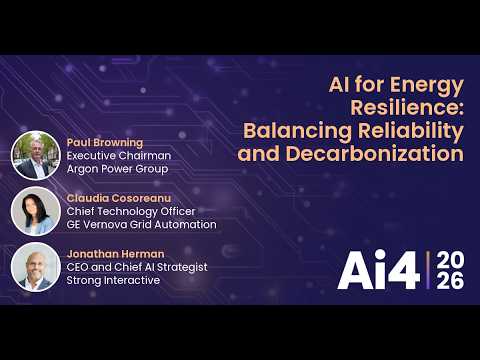
Published by Ai4 on YouTube on August 21, 2026, this video captures a panel discussion titled "AI for Energy Resilience: Balancing Reliability and Decarbonization." The session features industry leaders Paul Browning, Claudia Cosoreanu, and moderator Jonathan Herman discussing how AI can navigate volatile energy demand, reduce downtime, and model environmental risks to build future-proof energy systems.
## TL;DR
The panel explores the urgent energy crisis created by the rapid growth of AI data centers, which are projected to consume 950 TWh globally by 2030 and up to half of US energy production. Panelists highlight severe equipment backlogs, such as GE Vernova's six-year wait time on gas turbines, which forces companies to import and refurbish used generation hardware. To bridge this near-term gap, the speakers advocate for three key levers: long-duration storage (including green hydrogen), dynamic data center demand flexibility via geographic workload shifting, and "running the grid hotter" through dynamic line rating and AI-driven asset health monitoring. Ultimately, the discussion emphasizes that while long-term nuclear or space-based energy solutions are far off, immediate survival relies on a human-in-the-loop framework that leverages AI to optimize existing grid infrastructure.
## Atmosphere & style
The session carries an urgent, grounded, and pragmatic tone, balancing heavy technical depth with lighthearted pre-lunch crowd engagement. Panelist dynamics are sharp and complementary, pairing Browning's focus on heavy hardware generation with Cosoreanu's insight into grid automation and software intelligence. Rather than leaning into hyper-futuristic speculation, the conversational arc maintains a realistic, problem-solving feel focused on supply chain bottlenecks, operator trust, and immediate engineering compromises.
## Key takeaways
- [00:04](https://www.youtube.com/watch?v=xK2YiLGQWRQ&t=4s) Artificial intelligence requires massive amounts of energy, making electricity supply a primary bottleneck for future AI growth.
- [00:04](https://www.youtube.com/watch?v=xK2YiLGQWRQ&t=4s) Global electricity consumption by data centers is projected to nearly double from ~485 TWh in 2025 to ~950 TWh by 2030, equivalent to Japan's entire annual power usage.
- [00:04](https://www.youtube.com/watch?v=xK2YiLGQWRQ&t=4s) By 2030, US data centers are projected to account for roughly half of all domestic energy production.
- [00:04](https://www.youtube.com/watch?v=xK2YiLGQWRQ&t=4s) The immediate energy shortfall must be managed through three core levers: long-duration energy storage, flexible data center demand response, and optimizing existing grid infrastructure.
- [02:51](https://www.youtube.com/watch?v=xK2YiLGQWRQ&t=171s) Severe supply-chain backlogs have stretched lead times for new heavy-duty gas turbines out to six years, forcing companies to buy and refurbish used international turbines for data center deployment.
- [20:11](https://www.youtube.com/watch?v=xK2YiLGQWRQ&t=1211s) Microgrids and zonal autonomous control divide regional networks into self-balancing cells to handle distributed energy resources and maintain stability during peak loads.
- [20:11](https://www.youtube.com/watch?v=xK2YiLGQWRQ&t=1211s) Spatial misalignment between optimal renewable resource locations and aging 40- to 50-year-old grid infrastructure creates severe interconnection bottlenecks.
- [23:09](https://www.youtube.com/watch?v=xK2YiLGQWRQ&t=1389s) AI enhances the accuracy of load and renewable generation forecasting while enabling continuous digital-twin monitoring for asset anomaly detection.
- [25:27](https://www.youtube.com/watch?v=xK2YiLGQWRQ&t=1527s) Green hydrogen acts as a viable long-duration, seasonal energy storage medium for gas turbines, bridging the remaining capacity gap that short-duration batteries cannot cover.
- [25:27](https://www.youtube.com/watch?v=xK2YiLGQWRQ&t=1527s) Long-term options like nuclear power and hydrogen infrastructure cannot scale fast enough to meet the urgent 4- to 5-year power demand surge from AI.
- [28:14](https://www.youtube.com/watch?v=xK2YiLGQWRQ&t=1694s) Data centers can participate in demand response markets by dynamically shifting computational workloads across chip, server, or geographic facility levels based on latency requirements.
- [33:23](https://www.youtube.com/watch?v=xK2YiLGQWRQ&t=2003s) Dynamic Line Rating (DLR) and real-time AI thermal monitoring allow utilities to safely run transmission lines, transformers, and turbines hotter, unlocking up to 30% to 40% more capacity from existing assets.
- [37:35](https://www.youtube.com/watch?v=xK2YiLGQWRQ&t=2255s) Building trust with utilities and local communities requires early transparent communication and a human-in-the-loop approach for AI-driven grid decisions over the next 3 to 5 years.
- [41:24](https://www.youtube.com/watch?v=xK2YiLGQWRQ&t=2484s) As expanding grid instrumentation generates more data than humans can process, operator reliance on automated controls will naturally increase.
- [42:04](https://www.youtube.com/watch?v=xK2YiLGQWRQ&t=2524s) A reciprocal relationship defines the future of technology and infrastructure: AI needs energy to scale, and the energy grid needs AI to remain reliable.
## Detailed walkthrough
### [00:04](https://www.youtube.com/watch?v=xK2YiLGQWRQ&t=4s) Introduction and the Scale of the AI Energy Crisis
Panel moderator Jonathan Herman introduces the session titled *AI for Energy Resilience: Balancing Reliability and Decarbonization*, acknowledging that as the last panel before lunch, the audience might be feeling low on energy. Herman outlines his background as founder of Strong Interactive and founder of Airode, a company providing sovereign AI stacks to regulated industries, including nuclear power. He introduces panelists Paul Browning, Executive Chairman of Argon Power Group, and Claudia Cosoreanu, CTO of GE Vernova Grid Automation. Herman frames the discussion around a fundamental reality: artificial intelligence cannot exist without massive amounts of energy, a resource becoming increasingly scarce.
To illustrate the sheer scale of energy demand driven by AI, Herman presents several stark metrics and projections:
- **Global Consumption Surge:** Data center electricity consumption grew by approximately 485 terawatt-hours (TWh) in 2025 and is projected to reach roughly 950 TWh by 2030.
- **US Grid Impact:** Data centers are expected to account for approximately half of all United States energy production by 2030.
- **Unconventional Solutions:** While hyperscalers are recommissioning nuclear power plants, and companies like SpaceX explore space-based solar data centers or undersea hydroelectric units, these futuristic ideas remain years away from practical deployment.
- **Three Core Levers:** Herman proposes three primary levers to bridge the immediate energy gap while maintaining decarbonization goals:
1. Long-duration storage and changing capacity fuel sources.
2. Shifting demand via data center operational flexibility.
3. "Running the grid hotter" to maximize capacity from existing physical infrastructure.
---
[02:51](https://www.youtube.com/watch?v=xK2YiLGQWRQ&t=171s) Panelist Backgrounds and the Hardware Backlog
Herman introduces the panelists' specialized expertise from opposing ends of the energy landscape: Browning as a veteran of power generation machinery, and Cosoreanu as an expert in power transmission, protection, and automation. Browning highlights his deep experience in gas turbine development across GE, Mitsubishi Power Americas, and Solar Turbines (a Caterpillar company). His teams developed three of the four leading gas turbines powering heavy industry today: GE's HA frame, Mitsubishi's JAC frame, and Solar Turbines' Titan frame. Browning's current focus at Argon Power involves buying back gas turbines he sold 15 years ago in regions like India, Turkey, and the Middle East, refurbishing them, and bringing them back to the US for "behind-the-meter" deployment at data centers.
Cosoreanu emphasizes that generation means nothing without grid automation, protection, and monitoring to reliably deliver power from the plant to the consumer. Both panelists highlight that extreme equipment backlogs are crippling the rapid deployment of new power generation:
- **GE Vernova Backlog:** GE Vernova currently holds a backlog of approximately 125 gigawatts (GW) of power generation equipment while producing only about 20 GW annually—resulting in a six-year wait for new gas turbines.
- **Historic Demand Shift:** The US### Introduction and the Energy Intensity of AI
The session kicks off with panel moderator Jonathan Herman, founder of Strong Interactive and founder of AIrode—a company providing full sovereign AI stacks for regulated industries, including nuclear power—welcoming the audience. Acknowledging the pre-lunch timeslot, he pumps up the crowd's energy before introducing the main topic: the unavoidable physical reality of artificial intelligence. While public discussions surrounding AI typically focus on compute power, software models, and business transformations, AI cannot exist without massive amounts of electricity—a resource that is becoming increasingly scarce as AI adoption accelerates.
Herman frames the sheer scale of this energy demand with striking statistics and projections:
* Data center electricity consumption grew by approximately 485 TWh in 2025 and is projected to reach approximately 950 TWh by 2030.
* By 2030, data centers are expected to account for roughly half of all energy production in the United States.
* Hyperscalers are actively commissioning or recommissioning nuclear power facilities to secure dedicated baseload power.
* Unconventional energy concepts are being explored—such as SpaceX placing solar-powered data centers in orbit, or other companies sinking data centers into the ocean to leverage offshore hydropower—yet these non-traditional approaches remain years away from practical deployment.
To address this near-term supply-demand gap while maintaining progress toward decarbonization, Herman outlines three key operational levers:
1. **Long-duration storage:** Changing the profile of capacity burns.
2. **Data center flexibility:** Shifting demand dynamically across time and geography.
3. **Optimizing existing grid infrastructure:** Running the grid hotter and squeezing more throughput out of current assets.
[02:51](https://www.youtube.com/watch?v=xK2YiLGQWRQ&t=171s) Panelist Introductions: Generation vs. Grid Automation
Herman introduces the two expert panelists, representing opposite ends of the power infrastructure ecosystem: generation and grid management.
**Paul Browning**, Executive Chairman of Argon Power, brings deep experience in power generation equipment. Having built machines that make electrons throughout his career, Browning previously managed GE Vernova's heavy-duty gas turbine business, served as President and CEO of Mitsubishi Power Americas, and worked at Solar Turbines (owned by Caterpillar). Today, at Argon Power, his primary focus is locating gas turbines around the world, purchasing them, refurbishing them, and redeploying them "behind the meter" for data center applications. Browning notes that his teams developed and deployed three of the four primary heavy-duty gas turbines driving the global energy market today:
* GE Vernova’s HA class gas turbine
* Mitsubishi Power’s JAC class gas turbine
* Solar Turbines’ Titan gas turbine
Browning highlights his background in launching battery energy storage and renewable project development businesses during his tenure at Mitsubishi. He also shares his ongoing academic work as an adjunct professor at the University of Delaware, where he advises student research groups on the technical and financial feasibility of powering a 1-gigawatt (GW) data center behind the meter using renewable energy and storage.
**Claudia Cosoreanu**, Chief Technology Officer of GE Vernova Grid Automation, represents the downstream infrastructure intelligence that moves electricity once generated. Her division designs devices and software solutions covering substation protection, automation, control, monitoring, diagnostics, and industrial communications to ensure reliable power delivery. As Cosoreanu humorously summarizes: *"You generate the power, but without us, there is no power."* She emphasizes the mutual dependency between the two industries: AI is critical for energy optimization, but energy is equally critical to sustaining AI.
[06:56](https://www.youtube.com/watch?v=xK2YiLGQWRQ&t=416s) Quantifying the Energy Gap and Supply-Chain Backlogs
The discussion shifts to defining the true scale of the power deficit. To put the projected 950 TWh data center consumption into perspective, Browning points out that this matches the entire annual electricity consumption of Japan—one of the largest industrial power grids on Earth. Furthermore, individual hyper-scale data centers are now being planned in the 5 GW to 10 GW capacity range.
> "The city of New York... has an average load demand of about 6 and a half gigawatts and a peak that's about 10 gigawatts. So you're talking about having to build a behind-the-meter power plant for something that's like powering the entire financial capital of the world." — **Paul Browning**
This surge in demand hits an unprecedented supply-chain bottleneck. Browning points to GE Vernova's quarterly earnings call, which revealed a manufacturing backlog of approximately 125 GW against an annual production capacity of roughly 20 GW. This leaves lead times for popular heavy-duty gas turbines stretched out to six years across major original equipment manufacturers (OEMs), including GE Vernova, Mitsubishi Power, and Siemens Energy. This extreme shortage forces companies like Argon Power to source used turbines from international markets—such as India, Turkey, and the Middle East—to
[020:11] Microgrids, Autonomous Control, and the Grid Infrastructure Bottleneck
Claudia Cosoreanu describes how distributed energy resources (DERs)—such as electric vehicles and small-scale generation sources—can be grouped with localized electrical loads to form microgrids. Managed via energy management solutions, microgrids can balance their own generation and load locally and disconnect ("island") from the bulk power system when needed. For instance, if a data center's power needs threaten system stability, a self-sustaining microgrid can isolate itself, leaving the main grid available to serve higher-priority community loads.
GE Vernova is currently partnering with utility clients on a concept called **zonal autonomous control**, which divides the broader electrical network into smaller, independent cells capable of self-balancing. Deploying this architecture at scale requires AI to deliver precise load and generation forecasting alongside real-time asset anomaly detection.
A central challenge facing renewable energy deployment is spatial misalignment: optimal solar and wind resources are frequently located where the local power grid is weakest. Because bulk transmission infrastructure was built 40 to 50 years ago without accounting for distributed renewables, massive capital investment in grid interconnects and infrastructure buildup is essential to deliver power from resource-rich generation sites to demand centers.
- Microgrids integrate lower-power DERs and localized loads via smart Energy Management Systems (EMS).
- Zonal autonomous control splits power networks into self-balancing, autonomous cells using AI.
- AI forecasting for load, solar, and wind, combined with automated anomaly detection, is necessary for autonomous grid balancing.
- Existing grid assets are 40–50 years old, creating severe bottleneck risks at renewable interconnection points.
---
[023:09] AI-Driven Forecasting and Asset Health Monitoring
When asked what AI-driven grid solutions look like in active operation today, Cosoreanu explains that while generation and load forecasting are not new, traditional tools lacked the accuracy required for dynamic grid balancing. AI introduces an additional layer of intelligence that drastically improves prediction accuracy for fluctuating loads and intermittent renewable outputs.
Beyond load forecasting, AI plays a vital role in evaluating asset health to ensure microgrids can safely run in islanded mode. By pairing a physical asset's digital twin with real-time operational data, operators can evaluate whether equipment is performing within normal parameters or showing early signs of anomalies that demand manual intervention.
- AI acts as an accuracy-enhancing layer over traditional forecasting models for variable generation and load profiles.
- Digital twins combine baseline design models with real-time operational metrics to continuously evaluate asset health.
- Automated anomaly detection allows grid operators to catch performance degradation before equipment fails under load.
---
[025:27] Hydrogen-Fueled Gas Turbines for Long-Duration Energy Storage
Addressing short- and long-term grid stability, Paul Browning outlines the mechanics and practical realities of hydrogen-capable gas turbines. Produced via electrolysis powered by excess renewable energy, "green hydrogen" acts as a long-duration storage medium for clean power. Unlike battery energy storage systems (BESS), which excel at short-duration balancing, storing power as hydrogen molecules allows energy to be preserved affordably across weeks or seasons. This addresses the remaining ~8% of annual hours where renewables combined with short-duration batteries fall short.
Browning emphasizes that hydrogen power is no longer a theoretical solution, referencing a major project executed during his tenure at Mitsubishi alongside the Los Angeles Department of Water and Power (LADWP). The project shut down the last coal-fired plant supplying California—located in Delta, Utah—and replaced it with an 840-megawatt combined-cycle facility. The site integrates 220 megawatts of electrolysis to generate green hydrogen, storing it underground in two salt caverns, each roughly the size of the Empire State Building.
The Utah facility operates commercially using a blend of 30% hydrogen by volume and 70% natural gas, with an incremental pathway toward 100% hydrogen over time. The Los Angeles City Council recently approved a second hydrogen-fueled facility, the Scattergood project located within the LA basin.
While hydrogen and nuclear power represent viable long-duration energy solutions, Browning cautions that neither can scale fast enough to solve the immediate energy shortfall facing data center expansion over the next 4 to 5 years. Nuclear projects require 8 to 10 years to move the needle, and speculative ideas like space-based data centers fall outside near-term operational timelines. Consequently, demand-side management represents the primary mechanism capable of addressing the immediate power constraint.
- **Utah Project Scale:** Replaced a coal plant with an 840 MW combined-cycle plant paired with 220 MW of electrolysis capacity.
- **Underground Storage:** Two salt caverns, each equivalent in volume to the Empire State Building, provide seasonal hydrogen storage.
- **Fuel Blend:** Operational at 30% hydrogen by volume / 70% natural gas, targeting 100% hydrogen fuel over time.
- **Scattergood Project:** Second hydrogen power plant approved by the Los Angeles City Council within the LA basin.
- **Timeline Limits:** Hydrogen and nuclear are long-term fixes; neither can fully resolve the 4- to 5-year power crunch facing AI data centers.
---
[028:14] Demand-Side Flexibility and Data Center Workload Management
Cosoreanu highlights how the fundamental operation of the electric grid is undergoing a massive shift. Historically, power flowed unidirectionally from central generation plants through transmission and distribution to static consumers, with loads planned 3 to 5 years in advance. Today, grid operators must continuously reconcile variable, intermittent renewable generation with highly variable, unpredictable demand profiles. Achieving grid reliability requires dynamic demand-side flexibility.
To drive participation in flexibility programs, economic and market structures must incentivize load reductions. In several US states, demand response markets compensate commercial, industrial, and residential customers for dropping non-critical loads during severe peak events, such as heatwaves. Data centers are well-positioned to participate in these revenue-generating demand response mechanisms through intelligent workload shifting.
Workload management within data centers can be executed across multiple layers of the technology stack:
- **Board/Chip Level:** Dynamic load balancing between processor cores on a single printed circuit board.
- **Server Level:** Re-routing computational tasks between servers within a facility.
- **Facility Level:** Shifting non-latency-sensitive workloads between geographic regions.
Browning elaborates on geographic workload shifting, using an example where compute jobs are moved from a heat-stressed region like Arizona to a cooler facility in Colorado with surplus grid capacity. The critical variable in geographical shifting is network latency. High-priority workloads requiring instant execution remain local, while delay-tolerant batch jobs are offloaded to distant sites. Major technology companies, including Google, are actively publishing research and deploying software algorithms to execute dynamic latency-aware compute shifting across energy regions.
- Grid planning has shifted from static, 3- to 5-year forecast cycles to managing real-time double-ended variability (intermittent supply vs. variable demand).
- Demand response markets compensate large power consumers for voluntarily reducing load during regional grid peaks.
- Data centers can throttle power consumption at the core, server, or global facility level.
- Latency tolerance determines whether compute tasks can be migrated across regions to alleviate local power grids.
---
[033:23] Dynamic Line Rating and "Running the Grid Hotter"
Cosoreanu details how grid infrastructure constructed decades ago operates under rigid, static grid codes based on extreme worst-case seasonal peaks. Equipment is often sized for peak demand periods that last only six months of the year, leaving up to 50% unused grid capacity during off-peak periods.
To unlock this latent capacity without building new transmission lines, utilities are exploring **Dynamic Line Rating (DLR)**. DLR utilizes real-time environmental sensors to monitor conductor temperature and wind cooling effects, allowing utilities to safely push 30% to 40% more power through existing lines. However, line ratings are constrained by substation equipment on both ends, including transformers, circuit breakers, and protection relays, which are hard-coded to strict thermal limits.
By employing real-time AI monitoring and digital twin tracking on high-value equipment like power transformers, operators can safely run substation assets above baseline ratings for short, targeted windows—such as mid-day peak usage surges driven by high AI queries—while calculating exact thermal degradation and asset risk in real time.
Browning adds that the same principle applies to generation assets. Vendors like GE Vernova can run gas turbines above standard operating temperatures to output extra megawatts during critical, high-value grid hours. Although running turbines hotter shortens maintenance intervals, the premium value of power during critical peak hours makes the economic trade-off highly profitable.
- Static design codes leave up to 50% of nominal transmission capacity unutilized during non-peak operating windows.
- Dynamic Line Rating (DLR) leverages temperature and wind data to increase line throughput by 30% to 40%.
- AI asset monitoring evaluates real-time thermal stresses, enabling operators to safely overdrive transformers and turbines during high-value peak windows.
---
[037:35] Building Operational Trust and Keeping Humans in the Loop
In the panel's concluding minutes, the speakers address the critical human element: building trust with utility operators, regulators, and local communities. Browning notes that public opposition to data center projects is rarely resolved by presenting raw technical figures after community members have formed strong negative opinions. Presenting facts to a hostile room often results in distrust or accusations of falsifying data. The priority must be preserving public trust early through clear education regarding energy realities and the pragmatic compromises needed to sustain economic growth while infrastructure catches up.
From the utility operational standpoint, Cosoreanu stresses that utility grid operators share a single overarching imperative: keep the lights on without sacrificing system reliability. Because operators are risk-averse, adoption of AI tools requires clear demonstration through real-world utility pilots rather than theoretical marketing advocacy.
For the next 3 to 5 years, maintaining a **human-in-the-loop** architecture is essential for building operational confidence. AI systems will analyze millions of complex grid scenarios behind the scenes and present optimized operational recommendations, but human operators must retain final decision-making authority over grid control actions. Over time, as AI predictions consistently demonstrate safety and accuracy, operators will gradually transition toward higher levels of automated control.
- Restoring lost public trust is nearly impossible; early community engagement and transparent communication are essential for project approval.
- Utility adoption of AI relies on pragmatic, field-tested pilot projects rather than theoretical claims.
- Human-in-the-loop models will remain standard for 3 to 5 years, using AI for scenario analysis while human operators retain final execution authority.
[041:24] Building Trust in Grid Automation and Overcoming Human Limits
As grid instrumentation increases, the sheer volume of incoming data will rapidly exceed human processing capabilities. System operators will naturally lean more heavily on automated technology out of necessity. Over time, as these solutions consistently demonstrate reliability, operator trust in AI-driven grid controls will organically grow, enabling automated systems to manage complex split-second operations that human minds simply cannot handle.
- Rapidly expanding grid instrumentation generates far more data than the human brain can process.
- Growing operational reliance on technology will naturally accelerate operator trust in automated grid solutions.
[042:04] Near-Term Solutions and Closing Reflections
Reflecting on the three primary levers discussed to address current energy pressures—long-duration storage, dynamic demand management at data centers, and running grid assets harder and hotter—the panelists emphasized prioritizing near-term, actionable solutions. While long-term alternatives like nuclear power or orbital space data centers exist on distant horizons, managing demand at large loads and maximizing existing infrastructure represent the lowest-hanging fruit over the next three to seven years.
Closing the panel, the speakers underscored the symbiotic relationship between technology and infrastructure with a defining takeaway: "AI needs energy and energy needs AI." They urged the industry to ensure that energy grid development keeps pace with rapid technological advancements so the infrastructure is fully prepared to power the AI revolution.
- Key short-term grid levers include long-duration storage, flexible data center demand management, and optimizing current grid thermal ratings.
- Near-term grid optimization is far more practical and deployable within a 3–7 year window than capital-intensive or experimental concepts.
- The energy sector must actively modernize grid capacity to reliably sustain growing AI workload demands.
## Notable quotes
> [02:51](https://www.youtube.com/watch?v=xK2YiLGQWRQ&t=171s) You generate the power, but without us, there is no power. — Claudia Cosoreanu
> [06:56](https://www.youtube.com/watch?v=xK2YiLGQWRQ&t=416s) The city of New York... has an average load demand of about 6 and a half gigawatts and a peak that's about 10 gigawatts. So you're talking about having to build a behind-the-meter power plant for something that's like powering the entire financial capital of the world. — Paul Browning
> [42:04](https://www.youtube.com/watch?v=xK2YiLGQWRQ&t=2524s) AI needs energy and energy needs AI. — Panelists
## Mentioned
Airode, Ai4, Argon Power Group, Caterpillar, Claudia Cosoreanu, GE Vernova, GE Vernova Grid Automation, Google, Jonathan Herman, Los Angeles Department of Water and Power (LADWP), Mitsubishi Power Americas, Paul Browning, Scattergood project, Siemens Energy, Solar Turbines, SpaceX, Strong Interactive, University of Delaware
## Video description
Paul Browning - Executive Chairman, Argon Power Group
Claudia Cosoreanu - Chief Technology Officer, GE Vernova Grid Automation
Jonathan Herman - CEO and Chief AI Strategist, Strong Interactive
As the energy sector decarbonizes, AI plays a growing role in keeping the grid reliable and systems efficient. This panel features leaders from traditional and renewable sectors exploring how AI helps navigate volatile demand, reduce downtime, and model environmental risk. Learn how data-driven forecasting and predictive modeling are becoming mission-critical for resilient, future-proof energy systems.
Surging artificial intelligence workloads are creating an immediate power deficit that outpaces generation manufacturing timelines, requiring grid operators and data center owners to prioritize operational flexibility, grid asset overdriving, and short-term load shifting over slow-to-deploy generation assets.
The AI Consumption Surge and Equipment Backlogs (6:56)
Panel moderator Jonathan Herman cited projections that data center electricity use jumped roughly 485 TWh in 2025 and could hit 950 TWh by 2030, an amount equivalent to Japan's entire annual electricity demand. By 2030, data centers are projected to consume roughly half of all United States power production. At the same time, hyper-scale facilities are being planned for 5 GW to 10 GW capacities, comparable to the peak power demand of New York City.
Meeting this surge through new power plants is constrained by severe supply-chain bottlenecks. Argon Power Executive Chairman Paul Browning noted that major original equipment manufacturers face a six-year lead time on heavy-duty gas turbines, illustrated by GE Vernova's roughly 125 GW backlog against an annual production rate of 20 GW. Because long-term generation options like nuclear recommissioning or space-based solar units take years to deploy, Argon Power is sourcing and refurbishing older turbines previously sold to regions like India, Turkey, and the Middle East for domestic behind-the-meter use.
Squeezing Capacity from Existing Grid Assets
Because bulk transmission infrastructure was built 40 to 50 years ago, traditional static grid codes size equipment based on extreme seasonal peaks, leaving up to 50% of nominal transmission capacity unutilized during off-peak periods. Claudia Cosoreanu, CTO of GE Vernova Grid Automation, explained that utilities are testing Dynamic Line Rating (DLR), using local environmental and wind data to increase transmission line power flow by 30% to 40% without building new lines.
To push beyond hard-coded thermal limits in substations and generation facilities, operators are applying AI monitoring and digital twins to power transformers and gas turbines. Browning noted that running gas turbines above baseline operating temperatures during high-value peak windows yields additional megawatts; while this accelerates thermal degradation and shortens maintenance cycles, the premium value of peak power makes overdriving economically viable.
Decentralized Microgrids and Demand-Side Flexibility
Grid operations have shifted from predictable unidirectional power flows planned years in advance to balancing double-ended variability from intermittent renewables and dynamic consumer loads. To insulate the bulk power system, distributed energy resources are being linked into microgrids and self-balancing autonomous zones that can island themselves if a large facility threatens grid stability. Effective microgrid balancing depends on AI to forecast solar and wind output, model unpredictable load spikes, and detect early asset anomalies.
Concurrently, flexible data center architectures allow facilities to adapt to grid constraints and earn compensation in demand-response markets. Compute consumption can be throttled at the chip, server, or facility level. For non-latency-sensitive batch jobs, workloads can be routed away from heat-stressed regions like Arizona to cooler locations like Colorado, although real-time tasks remain constrained by latency requirements.
Long-Duration Storage and Operational Trust
While short-duration battery energy storage systems smooth daily fluctuations, clean long-duration storage is required for extended renewable deficits. Browning cited a commercial project with LADWP in Delta, Utah, which replaced an 840 MW coal facility with a combined-cycle plant running on 30% hydrogen and 70% natural gas, paired with 220 MW of electrolysis storing clean hydrogen in two underground salt caverns each the size of the Empire State Building. However, Browning warned that both hydrogen and nuclear require up to a decade to scale and cannot resolve data center power shortfalls over the next 4 to 5 years.
Implementing advanced digital solutions also depends on overcoming operational caution. Cosoreanu emphasized that grid operators prioritize reliability over novel software. Consequently, human-in-the-loop systems will remain standard for the next 3 to 5 years, relying on AI to simulate grid scenarios while leaving operational authority with humans until pilot track records build confidence.
The panel concluded that resolving the AI power crunch over the next 3 to 7 years depends on near-term tactical adjustments—specifically demand-side flexibility, dynamic line rating, and asset overdriving—rather than waiting on capital-intensive or speculative generation sources.
## Background
本文整理自科技频道 Ai4 于 2026 年 8 月 21 日在 YouTube 发布的研讨会视频,全长约 44 分钟。视频由 Strong Interactive 首席执行官 Jonathan Herman 主持,邀请了 Argon Power Group 执行董事长 Paul Browning 与 GE Vernova 首席技术官 Claudia Cosoreanu,共同探讨在能源脱碳的大背景下,如何利用人工智能技术应对数据中心爆发式增长带来的电力危机,兼顾电网可靠性与系统效率。
## TL;DR
这场研讨会深入剖析了人工智能算力激增与底层电力基础设施供应严重脱节的行业危机。由于大型设备交付延迟和电网并网排队长达数年,数据中心正在被迫转向“表后发电”和简单循环燃机等过桥方案,面临永久孤岛化的风险。专家们指出,在核能与氢能等长远方案落地之前,破解近期电力瓶颈的核心在于三大务实杠杆:利用 AI 驱动的数据中心多层级负荷灵活性调度、通过动态资产监控提升现有电网运行温度(Running the Grid Hotter),以及部署长时储能。技术落地的关键在于通过“人在回路”的试点模式建立公用事业运营商与公众对 AI 决策的信任。
## Atmosphere & style
对谈整体呈现出极高的专业度与务实严谨的工程碰撞氛围,在午餐前的轻松互动中迅速切入极为严峻的行业现实。两位嘉宾分别代表发电端与电网自动化两端的顶尖视角,既有相互打趣的默契,又有技术细节上的深刻互补。对话过程中充满实证数据与真实工程案例(如特拉华大学研究与犹他州氢能项目),将前沿的 AI 宏大叙事拉回至严苛的物理定律与供应链瓶颈,呈现出一种冷静、清醒且富有解法意识的专业探讨气场。
## Key takeaways
- [00:04](https://www.youtube.com/watch?v=xK2YiLGQWRQ&t=4s) 没有能源就没有人工智能,预计 2025 年到 2030 年数据中心用电量将从 485 TWh 飙升至 950 TWh,相当于日本全年的用电总量。
- [06:56](https://www.youtube.com/watch?v=xK2YiLGQWRQ&t=416s) 数据中心面临长达 5 到 7 年的电网并网排队与 4 到 6 年的燃机积压,迫使项目方在全球扫荡二手燃气轮机以实现表后发电(Behind the Meter)。
- [10:16](https://www.youtube.com/watch?v=xK2YiLGQWRQ&t=616s) 全球面临严重的电网侧投资脱节,发电侧投资规模接近电网侧的两倍,导致变压器与断路器等关键输配电基础设施严重缺货并出现并网审批积压。
- [13:28](https://www.youtube.com/watch?v=xK2YiLGQWRQ&t=808s) 弗吉尼亚等核心区域由于并网时间无法确定且改造成本飙升,许多数据中心正面临从过桥电力演变为永久孤岛化(Forever Islanded)自发电的现实风险。
- [16:32](https://www.youtube.com/watch?v=xK2YiLGQWRQ&t=992s) 可再生能源与电池储能虽能覆盖 90% 的常规用电需求,但在 Tier 3/4 的极高可用性考核下,数据中心仍需 100% 的燃机容量来应对冬季连续无风无光的极端时段。
- [18:57](https://www.youtube.com/watch?v=xK2YiLGQWRQ&t=1137s) 微电网配合能量管理系统(EMS)及分区自主控制(Zonal Autonomous Control),可实现子区域离网独立平衡,缓解老旧大电网的调度与输送瓶颈。
- [24:45](https://www.youtube.com/watch?v=xK2YiLGQWRQ&t=1485s) 以盐穴储氢联合循环电厂为代表的绿氢长时储能技术已实现商业化落地,但与先进核能一样建设周期漫长(需 8-10 年),难以解近渴。
- [28:10](https://www.youtube.com/watch?v=xK2YiLGQWRQ&t=1690s) 需求侧负荷灵活性(Demand Management)是短期内最可行的抓手,AI 作为连接中枢可通过芯片、服务器及跨地域调度容忍延迟的计算任务,实现削峰填谷。
- [33:24](https://www.youtube.com/watch?v=xK2YiLGQWRQ&t=2004s) 通过 AI 实时监控变电站变压器等资产的热寿命与状态,可在用电高峰期安全推高电网运行温度(Running the Grid Hotter),释放系统闲置冗余容量。
- [39:52](https://www.youtube.com/watch?v=xK2YiLGQWRQ&t=2392s) 在电网现代化推进中,未来 3 到 5 年必须维持人在回路(Human in the loop)架构,由 AI 辅助秒级推演海量工况并由调度员拍板,以逐步跨越行业与公众的信任鸿沟。
- [41:57](https://www.youtube.com/watch?v=xK2YiLGQWRQ&t=2517s) 在 3 到 7 年的近期紧平衡窗口内,需求侧负荷管理与压榨现有电网潜能是最立竿见影的低垂之果,AI 与能源基础设施必须双向协同演进。
## Detailed walkthrough
### [00:04](https://www.youtube.com/watch?v=xK2YiLGQWRQ&t=4s) 开场介绍与 AI 爆发带来的能源危机
主持人 Jonathan Herman 以幽默的互动唤醒了午餐前略显疲惫的观众。作为 Strong Interactive 的创始人兼首席 AI 战略家,以及为核电等受监管行业提供主权 AI 堆栈的企业 Airode 的创立者,他直奔主题指出:业内在讨论人工智能时往往聚焦于算力、软件和商业转型,但这一切的前提是能源——"没有能源,就没有人工智能"(there is no artificial intelligence without energy)。然而,随着 AI 需求的指数级暴增,电力正在成为极度稀缺的资源。
```mermaid
flowchart TD
accTitle: AI电力需求激增与应对路径
subgraph Demand ["AI 负载激增与现实缺口"]
D1["数据中心用电激增<br/>2025年 485 TWh → 2030年 950 TWh"]
D2["远期设想尚难解近渴<br/>太空太阳能 / 海底水力数据中心"]
D1 --> D2
end
subgraph Solutions ["弥合缺口的三大脱碳杠杆"]
S1["长时储能 (LDES)<br/>改变容量燃烧结构"]
S2["灵活性调度<br/>转移数据中心负荷"]
S3["提高电网运行温度<br/>挖掘现有资产潜能"]
end
Demand --> Solutions
```
数据中心的耗电量预计将从 2025 年的约 485 太瓦时(TWh)飙升至 2030 年的约 950 太瓦时;届时在美国,数据中心预计将消耗全美近一半的发电量。面对这一紧迫缺口,超大规模计算厂商(Hyperscalers)已开始重新启用或委托核电设施。尽管业界提出了一些前沿概念——如 SpaceX 计划将数据中心送入太空利用太阳能供电,或是将数据中心沉入海底利用水力发电——但这些方案远水解不了近渴。本次圆桌重点探讨在持续推进脱碳的前提下,弥合电力缺口的三大支柱杠杆:
- **长时储能技术(Long-Duration Storage)**:改变备用容量所消耗的燃料与介质结构。
- **负荷灵活性调度(Data Center Flexibility)**:依据电网状况动态转移计算与电力需求。
- **提高现有电网运行温度(Running the Grid Hotter)**:在不推倒重建的前提下榨取存量输配电基础设施的最大潜能。
---
### [02:57](https://www.youtube.com/watch?v=xK2YiLGQWRQ&t=177s) 嘉宾背景:发电端与电网自动化专家的对话
本次对谈汇聚了来自电力全产业链两端的顶尖行业老兵。Argon Power Group 执行董事长 Paul Browning 专注于"制造电子的机器"。他曾掌管 GE Vernova 的重型燃气轮机业务,出任过三菱电力美洲公司(Mitsubishi Power Americas)总裁兼首席执行官,早年还在卡特彼勒旗下的 Solar Turbines 工作。Paul 戏称当今支撑全球电力系统的四大主流燃机中,有三款(GE 的 HA 级、三菱的 JAC 级以及 Solar 的 Titan 燃气轮机)都是由他带领团队开发并推向市场的。如今,他带领 Argon Power 在全球范围内回购自己多年前售出的二手燃气轮机,进行翻新后运回美国,部署在数据中心现场进行"表后发电"(Behind the Meter)。同时,他在特拉华大学担任兼职教授,两年来一直指导学生团队研究如何利用可再生能源与储能为 1 吉瓦(GW)级的数据中心进行纯表后供电。
来自通用电气旗下 GE Vernova Grid Automation 的首席技术官 Claudia Cosoreanu 则专注于"电力产生后的智能化输配"。她的团队负责变电站保护、电网自动化、控制、监视诊断以及工业通信设备的设计与部署。Claudia 形象地将他们的使命总结为"点亮万家灯火"(we keep the lights on),并风趣地回应 Paul:"你们负责发电,但没有我们把电送出去,等于没有电。" 她强调,AI 对现代电网的稳定运行至关重要,但同样,能源也是 AI 能够持续发展的绝对基石。
---
### [06:56](https://www.youtube.com/watch?v=xK2YiLGQWRQ&t=416s) 供需失衡与设备积压:从日本电网规模到“表后发电”
谈及电力需求的规模时,Paul Browning 给出了极具视觉冲击力的对比:950 太瓦时相当于全球最大电网之一——整个日本全国一年的用电总量。而目前业界正在规划单体容量达 5 至 10 吉瓦(GW)的超大型数据中心。相比之下,整个纽约市所有行政区的平均电力负荷仅为 6.5 吉瓦,夏季峰值负荷也才大约 10 吉瓦;这意味着建造一个单体数据中心,就相当于要为整个全球金融之都建立一套专属的自备电厂。
```mermaid
flowchart LR
accTitle: 数据中心电力交付瓶颈与表后发电演变
subgraph GridQueue ["传统电网并网路径(严重受阻)"]
G1["AI 负荷爆发式增长"] --> G2["电网并网排队 5~7 年"]
G2 --> G3["燃机设备积压 4~6 年<br/>价格暴涨 3 倍"]
end
subgraph BehindTheMeter ["被迫转向表后发电 (BTM)"]
G3 --> B1["全球搜寻闲置/二手燃机<br/>(中东/土耳其/印度)"]
B1 --> B2["翻新并运抵美国数据中心现场"]
B2 --> B3["现场独立发电<br/>绕过公共输电网"]
end
```
然而,极速膨胀的需求撞上了极其严峻的供应链瓶颈:
- **设备交付周期过长**:GE Vernova 的燃机在手订单积压已达 125 吉瓦,而年产能仅约 20 吉瓦,排期长达 6 年;三菱和西门子同样售罄,未来 4 到 5 年内根本买不到新出厂的大型燃机。
- **二手设备翻新潮**:由于供需严重失衡导致设备价格暴涨三倍,企业不得不奔赴印度、土耳其、中东等地搜寻未充分利用的旧燃机,将其翻新后拉回美国本土救急。
- **二十年电网惯性被打破**:过去二十年里,受节能增效技术推动,美国整体电力需求基本维持平态;突然爆发的 AI 负荷让电网措手不及。
- **并网排队与表后发电**:目前全美大部分地区的公共电网并网排队等待时间长达 5 到 7 年。公用事业公司正在拼命抢购大型燃机,数据中心项目方则争相扫荡小型燃机以实现现场"表后发电"(Behind the Meter),即在数据中心园区内自建电厂自给自足。
---
### [10:16](https://www.youtube.com/watch?v=xK2YiLGQWRQ&t=616s) 电网侧投资脱节:发电激增遭遇输配电瓶颈
Claudia Cosoreanu 从电网基础设施的角度指出了问题的另一重核心症结:过去五到十年间,在脱碳政策的推动下,全球资本大量涌入发电侧,尤其是光伏(PV)等可再生能源领域。仅在 2025 年,全球发电侧投资就突破了 6000 亿美元,美国本土投资超过 2500 亿美元。然而,电网侧的配套投资却严重滞后,投资规模仅为发电侧的一半左右(全球电网投资约 3800 亿美元,美国约为 1000 亿至 1150 亿美元)。
| 投资领域 | 2025 年全球估算投资额 | 2025 年美国估算投资额 | 当前主要瓶颈与现状 |
|:--- |:--- |:--- |:--- |
| **电源/发电侧 (Generation)** | > 6000 亿美元 | > 2500 亿美元 | 集中于太阳能光伏与可再生能源,机组排产严重积压 |
| **电网/输配侧 (Grid)** | ~ 3800 亿美元 | ~ 1000 - 1150 亿美元 | 投资仅为发电侧的一半,变压器、断路器与智能调控容量严重不足 |
这种长期"重发电、轻电网"的投资断层导致了严峻的输配电瓶颈:即使建设了大量绿色发电设备,电网也没有足够的消纳与输送容量将电力送达负荷中心。随着大型数据中心接入需求的井喷,变压器、高压断路器以及保障电网可靠稳定运行所需的自动化监控与智能控制系统均面临着前所未有的承载极限。
### [12:17](https://www.youtube.com/watch?v=xK2YiLGQWRQ&t=737s) 电网并网积压与供应链瓶颈
Claudia 强调当前面临的危机远不止发电资产短缺,变压器、断路器以及所有与电网相关的关键设备都存在严重的积压。在并网审批方面,积压的项目规模更是令人震惊:美国有高达 2600 吉瓦(GW)的电力项目在排队等待,欧洲也有约 1700 吉瓦的待审项目。项目业主往往需要漫长等待 5 到 10 年才能拿到并网批准。
在这一严峻背景下,数据中心爆炸性的用电需求叠加进来,形成了多方力量在行业内部激烈碰撞的局面。时间周期的严重受限同时存在于两条战线:一侧是新增发电能力无法及时上线,另一侧则是电网容量受限、加固电网与实现互联所需的重型电气设备严重缺货。
- **美国并网排队规模**:约 2600 GW 的电力项目处于等待状态。
- **欧洲并网排队规模**:约 1700 GW 的项目正在排队。
- **项目等待周期**:项目方普遍面临 5 至 10 年的并网审批延误。
- **设备供应链堵塞**:变压器、断路器等关键并网基础设施严重供不应求。
---
### [13:28](https://www.youtube.com/watch?v=xK2YiLGQWRQ&t=808s) 数据中心的“过桥电力”策略与“孤岛化”现实
主持人向 Paul 提问:既然数据中心目前大量采购燃气轮机作为短期过渡方案,这种所谓“短期”到底有多现实?科技巨头何时才能真正摆脱对化石能源的依赖?
Paul 直言,像 Google、Amazon、Microsoft 这样的超大规模企业,最理想的方案自然是 100% 依赖电网供电且优先采用可再生能源。然而残酷的现实是眼下根本做不到。由于电网并网需要等 5 到 7 年,而数据中心在 2027 或 2028 年就必须上线投运,各大科技公司不得不退而求其次,采取所谓的“过桥电力解决方案”(Bridge Power Solutions)。它们在“表后”(behind-the-meter)直接采购并安装简单循环燃气轮机——虽然这些设备的燃料利用效率并不高——作为未来 5 到 7 年等待并网期间的自备电源。其既定策略是:待未来连入大电网后,通过在其他地方投资可再生能源项目,实现发电量与消耗量的 100% 抵消(哪怕不是同一小时的实时时空匹配)。
但现实情况正以惊人的速度恶化。以全球数据中心重镇弗吉尼亚州(Data Center Alley)为例,当地电力公用事业公司 Dominion 甚至已经不再向项目开发商提供任何明确的并网时间表,直接变成了“未定状态”,同时并网所需承担的改造成本却一路飙升。这导致许多数据中心开发者开始意识到:自己可能永远拿不到电网接入许可,不得不面临“永久孤岛化”(islanded forever)并终身自发电的局面。行业供应链危机极为严峻,GE Vernova、三菱(Mitsubishi)等主流燃机厂商的订单积压已排到 6 年之后。
```mermaid
flowchart TD
accTitle: 数据中心过桥电力方案演进路径
subgraph S1["现实困境与短期过渡 (当前~2028)"]
A["数据中心上线压力 (2027/2028)"] --> B["电网并网漫长等待 (5-10年/遥遥无期)"]
B --> C["表后安装简单循环燃气轮机<br/>(过桥电力方案 Bridge Power)"]
end
subgraph S2["规划目标 vs 现实风险"]
C --> D["理想路径: 接入电网 + 异地绿电配平 100% 抵消"]
C --> E["现实风险: 并网成本飙升 / 永久孤岛化 (Forever Islanded)"]
end
```
---
### [16:32](https://www.youtube.com/watch?v=xK2YiLGQWRQ&t=992s) 特拉华大学研究:容量(Capacity)与电量(Energy)的残酷鸿沟
主持人指出,必须厘清“能源可用量/电量”(Energy)与“实际装机容量/顶峰能力”(Capacity)之间的本质区别,尤其是在电网最极端恶劣的时刻。Paul 分享了他在特拉华大学(University of Delaware)指导学生进行的一项研究。他们最初的设想是探索能否通过部署“可再生能源 + 电池储能系统”,来减少数据中心在严苛考核期内所需的燃气轮机台数。
Paul 形象地打了个比方:“就像为家里买取暖炉一样,你必须按照一年中最冷那一天的极限需求去选型,而不是按全年平均气温选型。”最冷那一天的顶峰输出就是“容量”,而全年平均消耗就是“电量”。研究得出了一个令人沮丧的结论:
1. **常规时段表现优异**:在全年中约 90% 的小时里,“100% 可再生能源 + 电池储能”确实是最便宜、碳排放最低的最佳方案。
2. **严苛可靠性门槛**:数据中心必须满足 Tier 3(年均停机不得超过 1.5 小时)或 Tier 4(年均停机不得超过 26 分钟,即 99.99% 以上可用性)的严苛标准。
3. **极端天气瓶颈**:在 12 月和 1 月的冬季阴冷时期,日照时间短且可能出现连续数天风光骤减的极端天气,储能电池很快就会耗尽。为了确保这 90% 到 99.99% 可靠性之间的安全缺口,数据中心在那些极端小时里依然需要 100% 的燃气轮机容量来托底。
这意味着,虽然绿电能够大幅减少全年的碳排放总量(电量层面),但丝毫无法削减必须购置和备用的燃气轮机装机规模(容量层面)。
---
### [18:57](https://www.youtube.com/watch?v=xK2YiLGQWRQ&t=1137s) 分布式能源、微电网与分区自主控制(Zonal Autonomous Control)
针对电网互联与电源结构问题,Claudia 指出不存在任何单一发电技术(无论是燃机、可再生能源还是重获关注的核电)能够独立解决挑战,未来的核心在于多元能源结构的协同互补。其中极其关键的维度是**分布式能源(DERs)**——包括屋顶光伏、工商业光伏、电池储能系统以及电动汽车(EV)等。
尽管单个分布式能源的功率较小,但将它们与本地负荷聚合相连,便能构建起**微电网(Microgrid)**。微电网通过能量管理系统(EMS)实现就地平衡,并且具备在必要时脱离主网“离网运行”的能力。例如,当主网负荷吃紧或数据中心需要保供时,具备自备电源的微电网可以自主解列,从而为主网上更关键的公共负荷腾出容量。
Claudia 透露,GE Vernova 目前正与公用事业客户合作研发一套名为**“分区自主控制”(Zonal Autonomous Control)**的创新方案:
- **电网蜂窝化/分区化**:将传统大型电力网络划分为规模更小的蜂窝单元或分区;
- **独立平衡**:使各子区域在不完全依赖大电网调度的前提下,实现本地发电与用电负荷的自主动态平衡;
- **解决电网错位矛盾**:传统电网是在 40 至 50 年前建成的,未曾考虑可再生能源的地理分布。如今风光资源最丰沛的地区,往往电网架构最为薄弱。通过增强互联投资与局部微电网自治,才能将清洁电力高效输送到负荷中心。
```mermaid
flowchart LR
accTitle: 分区自主控制与微电网运作机制
subgraph DER["分布式能源 (DERs)"]
direction TB
G1["屋顶/工商业光伏 (PV)"]
G2["电池储能系统 (BESS)"]
G3["电动汽车 (EVs)"]
end
subgraph MG["微电网系统 (Microgrid)"]
EMS["能量管理系统 (EMS)<br/>AI 负荷/发电预测"]
Load["本地负荷 (数据中心/重要设施)"]
end
subgraph Grid["大电网 (Macro Grid)"]
MainGrid["主电网 / 输电网络"]
end
DER --> EMS
EMS <--> Load
MG <-- "自主解列 / 动态并网<br/>(分区自主控制)" --> MainGrid
```
---
### [23:09](https://www.youtube.com/watch?v=xK2YiLGQWRQ&t=1389s) AI 赋能预测、数字孪生与氢能轮机展望
在谈及 AI 在上述电网架构演进中的具体落地场景时,Claudia 指出,传统的负荷与发电预测技术虽然存在已久,但预测精度一直难以满足新型电力系统的严苛要求。AI 正在成为提供高阶智能的关键层,不仅能大幅提升间歇性风光发电与负荷波动的预测精准度,还能在**资产健康管理(Asset Health)**与**数字孪生(Digital Twin)**中发挥核心作用。通过实时监测物理设备的实际运行工况并与数字孪生模型进行高频比对,AI 能够在微电网独立运行时精准识别资产异常,指导运行人员提前介入排障。
随后,主持人将话题引向下一个前沿热点:既然燃气轮机作为必不可少的顶峰过渡装备在短期内无法被替代,那么具备**掺氢/纯氢燃烧能力(Hydrogen Capable Turbines)**的燃机设备,究竟具备怎样的潜力与应用前景。
### [24:45](https://www.youtube.com/watch?v=xK2YiLGQWRQ&t=1485s) 绿氢长时储能的现实落地与近中期困境
利用可再生能源进行电解水制取的“绿氢”(Green Hydrogen),在当前阶段虽然成本依然高昂,但其核心价值在于将可再生电能转化为分子进行廉价且长期的储存。燃气轮机具备燃烧包括氢气在内的几乎任何燃料的能力,当使用绿氢替代天然气时,系统便能输出零碳电力。电池储能系统(BESS)通常只能应对短时间尺度的充放电,而氢能这种基于分子的储能形式,恰恰能够解决全年那“最为致命的 8% 极端时段”中风光配储无法胜任的供电难题。
保罗·布朗宁(Paul Browning)强调这绝非空中楼阁,他分享了此前在三菱动力(Mitsubishi Power)与洛杉矶水电局(LADWP)合作的标杆项目:他们关停了位于犹他州德尔塔(Delta, Utah)、为加州供电的最后一座燃煤电厂,并在原址替换为一座 840 兆瓦(MW)的大型联合循环电厂。该场地配备了 220 兆瓦的电解槽,利用多余绿电制氢,并储存在地下两个大小堪比帝国大厦(Empire State Building)的巨大盐穴中。该项目目前已进入商业运营阶段,初始采用 30% 氢气与 70% 天然气的体积混合燃烧,未来将逐步过渡到 100% 纯氢运行。就在本次讨论的前一天,洛杉矶市议会刚批准了位于洛杉矶盆地的第二个氢燃料电厂项目——Scattergood 项目。
尽管绿氢项目已经从两年前的设想变为现实,但保罗坦言,这些技术在未来数年内仍无法从根本上改变大局,无法化解眼下的短期能源危机。同样,核能虽然极具前景,但即便按最乐观的估计,也需要 8 到 10 年才能真正发挥规模化效应;至于将数据中心送入太空等设想,短期内更无法解燃眉之急。因此,面对近在咫尺的电力短缺,唯一能在短期内真正发挥关键作用的杠杆就是需求侧管理(Demand Management)——毕竟数据中心是“人类有史以来制造出的最聪明的机器”,如果有什么设备应当具备智能的需求响应能力,那必然是非超级智能数据中心莫属。
- **犹他州 Delta 绿氢电厂核心参数**:840 MW 联合循环机组,配套 220 MW 电解水制氢装置,拥有两个帝国大厦规模的地下储氢盐穴,初期混合 30% 体积比例氢气,目标实现 100% 纯氢。
- **Scattergood 项目**:洛杉矶市议会最新批准的位于洛杉矶盆地内部的第二个氢能发电转型项目。
- **技术时间窗口对比**:氢能与先进核能(需 8-10 年)属于中长期方案,短期 4-5 年内最可行的解法集中在需求响应与负荷管理。
---
### [28:10](https://www.youtube.com/watch?v=xK2YiLGQWRQ&t=1690s) 电网双向波动与数据中心的算力负载灵活性
传统电网在过去四五十年间遵循“发电—输电—配电—用电”的单向刚性模式,负荷和发电曲线极其清晰,公用事业公司可以提前 3 到 5 年制定规划。然而,克劳迪娅·科索雷亚努(Claudia Cosoreanu)指出,随着风能、太阳能等可再生能源以及分布式能源(DER)的大规模并网,发电侧呈现出高度的间歇性与不确定性;与此同时,负荷侧也变得愈发难以预测。现代电网运营商必须在“双向波动”的极端条件下维持系统平衡,这使得“灵活性”(Flexibility)成为了保障电网可靠性的核心诉求。
在需求响应(Demand Response)市场机制下,工商业及居民用户可以在用电高峰期(如酷暑所有人都开启空调时)主动削减非关键负荷并获取经济补偿。数据中心作为高密度的电力负荷实体,同样具备极高的负载调节潜力。克劳迪娅解释称,从技术架构上看,数据中心可以在多个层级实现计算负载的动态调度:在印刷电路板(PCB)层面跨核心迁移、在机架层面跨服务器调度,甚至借助先进软件在不同地域的数据中心之间进行跨区域转移。AI 在此过程中充当了预测与控制的“连接组织”(Connective Tissue),通过精确刻画数据中心在各层级的负荷特征,实时匹配电网的可靠性需求。
```mermaid
flowchart TD
accTitle: 数据中心多层级负荷调度与电网平衡架构
subgraph GridSide["电网侧 (Grid)"]
A["间歇性可再生能源 / DER"] --> B["电网可靠性监控与需求响应信号"]
end
subgraph AIControl["AI 预测与控制中枢 (Connective Tissue)"]
B <--> C["AI 负荷特征刻画与协同调度算法"]
end
subgraph DCSide["数据中心多层级灵活负载 (Workload Flexibility)"]
C --> D1["芯片级:跨核心计算负载迁移 (Cores)"]
C --> D2["服务器级:跨物理机任务迁移 (Servers)"]
C --> D3["地理级:跨区域算力转移 (跨数据中心)"]
end
```
针对跨区域数据中心调度,保罗补充了实际工程中的关键考量:例如在亚利桑那州夏季炎热、电网负荷见顶时,可以将计算任务转移到气温更凉爽、电力更充裕的科罗拉多州数据中心。这种地理跨度调度的核心在于对“延迟容忍度”(Latency)的分流处理。对于许多批处理或离线训练任务,毫秒级的网络延迟无关紧要;而对于需要即时响应的高交互任务,则保留在本地处理。目前谷歌(Google)已在此领域展开实践并发布了相关研究成果。在全年少数几个最危急的峰值小时内,这种灵活削峰能力将极大缓解局部电网的供电崩溃风险。
---
### [33:24](https://www.youtube.com/watch?v=xK2YiLGQWRQ&t=2004s) 提高电网运行温度(Running the Grid Hotter)与 AI 动态资产监控
除了需求侧的负荷弹性,电网供给侧也存在巨大的潜能挖掘空间,即通过“提高电网运行温度”(Running the Grid Hotter)来释放隐藏容量。传统电网的标准与规范大多制定于四五十年前,完全基于静态的最极端工况(如冬夏两季的最极端负荷峰值)来设计所有电气设备与互联接口。这意味着在一年中可能长达 6 个月的非极端工况期间,电网实际仅以 50% 的负荷水平运行,导致系统中长期闲置着高达 50% 的输电冗余容量。
目前行业内已开展了动态线路增容(Dynamic Line Rating, DLR)技术的尝试,通过实时监测输电导线的环境温度和风速,动态评估输电线路的承载上限,部分公用事业公司借此释放了 30% 至 40% 的输电容量。然而,克劳迪娅指出,单纯监测线路并不能彻底解决问题,因为线路两端的变电站内还包含变压器、断路器及继电保护装置等关键瓶颈设备。如果这些变电站核心资产不支持超限运行,整条线路就无法真正提高运行温度。
```mermaid
flowchart LR
accTitle: 动态增容与变电站瓶颈及 AI 破局路径
subgraph DLR["动态线路增容 (DLR)"]
A["监测导线风速与温度"] --> B["释放 30%-40% 输电潜力"]
end
subgraph Bottleneck["变电站瓶颈 (Substations)"]
B --> C["变压器 / 断路器 / 保护继电器"]
end
subgraph AISolution["AI 实时资产状态监控"]
D["AI 实时运行参数监控与热寿命评估"] --> C
C --> E["在午休算力高峰等关键时段安全超负荷运行"]
end
```
AI 在此展现出关键的赋能作用:通过对变电站资产(尤其是变压器)建立实时的性能与运行状态监测模型,运营商可以精准评估短期“超温超负荷运行”对设备内部绝缘与寿命的即时影响。例如,当所有人都在午餐时间集中使用 ChatGPT 导致局部负荷激增时,调度中心便可以有把握地允许变压器在特定的安全时间窗口内过载运行,而无需承担设备突然爆毁的灾难性风险。这种数据驱动的透明度打消了调度员对设备故障的本能担忧,使电网在不新建物理基础设施的情况下,以可靠、可控的方式榨取出宝贵的峰值输送容量。
### [37:10](https://www.youtube.com/watch?v=xK2YiLGQWRQ&t=2230s) 运行边界的权衡与公众信任的建立
在探讨电网极限调度时,GE Vernova 在精准把控设备运行裕度方面展现出了成熟的工程能力。在一年中电力供需最为紧绷、电价最为昂贵的极少数峰值时段,调度人员可以通过让燃气轮机以略高于常态的温度超负荷运行,在短时间内压榨出额外的数兆瓦电力。尽管这种操作会加速设备损耗并缩短维护周期,但在电力极度稀缺的关键窗口期,这种经济与安全之间的权衡往往具有极佳的商业合理性。
```mermaid
flowchart TD
accTitle: 从人在回路到高度智能的电网运营演进
subgraph S1["阶段一:试点与验证 (当前)"]
A["联合公用事业公司开展 Pilot 试点"] --> B["AI 运行海量后台仿真场景"]
end
subgraph S2["阶段二:人在回路 (未来 3-5 年)"]
B --> C["AI 提供优化方案与调度建议"]
C --> D["调度员拥有最终决策与执行权"]
D --> E["在实际操作中逐步建立专业信任"]
end
subgraph S3["阶段三:自主协同 (长远未来)"]
E --> F["电网高密度传感器与海量数据接入"]
F --> G["超出人类大脑即时处理极限"]
G --> H["调度员深度依赖 AI 自动化协同决策"]
end
```
然而,技术层面的突破只是电网现代化的一部分,真正的落地瓶颈往往在于人类的“信任”。随着社会大众对 AI 的焦虑和耸人听闻的新闻报道层出不穷,如何跨越公众与一线运营人员的信任鸿沟成为核心议题。保罗·布朗宁(Paul Browning)指出,信任必须依靠实际行动和实证来建立,而非单纯的宣传说教。
保罗分享了他参与社区听证会的经历:许多居民在前来抗议数据中心项目时,内心早已预设立场。即便工程师向他们摆出详实的数据与科学事实,只要这些数据不符合他们既有的认知,他们就会直接指责你在撒谎,或者以非专业视角全盘质疑数据的真实性。保罗强调,信任一旦在最初阶段丧失,后续想要重新建立将极其艰难。能源行业目前面临的重大课题,就是在各种长期解决方案尚未完全到位的过渡期内,做好公众教育,坦诚阐明现实挑战,并制定务实的应对策略以支撑这场 AI 革命。
### [39:52](https://www.youtube.com/watch?v=xK2YiLGQWRQ&t=2392s) 运营商信任构建与“人在回路”的关键过渡期
从电网运行的角度来看,公用事业公司(Utilities)的终极使命非常纯粹,那就是“保持电力供应畅通(Keep the lights on)”。克劳迪娅·科索雷亚努(Claudia Cosoreanu)明确表示,设备与软件提供商的角色是全力协助运营商完成这一使命,因此任何新技术的引入都绝不能以牺牲系统的可靠性为代价。为了打消运营人员的顾虑,GE Vernova 坚持与电力公司紧密协作,不仅从原理上透彻解释新技术的潜在收益,更通过现场试点项目(Pilots)一步步验证算法的稳定度与可行性。
在技术演进的路径上,克劳迪娅强调在未来 3 到 5 年内必须严格保持“人在回路(Human in the loop)”的架构。AI 系统的强项在于能够在后台秒级推演成千上万甚至数百万种运行工况与场景,并将最优推荐方案呈现在调度台前;但最终是否采纳该建议、是否执行调度指令,决定权必须牢牢掌握在人类调度员手中。这种人机协作模式为调度人员提供了充分观察、验证 AI 决策质量的窗口期,从而在日积月累的操作中逐步建立起对系统的深度信任。
展望更长远的未来,随着整个电网被越来越多的高精度传感器和智能仪器全面武装,系统所产生的实时数据量将彻底超越人类大脑的即时处理极限。届时,一线调度人员对 AI 决策辅助系统的依赖将不再仅仅是一种选择,而是应对超复杂电网形态时不可或缺的必然依托。
### [41:57](https://www.youtube.com/watch?v=xK2YiLGQWRQ&t=2517s) 近期破局支点与核心结语:AI 与能源的双向奔赴
在讨论进入尾声之际,主持人总结了本次座谈探讨的应对当前电力瓶颈的三大抓手:长时储能(Long-duration storage)、数据中心需求侧响应与负荷灵活性(Demand management)、以及提升电网既有资产的承载极限(Running the grid hotter)。在被问及最希望观众铭记的核心观点时,保罗·布朗宁直言,在未来 3 到 7 年这一迫在眉睫的紧平衡窗口期内,“需求侧负荷管理”和“压榨现有电网潜能”是当前触手可及、最易落地的“低垂之果(Lowest hanging fruit)”。
- **近期现实可行性**:保罗坦言,负荷调节与电网超频运行并非轻而易举,但相比于审批建设周期漫长的核电项目,或是将数据中心送入太空等遥远设想,它们是眼下最立竿见影、行业必须全力以赴推进的现实解法。
- **产业共生关系**:克劳迪娅在闭幕致辞中再次呼应了开场的核心理念——“AI 需要能源,能源也需要 AI(AI needs energy and energy needs AI)”。
- **协同发展的呼吁**:克劳迪娅提醒全行业,在全社会将目光聚焦于 AI 算力与算法迭代的同时,必须同步加大对底层电网基础设施的建设与升级,确保有充足、坚韧的绿色能源为 AI 的持续爆发保驾护航。
## Notable quotes
> [00:04](https://www.youtube.com/watch?v=xK2YiLGQWRQ&t=4s) 没有能源,就没有人工智能(there is no artificial intelligence without energy) — Jonathan Herman
> [02:57](https://www.youtube.com/watch?v=xK2YiLGQWRQ&t=177s) 点亮万家灯火(we keep the lights on) — Claudia Cosoreanu
> [02:57](https://www.youtube.com/watch?v=xK2YiLGQWRQ&t=177s) 你们负责发电,但没有我们把电送出去,等于没有电。 — Claudia Cosoreanu
> [13:28](https://www.youtube.com/watch?v=xK2YiLGQWRQ&t=808s) 永久孤岛化(islanded forever) — Paul Browning
> [16:32](https://www.youtube.com/watch?v=xK2YiLGQWRQ&t=992s) 就像为家里买取暖炉一样,你必须按照一年中最冷那一天的极限需求去选型,而不是按全年平均气温选型。 — Paul Browning
> [24:45](https://www.youtube.com/watch?v=xK2YiLGQWRQ&t=1485s) 人类有史以来制造出的最聪明的机器 — Paul Browning
> [39:52](https://www.youtube.com/watch?v=xK2YiLGQWRQ&t=2392s) 保持电力供应畅通(Keep the lights on) — Claudia Cosoreanu
> [41:57](https://www.youtube.com/watch?v=xK2YiLGQWRQ&t=2517s) 低垂之果(Lowest hanging fruit) — Paul Browning
> [41:57](https://www.youtube.com/watch?v=xK2YiLGQWRQ&t=2517s) AI 需要能源,能源也需要 AI(AI needs energy and energy needs AI) — Claudia Cosoreanu
## Mentioned
Jonathan Herman, Strong Interactive, Airode, Paul Browning, Argon Power Group, GE Vernova, GE Vernova Grid Automation, Claudia Cosoreanu, 三菱电力美洲公司 (Mitsubishi Power Americas), Solar Turbines, 卡特彼勒 (Caterpillar), 特拉华大学 (University of Delaware), SpaceX, Google, Amazon, Microsoft, 西门子 (Siemens), Dominion Energy, 洛杉矶水电局 (LADWP), Scattergood 项目, ChatGPT
## Video description
Paul Browning - Executive Chairman, Argon Power Group
Claudia Cosoreanu - Chief Technology Officer, GE Vernova Grid Automation
Jonathan Herman - CEO and Chief AI Strategist, Strong Interactive
As the energy sector decarbonizes, AI plays a growing role in keeping the grid reliable and systems efficient. This panel features leaders from traditional and renewable sectors exploring how AI helps navigate volatile demand, reduce downtime, and model environmental risk. Learn how data-driven forecasting and predictive modeling are becoming mission-critical for resilient, future-proof energy systems.
[Source](https://www.youtube.com/watch?v=xK2YiLGQWRQ)
Source quotes
[0:04] Jonathan Herman: 没有能源,就没有人工智能(there is no artificial intelligence without energy)
[2:57] Claudia Cosoreanu: 点亮万家灯火(we keep the lights on)
[2:57] Claudia Cosoreanu: 你们负责发电,但没有我们把电送出去,等于没有电。
[13:28] Paul Browning: 永久孤岛化(islanded forever)
[16:32] Paul Browning: 就像为家里买取暖炉一样,你必须按照一年中最冷那一天的极限需求去选型,而不是按全年平均气温选型。
[24:45] Paul Browning: 人类有史以来制造出的最聪明的机器
[39:52] Claudia Cosoreanu: 保持电力供应畅通(Keep the lights on)
[41:57] Paul Browning: 低垂之果(Lowest hanging fruit)
[41:57] Claudia Cosoreanu: AI 需要能源,能源也需要 AI(AI needs energy and energy needs AI)
Source quotes
[2:51] Claudia Cosoreanu: You generate the power, but without us, there is no power.
[6:56] Paul Browning: The city of New York... has an average load demand of about 6 and a half gigawatts and a peak that's about 10 gigawatts. So you're talking about having to build a behind-the-meter power plant for something that's like powering the entire financial capital of the world.
[42:04] Panelists: AI needs energy and energy needs AI.
Original transcript
[0:04] How's everyone doing? All right, I'm going to ask
that question again so we have a little bit more
[0:09] energy in the room. How's everyone doing? Okay,
fantastic. I know we are the last session right
[0:15] before lunch. That's when the belly starts
uh aching a little bit and we start to get
[0:19] a little distracted, but uh we hope to keep your
attention with a great panel today. Um I'm going
[0:26] to uh first introduce myself. I'm Jonathan Herman.
I am the uh founder uh of Strong Interactive. Uh
[0:32] for some reason uh Crunchbase currently ranks me
among the top 100 CEOs globally as well as one
[0:39] of the top 100 people in artificial intelligence.
Uh my connection to this topic is that I recently
[0:46] founded a company called Airode which provides uh
full sovereign AI stacks to regulated fields which
[0:54] includes the nuclear power industry. Um having
said that I am joined by two experts true experts
[1:01] uh specifically in this space uh who are going to
share their knowledge with us today. Um typically
[1:07] when we talk about artificial intelligence we talk
about compute we talk about software and we talk
[1:13] about business transition. But of course there
is no artificial intelligence without energy.
[1:18] Something which is seems to be becoming more
and more scarce as the demand uh for artificial
[1:24] intelligence increases. Data center electricity
consumption grew by approximately 485 terowatts
[1:33] in 2025 and is projected to reach approximately
950 terowatts by 2030. In the United States,
[1:41] data centers are expected to account for
approximately half of all energy production
[1:47] uh by the year 2030. At the same time,
we've heard in the in the news lines
[1:53] about hyperscalers that are now commissioning or
recommissioning nuclear power facilities to be
[1:59] able to satisfy that demand. Um, but there's
also growing concerns about data centers,
[2:04] which we hear every day. SpaceX intends to uh put
data centers in space and power them through solar
[2:11] energy. Others intend to place data centers in
the sea and power them by hydro power. But all of
[2:18] those ideas are still years away and not coming
fast enough for us to be able to utilize. So
[2:24] today's question is how do we close that gap while
continuing to decarbonize? And we're going to
[2:30] talk about three different levers for potentially
doing that. Uh the first is long duration storage
[2:37] uh changing what the capacity burns. The second is
moving the demand through data center flexibility.
[2:44] And the third lever uh for us to explore today is
running the grid hotter, getting more out of what
[2:51] already exists. So I'll start with a couple of
brief introductions and I'll ask them to fill in
[2:57] anything that I missed. Uh Paul Browning spent his
career building the machines that make electrons.
[3:04] He ran what is today GE Vernova's heavyduty gas
turbine business. He [clears throat] went on
[3:10] to run Mitsubishi Power Americas and today
he's the executive chairman of Argon Power
[3:16] uh buying gas turbines around the world and
redeploying them behind the meter for meter
[3:22] for data centers. And we also have Claudia Kosanu.
I was hoping to pronounce her name correctly. She
[3:30] just gave me a wink so I think I did okay. Uh
is the chief technology officer of GE Vernova
[3:35] grid automation. Uh she builds the intelligence
that moves electricity once it exists. Substa sub
[3:44] substation protection, automation, control
and diagnostics. The same landscape here,
[3:50] but really spoken from two ends of the of the
perspect of the spectrum. So at this point,
[3:56] I'm going to give you each few minutes or 45
seconds each, I guess, based on our timing,
[4:00] uh just to fill in the gaps of what I might
have missed. Well, you did a great job. Um yeah,
[4:05] I'm a I'm sort of a power gen guy, a gas turbine
guy. Um in addition to working for GE Vernova and
[4:13] Mitsubishi Power, I also earlier in my career
worked for a company called Solar Turbines,
[4:17] which is owned by Caterpillar. My uh sort of
claim to fame is, um there's three gas turbines
[4:24] right now that are sort of the leading gas well
there's actually four gas turbines right now.
[4:27] They're like the leading gas turbines powering
what's happening right now. and my teams and
[4:31] I um developed and deployed three of those four.
Uh the HA gas turbine at GE we we did while I was
[4:37] there. The JAC at Mitsubishi we introduced while
I was there. And then the Titan gas turbine from
[4:43] solar we we develop my team and I developed while
I was there. So, uh, and and right now what I'm
[4:49] doing is going around the world, um, buying gas
turbines that I actually sold 15 years ago and,
[4:56] um, refurbishing them and bringing them back to
the United States, putting them behind a meter for
[5:01] data center applications. In addition to all that,
when I was at Mitsubishi, we launched a battery
[5:05] energy storage business and we watch we launched a
renewable power project development business. So,
[5:09] I'm very pro renewables, pro- energy storage. Um
and uh I I um I'm uh an adjunct professor at the
[5:18] University of Delaware and I've had for two
years now student groups looking at how can
[5:23] we power a a one gigawatt data center behind the
meter using renewables and energy storage. So I
[5:28] also want to talk about uh some of that work.
All right. And Claudia Kosanu, I'm the chief
[5:36] technology officer for grid automation part of
G Vernova. Uh as Jonathan said, I um protect and
[5:45] um monitor the the electric grid. So what we do is
we design um devices and solutions for protection,
[5:53] automation, control, monitoring and diagnostics,
industrial communications so that we can move the
[6:02] uh the power from the generation
to the consumer in a reliable
[6:07] um way every day. So we like to talk about our
work as we keep the lights on. Uh so I think you
[6:15] generate the power but without us there is no
power. Um and I think this is a very important
[6:23] topic today because I would say AI is critical
for energy but also energy is critical for AI.
[6:32] So hopefully we're going to give a little bit of
a flavor on the topic. Thank you. So, a couple of
[6:38] brief session notes uh before we start. Um this
is a 45m minute session. Uh as was mentioned
[6:44] uh we will probably use the entire time. We may
not have time for Q&A during the session, but we
[6:50] will all hang out uh in the hallway afterwards.
Um so let's establish the size of the problem
[6:56] uh before we begin to offer solutions. Um Paul,
how much load is arriving uh when and against
[7:05] what delivery schedule? Yeah. So Jonathan rattled
off some numbers, you know, in the beginning. So,
[7:11] you know, 950 terowatt hours is like what this
the entire country of Japan, that's the size of
[7:17] their power grid. That's how much electricity the
[clears throat] country of Japan consumes. One of
[7:21] the largest power grids in the world. And that's
what data centers are going to be consuming,
[7:26] you know, in the very near future. There's data
centers right now that are being talked about in
[7:31] in the size range of 5 to 10 gawatts at a same at
a single data center. Just to put that in context,
[7:37] the city of New York, all what is it? 12 burrows
of New York um has a an average load demand of
[7:45] about 6 and a half gawatts and a peak that's about
10 gawatt. So you're talking about having to build
[7:51] a behind the meter power plant for something
that's like powering the entire financial capital
[7:57] of the world. Um so we're we're just getting into
truly extraordinary kinds of numbers right now.
[8:04] And the problem is uh if you go to GE Vernova and
you know the they just had an their earnings call
[8:11] their backlog is now like 125 gawatts of power
and they only produce about 20 gawatts a year. So
[8:17] they're backlogged for like six years particularly
on their most popular products some of the ones I
[8:22] mentioned earlier. Um Mitsubishi is the same way.
Seammens who just spoke before us is the same
[8:27] way. like you can't buy a new gas turbine anymore
that's delivered in the next you know four or five
[8:33] years. Uh which is why companies like mine are
coming around and trying to you know go around the
[8:37] world and pick up the pieces of what isn't being
utilized in India and Turkey and the Middle East
[8:42] and other places and bring it back to the US for
you know to for our own use. So there's just this
[8:49] enormous gap right now between supply and demand
which is creating basically a scarcity kind of
[8:56] environment where prices have tripled just gone
through the roof. Delivery schedules are way out
[9:02] and what's causing all that is that um the the the
demand for AI grew so rapidly and so unexpectedly
[9:09] that our power grids were just completely
unprepared for it. And this you know the
[9:14] US has been the demand for electricity in United
States has been almost flat for two decades now uh
[9:20] because of energy efficiency and and other things.
Um and now we have for the first time in in 20
[9:27] years we have to rapidly add power and nobody
predicted it. Um and so if you want to get a grid
[9:34] interconnect you now have to wait five to seven
years in most parts of our country. um which is
[9:39] what's been been driving these folks to put the um
the power what we call behind the meter. So behind
[9:44] the meter means instead of buying your electricity
from the power grid, you're going to install power
[9:49] on your site at your your uh data center um and uh
and produce the the power yourself. Nobody wants
[9:56] to do that, but that's what they're being forced
to do and that's what's uh driving all this. So
[10:02] the you know the utilities are buying the really
big gas turbines as fast as they can. Uh and then
[10:07] the data center projects are buying the smaller
gas turbines to put behind the meter as fast as
[10:11] they can and everything's sold out right now. So
Claudia, when we look at the two sides of this
[10:16] equation, generation and infrastructure, you know,
how do you see it uh from your vantage point? I
[10:22] was thinking as Paul was talking about it. Um
so the reality is that for the last 5 10 years
[10:30] um due to the push for decarbonization there's
been a lot of investment in generation primarily
[10:38] uh renewable generation with PVs being
like solar generation being the the most
[10:45] um that everyone invests in. Uh so we're looking
at more than $600 billion globally invested in um
[10:55] generation in the US alone, more than 250 billion
um in 2025. And so when you think about it,
[11:04] there's a lot of generation that has been invested
in. No one is talking about the grid. So there's
[11:12] um if you look at the investment on the grid 50%
of the generation investment was uh invested in
[11:19] the grid only. So about 100 115 billion in the
US and and maybe 380 globally. So what this
[11:30] um lack of investment in the grid created is
what um Paul was describing and and Jonathan
[11:36] earlier. So there is no um capacity on the grid
so that these generation um assets can be added.
[11:46] Plus with the data centers uh increase in in
demand and increase in in connection to the grid
[11:54] uh where we have we have an issue. The grid is all
about um transformers, all about circuit breakers,
[12:03] all about the intelligence that allows for the
grid to be um run as reliable as as possible. And
[12:12] as Jonathan mentioned earlier and I don't know
if you were off uh referring or Paul if you're
[12:17] referring to generation assets only that we're
backlogged we are backlogged in trans transformers
[12:25] circuit breakers everything that's related to
to the grid and then on the interconnection
[12:30] side there's uh an incredible amount of projects
that are still waiting to get the interconnection
[12:39] approval. So you look at 2600 gawatt of of power
in the US and about 1,700 gawatt of power projects
[12:50] in in Europe. So this is um incredible when
you think about it. There's times of like 5
[12:58] years to 10 years the project owners are waiting
to get that interconnection. and you add the the
[13:07] data centers on top of that um and you do have uh
colliding forces on on the industry. So there's
[13:16] timeline restrictions really on both sides on the
generation side as well as the grid capacity and
[13:22] and the equipment that's needed to firm up the
grid and create the interconnectivity. Um Paul,
[13:28] when we talk about these turbines that are
currently being used uh by new data centers,
[13:34] um these are being sold as a short-term solution,
right, for all of the environmental considerations
[13:40] and other things that we've heard about. Um how
realistic is this as a short time short-term
[13:47] uh problem and how quickly can we get to the other
side of that? Yeah, it's a so you know companies
[13:53] like Google and Amazon and um Microsoft they they
would like nothing better than to power their data
[14:00] centers 100% from the grid hope and preferably
with renewable power. Um the the the reality is
[14:08] right now that um that's not possible. And so
what they're all doing is what they're calling
[14:14] bridge power solutions where what they're saying
is okay I can't I can't get my interconnect for
[14:19] five to seven years. Um so and and I'll tell you
in a moment why building renewable power behind
[14:25] the behind the meter has some real limitations.
Um and so and and I you know I I need to get on
[14:34] on like I need to be powering my data center in
2027 or 2028. So what they're doing is they're
[14:41] they're buying gas turbines. They're actually
buying simple cycle gas turbines, which means,
[14:46] you know, not very fuel efficient gas turbines.
They're installing them behind behind the meter.
[14:51] And the idea is that's going to provide their
power for the next 5 to seven years while they
[14:56] wait for that interconnect agreement. When
they get interconnected to the power grid,
[15:01] they're simultaneously going to be building
renewable power projects. and and at a minimum
[15:06] what they want to be able to do is when that time
comes be able to offset 100% of their usage with
[15:12] by generating a similar amount of renewable
power somewhere else in the power grid. Now,
[15:17] it's not all in the at the same hour and there's
a lot of sort of things you can criticize it,
[15:21] but at a bottom line at a minimum, they want
to be able to say we're we're producing as
[15:26] much renewable power as we're consuming, even if
it's not time matched. Um, so that's really sort
[15:33] of their their basic strategy as it exists. Now,
there are some like the problem's getting worse,
[15:40] it's not getting better. So, for example, if
you're in Virginia, which is like data center
[15:44] alley, the the the utility there is Dominion. What
I'm hearing today from project developers of data
[15:50] centers is Dominion won't even tell them anymore
when they can get a grid interconnect. It's sort
[15:55] of like unknown. And at the same time, they're
seeing their cost to get that interconnect going
[16:00] through the roof. So they're they're sitting
there and they're saying, you know what,
[16:04] like maybe I'm never going to get an interconnect.
I might be islanded forever. I you know,
[16:08] I might be generate have to generate my own power
forever for this project. And that I mean that's
[16:13] something that's just sort of started to come
out in the last 6 to nine months. So and this
[16:17] thing is just I mean it's changing rapidly day by
day. And I tell people every day, I wake up every
[16:22] day surprised it's even worse today than it was
yesterday. And you hear some crazy new thing like,
[16:28] you know, Verova's backlog logged for six years
or, you know, Mitsubishi or whomever. Like,
[16:32] it's it's that acute of a of a problem. So,
there's also an important distinction that we need
[16:39] to draw between energy availability and actual
capacity. and the availability needs to be there
[16:47] in the worst hours of uh of the time when the
grid uh requires that energy the most. Um Paul,
[16:55] you had a study uh at University of Delaware um
which didn't exactly give you the results that
[17:01] you were looking for. Can you talk just a little
bit about that? Yeah. So, we have this fundamental
[17:05] shortage of gas turbines as I just talked about
and what I wanted my students looking at is how
[17:10] can we use renewable power to at least reduce the
number of gas turbines that are needed during this
[17:15] critical period of time. And so, the thing you
have to understand is there's a difference between
[17:20] capacity and energy. So, think of it this way like
if you're going to buy a furnace to to heat your
[17:25] home, you have to buy a furnace that's big enough
to do the job on the coldest day of the year,
[17:29] not the average day of the year, right? So being
there on the coldest day, that's capacity. Being
[17:34] there on the average day, that's sort of like
energy, right? So the problem with with powering
[17:39] a data center with 100% renewable power plus
battery energy storage is it's actually the
[17:46] best solution for about 90% of the hours of the
year. It's the cheapest, lowest carbon solution
[17:50] for about 90% of the hours of the year. But
data centers have to satisfy like tier three,
[17:55] tier four reliability. Tier three means you can
only be down for an hour and a half a year. And
[18:00] tier four means you can only be down for 26
minutes a year. So it's that gap between,
[18:05] you know, 90% and 99.99% that is where you need
uh where renewables plus battery energy storage
[18:13] don't don't fill it. And and it's it's a few days
in December and January where uh the sun you're
[18:21] not getting as much solar power. the days are
shorter um and you get multiple days of really low
[18:28] renewable production both wind and solar and so
your batteries run dry and on those days you need
[18:33] 100% of the of your data center load met by the
gas turbines. So the very disappointing result of
[18:39] this study was yes, we can use renewables to very
substantially reduce carbon emissions, but we we
[18:46] still need all those gas turbines because on those
those few hours of the year when the renewables
[18:51] and aren't there and the batteries are empty,
you you need you need the 100% of the gas turbine
[18:57] capacity. Claudia, how does interconnectivity
help resolve that problem? We're not there yet.
[19:03] uh you cited some of the challenges that we have
with getting to where we need to be but you know
[19:08] how will that help address that issue? Well
interconnectivity from the perspective and the
[19:17] grid of the grid. So um obviously we have um a few
generation sources. So we have the gas turbine,
[19:29] we have the um renewable generation, we have
nuclear now which is getting a little bit more
[19:35] attention. So the first of all the reality is
there is no one generation source that will
[19:42] answer these these questions or these challenges.
Um there will be a mix of of the generation.
[19:50] The one other dimension that we should look at is
distributed energy resources. And this is I hope
[19:56] everyone uh knows what that is. But if not, the
distributed energy resources are the the PV solars
[20:02] on on you know the their houses or commercial
um buildings, the battery storage, the electric
[20:11] vehicles and those generation sources. They're
lower uh energy, they're lower lower power, but
[20:19] uh they can together um get connected with a load
and you can create what is called a micro grid. So
[20:29] micro grid is a combination of generation
combination of loads and they get um they
[20:37] get connected they're balanced through an energy
management solution and then you can you can have
[20:44] um that particular micro grid disconnected from
the grid when needed. So, for example, if as uh
[20:54] as Paul mentioned, and I think we'll talk a little
bit more about it as well, um if you do need to to
[21:01] power a data center um and the micro grid has
its um its own power, you can disconnect that
[21:08] load from the grid and allow for more important uh
load to be served. Currently we're we're working
[21:16] uh with with our customers the utilities on
a solution that is called zonal autonomous
[21:21] control and for that we're what we're doing is
we're we're talking to them about the concept
[21:27] of splitting the the electric network in smaller
cells smaller zones that can have this balancing
[21:35] between generation and load independent from from
the grid. Um and for in order for us to do that
[21:44] we can we we need AI. So you will need to have
load and generation forecasting. You will need to
[21:52] understand the asset anomalies when they happen.
Um so this is just um an idea where AI can can be
[22:01] used. Um and we're we're working on demonstrating
whether that is that works uh or not. The other
[22:08] dimension of the DERS and and this um you know
potential disconnection from the grid is the fact
[22:16] that um when you have renewable, you have wind
and you have solar all of that depends on where
[22:22] you are. So this the sun is strong where it is
and the wind is strong where it is. Uh so you do
[22:29] need to have this um the the generation located
in the right place. The problem is the grid was
[22:37] built many many years ago 40 50 years ago and it
was designed without the renewable generation in
[22:44] mind. So right now you have generation where the
sun is strong but the grid is not strong. So those
[22:51] inter interconnections that you were talking
about, this is where we need to to make sure
[22:56] that as an industry we pay attention and we invest
in the grid to build up the infrastructure to to
[23:04] bring the power where it needs to be. I think
this is a really important point and I'm glad
[23:09] of our discussion about micro grids. Uh and what
are you seeing when you say that we need AI to
[23:16] be able to do proper forecasting and to develop
these systems? you know what are you seeing in
[23:21] action today? So there's um so forecasting load
forecasting generation forecasting it's been
[23:30] around for a while um but not with the right level
of accuracy. So AI is we believe that AI is going
[23:39] to be that layer additional layer of intelligence
where we're actually going to be able to predict
[23:45] the load and generation. Um we also are looking
at the asset health. So in order for for these
[23:54] micro grids to run independently we need to know
that the assets can withstand um the the load and
[24:04] just understanding the the digital twin as we call
it of the asset and then the real-time performance
[24:10] or the real-time operating conditions of that
particular asset. then you can determine whether
[24:15] the the the asset is um running as it should or
if there's any anomaly that an operator should go
[24:24] and and solve for. Paul, let's talk for a second
about hydrogen capable turbines. Um if turbines
[24:31] are are really the the go-to generation source
that we have today, again, as a temporary fix,
[24:37] not a long-term fix. Um but what do you see as
the potential of using hydrogen? Yeah. So first
[24:45] of all, if you're going to use hydrogen is pretty
expensive right now, especially if you produce it
[24:49] from renewable power. That's what we call green
hydrogen. So you you use renewable power with
[24:54] electrolysis. So you convert water into hydrogen
and oxygen. And that hydrogen then is is basically
[25:00] a store of renewable power. And gas turbines can
burn pretty much any fuel including hydrogen. So
[25:07] uh so if you can use hydrogen in the in a
gas turbine instead of natural gas or some
[25:11] other carbon based fuel um you get zerocarbon
electricity um that's basically renewable power
[25:18] that you stored some time ago. And the neat thing
about storing the power in a molecule is you can
[25:22] store molecules for a long period of time very
affordably. And so it's it sort of solves this
[25:27] problem that battery energy storage doesn't solve
for us. it goes after those 8% of the hours in a
[25:32] year where the you know renewables plus battery
is not the the best solution. Um so and and this
[25:39] this is not a pipe dream. Uh my team and me
at Mitsubishi uh worked with the Los Angeles
[25:43] Department of Water and Power. We shut down the
last coal fire power plant producing power for
[25:48] the state of California. It's in Delta, Utah.
And we replaced it with a 840 megawatt combined
[25:53] cycle power plant. That's a very very large power
plant. Um, and in addition, we have 220 megawatts
[26:00] of electrolysis on the same site that's pro that's
converting renewable power into hydrogen, storing
[26:05] it underground in in two huge salt caverns, each
one the size of the Empire State Building. Um,
[26:11] and this thing is in commercial operation right
now. Um, and is going to be using 30% hydrogen
[26:17] to start. So 30% hydrogen by volume, 70% natural
gas to reduce carbon emissions. And the plan is
[26:23] that over time, and it's going to take a little
while, but over time, we're going to get to be
[26:27] able to power it with 100% um hydrogen. And
just yesterday, the Los Angeles City Council
[26:34] just approved their second hydrogen fueled power
plant, which is actually going to be in the LA
[26:38] basin. It's a project called Scattergood. Um and
so, uh two years ago, this was a little bit of a
[26:44] pipe dream. Today, you know, we're actually things
are in commercial operation and we're actually
[26:49] building them. Um, and so it's it's a real
solution, but it's it's not going to like move the
[26:55] needle in a way that matters for for some number
of years. It's not going to solve this short-term
[27:01] problem we have. And by the way, and I'll probably
I'll just riff a little bit on this. Like I'm a
[27:06] big believer in nuclear power as well. We have
the same problem with nuclear power, though. It's
[27:10] a great solution that that might move the needle
in 10 years from now, u maybe 8 years from now if
[27:16] you're really optimistic. Um and uh and you know
sending data centers to space is a it's also you
[27:23] know just doesn't seem like something that's going
to move the needle in the next four or five years.
[27:27] Maybe Elon Musk will prove me wrong, but um you
know, right now it's just the only solution,
[27:33] which I think we're going to get to soon, that
might move the needle in a in a time matter that
[27:37] time frame that ma matters is demand management,
which is sort of the flip side of what um we were
[27:43] just talking on the on the um uh this supply
side of things. On the demand side of things,
[27:49] you know, these are the smartest machines humans
have ever produced, these data centers, right?
[27:53] if anything should be able to demand manage.
It should be you know a super intelligent
[27:58] uh you know data center uh and so you know there
and we'll get into this I think in a little bit
[28:03] later but you know that's the only thing I can see
that actually sort of deals with this near-term
[28:09] crisis. Well well I think it's a good segue
now actually. So and I think you know in our
[28:14] preparation call you know Claudia you spoke about
the potential of data center workload flexibility
[28:22] and I wanted to ask you to share your thoughts
on that. Definitely I think um so first of all
[28:28] flexibility is a relatively new concept even
for the grid. Uh traditionally the grid operated
[28:36] one way. So there was generation, transmission,
distribution, consumer. Um the the load and the
[28:45] generation profiles were pretty clear. Um the the
power the generation and the load were uh planned
[28:52] years in advance, 3 years, 5 years. Utilities
knew what they needed to do. This is changing
[28:59] now or has changed for for a couple of years now.
generation like renewable generation is variable
[29:06] and intermittent. So you can no longer predict or
or have your your profile as you as you used to
[29:14] be. On top of that, we talked about distributed
energy resources and those are also variable and
[29:22] intermittent. And so now you have operators that
are trying to balance a variable and intermittent
[29:30] generation with a variable and intermittent uh
load. And this is what flexibility is all about.
[29:37] So the ability to balance those uh those two so
that you can maintain the reliability of the grid.
[29:45] Now going back to um a and um another dimension
that that we really need to think about as an
[29:52] industry is the market. So who incentivizes anyone
to reduce their load? Today there is um there are
[30:01] some states especially in the US where um there
is a demand response market meaning industrial
[30:09] or commercial or even res residential loads or
consumers can choose to reduce their load for
[30:17] a particular um period of time. Let's say right
now where it's extremely hot outside and everyone
[30:25] wants the air conditioning to be turned on. These
loads can respond to reducing their loads and
[30:32] they do that by reducing their air conditioning
by reducing the non-critical loads and they get
[30:38] paid for it. Now data centers are loads as well
and they can and some of them are doing it today.
[30:48] they can reduce their load. And the way to think
about it is you can reduce your load by managing
[30:56] managing the workload as a data center. You can
do that if you think about the technology stack,
[31:03] you can do that at the very low level uh on a on
a printed circuit board between cores. So you can
[31:10] move load from one core to another. Uh you can
move load from one server to another. You can
[31:17] also move load from a data center to another if
it if you have the right technology and if you um
[31:25] if you have this this all connected and again I'll
mention an AI application. So in order to do that,
[31:32] we would need to characterize um accurately the
the load profile of those of those data centers at
[31:41] the different levels and then also understand the
grid um reliability needs and then balance the two
[31:50] um through through the technology. You do need
this connective tissue where which is software
[31:57] that does the the prediction and also the control.
Yeah. And when you know when you're moving power
[32:04] from one data center to another. So for example,
you know it's a hot day in Arizona in the middle
[32:08] of the summer and you move the load to a data
center in Colorado that happens to be having a
[32:13] cooler day and has plenty of power. The thing you
have to deal with there is is latency. you know,
[32:17] like maybe it's far maybe maybe your demand is
in Arizona and it's got to travel to Colorado and
[32:22] back. There's a lot of in data centers if they're
smart enough, they can figure out there's a lot of
[32:27] their demands that are put on them where latency
really isn't a a big problem. They you don't need
[32:33] the answer instantly. And then there's others
where you do need it instantly and the latency is
[32:37] critical. So if you keep those in Arizona and you
move everything that's non-critical to somewhere
[32:42] else, you can turn down your data center in
Arizona and and address, you know, that that's one
[32:48] way you can flexibility can can happen. And like
Google is working on this right now and they've
[32:53] published some some work on it. Um again, these
are the smartest the smartest things we've ever
[32:59] built. If anything can demand manage, you know,
it should be a data center. And that's really
[33:04] just one aspect of it. There's there's there's
there's plenty of others other ways that we can,
[33:10] you know, achieve a more flexible data center
load when we're in some of these very few number
[33:17] of very critical hours of the year. So, we're
talking about flexibility on the demand side,
[33:23] but also there was something that came out of
our discussions about running the grid hotter
[33:27] to actually pull more capacity out. Um, Claudia,
I thought you had some some really great insights
[33:33] to that which I also wanted you to share. Yes.
So think about the grid I mentioned earlier was
[33:41] designed 40 50 years ago and it was designed to
grid codes that that have been defined at that
[33:49] time. Um and they were also designed for somewhat
static um situations, operating situation meaning
[34:02] um and you mentioned this earlier. So if if I have
the the peak um in the winter or in the summer
[34:10] um that that calculation drives the calculation
of of all the equipment and the interconnections
[34:17] on the grid. What happens is let's say I I run
the the the grid 50% of the time or six months
[34:26] in a year at that high um demand and and load and
generation. So the the peak is 6 months of the of
[34:34] the year but the other six months of the year I
only run at 50% of that and I'm you know just just
[34:42] as an example. So what happens during that 50% of
the time I have a lot of capacity 50% on the grid
[34:52] that I am not using today. Um there has been some
work done uh maybe you've heard of dynamic line
[35:00] rating. So this was this is a solution that
monitors the the conductor the line for um
[35:09] temperature and for wind and it can determine if
I can run that the that line hotter and utilities
[35:19] some utilities have tried they're seeing 30 40%
capacity the problem is you have a substation at
[35:29] the end of the line actually on both both sides.
You have transformers, you have circuit breakers,
[35:36] and you also have protection. And none of these
will be allowing you to run that grid hotter
[35:43] unless you do something about it. And AI again can
come in to help. Uh I mentioned the asset um the
[35:54] understanding of of the asset u performance. So if
you do have a realtime understanding of the of the
[36:03] asset performance and the operating parameters of
that asset then you can do the same thing you can
[36:11] operate your transformer you can run it hotter
for a period of time so I'm not talking about
[36:16] running it for the entire year but for a period
of time when you I don't know there's there's a
[36:22] need for extra power uh for data center because
everyone is on chat GPT at lunch. Um but so you
[36:29] can do that and you also have a because you have
the understanding technology to understand the
[36:36] asset um operating conditions you actually can
understand what the impact is on that transformer
[36:44] um sort of real time. You can also choose to run
the grid hotter or not because the the transformer
[36:50] for example could fail at any time. And this is
really just running the grid hotter in a reliable
[36:58] way because the operators are afraid and for the
right reasons that if I do that my my equipment
[37:05] is going to fail. Yeah. And and sorry you can
actually do the same thing on the generation side
[37:10] and and Vernova is actually you know really good
at this um is is knowing that okay I can run my
[37:15] gas turbine hotter than normal produce a few more
megawws than normal for a short period of time.
[37:20] it's going to have some consequence on my
maintenance intervals and things like that,
[37:24] but you know, if it's one of these really
critical hours a year where the power is really,
[37:29] really valuable, that trade-off oftent times makes
really good economic sense. So, that's another
[37:35] aspect of sort of running the grid hotter.
So, we've got about seven minutes left. Uh,
[37:40] I want to make sure that we cover the last piece,
uh, which is trust. And you mentioned operators.
[37:45] Um, none of this works without folks who are not
really still familiar with AI. Um, and who again
[37:54] read those scary headlines and all the concerns
that we have society about the use of AI. Um,
[38:01] Paul, I think in our conversation you said that
trust is really built on uh demonstrating as
[38:06] opposed to advocacy. um if you can both speak a
little bit about how we take these and apply them
[38:12] in the real world through building the necessary
trust. Yeah, it's a really interesting thing. I've
[38:18] been to some of these um community events where
you know people come out and are protesting a
[38:23] data center project and um you know most of the
people who by the time they show up at that event
[38:28] they've already made their mind up and so you know
you can put facts and figures in front of them but
[38:34] if the facts and figures don't align with what
they've already decided they think the truth is
[38:39] then they either accuse you of lying or they you
know if they don't like your numbers then you must
[38:44] be lying or you know or they you know they they
they they challenge the numbers in some way that
[38:50] maybe an engineer wouldn't but but maybe you know
someone else would. So the the key thing is not
[38:58] losing the trust in the first place. You know once
you've lost it it's just really challenging to
[39:05] regain it. Uh and so that's that's why we you know
we have a a real job to do in sort of educating
[39:12] uh the the the public in general around sort of
what are the real challenges here? what are the
[39:18] real solutions and then what are we going to
do in this period of time when we're trying
[39:23] to put all these solutions in place but they're
not yet in place and we're having to make some
[39:27] really pragmatic decisions about you know how
do we sort of keep this AI revolution going
[39:33] while all this other stuff that catches up
with you know this thing we failed to predict
[39:39] um and and you know again that's that's a a real
time issue that we're dealing with right now. So,
[39:52] remember what I said at the beginning, we keep the
lights on. Well, the utilities have the same moto,
[39:59] right? They keep the lights on. Actually, they
keep the lights on. We're just helping them.
[40:04] Um so we do need to make sure that whatever we do
um is helping the the operators of the grid uh and
[40:12] it is not affecting the reliability um of of the
system. What we do is we work with utilities for
[40:20] any idea that that we come up with. We explain we
talk to them about the u the potential benefits
[40:29] and then we work on pilots. We do have a couple of
pilots working on uh that we're working on as we
[40:37] speak. Um the other thing that is really important
especially for the first I don't know 3 five years
[40:44] going going forward is to maintain the human in
the loop. So the AI can be that that technology
[40:53] that runs thousands, millions of scenarios behind
the scene and presents the result to the operator,
[41:02] but the operator is the one that's going to make
the decision to make the change or not make the
[41:08] change that the the AI is going to to suggest.
There will be a time. So for now I think that
[41:16] will allow the team the uh the operators to uh
really see the suggestions the recommendations
[41:24] and the solutions and with time they will build
that trust. There will also be a time where
[41:32] um you know we're we're instrumenting the grid we
want to have more data. We will have a lot more
[41:37] data than a human uh brain can process. So over
time the they will be leaning on the technology
[41:48] um a lot more because they will have to. So we've
talked about three levers that can be pulled in
[41:57] order to meet the moment and to help solve uh the
problem today. Uh we talked about uh long-term
[42:04] storage, long duration storage u moving the
demand and creating flexibility in the a in the
[42:10] data centers themselves uh and then also running
the grid hotter. Is there any last thing that you
[42:16] would like to leave the audience with just for
them to remember from this session? You know,
[42:20] from my point of view, as I I mentioned earlier,
that second one that we well, actually the second
[42:26] and the third one that we mentioned, um, demand
man, learning how to demand manage at data centers
[42:33] or in at at other other large loads that can turn
down when on those toughest days of the year. Um,
[42:41] and then, you know, running the grid hotter. those
are actually the things that actually we can do
[42:46] sort of right away or at least in a time frame
that that impacts this this 3, four, five, six,
[42:53] sevenyear kind of problem that we have right now.
And so I see those as as sort of like the lowest
[42:59] hanging fruit and the sort of easiest to deploy.
I'm not saying they're easy. I'm saying they're
[43:04] easier than some of these other alternatives that
you know out there like nuclear and other things.
[43:08] So uh or sending data centers to space or you
know those kind of things like to me that's
[43:13] the real near near-term opportunity and the and
the thing that we should really be going at as
[43:17] hard as we can. So for me first of all I want to
thank everyone that sat with us for 45 minutes. Um
[43:24] so thank you. I will just say what I said at the
beginning AI needs energy and energy needs AI. So
[43:34] um I I've said in many discussions yesterday
uh or presentations that talked about talked
[43:40] a lot about AI. Um we as a as an industry we
need to think about how do we make sure that
[43:48] um it's not only about AI but we keep an eye on
developing the grid so that we have the energy
[43:55] to support AI. Thank you both and thanks everyone
for attending today. We appreciate it. [applause]