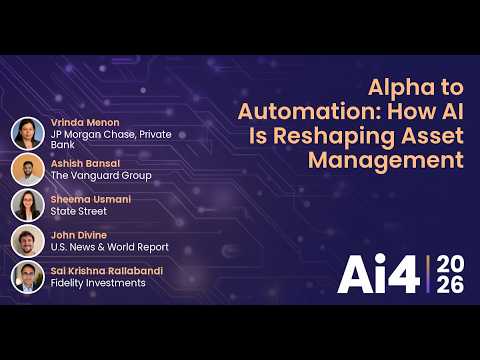
JPMorgan, Vanguard Execs Reject Pure AI Trading as Human Bias Persists
Ai4
Financial leaders from JPMorgan Chase, Vanguard, and State Street argue that artificial intelligence cannot permanently solve asset management because models reflect human behavioral flaws and require deterministic guardrails.
## Background
Published on YouTube by Ai4 on August 21, 2026, this panel discussion titled "Alpha to Automation: How AI Is Reshaping Asset Management" features industry leaders from JP Morgan Chase, U.S. News & World Report, State Street, Fidelity Investments, and Vanguard. The session explores how AI is moving beyond theoretical research to unlock actionable insights, lower operational costs, and scale client intelligence across dynamic financial markets.
## TL;DR
Financial leaders discuss the transition of artificial intelligence from basic task automation to multi-agent intelligence layers across asset and wealth management. Key operational shifts include measuring unit economics by cost per successful task rather than raw token usage, mitigating black-box risk through hybrid architectures that pair non-deterministic LLMs with deterministic calculation engines, and transitioning from static client personas to continuous hyper-personalization. The panel concludes that while AI unlocks new levels of institutional scalability, finance remains a balance of art and science that requires human judgment and rigorous governance.
## Atmosphere & style
The panel carries a polished, highly authoritative, and pragmatic tone characteristic of executive financial leadership. Discussions move smoothly between high-level strategic vision and granular architectural engineering, blending realistic caution about cost and compliance with genuine enthusiasm for transformative platforms. The dialogue feels candid, collaborative, and deeply grounded in real-world implementation rather than hype.
## Key takeaways
- [00:00](https://www.youtube.com/watch?v=Yp1Lo_W2p8k&t=0s) Enterprise focus in asset management is shifting from model research to production-scale operationalization and inference optimization.
- [00:00](https://www.youtube.com/watch?v=Yp1Lo_W2p8k&t=0s) Internal research highlights that over 80% of the U.S. population lacks access to a financial advisor, driving the push to build trusted AI companions.
- [04:31](https://www.youtube.com/watch?v=Yp1Lo_W2p8k&t=271s) Agentic systems analyze earnings call transcripts and real-time market data to capture subtle executive framing, sentiment, and tone across multiple time horizons.
- [07:59](https://www.youtube.com/watch?v=Yp1Lo_W2p8k&t=479s) Transforming legacy financial infrastructure requires holistic workflow redesign rather than merely layering AI tools onto existing operational complexity.
- [13:06](https://www.youtube.com/watch?v=Yp1Lo_W2p8k&t=786s) Human judgment remains essential in portfolio construction and client relations, whereas ideation, research, and compliance monitoring lean heavily on AI processing.
- [20:07](https://www.youtube.com/watch?v=Yp1Lo_W2p8k&t=1207s) Asset management firms are shifting unit economics from raw token consumption to measuring the cost per successful end-to-end task completed.
- [20:07](https://www.youtube.com/watch?v=Yp1Lo_W2p8k&t=1207s) Dynamic model routing sends lightweight subtasks to smaller models while reserving expensive frontier models for complex reasoning tasks.
- [24:13](https://www.youtube.com/watch?v=Yp1Lo_W2p8k&t=1453s) Early adoption of scalable AI architectures mirrors the early cloud computing transition, where initial infrastructure investments enabled long-term productivity gains.
- [28:20](https://www.youtube.com/watch?v=Yp1Lo_W2p8k&t=1700s) Hybrid architectures combine non-deterministic LLM data extraction with deterministic engines for precise financial calculations like discounted cash flow analysis.
- [28:20](https://www.youtube.com/watch?v=Yp1Lo_W2p8k&t=1700s) Evaluation suites for financial AI models should reserve up to 40% of test sets for out-of-distribution data to test performance during high market volatility.
- [34:32](https://www.youtube.com/watch?v=Yp1Lo_W2p8k&t=2072s) Smaller financial organizations should treat AI as a horizontal enabling layer and follow a 'crawl, walk, run' deployment strategy focusing on immediate pain points.
- [37:12](https://www.youtube.com/watch?v=Yp1Lo_W2p8k&t=2232s) Generative AI replaces static customer personas with continuous hyper-personalization by ingesting real-time client context without requiring model retraining.
- [40:09](https://www.youtube.com/watch?v=Yp1Lo_W2p8k&t=2409s) Agentic trading systems do not 'solve' asset management and often mirror human behavioral biases, emotional decisions, and inconsistencies.
- [41:50](https://www.youtube.com/watch?v=Yp1Lo_W2p8k&t=2510s) AI represents a foundational application platform shift, similar to smartphones, rather than a tool for incremental workflow automation.
- [43:38](https://www.youtube.com/watch?v=Yp1Lo_W2p8k&t=2618s) The next major milestone for financial AI is codifying deep human intuition and judgment to democratize high-fidelity advice globally.
## Detailed walkthrough
### [00:00](https://www.youtube.com/watch?v=Yp1Lo_W2p8k&t=0s) Welcoming the Panel and Setting Priorities
Moderator John Divine opens the panel discussion on how artificial intelligence is moving beyond theoretical research into practical, day-to-day implementation across asset and wealth management. The panel brings together data science, machine learning, and AI leaders from prominent financial institutions to discuss their frontline priorities and operational focuses.
```
+------------------+-------------------------------------------------------------+
| Speaker | Primary Current AI Focus |
+------------------+-------------------------------------------------------------+
| Ashish Bansal | Optimizing model inference to maximize ROI at scale |
| Sheema Usmani | Building AI companions to democratize financial advice |
| Vrinda Menon | Re-architecting legacy processes into intelligence layers |
| Sai Krishna | Developing agentic systems for complex financial workflows |
+------------------+-------------------------------------------------------------+
```
Each panelist shares their primary focus:
* **Ashish Bansal** concentrates on taking machine learning solutions from research to production environments at scale. He highlights model inference as a primary operational bottleneck and emphasizes optimizing inference across deployments to maximize return on investment (ROI).
* **Sheema Usmani** focuses on democratizing financial advice by developing trusted AI companions. She notes internal research showing that more than 80% of the US population lacks access to a financial advisor despite making daily financial decisions.
* **Vrinda Menon** leads efforts to re-evaluate legacy business operations designed around human-driven workflows. Her goal is to build persistent platforms that evolve with advancing AI models without requiring complete redesigns as capabilities improve.
* **Sai Krishna Rallabandi** focuses on agentic systems operating at the intersection of practical usability and action-oriented execution, addressing the unique operational challenges that arise when models transition from passive text generation to active decision-making.
---
[04:31](https://www.youtube.com/watch?v=Yp1Lo_W2p8k&t=271s) Capitalizing on High-Value Market Events via Agentic Systems
Sai Krishna details how agentic AI systems are applied to high-utility market events, using corporate earnings call transcripts as a primary case study. Because earnings announcements frequently drive substantial market capitalization swings, analyzing them requires capturing both explicit statements and underlying nuance.
Executive management teams often phrase statements carefully during earnings calls. Consequently, analyzing transcripts involves assessing non-verbal and contextual indicators, including tone, sentiment, and subtle shifts in executive framing across short-term (24 hours), medium-term (1 week), and longer horizons.
To deliver reliable output, agentic pipelines must manage diverse and noisy data streams, including real-time social media posts on platforms like X. Sai Krishna emphasizes that filtering low signal-to-noise ratios and establishing strict guardrails against numerical hallucinations are essential steps when translating raw market text into actionable trading signals.
---
[07:59](https://www.youtube.com/watch?v=Yp1Lo_W2p8k&t=479s) Transforming Legacy Infrastructure into Institutional Intelligence
Addressing legacy infrastructure in financial services, Vrinda Menon cautions against simply layering AI tools onto existing operational complexity. True transformation requires stepping back from incremental efficiencies and redesigning end-to-end workflows.
She illustrates this progression across three distinct operational layers:
1. **Task-Level Enhancement:** A research analyst uses AI to quickly summarize documents and isolate signals from market noise. While useful, this merely accelerates existing individual tasks.
2. **Integrated Intelligence Layers:** Synthesizing research, portfolio risks, market conditions, external macroeconomic events, and corporate updates into a unified intelligence layer transforms the analyst's capacity, moving from isolated speed gains to comprehensive decision support.
3. **End-to-End Workflow Redesign:** Re-evaluating traditional hand-offs across multiple departments allows organizations to streamline or eliminate intermediate steps. Unifying institutional knowledge—including tacit human expertise—creates an organizational intelligence layer capable of executing complex workflows efficiently.
Menon notes that moving to autonomous or semi-autonomous agents requires robust risk governance, deterministic safeguards for fiduciary duties, and predictable fallbacks to ensure consistency and compliance.
---
[13:06](https://www.youtube.com/watch?v=Yp1Lo_W2p8k&t=786s) Human-in-the-Loop Across the Investment Life Cycle
Ashish Bansal outlines how responsibilities split between automated AI systems and human expertise across the traditional investment life cycle.
* **Ideation & Research:** Highly data-intensive tasks—such as evaluating SEC filings, news streams, and earnings transcripts—benefit significantly from AI pattern recognition and automated synthesis.
* **Risk & Compliance:** Model-driven rule monitoring and vulnerability detection help ensure adherence to regulatory frameworks, though regulatory oversight remains strict.
* **Portfolio Construction & Client Communication:** These stages require human judgement. Tailoring portfolios to individual risk appetites and maintaining client relationships involve nuanced decisions that exceed pure rule-based logic.
The discussion highlights that while large language models excel at synthesizing unstructured text, they are not naturally "large numeric models." Because missing a single digit in financial figures can lead to severe errors, human verification and ensemble modeling—combining LLMs with quantitative, deep-learning, and outlier-detection models—remain critical safeguards in production environments.
---
<ElicitationsGroup message="Explore related aspects of AI implementation in asset management:">
<Elicitation label="Summarize Part 2 of this panel discussion" query="Provide a detailed walkthrough of Part 2 of the AI in Asset Management panel transcript."/>
<Elicitation label="Examine agentic AI guardrails in finance" query="What are the best practices for implementing guardrails and hallucination detection in financial AI agents?"/>
<ElicitationsGroup/>
[20:07](https://www.youtube.com/watch?v=Yp1Lo_W2p8k&t=1207s) Measuring Unit Economics: From Cost per Token to Successful Tasks
As artificial intelligence moves from experimentation into large-scale enterprise production, managing infrastructure costs becomes a central operational challenge. Sheema Usmani explains that her team at State Street has shifted away from measuring raw token consumption toward measuring the "cost per successful task completed." Relying solely on low-cost model responses can be economically deceiving if 60% of those outputs subsequently require expensive human review. Drawing on data from Epoch AI, she highlights that inference costs for fixed benchmarks drop by 9x to 900x annually, though user expectations for higher model capabilities continue to climb. When designing multi-agent systems, proper model routing is essential—directing low-cost, high-volume subtasks to lighter models while reserving high-cost, reasoning-heavy models for complex logic.
The expansion of multi-agent architectures—complete with inter-agent discussions, guardrails, and third-party Model Context Protocol (MCP) integrations—causes total token usage per task to explode due to retries and validation loops. Usmani emphasizes that real financial ROI stems from fundamentally redesigning and simplifying processes around AI capabilities rather than merely replicating legacy step-by-step workflows. When John Divine asks whether firms are currently satisfied with AI spending, Usmani notes that the field is evolving too rapidly for precise cost forecasting, and leadership across the industry remains eager for further cost stabilization and efficiency.
- **Inference Cost Benchmark:** Epoch AI estimates inference costs for identical model benchmarks decrease by 9x to 900x per year.
- **Task-Based Economics:** Evaluating AI value based on successful end-to-end task completion prevents hidden labor costs from human review loops.
- **Process Redesign:** True savings come from re-engineering workflows rather than automating traditional A-to-B-to-C operational steps verbatim.
---
[24:13](https://www.youtube.com/watch?v=Yp1Lo_W2p8k&t=1453s) Long-Term ROI and Inference Optimization Strategies
Vrinda Menon draws a direct parallel between current AI cost anxieties and the early adoption phase of cloud computing. Companies that committed to cloud-native architectures despite initial cost fears ultimately emerged as industry leaders, placing them in an ideal position to adopt large language models today. When AI doubles business output or quadruples worker productivity, raw infrastructure expenditures become secondary. Menon argues that between open-weight model ensembles and falling inference prices, unit costs will inevitably become a non-issue compared to the value delivered.
Sai Krishna Rallabandi and Ashish Bansal expand on the technical mechanics of cost reduction. Teams are actively implementing intelligent query routers, prompt caching at runtime, model preloading, and quantization to drive down per-token expenses. Addressing the current state of technology, Bansal points out that software engineering remains the single true "killer app" for LLMs so far. While generative tools assist in content creation, fields like finance and healthcare are still only scratching the surface, making hyper-focus on current token prices premature.
- **Cloud Parallel:** Early adopters who absorbed cloud infrastructure costs built the foundational architecture required for today's AI capabilities.
- **Technical Cost Controls:** Optimization strategies include model quantization, dynamic runtime prompt caching, and model warming.
- **State of Adoption:** Code generation represents the primary proven killer application for LLMs, with financial services positioned as a key emerging frontier.
---
[28:20](https://www.youtube.com/watch?v=Yp1Lo_W2p8k&t=1700s) Demystifying Black-Box Models via System Architecture and Deterministic Guardrails
Introducing "black-box" deep learning models into financial institutions naturally raises compliance and risk concerns. Bansal explains that data science teams often struggle to extract actionable metrics or logits from proprietary closed-source APIs to explain output generation. While black-box models serve well for rapid proof-of-concept testing, scaling client-facing products forces firms to evaluate whether to build sovereign, fully controllable models tailored to their internal standards.
To eliminate non-deterministic risk in critical calculations—such as discounted cash flow analysis—Rallabandi advocates for hybrid system design. In these architectures, the LLM is restricted to ingesting and parsing unstructured data, while underlying financial math is handed off to deterministic calculation engines. This approach preserves full auditability, allowing analysts to inspect the trace of how agents search, assimilate, and synthesize facts. Menon and Usmani add that models must expose confidence scores and assumption logs, while evaluation suites should test systems against out-of-distribution sample datasets to observe behavior during extreme market volatility.
- **Hybrid System Architecture:** Restricting LLMs to data ingestion while executing financial calculations through deterministic software prevents mathematical hallucinations.
- **Auditability and Traceability:** System logs must capture the full chain of agent searches, information assimilation steps, and underlying confidence levels.
- **Stress Testing:** Usmani notes that evaluated test sets should reserve approximately 40% for out-of-sample and out-of-distribution data to test performance against unexpected market conditions.
---
[34:32](https://www.youtube.com/watch?v=Yp1Lo_W2p8k&t=2072s) Implementation Strategies for Smaller Organizations
Addressing how smaller firms without massive data science teams can modernize their risk modeling, Bansal references a principle from Jeff Bezos: treat AI as a "horizontal enabling layer" rather than a standalone vertical stack. Smaller outfits should start by isolating small, well-understood components—such as a dedicated hallucination detection or prompt injection filter—and engineering those modular units to scale across the platform.
Menon recommends a pragmatic "crawl, walk, run" deployment strategy focused on solving an organization's most painful operational bottleneck first. Simple administrative tasks, such as document information extraction, are already solved problems that yield immediate productivity wins with base models. Capturing these early, measurable wins builds institutional knowledge and creates reusable components that lay the groundwork for sophisticated, bespoke AI deployments down the road.
- **Horizontal Layering:** AI should be integrated as an underlying layer across existing software components rather than bolted on as a separate system.
- **Crawl, Walk, Run Approach:** Begin with established, low-risk use cases like document extraction before attempting complex end-to-end automation.
- **Component Reuse:** Solving isolated pain points creates modular code assets and institutional expertise that can be leveraged across future projects.
---
[37:12](https://www.youtube.com/watch?v=Yp1Lo_W2p8k&t=2232s) Evolving from Static Customer Personas to Continuous Hyper-Personalization
In wealth management, client needs, risk tolerances, and priorities shift continually as life events occur—whether selling a business, having children, or transitioning toward legacy philanthropy. Menon clarifies that personalization cannot be treated as a static, one-time exercise. Wealth management platforms require continuous intelligence to monitor evolving client motivations and adjust portfolio recommendations dynamically throughout the client's lifecycle.
Usmani contrasts traditional market research—which groups investors into rigid, named customer personas—with AI-driven capabilities. Generative AI eliminates the need to map clients into fixed categories, allowing wealth managers to treat every individual as a unique "snowflake." Because large language models process rich contextual inputs in real time without requiring model retraining, advisors can deliver hyper-personalized insights tailored to an individual's exact life stage and financial circumstances.
- **Dynamic Financial Lifecycles:** Client goals alter dramatically over time due to personal milestones, requiring continuous background intelligence rather than static annual profiles.
- **Paradigm Shift in Personalization:** AI moves wealth management beyond traditional broad-bracket personas to true individual-level hyper-personalization.
- **Real-Time Contextual Adaptation:** LLMs ingest real-time life updates directly into context windows, providing tailored client insights without the overhead of retraining models.
[40:09](https://www.youtube.com/watch?v=Yp1Lo_W2p8k&t=2409s) Debunking the Myth of "Solving" Asset Management with AI
Addressing a pervasive misconception frequently seen on social media, the panel discusses the limitations of using large language models (LLMs) and agentic systems for financial trading. A key point highlighted is the false belief that finance is a static problem that can be completely solved to generate automated, effortless daily returns. In reality, agentic trading systems exhibit human-like biases, including making emotionally driven decisions or reversing previous choices. Asset management and finance cannot be treated purely as a mathematical formula or an equation with a single solution, as it inherently combines both art and science.
The moderator humorously laments that he cannot simply copy-trade his way into early retirement before steering the conversation toward final closing thoughts.
- Agentic systems do not eliminate behavioral flaws; they often mirror human biases, emotional decision-making, and inconsistency.
- Finance and asset management should be viewed as dynamic fields blending analytical discipline and art, rather than problems to be permanently "solved."
[41:50](https://www.youtube.com/watch?v=Yp1Lo_W2p8k&t=2510s) Reimagining Operating Models and Platform Shifts
As the discussion wraps up, the panelists reflect on the rapid evolution of artificial intelligence since the release of ChatGPT in late 2022. The progress from early foundational models to today’s advanced agentic workflows represents a significant step change, making previously intractable financial engineering problems actionable. Drawing an analogy to the advent of the smartphone, the speakers emphasize that AI is not merely incremental—much like smartphones did not just make better phone calls, AI is establishing an entirely new application platform.
Firms and leaders are urged to challenge existing paradigms and re-examine legacy processes. Operating models built around human constraints need to be completely reconsidered when empowered by autonomous AI agents, pushing organizations to aim for game-changing, structural transformations rather than minor operational improvements.
- The shift from basic LLMs to agentic systems opens up new opportunities to tackle complex industry challenges.
- Like the smartphone, AI provides a new foundational platform rather than just incremental automation for existing tasks.
- Organizations should actively question legacy workflows and determine whether their AI applications are creating transformative value or just minor efficiency gains.
[43:38](https://www.youtube.com/watch?v=Yp1Lo_W2p8k&t=2618s) Democratizing High-Fidelity Expertise and Concluding Remarks
The final panelist shares excitement about using AI to scale and democratize institutional expertise globally. While AI models have already demonstrated raw domain knowledge by passing rigorous professional tests—such as bar exams, CFP exams, and math olympiads—the next major frontier lies in capturing the nuanced judgment and pattern recognition that human experts acquire over decades of practice. Decoding and codifying this expert intuition into AI systems will enable high-fidelity financial guidance and vastly broaden access to quality advice for populations worldwide.
With those final insights, the moderator thanks the panel—featuring leaders from JPMorgan Chase, State Street, Fidelity Investments, and Vanguard—along with the audience, officially concluding the session.
- Models have already mastered basic test-taking knowledge across law, advice, and mathematics.
- The grand challenge for AI in asset management is capturing deep, experiential intuition and judgment to deliver reliable, high-fidelity guidance.
- Democratizing this level of expertise can significantly expand global access to institutional-quality financial management.
## Notable quotes
> [20:07](https://www.youtube.com/watch?v=Yp1Lo_W2p8k&t=1207s) Inference costs for fixed benchmarks drop by 9x to 900x annually. — Sheema Usmani
> [20:07](https://www.youtube.com/watch?v=Yp1Lo_W2p8k&t=1207s) Cost per successful task completed. — Sheema Usmani
> [24:13](https://www.youtube.com/watch?v=Yp1Lo_W2p8k&t=1453s) Software engineering remains the single true killer app for LLMs so far. — Ashish Bansal
> [34:32](https://www.youtube.com/watch?v=Yp1Lo_W2p8k&t=2072s) Treat AI as a horizontal enabling layer rather than a standalone vertical stack. — Ashish Bansal
> [37:12](https://www.youtube.com/watch?v=Yp1Lo_W2p8k&t=2232s) Generative AI eliminates the need to map clients into fixed categories, allowing wealth managers to treat every individual as a unique snowflake. — Sheema Usmani
> [40:09](https://www.youtube.com/watch?v=Yp1Lo_W2p8k&t=2409s) Asset management and finance cannot be treated purely as a mathematical formula or an equation with a single solution, as it inherently combines both art and science. — Sai Krishna Rallabandi
> [41:50](https://www.youtube.com/watch?v=Yp1Lo_W2p8k&t=2510s) AI is not merely incremental—much like smartphones did not just make better phone calls, AI is establishing an entirely new application platform. — Vrinda Menon
## Mentioned
Vrinda Menon, John Divine, Sheema Usmani, Sai Krishna Rallabandi, Ashish Bansal, JP Morgan Chase, U.S. News & World Report, State Street, Fidelity Investments, The Vanguard Group, Epoch AI, ChatGPT, Model Context Protocol (MCP), Jeff Bezos
## Video description
Vrinda Menon - CTO Transformative AI, JP Morgan Chase, Private Bank
John Divine - Assistant Managing Editor, Investing, U.S. News & World Report
Sheema Usmani - Vice President, Wealth Services R&D, State Street
Sai Krishna Rallabandi - Director, Data Science, Fidelity Investments
Ashish Bansal - Principal Machine Learning Engineer, The Vanguard Group
What does it take to stay ahead in a world of real-time markets and AI-powered competition? In this panel, leaders from asset managers and fintechs share how AI is unlocking new insights, cutting costs, and scaling client intelligence. From modeling to compliance, hear real-world case studies on how top firms are balancing innovation with oversight in today’s dynamic investment landscape.
摩根大通与先锋领航高管拒绝纯AI交易:人类偏见依然存在
来自摩根大通、先锋领航和道富银行的金融领袖认为,人工智能无法彻底解决资产管理问题,因为模型反映了人类的行为缺陷,且需要确定性的防护机制。
金融行业领袖探讨了人工智能在资产与财富管理领域中,如何从基础任务自动化迈向多智能体协作层。关键的运营转变包括:依据单次成功任务的成本而非单纯的Token消耗量来衡量单位经济效益;通过将非确定性LLM与确定性计算引擎相结合的混合架构来缓解黑箱风险;以及从静态客户画像向持续的超个性化转变。专家小组总结指出,尽管AI释放了更高水平的机构级可扩展性,但金融本质上仍是艺术与科学的结合,离不开人类的判断与严格的治理。
资产管理领域的企业关注点正从基础模型研究转向生产级落地与推理优化;由于超过80%的美国人口缺乏专业财务顾问,构建可信赖的 AI 陪伴助手成为推动理财普惠的核心方向。 (0:00)
针对财报电话会等高价值市场事件,智能体系统能够跨多个时间跨度捕捉高管言论中细微的语气与情绪转变,并依靠严格护栏过滤噪音以规避数值幻觉。 (4:31)
机构正在转变 AI 的单位经济学评估逻辑,从统计原始 Token 消耗转向衡量“单次端到端任务成功完成的成本”,并利用动态模型路由来兼顾任务效果与推理开销。 (20:07)
为应对金融合规与黑盒模型风险,领先机构采用混合系统架构:由大语言模型负责非结构化文本解析,核心金融计算则交由确定性引擎处理以确保全流程可审计。 (28:20)
Reading summary
Deploying artificial intelligence in asset and wealth management requires transitioning from isolated task automation to systemic workflow redesign, combining generative models with deterministic safeguards to protect fiduciary integrity. Data science leaders from major institutions argue that while AI unlocks continuous personalization and deep unstructured research, sustainable value depends on re-engineering operating models rather than treating finance as a fully automatable formula.
Hybrid Architectures and Deterministic Safeguards (28:20)
Large language models excel at synthesizing unstructured data—such as mining corporate earnings call transcripts, evaluating tone, and reviewing regulatory filings—but Ashish Bansal and Sai Krishna Rallabandi emphasize that they are not reliable numeric models. Because financial calculations tolerate zero error, deploying AI in live trading and advisory pipelines demands a clear separation of duties. In high-stakes analyses like discounted cash flow modeling, agentic systems should be restricted to unstructured extraction, immediately passing standardized inputs to deterministic engines.
To ensure fiduciary compliance, institutions must construct verifiable audit trails that track agent search logic, assimilation steps, and model confidence scores. Sheema Usmani and Vrinda Menon note that production evaluation requires testing systems against out-of-distribution sample data—reserving roughly 40% of test sets for extreme, volatile market scenarios to ensure predictable system behavior.
Re-Architecting Workflows Beyond Incremental Automation (7:59)
Vrinda Menon cautions against simply layering generative tools onto legacy institutional complexity. Real productivity gains require progressing through three levels: from basic task enhancement (such as research summarization) to integrated intelligence layers, and ultimately to the end-to-end redesign of inter-departmental workflows that eliminate traditional operational hand-offs.
For smaller organizations lacking large machine learning teams, Bansal advises viewing AI as a horizontal enabling layer across existing software rather than a dedicated vertical stack. Menon recommends a pragmatic 'crawl, walk, run' deployment strategy that begins by resolving clear administrative bottlenecks—such as automated document extraction—before attempting to build complex autonomous pipelines.
Reframing Unit Economics Around Completed Tasks (20:07)
As enterprise deployments expand, managing inference expenses has become a critical operational priority. Usmani explains that State Street evaluates infrastructure by the cost per successful end-to-end task rather than raw token usage, noting that low-cost model outputs generate negative returns if a majority require subsequent human remediation. Although Epoch AI benchmarks indicate that fixed-capability inference costs fall by 9x to 900x annually, token consumption continues to rise due to validation loops and multi-agent coordination.
To optimize expenditure, engineering teams rely on intelligent query routers that send routine tasks to lightweight models while reserving expensive frontier models for complex reasoning. Menon compares current AI cost anxieties to the early adoption of cloud infrastructure, arguing that operational output and productivity gains will ultimately outweigh unit inference costs.
Dynamic Personalization and Automation Limits (37:12)
In wealth management, generative AI is replacing static customer personas with dynamic hyper-personalization. Menon and Usmani point out that client circumstances, risk tolerances, and goals change continuously across life events. Because large models process rich contextual updates in real time without model retraining, advisors can deliver individualized guidance, helping bridge an access gap in which over 80% of the US population lacks financial advisory services.
However, the panel debunks the idea that asset management is a static problem that agentic systems can solve for effortless automated returns. Autonomous agents frequently mirror human behavioral flaws, including emotional swings and inconsistent decisions. Because asset allocation remains an evolving discipline combining qualitative art with quantitative science, human-in-the-loop judgment remains essential in portfolio design and fiduciary relationship management.
While agentic AI represents a foundational platform shift akin to cloud computing or mobile technology, the panelists emphasize that models cannot eliminate market risk or behavioral biases. The primary frontier for the industry is codifying expert human intuition and institutional knowledge into transparent, hybrid architectures that democratize high-fidelity financial advice.
## Background
本内容由 Ai4 于 2026 年 8 月 21 日发布在 YouTube 平台上,视频时长约为 44 分钟。内容为一场圆桌论坛,汇聚了来自摩根大通、先锋领航、道富银行、富达投资等顶尖金融机构的 AI 技术与业务领袖,共同探讨人工智能在资产管理与财富管理中的实战落地、降本增效、合规风控及业务重塑。
## TL;DR
论坛深入探讨了 AI 与智能体系统(Agentic Systems)在资管全生命周期中的应用重构与工程挑战。嘉宾们指出,企业应避免仅在旧流程上做点状修补,而应通过端到端的流程重塑和模型路由(Model Routing)兼顾颠覆性价值与单位经济学成本。针对大模型的“黑盒”与数值幻觉缺陷,需采用人机协同(Human-in-the-Loop)、计算解耦与确定性系统工程加以约束;同时,AI 正在推动财富管理从静态用户画像迈向生命周期的“超个性化”,并有望最终实现专业投资顾问能力的全面普惠。
## Atmosphere & style
整场圆桌讨论务实严谨且兼具行业前瞻性,嘉宾们既有硬核的技术架构洞察,又有宏观的商业敏锐度。主持人风趣的适时穿插与嘉宾幽默坦诚的交锋相得益彰,不仅打破了金融 AI 领域“一键暴富/全自动套利”的营销泡沫,更在理性拆解算力瓶颈与工程挑战的过程中,传递出对 AI 重塑财富管理生态的坚定信心与探索热情。
## Key takeaways
- [00:00](https://www.youtube.com/watch?v=Yp1Lo_W2p8k&t=0s) 资管机构落地 AI 的核心瓶颈已从研究探索转向生产推理,推理优化与降低算力成本成为决定大规模生产部署 ROI 的关键。
- [04:31](https://www.youtube.com/watch?v=Yp1Lo_W2p8k&t=271s) 财报电话会等金融场景需要多模态与因果推理,高管言语粉饰与低信噪比要求智能体具备极高的防幻觉护栏,单一数字偏差即可能引发重大财务损失。
- [07:59](https://www.youtube.com/watch?v=Yp1Lo_W2p8k&t=479s) 突破遗留系统不能仅停留在单点提效或文档总结,而应融合宏观风险与企业隐性知识,重塑端到端业务流并构建全局机构智能层。
- [11:45](https://www.youtube.com/watch?v=Yp1Lo_W2p8k&t=705s) 在金融信托领域应用智能体必须建立严格的治理架构,明确区分自主、半自主与受控智能体,并引入偏航保障机制以确保行为的确定性与一致性。
- [13:00](https://www.youtube.com/watch?v=Yp1Lo_W2p8k&t=780s) 投资生命周期呈现明确的 AI 与人机协作分工:构想研究和规则风险分析由 AI 主导,而资产组合构建与客户深度沟通必须保留 Human-in-the-Loop。
- [17:34](https://www.youtube.com/watch?v=Yp1Lo_W2p8k&t=1054s) 当前主流模型是 LLM 而非数值模型,极易发生数值计算错误;金融机构需通过模型集成(Ensemble)将逻辑推理与擅长精确计算的算法结合。
- [20:07](https://www.youtube.com/watch?v=Yp1Lo_W2p8k&t=1207s) 衡量 AI 投入产出比的指标正在从单 Token 成本转向“成功完成任务成本”,通过智能模型路由分流轻重任务是控制多智能体 Token 爆炸的核心策略。
- [24:13](https://www.youtube.com/watch?v=Yp1Lo_W2p8k&t=1453s) 类比云计算的普及历史,当 AI 能够带来数倍生产力跃升或业务翻倍时,前期的推理与基础设施成本在宏观价值面前终将边缘化。
- [25:42](https://www.youtube.com/watch?v=Yp1Lo_W2p8k&t=1542s) 编程是大模型目前唯一被彻底验证的杀手级应用,金融场景虽处早期,但过早过度纠结于算力成本反而容易错失战略先机。
- [28:11](https://www.youtube.com/watch?v=Yp1Lo_W2p8k&t=1691s) 闭源 API 隐藏对数概率等底层信息带来可解释性困局,推动核心金融场景逐步转向自研主权模型与可控架构。
- [31:26](https://www.youtube.com/watch?v=Yp1Lo_W2p8k&t=1886s) 采用确定性系统工程驯服概率幻觉:将 LLM 限制在非结构化信息摄取层,数值分析交由确定性代码,并配合有限状态机与审计追踪。
- [34:32](https://www.youtube.com/watch?v=Yp1Lo_W2p8k&t=2072s) 中小型金融机构应遵循“爬、走、跑”路线,避开宏大叙事,从最小边界的安全模块或最痛的单一业务节点实现水平赋能突破。
- [37:18](https://www.youtube.com/watch?v=Yp1Lo_W2p8k&t=2238s) 财富管理个性化正从预设静态画像演进为大模型驱动的全生命周期“超个性化”,实时捕捉结婚、生子或企业交割等动态生命事件。
- [40:18](https://www.youtube.com/watch?v=Yp1Lo_W2p8k&t=2418s) 破解金融全自动套利神话:金融资产管理兼具艺术与科学,智能体在真实市场波动下同样会暴露出情绪化和策略不一致等人性偏见。
- [41:49](https://www.youtube.com/watch?v=Yp1Lo_W2p8k&t=2509s) 生成式 AI 的终极愿景在于专业知识的普惠化(Democratize Expertise),通过学习人类专家的模式识别与直觉研判,向大众提供高保真投资指导。
## Detailed walkthrough
### [00:00](https://www.youtube.com/watch?v=Yp1Lo_W2p8k&t=0s) 开场介绍与行业高管的 AI 核心优先级
会议主持人 John Divine(《美国新闻与世界报道》投资板块助理主编)宣布论坛开始,并欢迎来自全球顶尖金融机构的嘉宾。他介绍本次讨论的核心议题是探索人工智能如何在日常实战中落地,尤其是在资产管理与财富管理前沿阵地的具体应用。主持人随后邀请四位嘉宾轮流介绍自己的背景、所在机构以及当前在工作中最为关注的 AI 核心战略重点。
```mermaid
flowchart TD
accTitle: 核心嘉宾及其 AI 战略优先级概览
subgraph Panelists["行业领袖与战略核心"]
A["Ashish Bansal<br/>Vanguard 首席机器学习工程师"] --> A1["推理优化与降低算力成本<br/>提升大规模生产环境 ROI"]
B["Sheema Usmani<br/>State Street 财富服务研发副总裁"] --> B1["打造可信 AI 财务顾问伴侣<br/>普惠超 80% 无投顾的群体"]
C["Vrinda Menon<br/>摩根大通私人银行 变革性 AI 主管"] --> C1["重塑遗留流程与业务模式<br/>构建兼顾当前价值与长期演进的平台"]
D["Sai Krishna Rallabandi<br/>Fidelity 数据科学总监"] --> D1["攻坚智能体系统(Agentic Systems)<br/>应对行动与推理层面的工程挑战"]
end
```
- **Ashish Bansal**(Vanguard 先锋领航集团首席机器学习工程师):工作重心在于推动解决方案从“研究探索”跨越到“生产落地”。他特别指出,当前所有模型部署的大规模扩展瓶颈都在于“推理成本(Inference bottleneck)”。因此,他的核心目标是通过全链路的推理优化,确保这些海量部署到生产环境的产品能为业务带来最大的 ROI(投资回报率)。
- **Sheema Usmani**(State Street 道富银行财富服务研发副总裁):团队当前的重中之重是打造一个“值得信赖的数字化财务顾问(Trusted financial advisor)”,核心目标是将财务教育和投资建议普及化、平民化。其团队调研表明,超过 80% 的美国人没有专属的专业财务顾问,但他们每天都在做出具体的财务决策;团队期望通过 AI 伴侣填补这一巨大的市场缺口。
- **Vrinda Menon**(JP Morgan Chase 摩根大通私人银行变革性 AI 负责人):团队每日深度思考的是审视银行内部的既有流程与商业模式。她指出,当前的大模型能力已远超多年前的想象,而现有体系本质上是过时的“基于人力操作系统去驾驭旧技术”的产物。她的核心战略是借此历史性契机重构底层流程,同时确保今天构建的技术和平台能随着模型能力的跃升而“持续增值”,避免被技术浪潮迭代淘汰。
- **Sai Krishna Rallabandi**(Fidelity Investments 富达投资数据科学总监):无论在职业工作还是个人研究中,他都极其痴迷于构建“智能体系统(Agentic Systems)”,并致力于将其工程化为切实可用的落地手段。他借用导师的箴言强调:“当我们投入巨大工程精力解决了一个问题后,问题本身往往会发生微妙的位移。”与纯粹的 LLM 相比,具备行动能力的智能体系统所引入的复杂性与风险完全处于另一个维度。
---
### [04:31](https://www.youtube.com/watch?v=Yp1Lo_W2p8k&t=271s) 从量化模型到智能体决策:以财报电话会为例的实战探索
面对主持人关于“资管与财富管理是否正在逐步摆脱传统量化模型、全面转向动态预测分析”的提问,Sai Krishna Rallabandi 深入分享了富达团队最新发表的一项前沿研究:如何将金融市场中的高价值事件精准转化为兼具超短期(24小时)、短期(1周)和中期(1个月)维度的强效投资建议。当前正值美股财报季,财报电话会议(Earnings Calls)往往能在极短时间内对上市公司市值产生剧烈震荡,是绝佳的研究场景。
```mermaid
flowchart TD
accTitle: 财报电话会议智能体决策分析流
subgraph Input["多模态信息输入"]
T["电话会议文字实录"]
V["高管语气与言外之意"]
X["社交平台实时流 (低信噪比)"]
W["全球宏观与外部突发事件"]
end
subgraph Agent["智能体推理与过滤层"]
GR["安全护栏与幻觉拦截 (防止数字编造)"]
RS["权重筛选与因果推理机制"]
end
subgraph Output["跨周期投资建议"]
R1["超短期建议 (24 小时)"]
R2["短期建议 (1 周)"]
R3["中期建议 (1 个月)"]
end
Input --> GR --> RS --> Output
```
Sai 剖析道,将财报电话会转化为交易建议是一项“看似简单实则极度艰深(deceptively non-trivial)”的系统工程。上市企业高管深知电话会每一句话的分量,常常会策略性地遮掩或粉饰负面事实,因此系统不能仅依赖“说了什么”,必须捕捉“怎么说的”——包括语调变化、情绪倾向等细微线索。如果智能体在解析中出现哪怕一个财务数字的幻觉,直接触发交易就可能导致灾难性亏损。与此同时,智能体还必须学会在极低信噪比(low signal-to-noise ratio)的环境下工作,例如实时处理社交平台 X 上的舆情脉冲,并结合错综复杂的全球宏观事件判断因果权重。当主持人打趣询问“所以你们已经解决(看透)市场了吗?”时,Sai 笑着幽默回应:“我们指望着能解决呢。”
---
### [07:59](https://www.youtube.com/watch?v=Yp1Lo_W2p8k&t=479s) 击穿遗留系统与业务流程:从普通用例跃迁到“机构智能层”
主持人 John Divine 转向 Vrinda Menon,抛出了金融行业普遍饱受诟病的“遗留技术(Legacy systems)沉重、流程割裂”的痛点,询问企业应如何避免只是在旧有复杂体系上“套壳贴纸”,以及如何区分普通用例与真正能带来商业变革的突破性用例。Vrinda 指出,历史包袱并非金融业独有,任何拥有四五十年历史的成熟企业(包括保险机构等)都受困于僵化漫长的老旧流程;从艺术与科学的双重维度去识别何为“点状优化”、何为“颠覆性重构”,是技术领袖的核心考验。
为了具象化这种差异,Vrinda 阐述了三个层次的业务跃迁路径:
```mermaid
flowchart LR
accTitle: AI 从点状提效到机构智能层的演进路径
subgraph Stage1["普通提效 (点状用例)"]
A1["研报信息摘要与提纯"]
A2["单点流程手册实时速查"]
end
subgraph Stage2["维度融合 (系统跃迁)"]
B1["研报 + 市场风险 + 宏观事件"]
B2["全行/全司流程节点串联"]
end
subgraph Stage3["机构智能层 (变革性突破)"]
C1["全局动态智能层<br/>赋能超强分析师"]
C2["隐性知识提取 + 智能体编排<br/>企业底层大脑重构"]
end
Stage1 --> Stage2 --> Stage3
```
1. **从“快速分析师”到“超级智能体赋能”**:在基础层面,AI 可以帮投资研究员过滤噪音、总结提炼,生成一份扎实的研究报告初稿,但这只是“很棒的用例”;真正的“颠覆性用例”在于将研究员的工作与实时市场动态、投资组合风险暴露、外部宏观地缘事件以及即时公司公告全方位连通,打造出一个“动态全局智能层(Intelligence layer)”,让研究员完成认知维度的全面跃迁。
2. **从“手边知识库”到“机构大脑与隐性知识萃取”**:许多团队仅满足于将客服手册或规章制度制成 RAG(检索增强生成)工具让员工快速查阅。但若将视野拓宽至全行或整个集团,打通分散在各个孤岛的流程脉络,甚至挖掘出顶级承保人或核心资深专家脑海深处的“隐性知识(Tacit knowledge)”,就能凝结成整个机构独有的核心壁垒(Secret sauce),并在其上架设协同作战的智能体网络。
3. **跨部门长链条业务的彻底重构**:传统业务流程在企业内部极其冗长,往往由客户发起,随后像接力棒一样流转经过 A、B、C、D 部门,每个部门按部就班增添自身专业见解最终完成。Vrinda 强调,当引入颠覆性 AI 重新审视端到端链路时,绝非简单在各部门内部提效,而是彻底重思这类多部门串联流程存在的根本逻辑。
以下是该视频片段(第 2 部分,共 4 部分)的详细内容记录与逐项还原:
---
### [11:45](https://www.youtube.com/watch?v=Yp1Lo_W2p8k&t=705s) 业务流程重构与 AI 智能体治理框架
摩根大通的 Vrinda Menon 深入阐述了企业在推进 AI 转型时,不能仅局限于局部优化。如果每个部门仅仅专注于优化自己的“输入与输出”以提升局部速度,所获得的收益是有限的。真正能够颠覆业务模式的,是学会“退后一步”重新审视全局流程——思考从节点 A 到节点 D 的最快路径是什么,中间的 B 节点和 C 节点是否真的有必要存在,甚至思考“这个流程本身是否还需要保留”。
作为技术领袖,Menon 强调在实现这种跨越式转变的同时,必须构建完备的技术治理与防护层:
```mermaid
flowchart TD
accTitle: AI 智能体治理与管控架构
subgraph Design ["流程设计与选择"]
A["评估业务流程<br/>(A → D 极简路径)"] --> B["确定智能体类型"]
B --> B1["完全自主 (Autonomous)"]
B --> B2["半自主 (Semi-Autonomous)"]
B --> B3["受控型 (Controlled)"]
end
subgraph Control ["运行管控与确定性"]
B1 & B2 & B3 --> C["核心管控指标"]
C --> C1["消除幻觉 (Hallucination)"]
C --> C2["输出一致性 (Consistency)"]
C --> C3["确定性行为 (Determinism)"]
end
subgraph Safety ["安全防护与保险体系"]
C1 & C2 & C3 --> D["信托级安全防护 Guardrails"]
D --> E["智能体偏航保险/赔付机制"]
end
```
- **信托义务与确定性(Determinism):** 在金融信托领域,工作流必须具备高度的可预测性与一致性,严控大模型产生的“幻觉”。
- **智能体形态划分:** 需要明确划分自主智能体(Autonomous Agents)、半自主智能体(Semi-Autonomous Agents)与受控智能体(Controlled Agents)的使用场景。
- **失控保障(Insurance):** 必须为智能体一旦发生偏航或错误建立安全防护罩(Guardrails)以及相应的风险保险与责任兜底机制。
---
### [13:00](https://www.youtube.com/watch?v=Yp1Lo_W2p8k&t=780s) 投资生命周期中的人机协作(Human-in-the-Loop)
主持人 John Divine 提出了一个贯穿金融投资全生命周期(从概念构想、研究、风险分析,到客户沟通和投资组合构建)的关键问题:AI 在何处创造最大价值,而人类的判断力又应该在何处保持核心地位?
先锋领航(Vanguard)的 Ashish Bansal 详细剖析了不同阶段的密集的密集度与人机协作模式:
```mermaid
flowchart LR
accTitle: 投资生命周期中的 AI 与人类分工
subgraph HeavyAI ["AI 主导(数据密集型)"]
A["构想与研究<br/>(Ideation & Research)"] --> B["风险与合规分析<br/>(Risk & Vulnerabilities)"]
end
subgraph HeavyHuman ["人类主导(决策与情绪)"]
B --> C["投资组合构建与优化<br/>(Portfolio Construction)"]
C --> D["客户沟通与交互<br/>(Client Communication)"]
end
A -. "AI 模式识别与归纳".-> A
B -. "规则匹配与漏洞挖掘".-> B
C -. "顾问直觉与经验评估".-> C
D -. "精细化情绪与人情洞察".-> D
```
1. **构想与研究(Ideation & Research):** 这是 AI 最能发挥价值的重镇。分析师需要处理海量的财报电话会会议纪要(Earnings Call Transcripts)和 SEC 监管文件。AI 可以高效提炼这些巨量数据中的模式与推论,每日、每周或按长期周期为具有不同风险偏好的投资者输出产品构想与市场洞察。
2. **风险分析(Risk Analysis):** 风险主要基于各大机构制定的规则与模式,监管指南明确。AI 可以快速扫描数据源,识别潜在的风险隐患与漏洞。
3. **组合构建与客户沟通(Portfolio Construction & Client Communication):** 必须严格保持**人环回路(Human-in-the-Loop)**。投资组合优化不仅仅是基于规则的计算,经验丰富的财务顾问(Financial Advisor)往往依赖直觉、微妙的市场神经以及对客户个性化需求的洞察来进行决策。即使 AI 做了初始推演,最终仍需人类进行评估与把关。
---
### [17:34](https://www.youtube.com/watch?v=Yp1Lo_W2p8k&t=1054s) 财报分析中的阿尔法(Alpha)生成与数值陷阱
针对利用 AI 分析财报电话会议(Earnings Calls),富达投资(Fidelity)的 Sai Krishna Rallabandi 探讨了智能体(Agents)如何捕捉人类难以察觉的“非线性关联(Non-linear Connections)”来创造 Alpha:
- **自动化量化过度反应:** 市场中大量交易机器人会对新闻作出快速反应,但这些机器人往往会模仿人类情绪,产生“过度反应”或“反应不足”。如果某家公司发布公告后市场量化资金过度抛售或追涨,AI 智能体能够识别出这种“过度反应”并对其进行定量测量,从而为捕捉反弹或套利提供 Alpha 信号。
- **大语言模型的数值缺陷:** Rallabandi 提醒大家,目前的主流技术是**大语言模型(LLM)**而非**大数值模型(Large Numeric Models)**。大语言模型在处理数字时极易出错,而这种错误在金融场景中是毁灭性的。
> "想象一下,如果一位客户拥有价值 80 万美元的英伟达(Nvidia)股票,而我们在沟通材料中由于模型错误掉了一个零,变成了 8 万美元——这会引发极其严重的后果。"
摩根大通的 Vrinda Menon 补充道,AI 绝不仅仅等同于 LLM。离群值检测(Outlier Detection)和深度学习技术早在 LLM 爆发前就已经成熟。金融机构的关键能力在于搭建**模型集成系统(Ensemble of Models)**,将善于逻辑关联的 LLM 与擅长精准计算的模型结合,实现数倍的效果叠加。
---
### [20:07](https://www.youtube.com/watch?v=Yp1Lo_W2p8k&t=1207s) AI 的单位经济学(Unit Economics)与成本测量
话题转入 AI 从实验阶段走向大规模企业级应用(Enterprise Production)时面临的成本剧增问题。智盛(State Street)的 Sheema Usmani 分享了团队在测量 AI 单位经济学和衡量投入产出比(ROI)时的核心策略:
- **从单 Token 成本转为“成功完成任务成本(Cost per Successful Task Completed)”:** 仅仅追求低廉的模型调用单价毫无意义。如果调用低成本模型导致 60% 的输出必须由人工二次审核,总体成本反而更高。
- **利用推理成本下降趋势与模型路由(Model Routing):** Epoch AI 的研究数据显示,在相同基准测试下,模型的推理成本正以每年 9 倍到 900 倍的速度快速下降。
```mermaid
flowchart TD
accTitle: 多智能体系统的模型路由与成本控制
A["复杂业务任务需求"] --> B{"模型路由系统 (Model Routing)"}
B -- "高层推理 / 复杂决策" --> C["高成本强模型<br/>(High-Cost Model)"]
B -- "海量 / 低复杂度子任务" --> D["低成本基础模型<br/>(Lower-Cost Model)"]
C --> E["集成 MCP 接口与多智能体协作"]
D --> E
E --> F["验证与 Guardrail 智能体重试"]
F --> G["衡量成功完成任务成本<br/>(Cost per Successful Task)"]
```
- **多智能体(Multi-Agent)与 MCP 集成的 Token 暴涨:** 当引入多智能体架构以及第三方 MCP(Model Context Protocol)集成时,智能体间的对话、重试(Retries)以及专门负责校验和防护(Guardrails)的 Agent 会导致单项任务的 Token 消耗呈爆炸式增长。因此,通过精细化的**模型路由**,让低成本模型去承载高频的底层任务,将高成本模型留给推理决策,是控制成本的关键。
- **重构流程才是最大的成本优化驱动力:** 重构业务流程(如简化从 A 到 D 的路径)比单纯用 AI 去自动化旧有复杂流程(A→B→C→D)带来的经济效益要高得多。
- **高层对成本现状的满意度:** Usmani 坦言,目前整个行业处于快速演进且尚不成熟的阶段,成本预测很难做到完全精准,目前大多数金融机构管理层对当下的成本控制和收益平衡“尚未达到完全满意的状态”。
---
- **核心数据点汇总:**
- **推理成本下降速率:** 相同基准下的模型推理成本每年下降约 9 倍至 900 倍(依据 Epoch AI 数据)。
- **数值敏感度示例:** 在客户资产报告中误将 800,000 美元误写为 80,000 美元将造成重大信誉与法律风险。
- **AI 成本衡量指标转型:** 从传统的 `Cost per Token` 转向更贴近业务价值的 `Cost per Successful Task Completed`。
### [24:13](https://www.youtube.com/watch?v=Yp1Lo_W2p8k&t=1453s) 云计算的历史镜像:从关注 Token 成本到衡量业务倍增价值
关于 AI 部署与推理成本的讨论热烈展开。Vrinda Menon 幽默地表示每个人都巴不得“每 Token 成本为 0”,但她随即提到了云计算兴起时的历史镜鉴:当年云基础设施刚出现时,业界也是极度焦虑于成本,担忧开销会不会把公司拖垮。然而事实证明,那些果断上云并转型为云原生(cloud-native)的企业,如今都成为了 AI 竞赛的领跑者,因为他们能够毫不费力地接入大语言模型、搭上生成式 AI 的快车。她强调,当 AI 为企业带来的价值是业务翻倍、生产力提升 4 倍时,这种变革性的回报会让最初的基础设施成本在宏观图景中变得微不足道。
与此同时,前一场来自 TomTom 的演讲嘉宾也指出了行业客观趋势:推理成本正在急剧下降。行业如今通过广泛的优化手段、引入权重开源模型(open-weight models)构建模型集成(ensemble),将日常简单琐碎的任务分流给较小的模型,而让前沿旗舰模型(frontier models)专攻高复杂度问题。因此,成本控制虽然是眼下的工程重心,但从长远来看,在颠覆性业务价值面前,它终将不再是瓶颈。
```mermaid
flowchart LR
accTitle: 模型路由与成本优化架构
accDescription: 用户请求通过智能路由器按复杂度分流到不同层级的模型,并辅以缓存与量化优化。
subgraph Ingestion["请求入口与调度"]
Q["用户查询 Query"] --> R["智能路由器 Router"]
R -- "简单 / 常见任务" --> S["小型 / 开源模型"]
R -- "复杂推理需求" --> F["前沿旗舰模型 Frontier LLM"]
end
subgraph Optimization["推理优化层"]
S & F --> C["运行时语义缓存 Caching"]
C --> M["模型量化 Quantization 与预热"]
end
```
- **生产力乘数效应**:评估 AI 投资回报率时,如果能带来 4 倍生产力飞跃或业务规模翻倍,前期的 Token 消耗成本即可忽略不计。
- **集成与分工策略**:混合使用开源/开放权重模型与顶级前沿模型,通过专业化分流降低整体系统开销。
---
### [25:42](https://www.youtube.com/watch?v=Yp1Lo_W2p8k&t=1542s) 推理优化技术演进与唯一的“杀手级应用”
Ashish Bansal 从工程落地角度进一步拆解了当前的成本优化图景。业界工程师们正在积极构建“智能路由器(Router mechanism)”,它能根据任务是否需要强逻辑推理,自主将查询动态路由至轻量级模型或大型模型。在推理层面,降低每 Token 成本的工具链正在快速成熟,包括运行时语义缓存(runtime caching)、模型预热(model warm-up preloading)以及模型量化(quantization)等。随着这些底层技术的普及,推理成本相比于最终带来的 ROI 同样将加速边际递减。
Sai Krishna Rallabandi 随后提出了一个冷静而尖锐的观点:当前整个行业依然处在 AI 变革的极早期阶段。他指出,到目前为止,大语言模型与智能体系统(Agentic systems)真正验证的“杀手级应用(killer app)”其实只有一个,那就是代码编程(programming)。虽然人们在内容生成和各种轻量级应用中铺天盖地使用它,但尚不存在第二个具有同等冲击力的杀手级场景。业内预测下一个迎来颠覆的赛道可能是金融或医疗,但在技术尚未完全渗透、行业仅触及皮毛的当下,过早过度纠结于算力成本反而容易错失战略先机。
- **动态路由决策**:根据输入任务的算力要求与推理复杂度,在小模型与大模型之间自适应分发。
- **底层工程手段**:运用模型量化(降低精度以缩减显存)、前置预热和运行时缓存机制全方位压缩时延与算力损耗。
- **单一杀手级场景**:编程是当下大模型唯一得到彻底验证的刚需场景,金融与医疗的杀手级落地仍处于孵化阶段。
---
### [28:11](https://www.youtube.com/watch?v=Yp1Lo_W2p8k&t=1691s) 破解“黑盒”难题:闭源 API 的局限与数据科学家的解释困境
主持人 John Divine 将话题切入金融行业的核心顾虑:深度学习模型的“黑盒(Black box)”特性。在对风控和严谨性要求极高的资产管理领域,“黑盒”往往意味着不可测的极端市场风险与合规障碍,由此引发了针对极端波动和未预期市场状况的压力测试讨论。
Ashish Bansal 结合与一线数据科学团队的协作经验分享道,当团队调用闭源商业模型 API 时,普遍会陷入可解释性困局。传统数据科学家习惯于通过模型输出的对数概率(logits)等底层指标,去逆向推导模型为何预测下一个 Token、其概率分布究竟如何。然而纯粹的闭源黑盒 API 切断了这种底层能见度。他指出,在验证概念(PoC)阶段,直接接入黑盒 API 能极快展示技术可行性;但一旦系统需要走向大规模生产环境,尤其是面向客户的直接交互场景,企业就必须严肃审视:是继续容忍无法探知的第三方黑盒,还是构建受控、主权归属于企业自身(sovereign to our company)、可根据金融细分业务定制优化的自研体系。
- **Logits 指标缺失**:闭源 API 隐藏了底层 Token 预测概率与置信分布,令严谨的数据科学归因与解释变得极其困难。
- **架构主权选择**:从原型验证走向核心业务时,企业面临“便利黑盒”与“可控自主模型”之间的关键分流。
---
### [31:26](https://www.youtube.com/watch?v=Yp1Lo_W2p8k&t=1886s) 确定性工程设计:用 Agent 轨迹与状态机驯服幻觉
针对黑盒风险,Sai Krishna Rallabandi、Vrinda Menon 与 Sheema Usmani 从软件工程架构层面开出了一剂良方——用确定性系统工程(Deterministic System Design)来约束模型的概率不确定性。Sai Krishna 以现金流折现分析(DCF Analysis)为例:如果直接让大语言模型进行数值计算,运行 $N$ 次可能会得到略微不同的结果;但如果重新设计系统架构,将 LLM 仅仅作为摄取与提炼非结构化信息的接口,后续核心计算完全交给确定性的代码程序处理,那么无论运行多少次,计算结果都会保持 100% 绝对一致。此外,智能体系统的执行轨迹(Agent trace)具有完整的审计能力,能够全程追溯 Agent 搜索了哪些数据、如何合并上下文以及怎样归纳信息,从而从系统设计上消解黑盒与幻觉问题。
Vrinda Menon 进一步强调了置信度监控与“优雅降级(graceful deterioration)”:模型必须能够解释自己的操作过程,暴露自己的置信水平;当其无法给出可靠回答时,必须明确告知用户它做出了哪些假设,并在关键链路中利用有限状态机(Finite State Machine)将控制权完全收回。Sheema Usmani 则补充了他们在压力测试中的量化标准:在评估 AI 风险系统时,测试集中必须有 40% 为分布外样本(out-of-distribution / out-of-sample data),专门用于暴露模型在极端未预期场景下的临界表现。
| 防御策略 | 实施机制 | 业务成效 |
|:--- |:--- |:--- |
| **计算与摄取解耦** | LLM 仅负责文本信息摄入与结构化提取,核心数值分析交由确定性代码执行。 | 彻底消除数值幻觉,多次执行保持 100% 确定性与可复现性。 |
| **智能体轨迹审计 (Agent Trace)** | 记录并可视化 Agent 的搜索路径、数据检索来源和合成步骤。 | 打开决策黑盒,实现端到端的合规审查与链路追踪。 |
| **有限状态机约束 (FSM)** | 关键业务逻辑由规则状态机硬编码接管,严格限制 LLM 的自由发散度。 | 阻断不可控推理,确保流程在预设的合规边界内流转。 |
| **分布外压力测试 (OOD 40%)** | 评测测试集中强制包含 40% 的样本外与非预期极端行情数据。 | 校验模型在极端市场波动与黑天鹅事件下的鲁棒性与异常表现。 |
- **优雅降级原则**:模型遭遇盲区时主动申报假设条件与置信缺陷,而非强行编造答案。
- **确定性护栏**:通过外围架构设计架空 LLM 的算术与核心逻辑控制,实现概率模型与刚性业务规则的无缝嵌合。
---
### [34:32](https://www.youtube.com/watch?v=Yp1Lo_W2p8k&t=2072s) 中小型机构的突围之路:水平赋能与切中唯一痛点
对于不具备摩根大通(JP Morgan)或先锋领航(Vanguard)那样庞大 AI 专家军团的中小型资产管理机构,主持人提问他们应如何起步推进风险建模等业务的现代化。
Sai Krishna Rallabandi 结合自己的小规模个人项目经验建议,小型团队应该挑选一个业务认知极深、边界清晰且能准确预判其错误模式的最小组件切入——例如做一个极简的“幻觉检测模块”或“提示词注入检测模块(Prompt injection detection)”。他引用了杰夫·贝佐斯(Jeff Bezos)的名言指出:“AI 是一层水平赋能层(horizontal enabling layer),它不是一个垂直技术栈,也不是那种硬生生螺栓连接到系统上的东西。”只要在最小的切片上把系统工程做到极致,这种能力就能水平扩展至全局。
Vrinda Menon 则从业务痛点视角给出了稍有不同但互为补充的路径:中小型机构资源有限,切忌铺摊子,而应该“挑选你最痛苦的那个单一业务问题(one of the most painful problems that you have)”。无论内部攻坚还是寻求外部协作,集中兵力将其彻底攻克。一旦这一个关键场景取得成功,企业不仅收获了真实的业务回报,更沉淀了组织内部的实战经验认知,以及日后能够反复复用的技术组件与架构资产。
- **贝佐斯水平赋能论**:AI 应被视为横向贯穿所有基础设施与流程的使能介质,而非孤立封闭的垂直孤岛。
- **微切口与纵深突破**:从小规模安全模块(如越狱注入防护、幻觉监控)或企业最痛的业务节点下刀,以点带面沉淀可复用的工程范式。
### [36:27](https://www.youtube.com/watch?v=Yp1Lo_W2p8k&t=2187s) AI 落地策略:从基础用例起步的“爬、走、跑”三步法
面对许多企业在数字化转型中“无从下手、没有任何积累该如何切入 AI”的普遍焦虑,专家给出的核心建议是遵循“爬、走、跑”(Crawl, Walk, and Run)的渐进式路径。企业不应一上来就盲目追求宏大叙事,而应当从最基础、最通用的痛点切入。例如,文档信息提取(Document Information Extraction)在绝大多数企业中都是普遍存在的业务瓶颈,但目前这在技术上已是一个被充分攻克的领域,市面上有海量的成熟工具,甚至基础大语言模型(Base Models)本身就能出色地完成任务。
企业应当先在这些基础用例上“爬行”并取得切实成果。在这个过程中,团队能够积累对技术边界的认知、沉淀工程与落地经验,随后再逐步迈向下一个层级。尽管初期的应用可能不具备颠覆性或划时代的变革意义,但它能够让组织切实收获业务价值与认知红利,并以此为跳板,最终演进出应对高度复杂场景的成熟能力。
```mermaid
flowchart LR
accTitle: AI能力建设的演进路径
subgraph S1["1. 爬行 (Crawl)"]
A["基础痛点切入<br/>(如文档信息提取)"] --> B["收获初期价值与经验"]
end
subgraph S2["2. 行走 (Walk)"]
B --> C["业务流程模块化重塑"]
end
subgraph S3["3. 奔跑 (Run)"]
C --> D["构建高度复杂智能体能力"]
end
```
---
### [37:18](https://www.youtube.com/watch?v=Yp1Lo_W2p8k&t=2238s) 重新定义财富管理个性化:从静态画像到生命周期的“超个性化”
在探讨利用 AI 进行客户深度洞察与财富管理时,行业内存在一个显著的认知误区:将“个性化”(Personalization)视为一次性完成的任务。Vrinda Menon 指出,财富管理的本质是服务于“人”,而人的状态随着生命周期的推移始终处于动态变化中。客户四年前的偏好可能与当下截然不同——他们可能经历了结婚、生子、添孙,或者在私人财富领域完成了企业的收购或出售;当个人财富累积到足以完全满足生活所需时,其关注重点往往会转向慈善捐赠(Philanthropy)、家族信托或下一代财富传承(Next-Gen)。因此,两年前为客户量身定制的最优方案,放到今天可能完全不再适用。金融机构必须建立持续跟踪客户兴趣、诉求、投资偏好及底层驱动力的“持续智能”(Continuous Intelligence)。
```mermaid
flowchart TD
accTitle: 从静态用户画像向大模型超个性化的演进
subgraph Traditional["传统画像模式"]
A["固定标签 (Personas)"] --> B["离散访谈与定期评估"]
end
subgraph Agentic["AI 超个性化模式"]
C["动态生命事件捕捉"] --> D["大模型全生命周期上下文"]
D --> E["雪花式超个性化定制 (Snowflake)"]
end
Traditional -. 范式迁移.-> Agentic
```
Sheema Usmani 进一步补充了市场研究范式的深刻转变。过去业内普遍依赖预设的“用户画像”(Personas),为特定群体打上标签甚至命名,并以此评估产品契合度。然而,现实中任何一个突发的生命事件都会彻底击碎既有的画像分类。借助大语言模型,行业正迈向“超个性化”(Hyper-personalization)时代——每个人都是独一无二的“雪花”(Snowflake)。大模型无需针对特定画像重新训练,只需输入客户当前的人生阶段与新发生的动态,便能自适应捕捉微小转变,提供真正端到端的专属定制。
- **传统模式局限**:静态的 Persona 将客户框定在固定的模板中,无法响应人生转折点。
- **大模型核心优势**:基于实时上下文的零样本/少样本感知,将个性化贯穿于客户全生命周期的每一次互动。
---
### [40:18](https://www.youtube.com/watch?v=Yp1Lo_W2p8k&t=2418s) 破解金融自动套利神话:智能体的偏见与金融的“艺术与科学”
针对社交媒体上普遍蔓延的浮躁论调,嘉宾指出了金融 AI 领域最大的误区之一:许多人在社交网络上宣称“金融是一个可以通过智能体系统(Agentic Systems)彻底解决的确定性问题”,并声称自己开发了能够实现“每日全自动稳定被动收益”的自动化系统。事实上,金融资产管理绝非单纯的数学题,它兼具“艺术与科学”(Art and Science)的双重属性,从本质上就无法被简单公式化或单向求解。
当把智能体系统实际部署于真实交易环境时,它们不仅无法完全规避风险,甚至会暴露出与人类完全相同的认知偏见(Biases):
- **情绪化决策**:智能体在面临剧烈波动和特定反馈回路时同样会做出非理性的情绪化反应。
- **违背策略一致性**:在压力场景下,模型可能会出现推翻原有逻辑、“食言”(Go back on their word)的不可预测行为。
主持人 John Divine 随后幽默地调侃道:“这可真是个令人心碎的消息,看来我是没办法靠着‘一键跟单智能体’直接躺平退休了。”
---
### [41:49](https://www.youtube.com/watch?v=Yp1Lo_W2p8k&t=2509s) 总结与展望:智能体范式转移与专业洞察的全面普惠
在圆桌闭幕总结中,嘉宾们一致认为当前正处于科技变革的黄金时代。回顾自 2022 年底 ChatGPT 问世以来的发展历程,AI 领域实现了一次跨越式的台阶跳跃(Step Change),而如今的智能体系统能力更远胜于最初的语言生成阶段,让过去许多被认为“不可能解决”的难题正在变成“可解的现实”。
```mermaid
flowchart TD
accTitle: AI 重塑专业领域与价值创造
subgraph Evolution["价值跃迁"]
M1["类比智能手机:不仅是改进通话,而是创造新生态平台"]
M2["重构运营底座:质疑既有人工流程,重塑商业模式"]
end
subgraph Democratization["能力普惠"]
D1["知识广度规模化:通过律师资格、CFP等专业考试"]
D2["核心攻坚:学习专家数十年的模式识别与直觉判断"]
D3["终极愿景:为全球大众提供高保真 (High-fidelity) 专业指导"]
end
Evolution --> Democratization
```
嘉宾以智能手机的历史作为类比:“智能手机的诞生绝不仅仅是提供了音质更好的通话功能,而是开创了一个全新的价值生态平台。”各家机构不应仅仅满足于利用 AI 将旧流程微调得“稍微快一点”,而应全面审视并推翻既有的人工操作模式,持续探索具有真正颠覆性的全流程重塑。
Sheema Usmani 阐述了最令人兴奋的终极愿景——“专业知识的民主化与普惠”(Democratize Expertise)。目前 AI 已经展示了其在知识广度上的规模化能力,先后通过了数学奥林匹克竞赛、律师资格考试(Bar Exam)以及注册理财规划师(CFP)专业认证。而接下来的核心挑战,在于如何让 AI 真正学习资深专家经过数十年实践沉淀下来的“模式识别”(Pattern Recognition)与“综合研判直觉”(Judgment)。一旦攻克这一难关,AI 将有能力向全球公众提供高保真(High-fidelity)的专业级指导,彻底打破专业财富与投资顾问服务的准入门槛。
## Notable quotes
> [04:41](https://www.youtube.com/watch?v=Yp1Lo_W2p8k&t=281s) 我们指望着能解决呢。 — Sai Krishna Rallabandi
> [17:34](https://www.youtube.com/watch?v=Yp1Lo_W2p8k&t=1054s) 想象一下,如果一位客户拥有价值 80 万美元的英伟达(Nvidia)股票,而我们在沟通材料中由于模型错误掉了一个零,变成了 8 万美元——这会引发极其严重的后果。 — Sai Krishna Rallabandi
> [34:32](https://www.youtube.com/watch?v=Yp1Lo_W2p8k&t=2072s) 挑选你最痛苦的那个单一业务问题 — Vrinda Menon
> [34:32](https://www.youtube.com/watch?v=Yp1Lo_W2p8k&t=2072s) AI 是一层水平赋能层(horizontal enabling layer),它不是一个垂直技术栈,也不是那种硬生生螺栓连接到系统上的东西。 — Sai Krishna Rallabandi
> [40:18](https://www.youtube.com/watch?v=Yp1Lo_W2p8k&t=2418s) 这可真是个令人心碎的消息,看来我是没办法靠着‘一键跟单智能体’直接躺平退休了。 — John Divine
> [41:49](https://www.youtube.com/watch?v=Yp1Lo_W2p8k&t=2509s) 智能手机的诞生绝不仅仅是提供了音质更好的通话功能,而是开创了一个全新的价值生态平台。
## Mentioned
Vrinda Menon, John Divine, Sheema Usmani, Sai Krishna Rallabandi, Ashish Bansal, JP Morgan Chase, U.S. News & World Report, State Street, Fidelity Investments, The Vanguard Group, TomTom, Epoch AI, Nvidia, Jeff Bezos, ChatGPT, Model Context Protocol (MCP), RAG, LLM, Discounted Cash Flow (DCF)
## Video description
Vrinda Menon - CTO Transformative AI, JP Morgan Chase, Private Bank
John Divine - Assistant Managing Editor, Investing, U.S. News & World Report
Sheema Usmani - Vice President, Wealth Services R&D, State Street
Sai Krishna Rallabandi - Director, Data Science, Fidelity Investments
Ashish Bansal - Principal Machine Learning Engineer, The Vanguard Group
What does it take to stay ahead in a world of real-time markets and AI-powered competition? In this panel, leaders from asset managers and fintechs share how AI is unlocking new insights, cutting costs, and scaling client intelligence. From modeling to compliance, hear real-world case studies on how top firms are balancing innovation with oversight in today’s dynamic investment landscape.
[Source](https://www.youtube.com/watch?v=Yp1Lo_W2p8k)
Source quotes
[4:41] Sai Krishna Rallabandi: 我们指望着能解决呢。
[17:34] Sai Krishna Rallabandi: 想象一下,如果一位客户拥有价值 80 万美元的英伟达(Nvidia)股票,而我们在沟通材料中由于模型错误掉了一个零,变成了 8 万美元——这会引发极其严重的后果。
[34:32] Vrinda Menon: 挑选你最痛苦的那个单一业务问题
[34:32] Sai Krishna Rallabandi: AI 是一层水平赋能层(horizontal enabling layer),它不是一个垂直技术栈,也不是那种硬生生螺栓连接到系统上的东西。
[40:18] John Divine: 这可真是个令人心碎的消息,看来我是没办法靠着‘一键跟单智能体’直接躺平退休了。
[41:49] 智能手机的诞生绝不仅仅是提供了音质更好的通话功能,而是开创了一个全新的价值生态平台。
Source quotes
[20:07] Sheema Usmani: Inference costs for fixed benchmarks drop by 9x to 900x annually.
[20:07] Sheema Usmani: Cost per successful task completed.
[24:13] Ashish Bansal: Software engineering remains the single true killer app for LLMs so far.
[34:32] Ashish Bansal: Treat AI as a horizontal enabling layer rather than a standalone vertical stack.
[34:32] Vrinda Menon: Crawl, walk, run.
[37:12] Sheema Usmani: Generative AI eliminates the need to map clients into fixed categories, allowing wealth managers to treat every individual as a unique snowflake.
[40:09] Sai Krishna Rallabandi: Asset management and finance cannot be treated purely as a mathematical formula or an equation with a single solution, as it inherently combines both art and science.
[41:50] Vrinda Menon: AI is not merely incremental—much like smartphones did not just make better phone calls, AI is establishing an entirely new application platform.
Original transcript
[0:00] All
[0:04] right, welcome everybody. Uh, good to be with you.
Appreciate you taking the time to be here. My name
[0:08] is John Deine. I am assistant managing editor of
the investing section at US News and World Report
[0:13] and got a great panel with me today um from some
of the leading uh financial services companies in
[0:21] the world. um and they're going to talk a little
bit about how they're using AI and everyday
[0:28] um work, day-to-day work um in the real world and
how it's being implemented um in asset management
[0:34] and wealth management on the uh on the front
lines as it were. So um let's kick things off
[0:41] by just having everybody uh give a little brief
introduction of who they are, what they do,
[0:47] um who who you work for and then um share what
your kind of highest uh AI priority is at work
[0:53] today. So we'll start with you Ashish. Thanks. Um
I'm Ashish Wanser. I'm uh working as a principal
[1:00] machine learning engineer at Vanguard and my
main focus is uh on taking the solutions from
[1:07] research to production and um current goals as
you know inference is a major bottleneck in all
[1:13] the deployments. So how to use different inference
optimization across the board to uh see how can
[1:21] we get the best ROI from all these products
that we are putting in production at scale.
[1:28] All right. Hi everyone. This is Shima Osmani.
I'm a VP at wealth services R&D at State Street.
[1:36] Um the highest priority for my team and me are
currently to build a trusted financial advisor.
[1:42] Uh essentially to democratize financial education
and advice for the masses. Um currently we've
[1:50] interviewed a lot of people and and essentially
we have more than 80% of the US population do not
[1:55] have a financial advisor whereas all of them
do take financial decisions every day. So the
[2:01] goal of our team is how can we use AI build a AI
companion to solve for that. Hi I'm Rinda Menon uh
[2:10] JP Morgan Chase. I'm the head of transformative
AI for the private bank and uh what my teams
[2:16] obsess over every single day is looking at the
processes that we have in the firm and thinking of
[2:22] u you know what business models we have and
considering how transformative AI can change that
[2:28] because at this moment in time we have a piece of
technology and models that can do way better than
[2:35] anything we could have imagined many years ago and
the processes that we built are built for legacy
[2:41] really because it was a human operating system
managing technology that was not optimized for
[2:47] AI. And so this is our opportunity and our moment
to rethink all of those models and do things that
[2:54] we thought were unimaginable many years ago. And
um in doing that as a technology leader, what I
[3:00] have to also obsess over is um as models and
capabilities become stronger and more powerful,
[3:07] the technology and platforms that we build
today need to grow in value as well. They
[3:11] cannot be thrown away. And so how do we deal
with the changing landscape at the same time
[3:17] build platforms that can harvest value today?
And that's a continuous evolution that we have
[3:21] to keep track of so that our money is well spent
in uh serving our clients and our uh employees
[3:27] and our uh organization. Good afternoon everyone.
I'm Sai Krishna Albandhi. I'm a director of data
[3:34] science and both in professional as well as
personal research. I'm obsessed by building
[3:40] um agentic systems mainly at the intersection
of agentic systems and trying to convert them
[3:46] into useful usable approaches. Um these are as
everybody else on the panel pointed out these are
[3:54] wonderful technologies. We are able to do things
that probably weren't even imaginable a couple of
[4:00] years ago. But one of my advisers used to say once
we solve a problem putting a lot of hard work into
[4:08] the engineering the question slightly changes and
that is really true when we apply these agentic
[4:14] systems for asset management, wealth management
and other aspects as well because the issues that
[4:20] we see in large language models are completely
different from the ones we see in agentic systems
[4:24] which now take actions on something and
it's very fascinating and challenging area.
[4:31] All right, great. Uh, Sai, I'm going to keep you
in the the hot seat uh with this next question.
[4:36] Um, so the shift towards AI and asset and and
wealth management uh kind of means moving a
[4:42] little bit away perhaps from the quant models um
and more uh more towards dynamic and predictive
[4:49] analytics. Um, how are you using AI to build
smarter portfolios, detect market anomalies and
[4:56] all that before they before they escalate? Yeah,
that's a that's a great question. Um, I'm involved
[5:02] in the team which does a lot of research in trying
to translate these approaches into useful systems
[5:08] as I mentioned and I'm going to talk about one of
the works that we have recently published which
[5:14] is taking a high utility high value event in the
financial market and translating that into a solid
[5:23] recommendation. Like an example of an event is
earnings call transcripts. Earnings call we are
[5:29] in the middle of earning season. Earnings
call transcripts have a lot of importance.
[5:34] They move the market cap of the companies by quite
significantly. Now one of the interesting problems
[5:42] we can take think about is given an earnings call
transcript can we make some recommendations? Can
[5:49] we generate recommendation over ultrashortterm
short-term and medium-term? So for example,
[5:56] 24 hours, 1 week, 1 month. Now this is a
seemingly deceptively non-trivial problem
[6:02] because what is said in an earnings call might
not exactly translate into what what it what
[6:10] is implied because as the executives are aware of
the earnings call's importance, they tend to mask
[6:16] certain statements. So it's not just about what
is said but how it is said. And there are a lot
[6:23] of factors that come into picture here like
the sentiment, the tone of the executives on
[6:28] the earnings call etc. And then once we have an
agentic system which is operating on this earnings
[6:34] call, we also have to be careful about what kind
of things the agentic system does. For example,
[6:40] if an agentic system just based on what is said
in the earnings call goes and makes a decision but
[6:46] there is some hallucination in one of the numbers
that might turn out to be a wrong result or the
[6:52] wrong uh wrong approach. So the every every part
of the pipeline the guardrails that we have to
[7:00] build the hallucination detection that we have
to build and what kind of reasoning should we
[7:05] take into account because if we concentrate on
let's say one data source which is X the posts
[7:12] on X about a particular company during an earnings
call it's a stream of information with very low SN
[7:18] signal to noise ratio very less useful information
there so how do we incorporate that information
[7:25] into the recommendation system as well. Also, what
happens around the world has a significant impact
[7:31] on what happens to the price of a company's
stock. So, what kind of factors do we take
[7:37] into account? What kind of factors do we not? How
do we fine-tune or train an agentic system to do
[7:43] that? How do we make the system? How do we teach
the system X is important versus Y is not? All of
[7:49] these are super interesting challenges. You solved
the market yet or We hope to. Okay. Um, Vinda,
[7:59] this one's for you. Um, so the financial services
space, uh, I guess is a little bit infamous
[8:04] infamous for having, you know, legacy technology
that's that's old, old systems, uh, fragmented
[8:11] processes, etc. And we're introducing, you know,
AI and some of the newest, uh, most groundbreaking
[8:17] technology that we have into those systems.
Um, how can firms avoid simply layering AI onto
[8:24] existing complexity? Um, and what distinguishes
like a promising use case from one that can
[8:32] uh be transformative for the for the business.
Um, I speak for financial industry but I'll also
[8:39] say legacy processes are not just in finance. It's
across like uh the thematic around today when you
[8:44] talk to different companies also observe different
panels is uh every company that's been around for
[8:50] a while even the insurance companies that just
bought have 40 50 years of legacy 40 50 years of
[8:55] processes especially if they've been around for a
long while and um transforming those is not easy.
[9:02] It's a hard problem and um just figuring out how
to consider what use case is a simple use case,
[9:09] a valuable use case or a transformative use case
is art and science in itself. So I'm going to give
[9:15] uh three examples not necessarily any particular
industry but I'll I'll try to give those examples
[9:20] in ways that uh connects with everybody. Um
take an example of an investment researcher
[9:26] um using AI information is now available at
their fingertips. the signal is separated from
[9:31] the noise. Uh the information is flowing in. It's
beautifully synthesized. And that research analyst
[9:36] then has a very good piece of analysis that
they can work on and add their own comments and
[9:42] thoughts into it. That's a very good AI use case.
But now extend that to something that's different,
[9:48] which is you're not just looking at investment
research. You're looking at market conditions.
[9:53] You're looking at portfolio risks. You're looking
at market risk. You're looking at external events.
[9:57] they're looking at company uh announcements and
all of these come together to actually create a
[10:03] layer of intelligence. Now you've taken that
research analyst who was fast and better with
[10:08] a good use case to a research analyst that can
do transformative work because you've actually
[10:13] brought all of these things together and created
an intelligence layer. So with every use case
[10:18] if you start thinking about it as is it just
good or is it gamechanging and how do we push
[10:24] it to gamechanging I think you're going to make a
phenomenal difference to the quality and value of
[10:29] output that you create. I'll take another example.
Throughout this day, I've heard people talk about,
[10:35] you know, getting information to people at their
fingertips, whether it be procedures for client
[10:39] service, whether it be the US Department of
Commerce, uh the things that people need in
[10:44] their hand in the moment to do their job. But now
think about getting all that information across
[10:50] an organization, whether it be a bank, whether it
be a insurance company, whatever company it is,
[10:56] and you bring all that together. You connect the
dots across all this knowledge and you create an
[11:01] institutional intelligence layer and just like the
underwriters talked about in the previous session.
[11:06] There's a lot of test knowledge and expertise in
the brains of humans and if you can figure that
[11:11] out too as a secret sauce of the organization
and you create an intelligence layer. You've
[11:17] taken a smarter person who's doing their job to
a smarter intelligence for the organization and
[11:22] you put agents on top of it or humans on top of
it. you've actually game changed and transformed
[11:27] the organization. And one last use case which
I think uh would again resonate with everybody
[11:33] a process. A process starts from the client. Let's
say depending on which company you are. It goes to
[11:39] department A, B, C and D. Each one adds their own
expertise and it gets to D and it gets completed.
[11:45] Um it's good if each department says I get this
input, I get this output out. Can I optimize it?
[11:51] Can I make that process faster? So each department
actually gets benefit. But the moment you take a
[11:56] step back and you say, "Okay, let me look at this
process in this new world. There's A, B, C and D.
[12:02] How do I get from A to D as fast as possible? Do
I need B? Do I need C? Do I need any of this?" And
[12:09] um or do I even need this process? And as you
think about that, you start to game change the
[12:14] business. And uh I think that's super important
to do because we have a tremendous opportunity to
[12:20] do this kind of transformation. And last but not
least, as a technology leader, many of the things
[12:25] you heard about today, guardrails, protections,
which model do I use, what version of what model,
[12:30] what hallucinations, consistency, predictability,
determinism, because we want to make sure that our
[12:35] workflows are consistent when it's fiduciary, uh
do I have autonomous agents, do I have agents that
[12:40] are semi-autonomous? Do I have controlled agents?
How do we think about all of this? How do we think
[12:45] about uh protections? How do we think about
insurance for if an agent goes wrong? There's
[12:50] a whole lot of layers that we have to think about
uh in order to be successful. But I think the
[12:55] opportunity is in our hands and if we can bring
all of this together, we really can transform
[13:00] every one of our businesses. Great. Thank you. Um
Ashish let's talk about an issue that I think is
[13:07] uh not unique to finance but uh certainly for
me is a fascinating question and that's where
[13:13] the human falls in the loop um in sort of the
investment process and the investment life
[13:20] cycle if you will from ideiation to research you
know risk analysis client communication portfolio
[13:28] construction uh where do you see AI creating
the most value and where Should human judgment
[13:34] remain central? Um, it's a very interesting
question. I I think like I'll just piggyback on
[13:41] uh what my fellow panelist has said. Um, as I
was uh talking about there are a lot many things
[13:49] uh uh like there's a lot of data which he was
talking about earning calls transcripts. So if
[13:55] I see through a life cycle of ideation and then
research they are very very u data intensive. So
[14:03] if uh there's an LNS I see uh who is trying to
do some kind of um ideations on what can be done
[14:12] from these kind of data sources such as like again
earning call transcripts are there then there are
[14:18] so many filings being filed in SEC um how can we
just take some of these data sets and um just look
[14:26] at those and ideulate on some of these products
u what are the different ways is to analyze and
[14:33] how to create products out of it or can we even
bring out some of the insights daily, weekly or
[14:39] monthly or even for a long horizon for either for
a particular investors or companies who wants to
[14:46] invest looking at the risk appetite of these uh
different filings and what has been discussed
[14:51] in these scenarios. So I see if we take the life
cycle the most of the opportunities uh where AI is
[14:59] trying to contribute is more on the ideation and
research side of the house where you can just try
[15:05] to pick uh brain of these huge models and see what
are the patterns and deductions are being driven
[15:12] from this huge amount of data and um then comes as
a risk piece of it following these two uh pieces
[15:20] in the life cycle Um from from uh uh from my point
of view uh risk is uh more of a you know patents
[15:30] and rules written by different uh institutes or
there are guidelines which financial institute
[15:37] just follow to see are they SEC regulated are they
are following all the uh guidelines through it.
[15:44] So we can still have AI um deciding what are the
different uh uh you know risk or vulnerabilities
[15:53] could be uh find found from these uh data sources
and um and given the last two which is like
[16:01] portfolio construction and client communication.
I see um from the finance perspective these stays
[16:08] the core piece where you need a human in the
loop kind of scenario. Um given if if uh you
[16:16] are trying to do an portfolio construction
and optimization for a particular client,
[16:21] there are so many nuances in that it is just not
the rule based. Sometimes it's just uh you know a
[16:28] very good uh financial advisor is trying to take a
decision and they just take decision on the nerves
[16:35] or on the on some of the you know patterns they
are trying to deduce not just a kind of a you know
[16:42] um very very fine line grained how you this is how
you have to uh uh do a portfolio construction. So
[16:50] I feel last of those two still remains centric
to human uh feedback. So it's more of they need
[16:59] to be judged and um uh evaluated by human even if
uh AI has been there to just do the first pass and
[17:08] ideate on those things. All right. And um this is
a little bit of an aside, but now two of you have
[17:14] uh mentioned using AI to sort of analyze earnings
calls. And I'm just curious if you can share
[17:20] anything about maybe what AI has revealed that uh
could be surprising or generate alpha that perhaps
[17:27] a human wouldn't notice or just anything that
y'all have learned from th those analyses. Oh,
[17:34] definitely. The nonlinear connections that agents
make today are extremely useful when it comes to
[17:41] things like alpha. I mean there are different ways
in which one can go about defining alpha and what
[17:46] alpha implies. For example, a very simple instance
could be the automation that exists already today.
[17:53] Like already there are a lot of bots which are
trading the market depending upon whatever the
[17:58] news item that comes out. And usually what happens
um is the bots follow human emotions which means
[18:05] they either underreact or overreact to something.
And when if let's say a particular company comes
[18:12] out with an article with a with some announcement
and the bots overreact to it identification that
[18:19] there is an overreaction is also alpha. So and
that's extremely extremely um suitable for an
[18:28] agentic system that can take nonlinear information
and collate the information in a nonlinear fashion
[18:34] and say hey this might be an overreaction. it
could also quantify the type of overreaction.
[18:40] Um I I will piggyback and add one point to uh the
last two stages probably need to be human centric
[18:49] which is that even though agentic systems we
have today can make these nonlinear connections.
[18:56] We have to be we have to recognize and realize
that these are large language models and not large
[19:02] numeric models which means they do tend to make
errors in numer numbers and some of those numbers
[19:10] uh the some of those mistakes can be catastrophic.
Imagine some customer who has $800,000 of worth
[19:17] of Nvidia stock and in our communication we just
drop one zero on say 80,000, right? Like that's a
[19:24] that's a pretty huge error. Yeah, we're very
upset if that happens. I'm just going to add
[19:30] one thing there. Um AI is not just about large
language models, right? um AI has existed for
[19:37] many years and uh there are other models as well
and typically it's an ensemble of models that
[19:43] have to solve complex problems exactly for the
reason you said Aish right um and um many of the
[19:49] technologies many of the outlier detection models
and the deep technology models existed way before
[19:55] uh large language models came along but they give
us this amazing opportunity of combining things
[20:00] and actually creating multiffold results because
of that. Yeah. All right, I want to move to you
[20:07] now. Um, so as AI moves from experimentation
to uh larger scale enterprise production,
[20:15] um, everyone here probably knows that costs can
scale pretty rapidly. Um, so how is your team uh,
[20:22] measuring the unit economics of AI? Uh, balancing
the spend, measuring the impact and and weighing
[20:28] the pros, the pros and cons, the cost and and
benefits. Thanks, John. Cost is always fun to
[20:35] talk about. Um [clears throat] so in for our team
uh we've started and I I think many of many teams
[20:42] have started measuring cost in terms of cost
per successful task completed rather than cost
[20:48] per token because you can imagine that if you
use a low cost if you get a low cost response
[20:55] uh it's not economical if 60% of the
responses then had to be humanly reviewed.
[21:00] Um so we have started like in this scenario
and also additionally thinking through that the
[21:07] uh overall cost for inference is declining
especially for a given benchmark. So Apoch AI
[21:13] published the stat that for the same benchmark the
cost of inference has been dropping 9x to 900x per
[21:21] year. It's just that we are used to even better
benchmarks now. But essentially whenever you are
[21:27] breaking down a problem whenever we are working
with a multi-agentic system model routing becomes
[21:33] very important because it's always easiest to
to give the best model for each of the tasks and
[21:39] then you don't have to optimize but Sai talked
about it his research is in that optimization
[21:45] of which model like a lower cost model might be
suitable for a lower cost uh lower level task
[21:53] which hopefully is higher in volume than the
complex task which will take a higher cost uh
[21:59] model which will justify the higher cost because
it's doing the reasoning doing the tokenization
[22:04] etc. Um another aspect that this all ties up
is like with the multi-agent tech uh system we
[22:12] have a lot of retries agent to agent conversation
validation agent all these guardrail agents which
[22:18] just expands explodes sort of like the token usage
for a given task that we currently like previously
[22:25] we were doing in a much simplistic way but with
these third party MCP integrations etc for a given
[22:32] task we the token usage we have seen has increased
a lot and that's why the measurement of like the
[22:38] cost per um successful task done has become much
more important. Um I'll I'll layer in also I think
[22:47] ultimately the strongest economics would come from
as Vinda mentioned if you change the process if
[22:53] you redesign the process to be simpler use AI to
identify what all do we have to solve for rather
[23:00] than going through the process of A to B to C to
D and just automating that with AI that would be
[23:06] another that has been another strong driver. And
uh the last point would be thinking through the
[23:12] AI architecture when you're building it so that
you are um managing the quality of the response,
[23:19] the latency as well as the cost at the same time.
Do you think you would characterize your your firm
[23:25] as being uh content currently with where costs
are for what what they're yielding? Um and I
[23:32] guess I'll open that up to everyone else. or is it
sort of an accepted notion that right now it's not
[23:37] exactly where it you want it to be but you see it
improving rapidly um sort of where are we on that
[23:43] spectrum I think this whole like there it's the
field overall is changing so rapidly and I would
[23:50] say it's immature at this point to actually say
what the costs etc are going to be as we scale
[23:56] so many new projects have come up with AI so it's
not stabilized yet to be actually very be accurate
[24:02] with the cost prediction So overall I would
say that I've not heard like it's it's not like
[24:07] completely satis complete satisfaction from the
uh leadership for now. I'd love to add on to Oh,
[24:13] go ahead. So I would love uh 0 per token. Um the
thing I'd say is um you know when uh when cloud
[24:22] came along I think some years ago for those people
involved in cloud cloud infrastructure cost was a
[24:27] massive deal like how much is it going to cost?
What's going to happen? is the you know are we
[24:31] going to get drowned under those costs companies
that chose to go with the cloud and become cloud
[24:36] native are the winners in this race now because
it's very easy for them to use large language
[24:41] models use AI get onto the AI bandwagon um so
I agree with everything Shima said I just add
[24:48] on that when you measure value and the value
is that you've doubled your business you've
[24:54] multiplied productivity 4x then it's game-changing
value and at that point these costs look tiny
[25:00] in the big scheme of things. So I think we have
to also think about what the future is and as the
[25:05] gentleman from TomTom in the previous session said
inference costs are coming down. There's a lot of
[25:10] optimization. There are openweight open-source
models that can be used as an ensemble of models
[25:15] to solve more complicated problems and you know
give off the simple things so that the frontier
[25:20] models do the more complicated things. And so
with all these techniques this is just a matter
[25:25] of time. um optimization is important, cost is
important, but that is very likely to become a
[25:31] non-issue when you look at the value that these
things can provide if you really think about it in
[25:35] a transformational way. Um so that's the way I uh
position that for all of us as we think about it.
[25:42] Yeah. um like I I I'd like to add on what u Zan um
like has been discussed here is more of like um if
[25:52] we see from the landscape of um does our companies
um are satisfied with the cost or not we are just
[26:00] exploring in the space of um what can be done here
and what are the different options to optimize
[26:07] uh these deployments. So as we were talking
about there are so many things coming in where
[26:13] um you'll see a lot of practitioners try to
come up with router mechanism of routing certain
[26:20] queries to a different model to a um like a
smaller model or a bigger model or to see is does
[26:27] this task need a reasoning kind of capability. So
they're trying to uh intelligently create those
[26:33] router in that space also more on inference as
well like um we have seen with a small similar
[26:41] task the cost is going down and down is more
from the uh if we see the space of inference
[26:47] optimization where they are trying to uh come up
with different kind of techniques more of caching
[26:53] how can we utilize those caching in the runtime or
more of uh preloading the models um to warm up and
[27:02] or or do either they want to do quantizations.
So there are so many techniques where industry
[27:07] is trying to move to lower the cost per token
and there would be a time as we're talking like
[27:13] these cost would come as diminishing pieces as
compared to the return on investment we look
[27:20] uh forward to these uh kind of scenarios. Yeah,
also I would like to add we are so early in this.
[27:28] We are really really early in this. The the one
killer app from large language models and agentic
[27:34] systems we have so far is programming. That's it.
We don't have a second killer app so far. Yeah, we
[27:41] use it everywhere. We use it to generate content.
We use it in all kinds of applications. But really
[27:47] the killer app only has been programming and we
are already seeing the effects of it. And there
[27:52] are speculations that the next field is going to
be finance. Some people say it's healthcare. We
[27:57] are not there yet. And we are barely scratching
the surface. And as as other panelists echoed,
[28:04] probably not the right time to think about costs
as of now. All right. That's that's nice to not
[28:11] think about. Um so there's there's a lot of love
to have 0 per token. Yes. Yes. Um so there's
[28:20] there's obviously a lot of very welljustified
optimism around um AI. I do want to touch on
[28:26] sort of some of the risks that might be um present
such as you know this there's a blackbox nature to
[28:34] some of these deep learning models um and when you
introduce something that has the term blackbox in
[28:40] it to you know finance uh people get a little
nervous. Um so how are you stress testing and
[28:47] I'll address this to um Ashish Shinsai and others
please feel free to hop in um but how are you
[28:54] guys stress testing AI applications uh against
extreme volatility unexpected market conditions
[29:01] etc um given that some of these models
themselves are kind of hard to peer into.
[29:11] So um like um I want to share an instance
when we talk about black boxes or using
[29:18] um closed source model as as an APIs. So most
of the time when I working with different teams
[29:24] and there are different data scientists on
those teams trying to use these models and
[29:30] um trying to make sense of how these responses
are related to one of the query that I input
[29:36] into these models. So they go more into finding
how can I explain this response coming out of
[29:42] these models. So there is a very good conversation
that happens as if we have logits coming out of
[29:48] these models I can make sense of how the model
is trying to predict the next token from that
[29:55] uh that scenario. But given uh these are the
black boxes uh we don't get that kind of you
[30:01] know um more metrics out of these uh models where
we can try to make sense of how these predictions
[30:09] are being generated. So sometimes it it is uh it
is taken as a pros and cons. If we want to just
[30:18] uh showcase like okay we can do this kind of use
case using this technology. It's a very good start
[30:24] to use a blackbox kind of scenario in the first
implementation to show we can really do these use
[30:31] cases. But it's a a more u deep diver conversation
that needs to happen within the teams is uh if we
[30:39] want to utilize this model at a particular scale
or even if it is uh more of customerf facing do we
[30:46] want to rely on these kind of blackbox models or
do we want to have something that is sovereign to
[30:52] uh our company and we can control the nature we
can control how the uh things are being generated
[30:59] or how the things are being outputed from these
these models. So it's a it's a question of how
[31:04] we want to um you know deploy solutions uh
either either for any use cases and what is
[31:12] the visibility we have behind the scenes. Can we
even tweak it? Can we change that uh nature or can
[31:18] we optimize it to our industry or even specific
to our company. Yeah. Also an interesting thing
[31:26] here when it comes to black boxes with respect
to large language models and black boxes with
[31:32] respect to agentic systems I think it's in system
design as Binda said if we think about how we go
[31:39] from A to D and do we need B and C there the
way we design a system like for example if we
[31:46] are using a large language model as a black box
it can generate different things if we run it n
[31:52] times it will generate slightly different answer.
But let's say we are building a system which does
[31:57] very simple c discounted cash flow analysis and
if we build the system in such a way that large
[32:03] language model is just used to ingest information
whereas we have deterministic processes which
[32:09] ingest that information and synthesize it based on
deterministic calculation. We run it end times we
[32:15] are going to get the same result. Now we can
inspect with agentic systems the trace what
[32:21] the agentic system has searched for how it has
assimilated information how it has synthesized
[32:27] information all of that is traceable. So the
issue we had with black boxes in large language
[32:33] model and the hallucinations with large language
models we can in some sense using good software
[32:41] system design alleviate with an agentic
system. I would say add on explainability
[32:48] um the model explains what it's done uh where
it's confidently trying to code something
[32:53] um understanding the degree of confidence super
important so that we can get more peak into the
[32:58] uh what's going on under the covers graceful
deterioration because it's not able to answer
[33:03] it it's made some assumptions that it can tell you
these assumptions were made um so just increasing
[33:09] the visibility into what the agent or the model
has done in responding I think is going would
[33:14] be very critical for us especially in use cases
where we cannot afford that level of risk right
[33:20] um and then to your point making it deterministic
so that you don't give the large language model an
[33:25] opportunity to even participate in that part
of the process because you've made it finite
[33:30] state machine you've put it in control um and so
harnessing the large language models tuning them
[33:36] specifically to your business so that that part
of the business is not going to be relying on
[33:41] something that's been created as a black box and
just given to you and handed over for you to work
[33:46] on. So there's a whole range of techniques that
can be applied to get control over this. Yeah. And
[33:52] I would like to add to that that essentially
once you have those deterministic ch checks,
[33:57] those guard rails etc. uh whenever you
are like evaluating these AI systems,
[34:03] we found like super helpful that we always
we have like 40% of our test set that we are
[34:09] evaluating it against being out of sample. uh
out of distribution samples. So that will help
[34:16] check through that because it's not just that
like we know that it works and we keep testing
[34:21] it but we also evaluate where is it is what is
it um giving in unexpected uh case scenarios.
[34:32] Okay. Um so I want to talk about maybe some
smaller outfits uh smaller organizations. you
[34:38] know, not everybody in the world is a Vanguard
or JP Morgan. Um, so if you don't have a massive
[34:45] fleet of specialized, you know, AI researchers,
um, what what would you recommend the first
[34:52] step being for an organization to, you know,
model or modernize their their risk modeling,
[34:58] etc. Um, I guess this is for anybody who wants
to take it. Yeah, I do a lot of I spend a lot of
[35:05] time with personal side projects and all of them
are small scale. Now I think a good scalable way
[35:13] for this is to pick one small component which
we understand the shape of. We understand the
[35:19] mistakes that system does. It could even be as
simple as a hallucination detection module or
[35:27] a prompt injection detection module. anything if
you make it as simple as possible and if we start
[35:34] putting AI there a quote which comes to my mind
is by Jeff Bezos where he says AI is a horizontal
[35:41] enabling layer it's not a vertical stack or it's
not something that you just bolt onto your system
[35:46] it's a horizontal enabling layer so if you pick a
very small application breaking down the problem
[35:52] into smallest components and apply AI there and
do a very good system engineering there that
[35:59] scales across the board. I'd start slightly
differently. I'd say if it's a small shop,
[36:07] pick one of your problems, one of the most painful
problems that you have. You don't have hundreds of
[36:11] researchers, thousands of data scientists. Pick
that problem. Solve it well. Get help if needed,
[36:17] but solve it and be successful in it. And two
things come out of that. Reuse in terms of
[36:22] learning that the organization gains. reuse
of potentially components and capabilities
[36:27] that then you can use over and over again. Um
I do talk to many companies where you know the
[36:33] question is how do we jump into AI? We don't have
anything. What do we do? And I always say crawl,
[36:38] walk and run. Um crawl into the use cases that
are basic. For example, every company struggles
[36:44] with extraction of information from documents.
That's a solved problem. There are hundreds of
[36:48] tools out there that can do it. Even base models
do that quite well. Um so crawl into that, succeed
[36:54] from that then during that process you learn and
then build on to the next thing and the next thing
[36:59] and at each one of these while it may not be
game-changing and transformational you start to
[37:04] harvest value and you start to harvest learning
and you could proceed from there and get to you
[37:09] know uh real sophisticated abilities at the end
of that. All right. Um, and in your day-to-day,
[37:18] um, is there a major misconception about using
AI for personalized client insights or wealth
[37:24] management, asset management, um, that you run
into a lot and are always having to correct or
[37:31] um or not? Uh, I can give that a shot because
I spend a lot of my time thinking about that.
[37:38] Um when you think of personalization and you think
of a human and especially in the space of wealth
[37:44] management um the same person is different every
year as life events happen as things change what
[37:52] I may have liked four years ago is very different
now because uh my life has changed I've you know
[37:57] I've had kids grandkids whatever or uh some
event has happened I bought a company I've sold
[38:02] a company I'm talking private wealth management
now and uh therefore my priorities have changed or
[38:08] I've got I've accumulated enough wealth that I can
satisfy my life's needs and now I'm thinking of
[38:13] philanthropy or nextgen or charities a whole bunch
of things and so personalization is not a one-time
[38:19] thing it's throughout the life cycle of all the
interactions and throughout the life cycle of
[38:24] um you know what the human is going through
because at the end of the day when you think
[38:28] wealth management it's about humans and so the
solutions that you provided two years ago to
[38:33] this client is very different if you want to
uniquely tailor it to this client today. And
[38:38] that continuous intelligence of what the client
is interested in, what their priorities are,
[38:43] what their motivations are, um how do they like
their portfolios, what products do they like
[38:48] is a continuously evolving thing that you have
to build and continuously manage and maintain.
[38:54] I'd like to add that um not a misconception
but some a change that I've noticed is
[39:01] uh whenever we we did a market research and
essentially the concept of personas came through
[39:07] like and that's very definitive that they you
even put a name to each of the personas and give
[39:13] uh interviews and um understand what the what
that persona wants but as Rena was saying that
[39:19] persona changes into like gets one life event and
it becomes something different and with AI we have
[39:25] the capability of hyperpersonalization. We are
no longer restricted to the concept of personas
[39:31] and just checking whether XYZ is fit for this per
for this persona and just test for that because
[39:38] with AI we have opened up to like the idea that
a persona is kind of like a snowflake where every
[39:44] individual is its own thing and then how do you
because LLMs you don't have to retrain etc for a
[39:51] given um persona you just have it for everyone
and when you're validating personas make sense
[39:58] But when you are u building we we building it
uniquely like it is already unique for each
[40:04] person given any of the inputs regarding their
life stage regarding wherever that person is
[40:09] and whatever new thing happens you don't have to
tell the LLM that oh this thing happened it just
[40:15] captures that I would like to add add on to it um
especially the part where we have to continuously
[40:23] adapt one of the misconceptions especially when it
comes to finance that I see on Twitter on a pretty
[40:33] regular basis is that finance is a problem that
we have to solve and we can solve it using agentic
[40:42] systems or LMS. There are way numerous posts which
say okay I have automated this I have built this
[40:49] system it's going to automatically keep earning
x amount of dollars for me every single day. No,
[40:55] agentic systems do have biases just like humans
do. When we put agentic systems for trading, they
[41:04] do show all of the biases that humans do. They
they do show, you know, they they take emotional
[41:12] decisions. They go back on their word. They do all
of those things. One of the misconceptions I do
[41:18] see and I think uh there has to be some effort in
terms of [snorts] um like doing something about it
[41:25] is finance is not a problem or asset management
is not a problem that we should aim to solve.
[41:30] It's it's not mathematics. Uh I think everybody
agrees that there is art and science to it. So by
[41:37] definition it's not a problem that we can solve.
Well that's crushing that I can't copy trade my
[41:44] way to retirement. Um it's really devastating.
But um we've got a few minutes left. Do you guys
[41:50] have any uh sort of closing remarks that you'd
like to uh impart upon uh folks who are here?
[41:58] Yeah, this is this is a super interesting
time for us to be uh in the conversation.
[42:04] I I feel blessed to be uh at a time when
all of these developments are happening.
[42:10] When Chad GPT came out in 2022, [sighs] it was a
significant step change. And then after that, the
[42:18] agentic systems that we have today are much much
better than what the moment that we had before. So
[42:24] this is a super exciting time. There are tons of
interesting problems that we all can work on and
[42:31] the problems that we thought were impossible to
solve are becoming probably probable to do now.
[42:38] So exciting times. Yeah, I mean I'd say um
you know if you think back on the smartphone
[42:45] um it didn't just make better phone calls. that
created an entirely new platform um for value
[42:52] and I think all of us have the opportunity in all
our respective firms or our personal lives or the
[42:57] companies that we run um to really build that next
layer of value and question everything that was
[43:03] done before and say the processes the operating
models that existed for a human uh to manage
[43:08] this is very different when you have the power of
agents and the power of this technology. And so
[43:13] how do we continue to harvest value and uh make
a difference because um many firms are already
[43:19] doing that and this is an opportunity and a great
time to be in thinking about these problems more
[43:24] holistically and challenging everything to say
is it gamechanging or is it just you know doing
[43:29] something that's a little better and is there an
opportunity to do something dramatically different
[43:33] and if you ask that question over and over again
I think we're going to find those opportunities
[43:38] in everything that we do. So super exciting.
Yes, I'd like to add that something that I
[43:45] find exciting as well is the idea of like how can
we democratize expertise with AI. So with AI we
[43:54] can see how it has scaled knowledge. We see that
in different like it can solve a math olympiard,
[43:59] it can pass a bar exam as a lawyer, a CFP exam as
a adviser or etc. But I think the next challenge
[44:06] is how can an AI system learn the um the pattern
recognition and a judgment that an expert learns
[44:15] learns through decades of experience. And it's
a really hard problem to solve. But I think if
[44:19] we get that right, we solve for how can AI
have uh create high uh fidelity guidance,
[44:28] provide high fidelity guidance to people and
that will provide access like AI will enable
[44:33] access to so many people across the world. All
right, thank you. I think we'll have to leave it
[44:37] there. Uh thank you panel for coming out and
thank you everybody for coming out as well.