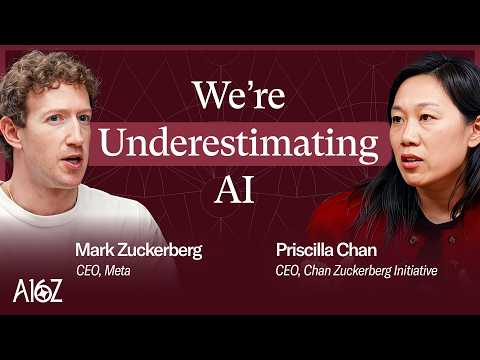
Zuckerberg Philanthropy Consolidates Science Units to Accelerate AI Disease Cures
a16z
The Chan Zuckerberg Initiative is unifying its decentralized hubs under AI leadership to build virtual cell models, arguing that massive open-source computation will compress the timeline for curing all diseases by century's end.
## Background
Published by the a16z channel on YouTube on November 6, 2025, this video features Mark Zuckerberg and Priscilla Chan in conversation with Ben Horowitz, Erik Torenberg, and Vineeta Agarwala. The discussion centers on how the Chan Zuckerberg Initiative (CZI) is building large-scale computational tools and virtual cell models to accelerate the cure, prevention, and management of all diseases by the end of the century.
## TL;DR
Over the past decade, CZI has shifted from traditional scientific funding toward developing open-source, $100 million-scale infrastructure projects like the CELLxGENE atlas, which was built in collaboration with the broader scientific community. By combining frontier biology with frontier AI, CZI is developing hierarchical virtual cell models to allow researchers to simulate complex biological systems and test high-risk hypotheses in silico before investing in expensive wet lab work. To maximize this flywheel effect, CZI is consolidating its operations under AI leadership, transitioning modern lab spaces to prioritize massive compute clusters over physical square footage, and democratizing access for global researchers.
## Atmosphere & style
The conversation carries a tone of ambitious yet grounded optimism, blending the iterative urgency of Silicon Valley engineering with the deeply empathetic clinical perspective of a pediatrician. There is an engaging dynamic between the hosts and the founders, highlighted by moments of reflective humor when discussing accidental successes like CELLxGENE alongside an unapologetic confidence in century-scale goals. It feels like a high-level strategic retrospective, tracing an emotional arc from early institutional skepticism to a validated, mature vision that balances long-term philanthropic patience with an impatient drive for daily discovery.
## Key takeaways
- [00:00](https://www.youtube.com/watch?v=YnV8pgHtO5Y&t=0s) The Chan Zuckerberg Initiative (CZI) was founded with a century-scale mission to help the scientific community cure, prevent, or manage all diseases by the end of the 21st century.
- [03:42](https://www.youtube.com/watch?v=YnV8pgHtO5Y&t=222s) Traditional government funding like NIH grants leaves a massive gap for long-term, expensive tool development, which CZI aims to fill by funding 10-to-15-year infrastructure projects.
- [03:08](https://www.youtube.com/watch?v=YnV8pgHtO5Y&t=188s) CZI's core strategy relies on a tool-first hypothesis, asserting that major scientific breakthroughs are fundamentally bottlenecked by observation and unlocked by new tools.
- [07:03](https://www.youtube.com/watch?v=YnV8pgHtO5Y&t=423s) The CZ Biohub bridges a cultural divide by pairing frontier biology with frontier AI to generate massive, highly specific datasets designed from the ground up to train AI models.
- [07:03](https://www.youtube.com/watch?v=YnV8pgHtO5Y&t=423s) The CZ Biohub Network is strategically split across three locations—San Francisco, Chicago, and New York—each focusing on a different intersection of biology, imaging, and tissue engineering.
- [13:32](https://www.youtube.com/watch?v=YnV8pgHtO5Y&t=812s) Priscilla Chan argues that 'most diseases should be thought of as rare diseases' because single-cell transcriptomics allows mapping how specific genetic variants uniquely impact individual biology.
- [11:35](https://www.youtube.com/watch?v=YnV8pgHtO5Y&t=695s) CZI's open-source tool CELLxGENE emerged as a foundational map to solve biology's lack of a standardized equivalent to the periodic table of elements.
- [15:55](https://www.youtube.com/watch?v=YnV8pgHtO5Y&t=955s) Standardizing data through CZI's cell annotation tool created a powerful network effect, resulting in the broader scientific community contributing 75% of the data for the shared single-cell atlas.
- [18:34](https://www.youtube.com/watch?v=YnV8pgHtO5Y&t=1114s) Virtual cell models serve as a digital organism or 'new fruit fly,' allowing scientists to safely run fast, cheap simulations in silico to derisk ideas before investing in expensive wet lab experiments.
- [24:06](https://www.youtube.com/watch?v=YnV8pgHtO5Y&t=1446s) CZI is building specialized biological AI models like 'Variant Former' and cellular diffusion models, with the long-term goal of developing the first hierarchical reasoning model over biology.
- [28:09](https://www.youtube.com/watch?v=YnV8pgHtO5Y&t=1689s) CZI is executing a major organizational shift to unify its biohubs, software, and AI research under the leadership of AI expert Alex Rives, believing AI advancements can accelerate their original timeline.
- [31:47](https://www.youtube.com/watch?v=YnV8pgHtO5Y&t=1907s) Domain-specific AI models are proving incredibly valuable in biology, but maximizing their impact requires intuitive user interfaces like CELLxGENE to democratize access for non-computational scientists.
- [34:53](https://www.youtube.com/watch?v=YnV8pgHtO5Y&t=2093s) The Biohub organizational model emphasizes physical co-location, deliberately placing biologists and engineers next to each other to foster breakthrough interdisciplinary communication.
- [38:40](https://www.youtube.com/watch?v=YnV8pgHtO5Y&t=2320s) Modern biology labs are expanding through compute power rather than physical square footage, with the Biohub scaling its cluster from 1,000 to 10,000 GPUs to support massive virtual cell models.
- [40:27](https://www.youtube.com/watch?v=YnV8pgHtO5Y&t=2427s) The broader scientific pipeline relies on long-term philanthropy to accelerate basic science, which biotechs, pharmaceutical companies, and public health initiatives can then leverage and distribute globally.
## Detailed walkthrough
### [00:00](https://www.youtube.com/watch?v=YnV8pgHtO5Y&t=0s) The "Pipeline of Hope" and the Genesis of CZI
Almost a decade ago, Mark Zuckerberg and Priscilla Chan founded the Chan Zuckerberg Initiative (CZI) with an incredibly ambitious, century-scale mission: to help the scientific community cure, prevent, or manage all diseases by the end of the 21st century. When they first announced this goal, the reaction from the scientific establishment was skepticism. "Most scientists couldn't look at us with a straight face," Priscilla recalls. The skepticism was justified under the traditional funding paradigm; simply distributing more NIH-style grants to individual labs would never yield such a monumental breakthrough. However, by forcing a conversation on what a credible pathway to this goal would actually look like, they identified a massive gap: the lack of shared, standardized tools and large-scale, collaborative datasets.
Priscilla’s passion for basic science is rooted in her clinical training as a pediatrician at UCSF. She frequently encountered families and young children suffering from mysterious conditions where the medical community had no answers. If they were lucky, they had a single gene name; more often, they were grouped into broad, poorly understood categories. As a resident, she was left trying to translate a few sparse lines of a printed PDF into a clinical care plan. This frustrating reality made her realize that to advance medicine, they had to first advance the forefront of basic science—a concept she describes as the "pipeline of hope."
- **The Core Mission:** To accelerate basic science so that the broader scientific community can cure, prevent, or manage all diseases by the year 2100.
- **The Funding Gap:** Traditional government funding (like NIH grants) is typically parceled out into small, short-term grants for individual investigators, leaving a gap for long-term, expensive tool development.
[03:08](https://www.youtube.com/watch?v=YnV8pgHtO5Y&t=188s) Accelerating Science Through Tool Building
Mark explains that CZI’s core strategy is built on a historical truth: most major scientific breakthroughs are preceded by the invention of a new tool that allows researchers to observe phenomena in entirely new ways. Just as the microscope unlocked the study of bacteria and the telescope opened up astronomy, modern biology requires new tools to move forward. Mark uses an engineering analogy to describe the current state of biology: "Without those kind of tools, it's kind of like you're coding without being able to step through the code and debug things."
CZI has stepped into a unique philanthropic niche by funding the development of these long-term, high-cost tools—projects requiring $100 million to $1 billion over a 10-to-15-year horizon. Because traditional academic funding structures do not support this scale of engineering, and because philanthropists often seek immediate credit rather than open-source infrastructure, this space was severely underfunded. CZI's focus is entirely on building these shared resources and giving them away to the global scientific community.
- **The Tool-First Hypothesis:** Scientific progress is bottlenecked by observation; new tools (like imaging technology and virtual cell models) unlock new paradigms of discovery.
- **Philanthropic Niche:** Funding high-risk, 10-to-15-year infrastructure projects that are too large for standard academic grants and too long-term for venture capital.
[06:29](https://www.youtube.com/watch?v=YnV8pgHtO5Y&t=389s) Frontier Biology Meets Frontier AI
The intersection of biology and artificial intelligence has created a fascinating cultural divide. While the biology community initially viewed CZI's century-scale goal as crazy and overly ambitious, the AI community had the opposite reaction, viewing it as "kind of boring" because they assumed it would "automatically going to happen" through computation. Mark notes that AI is simultaneously the most overestimated and underestimated technology of our era. CZI positions its work at the CZ Biohub as the bridge between these two worlds: "frontier biology paired with frontier AI."
While premier AI labs build advanced models and top biological institutions discover new datasets, very few organizations do both simultaneously. Even groundbreaking models like AlphaFold were trained on public datasets that were produced decades ago. By tightly coupling frontier AI with frontier biology, the CZ Biohub can generate massive, highly specific datasets designed from the ground up to train AI models, such as virtual cells that can simulate complex biological processes. Over the last decade, scientific research has yielded the highest return of any CZI initiative, leading them to double down on the Biohub as the primary focus of their philanthropy.
- **The CZ Biohub Network:** Consists of three primary locations, each partnered with local academic institutions to foster interdisciplinary collaboration:
- **San Francisco:** Focuses on deep imaging and single-cell transcriptomics.
- **Chicago:** Focuses on building physical tissues and studying cell-to-cell communication.
- **New York:** Focuses on cell engineering (programming cells to detect signals and take specific actions).
[11:35](https://www.youtube.com/watch?v=YnV8pgHtO5Y&t=695s) Redefining Precision Medicine and the "Cell by Gene" Accident
When looking at the future of therapeutics, Priscilla envisions a shift away from the "trial and error" approach that characterizes modern medicine. Today, patients with conditions like hypertension or depression are lumped into broad demographic categories, and doctors must cycle through different drugs to see what works. Priscilla argues that "most diseases should be thought of as rare diseases" because every individual's biology is unique. By using single-cell transcriptomics, researchers can map how specific genetic variants impact downstream cells, trace how proteins are expressed, and compare diseased cells directly to healthy ones. This allows drug developers to design highly targeted therapeutics while predicting off-target side effects before a drug ever enters a clinical trial.
CZI's commitment to open-source software has already quietly revolutionized the biotech startup and pharmaceutical R&D communities. The host shares an anecdote about a startup in their portfolio working on Idiopathic Pulmonary Fibrosis (IPF)—a devastating lung disease whose very name ("idiopathic") highlights how little we understand its cause. The startup's founder used CZI's open-source *CELLxGENE* tool to analyze millions of single cells from healthy and diseased patients, allowing them to isolate and study the gene expression of specific fibroblasts to identify new drug targets. Mark laughs and reveals that *CELLxGENE* was "almost an accident." It arose from a simple, glaring realization: even in 2025, biology still lacks its own equivalent of the periodic table of elements. CZI set out to build that foundational map.
- **The "Horrible VUS":** Pediatricians and geneticists frequently encounter "Variants of Unknown Significance" (VUS)—genetic mutations where they know a variation exists but have no data on what it actually does to the patient.
- **CELLxGENE:** An open-source single-cell data exploration tool developed by CZI that allows researchers worldwide to query and visualize millions of single cells.
[15:55](https://www.youtube.com/watch?v=YnV8pgHtO5Y&t=955s) The Network Effects of the Single-Cell Atlas
The Chan Zuckerberg Initiative (CZI) did not originally set out to build virtual cell models when they began their single-cell work a decade ago. Initially, they funded the methodology to standardize how single-cell science was conducted, seeding a few labs to start building out the data set. However, researchers quickly hit a bottleneck: they could not annotate the data fast enough. To solve this, CZI built "cell by gene," an annotation tool designed to make it easy for single-cell scientists to annotate and share their data publicly.
Because everyone started using the same annotation tool, the community standardized on the same data formats and metadata. This created a powerful network effect—what the speakers jokingly call a "come for the annotation, stay for the virtual cell model" dynamic. Over ten years, millions of cells have been built into this shared resource for the entire scientific community. Remarkably, CZI only funded about 25% of the data; the remaining 75% came from the broader scientific community because they found the standardized format so valuable. This level of quality control and standardization sets it apart from prior databases like GEO.
- **Cell by Gene:** The original annotation tool built by CZI to solve the data annotation bottleneck.
- **Funding Ratio:** CZI funded only 25% of the atlas; 75% was contributed by the broader scientific community.
- **Network Effect:** Standardizing the tool naturally standardized the data formats, making the data highly portable and clean compared to older databases.
---
[18:34](https://www.youtube.com/watch?v=YnV8pgHtO5Y&t=1114s) The Promise of Virtual Cells and "In Silico" Biology
The virtual cell model is poised to be one of the most important tools in modern science, building up a hierarchy from proteins to cellular structures, and eventually to complex systems like a virtual immune system. This tool will allow scientists to generate hypotheses and run estimates before executing full physical experiments. It also holds immense promise for precision medicine.
A major benefit of virtual biology is that it allows researchers to take on much riskier ideas. Currently, wet lab work is expensive, slow, and high-stakes; scientists must choose safe projects to secure grants, publish, and achieve tenure. A high-quality virtual cell model acts as a "new fruit fly"—a digital model organism with high fidelity to the human body. By testing and tinkering *in silico* first, researchers can derisk their ideas on the front end, making wet lab investments far more efficient.
- **Hierarchical Modeling:** Builds from proteins to cellular structures, up to complex systems like a virtual immune system.
- **The "New Fruit Fly":** The virtual cell serves as a digital model organism to run cheap, fast simulations.
- **Derisking Research:** Allows scientists to ask riskier, more ambitious questions computationally before spending time and money in the wet lab.
---
[24:06](https://www.youtube.com/watch?v=YnV8pgHtO5Y&t=1446s) Specialized AI Models and Reasoning in Biology
Rather than relying on a single monolithic model, the virtual cell is being built by training specialized capabilities that will become increasingly general over time. One such model is "Variant Former," which is trained on pairs of CRISPR edits to predict what happens to a cell after a specific genetic edit. Another is a diffusion model that can simulate and produce synthetic versions of rare cell configurations. Additionally, CZI has trained spatial models using data from their imaging institute to understand how cells look in different states.
The frontier of this research includes developing the first "reasoning model over biology." Instead of merely spitting out correlations, this model conceptually aims to reason through how biological systems evolve and why things happen. To make this reasoning effective, the models require strong underlying "world models." CZI's strategy is hierarchical: build a state-of-the-art protein model (leveraging the expertise of protein-folding researchers), integrate it into a state-of-the-art cellular model, and eventually scale up to simulate complex systems.
- **Variant Former:** An AI model trained on CRISPR edit pairs to predict cellular outcomes.
- **Diffusion Models for Cells:** Generates synthetic versions of rare cell configurations to allow testing against rare states.
- **Reasoning Models:** Early-stage models designed to reason through biological cause and effect rather than just identifying correlations.
- **Hierarchical Integration:** Combining protein-level models with cellular-level models to understand how sub-components interact.
---
[28:09](https://www.youtube.com/watch?v=YnV8pgHtO5Y&t=1689s) Unifying AI and Biology under One Biohub
CZI is announcing a major organizational shift to bring their historically decentralized efforts—running biohubs, building software, and conducting AI research—together under a single operating philanthropy. This unified team will be led by Alex Rives, a founder of Evolutionary Scale and a former Meta researcher who specialized in protein-folding models. The choice of an AI expert who understands biology to lead the program, rather than a traditional biologist who knows some AI, reflects CZI's view of where the relative weight of these fields lies today.
While CZI will continue its work in education and supporting local communities, the Biohub will become the main thrust of their philanthropy. When CZI first launched, their mission was to help the scientific community cure, prevent, or manage all diseases by the end of the century. With recent advances in AI, they believe this goal can be achieved "significantly sooner."
- **Leadership:** Alex Rives, former Meta AI researcher and leader of Evolutionary Scale, will head the unified science program.
- **Philanthropic Focus:** The Biohub is now the primary focus of CZI's philanthropy, aiming to accelerate the timeline of curing all diseases.
- **The AI-Biology Flywheel:** Unifying the teams allows CZI to close the loop between AI model generation and wet lab data collection. If a model has a blind spot, the team can immediately design and generate the exact data set needed to fix it using advanced tools like cryo-EM.
[31:47](https://www.youtube.com/watch?v=YnV8pgHtO5Y&t=1907s) Domain-Specific AI and Lowering the Barrier to Entry
The conversation shifts to the surprising trajectory of artificial intelligence, where domain-specific models are proving to be incredibly valuable. This stands in contrast to early industry assumptions that a few generalized AIs would simply become smarter than everyone at everything. In fields like video generation, different models excel at different tasks, proving that knowing the specific problem you are solving is vital to achieving superior results. In biology, where critical datasets are not publicly available on the internet, the Chan Zuckerberg Initiative is bucking the trend by creating open-source access to data. However, the real nuance lies in how that data is curated, annotated, and communicated to researchers.
A scientist does not interact with an AI the way an average user chats with ChatGPT; the interface and the nature of the conversation are highly specialized. To address this, tools like *Cell by Gene* are intentionally designed with a low barrier to entry, allowing users without deep computational or biological backgrounds to explore the data and contribute. Lowering this barrier is essential for fostering interdisciplinary breakthroughs. For example, immunology is increasingly recognized as playing a massive role in neurodegeneration, and an intuitive user interface allows immunologists to easily step into the world of neuroscience to see how their expertise fits.
* *Cell by Gene* was designed to democratize access to complex biological data, allowing researchers from diverse fields to collaborate without needing a deep computational background.
* The intersection of immunology and neurodegeneration serves as a prime example of why low-barrier, interdisciplinary tools are necessary for modern scientific discovery.
[34:53](https://www.youtube.com/watch?v=YnV8pgHtO5Y&t=2093s) The Biohub Organizational Model and Interdisciplinary Collaboration
When discussing whether the Biohub will grow by hiring more internal staff or by expanding its decentralized network of sites and labs, the speaker explains that it will be a combination of both, alongside the growth of a central AI team. Because science is decentralized by default due to traditional granting systems and researcher preferences, philanthropy has a unique opportunity to be "the most additive" by funding underrepresented, highly collaborative structures. The very first Biohub unlocked immense value simply by establishing a formal collaborative construct between UCSF, Stanford, and UC Berkeley—institutions that previously lacked a structured way to work together.
Another foundational element of the Biohub model is physical co-location, specifically having biologists sit directly next to engineers. The speaker notes that many organizational hurdles can be solved simply by changing where people sit, regardless of what the official org chart looks like: "it doesn't matter what the org chart is... you guys need to sit next to each other and until you get this thing to work." This simple focus on communication is a highly underrated tool in problem-solving. The inspiration for this model comes from physics, where research labs historically rallied around massive, shared projects and resources.
* The original Biohub successfully bridged the gap between three world-class institutions: UCSF, Stanford, and UC Berkeley.
* The physical co-location of biologists and engineers mirrors historical interdisciplinary successes, such as the famous MIT labs that brought different departments together to invent lasers.
[38:40](https://www.youtube.com/watch?v=YnV8pgHtO5Y&t=2320s) Compute as the New Lab Space
The expansion of the modern AI biology lab is not measured in physical square footage, but in compute power. Modern researchers are less interested in acquiring physical lab space and are instead focused on securing computational resources: "They don't want space. Yeah. They just want GPUs, agents." This compute infrastructure serves as the new lab space, and it is significantly more expensive than traditional wet lab space.
While a typical large academic lab might only have tens of GPUs, the Biohub was a pioneer in building a large-scale compute cluster of 1,000 GPUs, with active plans to scale into the 10,000 range. This level of scale allows researchers to ask entirely different types of scientific questions. To make this resource as impactful as possible, the Biohub invites external scientists to apply and pitch questions that require this massive scale of compute, seeding unique collaborations across the wider scientific community.
* The Biohub is scaling its compute cluster from 1,000 GPUs to the 10,000 range to support large-scale virtual cell models.
* External academic scientists can apply to access this massive compute cluster, opening up high-performance computing to labs that normally only have access to tens of GPUs.
[40:27](https://www.youtube.com/watch?v=YnV8pgHtO5Y&t=2427s) Ten Years of Philanthropy and the Scientific Pipeline
Reflecting on nearly ten years of building the Biohub, the speaker candidly recalls spending the first few years "completely envious of people working for for-profit companies" because of the immediate clarity and feedback provided by market forces. However, reaching the ten-year milestone has proven that their long-term philanthropic bets on biology have delivered far more than initially anticipated. This success has provided the validation needed to continue tolerating early ambiguity, maintaining a long time horizon while remaining "impatient at the same time" to drive daily iterations.
This patient yet urgent approach allowed the Biohub to have massive datasets ready to leverage the sudden rise of large language models. In philanthropy, having "customers"—measured by how many scientists use their open-source tools to publish important work—provides a deeply rewarding feedback loop. The ultimate goal is to support a complete pipeline: accelerating basic science through philanthropy, which feeds into biotechs developing novel therapies, pharma scaling them, and public health initiatives distributing them globally. The hosts close by celebrating the unique "founder market fit" of the leadership team, combining the perspectives of an engineer and a scientist-doctor to build tools that would otherwise not exist.
* The speaker emphasizes the value of having a long time horizon while remaining highly impatient during daily iterations to successfully navigate scientific ambiguity.
* The scientific pipeline relies on philanthropy to accelerate basic science and build open-source tools, which biotechs and pharmaceutical companies can then leverage to develop and scale novel therapies.
## Notable quotes
> [00:00](https://www.youtube.com/watch?v=YnV8pgHtO5Y&t=0s) Most scientists couldn't look at us with a straight face, — Priscilla Chan
> [03:08](https://www.youtube.com/watch?v=YnV8pgHtO5Y&t=188s) Without those kind of tools, it's kind of like you're coding without being able to step through the code and debug things. — Mark Zuckerberg
> [06:29](https://www.youtube.com/watch?v=YnV8pgHtO5Y&t=389s) frontier biology paired with frontier AI. — Mark Zuckerberg
> [11:35](https://www.youtube.com/watch?v=YnV8pgHtO5Y&t=695s) most diseases should be thought of as rare diseases — Priscilla Chan
> [15:55](https://www.youtube.com/watch?v=YnV8pgHtO5Y&t=955s) come for the annotation, stay for the virtual cell model — null
> [18:34](https://www.youtube.com/watch?v=YnV8pgHtO5Y&t=1114s) new fruit fly — null
> [24:06](https://www.youtube.com/watch?v=YnV8pgHtO5Y&t=1446s) reasoning model over biology. — null
> [34:53](https://www.youtube.com/watch?v=YnV8pgHtO5Y&t=2093s) it doesn't matter what the org chart is... you guys need to sit next to each other and until you get this thing to work. — null
> [38:40](https://www.youtube.com/watch?v=YnV8pgHtO5Y&t=2320s) They don't want space. Yeah. They just want GPUs, agents. — null
> [40:27](https://www.youtube.com/watch?v=YnV8pgHtO5Y&t=2427s) completely envious of people working for for-profit companies — null
## Mentioned
Mark Zuckerberg, Priscilla Chan, Chan Zuckerberg Initiative, CZI, Ben Horowitz, Erik Torenberg, Vineeta Agarwala, a16z, NIH, UCSF, AlphaFold, CZ Biohub, San Francisco, Chicago, New York, Idiopathic Pulmonary Fibrosis, CELLxGENE, GEO, Variant Former, CRISPR, Alex Rives, Evolutionary Scale, Meta, ChatGPT, Stanford, UC Berkeley, MIT
Mark Zuckerberg and Priscilla Chan argue that curing, preventing, or managing all human diseases can be dramatically accelerated by redirecting philanthropy toward long-term tool building, open-source biological data, and domain-specific artificial intelligence. By integrating computational models directly with experimental biology, the Chan Zuckerberg Initiative aims to replace empirical trial-and-error medicine with predictive, virtual cellular simulations.
Addressing the Infrastructure Gap in Basic Science (3:08)
Traditional biomedical research largely relies on short-term government grants, such as NIH awards to individual laboratories, leaving a structural deficit for long-horizon, high-cost engineering. Zuckerberg argues that major breakthroughs in biology historically depend on novel observation instruments, comparing current biological research without advanced tools to writing code without the ability to step through and debug it. Drawing on Chan's clinical experience treating pediatric patients with uncharacterized conditions and genetic variants of unknown significance, CZI directed its philanthropy toward 10-to-15-year infrastructure projects requiring $100 million to $1 billion that are too large for standard academic grants and too slow for venture capital.
Open-Source Data Standardization and Single-Cell Mapping (11:35)
Recognizing that biology still lacked a foundational reference system comparable to chemistry's periodic table, CZI funded single-cell transcriptomics and introduced CELLxGENE, an open-source tool developed to solve data annotation bottlenecks. By offering an accessible annotation platform, the initiative established standardized data and metadata formats across the scientific community. While CZI directly funded roughly 25% of the resulting single-cell atlas, external researchers contributed the remaining 75% due to the utility of the common format.
Standardized single-cell datasets enable researchers to compare healthy and diseased cells to identify exact mechanisms of pathology. For instance, an early-stage biotechnology company utilized CELLxGENE to analyze millions of cells to isolate aberrant gene expression in fibroblasts associated with idiopathic pulmonary fibrosis, demonstrating how open-source biological maps can streamline drug target discovery and help forecast off-target side effects.
Virtual Cells and Predictive Biological Modeling (18:34)
To reduce the high financial and temporal costs of physical laboratory work, CZI is constructing hierarchical virtual cell models to serve as digital model organisms. Much like fruit flies have functioned as biological benchmarks, these in silico models allow scientists to simulate hypotheses—spanning molecular protein structures up to complex systems like the immune system—before executing physical wet-lab experiments. This computational derisking enables investigators to pursue higher-risk scientific inquiries without jeopardizing grant funding.
Rather than depending on a single generalized artificial intelligence, the virtual cell framework integrates specialized biological models. These include Variant Former, an AI trained on paired CRISPR edits to forecast downstream cellular modifications, diffusion models that synthesize rare cellular states, and spatial imaging models. CZI is also directing efforts toward biological reasoning models designed to assess cause-and-effect dynamics rather than mere statistical correlations.
Unifying Compute Clusters and Interdisciplinary Biohubs (28:09)
CZI is consolidating its biohubs, software operations, and artificial intelligence research under a unified philanthropy led by AI researcher Alex Rives, reflecting their view that computation must tightly couple with experimental design. Borrowing organizational structures from physics, the Biohub model physically co-locates biologists directly beside software engineers to establish immediate feedback loops between wet-lab instruments, such as cryo-EM, and computational model generation.
Under this model, computational capacity functions as the primary lab resource. While standard academic research groups typically access only tens of GPUs, the Biohub established a 1,000-GPU cluster with plans to expand toward 10,000 GPUs. External academic scientists are invited to pitch research questions requiring this computational scale, expanding access to high-performance infrastructure across institutions including UCSF, Stanford, and UC Berkeley.
Zuckerberg and Chan forecast that coupling unified biohubs with domain-specific AI will allow the scientific community to achieve their disease prevention and management goals significantly sooner than their original 2100 target; however, the practical translation of these tools still depends on closing the gap between computational simulations, experimental verification, and commercial pharmaceutical drug delivery.
[0:00] Priscilla Chan: Most scientists couldn't look at us with a straight face,
[3:08] Mark Zuckerberg: Without those kind of tools, it's kind of like you're coding without being able to step through the code and debug things.
[6:29] Mark Zuckerberg: frontier biology paired with frontier AI.
[11:35] Priscilla Chan: most diseases should be thought of as rare diseases
[15:55] null: come for the annotation, stay for the virtual cell model
[18:34] null: new fruit fly
[24:06] null: reasoning model over biology.
[28:09] null: significantly sooner.
[34:53] null: it doesn't matter what the org chart is... you guys need to sit next to each other and until you get this thing to work.
[38:40] null: They don't want space. Yeah. They just want GPUs, agents.
[40:27] null: completely envious of people working for for-profit companies
Original transcript
[0:00] this is a a a space that I mean that
[0:02] there's just going to be a huge amount
[0:03] of leverage with AI. It still seems like
[0:05] there could be a lot more effort in this
[0:07] space around building tools and it's
[0:09] kind of this crazy thing that we're you
[0:11] know here in you know 2025 and there's
[0:15] not the kind [music] of periodic table
[0:16] of elements equivalent for biology. We
[0:18] think that this is like probably one of
[0:20] the most important [music] sets of tools
[0:22] that you need to build. When we first
[0:24] set out that the goal to cure and
[0:26] prevent disease by the end of the
[0:27] century, people like honestly most
[0:29] scientists couldn't look at us with a
[0:30] straight face. [laughter]
[0:32] >> And that's crazy.
[0:34] >> Yes. And it was true because if you just
[0:37] decided to spend the money funding the
[0:39] next best [music] grant for every single
[0:41] lab in the country, like you there was
[0:44] no pathway to that being true. The
[0:45] biology folks, I think, looked [music]
[0:47] at it as if it were crazy ambitious. And
[0:49] then the AI folks are like, well, that's
[0:52] kind of boring. That's just
[0:54] automatically going to happen. I know.
[0:56] It's like, okay, there's something in
[0:57] between there that needs to be bridged.
[1:02] >> Mark Priscilla, welcome to the Asz
[1:04] podcast.
[1:05] >> Thanks for having us.
[1:06] >> Yeah, great to be here. Excited.
[1:07] >> All right. Excited to have you. You're
[1:09] doing exciting stuff.
[1:10] >> Yeah. Well, to that end, almost a decade
[1:12] ago, you guys started the Chan
[1:13] Zuckerberg initiative with the mission
[1:15] and intent to cure, prevent, manage all
[1:17] disease by the end of this century.
[1:19] There's a lot of missions that you guys
[1:21] could have poured your time and
[1:22] resources into. Why don't we talk about
[1:24] take us behind the conversations of why
[1:26] you guys picked this one? Maybe
[1:27] Priscilla, why don't we start with with
[1:28] you and you hear your side of the story.
[1:31] >> It always surprises people when I talk
[1:33] about how we work in basic science
[1:34] research. Um, I trained as a
[1:36] pediatrician and people always think
[1:37] like, oh, it must be about medicine. And
[1:40] for me, it w, you know, I went into
[1:43] medicine because I wanted to improve
[1:45] people's lives. I wanted to make a
[1:47] difference. I wanted to be able to help
[1:48] others. And I think training as a
[1:51] pediatrician at UCSF, I met a lot of
[1:54] patients and frankly like little kids
[1:57] and families for which like we just had
[2:00] no idea what the problem was. and they
[2:03] might have like a specific gene that
[2:06] they could name if they were lucky. Um,
[2:08] or they could be grouped into a bunch of
[2:10] other diseases and there'd be a general
[2:12] sort of PDF they'd print out like this
[2:14] is what we know. And then it was my job
[2:16] as an intern or resident to try to
[2:18] translate like like a few lines of
[2:22] information to how we were supposed to
[2:24] take care of the patient. And for me,
[2:26] that's when I really like realized the
[2:28] power of basic science and how we need
[2:31] to work on basic science to advance the
[2:35] forefront of what's possible and without
[2:37] that there's sort of I think of it as
[2:40] the pipeline of hope.
[2:41] >> Yeah. And why did you think um
[2:45] you could cure all disease? Because
[2:46] that's like a very like aggressive goal.
[2:49] >> Um do you want to do you want to answer
[2:51] that one?
[2:51] >> Yeah. Well, well, I mean we're not going
[2:53] to cure all diseases to be clear. I mean
[2:55] the the strategy is to help scientists
[2:58] and the scientific community cure all
[3:00] diseases. So the strategy is really one
[3:03] of accelerating the pace of basic
[3:05] science and the theory that we had was
[3:09] if you look at the history of science
[3:10] most major breakthroughs are basically
[3:13] preceded by the invention of a new tool
[3:16] to observe phenomena in a new way.
[3:18] Right? So think about things like the
[3:19] microscope, right? Being able to observe
[3:21] bacteria or you know other fields, the
[3:24] telescope or
[3:25] >> um you know, but it's
[3:27] >> just to use an engineering example, you
[3:29] know, it's without those kind of tools,
[3:32] it's kind of like you're coding without
[3:33] being able to step through the code and
[3:35] debug things, right? So it's um that's
[3:38] like the old days
[3:39] >> when you [laughter]
[3:41] so so our our whole approach on this is
[3:44] basically let's help build tools that
[3:47] will accelerate the pace of the whole
[3:49] field and I think that that there's a
[3:52] niche that I think fits that because if
[3:55] you look at how funding works in science
[3:57] you know the vast majority of funding
[3:58] comes from the government and NIH
[4:00] grants. it's parcled out into these
[4:02] relatively small grants that allow
[4:04] individual investigators to investigate
[4:07] usually pretty near-term things. Um, and
[4:10] the development of these kind of new
[4:12] types of tools, whether it's imaging or
[4:14] building now a lot of AI things like
[4:16] virtual cell models, um, are longer
[4:19] term, often times more expensive to
[4:22] develop. So think about like on the
[4:24] order of a hundred you know maybe you
[4:27] know hundred million to a billion
[4:29] dollars over a um over a 10 to 15 year
[4:32] period and then you you try to unlock
[4:34] those tools and give them to the
[4:36] scientific community to accelerate the
[4:37] pace. So that's that's kind of the the
[4:39] theory
[4:39] >> right and and there it seems like
[4:41] there's also something that that's is
[4:44] you don't really get credit for the
[4:45] tools in a lot of ways. I mean, we've
[4:47] been noted, well, we have companies that
[4:48] use your tools and they're very happy
[4:50] about it. But, um, you know, I didn't
[4:53] even know that that was the case. And
[4:55] so,
[4:55] >> that's why it's philanthropy.
[4:56] >> Yeah. Well, it is, but most people do
[4:59] philanthropy to get credit, too. I mean,
[5:01] you know, like that's a you know, that
[5:02] that's kind of a part of it. So,
[5:06] how did you I guess did you think about
[5:08] that or were you just like, no, like
[5:10] this is going to work and if it works,
[5:12] that's all we need. We're super focused
[5:15] on like actually making every scientist
[5:17] better and and beyond science like
[5:20] startups, startup founders because I the
[5:23] point is we can't do this alone. And
[5:26] when we first set out that the goal to
[5:28] cure and prevent disease by the end of
[5:30] the century, people like honestly most
[5:32] scientists couldn't look at us with a
[5:34] straight face [laughter]
[5:35] >> and crazy.
[5:37] >> Yes. And it was true because if you just
[5:40] decided to spend the money funding the
[5:42] next best grant for every single lab in
[5:45] the country like you there's no pathway
[5:48] to that being true. But if you forced
[5:51] people to really think about this and
[5:53] like okay what is the most credible
[5:55] pathway to doing this and what are the
[5:57] barriers to that credible pathway then
[6:00] we sort of got somewhere right? They
[6:01] were like, well, like there's no shared
[6:03] tools or like we don't have we're not
[6:06] working on big projects and building the
[6:08] right data sets. And we're like, okay,
[6:10] well then we can start doing something
[6:12] about that. Um, and so that's where the
[6:14] idea of building shared tools cuz no one
[6:16] right now in the science.
[6:17] >> Well, that's so interesting. So
[6:19] basically, you're like, we're going to
[6:20] cure all disease and they're like,
[6:22] >> yeah, can't be done. Why can't it be
[6:23] done? Well, because we don't have the
[6:25] tools. Okay, that's pretty that's a
[6:28] pretty cool sequence.
[6:29] >> Yeah. Yeah. I mean, there's also this
[6:30] funny thing where the the biology folks,
[6:32] I think, looked at it as if it were
[6:34] crazy ambitious. And then the AI folks
[6:36] are like, well, that's kind of boring.
[6:39] That's just automatically going to
[6:40] happen. I know it's like, okay, there's
[6:42] something in between there that needs to
[6:44] be bridged. And if you can like kind of
[6:46] use the the kind of modern AI tools in
[6:49] order to build the types of tools that
[6:51] biologists need. So that's a big part of
[6:53] how we think about our work is um
[6:55] >> AI has got to be the most overestimated
[6:57] and underestimated technology ever like
[6:59] simultaneously. So weird. I mean, yeah,
[7:01] we'll probably like the internet early
[7:02] on, but but we kind of think about
[7:04] ourselves and the work that we're doing
[7:06] at the Biohub as frontier biology paired
[7:09] with frontier AI, right? So, there's
[7:11] there are labs that do frontier AI that
[7:14] uh basically, you know, are building the
[7:16] most advanced models. Um and then there
[7:20] are lots of biological research
[7:22] organizations that that effectively do
[7:25] very leading edge
[7:26] >> research to build um you know to either
[7:30] discover new data sets or or or looking
[7:32] to certain challenges.
[7:34] >> But so far there hasn't been anyone
[7:36] who's tried to do both of those at once.
[7:38] And when you look at I mean even
[7:40] something like AlphaFold which is
[7:41] amazing right it's it was built off of
[7:43] this data set that was a public data set
[7:45] that had been produced decades ago right
[7:48] and um
[7:50] >> what what I think you have the
[7:52] opportunity to do if you do both of
[7:53] those together is produce specific data
[7:56] sets for the purpose of training AI
[7:58] models to build virtual cells that can
[8:00] do specific things
[8:01] >> right
[8:02] >> so I think that that's like a a pretty
[8:04] interesting zone to be in
[8:06] >> and of all the things that that we've uh
[8:10] that we've worked on. You know, actually
[8:11] when when we started CZI, we we kind of
[8:13] actually focused on a number of areas
[8:14] and what we found is just that the
[8:16] science research has had by far the
[8:18] biggest return. So, we've just doubled
[8:19] down on it over and over and over until
[8:21] now we're at the point that, you know,
[8:23] we're 10 years in and Biohub is really
[8:25] the like main focus of of our of our
[8:28] philanthropy at this point.
[8:30] >> Um, but yeah, I mean, that's kind of
[8:32] that's basically the focus. Maybe you're
[8:34] not giving yourselves enough credit
[8:35] because you're sort of saying, "Well,
[8:36] there's bite-size science. We didn't
[8:38] want to do that. There's century scale
[8:40] science and that seemed like a long time
[8:42] horizon, but achievable, ambitious." But
[8:44] you've actually identified, you know,
[8:46] which I think is really fantastic, grand
[8:48] scientific challenges
[8:50] >> that are right in between. They're 10 to
[8:52] 15 year horizons, at least per kind of
[8:55] the way you communicate about them and
[8:56] the way you energize
[8:57] >> the scientific community about them. 10
[8:59] to 15 is kind of an interesting time
[9:00] horizon sort of like similar to the time
[9:03] horizon of a venturebacked company
[9:05] similar to the time horizon on which a
[9:07] team can work together for that period
[9:08] of time I think it's how did you get to
[9:10] that number and then how are you
[9:12] thinking about the challenges that you
[9:14] take on in each 10 to 15 year wave
[9:17] because that's concrete achievable
[9:21] you know you build a lot of credibility
[9:22] around it the way that you've announced
[9:24] those challenges [snorts]
[9:26] >> well I'm curious how you guys think
[9:27] about it but for us when we looked at
[9:29] the grand challenges for on the 10 to 15
[9:32] year time horizon it needs to be like
[9:36] when you look at it you're like I see a
[9:38] path
[9:39] >> right
[9:39] >> not everything needs to be solved for us
[9:42] to take it on in fact if everything's
[9:43] solved then that feels like that should
[9:45] just go
[9:46] >> ambitious enough
[9:46] >> yeah like you like we we have we have
[9:49] some risk appetite right so we want
[9:51] things where we're like there's a
[9:53] credible pathway someone who is at the
[9:56] helm who can do this And there's enough
[9:59] ambiguity where we feel like we could
[10:01] take on that risk and if we do it like
[10:04] the the returns could be higher than
[10:06] even expected and the way we modeled
[10:09] that from you know in the biohubs is we
[10:13] we have three biohubs. We have one in
[10:15] San Francisco, one in Chicago, one in
[10:17] New York. The one in New York works on
[10:19] cell engineering. You know can we
[10:21] engineer cells to go in and detect
[10:23] signals, read it out or to take certain
[10:25] actions. In Chicago, we're building
[10:27] tissues and looking at uh tissue cell
[10:31] communications within tissues. And then
[10:33] in San Francisco, we're looking at deep
[10:35] im imaging and uh transcrytoics.
[10:38] And that work the locations are not by
[10:42] accident. We also look at the partner
[10:44] universities because we have folks who
[10:46] come to the biohubs to do this work
[10:47] collaborative, interdisciplinary
[10:50] um and sort of unconstrained by the
[10:53] traditional lab. But we also build off
[10:56] of the labs at these academic institutes
[11:00] that support the work. And so uh that's
[11:02] how we sort of choose the grand
[11:04] challenge and um and the locations. And
[11:08] then the sort of layering and the uh
[11:12] large language models and AI coming into
[11:14] the picture has been so interesting
[11:17] because we were already building tools
[11:19] to measure interesting data building the
[11:22] data sets but we didn't really know what
[11:24] to do with them yet. Um and large
[11:27] language models coming onto the scene
[11:29] we're like wow we can make sense of all
[11:31] of this now. I'm curious what you view
[11:35] success as in the therapeutic realm. So,
[11:38] you know, we think a lot about
[11:40] understanding biology and sometimes we
[11:42] bet on startups that want to unlock
[11:43] completely new biological areas,
[11:45] diseases where we don't know what's
[11:46] going wrong. And then there's another
[11:48] group of folks who kind of say, hey,
[11:51] okay, now that we understand what's
[11:52] going wrong, let's fix it. Um, let's
[11:54] come in with a drug. Let's come in with
[11:55] a new type of chemistry, a new type of
[11:57] antibbody. How do you what do you think
[11:59] success for the CZ Biohub looks like 10,
[12:04] 20, 50 years from now in terms of the
[12:08] new medicines that you've enabled?
[12:09] >> We want there to be like an explosion of
[12:11] a community who are building these um
[12:14] just the new wave of what it means to be
[12:17] deploying precision medicine. like we
[12:20] like I think for rare diseases and
[12:21] common diseases alike, you're really
[12:24] talking about individual biology that we
[12:26] sort of lump together. Um and uh they
[12:31] and we often don't know how it happens,
[12:33] right? We know that you have this
[12:34] mutation or the worst nightmare is you
[12:36] have a variant of unknown significance.
[12:38] What does that even mean?
[12:40] >> The horrible us.
[12:41] >> Yes. Horrible. And you're like you tell
[12:43] someone you kind of know something but
[12:45] we don't know what it means. But if you
[12:47] look at the way we've been able to look
[12:49] at variants and look at single cell
[12:51] transcrytoics, we're starting to be able
[12:53] to say, okay, this variant actually
[12:55] impacts this set of downstream cells and
[12:58] then we start looking at the proteins
[12:59] that get expressed and how it looks
[13:02] similar or different to what a healthy
[13:04] cell would look like. Then you can start
[13:06] targeting. Okay, like let's look at that
[13:08] as a target. And you both know the
[13:11] specificity of the target you want to
[13:13] build based on the ability the ability
[13:15] to connect mutation to protein
[13:18] expression as well as to be able to
[13:20] predict off target effects. What are the
[13:23] side effects? Because you also know
[13:25] where else that drug will be able to
[13:28] interact with the body. And and so those
[13:31] are rare like and and but I really think
[13:34] most diseases should be thought of as
[13:37] rare diseases because each one of our
[13:39] biology is different and right now we
[13:42] just get lumped right we get lumped
[13:44] based on age demographics ancestry if
[13:47] we're lucky uh to have that level of
[13:49] understanding but truly each one of our
[13:52] biology is different and say like if you
[13:53] look at hypertension or depression like
[13:56] we kind of just go by trial and error
[13:58] and saying like let's just try that drug
[14:00] and see what happens. happens. But what
[14:01] should really happen is being able to
[14:04] precisely and accurately and quickly
[14:06] treat people by looking at individuals
[14:08] biology. We want to enable the basic
[14:10] science and we would be thrilled if
[14:12] people picked up the models that we
[14:14] build to be able to build the
[14:16] diagnostics, the therapeutics that need
[14:18] to come.
[14:20] >> You've built amazing data sets. I have
[14:22] to say like I mean you may not hear the
[14:24] feedback from the startup community and
[14:26] the pharma community and the R&D
[14:28] community but it's there because you've
[14:30] committed to open source and so people
[14:33] may not be they may not all be writing
[14:35] papers but they are using those tools.
[14:38] Um there's a startup in our portfolio
[14:40] working on idiopathic pulmonary
[14:42] fibrosis. The name tells you how vexing
[14:44] the disease is. It's idiopathic. We
[14:46] don't know why [laughter] it happens.
[14:47] The IPF is named that way. And so, you
[14:51] know, he was telling me that he used
[14:53] your cell by gene atlases to look at
[14:55] millions of single cells in patients
[14:58] with disease, without disease, try to
[15:00] pinpoint the fibroblasts, double click
[15:02] on the fibroblasts and their gene
[15:04] expression. It's try to, you know, use
[15:06] that to inform, hey, where could I go
[15:08] after a new drug target in this disease
[15:10] that's fundamentally a strange clump of
[15:12] idiopath, you know, idiopathic um
[15:15] origin. So um I think there's a huge
[15:18] there's a huge group of innovators who
[15:20] are who love the tools, the
[15:21] visualizations, the query systems and
[15:24] really the software approach that you
[15:25] built to making that data incredibly
[15:27] accessible. So
[15:28] >> cell by gene is like almost an accident
[15:30] though.
[15:32] >> Tell us more.
[15:33] >> So do you want to share a little bit
[15:34] about cellene or do you want me to
[15:36] start? Well, I mean, I don't know which
[15:37] part you want to get into, but I mean,
[15:38] but the cell atlas work overall, I mean,
[15:40] it's kind of this crazy thing that
[15:42] we're, you know, here in, you know, 2025
[15:45] and there's not the kind of periodic
[15:47] table of elements equivalent for
[15:49] biology, right? So, that was sort of a
[15:51] lot of the inspiration of it was all
[15:53] right, how do we both through work that
[15:55] we're going to do in the Biohub and
[15:56] through other grants um be able to pull
[15:58] together and standardize a format where
[16:00] you can have all this data. And when we
[16:02] were starting off, we didn't even
[16:05] necessarily have in mind that we were
[16:07] going to use that to build virtual cell
[16:09] models. I think that's sort of just come
[16:11] into focus as the AI work has advanced,
[16:14] but that's a very exciting thing. We
[16:16] should definitely spend a bunch of time
[16:17] on the virtual cell models, but I'm not
[16:19] sure what you wanted to get into on the
[16:20] cell atlas.
[16:21] >> Well, the single cell work is was one of
[16:24] our first RFAS 10 years ago we started
[16:26] and we were like, okay, we think this is
[16:28] possible. We actually funded the
[16:29] methodology for it to to standardize how
[16:33] it was going to be done. So that was 10
[16:34] years ago. And we then were we seated a
[16:38] few labs to start building out that data
[16:41] set. But we were like there are like
[16:43] millions or billions of different cell
[16:45] types and different permutations. Like
[16:47] how are we going to do this? And um
[16:50] especially with like a burgeoning
[16:52] technique. And so we ended up um seating
[16:55] a few groups and they started doing work
[16:57] and then they told us they had a
[16:59] problem. There was a uh there was a
[17:02] bottleneck in their workflow because
[17:04] they couldn't annotate the data fast
[17:06] enough. Um and so we built cell by gene
[17:09] was an annotation tool. That's the
[17:11] original source of this. So we built the
[17:14] annotation tool to make it easy for
[17:16] people to who are doing single cell
[17:18] science to be able to annotate the data.
[17:21] And then we put we put the data that we
[17:22] collected publicly so people could
[17:24] share. But because everyone started
[17:25] using the same annotation tool, everyone
[17:28] was standardized then on the same data
[17:30] formats
[17:31] >> and then there started being a a
[17:33] community around the tool and they
[17:35] wanted to share back and build the
[17:37] atlas. So now after 10 years there are
[17:40] millions of cells that have been built
[17:42] into this uh shared resource for the
[17:44] entire scientific community. We only
[17:46] funded about 75% of it. Sorry that's
[17:49] wrong. We've only funded 25% of it. 75%
[17:53] came from the broader community saying
[17:55] this is useful and there's an easy way
[17:58] for us to standardize and build the same
[18:01] metadata.
[18:02] >> That's right. [clears throat]
[18:03] >> It's like an interesting what you'd call
[18:05] a network effect, right?
[18:06] >> Yeah. I was going to say it sounds like
[18:08] the internet. Yeah.
[18:10] >> Come for the annotation, stay for the
[18:12] stay for the virtual cell model.
[18:13] >> Well, it was very important when we were
[18:14] getting started with the work to have
[18:16] everyone who was doing it have a
[18:18] consistent format. So that way it could
[18:20] be used and portable. And then once that
[18:22] kind of took off as as the way that it
[18:24] would get done, then other people just
[18:25] found it valuable.
[18:26] >> Yeah. And even relative to prior data
[18:28] bases like GIO and and whatnot, they're
[18:30] just simply not as standardized or QC.
[18:32] >> Yeah. Control.
[18:33] >> Yeah.
[18:34] >> Let's get into virtual cells. One of the
[18:36] the great challenges that the grandchild
[18:37] you would focus on. Um maybe talk about
[18:39] what is the promise or the hope and
[18:40] maybe some of the challenges or where
[18:42] we're at with it.
[18:42] >> Yeah. I mean, we think that one of this
[18:44] is going to be one of the most important
[18:46] tools at this point is basically
[18:48] building up the kind of hierarchy from
[18:50] proteins to um to
[18:54] just different structures within the
[18:56] cell to whole to like whole like a
[18:58] virtual immune system or different
[19:00] levels of hierarchy. And we think that
[19:03] this is going to end up being like a
[19:04] very important set of tools for people
[19:06] to effectively generate hypotheses for
[19:09] for different science work. um you know
[19:12] even before you get to the point where
[19:13] you're really running full experiments
[19:15] in it you can come up with some um
[19:17] estimate of how that might run um it
[19:19] will be useful for some of the precision
[19:21] medicine type um examples that Priscilla
[19:25] was talking about a few minutes ago but
[19:27] we think that this is like probably one
[19:30] of the most important sets of tools that
[19:32] you need to build um and it's not a
[19:35] single thing right so there's different
[19:37] angles to to come at this from the cell
[19:39] atlas data is helpful for understanding
[19:42] things on a cellular level. Um, one of
[19:45] the the kind of most important things
[19:47] that we're doing right now, the the um
[19:49] there's this this great company,
[19:51] Evolutionary Scale, who actually had a
[19:53] bunch of researchers who'd formerly
[19:54] worked at Meta on protein folding
[19:56] models, um, is joining a Biohub and and
[20:00] Alex Reeves, the the, uh, leader of it,
[20:02] is actually going to be the the kind of
[20:03] head of the whole science program, which
[20:06] is actually kind of interesting.
[20:07] >> Yeah. when you think about it where it's
[20:08] like you have AI and biology coming
[20:10] together and really it's like an AI
[20:12] person who understands biology is
[20:13] running it rather than a biologist who
[20:15] has some understanding of AI. I think
[20:16] just kind of speaks a little bit to
[20:18] where we think the the relative um
[20:21] weight of these things is. But [snorts]
[20:23] I mean we basically view, you know, like
[20:25] Priscilla was saying with the different
[20:27] biohubs. Then New York doing cellular
[20:29] engineering will basically make it so
[20:32] that you can have cells that can record
[20:34] different things that are going on
[20:35] around the body and and share that data
[20:37] and then you can build that into models.
[20:39] The Chicago Biohub being able to record
[20:42] inflammation um and and basically study
[20:44] that in order to kind of help understand
[20:47] um like that. That's a that's a
[20:49] different data set. We have the imaging
[20:50] institute which is we just trained our
[20:52] our first set of models around that
[20:54] which are the first like spatial models
[20:57] around understanding like the way that
[21:00] that kind of cells look in different
[21:02] states and eventually just like you have
[21:05] this analogy on the um kind of the
[21:09] industry side around language models
[21:10] where you have different capabilities
[21:12] and then over time you train them into
[21:13] models and it gets more and more
[21:14] general.
[21:15] >> That's kind of the idea here. So we'll
[21:17] we'll we'll build the biohubs around
[21:19] grand biological challenges. The biohubs
[21:22] will build tools that will generate
[21:23] novel data sets. We will build models
[21:26] based on those and then eventually
[21:28] combine the models into an increasingly
[21:30] general view of a virtual cell that will
[21:32] be useful um both for scientists and
[21:35] hopefully startups and companies that
[21:37] are working on finding drugs which is
[21:39] not our part of the whole thing but but
[21:41] I think is obviously a really important
[21:42] part of what needs to happen.
[21:44] >> Yeah. And you know, you guys think about
[21:46] risk all the time in terms of when you
[21:48] make investments like I think the
[21:52] promise of being able to do virtual
[21:54] biology using a virtual cell model is
[21:56] you can actually take on riskier ideas.
[21:59] right now like grant funding can be hard
[22:01] to come by and the wet lab work is
[22:03] expensive and slow and it's not just you
[22:06] know money it's also time and so you
[22:10] have to choose something that you think
[22:11] is going to have some likelihood of
[22:13] success to keep your lab career going
[22:16] and so it naturally lends people to take
[22:20] on like some risk but not a lot of risk
[22:22] because they need to make sure that they
[22:24] are hitting like a certain percentage of
[22:27] the time to make tenure or publish or
[22:30] whatever they need to do. But if you had
[22:32] a virtual cell model where you could
[22:33] simulate really highquality biology, you
[22:36] could actually then start testing and
[22:38] tinkering on the computational side and
[22:41] like ask riskier questions, things that
[22:43] would have been expensive and t costly
[22:45] in terms of time and resources to do in
[22:47] the lab and actually see if there is
[22:50] promise doing the experiments in
[22:52] silicone before you make the time and
[22:54] money investment in the wet lab.
[22:55] >> Do you think of it kind of like a model
[22:57] organism?
[22:58] >> Yeah. like it's the new fruit of fly.
[23:00] >> Yeah. [laughter]
[23:01] I was going to ask given the complexity
[23:03] of a cell, like how close um like how
[23:07] accurate do you think you'll get the
[23:09] model too? I mean just assuming I mean
[23:11] maybe you get it to like a perfectly
[23:12] accurate representation of a cell, but
[23:14] like how accurate to be useful with the
[23:17] virtual cell have to be?
[23:18] >> I think it will obviously iterate and
[23:20] get better and better because right now
[23:22] we we like right now we're still just
[23:23] talking about uh transcrytoics. are
[23:26] expanding into different ways of looking
[23:28] at the cell, but you get more and more
[23:32] accuracy and but I don't think it needs
[23:34] to be 100% accurate to be useful because
[23:37] you just want to be able to derisk the
[23:39] idea on the front end a little bit. Um,
[23:42] and the more and more you derisk it, the
[23:44] the more efficient it gets obviously,
[23:46] but it will be useful if you even get
[23:48] directional signal. And yes, I do. We do
[23:51] think about it like as a a model
[23:53] organism, but in a way that's like has
[23:57] fidelity to the human body, like you
[23:59] know, like I don't want to
[24:00] >> All models are wrong. Some are useful.
[24:02] >> Yeah.
[24:03] >> This is hopefully has has utility on
[24:05] certain access.
[24:06] >> Exactly. And just like the language
[24:08] models, you build in specific
[24:10] capabilities. So it's not so for
[24:12] example, you know, one of the models
[24:13] that uh we're we're publishing is is
[24:17] variant former, right? basically you
[24:19] know makes it so that um it's trained on
[24:22] a bunch of effectively pairs of you you
[24:24] have a cell you apply crisper to it in a
[24:26] place you see what comes out at the
[24:28] other side so it's it basically is able
[24:30] to make that kind of a prediction like
[24:31] okay if you have this edit that you're
[24:33] doing to to a cell what is likely going
[24:35] to happen um another one of the models
[24:38] is it's this diffusion model basically
[24:40] you can describe a type of cell that you
[24:42] would like it to simulate and it will
[24:43] just produce a kind of synthetic model
[24:46] of of of the cell Um, again, I mean,
[24:50] it's kind of interesting because to
[24:52] Priscilla's point before about how
[24:54] everyone is different and and like and
[24:56] different cells have have kind of um,
[24:59] you know, you want to be able to
[25:00] simulate these kind of rare
[25:02] configurations. Um, having at least a
[25:05] synthetic version of what that could
[25:06] look like is interesting and then you
[25:08] can test against that. The cryo model I
[25:10] think is interesting because it's
[25:11] spatial. So it kind of gives you a sense
[25:12] of there are all these different models
[25:14] that you can have that allow you to um
[25:18] basically look at different kinds of
[25:19] things and then you just train them in
[25:20] to be increasingly general over time.
[25:23] >> Wow. Very interesting. And is the is the
[25:26] modeling technology basically LLMs or
[25:29] like like is there is there a reasoning
[25:31] model? Is it like a just
[25:32] >> Oh, that's actually Yeah. I know that's
[25:33] a fascinating one too and because one of
[25:35] the new models um I think this one is
[25:38] very early but it's um it's it's
[25:40] basically the first reasoning model over
[25:42] biology. So the the idea is that um
[25:45] yeah, you you you effectively have these
[25:47] models that that kind of simulate world
[25:48] models in different ways and then you
[25:50] want it to be able to not just um be
[25:55] able to spit out correlations, right, in
[25:57] terms of like what it's found, but
[25:59] actually be able to kind of reason
[26:00] through how things would would evolve
[26:03] and why things would happen. Um I think
[26:05] that one's quite early but it's uh but
[26:08] it is interesting conceptually as what I
[26:11] think is clearly going to be an
[26:13] important direction
[26:14] >> um in terms of how these models evolve.
[26:16] >> Yeah. No it because that's what I was
[26:20] thinking you know that if it doesn't
[26:21] work the next question you have is why?
[26:24] >> Yeah.
[26:24] >> You know like
[26:25] >> but I think what you find in reasoning
[26:27] the the analogy
[26:28] >> you're married to your hypothesis.
[26:29] [laughter]
[26:30] Well, yeah. Sure. Sure. Yeah. I mean,
[26:31] the the uh
[26:33] >> Yeah. I thought I thought you're saying
[26:35] if if the reasoning model doesn't work,
[26:36] why? I mean, I think the
[26:39] kind of way in No, it's I mean, the
[26:41] language model analogy for that would be
[26:43] you need better kind of world models or
[26:45] or better pre-trained models in order to
[26:47] get the reasoning to be good. But, but
[26:48] it's yeah, you just you build more
[26:51] >> you build more capabilities into it. And
[26:52] I think that there's probably an order,
[26:54] too. So the work that Alex and the
[26:57] evolutionary scale folks worked on is a
[26:59] lot of it is protein um which is
[27:02] interesting because that's at a kind of
[27:06] smaller resolution obviously than the
[27:07] cellular data the cell atlas but
[27:10] >> part of the hypothesis is that you can
[27:12] look at all these different cells and
[27:13] you can kind of simulate how they might
[27:15] behave but you're going to have a
[27:17] somewhat shallow understanding unless
[27:19] you actually have this hierarchical
[27:21] understanding of what um how the sub
[27:24] components of the cells are going to
[27:26] interact. So
[27:27] >> our view is that you basically want to
[27:29] build up a state-of-the-art protein
[27:32] model and then have that be a part of
[27:34] the state-of-the-art cellular model and
[27:36] then once you have that you build things
[27:38] like the virtual immune system which
[27:40] allows you to simulate um much more
[27:42] complicated systems. But it's sort of
[27:43] this like hierarchical approach to
[27:45] building up these these uh virtual
[27:47] models. That makes a lot of sense
[27:49] because also as you get into
[27:51] personalization, you've got like common
[27:54] proteins combining into a unique cell.
[27:57] So that
[27:59] makes it like from a systems standpoint
[28:02] that makes it like much more manageable.
[28:04] That that makes a lot of sense.
[28:05] Interesting.
[28:06] >> Yeah.
[28:07] >> Yeah. Know it's it's it's very
[28:08] fascinating stuff.
[28:09] >> Yeah.
[28:09] >> So you guys are announcing some big news
[28:11] this week. Do you want to give us a
[28:12] sneak preview? Well, I the big news is
[28:16] uh thinking about how we are going to be
[28:19] coming together as one team. Um and you
[28:22] know in the past we have done we've run
[28:25] biohubs and we've done built software
[28:28] we've done some AI research but all of
[28:30] it has been really thinking about has
[28:32] been a little bit decentralized but now
[28:35] under Alex's leadership we are going to
[28:37] come together as the biohub a uh an
[28:41] operating philanthropy where we are
[28:43] doing the science um in service of a
[28:46] singular goal together and how do we
[28:49] actually advance the state of biology
[28:52] and research um at the intersection of
[28:54] AI and biology.
[28:56] >> Amazing. Alex is amazing. So,
[28:58] >> yeah. No, he's great. And then and then
[28:59] the other thing is that the piece that
[29:00] that I mentioned earlier, which is just
[29:02] Yeah. I mean, CCI has focused on a
[29:04] number of different things. We've really
[29:05] just found over time that we we feel
[29:07] like we've been able to make the biggest
[29:08] difference in science. So, we've just
[29:10] kept on doubling down on it and we're
[29:12] going to continue doing work in
[29:13] education. We're going to continue
[29:15] supporting local communities and and in
[29:17] those different pieces. But going
[29:19] forward, the biohub is really going to
[29:21] be the main thrust of our philanthropy
[29:23] and we're very excited about that
[29:25] because I think that this is there there
[29:26] has been you know when we started
[29:28] >> the mission to see if we could help the
[29:30] scientific community cure and prevent
[29:32] diseases by the end of the century. I do
[29:34] think with the advances in AI that
[29:36] should be possible to do significantly
[29:38] sooner and that is a very worthy and
[29:41] important and very exciting goal that we
[29:44] think we kind of have a unique place in
[29:45] the ecosystem that we can help empower
[29:47] others to make fast progress on that. So
[29:50] there there's obviously like plenty of
[29:53] advantages to decentralization from a
[29:55] management communication overhead and so
[29:57] forth and so like what are you trying to
[30:00] add by adding this kind of new
[30:03] layer/unification
[30:05] on top like what what are the outputs
[30:07] and then I guess what are the
[30:08] complexities to that because that's um
[30:10] I'm sorry to ask a CEO question.
[30:12] >> No no I I mean [laughter] I'm like super
[30:16] you want to go for it then I can jump
[30:18] in.
[30:18] >> Yeah. So there are obviously amazing
[30:20] groups doing frontier AI and a lot of
[30:22] groups doing uh great frontier biology
[30:26] and where we think we can do uniquely is
[30:29] actually tie these two together and we
[30:32] are we've funded data sets we've built
[30:34] data sets we're like building the
[30:36] instrumentation now to be able to look
[30:39] at the cell whether it's you know for at
[30:41] the tissue cell communication our cryoEM
[30:44] where we can look at the cell at nearly
[30:47] atomic level. So we have the ability to
[30:51] not only build the data sets but
[30:54] actually shape and form them the way we
[30:56] want based on what we see as necessary
[30:59] to complement the existing body of
[31:01] knowledge. And so we have amazing teams
[31:04] doing that work and we're building these
[31:06] AI models. And so what the reason to do
[31:09] it together is then we can actually
[31:12] complete the flywheel like you know the
[31:15] model is looking like it has some gaps
[31:17] and blind spots in this area. Okay, who
[31:19] do we talk to? How do we build um the
[31:22] next data set? And you know we're seeing
[31:24] this in the lab like the metadata is
[31:27] going to be so rich that we can feed
[31:29] back into the way that we do this
[31:30] modeling. Yeah.
[31:38] I think it's going to be incredibly
[31:39] powerful. And it's it's more than it's
[31:42] more than just like, you know, writing
[31:43] down a spec and saying like please
[31:44] deliver this. Like these people need to
[31:47] be sort of working shouldertoshoulder
[31:49] and shaping uh each other's work for
[31:52] this to actually um be the more and more
[31:56] accurate model of how the human cell
[31:57] works.
[31:58] >> Well, yeah. It's so interesting because
[31:59] that is exact like that's has been the
[32:01] biggest surprise in the industry for us
[32:03] in AI world like forget biology for one
[32:06] second is that the domain
[32:10] specific models have been like super
[32:13] interesting like the original thesis
[32:15] were like there's just some AIs are get
[32:17] so smart they're going to be smarter
[32:19] than everybody at everything but um
[32:21] >> like on video models like every video
[32:24] model is best at something but not
[32:26] everything And so knowing what problem
[32:29] you're solving actually turns out to be
[32:31] sort of ironically very important in AI
[32:34] um because you can actually get to a way
[32:38] better result. Yes.
[32:39] >> If you put the two together like yeah
[32:41] we're we're seeing that over and over
[32:43] over again uh in a way that that is
[32:47] >> I would say very counterintuitive to the
[32:49] whole narrative kind of going into it.
[32:51] >> And in biology it used to be the or at
[32:53] least you know one assumption was well
[32:54] the data sets aren't on the internet. So
[32:56] part of the reason you need a domain
[32:58] specific model is that the data sets are
[33:00] not public. you guys are kind of bucking
[33:02] that trend too by creating a lot of
[33:04] open- source access to the data and then
[33:06] even then it sounds like you're betting
[33:09] you know on the trend that we're seeing
[33:10] in other industries but still there will
[33:12] be nuance in how you annotate that data
[33:14] curate that data
[33:14] >> well and how you talk to a scientist
[33:16] right like so because you have to not
[33:18] only know the the data and the model and
[33:20] so forth but like the conversation is
[33:22] what we keep finding out ends up being
[33:24] very very important right
[33:25] >> so rich and so important how you
[33:27] actually
[33:27] >> a scientist isn't going to talk to it
[33:28] like you know I talked to chat at GPT or
[33:30] whatever. So, this is the fly you can
[33:32] talk to.
[33:33] >> Yeah. Yeah. Yeah. That that's really
[33:35] that's super exciting.
[33:36] >> And the user interface is actually
[33:38] really important. Um you talked about uh
[33:41] you guys have a founder who's using Cell
[33:43] by Gene. That user interface was
[33:45] intentionally designed to not need to
[33:47] have a computational or really a very
[33:50] deep biological background to be able to
[33:52] use because you want people coming from
[33:53] different fields to look at the problem.
[33:56] It's like look here, help us solve
[33:58] problems here. And so building that user
[34:01] interface in a way where it's not a very
[34:03] high barrier to entry to be able to poke
[34:05] around and learn something and bring
[34:07] knowledge back to your work, that's
[34:09] intentional. And we're really hoping
[34:11] when we build these virtual models um
[34:14] that we get to a place where we can
[34:17] allow a lower and lower barrier entry
[34:20] for people to say like you know like I
[34:22] have some knowledge about this maybe I
[34:24] can contribute. Um a very pertinent
[34:26] example is turns out I think immunology
[34:29] has a ton to do with neuro degeneration
[34:31] right but
[34:32] >> seems like immunology is behind all this
[34:34] so might be part of your century vision.
[34:36] >> Uh so you need to be able to allow the
[34:40] immunologists to come in and
[34:41] [clears throat] understand neuro
[34:42] degeneration and understand how their
[34:44] world fits in. And so the more you lower
[34:46] the barrier to entry allows people to
[34:48] actually think in a sort of truly
[34:51] collaborative and interdisciplinary way.
[34:53] So will the Biohub grow as a team? Like
[34:57] will you employ more people at the
[34:58] Biohub proper or are you moving towards
[35:01] more of a network model with more sites,
[35:04] more labs, more communitydriven data
[35:07] sets? Like which which is the thrust? Or
[35:09] maybe it's both.
[35:10] >> Probably a little of both. And we've
[35:11] added new biohubs over time. Um and then
[35:16] we're also building up more of this like
[35:18] central AI team.
[35:20] >> Cool. So um but I don't I think that
[35:23] these organizational questions of how do
[35:25] you set this up are fascinating and a
[35:27] lot of our approach is sort of informed
[35:30] by [snorts] what the rest of the field
[35:33] is doing because I you kind of think
[35:35] about science as it's this portfolio
[35:37] right society has a portfolio of stuff
[35:39] that it's trying to do and as in terms
[35:41] of philanthropy you want to
[35:44] >> be the most additive that you can be by
[35:46] trying to figure out what else is
[35:47] underrepresented. So science by default
[35:50] is very decentralized, right? It's like
[35:52] kind of the the way that granting has
[35:54] worked, the way that I think scientists
[35:55] by default want to work.
[35:57] >> Um
[35:58] >> so I think a lot of what we've found is
[36:00] that figuring out ways to encourage
[36:03] collaboration in um ways that otherwise
[36:08] seem very simple but weren't happening
[36:10] before can unlock a lot of value. So the
[36:12] very first Biohub what we did there were
[36:15] two kind of interesting things. One was
[36:17] it was this collaboration between UCSF,
[36:19] Stanford and Berkeley and there are all
[36:21] these really smart people at all these
[36:23] different places who previously I guess
[36:25] in theory they could have figured out a
[36:27] way to work together but there was not
[36:28] really a formal construct for them to do
[36:30] that and this just allowed a lot more
[36:32] collaboration. Mhm.
[36:33] >> The other one is cross- discipline.
[36:36] Basically having biologists sit next to
[36:39] engineers and this view that like these
[36:41] two disciplines are things that need to
[36:43] um and I I don't know. I mean I'm sure
[36:46] you know you've seen this in a lot of in
[36:47] a lot of the companies but like
[36:49] >> it's there's so many interesting
[36:51] >> in the companies they always like set
[36:52] them apart.
[36:53] >> Well, it's interesting. No, it's
[36:54] interesting how many organizational
[36:55] questions or problems you can fix just
[36:58] by having two teams sit together, right?
[37:00] It's like it doesn't matter what the or
[37:01] chart is or like whatever. It's like you
[37:03] guys need to sit next to each other and
[37:05] until you get this thing to work and
[37:08] >> um
[37:09] >> that's something I really believe in.
[37:10] So,
[37:10] >> and you have 10 you have 10 to 15 years.
[37:12] >> Well, no, it's all like communication is
[37:14] such an underrated problem in general.
[37:16] Yeah. Uh [clears throat] in in all kinds
[37:19] of in building anything or solving
[37:20] anything. So,
[37:22] >> that's a that's pretty neat.
[37:24] >> Yeah. Yeah. And it's it's just really
[37:25] kind of simple stuff, but but I think
[37:27] it's um
[37:28] >> it's sort of novel as a model. And one
[37:30] of the things that's so we've now copied
[37:32] this
[37:33] >> from the first Biohub to the Biohub
[37:35] network and expanded it to other models,
[37:37] but it's also just been neat to see um
[37:41] other folks who are working in the field
[37:43] also adopt similar models because it's a
[37:45] pretty intuitive thing.
[37:46] >> But you know, at some point you'll reach
[37:48] the point where you know, actually it's
[37:50] really good to have decentralized work
[37:51] too, right? So it shouldn't be that like
[37:53] we're not saying that this is like the
[37:54] way that all science should work. We're
[37:55] just saying that there's a space for
[37:57] this. It can unlock a lot of value
[37:58] because it for whatever reason hasn't
[38:01] been the default.
[38:02] >> Yeah. And we still rely on like
[38:04] >> Yeah. There's famous like stories in the
[38:06] MIT lab about that. That's how they
[38:08] invented lasers and so forth is they put
[38:10] a bunch of people from different
[38:12] departments in the same
[38:13] >> the lab. Yeah. Well, actually physics is
[38:16] where we got a lot of the inspiration.
[38:17] like physics has just historically been
[38:20] like labs have just rallied around big
[38:23] projects and big shared resources. Um
[38:26] and we will you know we are relatively
[38:29] centralized but we still depend on a lot
[38:31] of labs who are doing sort of exact
[38:33] frontier work or complimentary work to
[38:36] come together to support this. There's
[38:37] that. But one more thought on your
[38:40] expansion question is like and maybe
[38:41] this is like the uh modern AI lab. We
[38:44] are not expanding like a lot of square
[38:46] footage per se, but we're expanding our
[38:49] compute. Um
[38:50] >> yeah,
[38:51] >> the research they don't want employees
[38:52] working for them. They don't want space.
[38:54] Yeah. They just want GPUs,
[38:56] >> agents. So it's just like in a sense
[38:58] that's new lab space. Um it's much more
[39:01] expensive than wet lab space.
[39:03] >> And you guys have always been creative
[39:05] on that. Even in the last few years,
[39:06] you've created ways to share access to
[39:09] compute. You've enabled academic labs to
[39:12] you know um I forgot the name of your
[39:15] program kind of like
[39:17] >> scientists and residents or something
[39:18] like that
[39:20] rental kind of hoteling.
[39:22] >> The core of it is clusters. um you know
[39:25] if you look at individual labs they'll
[39:26] have like
[39:28] >> like a large lab would have tens of GPUs
[39:32] >> um and we were the first to really build
[39:34] a large scale compute cluster um a
[39:37] thousand now we're we have plans to move
[39:39] to the 10,000 range and that one
[39:44] requires a different type of project
[39:46] obviously you're are able to ask
[39:48] different types of questions
[39:50] >> um and uh it's a resource that we use
[39:53] but also we've invited scientists to
[39:56] apply and say like what question do you
[39:58] have that uh could use this amount of
[40:01] resource and be able to uh stem uh sort
[40:04] of seed collaborations that way
[40:06] >> and so if a scientist is out there
[40:07] listening like who's not employed by the
[40:10] biohub or working at the biohub but
[40:12] wants to collaborate with the biohub
[40:14] >> that you're going to create interesting
[40:17] >> interesting doors
[40:19] >> to utilize the resources that's awesome
[40:21] >> yeah I mean the GPUs are somewhat zero
[40:22] sum Right. So that the data isn't. So
[40:26] [laughter] yeah.
[40:26] >> Yeah. Fair enough.
[40:27] >> Yeah. So you're about to celebrate 10
[40:30] years um doing this. As as you look out
[40:33] in the years to come, what else can you
[40:36] tell us about either things that you're
[40:37] thinking about for the future or maybe
[40:39] even principles or a northstar that's
[40:41] going to guide how you guys grow and
[40:42] evolve going forward?
[40:44] You know, it's been really interesting
[40:47] in the past 10 years because I actually
[40:50] spent the first few years completely
[40:52] envious of people working for for-profit
[40:54] companies because there's so much
[40:56] clarity. Like the market will tell you
[40:59] whether or not it's private or public
[41:01] will tell you if you're doing a good
[41:02] job.
[41:03] >> If they think you're doing a good job,
[41:04] >> if they think you're [laughter]
[41:05] they're not always right.
[41:07] >> They're not always different. But I was
[41:10] still envious cuz that was I was like I
[41:12] craved that feedback like am I doing a
[41:14] good job? And you know 10 years in you
[41:18] the reason why we're doubling down on
[41:19] biology is like not only did we achieve
[41:22] what we said we were going to do and
[41:24] when we set out to set out on these
[41:27] projects it actually delivered more than
[41:29] we thought we were going to. And I was
[41:31] like okay that's a signal I can latch on
[41:33] to and like that's a signal I we can
[41:35] really continue doubling down and doing
[41:37] more of that. And so I think it's uh
[41:40] continuing to tolerate the early
[41:42] ambiguity when you're like, "Okay, I'm
[41:44] gonna do more of this." Um and uh and
[41:48] being patient, but uh uh being willing
[41:52] to have a long time horizon, but be
[41:54] impatient at the same time. because it's
[41:56] all those iterations along the way that
[41:58] have sort of allowed us to get to this
[42:00] place where you know to get lucky ready
[42:04] having built data data sets to take
[42:06] advantage of AI and large language
[42:08] models that's because of all the work
[42:09] that we have been doing and so being
[42:12] able to continue moving forward in this
[42:14] ambiguity and sometimes lack of signal
[42:17] on a big goal like I think we've sort of
[42:19] set the DNA for that.
[42:21] >> Amazing.
[42:21] >> Oh, no pun intended. [laughter]
[42:23] >> Yeah. But we get to see how many people
[42:24] use the tools and the feedback. Yeah.
[42:27] Yeah.
[42:27] >> Yeah. You have customers which is pretty
[42:29] cool.
[42:29] >> Yeah.
[42:30] >> For philanthropy. Like that's awesome.
[42:32] >> Yeah. No, it's it's one of the fun
[42:33] things about building tools is like you
[42:36] kind of get to see
[42:37] >> Yeah.
[42:38] >> How valuable do people find the tools?
[42:40] Do people use the tools in order to
[42:42] publish important work?
[42:43] >> Right. Right. Right. Right. Yeah. And
[42:45] well, I mean our feedback is they're
[42:47] awesome.
[42:48] >> Feedback
[42:49] and and completely unique by the way. So
[42:52] like
[42:53] >> the the other thing is like what would
[42:55] you use if you didn't have this? It's
[42:57] like there's nothing.
[42:58] >> No. Yeah. It's a real it's a real kind
[43:00] of void. I mean there's this whole
[43:02] pipeline that that needs to exist from
[43:04] accelerating basic science to funding a
[43:06] lot of people to use it to then you can
[43:08] get into the biotechs that basically can
[43:11] start to work on on on basically coming
[43:14] up with novel therapies and then you get
[43:15] the pharma companies that do them at
[43:17] scale. And then there's a space for
[43:19] philanthropy on the other side of public
[43:20] health of basically taking the the
[43:23] therapies and and kind of bring them out
[43:25] to everyone in the world. But this is a
[43:27] a space that and that there's just going
[43:29] to be a huge amount of leverage with AI
[43:32] and it is um yeah it's it still seems
[43:35] like there could be a lot more effort in
[43:38] the space around building tools and just
[43:40] accelerate the whole thing a lot better.
[43:41] >> Yeah. And I do think it is the place
[43:44] where you are completely unique. Right.
[43:47] The other things there are other people
[43:48] who can do that but there's nobody doing
[43:51] what
[43:51] >> that's got good good founder market.
[43:53] >> Yes. Founder market fit. [laughter] I
[43:54] mean if we didn't exist would it be a
[43:57] problem? Yes. Like those questions uh
[44:00] really land you know as a VC
[44:02] >> like one of us as an engineer the other
[44:04] one scientist doctor.
[44:06] >> Yeah very happy this direction.
[44:08] >> Yeah
[44:08] >> we thank you very much not only for our
[44:11] companies but for us as humans um for
[44:14] working on this work. It's amazing work.
[44:17] Thank you.
[44:17] >> Thank you guys.
[44:18] >> Thank you so much.
[44:30] [music]