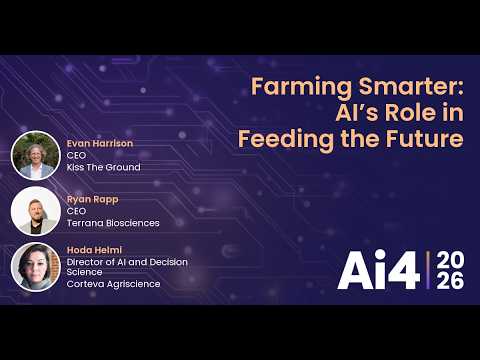
Corteva Cuts Crop Breeding Time in Half as AI Replaces Field Trials
Ai4
Predictive AI models and robotic weeders are replacing decades-old synthetic agrochemicals, shifting agriculture from maximizing raw crop yield toward optimizing nutrient density and human health.
## Background
Published on YouTube by the Ai4 channel on August 21, 2026, this panel session examines how artificial intelligence, robotics, and biotechnology are transforming the global food value chain. Featuring industry leaders Evan Harrison (Kiss the Ground), Ryan Rapp (Terrana Biosciences), and Hoda Helmi (Corteva Agriscience), the discussion explores how machine learning, digital twins, and biological innovations are enabling sustainable, profitable operations across agriculture.
## TL;DR
The panel explores agriculture's paradigm shift from purely maximizing raw yields toward multi-objective optimization centered on nutrient density, soil health, and human wellness. Corteva Agriscience illustrates how AI predictive modeling and digital twins cut crop breeding cycles from ten years to five while saving $150 million, while Terrana Biosciences details how beneficial plant RNA molecules replace legacy synthetic pesticides. The speakers also examine emerging hardware like autonomous laser-weeding robots and protected greenhouse structures that buffer crops against climate extremes and disease. Ultimately, transforming the global food system requires aligning farm profitability with supply chain transparency, precision nutrition, and growing consumer demand for regenerative practices.
## Atmosphere & style
The panel maintains an optimistic, pragmatic tone that balances high-level computational biology with the grounded realities of working farm operations. Evan Harrison's collaborative moderation and relatable anecdotes—drawing parallels from digital media transitions to childhood farm labor—create an engaging, conversational rhythm among the speakers. The discussion shifts seamlessly from technical breakthroughs in RNA design and drone phenotyping to broader societal impacts, culminating in a hopeful, lighthearted close centered on eradicating hunger and restoring ecological health.
## Key takeaways
- [00:04](https://www.youtube.com/watch?v=RmgfYw9yjIg&t=4s) Agriculture is shifting from a single-minded pursuit of maximum crop yield toward multi-objective optimization that balances nutrient density, human health, soil vitality, and farmer profitability.
- [00:04](https://www.youtube.com/watch?v=RmgfYw9yjIg&t=4s) Agricultural labor has dropped from 90% of the U.S. population in 1800 to under 2% today, redirecting technological priorities from raw labor reduction toward biological quality and resilience.
- [07:44](https://www.youtube.com/watch?v=RmgfYw9yjIg&t=464s) Corteva uses AI predictive models and digital twin simulations to cut seed development cycles from 10 years to 5, generating $150 million in COGS savings and accelerating response to climate shifts.
- [14:28](https://www.youtube.com/watch?v=RmgfYw9yjIg&t=868s) Harnessing beneficial native plant RNA allows crops to naturally resist fungal and bacterial pathogens, providing non-chemical alternatives for heavily sprayed crops like strawberries.
- [14:28](https://www.youtube.com/watch?v=RmgfYw9yjIg&t=868s) Developing RNA-based agricultural biologicals requires specialized AI architectures capable of learning from sparse data sets, as only around 1,500 RNA structures are resolved compared to over 20,000 protein structures.
- [17:34](https://www.youtube.com/watch?v=RmgfYw9yjIg&t=1054s) Storytelling and public education expanded U.S. consumer awareness of regenerative agriculture from 4% to 13% in three years, catalyzing market demand for healthier cultivation practices.
- [21:35](https://www.youtube.com/watch?v=RmgfYw9yjIg&t=1295s) With only ~10 new active chemical compounds commercialized over the past decade compared to ~800 legacy chemicals, AI-guided laser weeders and micro-torches are emerging as practical physical replacements for broad-spectrum herbicides.
- [25:07](https://www.youtube.com/watch?v=RmgfYw9yjIg&t=1507s) Protected culture and greenhouse production are expanding rapidly for horticultural crops to shield vulnerable produce from severe weather and pathogen outbreaks while localizing fresh food supply chains.
- [27:59](https://www.youtube.com/watch?v=RmgfYw9yjIg&t=1679s) Operational digital twins are moving agriculture toward autonomous farming, allowing daily AI models to dispatch robotic machinery and calibrate resource inputs with minimal manual intervention.
- [31:03](https://www.youtube.com/watch?v=RmgfYw9yjIg&t=1863s) End-to-end data traceability and retail AI assistants will empower 'food as medicine' initiatives, allowing consumers to verify farm-to-shelf provenance and match groceries to personalized health profiles.
- [36:22](https://www.youtube.com/watch?v=RmgfYw9yjIg&t=2182s) The long-term scaling of regenerative agriculture hinges on closing the farm profitability gap so sustainable, nutrient-dense food remains affordable to consumers while keeping growers financially viable.
- [41:37](https://www.youtube.com/watch?v=RmgfYw9yjIg&t=2497s) Panelists measure agricultural transformation by three core outcomes: reversing diet-related chronic illness, ending global hunger with nutrient-dense food, and actively regenerating soil health.
## Detailed walkthrough
### [00:04](https://www.youtube.com/watch?v=RmgfYw9yjIg&t=4s) Rethinking Agriculture: Moving from Max Yield to Human Health
Evan Harrison (CEO of Kiss the Ground) kicks off the panel by reflecting on his 30-year career in the music industry, leading transitions from mixtapes to CDs to digital streaming, which gave him deep insight into shifting consumer demand. Transitioning into agriculture, Harrison highlights Kiss the Ground's core mission: revealing the direct link between healthy soil, nutrient-dense food, and human health. He sets the stage for a panel exploring how cutting-edge technology—from AI-driven seed decision science at Corteva Agriscience to RNA plant biotech at Terrana Biosciences—can reform a broken food system where one in three people is unwell, two-thirds are overweight, and ultra-processed foods dominate.
```mermaid
accTitle: Transition from Yield Maximization to Multi-Objective Agricultural Optimization
flowchart LR
A["1800s–1900s: Industrial Focus"] --> B["Maximize Crop Yield & Reduce Farm Labor"]
B --> C["Rise of Heavy Machinery & Synthetic Inputs"]
C --> D["Modern Crisis: Depleted Soil & Rising Ill-Health"]
D --> E["AI & Biotech Evolution"]
E --> F["Multi-Objective Optimization: Health, Soil & Resilience"]
```
Harrison poses a fundamental question: for decades, agriculture obsessively optimized for "yield"—producing the maximum output for the lowest cost and effort. Can we now direct that same intensity toward nutrient density and human health? Hoda Helmi (Director of AI and Decision Science at Corteva Agriscience) agrees enthusiastically, noting that early agriculture was constrained by limited compute power, sparse data, and primitive analytics, forcing a narrow focus on yield and basic logistics. Today, AI allows decision systems to evaluate complex, conflicting objectives simultaneously—balancing nutritional quality, environmental footprint, farmer profitability, and climate resilience without sacrificing one for another.
Ryan Rapp (CEO of Terrana Biosciences) provides historical context on labor efficiency:
- **1800:** 90% of the U.S. population worked in agriculture to feed the nation.
- **1900:** Farm labor dropped to 40% as mechanization began.
- **Today:** Less than 2% of the U.S. population produces the entire food supply.
While industrial advances, chemistry, and early genetics drastically freed up human labor, Rapp argues that the next century must leverage AI, robotics, and biotechnology to optimize the *quality* and health impact of our food rather than merely pushing raw volume.
---
[07:44](https://www.youtube.com/watch?v=RmgfYw9yjIg&t=464s) Shortening Breeding Cycles and Building Digital Twins
Addressing Corteva's achievements, Harrison asks Helmi to explain how AI halved their crop development cycle from 10 years down to 5 while generating $150 million in savings. Helmi breaks down the traditional breeding pipeline, explaining that commercializing a single seed variety traditionally requires planting and physically testing thousands of genetic combinations across multiple geographical locations and growing seasons over a decade.
```mermaid
accTitle: AI-Accelerated Seed Breeding and Digital Twin Workflow
flowchart TD
A["Raw Genetic & Environmental Data"] --> B["AI Phenotyping (Drones & Remote Sensing)"]
B --> C["Digital Twin Virtual Farm Environment"]
C --> D["In-Silico Scenario & Combination Testing"]
D --> E["Accelerated Commercialization (5-Year Cycle)"]
E --> F["Reduced Waste, Cogs & Environmental Footprint"]
```
By employing AI predictive models, Corteva can now simulate and forecast performance outcomes *in silico*, skipping unnecessary field trials and cutting the development cycle in half. Additionally, precision phenotyping—using drones and advanced sensors—captures high-fidelity field data to continuously refine these predictive algorithms.
Helmi clarifies what a "digital twin" means in an agricultural context: a comprehensive virtual replica of the real-world farming system. Instead of testing decisions via trial and error in physical fields, agronomists run digital scenario analyses to evaluate seed selection, planting locations, and localized input needs.
- **$150 Million Saved:** Helmi emphasizes that these cost-of-goods-sold (COGS) savings are directly linked to sustainability—preventing seed waste, optimizing land usage, and eliminating unnecessary transport fuel.
- **Rapid Adaptation:** Shortening the breeding cycle allows scientists to deploy resilient crops much faster in response to emerging plant diseases and climate shifts.
---
[14:28](https://www.youtube.com/watch?v=RmgfYw9yjIg&t=868s) Harnessing Beneficial Plant Viruses via Targeted RNA
Shifting focus to plant biotech, Harrison asks Rapp to explain how Terrana Biosciences works with nature rather than attempting to override it, requesting a simple breakdown of RNA technology. Rapp uses the human gut microbiome as a parallel: just as humans have beneficial and harmful bacteria, plants host both harmful and beneficial viruses (many of which are RNA-based). Historically, science focused almost exclusively on bad viruses due to the crop damage they inflict, largely ignoring beneficial native viruses.
Terrana utilizes naturally occurring, beneficial plant RNA molecules that have co-evolved with plants over millions of years. By adding targeted molecular instructions, they prime the plant's natural immune system to defend against destructive pathogens (fungi, bacteria, or insects) without relying on harsh chemical pesticides.
```mermaid
accTitle: Structural AI Data Gap Between Proteins and RNA
flowchart LR
A["Protein AI Models (e.g. AlphaFold)"] --- B["20,000 Resolved Structures in Training Sets"]
C["RNA Biotech Models"] --- D["1,500 Resolved Structures in Training Sets"]
D --> E["Requires AI Trained on Sparse Data Models"]
```
Rapp highlights key insights regarding chemical usage and structural biology challenges:
- **The "Dirty Dozen" Vulnerability:** Strawberries consistently top pesticide contamination lists because growers rely heavily on synthetic fungicides to combat soil-borne root diseases. RNA technology offers a pathway to protect such crops naturally.
- **Sparse Data Challenge:** While protein design models like AlphaFold were trained on roughly 20,000 structural data points, science has resolved only ~1,500 RNA structures. Terrana relies on specialized AI models designed for sparse datasets to engineer these RNA molecules accurately.
---
[17:34](https://www.youtube.com/watch?v=RmgfYw9yjIg&t=1054s) Bridging Consumer Awareness & Targeted Field Interventions
Harrison shares data on public awareness surrounding regenerative farming and soil health, noting that Kiss the Ground’s research showed only 4% of U.S. adults understood regenerative agriculture four years prior. Through dedicated storytelling across media platforms, that number grew to 13% within three years. Harrison emphasizes that as public understanding of gut health and soil nutrition expands, storytelling serves as the critical bridge to driving consumer demand for healthier food systems.
Turning back to the technical panel, Harrison asks how chemical inputs can realistically be reduced on working farms over the next five years. Helmi outlines two main technological pathways:
1. **AI & Laser Weeding:** Drones equipped with computer vision fly over fields to detect weeds in real time. Rather than spraying broad-spectrum herbicide across entire fields, targeted lasers burn the weeds instantly.
2. **Precision Application:** Where chemical intervention remains necessary, smart sprayers target only the exact weed or infected plant, reducing overall chemical volumes exponentially.
When Harrison questions whether high-tech tools like laser-weeding drones are financially accessible for mid-sized farmers today, Helmi acknowledges that while early-stage technologies carry higher upfront costs, rapid hardware deflation—similar to drone adoption—is bringing precision weed management toward broad, practical affordability across the industry.
[21:35](https://www.youtube.com/watch?v=RmgfYw9yjIg&t=1295s) Replacing Legacy Agrochemicals with AI Lasers and Biologicals
Humanity currently relies on approximately 800 active chemical compounds to manage pests, diseases, and weeds across global agriculture. The vast majority of these synthetic chemistries were discovered during the late 1950s, 1960s, and early 1970s. Since that golden age of discovery, the pipeline of novel chemical inputs has dramatically tapered off, with only about ten new chemical actives introduced in the last decade. While moving away from chemical reliance is a positive shift for human health and ecology, these legacy inputs solved critical real-world problems that secured the global calorie supply. Replacing them requires viable, scalable technological alternatives.
Encouragingly, emerging biotechnological and physical solutions are stepping in to fill the void. These include RNA-based biocontrols and agricultural biologicals—leveraging native plant microflora to combat pathogens naturally. In horticultural crops, artificial intelligence combined with high-speed robotics is enabling non-chemical weed removal. Computer vision and pattern recognition models can identify individual weed species in real time and guide high-precision lasers or directed micro-torches to eliminate them without harming the crop. These automated implements look like something out of science fiction, but they are already deployed in commercial fields. Backing this up, Evan Harrison recounts how an acquaintance from the music industry transitioned into agricultural robotics to run a chemical-free farm, eventually building an expanding service business with precision field robots operated directly from an iPhone app.
- **Legacy Agrochemical Base:** Roughly 800 active compounds discovered primarily between the late 1950s and 1970s protect global food crops.
- **Innovation Drought:** Only around 10 new active chemistries have been commercialized over the past decade.
- **Targeted Robotics:** Computer vision models deploy sub-inch laser zapping and directed heat torches to destroy weeds mechanically instead of using broad-spectrum herbicides.
---
[25:07](https://www.youtube.com/watch?v=RmgfYw9yjIg&t=1507s) The Rise of Protected Culture and Local Horticultural Production
Looking ahead ten years, crop production is shifting rapidly toward "protected culture"—transitioning high-value horticultural crops from exposed open fields into structures covered by specialized plastics or into mid-tech and advanced greenhouses. Growing produce under protective cover shields crops from extreme weather swings, regulates moisture, and prevents bacterial and fungal infestations, resulting in far higher pack-out quality. Open-field leafy greens, by contrast, remain vulnerable to severe foodborne contamination, as illustrated by recent *Cyclospora* outbreaks in lettuce.
Scaling protected culture is far more feasible for fresh fruits and vegetables than for row crops because horticultural crops require significantly less acreage to feed populations. For instance, the entire commercial strawberry footprint in the United States spans only about 40,000 acres. Bringing a large percentage of this acreage under protected structures allows growers to extend regional seasons, buffer against temperature extremes on both ends of the calendar, and establish more localized, resilient food supply chains. Achieving widespread adoption requires an integrated approach that converges advanced seed genetics, tailored crop biotechnology, optimized hardware, and AI-managed climate controls to bring production costs down.
```mermaid
flowchart LR
accTitle: Protected Culture System Flow
A["Predictive AI & Climate Controls"] --> B["Protected Structure / Greenhouse"]
C["Engineered Biotech Seeds"] --> B
B --> D["Reduced Pathogens & Water Control"]
D --> E["High-Quality Year-Round Local Produce"]
```
---
[27:59](https://www.youtube.com/watch?v=RmgfYw9yjIg&t=1679s) Predictive Seed Breeding and Digital Twins for Autonomous Farming
In broad-acre row crops such as corn and soy, artificial intelligence is transforming seed development pipelines. Historically, breeding improved crop varieties required years of multi-environment physical field trials across diverse geographies. By applying machine learning models to predict how specific genetic traits and seed varieties will perform under various climatic and soil conditions, seed companies can bypass extensive physical trials. This compresses breeding cycles, accelerates time-to-market for high-performing, resilient traits, and substantially cuts the acreage required strictly for experimental seed production.
For the farmer, AI is evolving into operational digital twins that streamline daily farm logistics. Instead of reacting to unpredictable daily conditions, a grower will begin the morning with an AI-generated operational plan:
```mermaid
flowchart TD
accTitle: Farm Digital Twin Decision Engine
A["Real-time Weather & Field Data"] --> B["AI Digital Twin Engine"]
C["Equipment & Seed Inventory"] --> B
D["Commodity & Financial Data"] --> B
B --> E["Autonomous Tractor & Harvester Dispatch"]
B --> F["Prescription Seed & Resource Allocation"]
B --> G["Automated Enterprise Financial Optimization"]
```
Autonomous tractors, robotic harvesters, and humanoid field robots are already moving into commercial reality, reducing the need for constant human supervision and allowing farmers to run more sustainable, resource-efficient, and autonomous enterprises.
---
[31:03](https://www.youtube.com/watch?v=RmgfYw9yjIg&t=1863s) The Future Supermarket: Transparency, Biodiversity, and Food as Medicine
Supermarkets in the coming decade will undergo a massive transformation in labeling, product diversity, and personalized nutrition. Currently, 75% of consumers express a desire to buy healthier foods, yet 88% respond primarily to unstandardized marketing buzzwords like "natural" and "fresh" that carry no verified agronomic meaning. AI-driven end-to-end data pipelines will bring unprecedented transparency to retail shelves. Consumers will be able to scan products with their smartphones to instantly review the verified history of a food item—where the seed was sourced, what inputs were applied, and how and when it was harvested.
```mermaid
flowchart LR
accTitle: Farm-to-Shelf Traceability Flow
A["Farm IoT & Input Records"] --> B["Connected Enterprise Data Engine"]
C["Processing & Cold Chain Logs"] --> B
B --> D["Dynamic On-Package Label / QR"]
D --> E["Consumer Smartphone: Full Lineage & Nutrient Profile"]
```
Retail shelves will also feature greater crop biodiversity. Humans possess remarkably robust digestive systems and internal filtering organs—as Ryan Rapp jokes, "we are like raccoons, right? We can eat anything"—yet commercial supermarkets stock a narrow spectrum of edible plants. Companies like Pairwise are utilizing gene-editing and breeding tools to introduce unique, nutrient-dense seasonal crops (such as the Pacific Northwest black raspberry) into year-round commercial availability.
Furthermore, supermarkets will integrate "food as medicine" paradigms. As precision medicine enables physicians to prescribe specific micro- and macronutrient profiles tailored to an individual's biology, retail AI assistants will analyze shoppers' digital grocery carts in real time, steering food choices to match personal wellness goals while eliminating the confusion between organic, regenerative, and conventional claims.
- **Consumer Disconnect:** 75% of shoppers want food that improves health, but 88% rely on unregulated marketing terms like "natural" and "fresh".
- **Crop Innovation:** Gene editing and predictive breeding are turning niche, highly nutritious seasonal plants like black raspberries into shelf-stable, year-round staple crops.
- **Precision Nutrition:** In-store and digital shopping carts will incorporate real-time AI feedback loops that balance individual nutrient prescriptions against household food choices.
---
[36:22](https://www.youtube.com/watch?v=RmgfYw9yjIg&t=2182s) Shifting Supply Chains and the Tipping Point of Regenerative Agriculture
Transforming the broader food system relies on achieving a cultural and economic tipping point. While consumer demand for regenerative agriculture is climbing, the current certification landscape remains fragmented, confusing, and financially prohibitive for many growers who practice low-disturbance tillage, multi-crop rotations, cover cropping, and biological soil management.
For real system-level change to take hold, consumer awareness must align with supply chain modernization and supportive government subsidy structures. The fundamental bottleneck for modern growers remains farm-level profitability: regenerative and nutrient-dense food must remain accessible and affordable to everyday consumers while ensuring that farmers and supply chain operators run profitable enterprises.
---
[38:28](https://www.youtube.com/watch?v=RmgfYw9yjIg&t=2308s) Sources of Optimism: Youth Mobilization, Farm Labor Relief, and Consumer Connection
The panelists conclude by sharing the primary reasons they remain optimistic about the future of agriculture:
1. **Generational Passion for Environmental Solutions:** Evan Harrison highlights the younger generation's dedication to climate and planetary health, citing his daughter's career path in environmental communications following her involvement with the Surfrider Foundation. Hoda Helmi reinforces that corporate incentives are shifting precisely because youth-led consumer demand insists on radical transparency, environmental stewardship, and nutrient-rich food.
2. **Relieving the Physical Toll on Farm Labor:** Having grown up working on a vegetable farm, Ryan Rapp emphasizes that farm labor is inherently "backbreaking work" even with conventional mechanization. The primary promise of AI and robotics is not displacing human beings, but eliminating grueling manual tasks and dramatically improving the daily quality of life and safety for farmworkers.
3. **Reconnecting People to Food Systems:** A cultural resurgence is underway where consumers actively seek to understand the origins, ecological footprint, and biological journey of what they eat, providing the market mandate needed to drive agricultural technology forward.
[41:18](https://www.youtube.com/watch?v=RmgfYw9yjIg&t=2478s) Aligning Farm Profitability with Consumer Expectations
The dialogue surrounding the food supply chain is reaching a more constructive balance between two critical forces: ensuring farmers remain economically viable and profitable, and addressing consumer demands to have an active voice in how their food is cultivated. The speaker underscores the vital need to continue getting accurate facts and education directly to the public. Building this mutual understanding is essential to transforming the agricultural landscape into a win-win system that benefits growers, consumers, and distributors alike.
[41:37](https://www.youtube.com/watch?v=RmgfYw9yjIg&t=2497s) Defining Success: Health, Zero Hunger, and Environmental Regeneration
To close out the session, the panel transitions into a rapid-fire fill-in-the-blank game prompted by the phrase: *"We'll know we succeeded when..."* Each panelist shares their core metric for meaningful transformation across agriculture and the broader food ecosystem:
* **Human Health and Disease Prevention:** Success is defined by a fundamentally healthier population. Pointing back to critical baseline statistics, the moderator notes that two out of three people are currently overweight and one out of three is heading toward diet-related chronic illnesses. Rebuilding the food system means reversing these health crises.
* **Global Food Security and Nutrition:** A successful food system ensures that no one in the world goes to sleep hungry, guaranteeing that every individual has reliable access to food that is both sufficient in quantity and nutritious in quality.
* **Ecological and Soil Restoration:** True success requires agricultural practices that cease degrading the environment, evolving toward regenerative models that actively rebuild soil health and ecological resilience every time food is produced.
The panel wraps up on a humorous and lighthearted note, joking that the closing music is about to start playing them off the stage, before thanking the audience and each other for a lively and insightful discussion.
## Notable quotes
> [07:44](https://www.youtube.com/watch?v=RmgfYw9yjIg&t=464s) in silico — Hoda Helmi
> [07:44](https://www.youtube.com/watch?v=RmgfYw9yjIg&t=464s) digital twin — Hoda Helmi
> [14:28](https://www.youtube.com/watch?v=RmgfYw9yjIg&t=868s) Dirty Dozen — Ryan Rapp
> [38:28](https://www.youtube.com/watch?v=RmgfYw9yjIg&t=2308s) backbreaking work — Ryan Rapp
> [41:37](https://www.youtube.com/watch?v=RmgfYw9yjIg&t=2497s) We'll know we succeeded when... — Evan Harrison
## Mentioned
Evan Harrison, Ryan Rapp, Hoda Helmi, Kiss the Ground, Terrana Biosciences, Corteva Agriscience, Ai4, AlphaFold, Pairwise, Surfrider Foundation, Cyclospora
## Video description
Evan Harrison - CEO, Kiss The Ground
Ryan Rapp - CEO, Terrana Biosciences
Hoda Helmi - Director of AI and Decision Science, Corteva Agriscience
From drones to data models, AI is changing how food is grown and moved. In this panel, leaders from agriculture, CPG, and logistics explore how AI is enabling sustainable, profitable operations across the food value chain. Learn how growers are using machine learning to monitor soil health, how producers are using AI to cut waste, and how tech is making global food systems more resilient.
AI替代田间试验,Corteva将作物育种周期减半
预测性AI模型与除草机器人正在取代使用数十年的合成农化产品,推动农业从单纯追求作物产量转向优化营养密度与人类健康。
该专家小组探讨了农业的范式转变,即从单纯追求原始产量最大化,转向以营养密度、土壤健康和人类福祉为中心的多目标优化。Corteva Agriscience阐述了AI预测建模与数字孪生如何将作物育种周期从十年缩短至五年并节省1.5亿美元,而Terrana Biosciences则详细说明了有益植物RNA分子如何替代传统合成农药。发言者还探讨了自主激光除草机器人和保护性温室结构等新兴硬件,这些技术有助于缓冲极端气候和病害对作物的影响。最终,全球粮食系统的转型需要将农场盈利能力与供应链透明度、精准营养以及消费者对再生农业实践日益增长的需求相结合。
现代农业正从单纯追求产量的工业化模式转向兼顾营养密度、土壤活力与农户收益的多目标优化;在农业劳动力占比降至不足2%的背景下,技术重点已转向提升生物品质与生态韧性。 (0:04)
Corteva 利用 AI 预测模型与数字孪生农场模拟将种子育种周期从10年压缩至5年,不仅节省了1.5亿美元的销售成本,还大幅加速了对气候变暖与病害爆发的响应。 (7:44)
Terrana Biosciences 探索利用植物本土有益 RNA 增强作物抗病能力,针对已解析 RNA 结构仅约1,500个的行业短板,专门采用适用于稀疏数据的 AI 架构进行研发。 (14:28)
过去十年间全球仅商业化约10种新型农用化学活性成分,由计算机视觉驱动的 AI 激光除草机器人与定向喷枪正成为替代传统广谱除草剂的重要物理手段。 (21:35)
受控环境与温室设施栽培正在高价值园艺作物中快速铺开,结合端到端 AI 数据追溯体系,既能有效隔绝极端天气与病原体,也为零售端精准营养与本土供应链提供了保障。 (25:07)
Reading summary
Agricultural leaders argue that farming must transition from solely maximizing caloric yield to optimizing human health, environmental regeneration, and operational resilience through artificial intelligence, RNA biotechnology, and robotics.
Reorienting Agriculture Beyond Raw Caloric Yield (0:04)
Ryan Rapp notes that U.S. agricultural labor dropped from 90% of the population in 1800 to 40% in 1900 and under 2% today, driven by mechanization and synthetic inputs that solved labor constraints and boosted sheer volume. However, Evan Harrison emphasizes that this historical focus on yield has left a broken food system where two-thirds of adults are overweight and one in three suffers from diet-related chronic conditions. According to Hoda Helmi, early agronomic models were constrained by primitive analytics and limited computing power, forcing a narrow focus on volume. In contrast, modern AI decision systems can now evaluate multi-objective trade-offs simultaneously, balancing nutritional density, soil biology, farmer profitability, and climate resilience.
Compressing Seed Development Cycles via Digital Twins (7:44)
Commercializing a new seed variety has traditionally required planting thousands of experimental genetic combinations across diverse geographies over a decade. Helmi explains that Corteva halved this breeding timeline from 10 years to 5, generating $150 million in cost-of-goods-sold savings by running predictive machine learning models and gathering drone phenotyping data to simulate crop outcomes in silico. Beyond lab breeding, AI models are evolving into operational digital twins—virtual farm environments that simulate weather swings, soil variations, and resource requirements. These digital twins can automate daily farm logistics, such as dispatching autonomous tractors and robotic harvesters, reducing wasted seed and unnecessary chemical transport while speeding adaptation to emerging pathogens.
Substituting Legacy Agrochemicals with Biologicals and Lasers (21:35)
Global crop production currently relies on roughly 800 active synthetic compounds discovered primarily between the late 1950s and 1970s, with only about ten new chemical actives commercialized over the past decade. To address this innovation drought, Terrana Biosciences uses native, beneficial plant RNA molecules to prime natural crop immunity against pests and fungal diseases without chemical fungicides. Rapp notes a significant data bottleneck: while protein models like AlphaFold rely on roughly 20,000 structural data points, science has resolved only around 1,500 RNA structures, requiring specialized AI models trained on sparse datasets. In parallel, computer vision and robotics are replacing broad-spectrum herbicides with targeted field interventions. Drones and robotic implements identify individual weed species in real time, neutralizing them with sub-inch laser strikes or micro-torches. Helmi acknowledges high initial hardware costs for mid-sized growers, but points to rapid hardware deflation making precision management increasingly accessible.
Scaling Protected Culture and Transparent Supply Chains (25:07)
Panelists forecast a transition toward protected culture—moving high-value horticulture into plastic-covered structures or greenhouses to guard against extreme weather and pathogens such as Cyclospora. Rapp observes that this transition is particularly feasible for fresh produce because horticultural crops require modest land footprints, noting that the entire U.S. commercial strawberry supply occupies only about 40,000 acres. At the retail level, AI is positioned to address a persistent consumer disconnect: while 75% of shoppers desire health-promoting food, 88% rely on unverified marketing buzzwords like 'natural' and 'fresh.' Emerging systems will leverage IoT farm records and dynamic packaging to verify crop provenance, inputs, and harvest times, while gene editing expands biodiversity by turning niche seasonal crops like black raspberries into year-round commercial staples.
Realizing systemic agricultural transformation requires aligning consumer demand with supply chain modernization and farm economics. Panelists emphasize that fragmented certifications and adoption costs remain significant bottlenecks, warning that sustainable and nutrient-dense production will only succeed if technological innovations protect farm profitability while keeping healthy food accessible to the broader public.
[7:44] Hoda Helmi: in silico
[7:44] Hoda Helmi: digital twin
[14:28] Ryan Rapp: Dirty Dozen
[25:07] protected culture
[31:03] Ryan Rapp: we are like raccoons, right? We can eat anything
[31:03] food as medicine
[31:03] natural
[31:03] fresh
[38:28] Ryan Rapp: backbreaking work
[41:37] Evan Harrison: We'll know we succeeded when...
Original transcript
[0:04] I have the privilege of doing way less of the
talking. We're going to hear from some really
[0:10] really inspirational what I consider rock stars.
My background is in the music indust industry. I
[0:17] spent 30 years leading change when from when
people were making mixtapz to CDs. Then I
[0:24] uh helped lead the change to digital to digital.
So I understand consumer demand a bit. At Kiss the
[0:31] Ground, we focus on regenerative agriculture and
our purpose is all about the correlation between
[0:41] healthy soil, healthy foods, and our health. And
that's a lot of what we're going to be talking
[0:48] about up here today. And we're going to be coming
at from a slightly different upstream angle.
[0:54] You'll hear directly from Hoda. But my assessment
when I talked to Hod after having to look up a lot
[1:01] of terms that I didn't understand was we have
a leader in the AI space who is using AI for a
[1:08] decision science and how that affects creating
seeds. Not many of us when we think of the food
[1:15] we eat think about the seeds that help grow the
plants. And Hoda is going to be talking quite a
[1:20] bit about that. and Ryan, a longtime leader in the
agricultural space. What I really summized there
[1:27] was uh biotech and I think we're pretty familiar
with that term. He is going to be talking to us
[1:33] about how through science and AI we can actually
affect plant behavior. Fascinating stuff. So why
[1:43] are we talking about our food system? because
there is a direct correlation with our food
[1:49] system today and our poor health. One in three of
us is um is not well and 23 of us are overweight.
[2:00] So with the tie to ultrarocessed foods, soil
that is no longer healthy, we've got to do
[2:09] we've got to have a bit of a redo moment here. And
that's what we're going to be talking about. So,
[2:16] it really takes leadership to drive change. We've
got two great leaders here. So, I'm going to come
[2:22] join you and ask some questions and then we'll
probably have time for audience questions as well.
[2:29] All right, kicking it off. I don't want to be
blocked. Okay. Yep. Nobody bites here. We're gonna
[2:36] come close. All right. So, first up, we have spent
a lot of time in energy as an industry optimizing
[2:46] farming for yield. And I wasn't very familiar with
the term yield when I joined Kiss the Ground four
[2:54] years ago and how it pertains to farming. Simply
put, how do we spend at have the most efficient
[3:00] process in time spent and money spent for the
greatest output of product? The question is,
[3:08] can we apply that same intensity for an outcome
that focuses on our health and nutrient density
[3:16] in our food system? Jump on in whoever wants to
go first. Sure. Well, exciting to be here. Like
[3:22] what's the better combination than AI Vegas and
talking about food, right? So, um, and the short
[3:29] answer to that is absolutely. Um so I'm going back
historically in agriculture we have been trying to
[3:36] optimize for few objectives yield one of the main
important objectives that we wanted to optimize
[3:43] having more products out of one acre right and
then we added okay let's uh minimize cost now
[3:50] let's um optimize the logistics now with AI and
and and let me also give the context of why that
[3:58] was because limited data limited compute power,
limited um analytical capabilities. Now with AI,
[4:08] we have all of those. Well, data, you can
still argue that we don't have a lot of it,
[4:13] specifically in agriculture, which is multimodel,
very very complex. We need a lot of data, but AI
[4:19] is helping us actually to capture the data faster
and more efficient as well. So now with AI, we can
[4:26] have multiple different objectives. Now it's not
just about yield. It's about nutritional quality,
[4:32] right? It's about environmental impact. It's about
obviously farmer profitability. We cannot ignore
[4:39] that. Um it's about uh resiliency to um climate
change. So combining all of those obviously they
[4:47] are um conflicting objectives as well. But AI this
decision systems that we are building is helping
[4:54] us create so many different scenarios and put
those tradeoffs in the context and understand how
[5:01] we can optimize them finding that sweet spot that
optimize all of them not just well compromising
[5:08] for nutritional quality for profitability right
so Ryan what can you add to that yeah no I think
[5:15] that those are a lot of great points there when I
think back about where agriculture has Um and what
[5:20] we've optimized it really has been yield. It's
also been the number of people that are involved
[5:25] in agriculture. So if you go back to 1800 uh 90%
of the US population was involved in agriculture,
[5:32] right? 10% were in cities and everybody
was basically making a living out on the
[5:36] farm. Very inefficient process. By uh that was
1800. By 1900 that was down to 40%. Today we're
[5:44] down to less than 2%. So less than 2% of the US
population was involved in actually making all the
[5:49] food we eat each day. And that was done through an
amazing feat of engineering through the industrial
[5:54] revolution like bringing tractors in finding
uh new chemistries that dealt with diseases,
[6:00] right? Uh better genetics and seed developments
from the seed companies and the universities.
[6:05] And so that was sort of the first focus that
took all of our energy. If we can do that with
[6:10] that set of tools, to me it seems like today
we should be able to use AI and biotechnology
[6:16] and seed development processes and be able to
focus on the things that are actually going
[6:22] to bring us back to a healthier state overall.
So back to those ideas about nutrient density,
[6:27] about the ability to reduce pesticide use um a lot
of that I think can come through AI helping the
[6:33] farmer to actually manage day-to-day operations.
Right? So now you have this thing where you've got
[6:37] like just a couple people looking at, you know,
maybe a giant uh maybe they're farming about a
[6:42] thousand hectares of blackberry, right? And how
do you tend to all the plants and know what to do
[6:47] in all those situations? Where can robotics
and AI help you make those better decisions
[6:52] during that process so that you don't have to
use pesticides as often? I think AI can give us
[6:57] a really good foothold in that space and help
us make the, you know, the next hundred years,
[7:01] uh, the focus really being on the the quality
portion of the food. amazing perspective with
[7:06] those statistics. And I think a lot of us wonder
how did we get to where we are today where we
[7:16] need chemicals that are not good for our health on
our food to aid the farming process. Our soil has
[7:23] become unhealthy. Uh you mentioned the industrial
revolution. That's when we really started pumping
[7:30] out a lot more corn and soy and wheat in the
United States much more efficiently because we
[7:37] had a growing population that we had to feed. And
now the next big challenge is and how do we make
[7:44] sure that is nutrient-dense healthy foods that we
are feeding them. So, Kota, AI helped you reduce a
[7:54] um a a build cycle from 10 years down
to five years. Talk about how, you know,
[8:02] break that down for us as well as the savings
that you were able to generate of $150 million,
[8:08] not a small number. So, anything we're working
on that can be brought from 10 years to 5 years
[8:14] and save $150 million uh deserves a little bit
of attention. So please break that down for us
[8:20] and kind of end with how will that eventually
change what we experience at the grocery store.
[8:29] Well um a lot there you um have like multiple
points to your question that I'm going to tackle
[8:36] one by one breeding cycle how we are shortening
that and what does that mean even right well to
[8:44] many people breeding is just planting seed
but in reality for getting one variety to a
[8:51] commercial seed it means we are testing thousand
and thousands of different combinations through
[8:58] going through a lot of different experimentations,
multiple years, multiple locations to make sure
[9:04] the seed that then is becoming commercial is the
best seed that we could uh get to our customers
[9:12] from the yield standpoint, from the different
traits standpoint, uh disease susceptibility
[9:18] standpoint, profitability standpoint, there are
so many different aspects that we are checking
[9:24] throughout the breeding pipeline. So now we are
talking about shortening that funnel assuming
[9:31] that it takes 10 years from the first time that
you're starting looking at those royal varieties
[9:37] to when you are basically ready to commercialize
that seat. Well, AI is helping us to predict a
[9:46] lot of those combinations without even going to
those experimentation phase, right? And that is
[9:52] how we are shortening that funnel from 10 years
to different uh years for different varieties.
[9:59] Obviously, it's not just one um number that
it takes for the funnel. [snorts] Also I need
[10:07] to add that when we are shortening the funnel it
means that we are reacting faster to environmental
[10:14] changes to different disease that are um being
created appearing in the environment. We are
[10:21] giving the innovation faster to the farmers to our
customers so they can use better seed with better
[10:28] genetic qualities and so on so forth. That is the
how AI is helping us with shortening the funnel
[10:34] and I should mention that is not just predicting
of those varieties on how are their traits and
[10:40] then selecting the best of the best to go to spend
those experimentations but is also we are using AI
[10:46] to do uh prestigious uh precision phenotyping
which means okay all those experimentation
[10:53] let's get all those um phenotypes using drones
using a lot of different technologies that is
[10:59] available to us getting better data to be able to
create these AI systems that are predicting for
[11:05] us more accurate. Okay, this is the part for the
reading uh funnel. You want to uh chime in or do
[11:13] you want me to just go on and subscribe? Yeah.
Okay. So, the next part is that 150 million of
[11:19] uh savings. So I now I need to talk about
digital twin and um it's good to level set
[11:27] what is digital twin because you may have heard
that term in different context but that means many
[11:34] different things right depending on what industry
you're talking about what scale and scope we
[11:40] are talking about but when we are talking about
digital training agriculture you can think of a
[11:47] um digital virtual copy of the agriculture system.
This is the broadest definition for digital twin
[11:55] in agriculture. So now what we are trying to do,
we are trying to build that digital twin so that
[12:05] we wouldn't need to go to the physical environment
to test. We can basically having that digital
[12:13] twin doing a lot of testing in the digital
environment doing a lot of scenario analysis
[12:20] to understand what are the impact of different
decisions that we are making in the farm for what
[12:28] um products we are uh selecting where we are
planting those products what um chemicals if we
[12:36] have to apply what chemicals we have to apply and
where we need to apply apply them instead of like
[12:42] applying them to the whole field that it doesn't
need all of those chemicals that is also going
[12:48] back how we can reduce those chemical impacts um
and effects on health. So building that digital
[12:55] twin um in our organization now has helped us to
made a lot of decision more optimally and that
[13:03] has result in 150 million savings and that saving
is not profit is not cog saving right it's saving
[13:12] that is basically helping with sustainability
right a lot of minimizing the waste creating a
[13:20] lot of more seed that if we couldn't make these
optimal decisions would go to waste. Right? So
[13:27] basically this 150 million is helping us to
send to create more seed to have less of of
[13:37] waste to have less transportation for example just
basically saving on fuel and uh the impact of that
[13:44] on environment. So this is not I want to f um say
it multiple times that when we are talking about
[13:52] these cog saving a good portion of that is helping
with the sustainability. No longer this is the
[14:00] conversation about well these are sustainability
goals and these are our uh profitability goals.
[14:07] We have merged those so that when we are saving
those um cogs basically we are helping with the
[14:15] environmental impact and sustainability. Very
encouraging and you did a great job unpacking
[14:20] those two distinct points which really comes down
to efficiency when all is said and done. So Ryan,
[14:28] we're going to shift gears a little bit. The
evolution of nature's system has been I mean if
[14:36] we think about how many billions of years nature
has worked out its systems are you attempting to
[14:46] engineer nature to work in tandem with nature and
or um you know and please explain to us a simple
[14:55] understanding of RNA. Sure. Yeah. So I think to
the to your your middle question there I think
[15:01] that at Toronto we are trying to work with nature
um and learn a lot from it. Um so what we do is um
[15:07] if you the the best analogy I have is that we all
have become aware over the last 1015 years that
[15:12] you can have good bacteria and bad bacteria in
your stomach right good microbio bad microbio same
[15:18] is true in plants except uh in plants also there
are good viruses and bad viruses humans have and
[15:24] these are RNA based viruses humans have studied
the hell out of the bad ones because they cause
[15:29] a lot of economic damage and we lose a lot of our
crops through them. Um, turns out we pretty much
[15:34] ignored the beneficial and the good ones. So, what
we do at Tana is we take those uh molecules and we
[15:41] use all the natural features that they've already
evolved like how to co-live with the plant,
[15:45] how to keep the plant healthy. And what we then
do is give them a little bit of added instructions
[15:50] that help the plant either prime its immune system
to defend against a different virus or bacteria
[15:56] or fungus um or produce a little protein that can
protect it from an insect or something like that.
[16:02] So, um, the couple features of it are great. So,
one, um, these RNA molecules are way safer than,
[16:09] uh, the chemistries that we use to control these
pests today. So, this is something where you can
[16:14] think about like, um, I don't know if you're
familiar with like the dirty dozen list. This
[16:18] is where they go into grocery stores and they're
got they sample off of all the different produce
[16:22] in there. Strawberries come out at the top of
that list almost every year because you need a
[16:26] ton of chemistries to control the root fungus that
attack those plants. And uh I think there's a real
[16:33] possibility with RNA technology we can get them
off that list. But um I don't think we're going
[16:37] to do it without RNA or without RNA without AI.
Um specifically because uh RNA is a very different
[16:44] place than proteins. So u I'm sure a lot of you
have heard of alpha fold and now there's a whole
[16:49] bunch of different models uh that use AI to do
generative design of proteins. Um so that was
[16:54] done and the training data set for that was about
um 20,000 proteins that humanity had discovered
[17:00] the structures of like just through sheer brute
work. Now compare that with RNA molecules. We've
[17:06] elucidated the structure of about 1,500, right?
So we do not have nearly the data set to work off
[17:13] of. Um and I really think that AI working with
these sparse models is going to be how we're
[17:18] going to get to that. And that's one of our big
focuses at uh Toronto is actually bringing AI in
[17:24] um to use this in the design process so that we
can understand the structure of these molecules
[17:28] and make sure that we're keeping all the things
that they've evolved with over those years. Again,
[17:34] incredibly encouraging. Um, at Kiss the Ground
when I joined four years ago, everybody was
[17:43] talking about regenerative agriculture as if
everybody knew what we were talking about. We
[17:50] did some research and what we found was only
4% of the US adult population could connect
[17:58] regenerative agriculture, healthy soil, healthy
environment and ecosystem approach to farming.
[18:05] That number is now 13% in only three years of
now telling more stories across platforms. And
[18:13] Ryan brought up something which is incredibly
important. The connection between our gut health
[18:19] and our overall health. That's also a pretty newly
understood conversation in the in the mass market.
[18:28] So, it's pretty wild how far in advance the work
you're doing is from where people will truly feel
[18:36] the effect of it. And storytelling helps bridge
that gap a bit as we try and bring consumer
[18:43] demand to focus on foods that are produced in a
way that can make us healthier. So, as we um as
[18:52] we move down this path and you've both mentioned
chemical inputs, talk a little bit about chemical
[19:02] inputs today and how you see that lessening in
a practical sense over the course of the next
[19:08] call it five years. Yeah, very good question
and actually this is a topic for the industry,
[19:14] right? So um and I mentioned very briefly how
now AI technology is helping us in different
[19:23] ways to tackle that problem. Well, I think it's
obvious to everyone that chemicals are not good,
[19:29] right? We we want to avoid applying those
chemicals at all cost if we can, right? And um
[19:35] Ryan mentioned there are different ways for coming
up with solutions that is helping um us do that.
[19:42] But just simply from the drone technology and AI
technology combined and basically just think about
[19:52] it flying drones over the fields and predicting
real time not predicting looking and observing and
[20:00] uh distinguishing that okay this part of
the field has this herbicide and needs to be
[20:06] uh removed. Well, now with um laser technology,
those can be burned, right? Combination of these
[20:14] technologies is basically reducing the need for
those chemicals, the herbicides that we would
[20:20] need, right? So from a practical sense, is the
cost for practicing with those drones and with
[20:29] those lasers affordable by your midsize farmer
today who may have multiple crops? Good question.
[20:37] when the technology is still new where still we
are experimenting in those obviously not is not
[20:43] very scalable but as we are advancing and these
are becoming cheaper like drone actually now is
[20:50] accessible to a lot of farmers they're using in
different capacities but then combining that with
[20:55] AI and with that laser burning that is yet to
come to you know um affordable kind of solution
[21:02] for the farmers but these are what the industry
is working on right now And this was just one. It
[21:08] doesn't need to be laser. It can be uh precision
application of those chemicals, right? You're um
[21:15] finding those herbicides and the the areas in the
field that they need to be applied those chemicals
[21:20] and you're just going and applying that very
precisely to that part. Right. Great followup,
[21:26] Ryan. You talked about the dirty dozen. Um the
dirty dozen uh is a published list and you know
[21:35] these chemicals that make them classified as the
dirty dozen are being applied to solve a problem.
[21:42] Right. So how do you look at the work you do and
you already referenced one example really helping
[21:49] us cut back on um chemical inputs. Yeah. I mean so
to set a little context for it too. So, you know,
[21:57] humanity, like all of us in here, we rely on
about 800 active compounds, active chemistries to
[22:03] basically control all of the problems that we have
in agriculture. And most of those compounds were
[22:09] discovered in the late ' 50s, '60s, and early '7s,
like large far away. And since then, um the amount
[22:16] of these that we have discovered has tapered off,
right? um to the point where you know in the last
[22:23] 10 years I think we've brought in only like about
like 10 new chemistries to solve problems that we
[22:29] have. So there's there's two points about this.
One point is that okay that's good. We seem to be
[22:35] moving away from the bringing in new chemistries
and the use of chemistries. The other problem is
[22:40] well those chemistries were solving real world
problems right that actually still got food
[22:44] to our table and made sure we got calories and
nutrients. So what do we have to replace them?
[22:50] And so I'm really encouraged by today that we've
got technologies like RNA, we have biologicals,
[22:55] right? So this is using like other little microbes
that are already on the plants that can help fight
[23:00] off other microbes that are on the plants. Um
taking advantage of that. Um working to remove
[23:05] some of the herbicides for the systems like that
she was just talking about. There's now systems
[23:09] out there for um what we call horicultural crops,
which is basically everything we eat. Uh that use
[23:16] lasers to zap the weeds in the field. There's ones
that use directed little torches. And these things
[23:21] are number one, you got to Google these and watch
the videos of it because it looks like science
[23:25] fiction. But these things are all being driven by
AI, right? So this is all uh image recognition,
[23:30] pattern recognition for the weeds that are in
the field. And then that's directing the robotics
[23:35] with a very very targeted response. Um, so I'm I'm
very hopeful that we're on the upswing in the sort
[23:41] of like the bigger pool of solutions the other
way. We still have a long way to go to get these
[23:45] chemistries out of there, but I think that um the
research is really going in the right direction.
[23:50] The funding is really being aligned with it now.
So my hope is that, you know, we're going to get
[23:54] there sooner rather than later. Well, we're going
to talk about um predicting the future in just
[24:00] a second, but I will add a lot of what's being
talked about right now is happening and you can
[24:07] watch these videos that are really inspirational.
When I joined Kiss the Ground uh four years ago,
[24:14] an acquaintance who I knew from the music industry
who was in technology at the same time I was doing
[24:20] um you know all sorts of stuff in the
music industry created an auto automated
[24:25] uh robotic company to solve a problem because he
wanted to go chemical free on his farm. He turned
[24:32] into a service business and uh they're expanding
massively. So watching his creation on the fields,
[24:40] the precision and the accuracy of these little
robots that he controls with an app on his iPhone,
[24:46] it's pretty miraculous. So now looking out about
10 years, tell us what you believe farming will
[24:53] look like compared to what it is today with the
majority of farming farming today being a singular
[25:00] crop. You start this one. Sure. Maybe I can I can
talk about it from the uh sort of the horicultural
[25:07] crop perspective a little bit. Yeah. So I mean I
I think in 10 years one of the big things you're
[25:12] going to see and this is a trend that's happening
right now is there's more and more production
[25:16] moving into what we call protected culture. And
so protected culture is just that instead of it
[25:21] being grown in an open field, it at least has some
piece of plastic and a structure over it where you
[25:26] can control the rainfall, you can control the
rain that's getting to it. You can then control
[25:31] uh the fungus and the bacteria that are growing on
it so you have a higher quality crop at the end. I
[25:36] think we're going to see a lot more of that as the
environment tends to throw more and more swings at
[25:40] us. Um so I think that will be common. Um, other
things that I think are going to be more common is
[25:46] Ryan, can you slow down on the protective? Sure.
Like what will be grown and how can that scale in
[25:54] that environment? Yeah. So almost everything
can be grown in that environment. So today,
[26:00] uh, when you're getting your strawberries,
blackberries, raspberries, um, if you're
[26:05] getting lettuce at, anything that shows up
in like a a clamshell in the grocery store,
[26:09] all that stuff is either being grown under a piece
of plastic in a greenhouse or in what we call like
[26:14] midtec green houses. Um, you know, there's still
giant open fields of lettuce, and we're we're all
[26:19] learning about that together this summer through
the wonderful cycllosporia outbreak. Um, but the
[26:26] uh the the crux of all that is that uh there's
a bunch of pieces that go with it, right? So,
[26:32] one that's a lot more plastic in the environment,
which they already is a problem and the EU is
[26:37] working to come up with some alternatives to that.
But the other thing to remember is that we don't
[26:43] grow, it doesn't take nearly as many acres to feed
people the horicultural crops as it does to grow
[26:49] some of the feed stock crops like corn and soy. So
in the US where you get most of your strawberries,
[26:55] there's only about 40,000 acres of strawberries in
the US, right? And so it is a much more manageable
[27:00] situation to say that oh a large fraction of that
could be under some sort of protected culture. And
[27:05] that's true for almost all the horicultural crops.
So will that change the percentage of imports
[27:12] versus grown regionally locally? Yeah, it does
give the ability to have longer growing seasons
[27:19] locally um because you can mitigate some of the
heat and you can mitigate some of the coolness
[27:24] that comes on either end of your season. So, there
could be more stuff local. I mean, we're working
[27:29] with a company that does indoor agriculture uh and
they're getting really really good at doing this
[27:35] and trying to get the cost down. um they're very
very close to being able to grow things other than
[27:40] lettuce. But I think that that's where there's
going to be this interplay between can you bring
[27:44] in some biotechnology that can help them? Can
you bring in better seeds that can help them?
[27:48] Can you bring in better hardware and AI that
can help them? And getting all these things
[27:52] together can give us a better sort of more local
food supply. Excellent. Sure. Well, I'm going to
[27:59] take another angle, right, for row crops and like
the um crop seeds that we are um producing. Well,
[28:08] from the seed production standpoint, I would
say the production is going to be so fast and
[28:16] those trace that we want to see on the seeds, it's
going to be very easy to actually make sure that
[28:23] we are selecting for those faster, way faster than
what we are doing now. those experimentations that
[28:30] I mentioned all the selection process that we
are going through trials in different locations
[28:35] different environments we wouldn't have to do all
of those physical experimentations um we can do
[28:42] more of the prediction of those seeds in different
environments so accurately that that would reduce
[28:50] the need for that like long breeding cycle that we
have and we can have better varieties as uh at the
[28:58] output of those pipelines. Well, the production
system for these um seed production companies is
[29:06] going to be way more sustainable, efficient. We
don't have to use acres and acres to produce the
[29:13] seed that um the farmers are going to. So that
is from the um the seed business standpoint. But
[29:21] from the farmer's side, it's going to be also very
interesting what AI can create with that digital
[29:28] twin concept and the AI all those decisions that
the farmers are making every day, right? That they
[29:35] have to react to they wouldn't have to do any
of that. They they um started the their day by
[29:42] knowing exactly what is the weather, how is the
weather today, where the seed is that they need
[29:48] to start uh planting, where are the tractors and
how much of those um resources they would need
[29:54] for that. They can do their finances through AI
for what variety from what companies we need to
[30:02] um h they need to have for their operations,
right? So, think about it. No difficult decisions
[30:08] anymore. So this is about the decision making
part of it. Now let's talk about the actual
[30:13] physical work in the farm. Think about humanoid
the robots that they can have the tractors that
[30:21] basically can do most of the things without
needing a driver. Right? So and that is not
[30:28] 10 years it's actually now. Right? So, but it can
be more autonomous, less needing um supervision,
[30:38] right? So think about it like from the farmer's
standpoint, it's very exciting to see where how
[30:45] they can use AI now and then how they can use AI
as robotics and tractors and the harvesters to
[30:53] make their their whole operation basically needing
less resources but more autonomous. Right? So so
[31:03] bad pun. This is a chicken and egg conversation
here. Uh, most consumers, 75% want to buy food
[31:13] that will make them healthier. Yet, the confusion
of food labels is overwhelming. 88% respond most
[31:23] to the term natural and the term fresh. Those
are marketing terms. They they don't tie to
[31:29] the ingredients and to how and where the food was
grown. So, it's incredibly encouraging from where
[31:35] I'm sitting to hear that companies are applying
massive resources into making this change. Uh,
[31:44] which brings me to what will the supermarket
look like in 10 years versus where it is today?
[31:53] Very very good question. Well, I would say
first of all those labels that you mentioned,
[32:00] right? And as part of our production, we are
spending a lot of time on the labeling to
[32:07] make sure everything is regulated. All the right
information are on those labels and that is very
[32:14] big part of the operation as well. So I think
AI can help a lot with labeling with precision
[32:22] with accurate information on the labels so that
every food that is going to the grocery stores is
[32:28] very reliable. Those labels are reliable for the
consumers to look at. And even with their phones,
[32:35] they can scan and get a lot more information
that is not just on the label, but about the
[32:42] history of where that seed is coming from or that
food is coming from, how that has been produced,
[32:48] where it has been produced, when it has been
produced. It should be very easy with this whole,
[32:52] you know, connected systems, data systems
that should be accessible to everyone, right?
[32:59] So that is just one aspect of the supermarket and
how we can provide way more transparency about the
[33:08] food and where it's coming from. Yeah. Um so I
I think two things in the future I would hope
[33:15] to see in the supermarket. So one um humans like
we're amazing. We are like the we're raccoons,
[33:22] right? We can eat anything. If you look at any
other animal out there except maybe raccoon,
[33:27] uh like they can't eat anything like their livers
can't process things, right? Their kidneys can't
[33:31] handle certain things. Humans have amazing livers
and kidneys and we are very lucky to be able to
[33:37] eat most of the plants that are on this planet.
And so what I would hope is that you know we are
[33:42] we will start to see more and more diversity in
the types of produce that we have in the grocery
[33:47] stores. Um to give you an example, you know, one
of the um things that's very unique to the United
[33:53] States is the black raspberry. You can only get
it seasonally. It's typically in New England and
[33:58] the Pacific Northwest. You tend to think of it
like a farmer stand. Uh last company I worked at,
[34:03] Pairwise was actually making a version of this
where it is going to be available so it can be
[34:08] grown like a blackberry year round, right? So this
is another example of some another nutrient-dense,
[34:13] high antioxidant food that can be brought into our
food system. So, I hope more of that shows up. And
[34:18] the other piece is is an additional version of
what Hodto was talking about is that um we do
[34:23] start to have to treat food as medicine, right?
Um you're running you you are a biological system.
[34:29] You're running stuff through yourself every day.
Your liver is working, your kidneys working,
[34:33] your bloodstream's trying to, you know, move that
stuff around. And um at some point, you know,
[34:38] hopefully you're going to get a prescription
from your doctor about what your nutrient profile
[34:43] should look like, not just for the basics, but
for everything, right? For what you need. And the
[34:47] hope would be that as you're going and you're
putting those things into your grocery cart,
[34:51] there's some sort of AI system that is already
starting to understand, are you hitting that
[34:55] goal or are you not, right? And you're getting
that feedback instantly instead of like sitting
[35:00] down trying to make a dinner list. I'm going to
cook this on Tuesday, right? So, you're kind of
[35:03] picking the things you like. you're kind of doing
it the same way you've always done it, but you're
[35:07] getting that instant feedback that's going to help
steer you in the right direction towards what you
[35:11] need on a personal level. So that's why I hope
we'll sleep. I love that. Can I add also one other
[35:16] thing? So now we are going to supermarkets
and we are confused organic, non-organic,
[35:22] like different types of you know eggs, different
types of meat. I think AI can definitely help us
[35:30] with clarity of okay this is organic what it means
how it has been produced what has been applied or
[35:37] not applied on this what's the difference between
this label of organic versus the other one I think
[35:42] these are a lot of you know information that we
don't have access to it right now because up until
[35:49] now we had fragmented data systems now with AI we
the the companies are forced into building those
[36:00] data systems that are connected because AI needs
this data to provide that information. Right? So
[36:07] a lot of what we are talking about is AI forcing
these organizations to make that data usable as
[36:15] a system as a connected system from end to end.
Very very hopeful comments from both of you and
[36:22] it's pretty funny. Uh there's a joke in here
somewhere. If a system scientist and like we
[36:31] come at all of this from three very different
angles. We focus a lot on storytelling and our
[36:38] theory of change is based on Malcolm Gladwell's
tipping point and the approach is very simply
[36:46] okay 74% of the people pled want to buy food
that makes them healthier. Yet there's a big
[36:53] disconnect and there's a big distrust and there's
a big misinformation between actually buying the
[37:00] food that is going to make them healthier. So
the feeling is when we get that consumer demand,
[37:06] consumers looking for regenerative labels and
yes, that's another confusing term and there
[37:12] are certifications. Um it's earlier days of the
certifications all sorting themselves out and
[37:19] it's also cost prohibitive for a lot of farmers
who are doing things the hard way and the right
[37:25] way with least disturbance fewer chemicals or no
chemicals uh multicrop rotations cover crops and
[37:33] really have rich you know rich healthy soil. So
the thinking is as consumer demand increases the
[37:41] supply chain changes and already you're both
working extensively on issues in the supply
[37:49] chain and they're being solved as we speak. And
then finally, government subsidy rewarding all
[37:57] of the things that we're talking about here being
a big hurdle because the farmer today's biggest
[38:02] hurdle is um making a profit and everybody you
know consumers have to be able to fi afford food
[38:10] that is nutrient-dense uh and you know all the
companies need to make a profit and the farmer
[38:16] needs to make a profit. So these are complex
systems we're looking to solve here. So with that,
[38:21] let's shift to a very uh optimistic message
because there's a lot of optimism here. What is
[38:28] it that makes you both optimistic about where it's
all going? I will start by saying it's the youth
[38:36] generation that makes me optimistic. I was working
in the music industry. I was serving on the board
[38:41] of the Surf Rider Foundation. That's my closest
connection to nature. and I was uh setting up
[38:47] their events and bringing my daughter along. She
now graduated from San Diego State and she works
[38:53] in communications on environmental causes. This
generation is lit up and they are excited about
[39:03] finding solutions for a healthier planet and a
healthier human. That's what makes me optimistic.
[39:10] Well, I want to actually second that, you know,
um and and our previous conversation was about
[39:16] if society is asking for more nutrient food, the
companies are shifting their objective to produce
[39:24] that, right? So, and and youth right now, the
new generation, they want that. They are caring
[39:32] about the climate, they care about the food, they
care about transparency. And now combine that with
[39:39] everything that we talked so far with AI having
all those data accessible having digital twins
[39:45] and being able to respond to that need the
need of the society right so that is what is
[39:54] keeping me hopeful because as all of us know AI
is a technology it's a very powerful technology
[40:01] right we can use it in the wrong way but we can
definitely use it for a lot of good things to
[40:08] build value for society to generate value for
society to make sure that we are not wasting a
[40:15] lot of food and we are not um we are taking care
of the climate the environment right that we are
[40:23] not doing that or doing a very good job the best
job that we can right now right yeah um so that I
[40:31] would say two things so one um you know I grew
up working on a vegetable farm And uh it is it
[40:38] is backbreaking work even with mechanization
and tractors and automation. So my first hope
[40:43] that gives me hope is that uh AI and robotics
and everything it's not really going to replace
[40:48] the people that are there but it's going to make
the work that they do better and the make their
[40:53] quality of life better u and not so backbreaking.
That's hope number one. And then the second piece
[40:57] is around not just youth but people in general.
there is a resurgence in um people wanting to
[41:03] understand and connect with their food and where
it's coming from, how it's being produced. Um I do
[41:08] think it's right that even though you know there's
sort of this tug and pull between the farmer
[41:13] trying to say I got to grow the food how I can so
that I can get the most to the grocery store and
[41:18] make the farm profitable and the consumer saying
I want to have input in how my food is produced. I
[41:23] think that discussion is getting to a better place
and I hope that we continue to get the right facts
[41:28] out in front of people so people can be educated,
understand and we can get to a system where
[41:32] everybody is winning at the end of that. Amazing.
Okay, with a couple minutes left, we're going to
[41:38] play a little fill in the blank game and I'll go
first. And the blank goes like this. We'll know
[41:45] we succeeded when there's the blank. So I will say
we'll know we succeeded when we are healthier. The
[41:56] stats that I started with, two out of three of us
are overweight. One out of three um are heading
[42:03] towards diseases, chronic illnesses because of um
because of these issues. When we're healthier, the
[42:11] food system has been rebuilt and we've succeeded.
Well, I would say when we don't have anyone in the
[42:20] world that is a sleeping hungry, right, they all
have food enough and healthy enough as well. Yeah,
[42:29] I would definitely echo that and then also say
that we'll have one when um our agricultural
[42:35] practices are not also degrading the environment
so that we are building the system back up every
[42:40] time we do our food production. And this is the
moment when the music starts playing during our
[42:45] speeches. So, thank you very much for a lively
conversation. Thank you guys. Thank you all.