HHS Adapts AI Strategy to Lower Healthcare Costs and Expand Access
Ai4
The U.S. Department of Health and Human Services is developing unified federal frameworks and output-based evaluations to ensure clinical artificial intelligence acts as a deflationary force on national healthcare spending.
## Background
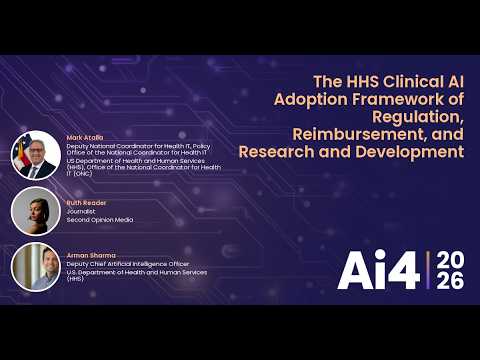
Published on YouTube by Ai4 on August 22, 2026, this panel video features HHS leaders Mark Atalla and Arman Sharma alongside journalist Ruth Reader. The session explores the Department of Health and Human Services' coordinated framework across regulation, reimbursement, and research to accelerate clinical AI adoption while managing care quality and public trust.
## TL;DR
Arman Sharma outlines HHS's vision to leverage AI as a deflationary force to expand healthcare access and shift away from the traditional 'sick care' system. He discusses CMMI payment model experiments like ACCESS, regulatory shifts from input-based ML evaluation to dynamic output benchmarking for generative AI, and the need for a national framework over state-by-state patchworks. Internally, the 'One HHS' strategy aims to modernize operations by consolidating data repositories and accelerating regulatory, grant, and claims review processes across the FDA, CMS, NIH, and ARPA-H.
## Atmosphere & style
The discussion is authoritative, strategic, and policy-focused, driven by direct and incisive interviewing from moderator Ruth Reader. Arman Sharma responds with pragmatic optimism, grounding complex regulatory and economic arguments in relatable real-world examples, such as primary care wait times. The interaction feels like an insider look into executive decision-making, balancing forward-looking technological enthusiasm with a grounded awareness of institutional hurdles.
## Key takeaways
- [00:04](https://www.youtube.com/watch?v=CbPTa-B3gAc&t=4s) The administration views AI as the defining technology of the 21st century, with White House directives prioritizing American AI dominance and meaningful adoption over stifling regulation.
- [00:04](https://www.youtube.com/watch?v=CbPTa-B3gAc&t=4s) The primary federal mandate for clinical AI in healthcare centers on expanding access and lowering costs for middle-class and working Americans.
- [00:04](https://www.youtube.com/watch?v=CbPTa-B3gAc&t=4s) The U.S. healthcare system operates fundamentally as a reactive "sick care system" where structural incentives fail to keep populations healthy long-term.
- [00:04](https://www.youtube.com/watch?v=CbPTa-B3gAc&t=4s) AI can help shift healthcare delivery by democratizing medical knowledge and restoring individual agency over personal health.
- [04:08](https://www.youtube.com/watch?v=CbPTa-B3gAc&t=248s) The CMMI ACCESS model was established as an experimental sandbox to collect real-world economic and clinical outcome data from frontier AI developers.
- [04:08](https://www.youtube.com/watch?v=CbPTa-B3gAc&t=248s) Federal policy aims for AI to act as a deflationary force on healthcare costs rather than being funded as a standalone line item in fee-for-service models.
- [04:08](https://www.youtube.com/watch?v=CbPTa-B3gAc&t=248s) HHS is exploring alternative payment structures for AI enablement, including bundled payments, capitation, and Accountable Care Organizations (ACOs).
- [09:34](https://www.youtube.com/watch?v=CbPTa-B3gAc&t=574s) Traditional Software as a Medical Device (SaMD) frameworks evaluate static inputs, whereas generative AI requires novel regulatory approaches centered on dynamic outputs.
- [09:34](https://www.youtube.com/watch?v=CbPTa-B3gAc&t=574s) HHS is investigating open, collaborative benchmarking and evaluation mechanisms to build clinical trust and meet White House AI Action Plan directives.
- [14:38](https://www.youtube.com/watch?v=CbPTa-B3gAc&t=878s) HHS opposes a state-by-state patchwork of conflicting AI regulations, preferring a unified national framework.
- [14:38](https://www.youtube.com/watch?v=CbPTa-B3gAc&t=878s) The FDA is developing draft guidance specifically targeted at generative AI and patient-facing medical tools.
- [17:20](https://www.youtube.com/watch?v=CbPTa-B3gAc&t=1040s) Under the "One HHS" strategy, the department is providing internal staff with enterprise-grade AI tools to dramatically accelerate core operational workflows across the FDA, CMS, NIH, and ARPA-H.
- [17:20](https://www.youtube.com/watch?v=CbPTa-B3gAc&t=1040s) HHS is executing agency-specific data consolidation projects—including merging 45 NIH research data repositories, aggregating CMS claims data for fraud detection, and digitizing legacy paper documents at the FDA.
## Detailed walkthrough
Here is the detailed, faithful walkthrough of the transcript section.
---
[00:04](https://www.youtube.com/watch?v=CbPTa-B3gAc&t=4s) Driving Vision for Clinical AI in Healthcare
The session opens with moderator Ruth Reader framing the panel on the Department of Health and Human Services (HHS) clinical AI adoption framework. Addressing Deputy Chief AI Officer Arman Sharma, she notes HHS's extensive work, internal infrastructure shifts, and pilot programs designed to drive AI adoption across healthcare. Reader prompts Sharma to articulate the high-level driving vision behind these sweeping federal initiatives, explicitly steering the conversation away from mere operational efficiency.
Arman Sharma emphasizes that the White House views AI as the defining technology of the 21st century, with a directive to push for American AI dominance and unlock technological potential rather than stifle it. However, drawing on guidance from the Office of Science and Technology Policy (OSTP), HHS recognizes that development alone is insufficient—meaningful adoption is crucial. For healthcare, the mandate centers squarely on improving access and affordability. Illustrating the current system's deficiencies, Sharma shares a personal story about living in Bethesda, Maryland—one of the country's wealthiest zip codes—where securing a routine primary care appointment takes roughly three weeks, highlighting how much worse access is for the rest of the nation.
Sharma contrasts the U.S. healthcare model with peer nations, noting that two centuries of structural incentives have created a "sick care system" that fails to keep populations healthy long-term. Fixing this system requires either a generational overhaul of payment structures or a total transformation of care delivery. Because healthcare fundamentally relies on transforming knowledge into action, patient-facing AI can democratize medical knowledge and restore individual health agency. Aligning with broader federal health goals to "make America healthy again," the overarching mission is to leverage AI pragmatically to expand care access for middle-class and working Americans.
- **Key Mandate:** Drive access and affordability across American healthcare through meaningful AI adoption.
- **Systemic Critique:** The historic U.S. model operates as a "sick care system" rather than a proactive wellness model.
- **Core Concept:** Healthcare is fundamentally "knowledge to anHere is a detailed, faithful walkthrough covering Part 1 of the panel transcript.
---
[00:04](https://www.youtube.com/watch?v=CbPTa-B3gAc&t=4s) HHS's Driving Vision for Healthcare AI
Ruth Reader opens the discussion by introducing Arman Sharma, Deputy Chief Artificial Intelligence Officer at the U.S. Department of Health and Human Services (HHS), noting that HHS has been actively pursuing AI pilots, industry collaborations, and internal infrastructure upgrades. Reader asks for the core driving vision behind HHS’s AI push, explicitly looking beyond mere operational efficiency.
Arman Sharma explains that the current administration views AI as the "defining technology of the 21st century." White House directives—driven by groups like the Office of Science and Technology Policy (OSTP)—emphasize pushing for American AI dominance by unlocking technology rather than stifling it. However, Sharma highlights that development alone is insufficient; the key imperative is *meaningful adoption*.
In healthcare, the primary mandate is **access and affordability**. Illustrating the current system's breakdown, Sharma shares a personal anecdote from when he first moved to Washington, D.C., living in Bethesda, Maryland—one of the wealthiest zip codes in the nation—where getting a primary care appointment still took three weeks. He notes that if wealthy areas face such delays, access across the rest of the country is far worse.
Sharma explains that the U.S. healthcare model built over the last 100 to 200 years is essentially a "sick care system" where financial incentives do not align with keeping people healthy. Transforming this system requires either altering payment models—a generational effort—or fundamentally changing the delivery model itself. Because AI democratizes knowledge, and much of healthcare is transforming knowledge into action, patient-facing AI offers a way to return individual agency over health to the public (aligning with the broader mission to "Make America Healthy Again").
- **Key Mandates:** Access and affordability across the U.S. healthcare system.
- **Example:** A 3-week wait time for primary care appointments in Bethesda, Maryland.
- **Core Strategy:** Using AI to democratize medical knowledge and shift from a reactive "sick care" framework to proactive care delivery.
---
[04:08](https://www.youtube.com/watch?v=CbPTa-B3gAc&t=248s) Payment Models and the Deflationary Role of AI
Reader points out that shifting care delivery and changing payment structures are interconnected. She highlights the Center for Medicare and Medicaid Innovation (CMMI) "ACCESS model"—an experimental CMMI payment model targeting AI-driven care for chronic conditions like diabetes and heart disease, where companies are paid based on patient outcomes. Reader notes there has been a "kurfuffle" over the low payment rates in the model and quotes Chris Klamp (senior adviser to HHS and nominee for Deputy Secretary), who stated that AI needs to be "deflationary in healthcare" to drive costs down.
Sharma agrees with Klamp’s assessment, stating that AI adoption only makes sense long-term if it lowers total costs. He clarifies that the ACCESS model was never intended as the sole, permanent mechanism for funding AI. Instead, CMMI used its regulatory authority to "wave the law" to create an experimental sandbox. The goal was to "shock the system" and incentivize frontier clinical AI developers—who usually operate direct-to-consumer outside traditional billing/coding constructs—to act as healthcare providers and collect real-world economic and outcome data.
Moving away from the traditional Physician Fee Schedule (a fee-for-service model), HHS is exploring mechanisms like bundled payments, capitation, and Accountable Care Organizations (ACOs). Sharma emphasizes that HHS isn't necessarily interested in paying *for* AI itself as a standalone line item, but rather using AI to enable better care outcomes within existing or adapted payment systems.
- **CMMI ACCESS Model Target:** AI-driven chronic disease management (e.g., diabetes, heart disease).
- **Economic Objective:** Ensuring AI acts as a **deflationary** force on healthcare spending.
- **Payment Alternatives Under Consideration:** Bundled payments, capitated care, and ACO structures.
---
[09:34](https://www.youtube.com/watch?v=CbPTa-B3gAc&t=574s) Regulatory Approach, Benchmarking, and Evaluation
Reader brings up the FDA's history of authorizing over 1,500 AI medical devices while pointing out that despite the Trump administration's overall deregulatory stance, HHS and OSTP recently held discussions with healthcare companies regarding AI governance, model evaluation, and benchmarking. She asks whether this signals upcoming policies, particularly regarding post-market surveillance.
Sharma clarifies that these meetings were not about immediate policymaking, but rather aimed at educating the department on the frontier of AI evaluation. He emphasizes that current Software as a Medical Device (SaMD) regulatory frameworks were built around traditional machine learning, which evaluates **inputs** (e.g., training data quality, training procedures, and pre-market approval). Generative AI, however, requires evaluating dynamic **outputs**, which current SaMD rules do not fully address.
Pursuant to the White House AI Action Plan released the previous summer, HHS agencies are investigating how to assess generative AI models. Evaluating dynamic models remains a nascent field—with key academic papers on health evaluations only emerging in the past year. Most commercial developers currently rely on closed, internal evaluation systems without sharing methodologies. HHS aims to foster collaborative, open benchmarking to build public and clinical trust.
- **FDA Context:** Over 1,500 AI-enabled medical products previously authorized.
- **Shift in Regulatory Thinking:** Transitioning from **input-based** pre-market checks (traditional machine learning) to **output-based** continuous evaluation (generative AI).
- **Core Policy Driver:** White House AI Action Plan directive to study benchmarking and evaluation.
---
[14:38](https://www.youtube.com/watch?v=CbPTa-B3gAc&t=878s) State Patchworks vs. Federal Frameworks
Reader notes that in the absence of centralized federal regulations, individual states are enacting vastly different laws. She contrasts Utah—which established an innovative AI sandbox for healthcare—with Illinois, which banned the use of AI in mental health care. She asks whether federal regulation is on the horizon to address this divergence.
Sharma confirms that HHS does not favor a "patchwork" of conflicting state laws, stating it hurts both technology developers and patients. While respecting states' rights under the federal system, HHS strongly believes a unified national framework is necessary for healthcare AI.
Explaining the delay in federal guidance, Sharma outlines the regulatory burden: the FDA must issue medical device rules through formal federal rulemaking processes, which are inherently slow and rigorous. In contrast, state actions—like Utah's agreement between its Department of Commerce and private companies—operate as speedier administrative contracts. He reassures the audience that FDA is actively working on draft guidance and communications, specifically addressing generative AI and patient-facing tools, to establish clear national guardrails.
- **State Regulatory Contrast:**
- **Utah:** Created a state-level healthcare AI sandbox through its Department of Commerce.
- **Illinois:** Passed restrictive legislation prohibiting AI use in mental healthcare.
- **Federal Stance:** Opposes state-by-state patchworks; actively working on FDA draft guidance for generative and patient-facing AI.
[17:20](https://www.youtube.com/watch?v=CbPTa-B3gAc&t=1040s) Internal AI Adoption and Data Infrastructure across HHS
Moderator Ruth Reader directs the conversation toward the overarching "One HHS" strategy, asking about internal AI deployment and efforts to consolidate systems and data across the department. Arman Sharma explains that as the largest civilian department in the federal government, HHS encompasses over 100,000 personnel, counting both federal employees and contractors. The central leadership holds a singular, ambitious goal: to give internal staff the same high-caliber enterprise AI capabilities enjoyed by the private sector, regardless of data sensitivity.
Rather than spreading efforts thin, HHS focuses centrally on identifying each division's core "bread-and-butter" workflows and applying frontier AI models directly to those processes. The objective is to drastically compress operational timelines—aiming to reduce six-month tasks down to "like six days." Specific target areas across HHS divisions include:
To achieve this safely and efficiently, central HHS teams collaborate with key "tiger teams" in each division to build out high-value use cases while working directly with frontier AI model companies to secure enterprise-ready, government-grade tools for department-wide deployment.
In parallel, HHS is driving data consolidation efforts across its agencies to unlock the full potential of AI. Establishing unified data lakes makes AI exponentially more effective at identifying trends and executing operational improvements. Because each division handles fundamentally different data, consolidation strategies are tailored specifically to their needs:
* **NIH:** Work is underway to merge and consolidate 45 separate controlled-access research data repositories from a technical standpoint.
* **CMS:** Aggregating data into single repositories allows simultaneous data querying, which significantly improves anti-fraud detection algorithms.
* **FDA:** The current administration initiated a massive digitization push after discovering a large portion of historical FDA documents existed solely on paper, converting legacy paper records into accessible digital assets.
Under the unified "One HHS" vision, the department seeks to make data maximumly accessible within unified repositories while leveraging frontier AI across everyday administrative tasks, ultimately delivering better and faster outcomes for the American public.
## Notable quotes
> [00:04](https://www.youtube.com/watch?v=CbPTa-B3gAc&t=4s) defining technology of the 21st century — Arman Sharma
> [00:04](https://www.youtube.com/watch?v=CbPTa-B3gAc&t=4s) sick care system — Arman Sharma
> [00:04](https://www.youtube.com/watch?v=CbPTa-B3gAc&t=4s) make America healthy again — Arman Sharma
> [04:08](https://www.youtube.com/watch?v=CbPTa-B3gAc&t=248s) deflationary in healthcare — Ruth Reader
> [04:08](https://www.youtube.com/watch?v=CbPTa-B3gAc&t=248s) wave the law — Arman Sharma
> [04:08](https://www.youtube.com/watch?v=CbPTa-B3gAc&t=248s) shock the system — Arman Sharma
## Mentioned
Department of Health and Human Services (HHS), Office of the National Coordinator for Health IT (ONC), White House, Office of Science and Technology Policy (OSTP), Center for Medicare and Medicaid Innovation (CMMI), Food and Drug Administration (FDA), National Institutes of Health (NIH), Advanced Research Projects Agency for Health (ARPA-H), Centers for Medicare & Medicaid Services (CMS), Second Opinion Media, Mark Atalla, Arman Sharma, Ruth Reader, Chris Klamp, ACCESS model, Physician Fee Schedule, Accountable Care Organizations (ACOs), Software as a Medical Device (SaMD), White House AI Action Plan, Utah Department of Commerce, Illinois
## Video description
Mark Atalla - Deputy National Coordinator for Health IT, Policy Office of the National Coordinator for Health IT, U.S. Department of Health and Human Services (HHS), Office of the National Coordinator for Health IT (ONC)
Arman Sharma - Deputy Chief Artificial Intelligence Officer, U.S. Department of Health and Human Services (HHS)
Ruth Reader - Journalist, Second Opinion Media
How can we accelerate the adoption of clinical AI while ensuring it improves patient care, reduces provider burden, and earns public trust? We will discuss how HHS is approaching this challenge through a coordinated framework that brings together regulation, reimbursement, and research and development to enable scalable AI adoption across the healthcare system. We will highlight the role of collaboration across HHS agencies and with stakeholders throughout the healthcare ecosystem. Attendees will leave with a clearer understanding of where federal policy is headed, the opportunities and challenges ahead, and how they can help shape the next generation of clinical AI. Join us to explore how these complementary policy levers can accelerate innovation while improving care for patients and clinicians alike.
HHS调整AI战略以降低医疗成本并扩大医疗可及性
美国卫生与公众服务部正在制定统一的联邦框架和基于产出的评估机制,以确保临床人工智能成为降低全美医疗支出的通缩力量。
Arman Sharma概述了HHS的愿景,即利用AI作为通缩力量来扩大医疗可及性,并摆脱传统的“疾病照护”(sick care)体系。他探讨了诸如ACCESS等CMMI支付模型试点、监管层面从基于输入的机器学习评估转向生成式AI的动态输出基准测试,以及建立全国统一框架以取代各州零散法规的必要性。在内部,“One HHS”战略旨在通过整合数据存储库,加速FDA、CMS、NIH和ARPA-H的监管、拨款与理赔审查流程,从而实现运营现代化。
美国卫生与公众服务部(HHS)副首席 AI 官 Arman Sharma 表示,临床 AI 的核心联邦使命是提升医疗可及性并降低费用,致力于通过 AI 普及医疗知识,推动现行被动的“治病系统”(sick care system)转向主动健康管理。 (0:04)
HHS 强调 AI 必须在医疗支出中发挥通缩作用;为此建立的 CMMI ACCESS 实验性支付沙盒旨在收集前沿临床 AI 的真实世界经济与疗效数据,而非将其作为按服务收费模式下的独立付费项目。 (4:08)
针对医疗器械软件(SaMD)以往仅评估静态输入的局限,HHS 与 FDA 正研究针对生成式 AI 动态输出的基准评测,并起草全国性统一指南以避免各州监管规则碎片化。 (9:34)
在“One HHS”战略下,该部正推动在 FDA 审评、CMS 欺诈检测及 NIH 基金评审等核心流程中应用前沿 AI,并同步推进数据整合,包括统一 NIH 的 45 个研究数据库及将 FDA 历史纸质档案全面数字化。 (17:20)
Reading summary
The Department of Health and Human Services is framing its clinical AI strategy around improving healthcare access and affordability, relying on value-based reimbursement, unified federal regulatory benchmarks, and internal infrastructure upgrades to transform the traditional care delivery model.
Driving Access and Proactive Care Delivery (0:04)
According to HHS Deputy Chief AI Officer Arman Sharma, federal clinical AI initiatives are guided by White House directives that view artificial intelligence as the defining technology of the 21st century. While the administration emphasizes American AI leadership, Sharma notes that technology development is meaningless without effective adoption. In healthcare, the primary federal mandate is resolving access and affordability challenges. Sharma critiques the historical U.S. framework as a two-century-old "sick care system" structured around misaligned incentives, pointing out that even in affluent areas like Bethesda, Maryland, routine primary care appointments routinely face three-week wait times.
To alter this structure, Sharma argues that policymakers must either execute a generational overhaul of healthcare payment systems or fundamentally transform care delivery. Because healthcare centers on translating medical knowledge into action, HHS views patient-facing AI tools as a pragmatic vehicle to democratize clinical information, restore patient agency, and align with broader administration goals to improve national health outcomes.
Deflationary Reimbursement Beyond Fee-for-Service (4:08)
Sharma highlights that AI adoption must function as a deflationary economic force to lower system-wide healthcare expenditures, echoing views shared by HHS senior adviser and Deputy Secretary nominee Chris Klamp. Rather than treating AI software as an independent, billable line item within traditional fee-for-service frameworks like the Physician Fee Schedule, HHS is prioritizing alternative payment mechanisms such as bundled payments, capitation, and Accountable Care Organizations (ACOs).
As a testing ground, the Center for Medicare and Medicaid Innovation (CMMI) launched the experimental ACCESS model, which ties reimbursement for chronic conditions such as diabetes and heart disease directly to patient outcomes. Sharma explains that despite industry concern over low payment rates, CMMI exercised its statutory authority to bypass standard rules deliberately. The initiative was intended to shock existing practices and incentivize frontier AI developers—who typically operate directly to consumers outside medical coding—to act as formal healthcare providers and produce real-world economic and outcome data.
Evolving Dynamic Regulation and National Standards (9:34)
While the FDA has authorized more than 1,500 AI-enabled medical devices, Sharma states that existing Software as a Medical Device (SaMD) frameworks are ill-equipped for generative AI. SaMD regulations were historically designed for traditional machine learning models, evaluating static inputs, training data sets, and pre-market technical specifications. Conversely, generative models produce dynamic outputs that demand continuous, post-market assessment. In response to the White House AI Action Plan, HHS is studying collaborative, open-benchmarking methodologies to replace the proprietary, unshared testing protocols currently used by private developers.
Sharma also addresses the regulatory fragmentation emerging across state lines, contrasting Utah’s commerce-driven AI sandbox with Illinois’s statutory prohibition on AI in mental healthcare. Emphasizing that conflicting state laws harm both developers and patients, Sharma confirms that HHS opposes a regulatory patchwork. Because formal FDA rulemaking involves slow, procedural administrative hurdles relative to state contracts, the FDA is currently developing targeted draft guidance and communications for generative and patient-facing clinical tools to establish consistent federal guardrails.
Internal Modernization Across the Federal Enterprise (17:20)
Across its internal enterprise of over 100,000 employees and contractors, HHS is pursuing a "One HHS" modernization program. Centralized leadership is partnering with divisional tiger teams and commercial AI developers to deploy enterprise-grade generative models into routine operations. The stated objective is to dramatically accelerate administrative cycles, converting six-month tasks into six-day turnarounds across primary divisional functions: regulatory reviews at the FDA, claims adjudication and fraud detection at CMS, and grant reviews at the NIH and ARPA-H.
This operational overhaul is paired with major data integration initiatives across HHS divisions. To provide clean inputs for enterprise AI systems, the department is executing technical consolidations, including merging 45 disparate controlled-access research databases at the NIH into a unified structure and centralizing CMS repositories to improve fraud detection algorithms. Additionally, the administration launched a comprehensive digitization initiative at the FDA after discovering that substantial volumes of historical agency records were stored exclusively on paper.
HHS is moving to establish a coherent federal framework for clinical AI by balancing national standards with output-based evaluations, but the timeline for formal FDA guidance on generative systems remains governed by lengthy rulemaking processes while commercial developers and states test conflicting approaches.
## Background
本视频由 Ai4 于 2026 年 8 月 22 日发布在 YouTube 平台上。根据页面简介,该内容聚焦于美国卫生与公众服务部(HHS)如何通过统筹监管、医保报销以及研发(R&D)三大政策杠杆,构建协调一致的临床 AI 采纳框架,以期在减轻医务人员负担、改善患者照护的同时建立公众信任并促进跨机构协作。
## TL;DR
对谈深入阐释了 HHS 推进医疗 AI 的底层愿景,即打破传统“疾病护理系统”的痼疾,通过 AI 赋能个人健康掌控权并提升医疗的可及性与可负担性。HHS 副首席人工智能官阿尔曼·夏尔马(Arman Sharma)重点剖析了 CMMI 借助 ACCESS 创新支付模型探索“通缩型”医疗 AI 的初衷,并指出生成式 AI 监管评估必须从传统的“基于输入”转向“基于输出”,以避免全美出现碎片化的拼凑式监管。此外,对话还披露了 HHS 内部推行的“One HHS”战略,力求通过打通 FDA、CMS 和 NIH 等机构的历史数据孤岛,将长达半年的审批与行政工作流压缩至数天之内。
## Atmosphere & style
整场对话节奏极快且信息高度密集,主持人提问犀利直指制度痛点,嘉宾的作答则兼具顶层战略格局与身处庞大官僚机构改革一线的坦诚务实。交流中毫无空洞的技术泡沫吹捧,取而代之的是对现行医保收费机制、SaMD 监管滞后性以及各州立法割裂等现实阻力的清醒审视。短短二十分钟的交锋充满务实推进的紧迫感与制度破局的张力,让听众深刻感受到联邦决策层在审慎监管与颠覆性创新之间寻找平衡的真实心境。
## Key takeaways
- [00:04](https://www.youtube.com/watch?v=CbPTa-B3gAc&t=4s) 白宫与 HHS 推进医疗 AI 的核心愿景是实现“有意义的采纳”,并将战略硬指标锚定在提升医疗的可及性(Access)与可负担性(Affordability)。
- [00:04](https://www.youtube.com/watch?v=CbPTa-B3gAc&t=4s) 面对传统“疾病护理系统”(Sick Care)的机制瓶颈,通过 AI 平民化医学专业知识以重塑医疗交付模式,是将健康掌控权还给个人的务实破局之道。
- [04:08](https://www.youtube.com/watch?v=CbPTa-B3gAc&t=248s) CMMI 推出的 ACCESS 支付试验模型利用法定豁免权,探索基于慢性病健康产出进行 AI 报销,充当打破传统“按项目付费”惯性的试验尖刀。
- [04:08](https://www.youtube.com/watch?v=CbPTa-B3gAc&t=248s) HHS 强调医疗 AI 必须发挥“通缩性力量”(deflationary force)以压缩虚高成本,并需通过捆绑支付、按人头付费等机制逐步融入现有医保规则。
- [04:08](https://www.youtube.com/watch?v=CbPTa-B3gAc&t=248s) 建立类似 ACCESS 模型的支付对接机制,是打破前沿临床 AI 公司长期脱离医保编码体系、仅走 D2C 路线而无法普惠大众现状的关键。
- [09:34](https://www.youtube.com/watch?v=CbPTa-B3gAc&t=574s) 当前联邦层面在 AI 上呈现“去监管”基调,但 FDA 长期以来在 AI 产品上市后不良事件与性能监测方面仍缺乏灵敏且成熟的工具支持。
- [10:36](https://www.youtube.com/watch?v=CbPTa-B3gAc&t=636s) 生成式 AI 的爆发促使监管评估范式发生根本转移:从传统 SaMD 框架侧重训练集质量的“基于输入”(Inputs-based)审查,转向针对生成质量与鲁棒性的“基于输出”(Outputs-based)评估。
- [10:36](https://www.youtube.com/watch?v=CbPTa-B3gAc&t=636s) AI 评估与基准测试目前尚处于极早期阶段,行业普遍存在企业内部闭门自评的痛点,HHS 依据白宫《人工智能行动计划》正着力推动跨机构与跨界的开放测试标准共享。
- [14:38](https://www.youtube.com/watch?v=CbPTa-B3gAc&t=878s) 针对各州在医疗 AI 监管上的两极分化(如犹他州沙盒与伊利诺伊州禁用心理 AI),HHS 明确反对碎片化监管拼凑,致力于确立统一的联邦级框架以保护创新与患者利益。
- [14:38](https://www.youtube.com/watch?v=CbPTa-B3gAc&t=878s) FDA 正在加快制定针对生成式 AI 的指导原则草案,但受限于法定医疗器械规则制定程序的漫长周期,其推进节奏天然慢于州级行政沙盒协议。
- [17:24](https://www.youtube.com/watch?v=CbPTa-B3gAc&t=1044s) HHS 推进“One HHS”内部战略,通过专业攻坚小组在监管审评、理赔裁决和科研同行评审等核心业务中引入具备政府安全认证的前沿 AI 工具。
- [17:24](https://www.youtube.com/watch?v=CbPTa-B3gAc&t=1044s) AI 落地的前提是打破历史遗留的数据孤岛,HHS 正在加速推进 FDA 纸质档案全面数字化、CMS 防欺诈数据集中调用以及 NIH 45 个独立科研数据仓的系统化合并。
- [17:24](https://www.youtube.com/watch?v=CbPTa-B3gAc&t=1044s) 通过向核心行政与审评流程注入 AI 能力,HHS 设定了将长达 6 个月的行政审评周期缩减至大约 6 天的激进提效指标。
- [20:44](https://www.youtube.com/watch?v=CbPTa-B3gAc&t=1244s) HHS 在 AI 领域的最终落脚点是将技术深度嵌入机构最基础的日常行政业务(bread-and-butter tasks),以此全面提升公共治理运转效能并服务公众。
## Detailed walkthrough
### [00:04](https://www.youtube.com/watch?v=CbPTa-B3gAc&t=4s) 驱动愿景:从“疾病治疗”转向以“可及性与可负担性”为核心的医疗变革
对话由《Second Opinion Media》记者露丝·里德(Ruth Reader)开场,她探讨了美国卫生与公众服务部(HHS)围绕临床人工智能(AI)所制定的采纳框架,并引出 HHS 副首席人工智能官(Deputy CAIO)阿尔曼·夏尔马(Arman Sharma)。面对全场观众,里德直奔核心议题:HHS 正在内部调整基础设施并开展大量试点,力推行业采纳 AI,但抛开单纯的“运营效率提升”,本届政府全面推进医疗 AI 的底层愿景究竟是什么?
阿尔曼·夏尔马指出,白宫从执政之初就将 AI 定位为“21 世纪的决定性技术”,明确提出要确保美国在 AI 领域的绝对主导地位,核心基准是“释放技术潜能而非加以扼杀”。白宫科技政策办公室(OSTP)等机构更是强调,单纯研发技术远远不够,关键在于“有意义的采纳”(meaningful adoption)。在医疗健康领域,这一愿景被高度凝练为两个硬指标:**医疗的可及性(Access)与可负担性(Affordability)**。夏尔马分享了一个亲身体验:他刚搬到华盛顿特区时住在马里兰州的贝塞斯达(Bethesda)——全美最富裕的邮政编码区之一,然而预约一次普通初级诊疗(Primary Care)居然要等整整 3 周。如果最富裕的地区尚且如此,全美其他地方的就医困境可想而知。
夏尔马进一步剖析了美国医疗体系的深层痼疾:过去一两百年建立起来的体制本质上是一个“疾病护理系统”(sick care system),其经济激励机制并非为了让人长期保持健康。要打破这一怪圈,通常只有两条路径:一是彻底重塑整个支付体系与执业模式,而这是一项需要耗费几代人时间的“代际工程”;二是彻底变革医疗的交付模式(model of delivery)。医疗实践的底层逻辑很大程度上是“将专业知识转化为具体行动”,而 AI 本质上能使知识平民化。结合卫生部提出的“让美国再次健康”(Make America Healthy Again, MAHA)目标,其核心在于将对个人健康的掌控权与能动性(individual agency)重新交还给民众。夏尔马强调,团队并非仅仅觉得 AI 技术“很酷”,而是认识到在中产甚至中高产家庭都难以负担优质医疗的现实下,面向患者的端到端 AI 交付模式是一场务实且势在必行的破局之道。
```mermaid
flowchart TD
accTitle: HHS 医疗 AI 愿景双轨驱动模型
subgraph S1["传统医疗困境"]
A["百年历史的'疾病护理系统' (Sick Care)"] --> B["经济激励偏离健康预防"]
B --> C["高额支出下缺乏可及性与可负担性\n(如富裕地区看病仍需等3周)"]
end
subgraph S2["破局路径选择"]
C --> D["路径一:重构支付与执业制度\n(耗资巨大的代际工程)"]
C --> E["路径二:重塑医疗交付模式\n(利用 AI 平民化专业知识)"]
end
subgraph S3["HHS 战略愿景"]
E --> F["赋予个人健康掌控权\n(Individual Agency)"]
F --> G["面向患者的临床 AI 规模化采纳"]
end
```
---
### [04:08](https://www.youtube.com/watch?v=CbPTa-B3gAc&t=248s) 支付机制重构:ACCESS 试验模型与“通缩型”医疗 AI
针对医疗交付模式的重塑,里德谈到了 HHS 迈出的关键一步:联邦医疗保险和联邦医疗补助创新中心(CMMI)近期推出了一个针对糖尿病和心脏病等慢性病管理的 AI 创新支付试验项目——ACCESS 模型。该模型打破常规,允许利用 AI 交付慢性病管理服务的企业根据实际健康产出(Outcomes)获取医保报销。里德指出,由于医保制定的支付费率较低,行业内引发了不少争议;而获特朗普总统提名为 HHS 副部长的克里斯·克隆普(Chris Klomp,现任 HHS 高级顾问)公开表示,AI 在医疗健康领域必须扮演“通缩性力量”(deflationary force),其根本使命就是把虚高的成本降下来。
阿尔曼·夏尔马对此作出了详细回应,并阐明了联邦政府在支付端的设计初衷:
- **CMMI 的特殊职权**:CMMI 最大的制度优势在于拥有“豁免现行法律限制”(waive the law)的法定权力,能够在局部沙盒中测试全新的报销机制与交付方式。
- **验证机制而非最终结论**:ACCESS 模型并非特朗普-小罗伯特·肯尼迪(RFK Jr.)治下的 HHS 最终钦定的全盘支付方案,而是一把用于“刺破现状的尖刀”(tip of the spear),目的在于积累前沿数据,为未来长期的支付规则修订提供循证依据。
- **打破传统按项目付费的惯性**:虽然业内人人都倡导“基于价值的医疗”(Value-Based Care)并抱怨“按项目付费”(Fee-for-Service)的弊端,但现实情况是,全美所有医生至今仍紧盯医保的《医师收费标准》(Physician Fee Schedule)。要引导顶尖科技公司放下单纯做软件的思路、主动作为实际的“医疗提供者”(Provider)深度参与诊疗,就必须通过政策沙盒提供强力驱动。
- **通缩逻辑与现实妥协**:夏尔马完全认同克隆普的观点,即医疗 AI 的使用“只有在具备通缩效应时才有意义”。然而政府不可能推翻重来凭空设立全新的支付体系,必须基于 CMS 现有的规则体系以及正在公示的拟议规则,通过捆绑支付(bundled payments)、按人头付费(capitation)以及责任医疗组织(ACO)等机制逐步渗透推进。
- **直面消费级与医保体系的断层**:以往绝大多数前沿临床 AI 公司都走“直接面向消费者”(D2C)路线,完全游离在医疗编码与账单报销体系之外。如果不构建类似 ACCESS 模型的对接接口,前沿 AI 技术将永远无法普惠由 CMS 及商业保险兜底的普通大众。
---
### [09:34](https://www.youtube.com/watch?v=CbPTa-B3gAc&t=574s) 监管与治理的转向:去监管基调下的模型基准与评估博弈
讨论随后转向了监管维度。里德指出,美国食品药品监督管理局(FDA)迄今已批准或授权了大约 1500 种 AI 医疗器械与产品。虽然现任政府在对 AI 的整体监管策略上展现出鲜明的“去监管”(deregulatory)倾向,强调避免扼杀创新,但近期联邦政策层面却出现了一个引人瞩目的新动向。
就在上周,HHS 与白宫科技政策办公室(OSTP)联合召集了一大批在 AI 赛道深耕的医疗健康企业,以及在 AI 领域重金布局的传统医疗巨头,闭门探讨 AI 治理(AI governance)体系的构建。会议的核心议题集中在如何制定行业基准测试(benchmarking)以及如何科学地评估前瞻性 AI 大模型。里德犀利地指出,这一举动背后折射出监管体系的一个长期痛点:长久以来,FDA 虽然掌握着严格的上市前审批门槛,但在 AI 产品推向市场后的“上市后不良事件与性能监测”(postmarket surveillance)方面,始终缺乏成熟、完备且灵敏的监管系统与工具支持。
### [10:36](https://www.youtube.com/watch?v=CbPTa-B3gAc&t=636s) 医疗 AI 评估与基准测试:从“基于输入”转向“基于输出”
针对主持人 Ruth Reader 询问当前的行业研讨是否会直接催生具体政策,美国卫生与公众服务部(HHS)副首席人工智能官 Arman Sharma 明确澄清,当前的倡议核心并不是急于制定硬性法规,而是部门为了跟上技术前沿而展开的自我学习与知识储备。由于当前 AI 热度空前,公众和业界急切想知道政府会如何监管,但现实情况是,基准测试(Benchmarking)和评估(Evaluations)的技术前沿与现行的监管政策之间存在着巨大鸿沟。长期以来,传统的“软件即医疗器械”(SaMD)监管框架主要针对经典机器学习应用,其审批逻辑高度侧重于“输入端”(Inputs)——即开发者使用了什么样的数据集来训练模型、训练流程是否合规严格。然而,生成式 AI 的爆发彻底打破了这一模式,以往基于输入的审核方式几乎“付诸东流”,监管评估必须被迫转向以“输出端”(Outputs)为核心,而现行的 SaMD 体系在此类场景下尚无成熟应用先例。
政府对新兴技术的认知常常落后产业二十年,Sharma 坦言这是一种非常中肯且普遍的批评,而 HHS 目前正是竭力避免在面向患者的临床 AI(Patient-facing AI)领域重蹈覆辙。评估与基准测试是建立公众信任的基石,但这仍是一个极其初期的领域;除了一些静态的 HealthBench 类测试外,评估领域的许多开创性学术论文在过去一年才刚刚发表。根据白宫发布的《人工智能行动计划》(White House AI Action Plan),HHS 旗下各机构被要求深入研究评估与基准测试机制。Sharma 指出,监管机构本质上是由人组成的组织,人类吸收新知识、将其转化为行为准则都需要时间。目前行业最大的痛点在于,各大商业公司往往只在内部闭门搞评估,缺乏对外公开和共享评估标准的动力;HHS 希望通过自身倡议唤起广泛关注,推动全行业在评估与基准测试上开展更开放的跨界合作。
| 评估维度 | 经典机器学习(传统 SaMD 框架) | 生成式 AI(新兴评估范式) |
|:--- |:--- |:--- |
| **监管审核核心** | **基于输入(Inputs-based)** | **基于输出(Outputs-based)** |
| **关注重点** | 训练数据集质量、数据标注、模型训练流程规范性 | 临床生成结果的准确性、安全性、鲁棒性与潜在幻觉 |
| **成熟度** | 规则成熟,已建立规范的上市前审查体系 | 处于极早期探索阶段,缺乏行业统一共享的基准 |
| **现行挑战** | 无法直接套用于具有动态生成能力的复杂大模型 | 商业机构普遍各自闭门自评,缺乏公开透明的标准与共享意愿 |
- 白宫《人工智能行动计划》明确要求 HHS 各下属机构将精力聚焦于 AI 评估与基准测试体系的建设。
- 监管政策当前面临的更迫切任务是界定技术边界,明确“输入评估”与“输出评估”在法律与执行层面的具体界线。
### [14:38](https://www.youtube.com/watch?v=CbPTa-B3gAc&t=878s) 应对各州监管碎片化:联邦框架与 FDA 医疗器械监管的挑战
在谈及医疗领域的监管节奏时,Ruth Reader 提出,由于联邦层面动作较为谨慎,美国各州已经呈现出严重分化的两极走势:例如犹他州大胆推出了针对医疗健康的“AI 监管沙盒”,而伊利诺伊州等地区则立法严禁在心理健康领域使用 AI。对此,Sharma 态度鲜明地表示,HHS 极度不希望看到这种割裂的“拼凑式监管”(Regulatory Patchwork),因为碎片化的规则既不利于技术开发者的合规创新,更无法真正保护患者利益。尽管在联邦体制下各州拥有自身权利,但在 AI 这类具有颠覆性的技术上,确立统一的联邦级框架至关重要。
FDA 正在紧锣密鼓地推进相关审评考量,但 Sharma 也坦言了联邦监管的现实难处:FDA 的所有相关规管必须纳入“医疗器械监管”法律框架之下,属于高度技术化的议题,必须经历漫长且严苛的联邦规则制定程序(Notice-and-Comment Rulemaking)。相比之下,犹他州的监管沙盒本质上是该州商务部与入驻企业之间签署的行政协议,其制定与签署周期远比 FDA 出台一份正式指南要快得多。Sharma 表示,FDA 正在加速制定针对生成式 AI 和患者端 AI 应用的指导原则草案(Draft Guidance)与政策通报,希望未来通过清晰的全国性框架与各州协同合作,抚平各州之间的法规鸿沟。
```mermaid
flowchart TD
accTitle: 联邦与州级监管路径对比
subgraph Federal["联邦层面 (FDA / HHS)"]
F1["纳入医疗器械 (SaMD) 监管"] --> F2["法定联邦规则制定与指南草案"]
F2 --> F3["建立全国统一合规框架"]
end
subgraph State["州级层面 (各州独立推进)"]
S1["犹他州:商务部沙盒合作协议"]
S2["伊利诺伊州:立法禁用心理健康 AI"]
S1 & S2 --> S3["导致全美合规环境碎片化 (Patchwork)"]
end
```
### [17:24](https://www.youtube.com/watch?v=CbPTa-B3gAc&t=1044s) “One HHS”内部战略:将前沿 AI 融入核心工作流与数据整合
谈及 HHS 内部的技术落地与“One HHS”战略时,Sharma 介绍道,HHS 是美国联邦政府中规模最大的民事部门,拥有超过 10 万名全职联邦雇员及外包合同人员。部门的核心战略目标非常明确:外部企业在日常工作中广泛使用前沿的企业级 AI 工具,联邦机构的工作人员也必须享有同样的能力。HHS 的中央团队正在与下属各业务局的专业攻坚小组(Tiger Teams)密切协作,梳理各部门最核心的“看家工作流”,力求引入具备政府级安全认证的前沿模型技术,将长达数月的审批和行政流程压缩至数天之内。
随后,Sharma 阐述了 AI 应用背后的核心支柱——全系统数据底座的重构与整合。如果无法打通数据孤岛构建统一数据湖,AI 挖掘趋势和推动运营改善的潜力就会被大幅削弱。然而,历史遗留的数据碎片化问题极为严重,各业务局正在推进多项技术整合攻坚:
```mermaid
flowchart LR
accTitle: HHS 核心业务 AI 赋能与数据整合架构
subgraph CoreAgencies["核心业务 AI 赋能"]
A["FDA: 监管审评"]
B["CMS: 理赔裁决与反欺诈"]
C["NIH / ARPA-H: 科研项目资助审评"]
end
subgraph Modernization["数据底座现代化整合"]
D["FDA: 历史海量纸质文档数字化"]
E["CMS: 统一集中调用防欺诈数据库"]
F["NIH: 整合 45 个受控访问科研数据仓"]
end
CoreAgencies <--> Modernization
```
- **FDA(食品药品监督管理局)**:工作流重心在于医疗器械与药品的监管审评(Regulatory Review)。新团队上任之初面临的严峻现实是,该机构历史上仍有惊人比例的文件全部以纸质形式封存,团队在入职头几个月不得不全力投入对整个 FDA 历史纸质档案的全面数字化战役。
- **CMS(医疗保险和医疗补助服务中心)**:核心任务是理赔裁决(Claims Adjudication)与反医保欺诈。通过将原本分散的数据集中存放到同一仓库,实现并发调用,从而大幅提升诈骗行为的实时监测与识别能力。
- **NIH(国立卫生研究院)与 ARPA-H(卫生高级研究计划局)**:工作流集中于庞大的科研资助项目同行评审(Grant Review)。NIH 内部原先分散存在着 45 个各自独立的受控访问研究数据仓库,HHS 正在从技术架构层面对其进行合并与集中化重构。
- **业务提效指标**:通过向各局核心日常流程注入前沿 AI 能力,目标是将原本耗时长达 6 个月的行政与审评周期直接缩减至大约 6 天("make 6 months go down to like six days")。
### [20:44](https://www.youtube.com/watch?v=CbPTa-B3gAc&t=1244s) 借助 AI 赋能机构日常业务与圆满收官
在座谈的最后时刻,发言人总结了美国卫生与公众服务部(HHS)在人工智能应用层面的根本落脚点:不仅要聚焦于前沿医疗技术的突破,更要将 AI 深度融入各政府机构最基础、最核心的“家常便饭式日常业务”(bread-and-butter tasks)中,从而切实提升政府机构的行政运转与服务效能,实现“更好地为美国人民服务”(better deliver for the American people)的最终宗旨。这种务实的态度体现了联邦机构在推进技术采纳时,兼顾宏观战略与微观日常执行的清晰思路。
随着发言人的总结陈词结束,主持人鲁斯·里德(Ruth Reader)为这场高密度的对谈画上了句号。她由衷地向两位嘉宾致谢,并幽默而感慨地评价道,大家确实在短短的 20 分钟时间里“塞进了海量干货”(squeezed a lot into 20 minutes),在极短的篇幅内系统地拆解了临床 AI 在监管、医保报销以及研发协同等维度的复杂议题。
- **AI 赋能日常行政**:强调推动 AI 在 HHS 各下属机构的日常与基础行政任务(bread-and-butter tasks)中落地,旨在全面提升公共服务效能与执行力,更好造福美国公众。
- **高效对谈收尾**:主持人总结指出,本次研讨在短短 20 分钟内高度浓缩了关于联邦医疗 AI 采纳框架的核心洞见与政策方向。
## Notable quotes
> [00:04](https://www.youtube.com/watch?v=CbPTa-B3gAc&t=4s) 释放技术潜能而非加以扼杀 — Arman Sharma
> [00:04](https://www.youtube.com/watch?v=CbPTa-B3gAc&t=4s) 有意义的采纳 — Arman Sharma
> [00:04](https://www.youtube.com/watch?v=CbPTa-B3gAc&t=4s) 代际工程 — Arman Sharma
> [04:08](https://www.youtube.com/watch?v=CbPTa-B3gAc&t=248s) 通缩性力量 — Chris Klomp
> [04:08](https://www.youtube.com/watch?v=CbPTa-B3gAc&t=248s) 豁免现行法律限制 — Arman Sharma
> [04:08](https://www.youtube.com/watch?v=CbPTa-B3gAc&t=248s) 刺破现状的尖刀 — Arman Sharma
> [10:36](https://www.youtube.com/watch?v=CbPTa-B3gAc&t=636s) 基于输入 — Arman Sharma
> [10:36](https://www.youtube.com/watch?v=CbPTa-B3gAc&t=636s) 基于输出 — Arman Sharma
> [14:38](https://www.youtube.com/watch?v=CbPTa-B3gAc&t=878s) 拼凑式监管 — Arman Sharma
> [17:24](https://www.youtube.com/watch?v=CbPTa-B3gAc&t=1044s) make 6 months go down to like six days — Arman Sharma
> [20:44](https://www.youtube.com/watch?v=CbPTa-B3gAc&t=1244s) bread-and-butter tasks — Arman Sharma
> [20:44](https://www.youtube.com/watch?v=CbPTa-B3gAc&t=1244s) better deliver for the American people — Arman Sharma
> [20:44](https://www.youtube.com/watch?v=CbPTa-B3gAc&t=1244s) squeezed a lot into 20 minutes — Ruth Reader
## Mentioned
美国卫生与公众服务部 (HHS), Mark Atalla, Arman Sharma, Ruth Reader, Second Opinion Media, 白宫科技政策办公室 (OSTP), 联邦医疗保险和联邦医疗补助创新中心 (CMMI), ACCESS 模型, Chris Klomp, Donald Trump, Robert F. Kennedy Jr. (RFK Jr.), 医疗保险和医疗补助服务中心 (CMS), 美国食品药品监督管理局 (FDA), SaMD, HealthBench, 白宫《人工智能行动计划》, 国立卫生研究院 (NIH), 卫生高级研究计划局 (ARPA-H)
## Video description
Mark Atalla - Deputy National Coordinator for Health IT, Policy Office of the National Coordinator for Health IT, U.S. Department of Health and Human Services (HHS), Office of the National Coordinator for Health IT (ONC)
Arman Sharma - Deputy Chief Artificial Intelligence Officer, U.S. Department of Health and Human Services (HHS)
Ruth Reader - Journalist, Second Opinion Media
How can we accelerate the adoption of clinical AI while ensuring it improves patient care, reduces provider burden, and earns public trust? We will discuss how HHS is approaching this challenge through a coordinated framework that brings together regulation, reimbursement, and research and development to enable scalable AI adoption across the healthcare system. We will highlight the role of collaboration across HHS agencies and with stakeholders throughout the healthcare ecosystem. Attendees will leave with a clearer understanding of where federal policy is headed, the opportunities and challenges ahead, and how they can help shape the next generation of clinical AI. Join us to explore how these complementary policy levers can accelerate innovation while improving care for patients and clinicians alike.
[Source](https://www.youtube.com/watch?v=CbPTa-B3gAc)
Source quotes
[0:04] Arman Sharma: 释放技术潜能而非加以扼杀
[0:04] Arman Sharma: 有意义的采纳
[0:04] Arman Sharma: 代际工程
[4:08] Chris Klomp: 通缩性力量
[4:08] Arman Sharma: 豁免现行法律限制
[4:08] Arman Sharma: 刺破现状的尖刀
[10:36] Arman Sharma: 基于输入
[10:36] Arman Sharma: 基于输出
[14:38] Arman Sharma: 拼凑式监管
[17:24] Arman Sharma: make 6 months go down to like six days
[20:44] Arman Sharma: bread-and-butter tasks
[20:44] Arman Sharma: better deliver for the American people
[20:44] Ruth Reader: squeezed a lot into 20 minutes
Source quotes
[0:04] Arman Sharma: defining technology of the 21st century
[0:04] Arman Sharma: sick care system
[0:04] Arman Sharma: make America healthy again
[4:08] Ruth Reader: deflationary in healthcare
[4:08] Arman Sharma: wave the law
[4:08] Arman Sharma: shock the system
[9:34] Arman Sharma: inputs
[9:34] Arman Sharma: outputs
[14:38] Arman Sharma: patchwork
[17:20] Ruth Reader: One HHS
[17:20] Arman Sharma: like six days
[17:20] Arman Sharma: bread-and-butter
Original transcript
[0:04] I'll just say we're uh here to discuss HHS uh
clinical AI adoption framework. We're going to
[0:10] get into regulation. Really fun stuff. Uh
and Armen uh basically leads a lot of the
[0:17] AI work at HHS. Is that fair to say? One one of
many, but but yes. Yes, we have a lot of AI work
[0:23] happening at HHS. Yes. So HHS you may or may not
know I don't know how healthcare oriented this
[0:29] audience is but uh HHS has been doing a lot
of AI work doing a lot of interesting pilots
[0:36] um a lot of work with industry to sort of get AI
uh adopted and also internally has been sort of
[0:44] shifting their infrastructure in order to better
utilize AI. So before we get into all the details,
[0:50] I kind of wanted a high level. Can you just give
me, you know, with all of the various projects
[0:55] that HHS is taking on in regards to HA in regards
to AI, I'm curious, uh, what is like the driving
[1:04] vision? And I don't mean operational efficiency. I
mean like what are we trying to get to with these
[1:09] changes? Sure. Um, so I think at a top level, you
know, this administration recognizes, you know,
[1:18] AI as the defining technology of the 21st century,
you know, plain and uh plain and simple. Um, you
[1:24] know, the White House has been, you know, since
since the president took office has been very very
[1:29] keen on, you know, we want this administration to
really push for American AI dominance. We want to
[1:34] unlock the technology, not stifle it. Um but you
know I think one thing that's unique about that
[1:40] this administration recognized particularly
through policies coming from groups like OSTP
[1:46] has been like you know it's not enough for just
AI to be developed it also has to be like this
[1:50] this phrase adoption right like it actually has to
be used meaningfully now for healthare what does
[1:55] that what does that mean our mandate for health
care in this administration is simple it's access
[2:00] and affordability um you know today in when I
first moved to DC I lived in Bethesda Maryland
[2:06] um and Bethesda, Maryland, it takes about 3
weeks to get a primary care appointment. That
[2:10] doesn't make a lot of sense in one of the in one
of the wealthiest zip codes in the country. So,
[2:14] you can just imagine what it's like um in
in the rest of the country. And and I don't
[2:18] have to explain that to to the folks in this
room. The the motivating factor behind why AI,
[2:23] it's not just that we think AI is cool. We think
AI is fascinating, but for healthcare is a very
[2:26] pragmatic use case. It's that in in the United
States compared to our peer nations, access and
[2:31] affordability simply is is not is not where it
needs to be. Um, I think there's a there's a key
[2:37] realization in this administration that the system
that we've set up over the last 100 years, 200
[2:43] years, especially in the United States compared
to other countries, um, is is is a sick care
[2:48] system. It's a system that is not really whose
incentives are not really aligned with keeping
[2:53] people keeping people healthy in in the long run.
So, how do you how do you how do you change that?
[2:58] You either have to completely change the system,
right? You have to change the way that things are
[3:02] paid for. If you change the way that p you know
practitioners provide it that you can you can do
[3:06] that but that's probably a generational exercise
or you completely change the delivery of the you
[3:12] basically change the model of delivery. The AI is
something AI fundamentally democratizes knowledge
[3:18] and a lot of medicine at least the original
part of a lot of health care is is knowledge to
[3:24] an action basically. So the idea is, you know, in
line with, you know, a lot of the secretary's sort
[3:30] of mission around make America healthy again, what
does that mean? That means to return individual
[3:33] agency to to people for for their health. And our
belief is that AI, particularly patient facing AI,
[3:40] um, allows for that or is a huge part of that. So
um, I'd say at a high level, yeah, I mean, we're
[3:45] obviously technologists. We really are fascinated
by the technology. We think it's we think it's
[3:48] cool. Um but uh but but for healthare there's a
very I think compared you know especially compared
[3:54] to other domains there's a very real use case
which is that you know uh middle class and even
[3:58] some upper middle class Americans don't have you
know access affordability to the level that they
[4:02] should given how much we spend but yeah so you
brought up a really important thing within this
[4:08] which is like you can you know change the way that
care is delivered or you can sort of change how we
[4:13] you know do health care which is generational but
it does seem like in order to when you change one
[4:21] the other one may follow. And so you know one of
the things that the federal government has done
[4:26] or HHS has done um in trying to sort of stoke this
kind of adoption is launch an experimental model
[4:34] um an experimental payment model for AIdriven
care uh for chronic disease. So think diabetes
[4:40] or heart disease. And basically they're they've
offered this program where these companies that
[4:47] are using AI to deliver diabetes and heart disease
care can get paid for that based on the outcomes,
[4:55] right? And that's the access model of CMS.
It's, you know, it's still experimental. It's
[5:00] not like a wide-ranging thing, right? One
interesting thing about that though is that
[5:06] uh the model so some of the pay rates [laughter]
been you know there's been there's been some a
[5:12] little bit of a kurfuffle about how much the the
government is paying for these services it's a
[5:17] it's quite low and Chris Clamp who President Trump
has nominated to be the new deputy secretary but
[5:23] is currently a senior adviser to HHS has said he
wants AI to be deflationary um in healthare care,
[5:32] right? Really drive down costs. So, so going back
to the original point, so you are kind of starting
[5:38] to tackle that bigger like reform of the whole
system and I'm sort of curious how you're thinking
[5:45] about that when you use these reimbursement
mechanisms. Sure. So, I think the access model is
[5:52] a I mean, I think you characterized it very well.
It's a it's I think it's an excellent first step.
[5:56] It hap it, you know, it was taken from CMI, the
center for Medicare and Medicaid innovation. Um,
[6:01] whose whole purpose is to do exactly is exactly
this that their superpower is that they can
[6:05] basically they can wave they can wave the law
to basically try out these these experimental
[6:09] methods to to pay for to pay for services um and
for new new ways of delivering care. So, you know,
[6:15] the goal of the access model I I don't think it's,
you know, I think when it first came out, there
[6:19] was this thought that it was like, oh, this is
how the, you know, Trump RFK Junior HHS is going
[6:24] to pay for AI, right? And you know that's I would
I would caveat that with saying it's a way for us
[6:29] to start generating the evidence we need to build
in longerlasting mechanisms for paying for paying
[6:36] for AI in the sort of um you know uh with all the
payment rules that we have you know it's a very
[6:42] it's very quippy to say oh well you know fee for
service sucks and like everything should be value
[6:46] based right like sure like in theory like yes you
should pay for outcomes like I I I agree but um
[6:54] you know the fact of the matter is that today all
physicians in America pay attention to physician
[6:58] fee schedule which is a fee for service rule. So I
think the access model was sort of was sort of the
[7:04] tip of the spear in that you know we wanted to we
did want to shock the system a little bit and and
[7:09] start to have um technology companies the leading
technology companies start thinking hey what would
[7:14] it be like if we participated as a provider if we
acted as a provider right um to even collect data
[7:20] on like whether that works or how that works or
what the economics of that you need to like push
[7:25] a lot of them to to actually do it and that's
what things like the access model uh allow for
[7:30] I think longer term I think you know uh I think
Chris's point is is absolutely is absolutely
[7:35] correct. AI the use of AI it only makes sense
if it's deflationary. Um but you know we have
[7:42] to figure out ways to do that within the confines
of you know the the system that we have right now
[7:47] right we're not building a system from scratch
right we we're not going to stand up a whole new
[7:51] like regime to pay like you know we have we have
a huge number of CMS rules many of which have you
[7:58] know very recently the proposed rules have gone
out um we have to we have to start from that
[8:02] very imperfect system and start to put things in
there that that start to move you know the needle
[8:08] um one thought that you know has you know uh is is
something that we're we're actively considering is
[8:13] is things like bundle payments right very simple
things that like we've used for other stuff but
[8:18] you know you can imagine also extending to to AI
I wouldn't even you know the way we the way I see
[8:25] it at least um is that you know we we don't people
always ask how are you going to pay for AI I mean
[8:30] we don't we don't I don't we don't necessarily
love the idea of paying for AI we could I mean
[8:35] but but the idea is yes you want to pay for better
outcomes but paying for better outcome sometimes,
[8:40] as many of you know, doesn't even mean like paying
for the outcome necessarily. It means like doing
[8:45] capitation. It means, you know, putting people
in an ACL. Like there's many ways of of of doing
[8:49] it and we're open to all of them. But um the key
point about the access models just we don't before
[8:54] that we just don't we don't have a lot of data
about when uh you know when frontier technology
[9:01] companies who are trying to build these new models
of care actually enter the the health care payment
[9:05] system. A lot of that a lot of that work your
clinical AI companies they're they're all direct
[9:10] to consumer. They don't live within the like
they're not they're not dealing with like coding.
[9:14] They're not dealing with they're they're not even
captured in that in that construct. Right? So if
[9:18] you really want to bring that to the the masses
who are paid for by by CMS and other payers,
[9:25] you have to you have to give them something
to actually start experimenting in that
[9:29] sort of sandbox. Uh and I think that's
what things like the access model does.
[9:34] So another thing about uh HHS policy we'll talk
about an AI because you know obviously FDA also
[9:41] regulates AI products. It has you know authorized
some 1500 AI medical products. Um, but in general,
[9:49] you know, the Trump administration has been very
deregulatory in its approach to AI. But something
[9:54] that something interesting happened last week
and I kind of want to dig into whether this is
[9:58] you know a note of things to come but um HHS OSTP
uh invited a bunch of healthcare companies uh in
[10:09] the AI space some just like traditional healthcare
companies who invested heavily in AI to discuss AI
[10:15] governance um and you know what benchmarking looks
like and how do we figure out how to evaluate AI
[10:22] models. And what was interesting to me about this
is um you know the FDA something that's come up
[10:29] in the past is that the FDA doesn't have a great
system for postmarket surveillance of AI and so I
[10:36] am curious whether this conversation and these
discussions could potentially lead to policies
[10:41] or how you're thinking about that in the context
of the sort of overall Sure. Um so I think I'll
[10:48] start with I'll start with the latter part of
the question. Um, so the initiative that you're
[10:51] that you're referring to is essentially a um, you
know, I think a lot of people thought it was a it
[10:57] was a policym sort of conversation. Uh, just but
I think that's the nature of the fact that because
[11:02] AI is very hot right now and everybody wants to
know how the government is is considering it. Um,
[11:07] you know, in in reality what it what it
actually is is it's a way for it's a way
[11:12] for us the department to start educating ourselves
about where this field is headed. I think you know
[11:18] the frontier of benchmarking and evaluations I
would actually argue is pretty far from where
[11:24] current regulatory policy is. Um a lot of the
the software as a medical device framework and
[11:29] even when applied to AI has traditionally
been applied to like machine learning type
[11:34] uh machine learning type applications which
means that um a lot of the judgment a lot of the
[11:40] pre-market you know approval is based on is based
on inputs. It's based on, you know, I'm someone
[11:46] who's proposed a model. What is the what is the
quality of my data that I use to train the model?
[11:50] What is the quality of the what is the quality
of the training procedure that I did? You know,
[11:55] all of that a lot of that goes out the window
when we think about uh things like generative AI,
[11:59] right? The thing that's really, you know, getting
a lot of people um excited about healthcare. Um,
[12:04] you know, for that you have to shift to a more
outputsbased uh, you know, mode of valuation.
[12:09] Software as a medical device currently doesn't
does not really recognize that. I mean that's not
[12:13] that's not really it hasn't really been applied
for that yet. So today today you know the so the
[12:19] the initiative that you're referring to the goal
of that really is to you know I think for a lot
[12:23] of technologies there's a there's a common and I
think very apt complaint that the government sort
[12:28] of realizes or learns about it like 20 years after
it like becomes a thing. Um we're just trying to
[12:34] like we want that to not be the case for patientf
facing AI like we recognize that evaluation and
[12:40] benchmarking is going to be a huge part of like
how people trust this technology and it's a very
[12:45] very nent field as many of you in you know in this
room know I think like a lot of the seinal papers
[12:51] in you know in in in eval beyond just your static
like healthbench type things a lot of those papers
[12:57] have come out in the last year or so. So it's
it's a very very new field which makes it a very
[13:02] exciting time for for our staff to also learn
about you know what's what's going on. So this
[13:08] effort really is pursuant you know the White House
AI action plan which came out last summer um you
[13:12] know really called for HHS agencies to investigate
eval and and and benchmarking and things of that
[13:18] things of that type not necessarily in a policym
way right now because I think frankly our our
[13:25] opinion is that you know it's that's a little bit
a little bit far right now. there's there's much
[13:30] uh there's there's much more glaring issues that
you know we have to look at things like scope
[13:34] things like what does output versus input like
what does that even mean drawing lines in the sand
[13:38] like those are I think the much more nearer nearer
questions that I think policy needs to address the
[13:44] um the the evaluation and benchmarking workstream
is is something it's uh you know these are our
[13:50] regulatory agencies are very human organizations
humans take time to learn things humans take time
[13:55] to incorporate those into their behavior um
you know so This is really, you know, our
[14:00] uh our thought and our attempt to hey, our goal
is to not only learn about what's out there, but
[14:05] also to draw attention to this field that I think,
you know, I would like to see a lot more people
[14:10] working on uh uh you know, collaboratively because
I think right now with Eval and benchmarking,
[14:16] especially in the commercial space, there's a lot
of sort of closed off people do a lot of internal
[14:20] eval [snorts] but but there's not really like a
you know, there's not really people don't really
[14:25] feel an incentive to like share how they're
sort of evaluating themselves and I I think
[14:30] you know from our perspective we want we want a
lot more people to be working on that um because
[14:34] we because at least at least I think um it's uh
it's going to be very important in in years to
[14:38] come. I want to go back to the uh deregulatory
sort of approach just because I think you know
[14:45] in healthcare deregulation it's sort of healthcare
likes to be regulated or maybe it doesn't love to
[14:51] be so regulated but it is very regulated and
you know I think there are a lot of health
[14:56] institutions that want to know how to prepare for
the future in their AI road mapaps. Um and we see
[15:02] as a result of sort of the deregulatory approach
that the states are kind of moving ahead and
[15:06] it is a wide spectrum. I mean, in in one state,
Utah, we'll talk about there is, you know, an AI
[15:13] sandbox for health care. In, you know, Illinois, I
think, you know, you were it's totally illegal to
[15:18] use AI and mental health. So, you know, that's
wide. And so, I'm curious if we'll see Yeah,
[15:25] I'm curious like if more regulation is on the
horizon from Yeah, I mean, I think I think,
[15:29] you know, we I think we've been pretty clear
that uh we don't we don't like patchwork. I don't
[15:35] think that that that's not something that we're
particularly fond of. We don't think it's helpful
[15:39] for developers. Uh we don't really think it's
helpful for patients either. Um obviously states
[15:44] rights are very much a thing that you know we all
believe in in the federal system. But uh but at
[15:49] the same time for this technology we do believe
like a federal framework um should should exist.
[15:54] Uh so you know I think from the FDA's perspective
like that that is definitely an area of active you
[16:00] know development and consideration. The one thing
I will flag, not to, you know, not to make excuses
[16:05] for us though, but but you know, with with the
FDA, the challenge becomes that this is all done
[16:10] under device regulation. That's something that
is a very tech that's a very technical topic and
[16:16] it's one that has to undergo federal rulem which
takes a long time. A lot of the states uh a lot of
[16:22] the state based um uh state laws that are being
discussed the states are not really on the hook
[16:28] uh ever really to evaluate whether medical devices
are like are like good or bad right um even in
[16:33] Utah's case which I think is very innovative even
Utah's case I mean this is basically a contract
[16:39] between the department of commerce and companies
participating in a sandbox um that is much easier
[16:44] and much faster to write and to execute on um
than it is to pass a single guidance at from
[16:51] from FDA. So we believe in national frameworks
for sure and our hope is that as the FDA as we
[16:58] come out with draft guidance as we come out with
more communications about how we're going to be
[17:03] thinking about generative AI specifically because
that seems to be the the application that people
[17:07] are most uh you know that that is really taking
off and that really gets to that you know patientf
[17:14] facing AI component. as we come out with more and
more uh stuff there, we we we hope to be able to
[17:20] um we hope to be able to also work with states
and to to help sort of level the playing field
[17:24] a little bit. And with our final minutes,
um I wanted to talk also about sort of the
[17:30] one HHS strategy and sort of how you're using AI
internally and also you know just about the data
[17:35] infrastructure. It's my understanding that you've
had you consolidated systems and potentially
[17:39] consolidated data. Can you tell us a little bit
about that work and sort of what its goal is?
[17:45] Sure. Um, so on on the on the internal side, so
you know, HHS is the largest civilian department
[17:52] uh in the federal government. We have 100 over
100,000 staff, both feds plus contractors. Um,
[17:58] so you know, for us, I'll I'll take the AI
piece first. Our goal has been our goal has
[18:03] been singular. It's basically been um people you
know outside of government use enterprise AI tools
[18:09] these days for every part of their work. We want
that same experience to exist within the federal
[18:13] government no matter how sensitive the data type
no matter how our goal centrally at HHS is to
[18:19] enable Frontier tools to um Frontier tools to go
into the most um the sort of breadandbut workflows
[18:27] that our agencies have. FDA is at, you know,
reg, you know, uh, regulatory review at the FDA,
[18:32] um, claims adjudication at CMS, uh, grant
review at places like NIH and RPH. Um,
[18:38] we want, we basically want to, what we're trying
to do is basically take take every single agency,
[18:42] boil it down to what is like the main like one or
two things that that agency does and how do we how
[18:47] do we bring Frontier AI to that process to make
6 months go down to like six days basically. So,
[18:52] so our our goal centrally has been really to work
with sort of key tiger teams in each division to
[18:58] do exactly to do exactly that. So, our so our goal
one on the governance side is to have people build
[19:03] out those use cases and then centrally to work
directly with the frontier model companies to
[19:08] to get uh you know government grade government
security grade but enterprise ready products
[19:15] that can be deployed to our to our entire
workforce. Um and then on the data side just
[19:19] uh in the in the time that we have left um uh yeah
so I I think there there there is data there are
[19:26] also data consolidation efforts you know going at
um uh happening across HHS and that's and that's
[19:32] part that's pretty tied to the AI thread because
you know obviously when you have data lakes and
[19:37] you have data in one place then AI is infinitely
more useful um to come up with trends and come up
[19:42] with more operational improvement type things that
work has been more at the divisions I would say So
[19:48] um because the types of data that exists at each
division are are are different. So at NIH we have
[19:52] 45 different controlled access data repositories
for for research. Um our hypothesis is that many
[19:58] of those can be can be many of those can be sort
of merged or consolidated. Um at least from a from
[20:04] a technical perspective um at CMS especially as
we're pushing on things like fraud detection and
[20:09] things like that it's very helpful if we're
able to call uh data at the same time which
[20:13] means things living in the same repositories. uh
and FDA um you know until this administration came
[20:19] in there was a huge proportion of FDA documents
in history that were all paper um so there was
[20:24] a huge effort underway to actually digitize the
entire FDA um we didn't think that that would be
[20:30] the first few months of our time there but that
is that is something that we had to do as well
[20:34] um so yeah I mean I would say I would say the 1HS
approach is really um make data super accessible
[20:39] put it all in the same place to the extent that
technical uh limitations allow and then um and
[20:44] then use AI for for for all the breadandbut tasks
of agencies so that we can better deliver for the
[20:49] American people. Well, thank you so much.
I think we squeezed a lot into 20 minutes.