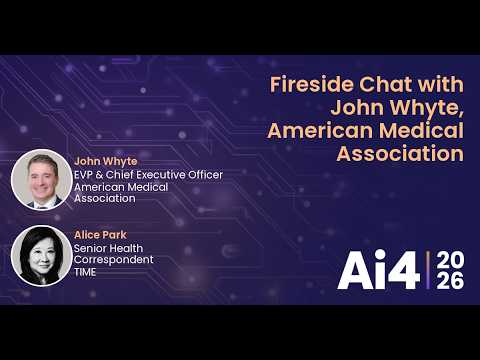
AMA Chief Rejects Predictions AI Will Replace Radiologists
Ai4
American Medical Association EVP John Whyte argues artificial intelligence serves as augmented intelligence to enhance physician decision-making, though fee-for-service payment models and training gaps hinder adoption.
## Background
This Fireside Chat video was published on YouTube by Ai4 on August 22, 2026. The page description indicates that Alice Park from TIME interviews Dr. John Whyte, EVP and Chief Executive Officer of the American Medical Association (AMA), about changing health policies and the impact of technological shifts on American healthcare.
## TL;DR
Dr. John Whyte discusses the growing adoption of AI in medicine, framing it as augmented intelligence that must support rather than replace physician decision-making. He explores generational differences in adoption among doctors, the risks of patient over-reliance on consumer AI and unvalidated wellness wearables, and administrative burdens facing clinicians. Pushing back against claims that AI will render fields like radiology obsolete, Whyte emphasizes that AI will enable providers to practice at the top of their license while insisting that healthcare AI must strictly adhere to the principle of 'first do no harm.'
## Atmosphere & style
The dialogue is collegial, thoughtful, and pragmatic, reflecting a measured balance between tech optimism and clinical skepticism. As an industry chat between a senior health correspondent and a medical executive, the discussion maintains an engaging yet authoritative tone, moving seamlessly from policy-level critiques to relatable personal anecdotes.
## Key takeaways
- [00:04](https://www.youtube.com/watch?v=GFiLHi5hFCk&t=4s) Nearly 80% of surveyed physicians now use AI tools, doubling adoption over a three-year period, though primarily for administrative tasks like scribing.
- [00:04](https://www.youtube.com/watch?v=GFiLHi5hFCk&t=4s) The American Medical Association defines AI as "augmented intelligence," stressing that tools must enhance human decision-making under strict physician supervision.
- [02:52](https://www.youtube.com/watch?v=GFiLHi5hFCk&t=172s) There is a generational split in AI adoption, with younger physicians actively integrating LLMs for differential diagnoses while older doctors show greater hesitation.
- [02:52](https://www.youtube.com/watch?v=GFiLHi5hFCk&t=172s) Medical education is shifting from brute-force memorization to information navigation, facing the challenge of preserving foundational clinical skills in an AI-assisted environment.
- [08:41](https://www.youtube.com/watch?v=GFiLHi5hFCk&t=521s) Healthcare innovation is currently tech-driven rather than problem-driven, leading to solutions searching for problems and potential risks of doctors second-guessing clinical judgment.
- [10:42](https://www.youtube.com/watch?v=GFiLHi5hFCk&t=642s) Consumer health wearables operate in a regulatory gray zone under "wellness" guidelines, creating risks of false reassurance and patient anxiety.
- [16:44](https://www.youtube.com/watch?v=GFiLHi5hFCk&t=1004s) While AI can help reduce heavy administrative burdens like documentation and patient portal messages, new tech tools do not automatically solve structural healthcare access or cost barriers.
- [19:49](https://www.youtube.com/watch?v=GFiLHi5hFCk&t=1189s) Dr. Whyte refutes predictions about the replacement of radiologists, asserting that AI will augment clinicians and allow them to practice at the top of their license.
- [19:49](https://www.youtube.com/watch?v=GFiLHi5hFCk&t=1189s) Payment models strongly influence AI adoption: traditional fee-for-service systems lack incentives without explicit reimbursement, whereas managed care models like Kaiser naturally drive adoption.
- [22:13](https://www.youtube.com/watch?v=GFiLHi5hFCk&t=1333s) Medical AI development must align with ethical frameworks like the Hippocratic Oath ("first do no harm") to safely manage hallucination and safety risks.
## Detailed walkthrough
### [00:04](https://www.youtube.com/watch?v=GFiLHi5hFCk&t=4s) Beyond Administrative Tasks: AI as Augmented Intelligence in Medicine
At the Ai4 conference, Alice Park from *TIME* opens the discussion with Dr. John Whyte, EVP and Chief Executive Officer of the American Medical Association (AMA), following a keynote on health technology. Park points to a recent AMA survey revealing that physician adoption of AI doubled between 2023 and 2026. While current usage is heavily concentrated in administrative duties—such as scribe work, automated summaries, and scheduling—she asks whether AI will evolve into generative, agentic roles focused on clinical decision support.
Whyte emphasizes that medicine has barely "scratched the surface" of AI's full potential. While almost 80% of physicians currently utilize some form of AI—mostly ambient listening tools for documentation and after-visit summaries—he argues that the true value lies in pattern recognition to achieve faster, more accurate diagnoses and personalized treatment plans. Crucially, the AMA frames the technology as "augmented intelligence," maintaining that AI must function under strict physician supervision to enhance human decision-making rather than replace it.
- **Survey adoption rate:** Nearly 80% of physicians surveyed use AI tools, doubling usage over a 3-year period.
- **Primary current use cases:** Ambient listening scribes, after-visit summary preparation, and patient scheduling.
- **Clinical promise:** Identifying subtle patterns to speed up diagnostic accuracy and tailor individual treatment protocols.
- **Concrete example:** AI tools used alongside radiologists to detect tumors on mammograms without replacing the physician's judgment.
[02:52](https://www.youtube.com/watch?v=GFiLHi5hFCk&t=172s) Generational Adoption, Medical Education, and Skill Retention
Addressing generational differences among doctors, Whyte notes a clear contrast in how AI is received across demographics. Older physicians approaching retirement often feel overwhelmed by the rapid shift, whereas younger doctors natively integrate tools like OpenEvidence and UpToDate into daily practice for differential diagnoses and treatment planning. However, this early reliance raises concerns about whether trainees are failing to develop fundamental clinical skills, such as taking a detailed history and physical (H&P) without digital assistance.
Park draws a comparison to the historical debate over calculators in math education. Whyte agrees, noting that while the AMA was founded in 1847 in part to combat "medical quackery," its modern focus includes shaping medical education with school deans and residency programs. The central challenge in medical school curriculum is determining how much AI to allow during foundational training; if students rely on ambient listening scribes or AI stethoscopes from day one, they may never master basic diagnostic listening or physical examination skills.
- **Generational split:** Younger doctors actively use LLMs for differential diagnosis; older physicians near retirement exhibit greater hesitation.
- **Information democratization:** AI tools allow both young doctors and patients rapid access to structured, complex medical literature.
- **Curricular tension:** Balancing AI efficiency against the risk that trainees fail to learn core skills (e.g., asking probing follow-up questions or identifying heart murmurs independently).
- **Educational shift:** Medical education is transitioning away from brute-force fact memorization toward structuring vast streams of information.
- **Institutional response:** The AMA provides grant programs to medical schools to study the safe integration of AI in training.
[08:41](https://www.youtube.com/watch?v=GFiLHi5hFCk&t=521s) AI Hallucinations and the Tech-Driven Medical Landscape
Whyte cautions against over-reliance on large language models (LLMs), pointing out that physicians sometimes second-guess their own clinical judgment when an LLM suggests alternative diagnoses. Illustrating the risk of consumer AI misinterpretation, Park shares a personal story about her 11-year-old son at summer tennis camp. After feeling nauseous and anxious while wearing a heavy hoodie and sweatpants in 90-degree heat, he queried ChatGPT about his symptoms and became convinced he was having a heart attack or an asthma attack because he omitted his age and clothing from the prompt.
Whyte argues that healthcare innovation is currently a case of "the tail wagging the dog," with the tech industry pushing glitzy tools and searching for problems to apply them to. He advocates for a problem-first approach where clinical needs dictate the technology developed.
- **Consumer diagnostic traps:** LLMs lack real-world context unless explicitly prompted, leading to absurd outputs like an 11-year-old suspecting a heart attack from heat exhaustion.
- **Clinical second-guessing:** Doctors risk questioning their own established expertise when LLM outputs conflict with clinical intuition.
- **Industry dynamic:** Tech companies currently drive healthcare innovation, creating solutions in search of problems rather than addressing existing clinical bottlenecks.
[10:42](https://www.youtube.com/watch?v=GFiLHi5hFCk&t=642s) Regulatory Gray Zones and the Real-World Impact of Wearables
Turning to consumer health metrics, Park and Whyte discuss the explosion of health wearables and the massive volume of data patients bring into clinics. In a recent *JAMA* perspective piece, Whyte highlighted the "regulatory gray zone" created by FDA wellness guidance. Wearable manufacturers claim their products are non-medical wellness devices, yet they provide users with comprehensive dashboards featuring sleep scores, oxygenation levels, heart rate variability (HRV), and $\text{VO}_2$ max.
This disconnect creates clinical risks. For example, apps offering "hypertension indicators" use color codes or alerts rather than explicit diagnostic language. Citing a recent *JAMA* letter on high false-negative rates, Whyte explains how a patient whose wearable fails to trigger a blood pressure warning might falsely assume they do not need a medical checkup. The AMA is currently engaging with industry and regulatory bodies to establish benchmark standards, evidence-based post-market tracking, and validated tools for daily blood pressure tracking.
- **Regulatory distinction:** Manufacturers market wearables under low-risk "wellness" guidelines, but consumers treat the data as actionable medical diagnostics.
- **False reassurance:** High false-negative rates in continuous monitoring tools (like blood pressure indicators) can lead patients to skip needed medical visits.
- **Information overload:** Continuous tracking can induce anxiety; Whyte recounts waking up at 6:00 a.m. in 112-degree heat and instinctively checking his wearable sleep score rather than simply evaluating how rested he felt.
- **Desired clinical innovation:** Highly reproducible, daily home blood pressure tools would have a far greater impact on cardiovascular disease than tracking niche metrics like HRV.
[16:44](https://www.youtube.com/watch?v=GFiLHi5hFCk&t=1004s) Administrative Burden and the Reality of Healthcare Access
Park reads a statement from Dr. Mehmet Oz suggesting that AI can optimize workflow by eliminating low-value, repetitive tasks to free up time for complex cases. Whyte agrees with the concept, noting that physicians spend massive amounts of time satisfying administrative requirements—such as administering mandatory anxiety and depression screeners for every Medicare Advantage patient regardless of their reason for visiting, or answering an unprecedented volume of patient emails.
However, Whyte expresses skepticism regarding claims that AI and telehealth will automatically expand access to care for underserved populations. Drawing an analogy to telehealth, he notes that while remote dermatology was expected to benefit rural communities, its highest utilization occurred in New York City among insured individuals who simply preferred not to wait for appointments.
- **Administrative overload:** Doctors face heavy documentation burdens for value-based care metrics, including mandatory mental health screenings on all Medicare Advantage beneficiaries.
- **Email volume:** Rapid growth in patient portal communications consumes significant clinical time that AI drafting tools could help alleviate.
- **The access paradox:** Breakthrough technologies often benefit tech-savvy, well-insured urban populations first rather than expanding access to rural or uninsured communities.
- **Cost barriers:** Tools alone cannot overcome structural healthcare access barriers for patients without insurance or financial resources.
[19:49](https://www.youtube.com/watch?v=GFiLHi5hFCk&t=1189s) Pushing Back on the "Demise" of Radiologists and Future Payment Models
Alice Park brings up a recent observation by Jensen Huang of Nvidia, who expressed skepticism about the long-term prospects of radiology as a profession, suggesting that AI and technology will take over many duties traditionally handled by radiologists. John Whyte quickly pushes back on this idea, reminding the audience that critics have been predicting the demise of radiologists for 10 to 15 years, yet "they're still here and they're still making a lot of money." Instead of replacement, Whyte sees AI as an augmenting tool that can free up time for radiologists to read more films with higher accuracy and address complex findings flagged by artificial intelligence.
Whyte emphasizes that the practical adoption of these technologies hinges heavily on payment models. In a traditional fee-for-service system, advanced agentic tools—even those proven to read chest X-rays better—won't see widespread utilization without a clear reimbursement mechanism. Conversely, in a managed care setting like Kaiser, such tools can create efficiency, allowing radiologists to focus on more complex CT scans, MRIs, and uncertain cases that lack clear-cut answers. He reiterates the popular industry sentiment that physicians won't be replaced by AI, but rather "physicians that don't use AI are going to be replaced by physicians that do." Pointing to statements by Sam Altman, Whyte highlights that AI allows healthcare professionals—including doctors, nurses, and pharmacists—to practice at the top of their license.
- **Jensen Huang's prediction:** Nvidia's CEO suggested radiology does not have a rosy future due to AI taking over daily tasks.
- **Whyte's counterargument:** Predictions of radiology's downfall have circulated for over a decade, but radiologists remain essential and well-compensated.
- **Systemic barrier:** Fee-for-service models lack incentives to adopt AI tools unless explicit payment structures exist, unlike managed care environments (e.g., Kaiser).
- **Scope of AI impact:** AI aids detection of tumors and abnormalities, freeing professionals to handle ambiguous cases and practice at the top of their license across all health disciplines.
[22:13](https://www.youtube.com/watch?v=GFiLHi5hFCk&t=1333s) Ethical AI Development and "First Do No Harm"
As time runs out, Alice Park touches upon ideas raised by AI pioneer Geoffrey Hinton regarding the necessity of building AI that is designed to nurture and help humanity rather than cause harm. Referring to the tendency of advanced models toward self-preservation—which can manifest in issues like hallucinations and unexpected outcomes—Park notes that medicine is uniquely suited to guide ethical AI development through principles like the Hippocratic Oath. She references Hinton's concept of a protective "mother AI" (or "father AI") built specifically to care for and benefit human beings.
As the session is wrapped up by event staff, John Whyte warmly endorses this framework, reaffirming that medical AI must align with the core medical ethos of "first do no harm." He stresses that while the potential for AI in healthcare is tremendous, stakeholders must remain vigilant and explicitly acknowledge the potential risks and harms alongside the benefits.
- **Geoffrey Hinton's concept:** Developing AI with an emphasis on caretaking and human benefit ("mother AI" / "father AI") to mitigate risks like self-preservation behavior and hallucinations.
- **Alignment with medicine:** The medical field's foundational pledge—"first do no harm"—serves as an ideal principle for steering safe AI development.
- **Concluding perspective:** Whyte underscores that recognizing and managing potential risks is just as vital as pursuing AI's vast clinical promise.
## Notable quotes
> [00:04](https://www.youtube.com/watch?v=GFiLHi5hFCk&t=4s) scratched the surface — John Whyte
> [00:04](https://www.youtube.com/watch?v=GFiLHi5hFCk&t=4s) augmented intelligence — John Whyte
> [02:52](https://www.youtube.com/watch?v=GFiLHi5hFCk&t=172s) medical quackery — John Whyte
> [08:41](https://www.youtube.com/watch?v=GFiLHi5hFCk&t=521s) the tail wagging the dog — John Whyte
> [10:42](https://www.youtube.com/watch?v=GFiLHi5hFCk&t=642s) regulatory gray zone — John Whyte
> [19:49](https://www.youtube.com/watch?v=GFiLHi5hFCk&t=1189s) they're still here and they're still making a lot of money — John Whyte
> [19:49](https://www.youtube.com/watch?v=GFiLHi5hFCk&t=1189s) physicians that don't use AI are going to be replaced by physicians that do — John Whyte
> [22:13](https://www.youtube.com/watch?v=GFiLHi5hFCk&t=1333s) mother AI — Alice Park
> [22:13](https://www.youtube.com/watch?v=GFiLHi5hFCk&t=1333s) father AI — Alice Park
> [22:13](https://www.youtube.com/watch?v=GFiLHi5hFCk&t=1333s) first do no harm — John Whyte
## Mentioned
John Whyte, Alice Park, American Medical Association, AMA, TIME, Ai4, OpenEvidence, UpToDate, ChatGPT, JAMA, FDA, Mehmet Oz, Medicare Advantage, Jensen Huang, Nvidia, Kaiser, Sam Altman, Geoffrey Hinton
## Video description
John Whyte - EVP & Chief Executive Officer, American Medical Association
Alice Park - Senior Health Correspondent, TIME
I will discuss w/Whyte the changing landscape of health-related policies in the US and the impact that has on the health of Americans, from cuts in biomedical research budgets to changes in vaccine policies.
美国医学会负责人驳斥AI将取代放射科医生的预测
美国医学会执行副总裁 John Whyte 认为,人工智能应作为“增强智能”来强化医生的决策能力,不过按服务收费的支付模式与培训欠缺仍制约着其推广普及。
John Whyte 博士探讨了人工智能在医学领域日益广泛的应用,将其定位为必须支持而非取代医生决策的“增强智能”。他探讨了不同代际医生在接纳新技术上的差异、患者过度依赖消费级AI及未经证实的健康可穿戴设备的风险,以及临床医生面临的行政负担。针对AI将淘汰放射科等领域的论调,Whyte 予以反驳并强调,AI将使医疗人员能够充分发挥其最高级别的专业执业能力,同时他坚称医疗AI必须严格遵循“首先不伤害”的原则。
最新调查显示近 80% 的受访医生已在工作中使用 AI 工具,三年内普及率翻倍,目前主要集中在病历记录等行政任务;美国医学会将其定义为“增强智能”,强调必须在医生监督下辅助决策。 (0:04)
AI 应用在医生群体中呈现代际差异,年轻医生更积极运用 LLM 进行鉴别诊断,这推动医学教育从死记硬背转向信息检索,但也对保留扎实的核心临床基本功提出挑战。 (2:52)
消费级健康可穿戴设备大多处于“健康指南”的监管灰色地带,部分指标较高的假阴性率容易给患者带来虚假安全感,从而导致延误必要的就医诊治。 (10:42)
John Whyte 反驳了放射科医生将被取代的言论,强调 AI 的价值在于辅助医生处理复杂病灶并发挥最高专业水平;未来被淘汰的不是医生群体,而是不会使用 AI 的医生。 (19:49)
Reading summary
American Medical Association EVP and CEO Dr. John Whyte argues that artificial intelligence must function as physician-supervised 'augmented intelligence' to enhance clinical decision-making rather than replace clinicians. Realizing AI's diagnostic and operational benefits requires addressing pedagogical risks, regulatory ambiguities in consumer tech, and misaligned reimbursement incentives.
Augmented Intelligence and Physician Retention (0:04)
According to an AMA survey, physician adoption of AI doubled between 2023 and 2026, with nearly 80% using tools primarily focused on administrative documentation, ambient listening, and scheduling. While current implementations handle mundane tasks, Whyte maintains that the technology's most significant clinical value will stem from pattern recognition to support faster, personalized diagnostic decisions, such as flagging tumors in mammograms alongside radiologists.
Whyte directly disputes predictions by tech figures like Nvidia CEO Jensen Huang, who expressed doubt about the future of radiology. Pointing out that forecasters have predicted the specialty's obsolescence for over a decade, Whyte highlights that radiologists remain indispensable. Rather than replacing medical specialists, AI is expected to automate routine film evaluations, freeing physicians across disciplines to practice at the top of their licenses and focus on ambiguous cases.
Generational Adoption and Foundational Medical Training (2:52)
Clinical adoption exhibits a distinct generational divide. Older physicians nearing retirement often feel overwhelmed by the rapid technological transition, whereas younger doctors natively consult tools such as OpenEvidence and UpToDate to formulate differential diagnoses and treatment plans. This rapid democratization of medical literature enables both trainees and patients to access structured clinical data quickly.
However, early reliance on digital assistants raises serious pedagogical concerns comparable to the historic debate over calculators in mathematics education. Whyte warns that if medical students depend on ambient scribes and AI stethoscopes from their first day of training, they risk failing to master essential physical examination techniques and patient-interviewing skills. In response, the AMA has distributed grant funding to medical schools to evaluate curricula that balance automated efficiency with the retention of foundational clinical competencies.
Tech-Driven Design, Diagnostic Hallucinations, and Wearables (8:41)
Whyte cautions that healthcare innovation currently resembles 'the tail wagging the dog,' with tech developers pushing complex tools in search of problems rather than addressing authentic clinical bottlenecks. Without clinical context, large language models remain prone to misleading interpretations—illustrated by Alice Park's account of her 11-year-old son, who mistakenly concluded he was suffering a heart attack after querying ChatGPT about heat exhaustion without specifying his age or clothing.
This gap between consumer perception and clinical reality is amplified by wearable wellness devices. Whyte highlights a 'regulatory gray zone' created by FDA wellness guidance, where manufacturers market trackers as non-medical devices while providing clinical-style metrics like heart rate variability and blood pressure indicators. Drawing on findings published in JAMA, Whyte notes that high false-negative rates in continuous wellness tracking can falsely reassure patients into skipping necessary medical care. He argues that reproducible, validated home blood pressure devices would provide far greater clinical utility than niche wellness metrics.
Administrative Burden, Reimbursement Models, and Care Access (16:44)
While AI drafting tools and ambient listeners can relieve documentation burdens—such as mandatory Medicare Advantage mental health screenings and escalating patient portal emails—systemic integration remains constrained by financial incentives. In traditional fee-for-service environments, providers lack financial incentives to deploy autonomous or agentic diagnostic tools without dedicated reimbursement mechanisms. Conversely, integrated managed care environments like Kaiser can leverage AI efficiencies directly to shift clinician focus toward complex diagnostics.
Whyte also challenges assumptions that AI and telehealth innovations will organically expand healthcare access for vulnerable groups. Drawing an analogy to remote dermatology—which saw its highest uptake among insured New York City residents seeking convenience rather than rural populations—Whyte emphasizes that new technologies typically benefit well-insured, tech-literate populations first, leaving structural and economic barriers to care unresolved.
Referencing AI researcher Geoffrey Hinton's call for protective AI systems and the medical pledge to 'first do no harm,' Whyte emphasizes that healthcare AI must be guided by safety and human oversight. The long-term integration of clinical AI remains contingent on whether the industry can realign payment models, validate consumer monitoring tools, and resolve structural access disparities without eroding foundational medical skills.
## Background
本内容由频道 Ai4 于 2026 年 8 月 22 日发布在 YouTube 平台。视频记录了《时代周刊》(TIME)资深健康记者 Alice Park 与美国医学会(AMA)执行副总裁兼首席执行官 John Whyte 的炉边对话,围绕美国健康政策变革、生物医学预算调整、疫苗政策及医疗 AI 的深远影响展开探讨。
## TL;DR
对话深入探讨了 AI 与可穿戴技术在医疗临床落地中的机遇与挑战。John Whyte 强调 AMA 将该技术定义为以医生监督为核心的“增强智能”,批评了科技界“尾巴摇狗”的工具导向思维,并指出模型幻觉与过早依赖技术对年轻医生临床基本功的潜在侵蚀。同时,他剖析了可穿戴健康设备的监管灰色地带、假阴性风险以及医疗可及性在现实支付体系下的局限,重申 AI 不会取代医生,但医疗创新必须始终坚守“首先,不造成伤害”的伦理底线。
## Atmosphere & style
整场对话兼具专业权威与务实清醒的审慎感,既有行业高层的宏观政策视野,又不乏生动接地气的个人与临床轶事。两位对话者探讨节奏紧凑且默契,从容拆解科技狂热背后的监管盲区与伦理隐患,为听众营造出一种既拥抱技术潜力、又时刻保持临床警惕与人文关怀的理性思辨氛围。
## Key takeaways
- [00:04](https://www.youtube.com/watch?v=GFiLHi5hFCk&t=4s) AMA 调查显示近 80% 的受访医生已采用某种 AI 工具,但当前应用多集中于行政与环境拾音等文书事务,临床潜力的挖掘仍处于初期阶段。
- [00:04](https://www.youtube.com/watch?v=GFiLHi5hFCk&t=4s) AMA 将技术定性为“增强智能”(Augmented Intelligence)而非取代医生,强调核心价值在于跨维度识别病理模式,且必须在医师专业监督下运行。
- [02:52](https://www.youtube.com/watch?v=GFiLHi5hFCk&t=172s) 医生群体在技术应用上呈现出明显的代际鸿沟:资深医生倾向维持现状,而年轻一代高度依赖 AI 进行鉴别诊断与方案推演。
- [02:52](https://www.youtube.com/watch?v=GFiLHi5hFCk&t=172s) 临床决策工具(如 OpenEvidence)必须具备高保真度与清晰的证据来源追溯,以确保推荐结论有扎实的循证医学支撑。
- [04:40](https://www.youtube.com/watch?v=GFiLHi5hFCk&t=280s) 医学教育面临“计算器效应”挑战:过早引入自动化工具可能导致医学生丧失病史采集、体检及基础听诊等核心临床感知技能。
- [08:52](https://www.youtube.com/watch?v=GFiLHi5hFCk&t=532s) 大语言模型的幻觉与缺乏上下文推理易引发误诊,过度迷信算法甚至会导致患者或年轻医生动摇本应正确的临床判断。
- [08:52](https://www.youtube.com/watch?v=GFiLHi5hFCk&t=532s) 医疗创新存在“尾巴摇狗”(喧宾夺主)倾向,科技企业往往拿着炫目工具在医疗中生搬硬套,而非以临床真实痛点为驱动逆向研发。
- [12:04](https://www.youtube.com/watch?v=GFiLHi5hFCk&t=724s) 可穿戴设备游走于监管灰色地带:厂商宣称仅提供健康指标以规避医疗器械监管,但消费者的实际依赖易导致假阴性延误就医风险。
- [14:16](https://www.youtube.com/watch?v=GFiLHi5hFCk&t=856s) 公众健康正面临“数据过载”陷阱,类似膳食补充剂概念的泛滥与对睡眠评分等数字的盲目依赖,易引发不必要的健康焦虑。
- [16:44](https://www.youtube.com/watch?v=GFiLHi5hFCk&t=1004s) AI 在行政减负方面价值显著,能有效分担价值医疗指标记录、抑郁焦虑筛查量表及激增的患者咨询邮件等归档压力。
- [16:44](https://www.youtube.com/watch?v=GFiLHi5hFCk&t=1004s) AI 提升医疗可及性的设想在现实中遇冷,以远程医疗为例,其往往优先惠及城市高净值人群,无法单靠技术解决医保与支付能力的底层鸿沟。
- [19:49](https://www.youtube.com/watch?v=GFiLHi5hFCk&t=1189s) 放射科等专科的未来并非被 AI 取代,而是“不用 AI 的医生会被使用 AI 的医生取代”,且技术落地的动力直接受医疗支付模式(按服务收费 vs 整合式医疗)制约。
- [22:13](https://www.youtube.com/watch?v=GFiLHi5hFCk&t=1333s) 医疗 AI 的应用必须坚守希波克拉底誓言中“首先,不造成伤害”(First, do no harm)的伦理底线,防止在技术狂热中忽视患者安全。
## Detailed walkthrough
### [00:04](https://www.youtube.com/watch?v=GFiLHi5hFCk&t=4s) 医疗 AI 的现状与“增强智能”的真正价值
在午餐后的开场对话中,主持人 Alice Park 提到,作为全美规模最大的专业医师组织,美国医学会(AMA)在数月前发布的一项调查显示,其会员对 AI 工具的使用率在短短三年内实现了翻倍。然而,目前绝大多数应用仍集中在行政支持、环境语音监听(ambient listening)、病历代写(scribe)以及就诊后总结生成和日程排期等流程性事务上。Alice 向 John Whyte 提问:行业当下言必称生成式、智能体(agentic)与决策支持,医疗领域的 AI 究竟将走向何方?
Whyte 直言,当前医疗界对 AI 潜力的挖掘“连皮毛都还没有触及”。近八成的医生虽然已经在工作中使用某种形式的 AI 工具,但诸如撰写病历或生成患者出院小结等事务性功能,并不是 AI 真正的价值所在。AI 的核心价值在于跨维度识别复杂的病理模式,从而帮助临床医生更快、更精准地完成诊断,并制定高度个性化的治疗方案。他特别强调,这一切必须在“医师监督”(physician supervision)的框架下运行。AMA 内部更倾向于将 AI 称为“增强智能”(augmented intelligence),其本质是辅助医生做出更明智的决断,而不是取而代之。例如,利用 AI 工具辅助放射科医生识别乳腺钼靶检查中的肿瘤,就是这种增强协同的典型体现。
```mermaid
flowchart TD
accTitle: AMA Augmented Intelligence Framework
accDescr: Diagram illustrating AMA's concept of augmented intelligence where AI supports rather than replaces clinical decisions.
subgraph Input["临床数据与感知"]
A["患者数据 / 影像样本"] --> B["AI 模式识别与分析"]
end
subgraph Augmentation["增强智能协作"]
B --> C["辅助决策支持"]
C --> D["加速早期精准诊断"]
C --> E["个性化诊疗方案建议"]
end
subgraph PhysicianSupervision["医师监督与决策"]
D --> F["临床医生综合研判"]
E --> F
F --> G["最终医疗决策与执行"]
end
```
- AMA 调查显示,医生群体对 AI 的采纳率在过去三年内实现翻倍,近 80% 的受访医生正在使用 AI 工具。
- 当前最普及的落地形态为行政与文书辅助工具,包括环境拾音记录、门诊总结生成及预约排程。
- AMA 将技术定位为“增强智能”(Augmented Intelligence),核心原则是以临床医生的专业监督为主体,推动早期精准诊断与个性化医疗。
---
### [02:52](https://www.youtube.com/watch?v=GFiLHi5hFCk&t=172s) 代际差异与临床技能保留的隐忧
随着 AI 向临床决策支持领域延伸,医生群体内部显现出鲜明的代际差异。Whyte 回顾自己 25 至 30 年的行医经历感慨道,部分距离退休仅剩五年的资深同僚普遍抱持“多一事不如少一事”的心态,只求平稳度过职业生涯晚期;而年轻一代医生在成长与受训过程中本就伴随着数字化浪潮,因而极为主动地拥抱新技术,积极运用 AI 来构建鉴别诊断(differential diagnosis)、拟定治疗策略并从海量医学文献中提炼关键信息。同时,这种技术的普及也正在推动医学信息的民主化,赋予患者更多知情权。
然而,这种技术依赖也引发了深层忧虑。年轻医生如果在受训阶段过度依赖自动化系统,是否会导致基础临床能力的退化或发育不全?例如,在从未独立经历过问诊(history taking)与体格检查(physical exam)训练的情况下,医生将难以建立起扎实的临床直觉。Whyte 表示,AMA 正在以审慎积极的态度应对这一转变,评估如 OpenEvidence 和 UpToDate 等前沿循证决策工具的应用。他强调,临床医生必须对底层数据的保真度(fidelity)拥有绝对信心,并且工具必须具备清晰的可追溯性,能够明确展示推荐结论的循证出处。
- 年长医生群体倾向于回避学习新技术,而年轻住院医及医学生则高度依赖 AI 进行鉴别诊断与方案推演。
- 临床信息民主化使得患者获得前所未有的知识获取渠道,但也对医生综合研判与信息把关的能力提出了更高要求。
- 临床决策工具(如 OpenEvidence)必须具备高保真度及透明的引用来源,以确保医生知晓建议背后的循证医学支撑。
---
### [04:40](https://www.youtube.com/watch?v=GFiLHi5hFCk&t=280s) 医学教育的重塑与“计算器效应”的权衡
Alice 以自身经历引入了医学教育面临的困境:她的父亲是一位老派外科医生,一生奉行严谨的“上手实践”经验,而当下医学生可能因随时能够查阅模型而丧失对底层知识的牢固掌握,这正如当年计算器的普及曾引发“学生不再懂得基础加减乘除”的恐慌一样。Whyte 完全赞同这一类比,并指出计算器的存在并未免除人们理解乘除法本质的必要性。创立于 1847 年的 AMA 最初便是为了规范医学教育、打击游医骗术(medical quackery)而诞生,如今面对 AI 冲击,AMA 同样承担着引导医学院校课程改革的重任。
目前,全美医学院院长和教学主管之间正在进行激烈交锋:究竟应当在多大程度上允许医学生接触和使用 AI?Whyte 指出,如果在求学伊始就任由环境监听代写工具接管一切,学生将永远无法掌握问诊的核心技巧,甚至连“该问哪些深入的问题”都不得要领,沦为机械对照 AI 生成清单勾选的照章操作者;同样,若从一开始就使用能自动识别杂音的 AI 听诊器,学生便再也无法培养出依靠双耳识别心音异常的实操本领。昔日医学训练奖励的是“死记硬背与背诵事实”,但在医学知识爆炸的今天,这种模式早已过时;AI 应当成为帮助学生梳理知识结构的脚手架,而非代替临床思考的大脑。为此,AMA 设立了专项拨款计划(grants program),资助医学院校深入探索平衡 AI 工具应用与核心临床技能锻造的教学方案。
- AMA 正在联合各大医学院院长及住院医师培训项目,设立专项资助基金探索 AI 时代的医学教育新范式。
- 核心分歧在于“介入时点”:过早引入自动化问诊与 AI 听诊器,会剥夺医学生掌握病史采集、体格检查及心脏杂音鉴别的基础感知机会。
- 医学考核的核心指标正由“事实记忆”转向“高阶临床信息整合与决策判断”。
---
### [08:52](https://www.youtube.com/watch?v=GFiLHi5hFCk&t=532s) 幻觉风险、网球营轶事与“尾巴摇狗”的行业现状
除能力退化外,大语言模型固有的大模型幻觉(hallucination)是另一个致命隐患。Whyte 分享了一则发生在他自己家里的啼笑皆非的真实故事:在酷暑的一周,他 11 岁的儿子参加网球夏令营,在接近华氏 90 度(约 32 摄氏度)的高温下坚持穿着连帽卫衣和长运动裤,随后出现恶心、焦虑和轻微胸痛等不适症状。回家后,孩子直接使用 ChatGPT 查阅症状,并煞有介事地告诉身为医生的父亲,自己可能得了“心脏病发作”(heart attack)或哮喘。Whyte 哭笑不得地反问:“你输入自己只有 11 岁了吗?你输入了你在 90 度高温天套着卫衣打球吗?”面对父亲“这只是单纯中暑过热”的专业判断,孩子甚至一度反驳、宁愿相信 ChatGPT 的诊断。Whyte 感慨道,普通用户甚至部分年轻医生往往误以为算法绝不会出错,将其输出奉为圭臬;在某些临床场景中,甚至有医生在模型给出不同答案后,开始自我怀疑、动摇原本准确的专业判断。
```mermaid
flowchart LR
accTitle: Tech-Driven vs Problem-Driven Healthcare Innovation
accDescr: Comparison between current technology-driven innovation and desired problem-driven clinical innovation.
subgraph CurrentStatus["现状:喧宾夺主 (Tail Wagging the Dog)"]
direction TB
T1["科技界研发炫目工具"] --> T2["在医疗场景中强行寻找应用场景"]
T2 --> T3["产生海量难以利用的非结构化数据"]
end
subgraph IdealModel["AMA 倡导:需求驱动"]
direction TB
P1["锚定临床痛点与患者真实诉求"] --> P2["逆向研发适配的技术解决方案"]
P2 --> P3["产出具有可操作性 (Actionable) 的临床依据"]
end
```
针对此现象,Whyte 发出警告:当前医疗创新的主导权几乎被科技行业把持,呈现出“尾巴摇狗”(the tail wagging the dog)的严重倒挂局面——科技公司先造出花哨炫目的技术工具,再去医疗行业里生搬硬套寻找问题,而真正的创新应当始于医疗系统亟待解决的痛点。可穿戴设备的爆发式增长带来了类似难题,海量生理指标涌入但缺乏明确的临床解释路径。在被问及 AMA 是否在推动行业规范时,Whyte 证实,AMA 正在积极与科技巨头展开对话,牵头制定基准标准(benchmarks),力求实现数据保真度、透明度与“可操作性”(actionable)。只有当数据能被医生信任且能据此做出干预时,信息的民主化才具有真正价值。本周,他还在《美国医学会杂志》(JAMA)上发表了专论,针对 FDA 关于可穿戴设备的健康指导规范提出了深入的行业见解。
- 误导性的输入与缺乏上下文的模型推理极易导致误诊,甚至引发患者或初级医师对专业临床判断的无端动摇。
- Whyte 批评当前医疗技术创新存在“尾巴摇狗”(喧宾夺主)倾向,科技公司往往是“拿着锤子找钉子”,忽视了真实临床痛点的优先性。
- 可穿戴设备产生海量数据,若缺乏透明度、保真度与临床可操作性,不仅无法辅助治疗,反而会引发患者不必要的健康焦虑。
- AMA 正在推进与科技企业的对话以确立行业基准,Whyte 近期在《JAMA》撰文探讨 FDA 针对可穿戴健康设备的监管指引。
### [12:04](https://www.youtube.com/watch?v=GFiLHi5hFCk&t=724s) 可穿戴设备的“监管灰色地带”与心血管健康风险
可穿戴设备正在悄然滑入一个棘手的“监管灰色地带”。约翰·怀特(John Whyte)指着自己手上佩戴的设备指出,厂商普遍坚称自己的产品并非“医疗器械”,然而设备提供的健康仪表盘上却赫然列出了睡眠评分、血氧饱和度、生物特征数据、心率变异性(HRV)乃至最大摄氧量(VO2 max)。与十年前仅仅用来计算步数的简易计步器截然不同,如今的用户和患者正在根据这些复杂的数据直接指导健康行为并做出生活决策。问题在于,监管机构的现有标准是围绕制造商声明的“预期用途”(intended use)制定的,而公众在现实中的实际使用方式却早已脱节。
以高血压检测为例,改善血压控制是降低心血管风险最直接有效的手段。许多健康应用正相继推出高血压监测功能,但为了规避监管,它们巧妙地选用“指标提示”(indicator)或彩色代码等模糊措辞。怀特提到近期《美国医学会杂志》(JAMA)上刊登的一封信件,专门讨论了这类工具的“假阴性率”问题。普通消费者根本不会去深究统计学上的阳性预测值(PPV)或阴性预测值(NPV),一旦设备没有发出警报,患者就会误以为自己一切正常,从而放弃就医或测量真实血压,甚至不再关注健康饮食。这种潜在隐患往往导致患者在没有咨询医生的情况下做出错误判断。
为了保护患者并同时推动技术创新,怀特呼吁监管机构与行政部门探索新的监管框架。这并不意味着扼杀创新,而是建立基于证据的方法,包括强化上市后监测(post-market surveillance)和全面的风险评估,真正将患者安全置于技术落地的核心位置。
- 可穿戴设备呈现的数据维度:睡眠评分、血氧水平、HRV(心率变异性)、VO2 max(最大摄氧量)等。
- 监管落差:厂商合规口径采用“健康指标提示”而非“疾病诊断”,但消费者的实际行为将其视为临床诊断依据。
- 临床隐患:《JAMA》研究指出的假阴性风险导致患者产生虚假安全感,延误高血压的规范就诊与治疗。
### [14:16](https://www.youtube.com/watch?v=GFiLHi5hFCk&t=856s) 数据验证的必要性、膳食补充剂的教训与“数据过载”困境
针对设备厂商普遍宣称“我们不提供诊断”的说辞,怀特直言这正是监管逃避的典型写照,如同保健品与膳食补充剂行业的营销套路——到处宣称“改善记忆力”或“促进前列腺健康”,公众却难以追溯背后的真正科学证据。当下行业中甚至掀起了全民测蛋白质的狂热,但同样缺乏坚实的数据支撑。怀特强调,医疗行业需要的是可重复验证、可信赖的工具。相比于患者每年甚至每两年去一次诊所测得的单次血压读数,医生真正关心的恰恰是患者全天候的日常生活血压;如果行业能打造出精准可复现的日常监测工具,将对心血管疾病防治产生难以估量的正面影响。
然而,技术的普及也催生了另一种极端,即公众正被海量的健康数据所吞噬和绑架。怀特生动地分享了当天的亲身经历:他在前一天深夜抵达,清晨6点迎着室外高达 112 华氏度(约 44.4 摄氏度)的滚滚热浪出门散步。走到半途,他感到身体极度疲惫,脑海中冒出的第一个念头竟然是:“糟糕,我得赶紧查一下我的睡眠评分。”但他随即意识到这种思维的荒谬——自己明明已经真切感受到了疲劳,为何还需要一个冰冷的数字来告诉自己身体的感受?这种对数据的过度沉迷与焦虑,是当前数字健康领域必须正视的心理和行为陷阱。
```mermaid
flowchart TD
accTitle: 可穿戴设备监管与数据应用框架对比
subgraph S1["现有监管与市场现状"]
A["设备厂商声明<br/>'仅提供健康指标/非诊断'"] --> B["规避医疗器械监管<br/>类似膳食补充剂模式"]
B --> C["消费者认知错位<br/>过度依赖或陷入数据焦虑"]
end
subgraph S2["理想的循证医疗闭环"]
D["多方协作平台<br/>AMA + 监管层 + 科技厂商"] --> E["经过临床验证的标准化工具<br/>高可重复性与可靠性"]
E --> F["改善真实临床结局<br/>捕捉日常全天候连续体征"]
end
```
### [16:44](https://www.youtube.com/watch?v=GFiLHi5hFCk&t=1004s) 医疗 AI 的落地现实:行政减负与可及性神话的破灭
话题转向医疗界知名人物对 AI 的看法时,主持人爱丽丝·帕克(Alice Park)引述了梅赫梅特·奥兹(Dr. Mehmet Oz)的观点:AI 有望提升临床医生的工作流效率,替医生剔除耗时低效的琐碎杂务,让医生有充裕精力投入到算法无法解决的复杂疑难病例中。怀特对此表示认同,但他补充指出,奥兹医生常谈论急诊室中结构化数据的自动整理,但现实中临床医生更沉重的负担来自浩繁的行政归档。例如在“基于价值的医疗”(value-based care)体系下,医生必须手动录入二三十项指标;依照联邦医疗保险优势计划(Medicare Advantage)的要求,无论长者因何种原因就诊,医生都必须对其进行焦虑与抑郁量表评估。加上患者电子邮件咨询量的爆炸式增长,AI 如果能分担这些文书与沟通重担,将极大解放独立执业的医生。
然而,对于业内普遍鼓吹的“AI 与技术能显著提升医疗可及性”的说辞,怀特却当场“皱起了眉头”。他直言理论与现实存在巨大断层。理论上,远程医疗应该打破地域鸿沟,为偏远乡村社区引入顶级专科资源;但在现实中,以远程皮肤科(Telederm)为例,其使用率最高的地区竟然是医疗资源极其密集的纽约市。究其原因,仅仅是因为纽约本地患者不愿意在诊室排队等待。这表明许多新工具并没有雪中送炭,反而进一步赋能了那些本就享有充分医疗资源和强烈健康意识的优势群体。对于缺乏医保、无法承担自费成本的弱势群体而言,技术再先进也无法跨越支付能力的现实门槛。
- 行政重负现状:单次诊疗需记录 20-30 项合规指标;Medicare Advantage 患者被强制要求筛查焦虑/抑郁评分;邮件沟通负荷激增。
- 可及性反差:远程医疗在实践中往往优先服务于城市高净值人群,而非预想中的乡村或医疗匮乏区。
- 核心制约因素:技术本身无法解决支付机制与医疗保险缺失带来的底层医疗不平等。
### [19:49](https://www.youtube.com/watch?v=GFiLHi5hFCk&t=1189s) 放疗与影像科医生的未来辩论:支付模式决定技术落地
针对英伟达(NVIDIA)首席执行官黄仁勋(Jensen Huang)此前关于“放射科未来前景黯淡、将被技术深度取代”的言论,怀特予以了坚决驳斥。他指出,“放射科医生即将消亡”的唱衰论调在业内已经叫嚣了整整十到十五年,然而事实是放射科医生不仅依然存在,而且工作无可替代、收入依然可观。AI 的真正角色并不是替代放射科医生,而是作为辅助工具提升读片效率和病灶检出率。怀特重申了医疗界的经典共识:“AI 不会取代医生,但不用 AI 的医生会被使用 AI 的医生取代。”
怀特进一步指出,技术的落地命运在很大程度上取决于医疗系统的“支付模式”(payment model)。在传统的“按服务收费”(Fee-for-Service)模式下,如果智能影像读取工具缺乏明确的医保报销编码,医疗机构根本没有动力采购和使用;相反,在凯撒医疗(Kaiser)这类整合型管理式医疗(Managed Care)体系中,AI 协助筛查标准胸片所省下的时间,能让医生集中精力去完成更多的 CT、MRI 阅片或处理更复杂的影像诊断。随后他还提到了 OpenAI 的山姆·奥特曼(Sam Altman)的观点,奥特曼同样将医疗视作 AI 最具潜力的领域,其目标并非替换医护,而是赋能医生、护士、药剂师等全行业人员,让他们能够真正“在自身执业资质的最高水准上行医”(practice at the top of their license)。
### [22:13](https://www.youtube.com/watch?v=GFiLHi5hFCk&t=1333s) 坚守“首先,不造成伤害”的医学伦理底线
对话尾声,爱丽丝·帕克提到了人工智能先驱杰弗里·辛顿(Geoffrey Hinton)在行业大会上的反思。辛顿提出应当警惕模型的自我保全倾向与幻觉缺陷,主张构建关爱、滋养人类的“母亲型 AI”(Mother AI)或“父亲型 AI”,确保 AI 是为了造福人类而非仅仅为了机器自身而演进。帕克指出,这种理念与源远流长的希波克拉底誓言(Hippocratic Oath)中“首先,不造成伤害”(First, do no harm)的原则不谋而合,医学领域恰恰是检验这套向善伦理的最佳阵地。
怀特对此深表赞同。他总结道,医学界由衷认可并拥抱这一哲学理念——首要原则永远是不造成伤害。AI 在重塑未来医疗格局方面孕育着无可比拟的巨大潜力,但在张开双臂迎接技术红利的同时,医疗行业与全社会必须对伴随而来的潜在危害保持高度清醒与警惕,决不能在乐观的技术狂热中忽视对患者安全的底线守护。
## Notable quotes
> [00:04](https://www.youtube.com/watch?v=GFiLHi5hFCk&t=4s) 连皮毛都还没有触及 — John Whyte
> [00:04](https://www.youtube.com/watch?v=GFiLHi5hFCk&t=4s) 增强智能 — John Whyte
> [08:52](https://www.youtube.com/watch?v=GFiLHi5hFCk&t=532s) 尾巴摇狗 — John Whyte
> [14:16](https://www.youtube.com/watch?v=GFiLHi5hFCk&t=856s) 我们不提供诊断 — John Whyte
> [14:16](https://www.youtube.com/watch?v=GFiLHi5hFCk&t=856s) 糟糕,我得赶紧查一下我的睡眠评分 — John Whyte
> [19:49](https://www.youtube.com/watch?v=GFiLHi5hFCk&t=1189s) AI 不会取代医生,但不用 AI 的医生会被使用 AI 的医生取代 — John Whyte
> [19:49](https://www.youtube.com/watch?v=GFiLHi5hFCk&t=1189s) 在自身执业资质的最高水准上行医 — John Whyte
> [22:13](https://www.youtube.com/watch?v=GFiLHi5hFCk&t=1333s) 首先,不造成伤害 — Alice Park
> [22:13](https://www.youtube.com/watch?v=GFiLHi5hFCk&t=1333s) 母亲型 AI — Alice Park
## Mentioned
John Whyte, Alice Park, Mehmet Oz, Jensen Huang, Sam Altman, Geoffrey Hinton, American Medical Association (AMA), TIME, JAMA, FDA, OpenEvidence, UpToDate, ChatGPT, OpenAI, NVIDIA, Kaiser Permanente, Medicare Advantage, Hippocratic Oath
## Video description
John Whyte - EVP & Chief Executive Officer, American Medical Association
Alice Park - Senior Health Correspondent, TIME
I will discuss w/Whyte the changing landscape of health-related policies in the US and the impact that has on the health of Americans, from cuts in biomedical research budgets to changes in vaccine policies.
[Source](https://www.youtube.com/watch?v=GFiLHi5hFCk)
Source quotes
[0:04] John Whyte: 连皮毛都还没有触及
[0:04] John Whyte: 增强智能
[8:52] John Whyte: 尾巴摇狗
[14:16] John Whyte: 我们不提供诊断
[14:16] John Whyte: 糟糕,我得赶紧查一下我的睡眠评分
[19:49] John Whyte: AI 不会取代医生,但不用 AI 的医生会被使用 AI 的医生取代
[19:49] John Whyte: 在自身执业资质的最高水准上行医
[22:13] Alice Park: 首先,不造成伤害
[22:13] Alice Park: 母亲型 AI
Source quotes
[0:04] John Whyte: scratched the surface
[0:04] John Whyte: augmented intelligence
[2:52] John Whyte: medical quackery
[8:41] John Whyte: the tail wagging the dog
[10:42] John Whyte: regulatory gray zone
[19:49] John Whyte: they're still here and they're still making a lot of money
[19:49] John Whyte: physicians that don't use AI are going to be replaced by physicians that do
[22:13] Alice Park: mother AI
[22:13] Alice Park: father AI
[22:13] John Whyte: first do no harm
Original transcript
[0:04] Thank you very much, Penny, and hello,
John. Hello, Alice. Hello, everyone here,
[0:09] and welcome back from lunch. So, really
looking forward to this discussion. I think um
[0:15] obviously at an AI conference, uh it was
great to see that AI uh in health was
[0:21] one of the keynotes here. So, um really
heartened to see that we're starting to take it
[0:27] very seriously, this um impact of technology on
health, and in particularly in medical care. So,
[0:33] wanted to ask you, you head up one of the largest
professional medical organizations in the country,
[0:40] and uh in a survey just a few months ago by the
American Medical Association, uh your members
[0:46] reported a doubling in the use of AI from 2023.
So, that's just 3 years, a doubling in 3 years. Uh
[0:53] we're going to go into some of the more the other
details of the survey, but at the moment, most
[0:58] of that use was concentrated on administrative,
scribe-related, you know, summary-type duties. Um
[1:08] and as you look at the landscape of where AI
is today, and what it could do in medicine,
[1:16] um where do you see that moving? Do you see
that evolving, you know, away from more sort of
[1:22] data collection-type duties to something that's
a little more, I guess the buzzword is agentic,
[1:28] generative, you know, decision-support-type roles?
And Alice, what I would say is I don't think we've
[1:37] even scratched the surface of the power of AI.
So, as you point out, and our survey demonstrate,
[1:44] 80% almost of physicians are using some AI
tool, and it's mostly what we would call ambient
[1:49] listening, uh a scribe that prepares the note for
the doctor, or prepares the note for you as you
[1:55] leave the after-visit summary, it's helping with
scheduling. That's not the value of AI. The value
[2:02] of AI is recognizing all these different patterns
that are helping in getting to a diagnosis sooner,
[2:10] more accurately, and then actually helping deliver
a personalized treatment plan for you. But it's
[2:18] all in the context of physician supervision,
and I think that's an important point.
[2:23] We refer to it as AMA as augmented intelligence.
It's going to help me make a better decision. And
[2:31] there's some good examples of that, you know, real
quickly. There's an AI tool that helps physicians
[2:37] in diagnosing tumors on mammograms.
That's a good thing. It's not replacing
[2:44] the physician. It's actually helping me do better.
That's the future of AI. From your membership,
[2:52] are you seeing a generational difference in terms
of how uh doctors are using it in the clinic? You
[3:00] know, as far as more decision support type um uses
versus note summaries and scribing. Absolutely.
[3:09] And I will say there are and I've been a physician
for 25-30 years. I had some colleagues that are
[3:15] probably 5 years from retirement, Alice, and
they're like, you know what? I'm just so worried
[3:21] to get through the next 5 years. But the younger
physicians, and that's partly how they've trained,
[3:27] are embracing it. And they're using it to help
with the diagnosis, with a differential diagnosis,
[3:34] to help with the treatment plan. And that's
important because it goes to how do I synthesize
[3:41] all this information that I have nowadays?
And what's also exciting about it is it's
[3:48] democratizing information. So it's also allowing
patients to have access to this information. But,
[3:55] you're right about that generational component
because younger people have grown up with it.
[4:00] They're used to it. Now, the challenge with that
is are they losing certain skills that or didn't
[4:06] develop certain skills because they never had to
take a history and physical or they never had a,
[4:11] you know, present a diagnosis without the use of
tools. But, at AMA, we're really looking at it in
[4:17] a positive way to say, how does it help me make
a better decision? Things like open evidence and
[4:23] other tools where I can put in some information,
you know, and up-to-date where it can help me
[4:29] um give you the best diagnosis, but I have to be
confident in the fidelity of that data and be able
[4:35] to see where they got those recommendations.
And And many of them are actually doing that.
[4:40] You brought up an interesting point,
which is medical education. And obviously,
[4:44] we're seeing AI play a bigger role in that
in a lot of positive ways. But, one of the
[4:50] one of the challenges, I think, is that experience
issue. My father's a surgeon and, you know,
[4:56] he he loves He's an old-fashioned surgeon. Talks a
lot about the hands-on approach and the experience
[5:03] and the importance of that. So, um at the AMA,
you know, since you are so involved in shaping,
[5:10] you know, the next generation of clinicians, how
do you look at that and at the role of AI and
[5:16] what it might do to education and knowledge
where you might have doctors in the future
[5:24] not {quote} {unquote} knowing as
much because they can look it up,
[5:29] you know, and of course, the best example is
like calculators and being able to, you know,
[5:32] do math, right? Is there was a lot of concern
back when calculators came out that, you know,
[5:38] kids would not know math and would not have
basic math skills. So, similar issue here, too,
[5:44] right? With medicine. It's like, how concerned
and what is the AMA doing to address that issue
[5:49] and and make sure that AI is a tool rather than a
replacement, right, for knowledge? Exactly right,
[5:55] and I think the calculator is a good example.
We use calculators now, but we use it in a
[6:00] different way. It's not trying to have kids not
understand how to do multiplication and division.
[6:07] So, it's an important point that you bring up
in terms of how do we address these issues? And
[6:14] the AMA's been around since 1847, a long time. And
it really started in terms of medical education,
[6:20] trying to address medical quackery, which is
what we would talk about. And and some days
[6:24] I think uh what old is new, uh but that's a
different now conversation. But the AMA has a
[6:33] important role in terms of medical education.
So, we are trying to work with the deans in
[6:38] the different medical schools to talk about how
should medical students use AI? Part of it is also
[6:46] in residency training is point of care. When I'm
seeing you, how does it help me make a better
[6:52] decision? But the interesting struggles that are
going on right now is how much AI do we allow
[6:58] in medical school? Because if you start using
a scribe ambient listening from the beginning,
[7:05] you'll never learn how to do a history and
physical. Or even know the right questions to ask,
[7:11] right? Cuz AI is really good at generating
questions, so you could just go down on a list.
[7:15] There is an AI stethoscope that will tell whether
you have murmurs or other elements. How will you
[7:22] ever learn to diagnose it if you've never had to?
And it's different for someone like myself who's
[7:29] been in training for past training for, you know,
20 25 years versus someone that's going on. So,
[7:34] we actually have had a grants program to medical
schools to really think about how do we address
[7:40] these issues? Because you're right, we want to
prepare the best physicians in in medical school
[7:46] and have to have that training. And you have to
acknowledge the role of AI. But the big difference
[7:51] that I would say is as I became a physician, you
were rewarded for being able to memorize and being
[7:59] able to, you know, spew off facts. That's not how
it works now, and it shouldn't be because there's
[8:06] just an explosion of medical technology
and medical information. AI can help you
[8:13] structure that in a way that is going to help you
become a better doctor. And that's how we have
[8:20] to help students think about it because the big
challenge and and I've seen this with students.
[8:25] If they have never had to come up with
their own differential on their own,
[8:29] they just rely upon an LLM to say, "Okay, here
are the five things that the patient might
[8:35] the symptoms and get a list. going to learn.
Right. Right. And there's so many symptoms that
[8:41] are very common in general, right? That
um you know, you know have to also know
[8:46] how to ask to go deeper. And remember there's
hallucination as well, that it provides wrong
[8:52] information. So even though we're talking
about physicians, I'll give the example,
[8:56] uh my 11-year-old is in tennis camp for the
summer and um he insists on wearing a hoodie and
[9:05] you know, and and uh long sweatpants and
it was very hot this week and he had some
[9:12] he had to sit down because he had some nausea and
feeling a little anxious and he said chest pain.
[9:19] So he comes home and he did use ChatGPT
and he comes to me and he says, you know,
[9:26] it could be a heart attack or asthma. And
I say, "Did you put in that you're 11?"
[9:34] He says, "No." I said, "You didn't have a heart
attack. You didn't have any shortness of breath. I
[9:40] said you were overheated because you're wearing a
hoodie. You put in that you were wearing a hoodie
[9:44] and it was like 90°. And he didn't agree with me.
He was like, "No, it could be heart attack." But
[9:49] that's the challenge. It It matters what you put
in as well in terms of the information, you know,
[9:55] that you're going to get out. So, people don't
think that these tools make mistakes. They're
[10:01] taking it as this is correct. And I can tell
you that there are physicians who then start
[10:07] to question their own judgment after they put
it in to an LLM because they think, "Oh, well,
[10:13] you know, maybe that knows better." And it's a
It's a challenge and it's certainly something
[10:17] that we have to work with industry to improve
because right now, Alice, it's the tech industry
[10:24] that's running innovations in healthcare. It's
the tail wagging the dog. And what it should be is
[10:31] let's start with the problems that we're trying
to solve. And then let's find solutions to do that
[10:35] rather than finding some glitzy tool and then say,
"Okay, well, let's go find a problem for that."
[10:42] I I think that's a good point that you make that
it's a tail wagging the dog at this point and it's
[10:46] the industry that's leading because as we see from
the explosion of um popularity of wearables, too,
[10:53] we now have people with armed with all kinds of
data and information, but we're not quite sure
[10:59] what it means. Is the AMA playing any active
role in working with industry or, you know,
[11:06] at least providing some guidance on how what to do
with all of that data and how to best interpret it
[11:13] so that, you know, it helps people rather than
scares them? We're actually talking to industry
[11:18] right now about can we set up some meetings
around developing benchmarks around what should be
[11:26] the right standards. Look, we need to have
transparency of data. We need to have fidelity
[11:32] that the information that you provide is useful
because here's what's happening. I talk about
[11:37] we're democratizing information and making it
more available. But what do I care about as a
[11:41] clinician? What do you care about as a patient?
That it's actionable. And if I don't know how
[11:47] to utilize this data or I don't believe in it,
how am I going to act upon it? And that's a real
[11:53] challenge. So, we want to work with industry. As
I mentioned, I wrote a perspective in JAMA this
[11:58] week about that this the wellness guidance
from the FDA as it relates to wearables,
[12:04] I call it a regulatory gray zone. Are they a
medical device or they're not a medical device?
[12:09] They want to say they're not a medical device, but
with the wearables and I have one on, it's telling
[12:15] me my sleep score, my oxygenation, my biometrics,
my HRV, my VO2 max. It's giving me a dashboard of
[12:25] my health data. Patients are acting on the data.
They're not looking at it as a, you know, a step
[12:33] meter that we had 10 years ago when it simply
told us the number of steps. That's the concern.
[12:39] The regulatory standard goes around this intended
use that the manufacturer wanted, but how it's
[12:44] actually being utilized is very different.
Let's take the example of hypertension. If
[12:51] I wanted to do one thing to reduce cardiovascular
risk, it would improve blood pressure control.
[12:57] And the apps are coming out with a hypertension
detection. They're using the term indicator. Yes,
[13:04] indicator. Sometimes it's a color code. You know,
there's a lot of um debate about that, but there
[13:09] is a letter in JAMA that recently appeared
that talked about the false negative rate.
[13:15] Which means if I'm wearing a tool, I know
it's checking for high blood pressure,
[13:20] and it doesn't give me an alert, maybe I
don't need to go to the doctor. Maybe I I need
[13:25] to eat healthy. Maybe I don't need to check
my blood pressure cuz it would have told me.
[13:31] Patients aren't looking at the, you know, the
positive predictive value, negative predictive
[13:36] value. They're thinking if this is marketed as a
hypertension indicator, then, you know, I'll make
[13:43] a decision based on what I hear. And the problem
is they're not even always coming to the doctor
[13:47] to talk about it. So, we need to have more of an
evidence-based approach. Maybe it's post market,
[13:56] maybe it's risk assessment, and we're you know,
very open to to talking to the administration
[14:02] about addressing some of these issues in a
regulatory perhaps a new regulatory framework. We
[14:07] want to promote innovation. We're not here to say
no. We're here to protect patients, and I don't
[14:11] hear that enough, Alice. That we're saying, "How
do we protect patients with these tools?" Right?
[14:16] I think that's an important thing that there's
a lot of stakeholders here. So, it looks like,
[14:20] you know, professional organizations like the AMA,
regulatory agencies, even the federal government,
[14:25] they're in the in the in the companies, right?
Need to They need There needs to be a a table
[14:31] which all of you are sitting and discussing these
issues because if you talk to the companies,
[14:37] they do say, you know, "We don't
diagnose." [laughter] But, as you said,
[14:43] because that's the regulatory state. Exactly.
But, as you Wait, people use it, however, Exactly.
[14:49] This is the supplement industry. What does it
improve memory, improve prostate? What does that
[14:54] mean? I mean, everyone's measuring protein right
now, too. What's the data on on protein? Let's
[15:01] have an evidence-based discussion about that that
relates to you. That's what we want to promote.
[15:09] Better outcomes in a way that is on data that we
can rely upon. So, if you want to measure blood
[15:16] pressure and talk about hypertension, then have
the validated tool. That Is that too much to ask
[15:21] to to measure blood pressure that's reproducible
that I can rely upon because that's the value
[15:27] of it. Because I Do I really care what your
blood pressure is the one time a year you come in
[15:33] or the once every other year? No, I care what it
is on a daily basis. And if I could have a good
[15:39] tool to measure that, that could have huge impact
on heart disease. But if it's used correctly,
[15:46] right? And if it's interpreted correctly. Oh,
that's right. And and I wish we had more input
[15:51] from industry and I know there's a lot of people
from industry here about having a good tool to do
[15:56] that. That's going to have more impact than your
HRV, which does have value or or your oxygenation.
[16:02] And there also has to be a recognition that
we don't want to be consumed by too much data.
[16:08] And you know, we were talking earlier and I said I
got in last night and I didn't tell you this part.
[16:14] I said I I woke up very early and walked outside
at 6:00 a.m. where it was like 112° already.
[16:20] But as I was walking, I thought, oh, I'm
really tired and I thought to myself, oh,
[16:24] I need to check my sleep score. Well,
I don't need to check my sleep score.
[16:30] I can just be how I feel. And that's the challenge
that we're all so facing as well that people can
[16:37] also be consumed by the data that we're collecting
as well. Okay, I want I now want to read to you
[16:44] some statements from, you know, leaders in
healthcare and technology and get get your
[16:49] perspective on them. Dr. Mehmet Oz, who we were
just talking about as well, recently said that he
[16:55] sees AI in health providing more opportunities to
make the workflow for clinicians, for doctors, um,
[17:04] better and and make it more efficient.
I.E., you know, perhaps as you were saying,
[17:10] eliminate some of the tasks that, you know,
take up a lot of time but don't have a lot of
[17:16] uh return, perhaps. And maybe even save that
time for more complicated cases that AI and,
[17:23] you know, algorithms can't really solve. Do you
agree with that? I do, and I'm glad to hear that
[17:28] Dr. Oz said that. I think we may have a little bit
of interpretation because I've heard him say that,
[17:34] and he often talks about if you came to the
ER, how it could, you know, tabulate and
[17:40] structure much of the data. And and that's
helpful, but still under physician input.
[17:45] But what I'd also say, and I think Dr. Oz is open
to discussion, just the amount of administrative
[17:49] burden that physicians have to document in terms
of value-based care. I got to document 20, 30
[17:57] things. That that takes up a lot of time. I have
to do a an anxiety and depression score on every
[18:03] Medicare beneficiary that comes in under Medicare
Advantage, no matter what reason they came in for.
[18:09] And I'm not always sure we're measuring the
right thing. So, if we can use AI to reduce
[18:16] some of those administrative tasks, to help with
responding to emails, we've seen a huge increase
[18:22] in the number of email exchanges that doctors
have to address, that allows us to see more time,
[18:28] to spend more time with patients. And that
is something that CMS has talked about.
[18:31] How do we empower independent physicians,
which is actually becoming a challenge. So,
[18:35] I'm glad to hear he said that. Okay. And it's also
obviously important for increasing access to care,
[18:40] too. I think a lot of people have looked at
technology and AI in particular as a tool to
[18:46] to help um increase access so that more people
are able to connect with the health care system,
[18:52] you know, either Yeah, I'm frowning
a little, Alice, cuz I don't know if
[18:55] we really have realized that benefit. And and
the example that I would say is in telehealth.
[19:02] In theory, it would be that I'm going to increase
access in rural communities to specialists.
[19:09] Let's take telederm. You know where the
greatest use of Telederm is? In New York City.
[19:16] Where all the They just have to wait too
long and they don't, you know, want to wait,
[19:20] you know, any longer. New Yorkers don't
want to wait. I'm concerned sometimes
[19:25] that some of these tools are just empowering
people that already have access and already are
[19:30] interested in their health. So, I want to see
more data on that that it truly has improved
[19:37] access because there's a cost component. Because
if you can't afford and you don't have insurance,
[19:42] uh it it doesn't matter what these
tools do. Okay. Um Now I'm going to uh
[19:49] read to you something Jensen Huang of Nvidia
recently said that one profession that he doesn't
[19:55] see having a very rosy future in coming years in
medicine is radiology. Um he he definitely sees,
[20:02] you know, AI and technology, I think. I don't
know if he would go so far as to replace,
[20:07] but maybe. But at least um really take over
a lot of the duties that radiologists do. Um
[20:14] Makes sense. I've I've heard that and I'm going
to push back, Alice, and I think you know this.
[20:19] They've been saying the demise of
radiologists for 10 or 15 years. So,
[20:24] this is not They're still here. And they're still
here and they're still making a lot of money.
[20:29] Um and they serve an important role. I think
what it can do is perhaps free up some time
[20:36] for radiologists to read more films, to read with
more accuracy. I'll tell you what's an important
[20:44] point here is what's going to be the payment
model there. Because say I have an agentic tool,
[20:50] you mentioned that. So, just for sake of argument,
and say it can read a chest x-ray better.
[20:55] If you're in a fee-for-service system and there's
not a way to pay for it, no one's going to utilize
[21:01] that. If you're in a managed care program like a
Kaiser and you have that service, that can free up
[21:07] time for radiologists to do more CT scans, to do
more MRIs, to do, you know, Or to read the Or to
[21:13] answer that AI finds. So, uh, people always love
to talk about the demise of various specialties.
[21:21] I'm not too concerned about it, and I also
don't think that, uh, there's going to
[21:25] physicians are going to be replaced by AI. I
think radiologists, physicians that don't use AI
[21:32] are going to be replaced by physicians that do.
Because these tools can help me as a radiologist
[21:38] detect more tumors, detect more abnormalities
in imaging, and actually improve patient care.
[21:44] And also perhaps concentrate on the cases that AI
finds more challenging. That's right. You know,
[21:49] can't provide a black and white answer for.
And I don't know if this is in your quotes,
[21:52] but you probably know Sam Altman talked about
in terms of AI that healthcare is the space
[21:59] that you need to be in. And he's not seeing it
from the point of replacing health professionals.
[22:04] The opportunities. Yes, and to practice at the top
of your license. And that's not just for doctors,
[22:08] that's for nurses, that's for pharmacists, it's
for all people in the health profession. Okay,
[22:13] we're we're at time. So, one last thing at this
conference and even last year, Geoffrey Hinton,
[22:18] um, talked about the need for really creating
AI that nurtures and helps us rather than, um,
[22:28] you know, harms us and uh, creating making sure
that we develop AI that is for us rather than for
[22:39] AI. You know, because any model that you create
is going to focus on self-preservation, right?
[22:44] And and that's what we're seeing with some of the
hallucinations and some of the things that, um,
[22:50] outcomes that we've seen with AI systems. So, it
seems that there's no better place in medicine,
[22:55] right? With the Hippocratic oath, um, do no
harm, to really put this into play. Um, and to
[23:01] find ways that AI algorithms can really benefit us
and nurture us. I think he calls it mother AI. Um,
[23:08] Or father AI. Or father AI, whichever you want
to say. Hi. I'm so sorry, we're going to have to
[23:14] end that. We have the next ones. So, just
final final thoughts on that. Sure. I I
[23:19] love that approach. It is about first do no
harm. And I think AI has tremendous potential,
[23:24] but we also have to recognize that there is
potential harm. We don't always acknowledge that.
[23:29] All right. John, thank you very
much. Really appreciate it.