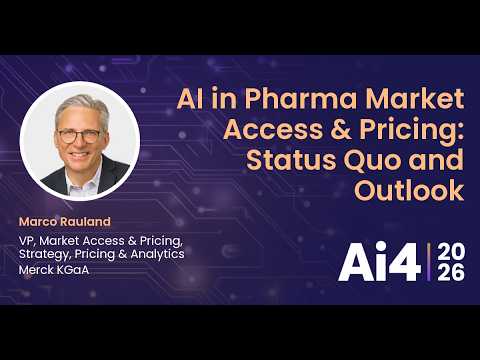
Merck KGaA Bans LLMs for Submissions, Uses ML and Avatars
Ai4
Merck KGaA halted LLMs for drug dossiers due to life-or-death hallucination risks, turning AI instead to tender pricing predictions and avatar roleplay.
## Background
Published on YouTube by the channel Ai4 on August 23, 2026, this video features Marco Rauland, VP of Market Access & Pricing at Merck KGaA. According to the description, the session explores the current status and future outlook of generative AI, conversational AI, and machine learning applications in pharmaceutical drug pricing and market access.
## TL;DR
Marco Rauland delivers a crash course on how AI is shaping pharmaceutical market access and pricing negotiations. He explains why Merck KGaA stopped using Large Language Models (LLMs) for external dossier submissions due to legal, safety, and hallucination risks, while showcasing successful applications of machine learning in predicting tender prices in data-rich markets like Italy. Additionally, he demonstrates an interactive AI avatar used for roleplaying payer negotiations and reflects on the potential future of fully automated, computer-to-computer price negotiations.
## Atmosphere & style
The presentation carries a lighthearted, humorous, and candid tone, starting with jokes about the tiny percentage of market access specialists in the audience. Rauland maintains an engaging, conversational style that seamlessly transitions into insightful industry commentary, even showing genuine vulnerability when he admits feeling nervous during a live demo with an aggressive AI avatar. The overall experience feels like an entertaining yet deeply practical masterclass from a seasoned industry insider.
## Key takeaways
- [00:04](https://www.youtube.com/watch?v=omwBH8DaBxw&t=4s) Specialists in pharmaceutical market access and pricing represent a tiny fraction of the overall healthcare and AI industry.
- [00:04](https://www.youtube.com/watch?v=omwBH8DaBxw&t=4s) The primary objective of market access is balancing a reasonable drug price with broad, unrestricted patient access.
- [03:34](https://www.youtube.com/watch?v=omwBH8DaBxw&t=214s) Merck KGaA stopped using Large Language Models (LLMs) for external-facing dossiers due to hallucination risks, unclear liability, and potential patient harm.
- [03:34](https://www.youtube.com/watch?v=omwBH8DaBxw&t=214s) Strict regulatory environments, such as Germany's, impose severe penalties and revenue losses for minor documentation flaws like missing references.
- [06:10](https://www.youtube.com/watch?v=omwBH8DaBxw&t=370s) Machine learning models outperform human estimators in high-volume, price-only tender procurement markets like Italy.
- [06:10](https://www.youtube.com/watch?v=omwBH8DaBxw&t=370s) ML tender prediction fails in low data density environments or for predicting pipeline drug values, which depend heavily on human negotiation variables.
- [10:36](https://www.youtube.com/watch?v=omwBH8DaBxw&t=636s) Interactive AI avatars allow market access teams to practice complex, natural-language payer negotiations at home with adjustable persona settings.
- [10:36](https://www.youtube.com/watch?v=omwBH8DaBxw&t=636s) AI negotiation avatars ingest clinical data and historical payer assessments to provide structured feedback on economic and value arguments.
- [16:36](https://www.youtube.com/watch?v=omwBH8DaBxw&t=996s) While AI avatars could eventually enable direct computer-to-computer price negotiations, automated systems risk losing human nuances and long-term strategic compromises.
Marco Rauland, VP of Market Access & Pricing at Merck KGaA, opens his session at the Ai4 conference with humor, expressing delight that not everyone has queued up for lunch yet. Reflecting on a conversation with a colleague from the previous day, he shares a joke about industry representation at the event: while his colleague estimated that pharma professionals make up roughly 5% of the attendees, he guessed that those specializing in pharmaceutical market access and pricing represent a minuscule "0.111115%". A quick show of hands from the audience confirms this tiny footprint, prompting Marco to welcome the rest of the room to a "crash course in market access and pricing for pharmaceuticals."
He promises that over the next twenty minutes, attendees will learn which AI tools can help them appear expert enough to apply for market access roles, as well as which immature tools to avoid. After briefly struggling with the presentation clicker controls on stage, he frames the ultimate goal of all market access and pricing work: preparing for the eventual negotiation with payers.
- A payer represents organizations such as Pharmacy Benefit Managers (PBMs) in the United States or national healthcare payers like those in Germany.
- The fundamental objective of market access is balancing two priorities: securing a "reasonable price" while obtaining broad patient access without restrictions.
- The standard process begins with establishing product value through clinical data in a value document, followed by price negotiations based on that value demonstration.
[03:34](https://www.youtube.com/watch?v=omwBH8DaBxw&t=214s) Why Pharma Avoids LLMs for External Submissions
Addressing the broader use of Large Language Models (LLMs) in pharmaceutical documentation, Marco highlights the severe risks of relying on AI to generate global master dossiers or localized market submissions. While LLMs offer speed, their tendency to hallucinate presents unacceptable legal and safety liabilities in healthcare. He contrasts everyday AI errors with those in pharma: ordering from a poorly recommended restaurant results in a minor disappointment, but omitting a critical side effect from a payer dossier could lead to unmonitored patient harm or death.
Because accountability remains unclear and human review processes are tailored to eliminate significant omissions, Merck KGaA explicitly stopped using LLMs for external-facing documents. Furthermore, strict regulatory environments, such as Germany's, impose harsh penalties for minor document flaws. German authorities review all submitted literature references line-by-line; if a single reference is missing, the submission is rejected as incomplete, causing a 90-day delay and millions of dollars in lost revenue.
- "We at Merck stopped using large language models to create external documents... The risk and also the unclear liability is what prevents us from doing this."
- High accuracy rates (e.g., 95% correct) are insufficient in pharma when the remaining 5% error margin carries life-or-death consequences or severe commercial penalties.
[06:10](https://www.youtube.com/watch?v=omwBH8DaBxw&t=370s) Machine Learning in Price & Tender Prediction
Turning to more successful AI applications, Marco explains how machine learning (ML) excels at predicting prices in tender-based procurement systems. In a tender process—such as national vaccine procurements—authorities award contracts to the bidder with the optimal price. The challenge lies in identifying a price that is low enough to win the contract, yet high enough to avoid leaving money on the table.
To tackle this, Merck trained an ML model on historical tender data to output optimal pricing recommendations for human approval. In head-to-head comparisons, the machine outperformed human estimators, making better predictions in 8 out of 10 cases. However, this success relies heavily on high data volume and specific market dynamics:
- ML tender prediction performs exceptionally well in markets like Italy, which runs several hundred price-only tenders per year with transparent, published data.
- It fails in environments with low data density, such as markets that issue only three national tenders per year.
- Value prediction for drug pipelines remains "mission impossible" because value is influenced by complex product factors and human negotiation variables—such as the specific day, time, or individual payer involved.
- He references US judicial research showing that identical crimes received vastly different sentences based on whether a court session took place on Monday morning versus Friday afternoon at 3:00 p.m., or which judge presided.
[10:36](https://www.youtube.com/watch?v=omwBH8DaBxw&t=636s) AI Avatars for Payer Negotiation Training
The traditional setup for negotiation preparation is expensive and time-consuming, requiring key country teams to gather for three days of in-person roleplay at venues like the Venetian with hired ex-payers. Marco demonstrates an interactive AI avatar named "Marcus" that allows teams to practice payer negotiations at home using natural language LLM conversations.
During the live demo, Marco walks through an interactive dialogue with the avatar:
During the exchange, the avatar pushes back on generic talking points, steering the conversation away from clinical details to demand a clear big-picture strategy. Marco admits on stage to feeling genuinely nervous during the interaction despite knowing it was a machine, because the recording and real-time responses mimic real-world pressure.
- The AI tool is ingested with product clinical information, historical payer assessments, objection lists, and recommended responses.
- After a session, the tool provides structured feedback detailing where the user effectively conveyed product value and where economic arguments need refinement.
- Persona settings allow users to adjust the avatar's personality from polite to "mean" (e.g., accusing the user of wasting time or failing to bring requested data).
- The system is also used across the company for sales rep training, onboarding, and introducing new clinical indications.
[16:36](https://www.youtube.com/watch?v=omwBH8DaBxw&t=996s) The Future of Automated Price Negotiations
Reflecting on how rapidly avatar realism has advanced over the past four years, Marco speculates that within one to two years, it will be difficult to distinguish an AI avatar from a human payer during video calls. Looking further ahead, he ponders whether payers might deploy identical AI models to simulate pharma companies, leading to a future where two computers negotiate drug prices directly:
While two automated systems could theoretically reach a price agreement in milliseconds, Marco notes that fully automated negotiations would strip away the nuances of human interaction and long-term strategic compromise—such as accepting a lower price today in exchange for a favorable position on a pipeline product launching three years later. He concludes by reiterating that utilizing these AI simulation tools offers professionals the best preparation for real-world market access roles.
## Notable quotes
> [00:04](https://www.youtube.com/watch?v=omwBH8DaBxw&t=4s) crash course in market access and pricing for pharmaceuticals — Marco Rauland
> [03:34](https://www.youtube.com/watch?v=omwBH8DaBxw&t=214s) We at Merck stopped using large language models to create external documents... The risk and also the unclear liability is what prevents us from doing this. — Marco Rauland
## Mentioned
Marco Rauland, Merck KGaA, Ai4, Pharmacy Benefit Managers (PBMs), Marcus, The Venetian
## Video description
Marco Rauland - VP, Market Access & Pricing, Strategy, Pricing & Analytics, Merck KGaA
Pharmaceutical drug pricing has become a critical global issue, with significant implications for healthcare access, affordability, and equity.
Despite its importance, AI applications in pharmaceutical drug pricing are still at a very early stage.
I will talk about generative and conversational AI as well as ML applications for Market Access & Pricing, a key activity to ensure a successful drug launch. I will highlight where those applications are already applied to make better and more informed decisions and where I see challenges and areas of improvement.
Merck KGaA 禁用大语言模型提交申报材料,转向机器学习与虚拟化身
因关乎生死的幻觉风险,Merck KGaA 叫停在药品档案中使用大语言模型,转而将 AI 用于招标定价预测和虚拟化身角色扮演。
Marco Rauland 简要剖析了人工智能如何重塑医药市场准入与价格谈判。他解释了 Merck KGaA 为何出于法律、安全及幻觉风险,停止在对外提交的申报材料中使用大语言模型(LLM),同时展示了机器学习在意大利等数据丰富的市场中预测招标价格的成功应用。此外,他还演示了用于模拟支付方谈判的交互式 AI 虚拟化身,并展望了未来完全由计算机自动进行价格谈判的前景。
默克(Merck KGaA)已明确停止使用大语言模型(LLM)生成面向外部的档案材料,主要原因在于 AI 幻觉风险、法律责任不明确以及潜在的患者安全隐患,尤其在德国等因微小文献遗漏就会导致惨重损失的严苛监管环境下更无法承受出错代价。 (3:34)
在以价格为唯一维度的公开高频招标市场(如意大利),机器学习模型在 80% 的情况下表现优于人类专家,但在低数据密度的市场或受复杂人际谈判变量影响的管线药物价值预测上仍难以奏效。 (6:10)
默克展示了名为“Marcus”的互动式 AI 谈判虚拟化身,该系统通过导入临床数据与历史评估记录,支持团队以自然语言在家演练复杂的医保谈判,并获取结构化的论点反馈与可调节的性格压力测试。 (10:36)
尽管未来药企与支付方两端的计算机理论上可在毫秒内完成全自动价格协商,但这种完全自动化的系统将抹去复杂的人际权衡与长期战略妥协空间。 (16:36)
Reading summary
Pharmaceutical market access teams are balancing AI's commercial potential with strict operational liabilities, deploying machine learning for tender predictions and internal training while barring generative models from regulatory submissions, according to Marco Rauland of Merck KGaA.
Risks Bar LLMs from Regulatory Submissions (3:34)
While large language models offer rapid drafting capabilities, Merck KGaA explicitly stopped using them to generate external-facing dossiers due to hallucination risks and unclear liability. In pharmaceutical market access, an omitted side effect can endanger patient health, making a typical 95% accuracy rate unacceptable when the remaining error margin carries life-or-death consequences.
Strict regulatory scrutiny further reinforces this policy. In Germany, for example, authorities conduct line-by-line checks of submitted literature references; missing a single reference results in the dossier being rejected as incomplete, triggering a 90-day delay and millions of dollars in lost commercial revenue.
Machine Learning Outperforms Humans in High-Volume Tenders (6:10)
Merck KGaA found clear success applying machine learning to tender-based procurement, where systems award contracts to the bidder with the optimal price. Trained on historical tender records, Merck's model produced pricing recommendations that beat human estimators in 8 out of 10 head-to-head comparisons, finding the balance between securing the bid and maximizing revenue.
This utility is constrained by data density. The model thrives in transparent markets like Italy, which conducts hundreds of price-only tenders annually, but fails in environments with only a few national tenders per year. Rauland noted that predicting drug pipeline value remains nearly impossible due to human negotiation variables, citing judicial research where sentencing varied widely based solely on whether a hearing occurred on a Monday morning or Friday afternoon.
Interactive Avatars Modernize Negotiation Practice (10:36)
To lower the cost and logistical burden of flying country teams to three-day, in-person roleplay workshops, Merck developed interactive AI avatars, such as one named 'Marcus,' to simulate payer discussions. Ingested with clinical data, historical payer assessments, and objection lists, the tool engages users in natural-language voice conversations, pushes back on weak arguments, and outputs structured evaluations highlighting where economic or clinical messaging needs refinement.
The system allows users to adjust persona settings from polite to aggressive to mimic real-world pressure. Beyond market access teams, Merck deploys the simulation across the enterprise for sales representative onboarding and training on new clinical indications.
The Strategic Limits of Automated Negotiations (16:36)
Rauland projected that within one to two years, AI avatars may become indistinguishable from humans on video calls. Looking further ahead, both payers and pharma manufacturers could theoretically deploy matched algorithmic agents holding clinical evidence, budget constraints, and volume caps to negotiate drug prices in milliseconds.
However, Rauland cautioned that fully automated transactions would eliminate strategic, human compromises. Algorithmic settlements could prevent companies from negotiating multi-year trade-offs, such as accepting a lower price on a current drug to secure favorable placement for a pipeline product scheduled to launch three years later.
While AI avatars and machine learning models deliver measurable efficiencies in training and high-volume tender bids, full automation remains constrained by high regulatory penalties for factual errors and the strategic necessity of long-term, human-led negotiation.
## Background
该内容由 Ai4 频道于 2026 年 8 月 23 日发布在 YouTube 平台。视频由默克集团(Merck KGaA)市场准入与定价副总裁 Marco Rauland 主讲,聚焦探讨了生成式 AI、对话式 AI 与机器学习在制药行业市场准入和药品定价中的应用现状、前沿探索及当前面临的挑战与局限。
## TL;DR
演讲者系统梳理了 AI 在医药市场准入与定价领域的真实落地图景。由于模型幻觉可能带来致命后果且合规风险极高,行业已全面禁止利用大语言模型自动生成外部医保申报案卷;而在数据充分透明的竞标采购中,机器学习在价格预测上的表现已显著超越人工判断。目前最成功的创新落地是利用 LLM 结合数字人开展医保谈判对抗演练,通过高度拟真且具心理压迫感的交互极大提升了团队的谈判准备效率,但长期来看涉及复杂利益博弈与人性的战略决策依然无法被算法完全取代。
## Atmosphere & style
演讲风格幽默机智且极接地气,主讲人以自嘲准入从业者是行业“极少数怪人”轻松开场,随后用严肃硬核的现实案例迅速打破外界对 AI 的浮夸预期。在播放自己亲自与 AI 苛刻支付方进行谈判攻防的实测录像时,现场气氛达到高潮,那种即便面对机器也无法掩饰的紧绷感与压迫力扑面而来。整场分享兼具对生命安全伦理的敬畏与对技术落地的务实理性,既有妙趣横生的调侃,又充满极具穿透力的行业洞察。
## Key takeaways
- [01:44](https://www.youtube.com/watch?v=omwBH8DaBxw&t=104s) 医药市场准入与定价(Market Access & Pricing)的核心使命是向支付方(如美国 PBM 或欧洲国家医保机构)证明产品价值,在争取合理商业回报的同时确保最大化的患者用药覆盖。
- [03:34](https://www.youtube.com/watch?v=omwBH8DaBxw&t=214s) 默克等药企已明确叫停利用大语言模型(LLM)直接撰写外部准入申报案卷,以避免因模型幻觉遗漏关键副作用或参考文献而引发致命责任与退单风险。
- [03:34](https://www.youtube.com/watch?v=omwBH8DaBxw&t=214s) 制药行业对申报材料有严苛的容错底线,即使大模型达到 95% 的准确度,剩下的 5% 潜在致命缺陷仍促使企业必须依靠严格的人工同行审核。
- [06:10](https://www.youtube.com/watch?v=omwBH8DaBxw&t=370s) 机器学习在药品集中招标(Tender)的价格预测中表现卓越,在报价策略上比纯人工判断具有高达 80% 的更优胜率,能有效平衡中标与利润留存。
- [06:10](https://www.youtube.com/watch?v=omwBH8DaBxw&t=370s) 竞价预测模型的成效高度依赖数据透明度与频次,在意大利等高频公开市场表现良好,但在样本极少的小规模招标市场则难以运作。
- [06:10](https://www.youtube.com/watch?v=omwBH8DaBxw&t=370s) 早期研发管线的支付方价值预测目前仍不可行,因为准入决策受谈判时间、谈判代表情绪及人际互动等非产品主观变量的深度干扰。
- [10:36](https://www.youtube.com/watch?v=omwBH8DaBxw&t=636s) 基于大语言模型与数字人虚拟化身(Avatar)的对抗演练系统已成熟落地,成功替代了耗资巨大的传统线下真人集训。
- [13:00](https://www.youtube.com/watch?v=omwBH8DaBxw&t=780s) AI 谈判模拟系统可动态调节支付方的人设风格(如极具压迫感的苛刻模式),并在保密环境下提供结构化复盘与针对性打分。
- [13:00](https://www.youtube.com/watch?v=omwBH8DaBxw&t=780s) 尽管未来可能出现药企与支付方 AI 之间的算法撮合,但在处理多产品跨周期战略妥协、人际信任与复杂利益博弈时,人类决策仍不可替代。
## Detailed walkthrough
### [00:04](https://www.youtube.com/watch?v=omwBH8DaBxw&t=4s) 医药市场准入速成课与 AI 的虚实
演讲者 Marco Rauland 开场时幽默地调侃了会场的气氛,庆幸大家没有一窝蜂跑去排队吃午餐,而是愿意留下来了解医药领域的市场准入(Market Access)。他提到前一天与一位同事闲聊,问同事觉得现场有多少参会者来自制药行业(Pharma),同事猜测大概有 5%;当他追问又有多少人专门从事制药行业的“市场准入与定价”(Market Access & Pricing)时,同事开玩笑地给出了一个极其微小的数字:“大概 0.111115% 吧”。他现场向听众提问,发现举手的人寥寥无几,打趣大家就是那“著名的 0.00005%”。
随后,他宣布接下来的 20 分钟将是针对制药市场准入与定价的“速成课”(Crash Course)。他风趣地指出,听完这场分享,在座的各位不仅能掌握申请此类岗位所需的一切知识,还能学会如何借助 AI 解决方案“作弊”,假装自己在这个高门槛领域非常聪明且见多识广。与此同时,他也会明确指出哪些 AI 工具因尚未成熟而必须规避,带大家一探这群从事药品准入与定价的“怪人”日常究竟在做些什么。
```mermaid
flowchart LR
accTitle: 药品市场准入与定价核心工作流循环
subgraph Value_Prep["价值证明与资料准备"]
A["临床价值与数据整理<br/>(Value Communication)"] --> B["编制准入案卷<br/>(Master Dossier)"]
end
subgraph Negotiation_Access["定价与支付方协商"]
B --> C["制定合理价格策略<br/>(Reasonable Price)"]
C --> D["医保/支付方谈判<br/>(Payer Negotiation)"]
D --> E["实现广泛患者覆盖<br/>(Broad Patient Access)"]
E --> A
end
```
---
### [01:44](https://www.youtube.com/watch?v=omwBH8DaBxw&t=104s) 核心任务:向支付方传达产品价值以实现广泛准入
在克服了现场翻页笔的小插曲后,演讲者直奔市场准入与定价的核心命题:他们所做的一切工作,终极目标都是为了与“支付方”(Payer)进行价格谈判。上午的议程谈到了药物研发和监管审批,但药物获批后,如何做好最充分的准备与支付方谈判才是关键。在美国,支付方主要指药房福利管理机构(PBM);而在德国等国家,则面对的是全国统一的国家医保支付机构。无论体系如何,药企都必须同这单一的机构进行产品价格博弈。
这项工作的终极目标在于向支付方清晰传达产品的真实价值,促使对方接受一个“合理的价格”(Reasonable Price)。当然,与任何商业谈判一样,买卖双方对何为“合理”往往存在巨大分歧。市场准入与定价团队之所以被称为“Pricing and Access”,是因为他们的使命是双重的:既要争取到合理的价格,又要确保产品获得广泛的准入(Broad Access),让所有能够获益的患者不受限制地用上药。为了达成该目标,工作流程形成了一个闭环:先准备详实的价值文档(Value Dossier)展示临床数据与价值,随后以此为依托开展价格谈判。
- **核心博弈对象**:美国市场的 PBM 或欧洲国家(如德国)的全国性医保支付机构。
- **双重核心诉求**:获得可持续的商业定价(Price),同时免除报销限制以惠及最大量患者(Access)。
- **标准准入流程**:先提交包含临床证据的价值文件,审核通过后再进入实质性价格谈判阶段。
---
### [03:34](https://www.youtube.com/watch?v=omwBH8DaBxw&t=214s) 为何大语言模型在生成外部申报文档中全面被叫停
谈及利用大语言模型(LLM)生成文档时,整个制药行业此前都跃跃欲试。药企通常需要撰写体量庞大的“全球主案卷”(Global Master Dossier),汇总产品的全部临床与经济学信息,再针对每个国家进行本地化适配并提交。然而,大模型无法根除的“幻觉”(Hallucinations)在制药行业带来了致命风险。Rauland 用一个生动的对比说明了这种严肃性:如果你让 AI 推荐威尼斯人酒店哪家餐厅最好,就算推荐得不好,大不了只是吃得不顺心;但在医保谈判的申报材料中,如果支付方要求补充产品副作用信息,而 LLM 生成的材料遗漏了一项关键副作用,导致患者用药后死亡,“谁来负责?谁承担法律责任?”
这种关乎生命的特殊性,使制药行业与其他行业存在本质差异。因此,默克公司(Merck KGaA)已经明确叫停了使用大语言模型生成外部申报文档的做法。尽管技术人员常辩解模型已有 95% 的准确率,但在制药界,没人能保证那错误的 5% 是不是致命缺陷;人工撰写虽然也会犯错,但经过层层严格的人工同行审核,关键副作用绝不会被遗漏。此外,申报文档附带海量的参考文献列表。以严谨著称的德国医保机构为例,如果审核人员发现提交的材料中漏掉了一篇相关文献,整套案卷就会被直接判定为“不完整”并退回,导致企业直接损失 90 天的时间和数以百万计的资金。出于伦理与法律责任考量,AI 在此领域的应用仍不成熟。
---
### [06:10](https://www.youtube.com/watch?v=omwBH8DaBxw&t=370s) 机器学习在招标价格预测中的成败与价值评估的局限
转向正面且切实可行的案例,Rauland 重点介绍了机器学习在竞标采购(Tender Business)中进行“价格预测”(Price Prediction)的突破。在政府集中招标(例如疫情期间的疫苗统采)中,规则通常是“赢者通吃”,报价最优惠的企业斩获全部份额。所谓“最佳价格”,是指既能击败竞争对手拿下标的、又不至于报得过低而白白损失利润(Leave money on the table)的价格。默克团队训练了机器学习模型来提供竞标报价预测,最终由人工决定是否采纳。实测显示,机器给出更优预测的概率达到了“十次中有八次”(8 out of 10),显著超越了纯人工判断。
然而,这种价格预测模型的有效性高度依赖外部数据环境。它在意大利等市场表现极佳,因为意大利每年有数百场药品招标,且中标价格和相关数据完全公开透明,充足的数据喂养让机器模型如鱼得水;但如果放在每年仅有两三场全国性招标的国家,由于样本量严重不足,模型根本无法运作。
另一方面,针对药企研发管线早期最为渴望的“价值预测”(Value Prediction)——即评估哪些管线资产对支付方更有价值、满足了更高的未满足临床需求、应该被优先推进——Rauland 直言目前这几乎是“不可能完成的任务”(Mission impossible)。价值的衡量极为主观且受制于大量非产品本身的复杂变量。例如在真实谈判中,谈判是安排在周五下午 3 点还是周一上午 10 点、对接的具体谈判代表是谁、上一轮谈判的历史情绪等,都会显著干扰最终决定。虽然理论上机器学习擅长捕捉人类未察觉的决策模式(类似美国司法研究发现不同法官或不同开庭时间会导致刑期差异),但一旦在医保谈判中对官方人员进行针对性的行为画像与定向攻防,必然会触碰严重的伦理与合规红线。
| 应用场景 | 技术手段 | 适用性与现状 | 核心制约因素 / 瓶颈 |
|:--- |:--- |:--- |:--- |
| **外部申报文档生成** | 大语言模型 (LLM) | **停用 / 规避** | 幻觉风险、缺失关键副作用的致死责任、遗漏参考文献导致退单罚时 |
| **招标竞价预测** | 机器学习 (ML) | **表现优异** (80% 胜率优于人类) | 仅适用于招标频次高、价格数据公开的市场(如意大利),小样本市场失效 |
| **管线价值评估预测** | 综合预测模型 | **目前不可行** (Mission impossible) | 价值维度多且主观;谈判受时间、人员、情绪干扰;个性化画像涉及伦理争议 |
| **谈判对抗模拟演练** | 对话式 LLM + 虚拟数字人 | **成熟且广泛落地** | 替代高成本线下彩排,可模拟刁难/温和等不同风格的支付方人设 |
---
### [10:36](https://www.youtube.com/watch?v=omwBH8DaBxw&t=636s) 突破性落地:用 LLM 虚拟化身重塑医保谈判对抗演练
在价值预测遇阻的背景下,Rauland 展示了一个 AI 已经取得惊艳成果的领域:支付方谈判模拟演练(Payer Negotiation Role Play)。传统的培训模式极其昂贵且耗时:公司需要将各大重点国家市场的团队召集到像威尼斯人酒店这样的会议中心集训 3 天,高薪聘请熟悉医保政策的前官方支付方代表(Ex-payer)扮演假想敌,通过反反复复的角色扮演推演论据,成本高昂。默克则开发了基于大语言模型与数字人虚拟化身(Avatar)的互动系统,让员工能够在电脑前随时实战演习。
现场大屏幕播放了一段演示视频:Rauland 本人正与一位名叫 Marcus 的数字人支付方进行视频通话。视频中 Rauland 试图从药物的高疗效等临床优势切入,而 AI 支付方 Marcus 则表现得十分老练且具压迫感,直接打断并要求“退后一步”(Take a step back),直截了当地逼问:“在深入具体数据或经济学模型之前,我想了解全局——你这次通话的真正目标是什么?你最希望我记住的核心信息到底是什么?”
```mermaid
flowchart TD
accTitle: 基于 LLM 的支付方模拟谈判系统架构
subgraph Data_Inputs["系统知识库注入"]
D1["产品全量临床与经济学数据"]
D2["历史准入评估案卷与竞品先例"]
D3["支付方典型异议库与标准应答策略"]
end
subgraph Simulation_Engine["AI 对话与评估引擎"]
LLM["大语言模型核心<br/>(动态实时响应,非固定剧本)"]
Persona["人设调节模块<br/>(苛刻/施压/温和/礼貌)"]
Data_Inputs --> LLM
Persona --> LLM
end
subgraph User_Loop["学员实战交互"]
Trainee["准入/销售学员"] <-->|"实时音视频攻防"| LLM
LLM --> Feedback["多维度打分与改进建议<br/>(如强化药物经济学论证)"]
Feedback -.->|"针对薄弱环节定向复练"| Trainee
end
```
---
### [13:00](https://www.youtube.com/watch?v=omwBH8DaBxw&t=780s) 沉浸式心理压迫感、产品特性与未来人机博弈展望
视频切回现场后,Rauland 笑着承认自己演练时其实非常紧张:“你们能看出我当时有多紧张吗?”尽管大家心里清楚屏幕对面只是一台机器,但因为系统在全程录音录像,且人们总是本能地想在对话中展现专业水准,这种压迫感会让人瞬间忘记自己是在与 AI 对话。该系统并非预先录制好的固定脚本,而是接入了经过专业调优的大语言模型,系统预先灌注了该药品的全部资料、过往及现行的官方评估报告,以及各类常见质疑与对答策略。
在演练结束后,系统会给出多维度的结构化反馈(例如肯定其临床价值叙述清晰,但指出药物经济学论述薄弱),并允许员工立刻跳回薄弱环节重新挑战。更重要的是,演练数据严格保密,不会全员公开,员工可以毫无心理负担地在家里反复“试错”。系统还支持调节支付方的“性格倾向”——从温和礼貌模式到极度苛刻、毫不客气的“刁难型支付方”(Mean Payer)。苛刻模式会精准还原真实谈判中的严酷场景,例如对方会当面训斥:“你是在浪费我的时间,同样的数据我已经跟你要了三次了,你还在讲我早就知道的东西!”这种拟真压力能极大地锻炼团队的心态。
在总结展望时,Rauland 回顾道,团队早在 4 年前就开始探索该方向,如今虚拟化身的真实度已突飞猛进,再过一到两年,人们甚至在视频会议中无法分辨对面坐着的是真人还是 AI。这一工具目前不仅广泛用于默克的准入谈判准备,还全面普及至新员工入职、新适应症拓展以及销售代表沟通培训。最后,他抛出了一个引人深思的假想:如果药企在用 AI 模拟支付方,支付方很可能也在用 AI 模拟药企进行对抗演练;未来的药品定价,会不会演变成两台电脑在几毫秒之内完成撮合?——一台掌握药物的全部临床价值,另一台掌握全社会的支付预算底线。不过他强调,人性的温度、长周期的战略妥协(如为三年后的下一款重磅药铺路)以及偶发的情感因素,在短时间内依然是冰冷算法无法完全取代的。
## Notable quotes
> [00:04](https://www.youtube.com/watch?v=omwBH8DaBxw&t=4s) 大概 0.111115% 吧 — Marco Rauland 的同事
> [00:04](https://www.youtube.com/watch?v=omwBH8DaBxw&t=4s) 著名的 0.00005% — Marco Rauland
> [03:34](https://www.youtube.com/watch?v=omwBH8DaBxw&t=214s) 谁来负责?谁承担法律责任? — Marco Rauland
> [06:10](https://www.youtube.com/watch?v=omwBH8DaBxw&t=370s) Leave money on the table — Marco Rauland
> [06:10](https://www.youtube.com/watch?v=omwBH8DaBxw&t=370s) 十次中有八次 — Marco Rauland
> [06:10](https://www.youtube.com/watch?v=omwBH8DaBxw&t=370s) 不可能完成的任务 — Marco Rauland
> [10:36](https://www.youtube.com/watch?v=omwBH8DaBxw&t=636s) 在深入具体数据或经济学模型之前,我想了解全局——你这次通话的真正目标是什么?你最希望我记住的核心信息到底是什么? — Marcus (AI 支付方虚拟化身)
> [13:00](https://www.youtube.com/watch?v=omwBH8DaBxw&t=780s) 你们能看出我当时有多紧张吗? — Marco Rauland
> [13:00](https://www.youtube.com/watch?v=omwBH8DaBxw&t=780s) 你是在浪费我的时间,同样的数据我已经跟你要了三次了,你还在讲我早就知道的东西! — Marcus (AI 支付方虚拟化身)
## Mentioned
Marco Rauland, Marcus (AI 虚拟化身), Merck KGaA (默克集团), PBM (药房福利管理机构), Ai4, Venetian Hotel (威尼斯人酒店)
## Video description
Marco Rauland - VP, Market Access & Pricing, Strategy, Pricing & Analytics, Merck KGaA
Pharmaceutical drug pricing has become a critical global issue, with significant implications for healthcare access, affordability, and equity.
Despite its importance, AI applications in pharmaceutical drug pricing are still at a very early stage.
I will talk about generative and conversational AI as well as ML applications for Market Access & Pricing, a key activity to ensure a successful drug launch. I will highlight where those applications are already applied to make better and more informed decisions and where I see challenges and areas of improvement.
[Source](https://www.youtube.com/watch?v=omwBH8DaBxw)
Source quotes
[0:04] Marco Rauland 的同事: 大概 0.111115% 吧
[0:04] Marco Rauland: 著名的 0.00005%
[3:34] Marco Rauland: 谁来负责?谁承担法律责任?
[6:10] Marco Rauland: Leave money on the table
[6:10] Marco Rauland: 十次中有八次
[6:10] Marco Rauland: 不可能完成的任务
[10:36] Marcus (AI 支付方虚拟化身): 在深入具体数据或经济学模型之前,我想了解全局——你这次通话的真正目标是什么?你最希望我记住的核心信息到底是什么?
[13:00] Marco Rauland: 你们能看出我当时有多紧张吗?
[13:00] Marcus (AI 支付方虚拟化身): 你是在浪费我的时间,同样的数据我已经跟你要了三次了,你还在讲我早就知道的东西!
Source quotes
[0:04] Marco Rauland: crash course in market access and pricing for pharmaceuticals
[3:34] Marco Rauland: We at Merck stopped using large language models to create external documents... The risk and also the unclear liability is what prevents us from doing this.
Original transcript
[0:04] Hello everyone. I'm happy that not everyone
is already queuing for lunch, so some
[0:08] are looking forward to learn a little bit more
about market access. I'm here with a colleague
[0:13] and yesterday we talked about it. I asked,
"What do you think? How many people are here
[0:16] at this conference from farmer?" And he said,
"Maybe 5%." Then I said, "Okay, how many do
[0:21] you think are from market access and pricing
in farmer?" And he said, "Maybe 0.111115%."
[0:29] So, who here in the room has
experience in market access farmer?
[0:33] Well, you are the famous 0.00005%. So, but for
the others, welcome to the crash course in market
[0:40] access and pricing for pharmaceuticals. And in
the next 20 minutes, you will learn everything
[0:47] you need to know to apply for this role. As you
will learn which AI solutions you can use to cheat
[0:53] and pretend you are very smart and knowledgeable
in this area. And I will also talk about the ones
[0:59] which you should avoid because they are not ready
yet. So, welcome to the crash course and let's
[1:05] have a look what these strange guys in market
access and pricing for pharmaceuticals are doing.
[1:13] I'm glad the presentation is up
and running. Oh, no, it's isn't.
[1:24] Oh, sorry. I need to press another button.
[1:28] What is forward? Green?
[1:35] Oh, it's always going back. Okay, while while the
colleagues are trying to get the slides up, um
[1:44] I mean, the key event which we are working
towards in market access and pricing is
[1:49] the negotiation with the payer. And this
is all what we think about is at the end.
[1:55] And we heard this morning drug development, how
drugs are developed. They are registered, but how
[2:01] now to be best prepared for the negotiation
with payers. What is a payer? I mean,
[2:05] you most of you are from the US, so a PBM. But
in Germany, we also have a national payer. So,
[2:12] it is this one organization and you need
to negotiate the price of the product.
[2:18] So, this is what we always have in mind. How
at the end can we communicate to the payer
[2:22] the value of our product that he is accepting
what I would call a reasonable price. And yes,
[2:28] you can imagine there is different views on what's
a reasonable price as in any kind of negotiation.
[2:35] So, this just highlights what I would
call key activities in our area. I mean,
[2:39] I've talked about the stakeholder interaction
and I come back to this, which is the key
[2:44] to engage with a payer. To show him this is the
value of the product. This is the price we want
[2:50] and we are called pricing and access because you
want to have a reasonable price and broad access.
[2:55] You want to reach as many patients as benefit from
your product. You don't want to have restrictions.
[3:02] And to get there, it's kind of a circle. I mean,
we heard about this What's very important is of
[3:07] course value communication. What's the value
of your product? What's the value to a payer?
[3:12] What price should I go after? What's a reasonable
price? And then, last but not least, to prepare
[3:19] the countries, you need a lot of documentation.
And I think most of you know the process in many
[3:23] markets is you start with a value document, which
shows the value, the clinical data of the product.
[3:29] And then the second part is based on this
value demonstration is the price negotiation.
[3:34] And let me start with something which
I think is important when it comes to
[3:38] I think in general pharma and large
language models which you use to create
[3:44] documents. I mean, we ever everyone is
keen to use this to create the document.
[3:49] A global master dossier, this is what we
call it, every information on the product.
[3:54] We localize them so that every country
has a document in hand they can submit.
[4:00] But the big challenge is we know these tools
still make hallucinations. I like the word [ __ ]
[4:09] And the problem is now and always use
this example, if you ask for a restaurant,
[4:13] what's the best restaurant in the Venetian?
And you go there and you don't like it, well,
[4:18] you don't like it. But imagine you're prepared
for a payer negotiation and the payers are saying,
[4:23] "We want to learn more about the side
effects of the product." And you let the tool
[4:28] create the response. What are you going to do if
if one side effect of the product is not listed?
[4:37] Patient gets it. The patient dies.
Who is responsible? Who is reliable?
[4:43] And I think this is a big big difference
in pharma compared to other businesses.
[4:48] That's why we at the Merck we stopped using large
language models to create external documents.
[4:56] As we just said, we are not ready
yet. And it might change over time.
[5:00] But the risk and also the unclear liability
is what what prevents us from doing this.
[5:05] And I think that's what we are we always say,
"Oh well, it's 95% correct." But how do we
[5:10] ensure that the five which is incorrect are not
significant? I know humans also make mistakes.
[5:16] But these documents are reviewed by a
lot of people and I've never came across
[5:22] that a side effect or something really significant
is not mentioned in this document. Another example
[5:27] when it comes to these documents is they come
with a long long list of literature references.
[5:34] And of course, it's obvious to say, "Hey,
let's use a model, compile, go in the internet,
[5:39] search all the literature." But in Germany is
a good example. I'm a German so I can say this.
[5:44] The Germans, they go through all the documents you
submit and all literature and if one is missing,
[5:50] they consider this is incomplete and send
it back to you. 90 days lost. Millions lost.
[5:58] It's the same. Just I think that that's
really important when when it comes to
[6:03] pharma and also the ethical
legal aspects of trusting models.
[6:10] But let me talk about something which
is maybe more positive and we can start
[6:14] heating when when you go into an interview
for market access is price prediction.
[6:22] And a typical and good example where really
works is in tender business. Tender means you
[6:29] have I mean an an authority. Sometimes there's
a national tender for vaccines which is famous
[6:34] examples in COVID times and the winner gets it
all and the one with the best price gets it all.
[6:41] So what's the best price? Well, what we tried is
machine learning. We feed the information into the
[6:49] machine and we said there's a tender what's
the best price? And best price really means
[6:56] I mean the price which is the lowest but not too
low. Then I mean you left you leave money on the
[7:02] table. So that's the challenge is I mean a low
price everyone can go in with but you would have
[7:08] to get an understanding on what's the best
price. So what we did is we trained a machine
[7:14] and the machine made a prediction and of course
then the humans decide if they're follow or not.
[7:20] What do you think is the percentage of correct
predictions the machine versus the human?
[7:28] Eight out of 10. The machine is making
a better prediction than the humans.
[7:34] Where do you think this works specifically well? I
can tell you it's of course in [snorts] countries
[7:39] where tenders are price only tenders. You have
many many markets where it's more than just this
[7:44] price which makes the winner. And the prices
are published. And you have a lot of tenders.
[7:54] And this is the limitation. It works [clears
throat] super well in Italy. Italy has several
[7:58] hundred tenders a year. You have a lot of
published data. You have a lot of information.
[8:03] The machine can make a very good prediction. It
doesn't work well in countries where you only
[8:08] have three tenders a year, national
tenders. It's not enough data. So,
[8:12] this is an unfortunately limitation, but but it
also shows where a machine learning specifically
[8:18] can be applied in in price prediction. Everyone
would like to use it for value prediction.
[8:26] So, this is my pipeline. Which products should
I focus on? Which one should I prioritize?
[8:32] What's more value? What's more value to payers?
Which one addresses the the highest unmet need?
[8:40] I think at the moment it's mission impossible.
[8:43] As you have so many factors which define value,
and I'm not just talking about the product factors
[8:51] which define in a way what is value. And then
specifically if you go into a negotiation
[8:58] with a payer and you you want to discuss value
and you want to predict what is the outcome,
[9:04] no one predicts the difference which exists um
the day you negotiate, the time you negotiate,
[9:12] the payer you negotiated with, the last result
of your negotiation. And these are all factors
[9:18] which have an impact on decision making. And we
don't know which one are these. And that's that's
[9:25] that's the challenge. And um I mean there's
there's a lot of research um on on court cases.
[9:30] I think many came out of the US which showed
for the same crime you got different charges,
[9:36] and they depended on things like whether
or not beyond court on Friday at 3:00 p.m.
[9:41] Try to be Monday 10:00. Uh and if Judge Miller is
is in charge, you get a higher sentence than Judge
[9:48] whatever Smith. Another thing we always forget
is we also have these factors to consider.
[9:54] I think in a way machines are good in identifying
these patterns because we we we don't know them.
[9:59] But then the next question is also from an ethical
perspective, how do you use them? I mean, you're
[10:03] then really in a targeting area, a profiling
area. So so how do you use this information?
[10:10] So in summary, I mean, we talked
about documentation. I think AI is not
[10:15] working as good as it has to be that we really
can use this for external documentation and and
[10:22] also communication of information. It works
well in price prediction in markets where
[10:28] data is available and a lot of data is available.
It does not work yet in really value prediction.
[10:36] But now I give you an example where I think
it works very well. Payer negotiation.
[10:43] The normal setup is you invite the key
markets. You invite them for 3 days
[10:50] at a place like the Vinicia. Then you
invite X payers. And you do role play.
[10:59] Okay, German team negotiate. Here's a
German X payer. He behaves like a X payer.
[11:04] 3 days, a lot of money. You go I mean,
back and forth, which is important. Right,
[11:09] try it again. I'm here's an argumentation
which you should try. But very time consuming.
[11:15] So what if you could replace this by
an avatar and you practice at home?
[11:23] Let's see how this looks like. Hi there, I'm
Marcus. Oh, do we have audio? up this meeting.
[11:31] Hey Marcus, how are you?
[11:34] I'm doing well, thanks. Good to finally connect.
Yeah, it has been a pleasure. I think last time
[11:39] when we finished our discussion, we talked about
the health economic models of our products. So,
[11:44] so I would be interested if there's any
additional information you would like to see.
[11:51] Thanks for remembering that. Right now, I'm trying
to get a better handle on the overall strategy.
[11:57] What's the main thing you're
hoping we'll see in your product?
[12:00] Yes, last time I think what what our
what makes our product different is is
[12:04] the additional benefit which it provides
in terms of having a higher efficacy. And
[12:09] I remember last time when we discussed this,
you were wondering what kind of evidence we
[12:13] should provide you with. So, is there any specific
evidence you would like to see about the product?
[12:21] I appreciate you following up, but I'm
not sure if we're on the same page.
[12:25] Before diving into specifics, I want to take
a step back. Okay, what what do you mean by a
[12:30] step back? Shall we start with the the clinical
benefits before we talk about health economics?
[12:37] I mean, before we get into specific data or
models, I want to understand the big picture.
[12:43] What are your goals for this call?
[12:45] What's the key message you want me
to take away about your product?
[12:55] Okay.
[13:00] Do you see how nervous I am?
[13:04] And people always say, "Well, it's just a machine
you talk to." But the machine is recording what
[13:09] you are saying. And I mean, in this case,
it was also recording what we recorded.
[13:13] And and I was super nervous. And I forgot that
you know, you want to say something smart. And of
[13:17] course, the generic version we cannot share any
any any product-specific details. And then they
[13:22] said, "Should we repeat this, Marco?" And just,
you know, then a bit more relaxed. And I said,
[13:26] "No. I think we leave it like this as it really
shows that you forget quickly that you talk to
[13:32] a machine. And by the way, this is recorded, but
this is a large language model talking to me. So,
[13:37] I it it it responds to my questions, right? It's
not kind of let's practice this and train this.
[13:42] And what we do is we feed all the information
of the product into this tool. We feed all the
[13:47] current assessments and and previous assessments
of products into the tool. We feed objection
[13:53] and potential responses to objections into this
tool. And then you can practice the negotiation.
[13:59] You can go back. I mean, at the end you give
gives you feedback and it says well you did
[14:03] good in in telling the story of the value of the
product, but you could do better by, I don't know,
[14:09] the economic part of of the discussion. So,
here are some suggestions. Would you like to
[14:14] try again? And then you go sort of
way back to this this specific part.
[14:19] And the good thing is, I mean, when I say
recorded it's not shared like with the whole
[14:22] company and no one sees how you fail. So, I
do this here on purpose. So, it's it's shared
[14:28] only I mean, you get the feedback. So,
you can train. You can train at home.
[14:32] You can train wherever you want, and you can
prepare for the negotiation. Uh I'm not saying
[14:37] it replace the human role play at all, but
it definitely helps to be better prepared.
[14:44] And coming back to where we said maybe
maybe at the end of the presentation you
[14:48] can apply for a market access role,
you can also use this for training.
[14:53] I mean, you can go to the tool and you say, "Okay,
I mean, I've been invited to a job interview and
[14:57] they want to learn about oncology and and
what are, I don't know, payer issues." You
[15:02] can use this tool. And he tells you what are payer
issues and he responds and he gives you questions.
[15:07] You can even say, "I mean, I'm invited to a
job interview, which questions would you ask in
[15:12] in this area?" And and it it does this um this
role play. So, I think that that's really really
[15:20] an application which works. And by the way, not
just in market access. I mean, we in the company,
[15:24] we use it for all kind of trainings, also sales
reps and all kind of communication trainings.
[15:30] But of course, since we are talking
about market access, this is one area.
[15:34] And what you also see, and this is the mean
payer, which I also think is a good feature. You
[15:38] can also make him nice and mean and little. And
mean is also reality. Sometimes they're saying,
[15:43] "I mean, you're wasting my time. I asked
you three times to come with this data
[15:46] and and still you're talking about what I already
know." And that's the reality. And this makes you
[15:51] even more nervous if he's saying, "Oh, we talked
about this, but I asked you for something else."
[15:55] You can also make it more nice and say,
"Well, I understand that you are busy and
[15:59] maybe next time I would appreciate if you bring
back um the additional data." Um this is just to
[16:06] highlight. We started doing this actually 4 years
ago. I mean, not not like with avatar versions.
[16:12] It's just to show, and we all know this, how
quickly these avatars have changed in terms of uh
[16:18] how real they look like. Um and this is actually
the the previous version what I showed you and
[16:23] I mean, give it another 1 to years and you
cannot even tell anymore if there's a real payer
[16:30] in a Teams call with you or if if it's if it's
an avatar. So, I think that that that's one of
[16:36] the applications which which I on
purpose, plus the the price prediction,
[16:40] wanted to show because I think it's not
just relevant for for for market access. But
[16:45] I also end my presentations with an I'm saying,
"Okay, this is what we do from pharma side."
[16:51] But do we know what the payers are doing? Maybe
they have the same models and they stimulate
[16:55] payers. Uh they stimulate market pharma
companies, so us. And they train us well.
[17:01] So, who knows if the future might look like
the two computers are just negotiating prices
[17:08] for pharmaceuticals. One has all the value
information, which is the pharma side. The
[17:13] other one has all the economic information. What
can we afford? What price? How many patients?
[17:18] And in milliseconds, they would come to an
agreement. But then of course we would miss
[17:22] the human part, which is Friday versus Monday.
And also and we shouldn't forget this also
[17:28] sometimes it's not a one event
negotiation. Sometimes you also negotiate
[17:33] about the future saying, "Okay, we we are
okay with this price for that product knowing
[17:38] that in 3 years time we have another one." So
it is also I think what will take some time. But
[17:44] I mean no one knows, but I think it's quite
what what AI can already do in market access and
[17:49] um specifically this this payer negotiation we use
frequently and also to train people and onboard
[17:54] people to train people on new indications. With
the payer mindset. This is this is what tool is
[18:00] is doing. So maybe there's also kind of an
application for you and um yeah, with that I think
[18:05] you have a good chance now if you train with
the tool to apply for market access role and
[18:10] I hope you had some more understanding about
what we do um than before. Um thanks a lot.
[18:15] [applause]