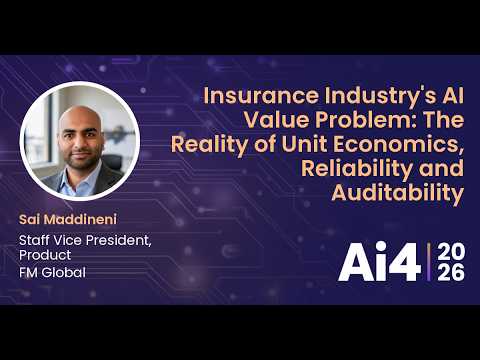
FM Global's Sai Maddineni Warns Agentic AI Inflates Insurance Costs
Ai4
Insurance companies must stop running deterministic logic through expensive AI models and instead use AI to generate traditional software code or amplify human underwriters.
## Background
Published on YouTube by Ai4 on August 17, 2026, this presentation features Sai Maddineni, Staff Vice President of Product at FM Global. According to the page description, the session explores what happens when 'Agentic Hype' meets 'Insurance Reality,' introducing a value-based framework to adopt AI at scale beyond mere operational efficiency.
## TL;DR
Sai Maddineni critiques the 'agentic everything' trend in the insurance industry by analyzing the prohibitive unit economics, unreliability, and auditability issues of using probabilistic AI models for deterministic tasks. He notes that while 95% of AI investments fail to deliver meaningful value, insurance work remains split between codifiable operations and probabilistic judgment calls. Maddineni outlines a four-tier framework that reserves AI for code generation and cognitive augmentation while keeping deterministic processes in traditional software and critical emotional touchpoints strictly human.
## Atmosphere & style
The presentation carries a pragmatic, grounded, and no-nonsense tone, delivered by a speaker who explicitly distances himself from corporate AI hypemen. Maddineni blends analytical rigor with relatable real-world examples, using sharp unit-economic math alongside poignant human scenarios like wildfire insurance claims. The audience experience feels like an intellectual reality check, steering leaders away from vanity metrics toward a strategic, disciplined vision for enterprise technology.
## Key takeaways
- [00:04](https://www.youtube.com/watch?v=UsJNqgoARGM&t=4s) Frontier AI models cost anywhere from 30x up to 1,500x more than traditional deterministic code to process simple logical tasks like calculating 2 + 2.
- [00:04](https://www.youtube.com/watch?v=UsJNqgoARGM&t=4s) Deploying probabilistic AI agents for complex enterprise insurance logic creates massive unit-economic scaling issues that break financial models.
- [03:17](https://www.youtube.com/watch?v=UsJNqgoARGM&t=197s) Recent MIT Media Lab data indicates that 95% of AI investments fail to deliver meaningful business ROI, exposing the gap in current enterprise strategies.
- [03:17](https://www.youtube.com/watch?v=UsJNqgoARGM&t=197s) Common industry excuses for low AI ROI—such as culture, change management, and usage deficits—ignore the core operational realities of business processes.
- [05:35](https://www.youtube.com/watch?v=UsJNqgoARGM&t=335s) Insurance work spans a spectrum: roughly two-thirds is deterministic/codifiable, while one-third is probabilistic and relies on human experience and judgment.
- [05:35](https://www.youtube.com/watch?v=UsJNqgoARGM&t=335s) Despite decades of digitization, less than 30% of codifiable insurance tasks live in software; the rest remain manual due to unstructured data like PDFs and emails.
- [09:02](https://www.youtube.com/watch?v=UsJNqgoARGM&t=542s) Evaluating AI agents requires addressing three main constraints: unit economics, model regression and reliability, and the lack of native auditability.
- [11:22](https://www.youtube.com/watch?v=UsJNqgoARGM&t=682s) For deterministic codifiable work, the optimal strategy is using AI to write traditional software code that is tested by engineers and executed cost-effectively.
- [11:22](https://www.youtube.com/watch?v=UsJNqgoARGM&t=682s) AI delivers high value in cognitive tasks by acting as a co-pilot—parsing unstructured submissions in seconds to amplify human capacity.
- [14:07](https://www.youtube.com/watch?v=UsJNqgoARGM&t=847s) Empathy-driven interactions, particularly during critical claims events, should remain strictly human to establish trust and brand loyalty.
- [14:07](https://www.youtube.com/watch?v=UsJNqgoARGM&t=847s) Successful AI integration requires deconstructing business workflows down to atomic tasks in close collaboration with frontline operational staff.
- [17:01](https://www.youtube.com/watch?v=UsJNqgoARGM&t=1021s) Organizations should look beyond cost cutting and headcount reduction, using AI-generated capacity to build compounding competitive moats in product design and risk modeling.
## Detailed walkthrough
Here is the detailed walkthrough of the transcript:
[00:04](https://www.youtube.com/watch?v=UsJNqgoARGM&t=4s) The $2+2$ Reality Check and the Cost of Agentic Hype
Sai Maddineni, Staff Vice President of Product at FM Global, opens his talk by pointing out that he is not wearing a black leather jacket or cool sneakers, signaling that he isn't an AI hypeman, but a technology product leader and consultant obsessed with business value. He shares a profound insight sparked by asking the leading AI models, a basic Java program, and his four-year-old daughter the simplest logical question possible: *"What's 2 + 2?"*
While all three naturally answered "4", analyzing the unit economics behind that execution revealed a massive gap. Compared to the traditional Java code, running that basic query through average frontier AI models cost 250 times more, with lighter models costing 30 to 50 times more and top frontier models costing up to 1,200 to 1,500 times as much. When applying this cost multiplier to the complex, multi-tiered logic built into enterprise insurance software over decades—such as eligibility rules, coverage validations, and rating logic—the cost difference scales into the hundreds of thousands or millions.
When vendors advocate for an "agentic everything" architecture, this unit-economic reality turns technical curiosity into an existential boardroom debate. The core takeaway isn't merely that AI can answer $2+2$, or even that it costs 250 times more, but asking whether AI should be answering deterministic questions in the first place.
- **Cost Comparisons ($2+2$ Query):**
- **Traditional Java Code:** Baseline cost ($1\times$).
- **Lightweight AI Models:** $30\times - 50\times$ cost multiplier.
- **Average Leading AI Models:** $250\times$ cost multiplier.
- **Top Frontier Models:** $1,200\times - 1,500\times$ cost multiplier.
- **Enterprise Scale Impact:** Multiplying these factors by millions or billions of annual insurance transactions breaks financial models.
---
[03:17](https://www.youtube.com/watch?v=UsJNqgoARGM&t=197s) Moving Past Vanity Metrics and Fluffy Market Responses
Reflecting on recent market shifts, Sai discusses how 2026 has brought a sharper focus on enterprise value and ROI. He points to a widely discussed report from the MIT Media Lab stating that **95% of all AI investments do not yield any meaningful business value**. For an industry built around risk management, a 95% probability of loss is something insurance professionals wouldn't touch with a ten-foot pole.
In response to this statistic, consultants, hyperscalers, chipmakers, and model developers pushed back with three main excuses:
1. **People Problem:** Framing it as a change management issue needing open minds and buy-in.
2. **Culture Problem:** Claiming organizations lack top-down executive alignment, bottom-up empowerment, or "sideways pollination" of ideas.
3. **Usage Deficit:** Arguing that organizations simply aren't using enough AI, leading to vanity metrics like tracking tokens per employee, salary as a percentage of tokens, and "token maxing."
Critiquing these explanations as fluffy and disconnected from operational reality, Sai stresses the need for a practical, grounded framework to evaluate where AI actually delivers business value.
---
[05:35](https://www.youtube.com/watch?v=UsJNqgoARGM&t=335s) The Spectrum of Work: Codifiable vs. Non-Codifiable Tasks
To evaluate AI implementation effectively, Sai establishes a spectrum of work specific to the insurance industry based on research from Accenture, McKinsey, and BCG:
```
[ Deterministic / Codifiable ] <================> [ Probabilistic / Non-Codifiable ]
• Rules-based (2+2 logic) • Experience & intuition
• ~2/3 of insurance tasks • ~1/3 of insurance tasks
• Same output every time • Subjective judgment calls
```
- **Codifiable Work (~2/3 of Insurance Operations):** Highly deterministic and rules-based logic where a given set of inputs yields the exact same output every time. If ten people are trained on it, they will perform it identically.
- **Non-Codifiable Work (~1/3 of Insurance Operations):** Deeply probabilistic work relying on individual experience, human intuition, and interpersonal dynamics. For example, pricing a cybersecurity policy for a mid-market manufacturer in a 50-year flood plain with a challenging loss history will yield two different, equally valid conclusions from two senior underwriters.
Sai quizzes the audience on how much codifiable work has actually been digitized into enterprise software over the past 30 years. While most assume a high percentage, **less than 30% (roughly a quarter)** of codifiable work lives in software. The remaining codifiable tasks are still processed manually by employees—not by choice, but because data arrives in non-standard spreadsheets, unstructured PDFs, or messy email attachments.
---
[09:02](https://www.youtube.com/watch?v=UsJNqgoARGM&t=542s) Evaluating AI Agents: Cost, Reliability, and Auditability
While LLM-based AI unlocks the vast space of un-coded tasks, model vendors advocate "agentic everything" without addressing three critical operational constraints:
1. **Unit-Economic Feasibility:** Running complex underwriting rules purely through probabilistic LLM agents dramatically inflates operating costs at scale.
2. **Reliability and Regression:** LLMs are intrinsically probabilistic engines guessing the next word. A prompt setup with a 90% success rate today offers no guaranteed backward compatibility when models update (similar to how early benchmarks showed GPT-4.5 regressing on specific tasks compared to GPT-4).
3. **Auditability:** AI systems in their current state are not inherently auditable. While engineers can introduce custom breakpoints and telemetry into software pipelines, auditability is not an automatic byproduct of running AI—it requires deliberate engineering effort and additional cost.
---
[11:22](https://www.youtube.com/watch?v=UsJNqgoARGM&t=682s) A Value-Based Framework: Mapping AI and Humans to the Work
To balance these tradeoffs, Sai presents a four-tier framework mapping technology to task types:
```
+-----------------------------------------------------------------------+
| VALUE FRAMEWORK |
+-------------------+---------------------------------------------------+
| Work Category | Optimal Strategy |
+-------------------+---------------------------------------------------+
| Solved Problems | Leave untouched; let existing systems run. |
| Deterministic | AI writes code -> QA/Engineers test -> Traditional|
| | Deterministic Software executes at scale. |
| Cognitive | Bake LLMs into processes (e.g. document analysis) |
| | to augment human speed and detail. |
| Empathy/Relation | Strictly Human (Claims, emotional moments). |
+-------------------+---------------------------------------------------+
```
- **1. Solved Problems:** Don't touch existing, working systems.
- **2. Deterministic Codifiable Work:** Use AI aggressively to *write traditional software code* rather than replacing execution with runtime AI agents. Human software engineers and QA teams review the AI-generated code, resulting in fast, reliable, auditable, and low-cost execution at scale.
- **3. Cognitive Work:** Embed AI directly into human workflows to act as an amplifier. For example, processing a complex 40-page broker submission containing multi-format loss runs, two-year-old financial statements, and context-heavy cover letters normally takes an underwriter 45 minutes. An AI co-pilot can parse and structure this context in seconds, enabling an underwriter to scale weekly reviews from 25–30 submissions to 50–60, or conduct deeper risk analysis.
- **4. Empathy & Relationship Region:** Human-centric moments where AI should never replace human connection.
---
[14:07](https://www.youtube.com/watch?v=UsJNqgoARGM&t=847s) The Empathy Boundary and Practical Execution
Sai illustrates the empathy region with a vivid scenario: a family escapes a devastating wildfire with their lives, but loses their home, photographs, furniture, and memories. Calling their insurer the next morning in shock, what secures their brand loyalty and long-term renewal isn't a chatbot or an AI agent—it's a human claims professional saying, *"We've got you. Here's what to do next. You're going to be all right."*
To implement this framework effectively, Sai urges leaders to "break it down like it's the '90s"—referencing how operations leaders during the early enterprise software boom decomposed business processes into individual atomic components:
- **Deconstruct Processes to the Atom:** Select a high-volume, meaningful business process.
- **Engage Frontline Workers:** Sit down with front-line staff who execute the daily work rather than managers who oversee it.
- **Analyze Tasks:** Categorize every task by inputs, expected outcomes, and whether it is logic-driven or experience-based.
---
[17:01](https://www.youtube.com/watch?v=UsJNqgoARGM&t=1021s) Strategic Vision: Moving Beyond Efficiency to Market Dominance
Closing with a direct plea to industry leaders, Sai warns against viewing AI solely through a cost-reduction or head-count-cutting lens. Aiming only for minor administrative efficiencies wastes the transformational potential of the technology.
Instead, organizations should leverage freed-up capacity to build a compounding competitive edge:
- **Underwriters:** Freeing underwriters from document processing enables them to design new business lines, niche coverage, and nuanced products.
- **Actuaries:** Unlocking historical unstructured documents allows actuaries to build superior risk models, creating a multi-year competitive moat that compounds over time.
Sai concludes by reminding the audience that the internet era was not won by the companies with the fastest connections, nor was the cloud era won by those who migrated the fastest. The AI era will be won by leaders who understand the technology deeply and have the courage to act strategically beyond basic operational efficiency.
> [03:17](https://www.youtube.com/watch?v=UsJNqgoARGM&t=197s) 95% of all AI investments do not yield any meaningful business value — Sai Maddineni
> [14:07](https://www.youtube.com/watch?v=UsJNqgoARGM&t=847s) We've got you. Here's what to do next. You're going to be all right. — Sai Maddineni
## Mentioned
Sai Maddineni, FM Global, MIT Media Lab, Accenture, McKinsey, BCG, Java, GPT-4, GPT-4.5
## Video description
Sai Maddineni - Staff Vice President, Product, FM Global
What happens when 'Agentic Hype' meets 'Insurance Reality'? I will explain why the “Agentic Everything” mindset breaks down in insurance where reliability, cost effectiveness and compliance matter. Attendees will leave with an instantly applicable value-based framework to adopt AI at scale and a strategic lens to think beyond operational efficiency. Join the session to set yourself apart in the AI journey - go from momentum to meaningful impact.
FM Global 的 Sai Maddineni 警告:智能体 AI 正在推高保险成本
保险公司必须停止在昂贵的 AI 模型上运行确定性逻辑,转而利用 AI 生成传统软件代码或赋能人类核保人员。
Sai Maddineni 分析了将概率型 AI 模型用于确定性任务时过高的单位经济成本、不可靠性及可审计性问题,批评了保险行业中“万物皆智能体”(agentic everything)的趋势。他指出,尽管 95% 的 AI 投资未能带来实质价值,但保险工作仍清晰地划分在可代码化操作与概率型判断决策之间。对此,Maddineni 提出了一个四层框架,主张将 AI 仅用于代码生成与认知增强,同时让确定性流程保留在传统软件中,并确保关键的情感沟通触点严格由人工负责。
FM Global产品高级副总裁Sai Maddineni指出,运行前沿AI模型处理简单逻辑(如2+2)的单位成本是传统代码的30至1500倍,盲目推行“Agentic Everything”会因高昂成本击垮保险业的财务模型。 (0:04)
针对MIT媒体实验室指出95%的AI投资未带来实际商业回报的数据,行业常拿文化缺陷或使用不足等借口推脱,却忽视了业务流程本身的运营现实。 (3:17)
在保险业务中约三分之二是规则明确的可编码工作,但由于非结构化PDF和邮件的大量存在,至今只有不到30%真正沉淀在软件中,其余仍依赖人工处理。 (5:35)
企业在评估部署AI Agent时必须直面三大现实约束:单位经济效益不可行、模型退化与可靠性问题,以及缺乏原生可审计性。 (9:02)
对于确定性的可编码任务,最优解是用AI生成传统代码并由工程师测试后低成本执行,而在核保认知辅助与涉及同理心的高关怀理赔场景中应划清人机边界。 (11:22)
Reading summary
Sai Maddineni, Staff Vice President of Product at FM Global, argues that insurance enterprises cannot rely on 'agentic everything' architectures due to severe cost, reliability, and auditability penalties. Instead, insurers must systematically map technology to task types—using AI to write deterministic code, assist cognitive evaluation, and preserve human empathy.
The Unit Economics of Deterministic Tasks (0:04)
Maddineni demonstrates that running deterministic logic through generative AI creates an untenable cost multiplier compared to traditional software. Executing a basic calculation like 2 + 2 costs 30 to 50 times more on lightweight AI models, 250 times more on average frontier models, and 1,200 to 1,500 times more on top frontier models relative to traditional Java code.
When applied at enterprise scale to millions of routine insurance transactions—such as rating logic, coverage validations, and eligibility rules—these unit economics break financial operating models, turning vendor recommendations for autonomous agent architectures into an existential boardroom risk.
Failure Rates, Model Regression, and Audit Deficits (3:17)
Citing an MIT Media Lab report finding that 95% of enterprise AI investments fail to generate meaningful business value, Maddineni rejects vendor assertions that blame organizational culture or low token consumption. While research indicates roughly two-thirds of insurance operations are deterministic and codifiable, less than 30% currently reside in enterprise software due to unstructured inputs like PDFs and emails.
Deploying LLM agents directly over these un-digitized tasks introduces critical technical liabilities. Because models are probabilistic engines guessing subsequent words, prompt configurations with 90% success rates offer no backward compatibility guarantees and risk task regression across updates (as observed between GPT-4 and GPT-4.5). Additionally, regulatory auditability is not an inherent trait of generative AI and requires custom engineering and telemetry to implement.
A Value-Based Framework for Insurance Workflows (11:22)
To balance operational tradeoffs, Maddineni proposes a four-tier framework mapping work to the appropriate execution method. Existing, functioning systems should remain untouched. For un-digitized deterministic tasks, AI should be used to write traditional software code that human engineers review and deploy, ensuring runtime execution remains fast, auditable, and inexpensive.
For cognitive tasks, LLMs should be embedded directly into human workflows as accelerators. For instance, parsing a complex 40-page broker submission usually requires 45 minutes of underwriter time; an AI tool parsing the unstructured context in seconds allows underwriters to expand weekly reviews from 25–30 submissions to 50–60. Finally, critical emotional touchpoints—such as supporting a policyholder who has lost a home in a wildfire—must remain strictly human to maintain customer trust.
Compounding Advantage Beyond Headcount Reductions (17:01)
Maddineni urges executives not to treat AI as a mere headcount-reduction or administrative-efficiency tool, which squanders its structural potential. By breaking core processes down to atomic components alongside frontline staff, insurers can redirect freed cognitive bandwidth toward defensible competitive moats.
Rather than cutting staff, organizations should redeploy underwriters to construct bespoke coverages and new business lines, while actuaries use newly accessible historical document archives to train superior risk models that compound advantages over time.
Maddineni concludes that enterprise leadership in the AI era will not belong to organizations that deploy models the fastest, but to those that understand the technical boundaries of the technology and strategically separate deterministic execution, cognitive assistance, and human relationship management.
## Background
该内容由 Ai4 频道于 2026 年 8 月 17 日发布在 YouTube 平台,主讲人为 FM Global 产品副总裁 Sai Maddineni。视频简介表明,演讲旨在探讨当“一切皆 Agent”的技术狂热撞上保险现实时为何会破灭,并为从业者提供一套兼顾可靠性、成本效益与合规性的价值驱动型 AI 规模化落地框架。
## TL;DR
演讲者通过“2 + 2”算术实验揭示了大模型推理成本远高于传统代码数十至上千倍的单元经济学硬伤,并指出 95% 企业 AI 项目缺乏实质业务价值。针对 Agent 在高吞吐、可靠性及可审计性上的致命缺陷,他将保险工作划分为确定性规则、认知理解与主观共情三大光谱。企业应采取三层框架落地 AI:用 AI 辅助生成传统确定性代码、用大模型提炼非结构化单据认知,并在极端共情场景坚守人工服务。真正的技术复利不在于短期裁员降本,而在于释放精算与核保潜能以构筑长远壁垒。
## Atmosphere & style
演讲风格务实、辛辣且充满幽默感,Sai 一开场便以调侃“黑皮夹克专家”打破了技术布道者的虚浮距离感。整场分享节奏紧凑、逻辑严密,通过生动的业务比喻与尖锐的成本拷问,将冷酷的底层算术与温暖的人性关怀巧妙结合。现场氛围从戳破泡沫的清醒反思,层层递进到周一即可落地的实战号召,极具感染力与启发性。
## Key takeaways
- [00:04](https://www.youtube.com/watch?v=UsJNqgoARGM&t=4s) 前沿 AI 大模型执行基础确定性逻辑的推理成本是传统代码程序的 1200 至 1500 倍,在海量交易吞吐的保险业务中,盲目用大模型运行固定规则在财务上不可持续。
- [02:30](https://www.youtube.com/watch?v=UsJNqgoARGM&t=150s) 麻省理工学院研究显示高达 95% 的企业 AI 投资未产生实质业务价值,盲目追踪 Token 消耗量等虚荣指标掩盖了业务价值评估的本质缺失。
- [05:35](https://www.youtube.com/watch?v=UsJNqgoARGM&t=335s) 保险行业约有三分之二的工作属于可编程化的规则型工作,但在过去 30 年中真正被软件系统化的不足 30%,大量规则仍因非结构化文档阻碍而依赖人工处理。
- [08:59](https://www.youtube.com/watch?v=UsJNqgoARGM&t=539s) “一切皆 Agent”在强监管企业落地面临三大硬伤:失控的单元经济成本、概率本质带来的模型退化与不可靠性,以及黑盒决策导致的不可审计性。
- [11:34](https://www.youtube.com/watch?v=UsJNqgoARGM&t=694s) 对于尚未代码化的确定性规则,最高效路径是利用 AI 辅助编写传统确定性底层代码并辅以人类 QA 审核,而非直接挂载高成本的 Agent 动态推理。
- [11:34](https://www.youtube.com/watch?v=UsJNqgoARGM&t=694s) 在认知与文档处理场景中,AI 是处理多格式复杂长文档(如 40 页投保材料与损失记录)的高效倍增器,可使核保产能提升一倍以上。
- [11:34](https://www.youtube.com/watch?v=UsJNqgoARGM&t=694s) 灾难理赔等危机时刻的情绪抚慰与信任建立属于人类主导的绝对壁垒,绝不能被聊天机器人替代,这是维系客户忠诚度与品牌价值的根基。
- [15:38](https://www.youtube.com/watch?v=UsJNqgoARGM&t=938s) 企业推进 AI 落地应重拾流程拆解艺术,召集一线业务人员围绕输入、交付产出、逻辑/经验依赖度及共情需求四个维度将流程细化至原子单元。
- [17:01](https://www.youtube.com/watch?v=UsJNqgoARGM&t=1021s) 企业决策者应超越单纯裁员削减预算的短期视角,通过解放顶尖核保师研发创新产品、赋能精算师挖掘非结构化数据构建定价优势来获取战略级复利。
- [17:01](https://www.youtube.com/watch?v=UsJNqgoARGM&t=1021s) 赢得 AI 时代桂冠的绝非盲目追赶时髦、采用速度最快的企业,而是对 AI 底层经济学与能力边界理解最深并坚决付诸行动的企业。
## Detailed walkthrough
### [00:04](https://www.youtube.com/watch?v=UsJNqgoARGM&t=4s) “2 + 2” 实验与被忽视的 AI 单元经济学成本
演讲者 Sai 开场幽默地调侃道,自己既没有穿标志性的“酷炫黑皮夹克”,也没有踩着潮流运动鞋,显然不是那种典型包装出来的 AI 专家。然而,正是基于一个最朴素的算术问题——“2 + 2 等于几?”,让他穿透了 AI 领域的喧嚣表象,洞察到底层那些被行业大声量玩家刻意掩盖的真相。
为了测试这一逻辑,Sai 分别将这个问题抛给了几大主流的前沿 AI 模型、一个用传统代码写成的微型 Java 程序,以及他 4 岁的女儿。不出所料,所有对象都给出了正确的答案:4。但当他开始核算每一次计算背后的实际成本时,惊人的差距显现了:主流 AI 模型的平均推理成本是传统 Java 程序的 250 倍。即便是轻量级模型,成本也高出 30 到 50 倍;而顶尖的前沿大模型,其成本倍数更是飙升至 1200 到 1500 倍——这不是百分比的差距,而是实打实的成本乘数。
在保险行业这样一个每年处理数百万乃至数十亿笔交易的庞大体系中,承保资格校验、保单覆盖范围验证以及费率计算等复杂规则已沉淀数十年。如果盲目将这些确定性逻辑全部交给大模型运行,成本倍数将直接放大数十万甚至数百万倍。因此,当有人高喊“一切皆 Agent(Agentic Everything)”时,必须用这笔经济账质问其可行性:这不再是纯粹的技术探索,而是关乎企业生死存亡的董事会级议题。核心问题从来不是 AI 能否算出 2 + 2,而是“我们究竟该不该让 AI 去算 2 + 2”。
- **前沿模型成本倍数**:顶尖大模型执行基础算术逻辑的成本是传统程序的 1200 至 1500 倍。
- **轻量模型成本倍数**:轻量级 AI 模型的调用成本仍达到传统软件的 30 至 50 倍。
- **行业核心追问**:在海量交易吞吐下,模型不应被用来解决确定性极强的初级逻辑问题。
---
### [02:30](https://www.youtube.com/watch?v=UsJNqgoARGM&t=150s) 95% 的价值困境与荒谬的“代币狂热”
作为一名长期深耕保险科技并在全球顶尖咨询机构指导过大型企业技术投资的产品负责人,Sai 直言自己有着职业病式的执念——“业务价值(Business Value)”。任何技术的引入,核心都在于能否更快、更好、以更低成本完成目标,能否开创以往无法实现的新可能,或者彻底淘汰陈旧低效的冗余环节。
然而,大语言模型(LLM)掀起的浪潮并未如预期般迅速在企业端兑现价值。麻省理工学院媒体实验室(MIT Media Lab)发布的一项重磅研究显示:高达 95% 的企业 AI 投资未能产生任何实质性的业务价值。对于以风险管理为立身之本的保险业而言,如果一个项目存在 95% 的亏损概率,核保人员甚至“连碰都不会碰一下”。
面对这一惨淡现实,市场上的芯片商、大模型厂商和咨询机构给出了三种流于表面的诊断与托辞:
1. **组织与人才问题**:将其归咎于变革管理(Change Management)不力,声称员工缺乏开放心态与认同感。
2. **企业文化问题**:宣称缺乏自上而下的高管支持、自下而上的赋能,或是跨部门的横向协同。
3. **“用量不足”的伪命题**:鼓吹企业只是调用量不够,甚至催生出“人均 Token 消耗量”、“薪资占 Token 成本比例”以及让人哭笑不得的“代币拉满(Token Maxing)”等虚荣指标(Vanity Metrics)。
这些虚浮的说辞掩盖了本质问题:企业未能将 AI 放置在正确的业务坐标系中去评估其实际效用。
---
### [05:35](https://www.youtube.com/watch?v=UsJNqgoARGM&t=335s) 保险工作图谱:可编程化与非可编程化的现实差距
为了彻底理清价值落地的逻辑,Sai 绘制了一幅保险业务的工作光谱。光谱的一端是类似“2 + 2”的高度确定性、基于固定规则的工作,输入与输出严格对应,任何机器都能精准执行;光谱的另一端则是高度概率性、依赖主观判断的工作,极度仰赖从业者的行业资历、直觉洞察以及与客户面对面的微妙人际关系,难以被完全文字化或标准化。
根据埃森哲(Accenture)、麦肯锡(McKinsey)与波士顿咨询(BCG)等多家机构的研究,保险日常工作中约有三分之二属于“可编程化(Codifiable)”的规则型工作。如果向 10 个人传授操作流程,他们的处理方式基本一致;而剩下的三分之一则是“非可编程化(Non-Codifiable)”的高阶工作——例如为一家处于 50 年一遇洪泛区且历史赔付记录复杂的制造业企业评估网络安全保单。如果将相同材料交给两位资深核保专家,他们可能会给出截然不同但各自成立的定价方案,这正是企业建立市场差异化竞争力的核心所在。
在现场互动环节,Sai 询问台下观众:在过去 30 年的企业软件演进中,有多少可编程化的规则工作真正被写进了系统?现场大多数人给出了正确答案:不足 30%。其余绝大部分规则型工作依然在由人工手动处理——这并非员工自愿,而是因为业务系统无法直接识别非标准的资产价值清单(Schedule of Values, SOV)电子表格、格式混乱的邮件附件或不可读取的扫描版 PDF。LLM 的爆发恰恰打开了这片沉睡的、未被代码化的庞大空间,但同时也引发了盲目的技术崇拜。
---
### [08:59](https://www.youtube.com/watch?v=UsJNqgoARGM&t=539s) 击破“一切皆 Agent”的神话:可靠性与可审计性危机
针对模型厂商和芯片巨头极力推销的“一切皆 Agent”理念,Sai 明确指出了大语言模型在企业核心场景中难以逾越的三大硬伤:
```mermaid
flowchart TD
accTitle: Agentic AI 落地三大瓶颈
subgraph Bottlenecks["Agent 落地核心瓶颈"]
A["高昂的单元经济成本<br/>(Unit Economics)"]
B["概率本质导致的不可靠性<br/>(Reliability & Regression)"]
C["黑盒决策缺乏可审计性<br/>(Auditability)"]
end
A --> D{"盲目 Agent 化面临的风险"}
B --> D
C --> D
D --> E["业务规模化扩张受阻"]
D --> F["合规与监管惩罚"]
D --> G["系统维护成本失控"]
```
1. **财务可行性与单元经济学**:前述数百倍乃至上千倍的推理成本,意味着如果将复杂的核保与理赔规则全部交给 Agent 动态推理,企业将在财务上面临不可承受的重负。
2. **输出的可靠性与模型退化**:LLM 的底层原理决定了其本质是基于概率预测下一个 Token。即使某个 Agent 应用今天的准确率能达到 90%,也无法保证底层模型升级后依然有效。例如从 GPT-4 调整至 GPT-4.5 时,部分任务表现甚至出现了明显的退化。如果没有极其坚固的防护栏(Guardrails),直接上线等同于将业务暴露在不可控的生产事故中。
3. **不可审计性(Auditability)**:这是保险等强监管行业的致命短板。Sai 提到自己当天上午与头部科技公司顶级 AI 工程师交流时的争论:尽管对方感到不适,却无法反驳“目前的 AI 本质上无法被直接审计”的事实。目前科研人员仍在探索可解释性方案;企业虽能通过插入断点和遥测监控来追踪逻辑,但这需要消耗额外的计算资源与 Token,绝非免费的副产品。
---
### [11:34](https://www.youtube.com/watch?v=UsJNqgoARGM&t=694s) 价值驱动的三层落地框架与人性的最终壁垒
结合业务图谱与技术特质,Sai 提出了一个清晰的“三层价值落地框架”,指引企业将技术与人力配置在最能释放效益的环节:
```mermaid
flowchart LR
accTitle: 保险业务 AI 价值落地三层框架
subgraph Layer1["1. 确定性/规则型工作"]
direction TB
L1_A["已解决问题: 保持现有传统软件运行"]
L1_B["未代码化规则: 用 AI 快速辅助编写传统软件代码<br/>(人类工程师与 QA 严格把关)"]
end
subgraph Layer2["2. 认知与文档处理型工作"]
direction TB
L2_A["40 页复杂 PDF / 历史赔付单据提取"]
L2_B["将 Prompt 与多样本嵌入业务工作流"]
L2_C["核保产能从 25 份/周跃升至 50-60 份/周"]
end
subgraph Layer3["3. 情感共情与关系型工作"]
direction TB
L3_A["灾难理赔 (如野火摧毁家园)"]
L3_B["人类理赔专员提供情绪抚慰与承诺"]
L3_C["构建品牌忠诚度与续保推荐的核心壁垒"]
end
Layer1 --> Outcomes["高效、稳健且高利润的现代保险企业"]
Layer2 --> Outcomes
Layer3 --> Outcomes
```
- **第一层:确定性代码化领域(传统软件 + AI 生成)**:已在线上稳定运行的系统切勿随意重构。对于过去因开发成本高而未被软件化的规则流程,最高效的策略不是直接挂载 Agent 运行,而是利用 AI 辅助程序员快速编写传统的底层确定性代码,再由人类工程师和 QA 团队进行代码审查与测试。这样既能大幅压缩开发周期,又能获得传统软件的高吞吐低成本、确定性与可审计性。
- **第二层:认知增强型工作(深度嵌入 AI)**:面对传统软件无法处理的半结构化信息,AI 是绝佳的生产力倍增器。例如一份长达 40 页的经纪人投保材料,往往包含三种不同格式的损失记录(Loss Run)、两年前的财务报表以及满是专业术语的附信。资深核保师通读往往需耗时 45 分钟,而设计优良的上下文 Prompt 与示例系统可在数秒内完成信息提炼。这使得核保人员不仅能将每周处理量从 25-30 份提升至 50-60 份,更能腾出精力去深挖高难度保单的精细化定价。
- **第三层:共情与关系领域(人类主导的绝对禁区)**:技术再先进,也绝不能替代极端危机时刻的人性关怀。当野火在一夜之间烧毁整个家庭的房屋、照片、画作与半生记忆时,受灾客户次日清晨颤抖着拨通求助电话,电话那头绝对不该是一个冷冰冰的聊天机器人,而必须是富有同理心的人类理赔专员。一句“别担心,我们全力支持你,接下来听我指导”,才是客户选择续保、向邻居推荐品牌以及建立信任护城河的真正源泉。
---
### [15:38](https://www.youtube.com/watch?v=UsJNqgoARGM&t=938s) 重拾 90 年代的流程拆解艺术:周一早上的实战行动
Sai 呼吁大家将业务流程“像 90 年代跳霹雳舞那样彻底拆碎(Break it down)”。这不仅是一个幽默的比喻,更是一次回溯历史的经验借鉴:20 世纪 90 年代正是企业级软件大规模铺开的黄金时期,当时卓越的运营管理者们所做的核心工作,就是将复杂的业务流程拆解为最小的“原子单元”,精准判定哪些环节交由软件固化、哪些环节保留人工处理。
他向在场的所有管理者提供了一个立即可行的实操建议:下周一回到办公室后,挑选一个具备一定业务体量且对团队至关重要的核心流程,把真正懂得该业务的一线实操人员(而非自以为懂得细节的管理层)召集进会议室。
在拆解过程中,团队只需紧扣四个核心维度展开白板推演:
- 业务的原始输入(Inputs)是什么?
- 最终期望的交付成果(Expected Outcome)是什么?
- 当前环节是基于明确规则逻辑(Logic-based),还是依赖长期积累的行业经验(Experience-based)?
- 哪些节点需要共情与人际交互,哪些节点需要高吞吐提取?
只要彻底完成这一剖析,所有的 AI 落地切入点与软件架构方案便会自然浮现,企业根本无需耗费巨资聘请外部机构来指手画脚。
---
### [17:01](https://www.youtube.com/watch?v=UsJNqgoARGM&t=1021s) 超越降本增效:在 AI 时代赢得市场主导权
演讲最后,Sai 向在场所有企业决策者发出了诚挚的呼吁:切勿贪图眼前的捷径,将 AI 视作单纯“裁减人员”或“削减几百万预算”的降本工具。
如果企业的视野能够超越平庸的运营效率,真正的战略级复利就会显现:
- **核保团队的解放**:摆脱了审阅繁冗文档的事务性枷锁后,顶尖核保师将有充裕时间去研发全新险种与极具差异化壁垒的细分产品。
- **精算建模的进化**:精算师得以利用 AI 从浩如烟海的历史非结构化单据中挖掘出前所未有的数据维度,从而构建出更敏锐、更精确的风险定价模型。在精算领域建立起领先竞争对手 1 到 2 年的技术优势,所产生的业务复利将随时间呈指数级放大。
Sai 总结道,技术的代际演进历史早已证明:
- 互联网时代(Internet Era)的最终赢家,不是当年拥有最快网线或最大服务器的公司;
- 云计算时代(Cloud Era)的领跑者,也不是单纯完成上云迁移动作最快、体量最大的机构;
- 同样,**AI 时代(AI Era)的桂冠,绝不会属于那些盲目追赶时髦、采用 AI 最快的企业,而必将属于那些对 AI 底层经济学与能力边界理解最深刻,并拥有非凡勇气将这种深度认知付诸坚决行动的企业**。
## Notable quotes
> [00:04](https://www.youtube.com/watch?v=UsJNqgoARGM&t=4s) 核心问题从来不是 AI 能否算出 2 + 2,而是我们究竟该不该让 AI 去算 2 + 2。 — Sai Maddineni
> [02:30](https://www.youtube.com/watch?v=UsJNqgoARGM&t=150s) 麻省理工学院媒体实验室发布的一项重磅研究显示:高达 95% 的企业 AI 投资未能产生任何实质性的业务价值。 — Sai Maddineni
> [02:30](https://www.youtube.com/watch?v=UsJNqgoARGM&t=150s) 如果一个项目存在 95% 的亏损概率,核保人员甚至连碰都不会碰一下。 — Sai Maddineni
> [05:35](https://www.youtube.com/watch?v=UsJNqgoARGM&t=335s) 在过去 30 年的企业软件演进中,真正被写进系统的可编程化规则工作不足 30%。 — Sai Maddineni
> [08:59](https://www.youtube.com/watch?v=UsJNqgoARGM&t=539s) 目前的 AI 本质上无法被直接审计。 — Sai Maddineni
> [11:34](https://www.youtube.com/watch?v=UsJNqgoARGM&t=694s) 对于过去因开发成本高而未被软件化的规则流程,最高效的策略不是直接挂载 Agent 运行,而是利用 AI 辅助程序员快速编写传统的底层确定性代码。 — Sai Maddineni
> [11:34](https://www.youtube.com/watch?v=UsJNqgoARGM&t=694s) 当野火在一夜之间烧毁整个家庭的房屋、照片、画作与半生记忆时,电话那头绝对不该是一个冷冰冰的聊天机器人,而必须是富有同理心的人类理赔专员。 — Sai Maddineni
> [15:38](https://www.youtube.com/watch?v=UsJNqgoARGM&t=938s) 将业务流程像 90 年代跳霹雳舞那样彻底拆碎(Break it down)。 — Sai Maddineni
> [17:01](https://www.youtube.com/watch?v=UsJNqgoARGM&t=1021s) 切勿贪图眼前的捷径,将 AI 视作单纯裁减人员或削减几百万预算的降本工具。 — Sai Maddineni
> [17:01](https://www.youtube.com/watch?v=UsJNqgoARGM&t=1021s) AI 时代的桂冠,绝不会属于那些盲目追赶时髦、采用 AI 最快的企业,而必将属于那些对 AI 底层经济学与能力边界理解最深刻,并拥有非凡勇气将这种深度认知付诸坚决行动的企业。 — Sai Maddineni
## Mentioned
Sai Maddineni, FM Global, Ai4, MIT Media Lab, Accenture, McKinsey, BCG, GPT-4, GPT-4.5, Java
## Video description
Sai Maddineni - Staff Vice President, Product, FM Global
What happens when 'Agentic Hype' meets 'Insurance Reality'? I will explain why the “Agentic Everything” mindset breaks down in insurance where reliability, cost effectiveness and compliance matter. Attendees will leave with an instantly applicable value-based framework to adopt AI at scale and a strategic lens to think beyond operational efficiency. Join the session to set yourself apart in the AI journey - go from momentum to meaningful impact.
[Source](https://www.youtube.com/watch?v=UsJNqgoARGM)
Source quotes
[0:04] Sai Maddineni: 核心问题从来不是 AI 能否算出 2 + 2,而是我们究竟该不该让 AI 去算 2 + 2。
[2:30] Sai Maddineni: 麻省理工学院媒体实验室发布的一项重磅研究显示:高达 95% 的企业 AI 投资未能产生任何实质性的业务价值。
[2:30] Sai Maddineni: 如果一个项目存在 95% 的亏损概率,核保人员甚至连碰都不会碰一下。
[5:35] Sai Maddineni: 在过去 30 年的企业软件演进中,真正被写进系统的可编程化规则工作不足 30%。
[8:59] Sai Maddineni: 目前的 AI 本质上无法被直接审计。
[11:34] Sai Maddineni: 对于过去因开发成本高而未被软件化的规则流程,最高效的策略不是直接挂载 Agent 运行,而是利用 AI 辅助程序员快速编写传统的底层确定性代码。
[11:34] Sai Maddineni: 当野火在一夜之间烧毁整个家庭的房屋、照片、画作与半生记忆时,电话那头绝对不该是一个冷冰冰的聊天机器人,而必须是富有同理心的人类理赔专员。
[15:38] Sai Maddineni: 将业务流程像 90 年代跳霹雳舞那样彻底拆碎(Break it down)。
[17:01] Sai Maddineni: 切勿贪图眼前的捷径,将 AI 视作单纯裁减人员或削减几百万预算的降本工具。
[17:01] Sai Maddineni: AI 时代的桂冠,绝不会属于那些盲目追赶时髦、采用 AI 最快的企业,而必将属于那些对 AI 底层经济学与能力边界理解最深刻,并拥有非凡勇气将这种深度认知付诸坚决行动的企业。
Source quotes
[0:04] Sai Maddineni: What's 2 + 2?
[3:17] Sai Maddineni: 95% of all AI investments do not yield any meaningful business value
[14:07] Sai Maddineni: We've got you. Here's what to do next. You're going to be all right.
Original transcript
[0:04] As you can see, I'm not wearing
a cool black leather jacket.
[0:07] I don't have cool sneakers on. So, I'm obviously
not an AI expert. So, what am I doing here? Um
[0:14] I'm here to share how a very, very simple question
led me to some very profound insights about AI,
[0:20] which honestly the loudest voices in the space
haven't talked about or have kept hidden, I guess.
[0:28] Uh and that very simple question was, "What's
2 + 2?" And just remember this, right? This is
[0:33] 2 + 2 equal to which you can enter into a
calculator. Right? So, I posed this question
[0:41] to the leading AI models. I built a small
Java program, which is traditional software.
[0:46] I also asked my 4-year-old daughter.
And surprise, surprise, everyone said
[0:54] four. Yeah, groundbreaking stuff, I know. Uh but
then the question I asked next was, "How much
[1:00] did that cost me?" How much did a simple logical
the most basic question we can think of cost me?
[1:08] When averaged across all of those leading AI
models, and when I compare that to the Java
[1:13] program, it cost me 250 times more. Some Some
of the lighter weight models were around 30, 40,
[1:21] 50 times, and some of the frontier models cost
me 1,200 to 1,500 times more. Not percentage.
[1:28] That's the cost multiple. Now, think about all of
the complex rules that we've built into insurance
[1:36] over the past few decades. Think about eligibility
rules, coverage validations, rating logic.
[1:43] That cost multiple goes up to a hundreds
of thousands and millions, right? So, when
[1:49] someone says, "Agentic everything," please,
please show them this number and ask them,
[1:55] "How is it possible?" Because at the scale that we
operate in this industry, millions and billions of
[2:00] transactions every single year, that that is not
technical curiosity anymore. That's a boardroom
[2:06] conversation about the very existence of the
company, right? So, the insight here isn't that
[2:12] AI can solve 2 + 2. The insight also is not that
it cost me 250 times more to do that. The insight
[2:19] is should AI even be answering a question
like that. Should you be using AI for that?
[2:25] And that's that and that's where that's what
led me to this stage. A little bit about me,
[2:30] I'm Sai. I'm a technology product leader in the
insurance company, and I'm also a consultant who's
[2:38] advised some of the largest companies in the world
on how to make the most from their technology
[2:43] investments. And the one and the one word which
I obsess over as a hazard of my job, if you will,
[2:53] uh is the word value. More specifically,
business value. How can I do things quicker,
[3:01] better, at a lower cost, maybe do things
which weren't previously possible,
[3:06] and maybe eliminate things which have always
been done, right? And what impact does that have
[3:11] on the people who I care about most? My family,
my colleagues, and my clients. So, one would
[3:17] imagine that when a once-in-a-generation
kind of technology like AI came up,
[3:23] LLM-based AI, just to be a little bit specific,
not to disappoint those who were there previously,
[3:28] you would imagine the first thing that would
come to everyone's mind is value, at least in the
[3:34] you know, those in the enterprise circles, not
so much the chip makers and the model makers.
[3:38] And fortunately, that's not been the case. But I'm
hearing a lot more about ROI and value this year,
[3:46] 2026, but I think one of the first big-bang
headline-worthy items that came out was actually
[3:54] in last year from the MIT Media Lab. If you all
remember this, it said 95% of all AI investments
[4:03] do not yield any meaningful business value.
95% right? We're We're in the insurance
[4:09] industry. We're risk managers. If someone
told us there's a 95% probability of loss,
[4:14] we wouldn't touch it with a 10-ft pole.
Right? We wouldn't even go close to it.
[4:19] So, when when this came out, there was a massive
reaction from the market. Every consultant,
[4:26] hyperscaler, model maker, chip maker, everybody
had a reaction, right? And the I categorized those
[4:32] reactions into these three categories.
First, they said it's a people problem.
[4:37] It's all about change management. You need buy-in
from people. You need people to have an open mind.
[4:42] The second thing which they said
was it was a culture problem.
[4:45] You need top-down executive buy-in. You need
bottoms-up empowerment. I don't know if it's
[4:50] sideways pollination of ideas, you know, imagine
every single direction. [snorts] And then finally,
[4:55] the most popular one is you you're not using it
enough. You're not using it enough. Vanity metrics
[5:02] started popping up last year, which was tokens
per employee, salary as a percentage of tokens.
[5:09] And eventually token maxing, right? That's a word
we use every single day with a straight face.
[5:15] Imagine that. Token maxing. Who would have
thought? I was like, it somewhat makes sense,
[5:21] but all of this feels very fluffy, right? There's
There's nothing that's truly real about any of
[5:27] this. So, I went on about researching what's
the best way we could get the most out of AI.
[5:35] And this is what I found. A lot of this is
not new, but it's definitely something which
[5:43] hasn't been framed in this context. That Maybe
that's how I'll put it. And And you'll see
[5:47] quickly what I mean. Imagine a spectrum, right?
Like not all work in insurance is created equal.
[5:54] Imagine a spectrum. All the way on one end, you
have work that's like 2 + 2. Very deterministic,
[6:02] very rules-based. For a given set of inputs, it's
the same output every single time. A machine could
[6:07] do it. And on the other end of the spectrum,
you have work that is deeply probabilistic.
[6:13] It really depends on who's sitting in the
room. Their experience, their instincts,
[6:19] and their relationship with the other
person in the room, right? And it's work you
[6:23] can't quite fully put into words
or write down on paper, right?
[6:28] So now in insurance, and this is based on multiple
um research papers as well as uh something which
[6:37] was published by Accenture, McKinsey, and BCG in
the past. So in insurance, they say almost two
[6:46] two-thirds of that work that we do in insurance
every day is codifiable. It's rules-based.
[6:54] You can clearly articulate
it on paper, and it works.
[6:59] If you were to teach 10 people how to do
it, they'll probably do it the same way.
[7:04] The other bit is what is called not
non-codifiable, right? These are things which
[7:11] honestly depend on who's sitting in the room.
[7:14] Think about trying to price a cybersecurity policy
for a mid-market manufacturer, right? Try to price
[7:24] Try to price something uh which has a challenging
loss history and is sitting in a I don't know,
[7:30] 50-year flood flood plain, right? If you gave that
same set of inputs to two senior underwriters,
[7:37] they will come out with two separate answers,
and both Both them might be right, right? So,
[7:42] codifiable is work which is which most of us do
very, very similarly to the others in the market.
[7:49] And non-codifiable is work where you differ and
also differentiate from those in the market,
[7:54] right? All right. Lecture time is done.
Quiz time. So, of all of this codifiable
[8:01] work which a machine could do, we've been
building software for the last 30 years.
[8:07] How much of this has been actually built into
enterprise software? Who thinks 100% of all
[8:13] codifiable work has been built into software?
I see no hands. Who thinks 75%? Who thinks 50%?
[8:24] Who thinks less than 30%? All right. Majority are
right. It's less than 30%. Only about a quarter of
[8:34] codifiable work has actually been built into
software. The rest of the work, it's still being
[8:40] done by people, by your people, not because
they want to do it, but because it came as a
[8:45] weird attachment in an email. It's a non-standard
schedule of value spreadsheet, if that makes sense
[8:50] to anyone. It came in as a PDF which your system
cannot recognize or understand, right? And then
[8:56] the remaining work that has always been done by
humans. Now, with the advent of AI, LLM-based AI
[9:02] specifically, over the last few years, the entire
space which hasn't been coded has opened up,
[9:09] right? And it almost feels like magic. It almost
feels like somebody gave us superpowers overnight.
[9:16] And if you talk to the chip makers and the model
makers, the instant advice they've given to us
[9:23] is agentic everything. Agents can do
everything. Just build agents for everything.
[9:28] And you know what? There's some truth to that.
Agents do operate across that entire spectrum.
[9:33] They are They can Agents can perceive things.
Agents can work on deterministic problems,
[9:39] but what no one has seriously talked about is is
it cost-effective to do? You saw that multiple.
[9:46] You saw how it will go up for
all of your underwriting rules.
[9:50] Is that the financially feasible thing
to do? Is it reliable? LLMs intrinsically
[9:58] are probabilistic in nature. They're always
guessing the right next word. So, if you're
[10:03] trying to do something reliably, it might work
today. It might have a 90% hit rate today,
[10:09] but as the models evolve, there's no guarantee
that it'll it'll work regressively, right?
[10:15] If you remember the chat GPT 4 to 4.5 moment,
when it went to 4.5, it performed worse than 4.
[10:24] So, there's no guarantees that something that
is working today is going to work in production
[10:27] tomorrow the same way, unless you have very
strong guardrails around it. Auditability.
[10:35] AI as it is today is not auditable. And I'll
fight any single person in this room about it.
[10:42] Right? I I I was talking to um some really
strong AI engineers from Big Tech this morning.
[10:52] They were offended by what I said,
but they could not refute what I said.
[10:56] Right? And auditability is still in the research
phases. Scientists are working towards it,
[11:01] trying to figure it out. You can, by the way, for
now, bring build breakpoints into the software.
[11:08] You can build some telemetry into it, but again,
it costs money. It's not for free. You don't get
[11:13] it as a byproduct of AI operating. AI has
to think and give you those breakpoints. So,
[11:22] with everything that stands right now, I
just want to give you a very simple framework
[11:28] that you can take back home and apply. Very
simple, based on that very spectrum of work.
[11:34] We first have the solved problems phase.
Don't do anything. Don't touch it. Let it run.
[11:39] We then have the deterministic codifiable
work, right? So, if you're operating at scale,
[11:45] traditional software is your
best best bet, right? And it's
[11:51] it's reliable, it's auditable, it's cost-effective
at scale. But, the reason we haven't built all of
[11:56] this in the last 30 years is it's expensive to
build and maintain, right? Whereas, on the flip
[12:01] side, AI agents, you can build them in minutes,
but there's no guarantee about reliability,
[12:06] auditability, or cost-effectiveness. So, in
this dichotomy, what you can do is you use AI
[12:13] aggressively to build software. AI has proven
itself to build software very very quickly.
[12:20] You still have human in the loop. You still have
your software engineers review the code. You have
[12:24] You still have your QA team test the code.
But, you can build something very very quickly,
[12:29] which runs at scale, and is not expensive.
So, that's an area where AI helps you win.
[12:38] This other area, which I'd like to call cognitive
work, traditional software could never do this,
[12:44] no matter what you did, right? But, AI is very
directly applicable. Think about the Copilot,
[12:49] Claude, ChatGPTs your teams use. They upload PDF
documents and ask questions of it, and there's a
[12:57] fair bit of back and forth. That's great. You're
You're basically helping them be productive.
[13:02] But, now in in order to take it to the next
level, bake it in. Bake it into the processes.
[13:09] It'll just amplify the superpowers that
your team already has. I mean, think about
[13:14] think about a regular broker submission
that comes into your underwriter's inboxes.
[13:19] It's a 40-page PDF. It has loss run in three
formats. It's got financials from 2 years ago.
[13:26] It has a cover letter full of nuance and context
which only senior underwriters can glean.
[13:33] And even that, they have to take 45 minutes to
do so. But, build that into a nice prompt section
[13:39] with a few examples, and they and AI can do
that for you in seconds. The underwriter who
[13:44] was managing 25, 30 submissions a week, now can
do 50 or 60. Or better yet, with those 25 or 30,
[13:51] they can go deeper into more nuanced pricing or
understanding of the risks. So, I've given you
[13:59] two areas where AI wins. But, I'm going to talk
about the third area where it certainly does not.
[14:07] And in our industry, I think this territory
is everything. I think this territory is
[14:13] what sets you apart from the others. So, think
about a moment. A family just lost their home.
[14:21] You know, wildfires came through last night.
They they got out unscathed, thank God, but
[14:27] everything else that they had is gone. The
paintings, their photos, their furniture,
[14:33] the memories they had with that place, everything
is gone. So, they call you the next morning
[14:40] shaking, unsure of what's to come next. And on
the other side of the line is not a chatbot.
[14:47] It's not an AI agent. But, it's your claims
professional. A human being who says,
[14:55] "We've got you. Here's what to do next. You're
going to be all right." And in our industry,
[15:02] that is the reason that a policy holder renews.
That is the reason they refer you to their
[15:07] neighbor. That is what builds your brand. That
That is what builds your brand loyalty, right?
[15:14] So, don't let the agentic hype
make you forget that ever.
[15:19] Cool. So, I gave you are areas. One,
where traditional software is awesome
[15:24] and AI helps you get there. Second, where AI
is directly applicable. But how to make it in.
[15:30] And third, where humans will always dominate. I
I call that the empathy and relationship region.
[15:38] All right. So, based on these
[15:44] changes, what do you do next? You break it down,
okay? You break it down like it's the '90s.
[15:50] Not because '90s was the peak era for
break dancing, but also '90s was the time
[15:55] when enterprise software was being adopted at
scale in businesses. And the operations leaders
[16:01] of that time did something, maybe some of you
remember, but the operations leaders of that time
[16:06] did something back then which we should strongly
consider doing now. They broke down the process
[16:12] into its individual atoms and decided what should
go into software and what should people continue
[16:17] doing. I I feel like that exercise today will be
of immense value. So, when you're at your desk
[16:24] Monday morning, pick one process, just just one
process. Something which is meaningful to you,
[16:30] something which has a fair bit of volume, and get
in the room with people who know how to do it.
[16:36] Not the managers who think they know how to do
it, but with the people who actually do it on the
[16:41] ground every single day. And break it down into
what are the inputs, what's the expected outcome,
[16:47] is it experience based or is it logic based? And
I promise you all of your AI use cases will start
[16:53] popping up. You don't need an external agency
or a company to come through and tell you that.
[17:01] And finally, I'd like to end this talk with a
plea. With a plea to all the leaders in this room.
[17:08] Please do not be tempted to
do the easy thing. Please
[17:15] do not think about how can I do what I'm doing
today with fewer people or for a few million less.
[17:25] If you If you can go beyond that thought,
[17:29] if you can go beyond the thought
that efficiency is your only goal,
[17:37] you can really climb that mountain. Honestly.
[17:40] Think about your underwriters. Now they don't
have that administrative burden of going through
[17:44] documents. What if they have the freedom to
come up with new business lines or products
[17:50] or more nuanced products which give you a
competitive edge? Think about your actuaries
[17:55] who didn't have as much data as they used to.
Now you can begin even more data from all of
[18:01] your historical documents. What if they could
build better risk models and that gives you a
[18:07] competitive edge? If you get a competitive edge
on the actuarial front for 1 year or maybe 2
[18:14] over your competitors, that compounds year over
year. So you know you know what I'm talking about.
[18:20] So if you ask me, the goal is not efficiency or
efficiency is not the only goal. If you ask me,
[18:27] the goal is market dominance. The goal is to
build something so good, so differentiated,
[18:34] so intelligent, yet human at the same time
that your competitors don't know what hit them.
[18:43] All that I can say is the internet era was not
[18:48] defined by the companies who had the fastest
internet connection or the largest servers.
[18:53] The cloud era was not won by the companies who
moved to the cloud the quickest or the most.
[19:00] And the AI era is not going to be won
by the people who adopt AI the quickest.
[19:05] It's going to be the companies
who understand AI the deepest
[19:10] and then had the courage to act on
what they understood. Thank you.