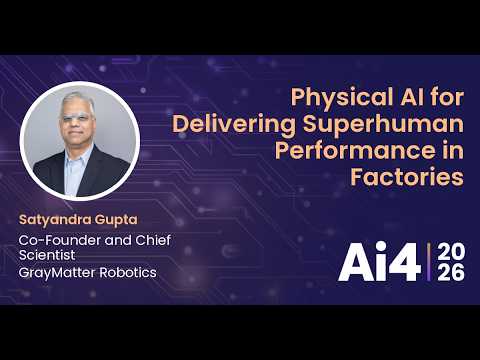
GrayMatter Uses Autonomous Lab AI to Quadruple Factory Robot Speed
Ai4
Imitating human workers limits robotic productivity and destroys factory ROI, requiring physical AI systems to discover higher-speed process recipes through autonomous real-world experimentation.
## Background
Published on YouTube by Ai4 on August 23, 2026, this presentation features Satyandra Gupta, Co-Founder and Chief Scientist at GrayMatter Robotics. The session explores how Physical AI allows industrial robots to conduct self-directed experiments in autonomous labs, moving beyond human demonstration to achieve superhuman speed, precision, and force in high-mix manufacturing.
## TL;DR
High-mix manufacturing struggles with labor shortages and part variability that traditional rigid automation and pure imitation learning cannot solve. GrayMatter Robotics deploys Physical AI across industrial finishing, sandblasting, and composite layup cells to operate at up to four to ten times manual human speed and force. To surpass human physical limits without risking shop-floor damage, robotic cells discover optimal process recipes through safe, self-directed physical reinforcement learning in autonomous lab settings combined with foundation models and diffusion policies. This approach transforms factory economics, eliminates hazardous manual work, reduces material waste, and transitions floor staff into supervisory roles.
## Atmosphere & style
The presentation carries an authoritative, analytical, and visionary tone grounded in the harsh realities of shop-floor economics. Satyandra Gupta delivers a structured, academic yet commercial breakdown of industrial robotics, using intuitive analogies like learning golf alongside rigorous technical workflows. Watching the session feels like an illuminating masterclass in cutting-edge manufacturing, balancing practical operational ROI with the future of autonomous robotic intelligence.
## Key takeaways
- [00:04](https://www.youtube.com/watch?v=wGDjtlv233M&t=4s) Manufacturing robotics must move beyond imitating human behavior to achieve superhuman speed and precision in order to justify ROI in high-mix manufacturing environments.
- [00:04](https://www.youtube.com/watch?v=wGDjtlv233M&t=4s) High-mix manufacturing lines cannot rely on mass-production automation due to rapid part variations and the inability to use rigid, static fixtures.
- [00:04](https://www.youtube.com/watch?v=wGDjtlv233M&t=4s) The United States has only about three robots per 100 manufacturing workers, primarily because its domestic industrial base is heavily weighted toward high-mix production.
- [03:37](https://www.youtube.com/watch?v=wGDjtlv233M&t=217s) Hazardous manual finishing tasks like sanding, grinding, and blasting create severe labor shortages, high employee turnover, and production backlogs.
- [03:37](https://www.youtube.com/watch?v=wGDjtlv233M&t=217s) Physical AI bridges the automation gap by combining multimodal 2D/3D sensing, domain-specific trajectory planning, and real-time in-process QA monitoring.
- [07:21](https://www.youtube.com/watch?v=wGDjtlv233M&t=441s) Robotic cells must target four to ten times human speed and throughput to overcome high capital costs, larger footprint requirements, and manual touch-up overhead.
- [10:10](https://www.youtube.com/watch?v=wGDjtlv233M&t=610s) Intelligent robotic cells automate six core surface finishing domains: grinding, sanding, polishing, blasting, buffing, and spraying.
- [14:37](https://www.youtube.com/watch?v=wGDjtlv233M&t=877s) Pure imitation learning and pure simulation are insufficient because human teleoperation cannot demonstrate superhuman speeds and contact physics lack simulation fidelity.
- [14:37](https://www.youtube.com/watch?v=wGDjtlv233M&t=877s) Robots in 'autonomous lab mode' safely discover optimal process recipes through self-directed physical reinforcement learning experiments on real hardware.
- [14:37](https://www.youtube.com/watch?v=wGDjtlv233M&t=877s) The Physical AI architecture integrates foundation models (LLMs and VLMs) for high-level reasoning with diffusion policies for low-level motor control.
- [20:42](https://www.youtube.com/watch?v=wGDjtlv233M&t=1242s) Deploying Physical AI eliminates hazardous manual labor, reduces consumable waste like abrasives and coatings, and upskills workers into supervisory roles.
## Detailed walkthrough
### [00:04](https://www.youtube.com/watch?v=wGDjtlv233M&t=4s) Mass Production vs. High-Mix Manufacturing Challenges
The presentation opens with a clear thesis: manufacturing robotics must move beyond mere replication of human behavior and leverage unique mechanical strengths to deliver truly "superhuman performance" and produce a favorable return on investment (ROI). In industrial manufacturing, operations generally split into two domains: mass production and high-mix production. Mass production—such as automotive and consumer electronics assembly—involves producing the exact same part repeatedly. Robots have dominated mass production for decades because companies can afford to spend extensive human engineering hours manually programming robot paths, deploying dedicated hard fixtures, and tuning cells for static lines without needing AI or adaptive sensors.
```mermaid
flowchart TD
accTitle: High-Mix Manufacturing vs Mass Production
subgraph MassProduction["Mass Production (Automotive / Electronics)"]
MP1["Static, repetitive parts"] --> MP2["Human manually programs trajectories"]
MP2 --> MP3["Rigid custom fixturing (No sensors needed)"]
end
subgraph HighMix["High-Mix Manufacturing (Aerospace / Heavy Machinery)"]
HM1["Constantly changing parts"] --> HM2["Manual programming is unfeasible"]
HM2 --> HM3["Cannot use rigid fixtures (Requires sensor-guided Physical AI)"]
end
```
In contrast, high-mix manufacturing involves building complex, low-volume, or customized equipment—such as airplanes, ships, ambulances, fire trucks, machine tools, and medical devices. These lines run short batches of constantly varying models on the same shop floor. Consequently, mass-production automation models fail in high-mix environments due to two primary bottlenecks:
1. **Rapid part variation:** Programming paths manually whenever a new part arrives is economically and practically unfeasible.
2. **Lack of static fixturing:** Unstructured or semi-structured part presentation requires dynamic sensing rather than expensive, specialized, rigid tooling.
- In the United States, there are currently only about three robots per 100 manufacturing workers, largely because the domestic industrial base is heavily weighted toward high-mix manufacturing.
---
[03:37](https://www.youtube.com/watch?v=wGDjtlv233M&t=217s) The Labor Bottleneck and the Role of Physical AI
Manual finishing operations such as sanding, grinding, spraying, and sandblasting impose severe physical and ergonomic strain on workers. Consequently, factories experience critical labor shortages, high employee turnover (workers often leave within a month or two), mounting production backlogs, and elevated scrap and consumable waste rates caused by an inexperienced, constantly rotating workforce.
```mermaid
flowchart LR
accTitle: Physical AI Processing Architecture
subgraph Perception["Perception & Modeling"]
S["2D/3D Vision & Sensors"] --> M["Build World / Part Model"]
end
subgraph Execution["Planning & Execution"]
M --> P["Physical AI Layer (Process Knowledge)"]
P --> T["Generate Tool & Robot Trajectories"]
T --> R["Robot Dynamic Control"]
end
subgraph Monitoring["In-Process Feedback"]
R --> F["In-Process QA & Monitoring"]
F --> P
end
```
To resolve these operational challenges, AI-powered robotics utilizing "Physical AI" must step in. Physical AI allows the robotic cell to perceive parts using 2D/3D vision, force, and infrared sensors, build a digital model of the world, determine appropriate processing trajectories using embedded domain knowledge, and dynamically monitor and adjust operations in real time.
- **AI across the robotic cell:** AI handles perception and part classification, tool and manipulator trajectory generation, dynamic real-time control, in-process inspection/QA, prognostic health monitoring, synthetic data generation via generative AI, and natural human-machine interfaces (HMI).
---
[07:21](https://www.youtube.com/watch?v=wGDjtlv233M&t=441s) Justifying ROI Through Superhuman Speed and Precision
AI-powered robotic cells incur significant capital costs due to sophisticated sensor suites, compute hardware, and safety infrastructure. If a robotic cell operates only at human speed, justifying the ROI becomes difficult—especially since robots occupy more floor space due to safety fencing, and complex parts may still require human operators to perform minor touch-ups on the remaining 2% to 5% of intricate work.
| Attribute | Human Operator | Traditional Robot Cell | Superhuman Physical AI Cell |
|:--- |:--- |:--- |:--- |
| **Speed** | Baseline (1x) | 1x (Imitation of human speed) | Up to 4x–10x human movement speed |
| **Exerted Force** | Limited by fatigue & ergonomics | High, but statically programmed | Dynamically modulated high force |
| **Precision** | Variable; degrades with fatigue | Static accuracy on rigid parts | Adaptive micro-precision on variable contours |
| **Media Utilization** | High abrasive/coating waste | Fixed consumption rates | Optimized media delivery (reduced waste) |
Robots are physically capable of moving up to ten times faster than humans, exerting much higher continuous forces, and maintaining superior geometric precision. By targeting "four times" the throughput of a manual worker, hardware costs become significantly more favorable, factory footprint is conserved, and touch-up delays no longer constrain overall shop-floor productivity.
---
[10:10](https://www.youtube.com/watch?v=wGDjtlv233M&t=610s) Real-World Deployments: Surface Finishing, Blasting, and Layup
GrayMatter Robotics deploys intelligent robotic cells across six industrial application areas: grinding, sanding, polishing, blasting, buffing, and spraying. These systems eliminate hazardous manual labor across multiple specialized domains:
```mermaid
flowchart TD
accTitle: Industrial Deployment Workflow
A["Part arrives at cell"] --> B["Multi-sensor 3D scan & model reconstruction"]
B --> C{"Select Process Domain"}
C --> D["Dual-Arm Sanding on Linear Tracks"]
C --> E["Ergonomic Sandblasting Enclosures"]
C --> F["Multi-Stage Sand-Prep-Coat Sequences"]
C --> G["Composite Layup & Defect Smoothing"]
```
- **Dual-arm Track Sanding:** Parts are loaded into a cell featuring two large industrial manipulators mounted on linear tracks. The system scans the part in 3D, plans paths, and sands fiber-reinforced composite or metallic structures at speeds well beyond manual capability.
- **Autonomous Sandblasting:** Replaces hazardous environments where humans previously had to suit up in protective blast gear. The system identifies material properties, scans part geometry, and executes consistent blasting.
- **Surface Preparation and Coating:** Executes multi-stage workflows—sanding to prep surfaces, applying coatings to specified thicknesses, and executing intermediate de-nibbing/sanding steps.
- **Aerospace Composite Layup:** Manipulators pick complex composite plies, drape and stretch them over intricate contoured tooling, inspect the surface with sensors for trapped air bubbles or wrinkles, and smooth them out with consistent pressure.
---
[14:37](https://www.youtube.com/watch?v=wGDjtlv233M&t=877s) Overcoming the Limits of Pure Imitation: Autonomous Lab Learning
Selecting an AI paradigm for high-mix processing requires understanding the specific constraints of the factory floor. Industrial manufacturing is semi-structured: unlike open-world autonomous driving, the cell is somewhat controlled, but unlike mass production, part variance is continuous.
```mermaid
flowchart LR
accTitle: Hybrid AI Stack for Superhuman Manufacturing
subgraph Inputs["Multimodal & Priors"]
H["Human Demonstration / MPC Priors"]
LLM["Foundation Models (LLMs / VLMs)"]
end
Pure imitation learning fails because copying human motion caps performance at human limits; teleoperation cannot run at four to ten times manual speed, and process simulation fidelity (such as abrasive wear and material removal mechanics) is insufficient for pure sim-to-real transfer. Factories also operate under zero risk tolerance—scraping an expensive aerostructure or damaging equipment during exploration is unacceptable.
GrayMatter addresses this by running physical robotic cells in an "autonomous lab mode":
1. **Hybrid Imitation & Experiential RL:** Human demonstrations or model predictive control (MPC) establish a safe operational baseline.
2. **Physical Safe Learning:** The robot conducts real-world self-directed experiments—varying standoff distances, abrasive grit pressures, and feed rates—to discover optimal process parameters safely without simulation discrepancies.
3. **Integrated Modern AI Stack:** The full architecture layers Large Language Models (LLMs) and Vision-Language Models (VLMs) for high-level semantic reasoning and task planning on top of diffusion policies and neural low-level motor control.
Gupta compares this multi-faceted AI framework to mastering golf: reading tips from an instructor (demonstration/imitation) and swinging in a virtual simulator (simulated RL) are helpful starting points, but true excellence requires real-world physical practice.
---
[20:42](https://www.youtube.com/watch?v=wGDjtlv233M&t=1242s) Societal and Economic Impact on Manufacturing
Deploying Physical AI in industrial settings generates broad operational and societal benefits:
- **Ergonomics & Safety:** Removes human operators from toxic, dust-filled, and ergonomically hazardous tasks such as sandblasting and heavy grinding.
- **Resource Optimization:** Precise robotic application reduces consumable media consumption, minimizing sandpaper waste and excess paint overspray.
- **Worker Upskilling:** Factory staff shift from physically demanding labor to supervisory robot operators and cell managers.
- **Inclusive Workforce:** Modernized software interfaces and autonomous material handling allow individuals without high physical strength to participate in modern manufacturing roles.
[21:40](https://www.youtube.com/watch?v=wGDjtlv233M&t=1300s) Concluding Remarks and Q&A Invitation
Satyandra Gupta wraps up his presentation on physical AI and autonomous robotic process learning in high-mix manufacturing. Bringing the talk to a close, he turns the session over to the audience and warmly invites attendees to ask any questions they might have regarding GrayMatter Robotics' technology, autonomous experimentation labs, or superhuman manufacturing applications:
> "So, with that, I'd like to conclude. Happy to answer any question that you may have."
## Notable quotes
> Human demonstrations can only take robotics so far in manufacturing applications. To truly transform high-mix manufacturing, robots must leverage their unique strengths—unmatched speed, precision, and force—beyond human limits. — Satyandra Gupta
> [00:04](https://www.youtube.com/watch?v=wGDjtlv233M&t=4s) In the United States, there are currently only about three robots per 100 manufacturing workers, largely because the domestic industrial base is heavily weighted toward high-mix manufacturing. — Satyandra Gupta
> [07:21](https://www.youtube.com/watch?v=wGDjtlv233M&t=441s) If a robotic cell operates only at human speed, justifying the ROI becomes difficult—especially since robots occupy more floor space due to safety fencing, and complex parts may still require human operators to perform minor touch-ups on the remaining 2% to 5% of intricate work. — Satyandra Gupta
> [07:21](https://www.youtube.com/watch?v=wGDjtlv233M&t=441s) Robots are physically capable of moving up to ten times faster than humans, exerting much higher continuous forces, and maintaining superior geometric precision. — Satyandra Gupta
> [14:37](https://www.youtube.com/watch?v=wGDjtlv233M&t=877s) Pure imitation learning fails because copying human motion caps performance at human limits; teleoperation cannot run at four to ten times manual speed, and process simulation fidelity (such as abrasive wear and material removal mechanics) is insufficient for pure sim-to-real transfer. — Satyandra Gupta
> [14:37](https://www.youtube.com/watch?v=wGDjtlv233M&t=877s) Factories also operate under zero risk tolerance—scraping an expensive aerostructure or damaging equipment during exploration is unacceptable. — Satyandra Gupta
> [21:40](https://www.youtube.com/watch?v=wGDjtlv233M&t=1300s) So, with that, I'd like to conclude. Happy to answer any question that you may have. — Satyandra Gupta
## Mentioned
Satyandra Gupta, GrayMatter Robotics, Ai4, Physical AI, Model Predictive Control (MPC), Large Language Models (LLMs), Vision-Language Models (VLMs), Diffusion Policies
## Video description
Satyandra Gupta - Co-Founder and Chief Scientist, GrayMatter Robotics
Human demonstrations can only take robotics so far in manufacturing applications. To truly transform high-mix manufacturing, robots must leverage their unique strengths—unmatched speed, precision, and force—beyond human limits. In this session, discover how Physical AI enables robots to conduct self-directed experiments in autonomous labs, learning new process recipes on their own to achieve superhuman manufacturing performance.
Satyandra Gupta of GrayMatter Robotics argues that automating high-mix manufacturing requires Physical AI systems that exceed human speed and mechanical capability rather than merely copy human motion, unlocking the throughput needed to justify high robotic capital investments.
High-Mix Manufacturing and the Automation Gap (0:04)
Traditional industrial automation relies on static production lines, dedicated hard fixturing, and extensive manual path programming—methods optimized for mass manufacturing such as automotive and consumer electronics assembly. In contrast, high-mix manufacturing produces low-volume, highly variable, or customized products such as aircraft, naval vessels, emergency vehicles, and medical equipment on the same shop floor. In these settings, rapid part variations and the absence of static fixturing make manual programming practically and economically unfeasible.
Because the United States industrial base is heavily weighted toward high-mix production, domestic factories average only about three robots per 100 manufacturing workers. This sector faces severe labor shortages and elevated turnover, with workers frequently leaving within months due to the physical and ergonomic strain of manual finishing processes like sanding, grinding, and sandblasting. These workforce deficits contribute to mounting production backlogs and high scrap rates from inexperienced labor.
Economic Justification Through Superhuman Speed and Force (7:21)
Gupta emphasizes that robotic cells cannot achieve a satisfactory return on investment if they only match human speeds. Advanced robotic systems incur high upfront capital expenditures for sensor suites, compute modules, and safety infrastructure, while also consuming substantial floor space and often requiring human operators to perform manual touch-ups on the remaining 2% to 5% of intricate surfaces.
To overcome these economic hurdles, robotic cells must exploit mechanical advantages over human labor. Industrial manipulators can operate up to ten times faster than human workers, exert dynamically modulated high forces without fatigue, and maintain micron-level geometric precision across irregular contours. By targeting at least four times the throughput of a manual worker, manufacturers can offset hardware and footprint expenses while preventing touch-up bottlenecks from hindering overall factory flow.
Autonomous Physical Experimentation Beyond Pure Imitation (14:37)
Standard robotic learning frameworks struggle with the semi-structured conditions of industrial manufacturing. Pure imitation learning caps system output at human limits because teleoperation cannot be conducted at four to ten times manual speed. At the same time, pure sim-to-real transfer falters because dynamic process mechanics—such as abrasive wear and material removal rates—cannot be simulated with sufficient fidelity, and factories enforce zero tolerance for scrap or damaged equipment.
GrayMatter addresses this through an "autonomous lab mode" that pairs physical reinforcement learning with human demonstration or model predictive control baselines. Operating directly on real hardware under strict safety validation, the system conducts controlled physical experiments to discover optimal standoff distances, feed rates, and grit pressures. High-level reasoning is handled by foundation models (LLMs and VLMs) for task planning, integrated with diffusion policies and neural controllers for dynamic tool trajectory execution.
Industrial Surface Finishing and Operational Impacts (10:10)
This Physical AI stack is deployed across six primary industrial finishing categories: grinding, sanding, polishing, blasting, buffing, and spraying. Real-world implementations include dual-arm manipulators on linear tracks that generate 3D scans to sand composite and metallic aerostructures, enclosed autonomous sandblasting cells that eliminate hazardous manual work, and multi-stage preparation cells that sand, coat, and de-nib surfaces to exact tolerances. In aerospace composite layup, manipulators place plies, scan for trapped air bubbles or wrinkles, and smooth contours with continuous pressure.
Beyond accelerating throughput, these deployments optimize resource efficiency by precisely applying coatings and abrasives, substantially reducing consumable waste. The transition also shifts factory personnel from ergonomically hazardous manual labor into supervisory cell operations, broadening workforce inclusion by removing high physical strength requirements from finishing roles.
Gupta concludes that realizing the potential of Physical AI in high-mix manufacturing depends on moving beyond human imitation toward physical experimentation and superhuman throughput, though practical deployment remains strictly contingent on real-time safety constraints and zero-defect tolerance on factory floors.
精炼阅读摘要
GrayMatter Robotics 联合创始人兼首席执行官 Satyandra Gupta 指出,高多品种、小批量制造无法沿用传统的刚性自动化模式;工业机器人必须超越对人类操作的简单模仿,依托融合物理 AI 与自主物理实验的控制架构实现“超人性能”,才能在经济层面确立清晰的投资回报。
高混合制造的自动化瓶颈与刚性模式局限 (0:04)
工业制造通常分为大规模量产与高多品种、小批量制造(High-Mix Manufacturing)。汽车与消费电子等大规模量产依靠数万小时的人工手动轨迹编程、专用刚性夹具与高度静态的装配流水线,过去数十年无需自适应传感器或 AI 即可成熟运转。然而,航空航天、船舶、特种车辆(救护车与消防车)、机床以及医疗设备等高混合领域,往往需要在同一作业区域内频繁轮换批次极小、外形各异的复杂工件。
量产自动化逻辑在此类场景彻底失效,核心瓶颈在于动态多变的零件外形导致人工重新编程在经济和工时上难以承受,且缺少标准化刚性夹具迫使系统必须依赖动态环境感知。Gupta 援引数据指出,美国制造业工人中每百人仅配备约三台机器人,其深层原因正在于美国工业基础高度偏向高混合制造,而传统自动化无法适配非结构化产线。
超越人体极限:以超常吞吐重塑投资回报率 (7:21)
部署配备高级视觉传感、计算单元与安全围栏的工业 AI 机器人工作站面临高昂的资本支出(CapEx)。若机器人仅维持相当于熟练工人的作业速度,其投资回报率(ROI)很难成立。这不仅因为安全防护网使机器人工作站占用的车间面积远大于传统人工工位,还因为复杂工件在自动化加工后,通常仍有 2% 到 5% 的狭窄边缘或微小死角需要人工手动修整。
要实现稳健的商业回报,机器人必须发挥独特的物理机械优势。机械臂能够承受远超人体耐受极限的持续负载,以人类四到十倍的速度高速运动,并在曲面轮廓上保持恒定自适应微米级精度。演讲指出,将系统吞吐能力设定为人工的四倍(4x),不仅能够大幅分摊高额硬件成本并精简场地占用,还能完全吸收人工后续修整带来的工时延误。
物理 AI 架构闭环与恶劣表面处理工艺落地 (3:37)
工业表层处理(打磨、喷砂、抛光、喷涂等)工作环境恶劣、人体工效负担沉重,工厂普遍面临严重的劳动力流失(新工人常在一至两个月内离职)、生产积压与材料报废损耗。为此,GrayMatter 构建了涵盖六大工业场景的“物理 AI”(Physical AI)架构:利用 2D/3D 视觉、力和红外传感器建立工件三维世界模型,注入工艺领域知识实时生成路径,并在执行中完成闭环动态控制与在线质检监测。
该系统已在多项极端工艺中进入实操:在双臂轨道打磨单元中,两台安装于直线导轨的重型机械臂完成 3D 扫描后高速打磨复合材料或金属大件;在喷砂作业中,系统自主识别人工原本需着重型防爆防尘服处理的材料与几何轮廓;在表面涂装线上,连贯执行打磨、预设厚度喷涂与去疵工序;在航空复合材料铺贴场景中,机械臂自动拾取预浸料覆于复杂模具表面,利用传感器实时探测微小褶皱或气泡并施压抚平。
突破纯模仿瓶颈:自主实验室物理强化学习 (14:37)
在高混合制造的算法构建上,车间属于半结构化环境:它既非完全开放的自动驾驶路况,也非固定不变的封闭流水线,且面向高价值工件(如昂贵航空构件)具有绝对的“零容忍度”,探针碰撞或报废零件均属不可接受的重大事故。纯粹的模仿学习在此遇阻,原因在于人类遥操作根本无法提供四至十倍速的极限示教动作;同时,材料磨损与去除等微观物理过程极其复杂,传统计算机仿真精度不足,导致“仿真到真实世界”(Sim-to-Real)策略迁移严重失真。
GrayMatter 采取的应对方案是设立“自主实验室模式”(Autonomous Lab Mode):先通过人类示范或模型预测控制(MPC)先验建立安全的作业基线边界,再由实体机器人在受控的物理单元内展开实体自导实验,微调磨料间距、进给速率与作用压力,完成无仿真失真的真实世界强化学习。系统架构顶层由大语言模型(LLM)与视觉语言模型(VLM)处理高阶语义推理与任务拆解,底层结合扩散策略(Diffusion Policies)实现高频运动控制,如同高尔夫选手在掌握理论指导后依靠大量实体挥杆实现微调精进。
作业环境去危害化、耗材节约与劳工结构转型 (20:42)
物理 AI 技术的规模化渗透正在重构重工业的劳动力结构与材料经济学。在作业安全性方面,系统将工人从粉尘、有毒化学喷涂和强震动打磨等高危作业面彻底剥离,直接化解了高流失率引发的制造产能瓶颈。在资源消耗层面,机器人对压力与喷涂轨迹的精准自适应调控显著降低了砂纸等研磨耗材的异常磨损,并减少了油漆过喷造成的材料浪费。
在人员配置上,车间工人转变为机器人工作站监督员与工艺排产协调员。配合直观的人机交互界面(HMI)和自动化重载物料搬运,现代高技术制造降低了对工人极端体能的硬性门槛,使更广泛的劳动力群体得以进入高端制造业核心工序。
Satyandra Gupta 总结强调,物理 AI 正在推动工业机器人从被动的人力复刻工具演变为具备超越人体极限的生产力平台。然而,高混合制造业严苛的零容错标准、复杂工件接触面的摩擦动力学特征,以及如何将自主实验室物理实验的效率安全推广至更多未知工件,仍是实体 AI 真正重塑工业车间必须持续验证的关键环节。
Detailed notes — zh
## Background
本内容由频道 Ai4 于 2026 年 8 月 23 日发布在 YouTube 平台上。视频记录了 GrayMatter Robotics 联合创始人兼首席科学家 Satyandra Gupta 的主题演讲,核心探讨人类示教在制造业中的局限性,并阐述如何借助具身物理人工智能(Physical AI)让机器人在自主实验室中自我探索新工艺配方,从而在多品种小批量制造中实现超越人类极限的超人级性能。
## TL;DR
Gupta 深入剖析了制造业在大规模生产与多品种小批量(High-Mix)场景下的自动化鸿沟,指出传统机器人因编程成本高昂和缺乏自适应传感而无法适应高混合车间,同时恶劣的表面处理工况正引发严峻的人力流失。为了打破高昂设备投入下的投资回报率(ROI)僵局,机器人绝不能仅停留在模仿人类,而必须发挥在速度、力量与精度上的物理优势,释放达到人类 4 倍节拍的“超人性能”。演讲展示了在轨道打磨、恶劣喷砂及航空复合材料铺放等复杂工序中的落地成果,并论证了结合大模型顶层认知、实物强化学习与安全自主实验室的多模态 AI 架构,不仅能化解制造业用工荒与耗材浪费,更推动了蓝领工人的技能转型。
## Atmosphere & style
整场演讲呈现出极为务实、严谨且富有产业洞察力的工程科技风格。Gupta 的语调从容自信,从冷酷严密的工厂经济账与 ROI 公式切入,直击自动化行业长期盲目模仿人类工人的底层误区;随着多台重型工业机器人在粉尘漫天与精密曲面场景中高速运转的实况展开,现场氛围转变为对尖端工程落地的震撼与赞叹。他借用高尔夫球手苦练挥杆的精妙隐喻,将抽象晦涩的复合 AI 架构讲得深入浅出,既具备硬核的工业技术说服力,又饱含对将人类工人从高危恶劣工况中解放出来的人文关怀。
## Key takeaways
- [00:04](https://www.youtube.com/watch?v=wGDjtlv233M&t=4s) 制造业呈现大规模生产与多品种小批量(High-Mix)的双重格局;后者因产品多变、频繁换线,在全美平均每 100 名工人仅配备约 3 台工业机器人,存在巨大的自动化鸿沟。
- [02:19](https://www.youtube.com/watch?v=wGDjtlv233M&t=139s) 传统工业机器人无法胜任多品种小批量场景,核心症结在于缺乏 AI 支持导致的巨额人工示教编程成本,以及无法为成百上千种工件定制昂贵的专用机械夹具。
- [02:19](https://www.youtube.com/watch?v=wGDjtlv233M&t=139s) 打磨、研磨、喷砂等表面加工工序充斥粉尘、高噪和重体力消耗,新员工通常在 1 至 2 个月内离职,严重的用工荒与高报废率倒逼产业必须引入 Physical AI。
- [05:09](https://www.youtube.com/watch?v=wGDjtlv233M&t=309s) Physical AI 构建起从多模态感知、三维物理建模、工具与机械臂双重轨迹自适应规划,到加工中质量检测与健康管理(PHM)的全自主决策执行闭环。
- [07:21](https://www.youtube.com/watch?v=wGDjtlv233M&t=441s) 破局高昂部署成本与 ROI 困境的关键在于拒绝单纯模仿人类——如果机器人的作业速度仅仅持平于人工,其昂贵的软硬件折旧与占地面积在经济模型上将完全不可行。
- [07:21](https://www.youtube.com/watch?v=wGDjtlv233M&t=441s) 工业机器人在刚性加压、关节速度与亚毫米精度上具备天然物理优势;当作业速度提升至人类的 4 倍时,可大幅压缩硬件回报周期并成倍提高厂房地面产出。
- [10:10](https://www.youtube.com/watch?v=wGDjtlv233M&t=610s) GrayMatter Robotics 已将超人级性能落地于双机器人协同轨道打磨、恶劣环境重型高压喷砂,以及航空航天级三维复杂曲面复合材料精准铺放等高端制造场景。
- [14:37](https://www.youtube.com/watch?v=wGDjtlv233M&t=877s) 高混合制造面临半结构化环境、缺乏互联网级工艺数据、接触力学仿真保真度有限以及高价值工件试错容忍度极低四大物理现实约束。
- [16:29](https://www.youtube.com/watch?v=wGDjtlv233M&t=989s) 当作业目标超越人类极限时,人类示范数据与远程遥操作均告失效,机器人工作站必须转化为“自主实验室”,在真实物理世界中主动摸索并锁定最优工艺配方。
- [16:29](https://www.youtube.com/watch?v=wGDjtlv233M&t=989s) 单一控制范式难以兼顾安全与超人性能,必须以模仿学习为起点,融合安全物理边界控制与面向实物的强化学习(RL),在物理试错中持续修正模型。
- [19:01](https://www.youtube.com/watch?v=wGDjtlv233M&t=1141s) Physical AI 采用顶层 VLM/LLM 认知推理与底层扩散策略及强化学习执行的多模态纵深架构,如高尔夫球手般兼顾理论指导、模拟仿真与真实物理球场实操。
- [20:42](https://www.youtube.com/watch?v=wGDjtlv233M&t=1242s) 智能机器人单元不仅大幅消除了高危工伤职业病并降低了砂纸与涂料耗损,更将传统重体力劳动者升级为系统督导员,降低了从业体力门槛并促进包容性就业。
## Detailed walkthrough
### [00:04](https://www.youtube.com/watch?v=wGDjtlv233M&t=4s) 制造业的双重格局:大规模生产与多品种小批量(High-Mix)的自动化鸿沟
演讲伊始,GrayMatter Robotics 联合创始人兼首席科学家 Satyandra Gupta 稍微停顿,等待陆续入场的听众落座。他开宗明义地指出了本次演讲的核心主旨:我们必须真正释放机器人的固有潜能,让它们展现出“超越人类极限”(Superhuman)的性能;唯有如此,企业才能在高度复杂的制造场景中实现具备绝对说服力的投资回报率(ROI)。
Gupta 随后勾勒出制造业的基本全景:整个行业清晰地划分为两类截然不同的生产模式。第一类是**大规模生产(Mass Production)**,即长期重复制造完全相同的产品。数十年来,工业机器人一直是大规模制造的绝对主力,尤其是在汽车整车装配和大量消费类电子产品的产线上。然而,另一半庞大的制造业版图则是**多品种、小批量制造(High-Mix Manufacturing)**。在这种环境下,产线绝不会长时间重复单一任务:企业可能今天在造飞机、轮船,明天生产救护车、消防车、机床或高端医疗设备。工人们通常在短时间内完成一批特定部件的加工,接着立即换线处理完全不同的零件,甚至在同一条产线上混流生产多种不同型号。
遗憾的是,在这类复杂多变的制造场景中,工业机器人几乎难觅踪影。Gupta 援引了一组发人深省的数据:在美国,制造业平均每 100 名工人中仅配备约 3 台工业机器人。之所以自动化密度如此低下,正是因为美国本土制造业绝大多数属于多品种、小批量的高混合生产模式;除了汽车制造仍保留大规模产线外,大部分消费电子等大规模装配早已转移到海外。这直接导致传统机器人无法直接移植到美国的制造业土壤中。
- **大规模生产特征**:重复生产单一标准化产品,机器人已被广泛应用数十年(如汽车工业、海外电子制造)。
- **多品种小批量(High-Mix)特征**:航空航天、造船、特种车辆(救护车、消防车)、精密机床及医疗器械制造,零件型号多、批次小、产线动态切换频繁。
- **全美工业机器人密度**:每 100 名制造业工人仅对应约 3 台机器人,主要症结在于传统自动化难以适配高混合生产环境。
---
### [02:19](https://www.youtube.com/watch?v=wGDjtlv233M&t=139s) 高混合制造的技术壁垒与严峻的人工困局
传统面向大规模生产的工业机器人之所以无法胜任多品种小批量制造,本质上受制于两大难以逾越的技术障碍。第一是**换线与编程成本过高**。在多品种产线上,上一道工序刚送来一种零件,下一刻就需要处理结构完全不同的新工件。大规模生产中机器人的部署逻辑是依靠工程师花费数周甚至数月进行人工示教和示教盒编程,"所有大规模生产中的机器人都是靠人一步一步编出来的,那里根本没有 AI"。但在频繁换线的场景下,让人类工程师反复入场重新编程在经济上是彻底不可行的。第二是**工装夹具与传感器的缺失**。大规模流水线依赖昂贵的专用定制夹具,彻底消除零部件定位的一切物理不确定性,机器人甚至不需要配备任何视觉传感器盲跑即可;但在高混合车间里,企业不可能为成百上千种异形零件分别定制专属夹具,零件直接摆在眼前,机器人必须在充满几何不确定性的前提下自主完成加工。
与自动化的缺失形成鲜明对比的,是人工操作所面临的前所未有的劳动力危机与健康挑战。表面处理工艺——如打磨(Sanding)、研磨(Grinding)、喷涂(Spraying)和喷砂(Sandblasting)——在人机工程学上极度恶劣且枯燥费力。工人需要长时间暴露在粉尘、振动、高噪音和强体力消耗的环境中。
其直接后果是极其严重的工人流失与用工荒。Gupta 指出,许多新员工招募入职后,往往坚持一到两个月就会选择辞职。工厂被迫陷入“招聘新员工—离职—再招新手”的恶性循环。源源不断的新手涌入,不仅导致工厂在制品积压严重,更直接拉高了零件报废率(Scrap Rate)和砂纸等耗材的严重浪费。面对无法招满的庞大制造岗位缺口,依靠具身物理人工智能(Physical AI)驱动的智能机器人已成为唯一的破局路径。
- **传统自动化的两大死穴**:
1. **人工示教无法应对频繁换线**:无 AI 的传统机器人编程周期漫长,无法应对动态多变的工件。
2. **无法依赖专用固定夹具**:多品种产线充满位置与公差不确定性,必须依靠实时自适应传感器。
- **表面加工恶劣工况**:打磨、抛光、喷砂和喷涂等工序存在严重的人体工程学伤害与职业健康风险。
- **制造用工危机**:极高的人员流失率(新员工通常在 1-2 个月内离职),造成技术断层、良率下降、耗材浪费及大面积订单积压。
---
### [05:09](https://www.youtube.com/watch?v=wGDjtlv233M&t=309s) 具身智能(Physical AI)的技术架构与感知决策闭环
为了在高混合制造中替代人工,必须引入“物理人工智能”(Physical AI)。Gupta 将 Physical AI 概括为一个完整的物理自主感知与执行闭环:AI 系统首先审视当前待处理的任务,利用 2D/3D 视觉、力控等多种传感器构建出对物理世界的精准实时模型;随后,算法根据工件实际几何形态自主决策并规划工具轨迹与机器人运动;最终驱动机器人执行作业,并在加工过程中持续监测打磨与切削质量,实时做出自适应补偿。
在这种全新范式下,人机交互被彻底简化。操作人员只需将一个未知的零件推到机器人工作站前,给出一句高层语义指令,例如:“打磨这个玻璃纤维(Glass Fiber)零件”。系统接收到这一上下文信息后,便能自动调取与该材料匹配的工艺参数库,自主推演出一整套作业流程。
```mermaid
flowchart TD
accTitle: Physical AI Architecture for Robotic Manufacturing Cells
accDescription: A multi-layered architecture diagram showing how sensors and AI components interact from perception to execution.
subgraph PerceptionLayer ["感知与建模 (Perception & World Modeling)"]
Sensors["传感器输入<br/>(2D/3D 视觉, 力传感器, 红外)"] --> WorldModel["实时物理世界三维建模"]
end
subgraph BrainLayer ["核心 Physical AI 与工艺引擎"]
Context["工艺知识与高级指令<br/>(如: '打磨玻璃纤维部件')"] --> AI_Engine["Physical AI 决策核心"]
WorldModel --> AI_Engine
AI_Engine --> ToolPath["工具接触轨迹自适应规划"]
AI_Engine --> RobotTraj["机器人无碰撞运动学轨迹生成"]
end
subgraph ExecutionLayer ["实时控制与质量闭环"]
SafeControl["实时安全控制系统"]
InProcessQA["在途加工检测与质量评估"]
PHM["设备寿命预测与健康管理 (PHM)"]
SynthData["生成式 AI 合成数据闭环"]
end
ToolPath --> SafeControl
RobotTraj --> SafeControl
SafeControl --> InProcessQA
InProcessQA -. 实时反馈纠偏.-> AI_Engine
```
Gupta 强调,AI 并非外挂模块,而是全面渗透在整个工作站的每个层级中:
- **感知与分类**:AI 视觉模型自主识别工件种类、装夹位姿以及表面微小缺陷;
- **双重轨迹生成**:AI 需同时生成终端工具本身的微观作用轨迹(Tool Trajectory),以及机械臂六轴/多轴联动的大范围空间运动轨迹(Robot Trajectory);
- **实时安全控制**:保证机器人在高速运行以及施加恒定接触力时不损伤高价值工件与设备结构;
- **加工中质量保障(In-Process Inspection)与 PHM**:实时监控加工表面光洁度并对机电硬件进行预测性维护(Prognostic and Health Management);
- **生成式 AI(Generative AI)应用**:利用生成模型自动构建大量的合成数据(Synthetic Data),用于训练罕见工况下的表面检测算法;
- **智能人机界面(Smart HMI)**:普通车间操作工无需编程经验,仅凭触控屏或语音即可快速下达工艺任务。
---
### [07:21](https://www.youtube.com/watch?v=wGDjtlv233M&t=441s) 破局 ROI 难题:为什么机器人必须追求“超越人类”(Superhuman)的性能
建立了技术构想后,Gupta 抛出了一个直击制造业商业本质的核心难题:**投资回报率(ROI)计算**。一套配备了密集传感器、高算力边缘计算以及先进 AI 软件系统的工业机器人单元,其前期软硬件成本极为昂贵。如果工件非常复杂,机器人可能只能完成 95% 或 98% 的工作,剩下的角落仍需要人工介入补刀(Touch-up);加之必须加装围栏或激光雷达等安全防护系统,单个机器人工作站的占地面积显著大于单个人工工位;产线面对海量未知工况偶尔还会发生异常停机。
基于上述现实,“如果机器人工作站的作业节拍仅仅和人类工人的速度持平,那么其 ROI 在经济模型上根本无法成立”。
这正是传统自动化团队经常陷入的误区——盲目模仿人类工人的速度和动作。Gupta 情绪昂扬地反问:“我们为什么要将机器人禁锢在人类的表现水平上?” 从物理机构的本质来看,工业机器人可以输出远超人类肌肉数十倍的强劲接触力,能够在重载工具下稳定加压;机器人的轴关节运动速度最高可以达到人类手臂挥动极限的 10 倍以上;在重复定位精度上更是达到微米/亚毫米级,完全免于人类疲劳、颤抖和注意力涣散的困扰。
因此,Physical AI 的核心战略必须是释放**超越人类极限(Superhuman)的性能**。Gupta 给出了关键的商业推导:如果机器人依靠精准的力控与高刚性算法,将加工速度提升至人类工人的 **4 倍**,原本严苛的经济模型将瞬间被颠覆:
1. **硬件折旧极速分摊**:单台机器人创造的吞吐量相当于 4 个工位,设备投资回报期大幅压缩;
2. **单位厂房面积产出剧增**:尽管单个机器人单元占地略大,但凭借 4 倍产能,其对工厂地面空间的有效利用率反而显著高于多个人工工位;
3. **消除人工瓶颈**:即使加工后仍需人类进行少量边缘补漆或打磨,由于机器人已经以“极速飞奔(Blazingly Faster)”完成了前序 95% 以上的大面积重体力工序,整条产线的总节拍也完全不会被拖慢。
---
### [10:10](https://www.youtube.com/watch?v=wGDjtlv233M&t=610s) 超人级工业应用落地:从轨道打磨、喷砂到航空复合材料铺放
为了佐证这一理论,Gupta 通过多个由 GrayMatter Robotics 实际交付的标杆商业案例,展示了具身智能在超人级制造场景中的震撼表现。
首先是一个**双机器人协同轨道打磨单元**。大型复杂零部件由工人推入工作站后,两台安装在长导轨轴上的高负荷工业机器人同时启动。系统顶置与端拾器传感器在数秒内完成三维几何点云扫描,当场生成数字孪生模型,随后双臂以远超人类臂力的下压力与飞快的切削进给速度展开打磨,展现出纯人工完全无法企及的节拍一致性与去除率。
其次是极具代表性的**重型喷砂(Sandblasting)作业**。Gupta 直言,喷砂是制造业中人机工程学体验最恶劣的工种之一:工人必须穿上厚重的密封防护服、佩戴正压呼吸面罩,孤身走进充满剧烈弹丸飞溅与窒息粉尘的封闭喷砂房中。由于体力消耗极大,工人们干完极短时间就必须停机脱去防护服出来休息换气。而在 GrayMatter 的喷砂工作站中,操作工只需把工件推入并输入材质信息,AI 系统全自主扫描识别工件几何轮廓与锈蚀/氧化皮分布,控制机器人以人类无法维持的恒定大流量和极致速度实施高压喷砂,彻底将人类从这一伤身劳神的极限工种中解放出来。
```
典型超人级表面加工流程(复合工艺工序):
[零件推入工作站]
│
▼
[AI 视觉 3D 扫描与实时几何建模]
│
▼
[超人速粗磨 (Pre-prep Sanding)] ── 强下压力、数倍于人工速度的表面准备
│
▼
[高均匀度底漆/涂层喷涂 (Coating Application)]
│
▼
[超精密二次精磨 (Finish Sanding)] ── 严格受控于涂层工艺规格厚度
│
▼
[合格工件下线输出]
```
随后展示的复杂工艺则是针对高精度要求的**多道次“打磨—涂层—复磨”复合工艺**。系统在扫描工件后,先进行底层强力打磨除杂,接着精准执行自动涂层涂覆,待涂层固化后再次驱动打磨头进行严格受控的精密轻磨,确保涂层最终厚度达到微米级的公差要求。
最后,Gupta 演示了一个在尖端航空航天领域至关重要的工艺——**复合材料铺放(Composite Layup)**。制造飞机机翼与机身曲面构件需要将预浸料纤维单层(Plies)精准平铺在极其复杂的三维双曲面模具上。传统人工铺层不仅极其耗时,且人工拉伸排气极易造成纤维褶皱、取向偏角等严重缺陷。在该应用中,机器人手爪端拾器抓起大面积碳纤维织物,借助密集的触觉与光学传感器监测布料的延展拉伸应力,顺应复杂轮廓自主贴合模具表面,精确成型出符合严苛适航标准的航空级复杂曲面构件。每一个动作都在闭环传感引导下稳定复现,再次印证了机器人在复杂物理世界中实现超人化作业的巨大力量。
### [13:29](https://www.youtube.com/watch?v=wGDjtlv233M&t=809s) 先进感知技术与 GrayMatter Robotics 产品线
借助先进的高精度传感技术,机器人不仅能细致检查工件表面是否存在气泡(bubbles)或气囊(air pockets),还可以像熟练的人类操作工那样逐一进行消除和修复。先进感知让机器人得以执行各类极其精细复杂的工序,而且在作业精度上已经远远甩开了人类手工的极限。
GrayMatter Robotics 长期致力于为各类高混合度制造(high-mix manufacturing)场景开发全套智能机器人解决方案,其产品目前已在全美各地规模化部署。整个产品矩阵覆盖了六大核心工艺领域:
- **研磨(Grinding)**
- **打磨砂光(Sanding)**
- **抛光(Polishing)**
- **喷砂(Blasting)**
- **研磨抛光/布轮抛光(Buffing)**
- **喷涂(Spraying)**
尽管具体的工艺要求各异,但其底层运行逻辑高度一致:只需将待加工零件放置在机器人工作站前,机器人便会自动扫描零件、实时构建三维数字模型,随后自主规划并执行相应的工艺操作。
---
### [14:37](https://www.youtube.com/watch?v=wGDjtlv233M&t=877s) 高混合度制造对 AI 范式的根本约束
在制造业中落地实体人工智能(Physical AI)时,首要问题是确立正确的算法路线。当前机器人学界最热门的方向之一是模仿学习(Imitation Learning),即通过记录并模仿人类工人的动作轨迹来教机器人干活。然而在严苛的高混合工业场景下,这种纯模仿路线并不可行。在决定技术架构前,必须客观认清此类制造场景所面临的现实物理边界:
```mermaid
flowchart TD
accTitle: High-Mix Manufacturing Physical AI Constraints
subgraph Environment ["工作环境特征"]
A["半结构化空间 (Semi-structured)"]
end
subgraph DataSimulation ["数据与仿真瓶颈"]
B["数据极度匮乏 (无互联网级现成数据)"]
C["仿真精度中等 (加工接触力学难完全模拟)"]
end
subgraph RiskConstraints ["工艺风险约束"]
D["风险容忍度极低 (不允许损伤高价值工件)"]
end
Environment --> E["实体 AI 架构决策"]
DataSimulation --> E
RiskConstraints --> E
```
- **半结构化空间(Semi-structured workspace)**:它既不像传统大规模流水线(Mass Production)那样高度结构化且固定不变,也不像自动驾驶面对的开放道路那样完全不可预测,而是一个处于受控与变化之间的半结构化环境。
- **数据极度匮乏(Very low data availability)**:工业加工没有现成的互联网级数据(internet-scale data)可供爬取,网上也不可能找得到展示特定工业零部件精密加工的教学视频。所有工艺数据必须依赖机器人在现场探索试验获得。
- **仿真保真度有限(Moderate simulation accuracy)**:对于涉及复杂接触力学、材料去除的加工工艺,目前的仿真工具无法达到绝对逼真,只能提供中等精度的参考。
- **风险容忍度极低(Low risk tolerance)**:工业生产中零件价值高昂,没有任何工厂能承受机器人“哪怕一周损坏一次工件”的惨重代价,试错成本极其严苛。
---
### [16:29](https://www.youtube.com/watch?v=wGDjtlv233M&t=989s) 超越人类极限:自主实验室与安全物理探索
如果追求的是超越人类极限的“超人性能”(superhuman performance),传统的人类示范数据就会彻底失效——“我可以整天观察人类是怎么操作的,但如果我想让机器人的作业速度比人类快四倍,人类的操作数据就毫无用处了。”同样,由于加工过程伴随超高动态响应与极高作业速度,远程遥操作(Teleoperation)在物理上也完全行不通;单纯依赖仿真软件更无法捕捉微观磨损与材料形变的复杂物理交互。
破局的关键在于将工作站转变为**自主实验室模式(Autonomous lab mode)**。以喷砂作业站为例,初始时将零件放入工作单元中,让机器人“自主探索”,主动尝试不同的喷射距离(standoff distances)与移动速度组合,实时检测材料去除率与表面粗糙度等关键指标,直到锁定最优的工艺参数配方(process recipes)。
在这类自主物理实验中,**安全学习(Safe learning)**构成了不可逾越的底线。倘若机器人在摸索过程中撞坏设备或破坏工件,试错代价将不可承受。主流的三大技术路线各有其局限性:
1. **模型预测控制(MPC)**:高度依赖先验物理模型,难以应对复杂的动态材料微观形变;
2. **强化学习(RL)**:高度依赖海量试错,传统做法多困在保真度不足的仿真环境里;
3. **模仿学习(Imitation Learning)**:上限被人类操作员的生理速度与熟练度锁死。
因此,单一方法无法破局,必须将多范式深度结合:以人类操作作为模仿学习的基准起点,再利用面向物理现实的**实物强化学习(Experiential Reinforcement Learning in the physical world)**突破人类上限;在物理实验过程中持续修正物理模型,并将其闭环反馈给控制系统,同时施加严密的安全边界约束。
---
### [19:01](https://www.youtube.com/watch?v=wGDjtlv233M&t=1141s) 多模态技术栈与高尔夫球手的隐喻
为了在动态多变的真实工厂中稳定交付超人性能,现代 Physical AI 必须采用纵深的多层软硬件技术栈:
- **顶层认知与推理**:基于大语言模型(LLM)与视觉语言模型(VLM)的基础模型(Foundation Models),负责环境感知与长程语义推理;
- **底层动作执行与控制**:结合任务规划(Task Planning)、扩散策略(Diffusion Policies)以及实物强化学习(Reinforcement Learning),实现高频、高精度的灵巧技能控制。
很多人质疑为何需要把这么多复杂的 AI 框架塞进同一个机器人系统。对此,演讲者打了一个生动的高尔夫球隐喻:“如果你想成为一名优秀的高尔夫球手,你会怎么做?你会找教练听取建议,但这本身并不能直接让你变成高手;你可能会看教学视频,也可能会在室内模拟器中练习挥杆,但归根结底,你必须走到真实的球场上去实操挥杆打球。”
在机器人系统中,VLM 和 LLM 扮演着“理论教学与战术理解”的角色,仿真提供“低成本初级训练”,而物理世界的强化学习与扩散策略则是“真实球场上的千锤百炼”。只有将这几重模态深度结合,机器人才能掌握真正卓越的工艺技能。
---
### [20:42](https://www.youtube.com/watch?v=wGDjtlv233M&t=1242s) 实体 AI 带来的社会价值与制造业未来
AI 赋能的智能机器人工作站在工业界的全面落地,蕴含着深远的产业与社会正向价值:
- **消除高危工伤与职业病**:将人类工人从长期重复、高振动、充满粉尘的恶劣加工环境中彻底解救出来,极大减少人体工效学损伤风险;
- **显著降低材料损耗**:机器人拥有超人类的精确力度控制与均匀走位,对砂纸、抛光剂、喷涂涂料等易耗品(consumable media)的利用率远高于手工操作,大幅减少材料浪费;
- **化解劳动力短缺危机**:在招聘熟练工极为困难的地区,制造企业依然能通过自动化单元扩充产能、拓展业务;
- **工人技能升级与包容性就业**:传统粗加工对工人的绝对体能与力量有极高要求,而部署 AI 工作站后,原本的重体力劳动者得以升级为“机器人单元操作员与督导者”。这大幅降低了从业的体力门槛,使得更多样化的人群(包括不具备强壮体魄的人)能够投身于先进制造业岗位。
## Notable quotes
> [02:19](https://www.youtube.com/watch?v=wGDjtlv233M&t=139s) 所有大规模生产中的机器人都是靠人一步一步编出来的,那里根本没有 AI — Satyandra Gupta
> [05:09](https://www.youtube.com/watch?v=wGDjtlv233M&t=309s) 打磨这个玻璃纤维(Glass Fiber)零件 — Satyandra Gupta
> [07:21](https://www.youtube.com/watch?v=wGDjtlv233M&t=441s) 如果机器人工作站的作业节拍仅仅和人类工人的速度持平,那么其 ROI 在经济模型上根本无法成立 — Satyandra Gupta
> [07:21](https://www.youtube.com/watch?v=wGDjtlv233M&t=441s) 我们为什么要将机器人禁锢在人类的表现水平上? — Satyandra Gupta
> [07:21](https://www.youtube.com/watch?v=wGDjtlv233M&t=441s) 极速飞奔(Blazingly Faster) — Satyandra Gupta
> [14:37](https://www.youtube.com/watch?v=wGDjtlv233M&t=877s) 哪怕一周损坏一次工件 — Satyandra Gupta
> [16:29](https://www.youtube.com/watch?v=wGDjtlv233M&t=989s) 我可以整天观察人类是怎么操作的,但如果我想让机器人的作业速度比人类快四倍,人类的操作数据就毫无用处了。 — Satyandra Gupta
> [16:29](https://www.youtube.com/watch?v=wGDjtlv233M&t=989s) 自主探索 — Satyandra Gupta
> [19:01](https://www.youtube.com/watch?v=wGDjtlv233M&t=1141s) 如果你想成为一名优秀的高尔夫球手,你会怎么做?你会找教练听取建议,但这本身并不能直接让你变成高手;你可能会看教学视频,也可能会在室内模拟器中练习挥杆,但归根结底,你必须走到真实的球场上去实操挥杆打球。 — Satyandra Gupta
> [20:42](https://www.youtube.com/watch?v=wGDjtlv233M&t=1242s) 机器人单元操作员与督导者 — Satyandra Gupta
## Mentioned
Satyandra Gupta, GrayMatter Robotics, Ai4, Physical AI (实体人工智能), 模仿学习 (Imitation Learning), 强化学习 (Reinforcement Learning), 模型预测控制 (MPC), 扩散策略 (Diffusion Policies), 大语言模型 (LLM), 视觉语言模型 (VLM), 设备寿命预测与健康管理 (PHM)
## Video description
Satyandra Gupta - Co-Founder and Chief Scientist, GrayMatter Robotics
Human demonstrations can only take robotics so far in manufacturing applications. To truly transform high-mix manufacturing, robots must leverage their unique strengths—unmatched speed, precision, and force—beyond human limits. In this session, discover how Physical AI enables robots to conduct self-directed experiments in autonomous labs, learning new process recipes on their own to achieve superhuman manufacturing performance.
[Source](https://www.youtube.com/watch?v=wGDjtlv233M)
Satyandra Gupta: Human demonstrations can only take robotics so far in manufacturing applications. To truly transform high-mix manufacturing, robots must leverage their unique strengths—unmatched speed, precision, and force—beyond human limits.
[0:04] Satyandra Gupta: In the United States, there are currently only about three robots per 100 manufacturing workers, largely because the domestic industrial base is heavily weighted toward high-mix manufacturing.
[7:21] Satyandra Gupta: If a robotic cell operates only at human speed, justifying the ROI becomes difficult—especially since robots occupy more floor space due to safety fencing, and complex parts may still require human operators to perform minor touch-ups on the remaining 2% to 5% of intricate work.
[7:21] Satyandra Gupta: Robots are physically capable of moving up to ten times faster than humans, exerting much higher continuous forces, and maintaining superior geometric precision.
[14:37] Satyandra Gupta: Pure imitation learning fails because copying human motion caps performance at human limits; teleoperation cannot run at four to ten times manual speed, and process simulation fidelity (such as abrasive wear and material removal mechanics) is insufficient for pure sim-to-real transfer.
[14:37] Satyandra Gupta: Factories also operate under zero risk tolerance—scraping an expensive aerostructure or damaging equipment during exploration is unacceptable.
[21:40] Satyandra Gupta: So, with that, I'd like to conclude. Happy to answer any question that you may have.
Original transcript
[0:04] So, today's presentation I'll try
to, you know, convince you that
[0:09] we should really leverage robots strength and
get them to deliver superhuman performance.
[0:16] And if we can do that, then it basically
produces favorable return on investment.
[0:22] So, that's the premise behind
it. So, little bit of background.
[0:30] Uh some people are just trickling
in, so I'm just going to take a quick
[0:33] pause, let everybody be seated.
[0:38] So, basically if you think about manufacturing,
[0:43] you have two different segment, mass production
where you are making the same thing over and over,
[0:51] and people have been using robots in that
application for a very long time. So, when you
[0:56] think about car production, when you think about
a lot of electronics production, people have been
[1:04] using robots in these application for a very long
time. Then there's a high mix production where
[1:12] you are not doing same thing over and over for
long periods of time. So, for example, you're
[1:18] making airplanes, you're making ships, you're
making ambulance, you're making fire trucks,
[1:24] you are making, you know, basically machine tools,
you're making medical equipment. So, a lot of it,
[1:30] what happens that you do some activities for a
period of time, short period of time, and then you
[1:36] do something else, and you also be making lots of
different models on the same line. Unfortunately,
[1:43] those type of manufacturing applications, people
don't use robots. Overall, if you look at it,
[1:51] approximately three robots per 100 manufacturing
workers in US, and that's just because US has
[1:58] a lot of high mix manufacturing and
mass production happens in the cars,
[2:04] but a lot of mass production even in electronics
does not happen in US. So, that's the reason why
[2:10] use of robot in US is not very high. High mix
manufacturing has the two challenges which
[2:20] historically has presented the mass
production style robot to be used. First,
[2:25] you need to change your parts quickly. So, for
example, you might be sending one type of part
[2:31] and little bit later you want to do a entirely
different type of part. Now, if you're going to
[2:37] have humans coming and programming robot, this
model would not work. All the mass production
[2:42] robot, by the way, humans come and program
robots, right? There's no AI being used in
[2:47] the mass production application. You can afford to
have humans come and program robots, you know, get
[2:53] the line producing the right kind of performance
and you just do the same thing over and over.
[2:59] Second thing is that you cannot simply deploy
custom fixtures and take all the uncertainty away
[3:08] and use the robot without deploying sensor. So,
that option is also not there if you are dealing
[3:15] with a high production line. Part comes in front
of you, you have to process it. You cannot demand
[3:21] any specialized fixtures, any specialized
tools. You just need to process the part.
[3:28] So, in order for us to solve basically this
problem, we need to look at it AI-powered robots.
[3:37] Now, why we really need to push for more robot to
be used in manufacturing? Manual operation pose
[3:45] enormous amount of challenges for human workers'
health. Lot of people when they do sanding,
[3:51] grinding, spraying, sandblasting type of
operation. These are operations are not,
[3:57] you know, easy to perform. They're
economically challenging operation and yet,
[4:01] large number of people have
to do these operations today.
[4:06] We are facing significant labor shortage.
And that leads to a lot of backlogs.
[4:13] Now, what is happening is that since these jobs
are very challenging, people sign up to do them,
[4:18] but large number of people quit after a month
or two. And then you're constantly getting new
[4:23] people to do these job and that creates lots of
challenges. And whenever you have large number
[4:28] of new workers trying to do these job, then you
also have high rate of scrap and also consumable
[4:34] waste because these workers are not really
experienced in doing these things. So, all
[4:39] this creates tremendous challenges and currently,
enormous amount of manufacturing jobs out there
[4:46] which people having tremendous difficulty
fulfilling them. So, all of this basically is
[4:55] pointing out to a future that we we
have to look at it, AI and robotics
[5:00] to help out to make sure that we can actually use
these AI-powered robot to start doing these jobs.
[5:09] Now, physical AI is creating
lots and lots of opportunities.
[5:15] So, physical AI broadly speaking means
AI basically looks at the task that
[5:24] it need to perform, examines it, uses camera,
other sensors, build the model of the world.
[5:30] From that, it basically decide what action robot
needs to take. And then robot can go ahead and
[5:38] perform this action. For example, you can put
the part in front of the robot and can say,
[5:43] "Sand this part." Right? This And you can provide
some contextual information. So, you can say
[5:50] sand this glass fiber part so the
robot can do appropriate things.
[5:55] And as robot begins it, the physical AI monitors
the cells, looks at how the progress is,
[6:00] and make appropriate adjustments. So, that's
kind of what the promise of physical AI is.
[6:06] And these type of cells you're going to use
robots. You're going to use tools, and then
[6:13] you're going to use lots of sensors. So, you will
have vision-based sensor, 2D, 3D, force sensing,
[6:19] sometime infrared sensing. So, lots of sensors.
Above that, you'll have physical AI layer,
[6:24] which will control robot behavior, and you'll
have process knowledge. On top of it, basically,
[6:30] you have human-machine interface through which
humans are going to be tasking these cells.
[6:37] So, where is AI? AI is going to be everywhere
in this cell, basically. The perception so that
[6:44] AI can look at the part, figure it out what kind
of part it is. AI will generate tool trajectories.
[6:51] AI will also generate robot trajectory. AI will
be powering your control system to make sure that,
[6:58] you know, part gets done safely. You're going to
do in-process inspection and quality assurance.
[7:05] You're going to do prognostic and health
management. You're going to use generative
[7:08] AI to generate synthetic data, and you're going
to have smart human-machine interfaces. So, AI
[7:14] is all over in these type of, you know, basically
cells. So, now that was the background. So, let's
[7:21] come to, you know, now the key question
that I was, you know, earlier alluding.
[7:29] So, when you have robots and you want to deploy
them, and if you're going to have this AI-powered
[7:35] cell where you have lots of sensors, lots of uh
you know, sophisticated AI software, all of this
[7:42] will add to cost. And part may be so intricate the
robot cannot do 100% of the work. Robot can do 95,
[7:50] 98% work. Some touch up is still required humans.
In a single robot cell usually takes more space
[7:59] than what a human does because you have to put
safety system around it and so on and so forth.
[8:04] And if you're going to so much variability,
you are going to have some challenges and
[8:08] sometime things will fail and somebody has
to come in do things. Now, if robot cell
[8:17] performs at the speed at which the humans are,
then justifying ROI does become problematic.
[8:27] Now, you look at it and say why robot need to
perform at the speed of human. Look at the robots.
[8:35] Robot can apply significantly higher force. Robot
is a lot more capable than humans are in terms of
[8:43] ability to apply force. Robot can move at 10 times
faster than human speed. Robot has a lot more
[8:50] precision than human does. So, why should we then
confine ourselves to only get robot delivering
[8:59] human performance? I mean, robot in terms of rate
at which it can operate, in terms of weight it
[9:06] can carry, you know, things that it can do, can do
tremendous be better job. So, why not then look at
[9:14] robots which are superhuman in terms of speed,
in terms of quality, in terms of basically
[9:22] uh precision, right? So, all of these things then
start shaping your economic calculations, right?
[9:32] Now, if you can robot do four
times better than humans,
[9:38] So, let's say robot can go four times faster
than human. Now, hardware costs a lot more
[9:42] favorable now, right? So, if you're buying
hardware, hardware costs are more favorable.
[9:48] You have significant space saving. A robot,
because of safety sensor around them, take
[9:54] more space than human, but not that much more
space, right? So, now space savings are there.
[10:00] And if human need to come and do
some touch-up, you are not slowing
[10:04] down the overall cell, because the robot is
going blazingly faster than human, right?
[10:10] So, how does this thing look like? So, here is
a robotic cell built by Gray Matter Robotics.
[10:15] Humans load the part into it. The two big robots
on both side of the cell mounted on tracks.
[10:22] As part comes in, system scans the part,
builds a 3D model, and then robot go ahead
[10:29] and start sanding it. Now, these robot can
go a lot faster than what humans can, right?
[10:37] So, that then creates more favorable,
you know, economical conditions for you
[10:43] to be able to utilize a robot in in these
kind of settings. So, the idea again is
[10:51] get robot going a lot faster than what humans
can. Here's another example of a robot performing
[10:59] sandblasting operation. A sandblasting is an
operation which is extremely hard for human to do.
[11:05] You have to suit up. You have to go in sandblast
booth. And it's a extremely ergonomically
[11:11] challenging operation. So, again, the same idea.
Can you put the part in front of the robot, robot
[11:17] can scan the part, build the model, and actually
perform the sandblasting operation, right? So, you
[11:22] just tell it what kind of material it is, and then
robot can go ahead and start sandblasting, right?
[11:29] So, again, completely eliminates the need
for human to do, you know, any kind of
[11:34] ergonomically challenging work. And robot can
do sandblasting a lot faster than a human can.
[11:43] And all this time where person has to go suit
up, take rest, and do things are all go away.
[11:51] So, here is a part where complex operation where
you want to perform some prep work where you're
[11:58] going to sand it to prepare the surface, then you
apply coating, and then you're going to go ahead
[12:02] and sand it again to make sure that, you know,
basically in the end, you can apply the coating
[12:09] uh to the specified uh thickness. So, once
again, uh the part in front of the robotic cell,
[12:16] it scans it, builds the model, understand what it
is, performs basically uh sanding operation on it.
[12:30] And then it will basically go ahead
and start doing coating on it, right?
[12:36] So, again, robot can go lot, lot faster and be
lot more consistent. So, so, this is, you know,
[12:45] how this operation looks like. Uh so, another
example that we can quickly take a look at it,
[12:53] which is example of robot performing composite
layup. So, to make lot of uh you know,
[12:59] aircraft part, you need to lay up composite
on complex tooling to make it. And again,
[13:05] robot can pick up these composite
material plies, put it on a tooling,
[13:13] stretch the part out, and then you can
go ahead and create these very complex
[13:17] contours which then uh get used
in in aerospace applications.
[13:24] Robot again is using sensors. So, when you
apply this, confirm the part, robot can go ahead
[13:29] and basically examine and see if there are
any bubbles or there any air pockets, then
[13:37] robot can remove all of that by examining it
the same way a human operator would. So, with
[13:43] this all this advanced sensing and technologies
which enable robot to, you know, perform lots of
[13:51] integrate operations, but do it with significant
more precision than what humans can do.
[13:58] So, overall Gray Matter Robotics has been
working on basically robotic solutions for many,
[14:05] many different kind of high-mix manufacturing
applications, and our solutions are currently
[14:12] deployed all over US. We offer six different
products. Uh in the grinding space, sanding space,
[14:20] polishing, blasting, buffing, and spraying, all
of this the same same idea. Robot basically, you
[14:30] put a part in front of it, it examines the part,
builds the model, and then performs the operation.
[14:37] Now, so let's little bit discuss about the AI
piece of it, you know, how the AI behind this
[14:42] works. Now, you got to select an AI approach, and
as I said, uh right now in the field of robotics,
[14:51] you can watch how human does the work and then
get robot to imitate it. That's one model.
[14:56] So, this is imitation learning. You get robot
to do what humans are doing basically, right?
[15:03] As I mentioned to you, the application that we are
looking at it, that's not the approach that we are
[15:07] going to go with it. But, before we commit to any
approach, let's kind of think about what kind of
[15:14] world we are living in. So, the kind of AI
approach self-driving car would need would be
[15:19] fundamentally different than kind of approach
uh you would use in high mix manufacturing.
[15:24] So, workspace in case of high mix manufacturing
is semi-structured. It's not structured like mass
[15:30] production, but it's not unstructured like your
roads, right? So, you somewhat control it. Data
[15:38] availability is very low. You're going to conduct
that you're going to perform the experiment. There
[15:43] are no internet scale data that you're going to
mine or there are no videos posted on internet
[15:48] that you're going to be able to examine it, right?
Nobody has done this thing before. So, your robot
[15:55] have to conduct its own experiment, figure it out
how to do it. So, data is going to be pretty low.
[16:01] Processing application, unfortunately,
simulation accuracy is not very high.
[16:06] Uh but it's not super low, either. So, we
have some moderately accurate simulations
[16:10] available to us. And risk tolerance is very
low. I mean, nobody wants to break a part
[16:17] even once a week, right? I mean, once a year,
probably, but people are very risk averse,
[16:23] right? So, that kind of informs it, right?
What kind of approach you can commit to.
[16:29] Now, basically, if you look at overall challenges,
right? So, existing data from manual operation
[16:36] is not useful when you're trying to do basically
superhuman performance. I can watch a human doing
[16:41] something all day long, not going to be helpful
to me if I want robot to go four times faster than
[16:46] human. Teleoperation is not feasible. I cannot get
a human to teleoperate the robot because robot is
[16:51] going to go at a, you know, significantly high
speed. I cannot just get these experimentation
[16:57] done in simulation because no simulation
is good enough for processing application.
[17:02] So, robot will have to conduct its own experiment
in autonomous lab mode. So, blasting cell, you put
[17:12] the part in it initially, and you let robot loose
at it, right? Robot tries different combination of
[17:19] stand out difference, different, you know, kind
of speeds, and then it figures it out, you know,
[17:24] how well it's performing, how and and whether it's
delivering the surface qualities necessary or not,
[17:30] right? Now, safety will be super critical. So,
when robot is conducting its own experiment,
[17:36] if robot start causing damage to itself or
your setup, then obviously it's too expensive
[17:42] of a setup, right? So, safe learning is the
approach through which we have to go. Now,
[17:50] three popular approaches in physical AI right now,
model predictive two two popular AI approaches and
[17:57] traditional approach. The traditional approach
is model predictive control. In that case,
[18:01] you assume you have a model and therefore robot
can teach itself using that control theory.
[18:07] Reinforcement learning where robot conducts lots
of experiments in simulation. Imitation learning
[18:12] where we are watching human do it and we are
just copying it, right? So, unfortunately, all
[18:18] of these approaches have fundamental limitations,
and therefore we cannot use any single approach.
[18:26] So, what lands up happening to deliver superhuman
performance, one can start making connection with
[18:35] imitation learning and reinforcement learning.
So, you can watch how human did it and that
[18:39] becomes your starting point, and robot then
starts from there and accelerate things using
[18:44] ex- periential reinforcement learning where
robot is actually doing reinforcement learning
[18:49] in physical world, not in a simulated world,
right? And as robot is conducting experiment,
[18:54] you are building basically model, and that model
is going to be then used to do this, right?
[19:01] So, managing risks becomes super important. So,
we just want to make sure that as you're doing it,
[19:08] you manage risk. Uh So, right now the AI stack
that looks like at the top level, you have
[19:16] foundation models both LLM and VLMs to get this
performance. You have reinforcement learning. You
[19:23] have task planning, diffusion policies. So, you
create this stack where we are using wide variety
[19:28] of different technologies. So, often people ask,
"Why do we need to integrate all of these things,
[19:36] right?" So, my question is, if you were to
become a good golf player, how would you do that?
[19:40] I mean, you will get advice from instructor,
but that itself is not going to make you good
[19:45] golf player. You have to probably watch some
videos. You have to practice in simulator,
[19:50] but ultimately you have to go practice in the real
world. So, all of these modalities will give you
[19:55] the value the same way AI reinforcement learning,
VLM, LLMs, all of these are offering you a new
[20:03] new source of uh information and practice for the
robot. And And that's how robot can become good.
[20:12] So, in summary, physical AI robot can
deliver great value in manufacturing
[20:19] uh in combination of a skill execution based upon
neural approaches and large task management which
[20:25] happen on a reasoning based approach is a
good combination to go. We need to really
[20:29] uh bring these two approaches together. And then,
of course, any software stack which is going to be
[20:34] there will include a wide variety of different
AI approaches. Now, this is my last slide.
[20:42] If we are successful in getting AI-powered robotic
cell deployed in manufacturing, it's a huge
[20:50] societal positive impact. We reduce ergonomic,
you know, challenging risk injury for workers.
[20:58] Robot actually can use your consumable media a
lot more efficiently than humans can. So, you
[21:03] reduce sandpaper a you reduce paint wastage, you
can optimize media significantly better. You can
[21:11] grow businesses. Wherever you are facing shortage
of workers, you can still grow business there.
[21:17] You can upskill your human workers. Human workers
now can become operators for these robotic lines.
[21:24] And you know, large number of other
type of humans can also play a human
[21:30] being can play in this role. You
you basically can don't require
[21:35] people who have significant physical
strength to go work in manufacturing sector.
[21:40] So, with that, I'd like to conclude. Happy
to answer any question that you may have.