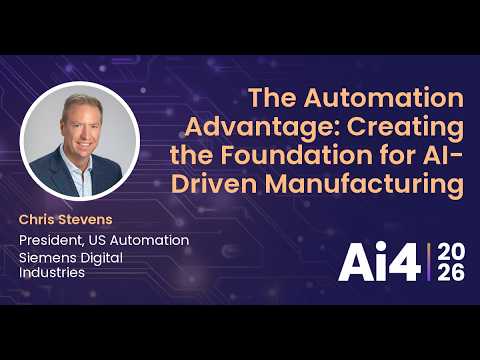
Siemens Urges Manufacturers to Pair AI With Deterministic Control Systems
Ai4
Industrial AI initiatives stall in production unless grounded in deterministic automation, verified digital twins, and robust grid capacity to handle rising energy demands.
## Background
This talk was delivered by Chris Stevens, President of US Automation at Siemens Digital Industries, published on YouTube by Ai4 on August 21, 2026. According to the page description, the session addresses why AI initiatives often stall in manufacturing and outlines how connected data, simulation, governance, and orchestration create the necessary foundation for trustworthy AI on the shop floor.
## TL;DR
The presentation highlights the massive scale of the U.S. manufacturing sector alongside critical resource challenges, including a projected shortage of over two million workers, rapidly shrinking skill half-lives, and severe power grid bottlenecks. While corporate leadership pressures plants for significant productivity gains, AI cannot operate effectively in high-stakes factory environments using probabilistic models alone. To bridge this gap, Siemens introduces the Digital Enterprise framework, which combines product and production digital twins with robust digital threads. This approach ensures that shop-floor AI meets essential requirements of determinism, engineering trust, and high performance while preserving strict cycle times and safety.
## Atmosphere & style
The presentation carries an authoritative yet approachable tone, opening with a high-stakes, cinematic framing of real-world manufacturing crises. The speaker uses vivid analogies—like calculating thousands of years of daily million-dollar payouts—to make astronomical economic figures tangible and grounded. It feels like an engaging, strategic executive briefing that balances serious operational warnings with optimistic, pragmatic solutions for the future of industrial automation.
## Key takeaways
- [01:05](https://www.youtube.com/watch?v=T4x7bAX8DDI&t=65s) U.S. manufacturing contributes $3 trillion to the economy, making operational and shop-floor challenges extremely high-stakes.
- [01:05](https://www.youtube.com/watch?v=T4x7bAX8DDI&t=65s) The manufacturing industry faces a projected shortage of 2.1 million to 2.5 million workers due to retirements and emerging growth industries.
- [01:05](https://www.youtube.com/watch?v=T4x7bAX8DDI&t=65s) The half-life of technical skills on the factory floor has shrunk from over 7 years to just 2.5 years, requiring continuous learning embedded in daily culture.
- [01:05](https://www.youtube.com/watch?v=T4x7bAX8DDI&t=65s) Power and power grid capacity have become major bottlenecks for AI expansion and modern manufacturing operations.
- [01:05](https://www.youtube.com/watch?v=T4x7bAX8DDI&t=65s) Data centers and industrial facilities are increasingly adopting peak shaving strategies to manage spiking energy demands.
- [05:21](https://www.youtube.com/watch?v=T4x7bAX8DDI&t=321s) Siemens defines the 'Digital Enterprise' by combining digital twins of product and production across both virtual and physical worlds.
- [05:21](https://www.youtube.com/watch?v=T4x7bAX8DDI&t=321s) Manufacturing requires strict determinism, where identical inputs always yield the exact same output, which creates tension with probabilistic AI.
- [05:21](https://www.youtube.com/watch?v=T4x7bAX8DDI&t=321s) AI recommendations must achieve engineering trust from floor operators and R&D engineers before being integrated into the control layer.
- [05:21](https://www.youtube.com/watch?v=T4x7bAX8DDI&t=321s) Shop-floor AI deployment must maintain strict operational performance without compromising cycle times or product quality.
## Detailed walkthrough
### [01:05](https://www.youtube.com/watch?v=T4x7bAX8DDI&t=65s) The $3 Trillion Manufacturing Challenge and Resource Gaps
Chris Stevens sets the scene by connecting with the audience over a familiar movie-like reality: in manufacturing, operational problems do not just appear quietly in a end-of-month report—they hit directly on the shop floor, impacting the bottom line and damaging crucial customer relationships. This is remarkably high-stakes given that U.S. manufacturing contributes $3 trillion to the economy. To contextualize that figure, Stevens notes that if a customer handed a manufacturer $1 million every single day, it would take over 8,000 years to reach $3 trillion.
However, major accelerating challenges threaten this sector:
* **Resource and Talent Shortages:** There is a projected gap of 2.1 million to 2.5 million manufacturing workers, calculated by factoring current capacity, future demand, retirements, and emerging growth industries.
* **Accelerating Skill Half-Life:** Tech introduced to the factory floor used to enjoy a 7+ year skill half-life. Today, that half-life has shrunk to just 2.5 years and continues to drop, requiring learning and development to be embedded into the daily culture.
* **The Power and Grid Bottleneck:** Speaking about insights from the National Association of Manufacturers (NAM), Stevens emphasizes that the two biggest hurdles for AI are chips and electricity. Between 2000 and 2020, minimal investments were made to the U.S. power grid, yet demand has spiked dramatically over the last six years. Data center companies are actively approaching Siemens to figure out "peak shaving" strategies to smooth out power demands and remain competitive.
---
[05:21](https://www.youtube.com/watch?v=T4x7bAX8DDI&t=321s) The Digital Enterprise: Bridging AI and Automation
While corporate boards and executives exert intense pressure to deliver productivity gains (often setting ambitious targets like 20%), AI cannot succeed on the shop floor without a solid foundation. Siemens approaches this via the "Digital Enterprise," combining digital twins of product and production across both virtual and physical worlds.
```
[ Digital Twin ] ─── (Product & Production Data)
│
▼
[ Digital Threads ] ─── (Model-Based Systems Engineering /
│ Smart Manufacturing Workflows)
▼
[ Role-Based Delivery ] ─── (Safe, Trustworthy Decisions)
```
To bridge the gap between AI and shop-floor automation—making the narrative a true "rom-com love story" between the two—manufacturers must focus on three core automation requirements:
1. **Determinism:** Industrial automation demands that a given set of inputs always yields the exact same output (for example, in high-risk environments like Detroit automotive stamping plants where unpredictability is dangerous).
2. **Engineering Trust:** Floor operators and front-end R&D engineers must trust AI-generated recommendations before those insights are permitted to touch the control layer.
3. **Performance:** Maintaining strict 9 to 11-second cycle times and uncompromising product quality.
---
[00:08:54
## Notable quotes
> [01:05](https://www.youtube.com/watch?v=T4x7bAX8DDI&t=65s) if a customer handed a manufacturer $1 million every single day, it would take over 8,000 years to reach $3 trillion. — Chris Stevens
> [01:05](https://www.youtube.com/watch?v=T4x7bAX8DDI&t=65s) Tech introduced to the factory floor used to enjoy a 7+ year skill half-life. Today, that half-life has shrunk to just 2.5 years and continues to drop — Chris Stevens
> [01:05](https://www.youtube.com/watch?v=T4x7bAX8DDI&t=65s) the two biggest hurdles for AI are chips and electricity. — Chris Stevens
> [05:21](https://www.youtube.com/watch?v=T4x7bAX8DDI&t=321s) Industrial automation demands that a given set of inputs always yields the exact same output — Chris Stevens
## Mentioned
Chris Stevens, Siemens Digital Industries, Siemens, National Association of Manufacturers, NAM, Digital Enterprise, Detroit
## Video description
Chris Stevens - President, US Automation, Siemens Digital Industries
Manufacturing is facing a convergence of challenges: workforce shortages, rapidly changing skills, rising energy demands, and an explosion of data. AI is often positioned as the answer. However, AI is inherently probabilistic, while manufacturing is a precision environment where shop floor decisions need to be deterministic. That tension is why so many AI initiatives stall between pilot and production.
This session explores what it takes to make AI trustworthy on the shop floor, and why that has less to do with smarter models and more to do with the foundation underneath them: connected data, simulation, governance, and orchestration.
In this session, you will learn:
• Why safety, reliability, and predictability are the prerequisites for AI-driven decision making in manufacturing
• How digital twins and simulation help manufacturers validate outcomes before changes impact production
• What orchestration means in practice and how it connects AI, people, and operational systems to enable trusted action at scale
Siemens' Chris Stevens argues that while artificial intelligence is pressured to deliver major productivity gains across the $3 trillion U.S. manufacturing sector, AI cannot succeed without first resolving critical resource bottlenecks and establishing deterministic automation foundations.
Macro Pressures: Labor Shortages and Power Constraints (1:05)
U.S. manufacturing faces severe operational headwinds that threaten shop-floor stability and customer commitments across the $3 trillion industry. Stevens highlights an estimated labor deficit of 2.1 million to 2.5 million workers, calculated by balancing existing capacity and retirement trajectories against accelerating demand and emerging growth industries. In addition, the effective half-life of factory-floor technical skills has dropped from over seven years to just 2.5 years, compelling manufacturers to integrate continuous training directly into workplace routines.
Physical infrastructure creates a parallel barrier to technological modernization. Drawing on findings from the National Association of Manufacturers, Stevens points to semiconductor supply and electricity as the primary bottlenecks for AI adoption. The U.S. power grid saw negligible investment between 2000 and 2020 despite a sharp surge in electricity consumption over the past six years, leading data center operators to consult Siemens on peak-shaving strategies to stabilize power usage.
Technical Requirements for Shop-Floor AI Integration (5:21)
Despite executive demands to secure productivity gains as high as 20%, Stevens asserts that artificial intelligence cannot be layered directly onto operations without an underlying automation framework. Siemens models this via a Digital Enterprise architecture, which bridges virtual designs and physical manufacturing through digital twins, model-based system engineering threads, and role-based data delivery.
To bridge AI with practical shop-floor execution, facilities must meet three rigid criteria: determinism, engineering trust, and cycle performance. High-risk operational environments, such as automotive stamping plants, require strict determinism—meaning identical inputs must always produce identical outputs. Consequently, plant operators and front-end research engineers must thoroughly trust AI outputs before autonomous decisions interact with industrial control layers, all while sustaining strict 9- to 11-second cycle times and preserving baseline product quality.
Stevens emphasizes that industrial AI implementation hinges on bridging high-level productivity demands with physical realities like electrical grid constraints, workforce retraining, and deterministic plant-floor controls. The source notes conclude before exploring how manufacturers can reconcile non-deterministic AI systems with the uncompromising predictability required on the factory line.
精炼阅读摘要
西门子(Siemens Digital)的 Chris Stevens 指出,美国制造业在面临人才缺口与电网瓶颈的同时承担着激进的生产力目标;若要将人工智能有效应用于工业制造,必须依托融合虚拟与实体的数字孪生架构,并恪守自动化对确定性、工程信任与生产节拍的硬性要求。
制造业的规模挑战与资源要素瓶颈 (1:05)
Chris Stevens 表示,美国制造业年贡献达 3 万亿美元,生产车间的运营问题会直接体现在现场,侵蚀利润并损害客户关系。然而,该领域正面临三大瓶颈:其一是劳动力短缺,综合考量现有产能、未来需求、员工退休及新兴行业扩张,预计制造业工人缺口将达 210 万至 250 万人;其二是技能半衰期急剧缩减,车间技术的技能半衰期已从过去的 7 年以上骤降至 2.5 年并持续下滑,迫使企业必须将培训融入日常文化。其三则是能源瓶颈,全美制造商协会(NAM)指出芯片与电力是 AI 面临的最大阻碍。2000 年至 2020 年间美国电网投资极低,而近六年电力需求激增,数据中心企业已开始寻求西门子等机构协助制定“削峰”策略以平衡用电负荷。
数字化企业架构与数据协同落地 (5:21)
尽管企业董事会与高管层施加了巨大的生产力增长压力(如普遍要求实现 20% 的提升指标),但 Stevens 认为,缺乏基础支撑的 AI 无法在制造车间落地。西门子主张通过“数字化企业”(Digital Enterprise)路径,将涵盖产品与生产的数字孪生体在虚拟世界与物理世界中深度结合。该架构借助基于模型的系统工程(MBSE)与智能制造工作流建立“数字主线”(Digital Threads),最终实现基于角色的交付机制(Role-Based Delivery),从而确保车间各环节能够在受控状态下做出安全、可靠的决策。
人工智能融入车间控制的三大底线 (5:21)
为真正弥合前沿 AI 技术与底层车间控制之间的隔阂,Stevens 强调工业场景必须满足三项核心自动化要求。首先是确定性(Determinism),系统对于给定输入必须产生完全一致且可预测的输出,这在底特律汽车冲压工厂等高危环境中是不可逾越的安全底线。其次是工程信任(Engineering Trust),在 AI 算法生成的优化建议触及控制层之前,现场操作人员与前端研发人员必须对其建立充分信任。最后是严格的性能表现(Performance),AI 介入后必须维持 9 至 11 秒的严苛生产节拍时间,且产品质量不能出现任何妥协。
Stevens 认为,制造业引入人工智能不是孤立的算法跃进,而是受制于电网容量不足与技能加速淘汰等现实条件。制造企业在追求 20% 效率增长的同时,必须在底层的数字孪生数据流与高风险控制层之间,坚守确定性、工程信任和严格节拍这三道自动化防线。
Detailed notes — zh
## Background
本内容由 Ai4 频道于 2026 年 8 月 21 日发布在 YouTube 上,演讲嘉宾为西门子数字化工业集团(Siemens Digital Industries)美国自动化业务总裁 Chris Stevens。视频重点探讨了制造业面临的人才短缺、技能半衰期骤降与能源瓶颈等严峻挑战,并阐明为何 AI 要在追求绝对确定性的车间生产中落地,关键不在于追求更复杂的模型,而在于构建连接数据、仿真验证、双通道治理与系统级编排的坚实工业底座。
## TL;DR
演讲直面美国制造业高达 210 万技能缺口与能源基础设施短缺的严酷现实,深入剖析了 AI 的概率推断本质与车间控制追求确定性之间的内在张力。西门子提出了以数字孪生和数字线程为基石的破局之道,阐明预测性、安全性和边缘可靠性是 AI 赋能产线的三大核心支柱。通过百事公司虚拟排查 90% 问题的实战与美国国防部双通道安全验证案例,Stevens 重点演示了如何通过工业级闭环编排将 AI 建议安全下发到底层 PLC 控制回路。最后,演讲强调利用 AI Agent 加速项目敏捷交付,将以人为本的用户采纳置于技术转型的核心位置。
## Atmosphere & style
整场演讲呈现出沉稳务实、富有工业洞察力且极具说服力的专业氛围。演讲者摒弃了对 AI 的盲目狂热与概念炒作,以厚重的工业制造底蕴和严谨的工程逻辑剖析现实瓶颈,将宏大复杂的架构拆解得举重若轻。现场讲述兼具战略远见与车间一线的烟火气,既有谈及冲压机床安全时的敬畏与笃定,也有运用交响乐编排比喻智能制造时的生动流畅,给观众带来一种脚踏实地、行稳致远的工程信任感与工业现代感。
## Key takeaways
- [01:05](https://www.youtube.com/watch?v=T4x7bAX8DDI&t=65s) 美国制造业面临严峻的人才挑战,行业存在约 210 万的技能缺口,且制造工程技能的半衰期已骤降至 2.5 年。
- [02:00](https://www.youtube.com/watch?v=T4x7bAX8DDI&t=120s) 算力与电力是 AI 落地的核心物理瓶颈,过去 20 年电网基础设施投资不足,使能源管理与削峰填谷成为工业智能化的重要前提。
- [04:55](https://www.youtube.com/watch?v=T4x7bAX8DDI&t=295s) 西门子数字化企业底座依托产品与生产的数字孪生体系,将虚拟与物理全生命周期的工业数据进行结构化沉淀。
- [05:35](https://www.youtube.com/watch?v=T4x7bAX8DDI&t=335s) 贯穿研发(MBSE)与生产运营的“数字线程”为 AI 注入工业上下文情境,使模型能向特定岗位精准推送可靠决策。
- [06:46](https://www.youtube.com/watch?v=T4x7bAX8DDI&t=406s) AI 模型本质上具有概率性,而车间控制严格要求百分之百的“确定性”,跨越这一张力是建立自动化工程信任的关键。
- [08:54](https://www.youtube.com/watch?v=T4x7bAX8DDI&t=534s) 预测性支柱:百事采用“数字优先设计”在工厂动工前利用数字孪生进行全真仿真,提前排查并解决了 90% 的潜在问题。
- [11:15](https://www.youtube.com/watch?v=T4x7bAX8DDI&t=675s) 安全性支柱:AI 提出的控制决策必须通过“双通道”机制校验,经由仿真、策略规则或人工介入审核后才允许执行。
- [12:45](https://www.youtube.com/watch?v=T4x7bAX8DDI&t=765s) 可靠性支柱:为满足毫秒级生产节拍与高频质检要求,AI 推理必须下沉部署至工业边缘端(Industrial Edge)以规避云端网络延迟。
- [14:24](https://www.youtube.com/watch?v=T4x7bAX8DDI&t=864s) 系统级工业编排(Orchestration)的核心在于穿透 IT 层壁垒,将顶层 AI 洞察安全闭环下发至底层 PLC 控制层执行物理动作。
- [16:41](https://www.youtube.com/watch?v=T4x7bAX8DDI&t=1001s) 通过引入 AI Agent 自动生成规范、业务梳理与测试环境,制造项目得以打破传统串行瀑布流,实现极短周期的敏捷交付。
- [17:35](https://www.youtube.com/watch?v=T4x7bAX8DDI&t=1055s) 数字化转型与 AI 落地的成败最终取决于一线人员的“用户采纳”(Adoption),尽早让操作员参与体验是组织变革管理的核心。
## Detailed walkthrough
### [01:05](https://www.youtube.com/watch?v=T4x7bAX8DDI&t=65s) 美国制造业的现实挑战与 AI 时代的基础设施瓶颈
对于制造业从业者而言,车间现场暴露的问题绝非一份报告上的简单数字,而是每天切身经历的现实,直接关系到底线利润与客户关系。美国制造业每年为国家经济贡献高达 3 万亿美元;如果一位超级客户每天消费 100 万美元,需要超过 8000 年才能达到这个体量。然而,如此庞大的产业支柱正面临着多重加速恶化的结构性挑战。首先是人才与技能短缺,全行业面临着高达 210 万的岗位技能缺口;伴随现场新技术的持续导入,以往一线操作工与制造工程师培训一次可胜任 7 年以上,如今技能的半衰期已骤降至 2.5 年甚至更短,终身学习已成为制造团队必须融入日常的基因。
除了人力缺口,算力与能源的短缺构成了 AI 落地的另一大物理瓶颈。在制造与算力领域,AI 的核心掣肘在于芯片与电力供应。从 2000 年到 2020 年的二十年间,美国电网基础设施几乎缺乏重大资本投资,而在过去数年内能源需求却呈现爆发式增长。这导致各大数据中心厂商纷纷向西门子寻求“削峰填谷”(Peak Shaving)与平滑能耗曲线的解决方案,以维持市场竞争力。西门子凭借横跨电网升级、工业建筑与基础设施、车间机床设备以及协调全流程的工业软件底座,构建了全局协同优势。在企业管理层和董事会普遍提出激进生产力提升目标(如董事长提出的 20% 生产力增长指标)的巨大压力下,AI 既是焦虑的来源,也是破局的答案,但其前提是具备坚实的基础设施支撑。
- **3 万亿美元**:美国制造业对国家经济的年度贡献规模。
- **210 万人**:根据现有产能、市场需求、退休潮及新兴产业测算的制造业人才技能缺口(部分咨询机构预估达 250 万)。
- **2.5 年**:制造工程技能的当前半衰期(过去长达 7 年以上且仍在进一步缩短)。
- **能源与算力挑战**:AI 的两大核心瓶颈是芯片与电力,电网在过去 20 年投资不足与近期需求暴增之间形成了巨大差距。
---
### [04:55](https://www.youtube.com/watch?v=T4x7bAX8DDI&t=295s) 数字化企业底座:数字孪生与数字线程赋能 AI
西门子多年来持续构建的核心体系被称为“数字化企业”(Digital Enterprise)。该理念的精髓在于建立产品与生产在虚拟世界与物理世界的“数字孪生”(Digital Twin),从而将复杂的工业数据在研发设计与车间生产全生命周期中结构化。单纯拥有数据并不足以支撑 AI 产生业务价值,必须配合承载业务流的“数字线程”(Digital Threads)——在工程研发端体现为基于模型的系统工程(MBSE),在运营制造端则体现为智能制造(Smart Manufacturing)。
这些数字线程充当了 AI 落地的强力催化剂。通过数字线程,系统能够在正确的时间、以正确的上下文背景(Contextualization),将 AI 模型与仿真方案直接推送给特定岗位的工程师或操作员,使团队能够以安全、可信、可靠的方式做出更快、更精准的决策。只有通过这种高质量、具备工业上下文的数据流持续喂养,AI 模型才能在产线上真正释放预期的性能。
```mermaid
flowchart LR
accTitle: 数字化企业数据与线程架构
subgraph DataFoundation ["数字孪生体系 (Digital Twin)"]
direction TB
A["产品数字孪生<br/>(虚拟设计/验证)"]
B["生产数字孪生<br/>(虚拟工厂/工艺)"]
end
subgraph DigitalThread ["数字线程贯通 (Digital Thread)"]
direction TB
C["研发工程: MBSE"]
D["制造运营: 智能制造"]
end
subgraph AIAction ["AI 上下文赋能与决策"]
direction TB
E["情境化工业数据"]
F["各岗位精准决策<br/>(安全/高可靠/实时)"]
end
DataFoundation --> DigitalThread
DigitalThread --> E
E --> F
```
---
### [06:46](https://www.youtube.com/watch?v=T4x7bAX8DDI&t=406s) AI 与自动化的张力:从概率推断到确定性控制
在传统的制造与自动化认知中,AI 往往不是工程师的第一选择。演讲者提出了一个核心观点——“AI 深度热爱自动化”(AI loves automation),但要将两者融为一体,必须跨越模型特征与工业底线之间的鸿沟。AI 模型本质上具有概率性,而车间自动化系统则严格遵循“确定性”(Determinism)。以底特律汽车工厂中巨大且具有潜在危险的重型冲压机床为例,控制系统面对一组特定的输入信号,必须百分之百产生绝对一致、分毫不差的输出动作。
此外,“工程信任”(Engineering Trust)构成了自动化部署的基石。无论是前端负责系统研发搭建的工程师,还是车间一线运维人员,在将 AI 给出的优化建议下发至底层控制回路(Control Layer)之前,都必须建立严格的信任机制。再者,制造业对性能与节拍时间(Cycle Time)有着极其严苛的要求:无论是 9 秒、10 秒还是 11 秒的严密节拍与产品质量公差,都容不得任何闪失。要将 AI 的灵活性与自动化的确定性结合成一场精彩的“工业爱情喜剧”,必须在预测性、安全性与可靠性三个核心维度架设坚实的桥梁。
---
### [08:54](https://www.youtube.com/watch?v=T4x7bAX8DDI&t=534s) 融合的三大支柱:预测性、安全性与边缘可靠性
第一大支柱是**预测性(Predictability)**,其关键载体是虚拟世界的数字孪生与仿真。百事公司(PepsiCo)的高级副总裁 Athena 在演讲视频中分享了百事采用“数字优先设计”(Digital-first design approach)与“数字孪生编排器”(Digital Twin Composer)的实践。在实体工厂破土动工、花费一分钱之前,百事就将海量数据导入统一的沉浸式高拟真环境中,利用 AI 驱动的仿真在虚拟空间中探索成百上千种产线布局,进行人体工学与物料流动验证。实践证明,百事在产线实际落地前,就在虚拟数字孪生中提前排查并解决了 **90% 的潜在问题**,使数字孪生从“可有可无”彻底变成了“必不可少”。
第二大支柱是**安全性(Safety)**。在工业自动化中,硬件与逻辑安全一直依赖于“双通道”(Two-channel)校验机制,只有两个独立通道均通过,系统才允许执行下一步动作。引入 AI 之后同样遵循该原则:AI 提出的任何优化建议或控制参数,必须通过第二通道进行严格校验——该通道可以是一套策略规则(Policy)、一次虚拟仿真验证,或者是人工介入(Human-in-the-loop)。美国国防部(DoD)的一项柔性制造与关键零部件本土化重塑项目中便全面应用了这一逻辑,在仅 12 个月的极短交付周期内,所有 AI 决策都置于双通道安全框架下运行。
第三大支柱是**可靠性(Reliability)**。虽然大语言模型与复杂神经网络通常运行于算力庞大的云端,但在制造业高频严苛的场景下(例如每天执行数千次的焊缝机器视觉质检),云端往返的网络延迟根本无法满足毫秒级生产节拍的要求。西门子将 AI 能力下沉部署至最靠近机床的“边缘端”(Industrial Edge),在边缘本地完成毫秒级的合格判定与分拣剔除动作,从而确保产线在极高节拍下依旧具备无可动摇的确定性与可靠性。
---
### [14:24](https://www.youtube.com/watch?v=T4x7bAX8DDI&t=864s) 闭环编排:将 AI 决策真正贯穿至底层控制层
如同经典电影在高潮时刻通过各种乐器的交响编排带来震撼体验,工业智能化的核心在于西门子所实现的“系统级编排”(Orchestration)。行业内多数厂商所讨论的编排往往局限在“横线之上”的企业 IT 层、报表仪表盘或独立的预测性维护模型之间;而西门子定义的编排,则是将顶层模型的推理洞察,安全穿透并转化为可直接下发至底层“控制层”(Control Layer)的物理执行动作。
以车间水质 pH 偏高的报警场景为例:AI 模型可能会生成多种调整策略,其中看似最简单直接的操作是“修改控制设定值(Set Point)”,而其他方案可能涉及更复杂的配比调整。通过西门子的工业编排体系,系统会同步调用数字孪生进行效果预测、通过双通道策略及仿真(或人工审核)进行安全性检验,并在边缘侧验证执行可靠性。在实际运行中,看似简单的“直接修改设定值”方案未能通过仿真与策略安全检验而被系统拦截,最终通过多重检验的合规方案被安全下发至 PLC 控制层执行,真正实现了智能与自动化的无缝闭环。
```mermaid
flowchart TD
accTitle: AI 决策下发至控制层的工业编排流程
Alarm["车间警报触发<br/>(例如: pH 值过高)"] --> AIModels["AI / 预测模型群<br/>(生成多种处理建议方案)"]
subgraph OrchestrationEngine ["西门子工业编排底座 (Orchestration)"]
direction TB
V1["预测性检验: 数字孪生仿真验证"]
V2["安全性检验: 双通道策略 / 人工介入"]
V3["可靠性检验: 边缘执行响应评估"]
end
AIModels --> OrchestrationEngine
OrchestrationEngine --> DecisionCheck{"校验是否通过?"}
DecisionCheck -- "未通过 (如简单修改设定值有风险)" --> Reject["拦截风险操作 / 报警提示"]
DecisionCheck -- "验证通过的可靠方案" --> ControlLayer["下发至底层控制层 (PLC / 执行机构)"]
```
---
### [16:41](https://www.youtube.com/watch?v=T4x7bAX8DDI&t=1001s) 加速交付与用户采纳:AI Agent 驱动的项目范式变革
在传统工业项目的交付路径中,规划与实施往往采用串行、关键路径分明的经典瀑布式项目计划,但在当前节奏飞速变化的转型浪潮中,传统交付模式已无法满足客户严苛的时间要求。为了在类似国防部 12 个月内完成整线重塑的极限工期中履约,西门子将 AI Agent(智能体)全面引入内部部署与交付流程中。通过 AI Agent 自动生成设备技术规范、梳理业务需求、辅助测试验证,并在极短时间内快速搭建运行环境与用户交互界面。
这种敏捷流程的核心目的在于尽早让一线操作员和工程师参与其中,“越早让他们亲手触摸、感知系统,我们获得的反馈就越准确、越有效”。西门子正全面拥抱“用户采纳”(Adoption)这一核心理念——如果现场人员不采纳新技术,任何前期规划的 ROI 和转型路线图都将沦为空谈。通过 AI 自动化加速工程实施,团队得以将更多精力投入到组织变革管理(OCM)与沟通赋能中。在数字化转型的剧本中,制造企业自身才是“总导演”,西门子致力于在企业所处的任何阶段提供支撑,共同决定这场工业智能化变革的圆满结局。
## Notable quotes
> [01:05](https://www.youtube.com/watch?v=T4x7bAX8DDI&t=65s) 技能的半衰期已骤降至 2.5 年甚至更短,终身学习已成为制造团队必须融入日常的基因。 — Chris Stevens
> [01:05](https://www.youtube.com/watch?v=T4x7bAX8DDI&t=65s) AI 既是焦虑的来源,也是破局的答案,但其前提是具备坚实的基础设施支撑。 — Chris Stevens
> [04:55](https://www.youtube.com/watch?v=T4x7bAX8DDI&t=295s) 单纯拥有数据并不足以支撑 AI 产生业务价值,必须配合承载业务流的“数字线程”。 — Chris Stevens
> [04:55](https://www.youtube.com/watch?v=T4x7bAX8DDI&t=295s) 只有通过这种高质量、具备工业上下文的数据流持续喂养,AI 模型才能在产线上真正释放预期的性能。 — Chris Stevens
> [06:46](https://www.youtube.com/watch?v=T4x7bAX8DDI&t=406s) AI 深度热爱自动化(AI loves automation),但要将两者融为一体,必须跨越模型特征与工业底线之间的鸿沟。 — Chris Stevens
> [06:46](https://www.youtube.com/watch?v=T4x7bAX8DDI&t=406s) AI 模型本质上具有概率性,而车间自动化系统则严格遵循“确定性”。 — Chris Stevens
> [08:54](https://www.youtube.com/watch?v=T4x7bAX8DDI&t=534s) 百事在产线实际落地前,就在虚拟数字孪生中提前排查并解决了 90% 的潜在问题,使数字孪生从“可有可无”彻底变成了“必不可少”。 — Athena
> [08:54](https://www.youtube.com/watch?v=T4x7bAX8DDI&t=534s) AI 提出的任何优化建议或控制参数,必须通过第二通道进行严格校验——该通道可以是一套策略规则、一次虚拟仿真验证,或者是人工介入。 — Chris Stevens
> [14:24](https://www.youtube.com/watch?v=T4x7bAX8DDI&t=864s) 西门子定义的编排,则是将顶层模型的推理洞察,安全穿透并转化为可直接下发至底层“控制层”的物理执行动作。 — Chris Stevens
> [16:41](https://www.youtube.com/watch?v=T4x7bAX8DDI&t=1001s) 越早让他们亲手触摸、感知系统,我们获得的反馈就越准确、越有效。 — Chris Stevens
> [16:41](https://www.youtube.com/watch?v=T4x7bAX8DDI&t=1001s) 如果现场人员不采纳新技术,任何前期规划的 ROI 和转型路线图都将沦为空谈。 — Chris Stevens
> [16:41](https://www.youtube.com/watch?v=T4x7bAX8DDI&t=1001s) 在数字化转型的剧本中,制造企业自身才是“总导演”,西门子致力于在企业所处的任何阶段提供支撑,共同决定这场工业智能化变革的圆满结局。 — Chris Stevens
## Mentioned
Chris Stevens, 西门子 (Siemens), 西门子数字化工业软件 (Siemens Digital Industries), 百事公司 (PepsiCo), Athena, 美国国防部 (DoD), 数字化企业 (Digital Enterprise), 数字孪生 (Digital Twin), 数字线程 (Digital Thread), 数字孪生编排器 (Digital Twin Composer), 基于模型的系统工程 (MBSE), 智能制造 (Smart Manufacturing), 工业边缘 (Industrial Edge), PLC (可编程逻辑控制器), AI Agent (智能体)
## Video description
Chris Stevens - President, US Automation, Siemens Digital Industries
Manufacturing is facing a convergence of challenges: workforce shortages, rapidly changing skills, rising energy demands, and an explosion of data. AI is often positioned as the answer. However, AI is inherently probabilistic, while manufacturing is a precision environment where shop floor decisions need to be deterministic. That tension is why so many AI initiatives stall between pilot and production.
This session explores what it takes to make AI trustworthy on the shop floor, and why that has less to do with smarter models and more to do with the foundation underneath them: connected data, simulation, governance, and orchestration.
In this session, you will learn:
• Why safety, reliability, and predictability are the prerequisites for AI-driven decision making in manufacturing
• How digital twins and simulation help manufacturers validate outcomes before changes impact production
• What orchestration means in practice and how it connects AI, people, and operational systems to enable trusted action at scale
[Source](https://www.youtube.com/watch?v=T4x7bAX8DDI)
Source quotes
[1:05] Chris Stevens: 技能的半衰期已骤降至 2.5 年甚至更短,终身学习已成为制造团队必须融入日常的基因。
[1:05] Chris Stevens: AI 既是焦虑的来源,也是破局的答案,但其前提是具备坚实的基础设施支撑。
[4:55] Chris Stevens: 单纯拥有数据并不足以支撑 AI 产生业务价值,必须配合承载业务流的“数字线程”。
[4:55] Chris Stevens: 只有通过这种高质量、具备工业上下文的数据流持续喂养,AI 模型才能在产线上真正释放预期的性能。
[6:46] Chris Stevens: AI 深度热爱自动化(AI loves automation),但要将两者融为一体,必须跨越模型特征与工业底线之间的鸿沟。
[6:46] Chris Stevens: AI 模型本质上具有概率性,而车间自动化系统则严格遵循“确定性”。
[8:54] Athena: 百事在产线实际落地前,就在虚拟数字孪生中提前排查并解决了 90% 的潜在问题,使数字孪生从“可有可无”彻底变成了“必不可少”。
[8:54] Chris Stevens: AI 提出的任何优化建议或控制参数,必须通过第二通道进行严格校验——该通道可以是一套策略规则、一次虚拟仿真验证,或者是人工介入。
[14:24] Chris Stevens: 西门子定义的编排,则是将顶层模型的推理洞察,安全穿透并转化为可直接下发至底层“控制层”的物理执行动作。
[16:41] Chris Stevens: 越早让他们亲手触摸、感知系统,我们获得的反馈就越准确、越有效。
[16:41] Chris Stevens: 如果现场人员不采纳新技术,任何前期规划的 ROI 和转型路线图都将沦为空谈。
[16:41] Chris Stevens: 在数字化转型的剧本中,制造企业自身才是“总导演”,西门子致力于在企业所处的任何阶段提供支撑,共同决定这场工业智能化变革的圆满结局。
Source quotes
[1:05] Chris Stevens: if a customer handed a manufacturer $1 million every single day, it would take over 8,000 years to reach $3 trillion.
[1:05] Chris Stevens: Tech introduced to the factory floor used to enjoy a 7+ year skill half-life. Today, that half-life has shrunk to just 2.5 years and continues to drop
[1:05] Chris Stevens: the two biggest hurdles for AI are chips and electricity.
[5:21] Chris Stevens: Industrial automation demands that a given set of inputs always yields the exact same output
Original transcript
[0:00] Heat.
[0:20] Heat.
[0:24] Heat. [music]
[0:45] [music]
[0:45] [music]
[0:45] Heat.
[0:50] [music]
[0:58] [music]
[1:05] Can you guys hear me? Okay, it's good. Yeah. So,
for those of us in manufacturing, that should look
[1:12] pretty familiar. That's a movie that we are
in every single day. And so a problem doesn't
[1:20] just show up in a report somewhere. A problem
actually shows up in the shop floor. It can
[1:25] affect our bottom line and more importantly affect
our customer relationships. The reason why that's
[1:33] significant is look how much the US manufacturing
contributes to the US economy. $3 trillion.
[1:43] So, just to put that in perspective, if this nice
gentleman right here was my best customer and gave
[1:49] me a million dollars a day, it would take over
8,000 years to reach three $3 trillion. That's
[1:55] major. That's very impactful. And there's a lot of
issues or challenges that's affecting that number.
[2:04] They're not new, but they are accelerating. this
idea of a skilled or idea of gap in resources 2.1
[2:13] million gaps in resources and the way they came
up with that number is they looked at the initial
[2:18] capacity today they looked at the demand they
looked at um retirement they looked at some of
[2:23] the emerging growth industries and that's how they
came up with that number and in some consultants
[2:28] that number is actually greater than that 2.5
half-life used to be seven plus years the good
[2:36] news is there's a lot of technology technology is
being delivered to the shop floor. What that means
[2:42] is when we deliver this technology to the shop
floor, we used to be able to train some of our
[2:46] operators, some of our manufacturing engineers,
they were good for seven years. Now it's 2.5 and
[2:52] it's decreasing. So learning and development has
to be in our DNA every single day and week. And
[2:58] I'll come to I'm sure you guys have already talked
about this in great lengths with all the different
[3:03] sessions here when it comes to data and data
contextualization, but I'll come to that here in a
[3:07] minute. I was at the uh nano national association
of manufacturing with a lot of my colleagues
[3:14] in manufacturing across the US. Uh one of our
partners got up on stage and talked about this
[3:20] idea of electricity and the gap in electricity. I
thought that was extremely interesting because I'm
[3:26] sure you've already heard this, but the two major
challenges with AI is chips and electricity. And
[3:34] if you look at the gap that exists in the US,
that doesn't get any better in the next couple
[3:41] decades. The reason for that is for many years for
basically between 2000 and 2020, we didn't make
[3:49] any significant investments to the grid. And just
in the last six years, we saw that demand climb
[3:55] rapidly as I'm sure you guys have seen. And so
Seammens has a unique position here. If you look
[4:03] at Seammens across the board, we understand
the grid. We can make enhancements, upgrades.
[4:09] We understand the building, the infrastructure
that surrounds the building. We understands the
[4:14] machines in the building. And we of course have
all the software that coordinates and orchestrates
[4:19] all that across the grid, the building and the
machines within the building. And sometimes our
[4:26] customers are connecting the dots faster than
we are quite frankly. I mean we have a lot of
[4:30] the different data center companies come to us and
saying seamans help please help us with this idea
[4:34] of peak shaving. How do we smooth out these energy
demands? Because they have to right it's it's a
[4:41] necessity. They have to figure out this formula or
they won't be able to compete. and eventually be
[4:46] replaced. So, as you can see, AI is definitely
the pressure and any customer we go to, if you
[4:56] talk to the executives, you talk to the boards,
they're also applying a lot of pressure to the
[5:00] organizations saying we need to do more. We have
a productivity number out there. Our chairman said
[5:06] 20%. as an example. So a lot of other companies
are doing the same thing. But of course AI is
[5:13] applying a lot of pressure but in many many many
cases it's also the answer assuming you have that
[5:21] right foundation. Now the good news is Seammens
has been talking about this been delivering on
[5:28] this for many many years. It's what we call the
digital enterprise. So simply put digital twin of
[5:35] product and production both virtual and physical
world and so that's now the data that I talked
[5:41] about just a few minutes ago. So this would help
structure our data around product and production.
[5:47] What's also important is workflow. So there's an
idea of what we call digital threads. So the way
[5:53] we engage with our customers is the around digital
threads. So for engineering as an example we
[5:59] talk about modelbased systems engineering. On the
operations side, we talk about smart manufacturing
[6:05] and how can we ensure success through that digital
thread with all our customers. Also, in the last
[6:11] few years, this has been a huge catalyst for
us when it comes to AI. So, what we're doing
[6:17] with these digital threads is we're pre presenting
these models or these solutions that come from the
[6:22] models to different roles in the companies when
they need it. so they can make faster decisions,
[6:28] better decisions, more accurate decisions
in a safe, reliable manner. So that gives
[6:35] us the data and the data contextualization
that's needed. So when you feed these models,
[6:39] you'll get the performance that you're hoping and
you set out for initially when you deployed them.
[6:46] Okay? So typically when you think of manufacturing
and you think of automation, you don't necessarily
[6:52] think of AI or at least it's not the first use
case that comes to your mind. What I'm here to
[6:58] convince you of is what we like to say is AI
loves automation. I don't think I need to go
[7:06] through the AI piece. I think you guys have heard
that in exhaustion the left side. Flexibility,
[7:11] productivity gains, all that good stuff. What I'm
going to spend a little time with you is this idea
[7:16] of automation and how we want to bridge that gap
between AI and automation. So the first term we
[7:23] use a lot is determinism. So what does that mean?
It means we have a set of inputs that come in
[7:29] and we always want the same output. And I live in
Detroit. So if you go through an automotive plant,
[7:37] you see some pretty scary stamping machines that
are coming on stamping parts and then moving them
[7:42] on. You got you want to make sure you have the
same output when you're working with some of those
[7:46] machines. So that's very important when it comes
to automation. Engineering trust is extremely
[7:52] important when it comes to automation. Of course,
there's engineers that are in the front end on the
[7:57] R&D side setting up these different systems, these
processes. So there needs to be trust with that
[8:02] group. but also when it comes to the shop floor.
So again, if AI is going to make some suggestions,
[8:08] we have to make sure it has the trust of those
engineering skills before we apply that to the
[8:13] control layer. And then of course performance.
So performance is not just numbers. Uh cycle
[8:22] time as an example is extremely important when it
comes to manufacturing. That 9-second, 10-second,
[8:28] 11sec cycle time is extremely important that we
ensure that. but also quality. So these are the
[8:34] areas that we need when it comes to automation.
So now, how do we bridge that gap between AI and
[8:42] automation? And how do I make this movie some
kind of love story here for you? Because I know
[8:47] you guys all like romcoms. So I'm getting there.
So we'll go through three different scenes. The
[8:54] first one that we're the bridge that we're
going to gap here is around predictability.
[9:02] used to. Okay. When it comes to predictability, we
like to talk about the digital twin in a virtual
[9:11] world. And we work with a lot of our customers
that define many different use cases, ergonomic
[9:17] studies, material flow, all the different things
you can think of when it comes to production that
[9:21] you're doing in a digital twin in a virtual
world. Just seven months ago, our chairman
[9:28] shared the stage with many of our customers
and PepsiCo is one of those and they have a
[9:34] fantastic story around what they're doing with the
digital twin. Athena got up on stage and instead
[9:39] of me trying to replicate exactly what she said,
I thought I'd take a minute and play that video.
[9:46] What we wanted to do is adopt a digital first
design approach and that means leverage digital
[9:54] twins and adopting AI at scale in all the
parts of the operations where we were able
[9:59] to co-design and simulate and optimize the layout
before any physical build begins. So the digital
[10:08] twin composer allows us to do everything in the
virtual world being able to simulate everything
[10:15] in a way where we don't have to spend a single
dollar on the physical plant before we know the
[10:21] design is the final design. So therefore we are
able to pull now massive amounts of data that
[10:27] we are able to simulate in a unified immersive
environment. That means we can create a beautiful
[10:34] photo realalistic way which you saw before in the
discussion and with the AI powered simulation now
[10:40] we can explore hundreds or thousands of potential
layouts to find the most efficient options.
[10:51] She always does a fantastic job. That's why I
always play that video going through what the
[10:55] capabilities are. In fact, what she goes on to
say is it's not a nice to have anymore. It's a
[11:00] mustave. So there's nothing that we do in a plant
that we don't start in a digital twin. And we
[11:05] talked about predictability. There's nothing that
screams louder than that 90% number. And that's
[11:11] the potential issues that were identified
before it actually hit the shop floor using
[11:15] that digital twin. So some remarkable results
there from PepsiCo. I don't know about you,
[11:21] but I already feel a little bit safer. But
we'll get into this idea of safety. So again,
[11:26] when I talk about those plants, you talk about
those major machines, safety is the first thing
[11:30] that comes through our head when it comes to the
operators. We want to make sure that they're safe.
[11:35] Again, I'll put my automation hat on just for
a second. Uh when it comes to automation, we're
[11:39] always talking two channels. There's always this
kind of check and balances with the two different
[11:43] channels. So if those channels both pass, then
we say yes, go on to the next station. With AI,
[11:52] as we induce AI automation, it's no different. So
as we have these suggestions or these solutions
[11:57] or these possibilities, we always want to check
that with another channel whether it's policy,
[12:03] whether it's a simulation or whether it's a
human. So that's how we get this safety that we're
[12:08] talking about. Another customer example um is
from a Department of Defense modernization program
[12:15] that we're very excited about. The announcement is
going to come out in a couple of days. But when we
[12:20] look at what they asked us to do around flexible
and adaptable manufacturing and reshore some of
[12:26] those capabilities here for some key components
that that's needed for them. Everything we talked
[12:32] about, everything we're doing as part of this
program starts with predictability, starts with
[12:35] the digital twin, starts with validation. We
put AI everywhere that we can because of the
[12:41] time frame that's needed. This 12-month window
is pretty short. And of course, everything we do
[12:46] is around safety. So this whole twochannel
po approach, not only with the operators,
[12:50] but also with with the engineers in mind. So
we're very excited about this. You'll see more
[12:55] of that here in the next couple days. So talked
about predictability, we talked about safety. Now
[13:03] let's talk about reliability. So typically
when we talk about large language models,
[13:09] we kind of think of those in the cloud, right?
Because the computation power that's needed.
[13:14] Well, again, when it comes to manufacturing,
there's certain adaptable capabilities that we
[13:18] can deploy like visual inspection. However, to do
that, we do over a thousand a day. So, the speed
[13:23] that we need to do this visual inspection doesn't
work in the cloud. We can't handle the round trip
[13:27] that it takes to go to the model and come back.
So, we have to go closer to the machine. It's
[13:32] what we call in the edge. So, we want to bring
these capabilities to the edge, closest to the
[13:37] machine. So when it goes back and validates to the
model and says yes it's a pass this welds a pass
[13:42] or this weld's a fail it knows exactly what to do
it pushes it aside or moves it along but to get
[13:48] that speed and that response time we need we bring
bring those capabilities to the edge we can't do
[13:52] that in the cloud and that's when we talk about
reliability that's what we mean by reliability.
[14:00] So hopefully you can the pictures start making
more sense. This romcom is starting to become
[14:05] a little clear is through predictability,
through safety, and through reliability,
[14:12] you can now see why AI loves automation. So
since we're talking about a movie and a film,
[14:24] best part of the movie, right, is that point
in the movie where all the story lines come
[14:28] together and there's that climax in the scene
and what usually encomp it's all in embodied
[14:34] with that scene is music and what happens is
pure orchestration with some a lot of different
[14:40] instruments that allows that that powerful
piece of music. Well, that's what Semens
[14:46] does with all these different capabilities that
we talked about is provides that orchestration.
[14:54] So
[14:57] when we talk about all these different
capabilities, when you go to the next
[15:00] section and talk about another model, another
predictive maintenance model that can that can
[15:04] affect or help you talk about another dashboard,
we talk about another enterprise system,
[15:09] we have all these capabilities and what most
people when most people talk about orchestration,
[15:13] it's kind of above that line, right? It's
orchestration in this kind of enterprise
[15:17] layer. When we talk about orchestration,
it's how do we take those capabilities,
[15:22] make some valuable decisions and apply that
down to the control layer. So that's actually
[15:29] creating action to update the control layer.
That's pure orchestration for us when it comes
[15:34] to manufacturing. So, just to give you an idea of
what that looks like, uh, if we have an alarm and
[15:42] that alarm is say your pH levels are too high. So,
the first thing we want to do is go to all these
[15:48] great models that you've been learning about over
the last couple days. And these models are going
[15:52] to give you some suggestions. Some seem pretty
relatively easy, like just change the set point.
[15:58] Um, others may be a little bit more involved. But
the whole idea is we want to orchestrate all those
[16:04] things I talked about predictability. So we're
going to implement this idea of a digital twin
[16:09] safety. So this two channel approach we're going
to introduce maybe the human in the loop and then
[16:13] of course reliability. We have to ensure that we
get the reliability that we want before we take
[16:17] action on that control layer. So in this case
what actually happened is everything else that
[16:23] we thought maybe were a little bit more difficult
is what was actually approved and actually moved
[16:27] down to the control layer. we thought did not pass
those tests. So whether it was through policy or
[16:33] simulation or human in a loop just changing that
set point didn't work in this particular case.
[16:41] So that's what we mean by orchestration. Now
in every customer journey that we're on when
[16:47] we get to a point where they get very excited
about our technology they get very excited about
[16:51] our possibilities the question I always get
asked is what's next? What is the next step?
[16:58] I love your vision. what's the roadmap that
allows us to get there. We talk about return
[17:04] on investments of course and we talk about
what is the real ROI for phase one, phase two,
[17:08] phase three and typically we lay out a plan that
we both agree to. We start executing this plan.
[17:17] Traditionally or historically what we've done is
taken a very traditional project plan approach.
[17:22] So this should look pretty familiar, somewhat
serial, definitely kind of critical path if you
[17:28] look at it. But unfortunately in the past and
if you look at the way this transformation is
[17:32] happening and how fast it's happening, this no
longer made sense. We couldn't accomplish what
[17:38] the customer needed in the time frame that they
needed it. I talked I told you about bringing
[17:42] all those capabilities in in a 12-month window.
That's incredible. And the only way we're going
[17:47] to do that is actually apply AI internally to our
deployment process. And so we are using agents
[17:55] internally to create machine specifications
to create requirements. We want to make sure
[17:59] we validate using these agents as well. We set
up environments, we set up systems, we set up
[18:06] uh user interfaces very very quickly because we
want to get the user involved as fast as possible
[18:14] because we know the faster we involve them, the
faster we allow them to touch and feel the system,
[18:19] the better response we're going to get and the
more accurate response we're going to get. And
[18:23] ultimately for us, this is somewhat of a new word
for Seammens, but it's something we're embracing
[18:28] every single day is this idea of adoption.
That is critical because if you don't adopt
[18:33] our technology, you don't get the value that we
set out on originally in that ROI and that roadmap
[18:37] that we talked about. So adoption is something
that's is key to us. It's something we're focused
[18:42] on every single day because we could do these
other areas much faster. um we can focus on
[18:47] organizational change management, communication,
all the things that um are important to adoption.
[18:53] So, back to our romcom, as you can see, the future
doesn't wait. I'm sure you've heard that. You
[19:00] heard that in the keynote this morning. You heard
at all the other sessions. Seammens wants to be a
[19:04] part of your journey. And we always say we love to
meet the customer where they're at. No matter how
[19:09] large of a project or small of a project, we want
to be a part of that movie that you're building.
[19:14] And the cool thing about the movie you're building
is you're the director and you get to you get to
[19:18] decide how that ends. So, thank you for your
time. I really appreciate it and enjoy lunch.
[19:25] [applause]