## Background
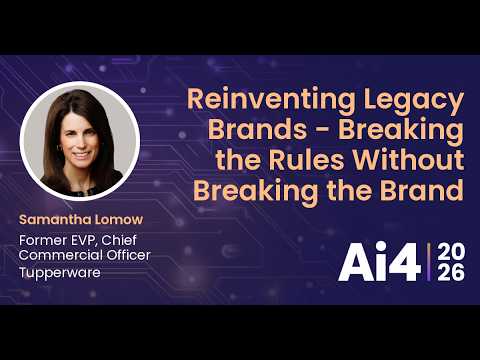
This presentation was published on YouTube by Ai4 on August 14, 2026. The page description introduces speaker Samantha Lomow, former EVP and Chief Commercial Officer at Tupperware, as she shares candid stories and practical insights on transforming legacy brands, navigating AI in established organizations, and helping teams embrace change following Tupperware's bankruptcy.
## TL;DR
Samantha Lomow explores how legacy brands like Hasbro, Foot Locker, and Tupperware struggle not because of their age, but due to outdated internal rules and invisible organizational friction. She explains that AI acts as a mirror that exposes underlying human and structural issues rather than creating them. By using AI to leapfrog tech debt, digitize decades of legacy assets, and create safe operational playgrounds for rapid experimentation, organizations can foster human curiosity. Ultimately, Lomow challenges leaders to question long-standing corporate assumptions to successfully reinvent their businesses.
## Atmosphere & style
The presentation carries an engaging, pragmatic, and insightful tone, blending executive expertise with lighthearted humor—such as Lomow sharing how an AI tool dubbed her a 'therapist for billion-dollar legacy brands.' The narrative moves smoothly from diagnosing high-level corporate identity crises to sharing candid, practical lessons from post-bankruptcy Tupperware. It feels empowering and thought-provoking, inspiring leaders to break outdated rules and cultivate a culture of curiosity and safe experimentation.
## Key takeaways
- [00:04](https://www.youtube.com/watch?v=35Dsa0cGxcA&t=4s) Lomow's AI bio jokingly labeled her a "therapist for billion-dollar legacy brands," reflecting how companies seek guidance during severe identity crises.
- [00:04](https://www.youtube.com/watch?v=35Dsa0cGxcA&t=4s) Core transformation truth: Brands and business models don't get tired; unwritten organizational rules do.
- [02:38](https://www.youtube.com/watch?v=35Dsa0cGxcA&t=158s) Legacy brands like Hasbro, Foot Locker, and Tupperware struggled not because they were old, but because they remained optimized for yesterday's realities.
- [04:55](https://www.youtube.com/watch?v=35Dsa0cGxcA&t=295s) AI does not create organizational friction; it exposes long-standing human and structural flaws such as low trust, slow approvals, and fear of failure.
- [04:55](https://www.youtube.com/watch?v=35Dsa0cGxcA&t=295s) Organizational friction is evident in widespread change fatigue (nearly 75%), $10 trillion in global disengagement costs, and an 81% vs. 53% gap in leader vs. employee perceptions of AI adoption.
- [04:55](https://www.youtube.com/watch?v=35Dsa0cGxcA&t=295s) Responsible transformation requires balancing innovation with governance to protect customer trust and data privacy while eliminating procedural bloat.
- [06:44](https://www.youtube.com/watch?v=35Dsa0cGxcA&t=404s) Post-bankruptcy, Tupperware used AI to bypass tech debt, mapping internal workflows and digitizing decades of data, photography, and catalogs.
- [06:44](https://www.youtube.com/watch?v=35Dsa0cGxcA&t=404s) AI was applied strategically at Tupperware to modernize customer support, maintaining high-touch human interaction where essential.
- [09:26](https://www.youtube.com/watch?v=35Dsa0cGxcA&t=566s) Transformation relies on leaders granting permission to question assumptions and introducing productive friction with bold questions.
- [13:03](https://www.youtube.com/watch?v=35Dsa0cGxcA&t=783s) Lowering the cost of failure by creating safe corporate "playgrounds" for low-stakes AI experimentation accelerates innovation and learning loops.
- [13:03](https://www.youtube.com/watch?v=35Dsa0cGxcA&t=783s) Tupperware combined AI with human creativity to simulate customer perspectives and rapidly validate product ideation.
- [15:27](https://www.youtube.com/watch?v=35Dsa0cGxcA&t=927s) Leaders can spark reinvention by dedicating meeting time to identifying and questioning outdated rules, approvals, and assumptions.
## Detailed walkthrough
### [00:04](https://www.youtube.com/watch?v=35Dsa0cGxcA&t=4s) AI as a "Therapist" for Billion-Dollar Legacy Brands
Samantha Lomow opens her talk by asking the audience a pointed opening question: "where does your organization know it needs to change, but it hasn't?" She prompts attendees to keep that answer in mind. When introducing herself, she shares a humorous anecdote about asking an AI tool for help writing her bio. Rather than suggesting typical buzzwords like "transformation executive" or "growth innovation catalyst," the AI diagnosed her role directly: "Tell them your name's Samantha Lomow, and that you're essentially a therapist for billion-dollar legacy brands." She acknowledges that this description hits surprisingly close to home, as companies usually reach out to her in the middle of severe identity crises.
When legacy companies reach out, their leadership typically asks questions like, "Is our brand even still relevant?" or "Why aren't customers responding the way they used to?" Lomow clarifies that these are not true therapy questions, but fundamental leadership questions. Over her career, she has uncovered core truths about business transformation: customers change first, and companies do not have identity crises—leaders do. Organizations do not resist change—people do; and technology alone does not transform companies—people do.
- **Mentor's Insight:** Years ago, a mentor shared a perspective that has guided every transformation in her career: "Brands and business models don't get tired. Rules do."
- **Customer Reality:** Customers do not care about internal corporate obstacles; they only experience the ultimate product or service result.
[02:38](https://www.youtube.com/watch?v=35Dsa0cGxcA&t=158s) Breaking Invisible Rules: Hasbro, Foot Locker, and Tupperware
Reflecting on 25 years of experience across Hasbro, Foot Locker, and Tupperware, Lomow notes that despite operating across wildly different industries and business models, the underlying transformation story remains identical. Legacy brands do not struggle because they are old; they struggle because they are optimized for yesterday's realities. Every organization accumulates unwritten rules, processes, and approvals that people follow blindly without questioning, creating severe invisible friction.
- **Hasbro:** The invisible rule was "we're a toy company." Over 20 years ago, the major breakthrough was realizing Hasbro was an intellectual property company that happened to make toys, unlocking massive global franchises like the *Transformers* movie series.
- **Foot Locker:** The core rule was "double down on Nike." While this strategy drove past success, it eventually limited growth when customer preferences evolved and new sneaker brands emerged.
- **Tupperware:** An 80-year-old brand whose identity was deeply tied to the traditional Tupperware party. While consumer shopping habits shifted dramatically, the internal rule stayed rigid for decades.
[04:55](https://www.youtube.com/watch?v=35Dsa0cGxcA&t=295s) AI Exposes Organizational and Human Friction
Addressing AI as the "elephant in the room," Lomow argues that AI does not create organizational friction; it reveals it. AI makes long-standing organizational flaws impossible to ignore: low trust in corporate leadership, slow approval processes, or a culture that fears failure. The true hurdle in digital transformation is human and structural, not technical.
- **Change Fatigue:** Citing Gartner, Lomow highlights that nearly 75% of employees are experiencing change fatigue.
- **Cost of Disengagement:** Citing Gallup, global employee disengagement costs the economy roughly $10 trillion annually.
- **Belief Gap:** Research from Oxford, Stanford, and BetterUp reveals that 81% of senior leaders believe their organizations are embracing AI augmentation, whereas only 53% of employees agree.
- **Responsible Governance:** Lomow emphasizes that innovation without governance is not leadership. Responsible experimentation requires clear boundaries to protect customer trust, data privacy, and ethics, while stripping away unnecessary procedural bloat.
[06:44](https://www.youtube.com/watch?v=35Dsa0cGxcA&t=404s) Lessons from Tupperware's Post-Bankruptcy Reinvention
Lomow outlines how Tupperware utilized AI to leapfrog years of legacy tech debt following its bankruptcy filing. The restructuring forced the company to stop looking inward and focus back on the consumer, who was discovering products across diverse non-party channels. However, before AI could generate value, Tupperware had to conduct deep foundational work across workflows, assets, and employee culture.
- **Workflow & Approval Mapping:** Tupperware mapped out how work actually moved through the company, questioning how many hand-offs and management approvals were required before a decision reached the end consumer.
- **Data & Asset Digitization:** Before AI could write marketing copy or generate creative assets, the company had to clean years of consumer data and digitize decades of physical photography, recipes, product catalogs, and brand collateral.
- **Customer Experience & High-Touch Balance:** AI was implemented to reduce wait times and modernize support, but leaders were transparent about where AI speed was appropriate versus where high-touch human support was required.
[09:26](https://www.youtube.com/watch?v=35Dsa0cGxcA&t=566s) Fostering Curiosity: Turning an 80-Year-Old Brand into a Startup
When internal friction was removed at Tupperware, the company culture shifted from defensive preservation to creative redesign. AI transformed from a tech tool into an amplifier for human curiosity, giving teams time back to solve actual customer problems instead of managing internal bureaucracies.
- **Leadership as Permission:** Transformation relies on leadership creating room to question long-held assumptions. Lomow notes that in the age of AI, competitive advantage comes from asking better questions rather than simply having answers.
- **Productive Friction:** Leaders must introduce productive friction by posing bold questions, such as: "If our best customer disappeared tomorrow, what would we do?" or "What are we protecting that the market no longer values?"
[13:03](https://www.youtube.com/watch?v=35Dsa0cGxcA&t=783s) Creating Organizational "Playgrounds" for Low-Stakes Experimentation
To overcome corporate risk-aversion, Lomow advocates for bringing "play" back into business operations—not through breakroom foosball tables, but by creating safe "playgrounds" where employees can experiment before real-world stakes apply. Observing that five-year-olds experiment naturally until corporate structures bury their curiosity, she explains that lowering the cost of failure directly raises organizational curiosity.
- **Tupperware Simulation:** Using AI combined with human creativity, Tupperware teams ideated product concepts, simulated international customer perspectives, and rapidly tested which ideas deserved innovation pipeline funding.
- **Fast Learning:** Focusing on low-stakes, rapid-learning loops allowed Tupperware to eliminate unnecessary developmental steps and prove that the organization could innovate faster with less friction.
[15:27](https://www.youtube.com/watch?v=35Dsa0cGxcA&t=927s) The Meeting Agenda Challenge and Free "Rule Therapy"
Lomow closes her address with a concrete challenge for organizational leaders to bring back to their next team meeting. Instead of reviewing standard action items, she advises replacing one item with a single powerful question to name the "elephant" in the room: "What's one rule, one approval, one meeting, or one assumption that we follow simply because we always have?" Leaders should listen without immediately defending or solving the rule. She asks leaders to consider: "If today's customer built this company, would they design it this way?" If the answer is no, that is precisely where reinvention begins.
- **Interactive QR Code Survey:** Lomow invites the audience to participate in 30 seconds of "free rule therapy" by scanning a QR code to rate their organization's readiness to break rules, share takeaway insights, and submit a "better question" for a collaborative leader playbook.
- **Closing Remarks:** Expressing gratitude to the audience and the conference organizers at Ai4, Lomow leaves the room with her core thesis: "Brands don't get tired, the rules do."
<FollowUp label="Want to explore Tupperware's specific AI workflow redesigns in detail?" query="Can you walk through the exact steps and workflow changes Tupperware implemented to digitize brand assets and streamline approval processes with AI?"/>
## Notable quotes
> [00:04](https://www.youtube.com/watch?v=35Dsa0cGxcA&t=4s) where does your organization know it needs to change, but it hasn't? — Samantha Lomow
> [00:04](https://www.youtube.com/watch?v=35Dsa0cGxcA&t=4s) Tell them your name's Samantha Lomow, and that you're essentially a therapist for billion-dollar legacy brands. — Samantha Lomow
> [00:04](https://www.youtube.com/watch?v=35Dsa0cGxcA&t=4s) Brands and business models don't get tired. Rules do. — Samantha Lomow
> [02:38](https://www.youtube.com/watch?v=35Dsa0cGxcA&t=158s) We're a toy company.
> [02:38](https://www.youtube.com/watch?v=35Dsa0cGxcA&t=158s) Double down on Nike.
> [02:38](https://www.youtube.com/watch?v=35Dsa0cGxcA&t=158s) Sales = Tupperware party
> [09:26](https://www.youtube.com/watch?v=35Dsa0cGxcA&t=566s) If our best customer disappeared tomorrow, what would we do?
> [09:26](https://www.youtube.com/watch?v=35Dsa0cGxcA&t=566s) What are we protecting that the market no longer values?
> [15:27](https://www.youtube.com/watch?v=35Dsa0cGxcA&t=927s) What's one rule, one approval, one meeting, or one assumption that we follow simply because we always have?
> [15:27](https://www.youtube.com/watch?v=35Dsa0cGxcA&t=927s) If today's customer built this company, would they design it this way?
> [15:27](https://www.youtube.com/watch?v=35Dsa0cGxcA&t=927s) Brands don't get tired, the rules do. — Samantha Lomow
## Video description
Samantha Lomow - Former EVP, Chief Commercial Officer, Tupperware
What does it take for an iconic brand to reinvent itself in the age of AI?
For more than 25 years, I've had the privilege of helping reinvent some of the world's most iconic brands, including Hasbro, Foot Locker, and Tupperware. Across very different industries, business models, and moments of disruption, I've learned that the hardest part of transformation isn't building what's next; it's knowing what to leave behind.
In this session, I'll share candid stories and practical lessons from leading large-scale business transformations, including Tupperware's reinvention following bankruptcy and the role AI played in accelerating new ways of working. You'll leave with fresh perspectives on leading transformation, navigating AI in legacy organizations, and helping your people embrace what's next without losing what matters most.
If you're leading a legacy business or simply preparing your organization for what's next, I hope you'll join me for a conversation about reinvention, leadership, and the future of iconic brands.
Transformation executive Samantha Lomow argues that legacy enterprises struggle not because their brands age out of relevance, but because they remain trapped by obsolete internal rules and leadership inertia. Rather than acting as a standalone remedy, artificial intelligence acts as an operational diagnostic that exposes hidden organizational friction and cultural resistance.
Challenging the Invisible Rules of Legacy Brands (2:38)
Drawing on executive experience across Hasbro, Foot Locker, and Tupperware, Lomow asserts that brands and business models do not tire—their operational rules do. Over time, enterprises accumulate unquestioned, unwritten norms and approval layers that cause invisible friction. Transformation begins by identifying these self-imposed constraints and realigning internal priorities with current consumer behavior, because customers judge only the final product or service, indifferent to internal procedural roadblocks.
Lomow points to historical pivots where breaking these implicit rules unlocked critical value. Hasbro moved from defining itself strictly as a toy company to operating as an intellectual property enterprise that manufactures toys, yielding major franchises like the Transformers films. Foot Locker had to evolve past an exclusive focus on its core supplier, Nike, to address shifting retail preferences. Similarly, Tupperware needed to dismantle an 80-year-old assumption that commerce had to be mediated through Tupperware parties, expanding toward multi-channel accessibility.
AI as an X-Ray for Organizational Friction (4:55)
Lomow contends that AI does not introduce friction into enterprises; it makes pre-existing organizational dysfunction impossible to overlook. When generative and analytical tools stall, the root cause is rarely the technology itself. Instead, AI exposes structural impediments such as risk-averse cultures, low institutional trust, and cumbersome management approval chains.
This friction plays out against significant workforce strain. Citing Gartner, Lomow notes that approximately 75% of employees report experiencing change fatigue, while Gallup estimates that employee disengagement costs the global economy $10 trillion annually. Furthermore, joint findings from Oxford, Stanford, and BetterUp highlight an alignment gap: 81% of senior executives believe their organizations are actively adopting AI augmentation, compared to only 53% of front-line staff. Lomow cautions that addressing this divide requires responsible governance that protects data privacy and consumer ethics without creating new bureaucratic layers.
Tupperware's Post-Bankruptcy Operational Modernization (6:44)
Following Tupperware's bankruptcy filing, the company used AI to bypass decades of accumulated technical debt and redirect focus toward multi-channel shoppers. However, Lomow emphasizes that deploying generative tools required extensive, unglamorous preparatory work across internal processes and historical archives.
Before marketing copy or visual assets could be generated, Tupperware audited approval workflows to reduce hand-offs before work reached the customer. The company cleaned years of fragmented consumer records and digitized decades of physical product catalogs, photographs, and recipes. Operationally, AI was integrated into customer service to cut response delays, with clear leadership boundaries established between automated inquiries and situations requiring human representatives.
Lowering Experimentation Costs Through Simulation (13:03)
To counter corporate fear of failure, Lomow advises organizations to build low-stakes testing environments or "playgrounds." When enterprises lower the structural cost of failure, internal curiosity naturally rises, replacing administrative defense mechanisms with product and channel experimentation.
At Tupperware, teams combined human concept development with AI simulations to evaluate product ideas and model international consumer responses before allocating capital to innovation pipelines. Lomow challenges leaders to introduce productive friction into routine meetings by asking teams to isolate one rule, approval, or meeting retained purely out of precedent, testing whether today's customer would design the company that way.
Lomow concludes that sustainable enterprise modernization hinges on leadership's willingness to unlearn historical operational habits rather than just adopting new software. While AI can accelerate workflow digitization and simulated market testing, its efficacy depends entirely on eliminating internal friction and obsolete institutional rules.
## Background
该视频由 Ai4 频道于 2026 年 8 月 14 日发布在 YouTube 平台上。内容为特百惠(Tupperware)前执行副总裁兼首席商业官 Samantha Lomow 的主题演讲,介绍她在孩之宝、富乐客及特百惠等经典品牌经历的转型实践,探讨传统品牌在破产重组与 AI 时代如何打破陈旧规则并实现自我重塑。
## TL;DR
演讲核心指出,传统品牌举步维艰并非因为衰老,而是因为它们仍在为“昨天”进行过度优化,被内部未经言明的隐形规则所束缚。AI 并非阻力的制造者,而是一面揭示企业信任缺失、流程迟缓与文化保守的镜子。以特百惠破产后的重构为例,企业转型的首要任务不是引入技术,而是梳理工作流并打造低失败成本的“游乐场”以唤醒团队的好奇心。在答案唾手可得的 AI 时代,领导力的关键在于主动打破僵化规则,提出更具洞察力的好问题,以服务明天的客户。
## Atmosphere & style
整场演讲兼具“商业心理治疗师”般的敏锐剖析与一线转型高管的沉稳干练,语调真诚、犀利且极富感染力。Samantha Lomow 摒弃了晦涩的技术术语堆砌,用生动具象的比喻与坦诚的复盘直面组织内部“房间里的大象”。叙事节奏层层递进,从揭示组织焦虑的沉重现实自然过渡到用玩乐心态拥抱未知的鼓舞号召,带给观众兼具深度反思与行动信心的视听体验。
## Key takeaways
- [00:04](https://www.youtube.com/watch?v=35Dsa0cGxcA&t=4s) 传统品牌转型的核心阻碍不是品牌或商业模式本身的衰退,而是组织内部未经言明且僵化的隐形规则(“规则会疲劳,品牌不会”)。
- [02:38](https://www.youtube.com/watch?v=35Dsa0cGxcA&t=158s) 传统品牌陷入困境的根本原因在于它们仍在为“昨天”过度优化,企业必须打破过往成功模式所带来的路径依赖与身份束缚。
- [04:22](https://www.youtube.com/watch?v=35Dsa0cGxcA&t=262s) AI 本身并不制造摩擦,而是扮演了一面镜子,将组织内部原有的信任缺失、流程冗长和文化保守等积弊彻底暴露出来。
- [04:22](https://www.youtube.com/watch?v=35Dsa0cGxcA&t=262s) 全球近 75% 的员工承受着变革疲劳,企业转型的首要痛点不是技术瓶颈,而是组织文化与员工信念的人性断层。
- [06:44](https://www.youtube.com/watch?v=35Dsa0cGxcA&t=404s) 业务转型的第一步是重构组织流程、梳理审批链条与沉淀清洗数字化资产,而非盲目直接部署 AI 工具。
- [09:26](https://www.youtube.com/watch?v=35Dsa0cGxcA&t=566s) 在 AI 让人人都能轻松获取现成答案的时代,企业最核心的竞争力和领导力体现为能否提出更具洞察力的好问题。
- [09:26](https://www.youtube.com/watch?v=35Dsa0cGxcA&t=566s) 高达 81% 的高管认为企业在拥抱 AI,但仅 53% 员工认同,这种高达 28% 的认知落差证明推动变革的关键在于自下而上的信念对齐与赋权。
- [13:03](https://www.youtube.com/watch?v=35Dsa0cGxcA&t=783s) 激发组织创新需要打造低失败成本的“游乐场”,通过赋予团队试错安全感,以玩乐心态唤醒员工被制度扼杀的好奇心。
- [14:14](https://www.youtube.com/watch?v=35Dsa0cGxcA&t=854s) 特百惠利用 AI 模拟全球用户场景进行快速概念测试,在降低试错成本的同时,成功打破了沉淀数十年的固化工作流程假设。
- [15:27](https://www.youtube.com/watch?v=35Dsa0cGxcA&t=927s) 领导者应主动在组织中制造“建设性摩擦”,在会议中用挑战现状的提问替代常规议程,直面人人心知肚明却不敢触碰的潜规则。
- [17:34](https://www.youtube.com/watch?v=35Dsa0cGxcA&t=1054s) 过时的规则在最初往往是对好问题的正确回应,领导者应引导团队从“未来客户视角”重新设计业务与组织架构。
## Detailed walkthrough
### [00:04](https://www.youtube.com/watch?v=35Dsa0cGxcA&t=4s) 传统品牌的“心理治疗师”与变革的本质
在演讲的一开始,演讲者向全场抛出了一个直击痛点的问题:“你的企业明知需要改变、却迟迟没有行动的地方究竟在哪里?”她让听众把这个答案留在心中,因为这正是传统企业转型的核心症结所在。Samantha Lomow 谈到自己在准备这场关于“AI 时代重塑传统品牌”的演讲时,曾试着让 AI 为自己写一段开场介绍。她原本以为 AI 会给出诸如“转型高管”或“增长与创新催化剂”这类光鲜亮丽的头衔,没想到 AI 却直接对她进行了一番“诊断”,写道:“告诉大家你叫 Samantha Lomow,本质上是一名服务于估值数十亿美元传统品牌的‘心理治疗师’。”
这句看似调侃的评价其实非常切中要害。当各大企业遭遇身份危机时,负责人的求助电话往往都会打到她这里,而对话的开头总是惊人的一致:“我们的品牌还有存在感吗?为什么客户不再像过去那样买账了?”这些问题看似是商业困惑,本质上却是深刻的领导力命题。多年来穿梭于各大企业转型一线的经验让她领悟到:市场的改变永远先于企业发生;品牌和组织本身并不会产生身份危机或抗拒变革,真正产生危机、抗拒改变的是身处其中的领导者与员工;同样,能够真正重塑企业的从来不是技术本身,而是人。
技术演进的浪潮波澜壮阔,但底层逻辑从未改变——企业面临的最大挑战从来不是如何引入或部署新技术,而是如何引导团队重新构想组织未来的可能性。多年前一位导师传授给她的座右铭至今仍指导着她的每一次转型:“品牌和商业模式不会疲劳,规则才会。”("Brands and business models don't get tired. Rules do.")在当下,AI 最强大的价值之一,正是以极其敏锐的方式揭示那些早已被人们视作理所当然、不再质疑的陈旧内部规则,因为终端消费者根本不在乎企业内部有多少流程阻碍,他们只在乎最终交付到眼前的体验。
---
### [02:38](https://www.youtube.com/watch?v=35Dsa0cGxcA&t=158s) 跨越三大经典品牌的隐形规则
回顾自己过去 25 年间主导孩之宝(Hasbro)、富乐客(Foot Locker)和特百惠(Tupperware)这三家处于不同行业、拥有截然不同商业模式与客群的品牌重塑历程,Samantha 发现这根本不是三个独立的转型案例,而是同一种模式在不断重演。每一家陷入停滞的传统企业,内部都被一条未经言明的“隐形规则”所桎梏:
```mermaid
flowchart TD
accTitle: 传统品牌隐形规则与其转型突破
subgraph Hasbro["孩之宝 (Hasbro)"]
H1["隐形规则:我们只是一家玩具制造厂"] --> H2["认知跃迁:转型为拥有 IP 并兼做玩具的内容公司"]
end
subgraph FootLocker["富乐客 (Foot Locker)"]
F1["隐形规则:全力押注单一巨头 Nike"] --> F2["认知跃迁:打破渠道依赖,响应多元新兴品牌与客群"]
end
subgraph Tupperware["特百惠 (Tupperware)"]
T1["隐形规则:特百惠派对直销是不可撼动的企业灵魂"] --> T2["认知跃迁:全渠道触达现代消费者,彻底重构业务流"]
end
```
在孩之宝,当时的隐形规则是“我们是一家玩具公司”。二十多年前其实现爆发性突破的关键,并不单单是制作了第一部轰动全球的《变形金刚》大电影,而是认知层面的根本转变——意识到自己本质上是一家“恰好制造玩具的知识产权(IP)公司”。在富乐客,既有的规则是“全力押注 Nike”,这种策略在特定历史时期带来了辉煌成就,但随着消费习惯变迁和新兴运动品牌崛起,曾经成就品牌的成功策略反而变成了限制增长的紧箍咒。
而在拥有 80 年历史的特百惠,以家庭派对为核心的直销模式不仅是一种销售渠道,更被奉为企业不可触碰的身份图腾。几十年来,外部消费者的购买习惯早已翻天覆地,但这条规则却被固执地保留了下来。这三大案例揭示了一个极其深刻的真理:“传统品牌之所以举步维艰,并非因为它们衰老,而是因为它们仍在为‘昨天’进行过度优化。”("Legacy brands don't struggle because they're old, they struggle because they're optimized for yesterday.")
---
### [04:22](https://www.youtube.com/watch?v=35Dsa0cGxcA&t=262s) AI 不是摩擦的制造者,而是组织沉疴的显影剂
在大多数组织中,总存在着人人默默遵守却从不公开质疑的会议、审批流程或潜规则,这些陈规构成了吞噬效率的“隐形摩擦”。如今,AI 往往被管理层视作企业内部那头引发焦虑与阻力的“房间里的大象”。然而 Samantha 指出,AI 从未主动制造摩擦,它的真正角色是一面镜子——它让那些积弊已久的旧问题变得再也无法被忽视。
- **暴露信任缺失**:若企业内部缺乏基本的信任机制,引入 AI 只会让监控与防备心理更加凸显。
- **暴露流程迟缓**:若原有协作与决策链条冗长,试图依靠 AI 加速只会放大接口脱节的矛盾。
- **暴露文化保守**:若企业文化本身惩罚失败、不鼓励试错,AI 工具的推行便会寸步难行。
外部行业数据同样印证了这种组织层面的信任与管理危机:
- **变革疲劳高企**:Gartner 数据显示,全球有近四分之三(约 75%)的员工正承受着严重的“变革疲劳”(Change Fatigue)。
- **敬业度缺失的代价**:Gallup 的统计表明,由于员工缺乏敬业度与认同感,每年给全球经济造成的损失高达 10 万亿美元。
绝大多数企业遭遇的从来不是“AI 技术问题”,而是组织架构与员工信念的问题。一线员工往往冷眼旁观,等待着看这次 AI 转型是否会和以往雷声大雨点小的变革一样无疾而终。因此,AI 暴露出的技术断层背后,本质上是人性的断层。当然,这并不意味着要放任不受约束的混乱实验。缺乏治理的创新不是领导力,负责任的探索必须建立在保护客户信任、数据安全、隐私与商业伦理的明确边界之内;领导者的职责并非取消管控,而是在守护底线的同时,大刀阔斧地剔除所有非必要的内部摩擦。
---
### [06:44](https://www.youtube.com/watch?v=35Dsa0cGxcA&t=404s) 特百惠破产重组与重塑业务流程
特百惠在经历破产重组之后,获得了一个极少数传统企业才能拥有的宝贵机会:一个彻底清零的“全新开端”(A fresh start)。这场危机带来的最大收获,是强迫这家深陷内部惯性的企业停止内耗自省,重新将目光投向外部真实的世界。彼时的消费者早已改变了发现商品与购物的方式,他们期望品牌能够出现在自己生活的每一个触点,而绝非仅仅局限于传统的特百惠直销派对,企业需要补足的是落后了数十年的功课。
AI 在特百惠的跨越式追赶中发挥了催化剂作用,但团队很快意识到:**企业转型的第一步绝非引入 AI,而是重构组织自身。** 在技术真正派上用场之前,必须完成一系列深度的组织梳理与基础建设:
- **梳理决策与工作流**:团队全面绘制了工作流在企业内部的流转路径,排查一项决策到达最终消费者之前究竟需要经过多少道审批和交接,果断废除那些早已不合逻辑的陈旧卡点。
- **治理数据与数字化资产**:在让 AI 撰写营销文案之前,必须重构工作流程并清洗沉淀多年的杂乱客户数据;在让 AI 生成创意物料之前,必须将数十年来积累的产品摄影、食谱、产品说明与品牌素材全面数字化。
- **重构客户体验边界**:利用 AI 大幅缩短响应等待时间,但前提是必须与员工及客户建立清晰的信任预期——明确哪些环节由 AI 提供极速响应,哪些高情感浓度、高复杂度的场景则必须保留人工专员的温情介入。
当这些阻碍效率的摩擦被逐一清除后,企业内部的沟通范式发生了奇迹般的变化。员工不再执着于追问“我们如何继续按过去的方式做事?”,而是开始主动探索“还有哪些看不见的规则在拖我们的后腿?”。AI 的真正价值绝非替代人类的创造力,而是放大了团队的好奇心,并将宝贵的时间从应付内部流程中解脱出来,重新投入到解决真实的客户问题上。
---
### [09:26](https://www.youtube.com/watch?v=35Dsa0cGxcA&t=566s) 激发好奇心与提出更好问题的领导力
在特百惠重塑的过程中,那些最终脱颖而出的团队往往不是技术实力最强的团队,而是最敢于打破常规、积极试错的团队。破产重组让这家 80 岁高龄的传统巨头不得不像一家初创公司那样思考与行动,勇于提出数十年无人敢问的问题。初创企业天然具备实验精神,而传统企业却往往在规模化中将其遗忘。
让一家老牌企业重新拥有初创思维的关键,不是技术投资,而是“领导者的授权”(Permission)。真正的转型始于领导者主动为团队开辟出质疑现状、探索未知、挑战假设的心理安全空间。在人工智能普及的时代,人人都能轻易获得现成的答案,企业真正的核心竞争力不再是掌握答案,而是**能否提出更具洞察力的好问题**。
Samantha 再次借用“心理治疗师”的比喻来诠释领导者的使命:治疗师从不越俎代庖告诉来访者应该成为谁,而是通过层层递进的发问,引导对方看清此前未曾察觉的盲区与全新可能性。优秀的领导者应当善于制造“建设性的摩擦”(Productive friction),引导团队自我审视:
- “如果明天我们最核心的客户彻底消失了,我们该怎么办?我们会首先改变什么?”
- “我们目前竭力保护的东西,是否在市场上早已失去了价值?”
- “在我们开会的会议室里,人人心知肚明却避而不谈的‘大象’究竟是什么?那条大家都默许却无人质疑的规则又是什么?”
来自牛津大学、斯坦福大学与 BetterUp 的联合研究显示,**81% 的高层管理者认为自身组织正在积极拥抱 AI 增强,但仅有 53% 的一线员工对此表示认同**。这高达 28 个百分点的巨大认知鸿沟再次证明,阻碍 AI 落地的不是工具本身,而是组织上下的信念落差。推动 AI 的应用只是万里长征的第一步,重塑传统企业最艰巨也最核心的功课,是将持续的好奇心、敢于试错的授权与不断自我质疑的精神,内化为整个组织日常运转的底层操作系统。
### [13:03](https://www.youtube.com/watch?v=35Dsa0cGxcA&t=783s) 创造低失败成本的“游乐场”:用玩乐心态唤醒组织好奇心
真正的变革绝不是靠发布另一份备忘录或政策文件推动的,它的本质状态其实更像是“玩耍(Play)”。这种玩乐并不是在员工休息室里摆张桌上足球台,或者在公司停车场搭个滑梯那种表面功夫,而是指管理者必须在组织内部构建一个在“真正下注之前可以安全实验”的环境。当玩乐的心态进入工作时,它会显著降低失败的成本;而只要失败的成本大幅下降,团队与生俱来的好奇心就会自然而然地重新复苏。
五岁的小孩在尝试新事物和做实验时从来不会先举手“申请批准”,他们想到就会直接动手去试。成人并不是随着年龄增长丧失了好奇心,而是被组织层面的种种机制给扼杀了。企业在漫长的发展中堆砌了太多层级、审批流、繁冗架构、固定流程以及看不见的隐形规则,正是这些条条框框让员工觉得每一次微小的实验都是充满风险的冒险,而无法成为日常习惯。因此,领导力的核心绝不仅仅是制定业绩目标和分配资本预算,更关键的是要为组织营造能够让好奇心茁壮成长的土壤。管理者需要为团队打造一个“游乐场(Playground)”,通过清晰的安全边界让大家能够毫无后顾之忧地展开自由探索。
### [14:14](https://www.youtube.com/watch?v=35Dsa0cGxcA&t=854s) Tupperware 的 AI 实验:重塑流程与打破沉淀数十年的假设
在 Tupperware 推进转型时,团队并没有从起草冗长的新政策入手,而是直接“赋予自己去尝试的许可”。团队将生成式 AI 工具与人类的创意思维紧密结合,共同构思全新的产品机会与概念方案。他们借助 AI 在极短的时间内模拟全球不同地区消费者的视角与使用场景,理解各地用户会如何使用这些产品,随后快速进行概念测试,筛选出真正具备潜力的方案并推入创新研发管线。整个流程的核心就在于“低试错成本与高速度学习”。
```mermaid
flowchart TD
accTitle: Tupperware 基于 AI 与人机协同的快速创新实验流程
subgraph HumanAI ["人机协同探索(低风险实验)"]
A["AI 工具与人类创意协作"] --> B["构思新产品概念与机会"]
B --> C["模拟全球多元用户视角与使用场景"]
end
subgraph Pipeline ["验证与流程重构"]
C --> D["低成本快速概念测试"]
D --> E["筛选高价值方案进入创新管线"]
E --> F["打破数十年流程假设与固定工序"]
F --> G["建立团队好奇心,完成工作方式重塑"]
end
```
在这一实践过程中,Tupperware 获得的最深远收益甚至超越了产品本身——团队借此成功打破了过去数十年沉淀下来的固有假设和死板的工序先后逻辑。他们向自己证明了组织不仅能够以更快的速度获得更高质量的洞察,而且能在大幅精简步骤、消除内部摩擦的前提下持续推出创新。这种实打实的成效给团队注入了巨大的信心,让员工的心态从过去的抵触防范彻底转变为开放好奇。转型的真正起点并不在于技术本身有多先进,而在于团队终于发掘出了一种更高效、更敏捷的全新工作方式。
- **低风险快速迭代**:以最小的试错成本进行全球化多场景的用户反馈模拟与概念过滤。
- **重塑认知范式**:用实际成果打破“事情必须按老套路一步步做”的思维惯性,用好奇心取代抵触情绪。
- **技术背后的本质**:转型成功的核心是工作方式(Way of Working)的底层跃迁,技术只是催化剂。
### [15:27](https://www.youtube.com/watch?v=35Dsa0cGxcA&t=927s) 重写企业文化与提出更好的问题:从防御到重塑
AI 固然会重写几乎所有的业务流程,但对于领导者而言,更紧迫、更根本的任务是“重写企业文化”。组织必须主动挑战过去几十年积累下来的陈旧假设与隐形规则,确保自己是在为“明天的最终用户”打造产品与服务,而不是死守着今天的用户不放——而打破隐形规则这件事,只有领导者亲自带头才能做到。因此,企业高管与其反复纠结“我们的组织是否准备好迎接 AI 了”,不如深入拷问:“究竟是哪一条规则正在阻碍我们去服务未来的客户?”
AI 的价值不仅在于为我们提供更好的现成答案,更在于赋予我们提出更高质量问题的契机。那些五岁小孩每天都会挂在嘴边的“如果……会怎样(What if)”、“为什么不(Why not)”以及“我们还能怎么做(How else might we)”,恰恰是企业重获活力的源泉。在未来的商业竞争中,最终胜出的组织未必是拥有最顶尖技术的公司,而必然是那些敢于对全行业习以为常的规则提出质疑的企业。
在接下来的下一次团队例会中,建议管理者不妨改变会议议程:
1. **替换议程项**:试着用“一个更好的提问”来替代原本的一个具体待办事项(Action Item),主动制造一点良性的“建设性摩擦(Productive Friction)”。
2. **直面房间里的大象**:向团队发问:“有哪一条规则、哪一项审批、哪一个固定会议或哪一个假设,是我们仅仅因为‘过去一直这么做’而在盲目遵守的?”
3. **倾听而不辩解**:当抛出问题后,领导者要做的只是静静倾听,不要立刻跳出来维护旧规,也不要急着当场给出解决方案,直接把遮遮掩掩的问题摆上台面。团队往往早已心知肚明,只是过去从未获得公开表达的许可。
4. **从未来客户视角审视**:共同思考“如果由今天的客户重新创立这家公司,他们还会这样设计业务与组织吗?”如果答案是否定的,那就是重塑与变革真正发生的原点,正如 Samantha Lomow 所强调的:“衰老的从来不是品牌,而是那些僵化的规则。”
### [17:34](https://www.youtube.com/watch?v=35Dsa0cGxcA&t=1054s) 规则疗法互动与结语:构建 AI 时代领导者的“提问集”
在演讲尾声,Samantha Lomow 邀请现场全体听众参与一个 30 秒的“免费规则疗法(Free Rule Therapy)”互动反思环节。她指出,企业里现存的每一条看似过时的规则,在最初被制定出来的那个时刻,其实都曾是对某个绝佳问题的正确回应。为了帮助所有正在 AI 时代引领转型的管理者建立一套“优质问题工具库”,她邀请大家现场扫描屏幕上的二维码共同参与:
- **评估组织现状**:评估所在组织目前打破与挑战隐形规则的准备程度。
- **分享共鸣见解**:写下本次分享中最有共鸣、准备带回团队实践的核心观点。
- **贡献关键提问**:提交一个准备下周向团队提出、或是认为当下的领导者普遍应该深思的“优质问题”。
这些征集到的问题与思考将被整理汇编成一份《AI 时代领导者提问集》,并统一回传给留下邮箱的参会者,帮助大家在 AI 时代共同探索如何重塑组织。最后,Samantha Lomow 向 Ai4 主办方及全体与会者表达了感谢,并期待在会后与大家展开进一步的深入交流。
## Notable quotes
> [00:04](https://www.youtube.com/watch?v=35Dsa0cGxcA&t=4s) 告诉大家你叫 Samantha Lomow,本质上是一名服务于估值数十亿美元传统品牌的‘心理治疗师’。 — Samantha Lomow
> [00:04](https://www.youtube.com/watch?v=35Dsa0cGxcA&t=4s) 品牌和商业模式不会疲劳,规则才会。 — Samantha Lomow
> [02:38](https://www.youtube.com/watch?v=35Dsa0cGxcA&t=158s) 传统品牌之所以举步维艰,并非因为它们衰老,而是因为它们仍在为‘昨天’进行过度优化。 — Samantha Lomow
> [06:44](https://www.youtube.com/watch?v=35Dsa0cGxcA&t=404s) 企业转型的第一步绝非引入 AI,而是重构组织自身。 — Samantha Lomow
> [09:26](https://www.youtube.com/watch?v=35Dsa0cGxcA&t=566s) 如果明天我们最核心的客户彻底消失了,我们该怎么办?我们会首先改变什么? — Samantha Lomow
> [09:26](https://www.youtube.com/watch?v=35Dsa0cGxcA&t=566s) 在我们开会的会议室里,人人心知肚明却避而不谈的‘大象’究竟是什么?那条大家都默许却无人质疑的规则又是什么? — Samantha Lomow
> [09:26](https://www.youtube.com/watch?v=35Dsa0cGxcA&t=566s) 81% 的高层管理者认为自身组织正在积极拥抱 AI 增强,但仅有 53% 的一线员工对此表示认同。 — Samantha Lomow
> [15:27](https://www.youtube.com/watch?v=35Dsa0cGxcA&t=927s) 究竟是哪一条规则正在阻碍我们去服务未来的客户? — Samantha Lomow
> [15:27](https://www.youtube.com/watch?v=35Dsa0cGxcA&t=927s) 如果由今天的客户重新创立这家公司,他们还会这样设计业务与组织吗? — Samantha Lomow
> [15:27](https://www.youtube.com/watch?v=35Dsa0cGxcA&t=927s) 衰老的从来不是品牌,而是那些僵化的规则。 — Samantha Lomow
## Mentioned
Samantha Lomow, 特百惠 (Tupperware), 孩之宝 (Hasbro), 富乐客 (Foot Locker), 耐克 (Nike), 变形金刚 (Transformers), Gartner, 盖洛普 (Gallup), 牛津大学 (University of Oxford), 斯坦福大学 (Stanford University), BetterUp, Ai4
## Video description
Samantha Lomow - Former EVP, Chief Commercial Officer, Tupperware
What does it take for an iconic brand to reinvent itself in the age of AI?
For more than 25 years, I've had the privilege of helping reinvent some of the world's most iconic brands, including Hasbro, Foot Locker, and Tupperware. Across very different industries, business models, and moments of disruption, I've learned that the hardest part of transformation isn't building what's next; it's knowing what to leave behind.
In this session, I'll share candid stories and practical lessons from leading large-scale business transformations, including Tupperware's reinvention following bankruptcy and the role AI played in accelerating new ways of working. You'll leave with fresh perspectives on leading transformation, navigating AI in legacy organizations, and helping your people embrace what's next without losing what matters most.
If you're leading a legacy business or simply preparing your organization for what's next, I hope you'll join me for a conversation about reinvention, leadership, and the future of iconic brands.
[Source](https://www.youtube.com/watch?v=35Dsa0cGxcA)
[0:04] Samantha Lomow: where does your organization know it needs to change, but it hasn't?
[0:04] Samantha Lomow: Tell them your name's Samantha Lomow, and that you're essentially a therapist for billion-dollar legacy brands.
[0:04] Samantha Lomow: Brands and business models don't get tired. Rules do.
[2:38] We're a toy company.
[2:38] Double down on Nike.
[2:38] Sales = Tupperware party
[9:26] If our best customer disappeared tomorrow, what would we do?
[9:26] What are we protecting that the market no longer values?
[15:27] What's one rule, one approval, one meeting, or one assumption that we follow simply because we always have?
[15:27] If today's customer built this company, would they design it this way?
[15:27] Samantha Lomow: Brands don't get tired, the rules do.
Original transcript
[0:04] Start by asking, um, where does your organization
know it needs to change, but it hasn't?
[0:12] Um, and I want you to keep that answer in the back
of your mind because I'm going to come back to it.
[0:17] So, good afternoon. Um, here to talk about
reinventing legacy brands in the age of AI.
[0:24] And so, naturally, I asked, uh, AI to help me
with a brief introduction, and I was uh, kind
[0:29] of expecting it to say something like, "Tell them
you're a transformation executive." or a growth
[0:34] innovation catalyst. And instead, AI kind of
diagnosed me, and it said, "Tell them your name's
[0:41] Samantha Lomo, and, um, that you're essentially a
therapist for billion-dollar legacy brands." Uh,
[0:49] honestly, it's not that far off. Uh, my phone
does ring when companies have are having their
[0:55] identity crises, and the conversation usually goes
something like this. Uh, "Is our brand even still
[1:01] relevant? And why aren't customers responding the
way they used to?" Well, clearly, these are, um,
[1:09] not therapy questions. They're leadership
questions. But, here's what I've learned.
[1:15] The customer changes first. Brands and companies
don't have identity crises. Leaders do. And
[1:24] organizations don't resist change. People do. And
technology doesn't transform companies. People do.
[1:34] And that's really what I want to talk about today.
So, I've spent my career leading transformation,
[1:40] both before AI and in the age of AI. And while
uh, technology has changed dramatically, one
[1:48] thing hasn't. The biggest challenge has never been
about adopting technology in our organizations.
[1:55] It's really been about helping people imagine what
their organizations can become next. Years ago,
[2:05] a mentor of mine shared something with me that
I've carried through every transformation since.
[2:12] Brands and business models
don't get tired. Rules do.
[2:17] And I believe that AI has a remarkable way of
exposing the rules that we've stopped questioning.
[2:25] Because your customers don't care what's
getting in the way inside your company.
[2:30] They simply experience the result.
So let's talk about those rules.
[2:38] Now I've had the privilege of helping reinvent
these three companies. Different industries,
[2:44] different business models, different customers.
And when I look back over 25 years, I don't see
[2:51] the I don't see three different transformation
stories. I see the same story and the same
[2:56] pattern repeating itself. So at Hasbro,
the invisible rule was we're a toy company.
[3:04] And 20 plus years ago, the breakthrough wasn't
making the first blockbuster Transformers movie.
[3:09] It was realizing that we
weren't just a toy company,
[3:12] but we were an intellectual property company
that happened to make toys. And that single
[3:18] shift unlocked an entirely different future. Now
at Foot Locker, the rule was double down on Nike.
[3:26] And that worked until it didn't. Then
the customer changed, new brands emerged,
[3:34] and you know, the strategy that had created its
success became the one that was limiting growth.
[3:41] And then there was Tupperware. An iconic
80-year-old company built on the Tupperware party.
[3:48] And for decades, um selling was the business
wasn't just a business model, it was really
[3:55] the identity of the business itself. And while the
customer had evolved, that rule didn't. So, three
[4:02] companies, three industries, same lesson. Legacy
brands don't struggle because they're old, they
[4:09] struggle because they're optimized for yesterday.
So, my hope today is that I can help you identify
[4:16] some of the invisible rules that, you know, might
be getting in the way inside of your organization.
[4:22] We'll call them the the elephants. So, let me see
if this sounds familiar. Raise your hand if um
[4:30] your company or one of the companies that you're
working with has a meeting or a process or an
[4:36] approval or any kind of unwritten rule that
everyone still follows, but nobody questions.
[4:43] Anyone? Yeah, I think we're all in
the same boat. So, every organization
[4:47] has these invisible rules and if they're left
unchallenged, they create invisible friction.
[4:55] Now, in most organizations today, when it
comes to friction, AI has really become the
[5:00] elephant in the room. But, I don't think that AI
creates friction. I actually think it reveals it.
[5:08] I'm not saying that, you know, there aren't trust
issues with HR with AI, so let's be honest, but
[5:14] here's what I see. AI isn't creating new problems,
it's making old ones impossible to ignore.
[5:21] So, if trust is low, AI exposes that. If your
processes are slow, AI is going to expose that.
[5:29] And if your culture doesn't reward
experimentation, AI exposes that, too.
[5:36] Now, Gartner tells us that nearly three quarters
of employees are experiencing change fatigue.
[5:42] And Gallup estimates that um the disengagement
costs the global economy $10 trillion a year.
[5:50] These are staggering numbers, and it tells me
that most organizations don't have an AI problem.
[5:56] They have an organizational one and a belief
problem. People are waiting to see whether this
[6:02] transformation will be different from the last
one. So, AI isn't just exposing technology gaps,
[6:09] it's actually exposing human ones. Now, look,
to be clear, I'm I don't want to advocate for
[6:15] uncontrolled experimentation. Um, innovation
without government governance isn't leadership,
[6:22] and responsible experimentation
happens within clear boundaries
[6:26] that protect customer trust, data, privacy, and
ethics. But, our job isn't to remove governance.
[6:35] It's to um it's really to remove unnecessary
friction while we protect what matters most.
[6:44] Now, the greatest lesson that I learned about AI
came from Tupperware. After bankruptcy, we were
[6:49] given something that very few organizations
get. A fresh start. And restructuring gave us
[6:56] something even more valuable. It forced us to stop
looking inward and start looking outward again.
[7:05] Because while we were focused on ourselves,
our customer had already changed.
[7:10] They were discovering products differently,
shopping differently, um expecting us to meet
[7:15] them wherever they were, not just at a Tupperware
party. And we had decades of catching up to do.
[7:22] So, AI really became one of the tools that helped
us leapfrog. But, what I quickly realized was that
[7:29] um AI wasn't our first transformation. The
organization was. So, we had to map um how
[7:36] work actually moved through the company. How many
approvals a decision required before it reached
[7:43] uh the end consumer. How many hand-offs? No one
had ever questioned it, and once we did, you know,
[7:49] a lot of it just didn't make any sense anymore.
So, before AI could write a marketing campaign,
[7:57] we had to redesign workflows and clean years of
customer data. Before AI could generate creative,
[8:05] we had to digitize decades of photography,
recipes, product information, and brand assets.
[8:12] And um like I'm sure all of you, we also had
to rethink the customer experience itself.
[8:17] And yes, AI helped us reduce the wait times
and modernize our customer experience,
[8:23] but you know, first we had to build trust with
our own employees as well as our customers,
[8:29] and we had to be really clear about where
AI would deliver faster service, um and
[8:35] equally clear on when a human would be there in a
high-touch situation to help them if AI couldn't.
[8:44] So, only then did AI become uh really useful.
And because we were able to remove this friction,
[8:51] something really interesting happened. The
conversation changed, and we stopped asking,
[8:57] "How do we keep doing things the way we've
always done them?" And we started asking,
[9:02] "What other invisible rules are holding us back?"
So, that's when the transformation really began,
[9:09] and our job was just no longer preserving the old
way of working, but it was really to redesign it.
[9:14] So, AI helped us move faster, um but like
I said, the real breakthrough wasn't the
[9:18] technology, it was really giving ourselves
permission to rethink the way we worked.
[9:26] So, that's when I realized AI wasn't replacing
creativity, it was really amplifying curiosity.
[9:32] And uh it gave us back something
else that was really important.
[9:36] It gave us more time to solve customer problems
instead of managing internal processes.
[9:42] So the teams that succeeded were they weren't
the most technical, they were the ones that were
[9:47] the most willing to experiment. And with our fresh
start, you know, we had to act more like a startup
[9:53] than a legacy company. And that gave us permission
to ask questions that we hadn't asked in decades.
[10:00] Because experimentation is really something um
that every startup understands, legacy companies
[10:08] often forget. So the question is, how do you get
an 80-year-old company to think like a startup?
[10:16] Uh obviously you don't want to do that with
a bankruptcy like we did, but you know,
[10:19] it's not really a technology question. It's
a permission question. Because permission's
[10:26] really the leadership uh challenge. Transformation
doesn't begin with the technology, it begins when
[10:33] leaders create space to question, to explore, to
challenge assumptions, and to imagine um something
[10:41] different. Because in the age of AI, let's face
it, the competitive advantage won't come from
[10:47] having all the answers. Everyone's going to have
answers. It's really going to come from asking
[10:52] better questions. And really helping our teams to
challenge those invisible rules I talked about,
[10:58] and remembering that, you know, experimentation
almost always starts with the customer. Every rule
[11:05] was once the answer to a really good question.
So maybe it's time to ask a better one. So think
[11:11] about it. Um I started by talking about being
a therapist. You know, a therapist doesn't tell
[11:17] you who to become. They ask questions to help you
see possibilities that you couldn't see before.
[11:23] Um and that's really what leaders need to do. You
know, great leaders create productive friction.
[11:30] Um the kind that uncovers blind spots and leads
to better questions. You know, questions like,
[11:35] if our best customer disappeared tomorrow, what
would we do? Or what would we change first?
[11:42] You know, what are we protecting that the market
no longer values? And, you know, the therapist in
[11:48] me would ask maybe even bolder questions. What's
the elephant in your meeting room? You know,
[11:54] what's the one rule that everyone accepts and
nobody questions? I'm not suggesting that you
[12:00] break break those rules, but I think you need to
become curious enough to play with them because
[12:05] great questions really create possibility and
possibility is is truly where reinvention begins.
[12:13] How many of you have ever wanted to improve your
customer experience only to discover that um
[12:21] your biggest obstacle was one of your own
internal processes and not your customer? Exactly.
[12:27] I wasn't surprised when I saw the research
from Oxford um Stanford and BetterUp
[12:33] that found that 81% of senior leaders believe that
their organizations are embracing AI augmentation.
[12:41] Only 53% of employees agree. Again, the gap isn't
about technology. It's really about belief. And
[12:49] implementing AI is only part of the job. Uh, the
real work is making curiosity and questioning part
[12:56] of how the organization operates. So, what does
it look like? It doesn't It's not another policy
[13:03] or another memo. Uh, I really believe it looks
like play. And I'm not talking about foosball in
[13:09] your break room or setting up some slide in your
company's parking lot. I'm really talking about,
[13:15] you know, creating an environment where it's
safe to experiment before the stakes are real.
[13:21] Cuz play lowers the the um the cost of failure.
When the cost of failure drops, curiosity rises.
[13:28] So, if you ever watch a 5-year-old, um they
don't ask permission to experiment, they just do.
[13:34] And they just try. And somewhere along the
way, it's not our curiosity that disappears,
[13:41] um our organizations bury it. And because we have
all these layers and approvals and structures and
[13:47] processes and invisible rules that really make
experimentation feel risky rather than routine.
[13:56] Leadership isn't just about setting goals and
allocating capital. It really comes down to, you
[14:01] know, how you create conditions where curiosity
can thrive. So, I call it a playground and
[14:08] um it's a place where clear boundaries make
exploration safe. And that's really what we
[14:14] did at Tupperware. We didn't start with another
policy, we really just gave ourselves permission.
[14:20] We used AI alongside um human creativity to ideate
new product opportunities and concepts and really
[14:27] simulate um customer perspectives from around
the world and how they would use our products.
[14:34] And we rapidly were able to test concepts and
figure out which ones deserved further investment
[14:39] and put those into our innovation pipeline. And
so, we really, you know, focused on low stakes
[14:44] but fast learning. And you know, something even
more important happened through that process.
[14:50] We were able to challenge decades of assumptions,
deep assumptions and sequencing about how work had
[14:56] to get done. And we showed ourselves that we could
move faster and gain better insights and still
[15:03] innovate, you know, with fewer steps and less
friction. So, that gave us a lot of confidence
[15:09] and the experience really changed mindsets in
the teams and really allowed them to become more
[15:15] curious than resistant. And that's really the
moment that, you know, transformation began and
[15:20] it wasn't really the technology, um but it was
really the discovery of a better way to work.
[15:27] So, AI is going to certainly rewrite
almost every business process.
[15:32] But, you know, we, leaders, we really need
to rewrite culture. We have to challenge the
[15:37] assumptions and those invisible rules that we've
accumulated over decades so that we can build, um,
[15:44] for tomorrow's end user and not today's.
And only leaders can really do that. So,
[15:49] maybe the question isn't so much, you know, is my
organization ready for AI? Maybe it's, you know,
[15:56] which rule is keeping us from serving tomorrow's
customer. AI isn't just giving us better answers,
[16:03] it really is giving us the opportunity to ask
better questions. It's those what ifs and the why
[16:08] nots and the how else might we's that 5-year-old
us would ask every day. And I really do think that
[16:16] the organizations that win won't necessarily
have the best technology. I really think that
[16:22] they're going to be the ones that are willing
to ask the questions that everyone else accepts.
[16:28] So, here's my challenge, you know, back,
uh, to my original question around, um,
[16:33] what what you might need to change in your
organization. At your next team meeting,
[16:40] change the agenda. You know, try to replace, you
know, one action item with one better question
[16:48] and create a little of that productive friction.
So, what's one rule, one approval, one meeting,
[16:55] or one assumption that we follow
simply because we always have?
[17:00] And then, just listen. Don't defend it. Don't
solve it immediately. Just name the elephant and
[17:07] you might be surprised by what your team already
knows, but hasn't really been invited to say.
[17:14] And then ask, you know, your yourselves and
your your team, like, if today's customer
[17:19] built this company, would they design it this
way? And the answer If the answer is, um, no,
[17:26] that's where reinvention begins, because brands
don't get tired, the rules do, as I said before.
[17:34] So, before we wrap up, I I want to offer one,
um, final quick 30 session of free therapy,
[17:40] free rule therapy. Since, um, every rule was
once the answer to a really good question,
[17:46] if you can want to help build the book of
better questions that leaders are asking
[17:51] as they reinvent their organizations in the age
of AI, you can scan the QR code, it can take take
[17:56] 30 seconds to reflect, we can all do it right now
together. Um, first, um, tell me how ready your
[18:03] organization is to challenge invisible rules, tell
me which idea resonated with you that you're going
[18:09] to take back to your team, and then if you would
be willing to contribute one better question that
[18:14] I either you'll be asking your team next week, or
one that you believe leaders should be asking now,
[18:21] I'll compile all the responses, share them back,
um, with everyone if you who leaves their email,
[18:27] and together we'll, um, we'll create a
collection of questions that leaders are asking
[18:32] as they reinvent their organizations
in the age of AI. Thank you very much,
[18:38] and, um, thank you AI4, and look forward to
speaking with anyone after the session. Thanks.