Coinbase Alum Reppel Targets Web Payments Standard For AI Agents
Ai4
Autonomous AI commerce will scale into a multi-trillion-dollar market as open payment protocols replace credit card fee structures with sub-cent stablecoin transactions.
## Background
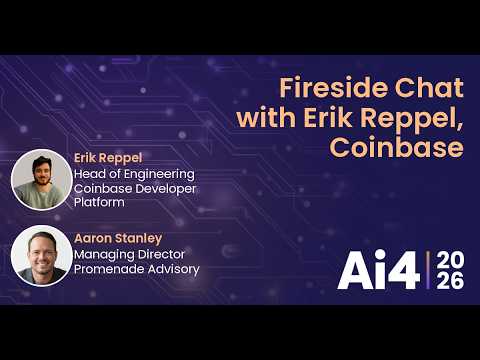
Published on YouTube by Ai4 on August 22, 2026, this fireside chat features Erik Reppel, creator of x402 and Head of Engineering for Coinbase Developer Platform, alongside Aaron Stanley of Promenade Advisory. According to the page description, the session explores the convergence of AI, cryptocurrency, and internet-native payments, discussing how autonomous AI agents can hold wallets and access services as independent economic actors.
## TL;DR
In this fireside chat, Erik Reppel and Aaron Stanley unpack the x402 payment standard—a revived version of the HTTP 402 'Payment Required' status code designed to enable native, autonomous transactions for AI agents. They discuss how stablecoins solve the high friction and price floors of credit cards, allowing agents to execute sub-dollar micro-transactions for data and API access without human intervention. The conversation also details the ecosystem's impressive growth, the 'agentic premium,' and the decision to house the x402 Foundation under the Linux Foundation to maintain an open, neutral protocol alongside major payment titans.
## Atmosphere & style
The session feels engaging, candid, and densely packed with technical insights. Reppel and Stanley maintain an easygoing, conversational rapport, playfully joking about competing with political speeches while grounding high-level concepts in vivid real-world scenarios. The overall mood is forward-looking and optimistic, striking a balance between rigorous technical discussion and accessible enthusiasm for the multi-trillion-dollar future of agentic commerce.
## Key takeaways
- [00:04](https://www.youtube.com/watch?v=SdwMyzlUc80&t=4s) Erik Reppel introduces agentic commerce and his background, including founding Fifth Dimension Technologies, chairing the x402 Foundation, and advising Coinbase.
- [02:37](https://www.youtube.com/watch?v=SdwMyzlUc80&t=157s) Reppel defines the x402 standard, which reactivates HTTP status code 402 ('Payment Required') to enable native, automated machine-to-machine payments.
- [04:07](https://www.youtube.com/watch?v=SdwMyzlUc80&t=247s) The x402 standard has processed over 400 million total transactions (~$250M volume), averaging around 375,000 transactions per day.
- [04:07](https://www.youtube.com/watch?v=SdwMyzlUc80&t=247s) Agentic commerce operates across two models: conversational commerce (human-in-the-loop) and autonomous commerce (machine-to-machine micro-transactions).
- [07:26](https://www.youtube.com/watch?v=SdwMyzlUc80&t=446s) Stablecoins are preferred for agentic micro-transactions because traditional credit cards carry fee floors (~$0.30 + 3%) that eliminate sub-dollar transactions.
- [10:38](https://www.youtube.com/watch?v=SdwMyzlUc80&t=638s) x402 acts as a single integration layer across ~25,000 services, eliminating manual subscription management and API key setup for AI agents.
- [10:38](https://www.youtube.com/watch?v=SdwMyzlUc80&t=638s) Service providers exploit an 'agentic premium,' charging slightly higher per-call rates via x402 because agents prioritize frictionless access over upfront subscriptions.
- [15:42](https://www.youtube.com/watch?v=SdwMyzlUc80&t=942s) The x402 Foundation operates under the Linux Foundation as an open, neutral governance body backed by major payment giants like Visa, Mastercard, and Stripe.
- [18:22](https://www.youtube.com/watch?v=SdwMyzlUc80&t=1102s) Integrated agentic payments are projected to become a multi-trillion dollar market, following the same rapid adoption trajectory as native web search in AI models.
- [19:40](https://www.youtube.com/watch?v=SdwMyzlUc80&t=1180s) Reppel encourages audience members to test agentic payments directly by using Model Context Protocol (MCP) implementations to provision funded wallets for AI agents.
## Detailed walkthrough
### [00:04](https://www.youtube.com/watch?v=SdwMyzlUc80&t=4s) Introduction and the Convergence of AI and Internet-Native Payments
Aaron Stanley, Managing Director of Promenade Advisory, kicks off the fireside chat by introducing the session's focus on agentic commerce and agentic payments. Drawing a connection to the preceding panel's discussion on automated trade, Stanley highlights how autonomous agents are poised to become a core rail for digital commerce. He introduces guest Erik Reppel, formerly Head of Engineering for the Coinbase Developer Platform and creator of the **x402** payment standard. Reppel quips about their panel's time slot competing directly with presidential candidate Andrew Yang, joking that hopefully, their talk will offer higher "information density" for the audience.
Reppel shares his background, explaining that he left Coinbase in May to found **Fifth Dimension Technologies**, a startup currently operating in stealth. Alongside his new venture, Reppel chairs the technical steering committee for the x402 Foundation and acts as an advisor to Coinbase on agentic commerce. Polling the audience via a show of hands, Reppel observes that while a modest number of attendees are familiar with x402, significantly more have heard of agentic commerce as a concept—though only two audience members have actually had an AI agent conduct a financial transaction on their behalf.
- **Speakers:** Aaron Stanley (Managing Director, Promenade Advisory) and Erik Reppel (Founder of Fifth Dimension Technologies; Chair, x402 Foundation Technical Steering Committee; Advisor to Coinbase).
- **Background Context:** The session takes place at the AI4 conference.
- **Audience Poll Results:** Only two "trailblazers" in the room had actively experienced an agent transacting on their behalf.
---
[02:37](https://www.youtube.com/watch?v=SdwMyzlUc80&t=157s) Unpacking the x402 Standard and HTTP Error Code 402
Reppel defines **x402** as an open standard for internet payments, comparing its role to foundational web protocols that dictate how content is rendered, styled, or transmitted between computers. He notes that the desire for native internet payments is far from new—tracing back to early web pioneer Marc Andreessen. The lineage of these early attempts is preserved in the HTTP `402 Payment Required` status code created in the 1990s. Reppel displays a favorite party trick by reciting the complete 1990s technical specification for the code: *"402 Payment Required reserved for future use."*
With the rise of programmable money, modern payment rails, and AI-driven workflows, Reppel saw the necessity to finally reactivate status code 402. The standard provides a mutual agreement across software systems so that computers and AI agents can execute payments natively without human intervention.
[04:07](https://www.youtube.com/watch?v=SdwMyzlUc80&t=247s) The Current State of Agentic Commerce: Scale, Scale Usage, and Micro-Transactions
Addressing Stanley's question about the real-world traction of agentic commerce, Reppel reveals that x402 processed **375,000 transactions** on the preceding day alone. Over its lifetime of roughly a year and a month, the standard has facilitated over **400 million transactions** totaling approximately **$250 million in payment volume**.
Reppel categorizes agentic commerce into two primary paradigms:
1. **Conversational Commerce:** Human-in-the-loop e-commerce (e.g., asking Claude for running shoe recommendations based on specific running habits and clicking a traditional checkout button).
2. **Autonomous Commerce:** Purpose-driven, machine-to-machine interactions where the agent operates independently within a given budget.
Reppel illustrates autonomous commerce through a research workflow: an agent looking for shoe recommendations might spend 2 cents to access a specialized catalog on *Runner's World*, followed by 3-cent micro-payments for individual review articles. This micro-transaction model offers a potential solution to a critical AI challenge: the disintermediation of content publishers. Rather than scraping sites and destroying affiliate revenue models, agents pay small fees directly to publishers for context and tools.
- **Daily Volume:** 375,000 recorded daily transactions on x402.
- **Cumulative Metrics:** ~400 million total transactions; ~$250 million total volume.
- **Micro-Payment Rates:** Typical contextual data purchases range between $0.01 and $0.03 per request.
---
[07:26](https://www.youtube.com/watch?v=SdwMyzlUc80&t=446s) Stablecoins vs. Credit Cards: Choosing the Right Financial Rail
When asked why AI agents favor blockchain-based stablecoins over traditional credit cards or ACH transfers, Reppel explains that agents act "much like water" by defaulting to downhill, path-of-least-resistance solutions. Credit card networks impose fixed transaction fees of around **30 cents plus ~3%**, which effectively wipes out any transaction valued below 60 cents. Consequently, credit card architecture asserts that the minimum representable transaction on the web is roughly $1.00.
Stablecoins allow agents to seamlessly transfer fractions of a cent or low-dollar amounts (e.g., 2-cent pieces of data) without being penalized by flat credit card fees. However, Reppel emphasizes that x402 is rail-agnostic and does not mandate cryptocurrency. He compares x402 to the placard in a restaurant window listing accepted payment methods (Visa, Mastercard, Discover, Sam's Club, cash). While high-value or insurance-dependent purchases (like airline tickets) benefit from credit card chargebacks and travel rewards, micro-data lookups and API requests naturally lean toward stablecoins.
- **Traditional Card Fee Floor:** ~30¢ + 3% per transaction, pricing out sub-$1.00 web interactions.
- **x402 Payment Flexibility:** Accommodates cards, stablecoins, and alternative payment rails dynamically based on user and merchant preference.
---
[10:38](https://www.youtube.com/watch?v=SdwMyzlUc80&t=638s) Unlocking Micro-Payments, Dynamic Tooling, and the "Agentic Premium"
Stanley draws an analogy between the lack of web micro-payments and a artificial price floor, noting how users are routinely forced into $50/month subscriptions for single-article access. Reppel explains how x402 bypasses subscription fatigue and API management. Currently, developers waste time setting up individual Model Context Protocol (MCP) connectors and managing dozens of individual API keys. With x402, an agent utilizes a single client and wallet, granting immediate access to an ecosystem of over **25,000 x402-enabled services** without human account creation or pre-funding.
This friction-free access creates what Reppel calls **dynamic agents**—systems whose capabilities dynamically expand based on available paid endpoints rather than remaining statically defined at configuration time. Additionally, Reppel reveals an unexpected market trend: the **"agentic premium."** Data and API providers charging $0.003 per call under a traditional subscription can charge $0.005 per call via x402. Users willingly pay a slightly higher per-call rate to avoid pre-committing capital or storing credit cards on file. If an agent's usage spikes, it dynamically converts to a traditional monthly subscription.
- **Ecosystem Reach:** ~25,000 active x402-enabled services accessible via a single integration.
- **The Agentic Premium:** Providers realize higher margins per request (e.g., 0.5¢ vs. 0.3¢) because agents prioritize zero-friction access over account creation.
---
[15:42](https://www.youtube.com/watch?v=SdwMyzlUc80&t=942s) The Role of Payment Titans and Open Governance Standards
Stanley points out that traditional payment processors and card networks—including Stripe, Fiserv, Visa, and Mastercard—are actively participating in the x402 ecosystem and the agentic commerce space. Reppel explains that the **x402 Foundation** was established as a neutral, open subsidiary under the **Linux Foundation** after being spun out by Coinbase to ensure multi-company governance.
Reppel emphasizes that traditional payment titans are investing in open protocols because neutral, open standards prevent any single dominant gateway from walling off the ecosystem. Drawing a historical parallel, Reppel compares the current state of agentic standards to the early battle between AOL's closed portal and the open internet. Just as the open web triumphed over proprietary portals by offering businesses control over their customer relationships, open payment protocols provide a stable, neutral foundation for all market participants.
- **Governing Body:** x402 Foundation, hosted under the Linux Foundation.
- **Participating Titans:** Visa, Mastercard, American Express, Adyen, Stripe, Fiserv, and Coinbase.
- **Core Principle:** Open, neutral protocol access preventing proprietary platform lock-in.
[18:22](https://www.youtube.com/watch?v=SdwMyzlUc80&t=1102s) Standardizing Agentic Commerce and the Multi-Trillion Dollar Payment Future
The open-protocol nature of x402 is precisely what drives significant corporate interest toward the x402 Foundation and the emerging concept of agentic commerce. While it is undeniably clear that agentic commerce is poised to become a mainstream reality, the industry is currently in its very early stages. Interestingly, the primary bottleneck right now isn't the payment mechanism itself, but rather the maturity and abundance of the agents themselves. Non-technical users should be able to integrate payments into their agents effortlessly without needing complex setups—it should simply be built-in by default. Drawing an analogy to recent technological shifts, just three years ago AI agents did not feature native web search capabilities, whereas today an agent lacking integrated search feels entirely incomplete. In a couple of years, embedded payments will follow the exact same path and become a standard expectation for all autonomous AI agents.
Projections regarding the scale of this technological shift point toward agentic payments evolving into a multi-trillion dollar market, a scale that naturally captures major corporate attention given that "anytime the number starts with a 't', companies get pretty excited." Addressing the demand side of this ecosystem, Erik Reppel notes that while his current project remains in stealth mode, interested followers can stay updated through his LinkedIn or his X (formerly Twitter) account under the handle @programmer.
- Open-protocol standards like x402 facilitate institutional interest and foundation support.
- The key obstacle for agentic commerce is agent availability and seamless usability, rather than the underlying payment rails.
- Integrated payments are expected to follow the same adoption curve as integrated search in AI agents.
- Market estimates project agentic payments to reach multi-trillion-dollar scale.
- Speaker Erik Reppel can be followed at @programmer on X or via his name on LinkedIn for updates on his stealth venture.
[19:40](https://www.youtube.com/watch?v=SdwMyzlUc80&t=1180s) Call to Action and Concluding Remarks
To wrap up the fireside chat, Erik Reppel shares a direct call to action for the audience: empower an AI agent to execute a transaction firsthand. With the help of numerous Model Context Protocol (MCP) implementations, users can easily furnish an agent with a digital wallet, fund it with as little as two dollars, and observe the experience of an agent autonomously paying for services or resources. Taking this step no longer requires deep technical expertise, yet it provides invaluable insight into the future of digital commerce.
In a room of roughly one hundred audience members, it is estimated that only about 2% have experienced an agent performing a payment so far. The session concludes with an encouraging invitation to join that pioneering 3%, followed by closing thanks to the audience, Erik Reppel, and the host conference Ai4.
- Users can utilize MCP tools to provision wallets for AI agents and test payments with minimal capital ($2).
- An estimated 2% of the session's audience had experienced autonomous agent payments at the time of recording.
- The session concludes with appreciation for speaker Erik Reppel and event host Ai4.
## Notable quotes
> [02:37](https://www.youtube.com/watch?v=SdwMyzlUc80&t=157s) 402 Payment Required reserved for future use. — Erik Reppel
> [18:22](https://www.youtube.com/watch?v=SdwMyzlUc80&t=1102s) anytime the number starts with a 't', companies get pretty excited. — Erik Reppel
## Mentioned
Aaron Stanley, Adyen, Ai4, American Express, Andrew Yang, Claude, Coinbase, Coinbase Developer Platform, Erik Reppel, Fifth Dimension Technologies, Fiserv, Linux Foundation, Marc Andreessen, Mastercard, Model Context Protocol, Promenade Advisory, Runner's World, Stripe, Visa, x402, x402 Foundation, Yuga Cohler
## Video description
Erik Reppel - Head of Engineering, Coinbase Developer Platform
Aaron Stanley - Managing Director, Promenade Advisory
What happens when AI agents become economic actors capable of holding wallets, making payments, and accessing services on their own? This fireside chat will explore the convergence of AI, crypto, and internet-native payments with Erik Reppel, creator of x402, and Yuga Cohler, Head of Engineering for Coinbase Developer Platform. The conversation will illustrate why financial infrastructure may become a critical layer for the agentic web, from autonomous transactions to new models for digital commerce
Coinbase 前员工 Reppel 瞄准面向 AI 智能体的网络支付标准
随着开放支付协议以不足一美分的稳定币交易取代信用卡手续费结构,自主式 AI 商业将扩展为一个数万亿美元规模的市场。
在这场炉边谈话中,Erik Reppel 与 Aaron Stanley 深入探讨了 x402 支付标准——该标准重新启用了 HTTP 402“Payment Required”(需要付款)状态码,旨在为 AI 智能体实现原生的自主交易。他们讨论了稳定币如何解决信用卡的高摩擦与最低手续费门槛,从而使智能体能够在无需人工干预的情况下,针对数据和 API 访问执行不足一美元的微交易。对话还详细介绍了该生态系统的显著增长、“智能体溢价”,以及将 x402 Foundation 设立在 Linux Foundation 旗下以同主要支付巨头共同维持开放、中立协议的决定。
Erik Reppel 介绍了智能体商业及其个人背景,包括创立 Fifth Dimension Technologies、担任 x402 Foundation 主席以及担任 Coinbase 顾问。 (0:04)
Reppel 对 x402 标准进行了阐述,该标准重新启用了 HTTP 状态码 402(“Payment Required”),以实现原生的自动化机器对机器支付。 (2:37)
x402 标准已累计处理超过 4 亿笔交易(交易总额约 2.5 亿美元),日均交易量约为 37.5 万笔。 (4:07)
智能体商业通过两种模式运行:对话式商业(有人在环)与自主式商业(机器对机器的微交易)。 (4:07)
稳定币是智能体微交易的首选,因为传统信用卡存在最低收费门槛(约 0.30 美元 + 3%),排除了不足一美元交易的可行性。 (7:26)
Reading summary
Erik Reppel and Aaron Stanley argue that autonomous AI agents require open, internet-native payment rails—built by activating the legacy HTTP 402 status code—to eliminate subscription friction and enable viable machine-to-machine micro-transactions.
Reactivating HTTP 402 for Autonomous Machine Transactions (2:37)
Erik Reppel describes the x402 standard as an open protocol designed to implement the HTTP 402 'Payment Required' status code, which had remained reserved for future use since the 1990s. While conversational commerce retains a human in the loop to approve purchases, autonomous commerce enables software agents to transact independently against set budgets. This structure allows agents to purchase discrete data—such as paying $0.01 to $0.03 for catalog queries or review articles—directly compensating publishers instead of relying on scraping models that erode affiliate revenue. According to Reppel, x402 had logged 375,000 transactions the day prior to the talk, reaching over 400 million lifetime transactions and approximately $250 million in cumulative payment volume.
Economics of Micro-Transactions: Stablecoins Versus Credit Cards (7:26)
Traditional payment systems like credit cards impose flat fees of roughly $0.30 plus 3%, which Reppel notes renders transactions under $0.60 uneconomical and imposes an artificial $1.00 price floor across the web. Because autonomous agents gravitate toward the path of least resistance, they default to low-fee stablecoins when paying fractions of a cent or a few cents for individual API and data requests.
Reppel clarifies that x402 is rail-agnostic and functions similarly to an acceptance sign in a storefront. Merchants and agents can select payment methods dynamically: stablecoins suit low-value context lookups, while traditional card rails remain advantageous for high-value transactions that require consumer insurance, chargeback rights, or travel rewards.
Dynamic Tooling and the Agentic Premium (10:38)
Instead of requiring developers to manually register API keys or pay $50 monthly recurring subscriptions for occasional use, x402 lets agents access roughly 25,000 enabled services through a single client and wallet. This architecture facilitates 'dynamic agents' that expand their operational capabilities at runtime whenever they encounter paid endpoints.
Reppel highlights an emerging market phenomenon he calls the 'agentic premium,' wherein providers charge higher per-call rates (such as $0.005 instead of $0.003 under a subscription) via x402. Buyers willingly accept this premium to avoid account creation, pre-funding commitments, and storing credit cards on file, with the option to dynamically transition to monthly plans if query volumes surge.
Neutral Governance and the Multi-Trillion Dollar Trajectory (15:42)
To prevent proprietary lock-in, Coinbase transferred x402 governance to an independent foundation hosted by the Linux Foundation. Payment industry participants, including Visa, Mastercard, American Express, Stripe, Fiserv, and Adyen, have joined the effort. Reppel compares this cooperative approach to the historical victory of the open web over proprietary walled gardens like AOL, providing businesses with direct control over commercial relationships.
Industry projections cited during the session estimate agentic payments will reach multi-trillion-dollar volumes. Reppel asserts that payment rails are no longer the primary hurdle; instead, growth depends on improving agent usability and availability so non-technical users can deploy payments by default, mirroring how web search became standard in AI agents over recent years.
Reppel emphasizes that agentic commerce remains in its infancy, noting an audience poll where only approximately 2% of attendees had ever experienced an agent transacting on their behalf. To accelerate real-world adoption, he encourages users and developers to equip agents with Model Context Protocol tooling and test autonomous transactions using wallets funded with minimal amounts, such as two dollars.
## Background
该内容由 YouTube 频道 Ai4 于 2026 年 8 月 22 日发布,记录了 Promenade Advisory 董事总经理 Aaron Stanley 与 x402 协议创造者、前 Coinbase 开发者平台工程负责人 Erik Reppel 的炉边对谈。视频重点探讨了当 AI 智能体成为具备自主钱包与支付能力的经济实体时,加密支付与互联网原生金融基础设施将如何重塑数字化商业与 Agentic Web。
## TL;DR
对谈深入解析了开放支付标准 x402 如何激活 HTTP 402 状态码,为 AI 智能体构建起免除传统信用卡高昂通道费的低摩擦微支付网络。Erik 对比了人在回路的“对话式商务”与目标驱动的“自主商务”,指出智能体通过按次微付费采购数据与 API 工具,不仅打破了开发者的连接器与订阅疲劳,还催生了“智能体溢价”与新型内容变现模式。通过将 x402 移交 Linux 基金会治理,该标准正联合全球支付巨头构建去中心化、多轨道兼容的中立商业生态,并预计支付能力将在未来两到三年内成为智能体的出厂标配。
## Atmosphere & style
整场炉边对谈节奏轻快且信息密度极高,Erik 幽默风趣的开场迅速拉近了与现场观众的距离,其一字不差背诵 HTTP 402 协议原文更展现出资深极客的技术底蕴。对话在宏观产业趋势与底层架构逻辑之间自如切换,主持人 Aaron 的敏锐提问引导出极具启发性的商业洞察。现场氛围务实而充满前瞻性探索欲,尾声向全场发出的“为你的智能体充入两美元并完成首次自主支付”的号召,更赋予了整场分享强烈的行动感与感召力。
## Key takeaways
- [00:04](https://www.youtube.com/watch?v=SdwMyzlUc80&t=4s) Erik Reppel 在 Coinbase 期间主导创建了开放支付标准 x402,旨在为 AI 智能体构建互联网原生的自主商业支付基础设施。
- [02:44](https://www.youtube.com/watch?v=SdwMyzlUc80&t=164s) x402 协议重启了自 20 世纪 90 年代起被预留的 HTTP 402(Payment Required)状态码,将其落地为面向机器自主交易的开放标准。
- [04:40](https://www.youtube.com/watch?v=SdwMyzlUc80&t=280s) x402 累计处理交易超 4 亿笔、金额超 2.5 亿美元,日均处理 37.5 万笔小额微支付,主要用于智能体获取数据上下文与工具调用。
- [04:40](https://www.youtube.com/watch?v=SdwMyzlUc80&t=280s) 智能体商务可划分为“人在回路”的对话式商务与“目标驱动且自主支付微额费用”的自主商务两种形态。
- [04:40](https://www.youtube.com/watch?v=SdwMyzlUc80&t=280s) 微支付机制确立了“向智能体收费,向人类展示广告”的新模式,帮助内容创作者在 AI 聚合时代重塑商业变现路径。
- [07:59](https://www.youtube.com/watch?v=SdwMyzlUc80&t=479s) 传统信用卡因单笔 30 美分固定费用与 3% 抽成无法支持低于 1 美元的交易,而稳定币与区块链网络成为智能体微支付阻力最小的通道。
- [07:59](https://www.youtube.com/watch?v=SdwMyzlUc80&t=479s) x402 实现了支付轨道与业务逻辑的解耦,使高频微支付可走稳定币通道,大额消费仍可沿用信用卡以享受航旅保险与积分等权益。
- [10:38](https://www.youtube.com/watch?v=SdwMyzlUc80&t=638s) 借助单一 x402 客户端钱包,智能体可按需动态调用超 2.5 万个付费服务,彻底解决了开发者手动管理数十个 API Key 的连接器疲劳。
- [10:38](https://www.youtube.com/watch?v=SdwMyzlUc80&t=638s) “智能体溢价”机制让 API 供应商通过免预充值的小额按次计费吸引调用,并在高频使用场景下自然转化为长期包月订阅客户。
- [15:42](https://www.youtube.com/watch?v=SdwMyzlUc80&t=942s) x402 移交 Linux 基金会旗下进行中立治理,旨在防止单一封闭平台垄断智能体生态,因而吸引了 Visa、Mastercard、Stripe 等支付巨头参与。
- [18:22](https://www.youtube.com/watch?v=SdwMyzlUc80&t=1102s) 自主支付与钱包预计在未来两到三年内成为 AI 智能体的出厂标配能力,如同网络搜索一样无感嵌入,驱动万亿美元级商业市场。
- [19:12](https://www.youtube.com/watch?v=SdwMyzlUc80&t=1152s) 开发者与用户目前可通过 MCP 工具轻松为智能体绑定钱包并充入小额资金,率先跨越实践门槛体验智能体自主交易。
## Detailed walkthrough
### [00:04](https://www.youtube.com/watch?v=SdwMyzlUc80&t=4s) 开场介绍:AI 与区块链交汇下的 Agentic Commerce
主持人 Aaron Stanley(Promenade Advisory 董事总经理,前媒体人与播客主持人)为本次对谈拉开序幕。他提到上一场小组讨论已经涉及了智能体商务(Agentic Commerce)的主题,探讨其如何成为未来多种商业形态的新型轨道。本场对话聚焦于区块链与 AI 技术的深度融合,特别邀请到了 Coinbase 顾问、前 Coinbase 开发者平台工程负责人 Erik Reppel。
```mermaid
flowchart LR
accTitle: AI 与加密支付的交汇
subgraph AI["AI 智能体生态"]
A1["自主决策 Agent"]
A2["动态工具调用 MCP"]
end
subgraph Infra["x402 开放协议标准"]
I1["HTTP 402 状态码"]
I2["多支付轨道解耦"]
end
subgraph Settlement["结算与商业层"]
S1["微支付 / 稳定币"]
S2["传统卡组织 / 信用卡"]
end
AI --> Infra --> Settlement
```
Erik Reppel 幽默地调侃现场与 Andrew Yang(杨安泽)的演讲时段重合,笑称希望自己的分享能具备更高的信息密度,并欣慰现场有足够的空位供大家坐下交流。Erik 透露自己于当年 5 月离开 Coinbase,创立了目前处于隐身(Stealth)阶段的新公司 Fifth Dimension Technologies。在 Coinbase 期间,他在“Agentic Commerce”一词尚未普及时便主导创建了开放支付标准 x402,目前担任 x402 基金会技术指导委员会主席,并持续为 Coinbase 提供相关咨询。
在现场互动调查中,Erik 发现现场有部分人听过 x402 标准,更多人了解 Agentic Commerce 的概念,但仅有极少数先行者真正体验过由 AI 智能体代表自己进行自主交易。
---
### [02:44](https://www.youtube.com/watch?v=SdwMyzlUc80&t=164s) 重启 HTTP 402:构建互联网原生支付标准
谈到 x402 的本质,Erik 将其定义为“互联网支付的开放标准”。他指出,整个互联网基石均由各种开放协议构建——从内容渲染、计算机通信、程序执行到组件样式,全部基于行业达成的共识标准。然而,在互联网上嵌入原生支付并非新鲜概念,早在网景时代 Marc Andreessen(马克·安德森)就曾尝试探索,而这段历史的痕迹至今仍保留在 HTTP 状态码中。
Erik 现场展示了他的“聚会绝活(party trick)”——一字不差地背诵 HTTP 402 状态码的技术规范原文:“402 Payment Required, reserved for future use”(402 所需付款,保留供未来使用)。该状态码自 20 世纪 90 年代起便处于预留状态。Erik 认为,随着现代化支付轨道(如区块链与稳定币)的成熟以及计算机驱动交易(机器自主支付)需求的爆发,重启并激活该状态码的时机已经成熟,这正是 x402 诞生的核心初衷。
---
### [04:40](https://www.youtube.com/watch?v=SdwMyzlUc80&t=280s) 智能体商务现状:对话式商务与自主商务
针对智能体商务的落地现状,Erik 给出了一组亮眼的数据:仅在对谈前一天,x402 记录在案的链上交易量就达到了 37.5 万笔;在过去一年多的时间里,x402 已累计处理约 2.5 亿($250M)美元的支付规模,交易笔数突破 4 亿笔。这些交易绝大部分是智能体为了获取上下文数据或调用未集成的工具而发生的小额微支付。
Erik 将智能体商务划分为两个截然不同的类别:
```mermaid
flowchart TD
accTitle: 对话式商务与自主商务对比
subgraph Conversational["对话式商务 (Conversational Commerce)"]
C1["用户发起目标需求<br/>(例如:寻找慢跑鞋)"] --> C2["LLM 搜索调研并推荐选项"]
C2 --> C3["用户人工点击确认购买<br/>(人一直在流程回路中)"]
end
subgraph Autonomous["自主商务 (Autonomous Commerce)"]
A1["智能体拆解子任务"] --> A2["自主微支付购买评测数据<br/>(例如:2美分/篇)"]
A2 --> A3["自主调用付费 API 工具"]
A3 --> A4["输出高质量聚合结果"]
end
```
- **对话式商务(Conversational Commerce)**:人在回路中(Human-in-the-loop)。例如用户告诉 Claude 自己每次跑两公里、需要推荐跑鞋,Claude 列出 6 个选项后由用户手动点击购买。这种模式本质上是传统电商或 Shopify 购物的延伸。
- **自主商务(Autonomous Commerce)**:人脱离决策回路,由目标与任务驱动。例如智能体在调研跑鞋时,自主向 Runner's World 支付 2 美分调取最新产品目录,再分别支付 3 美分单价购买专业测评。
这种微支付模式解决了 AI 时代内容发布者的生存危机。以往 ChatGPT 等聚合摘要导致《Wirecutter》等评测机构流量枯竭、联盟营销收益归零;而 x402 确立了“向智能体收费,向人类展示广告(charge agents, show humans ads)”的新规则,让用户仅需支付几美分至数美元预算,就能获得质量提升 5 倍的深度研究成果。
- **单日交易量**:已知监控范围内超 375,000 笔
- **累计处理规模**:超 4 亿笔交易,支付总额约 2.5 亿美元
- **核心应用场景**:为 AI Agent 实时采购数据上下文、API 工具与研究报告
---
### [07:59](https://www.youtube.com/watch?v=SdwMyzlUc80&t=479s) 解耦支付轨道:为何信用卡无法支撑微支付生态
针对为什么智能体不能直接刷信用卡或使用 ACH 转账,而倾向于使用基于区块链的稳定币,Erik 形象地将智能体比作“流水”——它们永远流向阻力最小、最容易落地的“顺坡解决方案(downhill solutions)”。传统信用卡网络拥有高昂的基础费率(单笔约 30 美分固定费用 + 3% 抽成),这直接宣判了低于 60 美分的小额交易在经济上不可行。
在传统互联网中,用户几乎买不到 1 美元以下的东西,因为 1 美元里有 33 美分立即被通道费吞噬,导致互联网的名义最小价值被锚定在 1 美元左右。然而现实中存在大量仅值 2 美分的数据或信息片段。
```mermaid
flowchart LR
accTitle: x402 支付路由与场景选择
Req["智能体发起消费请求"] --> X402["x402 协议协商层"]
X402 -->|"超低单价 / 微支付 / API 调用<br/>(规避 30美分+3% 固定摩擦)"| SC["稳定币 / 区块链轨道"]
X402 -->|"大额消费 / 机票预订<br/>(需要争议撤销、积分与航旅保险)"| CC["传统信用卡 / 银行卡"]
```
Erik 强调,x402 的使命不是强行推行某一种单一金融轨道,而是像餐厅收银台前展示 Visa、Mastercard、Amex 的标牌一样,将支付轨道与交易逻辑彻底解耦:
- **稳定币优势场景**:高频、小额微支付,或商家希望直接节省 3% 信用卡通道费的场景。
- **信用卡优势场景**:购买机票等大额消费,用户需要信用卡自带的航旅延误险、盗刷拒付(Chargeback)保障及消费积分。
---
### [10:38](https://www.youtube.com/watch?v=SdwMyzlUc80&t=638s) 破解连接器疲劳与“智能体溢价(Agentic Premium)”
传统开发者构建智能体时普遍面临“连接器与订阅疲劳(connector / subscription fatigue)”:为了让 Agent 获得功能,开发者必须手动注册数十个平台、绑定信用卡并管理 20 多个 API Key。而在 x402 模式下,智能体只需配置一个支持 x402 的客户端钱包(例如通过 MCP 协议集成 Coinbase 钱包工具),即可实现“发现即支付(discover and pay)”。
目前已有约 25,000 个服务支持 x402 规范。智能体无需人工介入预先注册,在需要获取高精天气数据等长尾服务时,即时支付 2 美分即可调用。这使得智能体从过去的“静态能力(能力集在配置时固化)”进化为“动态能力(随市场可付费服务的扩充而实时扩展)”。
```mermaid
flowchart TD
accTitle: 静态 Agent 与动态 Agent 对比
subgraph Static["传统静态 Agent"]
S_User["开发者手动注册 20+ 平台"] --> S_Keys["硬编码 20+ API Keys / MCP"]
S_Keys --> S_Agent["功能集合受限且固定"]
end
subgraph Dynamic["x402 动态 Agent"]
D_Wallet["单一 x402 钱包 / Client"] --> D_Discover["动态发现 25,000+ x402 服务"]
D_Discover --> D_Pay["按次微支付结算 (Pay-per-use)"]
D_Pay --> D_Agent["能力随生态自动无限扩展"]
end
```
此外,Erik 揭示了一个新兴的市场机制——**智能体溢价(Agentic Premium)**:
- **免预付带来的溢价接受度**:API 供应商若按传统订阅收费单次折合 0.3 美分,但在 x402 模式下定价 0.5 美分依然极受欢迎,因为调用方免去了开户、预充值和绑定信用卡的繁琐流程。
- **天然的转化漏斗**:API 服务商接入 x402 的最差结果就是单次调用收入增加;当某只理性决策的智能体调用频率达到阈值时,便会自然转化为长期包月订阅客户。
---
### [15:42](https://www.youtube.com/watch?v=SdwMyzlUc80&t=942s) 支付巨头入局:Linux 基金会与开放协议的中立性
针对 Visa、Mastercard、American Express、Stripe、Adyen、Fiserv 等传统支付巨头纷纷加入 x402 基金会或布局智能体商业的现象,Erik 深入阐释了背后的治理逻辑。Coinbase 将 x402 剥离为 Linux 基金会旗下的独立子基金会,以确保其作为开源协议的多方共同治理与中立性。
Erik 用互联网击败 AOL(美国在线)的历史作为类比:AOL 作为一个封闭的花园式门户,严格控制着谁能触达最终用户,并可随意驱逐竞争对手;而开放互联网协议本身不赋予任何单一实体特权,为所有参与者提供了公平中立的竞争舞台。各大支付巨头深知,唯有建立在去中心化、开放且中立的标准基石之上,各方才能免于被单一平台垄断封锁,真正掌控自身在未来智能体经济中的命运。
### [18:22](https://www.youtube.com/watch?v=SdwMyzlUc80&t=1102s) x402 开放协议与智能体电商的演进路径
各大企业之所以对 x402 基金会及其生态表现出极大热情,核心在于 x402 本身所具备的开放协议属性。谈及智能体电商(Agentic Commerce)的前景,这无疑是未来必然会发生的大趋势,但目前整个行业仍处于极其早期的阶段。当前智能体电商面临的最大瓶颈其实并不在商业交易机制本身,而在于智能体普及度与易用性——行业需要让更多普通人无需具备深厚的技术背景,就能直接为智能体接入支付功能。
```mermaid
flowchart LR
accTitle: AI 智能体默认能力的演进对比
subgraph S1["三年前"]
A1["基础 AI 智能体"] --> B1["无内置搜索能力"]
end
subgraph S2["现阶段"]
A2["现代 AI 智能体"] --> B2["默认集成搜索能力"]
end
subgraph S3["未来数年"]
A3["下一代 Agent"] --> B3["默认内置支付与钱包<br/>(x402 等开放协议)"]
end
```
这种演进轨迹与智能体的其他基础功能高度相似。三年前,智能体默认并不具备网络搜索功能;而如今,如果一个智能体没有内置搜索能力,用户反而会感到不可思议。预计在未来两到三年内,自主支付功能也将变成智能体的标准出厂配置。
- **万亿美元级市场预期**:业内多项预测显示,智能体支付将成长为一个数万亿美元(Multi-trillion dollar)规模的庞大市场;正如现场所调侃的那样,“只要预测数字以‘万亿(T)’开头,各大公司就会立刻兴奋起来”。
- **开箱即用的支付能力**:未来的核心目标是消除技术集成门槛,使支付能力如同网络搜索一样无感嵌入到每一个智能体的工作流中。
---
### [19:12](https://www.youtube.com/watch?v=SdwMyzlUc80&t=1152s) 隐身创业项目与现场倡议:让你的智能体完成第一笔支付
在被问及当前正在探索的需求端项目及核心逻辑时,Erik 透露自己目前正处于隐身创业(Stealth Mode)阶段,尚无法公开具体细节,感兴趣的观众可以通过 X(原 Twitter,账号为 @programmer)或 LinkedIn 关注其后续动态。
针对现场企业与开发者的实践落地,Erik 给出了非常直接且具操作性的行动倡议(Call to Action):亲自去让自己的智能体完成一次实际支付。如今市面上已有大量支持 MCP(Model Context Protocol)的工具与插件,用户完全不需要高深的技术知识,就能轻松为智能体绑定一个钱包。
> “往里面充入两美元,亲眼看看你的智能体具备自主付费能力后会发生什么。在场的上百人里,目前可能只有 2% 的人实际操作过。成为那率先尝试的 3% 吧。”
随着这一号召,主持人 Aaron Stanley 与 Erik 共同向现场观众及 Ai4 主办方致谢,正式结束了本次炉边对谈。
## Notable quotes
> [02:44](https://www.youtube.com/watch?v=SdwMyzlUc80&t=164s) 402 Payment Required, reserved for future use — Erik Reppel
> [04:40](https://www.youtube.com/watch?v=SdwMyzlUc80&t=280s) 向智能体收费,向人类展示广告(charge agents, show humans ads) — Erik Reppel
> [07:59](https://www.youtube.com/watch?v=SdwMyzlUc80&t=479s) 智能体就像流水,永远流向阻力最小、最容易落地的顺坡解决方案(downhill solutions)。 — Erik Reppel
> [07:59](https://www.youtube.com/watch?v=SdwMyzlUc80&t=479s) 在传统互联网中,用户几乎买不到 1 美元以下的东西,因为 1 美元里有 33 美分立即被通道费吞噬,导致互联网的名义最小价值被锚定在 1 美元左右。 — Erik Reppel
> [10:38](https://www.youtube.com/watch?v=SdwMyzlUc80&t=638s) 发现即支付(discover and pay) — Erik Reppel
> [10:38](https://www.youtube.com/watch?v=SdwMyzlUc80&t=638s) API 服务商接入 x402 的最差结果就是单次调用收入增加;当某只理性决策的智能体调用频率达到阈值时,便会自然转化为长期包月订阅客户。 — Erik Reppel
> [18:22](https://www.youtube.com/watch?v=SdwMyzlUc80&t=1102s) 只要预测数字以‘万亿(T)’开头,各大公司就会立刻兴奋起来。 — Erik Reppel
> [19:12](https://www.youtube.com/watch?v=SdwMyzlUc80&t=1152s) 往里面充入两美元,亲眼看看你的智能体具备自主付费能力后会发生什么。在场的上百人里,目前可能只有 2% 的人实际操作过。成为那率先尝试的 3% 吧。 — Erik Reppel
## Mentioned
Erik Reppel, Aaron Stanley, Yuga Cohler, Andrew Yang, Marc Andreessen, Coinbase, Coinbase Developer Platform, Promenade Advisory, Fifth Dimension Technologies, x402, x402 基金会, Linux 基金会, HTTP 402, Agentic Commerce, MCP (Model Context Protocol), Claude, ChatGPT, Shopify, Runner's World, Wirecutter, Visa, Mastercard, American Express, Stripe, Adyen, Fiserv, AOL, Ai4
## Video description
Erik Reppel - Head of Engineering, Coinbase Developer Platform
Aaron Stanley - Managing Director, Promenade Advisory
What happens when AI agents become economic actors capable of holding wallets, making payments, and accessing services on their own? This fireside chat will explore the convergence of AI, crypto, and internet-native payments with Erik Reppel, creator of x402, and Yuga Cohler, Head of Engineering for Coinbase Developer Platform. The conversation will illustrate why financial infrastructure may become a critical layer for the agentic web, from autonomous transactions to new models for digital commerce
[Source](https://www.youtube.com/watch?v=SdwMyzlUc80)
Source quotes
[2:44] Erik Reppel: 402 Payment Required, reserved for future use
[4:40] Erik Reppel: 向智能体收费,向人类展示广告(charge agents, show humans ads)
[7:59] Erik Reppel: 智能体就像流水,永远流向阻力最小、最容易落地的顺坡解决方案(downhill solutions)。
[7:59] Erik Reppel: 在传统互联网中,用户几乎买不到 1 美元以下的东西,因为 1 美元里有 33 美分立即被通道费吞噬,导致互联网的名义最小价值被锚定在 1 美元左右。
[10:38] Erik Reppel: 发现即支付(discover and pay)
[10:38] Erik Reppel: API 服务商接入 x402 的最差结果就是单次调用收入增加;当某只理性决策的智能体调用频率达到阈值时,便会自然转化为长期包月订阅客户。
[18:22] Erik Reppel: 只要预测数字以‘万亿(T)’开头,各大公司就会立刻兴奋起来。
[19:12] Erik Reppel: 往里面充入两美元,亲眼看看你的智能体具备自主付费能力后会发生什么。在场的上百人里,目前可能只有 2% 的人实际操作过。成为那率先尝试的 3% 吧。
Source quotes
[2:37] Erik Reppel: 402 Payment Required reserved for future use.
[18:22] Erik Reppel: anytime the number starts with a 't', companies get pretty excited.
Original transcript
[0:04] All right, thanks everybody for being here and uh
thanks to the AI4 uh folks for having us. Really
[0:09] excited for this conversation. Uh the last panel
uh was I think quite appropriate because they
[0:14] were kind of getting into some of these agentic
commerce themes kind of teasing some of these
[0:17] concepts um how this is going to become um you
know kind of the new the new rail for for a lot
[0:22] of types of commerce moving ahead. So really
fortunate today to be uh to have Eric Reppel
[0:27] who is um an adviser to Coinbase and he's also the
mastermind behind the X42 agentic commerce agentic
[0:35] payments standard. So we're going to be diving
into that talking about that a bit more. Uh my
[0:39] name is Aaron Stanley. I I run an advisory firm
called Prominade Advisory. Uh former journalist
[0:45] and um you know podcaster all that. have a deep
history on kind of the blockchain side of things
[0:50] and now the the blockchain and the AI worlds
are really kind of converging in this area of
[0:55] agentic payments uh using blockchain. So that's
what we're going to be talking about today.
[0:59] So um with that um Eric would love for you
to introduce yourself quick and you've really
[1:04] actually been at the the forefront of a lot of
of a lot of just kind of new things over the last
[1:09] couple of years um on the AI side and on the on
the blockchain side of things. But tell us a bit
[1:13] about uh what you're working on now and then how
you ended up in this world of Agentic Commerce.
[1:19] Yeah, thanks for the intro and uh excited to be
here. Thanks for everyone showing up. I know we
[1:24] got uh Andrew Yang as our competitive slot,
so you know, hopefully it'll be a little bit
[1:29] more information dense. We have enough chairs,
so you know. Um yeah, so I'm I'm Eric. I'm the
[1:35] previously I was the head of engineering for
Coinbase developer platform. Uh I left Coinbase
[1:39] in May to start a company. Uh while I was at
Coinbase, I uh created a standard called X42.
[1:47] It uh predates the term agent commerce. So
it's uh and it's does a lot of volume. So
[1:53] uh some of you have may have heard of it, some
of you may have not have maybe by show of hands,
[1:58] who's heard of X42 before? Couple people. Who has
heard of Agentic Commerce as a concept before?
[2:07] Few more people. Okay, it's good to
know. Who's made an agentic transaction
[2:11] or had an agent transact on your behalf? All
right. All right. Two people trailblazers here.
[2:17] Um yeah, so I I left Coinbase to start a
company. That company is called Fifth Dimension
[2:23] Technologies. It's currently in stealth. Um more
to come soon, but I also uh chair the technical
[2:30] steering committee for the X42 Foundation and uh
advise Coinbase on Agenda Commerce. So let's dive
[2:37] right into it. tell us what is X42 and why is this
an important thing that folks should know about.
[2:44] So I I describe X42 as an open
standard for internet payments.
[2:50] Uh and so the the internet as a whole
is full of these standards of like how
[2:54] do you render content? How do you you know
communicate between computers? How do you
[2:59] execute program interaction? How do you
style components? like everything on the
[3:04] internet is based off of effectively a mutual
agreement on how things should be done. Uh,
[3:10] and the idea of putting payments on the internet
is not a new idea. It is definitely not an idea I
[3:15] came up with. This is like actually a side quest
Mark Andre went on way back when. And you see the
[3:21] kind of lineage of early attempts to do payments
on the internet in the 402 status code. So if you
[3:27] if you for the engineers in the room, you may
have heard of the 402 HTTP status code. What it
[3:32] means is payment required. And uh it's been around
since the 90s. It's kind of like a I have a party
[3:38] trick actually. It's I can recite the entirety
of the 402 status codes technical specification.
[3:44] It's uh 402 payment required reserved for future
use. And uh now in this world where we have more
[3:53] and more modern payment rails and we have more
and more need for computer-driven payments,
[4:01] I think I thought it was about time to
reactivate that status code and hence X42.
[4:07] And so in the it's interesting in the in the
world of uh in the blockchain world anyway,
[4:12] agentic payments and agentic commerce has
become this really kind of hot topic. Um
[4:17] and um so it's it's interesting to kind of
see the convergence here between you know
[4:22] that world of technology and then this world
of AI but I would love for you to maybe give us
[4:26] a bit of color on just like what is the
state of agentic commerce right now? It's
[4:30] kind of a buzzword but there is a there there um
what's been like the traction like like what are
[4:36] agents actually doing? Um you know what are they
transacting like what are they buying? What are
[4:40] they what are they what types of activity are they
doing? Yeah. So, there was uh 375,000 transactions
[4:46] on X42 that we know about yesterday. Um could be
more. You can only measure part of the internet.
[4:53] Um over the course of the last year and
a bit, X42's done, I believe, roughly
[4:58] $250 million in payment volume and over the
course of about 400 million transactions.
[5:05] Uh and so this is a thing that's happening right
now. Typically what people use X42 for is uh
[5:13] small value transactions to give their agents more
context or access to tools that they don't have.
[5:20] Uh and there's I think of agent commerce as
being two categories. There's like conversational
[5:25] commerce which is hey you know Claude I want to
go I want to I want a new pair of running shoes.
[5:31] What running shoes are good for me?
like I'm, you know, I tend to run
[5:35] two kilometers at a time and blah blah
blah and whatever your constraints are.
[5:38] And Claude kind of goes into some research and
then is like, "Hey, here are the six options that
[5:43] I came up with." And then you click buy. And
that's like very e-commerce like it's not so
[5:47] different than just googling something and then
like buying on a Shopify store. And then there's
[5:52] what I call autonomous commerce, which is commerce
where you aren't necessarily in the loop and the
[5:59] types of transactions are more purpose- driven
than goods driven. And so while doing that
[6:07] research to find the right shoes for you,
Claude might need to pay for access to some
[6:11] data. You might need to pay for access to like
reviews. So maybe it goes and pays, I don't know,
[6:17] Runners World or something for kind of the latest
catalog. it pays it 2 cents and then it goes and
[6:23] pay pays for a bunch of reviews of different
shoes and is paying like 3 cents per article and
[6:29] that is like those small value transactions
compensate the broader internet and create
[6:34] still an incentive to publish content. Um, one of
the big problems with AI is AI disintermediates
[6:41] uh publishers from their audience. And
so if you're, you know, the wire cutter,
[6:45] people don't go to you anymore, you're not
making affiliate links revenue anymore,
[6:49] they're getting an aggregate summary through
chatbt, you kind of are out of business.
[6:54] And so instead, what X42 allows you to do
is charge agents, show humans ads. And uh
[7:02] so to the when you're doing that task of like
research to running shoes, there's all sorts
[7:06] of little things where paying a scent or two
for additional context or tools or you know
[7:13] uh goods and services will likely get you a better
result. And I think increasingly people are going
[7:18] to be willing to pay small amounts of money to
get you know 5x better results from their agent.
[7:26] And then um so there's there's a scenario where
okay if I give my agent say a budget of $20. Okay,
[7:33] I'm giving it this task. Go find me the best
pair of running shoes. I'm giving you a budget
[7:36] of $20 to acquire whatever information you need to
best, you know, present me some recommendations.
[7:43] Like that's kind of the idea for this type of
thing is that the agent has the ability to sort
[7:47] of spend money on whatever it needs to spend um
autonomously so as to accomplish the broader goal
[7:54] that you've given it. Right? That's kind of the
idea. So, but like why why do you need to use
[7:59] or why would the agent want to use uh pay with
stable coins like blockchain based uh dollars
[8:04] versus just paying with like a credit card
or like an a payment or some other mechanism?
[8:10] So, it's a good question. the
[8:14] I think that agents are much like water where they
kind of flow to whatever the most easy solution is
[8:21] and so you want to give your agents like
downhill solutions to solve their problems and uh
[8:27] I think the short answer is like agents are going
to use credit cards and stable coins and like any
[8:31] number of rails over time. It's just that like
payment networks are built for different things.
[8:37] like credit cards, the fees on a credit card
transaction are 30 cents plus 3%ish. And so
[8:44] that that kind of uh wipes out all types
of transaction value that occurs that
[8:52] is uh you know sub 60 cents roughly.
Like you probably have noticed you've
[8:56] never purchased something on the internet
for less than a dollar. And that's because
[9:00] of that dollar 33 cents of that immediately is
just going into processing fees. And so you the
[9:07] it it asserts that the minimum representable
value on the internet is like roughly a dollar.
[9:13] And I think that's just like factually not true.
I think there's all sorts of like two cent pieces
[9:17] of information laying around that are worth
paying two cents for. And so X42 uh does plan
[9:25] on supporting cards. I was actually in the card
acceptance working group meeting this morning. Um,
[9:31] but the goal is really to enable the right rails
for the right types of transactions and let choice
[9:37] reign. And so one analogy I make for X42 is
X42 is the little plaqueard at the restaurant
[9:43] that says we accept Sam's Club and Discover and
Mastercard and Visa. Then you as the consumer
[9:49] choose like what is the way I want to pay? And
the merchant says here are all the ways I accept.
[9:54] uh and you as the end consumer say like I have
a Visa card and so I'm gonna pay with my Visa
[9:58] card or I'm gonna pay cash, right? And so there
are times where stable coins are just better.
[10:05] Like maybe you just want as a restaurant 3% more
money. Like that's a great reason to want to use
[10:11] uh blockchains and stable coins. There other
times where you as a consumer might prefer,
[10:15] hey, I do want to put this on a credit card.
for example, a flight like you probably want,
[10:20] you know, the travel insurance that your credit
card gives you and the like chargeback guarantees
[10:24] and the points on a flight. And so it's
not about prescribing the financial rail,
[10:28] it's about building the infrastructure that
decouples the rail from the transaction and
[10:33] lets people choose the appropriate rail
for the transaction that's occurring.
[10:38] And then so I think the microp payments example
is a really good one and that's that's been a
[10:42] problem that I think folks have been trying to
solve for quite some time is okay you know I
[10:47] I don't necessarily want to subscribe to the New
York Times uh pay you know $50 a month or whatever
[10:52] but like I do want to pay for this I do want to
read this one article and I would pay you know 10
[10:56] cents or whatever to read this one article but I'm
not going to spend you know I'm not going to buy a
[10:59] whole subscription just to read this one article
and so there's this whole kind of it's almost I
[11:04] almost think of it as like a minimum wage where
it's like yeah there's probably people that would
[11:07] be willing to work for beneath the minimum wage,
but since the the minimum is, you know, whatever,
[11:11] $15 an hour or whatever, like that people that
would be willing to work for that for for below
[11:15] the minimum wage are kind of frozen out of the
market. So, like there's this whole kind of part
[11:18] of the economy that's like frozen out that's just
like not allowed to exist essentially because it
[11:23] wouldn't be viable. But like I mean how if if this
kind of micro payment ecosystem is unlocked in the
[11:28] internet using X42 like how do you see that type
of um like what type of other types of activity
[11:36] could could occur or what other types of you know
business models could we see? Well I'll tell you
[11:41] the one that is like the most interesting to me
which is isn't one particular it's it's that so
[11:46] I'll give you a few like real world observations.
So, one is that probably everyone in this room has
[11:52] has run into like connector or subscription
fatigue where you try to wire up like a bunch of
[11:58] connectors or MCPs or things that require API keys
into your agent to make it useful. Um, one of the
[12:06] great properties of X42 is because it's pay, you
don't actually need to go and create an API key.
[12:13] like you can kind of replace the 20 API keys
that you have in your open C claw agent with
[12:19] one X42 client and there's like 10 different X42
enabled wallets and ways of doing X42 via MCP
[12:26] you should use Coinbases. Um but you know the
with that one tool with those two tools of
[12:33] you know discover and pay you now get access to
like an entire ecosystem of different services
[12:39] instead of having to go and sign up for each
one individually. And so there's roughly 25,000
[12:45] uh services that have X42 enabled on them right
now. And so with one integration, you basically
[12:50] get access to that entire inventory of uh things
to do versus like having to go and subscribe to
[12:56] each one which requires like human intervention
and going and creating an account and all this
[13:00] like stuff where your agent you probably don't
like let's say you want access to weather data
[13:06] like high fidelity weather data like it's not
worth going and like creating an API key for like
[13:12] super high fidelity weather data. you'll be
like you'll be fine with you know whatever
[13:16] the like you know commoditized version is but if
it's trivial and it costs two cents like you're
[13:22] probably willing to pay those two cents for
the better data if it's just like seamless um
[13:29] so that's one it's like the dynamic tool access
creates what I call dynamic agents versus static
[13:34] agents where the set of capabilities of the
agent is not right now most agents are kind
[13:38] of statically def uh defined and they're
what they're capable of doing is is uh
[13:45] fixed in time based on what how you've configured
them. If you have peruse microp payments,
[13:50] you actually get agents that have a dynamic
set of functionality based on what the market
[13:54] presents to them as payable. And so, you know,
tomorrow there'll be 25,03 enabled X42 services.
[14:01] That's three more things your agent can go and
do that you didn't have to do anything to enable.
[14:06] And then two is what I've noticed is that there's
the agentic premium. And so we have all these API
[14:11] providers. APIs are definitely the like number one
thing that X42 the number one use case for X42.
[14:19] And uh what I've noticed is that people are
actually willing to pay slightly more for uh
[14:26] API usage via X42 than they are on a subscription
because they don't have to pre-commit to an
[14:30] account and preund an account. And so if you're
charging like you know.3 cents per transaction
[14:37] on your API, you can probably charge 0.5 cents
per transaction on your API with X42 because
[14:43] now I don't have to go and like create an account
and lay a credit card on the line. And so this
[14:47] agentic premium uh is like I think a really
interesting market dynamic that's emerged that
[14:55] probably no one else has really noticed
because it's kind of an X42 only thing.
[14:59] It's the only X42 is the only thing that has
enough volume for it to really materialize. Um,
[15:05] but yeah, it's like the the thing I say is
like actually most people should be taking
[15:09] advantage of the agentic premium where like the
worst thing you get if you enable X42 on your
[15:15] on your product is more money. And then if they're
using you a lot, there's like a natural because of
[15:22] the premium, there's a natural incentive to just
go and subscribe. And so the conversion between
[15:26] pay-per-use to subscription is like very clean and
like makes total sense. And yeah, if your agent
[15:32] is now using an agent is now using your product
on every call, like they well they're rational
[15:37] actors like you should probably go subscribe
to the product instead of paying pre-use.
[15:42] And then I think one one area that um I think
people have been very surprised by and don't
[15:48] necessarily know but are very keen to learn is
that uh even within the X42 Foundation itself um
[15:55] there are pretty much all of the major uh
payment companies, credit card companies, payment
[16:00] processor companies are all either you know kind
of stewards or members of the X42 Foundation.
[16:06] A lot of these guys are also working on their
own, you know, kind of parallel standards in
[16:10] in some capacity, but this agentic commerce
trend seems to have really taken off amongst
[16:16] kind of the the old like the the the titans of
the payments industry essentially. So maybe talk
[16:22] a bit about that and like why are all these um you
know these the like the like the stripes and the
[16:28] the you know the ferves and these guys and even
Visa and Mastercard are also investing heavily
[16:33] in this like why are all these folks really
uh excited about agentic commerce right now?
[16:40] It's a good question. I So, the X42 Foundation,
it's it's an open foundation under the Linux, it's
[16:46] a subsidiary of the Linux Foundation. Uh, Coinbase
spun out X42 into a foundation model to enable
[16:54] governance by multiple companies as you should
have for any open- source protocol. Um and so
[17:00] we have Visa, Mastercard, Ammex, Adden, Stripe,
Fiserve, and many many other companies that uh
[17:08] I will I will uh you can go to x42.org if you want
to go see the full, you know, list of logos. Um,
[17:15] I think it's that in these like
worlds of change and and kind of
[17:23] the the internet served us so well because
it's a neutral battlefield to go to war on
[17:29] like it doesn't the internet protocols themselves
do not uh create an intrinsic advantage to anyone
[17:36] and it becomes like a very level playing field to
compete and ultimately like that's I think what
[17:42] most people want is they want to be on kind of
shore footing where and and this is why the open
[17:48] internet won out over AOL is like AOL kind of
controlled who got access to the end users and uh
[17:56] so if you went up against AOL like they would
just kick you out of the AOL you know portal
[18:01] and the the open internet is like oh actually
like we control our own destiny here we are the
[18:06] like there's no one who can block us from reaching
our customers and that's why open protocols are so
[18:11] important is because they should be neutral and
should be a stable foundation to build on that
[18:17] there isn't like a single entity that can you
know prevent you from building on this technology
[18:22] and so I think that's why the I think the open
protocol nature of X42 is why these companies
[18:27] get excited about the X42 foundation
itself and then agentic commerce
[18:31] is like very clearly a thing that's going
to happen and it's very early like I think
[18:36] actually the biggest problem with agentic
commerce isn't the commerce it's the agents
[18:40] um in that there just needs to be more agents
where you know you don't have to be technical to
[18:44] like hook up payments into your agent. It should
just be there. Um like three years ago agents
[18:50] didn't have search by default. Now any agent
that doesn't have search baked into it is like
[18:55] you're kind of shocked if it isn't. I think
payments will be the same in a couple years. Um
[19:00] and so it's like there there's been projections of
you know agentic payments being a multi-t trillion
[19:06] dollar market. Anytime the number starts with
a t companies get pretty excited. So, you know,
[19:12] and then maybe to wrap up, uh would love for you
to riff a bit on a bit more what you're working on
[19:17] uh on your current project, which is really more
kind of on the demand side, which you alluded to.
[19:22] Uh what's kind of your your thesis there?
And then also if you have a particular
[19:26] call to action for folks uh in the audience
here with regards to like maybe how they can
[19:31] either you know implement X42 in some sort of
way or or maybe take a closer look at like how
[19:36] they could be able to you know how could they
could utilize Genic Payments in their business
[19:40] uh or anything else you might want to add
there. Yeah, I uh I'm in stealth so I'm
[19:45] not really talking about what I'm doing yet
but uh you know if you want updates follow
[19:49] me on LinkedIn or Twitter. I'm programmer
on Twitter. LinkedIn is just my name. Um,
[19:56] I think my call to action is like have your agent
do a payment. Like the there's a million MCPS that
[20:02] will give your agent a wallet and you can put two
bucks in it and you can see what it's like if your
[20:06] agent can pay for stuff. And that's a thing that
you don't really need to be technical anymore to
[20:10] do that. And uh it's it'll be very interesting at
the very least. That's uh that's my my promise is
[20:17] like it'll be an experience that uh you know
one there's probably 100 people in this room.
[20:22] 2% of people have done it at this point. So,
be part of the 3%. Um, so I think we're over.
[20:28] So, we will uh should we wrap it up? Yeah,
let's wrap it up. Uh well, thanks everybody for
[20:33] uh for being here this afternoon and thanks
to Eric and thanks to the AI4 uh for having us