Upwork Finds AI Agents Fail Most Real Tasks Without Human Guidance
Ai4
Autonomous AI agents succeed on only 30% to 40% of paid digital jobs on their first pass, but reach human expert parity at 1,000 times the speed when directed by human verifiers.
AI-assisted summary of Rearchitecting Upwork for the AI Era With Upwork And The BBC — original source. Check the original for full context.
Source published:
Detailed notes
## Background Published on YouTube by the Ai4 channel on August 22, 2026, this fireside chat features Upwork CTO Andrew Rabinovich in conversation with BBC Senior Technology Journalist Thomas Germain. According to the description, the session explores real-world performance data from Upwork's Human + Agent Productivity Index (HAPI) and details how the platform rebuilt its infrastructure around 'Uma' to coordinate human expertise with autonomous agents.
## TL;DR Upwork CTO Andrew Rabinovich argues that autonomous AI agents remain far from replacing human knowledge workers, succeeding only 30% to 40% of the time on real-world qualitative tasks without human guidance. To bridge this gap, Upwork is transitioning into an AI work operating system powered by 'Uma', a meta-agent that decomposes client intent into atomic basis functions and orchestrates hybrid human-machine execution. The platform is also seeing the rise of 'agentic hiring,' where autonomous AI models hire human freelancers via API to act as real-time verifiers for subjective and non-deterministic decisions. Ultimately, Rabinovich rejects the lump-of-labor fallacy, asserting that embedding human experts into native agent workflows via Model Context Protocols (MCPs) will unlock backlogged demand and vastly expand global productive capacity.
## Atmosphere & style The discussion carries a measured, pragmatic tone that cuts through Silicon Valley hyperbole with hard marketplace data. Germain acts as an incisive journalistic foil, pressing on real-world labor anxieties, flawed benchmark claims, and workforce displacement, while Rabinovich responds with the steady, analytical calm of a 25-year machine learning veteran. The conversation moves from a sober reality check on the limits of next-token prediction to a grounded, reassuring vision of human-in-the-loop collaboration.
## Key takeaways - [00:04](https://www.youtube.com/watch?v=BkAY24qUbn0&t=4s) AI is far from replacing human labor because existing models rely entirely on human data and struggle in unconstrained, non-deterministic domains. - [00:04](https://www.youtube.com/watch?v=BkAY24qUbn0&t=4s) Upwork is transitioning from a traditional talent matchmaking marketplace into an AI-native work operating system that translates client intent into orchestrated human-agent deliverables. - [02:17](https://www.youtube.com/watch?v=BkAY24qUbn0&t=137s) Uma serves as an orchestration meta-agent that breaks complex projects down into 500 to 1,000 atomic units of work, delegating each to the optimal mix of specialized agents and human freelancers. - [04:30](https://www.youtube.com/watch?v=BkAY24qUbn0&t=270s) Evaluating qualitative work such as writing and design cannot rely on traditional benchmarks, requiring real marketplace transaction data and client satisfaction as ground truth. - [07:32](https://www.youtube.com/watch?v=BkAY24qUbn0&t=452s) Upwork's Human + Agent Productivity Index (HAPI) shows that autonomous AI succeeds only 30% to 40% of the time on real jobs, but reaches expert-level parity 1,000x faster when paired with human guidance. - [10:37](https://www.youtube.com/watch?v=BkAY24qUbn0&t=637s) Autonomous agents break down on complex workflows due to multimodal prompt ambiguity, statistical next-token prediction limits, and an inability to manage multi-turn task dependencies. - [10:37](https://www.youtube.com/watch?v=BkAY24qUbn0&t=637s) Determining completion for qualitative digital work is an AI-complete problem that lacks the objective stopping conditions found in deterministic domains like mathematics or chess. - [17:35](https://www.youtube.com/watch?v=BkAY24qUbn0&t=1055s) AI agents are transitioning into sources of labor demand through 'agentic hiring,' programmatically hiring human specialists via API to resolve subjective ambiguity and verify quality in real time. - [20:23](https://www.youtube.com/watch?v=BkAY24qUbn0&t=1223s) Model Context Protocols (MCPs) enable millions of freelance specialists to be surfaced directly inside native productivity environments like ChatGPT, Slack, and Claude as prompt extensions. - [20:23](https://www.youtube.com/watch?v=BkAY24qUbn0&t=1223s) AI agent collaboration overcomes the lump-of-labor fallacy by removing headcount bottlenecks and drastically expanding total global work capacity for unexecuted initiatives.
## Detailed walkthrough ### [00:04](https://www.youtube.com/watch?v=BkAY24qUbn0&t=4s) Rethinking Upwork: From Talent Matchmaker to Work Operating System
Thomas Germain opens the conversation by addressing the elephant in the room: widespread conference buzz claiming AI will surpass human intelligence and displace all human labor, which poses an existential threat to freelance marketplaces. Andrew Rabinovich, drawing on 25 years of machine learning experience, firmly pushes back, asserting that we are "nowhere close" to replacing humans. AI has simply learned to perform tasks "faster, cheaper, and better"—specifically for workflows humans have already mastered. Because all AI models rely entirely on human-generated or human-collected training data, they struggle profoundly in unconstrained, non-deterministic domains where established playbooks do not exist.
Rabinovich outlines how Upwork is reinventing its core business model. Historically, the platform operated as a matchmaking marketplace connecting clients to freelance talent for digital work. Today, Upwork is pivoting into a full "work operating system" or work delivery platform. In this paradigm, clients no longer need to figure out how to execute a project or specify job roles; they merely express their high-level intent. Upwork’s overarching AI system—Uma—then analyzes the request and orchestrates a hybrid mix of machines and human experts with human oversight to produce the finished deliverables.
```mermaid flowchart TD accTitle: Evolution of Upwork Architecture accDescription: Comparison between Upwork's legacy talent marketplace model and its modern AI-native work operating system.
subgraph Legacy["Legacy Marketplace Model"] L1["Client specifies role/skills"] --> L2["Upwork matches client to freelancer"] L2 --> L3["Freelancer manually produces deliverable"] end
subgraph Modern["Work Operating System Model"] M1["Client defines high-level goal/intent"] --> M2["Uma Meta-Agent decomposes intent"] M2 --> M3["Match atomic units to hybrid talent (Humans + Agents)"] M3 --> M4["Human-in-the-loop oversight & quality verification"] end ```
---
[02:17](https://www.youtube.com/watch?v=BkAY24qUbn0&t=137s) Inside Uma: Intent Translation and Atomic Units of Work
Responding to Germain's questions regarding the architecture of Uma and the deliberate boundaries set for agentic workflows, Rabinovich explains that Uma stands for **Upwork's Mindful AI**. The emphasis on "mindfulness" reflects a strict design philosophy focused on delivering trustworthy, reliable, and explainable outcomes. Crucially, Uma is not designed as an autonomous worker that executes end tasks, but rather as an orchestration "meta-agent" structured across four foundational stages:
1. **Intent Understanding:** Translating high-level client objectives into actionable execution plans (e.g., when a client states *"I want my business to make more money,"* Uma translates this abstract goal rather than forcing the client to specify a software engineer, designer, or marketer). 2. **Decomposition into Basis Functions:** Drawing on 20 years of proprietary digital work data, Uma breaks down complex, exponential job varieties into 500 to 1,000 atomic units of work ("basis functions") that can be combined to assemble any project. 3. **Talent & Tool Orchestration:** Identifying and assigning the optimal combination of human freelancers and specialized AI agents to execute these individual atomic tasks in concert. 4. **Outcome Verification:** Evaluating and validating the final output against client expectations before delivery.
---
[04:30](https://www.youtube.com/watch?v=BkAY24qUbn0&t=270s) Benchmarking Qualitative Work: Ground Truth via Market Feedback
Germain points out a fundamental gap in traditional AI benchmarks: industry evaluations focus predominantly on quantitative, deterministic tasks like coding and mathematics, whereas over 90% of Upwork's marketplace consists of qualitative tasks like copywriting, design, and marketing strategy. Rabinovich explains that for deterministic tasks (such as coding or machine translation), automated verification is straightforward. However, evaluating qualitative output requires ground-truth validation derived from real-world marketplace transactions.
Borrowing from marketplace feedback loops akin to Uber or Airbnb, Upwork treats satisfied client outcomes from completed projects as ground truth. Uma is continuously trained on freelancer-generated deliverables and corresponding client acceptance data. This category-by-category learning process allows Uma to evaluate new agent-generated outputs against historical, verified work. Furthermore, Rabinovich emphasizes that standard deep learning concepts like transfer learning do not apply cleanly across disparate domains; mastering web design evaluation does not automatically translate into evaluating complex cross-functional strategies.
---
[07:32](https://www.youtube.com/watch?v=BkAY24qUbn0&t=452s) The Human + Agent Productivity Index (HAPI)
Turning to Upwork’s research, Germain highlights the **Human + Agent Productivity Index (HAPI)**. Rabinovich contrasts HAPI against standard industry benchmarks: - **Academic Benchmarks:** Static and prone to "hill climbing" (overfitting to pass LSATs or SATs, yet failing basic common-sense tests like counting how many letters 'p' are in "Google"). - **Data Labeling Vendors:** Incentivized to present models as failing with single-digit precision to encourage continued enterprise data spending. - **HAPI Methodology:** Evaluates autonomous agents against dynamically updated, real paid jobs posted on Upwork that possess genuine economic value.
The findings demonstrate that when state-of-the-art AI agents attempt real Upwork jobs autonomously, they struggle significantly on the first pass (succeeding only 30% to 40% of the time). However, when a human expert is placed in the loop—reviewing initial drafts and guiding the agent through iterative refinement—agent performance reaches parity with standalone human experts while completing tasks roughly **1,000 times faster**.
```mermaid flowchart LR accTitle: Human plus Agent Productivity Loop accDescription: Iterative feedback loop showing how human guidance brings AI agent output to expert quality at high speed.
A["Real Job Task"] --> B["AI Agent First Attempt"] B --> C{"Autonomous Success: 30-40%"} C -->|Fails / Ambiguous| D["Human Expert Review & Guidance"] D --> E["Iterative Prompt Adjustments"] E --> B C -->|Refined| F["Expert-Parity Deliverable<br/>(1,000x Faster)"] ```
---
[10:37](https://www.youtube.com/watch?v=BkAY24qUbn0&t=637s) Prompt Ambiguity, Modality Limits, and Deterministic vs. Qualitative AI
Rabinovich breaks down the primary technical bottlenecks preventing autonomous agent success: - **Multimodal Ambiguity vs. Text Bottlenecks:** Real-world work involves complex combinations of text, pixels, and audio. Translating a nuanced UX/UI paradigm or brand voice purely through text prompts creates significant ambiguity, causing autonomous models to drift off-target. - **Limits of Next-Token Prediction:** Large language models are statistical pattern-matching engines fine-tuned via RLHF (Reinforcement Learning with Human Feedback). They lack intrinsic intuition, human experience, and the tacit context needed to infer what a client truly means. - **Task Scope and Multi-Turn Complexity:** Simple, single-turn, self-contained tasks (e.g., spinning up a web server or laying out a basic page) are achievable autonomously. Once a workflow requires coordinating front-end code, back-end architecture, content, and marketing assets, generic agents break down.
When Germain compares this to recent claims by OpenAI and Anthropic regarding models solving novel mathematics theorems, Rabinovich differentiates between deterministic problem-solving and qualitative work:
| Work Dimension | Deterministic Tasks (Math, Proofs, Games) | Qualitative Digital Work (Design, Writing, Strategy) | |:--- |:--- |:--- | | **1. Goal Formulation** | Human-defined (e.g., Fermat's Last Theorem, Fields Medalist formulations) | Human-defined client intent | | **2. Computation / Exploration** | Infinite memory, brute-force search, parallel exploration (e.g., AlphaGo Move 37) | Creative generation and multi-asset synthesis | | **3. Stopping Condition / Verification** | Straightforward: formal mathematical proof checking or win/loss game state | Non-deterministic: requires nuanced human taste, judgment, and context |
Rabinovich argues that knowing when a qualitative task is truly complete is an "AI-complete problem"—and until human judgment can be mathematically formalized, human-in-the-loop collaboration remains essential.
---
[17:35](https://www.youtube.com/watch?v=BkAY24qUbn0&t=1055s) Agentic Hiring: Transforming Freelancers into Real-Time Verifiers
Addressing the economic impact on knowledge workers, Rabinovich rejects the notion that automation simply shrinks the labor pool, citing historical precedents: the invention of calculators expanded the mathematics field, and moving from punch cards to high-level code created millions of software engineering roles. As software production costs collapse, demand shifts toward bespoke, highly personalized applications.
While low-level mechanical tasks (basic logo generation, simple text translation, boilerplate summaries) are fully automated, a profound shift is occurring on Upwork: **AI agents are shifting from a source of talent supply to a major source of labor demand**.
Under this emerging paradigm of *agentic hiring*: - Frontier systems (such as ChatGPT, Claude, or Gemini) encounter subjective ambiguity or non-deterministic hurdles (e.g., clinical cross-checking, subjective recommendations, nuanced copy reviews). - The AI agent directly hires human freelancers on Upwork via API in real time. - Freelancers transition from executing monolithic, weeks-long projects to serving as expert guides and verifiers who handle high-frequency micro-decisions—potentially answering complex, context-specific queries dozens of times per minute.
Germain concludes the segment by bringing up broader anxieties in the labor market, citing recent reports in *The Guardian* on the burnout of an "infinite work week" managing autonomous tools, and corporate case studies like Klarna replacing in-house customer service teams with AI, only to later rely on gig workers paired with AI systems.
[20:23](https://www.youtube.com/watch?v=BkAY24qUbn0&t=1223s) Optimism Against a Dystopian Labor Market: MCPs and Expanding Capacity
Confronted with the unsettling specter of a "dystopian labor market," Thomas Germain jokingly invites Andrew Rabinovich to "play therapist" and articulate why he remains optimistic about what lies ahead. Rabinovich acknowledges that seismic technological shifts inevitably produce dramatic "oscillations in both directions" as hype, panic, and experimentation collide, but notes that this turbulence continues only until the field eventually settles down and a stable, long-term trajectory emerges. While familiar work habits and paradigms are being thoroughly dismantled and reassembled, Rabinovich identifies two core structural pillars that justify his positive outlook.
The first reason centers on frictionless workflow integration. Rabinovich emphasizes that future work will not force users to abandon their native work hubs; instead, human experts and intelligent agents will collaborate natively within whatever environment teams already inhabit, whether that is ChatGPT, Slack, or Claude. By leveraging Upwork’s Model Context Protocols (MCPs), the platform’s global footprint of roughly 20 million skilled professionals can be surfaced and embedded directly into automated workflows as an on-demand, real-time extension of the prompt layer.
The second pillar of Rabinovich’s optimism lies in dismantling the lump-of-labor fallacy. He argues that the advent of autonomous and assisted agents will vastly increase the sheer volume of work accomplished globally rather than reducing human opportunity. In Rabinovich's view, contemporary teams do not leave initiatives untouched because they lack ideas or ambitions; "the things that we do now is not because we don't know what else to do," he stresses, but simply "because we don't have any resources to do more." By removing the resource bottleneck, agentic tooling combined with human specialists will dramatically expand what organizations can build, leading Germain to close the fireside chat with mutual thanks as time runs out.
```mermaid flowchart LR accTitle: Upwork MCP Architecture for Embedded Human-Agent Workflows subgraph Native["Native Work Environments"] ChatGPT["ChatGPT"] Slack["Slack"] Claude["Claude & Cloud Workspaces"] end subgraph Orchestration["Interoperability Layer"] MCP["Upwork Model Context Protocol (MCP)"] end subgraph Capacity["Expanded Work Capacity"] Agents["Autonomous Agents"] Talent["20M+ Human Specialists"] end
Native --> MCP MCP --> Agents MCP --> Talent ```
- **Equilibrium following disruption**: Large-scale technological transformations initially trigger wild oscillations across markets before settling into stable, lasting operational norms. - **MCP-driven workforce integration**: Through Model Context Protocol implementations, Upwork aims to bridge its pool of roughly 20 million independent professionals directly into agent prompts and third-party productivity environments. - **Resource unblocking over displacement**: Agentic expansion unlocks latent project demand, enabling organizations to tackle backlogged roadmaps that were previously abandoned solely due to resource and headcount constraints.
## Notable quotes > [00:04](https://www.youtube.com/watch?v=BkAY24qUbn0&t=4s) nowhere close — Andrew Rabinovich
> [00:04](https://www.youtube.com/watch?v=BkAY24qUbn0&t=4s) faster, cheaper, and better — Andrew Rabinovich
> [02:17](https://www.youtube.com/watch?v=BkAY24qUbn0&t=137s) I want my business to make more money — Andrew Rabinovich
> [10:37](https://www.youtube.com/watch?v=BkAY24qUbn0&t=637s) AI-complete problem — Andrew Rabinovich
> [20:23](https://www.youtube.com/watch?v=BkAY24qUbn0&t=1223s) the things that we do now is not because we don't know what else to do — Andrew Rabinovich
> [20:23](https://www.youtube.com/watch?v=BkAY24qUbn0&t=1223s) because we don't have any resources to do more — Andrew Rabinovich
> [20:23](https://www.youtube.com/watch?v=BkAY24qUbn0&t=1223s) play therapist — Thomas Germain
> [20:23](https://www.youtube.com/watch?v=BkAY24qUbn0&t=1223s) oscillations in both directions — Andrew Rabinovich
## Mentioned Airbnb, AlphaGo, Andrew Rabinovich, Anthropic, ChatGPT, Claude, Gemini, Google, HAPI (Human + Agent Productivity Index), Klarna, Model Context Protocol (MCP), OpenAI, Slack, The BBC, The Guardian, Thomas Germain, Uber, Uma (Upwork's Mindful AI), Upwork
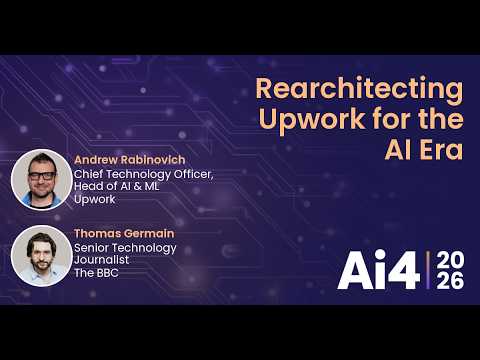
## Video description Andrew Rabinovich — Chief Technology Officer, Head of AI & ML, Upwork Thomas Germain — Senior Technology Journalist, The BBC
Information Companies are investing billions of dollars in autonomous AI agents with the promise that software will soon complete professional work independently. But what actually happens when you test these systems on real jobs with real stakes?
Andrew Rabinovich, Chief Technology Officer and Head of AI/ML at Upwork, brings a perspective shaped by 25 years in machine learning and one of the world’s largest real-world datasets on digital work. On the Upwork marketplace, more than 800,000 clients post over 3 million jobs each year across hundreds of professional categories, creating a live laboratory for testing the limits of AI agents in production environments.
In this fireside chat, we’ll share insights from Upwork’s Human + Agent Productivity Index (HAPI), which evaluates how advanced AI agents perform on real paid tasks. The results reveal a consistent pattern: agents struggle to reliably complete even well-defined work on their own, but performance improves dramatically when paired with expert human guidance.
Drawing on more than 10 petabytes of proprietary marketplace interaction data, this discussion will also focus on how Upwork rebuilt its platform for the AI era with Uma, an AI-native orchestration layer designed to coordinate human expertise and intelligent agents to deliver work outcomes faster and more reliably.
Join this session to understand what real-world data reveals about the limits of autonomous AI and why the future of work will be built around human-AI collaboration rather than replacement.
[Source](https://www.youtube.com/watch?v=BkAY24qUbn0)