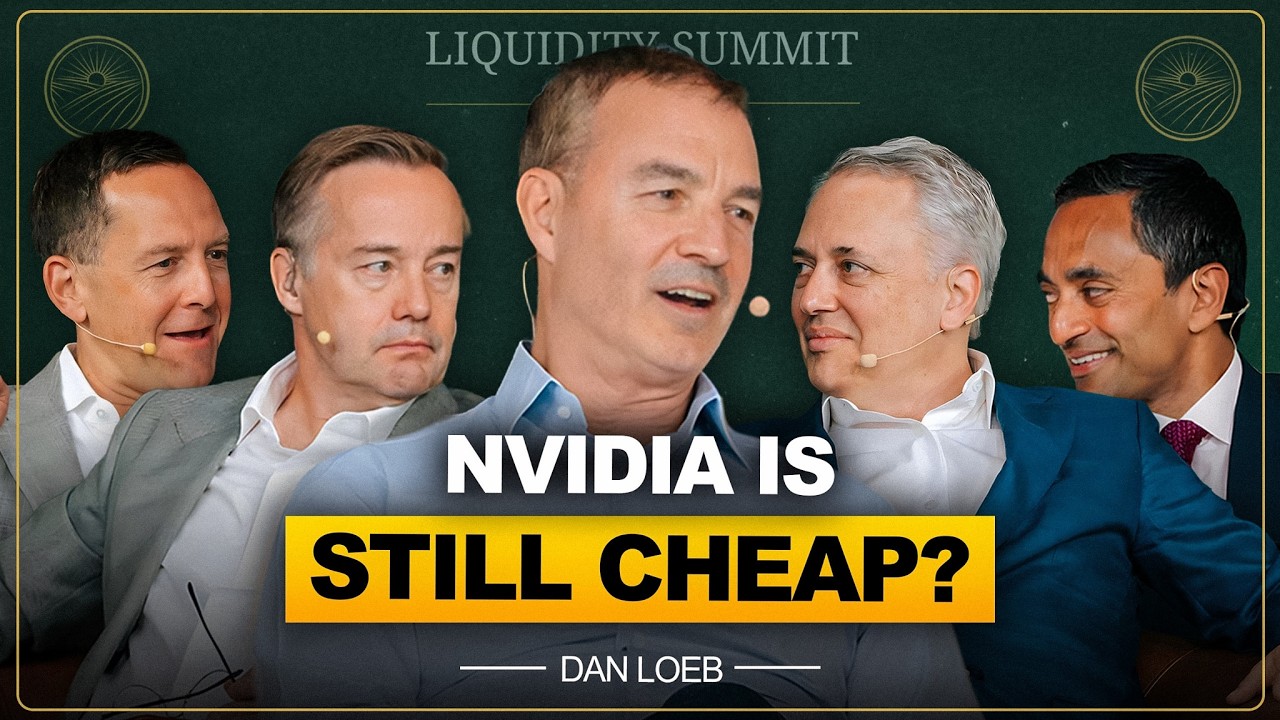
Loeb Avoids Valuation-Based Shorts to Prevent Meme-Stock Losses
All-In Podcast
Hedge fund manager Dan Loeb warns short sellers will get run over by retail trading frenzies unless they pivot away from valuation-based targets to focus strictly on structural corporate impairments.
## Background
Published on YouTube by the All-In Podcast on June 5, 2026, this episode features hedge fund billionaire Dan Loeb joining the hosts. The show notes describe a conversation covering Loeb's early investor journey from internet message boards to Third Point, his strategic evolution into quality and AI, the intricacies of short selling, and his advocacy for criminal justice reform.
## TL;DR
Dan Loeb, CEO and CIO of Third Point, walks through his transition from an early internet 'original troll' exposing corporate frauds to managing a major multi-strategy hedge fund. The discussion outlines Third Point's evolution from pure event-driven transactions to capturing AI and tech trends, while highlighting the irreplaceable nature of human pattern recognition in assessing management moats. Additionally, the hosts debate venture capital equity distributions and Nvidia's valuation, while Loeb shares his philanthropic dedication to charter-school education reform and his successful battle alongside conservative activists to secure a presidential pardon for Silk Road founder Ross Ulbricht.
## Atmosphere & style
The conversation carries a highly engaging, sharp, and collegial vibe, blending the casual camaraderie of the 'Besties' with deep-dive institutional market intelligence. It feels like an inside look at elite finance, shifting naturally from lighthearted banter about early internet trolling and painful venture capital missteps to deeply serious, reflective commentary on structural poverty and the human soul. The dynamic is intellectually rigorous yet approachable, grounded in decades of shared history, pattern recognition, and mutual respect.
## Key takeaways
- [00:00](https://www.youtube.com/watch?v=i8OI8CNdZgU&t=0s) Dan Loeb notes that the landscape for activists and short sellers has dramatically shifted since the 1990s, when early internet message boards on Yahoo and Silicon Investor were used to expose fraudulent companies through shame and humor.
- [00:00](https://www.youtube.com/watch?v=i8OI8CNdZgU&t=0s) Loeb recounts a 1990s short target, Act Trade, which claimed to have proprietary 'TADS' technology but was actually a basic factoring company financing everyday appliances at an irrational multiple of book value.
- [03:18](https://www.youtube.com/watch?v=i8OI8CNdZgU&t=198s) Loeb gained intense foundational training on the distressed debt desk at Jefferies, which he describes as putting in his '10,000 hours' by constantly writing up investment ideas to move cheap, post-distressed debt.
- [03:18](https://www.youtube.com/watch?v=i8OI8CNdZgU&t=198s) Rather than relying on traditional top-down mentorship, Loeb reverse-engineered his investment system by studying and copying the best practices of contemporaries and clients like Eric Mindich and David Tepper.
- [06:43](https://www.youtube.com/watch?v=i8OI8CNdZgU&t=403s) Third Point shifted its strategy from pure event-driven investing—buying into market dislocations and complex transactions driven by misaligned management projections—to a multi-strategy powerhouse focused on tech, innovation, and credit.
- [06:43](https://www.youtube.com/watch?v=i8OI8CNdZgU&t=403s) Loeb emphasizes that modern market dynamics require an absolute baseline of technological literacy across all asset classes, contrasting it with the era before the Global Financial Crisis where investors could get away without it.
- [12:20](https://www.youtube.com/watch?v=i8OI8CNdZgU&t=740s) Despite the rise of AI and automated agentic models, Loeb strongly argues that the human element and human networks remain indispensable for assessing qualitative moats, pattern recognition, and adaptable management teams.
- [12:20](https://www.youtube.com/watch?v=i8OI8CNdZgU&t=740s) Third Point avoids purely valuation-based short selling to prevent getting run over by retail trading frenzies, choosing instead to target structural impairments like hidden capital commitments in homebuilder option contracts.
- [17:49](https://www.youtube.com/watch?v=i8OI8CNdZgU&t=1069s) David Sacks shares the structural difficulty private market investors face when distributing public equities, highlighting his own multi-billion-dollar missed opportunities in holding or selling early on companies like Palantir and Enphase Energy.
- [17:49](https://www.youtube.com/watch?v=i8OI8CNdZgU&t=1069s) Sacks notes that taking seats on public company boards can be a major structural disadvantage because it severely limits an investor's liquidity and ability to trade out of a position dynamically.
- [20:10](https://www.youtube.com/watch?v=i8OI8CNdZgU&t=1210s) The scale of global market caps has shifted exponentially over the last decade, moving from an era where a $100 billion valuation was viewed as an absolute ceiling to a modern market supporting multi-trillion-dollar companies.
- [20:10](https://www.youtube.com/watch?v=i8OI8CNdZgU&t=1210s) Sacks argues that Nvidia is fundamentally undervalued relative to its expected earnings over the next few years, noting that mega-cap tech winners often face 'safe short' pressure from long-short pods before breaking out further.
- [22:22](https://www.youtube.com/watch?v=i8OI8CNdZgU&t=1342s) Loeb argues that systemic public education failures—driven by a lack of meritocracy and accountability due to union structures—are the primary drivers of income inequality, rather than the extreme wealth of individuals.
- [26:09](https://www.youtube.com/watch?v=i8OI8CNdZgU&t=1569s) Loeb details his systemic and individual framework for criminal justice reform, pointing out that many people serve highly disproportionate sentences or are trapped in a system with zero remaining judicial recourse.
- [26:09](https://www.youtube.com/watch?v=i8OI8CNdZgU&t=1569s) The successful pardon of Silk Road founder Ross Ulbricht required years of external political pressure from activists like Charlie Kirk after an initial commutation effort was blocked by Justice Department threats during Donald Trump's first term.
## Detailed walkthrough
### [00:00](https://www.youtube.com/watch?v=i8OI8CNdZgU&t=0s) The "Original Troll" and the Wild West of the Early Internet
Activists and short sellers have seen a dramatic shift in their landscape, but for Dan Loeb, CEO and CIO of Third Point, the core of the craft remains deeply tied to a blend of sharp analysis and public pressure. Reflecting on the early days of his career in the 1990s, Loeb recalls a time when "our main tool was shame and humor." Long before Reddit, Wall Street Bets, or modern social media platforms existed, Loeb was active on early internet message boards like Yahoo and Silicon Investor. He describes this era as a "wild west" where people congregated anonymously to exchange ideas, blow off steam, and "kibbitz."
When asked if he engaged in trolling during those early days, Loeb jokingly refers to himself as the "OT"—the "original troll." For him, uncovering fraudulent companies in the unsupervised market of the 1990s was incredibly fun, especially on the short side. He recalls a specific target called Act Trade, run by a "repeat fraudster." Loeb and his team got under the founder's skin by exposing that the business was merely a factoring company trading at a massive multiple of book value. The company claimed to have a proprietary technology called "TADS" to package factoring securities, but in reality, they were simply financing everyday appliances like refrigerators.
- **Key Platforms of the 1990s:** Yahoo message boards, Silicon Investor.
- **Act Trade Case Study:** A factoring company financing refrigerators that claimed proprietary "TADS" technology to trade at a high multiple of book value.
[03:18](https://www.youtube.com/watch?v=i8OI8CNdZgU&t=198s) Learning the Ropes: From Payne Weber to Jefferies
Loeb’s path to managing nearly $30 billion in assets at Third Point was shaped by a series of formative, often unconventional, experiences. His interest in investing began at age ten when his father—a great lawyer but a "notoriously bad investor"—took him to meet a broker. By the 11th grade, Loeb had landed a job at a Payne Weber branch office under Allan Crown, where he posted books, made cold calls, and traded options on Occidental Petroleum and Teledyne. "I think we broke certain securities laws, but I think the statute of limitations is passed," Loeb jokes, recalling how he repeatedly made and lost all his money.
His formal education in valuation began at Warburg Pincus, spanning private equity and venture capital, followed by a crucial stint at a risk arbitrage firm. However, Loeb's career truly accelerated in his late 20s on the distressed debt desk at Jefferies. He describes this period as "drinking out of a fire hose," putting in his "10,000 hours" by writing up investment ideas daily to move massive blocks of cheap, post-distressed debt.
Rather than relying on traditional, top-down mentorship, Loeb reverse-engineered his investment philosophy by observing his peers and clients. He closely watched brilliant contemporaries like Eric Mindich—the youngest-ever partner at Goldman Sachs who ran their arb desk alongside Amos Dreisbach—and legendary investors like David Tepper. Loeb compares his learning style to a "Chinese corporation that was like copying and reverse engineering," taking the best practices from everyone to build his own "operating system" for event-driven investing.
- **Early Trading Targets:** Options on Occidental Petroleum and Teledyne.
- **Key Career Stops:** Payne Weber (high school), Warburg Pincus, Risk Arb firm, Jefferies (distressed debt desk).
- **Influential Peers/Clients:** Eric Mindich (Goldman Sachs), Amos Dreisbach, David Tepper.
[06:43](https://www.youtube.com/watch?v=i8OI8CNdZgU&t=403s) The Evolution of Third Point's Strategy
When Third Point launched, its strategy was strictly "event-driven investing." Rather than focusing on the underlying quality of a business, Loeb targeted highly complex transactions: takeovers, spin-offs, risk arbitrage, bankruptcies, privatizations, and demutualizations. These situations created massive alpha due to a mix of market dislocation, opacity, and time constraints. Loeb frequently relies on a classic Jesse Livermore quote, "there's nothing new under the sun," to describe how management incentives drive these situations. In many transactions, management teams were incentivized to "sandbag" their projections while their options were being set, allowing Third Point to buy in at depressed prices and ride the subsequent wave of operational outperformance and increased transparency.
Over time, Third Point evolved from this pure event-driven model into a multi-strategy powerhouse. As technology became a dominant economic force, the firm shifted its focus toward business quality, innovation, disruption, and broader thematic trends across consumer behavior and financial services. Loeb notes that while investors could get away with being technologically or economically illiterate prior to the Global Financial Crisis (GFC), today's markets require a deep, correlated understanding of technology across all asset classes.
To support this broader mandate, Third Point expanded its platform. Loeb's partner, Rob Schwarz—whom he has known since they took Kempo Karate together at age ten—reconnected with him at their 20-year high school reunion in 1999. Schwarz's background in wireless RF components helped launch Third Point's venture capital arm, starting with an early investment in Dave Fischer's Radio Communications, a Wi-Fi chipmaker later sold to Texas Instruments. Today, Third Point's integrated platform spans:
- **The Core Hedge Fund:** Long/short equity and credit (structured credit and high yield).
- **CLO & Private Credit Business:** Traditional private credit, direct sponsor lending, and workouts ("credit solutions").
- **Insurance Company:** A wholly-owned (now half-owned) entity that captures investment-grade private and public credit, utilizing surplus capital.
[12:20](https://www.youtube.com/watch?v=i8OI8CNdZgU&t=740s) The Role of the Human and Assessing Moats in the Age of AI
As artificial intelligence and automated agents reshape asset allocation and risk management, Loeb remains firm that the human element of investing will never disappear. While AI can process vast amounts of data, it cannot replicate the "social component" and the "human network" required to build relationships and capture unique opportunities. "The agents of the AI will never really be able to look in your eye and assess all the things," Loeb explains, adding that investors ultimately want to know the human face behind who is making or losing their money.
This human assessment is particularly vital when evaluating a company's "moat" and durability. Loeb acknowledges that determining whether a company will survive the next 10 to 20 years is harder than ever, noting that past investors often deluded themselves about the permanent moats of giants like IBM, AOL, or Yahoo. Because technology and products change rapidly, Third Point focuses heavily on finding adaptable management teams. Assessing this adaptability is not a quantitative exercise; rather, Loeb relies on "pattern recognition" built over 30 years of qualitative, subjective observation.
When it comes to short selling in the current market, Loeb emphasizes that Third Point avoids a "solely valuation-based approach." He has seen too many short sellers get "run over" by targeting companies with irrational valuations that suddenly get swept up in retail trading frenzies on Reddit or among speculative space companies. Instead, they look for structural impairments. For example, Loeb highlights a short thesis they held on homebuilders, where companies pretended to be asset-light like NVR but actually held massive, hidden capital commitments to land pools through option contracts.
[17:49](https://www.youtube.com/watch?v=i8OI8CNdZgU&t=1069s) The Vexing Challenge of Distributing Public Equities
The discussion shifts to the "hangover" of inventory disruptions and unsustainable pricing in the real estate and building sectors, where buyers are no longer able to pay high prices in the current financing and inflationary environment. Jason Calacanis brings David Sacks into the conversation, noting that while Sacks is famous for the *All-In* theme song lyric "let your winners ride," navigating the distribution of equities as a private market investor remains one of the most vexing questions in venture capital.
Sacks openly admits that he does not claim to have any great expertise in timing distributions, sharing several painful examples of selling too early. He recounts that his firm was a private investor in Palantir and sold all their stock when it was in the $20s, missing out on a massive subsequent run. Even more dramatically, they led the Series B in Upstart and were early investors in Enphase Energy. On Enphase, they sold some stock at the IPO, took a tax hit, and eventually sold the rest under a dollar; had they held on, Sacks estimates the position would have been worth $4 billion. He notes that being on company boards often restricts liquidity, which is why he has largely stopped taking board seats.
- Sacks's firm sold Palantir in the $20s, missing a massive post-IPO surge.
- They sold Enphase Energy under $1.00, missing out on what would have eventually been a $4 billion position.
- Sacks advises that board seats can be a double-edged sword because they restrict an investor's ability to remain liquid.
---
[20:10](https://www.youtube.com/watch?v=i8OI8CNdZgU&t=1210s) The Evolution of Market Caps and the Nvidia Debate
The hosts engage in some lighthearted banter about how different their lives—and personalities—would be if they had never sold their earliest home runs. Calacanis jokes about how "insufferable" Chamath Palihapitiya would be if he had never sold his Facebook stock, or how David Friedberg would be worth $10 billion if he had held onto his Google shares. Sacks reflects on how much the scale of the market has changed over the last decade. Ten years ago, a $100 billion market cap was viewed as the absolute ceiling for how big a company could get. When Facebook IPO'd at a $50 billion valuation, investors assumed the upside was capped at $100 billion. Today, the market routinely supports multi-trillion-dollar giants.
This leads to a debate about Nvidia's current valuation. Sacks argues that Nvidia is actually undervalued right now when looking at its projected earnings over the next two to three years. He explains that people have a hard time processing the sheer scale of the largest corporate entities in human history. Furthermore, market dynamics force long-short hedge fund pods to be short *something*, making massive winners like Nvidia, Google, or Amazon frequent targets for "safe shorts" before they inevitably break out again.
- Facebook went public at a $50 billion valuation when a $100 billion market cap was considered the historical ceiling.
- Sacks asserts that Nvidia is "absolutely" undervalued based on its earnings outlook for the next two to three years.
- Large tech giants often languish under "safe short" narratives from long-short pods before experiencing major valuation breakouts.
---
[22:22](https://www.youtube.com/watch?v=i8OI8CNdZgU&t=1342s) Philanthropy, Education Reform, and Systemic Inequality
Calacanis shifts the conversation to society and culture, asking guest Dan Loevenich about his deep passion for criminal justice reform and his pivotal role in securing the pardon of Silk Road founder Ross Ulbricht. Loevenich steps back to explain his broader philanthropic framework, which focuses heavily on addressing income inequality and expanding opportunity. His journey into criminal justice reform actually began with education reform. As the former chairman of Success Academy, a charter school network in New York, Loevenich argues that the root of income inequality is not the extreme wealth of individuals like Jeff Bezos, but rather a systemic failure to equip vulnerable children with the intellectual tools to compete.
Loevenich contends that poverty is not an intractable problem. Instead, he argues that the public education system fails because basic business principles—such as accountability, merit, and cultivating talent—are set aside to protect the interests of teachers' unions. He emphasizes that this is a structural issue rather than a lack of funding. Seeking common ground between conservatives and liberals, Loevenich looks for areas of consensus, such as improving education and recognizing that government-run systems often falter.
- Loevenich served as the chairman of Success Academy, a prominent charter school network in New York.
- He argues that systemic educational failures, driven by union structures that reject accountability and merit, are the primary drivers of income inequality.
- He highlights Atom Computing, a quantum computing company in his portfolio, as a rare example of a highly successful public-private partnership where the government drove a tough bargain that will benefit taxpayers.
---
[26:09](https://www.youtube.com/watch?v=i8OI8CNdZgU&t=1569s) The Fight for Ross Ulbricht's Pardon and Individual Philanthropy
Loevenich details his framework for criminal justice reform, clarifying that while there are many bad people in prison who belong there, the system is also filled with individuals who are falsely convicted, genuinely rehabilitated, or serving highly disproportionate sentences. He points to the case of John Grubman, who received an 18-year sentence for dealing in gray-market baby formula and diapers, before diving deep into the case of Ross Ulbricht. Ulbricht, who ran the Silk Road exchange, became a folk hero within the crypto community. While Ulbricht admitted to illegal activity and expressed deep regret for the drug transactions on his platform, he was sentenced to a double life sentence plus 40 years.
Loevenich was alerted to the severity of Ulbricht's sentence by crypto insiders and realized that because there was no judicial recourse left for a life sentence, only a presidential pardon could free him. Loevenich partnered with conservative activist Charlie Kirk, who championed the cause and brought it directly to Donald Trump. During the final days of Trump's first term, a commutation seemed certain, but the Justice Department threatened political retaliation against Trump, causing him to withdraw it at the last minute. Over the subsequent four years, Kirk kept the pressure on, making it his primary ask of Trump. Trump ultimately promised the libertarian and crypto communities he would act, resulting in Ulbricht's sentence being commuted and pardoned. Today, Ulbricht is married, expecting a child, and living a free life after a decade in prison. Loevenich concludes by stating that while systemic advocacy is important, helping individuals "one at a time" deeply nurtures the soul.
- Ross Ulbricht was sentenced to double life plus 40 years for running the Silk Road exchange.
- The initial commutation attempt on the last day of Trump's 45th term was derailed when the Justice Department threatened to "go after" the president.
- Following sustained advocacy by Charlie Kirk and attorney David Warrington (now White House Counsel), Ulbricht was fully pardoned, married, and is now expecting a child.
- Loevenich continues his criminal justice work through an organization called Olive, alongside efforts to fight anti-Semitism and support Jewish identity.
## Notable quotes
> [00:00](https://www.youtube.com/watch?v=i8OI8CNdZgU&t=0s) our main tool was shame and humor. — Dan Loeb
> [00:00](https://www.youtube.com/watch?v=i8OI8CNdZgU&t=0s) OT — Dan Loeb
> [00:00](https://www.youtube.com/watch?v=i8OI8CNdZgU&t=0s) original troll — Dan Loeb
> [03:18](https://www.youtube.com/watch?v=i8OI8CNdZgU&t=198s) I think we broke certain securities laws, but I think the statute of limitations is passed — Dan Loeb
> [03:18](https://www.youtube.com/watch?v=i8OI8CNdZgU&t=198s) drinking out of a fire hose — Dan Loeb
> [03:18](https://www.youtube.com/watch?v=i8OI8CNdZgU&t=198s) 10,000 hours — Dan Loeb
> [03:18](https://www.youtube.com/watch?v=i8OI8CNdZgU&t=198s) Chinese corporation that was like copying and reverse engineering — Dan Loeb
> [06:43](https://www.youtube.com/watch?v=i8OI8CNdZgU&t=403s) there's nothing new under the sun — Jesse Livermore
> [12:20](https://www.youtube.com/watch?v=i8OI8CNdZgU&t=740s) The agents of the AI will never really be able to look in your eye and assess all the things — Dan Loeb
> [17:49](https://www.youtube.com/watch?v=i8OI8CNdZgU&t=1069s) let your winners ride — David Sacks
> [20:10](https://www.youtube.com/watch?v=i8OI8CNdZgU&t=1210s) absolutely — David Sacks
> [26:09](https://www.youtube.com/watch?v=i8OI8CNdZgU&t=1569s) go after — Justice Department
> [26:09](https://www.youtube.com/watch?v=i8OI8CNdZgU&t=1569s) one at a time — Dan Loevenich
## Mentioned
Dan Loeb, Third Point, Yahoo, Silicon Investor, Act Trade, TADS, Payne Weber, Allan Crown, Occidental Petroleum, Teledyne, Warburg Pincus, Jefferies, Eric Mindich, Goldman Sachs, Amos Dreisbach, David Tepper, Jesse Livermore, Rob Schwarz, Dave Fischer, Radio Communications, Texas Instruments, IBM, AOL, NVR, Jason Calacanis, David Sacks, Chamath Palihapitiya, David Friedberg, Palantir, Upstart, Enphase Energy, Facebook, Google, Nvidia, Amazon, Dan Loevenich, Ross Ulbricht, Jeff Bezos, Success Academy, Atom Computing, John Grubman, Silk Road, Charlie Kirk, Donald Trump, Justice Department, David Warrington, Olive
勒布规避估值型做空以防散户抱团股亏损
对冲基金经理Dan Loeb警告称,做空者若不从基于估值的目标转向严格关注企业结构性缺陷,就将在散户交易狂潮中遭受重创。
Third Point首席执行官兼首席投资官Dan Loeb回顾了他从早期互联网揭露企业欺诈的“初代喷子”,转型为掌管大型多策略对冲基金经理的历程。本次讨论概述了Third Point如何从纯事件驱动型交易演进为捕捉人工智能与科技趋势,同时强调了人类模式识别在评估管理层护城河时具有不可替代的作用。此外,主持人还就风险投资股权分配及Nvidia估值展开了辩论,Loeb也分享了他在特许学校教育改革方面的慈善投入,以及他与保守派活动人士成功为“丝绸之路”创始人Ross Ulbricht争取到总统赦免的经历。
Dan Loeb指出,自20世纪90年代以来,维权投资者和做空者的生存环境已发生剧变;当时人们利用Yahoo和Silicon Investor等早期互联网留言板,通过羞辱和幽默讽刺来揭露造假公司。 (0:00)
Loeb回顾了20世纪90年代的一个做空目标Act Trade,该公司声称拥有专有的“TADS”技术,但实际上只是一家以离谱的账面价值倍数向日常家电提供融资的基础保理公司。 (0:00)
Loeb在Jefferies的不良债务交易团队接受了高强度的基础训练,他将此描述为投入了自己的“一万小时”,通过源源不断地撰写投资构想来推进廉价的重组后不良债务交易。 (3:18)
Loeb没有依赖传统的自上而下的导师指导,而是通过研究并借鉴Eric Mindich和David Tepper等同侪与客户的最佳实践,反向推导构建了自己的投资体系。 (3:18)
Third Point将其策略从纯事件驱动型投资(即买入由管理层不当预期引发的市场错配和复杂交易)转向了专注于科技、创新和信贷的多策略强手。 (6:43)
Reading summary
Third Point founder Dan Loeb and the All-In hosts examine the transformation of public and private markets, arguing that modern investing requires navigating trillion-dollar scale, avoiding simplistic valuation-based shorts, and relying on qualitative human judgment over purely quantitative metrics.
From Distressed Debt to Multi-Strategy Platforms (6:43)
Loeb established his investment framework by reverse-engineering the strategies of market peers like Eric Mindich and David Tepper while working Jefferies' distressed debt desk. Initially, Third Point focused on pure event-driven setups—including takeovers, spin-offs, and bankruptcies—capitalizing on instances where executive teams sandbagged projections while setting their equity options, leaving mispriced assets positioned for operational recovery.
As technological disruption expanded across industries, Loeb broadened the firm beyond traditional event-driven trades into a diversified platform. Together with partner Rob Schwarz, Third Point added venture capital investments, direct lending, structured credit solutions, and a dedicated insurance vehicle designed to deploy surplus capital into investment-grade credit.
Short Selling Realities and the Human Edge (12:20)
In contrast to his early career targeting frauds on 1990s message boards, Loeb cautions that short selling strictly against stretched valuations has become dangerous due to retail trading frenzies. Third Point instead targets structural balance sheet flaws, such as homebuilders that present themselves as asset-light while masking heavy capital commitments through land-pool option contracts.
Loeb also argues that artificial intelligence cannot replace human networks or the qualitative assessment required to evaluate leadership. Because perceived competitive moats—such as those once attributed to IBM, AOL, or Yahoo—frequently deteriorate, he relies on subjective pattern recognition to judge whether management teams can adapt to rapid technological shifts.
Venture Liquidity and Shifting Valuation Ceilings (17:49)
David Sacks highlights the operational difficulty venture investors face in managing public equity distributions, citing early exits from Palantir in the $20 range and Enphase Energy below $1.00, the latter forfeiting a stake that would have reached an estimated $4 billion. Sacks also notes that holding board seats often exacerbates this challenge by restricting liquidity windows.
Reflecting on market structure, Sacks observes that historical valuation assumptions have been upended: where a $100 billion market capitalization was once viewed as an absolute ceiling, multi-trillion-dollar caps are now routine. He asserts that mega-cap leaders such as Nvidia remain undervalued relative to two-to-three-year projected earnings, even as long-short hedge fund pods periodically lean on them as safe short positions.
Education Reform and Targeted Clemency Advocacy (22:22)
Outside asset management, Loeb frames economic inequality as an educational failure rather than a byproduct of extreme wealth generation. Drawing on his tenure chairing the Success Academy charter school network, he argues that union-backed structures resist performance accountability and merit-based talent management, undermining student outcomes despite substantial public funding.
Loeb also applies targeted interventions to criminal justice reform, pointing to disproportionate sentences within the federal prison system. Working alongside activist Charlie Kirk after judicial appeals were exhausted, Loeb successfully lobbied for Donald Trump's presidential commutation and pardon of Silk Road founder Ross Ulbricht, whose initial clemency attempt had stalled during Trump's first administration over Department of Justice opposition.
The discussion underscores that whether evaluating public equities, navigating illiquid venture distributions, or addressing systemic social problems, standard quantitative templates and institutional structures frequently fail without active, human-driven adaptation.
精炼阅读摘要
Third Point 首席执行官兼首席投资官 Dan Loeb 探讨了对冲基金投资与卖空策略的演变,强调即使在人工智能时代,主观模式识别、对管理层适应能力的评估以及人类社交网络仍是核心优势;同时,节目嘉宾结合自身经验反思了公开市场股权分配的时机抉择、科技巨头估值上限的突破,以及刑事司法与教育改革等慈善议题。
投资体系演变与早期卖空经历 (0:00)
Dan Loeb 的投资生涯始于高中的 Payne Weber 营业部,经历了 Warburg Pincus 的私募与创投训练、风险套利机构的工作,并在 20 多岁时在 Jefferies 的不良债务业务中高强度积累经验。他通过观察并反向工程 Eric Mindich 和 David Tepper 等同行及客户的最佳实践,搭建了专注于事件驱动型投资的操作框架。在 1990 年代尚未受严格监管的早期互联网论坛(如 Yahoo 和 Silicon Investor)上,Loeb 戏称自己为“初代网络喷子”(original troll),主要运用公开羞辱与幽默感来揭露造假公司,例如揭露号称拥有专利技术“TADS”但实际仅是为冰箱等日用家电提供保理融资的公司 Act Trade。
随后,Third Point 从最初纯粹针对企业控制权收购、分拆、破产重组等事件驱动策略(利用管理层在期权设定时故意压低业绩预期的行为盈利),逐步演化为管理近 300 亿美元资产的多策略机构。伴随科技成为主导力量,公司引入了联合创始人 Rob Schwarz 的科技背景,将布局拓展至风险投资(首个项目为 Radio Communications,后售予德州仪器)、多空股票、结构化信用与高收益债、CLO 和私募信贷,以及捕获投资级信贷利差的保险公司资产运作。
AI 时代的人类网络与做空陷阱 (12:20)
尽管人工智能和自动化代理正在重塑资产配置与风险管理,Loeb 坚持认为投资中的人类要素永远不可替代。他指出,AI 无法复现面对面建立信任的社交网络与人际洞察,委托人最终仍需要看到承担资本盈亏的人类面孔。面对变化加速的商业环境,评估企业护城河变得前所未有地困难,历史经验表明 IBM、AOL 或 Yahoo 等巨头的所谓永久护城河都会瓦解;因此,Third Point 依托 Loeb 积累三十年的定性模式识别,重点评估管理层是否具备应对技术变革的动态适应能力。
在做空策略上,Loeb 警告不能仅依赖估值过高这一项指标,否则极易在 Reddit 等散户抱团狂热或投机性太空股行情中被严重碾压。Third Point 转而寻找具有结构性缺陷的目标。例如,他们曾做空某些住宅建筑商,这些公司对外标榜自己像 NVR 一样属于轻资产模式,但实际上却通过期权合同对土地储备池承担了大量隐蔽的刚性资本承诺。
股权退出挑战与科技巨头市值重构 (17:49)
针对风险投资在公开市场退出与股票分配的时机抉择,David Sacks 指出这是创投领域最棘手的难题之一,即便信奉“让赢家奔跑”的原则也难免犯错。Sacks 坦言其基金曾在 Palantir 股价位于 20 多美元时全数抛售,从而错失后续大幅拉升;而在早期投资 Enphase Energy 时,其团队在 IPO 阶段出售部分股票并在 1 美元以下清仓剩余份额,若一直持有该头寸最终价值可达 40 亿美元。Sacks 还强调,担任董事会席位往往会严重限制流动性与变现灵活性,因此他已基本不再担任董事职务。
在讨论科技公司体量时,Sacks 回顾道,十年前市场普遍将 1000 亿美元市值视作企业规模的绝对天花板,例如 Facebook 以 500 亿美元估值上市时上限被预期极为狭窄,如今市场却已常态化容纳数万亿美元的巨头。关于 Nvidia 的当前估值,Sacks 认为基于未来两到三年的盈利预期,该股票实际上仍被低估。他解释称投资者难以消化史上最大规模企业的体量演进,且多空对冲基金 pod 的机制常强制其建立空头对冲,导致 Nvidia、Google 和 Amazon 等巨头频频成为“安全做空标的”,直到估值再度实现向上突破。
教育问责、制度失灵与司法赦免倡导 (22:22)
Dan Loevenich 将其慈善重心放在应对收入不平等与扩大社会流动性上,认为收入不平等的根源并非极少数富豪的巨额财富,而是公共教育系统未能向弱势儿童提供足够的智力工具与竞争力。作为纽约 Success Academy 特许学校网络的前主席,Loevenich 坚称贫困并非不可解决的绝症,公共教育的问题在于教师工会体制排斥问责制与择优评估等商业常识,这属于体制缺陷而非资金不足。
在刑事司法改革领域,Loevenich 指出监狱系统充斥着量刑畸重或已完全洗心革面的人员,例如 Silk Road 创始人 Ross Ulbricht 因平台毒品交易被判处双重无期徒刑加 40 年。在司法救济途径耗尽的情况下,Loevenich 联手保守派活动家 Charlie Kirk 与律师 David Warrington,向 Donald Trump 持续游说总统赦免。尽管在特朗普第一任期最后一天因司法部威胁追究而流产,但 Kirk 在随后数年间持续跟进,最终兑现了承诺,促成 Ulbricht 获释成婚并重回正常生活。Loevenich 表示,除了系统性倡导,通过 Olive 等组织一次拯救一个个体也能给予心灵极大滋养。
本期对谈反映出成熟投资机构在应对算法与量化狂潮时,愈发强调对管理层定性判断、企业结构性漏洞以及人类社交网络的依赖;同时,从早期风投的过早退出反思到万亿美元巨头的估值重构,展现了市场尺度剧变带来的认知挑战,而个案推动的制度改革与个案赦免则揭示了资本影响现实社会的多元路径。
Detailed notes — zh
## Background
本期视频由知名商业科技播客《All-In Podcast》于 2026 年 6 月 27 日发布在 YouTube 平台。节目围绕传奇激进对冲基金经理、Third Point 创始人兼首席投资官丹·勒布(Dan Loeb)的投资生涯展开,涵盖了他从早期股票论坛恶搞与揭露造假、在杰富瑞经受困境债务历练,到将策略转型至业务质量与 AI、做空房屋建筑商,以及参与刑事司法改革推动罗斯·乌布利希(Ross Ulbricht)获得总统特赦的完整心路历程。
## TL;DR
丹·勒布系统回顾了自身投资哲学从“羞辱造假与事件驱动套利”向“商业模式质量、宏观穿透与 AI 赋能”的范式迭代,强调做空艺术与个股/信用资产挑选在当下至关重要。他深入剖析了 Third Point 旗下多策略平台的资产整合机制、当下做空美国房屋建筑商的逻辑破绽,并坚决驳斥了英伟达触顶论,指出多空平台型基金将其作为安全做空标的乃是短视陷阱。此外,勒布坚信对管理团队的直觉和面对面模式识别无法被 AI Agent 取代,并坦陈了过早清仓 Palantir 等优秀企业的教训。在社会议题上,勒布分享了以问责制推进教育改革、通过公私合营支持量子计算(Atom Computing),以及历经两届总统任期联合多方力量促成乌布利希完全特赦的微观慈善理念。
## Atmosphere & style
对谈在顶级对冲基金大佬与硅谷科技投资好友之间展开,兼具高密度的硬核金融交锋与充满行业自嘲的黑色幽默,整体氛围既从容通透又极具现实穿透力。在回忆早年混迹论坛当“初代喷子”和经历重大卖飞失误时,勒布展现出罕见的坦率与松弛;而当话题切入畸形的司法重刑判决、体制弊病以及幕后奔走特赦个体的漫长博弈时,现场基调迅速转为庄重与深沉,呈现出极具张力的人性关怀与思想厚度。
## Bulletin
- [16:02](https://www.youtube.com/watch?v=i8OI8CNdZgU&t=962s) 丹·勒布指出失落的做空艺术已强势回归,但严厉警告切勿单纯因估值过高而做空,并分享了因伪轻资产模式及成本挤压而重仓做空美国房屋建筑商的案例。
- [21:19](https://www.youtube.com/watch?v=i8OI8CNdZgU&t=1279s) 针对英伟达的市值天花板争议,勒布认为基于未来两到三年盈利预期其估值依然被严重低估,多空仓基金因结构性对冲需求将其误当成了做空标的。
- [10:40](https://www.youtube.com/watch?v=i8OI8CNdZgU&t=640s) Third Point 已从早期的事件驱动型套利,演变为融合股票多空、私人信贷、CLO 及能够吸纳高评级投资级资产的保险平台的综合多策略架构。
- [26:09](https://www.youtube.com/watch?v=i8OI8CNdZgU&t=1569s) 在刑事司法改革领域,勒布联合查理·柯克等人历经多年游说,最终促成丝绸之路创始人罗斯·乌布利希获得总统完全特赦重获自由。
## Key takeaways
- [00:00](https://www.youtube.com/watch?v=i8OI8CNdZgU&t=0s) 做空艺术与精细化选股重新成为市场核心,激进投资必须具备代理权争夺战作为硬核威慑力。
- [00:34](https://www.youtube.com/watch?v=i8OI8CNdZgU&t=34s) 90年代互联网初代论坛充斥造假骗局,勒布等人通过网络嘲讽与基本面做空击垮了如伪装成高科技的保理公司 Actrade 等骗局标的。
- [03:18](https://www.youtube.com/watch?v=i8OI8CNdZgU&t=198s) 杰富瑞困境债务组的高强度实战与向同龄顶尖投资人(如 Eric Mindich、David Tepper)的逆向工程,奠定了勒布专有的投资底层操作系统。
- [06:48](https://www.youtube.com/watch?v=i8OI8CNdZgU&t=408s) 早期事件驱动投资依托并购、分拆及破产重组中的信息不透明与管理层压制预期的激励错配,创造出巨大的阿尔法红利。
- [08:07](https://www.youtube.com/watch?v=i8OI8CNdZgU&t=487s) Third Point 的投资范式全面转向业务质地与科技全域穿透,科技逻辑如今已深度渗透并绑定了包括另类信贷在内的所有传统资产类别。
- [12:20](https://www.youtube.com/watch?v=i8OI8CNdZgU&t=740s) AI 与 Agent 无法取代人类投资者的眼神交流、直觉以及对创业者的定性洞察,资本的最终托付依然依托于人。
- [13:45](https://www.youtube.com/watch?v=i8OI8CNdZgU&t=825s) 在技术颠覆加速的时代,真正的企业护城河愈发罕见,对管理团队敏捷适应能力的定性模式识别成为核心考量。
- [16:02](https://www.youtube.com/watch?v=i8OI8CNdZgU&t=962s) 美国房屋建筑商表面模仿 NVR 的轻资产土地期权模式,实则面临巨额资本承诺与疫情后暴涨的高成本及终端支付能力脱节的双重挤压。
- [18:25](https://www.youtube.com/watch?v=i8OI8CNdZgU&t=1105s) 投资者需适应多万亿美元市值的新时代,过早止盈(如错失 Palantir 后续涨幅或因出任董事失去流动性)往往带来巨大的机会成本。
- [21:19](https://www.youtube.com/watch?v=i8OI8CNdZgU&t=1279s) 英伟达重演了昔日谷歌与亚马逊被多空基金误当成安全做空标的的走势,其当前价位尚未充分反映未来数年的实际盈利潜力。
- [22:22](https://www.youtube.com/watch?v=i8OI8CNdZgU&t=1342s) 教育改革打破贫富差距的瓶颈在于破损的制度结构与缺乏问责制,而非投入资金不足。
- [24:35](https://www.youtube.com/watch?v=i8OI8CNdZgU&t=1475s) 高效的公私合营模式(如政府投资量子计算初创企业 Atom Computing)能够实现纳税人收益、国家战略与初创企业估值提升的三赢局面。
- [26:09](https://www.youtube.com/watch?v=i8OI8CNdZgU&t=1569s) 司法改革应聚焦于量刑严重畸轻畸重的个案纠偏,推动罗斯·乌布利希的双重无期徒刑特赦正是跨越党派诉求的典型范例。
- [30:18](https://www.youtube.com/watch?v=i8OI8CNdZgU&t=1818s) 慈善事业除大型机构化合作外,必须辅以点对点直接救助具体受困个体的微观实践,方能实现双向的心灵滋养。
## Detailed walkthrough
### [00:00](https://www.youtube.com/watch?v=i8OI8CNdZgU&t=0s) 开场:做空艺术的回归与激进投资策略的演进
在由 All-In 团队主持的访谈中,传奇激进对冲基金经理、Third Point 创始人兼首席投资官(CIO)丹·勒布(Dan Loeb)登台开宗明义。他直言当下市场环境已经发生巨大变化:“失落的做空艺术已经强势回归,而且它在当下至关重要。”勒布强调,如今不仅是“选股者的市场”,更是“债券和信用资产挑选者的市场”,投资者无论涉足何种资产类别,都必须具备极高的甄别能力。
谈及自己标志性的“激进主义(Shareholder Activism)”投资风格演化,勒布回顾了 Third Point 早期策略与现在的鲜明反差。早年间基金规模尚小,勒布最擅长且最依赖的武器是“羞辱与幽默感(shame and humor)”——例如当年在周末对食品巨头雀巢(Nestlé)公开发动激烈攻势、炮轰管理层。然而随着管理规模扩大,如今的沟通基调已经全面转向“敢于成就伟大(Dare to be great)”的建设性赋能姿态。勒布用了一句极其犀利的讽刺来总结激进投资的硬核本质:
> “没有代理权争夺战(Proxy Contest)的激进投资,就像没有地狱的天主教一样,毫无威慑力。”
### [00:34](https://www.youtube.com/watch?v=i8OI8CNdZgU&t=34s) 互联网初代喷子(OT)与 90 年代揭露造假的狂野西部
在主持人提到勒布在社交平台 X(原 Twitter)上以言辞犀利、情绪饱满而著称后,话题转向了勒布作为公众人物的“黑历史”。主持人调侃勒布在 Reddit 社区 Wall Street Bets 诞生很多年之前就已经是混迹论坛的“骨灰级老鸟”。勒布坦然笑纳,回忆起 1990 年代互联网浪潮刚兴起时的盛况:远在 Reddit 出现前,投资者主要聚集在 Yahoo 留言板以及 Silicon Investor 等初代股票论坛上。当时大家隐匿在匿名马甲背后互相探讨、聊天闲扯(Kibbitz),那是一个毫无监管的“狂野西部”,言论无拘无束,但其中也蕴藏着大量极具深度的干货与实质洞察,和如今的社群生态并无本质不同。
当被问及当年是否也会亲自下场“网络恶搞/挑衅(trolling)”时,勒布打趣说,别人自称 OG(Original Gangster),而他其实是“OT(Original Troll,初代喷子)”。他坦言自己当时根本没料到未来会管理数百亿美元的机构资金,只是纯粹为了寻开心和发泄压力。尤其是做空(Shorting)维度,其间充满了黑色幽默:90 年代的资本市场监管远不如现在严密,市场充斥着极其夸张的财务造假欺诈公司。勒布和伙伴们最热衷的事情,就是揪出这些商业骗局,在论坛上戏谑、嘲讽管理层,并最终在市场上做空击垮对手获利。
勒布分享了一个令他记忆犹新的典型案例:一家名为 Actrade 的上市公司。该公司的掌舵人是一个惯犯级造假者(repeat fraudster)。Third Point 团队在调查中撕开了其伪装——该公司表面上被包装成高科技企业,宣称拥有一项名为“TADS”的独家全新技术,估值被炒作到账面价值(Book Value)的五到六倍之巨。然而勒布等人核查后发现,其业务底层不过是一家平庸且充满风险的保理借贷公司(factoring company),所谓的高科技无非是给冷柜、冰箱等传统家电的分期付款保理资产换了一层包装。勒布等人在网上不断戳破对方的谎言,直戳造假者的痛处,最终彻底粉碎了这家公司的骗局。
### [03:18](https://www.youtube.com/watch?v=i8OI8CNdZgU&t=198s) 投资成名之路:从少年交易员到杰富瑞的“破产重组熔炉”
主持人提问,Third Point 当年以极微小的种子资金起步,如今资产管理规模(AUM)已逼近 300 亿美元,勒布究竟是如何一步步掌握投资这门技艺的。勒布娓娓道来自己的成长经历:他对投资的痴迷始于童年。大约 10 岁时,身为一名出色律师但在投资上“臭名昭著地糟糕”的父亲带他去见了一位经纪人,由此开启了他的实盘初体验。到了高十一学期(11th grade),勒布在潘恩韦伯(Paine Webber,后被瑞银收购)的一家分行找到了一份工作,师从一位名叫 Allan Crown 的经纪人。当时勒布的主要工作是帮其记账和打陌生电话(cold calls)。勒布戏称,自己当时帮着打电话可能已经触犯了某些证券合规法规,好在诉讼时效早已过去。高中期间,他频繁交易西方石油(Occidental Petroleum)以及 Teledyne 的期权合约。由于期权波动剧烈,他经历过数次短时间内资产暴赚又彻底亏光的过山车行情,但这些惨痛教训塑造了他早期的风险意识。
大学毕业后,勒布的专业金融训练正式拉开序幕:
1. **华平投资(Warburg Pincus)**:作为他的第一份正式工作,他在跨越私募股权(PE)与风险投资(VC)的真实项目全流程中,扎实掌握了对企业价值的评估方法(Valuation)。
2. **风险套利机构(Risk Arbitrage Firm)**:这段经历为他理解并购交易机制打下了无价的基础。
3. **杰富瑞(Jefferies)困境债务组(Distressed Debt Desk)**:勒布自嘲在 20 几岁时换了太多份工作,但在杰富瑞的经历让他彻底沉下心来并迅速成熟。他从研究分析师做起,当时走出破产困境的垃圾债与重组证券极其廉价,每天都有大笔的债务头寸需要撮合与消化。
勒布将杰富瑞的高强度洗礼比作“从消防水龙带里接水喝(drinking out of a fire hose)”,每天不断撰写深度研报、分析重组方案,在极短时间内完成了投资领域的“一万小时定律”和“一万次实战推举”。勒布特别反思了世俗对“导师(Mentorship)”的狭隘认知——许多人将指导视为某种金字塔式的层级关系,即必须由年长资深的泰斗传授智慧;但他认为,自己学到最多的反而来自身边的同龄战友(cohort),以及他的机构客户。
例如,当时高盛最年轻的明星合伙人、负责高盛风险套利业务的埃里克·明迪奇(Eric Mindich)及其团队的核心成员(包括 Amos Hostetter 等人),就毫无保留地向勒布展示了顶级对冲基金思考事件驱动型投资的逻辑框架。此外,勒布还负责覆盖了包括大卫·泰珀(David Tepper,Appaloosa Management 创始人)在内的一批业内顶尖投资大脑。勒布生动地形容当时的自己就像一家“早期的中国技术公司”:通过疯狂逆向工程、拆解吸收全市场顶尖投资者的思考方式,并将各家之所长融合成专属于 Third Point 自身的投资底层操作系统(Operating System)。
```mermaid
flowchart TD
accTitle: 丹·勒布的投资操作系统演进之路
accDescr: 展示丹·勒布从少年交易员起步,经由华平、杰富瑞到创立 Third Point 事件驱动及科技演化的全过程。
subgraph Phase1 ["早期探索与基础奠定 (少年 - 20岁初)"]
A["10岁:受父亲启发涉足投资"] --> B["高十一:Paine Webber 实盘记账与期权交易"]
B --> C["华平投资 (PE/VC 企业价值评估)"]
C --> D["风险套利公司 (并购套利机制)"]
end
subgraph Phase2 ["杰富瑞高压熔炉与逆向工程 (成熟期)"]
E["杰富瑞困境债务台:高强度实战 (10,000 Reps)"]
F["顶级客户智囊网络<br/>• Eric Mindich (高盛套利桌)<br/>• David Tepper 等传奇投资人"]
E -.-> G["吸收/逆向工程多方智慧,打造专有投资操作系统"]
F -.-> G
end
subgraph Phase3 ["Third Point 策略迭代 (基金管理)"]
H["传统事件驱动模型<br/>(困境债务、分拆、私有化、管理层激励反差)"]
I["现代复合模型<br/>(拥抱科技全景穿透、商业模式质量、AI 驱动创新)"]
H --> I
end
Phase1 --> Phase2
G --> H
```
### [06:48](https://www.youtube.com/watch?v=i8OI8CNdZgU&t=408s) Third Point 早期策略内核:事件驱动与逆向套利
在解释 Third Point 成立初期的风格表达时,勒布指出,当时的杀手锏是“事件驱动型投资(Event-Driven Investing)”。在那个时期,他们不太在乎企业质地本身的长期优劣,而是全神贯注于极其复杂的特殊交易场景——包括并购接管、公司分拆(Spin-offs)、风险套利、破产清算与重组、私有化以及非互助化改制(Demutualization)。
在勒布看来,这些复杂交易之所以能爆发出惊人的超额阿尔法(Alpha)收益,源于四大核心要素的完美交汇:资产定价错配(Dislocation)、财务与业务信息的极度不透明(Opacity)、时间维度的特殊压缩,以及最关键的——**管理层激励机制(Management Incentives)**。勒布引用了投资大师杰西·利弗莫尔(Jesse Livermore)的名言:“阳光底下没有新鲜事(There's nothing new under the sun)”。
在上述特殊交易发生的窗口期,上市公司管理层往往有强烈的动机故意隐瞒利润、极力打压预期(Sandbag the numbers)。因为在此期间公司面临大量抛售、股票供给过剩,管理层的期权行权价正好在此时被锁定。作为极少数看穿这套游戏规则的联合投资者,Third Point 能够以极具吸引力的低估值介入这些饱受压制的目标公司。随后,随着重组完成、信息透明度提升、华尔街研究覆盖跟进,公司业绩与利润率开始超预期释放,Third Point 得以全面享受基本面与估值双击带来的巨大红利。勒布由衷感叹,那是属于事件驱动型投资的“黄金年代”。
### [08:07](https://www.youtube.com/watch?v=i8OI8CNdZgU&t=487s) 范式转换:拥抱业务质地、AI 变革与科技全域穿透
时代车轮滚滚向前,传统的事件驱动框架虽然依然保留在 Third Point 的基因中,但基金的整体范式经历了深刻的结构性重构。随着科技对各行各业的全面侵蚀与重塑,单纯盯着财务与法律架构套利已无法立足,Third Point 开始大举转向:
1. 聚焦“商业模式的质量(Business Quality)”;
2. 深刻理解创新与技术颠覆(Disruption);
3. 建立自上而下的宏观与消费趋势洞察,穿透金融服务业演进与宏观经济背景;
4. 全面拥抱人工智能(AI)浪潮,将其视作历次技术革命的集大成者。
勒布与主持人展开讨论:在 2008 年全球金融危机(GFC)之前,哪怕你是一个“科技文盲”,甚至在一定程度上是“宏观经济学文盲”,单凭对传统公司金融或利差的挖掘,都能在资本市场上赚得盆满钵满。但在今天,这两者缺一不可。科技早已成为一条不可分割的主线(Tech throughline)穿透了一切行业——哪怕是像 Blue Owl 这样以传统另类信贷或资产交易见长的机构,如今也必须在科技前沿拥有极深厚的认知与专业度。过去那些看似与科技毫无关联的非相关资产包,现在在底层事实上全部被科技驱动的逻辑紧紧绑定在了一起。
为了具象化 Third Point 是如何提早布局科技投资的,勒布揭秘了背后的关键人物——他的长期合伙人罗布·施瓦茨(Rob Schwarz)。两人的渊源可以追溯到 10 岁时一起练习拳道空手道(Kempo Karate)。勒布自黑说,当年施瓦茨一路打到了紫带,而自己连黄带都没考过。两人在 1999 年的高中毕业 20 周年聚会上重新联系上,当时施瓦茨正担任无线射频(RF)元器件的销售代表。敏锐的勒布立即意识到,身处供应链一线的施瓦茨是为对冲基金做渠道核查(Channel checks)的不二人选。
几年之后,勒布对施瓦茨提议:“你在日常工作中能接触到很多绝顶聪明的工程师,如果你哪天遇到真正懂行、拔尖的工程专家,我们就应该直接投资他们。”虽然当时的 Third Point 并非正统意义上的硅谷风险投资机构,对 VC 范式一窍不通,但他们坚信早期投资的核心就是“押注对的人”。这一极富直觉的非共识决定,拉开了 Third Point 深入科技前沿与创业投资领域的崭新篇章。
### [10:40](https://www.youtube.com/watch?v=i8OI8CNdZgU&t=640s) Third Point 的全方位多策略平台与跨资产整合
Dan Loeb 回顾了他们早期的风险投资尝试。当时 Dave Fischer 创办了一家名为 Radiata Communications 的芯片公司,研发兼容 802.11a/b/g 标准的 Wi-Fi 基站芯片,该公司最终成功出售给了德州仪器(Texas Instruments)。虽然 Loeb 表示不会花过多时间细讲 Third Point 的风投历程,但这项活动最早是从主基金内部孵化,后来拓展为独立的专属风险投资基金。
这些业务的真正核心在于高度互联,最终凝聚在 Third Point 当下的综合平台之中。目前 Third Point 旗下不仅拥有涵盖股票多空、结构化信贷(Structured Credit)和高收益债(High Yield)的旗舰对冲基金,还通过并购建立了抵押贷款凭证(CLO)业务,并创立了涉足传统直接借贷、赞助商融资(Direct Sponsor Financing)及债务重组(Workouts / Credit Solutions)的私人信贷(Private Credit)业务。几年前,Third Point 进一步进军保险领域:此前他们做过一家财产及意外险(P&C)公司,而最近创立的这家寿险/再保险平台最初由他们全资拥有,如今保留了一半股权。该保险公司能够吸纳 Third Point 承揽的高评级投资级资产——包括通过结构化工具包装的私人信贷、结构化信贷、整笔贷款(Whole Loans)以及公募和私募的投资级信贷,使团队能够以极其高效且创新的方式调配盈余资本(Surplus Capital)。
```mermaid
flowchart TD
accTitle: Third Point 资本与业务协同架构图
accDescr: 展示 Third Point 旗下主要基金、信贷业务及保险平台之间的资产互联与协同流动模式。
subgraph FundOperations["核心投资平台 (Third Point)"]
HedgeFund["旗舰对冲基金\n(股票多空 / 结构化信贷 / 高收益债)"]
VC["风险投资业务\n(早期专用基金 / 芯片科技)"]
end
subgraph CreditSolutions["信贷与债务解决方案"]
CLO["CLO 业务\n(外部并购整合)"]
PrivateCredit["私人信贷业务\n(直接借贷 / 赞助商融资 / 重组处置)"]
end
subgraph InsurancePlatform["保险及资本池应用"]
Insurance["保险资产运作平台\n(持有 50% 股权)"]
Assets["吸收投资级资产\n(整笔贷款 / 结构化信贷 / 盈余资本运作)"]
end
HedgeFund <--> CreditSolutions
CreditSolutions --> Insurance
Insurance --> Assets
```
### [12:20](https://www.youtube.com/watch?v=i8OI8CNdZgU&t=740s) 人类与 AI Agent 的边界:人际网络、眼神交流与资本责任
面对主持人和嘉宾关于“在 Agent、AI 算法、海量数据与机器学习充斥的未来十年,Dan Loeb 与人类管理者的角色将变成什么”的提问,Loeb 直言,他目前的主要精力和时间依然放在旗舰对冲基金的管理上,因为这依然是 Third Point 最大且最核心的资本池。
Loeb 坚信投资中的人类元素永远无法被取代。人际网络的社会属性极其关键——结识优秀人才、敏锐捕捉机会、在商业合作中深度互动,这些能力是代码和模型无法完全模拟的。即便未来风投机构(比如 Andreessen Horowitz 等)可能会配置自动化 Agent 来进行初步研判,但资本的最终托付依然依托于人。正如台上嘉宾打趣指出的那样,出资人最终“需要知道到底是谁在帮你赚钱,或者是谁把你的钱赔光了”。Loeb 补充道,AI 和智能体永远无法做到在现实中凝视对方的双眼,以一种深沉的直觉与全方位的感官去穿透并评估对面的创业者。
### [13:45](https://www.youtube.com/watch?v=i8OI8CNdZgU&t=825s) 护城河、商业韧性与主观定性的管理团队评估
对话转向 Loeb 投资哲学的演进。早期的 Dan Loeb 习惯于寻找“带有明确催化剂的廉价证券”(Cheap securities with catalysts),而如今他越来越聚焦于企业的护城河、商业模式的防守性以及营收的持久度(Durability)。Chamath 提出的“企业的时间价值边界”(Time-bounded value of companies)在这里引发了强烈共鸣——在如今的技术颠覆浪潮下,能够存活 7 年、10 年乃至 20 年的真正护城河变得极其稀少且难以界定。Loeb 坦言,回望过去,很多投资者其实在护城河上自我欺骗了,曾经被认为坚不可摧的 IBM、AOL 或 Yahoo 最终都被浪潮侵蚀。
正因无法单凭一项产品或技术断言其能永久领先,Loeb 将核心考量重新落脚在管理团队身上。他强调必须寻找具备极强适应能力的管理层,能够在剧变中始终保持行业领先。当被问及“对管理团队的评估是否已经建立了一套可量化的打分表(Rubric)”时,Loeb 清了清嗓子明确否定:这绝非量化体系所能概括,它至今仍然是极度主观且定性的工作。在经历市场摸爬滚打 30 年后,这完全演变成了一种深层的“模式识别”(Pattern Recognition)。
### [16:02](https://www.youtube.com/watch?v=i8OI8CNdZgU&t=962s) 做空的新机遇与房地产建筑商的做空逻辑
针对 Loeb 近期公开提出“做空市场正迎来多年罕见的丰富机会”,现场探讨了其标的筛选机制是自上而下(Top-down)还是由事件驱动的自下而上捕捉。Loeb 明确表示,他们严厉规避“单纯基于估值过高”的做空策略。单纯因为估值愚蠢而做空往往极其危险,历史上无数空头因此被碾压,尤其是遇到 Reddit 散户抱团或当前某些毫无基本面逻辑却暴涨的商业航天概念股时,估值空头往往死无葬身之地。
随后,Loeb 详尽拆解了他们从去年开始重仓做空美国房屋建筑商(Homebuilders)的经典案例。市场普遍认为只是高利率和房贷利差压制了房价,但 Third Point 洞察到了更深层的结构性病灶:
- **伪轻资产模式**:许多建筑商对外声称自己在效仿 NVR 采取“轻资产”(Asset-light)模式,宣称手中握有的只是土地期权(Land Options),但实际上它们对土地储备池做出了沉重的资本承诺,一旦周期转向,这些价值便会迅速减记。
- **疫情后的供需挂钩与成本挤压**:建筑业是最后几个残留“疫情后供应链扰动幻觉”的行业。此前新房售价被推高到不可持续的荒谬水平,伴随而来的是飙升的建筑原材料和人工成本。在当前的融资环境下,终端购房者早已无力承担如此高昂的价格,而建筑商自身又遭遇通胀与高成本的两头挤压,利润面临双重瓦解。
### [18:25](https://www.youtube.com/watch?v=i8OI8CNdZgU&t=1105s) 私募转公募的退出困局:卖飞的痛点与万亿市值新常态
David Sacks 被拉入讨论关于“让利润奔跑(Let your winners ride)”与在公募市场何时派发减持的难题。Loeb 直率地自嘲 Third Point 在历史上也犯过很多令人扼腕的退出错误:
- 他们曾是 Palantir 的早期一级市场投资人,却在股价 20 多美元时全数抛光,彻底错过了后面高达 8 到 10 倍的巨幅涨幅;
- 他们领投了 Upstart 的 B 轮融资,但由于担任董事职务导致股票流动性受限,最终在流动性锁定期吃尽苦头,这也是 Third Point 后来决定尽量不进董事会的重要原因;
- 他们极早期投资了微型逆变器巨头 Enphase Energy,在 IPO 时卖出部分以抵扣税收,甚至在股价跌破 1 美元时草率清仓——如果他们一直拿住不动,那笔投资本可以赚取 40 亿美元的利润。
面对市场的残酷与不易,Sacks 也深表赞同,表示这是所有一级市场投资人最棘手的折磨。Sacks 分享了自己作为早期天使与 VC 投资 Meta(Facebook)和 Palantir 的经历:
- 面对上市后股票的处理,往往只能“按具体情况权衡”(Case by case)。有些公司因担任董事无法变现导致后悔,另一些公司最明智的选择则是永久持有。
- 嘉宾们随即开起了好友间的玩笑:如果当年 Chamath 从未卖掉他的 Facebook 股票,或者 Friedberg 从未卖掉他的早期 Google 股票,他们现在该多么令人“无法忍受”(Insufferable),Friedberg 的身价甚至能冲到 100 亿美元。
- Sacks 分析指出,认知偏差很大程度来自时代的尺度变化:十年前投资圈普遍认为千亿美元市值几乎是商业世界的天花板(Facebook 以 500 亿估值 IPO 时,大家认为翻倍到 1000 亿就已经见顶);而如今市场进入了多万亿美元市值(Multi-trillion dollar)时代,赛道的容量和空间发生了根本性重塑,彻底颠覆了以往早早止盈的思维定势。
### [21:19](https://www.youtube.com/watch?v=i8OI8CNdZgU&t=1279s) 英伟达的估值争议与多空基金的做空陷阱
在谈及英伟达(NVIDIA)时,市场普遍对其庞大的体量心存顾虑,甚至认为其市值已经触及了天花板。然而 Dan Loeb 明确指出,未来回过头来看,这种思维方式显得非常短视与愚蠢。凭借在行业中无可撼动的统治地位,结合未来两到三年的预期盈利来看,英伟达在当前价位绝对被严重低估了。
对于市场为何会产生这种认知偏差,Dan Loeb 剖析了背后的多空博弈逻辑。一方面,大众很难在心理上接受人类历史上体量最为庞大的商业实体的诞生;另一方面,市场上总有其他增速更快的新概念资产在吸引眼球。更为关键的是对冲基金的结构性限制:多空仓平台型基金(Pod Shops)的架构要求基金经理必须保持风险对冲,手里必须要有空头仓位。对这些基金经理而言,英伟达因为市值过大、似乎涨幅受限,反而被误当成了“安全的做空标的”(Safe Short)。这种现象并非新鲜事,当年 Alphabet(Google)和亚马逊(Amazon)也曾遭遇完全相同的做空待遇。这些领头羊往往会在某个估值区间徘徊震荡一段时间,随后再度强势突破,而英伟达未来也终将迎来这样的突破。
- 针对英伟达当前的交易价格,基于未来两至三年的盈利预测,Dan Loeb 认为其估值依然处于明显的低估状态。
- 多空基金受制于仓位对冲规则,倾向于寻找所谓的“安全做空标的”,英伟达正像当年的谷歌和亚马逊一样被错误地推上了这一位置。
---
### [22:22](https://www.youtube.com/watch?v=i8OI8CNdZgU&t=1342s) 慈善理念与教育改革:打破贫富差距的体制症结
话题随后转向社会文化与公共议题。主持人提到了 Dan Loeb 在刑事司法改革领域的投入以及他在促成罗斯·乌布利希(Ross Ulbricht)获得特赦中所扮演的关键角色。在深入阐述司法改革之前,Dan Loeb 首先梳理了自己的慈善资助框架。与 Brad Gerstner 等现场多数科技与投资界同仁一样,他极度关注收入不平等问题,并致力于让更多弱势群体能够享受到现代社会的发展红利。
Dan Loeb 强调,收入不平等的症结绝不是因为杰夫·贝佐斯(Jeff Bezos)等人积累了数万亿美元的财富,真正的问题在于社会没能为最脆弱的儿童提供在这个时代生存和竞争所必需的智力工具。贫困并不是无法克服的顽疾,教育早已证明了这一点;真正阻碍变革的是僵化的教师工会体系。商业世界行之有效的“问责制(Accountability)”、“优胜劣汰(Merit)”和“人才培养机制”,在公共教育领域为了保护成年工会成员的利益而被全盘废弃。作为纽约特许学校网络“成功学院”(Success Academy)的长期支持者及前董事会主席,他直言教育危机根本不是缺乏资金投入,而是缺乏问责制这一破损的制度结构。
---
### [24:35](https://www.youtube.com/watch?v=i8OI8CNdZgU&t=1475s) 跨越党派鸿沟与高效的公私合营实践
在探索能够让保守派、自由派和进步派达成共识的议题时,Dan Loeb 发现教育改革和政府机制改进是为数不多的最大公约数。尽管公众普遍对政府直接插手项目持怀疑态度,但他特别肯定了本届政府在支持私营部门方面罕见的高效作为,尤其是公私合作模式(Public-Private Partnership)。
Dan Loeb 以其投资组合中的量子计算公司 Atom Computing 为例进行了详细说明。该公司与其他数家量子计算企业一同获得了美国政府的资金支持。在谈判合作时,政府机构不仅在密码学等关键需求上提出了极高要求,而且在商业谈判中展现出了极强的专业度和强硬手腕。政府不仅是这批创新技术的客户,更是投资人;纳税人的资金在这类合作中将斩获丰厚回报,同时政府的深度背书也切实提升了企业的内在商业价值,形成了纳税人、国家战略与初创企业三赢的局面。
```mermaid
flowchart TD
accTitle: 政府与量子计算企业公私合营架构
accDescr: 展示美国政府作为投资人与客户双重身份支持 Atom Computing 并为纳税人创造回报的机制
subgraph GovRole["美国联邦政府"]
A["战略资金支持"]
B["高难度密码学采购需求"]
end
subgraph Enterprise["量子计算企业 (如 Atom Computing)"]
C["前沿技术攻坚与落地"]
D["企业商业估值大幅提升"]
end
subgraph Outcome["多赢成果"]
E["纳税人共享巨额财务回报"]
F["国家核心科技基础设施强化"]
end
A --> C
B --> C
C --> D
D --> E
D --> F
```
---
### [26:09](https://www.youtube.com/watch?v=i8OI8CNdZgU&t=1569s) 刑事司法改革与推动罗斯·乌布利希(Ross Ulbricht)总统特赦
Dan Loeb 随后系统阐释了自己在刑事司法改革上的立场。他明确表示,自己绝不支持滥用“司法改革”旗号放任犯罪、放弃起诉恶性罪犯的做法,狱中确实关押着大量真正的恶人。但他关注的是另外三类急需救济的人群:被错误定罪的无辜者、真心悔过并完成自我改造的人,以及服刑判决与所犯过错严重不匹配的人(例如因倒卖灰色市场纸尿裤和婴儿奶粉而被重判18年监禁的约翰·格拉布曼案件)。
正是在这种背景下,Dan Loeb 介入了“丝绸之路”(Silk Road)创始人罗斯·乌布利希(Ross Ulbricht)的案件:
* **案件背景与荒谬判决**:乌布利希创建了早期加密货币交易市场“丝绸之路”,并成为加密技术社区的代表人物。尽管乌布利希承认平台存在非法药物交易并表达了深刻忏悔,且政府指控的买凶杀人从未被正式起诉、本人也坚决予以否认,法院最终却对他判处了“双重无期徒刑加40年”(Double life plus 40 years)——这种甚至超越了生命极限的漫长刑期显得极度荒谬与不成比例。
* **体制死局与游说开端**:面对无期徒刑,常规司法救济程序已经彻底走入死胡同,唯一的希望在于总统特赦。经由一位通过 Intel 认识、名为 Rivetz 的女性以及 Olaf Carlson-Wee 等加密圈内人士的引荐,Dan Loeb 决定为这一案件奔走。
* **联合关键力量推动**:由于精通赦免机制,Dan Loeb 找到了查理·柯克(Charlie Kirk)。查理·柯克对乌布利希的不公遭遇深表同情并全力推进此事,直接向总统特朗普陈情;当时柯克的长期私人律师戴维·沃灵顿(David Warrington,现任白宫法律顾问)也为此默默工作了数年。
* **第一任期的意外挫折与最终胜利**:在特朗普第45任总统任期的最后一天,特赦原本已板上钉钉,但司法部突然以对总统展开审查进行施压威胁,导致该减刑决定在最后一刻被撤回。四年后,查理·柯克将此事列为他向总统提出的唯一核心诉求,特朗普随后在自由意志主义者与加密社区的集会上公开承诺予以解决。最终乌布利希不仅获得了减刑,更直接得到了总统完全特赦。
在服刑逾十年之后,乌布利希重获自由。如今他已组建家庭、迎娶妻子并即将迎来自己的孩子,重归正常人生。
---
### [30:18](https://www.youtube.com/watch?v=i8OI8CNdZgU&t=1818s) 践行微观慈善:点对点拯救个体的灵魂价值
面对主持人关于是否会继续参与此类救援的提问,Dan Loeb 给予了十分坚定的回答。他表示自己正在通过 Aleph 等司法援助组织持续展开行动,不断对具体的个案进行筛查与救助。
在总结自己的慈善哲学时,Dan Loeb 认为,机构化慈善固然不可或缺——他自己在对抗反犹太主义(Anti-Semitism)、增强犹太文化认同等方面倾注了巨额资源并与许多大型机构保持合作——但作为慈善家,不能仅仅停留在抽象的宏观组织层面。亲身投入、一次挽救一个具体的人("help people one at a time"),能为受困者带来新生,也是对慈善者自身心灵最好的滋养。访谈在全场观众对 Dan Loeb 的热烈掌声中圆满落幕。
## Notable quotes
> [00:00](https://www.youtube.com/watch?v=i8OI8CNdZgU&t=0s) 失落的做空艺术已经强势回归,而且它在当下至关重要。 — Dan Loeb
> [00:00](https://www.youtube.com/watch?v=i8OI8CNdZgU&t=0s) 没有代理权争夺战的激进投资,就像没有地狱的天主教一样,毫无威慑力。 — Dan Loeb
> [06:48](https://www.youtube.com/watch?v=i8OI8CNdZgU&t=408s) 阳光底下没有新鲜事 — Jesse Livermore
> [08:07](https://www.youtube.com/watch?v=i8OI8CNdZgU&t=487s) 你在日常工作中能接触到很多绝顶聪明的工程师,如果你哪天遇到真正懂行、拔尖的工程专家,我们就应该直接投资他们。 — Dan Loeb
> [12:20](https://www.youtube.com/watch?v=i8OI8CNdZgU&t=740s) 需要知道到底是谁在帮你赚钱,或者是谁把你的钱赔光了 — 主持人
> [13:45](https://www.youtube.com/watch?v=i8OI8CNdZgU&t=825s) 带有明确催化剂的廉价证券 — Dan Loeb
> [13:45](https://www.youtube.com/watch?v=i8OI8CNdZgU&t=825s) 企业的时间价值边界 — Chamath Palihapitiya
> [18:25](https://www.youtube.com/watch?v=i8OI8CNdZgU&t=1105s) 让利润奔跑 — David Sacks
> [21:19](https://www.youtube.com/watch?v=i8OI8CNdZgU&t=1279s) 安全做空标的 — Dan Loeb
> [30:18](https://www.youtube.com/watch?v=i8OI8CNdZgU&t=1818s) help people one at a time — Dan Loeb
## Mentioned
Dan Loeb, Third Point, All-In Podcast, Nestlé, Wall Street Bets, Yahoo, Silicon Investor, Actrade, Allan Crown, Paine Webber, Occidental Petroleum, Teledyne, Warburg Pincus, Jefferies, Eric Mindich, Amos Hostetter, David Tepper, Appaloosa Management, Blue Owl, Rob Schwarz, Dave Fischer, Radiata Communications, Texas Instruments, Andreessen Horowitz, Chamath Palihapitiya, IBM, AOL, NVR, David Sacks, Palantir, Upstart, Enphase Energy, Meta, Google, Friedberg, NVIDIA, Amazon, Brad Gerstner, Jeff Bezos, Success Academy, Atom Computing, John Grabman, Ross Ulbricht, Silk Road, Olaf Carlson-Wee, Charlie Kirk, David Warrington, Donald Trump, Aleph
## Video description
(0:00) Dan Loeb joins the Besties!
(0:34) Investor journey: From message boards and trolling Wall Street to a multibillion dollar hedge fund
(3:15) Third Point's early days: mentors and market turmoil
(8:47) Strategy shift: Event-driven to quality and AI
(16:01) The art of short selling and a homebuilder trade
(22:15) Criminal justice reform and the Ross Ulbricht pardon
Thanks to our partners for making this possible!
EY - Agentic AI is introducing a new investment discipline. As AI shifts to consumption-based models, EY connects spend to enterprise value.
https://www.ey.com/en_us/insights/ai/agentic-ai-token-costs?WT.mc_id=3501318&AA.tsrc=sponsorship
NYSE - Thank you to our partner, the New York Stock Exchange - a modern marketplace and exchange for building the future. It all happens at the NYSE.
https://www.nyse.com
Plaud - Never miss a moment. Plaud, our official wearable AI note-taking partner at All-In Liquidity Summit, captured every insight.
https://www.plaud.ai
Follow Dan Loeb:
https://x.com/DanielSLoeb1
Apply for Summit 2026:
https://allin.com/events
Follow the besties:
https://x.com/chamath
https://x.com/Jason
https://x.com/DavidSacks
https://x.com/friedberg
Follow on X:
https://x.com/theallinpod
Follow on Instagram:
https://www.instagram.com/theallinpod
Follow on TikTok:
https://www.tiktok.com/@theallinpod
Follow on LinkedIn:
https://www.linkedin.com/company/allinpod
Intro Music Credit:
https://rb.gy/tppkzl
https://x.com/yung_spielburg
Intro Video Credit:
https://x.com/TheZachEffect
#allin #tech #news
[Source](https://www.youtube.com/watch?v=i8OI8CNdZgU)
Source quotes
[0:00] Dan Loeb: 失落的做空艺术已经强势回归,而且它在当下至关重要。
[0:00] Dan Loeb: 没有代理权争夺战的激进投资,就像没有地狱的天主教一样,毫无威慑力。
[6:48] Jesse Livermore: 阳光底下没有新鲜事
[8:07] Dan Loeb: 你在日常工作中能接触到很多绝顶聪明的工程师,如果你哪天遇到真正懂行、拔尖的工程专家,我们就应该直接投资他们。
[12:20] 主持人: 需要知道到底是谁在帮你赚钱,或者是谁把你的钱赔光了
[13:45] Dan Loeb: 带有明确催化剂的廉价证券
[13:45] Chamath Palihapitiya: 企业的时间价值边界
[18:25] David Sacks: 让利润奔跑
[21:19] Dan Loeb: 安全做空标的
[30:18] Dan Loeb: help people one at a time
Source quotes
[0:00] Dan Loeb: our main tool was shame and humor.
[0:00] Dan Loeb: OT
[0:00] Dan Loeb: original troll
[3:18] Dan Loeb: I think we broke certain securities laws, but I think the statute of limitations is passed
[3:18] Dan Loeb: drinking out of a fire hose
[3:18] Dan Loeb: 10,000 hours
[3:18] Dan Loeb: Chinese corporation that was like copying and reverse engineering
[6:43] Jesse Livermore: there's nothing new under the sun
[12:20] Dan Loeb: The agents of the AI will never really be able to look in your eye and assess all the things
[17:49] David Sacks: let your winners ride
[20:10] David Sacks: absolutely
[26:09] Justice Department: go after
[26:09] Dan Loevenich: one at a time
Original transcript
[0:00] Legendary activist investor Dan Lope. He
[0:03] of course is [music] the CEO and CIO of
[0:05] Third Point.
[0:06] >> The lost art of shortselling has come
[0:08] back and it's absolutely critical.
[0:11] [music]
[0:11] >> Doesn't matter what you do, you have to
[0:12] be really selective. People talk about
[0:14] stock pickers market. This is a bond and
[0:16] credit pickers market.
[0:17] >> When we were [music] small, our main
[0:19] tool was a shame and humor. Dan Loe
[0:22] turning up the heat on Nestle [music]
[0:24] over the weekend. The shift has really
[0:26] been more towards a dare to be great
[0:28] message. [music] Activism without proxy
[0:31] contest is like Catholicism without
[0:33] hell.
[0:34] >> You're [music] very active on the
[0:35] Twitter as well.
[0:36] >> Oh wow.
[0:37] >> You found your voice.
[0:39] >> Lot a lot of emotion brewing there.
[0:41] >> Can we actually start with that? Before
[0:42] Twitter, you were actually quite active,
[0:46] but they were in very different places.
[0:47] I mean, you were in Wall Street Bets
[0:49] before Wall Street Bets existed. Can you
[0:51] just walk us through your evolution as a
[0:54] as a uh public persona?
[0:56] >> Sure. I mean, there was this brand new
[0:59] technology
[1:01] uh that came out called the internet.
[1:02] And really shortly that thereafter uh
[1:05] long before Reddit or any of these other
[1:08] things, there were a series of of chat
[1:10] boards. There was, you know, Yahoo,
[1:12] there was something called Silicon
[1:14] Investor,
[1:15] um a few other ones. And people would
[1:17] congregate in kibbitz. It was done
[1:20] mostly anonymously and um it was an
[1:23] interesting place to exchange ideas.
[1:26] There was it was it was really the wild
[1:28] west. People could pretty much say or do
[1:30] anything, but there was a lot of but
[1:31] there was a lot of substance there too.
[1:32] It's not actually that much different
[1:34] than from today.
[1:35] >> You uh did you engage at all in any
[1:37] trolling per se?
[1:38] >> Well, some people use the term OG.
[1:40] Sometimes I say I was the OT. Um
[1:44] >> the original troll.
[1:45] >> Yeah. No, I did. I mean, it was it was
[1:47] fun. You know, I I didn't know I was one
[1:50] day going to run institutional money and
[1:52] have a big fund and, you know, I was
[1:54] just having fun and uh and blowing off
[1:58] steam and and uh yeah, it was fun. I
[2:01] mean, investing is fun and particularly
[2:04] on the short side. I mean, there's so
[2:05] much humor in it when you detect these
[2:08] companies, especially in the '9s. I
[2:10] mean, that the it was really
[2:12] unsupervised. There were some incredibly
[2:15] fraudulent companies out there and it
[2:18] was just fun to uncover them and kind of
[2:21] taunt the management teams and
[2:23] ultimately uh prevail.
[2:26] >> You have one story above others that
[2:28] kind of stands out in that era. I mean,
[2:31] there were there were a bunch. There was
[2:34] uh wow. Um, there was a company called
[2:38] Act Trade that I remember run by a guy
[2:41] who was like a repeat uh fraudster and
[2:45] [laughter] we uncovered it and and um
[2:50] you know I I know we really got under
[2:53] this person's skin and ultimately it was
[2:55] really just a factoring company trading
[2:57] at five six I don't remember what it
[2:59] some large multiple of book value and
[3:02] they had created a new technology called
[3:05] TADS I don't remember what TAD stood
[3:07] for, but they were basically repackaging
[3:10] factory securities and saying that they
[3:13] had some special technology. They were
[3:15] financing refrigerators and things like
[3:17] that.
[3:18] >> Tell us um your evolution as an investor
[3:22] when you started Third Point. I mean,
[3:23] you started with very very little
[3:25] capital. Now it's almost 30 billion of
[3:27] AUM. your multistrat, but you learned at
[3:30] Jeffre, I think, like you learned
[3:33] helping people like David Ter allocate
[3:35] capitals. Just walk us through how you
[3:37] learned to invest.
[3:39] >> Well, I I started um really fascinated
[3:43] by investing and wanting to do it. I
[3:46] think when I I remember when I was 10
[3:47] years old, my dad took me my dad was a
[3:51] notoriously bad investor himself. So, he
[3:54] didn't give me any good examples. He was
[3:56] a great lawyer, not a great investor.
[3:58] But he took me to meet a broker and I
[4:00] started investing. And then in high
[4:02] school in the 11th grade, I got a job at
[4:04] the branch office of Bear Stern, sorry,
[4:08] of uh Payne Weber working for a guy
[4:09] named Allan Crown who let me post his
[4:12] books and make cold calls. And I think
[4:14] we broke certain securities laws, but I
[4:17] think the statute of limitations is
[4:19] passed. I would trade um options on
[4:22] accidental petroleum and teladine. there
[4:24] was a lot of volatility and um I think I
[4:27] had flurries of making money and lost
[4:29] all of it a couple of different times
[4:31] but it was a good good lesson. I
[4:33] continued doing it in college and then
[4:35] um my learning started really formerly
[4:40] at Warberg Pinkis where I really learned
[4:42] to value enterprises as my first job
[4:44] private kind of across the spectrum of
[4:46] private equity and venture capital.
[4:50] I worked at a risk arb firm which was
[4:52] really invaluable. Uh and then
[4:56] skipping forward I had I had way too
[4:59] many jobs in my 20s. Uh but I got really
[5:01] serious at Jeffre. I had a amazing
[5:03] opportunity to work on the distress debt
[5:05] desk there. I started out as a research
[5:08] analyst and I was just like drinking out
[5:10] of a fire hose. There was so much
[5:12] activity.
[5:14] the securities were so cheap coming out
[5:16] of distressed
[5:18] and um it was you know the 10,000 hours
[5:22] 10,000 reps we would write up uh
[5:26] different things every every day there
[5:27] were big blocks of debt to move and I
[5:29] really got that that was my real
[5:31] learning point and you know I stress
[5:32] this to people that you know everyone's
[5:34] kind of sees mentorship as this sort of
[5:36] hierarchical thing where you you know
[5:39] learn from some wise older person but
[5:41] it's I I I learned a ton from my
[5:44] colleagues, from my own cohort, and I
[5:47] learned a ton from my customers, you
[5:49] know, like Eric Mindic was a um boy
[5:52] wonder at Goldman. He was the youngest
[5:54] partner.
[5:55] >> Youngest partner at Goldman.
[5:56] >> Yeah. Ran the ARB desk there and he had
[5:59] this triumvirate or quadrumbate,
[6:02] whatever the four four people. Uh I
[6:04] don't want to leave them out, but Amos
[6:05] Dker and um
[6:10] can't some other guys. Anyway, they were
[6:13] great and they really kind of brought me
[6:14] into their thought process thinking
[6:17] about event- driven investing and then,
[6:19] you know, I covered some of the smartest
[6:21] people in the business, including David
[6:23] Ter. I got to watch their thought
[6:25] process and I was like a, you know, like
[6:27] a Chinese corporation that was like
[6:30] copying and reverse engineering and
[6:32] taking everything in and creating my
[6:34] database of knowledge and my own
[6:38] operating system. kind of taking the
[6:40] best out of what all these different
[6:42] people did.
[6:43] >> And what was that style when you first
[6:45] started Thirdp Point? What did you what
[6:46] was that expression?
[6:48] >> That was well I think that you know we
[6:50] call it event driven investing. It was
[6:52] really less [snorts] focused on the
[6:54] quality of business more focused on very
[6:57] complex transactions takeovers spin-offs
[7:00] risk risk or arbitrage bankruptcies
[7:03] privatizations demutralizations. And
[7:06] these transactions created unbelievable
[7:09] opportunities for alpha because of the
[7:11] confluence of dislocation,
[7:15] opacity, kind of time, but also this
[7:18] goes and nothing changes. I always quote
[7:20] this Jesse Livermore line, there's
[7:22] nothing new under the sun. A real focus
[7:25] on management incentives. So in all
[7:27] these different kinds of transactions,
[7:29] management was incentivized to sandbag
[7:32] their numbers during a time when there
[7:34] was an excess supply of securities where
[7:37] their options were being set. And we as
[7:40] co-investors got to come in with these
[7:42] depressed projections and ride along not
[7:45] just the um well we got to ride along a
[7:49] few different things that would happen.
[7:51] greater transparency and understanding
[7:53] of the business coverage uh companies
[7:56] that that delivered a topline and
[8:00] margins and roe and everything else
[8:02] better than expectations. So it was
[8:04] really a golden era for that type of
[8:06] investment
[8:07] >> and from where that started to what
[8:09] third point is today just describe that
[8:12] and where you want to where do you go
[8:14] from here?
[8:14] >> Yeah. So stylistically that event um
[8:18] approach it's it's it's still something
[8:21] we think about it's in our um it's in
[8:25] our framework but I think what happened
[8:28] really when technology became a bigger
[8:32] uh force but really everything changed
[8:35] is a greater focus on business quality
[8:38] and
[8:40] um innovation and disruption and more
[8:43] thematic on the on hand understanding of
[8:46] consumer trends what's going on in
[8:48] financial services what's the economic
[8:51] macro backdrop that's that's supporting
[8:53] all this and of course the big topic of
[8:56] this event you know AI is sort of the
[8:59] culmination of that but all these major
[9:02] technological innovations that have
[9:04] really happened since
[9:06] >> you could make money before by not being
[9:08] technology savvy in the markets
[9:10] >> you could be technologically illiterate
[9:11] or just say I don't do it and you could
[9:13] also be even more or less e you know up
[9:16] until the GFC I think you could be more
[9:18] or less economically illiterate and make
[9:20] a lot of money
[9:21] >> and now
[9:24] I you wouldn't want to be either one of
[9:26] those things I mean given how much how
[9:28] much more important
[9:29] >> like the tech through line needs to be
[9:31] understood everywhere
[9:33] >> even if you're like blue owl and you're
[9:35] trading I mean blue owl obviously is
[9:36] very sophisticated in tech now but
[9:39] >> any pool of capital that used to not be
[9:42] correlated is effectively correlated
[9:45] I mean, yeah. Yes. Yeah, you could say
[9:48] that. And I just want to answer your
[9:49] question just to kind of fast forward
[9:50] and give people a snapshot of what we do
[9:53] today.
[9:54] >> Rob Schwarz, who's my partner, and we
[9:57] took Kempo Karate together when we were
[9:58] 10 years old.
[10:00] >> It was a purple belt. I think I never
[10:01] made it past yellow belt, but um we
[10:04] reconnected at our 20-year reunion in
[10:08] I'm we're a I'm aging both of us. Sorry
[10:10] to give up your secret, Rob. uh in 1999.
[10:15] It was our 20-y year reunion, and he was
[10:18] working as a a sales rep for wireless RF
[10:22] components. And I said, "Wow, this guy'd
[10:24] be great to do channel checks for us."
[10:27] And then I asked him um a couple years
[10:30] later say, "Hey, you meet some smart
[10:32] people. If you ever come across a really
[10:34] savvy engineer, we should invest." We
[10:37] didn't know what we're doing. We weren't
[10:38] venture capitalists, but we were getting
[10:39] behind person. There was a guy named
[10:40] Dave Fischer started a company called
[10:42] radio communications. They made chips.
[10:45] He made chips that were I still remember
[10:47] ABG compatible for Wi-Fi base stations.
[10:51] And ultimately the company was sold to
[10:53] Texas Instruments. And you know we've I
[10:56] won't go deep into our our our venture
[10:58] business, but that we started to do
[11:00] within the fund. We've done a couple of
[11:03] dedicated funds. So we have that strand
[11:07] of activity. We can talk about a little
[11:10] bit more about what we're thinking and
[11:11] how we're seeing this. But I think what
[11:13] ultimately what I want you to get to is
[11:14] that all these things are interconnected
[11:16] and come together under the platform
[11:18] that we have today because we have the
[11:19] main hedge fund which does credit equity
[11:23] long short credit is both structured
[11:25] credit and high yield. We have a CLO
[11:28] business that we acquired. We started a
[11:31] um a private credit business. Uh it does
[11:36] traditional private credit, direct uh
[11:39] sponsor financing, direct lending and
[11:41] workouts which is very important. So
[11:43] credit solutions as they call it. A lot
[11:45] to do there. And then we started an
[11:48] insurance company uh a few years ago.
[11:51] It's not the first insurance company we
[11:52] did. We did a PNC company, but this one
[11:54] is was wholly owned. Now we own half of
[11:57] it. And the insurance company
[12:00] um captures basically the investment
[12:02] grade part of what we do. So private
[12:06] credit through structured vehicles,
[12:07] structured credit, whole loans,
[12:11] um uh investment grade both private and
[12:15] and and public, but we also can use our
[12:17] surplus capital in very interesting
[12:19] ways. So
[12:20] >> So what's the role of the human? What's
[12:22] the role of Dan Loe in running
[12:24] thirdpoint 10 years from now? Like 10
[12:29] years before Dan Lo was 100% of
[12:31] thirdpoint
[12:32] >> and then there's now there's agents,
[12:34] there's AI, there's all this learning,
[12:35] there's all of this data.
[12:39] Where do you see the role of the human?
[12:41] Where do you see the role of systems
[12:44] making decisions, allocating capital,
[12:46] managing risk? I mean it's a so first of
[12:49] all investing now like first of all the
[12:52] my time is spent primarily on managing
[12:55] the hedge fund which for now is the
[12:58] biggest capital pool and most important
[13:01] business that we're in.
[13:02] >> Yeah. the human element. I think this is
[13:04] true for everyone you have here like the
[13:07] the element of uh the social component
[13:10] that the the human network of knowing
[13:14] people being able to to capture
[13:16] opportunities work with people interact
[13:20] like that's never going away. like
[13:21] you're never had going to maybe maybe
[13:23] you can theorize that there will be
[13:24] agents that will sit at Andre and
[13:27] Horowitz and who whoever else your funds
[13:30] but I think the human will always have
[13:32] to be there because people like to
[13:35] you know
[13:35] >> you want to know who's making or losing
[13:37] the money.
[13:37] >> Yeah. There's a there is a thing that I
[13:39] think the the the agents of the AI will
[13:41] never really be able to look in your eye
[13:43] and assess all the things that
[13:45] >> you you've expanded your philosophy of
[13:48] investing in companies from cheap catal
[13:51] uh cheap securities with catalyst is I
[13:53] think how you described it on a podcast
[13:55] recently um and now you're very
[13:57] concerned about moes defensibility and
[14:00] just the quality or the brittleleness as
[14:02] Chimath likes to remind us of the
[14:04] revenue so maybe could you tell us how
[14:07] you evolved that core thinking about the
[14:10] quality of companies and then maybe give
[14:12] us some examples of the companies that
[14:15] now fit through that filter where you
[14:17] feel they have a moat, you feel they
[14:19] have durability.
[14:20] >> Yeah, obviously that's everything right
[14:21] now. Chimath talks about the time
[14:24] bounded value of companies and I think
[14:28] that's essential. um what what are the
[14:31] companies that are going to be around
[14:34] seven to 10 to 20 like what what what
[14:36] are the real moes that exist out there
[14:38] and it's it's it is harder now I don't
[14:43] think we can I I don't know that we can
[14:46] really go out you know 10 or 20 years
[14:48] ago by the way I think we deluded
[14:49] ourselves earlier because I think if you
[14:51] ask people about the moat around you
[14:53] know IBM or you know some of the other
[14:57] companies
[14:58] >> AOL
[14:59] >> AOL Well, Yahoo, you know, you say the
[15:02] same thing. I mean, look, we're we're
[15:04] we're we're investing
[15:07] >> outside of tech into uh companies that
[15:12] have uh you know, some great Well, first
[15:16] of all, it also comes back to the
[15:18] management because we can't really just
[15:21] look at a product or a technology and
[15:25] say, "Oh, this is going to be it
[15:27] forever." So we really look for a
[15:29] management team that we think will be
[15:31] adaptable and just like you guys were
[15:33] saying last night, you don't want to be
[15:35] on boards of companies. These are things
[15:37] that they should be doing. So I think
[15:38] that's a huge part of it like finding
[15:40] management teams that you really believe
[15:41] in that have
[15:43] >> have a proven ability to stay ahead of.
[15:46] >> Is that quantifiable or is it still very
[15:48] much a subjective um
[15:50] >> sorry [clears throat] is what
[15:50] >> is it quantifiable assessing the
[15:52] management team? Have you built a rubric
[15:54] for doing that? No, it's still very
[15:55] subjective qualitative. I I think it's
[15:58] one of those things after 30 years
[15:59] there's like a pattern recognition and
[16:01] you
[16:02] >> let me ask a question on um on screening
[16:05] you know in the I think you've said
[16:07] recently publicly that there's a lot of
[16:10] opportunities on the short side in the
[16:12] market right now for the first time in a
[16:15] long time how do you start top down is
[16:18] that a top down or is it an
[16:19] opportunistic an you know something
[16:21] comes across the wire and you guys jump
[16:23] on it in kind of an event- driven way or
[16:26] do you guys have kind kind of a
[16:27] systematic top- down approach to looking
[16:29] at the market and finding those
[16:31] opportunities.
[16:32] >> Yeah, there's no one approach to it. I
[16:34] think one thing that we've avoided is
[16:37] kind of a valuation
[16:39] a solely valuationbased approach.
[16:42] There's a I've just seen
[16:44] I've seen too many people get run over
[16:46] by shorts that have dumb valuations, but
[16:51] they get captured on, you know, Reddit
[16:54] or one of these other things and they
[16:56] just get their, you know, or like some
[16:58] of these space companies right now that
[17:01] there's no rhyme or reason. We had a a
[17:04] really strong view on homebuilders from
[17:06] last year
[17:08] that uh there were two things going on.
[17:12] It wasn't just
[17:14] it wasn't just rates, mortgage spreads
[17:17] that were depressing housing prices.
[17:20] that home prices that that the home
[17:22] building industry was first structurally
[17:26] um impaired because of the way that they
[17:29] were all pretending to be NVR which is
[17:31] say all pretending to be asset light but
[17:33] they had massive commitments to these
[17:35] land pools which in in things that they
[17:37] said were options but they were really
[17:39] very committed in the capital and that
[17:41] that value was going on but but that the
[17:44] the home building industry was really
[17:46] the last industry that had this postcoid
[17:49] hangover over of inventory disruptions
[17:52] and and pricing um pricing that really
[17:57] made no sense. You know, all those
[17:59] prices went up to unsustainable levels,
[18:02] but so did um building costs went up and
[18:06] and buyers are no longer able to pay
[18:09] those prices at the current current um
[18:13] uh in the current financing environment.
[18:15] But that the but there have also gotten
[18:17] squeezed by by inflation and costs. So
[18:20] that's been you know something so we've
[18:23] been short on things related to that.
[18:25] >> Let me bring Saxs into the discussion
[18:26] here. Sax we've learned uh a little bit
[18:29] about distribution of public securities.
[18:31] You're famous in the all-in theme song
[18:34] of this great quote let your winners
[18:36] ride. I'm curious when you hear Dan
[18:37] talking about this um how you think
[18:41] about as a private market investor how
[18:44] to navigate distributing equities and
[18:46] and how you've sharpened your blade
[18:48] about you know which ones have brittle
[18:51] or you know more robust revenue.
[18:54] >> I mean that's I'm sure you guys share
[18:56] this. It's it's one of the most vexing
[18:58] questions. We were um we were private
[19:02] investors in Palunteer and I think we
[19:05] sold all our stock in the 20s. Huge
[19:07] mistake.
[19:08] >> Gosh, I missed a 10x after going public.
[19:11] >> Yeah.
[19:11] >> Or up 8x or something.
[19:12] >> We were um private. We led the B round
[19:16] in in Upstart. Uh that was one I think
[19:21] we learned not to go on boards anymore
[19:23] because it restricts your ability to be
[19:25] liquid. But we're also early investors
[19:27] in in Nphase and we um sold some stock
[19:32] on the IPO and then took a tax hit and I
[19:35] think sold it under a dollar and the
[19:37] stock I think had we stayed on would
[19:39] have made $4 billion. I am not claiming
[19:41] to have any great expertise in knowing
[19:43] how to best distribute our
[19:45] >> dude markets are brutal.
[19:47] >> It's so hard. I mean you're
[19:49] >> No, this is why I bring it up. We've all
[19:50] struggled with this. Sax, where did
[19:52] where have you wound up?
[19:53] >> I I think it's case by case. I mean,
[19:55] there's some companies where, like I was
[19:58] on a board and you can't sell and you
[20:00] end up regretting that. And then there's
[20:02] others where the best thing to do is
[20:04] just hold on to that stock forever.
[20:06] >> Examples in your portfolio where you
[20:09] made great decisions.
[20:10] >> I'm not going to talk about the ones
[20:10] that didn't do so well, but um but no, I
[20:13] mean, look, I've I've owned um Meta and
[20:16] Palunteer as a private, you know, as a
[20:20] venture investor, as an angel investor.
[20:22] And you sold
[20:23] >> and the question well I sold some and
[20:24] held on to some obviously in hindsight
[20:27] you take Meta I think Meta IPOs Facebook
[20:30] back then IPO 50 billion
[20:34] >> 50 billion now it's went down to 18 now
[20:36] it's
[20:37] >> can you imagine how alternate universe
[20:41] >> 400 right
[20:42] >> Chamath never sold his Facebook how
[20:44] insufferable he'd be or if Freeberg
[20:47] never sold his Googleberg would be worth
[20:49] 10 billion
[20:50] >> I I would be nearly as What's that?
[20:52] >> I wouldn't be nearly as good.
[20:53] >> It's like a like an analyst
[20:55] >> because it created tension.
[20:57] >> It's not real. It's not It's not earned.
[20:59] >> So back in those days, 10 years ago, we
[21:01] thought a hundred billion dollar market
[21:03] cap company was pretty much as big as
[21:04] anything could get.
[21:06] >> Yeah.
[21:06] >> And so Facebook at 50 or whatever, it's
[21:09] like the upside was to 100. And things
[21:12] are just totally different now. We have
[21:13] multi-trillion dollar companies. The
[21:15] market's so much bigger. And that that
[21:17] changes. I mean, that's a rub against
[21:19] Nvidia, which is a $5 billion company,
[21:22] and people feel like it's sort of a
[21:24] ceiling on it. I think we'll look back
[21:26] at some point in time and say that was a
[21:28] foolish way to think about Nvidia given
[21:30] its dominant position and its valuation
[21:33] relative to
[21:34] >> Is it undervalued right now?
[21:35] >> Yeah, absolutely. On earnings over the
[21:37] next two or three years.
[21:39] >> And is it because people are having a
[21:41] hard time processing the largest entity
[21:44] that's ever existed in human? I I think
[21:46] that and and the narrative that that the
[21:49] well first of all technically there's
[21:51] all this other stuff that's growing
[21:53] faster and going up more people are and
[21:56] the long short pods are structured such
[21:59] that they have to be short something. So
[22:00] Nvidia feels like a safe short by the
[22:02] way Google was a safe short um Amazon
[22:06] was a safe short. So I mean this just
[22:08] happens and sometimes they'll languish
[22:10] at a valuation then they they break out.
[22:12] I think that'll eventually happen with
[22:14] Nvidia.
[22:15] >> Well, there's probably some boundary
[22:16] condition discount to that, right? Like
[22:18] we've never seen a valuation like this.
[22:20] You can't overbet that.
[22:22] >> I want to shift topics for a second. I
[22:23] just want to talk society and culture
[22:25] before we run out of time with you.
[22:27] There was this uh incredible thing that
[22:29] you told me which I relate to these guys
[22:31] which is um you're very passionate about
[22:33] criminal justice reform and specifically
[22:36] you were a key person to get the pardon
[22:39] of Ross Albrook. Tell us your views on
[22:43] criminal justice, why it hit such a
[22:46] nerve and then why Ross Albert? What was
[22:49] what happened there that said I must
[22:52] fight for this guy?
[22:53] >> Let me take a step back and just talk
[22:55] about my framework for philanthropy,
[22:58] which is I think not unlike Brad
[23:00] Gersonner and many people in the room
[23:02] here is that I care I would say
[23:05] everybody up here. I care deeply about
[23:08] income inequality. I care deeply about
[23:12] making sure that as many people have
[23:14] opportunities to the incredible things
[23:16] that we've all had here. So, my interest
[23:18] in criminal justice reform really
[23:20] started earlier with an interest in
[23:22] education
[23:24] and education reform. And I was very
[23:26] lucky to get on the uh to start
[23:28] supporting get on the board and
[23:29] ultimately be chairman of successmies
[23:32] which is a charter school network in New
[23:34] York. And I do think nobody talks about
[23:37] it, but the thing that's hiding out in
[23:39] plain sight for everybody is that the
[23:42] problems with income inequality isn't
[23:45] that, you know, Jeff Bezos is going to
[23:48] be a trillionaire or all these other
[23:52] people are gaining wealth. It's that
[23:53] we're not equipping
[23:56] children and particularly the most
[23:58] vulnerable children with the
[23:59] intellectual tools that they need to
[24:01] succeed and compete. And it's not
[24:04] because poverty is this intractable
[24:06] thing that can't be overcome. We've
[24:08] proven that it can be. The problem is
[24:11] that the unions and the basic principles
[24:13] that we all use in business, which is
[24:15] accountability and merit and cultivating
[24:19] talent is set aside for the benefit of
[24:22] adults who are part of these unions. And
[24:24] it's a systemic thing. It's not a lack
[24:26] of money. It's really a lack of it's
[24:29] just a broken structure. Accountability
[24:32] is I think what I'm hearing. Yeah.
[24:33] >> So, I spent a lot of time on that. Just
[24:35] leave it at that. Um I I then became
[24:38] aware and it was interesting. I was
[24:39] looking for issues that conservatives,
[24:41] you know, it's great to see Federman and
[24:44] McCormack up here like what are issues
[24:46] that conservatives and liberals,
[24:49] progressives can agree on. Hopefully,
[24:51] they can agree that we want young people
[24:52] to be better educated. I think we can
[24:54] also agree that whenever you put the
[24:56] government in charge of something,
[24:58] they'll it up one way or another. I I
[25:01] want to give you guys a shout out though
[25:03] for noting up this private public
[25:05] partnership with the investments in the
[25:07] private sector because I think this
[25:09] administration has done enormously good
[25:11] job at backing companies. But let's put
[25:13] that aside. It's one of the rare
[25:15] instances where I've seen that. But um
[25:18] >> can you give an example of that that's
[25:19] standing out in your mind? We have a
[25:21] company in our portfolio called Atom
[25:23] Computing that with many other quantum
[25:27] companies um has gotten money from the
[25:31] government and we were just super
[25:32] impressed that they uh how they
[25:36] contracted with us to engage with them
[25:38] in cryptography and to meet the
[25:41] government's needs but also in the
[25:43] financial component. They drove a really
[25:45] tough bargain. the the the uh government
[25:48] the taxpayers are going to make a ton of
[25:50] money on this and their involvement also
[25:53] has will contribute meaningfully to the
[25:55] value of this business. It's just like a
[25:57] win all.
[25:57] >> So they're an investor and a customer,
[25:59] >> right? And they are capturing part of
[26:02] that value as a customer for the
[26:05] American people which they I think
[26:07] everybody deserves.
[26:08] >> Yeah.
[26:09] >> Okay. So back to the
[26:10] >> So criminal justice reform, first of
[26:12] all, there's a lot of bad people in
[26:13] jail. I'm not one of, you know, I think
[26:15] the criminal justice uh
[26:18] uh movement has been undermined by uh
[26:21] folks who see it as an opportunity to
[26:24] not prosecute, not deal with bad people
[26:28] that are out there. But there's also a
[26:31] lot of people that are rehabilitated.
[26:34] Uh well, there's really three different
[26:36] categories. There's people who are
[26:37] falsely uh convicted. There are people
[26:41] who have shown
[26:43] uh contrition and rehabilitation
[26:45] and those then there are those who just
[26:48] had a really
[26:50] disproportionate sentence relative to
[26:52] what they did. There's a case right now
[26:55] of of a guy named John John Grubman who
[26:58] was uh dealt in gray market diapers and
[27:01] formula. He got an 18-year sentence for
[27:03] dealing these goods. Uh in the case of
[27:06] Ross Olrich, I was approached by someone
[27:08] and this just seemed Ross as people may
[27:12] know uh probably this room knows he was
[27:15] sort of a a folk hero because he had
[27:19] this sort of cat-and- mouse game with
[27:20] the government. He ran Silk Road. Silk
[27:23] Road was a one of the first like
[27:25] crypto-based exchanges. He acknowledges
[27:28] that he did things that were illegal
[27:30] that he should have done. He regret it
[27:32] regrets it. uh drugs were were dealt on
[27:34] the exchange. Um
[27:38] but that that's that's what he was
[27:40] accused of. The government later said
[27:42] that there were murder for for hire uh
[27:46] incidents that was never that wasn't in
[27:48] he was never prosecuted for that and he
[27:51] denies that that ever happened. But in
[27:52] any case um he was sentenced to a double
[27:56] life double life plus 40 years. who
[28:01] knows how he got the extra 40 years on
[28:02] there and how he would spend that after
[28:04] he'd been there for two lifetimes. And
[28:07] um
[28:09] there there's a a woman I met through
[28:11] Intel named Rivetz who alerted me to
[28:14] this friends with Olaf Carlson Wii and
[28:18] uh sort of the crypto insiders. And um I
[28:23] I thought about this like this guy's got
[28:25] no way out. There's no there's no
[28:27] recourse through the system to get
[28:29] someone with a life sentence out of
[28:31] jail. This this will only work with a
[28:33] presidential pardon. And we worked on
[28:36] it. We had some familiarity with the
[28:38] pardon process. Worked on it. Um then I
[28:42] approached Charlie Kirk about this. And
[28:45] Charlie really embraced this and
[28:47] embraced this individual as someone who
[28:50] had been falsely or not falsely but
[28:53] unfairly sentenced.
[28:55] He took it to the president. Um Charlie
[28:58] had a also had an attorney named David
[29:01] Warrington who's currently the uh
[29:04] >> White House counsel.
[29:05] >> White House counsel. I just found out a
[29:07] couple days ago because I was talking to
[29:08] him that he was his lawyer for a decade.
[29:11] Um so I'm not taking credit for this.
[29:12] I'm not saying Charlie does it. It takes
[29:14] a village. But David had been working on
[29:16] it. And on the last day of
[29:20] Trump's 45th term,
[29:24] we we were we were certain that he was
[29:26] going to get out. And the Justice
[29:28] Department, for whatever reason, said,
[29:31] "If you if if you if you commute his
[29:35] sentence, we're going to go after you to
[29:37] to the president." So he as I understand
[29:41] um he uh withdrew the commutation. So
[29:46] four years went by and um really Charlie
[29:49] took the lead on this. This was his only
[29:51] ask of the president and the president
[29:52] at a uh to libertarians and to the
[29:56] crypto community promised to uh deal
[30:00] with this and not only was sentence
[30:02] commuted but is pardoned and today
[30:04] Charlie is married. Not Charlie, sorry.
[30:06] Um, Ross is married, is having a child,
[30:10] and uh living a free life after spending
[30:13] a decade, which is probably argue
[30:15] whether that was the right amount or
[30:16] not. Um,
[30:18] >> and you feel like you should is there a
[30:20] role for you to play in doing more of
[30:22] this? Was this a
[30:23] >> No, I continue I I continue to work on
[30:26] cases. is there's an organization called
[30:28] Olive uh and we work
[30:32] you know constantly on different people
[30:34] and I think it's you know look it's I I
[30:37] feel like as philanthropists it's great
[30:39] to do to work with organizations
[30:43] and there's a lot of great organizations
[30:45] I work with I do a lot fighting
[30:48] anti-semitism and um supporting Jewish
[30:51] identity also but I also think that we
[30:54] can help people one at a time. I think
[30:57] it just really nurtures the soul and I
[30:59] think it just good thing to do.
[31:01] >> All right, let's give it up for Dan. Dan
[31:03] Logan.
[31:05] [music]
[31:11] >> [music]