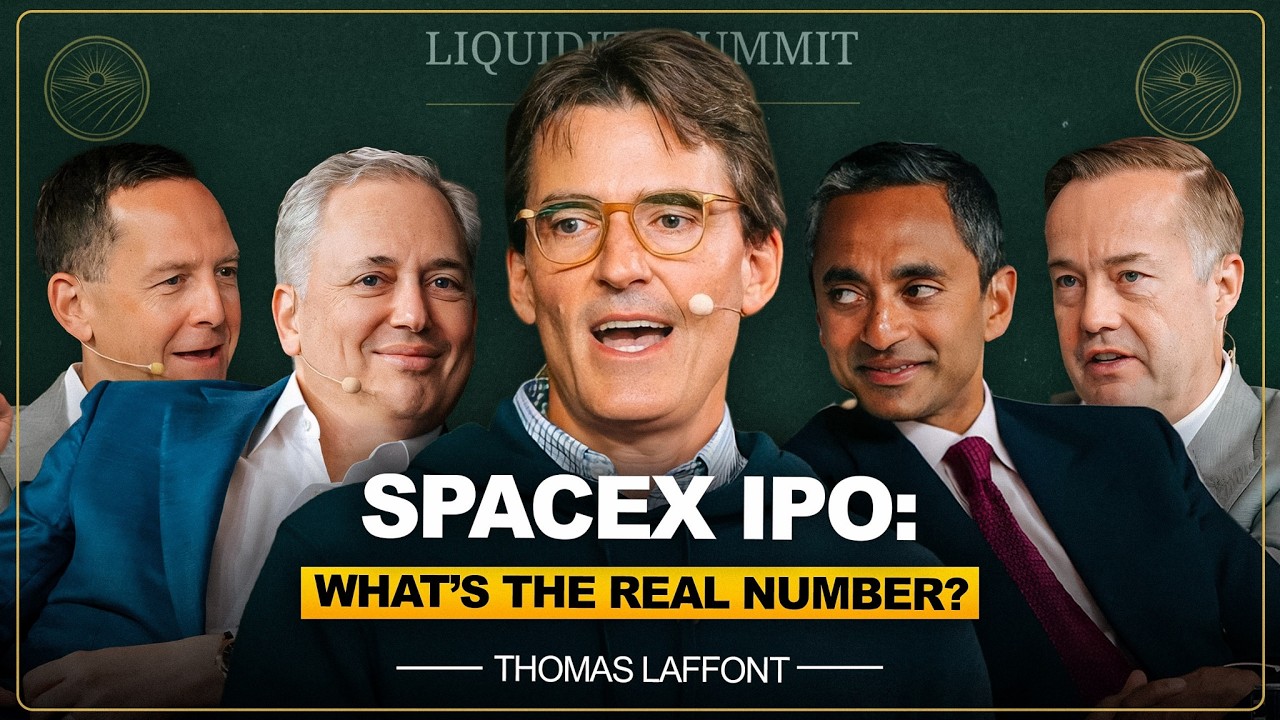
Coatue Raises AI Fund as Anthropic Submits Confidential IPO Filing
All-In Podcast
The venture ecosystem faces a massive $4 trillion liquidity wave driven by impending mega-exits from SpaceX and Anthropic, triggering an unprecedented hyper-growth era where top-tier AI leaders are already eclipsing traditional legacy software giants in revenue.
## Background
Published on June 4, 2026, on the All-In Podcast YouTube channel, this video features Coatue's Thomas Laffont joining the hosts to discuss the return of public markets and the dominant role of AI in the "Unicorn Economy." The show notes highlight an impending $4T AI IPO explosion, the compounding monopoly of SpaceX, unprecedented scaling paradoxes, and a deep-dive Q&A session covering venture capital liquidity.
## TL;DR
Thomas Laffont presents a data-driven update on the unicorn economy, highlighting a 70% market surge since late 2024 and a massive 5x concentration of capital per unicorn compared to 2021. The discussion focuses on the elite "Magnificent 8" private index, impending mega-exits from SpaceX and Anthropic, and the historic revenue trajectories of generative AI leaders outpacing traditional tech incumbents. Additionally, Laffont outlines the evolving platform phases of SpaceX, the hardware demands driving the semiconductor sector, and the three pillars generating $140 billion in real AI ecosystem revenue.
## Atmosphere & style
The session blends lighthearted, friendly banter with dense, high-level financial analysis, kicking off with jokes about Laffont's long-awaited "world podcast premiere." The dynamic between Laffont and the "besties" feels like a collaborative, elite boardroom meeting where intense data slides are met with seasoned curiosity and sharp macroeconomic debate. It carries an energetic yet deeply analytical vibe, moving from the grueling reality of hardware tech to speculative economic frameworks, ultimately leaving listeners with a grounded, rigorous meditation on the shifting realities of global tech wealth.
## Key takeaways
- [00:01](https://www.youtube.com/watch?v=UIoV8rG_25s&t=1s) Coatue (CO2) is introduced as a major tech investment force with $55 billion under management, looking to raise an additional $1 billion to invest exclusively in AI.
- [00:01](https://www.youtube.com/watch?v=UIoV8rG_25s&t=1s) The unicorn economy has risen by an average of 70% since September 2024, showing a clear public and private market recovery, though its relative share of the NASDAQ has stabilized.
- [01:20](https://www.youtube.com/watch?v=UIoV8rG_25s&t=80s) A structural shift in fundraising has increased capital concentration, with funding per individual unicorn growing fivefold since 2021 despite lower overall unicorn creation rates.
- [02:05](https://www.youtube.com/watch?v=UIoV8rG_25s&t=125s) A comparative cohort analysis reveals high fragility in the 2021 ZIRP unicorn cohort, with fewer than 20% achieving liquidity or new funding after 20 quarters.
- [02:05](https://www.youtube.com/watch?v=UIoV8rG_25s&t=125s) The private 'Magnificent 8' index represents nearly $4 trillion in total value, with almost every single constituent outperforming the public tech giants of the Magnificent 7.
- [04:36](https://www.youtube.com/watch?v=UIoV8rG_25s&t=276s) Venture ecosystem exits are thawing in 2026, with upcoming multi-billion dollar listings from SpaceX and Anthropic projected to return more capital than the past decade combined.
- [06:18](https://www.youtube.com/watch?v=UIoV8rG_25s&t=378s) Generative AI leaders are achieving unprecedented financial velocity, scaling past legacy giants like Adobe and Salesforce since January 2025, and pacing to eclipse AWS by the end of 2026.
- [07:50](https://www.youtube.com/watch?v=UIoV8rG_25s&t=470s) SpaceX's corporate valuation has historically broken out on a per-launch basis as it matures from unpredictable one-off rocket launches into a recurring multi-constellation platform business model.
- [10:41](https://www.youtube.com/watch?v=UIoV8rG_25s&t=641s) Data analysis reveals a counterintuitive '10x paradox' where massive centacorns ($100B+) have a 31% probability of scaling 10x, significantly outperforming the 10x growth rates of smaller unicorns.
- [12:54](https://www.youtube.com/watch?v=UIoV8rG_25s&t=774s) Hardware plays like chip manufacturer Cerebras show that deep technical breakthroughs require long development grinds and periods of zero incoming capital before landing massive contracts.
- [13:56](https://www.youtube.com/watch?v=UIoV8rG_25s&t=836s) Advanced AI architectures will require hyper-personalized contextual data retention, causing projected localized memory hardware requirements per user to quintuple.
- [14:50](https://www.youtube.com/watch?v=UIoV8rG_25s&t=890s) The monetization of the $140 billion AI ecosystem is being driven by three pillars: consumer subscriptions, enterprise software adoption, and the massive scaling of AI-enabled advertising.
- [22:25](https://www.youtube.com/watch?v=UIoV8rG_25s&t=1345s) The current tech wave is distinct from past speculative cycles because frontier companies are generating massive tangible revenue at an unprecedented operational scale and growth rate.
- [24:14](https://www.youtube.com/watch?v=UIoV8rG_25s&t=1454s) The market theory that AI foundation models are simple commodities has been thoroughly disproven, with sudden model breakthroughs acting as unpredictable variables that shift industry trajectories.
- [27:04](https://www.youtube.com/watch?v=UIoV8rG_25s&t=1624s) A 10-year investment strategy that annually rebalances to hold only the top 10 largest companies by market cap in the NASDAQ outpaces the broader index by roughly 3x.
- [29:23](https://www.youtube.com/watch?v=UIoV8rG_25s&t=1763s) Starlink is successfully disrupting a global telecommunications profit pool valued between $200 billion and $400 billion by bypassing traditional physical cell tower infrastructure.
- [30:57](https://www.youtube.com/watch?v=UIoV8rG_25s&t=1857s) Unlike traditional software companies, AI leaders face massive ongoing capital expenditure requirements for raw compute infrastructure, which complicates standard predatory pricing strategies.
## Detailed walkthrough
### [00:01](https://www.youtube.com/watch?v=UIoV8rG_25s&t=1s) The World Podcast Premiere and the State of the Unicorn Economy
The speaker kicks off the session with some lighthearted banter, jokingly asking why they waited to make their "world podcast premiere" on the All-In podcast instead of answering when all the "ankle biters called." They chose to hold out until the "besties" finally reached out. CO2 is introduced as one of the most successful hedge funds of the past two decades, boasting a staggering $55 billion under management. Their flagship hedge fund is focused heavily on the idea business, aiming to discover great entrepreneurs and revolutionary concepts that can scale massively. To fuel this mission, they are currently looking to raise an additional $1 billion specifically to invest in AI.
Transitioning into the core presentation, the speaker invites the "besties" to sit back and take a brief break after their hours of talking. The discussion shifts to a series of data slides detailing an update on the unicorn economy. The public and private markets are showing clear signs of a comeback. Since September of 2024, the unicorn economy has surged by an average of 70%, a move that mirrors the aggressive upward trajectory seen in the public markets. However, when looking closely at the unicorn economy’s share of the NASDAQ, the metric has largely plateaued over the past few years despite a massive run-up since 2015. This stabilization is attributed to the incredibly strong market performance of prominent public tech companies like Palo Alto Networks.
- **CO2 Capital Metrics:** $55 billion under management, currently raising an additional $1 billion for AI investments.
- **Unicorn Market Recovery:** The unicorn economy has risen by an average of 70% since September 2024.
- **NASDAQ Share:** The share of the unicorn economy within the NASDAQ has plateaued recently due to the strong performance of public incumbents.
[01:20](https://www.youtube.com/watch?v=UIoV8rG_25s&t=80s) The Changing Composition of Unicorn Fundraising
AI is completely dominating fundraising, capturing an increasing share of capital "wallet share" multiple years in a row. However, the fundamental composition of this funding has shifted dramatically compared to the past. During the Zero Interest Rate Policy (ZIRP) era peaking in 2021, the market operated as a massive "unicorn factory." Today, the creation pace of new unicorns has normalized back down to much lower, pre-COVID levels.
Mathematically, when you combine a lower rate of unicorn creation with massive aggregate fundraising, the concentration of capital becomes stark: funding per unicorn has increased fivefold since 2021. The ecosystem now features significantly fewer individual unicorns, but each one is raising vastly larger sums of money.
- **Funding Concentration:** Capital per unicorn is up 5x compared to the peak ZIRP era of 2021.
- **Market Dynamics:** A structural shift from a high volume of new unicorns to a small group of heavily funded companies.
[02:05](https://www.youtube.com/watch?v=UIoV8rG_25s&t=125s) Cohort Health and the "Magnificent 8" Index
The speaker dives deep into an analysis of ecosystem health by comparing three distinct unicorn cohorts based on how many quarters it takes for companies to either exit or raise a new round. The pre-ZIRP cohort, consisting of about 73 companies, proved highly resilient; 20 quarters after achieving unicorn status, 80% of them had successfully reached a liquidity event or a new funding round. In contrast, the notorious 2021 cohort—visualized as a red line on the slide—presents a troubling picture. Not only was it bloated with 479 unicorns, but 20 quarters in, fewer than 20% of them have managed to exit or raise capital. This sets up the critical question for the newly emerging 2024 cohort of AI companies: which historical path will they resemble?
Funding is not just consolidating within AI as a sector, but within a remarkably small handful of elite AI players like OpenAI and Anthropic, who are pulling in historic, massive rounds. This concentration inspires a new hypothetical future index dubbed the "Magnificent 8." This elite private index represents nearly $4 trillion in total value and features a diverse array of sector leaders: SpaceX (space tech), Stripe and Revolut (fintech), Anthropic (AI), Data Bricks (data/software), ByteDance (internet), and Anduril (defense tech). The speaker notes that this index has absolutely "crushed" the public "Magnificent 7," with almost every single private name outperforming the public tech giants.
- **Cohort Comparison Data:**
- **Pre-ZIRP Cohort:** 73 companies; 80% raised or exited after 20 quarters.
- **2021 Cohort:** 479 companies; less than 20% raised or exited after 20 quarters.
- **The "Magnificent 8" Components:** SpaceX, Stripe, Anthropic, Data Bricks, Revolut, ByteDance, and Anduril.
- **Index Valuation:** The Magnificent 8 commands a collective value of nearly $4 trillion.
[04:36](https://www.youtube.com/watch?v=UIoV8rG_25s&t=276s) Thawing Exits and the Ecosystem Cash Rebalance
A major positive indicator for the venture ecosystem is that "the exits are thawing." A recurring debate with the podcast hosts over the years has centered on the fact that while the unicorn economy is world-class at consuming cash, it historically struggled to return it. For an investment ecosystem to remain healthy and sustainable, there must be a fundamental balance between cash consumed and cash returned. Data from 2026 demonstrates a strong positive trend toward recovery—not quite reaching the historic peaks of 2021, but showing massive improvement with half the year still remaining.
Crucially, the current positive baseline data does not yet account for three mega-companies on the immediate horizon. SpaceX is expected to go public within the next few weeks. Furthermore, breaking news headlines just hit today revealing that Anthropic has confidentially submitted its S-1 filing to go public. When calculating the totality of just these three upcoming liquidity events, the capital returned will be "more than the 10 years kind of combined." This marks a dramatic shift from the first All-In Summit in 2024, where the speaker warned that the ecosystem was fundamentally broken and out of balance.
- **Ecosystem Health:** 2026 is showing a strong normalization toward balanced cash consumption and cash returns.
- **Major Impending Exits:** SpaceX is anticipated to go public in a matter of weeks; Anthropic has officially filed its S-1 confidentially.
- **Liquidity Impact:** The combined scale of the three upcoming mega-exits is projected to exceed the last decade of ecosystem exits combined.
[06:18](https://www.youtube.com/watch?v=UIoV8rG_25s&t=378s) The Unprecedented Hyper-Growth of GenAI Leaders
The sheer financial velocity of companies like OpenAI and Anthropic is completely unprecedented in business history, with growth rates "unlike anything that we've ever seen." To contextualize this vertical trajectory, the speaker references a chart tracking progress from January 2025—only a year and a half ago. In a matter of just a few months, these generative AI pioneers surpassed the revenue scale of established enterprise giants.
The chart illustrates a rapid cascading of milestones: the AI leaders first blew past the HR giant Workday, overtook ServiceNow, and eclipsed Adobe by the end of 2025. By January, they crossed the scale of Salesforce, and they are now officially larger than both Google Cloud and Microsoft Azure. Looking forward based on current forecasts, estimates suggest these AI powerhouses will surpass Amazon Web Services (AWS) by the end of the year, and they possess the mathematical potential to be larger than the entirety of Microsoft by 2028.
- **Growth Timeline:** The historic revenue ramp began in earnest in January 2025.
- **Defeated Incumbents (Chronological order):** Workday, ServiceNow, Adobe, Salesforce, Google Cloud, and Azure.
- **Future Forecasts:** Positioned to overtake AWS by the end of 2026, with projections targeting a scale larger than all of Microsoft by 2028.
[07:22](https://www.youtube.com/watch?v=UIoV8rG_25s&t=442s) Hyperscalers and the Funding of Disruption
The largest hyperscalers in the world are not merely sitting on the sidelines watching the current wave of technological disruption unfold; they are actively driving it. Following the massive "chat GBT moment" that catalyzed the industry, these dominant global companies have poured an "unprecedented" amount of capital into creating and enabling this massive structural shift.
---
[07:50](https://www.youtube.com/watch?v=UIoV8rG_25s&t=470s) Deciphering the SpaceX Valuation Model
SpaceX is a frequent topic of conversation, and understanding it through an investor's lens provides valuable insights, whether someone wants to actually own the stock or "just want to seem smart at a cocktail party." Statistically, the number one driver correlated with SpaceX's soaring valuation is its sheer cadence of launches. This correlation makes intuitive sense: if a company's core business is launching rockets, a higher volume of launches should naturally yield a higher corporate value.
However, a closer look at a fundamentally different ratio—the company's overall valuation divided by its number of launches—reveals a more complex narrative. For a long period, this ratio remained within a relatively fixed, stable range. Eventually, it began to break out and move dramatically upward. Assuming that markets are generally rational, this shift indicates that the market began valuing SpaceX significantly higher on a *per-launch* basis even as its total volume of launches accelerated, contrasting sharply with its early operational days.
[09:04](https://www.youtube.com/watch?v=UIoV8rG_25s&t=544s) The SpaceX Code Framework: From Rockets to Platforms
The underlying cause of this valuation surge can be explained by a "code framework" focused on the evolving quality of SpaceX's business model. The business fundamentally transforms and improves the more frequently it launches, progressing through distinct operational phases:
* **Phase 1 (Pre-Constellation):** This is the initial trial phase where the company is simply trying its rockets out. Because "rockets are hard," operations are unpredictable, relying on a few government customers that generate volatile, one-time revenue.
* **Phase 2 (Initial Ramp):** The company transitions into building its first constellation. A constellation serves as a reliable end market that introduces a highly coveted recurring revenue business model. More satellites in orbit directly translate to more subscribers, which yields predictable, compounding revenue.
* **Phase 3 (Scale):** Operations expand from a single constellation to managing multiple constellations. This phase taps into a massive global demand where a wide variety of commercial companies, sovereign governments, and militaries want to own and control their own distinct constellations to "control their own destiny."
* **Phase 4 (Platform):** Ultimately, the scaled business matures into a powerful tech platform. In the modern technology age, a platform of this magnitude allows the company to leverage its massive core customer base to launch entirely new business verticals. These prospective frontier opportunities include space data centers, specialized space applications, and the long-term commercial "optionality of the moon and Mars."
---
[10:41](https://www.youtube.com/watch?v=UIoV8rG_25s&t=641s) Unprecedented Scaling and the 10x Growth Paradox
A defining hallmark of the current technological era is the sheer velocity at which companies are scaling. When measured against historic paradigm shifts like the personal computer, the internet, or mobile technology, Anthropic stands out in particular, scaling at a pace "like no other company that we've ever seen."
This rapid expansion prompted a deep data analysis to share with "the besties" on the podcast, examining three distinct buckets of companies to evaluate the statistical likelihood of achieving a 10x return. For a growth investor—while perhaps different from a seed investor like JCAL—a 10x return is an exceptional, highly elusive milestone. The historical data yields surprising probabilities regarding corporate growth:
* **Unicorns ($1B+):** A private company valued at or above 1 billion dollars has roughly an **8% chance** of one day scaling 10x to become a decacorn ($10B+).
* **Decacorns ($10B+):** Companies valued over 10 billion dollars possess a **8% to 13% chance** of scaling 10x to reach a 100 billion dollar valuation.
* **Centacorns ($100B+):** In a striking subversion of traditional growth expectations across both public and private markets, a mega-cap company valued at 100 billion dollars or more actually boasts a **31% chance** of having achieved or achieving a 10x growth milestone.
This phenomenon highlights a massive compression of the timeline required to generate elite-tier market value. Historically, it took public companies multiple years to climb from a 500 billion dollar market cap to the 1 trillion dollar milestone. Yet, recent public market activity completely upended this norm: three distinct companies achieved this feat within the exact same year, and two of them managed to do it within a matter of mere weeks.
---
[12:54](https://www.youtube.com/watch?v=UIoV8rG_25s&t=774s) The Long Grind of Cerebras and the Semiconductor Boom
While some hyper-growth companies scale to historic heights almost overnight, other deeply successful hardware plays require an incredibly long, agonizing path to victory. A prime example is Cerebras, a chip manufacturing company that recently executed its IPO. Having led the Series B round and served as a dedicated board member for a long time, there is immense pride in their journey. However, looking closely at their funding history reveals a prominent "little construction icon" representing years of grueling development. The company endured protracted "dark periods" characterized by multiple years with zero new incoming capital, forcing a hard grind to perfect their proprietary technology.
This period of intense perseverance ultimately set the stage for a massive, game-changing contract with OpenAI. This single commercial agreement vindicated their technical approach and instantly quintupled the overall valuation of the company.
- Cerebras serves as a case study for a broader, generational bull run across the entire semiconductor sector.
- Since the 2024 All-In Summit, the semiconductor industry has vastly outperformed the broader market indices, as noted in recent discussions with Brad Gerstner.
---
[13:56](https://www.youtube.com/watch?v=UIoV8rG_25s&t=836s) The Future of AI Utility and the Quintupling of Memory
Looking forward, a major point of consensus among morning speakers is that the utility of any artificial intelligence system is directly tied to its deep contextual knowledge of an individual user or enterprise. For example, when a user wants to book a restaurant, they expect their AI assistant to seamlessly remember their explicit personal preferences, such as their preferred dining times and favorite cuisines.
To deliver this hyper-personalized, high-utility service, AI architectures will require massive amounts of localized data retention. Consequently, the industry projects that the total amount of hardware memory required per individual user could easily quintuple to support these advanced systems. This explosive baseline demand for contextual data architecture directly explains the aggressive market moves and rising valuations currently observed across top-tier memory hardware companies.
The Reality of AI Revenue and the $140 Billion Ecosystem
The speaker addresses the lingering controversy surrounding the AI ecosystem: "where's the revenue?" Over the past 12 to 24 months, the market has been plagued by skepticism regarding actual returns on investment (ROI) and monetization. To answer this, the speaker presents an analysis of the AI ecosystem's current scale and trajectory, sizing it at roughly $140 billion today. They confidently project that it will surge to $300 billion this year, before doubling yet again in 2027.
To demystify where this money is actually coming from, the speaker breaks the sector down into three fundamental pillars:
* **Consumer Revenue:** This is a straightforward calculation driven by the total number of subscribers multiplied by the ARPU (Average Revenue Per User).
* **AI-Enabled Advertising:** An overlooked but massive driver. Currently, an estimated one-quarter of all ads served by Meta and Google are AI-enabled, a penetration rate they believe will eventually reach 100%, representing a $150 billion market.
* **Enterprise Breakthroughs:** Internal business applications driven by modern cloud infrastructure, advanced coding models, and specialized engines like Codex.
---
The Universal Disruption of the Global Economy
Reflecting on prior investment eras, the speaker notes a profound shift unique to the current market: almost every single sector of the global economy is undergoing a simultaneous transformation. While software is the most obvious target, the speaker highlights telecom as a major battleground. They predict that within a few years, Starlink will power a device allowing anyone to make a phone call from anywhere on earth. Referencing a "profit pools" framework discussed earlier by a colleague named Nikesha, the speaker argues that Starlink's ultimate goal is capturing the entire global profit pool of broadband and wireless telecom, jokingly adding that "every time we get a dropped call, we get reminded that there's a better technology out there."
The ripple effects extend far past telecom. Massive data center compute demands have completely rewritten the energy equation in states like Pennsylvania—a point previously echoed by visiting senators. The automotive industry is facing similar identity crises; the speaker points to Ferrari's recent attempts to introduce new electric and autonomous technologies, which left onlookers begging the question of what happens to a luxury legacy franchise in an automated world. Even the consumer goods sector is being disrupted by GLP-1 weight-loss medications, which are fundamentally altering the consumption of food and alcohol, changing diet compositions, and shifting the cultural focus heavily toward wellness.
- The new "unicorn economy" is structurally healthier, with AI serving as the primary engine behind this stability.
- Market winners are compounding their advantages faster than ever before, dramatically raising the cost of failing to be a top-tier player.
- All of this sweeping macroeconomic disruption is happening before the world has even achieved superintelligence.
---
Navigating the Stay-Private-Longer Playbook and the K-Shape Market
The host steers the conversation toward how these changes alter the private market playing field for LPs, angel investors, and venture capital firms over the next decade. The game has changed drastically from the playbook of 20 years ago. Today, massive gains are consolidating into a tiny handful of companies because firms are choosing to stay private longer. The host points to varying industry strategies: early-stage specialists, firms like Craft Ventures handling Series A, growth players dipping lower into private rounds, individuals like Brad Gerstner balancing time between public and early-stage bets, and giants like Andreessen Horowitz effectively indexing venture capital by going after "the average in a major way."
The speaker responds with a mix of optimism and caution. On the positive side of the ledger, the outcomes are extraordinarily large—yielding numbers never thought possible for private entities. This explains why the speaker previously highlighted SpaceX; its valuation counterintuitively scales upward the more frequently they launch. Unlike the Zero Interest Rate Policy (ZERP) era, where outcomes were smaller and companies stayed private indefinitely, today's heavy hitters like Anthropic and OpenAI are openly stating their desire to go public, with exits anticipated within a 12-month window.
However, the persistent challenge is that the market is fracturing. The "K-shape" economic split and the power law are dominating startups just as they dominate the rest of society. Looking closely at "centicorn" data (companies valued at $100 billion or more), the ecosystem has been stuck at the exact same number for a while. The speaker leaves the audience with a stark warning sign for capital allocators: the market has seen virtually no new centicorns created over the past couple of years, signaling a intense concentration of power at the very top.
[21:22](https://www.youtube.com/watch?v=UIoV8rG_25s&t=1282s) The LP Dilemma: Rational Allocations vs. Disconnected Valuations
The discussion opens with a fundamental dilemma facing modern capital allocators and Limited Partners (LPs). Looking at the massive growth of dominant tech platforms, a rational investor might conclude that the best strategy is simply to "yolo every dollar you can" into whichever company hits the $100 billion valuation milestone first. On paper, it looks like a sure bet: it represents the path of least resistance, the lowest amount of effort, and the fastest potential return.
However, the speakers note that classic rules of supply and demand are driving market valuations to a point where they are completely disconnected from historical metrics. Referencing an insight shared earlier in the day by Bill Ackman, they point out a strange new phenomenon in the markets: investors are essentially making "venture investments in trillion dollar companies," handing out massive valuations that hover at 50 to 100 times revenue. This raises a pressing question for high-net-worth and ultra-high-net-worth private investors on where to rationally deploy capital over the next five years, especially given the frantic race to crowd into just three major names.
- **Historical Valuation Strain:** Current tech valuations are disconnecting from any traditional metrics previously used by the industry.
- **The "Ackman" Metric:** Trillion-dollar companies are being priced like early-stage venture bets at 50x to 100x revenue multiples.
- **The Core Question:** While crowding into the top three names worked flawlessly for the past 5 years, will it hold true for the next 5?
[22:25](https://www.youtube.com/watch?v=UIoV8rG_25s&t=1345s) Real Performance and the Public Market "Antiseptic"
While the valuation metrics look staggering, Thomas pushes back against the idea that this is a repeat of past speculative manias. Having lived through both the 2000 dot-com crash and the tech bubble of 2021, he emphasizes that the dominant players of the current era are "not fake companies." Instead, these businesses are generating massive, tangible revenue at a scale and growth rate never before witnessed in market history. Even in the highly competitive AI sector, underlying business models are showing sudden structural viability, with reports indicating that Anthropic had already achieved a profitable month.
Ultimately, the speakers agree that the public market acts as the "great test equalizer" and the "great antiseptic." The public markets will not care about polished pitch decks or private presentations; instead, companies like SpaceX, OpenAI, and Anthropic will eventually have to withstand intense, raw public scrutiny. Thomas expresses deep confidence in this mechanism, noting he is eager to see how these mega-firms handle the relentless pressure of short-sellers, political figures, and public market debaters.
- **Structural Difference from 2000/2021:** Today's frontier tech companies are defined by massive revenue scale and unprecedented operational growth rates.
- **Anthropic Financial Milestone:** The company reportedly achieved a profitable month, signaling earlier-than-expected monetization.
- **The "T+1" Market Shift:** While market discipline traditionally happens on day one of an IPO ($t = 1$), heavy passive index buying may distort this. Investors estimate it might now take "6 month plus one" day to wash through supply/demand distortions and get an accurate read on a newly public company.
[24:14](https://www.youtube.com/watch?v=UIoV8rG_25s&t=1454s) Systemic Compounds and Finding Conviction in Ground Truths
The conversation shifts to a deeper strategic debate: is there a structural flaw in the markets allowing these massive "compounders" to accelerate their dominance at scale, or is it merely survivor bias? Thomas cautions against over-interpreting the data because the sample size ($N$) of these elite companies is incredibly small. To illustrate how volatile this trajectory can be, he points to Anthropic's history, noting that the company was entirely different before the introduction of its Claude code models. "One event completely dented the trajectory of almost that entire industry," proving that a single product breakthrough can upend assumptions. He likens these sudden market-disrupting forces to "the mule in the Foundation series"—an unpredictable, black-swan variable that appears out of nowhere.
Chamath asks how Thomas keeps his strategy organized as his asset base swells into broader arenas like data center infrastructure, rather than just cutting a single $10 billion check into a name like Anthropic. Thomas explains that building intensely detailed presentation decks serves as his ultimate mental re-anchoring process. Spending two weeks on a deep-dive analysis acts as a full-time job that filters out the noise of a thousand outside opinions. By forcing his team to peel back layers and return to "ground truths of numbers and valuation," he re-establishes pure investment conviction. He reminds the room that when top-tier tech giants grew into trillion-dollar titans in mere weeks, it was the release of massive "pent-up energy"—real, decades-old businesses trading at some of the lowest earnings multiples in the entire S&P 500.
- **The Commodity Narrative Defeated:** The popular market theory that AI foundational models are simple commodities destined to be completely commoditized has been "thoroughly disproven."
- **The "Foundation" Analogy:** Frontier AI breakthroughs represent unpredictable shifts, much like Isaac Asimov's "The Mule" character who upends calculated historical predictions.
- **The Manufacturing Bottleneck:** The speakers note a key difference in tech supply chains: "If I want to design a chip like OpenAI, I can go to TSMC... If I want to make memory, well, there is no TSMC."
[27:04](https://www.youtube.com/watch?v=UIoV8rG_25s&t=1624s) The Trillion-Dollar Filtering Mechanism
The conversation shifts toward evaluating structural market dynamics, particularly how policy, elections, and company multiples interact. The speakers examine a chart detailing the probability of companies advancing from one valuation tier to the next. The progression appears highly counterintuitive, prompting the group to speculate on the odds of trillion-dollar market cap companies expanding even further to a ten-trillion-dollar valuation. While historical data suggests a steep climb, the speakers debate whether the probability for these tech giants will outperform expectations, with some predicting a greater than 30% success rate.
This rare level of growth is described as a rigorous filtering mechanism rooted in classical Ben Graham-style business analysis. To sustain a place in the "trillion dollar club," a business must possess a compounding advantage and an exceptionally durable earnings structure. The speakers note that current market leaders keep surpassing historical limits because their target markets have expanded far beyond what anyone initially anticipated. However, they also recognize that regulatory constraints play a decisive role; historical examples like the breakup of the Bell system illustrate how government intervention can permanently alter a corporate monopoly's trajectory before it can dominate adjacent fields like the internet or e-commerce.
- **The Trillion-Dollar Club Filter:** Reaching and maintaining this tier requires clear structural compounding advantages and rare durability of earnings.
- **The Trading Bot Strategy:** A hypothetical trading strategy is floated—simply automated buying of any company the moment it hits a $1 trillion market cap.
- **The NASDAQ Top 10 Outperformance:** A cited study indicates that a 10-year strategy of annually rebalancing to hold just the top 10 companies by market cap in the NASDAQ outperforms the broader index by roughly 3x.
[29:23](https://www.youtube.com/watch?v=UIoV8rG_25s&t=1763s) Capital Recycling and SpaceX's Global Market
The panel presses their guest, Thomas, on what happens to Silicon Valley's competitive and entrepreneurial dynamics when massive amounts of capital—potentially three to four trillion dollars—are distributed back to General Partners (GPs) and Limited Partners (LPs) and recycled into the ecosystem. The question prompts some lighthearted banter regarding David's notoriously bearish views on California real estate, with jokes about selling San Francisco homes and tracking whether a "40,000 foot mausoleum" might be hitting the market, complete with "protesters not included."
Turning to hard tech, the conversation focuses on SpaceX and the valuation surrounding its potential initial public offering (IPO). While the exact right price for the listing remains up for debate, the structural reality of its addressable market is immense. SpaceX's Starlink business is singled out for disrupting a massive global profit pool of telecommunications and service providers, which sits between $200 billion and $400 billion. Starlink has rapidly captured this space by offering a fundamentally superior product that "works all the time" without relying on traditional infrastructure like radio towers.
- **Ecosystem Liquidity:** Between $3 trillion and $4 trillion could potentially flow back through the GP/LP lifecycle to be re-invested into tech ecosystems.
- **Global Telco Profit Pool:** The addressable global profit pool for telecommunication and service providers is estimated at $200 billion to $400 billion.
- **Product Dominance:** Starlink is highlighted for entering a massive market completely from scratch within just a few years by rendering physical radio tower infrastructure obsolete.
[30:57](https://www.youtube.com/watch?v=UIoV8rG_25s&t=1857s) AI Capital Levers and the Value of Deep Analysis
The discussion moves into uncharted territory as the speakers compare the current AI landscape to the historical ride-sharing and food delivery wars. In those earlier tech conflicts, massive inflows of venture capital were ultimately weaponized to fund aggressive price wars to choke out competitors. The group poses a pivotal question: will tech giants like OpenAI and Anthropic eventually use their massive war chests to pull a similar price lever?
While economic rationality suggests these AI firms should leverage price to compete, their situation is uniquely complicated by massive ongoing infrastructure expenditures. The speakers conclude that the tech landscape is bound to experience counterintuitive changes that defy current models. The segment wraps up with the hosts thanking Thomas for his rigorous, two-week analytical effort. They emphasize how valuable it is to occasionally "slow down" and "meditate on the actual state of reality," praising the presentation for being incredibly rich and grounded.
- **The Capital Weapon:** A parallel is drawn to ride-sharing and food delivery wars, where excess capital was explicitly used to subsidize prices and squeeze competitors.
- **AI Price Pressures:** OpenAI and Anthropic are identified as prime candidates for a potential price war, provided their massive infrastructure spending leaves enough free cash flow.
- **Infrastructure Constraints:** Unlike software-only plays, AI companies face immense capital expenditure obligations for raw computing infrastructure, which complicates standard predatory pricing strategies.
A Grounded Compliment and Farewell
The conversation wraps up with a lighthearted moment of banter and mutual appreciation. One of the speakers ponders whether being described as "incredibly grounded" was intended as a compliment or an insult. Chamath quickly clarifies that it was absolutely intended as a "compliment," prompting a warm and gracious "Thank you" in response. The speaker expresses deep gratitude to Chamath for the high praise and extends a heartfelt thank you to Thomas for attending the session, concluding the event on a high, collaborative note.
- The speaker playfully questions the nature of being called "incredibly grounded" before accepting it as a genuine compliment.
- Verbatim gratitude: "Thank you. I'll just say thank you to you Chimath for that incredible compliment and for you Thomas for coming."
- Thomas closes out the interaction by validating the host's efforts, saying, "Thanks for doing great job."
## Notable quotes
> [04:36](https://www.youtube.com/watch?v=UIoV8rG_25s&t=276s) the exits are thawing. — Thomas Laffont
> [04:36](https://www.youtube.com/watch?v=UIoV8rG_25s&t=276s) more than the 10 years kind of combined. — Thomas Laffont
> [06:18](https://www.youtube.com/watch?v=UIoV8rG_25s&t=378s) unlike anything that we've ever seen. — Thomas Laffont
> [09:04](https://www.youtube.com/watch?v=UIoV8rG_25s&t=544s) rockets are hard — Thomas Laffont
> [09:04](https://www.youtube.com/watch?v=UIoV8rG_25s&t=544s) optionality of the moon and Mars. — Thomas Laffont
> [10:41](https://www.youtube.com/watch?v=UIoV8rG_25s&t=641s) like no other company that we've ever seen. — Thomas Laffont
> [13:56](https://www.youtube.com/watch?v=UIoV8rG_25s&t=836s) where's the revenue? — Thomas Laffont
> [16:56](https://www.youtube.com/watch?v=UIoV8rG_25s&t=1016s) every time we get a dropped call, we get reminded that there's a better technology out there. — Thomas Laffont
> [21:22](https://www.youtube.com/watch?v=UIoV8rG_25s&t=1282s) yolo every dollar you can
> [21:22](https://www.youtube.com/watch?v=UIoV8rG_25s&t=1282s) venture investments in trillion dollar companies — Bill Ackman
> [22:25](https://www.youtube.com/watch?v=UIoV8rG_25s&t=1345s) not fake companies. — Thomas Laffont
> [22:25](https://www.youtube.com/watch?v=UIoV8rG_25s&t=1345s) great test equalizer
> [22:25](https://www.youtube.com/watch?v=UIoV8rG_25s&t=1345s) great antiseptic.
> [24:14](https://www.youtube.com/watch?v=UIoV8rG_25s&t=1454s) One event completely dented the trajectory of almost that entire industry — Thomas Laffont
> [24:14](https://www.youtube.com/watch?v=UIoV8rG_25s&t=1454s) the mule in the Foundation series — Thomas Laffont
> [24:14](https://www.youtube.com/watch?v=UIoV8rG_25s&t=1454s) If I want to design a chip like OpenAI, I can go to TSMC... If I want to make memory, well, there is no TSMC.
> [29:23](https://www.youtube.com/watch?v=UIoV8rG_25s&t=1763s) works all the time — Thomas Laffont
> [30:57](https://www.youtube.com/watch?v=UIoV8rG_25s&t=1857s) slow down
> [30:57](https://www.youtube.com/watch?v=UIoV8rG_25s&t=1857s) meditate on the actual state of reality
## Mentioned
Thomas Laffont, Coatue, All-In Podcast, Palo Alto Networks, OpenAI, Anthropic, SpaceX, Stripe, Revolut, Data Bricks, ByteDance, Anduril, Workday, ServiceNow, Adobe, Salesforce, Google Cloud, Microsoft Azure, Amazon Web Services, Microsoft, Google, Starlink, Cerebras, Brad Gerstner, Meta, Codex, Ferrari, Craft Ventures, Andreessen Horowitz, Bill Ackman, Claude, Isaac Asimov, TSMC, Ben Graham
Thomas Laffont argues that the private tech ecosystem has shifted from broad speculative unicorn creation to an extreme concentration of capital and unprecedented revenue velocity among a few elite firms. This consolidation sets the stage for a projected multi-trillion-dollar IPO wave that could return more capital than the prior decade combined.
Capital Consolidation and the Magnificent 8 (2:05)
Following the peak Zero Interest Rate Policy (ZIRP) era of 2021, the pace of new unicorn creation has dropped back to pre-COVID levels, yet funding per unicorn has increased fivefold. Capital is increasingly concentrated within a small cluster of dominant private companies. Laffont highlights a private benchmark dubbed the 'Magnificent 8'—comprising SpaceX, Stripe, Revolut, Anthropic, Databricks, ByteDance, and Anduril—which commands nearly $4 trillion in aggregate value and has broadly outpaced the public 'Magnificent 7' tech giants.
This trend marks a sharp divergence in cohort survival. While 80% of pre-ZIRP unicorns raised follow-on capital or achieved an exit within 20 quarters, less than 20% of the bloated 2021 cohort (totaling 479 companies) managed to do so over the same timeframe. Laffont observes that capital allocators now face a K-shaped distribution where market power and funding pool into a narrow group of category winners.
Unprecedented Velocity in Generative AI Monetization (6:18)
Laffont rejects claims that frontier AI lacks tangible monetization or represents commoditized software, estimating current AI ecosystem revenue at $140 billion, with projections reaching $300 billion in 2026 before doubling again in 2027. He breaks this monetization into three drivers: consumer subscription ARPU, AI-enabled advertising (projected to expand from 25% of Meta and Google ads toward 100%), and enterprise cloud infrastructure and coding automation.
Operational metrics for leading frontier labs exhibit revenue ramps without historical precedent. After tracking growth from early 2025, Laffont notes that leaders like OpenAI and Anthropic quickly eclipsed the revenue scales of enterprise software incumbents, including Workday, ServiceNow, Adobe, and Salesforce. Current trajectories indicate these entities have surpassed Google Cloud and Microsoft Azure, are positioned to surpass AWS by late 2026, and could mathematically reach the overall scale of Microsoft by 2028, with Anthropic already logging a reported profitable month.
The Impending Multi-Trillion-Dollar Exit Wave (4:36)
Historically criticized for absorbing massive capital while failing to return it, the venture ecosystem is beginning to rebalance as liquidity events thaw. Laffont highlights that upcoming marquee exits—including Anthropic's confidential S-1 registration and an anticipated SpaceX public offering—are positioned to return more capital to General Partners and Limited Partners than the cumulative sum of the preceding ten years.
Between $3 trillion and $4 trillion in capital could cycle back through institutional allocators. In hard tech, SpaceX exemplifies structural market expansion: its per-launch valuation multiple has expanded as operations shifted from erratic government contracts to recurring satellite constellations and platform services. Starlink alone is targeted at disrupting an addressable global telecommunications profit pool estimated between $200 billion and $400 billion without relying on physical ground tower networks.
The Scale Paradox and Public Scrutiny (10:41)
Historical growth data presents an inverted probability curve: while a $1 billion unicorn has only an 8% chance of scaling 10x to $10 billion, mega-cap companies valued at $100 billion or more have demonstrated a 31% likelihood of achieving a 10x return. This dynamic has compressed value creation timelines, with several public firms advancing from $500 billion to $1 trillion in market capitalization within weeks.
However, this scaling creates an allocator dilemma. As noted in discussions referencing Bill Ackman, investors are effectively writing venture-style checks into trillion-dollar companies trading at 50x to 100x revenue multiples. Laffont maintains that the public market will act as the ultimate 'antiseptic' to test these multiples against short-sellers and macro scrutiny, though passive index inflows may distort price discovery for an estimated six months post-listing.
While Laffont emphasizes that current tech leaders are supported by unprecedented operational velocity rather than dot-com era speculation, significant hurdles persist. Scaled AI models face capital constraints, high infrastructure costs, and physical supply bottlenecks—such as hardware memory requirements quintupling per user—which may complicate long-term margins and trigger predatory pricing wars among well-capitalized leaders.
## Background
本期内容由知名科技商业播客《All-In Podcast》于 2026 年 6 月 27 日发布在 YouTube 平台。节目记录了管理 550 亿美元规模的 Coatue 联合创始人 Thomas Laffont 登台 All-In 峰会的分享与问答,重点探讨了 AI 对“独角兽经济”的深度重塑、即将到来的 4 万亿美元超级 IPO 浪潮、SpaceX 平台化跃迁的估值逻辑,以及颠覆常理的企业增长悖论。
## TL;DR
Thomas Laffont 深入拆解了当前一级市场的根本性转变:市场虽然告别了零利率时期的批量造神,但单家独角兽平均融资额激增 5 倍,且由 SpaceX、Anthropic 和 OpenAI 牵头的超级 IPO 浪潮将释放超越过去十年总和的流动性。在增长维度上,领头的基础模型厂商仅用一年半便相继超越 Salesforce、Google Cloud 与 Azure 等老牌巨头,破除了 AI 缺乏真实商业变现的质疑,与半导体硬件端共同筑起数千亿美元的实际收入底座。与此同时,统计数据揭示了反直觉的“10 倍增长悖论”——千亿级巨头再翻十倍的胜率远高于早期独角兽跃迁,极端的幂律分化不仅重塑了风险投资的配置逻辑,也预示着天量资本回流后头部巨头间或将迎来残酷的价格肉搏战。
## Atmosphere & style
整场对话在扎实硬核的研究图表与风投圈标志性的辛辣互嘲中展开,四位主持人插科打诨调侃旧金山豪宅与市场泡沫,与 Laffont 严谨笃定的投研阐述形成绝佳的化学反应。面对当前市场近乎失控的 AI 造神狂热,Laffont 刻意放慢节奏,以回归财务模型与客观数字的“地面真实”穿透喧嚣杂音,现场情绪从开场的自嘲打趣逐步推进至对底层垄断与公开市场检验的冷静审视。整场交流既展现出顶级资本置身历史级技术奇点时的澎湃雄心,又始终弥漫着对资本过剩、估值断层以及反垄断阴影的清醒警惕,呈现出极具信息密度与智力碰撞的现场质感。
## Bulletin
- [04:05](https://www.youtube.com/watch?v=UIoV8rG_25s&t=245s) 一级市场流动性迎来历史性破冰:SpaceX、Anthropic 与 OpenAI 即将启动的超级 IPO 浪潮,释放的流动性总额预计将超越过去十年所有风投退出事件的总和。
- [00:45](https://www.youtube.com/watch?v=UIoV8rG_25s&t=45s) 独角兽融资结构极端极化:自 2021 年零利率时代以来,尽管新增独角兽数量回归常态,但存活独角兽的平均单笔融资金额激增 5 倍,资本加速向极少数头部集中。
- [10:41](https://www.youtube.com/watch?v=UIoV8rG_25s&t=641s) 资本市场颠覆性规律“十倍增长悖论”确立:千亿美元级企业晋级万亿美元帝国的概率高达 31%,远超独角兽跨入百亿美元门槛的 8%,超级巨头展现出更强的马太效应。
- [14:44](https://www.youtube.com/watch?v=UIoV8rG_25s&t=884s) AI 商业化进入规模变现期:全球 AI 市场规模预计从当下的 1400 亿美元翻倍至年内约 3000 亿美元,单用户内存需求预计暴增 5 倍,深度改写半导体与云基建格局。
## Key takeaways
- [00:01](https://www.youtube.com/watch?v=UIoV8rG_25s&t=1s) Coatue 正为其专项 AI 投资额外募资 10 亿美元,其 550 亿美元的管理规模将进一步聚焦于能够实现指数级增长的颠覆性公司。
- [02:05](https://www.youtube.com/watch?v=UIoV8rG_25s&t=125s) 独角兽存活率出现代际断层:前零利率时期 80% 的独角兽可在 5 年内成功再融资或退出,而 2021 年泡沫期队列中实现退出的比例已暴跌至不足 20%。
- [04:05](https://www.youtube.com/watch?v=UIoV8rG_25s&t=245s) 一级市场“超强八巨头”(包括 SpaceX、Anthropic、Stripe、Databricks 等)总市值逼近 4 万亿美元,其整体投资回报已全面跑赢美股传统 Mag 7 指数。
- [06:18](https://www.youtube.com/watch?v=UIoV8rG_25s&t=378s) 头部 AI 巨头的营收增速打破商业史认知:OpenAI 与 Anthropic 在短短一年半内连续超越 Salesforce、Google Cloud 与 Azure,预计 2026 年底前超越 AWS。
- [08:45](https://www.youtube.com/watch?v=UIoV8rG_25s&t=525s) SpaceX 的单次发射估值倍数随发射频次提高不降反升,核心在于其业务已从单次政府合同跨越为星链高黏性经常性收入,正加速迈向太空平台生态。
- [10:41](https://www.youtube.com/watch?v=UIoV8rG_25s&t=641s) 巨头跃迁概率存在反常识的层层筛选机制:千亿巨头凭借极强的复利优势与盈利耐久性,向万亿门槛跃迁的胜率(31%)反而远高于初创公司跨越生死线。
- [13:08](https://www.youtube.com/watch?v=UIoV8rG_25s&t=788s) 硬件创新周期极为漫长沉重:AI 芯片厂商 Cerebras 历经数年无外部注资的研发长跑,最终凭借 OpenAI 的巨额订单使估值实现了 5 倍暴涨。
- [13:08](https://www.youtube.com/watch?v=UIoV8rG_25s&t=788s) AI 上下文与长期记忆依赖正在催生单用户内存需求翻 5 倍,带动具备高垄断性与高资本开支壁垒的先进存储芯片产业链迎来代际爆发。
- [14:44](https://www.youtube.com/watch?v=UIoV8rG_25s&t=884s) AI 变现逻辑由三大确定性支柱构成:消费者订阅现金流、高达 1500 亿美元空间的 AI 赋能广告渗透,以及企业端智能代码协同工具的深度植入。
- [16:11](https://www.youtube.com/watch?v=UIoV8rG_25s&t=971s) 颠覆正在外溢至各实体行业:星链正在蚕食全球 2000 亿至 4000 亿美元的电信利润池,超大规模算力正在重构区域能源供需,GLP-1 药物亦在冲击大消费供应链。
- [24:48](https://www.youtube.com/watch?v=UIoV8rG_25s&t=1488s) 事实证伪了基础大模型沦为“大宗商品化”的假设,头部模型厂商不仅没有贬值,反而凭借算力规模与核心技术迭代构建了极高的价值捕获壁垒。
- [26:48](https://www.youtube.com/watch?v=UIoV8rG_25s&t=1608s) 芯片与存储呈现结构性壁垒差异:自研定制 ASIC 尚能依托台积电等晶圆代工体系,而先进存储芯片在全球范围内缺乏替代代工渠道,供给垄断程度极高。
- [28:07](https://www.youtube.com/watch?v=UIoV8rG_25s&t=1687s) 十年回测数据证明纳斯达克头部的强马太效应:每年定期动态调仓持有纳斯达克前十大科技巨头,最终复合收益率比大盘基准高出近 3 倍。
- [30:10](https://www.youtube.com/watch?v=UIoV8rG_25s&t=1810s) 数万亿美元资本从巨型 IPO 退出并回流硅谷,可能重演历史上网约车大战的过剩流动性,诱发手握巨资的大模型厂商在 Token 与推理层面发动血腥价格战。
## Detailed walkthrough
### [00:01](https://www.youtube.com/watch?v=UIoV8rG_25s&t=1s) 播客首秀与 Coatue 的 AI 投资雄心
Coatue Management 联合创始人托马斯·拉丰(Thomas Laffont)在 All-In 峰会上登台,以一句幽默的自嘲拉开序幕。他打趣道:“为什么你们觉得我会把播客全球首秀留给 All-In?之前那些微不足道的小角色(ankle biters)打电话约我,我都说:‘不,我只等几位 Besties 给我打电话。’”作为华尔街过去二十年里最成功的对冲基金与科技投资基金之一,Coatue 目前管理着高达 550 亿美元的资产规模(AUM)。现场介绍强调,Coatue 核心的立足点始终是寻找最杰出的创业者与颠覆性企业,他们当下正计划再募资 10 亿美元全力押注人工智能(AI),因为在风险投资与思想产业中,“当你拥有一个真正颠覆性的想法时,它能成长到极其庞大的规模”。
在调侃完四位主持人(Besties)已经在台上高强度输出了几个小时、现在可以“坐下来歇几分钟”之后,拉丰打开精心准备的幻灯片,正式展开他对当下“独角兽经济”(Unicorn Economy)与 AI 资本周期的深度复盘。
- **Coatue 资产体量**:旗下旗舰对冲基金与风投策略累计资产管理规模达 550 亿美元。
- **全新募资计划**:正在为专项 AI 投资额外募资 10 亿美元。
---
### [00:45](https://www.youtube.com/watch?v=UIoV8rG_25s&t=45s) 独角兽经济复苏与融资结构剧变:融资金额飙升 5 倍
拉丰首先展示了宏观市场的回暖态势:自 2024 年 9 月以来,一级市场的独角兽经济整体估值平均反弹了 70%。然而值得关注的是,公开市场的科技股(如纳斯达克)也走出了一条几乎平行的强劲上涨曲线。过去在 2015 年至 2021 年间,独角兽板块相对纳斯达克总市值的占比曾出现跨越式上升,但近年来这一比值已进入平缓期(plateaued)。拉丰认为,这从侧面反映了诸如 Palo Alto Networks 等成熟上市科技企业在基本面和市值上的极强韧性。
与此同时,资本向人工智能集中的趋势正在加速演进。AI 在一级市场融资总额中所占的“钱包份额”(wallet share)已经实现连续多年持续攀升。但拉丰指出,资本的内部构成发生了剧烈质变:在 2021 年的零利率(ZIRP)狂热期,市场宛如一座“独角兽量产工厂”,诞生了数量空前的初创独角兽;而当下,新增独角兽的数量已经大幅回落至疫情前的常态化水平。
从数学模型上看,两者的叠加带来了一个惊人的结论:**自 2021 年以来,单家独角兽的平均融资金额飙升了整整 5 倍(5x)**。市场不再雨露均沾地批量制造独角兽,而是呈现出“独角兽数量锐减、但幸存者单轮吞噬海量资金”的全新资本范式。
```mermaid
flowchart LR
accTitle: 一级市场融资范式转变
accDescr: 对比2021年零利率时代与2024年AI时代的独角兽生成速度与平均融资规模
subgraph ZIRP["2021 零利率时代 (ZIRP)"]
A1["独角兽量产工厂\n(诞生数量极高)"]
A2["单家融资金额分散\n(资本遍地开花)"]
end
subgraph AI2024["2024 AI 时代"]
B1["独角兽生成降速\n(回归疫情前常态)"]
B2["单家融资激增 5x\n(资本向少数头部极化)"]
end
A1 --> B1
A2 --> B2
```
---
### [02:05](https://www.youtube.com/watch?v=UIoV8rG_25s&t=125s) 独角兽代际生死分化与未上市公司“超强八巨头”
为了评估整个创业生态的底层健康度,拉丰通过一组纵向生命周期数据对不同年份的独角兽队列(Cohort)进行了犀利的横向对比:
- **前零利率时期队列(Pre-ZIRP Cohort)**:以仅有约 73 家独角兽的典型年份为例,在晋升独角兽后的 20 个季度(约 5 年)内,有高达 80% 的企业成功完成了下一轮新融资或实现了并购/IPO 退出。拉丰评价这是一个“相当健康”的良性资本循环。
- **2021 年零利率狂热队列(2021 Cohort)**:该队列的独角兽总数膨胀到了不可思议的 479 家。然而在跨越 20 个季度后,仅有不到 20% 的企业能够获得后续轮次融资或成功退出,暴露出极为严重的流动性悬崖与资产停滞。
- **2024 年 AI 独角兽新队列**:拉丰提出了整个风投界都在面临的终极疑问——这批当下备受瞩目的 AI 独角兽,未来究竟会像健康的早期队列那样完成价值蜕变,还是会重蹈 2021 年估值泡沫破灭、后续无人接盘的覆辙?
拉丰进一步阐明,当前这波资本集聚并不仅仅是泛指“AI 初创公司”,而是极端集中在“极少数头部 AI 巨头”手中,典型代表就是 OpenAI 和 Anthropic 等正在完成超大体量融资的基础模型厂商。
基于这种极化分布,拉丰提出了一级市场的全新指数——**“超强八巨头”(Magnificent 8)**。尽管随着未来这些公司陆续走向 IPO,这一非上市巨头名单的阵容会逐步精简,但他对这批超级独角兽展现出的业务跨度和质量表示由衷惊叹。这个群体不仅体量庞大,而且展现出了惊人的业务多样性,横跨了核心互联网、大模型、金融科技、国防科技与商业航天:
| 公司名称 | 核心赛道 | 行业代表性 |
|:--- |:--- |:--- |
| **SpaceX** | 航天科技(Space Tech) | 火箭复用发射与星链卫星互联网霸权 |
| **Anthropic** | 人工智能(AI) | 顶尖基础大语言模型研发(Claude 系列) |
| **Stripe** | 金融科技(Fintech) | 全球数字支付基础设施与金融软件 |
| **Databricks** | 企业数据与 AI 基础设施 | 统一数据湖仓与分析平台 |
| **Revolut** | 金融科技 / 新型银行 | 全球数字银行与个人金融超级应用 |
| **ByteDance** | 互联网 / 社交媒体 | 全球短视频平台与内容算法引擎 |
| **Anduril** | 国防科技(Defense Tech) | 自主防御系统与现代化军工科技 |
拉丰强调,非上市巨头阵营不再仅仅依赖传统的 SaaS 或消费互联网模式,从太空探索到边境自主防务,顶级科技资产的护城河正在变得前所未有的宽阔与硬核。
### [04:05](https://www.youtube.com/watch?v=UIoV8rG_25s&t=245s) 击败 Mag 7 的 4 万亿美元资产与退出通道的全面解冻
Thomas Laffont 指出,涵盖太空科技与前沿 AI 独角兽的这一投资组合表现极其强劲,哪怕持有十年以上他也感到非常安心。这批资产总市值已逼近 4 万亿美元,其整体表现彻底碾压了传统美股七巨头(Mag 7),组合内几乎每一个名字的回报率都跑赢了 Mag 7 指数。
更为积极的信号在于一级市场的退出机制正在“破冰融解”。Laffont 谈到过去几年在 All-In 节目中反复探讨的一个核心痛点:独角兽经济极其擅长烧钱和消耗资本,但究竟能向投资人回流多少真金白银?健康的科技生态系统必须在“资金消耗量”与“资金回流额”之间维持动态平衡。回顾 2026 年上半年的走势,退出规模已呈现出相当良好的复苏态势,虽未完全回到 2021 年的历史顶峰,但在下半年尚未展开的情况下,势头已非常稳健。
真正引发质变的是即将登场的三大超级 IPO。首先是备受瞩目的 SpaceX 预计将在未来数周内正式上市;其次是 Anthropic,就在当天刚爆出已秘密递交 S-1 招股说明书的消息。仅仅把 SpaceX、Anthropic 和 OpenAI 这三家即将上市的体量相加,其释放的流动性总额就将超越过去十年来所有退出事件的总和。Laffont 回忆起自己在 2024 年首届 All-In 峰会上的演讲,当时整个创业生态严重失衡,烧钱速度远超资本退出回报;而到了当下,甚至在上述三家巨无霸正式敲钟之前,生态系统的资本进出就已经显著趋向平衡,并且这种改善还将持续深化。
- 资产组合代表了近 4 万亿美元的市值,超额收益全面战胜传统科技七巨头(Mag 7)。
- 独角兽生态正从过去的“单向过度消耗现金”转向“资本退出与回流”的良性平衡。
- 仅 SpaceX、Anthropic 与 OpenAI 三大即将到来的 IPO 规模,就将超过过去 10 年退出总和。
```mermaid
flowchart TD
accTitle: AI 与硬科技独角兽的资本退出与飞跃轨迹
accDescr: 展示独角兽生态从资金消耗走向超大规模 IPO 退出及超越传统巨头收入的过程
subgraph ECOSYSTEM["一级市场资本再平衡"]
A["历史状态 (2024) 严重失衡<br/>高额烧钱消耗,极低退出回流"] --> B["2026 退出通道解冻<br/>常态化并购与上市回暖"]
B --> C["超级 IPO 浪潮<br/>SpaceX / Anthropic / OpenAI"]
C --> D["单次浪潮流动性<br/>超过此前 10 年退出总和"]
end
subgraph DISRUPTION["营收扩张与超越节奏 (2025-2028)"]
E["2025 年初 起步追赶"] --> F["超越传统 SaaS<br/>Workday → ServiceNow → Adobe → Salesforce"]
F --> G["超越云基础设施<br/>Google Cloud → Azure → AWS"]
G --> H["2028 远期预测<br/>单体体量或超整机微软"]
end
```
---
### [06:18](https://www.youtube.com/watch?v=UIoV8rG_25s&t=378s) 颠覆常理的超高速增长:从击垮传统 SaaS 到超越顶级云厂商
OpenAI 与 Anthropic 的年化收入狂飙速度彻底打破了商业史上的所有既往认知。Laffont 展示的对比图表仅仅始于 2025 年 1 月——距今不过一年半左右的时间。在这短短一年半内,这两家前沿 AI 巨头以摧枯拉朽之势完成了一系列令人瞠目结舌的超越:仅用数月时间便超越了人力资源巨头 Workday,随后接连将 ServiceNow 和 Adobe 甩在身后;到了次年 1 月,Salesforce 亦被超越;时至今日,其营收规模已经全面跨越了 Google Cloud 和微软 Azure。
根据 Coatue 的模型假设与测算推演,增长狂潮远未见顶:这两家 AI 领头羊不仅体量已超越 Azure,预计在 2026 年底前就将全面超越云计算霸主 AWS,甚至有潜力在 2028 年超越整个微软公司的总体营收规模。面对这种级别的颠覆,老牌超大规模云厂商(Hyperscalers)并没有坐以待毙。他们非但没有抗拒颠覆,反而成为了这场技术革命背后最大的出资人与助推者。自 ChatGPT 横空出世以来,全球最大的科技巨头们投入了史无前例的天量资本开支与算力基建,以极其激进的姿态亲手资助和孵化着这场产业剧变。
- 增长起点:仅从 2025 年 1 月起步,短短一年半内走完了传统软件巨头数十年的营收积累路径。
- 被超越的技术巨头序列:Workday $\rightarrow$ ServiceNow $\rightarrow$ Adobe $\rightarrow$ Salesforce $\rightarrow$ Google Cloud $\rightarrow$ Microsoft Azure。
- 远期预测目标:预计 2026 年底前超越 AWS,2028 年收入规模有望向微软整个集团发起挑战。
---
### [07:50](https://www.youtube.com/watch?v=UIoV8rG_25s&t=470s) SpaceX 的估值底层逻辑:发射频次与单次发射价值跃迁
鉴于 SpaceX 即将迎来上市,Laffont 特别向现场听众分享了 Coatue 作为专业投资机构对 SpaceX 的估值分析框架,以便大家无论是准备真金白银建仓,还是在高端酒会上高谈阔论,都能拥有第一视角的专业洞见。
从历史数据来看,与 SpaceX 估值直接高度正相关的核心一阶驱动指标是其“火箭发射频次”(Launch Cadence)。从商业常理上讲这完全直观:SpaceX 的核心立足之本就是发射业务,发射越频繁、履约交付越多,公司的基本面价值自然越高。但 Laffont 提醒大家关注一个更加关键且发生结构性突变的全新比率指标——**“公司估值除以发射次数”(Valuation / Launches)**。长期以来,该比率一直维持在一个相对固定的震荡区间内,然而随着业务重心的跃升与规模效应的爆发,这一指标随后彻底打破了原有的横盘格局,展现出极为剧烈的指数级向上跃升。
### [08:45](https://www.youtube.com/watch?v=UIoV8rG_25s&t=525s) SpaceX 的复合估值逻辑:从单次发射到平台经济
市场本质上是理性的。当 Coatue 观察 SpaceX 时,产生了一个深刻的疑问:为什么随着 SpaceX 发射次数的激增,公开与私募市场对其“单次发射”(per-launch)的估值倍数不降反升,甚至远高于它刚起步时的估值水平?Thomas Laffont 提出了 Coatue 的核心分析框架:**SpaceX 发射得越多,其商业模式的质地(quality)就越高**。
在业务起步的第一阶段——“星座组网前”(Pre-constellation),公司主要在攻关基础火箭技术,毕竟造火箭极度艰难。在这个时期,客户主要是零散的政府订单,业务属于单次、低频且难以预测的收入流。随后进入第二阶段“初期爬坡”(Initial ramp),SpaceX 迎来了关键突破——打造了第一座卫星星座(Starlink 星链)。星座的战略意义在于它创造了庞大的内生终端市场,并带来了高价值的 SaaS 式“经常性订阅收入”(recurring revenue):送入轨道的卫星越多,网络覆盖就越好,能够承载的订阅用户数和收入就呈指数级扩张。
```mermaid
flowchart LR
accTitle: SpaceX business model evolution
accDescr: Four distinct phases of SpaceX business evolution from single launches to broad space platform.
subgraph S1["阶段 1: 试验与验证"]
A["星座前阶段<br/>单次发射/政府项目/收入不确定"]
end
subgraph S2["阶段 2: 闭环爬坡"]
B["首个星座Starlink<br/>自建终端市场/经常性订阅收入"]
end
subgraph S3["阶段 3: 规模化定制"]
C["多星座拓展<br/>面向企业、政府与军方专属星座"]
end
subgraph S4["阶段 4: 终极平台"]
D["空间平台生态<br/>太空数据中心/登月与火星远期期权"]
end
A --> B
B --> C
C --> D
```
随着这一飞轮进入“规模化阶段”(Scale),SpaceX 正在超越单一自建星座,迈入为全球多种企业、主权政府及军方客户部署定制星座的新格局。各国和组织为了掌控自身战略命运,必然需要拥有自主可控的专属星座。最终,这使得 SpaceX 蜕变成为一个极度稀缺的底层科技“平台”(Platform)。在这个阶段,其核心发射业务不仅吸纳了海量客户,更孕育出全新的商业前沿——例如轨道太空数据中心(Space data centers),以及登月、探索火星等极具想象空间的广阔商业期权。
- **阶段一(Pre-constellation)**:火箭技术攻关期,依赖不可预测的单次政府发射合同。
- **阶段二(Initial Ramp)**:Starlink 卫星星座确立,将发射能力转化为可复利的经常性订阅用户收入。
- **阶段三(Scale)**:承接企业、政府和军方的定制专属星座需求,客户为掌握自主命运而付费。
- **阶段四(Platform)**:演变为平台型基础设施,开启太空数据中心、月球/火星探索等多元衍生业态。
---
### [10:41](https://www.youtube.com/watch?v=UIoV8rG_25s&t=641s) 10倍增长悖论:为什么千亿巨头更容易再翻10倍?
当前科技浪潮最引人注目的特征,就是企业的扩张速度打破了历史一切认知框架。无论是回溯 PC 时代、互联网时代还是移动互联网时代,没有任何一家公司的增长斜率能与当下的 Anthropic 等前沿 AI 企业相提并论。
面对这种罕见的技术爆发,Coatue 对市场上不同体量公司的“10倍增长回报率”(10x returns)做了一项极具颠覆性的统计分析。在风险投资和成长型投资领域,像 Jason Calacanis 这类早期天使或种子期投资人可能追求百倍回报,但对管理大规模资金的成长型投资机构(Growth investors)而言,捕捉到一家能够增长 10 倍的公司已经是梦寐以求的优异战绩。然而,历史统计数据却揭示了一个“反常识”的资本悖论:
| 企业估值梯队 | 进阶目标 | 达成 10 倍增长的历史概率 | 市场认知反差 |
|:--- |:--- |:--- |:--- |
| **独角兽 (Unicorn, 约 $1B)** | 跃升至 **十角兽 (Decacorn, $10B+)** | **约 8%** | 极其困难,绝大部分企业卡在百亿美元门槛之前 |
| **十角兽 (Decacorn, 约 $10B)** | 跃升至 **千亿美金巨头 ($100B+)** | **8% ~ 13%** | 概率略微提升,但淘汰率仍然严酷 |
| **百角兽 (Centacorn, $100B+)** | 跃升至 **万亿美金级帝国 ($1T+)** | **高达 31%** | 巨头展现出更强大的马太效应与指数级复合增长能力 |
通常人们的直觉认为:小体量公司因为基数低,实现 10 倍膨胀应该更容易;而千亿美元规模的庞然大物要想再涨 10 倍几乎不可思议。然而数据彻底击碎了这种偏见——千亿美元级企业再实现 10 倍增长的概率(31%)竟然是独角兽跨入百亿门槛(8%)的近 4 倍。
这种价值爆发的速度在公开市场上同样得到了印证。过去,一家企业从 5000 亿美元市值攀升到 1 万亿美元通常需要数年时间的业绩沉淀。但在最近这一波 AI 驱动的资本潮中,不仅有 3 家公司在同一年内跨越了这一门槛,甚至有 2 家公司在短短数周之内就完成了从 5000 亿到万亿美元市值的跨越。
---
### [12:44](https://www.youtube.com/watch?v=UIoV8rG_25s&t=764s) 资本周期的两极:光速造神与 Cerebras 的长期长跑
然而,并非所有 AI 赛道的赢家都经历着这种数周内市值翻倍的顺风顺水。商业世界在呈现“超光速狂飙”的同时,也展现了完全相反的极端——硬科技公司历经漫长周期的淬炼与长跑。
刚完成 IPO 的 AI 芯片公司 Cerebras 就是最典型的例证。Thomas Laffont 本人曾长期担任 Cerebras 董事会成员并领投了其 B 轮融资。他回顾了这家公司的融资史:在今天整个市场对大算力和专用 AI 芯片趋之若鹜之前,研发晶圆级超大芯片经历了极其漫长而艰苦的研发爬坡期。从起步到走向公开市场,这种十年磨一剑的重资产硬件创新,恰恰与当前软件应用端几周翻倍的“光速 scaling”形成了极为鲜明的对比。
### [13:08](https://www.youtube.com/watch?v=UIoV8rG_25s&t=788s) 艰难磨砺后的芯片爆发与内存需求激增
Thomas Laffont 回顾了硬件与半导体公司在爆发前必须经历的痛苦周期。他指着幻灯片上带有“施工图标”的时间线指出,这背后其实经历了极其漫长而黑暗的时期——团队在连续数年没有任何新外部资本注入的困境下咬牙苦干,硬生生把底层技术磨砺出来。以 Cerebras 为例,正是这段艰苦卓绝的研发积累,才最终换来了来自 OpenAI 的海量订单合同,直接将公司的估值推升了整整五倍。
但这绝非仅仅是某一家初创公司的个例,整个半导体行业正在迎来一场历史罕见的“代际牛市”(generational run)。Laffont 提到他稍早前还在与 Altimeter Capital 的 Brad Gerstner 深入交流此话题:自 2024 年 All-In Summit 以来,半导体板块相对整体基准指数的超额表现极其惊人,行业爆发力彻底拉开。
谈及未来的核心驱动力,Laffont 引用了峰会上午多位嘉宾达成的共识:**AI 系统对用户或企业业务的了解越深入,它产生的实际价值就越高**。无论是预订餐厅时系统自动记忆你的就餐时间、饮食口味和偏好,还是企业端的个性化协同,背后都离不开对上下文与长期记忆的极致依赖。基于 AI 系统的服务需求,Coatue 预测未来**每个用户所对应的内存需求(Memory per user)可能会翻上整整五倍(quintuple)**,这也是近期各类存储/内存半导体厂商股价持续暴涨的核心逻辑。
```mermaid
flowchart TD
accTitle: 芯片研发到市场爆发与内存需求激增示意图
accDescr: 展示芯片企业经历技术研发与合同刺激估值增长,以及上下文记忆需求驱动存储行业爆发的链路。
subgraph Hardware["硬件积累与商业突破"]
A["长年技术攻坚<br/>(零资本注入/暗黑摸索)"] --> B["斩获巨额核心订单<br/>(如 OpenAI 合约)"]
B --> C["企业估值实现 5 倍爆发<br/>(如 Cerebras 等)"]
end
subgraph MemoryDemand["个性化需求驱动存储"]
D["AI 上下文与个性化深入<br/>(用户偏好/企业专有数据)"] --> E["单用户内存需求暴增 5 倍"]
E --> F["存储/内存类半导体公司暴涨"]
end
C -.->|"拉动整体半导体代际牛市"| MemoryDemand
```
- **硬件研发的长周期阵痛**:初创企业往往需要经历多年无外部融资、全凭技术沉淀支撑的硬磨期。
- **客户合同带来指数级估值反弹**:Cerebras 在拿到 OpenAI 巨额合同后,估值直接暴涨 5 倍。
- **半导体板块的代际跑赢**:从 2024 年峰会到当下,半导体行业的涨幅大幅度超越了公开市场基准大盘。
- **单用户存储容量需求翻 5 倍**:AI 越智能越离不开对上下文数据和用户档案的即时留存,直接催化了内存硬件产业链的爆发。
---
### [14:44](https://www.youtube.com/watch?v=UIoV8rG_25s&t=884s) 破除“AI 收入在哪”的质疑:3000 亿美元生态与三大变现支柱
针对过去 12 到 24 个月里科技与投资圈最广泛、最激烈的争论——“AI 到底赚不赚钱?真实的 ROI 在哪里?收入究竟从何而来?”——Laffont 给出了 Coatue 详实的量化拆解与市场预估。他指出,目前 AI 生态系统的市场体量约为 1400 亿美元,今年预计将达到 3000 亿美元左右,并将在 2027 年再次翻番。
为了厘清这一庞大规模的资金流向,Laffont 将 AI 商业化的核心支柱提炼为三大板块:
1. **C 端消费者订阅(Consumer Subscriptions)**:采用最经典的“订阅用户基数(Subs)× 每用户平均收入(ARPU)”模型,持续提供坚实的现金流底座。
2. **AI 原生与增强广告(AI-Enabled Ads)**:这是最容易被市场普遍忽视、却吸金惊人的领域。Coatue 测算,目前 Meta 和 Google 等巨头投放的广告中,已有约 25% 是由 AI 赋能的;未来这一渗透率必将向 100% 迈进,对应着至少 1500 亿美元的市场体量。
3. **企业端软件突破(Enterprise Software)**:以代码生成与协同为代表的生产力工具正深植各大企业核心系统,例如 Claude Code 以及各类智能代码引擎等在企业内部展现出的恐怖渗透率。
- **AI 生态规模演进**:从当下的约 1400 亿美元,预计年内达到约 3000 亿美元,并于 2027 年实现翻倍。
- **广告行业的 AI 替代曲线**:当前 Meta、Google 约 25% 广告已由 AI 驱动,未来目标 100%,带来 1500 亿美元的确定性增量。
- **三大营收支柱协同**:C 端付费订阅、数字广告投放升级与 B 端企业代码/办公生产力落地共同支撑起生态估值。
---
### [16:11](https://www.youtube.com/watch?v=UIoV8rG_25s&t=971s) 全产业重塑:从 Starlink 颠覆电信到汽车与大健康的全面洗牌
Laffont 指出,当前这一轮技术革命与他过往投资生涯中见证的所有周期都有本质不同:**当下几乎每一个传统经济领域,都在同一时刻遭遇颠覆与重构**。软件行业的剧变固然显而易见,但向物理世界蔓延的速度同样迅猛:
在**电信行业(Telco)**,全球电信网络正面临彻底换轨。Laffont 坚信未来几年内,Starlink 支持的便携终端就能让用户在全球任何角落顺畅拨打电话。尽管人们常认为通信网络覆盖已是解决的问题,但现实中屡见不鲜的“掉线”时刻无时无刻不在提醒消费者——市面上存在着更优秀、更先进的连接范式。借用 Nikesh Arora 提出的“利润池(profit pools)”分析框架,Starlink 最终切入并蚕食的,实际上是全球涵盖宽带与无线通信的千亿级电信利润池。
在**算力与能源领域**,数据中心庞大的计算负载正在剧烈改写各地的能源格局。正如多位参会参议员所分享的那样,超大规模数据中心的落地已经彻底改变了诸如宾夕法尼亚州等地的能源供需方程式。
在**汽车与出行行业**,传统顶奢与性能车企也难逃洗礼。Laffont 提到了法拉利近期尝试推出结合电动与自动驾驶新技术路线时引发的公众舆论风波——在全面电动化与自动化的时代,传统燃油性能车品牌护城河与核心资产的未来该何去何从?市场对其新车的复杂反馈正精准印证了这场巨大的价值重估。
在**大健康与消费品领域**,GLP-1 类减重新药的普及,正对传统食品加工、零食与酒精类饮品的宏观消费结构产生深远而不可逆的剧烈冲击。各行各业的底层商业逻辑都在同步发生位移。
- **Starlink 与全球电信利润池**:卫星直连通讯将直接进攻传统宽带与移动网络,瞄准由频发断联暴露出的庞大改良需求。
- **AI 算力对能源基础设施的反哺与挑战**:超级数据中心已在区域电网与能源政策层面(如宾夕法尼亚州)成为核心变量。
- **传统车企面对“电动+自动驾驶”的品牌身份危机**:包括法拉利等头部性能品牌在技术转轨中面临的核心资产重新定价难题。
- **GLP-1 跨界冲击大消费**:减重药物正在自下而上改变食品与酒精供应链的终端需求。
### [17:37](https://www.youtube.com/watch?v=UIoV8rG_25s&t=1057s) 独角兽新经济体的核心启示:复利加速与全面颠覆
从全球健康与生活方式的微观趋势——包括食品与酒精消费习惯的转变、饮食结构的重塑以及对身心健康(Wellness)的极度重视——收束回宏观科技生态,托马斯·拉丰(Thomas Laffont)总结了他关于当下科技格局的核心洞察。他的第一个核心结论是:当前的“独角兽经济体”比以往任何时候都要健康得多,而这一切很大程度上要归功于人工智能(AI)的强劲推动。
在这一轮繁荣中,赢家的复利增长速度刷新了历史记录。拉丰强调,这意味着“未能押中赢家所要付出的机会成本比以往任何时候都更加高昂”。与此同时,颠覆正在无情地冲击着全球经济的每一个组成部分。更令人震撼的是,这一切颠覆甚至发生在“我们尚未真正迎来超级智能(Superintelligence)”的前提之下。回顾过去两年的巨变,拉丰不禁展望未来:如果以两年为一个周期,当再次回到峰会时,整个商业与科技世界又将翻天覆地?这无疑是一个令人期待却又充满悬念的关键转折期。
- 赢家正在以超乎以往的速度滚雪球式积累优势,未进入头部赢家行列的代价变得极端沉重。
- 颠覆已全面渗透全球经济各个领域,且这一格局尚未计入未来可能出现的通用超级智能(Superintelligence)。
---
### [18:35](https://www.youtube.com/watch?v=UIoV8rG_25s&t=1115s) 幂律法则统治一切:一级市场打法与投资分化之问
进入问答与深度探讨环节,主持人杰森·卡拉卡尼斯(Jason Calacanis)抛出了一个直击所有投资人痛点的大命题:“幂律法则正在统治我们的生活”(The power law rules our lives)。市场上所有的巨大红利正在被极少数超级公司瓜分与巩固。面对企业“在更长时间内保持私有化(Stay private longer)”并孕育出前所未有规模超级巨无霸的现象,一级市场生态的实际打法正在经历剧烈重构。
杰森指出,各层级参与者的战略路径已然出现巨大割裂:
- 他自己深耕最早期的种子阶段;
- 像 Craft Ventures 这类基金主攻 A 轮;
- Coatue 兼具公募与后期私募能力,向一级市场下沉捕捞头部;
- 而像布拉德·格斯特纳(Brad Gerstner,Altimeter 创始人)这样的投资者,也在权衡时间和精力究竟该重注于早期还是二级公募市场;
- 更有像 Andreessen Horowitz(a16z)这样管理百亿美元巨资的超级机构,似乎正在试图通过大体量资金“对整个风投行业进行指数化投资(Indexing venture)”,追求行业平均甚至包揽全部头部。
杰森向拉丰发问:在私募市场运作规则与二十年前的经典投资手册(Playbook)截然不同的今天,未来的出资人(LP)、天使投资人以及风险投资机构,究竟该如何确立一套未来一二十年内能自洽且有效的投资策略?
---
### [19:45](https://www.youtube.com/watch?v=UIoV8rG_25s&t=1185s) 大退出周期的回归与百角兽停滞的隐忧
拉丰在回应时,首先将账面上的积极因素进行了清晰拆解。他指出,目前私募市场展现出最振奋人心的一面在于“回报规模极其庞大”(The outcomes are big)。业界正在见证此前在私营公司阶段根本无法想象的天文数字级估值与体量,这对整个创新生态系统而言是巨大的利好。
拉丰以自己此前展示的 SpaceX 投影片为例说明了这种超常规的增长逻辑:在火箭发射业务上,出现了一个看似反直觉的现象——发射次数越多,公司的护城河与估值反倒呈现加速抬升的倍增效应。更为重要的是,不同于零利率时代(ZERP era)那些规模有限且不愿上市的“纸面独角兽”,当前这批体量巨大的巨头拥有极强的公开发行意愿。不仅大批超大型资产有望在未来 12 个月内登陆公开市场,就连 Anthropic 和 OpenAI 这两家顶尖 AI 先锋也已公开表态寻求上市。这标志着资本退出的流动性死结有望迅速被解开。
然而,拉丰随即指出了繁荣背后的暗面与预警信号:
- **K型分化与极端幂律**:无论是宏观社会还是初创公司内部,K型分化(K-shape)正愈演愈烈,中间层正被迅速掏空。
- **百角兽(Centicorns,估值千亿美元级企业)的孵化停滞**:拉丰提醒大家注意他之前展示的数据,百角兽的名单在过去几年中几乎陷于停滞,并未涌现出多少真正全新的成员。
如果未来十年无法源源不断诞生新的百角兽,这一现象将向整个行业发出严肃的警报:巨头垄断与头部固化是否已经阻断了新巨头的上升通道?这直接拷问着全球资本配置者(Capital allocators)下一步该把重注押在何方。
### [21:22](https://www.youtube.com/watch?v=UIoV8rG_25s&t=1282s) 资本配置的困境:全仓押注万亿巨头还是警惕估值泡沫?
台上讨论转向了当下资金配置者(LPs、高净值个人与家族办公室)面临的现实困惑。如果按照目前市场呈现的极端分化趋势,一个理性的投资人最省事的策略似乎就是:死守并等待谁先迈过1000亿美元的门槛,然后毫不犹豫地把所有子弹直接“全仓单押”("yolo every dollar you can in there")。因为在很多人的认知里,这类超级领跑者最稳妥、脆弱性最低、耗费精力最少,而且能带来最快的回报。然而,供需失衡正在将估值推向前所未有的极端,甚至完全脱离了历史上任何合理的估值坐标系。
正如比尔·阿克曼(Bill Ackman)在大会早些时候所指出的,现在的投资者实际上是在以50倍甚至100倍的市销率(P/S),向那些潜在万亿体量的巨无霸下注风险投资。这种将极度狂热的风险溢价赋予万亿美元级别企业的行为,引发了核心疑问:理性资本到底应该流向何处?所有人争相恐后挤进仅有的两三家头部公司(如 OpenAI、SpaceX、Anthropic),这难道不令人担忧吗?
- **资本配置的被动惯性**:过去5年间,重仓押注极少数确定性最高的赢家被证明是最成功的策略,但未来的5年是否还能如法炮制充满未知。
- **估值逻辑的断层**:以往百倍市销率仅见于早期高增长的SaaS或初创公司,如今却被直接套用在万亿体量的超大型资产上。
---
### [22:16](https://www.youtube.com/watch?v=UIoV8rG_25s&t=1336s) 真实营收与公开市场的“消毒剂”考验
面对估值过高的质疑,托马斯·拉丰(Thomas Laffont)提出了鲜明的反驳。他强调,这些生成式 AI 巨头绝非“假模假样的皮包公司”("these are not fake companies")。回顾2000年的互联网泡沫以及2021年的零利率狂热,当时许多公司既无收入也无商业逻辑;但眼下这些 AI 龙头企业不仅以人类商业史上从未见过的惊人速度增长,而且是在极大规模的基数上产生货真价实的巨额营收。甚至有报道指出,Anthropic 此前甚至已经实现过单月盈利。
不过,拉丰也完全认同查马斯(Chamath Palihapitiya)的观点:公开市场才是检验一切的“终极均衡器”和“最好的消毒剂”("the great antiseptic")。二级市场从不看任何天花乱坠的演示文稿或故事包装。无论是 SpaceX、OpenAI 还是 Anthropic,一旦走向 IPO,就必须面对公开市场上做空者、质疑者、辩论家以及政策监管者的全面审视,拉丰对这些超级独角兽终将接受公开检验感到由衷兴奋。
```mermaid
flowchart LR
accTitle: 从一级市场叙事到二级市场公开检验
accDescr: 展示巨头企业从一级市场的高估值融资走向公开市场接受全面审视的逻辑过程
subgraph Private["一级市场环境"]
A["巨额真实营收<br/>超高速增长"] --> B["百倍市销率估值<br/>资金抱团前三名"]
end
subgraph Public["二级市场检验(消毒剂)"]
C["做空机构审视"]
D["散户与被动资金"]
E["财报盈利实测"]
end
B -->|"进入公开市场 IPO"| Public
```
- **与历史泡沫的本质区别**:当前头部公司兼具极高体量与超高速增长,并非当年靠虚幻点击量或概念炒作支撑的投机产物。
- **公开市场的穿透力**:华尔街的严苛审核将迅速挤出水分,让商业模式的真实成色在显微镜下暴露无遗。
---
### [23:44](https://www.youtube.com/watch?v=UIoV8rG_25s&t=1424s) 被动买盘的延迟效应与极小样本下的行业变局
针对公开市场的定价机制,查马斯抛出了两个不同维度的深入提问。在战术层面上,传统观念认为市场这剂“消毒剂”在上市第一天(T+1)就会生效;但在现代资本市场中,庞大的指数基金和被动买盘会持续涌入吸纳筹码,真正的价格发现是否会被大幅延后到解禁期结束之后(即六个月零一天,T+6M+1D)?在战略层面上,巨头在超大体量下依然能够实现复合加速增长,这究竟代表着某种结构性的市场低效,还是仅仅是不可复制的“幸存者偏差”?
拉丰对此持谨慎态度,认为不宜将现状过度理论化或过度解读。核心原因在于当下的有效样本量(N)实在太小,整个赛道完全被几家巨头主导,而且竞争格局极易因单一事件而彻底倾覆。以 Anthropic 为例,在其推出顶尖的代码生成能力(Claude Code)之前和之后,完全是两家截然不同的公司。一次关键技术突破就足以逆转整个行业的走势,因此目前很难断言这是一种长期的市场机制,抑或只是极少数突破性玩家在特定历史时点的阶段性爆发。
### [24:48](https://www.youtube.com/watch?v=UIoV8rG_25s&t=1488s) 大模型并非大宗商品化与“骡子”假说
对话围绕前沿大模型公司的本质展开了交锋。有人提出疑问:这些领跑的人工智能公司究竟是不是像阿西莫夫《基地》(Foundation)系列小说中的“骡子”(The Mule)一样——作为一个完全无法预测、凭空降临且不可复制的突发历史变异?抑或这只是一个阶段性的偶然现象?然而,托马斯·拉封(Thomas Laffont)指出,早前市场上甚嚣尘上的论调——即“这些基础模型最终都会沦为毫无护城河的大宗商品(Commodities),相关的基础模型公司也会随之贬值甚至消亡”——如今已经被事实彻底证伪。这些头部模型公司不仅没有大宗商品化,反而在规模化和价值捕获上展现出了极强的壁垒。
### [25:11](https://www.youtube.com/watch?v=UIoV8rG_25s&t=1511s) Coatue 的投资框架:在万亿美元浪潮中锚定底层逻辑
面对人工智能领域的急剧膨胀,主持人向 Coatue 抛出了一个核心疑问:随着资产管理规模的持续飙升,Coatue 顺应趋势拓展了多元化布局,甚至重仓投入数据中心等底层基础设施,但当看到某些模型公司的惊人跃升时,是否会闪过“我们当初为什么不干脆直接砸 100 亿美元给 Anthropic 就行了”的念头?在如此庞杂且快速变化的赛道中,投资机构该如何保持战略定力而不迷失?
拉封坦言,为此次大会准备演示材料是一项极高负荷的工作,他和团队在过去两周里几乎全职扑在这份幻灯片上,但这恰恰是帮自己“重新锚定信念(Re-anchor conviction)”的必要过程。身处喧嚣的市场,如果每天听取上千个人的各色意见,很容易被纷繁的信息干扰而丧失判断力。对他而言,穿透迷雾的唯一方法就是回归本质——回到估值、财务模型与客观数字这些“地面真实(Ground Truths)”上来:
* **不是泡沫中的虚幻造神**:那些在短短数周或数月内市值暴涨跃升至万亿美元级别的超级巨头,并非横空出世的概念炒作公司。它们都是历经数十年技术积淀与商业洗礼的成熟企业。
* **极具支撑力的估值乘数**:即便市值达到了令人咋舌的天文数字,这些领头羊交易时的市盈率(P/E Multiple)在标普 500 指数中几乎仍处于最低梯队之列,背后积蓄已久的势能(Pent-up energy)在 AI 浪潮的催化下得到了集中爆发。
```mermaid
flowchart TD
accTitle: 投资噪音与底层逻辑过滤图
accDescr: 展示 Coatue 在面对市场海量噪音时,如何通过财务模型与数字回归底层真实
subgraph NoiseFilter["市场信息与战略权衡"]
A["海量市场观点与杂音<br/>(1,000+ 外部声音)"]
B["资本配置焦虑<br/>(是否直接下注百亿全押单家模型?)"]
end
subgraph GroundTruth["底层真实与信念锚定"]
C["回归财务模型与估值真实<br/>(Ground Truths)"]
D["评估企业护城河与盈利耐久性<br/>(Durability of Earnings)"]
E["跨周期配置<br/>(算力基础设施 / 存储 / 核心资产)"]
end
A --> C
B --> C
C --> D
D --> E
```
### [26:48](https://www.youtube.com/watch?v=UIoV8rG_25s&t=1608s) 芯片与存储的结构性壁垒,以及监管政策的影响
在讨论供应链底层价值分布时,拉封分享了一个关于芯片代工与存储芯片(Memory)的精辟对比:
> “有人向我指出了存储芯片的关键逻辑:如果我想像 OpenAI 那样自主设计一款定制 ASIC 芯片,哪怕难度极高,我至少还可以去找台积电(TSMC)帮我代工生产;但如果我想造先进存储芯片,这世界上可没有第二个‘存储领域的台积电’供你调用。”
这引发了深度的估值拷问:当定制 ASIC 芯片可以依赖台积电这种强大的晶圆代工基础设施时,几乎毫无代工替代选项、产能高度垄断且资本开支极其沉重的先进存储芯片,其估值乘数究竟应该怎么定?与此同时,主持人指出,美国联邦贸易委员会(FTC)主席莉娜·汗(Lina Khan)所带来的强监管阴影与反垄断重压在图表中清晰可见,并直接点名大卫·萨克斯(David Sacks),希望探讨未来的宏观政策、大选走向将如何直接重塑这些科技巨头的最终商业结局。
### [27:18](https://www.youtube.com/watch?v=UIoV8rG_25s&t=1638s) 跨越量级门槛的概率:向 10 万亿美元俱乐部进发
讨论随即转向拉封演示中一张极具冲击力的图表——各个市值体量的公司晋级到下一个数量级门槛(Next Level)的历史概率。大卫·萨克斯指出,这张图表呈现的规律非常反直觉:
* **跨越阶梯的历史概率**:图表中统计的上一阶段跃迁概率(达到万亿美元市值门槛)约为 31%。
* **万亿到十万亿的猜想**:萨克斯顺着逻辑进一步推演:现有的万亿美元巨头冲上 10 万亿美元市值的概率会是多少?这一概率究竟会高于还是低于 30%?现场讨论倾向于认为,这一概率很可能会显著高于 30%,甚至达到 50% 甚至更高。
拉封对此解释称,这种随着市值规模扩大、跃迁概率反而可能提升的反直觉现象,本质上源于一种**层层筛选机制(Filtering mechanism)**:
* 企业每往上跨越一个体量层级,都必须经过一次极端严苛的过滤。
* 能够突破重围存活并跻身万亿俱乐部的公司,无一不具备极其强大的复利优势(Compounding advantage)以及无可比拟的盈利耐久性(Durability of earnings)。
* 这种不可逆的结构性垄断壁垒,使得万亿美元巨头向 10 万亿美元冲击时的胜率,反而远高于初创公司跨越早期生死线。
### [28:07](https://www.youtube.com/watch?v=UIoV8rG_25s&t=1687s) 万亿美元俱乐部与纳斯达克头部的复利神话
讨论延续至企业估值的底层逻辑。主持人与嘉宾指出,如果一家企业具备极高且持久的盈利持续性(durability of earnings),它便能迅速加速跨入下一个增长阶段。这种评估方式本质上类似于本杰明·格雷厄姆(Benjamin Graham)传统的价值分析法。然而,要想迈入如今备受瞩目的“万亿美元俱乐部”(trillion-dollar club),企业不仅需要拥有绝对主导地位,更关键的是其实际潜在市场规模(TAM)往往远超人们最初的预测。市场饱和的临界点被不断推迟,而真正能对其构成致命威胁的往往不是竞争,而是反垄断等政府干预——就像当年贝尔系统(Bell System)如果未被拆解,它极有可能凭借网络垄断进一步吞并互联网基础设施乃至早期的电子商务。
针对这一现象,对冲基金衍生出了一种简单却极为奏效的交易策略:即在某家公司市值突破 1 万亿美元时便自动化建仓并持有。回顾历史,苹果(Apple)成为全球首家突破万亿美元市值的科技巨头时,市场曾惊呼不可思议,而如今这一梯队已扩展到数家巨头。席间提到一项长达 10 年的市场研究:如果投资者不单纯持有纳斯达克指数,而是每年定期对纳斯达克市值排名前十的头部巨头进行再平衡再投资,其最终收益将在十年跨度内实现高达约 3 倍的超额回报(outperformance)。这种头部集中与超级马太效应,让在场嘉宾不禁调侃为何没有直接将所有资产都无脑配置在这套策略上。
- **格雷厄姆式估值**:企业能否跨越至下一阶段,核心取决于其盈利能力的抗周期性与持久性(durability)。
- **市场饱和与反垄断**:科技巨头的 TAM 持续打破天花板;若非监管强制介入(如贝尔系统拆解),主导者垄断半径本可无限延伸至互联网与电商领域。
- **头部集中回报**:研究表明,按市值每年动态调仓持有纳斯达克前十名公司,十年内的表现比基准指数多出近 3 倍收益。
---
### [29:20](https://www.youtube.com/watch?v=UIoV8rG_25s&t=1760s) 四万亿资本回流与硅谷再投资的连锁反应
随着话题深入,查马斯·帕里哈皮蒂亚(Chamath Palihapitiya)向 Coatue 的托马斯·拉丰(Thomas Laffont)抛出了压轴核心问题:如果本轮由 AI 和顶尖独角兽引领的 IPO 浪潮真的将 3 万亿至 4 万亿美元现金返还给 GP(通用合伙人),随后分配给 LP(有限合伙人),当这笔前所未有的庞大流动性重新循环(recycling)回硅谷时,创业生态与竞争格局将发生何种巨变?
拉丰随即拿现场的“好兄弟”打趣,调侃道:“我首先想到的是,大卫·萨克斯(David Sacks)之前可是极其看空加利福尼亚的房地产。”现场立刻爆发出一阵哄笑。萨克斯顺势自嘲,笑称既然大量资本即将涌入、旧金山的豪宅开始重新热销,“现在正是卖房的好时机”;席间甚至揶揄起萨克斯那栋标志性的旧金山豪宅:“有没有人想买一座 40,000 平方英尺的陵墓(mausoleum)?抗议者不包含在内哦!”在一片欢快的插科打诨中,话题迅速转入巨额资本重置对商业本质的深层冲击。
```mermaid
flowchart TD
accTitle: 巨额流动性回流与市场循环路径
accDescr: 展示数万亿IPO资金从退出到再投资并可能引发价格战的演进逻辑
subgraph Liquidity ["流动性释放与回流"]
A["巨额 IPO 退出 ($3T - $4T)"] --> B["资金回流至 GP 与 LP"]
B --> C["资本再循环注入硅谷生态"]
end
subgraph MarketImpact ["市场与竞争影响"]
C --> D["推动资产价格与不动产回暖"]
C --> E["充裕资本加剧头部企业对抗"]
E --> F["潜在价格战 (如 OpenAI vs Anthropic)"]
end
```
---
### [30:10](https://www.youtube.com/watch?v=UIoV8rG_25s&t=1810s) SpaceX 的电信利润池与大模型潜在的价格战
回到企业的基本盘,拉丰谈及了 SpaceX 惊人的估值逻辑。尽管目前尚无法断言 1.75 万亿美元是否是其上市时的准确合理估值,但从底层基本盘看,SpaceX 面向的是一个规模庞大的实体产业。全球电信运营商和服务商每年的利润池(profit pool)在 2000 亿到 4000 亿美元之间。而仅在数年前甚至还未完全成型的星链(Starlink),如今正凭借无死角覆盖、无需地面信号塔的降维打击产品体验,正面切入这个数千亿美元级别的全球利润池。
然而,当海量资本回流并充斥市场时,科技行业也极易重蹈覆辙。回顾当年的网约车大战(Uber 与 Lyft)和外卖配送补贴战,过剩的资本最终全部变成了企业进行残酷价格战(price war)的弹药。拉丰和查马斯指出,面对史无前例的资本堆积,大模型赛道未来极可能出现类似剧本——坐拥数百亿美元充沛资金的 OpenAI 与 Anthropic,是否会为了争夺开发者与企业端入口,最终掀起一场同样惨烈的底层 Token 与推理价格血战?这正是硅谷未来必须面对的终极悬念。
- **全球电信利润池**:全球电信与通信服务商的年度利润池高达 2000 亿至 4000 亿美元,星链(Starlink)正凭借更优的卫星网络体验全面蚕食该市场。
- **资本过剩的副作用**:历史上的共享出行与本地生活大战证明,海量过剩流动性往往会异化为血腥的价格补贴战。
- **大模型竞争前瞻**:市场高度关注 OpenAI 与 Anthropic 之间是否会因巨额融资而爆发全面降价促销的价格战。
### [31:14](https://www.youtube.com/watch?v=UIoV8rG_25s&t=1874s) 巨头资本博弈与价格杠杆:未来或将出现反直觉变局
围绕头部基础模型公司之间的竞争,讨论引申出一个关键疑问:像 OpenAI 和 Anthropic 这样坐拥天量融资与巨额资本储备的超级独角兽,未来是否会为了击溃对手而主动动用“价格杠杆”(Price Lever)大打价格战?从纯粹的商业竞争逻辑来看,“按理性推断,他们确实应该这么做”。拥有雄厚资本支撑的企业完全有能力采取激进的降价策略,甚至一些公司可能会自恃账上躺着“2000 亿美元现金”来通过补贴争夺开发者与客户生态。
然而,现实情况要复杂得多,因为这些公司在底层基础设施与算力集群上的资本开销同样极其庞大。巨额的算力消耗使得价格杠杆的运用变得并不那么显而易见和轻松。尽管如此,未来的市场博弈注定会出现各种今天难以预料、甚至反直觉的剧烈变化。大模型领域的格局演进充满动态未知,可能需要等到两三年后再回过头来复盘,才能看清当下这些策略布局中究竟“什么是对的,什么是错的”。
- **资本与价格战的博弈**:当基础模型赛道进入资本高度集中的阶段,头部玩家是否会利用巨额资金护城河发动价格倾销以抢占市场,是左右行业格局的核心变量之一。
- **基建开销的现实制约**:尽管手握庞大现金储备,但动辄数百亿乃至上千亿美元的 AI 基础设施资本支出(CapEx),极大地压缩了企业在推理和定价上随意打价格战的缓冲垫。
---
### [31:48](https://www.youtube.com/watch?v=UIoV8rG_25s&t=1908s) 峰会圆桌收官:在狂热市场中慢下来沉思现实
针对 Thomas Laffont 与 Coatue 团队带来的深度行业梳理,All-In 播客的主持人团队给予了极高评价。主持人现场提议,不应等两年后再复盘,而是应该每年都把 Thomas 请回来,让所有人都能持续受益于他背后长达数周的高强度研究与扎实洞察。对于现场观众与播客受众而言,在当今喧嚣狂热的 AI 资本浪潮中,能够有专业投资人真正把节奏放慢下来,深刻“沉思现实的真实状态”,呈现一份如此脚踏实地、数据扎实的分析报告,显得尤为珍贵。
现场的互动也充满了 All-In 一贯的幽默与调侃氛围。当 Chamath 评价这份报告“极其脚踏实地”(Incredibly grounded)时,现场笑称“这话从你嘴里说出来真是意味深长”,甚至打趣分不清这究竟是赞美还是讽刺。最终在确认这是发自内心的崇高赞誉后,全场向 Chamath 的点评致谢,更向倾注心血带来全套洞见的 Thomas Laffont 表达了由衷感谢,宣布正式锁定未来每年的回归之约,并在热烈的致谢与掌声中为本场分享画上句号。
- **年度约定达成**:主持人现场拍板,将 Thomas Laffont 的深度市场洞察锁定为每年一度的固定返场环节。
- **研究的长期价值**:面对 AI 领域的市场过热与估值狂飙,行业最稀缺的能力是在狂热中“放慢节奏”(Power of slowing down),以真实商业基本面与数据为锚展开理性推演。
## Notable quotes
> [00:01](https://www.youtube.com/watch?v=UIoV8rG_25s&t=1s) 为什么你们觉得我会把播客全球首秀留给 All-In?之前那些微不足道的小角色打电话约我,我都说:‘不,我只等几位 Besties 给我打电话。’ — Thomas Laffont
> [00:01](https://www.youtube.com/watch?v=UIoV8rG_25s&t=1s) 当你拥有一个真正颠覆性的想法时,它能成长到极其庞大的规模。 — Thomas Laffont
> [08:45](https://www.youtube.com/watch?v=UIoV8rG_25s&t=525s) SpaceX 发射得越多,其商业模式的质地就越高。 — Thomas Laffont
> [13:08](https://www.youtube.com/watch?v=UIoV8rG_25s&t=788s) AI 系统对用户或企业业务的了解越深入,它产生的实际价值就越高。 — Thomas Laffont
> [17:37](https://www.youtube.com/watch?v=UIoV8rG_25s&t=1057s) 未能押中赢家所要付出的机会成本比以往任何时候都更加高昂。 — Thomas Laffont
> [18:35](https://www.youtube.com/watch?v=UIoV8rG_25s&t=1115s) 幂律法则正在统治我们的生活。 — Jason Calacanis
> [22:16](https://www.youtube.com/watch?v=UIoV8rG_25s&t=1336s) these are not fake companies(这些生成式 AI 巨头绝非假模假样的皮包公司)。 — Thomas Laffont
> [22:16](https://www.youtube.com/watch?v=UIoV8rG_25s&t=1336s) 公开市场才是检验一切的“终极均衡器”和“最好的消毒剂”(the great antiseptic)。 — Thomas Laffont
> [26:48](https://www.youtube.com/watch?v=UIoV8rG_25s&t=1608s) 如果我想像 OpenAI 那样自主设计一款定制 ASIC 芯片,哪怕难度极高,我至少还可以去找台积电帮我代工生产;但如果我想造先进存储芯片,这世界上可没有第二个‘存储领域的台积电’供你调用。 — Thomas Laffont
> [29:20](https://www.youtube.com/watch?v=UIoV8rG_25s&t=1760s) 有没有人想买一座 40,000 平方英尺的陵墓?抗议者不包含在内哦! — David Sacks
## Mentioned
Thomas Laffont, Coatue Management, All-In Podcast, Jason Calacanis, Chamath Palihapitiya, David Sacks, Palo Alto Networks, SpaceX, Starlink, Anthropic, OpenAI, Stripe, Databricks, Revolut, ByteDance, Anduril, Workday, ServiceNow, Adobe, Salesforce, Google Cloud, Microsoft Azure, AWS, Microsoft, Cerebras, Brad Gerstner, Altimeter Capital, Meta, Google, Claude Code, Nikesh Arora, GLP-1, Craft Ventures, Andreessen Horowitz (a16z), Bill Ackman, 台积电 (TSMC), Lina Khan, FTC, 贝尔系统 (Bell System), Apple, Uber, Lyft
## Video description
(0:00) Coatue's Thomas Laffont joins the Besties!
(0:30) Public markets are back as AI is dominates the "Unicorn Economy"
(5:15) The $4T AI IPO explosion
(7:48) The case for SpaceX: Compounding launch monopoly and Starlink
(10:38) The 10x Paradox: Why we're seeing unprecedented scaling
(15:33) Segmenting AI markets and future impact
(18:32) Bestie Q&A: Power Law in AI, future of VC, where revenue is coming from, liquidity explosion
Thanks to our partners for making this possible!
EY - Agentic AI is introducing a new investment discipline. As AI shifts to consumption-based models, EY connects spend to enterprise value.
https://www.ey.com/en_us/insights/ai/agentic-ai-token-costs?WT.mc_id=3501318&AA.tsrc=sponsorship
NYSE - Thank you to our partner, the New York Stock Exchange - a modern marketplace and exchange for building the future. It all happens at the NYSE.
https://www.nyse.com
Plaud - Never miss a moment. Plaud, our official wearable AI note-taking partner at All-In Liquidity Summit, captured every insight.
https://www.plaud.ai
Apply for Summit 2026:
https://allin.com/events
Follow the besties:
https://x.com/chamath
https://x.com/Jason
https://x.com/DavidSacks
https://x.com/friedberg
Follow on X:
https://x.com/theallinpod
Follow on Instagram:
https://www.instagram.com/theallinpod
Follow on TikTok:
https://www.tiktok.com/@theallinpod
Follow on LinkedIn:
https://www.linkedin.com/company/allinpod
Intro Music Credit:
https://rb.gy/tppkzl
https://x.com/yung_spielburg
#allin #tech #news
[Source](https://www.youtube.com/watch?v=UIoV8rG_25s)
Source quotes
[0:01] Thomas Laffont: 为什么你们觉得我会把播客全球首秀留给 All-In?之前那些微不足道的小角色打电话约我,我都说:‘不,我只等几位 Besties 给我打电话。’
[0:01] Thomas Laffont: 当你拥有一个真正颠覆性的想法时,它能成长到极其庞大的规模。
[8:45] Thomas Laffont: SpaceX 发射得越多,其商业模式的质地就越高。
[13:08] Thomas Laffont: AI 系统对用户或企业业务的了解越深入,它产生的实际价值就越高。
[17:37] Thomas Laffont: 未能押中赢家所要付出的机会成本比以往任何时候都更加高昂。
[18:35] Jason Calacanis: 幂律法则正在统治我们的生活。
[22:16] Thomas Laffont: these are not fake companies(这些生成式 AI 巨头绝非假模假样的皮包公司)。
[22:16] Thomas Laffont: 公开市场才是检验一切的“终极均衡器”和“最好的消毒剂”(the great antiseptic)。
[26:48] Thomas Laffont: 如果我想像 OpenAI 那样自主设计一款定制 ASIC 芯片,哪怕难度极高,我至少还可以去找台积电帮我代工生产;但如果我想造先进存储芯片,这世界上可没有第二个‘存储领域的台积电’供你调用。
[29:20] David Sacks: 有没有人想买一座 40,000 平方英尺的陵墓?抗议者不包含在内哦!
Source quotes
[4:36] Thomas Laffont: the exits are thawing.
[4:36] Thomas Laffont: more than the 10 years kind of combined.
[6:18] Thomas Laffont: unlike anything that we've ever seen.
[9:04] Thomas Laffont: rockets are hard
[9:04] Thomas Laffont: optionality of the moon and Mars.
[10:41] Thomas Laffont: like no other company that we've ever seen.
[13:56] Thomas Laffont: where's the revenue?
[16:56] Thomas Laffont: every time we get a dropped call, we get reminded that there's a better technology out there.
[21:22] yolo every dollar you can
[21:22] Bill Ackman: venture investments in trillion dollar companies
[22:25] Thomas Laffont: not fake companies.
[22:25] great test equalizer
[22:25] great antiseptic.
[24:14] Thomas Laffont: One event completely dented the trajectory of almost that entire industry
[24:14] Thomas Laffont: the mule in the Foundation series
[24:14] If I want to design a chip like OpenAI, I can go to TSMC... If I want to make memory, well, there is no TSMC.
[29:23] Thomas Laffont: works all the time
[30:57] slow down
[30:57] meditate on the actual state of reality
Original transcript
[0:01] Why do you think I waited to make my
[0:01] Why do you think I waited to make my world podcast premiere for Allin? All
[0:03] world podcast premiere for Allin? All
[0:03] world podcast premiere for Allin? All the ankle biters called and I said, "No,
[0:05] the ankle biters called and I said, "No,
[0:05] the ankle biters called and I said, "No, I'm just going to wait till the besties
[0:08] I'm just going to wait till the besties
[0:08] I'm just going to wait till the besties call."
[0:08] call."
[0:08] call." >> CO2 is one of the most successful hedge
[0:10] >> CO2 is one of the most successful hedge
[0:10] >> CO2 is one of the most successful hedge funds of the last two decades.
[0:12] funds of the last two decades.
[0:12] funds of the last two decades. >> $55 billion under management.
[0:14] >> $55 billion under management.
[0:14] >> $55 billion under management. >> This is their flagship hedge fund.
[0:16] >> This is their flagship hedge fund.
[0:16] >> This is their flagship hedge fund. >> The reason we decided to kind of get
[0:17] >> The reason we decided to kind of get
[0:17] >> The reason we decided to kind of get into this business is to find great
[0:19] into this business is to find great
[0:19] into this business is to find great entrepreneurs and find great companies.
[0:21] entrepreneurs and find great companies.
[0:21] entrepreneurs and find great companies. >> And they're looking to raise a whole
[0:22] >> And they're looking to raise a whole
[0:22] >> And they're looking to raise a whole billion dollars more to invest in AI.
[0:25] billion dollars more to invest in AI.
[0:25] billion dollars more to invest in AI. >> We're in an idea business. And when you
[0:26] >> We're in an idea business. And when you
[0:26] >> We're in an idea business. And when you have a truly revolutionary idea, it can
[0:28] have a truly revolutionary idea, it can
[0:28] have a truly revolutionary idea, it can get really big.
[0:31] get really big.
[0:31] get really big. I hope to do something a little bit
[0:32] I hope to do something a little bit
[0:32] I hope to do something a little bit different. Besties, you've been on for a
[0:34] different. Besties, you've been on for a
[0:34] different. Besties, you've been on for a couple hours, so you can take a break
[0:35] couple hours, so you can take a break
[0:35] couple hours, so you can take a break now for a few minutes. Sit back. We are
[0:38] now for a few minutes. Sit back. We are
[0:38] now for a few minutes. Sit back. We are going to show you some slides and we're
[0:41] going to show you some slides and we're
[0:42] going to show you some slides and we're going to walk you through really an
[0:43] going to walk you through really an
[0:43] going to walk you through really an update on the unicorn economy. So, the
[0:45] update on the unicorn economy. So, the
[0:46] update on the unicorn economy. So, the markets are back. We can see that the
[0:48] markets are back. We can see that the
[0:48] markets are back. We can see that the unicorn economy on average since
[0:50] unicorn economy on average since
[0:50] unicorn economy on average since September of 24 is up 70%. I think
[0:53] September of 24 is up 70%. I think
[0:53] September of 24 is up 70%. I think that's intuitive to a lot of us. But
[0:55] that's intuitive to a lot of us. But
[0:55] that's intuitive to a lot of us. But what's even more amazing is that the
[0:57] what's even more amazing is that the
[0:57] what's even more amazing is that the public market has really made the same
[1:00] public market has really made the same
[1:00] public market has really made the same move up. So if we look at the share of
[1:03] move up. So if we look at the share of
[1:03] move up. So if we look at the share of the unicorn economy of the NASDAQ, which
[1:05] the unicorn economy of the NASDAQ, which
[1:05] the unicorn economy of the NASDAQ, which had a significant move up since 2015,
[1:09] had a significant move up since 2015,
[1:09] had a significant move up since 2015, it's really kind of plateaued over the
[1:11] it's really kind of plateaued over the
[1:11] it's really kind of plateaued over the past few years. And I think it speaks to
[1:13] past few years. And I think it speaks to
[1:13] past few years. And I think it speaks to the performance of public companies like
[1:15] the performance of public companies like
[1:15] the performance of public companies like Palo Alto and others. So AI is
[1:18] Palo Alto and others. So AI is
[1:18] Palo Alto and others. So AI is dominating fundraising.
[1:20] dominating fundraising.
[1:20] dominating fundraising. What's kind of interesting in this slide
[1:21] What's kind of interesting in this slide
[1:21] What's kind of interesting in this slide is you can see the share continues to
[1:23] is you can see the share continues to
[1:23] is you can see the share continues to increase. So multiple years in a row now
[1:26] increase. So multiple years in a row now
[1:26] increase. So multiple years in a row now that AI is increasing its wallet share
[1:29] that AI is increasing its wallet share
[1:29] that AI is increasing its wallet share of fundraising.
[1:35] But the composition of that funding has
[1:35] But the composition of that funding has changed. If you look at the unicorn
[1:37] changed. If you look at the unicorn
[1:37] changed. If you look at the unicorn factory which really peaked in the Zer
[1:40] factory which really peaked in the Zer
[1:40] factory which really peaked in the Zer era of 2021,
[1:42] era of 2021,
[1:42] era of 2021, we've now really normalized at a much
[1:44] we've now really normalized at a much
[1:44] we've now really normalized at a much lower level precoid.
[1:47] lower level precoid.
[1:47] lower level precoid. So mathematically if you put both
[1:49] So mathematically if you put both
[1:49] So mathematically if you put both together you can see that the funding
[1:52] together you can see that the funding
[1:52] together you can see that the funding per unicorn has increased 5x since 2021.
[1:58] per unicorn has increased 5x since 2021.
[1:58] per unicorn has increased 5x since 2021. So we have fewer unicorns that are each
[2:01] So we have fewer unicorns that are each
[2:01] So we have fewer unicorns that are each raising more.
[2:05] Now I'm going to spend a minute on this
[2:05] Now I'm going to spend a minute on this slide because this slide is really about
[2:07] slide because this slide is really about
[2:07] slide because this slide is really about the health of our ecosystem.
[2:10] the health of our ecosystem.
[2:10] the health of our ecosystem. So the way to interpret this is if you
[2:11] So the way to interpret this is if you
[2:11] So the way to interpret this is if you look at the green line which is the
[2:14] look at the green line which is the
[2:14] look at the green line which is the preserp era unicorn cohort of which
[2:17] preserp era unicorn cohort of which
[2:17] preserp era unicorn cohort of which there's about 73
[2:19] there's about 73
[2:19] there's about 73 you can see that 20 quarters after
[2:22] you can see that 20 quarters after
[2:22] you can see that 20 quarters after becoming a unicorn
[2:25] becoming a unicorn
[2:25] becoming a unicorn 80% of them had either raised a new
[2:27] 80% of them had either raised a new
[2:27] 80% of them had either raised a new round or exited which is I would say
[2:30] round or exited which is I would say
[2:30] round or exited which is I would say pretty healthy.
[2:33] pretty healthy.
[2:33] pretty healthy. Now if we look at the 2021 cohort which
[2:35] Now if we look at the 2021 cohort which
[2:35] Now if we look at the 2021 cohort which is the red line two things stand out.
[2:37] is the red line two things stand out.
[2:37] is the red line two things stand out. first that 20 quarters in, you can see
[2:41] first that 20 quarters in, you can see
[2:42] first that 20 quarters in, you can see less than 20% less had either exited or
[2:46] less than 20% less had either exited or
[2:46] less than 20% less had either exited or raised. But look at the number 479
[2:49] raised. But look at the number 479
[2:49] raised. But look at the number 479 versus 73 in the prior cohort. So now
[2:53] versus 73 in the prior cohort. So now
[2:53] versus 73 in the prior cohort. So now here comes this new cohort, what we'll
[2:54] here comes this new cohort, what we'll
[2:54] here comes this new cohort, what we'll call our 2024 cohort of AI companies.
[2:57] call our 2024 cohort of AI companies.
[2:57] call our 2024 cohort of AI companies. And the key question is what will happen
[2:59] And the key question is what will happen
[3:00] And the key question is what will happen in the future?
[3:02] in the future?
[3:02] in the future? Which of these cohorts will they
[3:03] Which of these cohorts will they
[3:03] Which of these cohorts will they resemble the most?
[3:07] resemble the most?
[3:07] resemble the most? So we talked about how AI is
[3:08] So we talked about how AI is
[3:08] So we talked about how AI is concentrating the funding base of
[3:10] concentrating the funding base of
[3:10] concentrating the funding base of unicorns, but what we also see is the
[3:12] unicorns, but what we also see is the
[3:12] unicorns, but what we also see is the top 10
[3:14] top 10
[3:14] top 10 is capturing a significant share of
[3:17] is capturing a significant share of
[3:17] is capturing a significant share of funding. So it's not just AI companies,
[3:21] funding. So it's not just AI companies,
[3:21] funding. So it's not just AI companies, it's a small number of AI companies,
[3:24] it's a small number of AI companies,
[3:24] it's a small number of AI companies, which probably makes sense since we know
[3:26] which probably makes sense since we know
[3:26] which probably makes sense since we know that Enthropic and OpenAI are raising
[3:29] that Enthropic and OpenAI are raising
[3:29] that Enthropic and OpenAI are raising massive rounds.
[3:35] And so what I like to think is we kind
[3:35] And so what I like to think is we kind of have a new index. If we really
[3:36] of have a new index. If we really
[3:36] of have a new index. If we really thought about what the index of the
[3:38] thought about what the index of the
[3:38] thought about what the index of the future is,
[3:40] future is,
[3:40] future is, what for now I'll be able to call the
[3:41] what for now I'll be able to call the
[3:41] what for now I'll be able to call the magnificent 8, but that number is going
[3:43] magnificent 8, but that number is going
[3:43] magnificent 8, but that number is going to shrink as these companies go public.
[3:46] to shrink as these companies go public.
[3:46] to shrink as these companies go public. The first thing that jumps to my mind
[3:47] The first thing that jumps to my mind
[3:47] The first thing that jumps to my mind is, wow, what an incredible group of
[3:49] is, wow, what an incredible group of
[3:49] is, wow, what an incredible group of companies.
[3:51] companies.
[3:52] companies. And look at the diversity. SpaceX,
[3:53] And look at the diversity. SpaceX,
[3:54] And look at the diversity. SpaceX, Stripe, Anthropic, Data Bricks,
[3:56] Stripe, Anthropic, Data Bricks,
[3:56] Stripe, Anthropic, Data Bricks, Revolute, Bite Dance, Anderero. We have
[3:59] Revolute, Bite Dance, Anderero. We have
[3:59] Revolute, Bite Dance, Anderero. We have internet, we have AI, we have fintech,
[4:02] internet, we have AI, we have fintech,
[4:02] internet, we have AI, we have fintech, we have space tech.
[4:05] we have space tech.
[4:05] we have space tech. I'd feel pretty comfortable owning this
[4:07] I'd feel pretty comfortable owning this
[4:07] I'd feel pretty comfortable owning this index if I could for the next decade
[4:09] index if I could for the next decade
[4:09] index if I could for the next decade plus.
[4:11] plus.
[4:11] plus. And obviously the performance of this
[4:13] And obviously the performance of this
[4:13] And obviously the performance of this index has been incredible. It represents
[4:15] index has been incredible. It represents
[4:15] index has been incredible. It represents almost $4 trillion of value and has
[4:18] almost $4 trillion of value and has
[4:18] almost $4 trillion of value and has really crushed the traditional kind of
[4:21] really crushed the traditional kind of
[4:21] really crushed the traditional kind of mag 7. Almost every single one of these
[4:24] mag 7. Almost every single one of these
[4:24] mag 7. Almost every single one of these names has outperformed that index.
[4:36] Now, another positive sign is that if we
[4:36] Now, another positive sign is that if we look at the exits,
[4:39] look at the exits,
[4:39] look at the exits, the exits are thawing.
[4:42] the exits are thawing.
[4:42] the exits are thawing. So, one of the things that we've talked
[4:43] So, one of the things that we've talked
[4:43] So, one of the things that we've talked a lot about with the besties over the
[4:45] a lot about with the besties over the
[4:45] a lot about with the besties over the years is we know the unicorn economy is
[4:48] years is we know the unicorn economy is
[4:48] years is we know the unicorn economy is great at consuming cash, but how much
[4:50] great at consuming cash, but how much
[4:50] great at consuming cash, but how much cash is it really returning?
[4:53] cash is it really returning?
[4:53] cash is it really returning? We need to have a balance between the
[4:55] We need to have a balance between the
[4:56] We need to have a balance between the amount of cash consumed to the amount of
[4:58] amount of cash consumed to the amount of
[4:58] amount of cash consumed to the amount of cash returned. That's how an ecosystem
[5:00] cash returned. That's how an ecosystem
[5:00] cash returned. That's how an ecosystem stays in balance. And if we look, 2026
[5:03] stays in balance. And if we look, 2026
[5:03] stays in balance. And if we look, 2026 is actually on a pretty good trend.
[5:06] is actually on a pretty good trend.
[5:06] is actually on a pretty good trend. Not quite where 2021 was, but pretty
[5:09] Not quite where 2021 was, but pretty
[5:09] Not quite where 2021 was, but pretty good. And we still have half a year to
[5:11] good. And we still have half a year to
[5:11] good. And we still have half a year to go.
[5:17] But
[5:17] But that doesn't include
[5:19] that doesn't include
[5:19] that doesn't include three companies that we know will be
[5:21] three companies that we know will be
[5:21] three companies that we know will be coming public pretty shortly. SpaceX
[5:24] coming public pretty shortly. SpaceX
[5:24] coming public pretty shortly. SpaceX obviously in the next few weeks and we
[5:26] obviously in the next few weeks and we
[5:26] obviously in the next few weeks and we know Anthropic just today the headlines
[5:29] know Anthropic just today the headlines
[5:29] know Anthropic just today the headlines hit that they've submitted
[5:30] hit that they've submitted
[5:30] hit that they've submitted confidentially for their S1.
[5:34] confidentially for their S1.
[5:34] confidentially for their S1. And if you add up the totality of just
[5:36] And if you add up the totality of just
[5:36] And if you add up the totality of just those three companies, you can see that
[5:39] those three companies, you can see that
[5:39] those three companies, you can see that it's basically going to be more than the
[5:40] it's basically going to be more than the
[5:40] it's basically going to be more than the 10 years kind of combined.
[5:48] Which ultimately means if you remember
[5:48] Which ultimately means if you remember and you were there when I presented the
[5:50] and you were there when I presented the
[5:50] and you were there when I presented the first all-in summit in 2024, we knew our
[5:53] first all-in summit in 2024, we knew our
[5:53] first all-in summit in 2024, we knew our ecosystem was out of balance, we were
[5:55] ecosystem was out of balance, we were
[5:55] ecosystem was out of balance, we were consuming way more cash than we were
[5:57] consuming way more cash than we were
[5:57] consuming way more cash than we were returning, which is just a fundamental
[5:59] returning, which is just a fundamental
[5:59] returning, which is just a fundamental imbalance. And you can see that now even
[6:03] imbalance. And you can see that now even
[6:03] imbalance. And you can see that now even pre
[6:05] pre
[6:05] pre liquidity events that I just mentioned,
[6:06] liquidity events that I just mentioned,
[6:06] liquidity events that I just mentioned, our ecosystem is significantly more
[6:09] our ecosystem is significantly more
[6:09] our ecosystem is significantly more balanced
[6:11] balanced
[6:11] balanced and that will continue to improve.
[6:18] Part of it is that the growth rates of
[6:18] Part of it is that the growth rates of open AI and anthropic are unlike
[6:19] open AI and anthropic are unlike
[6:19] open AI and anthropic are unlike anything that we've ever seen.
[6:22] anything that we've ever seen.
[6:22] anything that we've ever seen. So if you look at this chart, just
[6:23] So if you look at this chart, just
[6:24] So if you look at this chart, just remember this chart starts in January of
[6:26] remember this chart starts in January of
[6:26] remember this chart starts in January of 2025.
[6:28] 2025.
[6:28] 2025. That was only a year and a half ago.
[6:32] That was only a year and a half ago.
[6:32] That was only a year and a half ago. Just a few months in, these companies
[6:34] Just a few months in, these companies
[6:34] Just a few months in, these companies passed Workday, a pretty incredible HR
[6:36] passed Workday, a pretty incredible HR
[6:36] passed Workday, a pretty incredible HR company.
[6:38] company.
[6:38] company. Then it was Service Now. It was Adobe by
[6:41] Then it was Service Now. It was Adobe by
[6:42] Then it was Service Now. It was Adobe by the end of the year.
[6:44] the end of the year.
[6:44] the end of the year. Salesforce on the way just in January.
[6:48] Salesforce on the way just in January.
[6:48] Salesforce on the way just in January. Now even bigger than Google Cloud and
[6:50] Now even bigger than Google Cloud and
[6:50] Now even bigger than Google Cloud and Azure.
[6:53] Azure.
[6:53] Azure. So what can that look like in the
[6:55] So what can that look like in the
[6:55] So what can that look like in the future? Well,
[6:57] future? Well,
[6:57] future? Well, this is just based on kind of some
[6:59] this is just based on kind of some
[6:59] this is just based on kind of some assumptions and some forecasts, but you
[7:01] assumptions and some forecasts, but you
[7:01] assumptions and some forecasts, but you can see
[7:03] can see
[7:03] can see that we estimate that only not only is
[7:05] that we estimate that only not only is
[7:05] that we estimate that only not only is it bigger than Azure, but by the end of
[7:08] it bigger than Azure, but by the end of
[7:08] it bigger than Azure, but by the end of the year could be bigger than AWS. and
[7:11] the year could be bigger than AWS. and
[7:11] the year could be bigger than AWS. and potentially bigger than all of Microsoft
[7:15] potentially bigger than all of Microsoft
[7:15] potentially bigger than all of Microsoft by 2028.
[7:22] Now, these hyperscalers aren't sitting
[7:22] Now, these hyperscalers aren't sitting still. They're seeing the disruption,
[7:25] still. They're seeing the disruption,
[7:25] still. They're seeing the disruption, but actually they're doing more than
[7:26] but actually they're doing more than
[7:26] but actually they're doing more than seeing it. They're actually funding it.
[7:30] seeing it. They're actually funding it.
[7:30] seeing it. They're actually funding it. Because if you look at the chat GBT
[7:31] Because if you look at the chat GBT
[7:31] Because if you look at the chat GBT moment that we know happened, look at
[7:34] moment that we know happened, look at
[7:34] moment that we know happened, look at how much these companies, the largest in
[7:36] how much these companies, the largest in
[7:36] how much these companies, the largest in the world, have invested in enabling and
[7:40] the world, have invested in enabling and
[7:40] the world, have invested in enabling and creating this change. Truly
[7:42] creating this change. Truly
[7:42] creating this change. Truly unprecedented.
[7:50] So I know SpaceX, a lot of people are
[7:50] So I know SpaceX, a lot of people are going to talk about SpaceX. So I thought
[7:52] going to talk about SpaceX. So I thought
[7:52] going to talk about SpaceX. So I thought I would share a little bit of how we as
[7:53] I would share a little bit of how we as
[7:53] I would share a little bit of how we as investors think about SpaceX.
[7:56] investors think about SpaceX.
[7:56] investors think about SpaceX. So that as you think about whether it's
[7:58] So that as you think about whether it's
[7:58] So that as you think about whether it's a stock that you want to own or you just
[8:00] a stock that you want to own or you just
[8:00] a stock that you want to own or you just want to seem smart at a cocktail party,
[8:01] want to seem smart at a cocktail party,
[8:01] want to seem smart at a cocktail party, you can benefit from our knowledge.
[8:05] you can benefit from our knowledge.
[8:05] you can benefit from our knowledge. The first thing that pops out when we
[8:07] The first thing that pops out when we
[8:07] The first thing that pops out when we look and study SpaceX is that the number
[8:09] look and study SpaceX is that the number
[8:10] look and study SpaceX is that the number one driver correlated to the valuation
[8:12] one driver correlated to the valuation
[8:12] one driver correlated to the valuation of SpaceX is cadence of launches,
[8:19] which intuitively makes sense. If your
[8:19] which intuitively makes sense. If your business is the launch business, the
[8:21] business is the launch business, the
[8:21] business is the launch business, the more you launch, the higher your value
[8:22] more you launch, the higher your value
[8:22] more you launch, the higher your value should be. So I think we see that in the
[8:25] should be. So I think we see that in the
[8:25] should be. So I think we see that in the data.
[8:27] data.
[8:27] data. But there's another fundamentally
[8:29] But there's another fundamentally
[8:29] But there's another fundamentally different ratio that I want to point you
[8:31] different ratio that I want to point you
[8:31] different ratio that I want to point you to which is what if we took the
[8:33] to which is what if we took the
[8:33] to which is what if we took the valuation, we divided it by the number
[8:35] valuation, we divided it by the number
[8:35] valuation, we divided it by the number of launches. What would that look like?
[8:38] of launches. What would that look like?
[8:38] of launches. What would that look like? Well, you can see it was kind of in a
[8:39] Well, you can see it was kind of in a
[8:39] Well, you can see it was kind of in a fixed range for a while and then it
[8:41] fixed range for a while and then it
[8:41] fixed range for a while and then it really started to move up.
[8:45] really started to move up.
[8:45] really started to move up. And we believe that markets are
[8:47] And we believe that markets are
[8:47] And we believe that markets are rational. And so we started thinking,
[8:49] rational. And so we started thinking,
[8:49] rational. And so we started thinking, well, why is it that the market is
[8:51] well, why is it that the market is
[8:51] well, why is it that the market is valuing SpaceX higher on a perlaunch
[8:54] valuing SpaceX higher on a perlaunch
[8:54] valuing SpaceX higher on a perlaunch basis when it's launching more than when
[8:56] basis when it's launching more than when
[8:56] basis when it's launching more than when it was just starting out?
[9:04] And my fundamental view, and we'll kind
[9:04] And my fundamental view, and we'll kind of call this our code framework, is that
[9:06] of call this our code framework, is that
[9:06] of call this our code framework, is that the reason is
[9:09] the reason is
[9:09] the reason is that the quality of SpaceX's business
[9:11] that the quality of SpaceX's business
[9:11] that the quality of SpaceX's business model increases the more you launch.
[9:14] model increases the more you launch.
[9:14] model increases the more you launch. So, in phase one, which we call
[9:16] So, in phase one, which we call
[9:16] So, in phase one, which we call pre-constellation, you're just trying
[9:18] pre-constellation, you're just trying
[9:18] pre-constellation, you're just trying your rockets. And we know rockets are
[9:20] your rockets. And we know rockets are
[9:20] your rockets. And we know rockets are hard
[9:22] hard
[9:22] hard and maybe you have a few government
[9:24] and maybe you have a few government
[9:24] and maybe you have a few government customers and that's a one-time revenue
[9:27] customers and that's a one-time revenue
[9:27] customers and that's a one-time revenue business and it's unpredictable.
[9:30] business and it's unpredictable.
[9:30] business and it's unpredictable. Then you get into your initial ramp and
[9:32] Then you get into your initial ramp and
[9:32] Then you get into your initial ramp and now you might have one constellation.
[9:34] now you might have one constellation.
[9:34] now you might have one constellation. So, why is a constellation important?
[9:36] So, why is a constellation important?
[9:36] So, why is a constellation important? Well, it's an end market and it's a
[9:39] Well, it's an end market and it's a
[9:39] Well, it's an end market and it's a recurring revenue business. The more
[9:41] recurring revenue business. The more
[9:41] recurring revenue business. The more satellites you put up, the more
[9:42] satellites you put up, the more
[9:42] satellites you put up, the more subscribers you have, the more revenue,
[9:45] subscribers you have, the more revenue,
[9:45] subscribers you have, the more revenue, etc.
[9:51] Now you can move from ramp into scale.
[9:51] Now you can move from ramp into scale. Now you don't just have one
[9:52] Now you don't just have one
[9:52] Now you don't just have one constellation, you have multiple
[9:54] constellation, you have multiple
[9:54] constellation, you have multiple constellations.
[9:55] constellations.
[9:56] constellations. And ultimately, we believe that a ride a
[9:58] And ultimately, we believe that a ride a
[9:58] And ultimately, we believe that a ride a wide variety of companies and
[10:00] wide variety of companies and
[10:00] wide variety of companies and governments and militaries will want to
[10:03] governments and militaries will want to
[10:03] governments and militaries will want to own their own constellation so they can
[10:05] own their own constellation so they can
[10:05] own their own constellation so they can control their own destiny.
[10:10] control their own destiny.
[10:10] control their own destiny. So now you move into being a scale
[10:12] So now you move into being a scale
[10:12] So now you move into being a scale business which ultimately becomes a
[10:14] business which ultimately becomes a
[10:14] business which ultimately becomes a platform and we know how valuable these
[10:17] platform and we know how valuable these
[10:17] platform and we know how valuable these platforms are in this technology age and
[10:20] platforms are in this technology age and
[10:20] platforms are in this technology age and platform means not only do you have many
[10:23] platform means not only do you have many
[10:23] platform means not only do you have many more customers in your core business but
[10:24] more customers in your core business but
[10:24] more customers in your core business but you also have new businesses.
[10:27] you also have new businesses.
[10:27] you also have new businesses. It could be space data centers. It could
[10:29] It could be space data centers. It could
[10:29] It could be space data centers. It could be the optionality of the moon and Mars
[10:32] be the optionality of the moon and Mars
[10:32] be the optionality of the moon and Mars and other space applications.
[10:41] Now we know one defining feature of this
[10:41] Now we know one defining feature of this era has been how quickly these companies
[10:43] era has been how quickly these companies
[10:43] era has been how quickly these companies are scaling. And if we just look at
[10:44] are scaling. And if we just look at
[10:44] are scaling. And if we just look at whether it's the PC or the internet or
[10:46] whether it's the PC or the internet or
[10:46] whether it's the PC or the internet or the mobile, Anthropic in particular is
[10:49] the mobile, Anthropic in particular is
[10:49] the mobile, Anthropic in particular is scaling like no other company that we've
[10:51] scaling like no other company that we've
[10:51] scaling like no other company that we've ever seen.
[10:59] Now, this was kind of an interesting
[10:59] Now, this was kind of an interesting analysis and this is one I'm I'm curious
[11:01] analysis and this is one I'm I'm curious
[11:01] analysis and this is one I'm I'm curious to kind of discuss with the besties, but
[11:04] to kind of discuss with the besties, but
[11:04] to kind of discuss with the besties, but we looked at essentially three buckets
[11:06] we looked at essentially three buckets
[11:06] we looked at essentially three buckets of companies
[11:08] of companies
[11:08] of companies and we said, okay, within each bucket,
[11:10] and we said, okay, within each bucket,
[11:10] and we said, okay, within each bucket, what is the likelihood that you will
[11:11] what is the likelihood that you will
[11:11] what is the likelihood that you will have a 10x,
[11:13] have a 10x,
[11:13] have a 10x, which I would view as an investor, maybe
[11:15] which I would view as an investor, maybe
[11:15] which I would view as an investor, maybe not a seed investor like JCAL, but for
[11:17] not a seed investor like JCAL, but for
[11:17] not a seed investor like JCAL, but for us as growth investors, wow, a 10x is
[11:19] us as growth investors, wow, a 10x is
[11:19] us as growth investors, wow, a 10x is pretty good. They're hard to find.
[11:23] pretty good. They're hard to find.
[11:23] pretty good. They're hard to find. So the data showed us that if you're a
[11:25] So the data showed us that if you're a
[11:25] So the data showed us that if you're a unicorn,
[11:27] unicorn,
[11:27] unicorn, the odds of you one day becoming a
[11:29] the odds of you one day becoming a
[11:29] the odds of you one day becoming a decacorn are about 8%.
[11:37] If you're a decacorn, so that means
[11:37] If you're a decacorn, so that means you're over 10 billion,
[11:39] you're over 10 billion,
[11:40] you're over 10 billion, the odds of you becoming a hundred
[11:42] the odds of you becoming a hundred
[11:42] the odds of you becoming a hundred billion dollar company, not much better.
[11:44] billion dollar company, not much better.
[11:44] billion dollar company, not much better. 8% to 13%.
[11:50] But how interesting that if you're a
[11:50] But how interesting that if you're a centacorn 100 billion or more
[11:53] centacorn 100 billion or more
[11:53] centacorn 100 billion or more the odds and by the way we're putting in
[11:55] the odds and by the way we're putting in
[11:55] the odds and by the way we're putting in public and private companies
[11:57] public and private companies
[11:57] public and private companies you now have a 31% chance of having had
[12:00] you now have a 31% chance of having had
[12:00] you now have a 31% chance of having had a 10x.
[12:03] a 10x.
[12:03] a 10x. This kind of flies in my opinion
[12:06] This kind of flies in my opinion
[12:06] This kind of flies in my opinion in different than maybe we would have
[12:09] in different than maybe we would have
[12:09] in different than maybe we would have expected.
[12:14] And if we look at how quickly these
[12:14] And if we look at how quickly these companies are creating value, this is a
[12:15] companies are creating value, this is a
[12:15] companies are creating value, this is a chart that I kind of added at the last
[12:17] chart that I kind of added at the last
[12:18] chart that I kind of added at the last minute because the data is so fresh, but
[12:19] minute because the data is so fresh, but
[12:19] minute because the data is so fresh, but you can see it typically takes multiple
[12:22] you can see it typically takes multiple
[12:22] you can see it typically takes multiple years to go from 500 billion to a
[12:25] years to go from 500 billion to a
[12:25] years to go from 500 billion to a trillion of market cap. Well, something
[12:27] trillion of market cap. Well, something
[12:27] trillion of market cap. Well, something happened very recently in the public
[12:29] happened very recently in the public
[12:29] happened very recently in the public market, which is that not only did we
[12:31] market, which is that not only did we
[12:31] market, which is that not only did we have three companies do it in the same
[12:32] have three companies do it in the same
[12:32] have three companies do it in the same year, but we had two companies do it in
[12:35] year, but we had two companies do it in
[12:35] year, but we had two companies do it in a matter of weeks.
[12:38] a matter of weeks.
[12:38] a matter of weeks. So we can talk about what conclusions
[12:40] So we can talk about what conclusions
[12:40] So we can talk about what conclusions to take from that.
[12:44] to take from that.
[12:44] to take from that. Now even as these companies were scaling
[12:46] Now even as these companies were scaling
[12:46] Now even as these companies were scaling incredibly quickly from 500 billion to a
[12:48] incredibly quickly from 500 billion to a
[12:48] incredibly quickly from 500 billion to a trillion,
[12:50] trillion,
[12:50] trillion, we had other companies take a long time
[12:52] we had other companies take a long time
[12:52] we had other companies take a long time to succeed.
[12:54] to succeed.
[12:54] to succeed. And this is a company called Cerebras
[12:56] And this is a company called Cerebras
[12:56] And this is a company called Cerebras that just went IPO. So I thought it'd be
[12:57] that just went IPO. So I thought it'd be
[12:57] that just went IPO. So I thought it'd be a good candidate. I was very proud to be
[13:00] a good candidate. I was very proud to be
[13:00] a good candidate. I was very proud to be a board member for a long time and led
[13:02] a board member for a long time and led
[13:02] a board member for a long time and led the series B.
[13:04] the series B.
[13:04] the series B. But if you look at the company's funding
[13:06] But if you look at the company's funding
[13:06] But if you look at the company's funding history, you can see where I put the
[13:08] history, you can see where I put the
[13:08] history, you can see where I put the little construction icon
[13:11] little construction icon
[13:11] little construction icon that it took a long time and there was
[13:12] that it took a long time and there was
[13:12] that it took a long time and there was some dark periods, multiple years of no
[13:16] some dark periods, multiple years of no
[13:16] some dark periods, multiple years of no new capital, of hard grind to develop
[13:18] new capital, of hard grind to develop
[13:18] new capital, of hard grind to develop their technology.
[13:20] their technology.
[13:20] their technology. All of that time leading up to a massive
[13:23] All of that time leading up to a massive
[13:23] All of that time leading up to a massive open AI contract
[13:26] open AI contract
[13:26] open AI contract which then quintuple the value of the
[13:27] which then quintuple the value of the
[13:27] which then quintuple the value of the company.
[13:34] But we know Cerebrus has been
[13:34] But we know Cerebrus has been successful. And frankly, it's not just
[13:35] successful. And frankly, it's not just
[13:35] successful. And frankly, it's not just Cerebras. Semis are on a generational
[13:38] Cerebras. Semis are on a generational
[13:38] Cerebras. Semis are on a generational run. I was just talking about this with
[13:40] run. I was just talking about this with
[13:40] run. I was just talking about this with my friend Brad Gersonner earlier. This
[13:42] my friend Brad Gersonner earlier. This
[13:42] my friend Brad Gersonner earlier. This is just since 2024, the all-in summit.
[13:45] is just since 2024, the all-in summit.
[13:45] is just since 2024, the all-in summit. You can see how much the semiconductor
[13:48] You can see how much the semiconductor
[13:48] You can see how much the semiconductor industry has outperformed the index.
[13:56] What will happen in the future? Well,
[13:56] What will happen in the future? Well, one takeaway from having listened to a
[13:58] one takeaway from having listened to a
[13:58] one takeaway from having listened to a lot of speakers this morning is that
[14:01] lot of speakers this morning is that
[14:01] lot of speakers this morning is that there seems to be wide agreement that
[14:03] there seems to be wide agreement that
[14:03] there seems to be wide agreement that the more an AI system knows about your
[14:06] the more an AI system knows about your
[14:06] the more an AI system knows about your business or you as a user, the more
[14:09] business or you as a user, the more
[14:09] business or you as a user, the more useful it is.
[14:11] useful it is.
[14:11] useful it is. You want to know when you go and book a
[14:13] You want to know when you go and book a
[14:13] You want to know when you go and book a restaurant that it knows already your
[14:15] restaurant that it knows already your
[14:15] restaurant that it knows already your preferences, whether it's what time you
[14:16] preferences, whether it's what time you
[14:16] preferences, whether it's what time you like to eat or what food you like to
[14:18] like to eat or what food you like to
[14:18] like to eat or what food you like to have, etc.
[14:21] have, etc.
[14:21] have, etc. So we think ultimately that in this era
[14:23] So we think ultimately that in this era
[14:23] So we think ultimately that in this era the amount of memory per user
[14:27] the amount of memory per user
[14:27] the amount of memory per user could quintuple just based on the demand
[14:30] could quintuple just based on the demand
[14:30] could quintuple just based on the demand that these AI systems are requiring to
[14:32] that these AI systems are requiring to
[14:32] that these AI systems are requiring to provide their services. That helps
[14:35] provide their services. That helps
[14:35] provide their services. That helps explain why we've seen some of these
[14:37] explain why we've seen some of these
[14:37] explain why we've seen some of these moves in these memory companies.
[14:44] And then I want to finish on a point
[14:44] And then I want to finish on a point that I think has a lot of controversy
[14:45] that I think has a lot of controversy
[14:45] that I think has a lot of controversy which is where's the revenue? If we
[14:49] which is where's the revenue? If we
[14:49] which is where's the revenue? If we remember over the past 12 to 24 months
[14:51] remember over the past 12 to 24 months
[14:51] remember over the past 12 to 24 months there's been a lot of discussion about
[14:53] there's been a lot of discussion about
[14:53] there's been a lot of discussion about is there revenue is there ROI where is
[14:55] is there revenue is there ROI where is
[14:55] is there revenue is there ROI where is this associated with
[14:59] this associated with
[14:59] this associated with so we tried to look and see okay what is
[15:01] so we tried to look and see okay what is
[15:01] so we tried to look and see okay what is the size ultimately of the AI ecosystem
[15:05] the size ultimately of the AI ecosystem
[15:06] the size ultimately of the AI ecosystem we believe that it's about 140 billion
[15:08] we believe that it's about 140 billion
[15:08] we believe that it's about 140 billion today it'll be about 300 billion this
[15:11] today it'll be about 300 billion this
[15:11] today it'll be about 300 billion this year and it'll double in 2027 so where
[15:13] year and it'll double in 2027 so where
[15:13] year and it'll double in 2027 so where is that revenue coming from
[15:17] is that revenue coming from
[15:17] is that revenue coming from well if If we break it down, we can see
[15:20] well if If we break it down, we can see
[15:20] well if If we break it down, we can see we kind of estimate three key pillars to
[15:23] we kind of estimate three key pillars to
[15:23] we kind of estimate three key pillars to this industry. One, we know consumer
[15:28] this industry. One, we know consumer
[15:28] this industry. One, we know consumer number of subs times an arpoo. That
[15:31] number of subs times an arpoo. That
[15:31] number of subs times an arpoo. That gives you your consumer revenue.
[15:34] gives you your consumer revenue.
[15:34] gives you your consumer revenue. One that I think a lot of people forget,
[15:35] One that I think a lot of people forget,
[15:36] One that I think a lot of people forget, but it's ads.
[15:38] but it's ads.
[15:38] but it's ads. We estimate currently that about a
[15:39] We estimate currently that about a
[15:39] We estimate currently that about a quarter of ads served by Meta and Google
[15:41] quarter of ads served by Meta and Google
[15:41] quarter of ads served by Meta and Google are AI enabled.
[15:43] are AI enabled.
[15:43] are AI enabled. We think that penetration will
[15:45] We think that penetration will
[15:45] We think that penetration will eventually go to 100%. that's 150
[15:47] eventually go to 100%. that's 150
[15:47] eventually go to 100%. that's 150 billion
[15:50] billion
[15:50] billion and then obviously we all know about the
[15:52] and then obviously we all know about the
[15:52] and then obviously we all know about the breakthroughs in enterprise
[15:58] and what cloud code and codeex are doing
[15:58] and what cloud code and codeex are doing inside of those businesses. So if you
[16:00] inside of those businesses. So if you
[16:00] inside of those businesses. So if you add all these together you get a good
[16:02] add all these together you get a good
[16:02] add all these together you get a good sense of the size of this ecosystem.
[16:11] So this will be kind of my second to
[16:11] So this will be kind of my second to last slide. One thing that's different
[16:14] last slide. One thing that's different
[16:14] last slide. One thing that's different to me about this era versus the prior
[16:16] to me about this era versus the prior
[16:16] to me about this era versus the prior eras in which I was an investor
[16:19] eras in which I was an investor
[16:19] eras in which I was an investor is that almost every sector of the
[16:21] is that almost every sector of the
[16:21] is that almost every sector of the economy is being transformed at the
[16:23] economy is being transformed at the
[16:23] economy is being transformed at the moment. So we know some of the obvious
[16:25] moment. So we know some of the obvious
[16:25] moment. So we know some of the obvious ones software but look at telco.
[16:29] ones software but look at telco.
[16:29] ones software but look at telco. I believe that within a few years
[16:31] I believe that within a few years
[16:31] I believe that within a few years Starlink will power a device which will
[16:33] Starlink will power a device which will
[16:33] Starlink will power a device which will actually enable you to make a phone call
[16:35] actually enable you to make a phone call
[16:35] actually enable you to make a phone call anywhere in the world. And we think
[16:37] anywhere in the world. And we think
[16:37] anywhere in the world. And we think that's a solved problem. But every time
[16:39] that's a solved problem. But every time
[16:40] that's a solved problem. But every time we get a drop call, we get reminded that
[16:41] we get a drop call, we get reminded that
[16:42] we get a drop call, we get reminded that there's a better technology out there.
[16:44] there's a better technology out there.
[16:44] there's a better technology out there. So back to Nikesha's framework on profit
[16:46] So back to Nikesha's framework on profit
[16:46] So back to Nikesha's framework on profit pools. I think the Starlink profit pool
[16:49] pools. I think the Starlink profit pool
[16:49] pools. I think the Starlink profit pool is the telco global profit pool of
[16:52] is the telco global profit pool of
[16:52] is the telco global profit pool of broadband and wireless.
[16:56] broadband and wireless.
[16:56] broadband and wireless. We know compute is driving massive
[16:58] We know compute is driving massive
[16:58] We know compute is driving massive changes in semis.
[17:00] changes in semis.
[17:00] changes in semis. We had senators earlier on telling us
[17:02] We had senators earlier on telling us
[17:02] We had senators earlier on telling us how data centers have changed the energy
[17:04] how data centers have changed the energy
[17:04] how data centers have changed the energy equation in Pennsylvania.
[17:07] equation in Pennsylvania.
[17:07] equation in Pennsylvania. Just think about the auto business. I'm
[17:09] Just think about the auto business. I'm
[17:10] Just think about the auto business. I'm sure a lot of us followed what happened
[17:11] sure a lot of us followed what happened
[17:11] sure a lot of us followed what happened to Ferrari last week, trying to
[17:13] to Ferrari last week, trying to
[17:13] to Ferrari last week, trying to introduce a new technology of electric
[17:15] introduce a new technology of electric
[17:15] introduce a new technology of electric and autonomous,
[17:17] and autonomous,
[17:17] and autonomous, begging the question of what is the
[17:19] begging the question of what is the
[17:19] begging the question of what is the future of that franchise in an
[17:20] future of that franchise in an
[17:20] future of that franchise in an autonomous and electric world. And I
[17:22] autonomous and electric world. And I
[17:22] autonomous and electric world. And I think the response to that car kind of
[17:26] think the response to that car kind of
[17:26] think the response to that car kind of fed into this narrative.
[17:30] fed into this narrative.
[17:30] fed into this narrative. And then obviously in consumer we know
[17:32] And then obviously in consumer we know
[17:32] And then obviously in consumer we know GLPs are having a profound impact on
[17:35] GLPs are having a profound impact on
[17:35] GLPs are having a profound impact on consumption of food, alcohol,
[17:37] consumption of food, alcohol,
[17:37] consumption of food, alcohol, composition of diet and a huge focus
[17:41] composition of diet and a huge focus
[17:41] composition of diet and a huge focus kind of on wellness.
[17:44] kind of on wellness.
[17:44] kind of on wellness. So if we put all that together, what are
[17:46] So if we put all that together, what are
[17:46] So if we put all that together, what are our takeaways? Well, my first takeaway
[17:49] our takeaways? Well, my first takeaway
[17:49] our takeaways? Well, my first takeaway is that the new unicorn economy is
[17:51] is that the new unicorn economy is
[17:51] is that the new unicorn economy is healthier
[17:53] healthier
[17:53] healthier and we really have kind of AI to thank
[17:56] and we really have kind of AI to thank
[17:56] and we really have kind of AI to thank for that.
[17:57] for that.
[17:58] for that. The winners are compounding faster than
[18:00] The winners are compounding faster than
[18:00] The winners are compounding faster than ever, which means the costs of not being
[18:02] ever, which means the costs of not being
[18:02] ever, which means the costs of not being in a winner are higher than ever.
[18:06] in a winner are higher than ever.
[18:06] in a winner are higher than ever. Disruption is impacting every part of
[18:09] Disruption is impacting every part of
[18:09] Disruption is impacting every part of the global economy.
[18:11] the global economy.
[18:12] the global economy. And by the way, we don't even have super
[18:13] And by the way, we don't even have super
[18:13] And by the way, we don't even have super intelligence yet.
[18:16] intelligence yet.
[18:16] intelligence yet. So if I think that it was about 2 years
[18:18] So if I think that it was about 2 years
[18:18] So if I think that it was about 2 years since my last all-in summit, I started
[18:21] since my last all-in summit, I started
[18:22] since my last all-in summit, I started thinking, well, gee, what could this
[18:23] thinking, well, gee, what could this
[18:23] thinking, well, gee, what could this look like in two years? And we know it's
[18:25] look like in two years? And we know it's
[18:26] look like in two years? And we know it's going to be a really interesting time.
[18:27] going to be a really interesting time.
[18:27] going to be a really interesting time. And thankfully, we have a great group to
[18:29] And thankfully, we have a great group to
[18:29] And thankfully, we have a great group to help us navigate what the next two years
[18:31] help us navigate what the next two years
[18:31] help us navigate what the next two years will look like. We're going to give this
[18:33] will look like. We're going to give this
[18:33] will look like. We're going to give this a title.
[18:35] a title.
[18:35] a title. The power law rules our lives. The power
[18:37] The power law rules our lives. The power
[18:37] The power law rules our lives. The power law rules our lives. All the great gains
[18:39] law rules our lives. All the great gains
[18:39] law rules our lives. All the great gains are being consolidated into small
[18:41] are being consolidated into small
[18:41] are being consolidated into small numbers of companies. Uh but we're still
[18:43] numbers of companies. Uh but we're still
[18:43] numbers of companies. Uh but we're still seeing strength in those. How do you see
[18:46] seeing strength in those. How do you see
[18:46] seeing strength in those. How do you see the private market
[18:49] the private market
[18:49] the private market uh ecosystem, the game on the field
[18:52] uh ecosystem, the game on the field
[18:52] uh ecosystem, the game on the field evolving because of the stay private
[18:55] evolving because of the stay private
[18:55] evolving because of the stay private longer and these extraordinary outcomes?
[18:58] longer and these extraordinary outcomes?
[18:58] longer and these extraordinary outcomes? Obviously, I operate in the earliest
[19:00] Obviously, I operate in the earliest
[19:00] Obviously, I operate in the earliest stages. You have people who are doing
[19:02] stages. You have people who are doing
[19:02] stages. You have people who are doing series A's like craft ventures. You have
[19:05] series A's like craft ventures. You have
[19:06] series A's like craft ventures. You have uh yourselves dipping down into private,
[19:08] uh yourselves dipping down into private,
[19:08] uh yourselves dipping down into private, but I was talking to Brad Gersonner, who
[19:09] but I was talking to Brad Gersonner, who
[19:09] but I was talking to Brad Gersonner, who you um discussed earlier. He was like, I
[19:12] you um discussed earlier. He was like, I
[19:12] you um discussed earlier. He was like, I I I have to figure out where to put my
[19:14] I I have to figure out where to put my
[19:14] I I have to figure out where to put my time. You know, we have early stage and
[19:16] time. You know, we have early stage and
[19:16] time. You know, we have early stage and and they and they do obviously public
[19:18] and they and they do obviously public
[19:18] and they and they do obviously public like yourselves. So, and then add to
[19:21] like yourselves. So, and then add to
[19:21] like yourselves. So, and then add to that, you have people like Andre and
[19:23] that, you have people like Andre and
[19:23] that, you have people like Andre and Harowitz maybe going for the average in
[19:25] Harowitz maybe going for the average in
[19:25] Harowitz maybe going for the average in a major way and indexing venture. What
[19:28] a major way and indexing venture. What
[19:28] a major way and indexing venture. What What is the playing field going to look
[19:29] What is the playing field going to look
[19:30] What is the playing field going to look like for people who are LPs, angel
[19:32] like for people who are LPs, angel
[19:32] like for people who are LPs, angel investors, venture firms? What how does
[19:35] investors, venture firms? What how does
[19:35] investors, venture firms? What how does this all sort out into a cohesive
[19:37] this all sort out into a cohesive
[19:37] this all sort out into a cohesive strategy over the next decade or two?
[19:39] strategy over the next decade or two?
[19:39] strategy over the next decade or two? because it's clearly the private markets
[19:41] because it's clearly the private markets
[19:41] because it's clearly the private markets are operating much differently than the
[19:43] are operating much differently than the
[19:43] are operating much differently than the playbook 20 years ago.
[19:45] playbook 20 years ago.
[19:45] playbook 20 years ago. >> Yeah. So I think the the first breakdown
[19:47] >> Yeah. So I think the the first breakdown
[19:47] >> Yeah. So I think the the first breakdown I would I would submit is on the
[19:51] I would I would submit is on the
[19:51] I would I would submit is on the positive side of the ledger, the
[19:53] positive side of the ledger, the
[19:53] positive side of the ledger, the outcomes are big, right? We're seeing
[19:55] outcomes are big, right? We're seeing
[19:55] outcomes are big, right? We're seeing outcomes that we never thought possible
[19:56] outcomes that we never thought possible
[19:56] outcomes that we never thought possible in private companies and I think that's
[19:59] in private companies and I think that's
[19:59] in private companies and I think that's good just generally for our ecosystem.
[20:01] good just generally for our ecosystem.
[20:01] good just generally for our ecosystem. So we have big outcomes.
[20:03] So we have big outcomes.
[20:03] So we have big outcomes. It's really why I wanted to kind of show
[20:05] It's really why I wanted to kind of show
[20:05] It's really why I wanted to kind of show that SpaceX slide. It was somewhat
[20:07] that SpaceX slide. It was somewhat
[20:07] that SpaceX slide. It was somewhat counterintuitive to me on the launch
[20:09] counterintuitive to me on the launch
[20:09] counterintuitive to me on the launch business. Why is it that the company
[20:11] business. Why is it that the company
[20:11] business. Why is it that the company would be valued more as it launched
[20:12] would be valued more as it launched
[20:12] would be valued more as it launched more? So, I think at least we have a
[20:15] more? So, I think at least we have a
[20:15] more? So, I think at least we have a number of big outcomes and those
[20:17] number of big outcomes and those
[20:17] number of big outcomes and those outcomes will be public within it seems
[20:20] outcomes will be public within it seems
[20:20] outcomes will be public within it seems like a 12-month period. So, if I think
[20:22] like a 12-month period. So, if I think
[20:22] like a 12-month period. So, if I think about, you know, the ZERP era where the
[20:24] about, you know, the ZERP era where the
[20:24] about, you know, the ZERP era where the outcomes were smaller and companies were
[20:27] outcomes were smaller and companies were
[20:27] outcomes were smaller and companies were not going public, I think at least in
[20:29] not going public, I think at least in
[20:29] not going public, I think at least in this era, we have big outcomes and a
[20:33] this era, we have big outcomes and a
[20:33] this era, we have big outcomes and a desire of these companies to go public,
[20:35] desire of these companies to go public,
[20:35] desire of these companies to go public, right? I think both Anthropic and OpenAI
[20:38] right? I think both Anthropic and OpenAI
[20:38] right? I think both Anthropic and OpenAI are both publicly saying that they want
[20:40] are both publicly saying that they want
[20:40] are both publicly saying that they want to be public. So I would say that's
[20:42] to be public. So I would say that's
[20:42] to be public. So I would say that's good. I'd say the biggest issue is the
[20:47] good. I'd say the biggest issue is the
[20:47] good. I'd say the biggest issue is the it seems like we're talking about Kshape
[20:49] it seems like we're talking about Kshape
[20:49] it seems like we're talking about Kshape and power law in every aspect of life.
[20:52] and power law in every aspect of life.
[20:52] and power law in every aspect of life. >> Yeah.
[20:53] >> Yeah.
[20:53] >> Yeah. >> And it seems like that's the case in
[20:54] >> And it seems like that's the case in
[20:54] >> And it seems like that's the case in startups as well. So we've seen if you
[20:56] startups as well. So we've seen if you
[20:56] startups as well. So we've seen if you looked at my centerorn slide, we've
[20:59] looked at my centerorn slide, we've
[20:59] looked at my centerorn slide, we've really kind of been stuck at this number
[21:00] really kind of been stuck at this number
[21:00] really kind of been stuck at this number for a little bit now.
[21:03] for a little bit now.
[21:03] for a little bit now. So I think JCL I think the point that
[21:04] So I think JCL I think the point that
[21:04] So I think JCL I think the point that you're asking is if we were to see no
[21:07] you're asking is if we were to see no
[21:07] you're asking is if we were to see no new center coorns right in the next
[21:09] new center coorns right in the next
[21:09] new center coorns right in the next decade we've basically not really seen
[21:11] decade we've basically not really seen
[21:11] decade we've basically not really seen any new one in the past couple of years
[21:14] any new one in the past couple of years
[21:14] any new one in the past couple of years I think that's going to be a warning
[21:16] I think that's going to be a warning
[21:16] I think that's going to be a warning sign kind of for us what does this mean
[21:19] sign kind of for us what does this mean
[21:19] sign kind of for us what does this mean for where capital allocators should be
[21:22] for where capital allocators should be
[21:22] for where capital allocators should be thinking about putting their money
[21:23] thinking about putting their money
[21:23] thinking about putting their money because what you're showing here a
[21:25] because what you're showing here a
[21:25] because what you're showing here a rational person who's an LP we just say
[21:29] rational person who's an LP we just say
[21:29] rational person who's an LP we just say wait for whoever gets to a 100red
[21:31] wait for whoever gets to a 100red
[21:31] wait for whoever gets to a 100red billion
[21:32] billion
[21:32] billion and yolo every dollar you can in there
[21:35] and yolo every dollar you can in there
[21:35] and yolo every dollar you can in there because it's the most sure thing. It's
[21:37] because it's the most sure thing. It's
[21:37] because it's the most sure thing. It's the least brittle. It's the least amount
[21:39] the least brittle. It's the least amount
[21:39] the least brittle. It's the least amount of effort and it's the quickest return.
[21:41] of effort and it's the quickest return.
[21:41] of effort and it's the quickest return. But as we know, supply demand equals
[21:43] But as we know, supply demand equals
[21:43] But as we know, supply demand equals valuation. These valuations are
[21:46] valuation. These valuations are
[21:46] valuation. These valuations are disconnecting from any valuation metric
[21:48] disconnecting from any valuation metric
[21:48] disconnecting from any valuation metric we've ever had. Uh we had it explained
[21:50] we've ever had. Uh we had it explained
[21:50] we've ever had. Uh we had it explained to us today by Bill Aman I think quite
[21:53] to us today by Bill Aman I think quite
[21:53] to us today by Bill Aman I think quite accurately. You're making venture
[21:55] accurately. You're making venture
[21:55] accurately. You're making venture investments in trillion dollar companies
[21:57] investments in trillion dollar companies
[21:57] investments in trillion dollar companies and giving them 50 times revenue, 100
[21:59] and giving them 50 times revenue, 100
[21:59] and giving them 50 times revenue, 100 times revenue evaluations. So talk a
[22:01] times revenue evaluations. So talk a
[22:01] times revenue evaluations. So talk a little bit about where people should
[22:03] little bit about where people should
[22:03] little bit about where people should rationally as a limited partner, as a
[22:05] rationally as a limited partner, as a
[22:05] rationally as a limited partner, as a private investor, a high net worth
[22:07] private investor, a high net worth
[22:07] private investor, a high net worth individual, ultra- high net worth, where
[22:08] individual, ultra- high net worth, where
[22:08] individual, ultra- high net worth, where should they be putting their money to
[22:10] should they be putting their money to
[22:10] should they be putting their money to work and do you worry about this
[22:12] work and do you worry about this
[22:12] work and do you worry about this everybody racing to be in three names?
[22:15] everybody racing to be in three names?
[22:16] everybody racing to be in three names? >> Yeah, look, that obviously was the right
[22:17] >> Yeah, look, that obviously was the right
[22:17] >> Yeah, look, that obviously was the right strategy for the past 5 years. The
[22:19] strategy for the past 5 years. The
[22:19] strategy for the past 5 years. The question is about the next five years,
[22:22] question is about the next five years,
[22:22] question is about the next five years, >> correct?
[22:23] >> correct?
[22:23] >> correct? >> Right. So
[22:25] >> Right. So
[22:25] >> Right. So the one push back I would have just on
[22:27] the one push back I would have just on
[22:28] the one push back I would have just on the valuation argument is these are not
[22:30] the valuation argument is these are not
[22:30] the valuation argument is these are not fake companies.
[22:31] fake companies.
[22:31] fake companies. >> No, absolutely not.
[22:32] >> No, absolutely not.
[22:32] >> No, absolutely not. >> So I think we have to I remember the
[22:34] >> So I think we have to I remember the
[22:34] >> So I think we have to I remember the bubble in 2000. I also remember 2021,
[22:37] bubble in 2000. I also remember 2021,
[22:37] bubble in 2000. I also remember 2021, right? These are companies generating
[22:39] right? These are companies generating
[22:39] right? These are companies generating substantial revenue at scale
[22:42] substantial revenue at scale
[22:42] substantial revenue at scale that are growing faster than anything
[22:44] that are growing faster than anything
[22:44] that are growing faster than anything we've ever seen. So you know these
[22:46] we've ever seen. So you know these
[22:46] we've ever seen. So you know these businesses are real and they're
[22:48] businesses are real and they're
[22:48] businesses are real and they're performing. And I think it was widely
[22:51] performing. And I think it was widely
[22:51] performing. And I think it was widely shown that Anthropic even had a
[22:52] shown that Anthropic even had a
[22:52] shown that Anthropic even had a profitable month, I believe, is what was
[22:55] profitable month, I believe, is what was
[22:55] profitable month, I believe, is what was reported. So, you know, they're they're
[22:57] reported. So, you know, they're they're
[22:58] reported. So, you know, they're they're they're also kind of profitable. But
[23:00] they're also kind of profitable. But
[23:00] they're also kind of profitable. But ultimately, and I think Traumath, you
[23:02] ultimately, and I think Traumath, you
[23:02] ultimately, and I think Traumath, you agree with this, the public market is
[23:06] agree with this, the public market is
[23:06] agree with this, the public market is the great test
[23:07] the great test
[23:07] the great test >> equalizer.
[23:08] >> equalizer.
[23:08] >> equalizer. >> Yes.
[23:09] >> Yes.
[23:09] >> Yes. >> Yeah.
[23:10] >> Yeah.
[23:10] >> Yeah. >> It will be the great antiseptic. it will
[23:13] >> It will be the great antiseptic. it will
[23:13] >> It will be the great antiseptic. it will not care about my presentation
[23:16] not care about my presentation
[23:16] not care about my presentation or you know um and so I love that. I
[23:19] or you know um and so I love that. I
[23:19] or you know um and so I love that. I love that these companies are going to
[23:21] love that these companies are going to
[23:21] love that these companies are going to have to face the scrutiny both SpaceX,
[23:23] have to face the scrutiny both SpaceX,
[23:23] have to face the scrutiny both SpaceX, OpenAI and Anthropic of the market,
[23:26] OpenAI and Anthropic of the market,
[23:26] OpenAI and Anthropic of the market, right? And ultimately, I'm a big
[23:29] right? And ultimately, I'm a big
[23:29] right? And ultimately, I'm a big believer in the market. And so, I'm very
[23:33] believer in the market. And so, I'm very
[23:33] believer in the market. And so, I'm very excited to see these companies go public
[23:35] excited to see these companies go public
[23:35] excited to see these companies go public withstand the scrutiny of short sellers,
[23:39] withstand the scrutiny of short sellers,
[23:39] withstand the scrutiny of short sellers, pontificators, debaters, politicians,
[23:42] pontificators, debaters, politicians,
[23:42] pontificators, debaters, politicians, kind of etc.
[23:43] kind of etc.
[23:43] kind of etc. >> Let me let me ask you two questions on
[23:44] >> Let me let me ask you two questions on
[23:44] >> Let me let me ask you two questions on that. The first is very tactical which
[23:46] that. The first is very tactical which
[23:46] that. The first is very tactical which is normally we would say that the
[23:49] is normally we would say that the
[23:49] is normally we would say that the antiseptic or the disinfected happens on
[23:52] antiseptic or the disinfected happens on
[23:52] antiseptic or the disinfected happens on t equals one day right
[23:56] t equals one day right
[23:56] t equals one day right >> now the rules are changing there's going
[23:58] >> now the rules are changing there's going
[23:58] >> now the rules are changing there's going to be a lot of passive buying so it's
[24:00] to be a lot of passive buying so it's
[24:00] to be a lot of passive buying so it's going to move out that date because
[24:02] going to move out that date because
[24:02] going to move out that date because you're going to have to wash through a
[24:03] you're going to have to wash through a
[24:03] you're going to have to wash through a lot of supply demand so that's that
[24:05] lot of supply demand so that's that
[24:05] lot of supply demand so that's that could maybe
[24:06] could maybe
[24:06] could maybe >> 6 month plus one
[24:07] >> 6 month plus one
[24:07] >> 6 month plus one >> 6 month plus one is when you'd say we
[24:09] >> 6 month plus one is when you'd say we
[24:09] >> 6 month plus one is when you'd say we can really start to get a sense of what
[24:11] can really start to get a sense of what
[24:11] can really start to get a sense of what these companies are okay so that's a
[24:12] these companies are okay so that's a
[24:12] these companies are okay so that's a tactical question
[24:14] tactical question
[24:14] tactical question >> the more strategic question, Thomas, is
[24:15] >> the more strategic question, Thomas, is
[24:15] >> the more strategic question, Thomas, is do you think that there's something
[24:17] do you think that there's something
[24:17] do you think that there's something structurally inefficient or wrong that's
[24:19] structurally inefficient or wrong that's
[24:19] structurally inefficient or wrong that's allowing these compounders to accelerate
[24:22] allowing these compounders to accelerate
[24:22] allowing these compounders to accelerate at scale? Like is that a market
[24:23] at scale? Like is that a market
[24:23] at scale? Like is that a market efficiency problem or do you think
[24:25] efficiency problem or do you think
[24:25] efficiency problem or do you think that's just a survivor bias and we
[24:26] that's just a survivor bias and we
[24:26] that's just a survivor bias and we shouldn't look too much into that? How
[24:28] shouldn't look too much into that? How
[24:28] shouldn't look too much into that? How do you look at that?
[24:29] do you look at that?
[24:30] do you look at that? >> I don't want to read too much into it
[24:31] >> I don't want to read too much into it
[24:31] >> I don't want to read too much into it because the N of those companies is so
[24:33] because the N of those companies is so
[24:33] because the N of those companies is so small and look at anthropic, right?
[24:36] small and look at anthropic, right?
[24:36] small and look at anthropic, right? Anthropic pre-cloud code was a
[24:39] Anthropic pre-cloud code was a
[24:39] Anthropic pre-cloud code was a completely different company than
[24:40] completely different company than
[24:40] completely different company than postcloud code, right? So one one event
[24:42] postcloud code, right? So one one event
[24:42] postcloud code, right? So one one event completely dented the trajectory of
[24:44] completely dented the trajectory of
[24:44] completely dented the trajectory of almost that entire industry. So it's
[24:47] almost that entire industry. So it's
[24:47] almost that entire industry. So it's hard for me to know whether that's
[24:48] hard for me to know whether that's
[24:48] hard for me to know whether that's truly, you know, whether these companies
[24:51] truly, you know, whether these companies
[24:51] truly, you know, whether these companies were like the mule in the Foundation
[24:53] were like the mule in the Foundation
[24:53] were like the mule in the Foundation series, something that could never be
[24:55] series, something that could never be
[24:55] series, something that could never be predicted and just came out of nowhere
[24:57] predicted and just came out of nowhere
[24:57] predicted and just came out of nowhere and it was just a one-time thing,
[24:59] and it was just a one-time thing,
[24:59] and it was just a one-time thing, >> you know. Um, we'll see. I do think that
[25:02] >> you know. Um, we'll see. I do think that
[25:02] >> you know. Um, we'll see. I do think that the narrative of oh these models are
[25:04] the narrative of oh these models are
[25:04] the narrative of oh these models are commodities and these companies are
[25:06] commodities and these companies are
[25:06] commodities and these companies are going to get I think that's been pretty
[25:08] going to get I think that's been pretty
[25:08] going to get I think that's been pretty thoroughly disproven now right um
[25:11] thoroughly disproven now right um
[25:11] thoroughly disproven now right um >> how do you as co you know your asset
[25:13] >> how do you as co you know your asset
[25:13] >> how do you as co you know your asset base has swelled you've gone into you've
[25:16] base has swelled you've gone into you've
[25:16] base has swelled you've gone into you've expanded strategy you're now doing you
[25:18] expanded strategy you're now doing you
[25:18] expanded strategy you're now doing you know data centers you're doing many
[25:20] know data centers you're doing many
[25:20] know data centers you're doing many things how do you keep it all organized
[25:23] things how do you keep it all organized
[25:23] things how do you keep it all organized when maybe a slide like that would say
[25:26] when maybe a slide like that would say
[25:26] when maybe a slide like that would say hold on a second maybe we should have
[25:27] hold on a second maybe we should have
[25:28] hold on a second maybe we should have just plowed 10 billion dollars into
[25:30] just plowed 10 billion dollars into
[25:30] just plowed 10 billion dollars into anthropic like how do you balance.
[25:32] anthropic like how do you balance.
[25:32] anthropic like how do you balance. >> The reason I I make a deck like this and
[25:34] >> The reason I I make a deck like this and
[25:34] >> The reason I I make a deck like this and in some ways I should thank you guys
[25:36] in some ways I should thank you guys
[25:36] in some ways I should thank you guys because when we when I do something like
[25:39] because when we when I do something like
[25:39] because when we when I do something like this for you guys and it is tremendous
[25:41] this for you guys and it is tremendous
[25:42] this for you guys and it is tremendous amount of time from uh myself and our
[25:44] amount of time from uh myself and our
[25:44] amount of time from uh myself and our team and um we really want to present
[25:46] team and um we really want to present
[25:46] team and um we really want to present you with accurate information. So the
[25:48] you with accurate information. So the
[25:48] you with accurate information. So the past two weeks has pretty much been a
[25:50] past two weeks has pretty much been a
[25:50] past two weeks has pretty much been a full-time job doing this. But for me it
[25:53] full-time job doing this. But for me it
[25:53] full-time job doing this. But for me it reanchors my conviction around what to
[25:55] reanchors my conviction around what to
[25:55] reanchors my conviction around what to do. you know, I I can't go and listen to
[25:58] do. you know, I I can't go and listen to
[25:58] do. you know, I I can't go and listen to a thousand people and then I get
[25:59] a thousand people and then I get
[26:00] a thousand people and then I get distracted and I I don't know what I'm
[26:01] distracted and I I don't know what I'm
[26:01] distracted and I I don't know what I'm thinking anymore. So going back to these
[26:03] thinking anymore. So going back to these
[26:03] thinking anymore. So going back to these ground truths of numbers and valuation
[26:06] ground truths of numbers and valuation
[26:06] ground truths of numbers and valuation bring me back to a point of okay
[26:09] bring me back to a point of okay
[26:09] bring me back to a point of okay conviction, right? So for me whenever I
[26:11] conviction, right? So for me whenever I
[26:11] conviction, right? So for me whenever I try and understand the world, I go back
[26:13] try and understand the world, I go back
[26:13] try and understand the world, I go back to okay, what do I understand? I
[26:15] to okay, what do I understand? I
[26:15] to okay, what do I understand? I understand models. I understand numbers.
[26:17] understand models. I understand numbers.
[26:17] understand models. I understand numbers. Let me go back and kind of peel this
[26:18] Let me go back and kind of peel this
[26:18] Let me go back and kind of peel this out. What I think hopefully the deck
[26:20] out. What I think hopefully the deck
[26:20] out. What I think hopefully the deck will show is look there is substantial
[26:23] will show is look there is substantial
[26:24] will show is look there is substantial reasons for why right if you look at the
[26:27] reasons for why right if you look at the
[26:27] reasons for why right if you look at the the trillion dollar companies that
[26:29] the trillion dollar companies that
[26:29] the trillion dollar companies that became trillion dollar companies in a
[26:31] became trillion dollar companies in a
[26:31] became trillion dollar companies in a matter of weeks these are not fake
[26:33] matter of weeks these are not fake
[26:33] matter of weeks these are not fake companies like these companies have been
[26:35] companies like these companies have been
[26:35] companies like these companies have been around for decades right and they trade
[26:37] around for decades right and they trade
[26:37] around for decades right and they trade at the lowest multiple of earnings of
[26:39] at the lowest multiple of earnings of
[26:39] at the lowest multiple of earnings of the S&P 500 of almost any other company
[26:43] the S&P 500 of almost any other company
[26:43] the S&P 500 of almost any other company so there is kind of something kind of
[26:44] so there is kind of something kind of
[26:44] so there is kind of something kind of real
[26:45] real
[26:45] real >> pentup energy there that just got
[26:46] >> pentup energy there that just got
[26:46] >> pentup energy there that just got released
[26:47] released
[26:47] released >> correct and now it's like Someone made a
[26:49] >> correct and now it's like Someone made a
[26:49] >> correct and now it's like Someone made a point to me on on um on uh you'll like
[26:51] point to me on on um on uh you'll like
[26:52] point to me on on um on uh you'll like this on memory, right? They said, "Well,
[26:53] this on memory, right? They said, "Well,
[26:53] this on memory, right? They said, "Well, if I want to design a chip like OpenAI,
[26:55] if I want to design a chip like OpenAI,
[26:55] if I want to design a chip like OpenAI, I can go to TSMC." And I know it's hard,
[26:57] I can go to TSMC." And I know it's hard,
[26:58] I can go to TSMC." And I know it's hard, but at least I have TSMC to help me. If
[27:00] but at least I have TSMC to help me. If
[27:00] but at least I have TSMC to help me. If I want to make memory, well, there is no
[27:02] I want to make memory, well, there is no
[27:02] I want to make memory, well, there is no TSMC,
[27:03] TSMC,
[27:03] TSMC, >> right?
[27:04] >> right?
[27:04] >> right? >> So, what should the memory multiples be
[27:06] >> So, what should the memory multiples be
[27:06] >> So, what should the memory multiples be versus ASIC chips as an example? The
[27:08] versus ASIC chips as an example? The
[27:08] versus ASIC chips as an example? The wrath of Lena Khan can be se seen
[27:10] wrath of Lena Khan can be se seen
[27:10] wrath of Lena Khan can be se seen clearly in this and saxs. I want to get
[27:12] clearly in this and saxs. I want to get
[27:12] clearly in this and saxs. I want to get your input into how policy and elections
[27:16] your input into how policy and elections
[27:16] your input into how policy and elections matter when it comes to outcomes.
[27:18] matter when it comes to outcomes.
[27:18] matter when it comes to outcomes. >> As I saw, I don't know if it was this
[27:20] >> As I saw, I don't know if it was this
[27:20] >> As I saw, I don't know if it was this chart, but the the chart where you show
[27:22] chart, but the the chart where you show
[27:22] chart, but the the chart where you show the odds of each category reaching the
[27:25] the odds of each category reaching the
[27:25] the odds of each category reaching the next level,
[27:26] next level,
[27:26] next level, >> the
[27:27] >> the
[27:27] >> the >> would you have predicted that out of
[27:28] >> would you have predicted that out of
[27:28] >> would you have predicted that out of curiosity?
[27:29] curiosity?
[27:29] curiosity? >> It's very counterintuitive. Where my
[27:31] >> It's very counterintuitive. Where my
[27:31] >> It's very counterintuitive. Where my mind went was extrapolating one more,
[27:34] mind went was extrapolating one more,
[27:34] mind went was extrapolating one more, which is what are the odds that the
[27:35] which is what are the odds that the
[27:35] which is what are the odds that the trillion dollar market cap companies get
[27:37] trillion dollar market cap companies get
[27:37] trillion dollar market cap companies get to 10?
[27:38] to 10?
[27:38] to 10? >> Yeah. Yeah.
[27:38] >> Yeah. Yeah.
[27:38] >> Yeah. Yeah. >> And the last one was 31%. I mean, it
[27:41] >> And the last one was 31%. I mean, it
[27:41] >> And the last one was 31%. I mean, it seems to me what it be like 50%.
[27:43] seems to me what it be like 50%.
[27:43] seems to me what it be like 50%. >> 100%. I don't know. It seems I'm
[27:45] >> 100%. I don't know. It seems I'm
[27:45] >> 100%. I don't know. It seems I'm thinking is it going to be greater than
[27:47] thinking is it going to be greater than
[27:47] thinking is it going to be greater than or less than 30? And it seems to me it's
[27:49] or less than 30? And it seems to me it's
[27:49] or less than 30? And it seems to me it's greater than 30% are going to hit that.
[27:51] greater than 30% are going to hit that.
[27:51] greater than 30% are going to hit that. >> It's it's it's probably the filtering
[27:54] >> It's it's it's probably the filtering
[27:54] >> It's it's it's probably the filtering mechanism of what's the compounding
[27:56] mechanism of what's the compounding
[27:56] mechanism of what's the compounding advantage or the durability of earnings
[27:58] advantage or the durability of earnings
[27:58] advantage or the durability of earnings of that company. And for every step, you
[28:01] of that company. And for every step, you
[28:01] of that company. And for every step, you have a filter that says, do you have a
[28:03] have a filter that says, do you have a
[28:03] have a filter that says, do you have a compounding advantage? Do you increase
[28:05] compounding advantage? Do you increase
[28:05] compounding advantage? Do you increase do you have a stronger durability of
[28:07] do you have a stronger durability of
[28:07] do you have a stronger durability of earnings? And if so, you're going to
[28:08] earnings? And if so, you're going to
[28:08] earnings? And if so, you're going to accelerate to the next phase. It's
[28:10] accelerate to the next phase. It's
[28:10] accelerate to the next phase. It's almost like fundamental to business um
[28:13] almost like fundamental to business um
[28:14] almost like fundamental to business um valuation analysis like Ben Graham style
[28:16] valuation analysis like Ben Graham style
[28:16] valuation analysis like Ben Graham style analysis.
[28:17] analysis.
[28:17] analysis. >> To get to that level that's called the
[28:18] >> To get to that level that's called the
[28:18] >> To get to that level that's called the trillion dollar club, you have to have a
[28:20] trillion dollar club, you have to have a
[28:20] trillion dollar club, you have to have a dominant business. And then the question
[28:22] dominant business. And then the question
[28:22] dominant business. And then the question is just at what point do you hit
[28:23] is just at what point do you hit
[28:23] is just at what point do you hit saturation and it seems like all of
[28:26] saturation and it seems like all of
[28:26] saturation and it seems like all of these markets have ended up being so
[28:27] these markets have ended up being so
[28:27] these markets have ended up being so much bigger than anyone would have
[28:28] much bigger than anyone would have
[28:28] much bigger than anyone would have predicted.
[28:29] predicted.
[28:29] predicted. >> Yeah. I mean just or or government
[28:31] >> Yeah. I mean just or or government
[28:31] >> Yeah. I mean just or or government intervention because fundamentally if
[28:33] intervention because fundamentally if
[28:33] intervention because fundamentally if you think about the break up of the Bell
[28:35] you think about the break up of the Bell
[28:36] you think about the break up of the Bell system. I mean who knows where that
[28:37] system. I mean who knows where that
[28:37] system. I mean who knows where that would have gone over time. They could
[28:38] would have gone over time. They could
[28:38] would have gone over time. They could have had a monopoly on the internet.
[28:39] have had a monopoly on the internet.
[28:39] have had a monopoly on the internet. They could have had a monopoly on
[28:40] They could have had a monopoly on
[28:40] They could have had a monopoly on commerce. They could have had a monopoly
[28:42] commerce. They could have had a monopoly
[28:42] commerce. They could have had a monopoly in e-commerce and on and on and on.
[28:44] in e-commerce and on and on and on.
[28:44] in e-commerce and on and on and on. >> But as a trading strategy what you'd
[28:46] >> But as a trading strategy what you'd
[28:46] >> But as a trading strategy what you'd like to do is have a bot that just
[28:48] like to do is have a bot that just
[28:48] like to do is have a bot that just starts buying up shares of a company
[28:50] starts buying up shares of a company
[28:50] starts buying up shares of a company once it hits 1 trillion. And actually if
[28:53] once it hits 1 trillion. And actually if
[28:53] once it hits 1 trillion. And actually if you had done that I mean a lot of the I
[28:55] you had done that I mean a lot of the I
[28:55] you had done that I mean a lot of the I mean I remember who was the first
[28:56] mean I remember who was the first
[28:56] mean I remember who was the first company to hit trillion was it Apple?
[28:57] company to hit trillion was it Apple?
[28:57] company to hit trillion was it Apple? >> I believe so. Yeah. And everyone was
[28:59] >> I believe so. Yeah. And everyone was
[28:59] >> I believe so. Yeah. And everyone was like, "Oh my god, well," and you know,
[29:01] like, "Oh my god, well," and you know,
[29:01] like, "Oh my god, well," and you know, now there's what, like five or
[29:02] now there's what, like five or
[29:02] now there's what, like five or something.
[29:03] something.
[29:03] something. >> Study that showed if you bought, I'm
[29:05] >> Study that showed if you bought, I'm
[29:05] >> Study that showed if you bought, I'm sorry to interrupt, but that if you
[29:06] sorry to interrupt, but that if you
[29:06] sorry to interrupt, but that if you bought the NASDAQ
[29:08] bought the NASDAQ
[29:08] bought the NASDAQ um over a 10-year period, you get like a
[29:10] um over a 10-year period, you get like a
[29:10] um over a 10-year period, you get like a 3x multiple or something quite
[29:12] 3x multiple or something quite
[29:12] 3x multiple or something quite significant. If you just rebalanced
[29:13] significant. If you just rebalanced
[29:13] significant. If you just rebalanced every year on the top 10 companies in
[29:15] every year on the top 10 companies in
[29:15] every year on the top 10 companies in the NASDAQ, so just buy the top 10
[29:17] the NASDAQ, so just buy the top 10
[29:17] the NASDAQ, so just buy the top 10 companies by market cap and you
[29:18] companies by market cap and you
[29:18] companies by market cap and you outperform over a decade by like 3x.
[29:20] outperform over a decade by like 3x.
[29:20] outperform over a decade by like 3x. >> Yeah, Thomas, why didn't you do that?
[29:23] >> Yeah, Thomas, why didn't you do that?
[29:23] >> Yeah, Thomas, why didn't you do that? What is your maybe maybe just the last
[29:24] What is your maybe maybe just the last
[29:24] What is your maybe maybe just the last question so we make sure we wrap up
[29:26] question so we make sure we wrap up
[29:26] question so we make sure we wrap up about something that I think you're
[29:27] about something that I think you're
[29:28] about something that I think you're uniquely positioned to tell us.
[29:29] uniquely positioned to tell us.
[29:29] uniquely positioned to tell us. >> What happens when all this money gets
[29:31] >> What happens when all this money gets
[29:31] >> What happens when all this money gets distributed back
[29:32] distributed back
[29:32] distributed back >> like what do you think happens to your
[29:34] >> like what do you think happens to your
[29:34] >> like what do you think happens to your competitive dynamics? What do you think
[29:36] competitive dynamics? What do you think
[29:36] competitive dynamics? What do you think happens to entrepreneurial dynamics?
[29:38] happens to entrepreneurial dynamics?
[29:38] happens to entrepreneurial dynamics? What happens in Silicon Valley when
[29:41] What happens in Silicon Valley when
[29:41] What happens in Silicon Valley when three or four trillion dollars gets put
[29:43] three or four trillion dollars gets put
[29:43] three or four trillion dollars gets put back to GPS then to LPs and then the
[29:45] back to GPS then to LPs and then the
[29:46] back to GPS then to LPs and then the recycling happens?
[29:48] recycling happens?
[29:48] recycling happens? Well, the first thing that comes to mind
[29:49] Well, the first thing that comes to mind
[29:49] Well, the first thing that comes to mind is I remember when David was so bearish
[29:51] is I remember when David was so bearish
[29:51] is I remember when David was so bearish California real estate. Um,
[29:55] California real estate. Um,
[29:55] California real estate. Um, >> we'll see whether this influx of capital
[29:57] >> we'll see whether this influx of capital
[29:57] >> we'll see whether this influx of capital >> time to sell.
[29:59] >> time to sell.
[29:59] >> time to sell. >> San Francisco homes are selling.
[30:01] >> San Francisco homes are selling.
[30:01] >> San Francisco homes are selling. >> Buy the 40%body. Anybody interested in a
[30:04] >> Buy the 40%body. Anybody interested in a
[30:04] >> Buy the 40%body. Anybody interested in a 40,000 foot mausoleum?
[30:05] 40,000 foot mausoleum?
[30:06] 40,000 foot mausoleum? >> Yes.
[30:07] >> Yes.
[30:07] >> Yes. >> Protesters not included.
[30:09] >> Protesters not included.
[30:09] >> Protesters not included. >> The one thing I'll say on SpaceX and
[30:10] >> The one thing I'll say on SpaceX and
[30:10] >> The one thing I'll say on SpaceX and look, I don't know whether 1.75 is the
[30:12] look, I don't know whether 1.75 is the
[30:12] look, I don't know whether 1.75 is the right price for the IPO and you know,
[30:15] right price for the IPO and you know,
[30:15] right price for the IPO and you know, frankly, I have no clue.
[30:17] frankly, I have no clue.
[30:17] frankly, I have no clue. What I do know is that the global profit
[30:20] What I do know is that the global profit
[30:20] What I do know is that the global profit pool of telco and service providers
[30:22] pool of telco and service providers
[30:22] pool of telco and service providers across the world is anywhere between 2
[30:25] across the world is anywhere between 2
[30:25] across the world is anywhere between 2 to 400 billion depending on who you want
[30:27] to 400 billion depending on who you want
[30:27] to 400 billion depending on who you want to address. Right? So you do have to
[30:29] to address. Right? So you do have to
[30:29] to address. Right? So you do have to think about a company that just in a
[30:30] think about a company that just in a
[30:30] think about a company that just in a core business which by the way wasn't
[30:32] core business which by the way wasn't
[30:32] core business which by the way wasn't even in a couple years ago is addressing
[30:35] even in a couple years ago is addressing
[30:35] even in a couple years ago is addressing a profit pool of multiple hundreds of
[30:37] a profit pool of multiple hundreds of
[30:37] a profit pool of multiple hundreds of billions of dollars with a substantially
[30:39] billions of dollars with a substantially
[30:39] billions of dollars with a substantially better product. Right? I think all of us
[30:41] better product. Right? I think all of us
[30:41] better product. Right? I think all of us when you think about Starlink works all
[30:43] when you think about Starlink works all
[30:44] when you think about Starlink works all the time, no radio towers, you know,
[30:46] the time, no radio towers, you know,
[30:46] the time, no radio towers, you know, etc. So I go back to it and I think
[30:51] etc. So I go back to it and I think
[30:52] etc. So I go back to it and I think it's hard to know Chimath because we've
[30:53] it's hard to know Chimath because we've
[30:53] it's hard to know Chimath because we've never had anything like this before,
[30:55] never had anything like this before,
[30:55] never had anything like this before, right? Um
[30:57] right? Um
[30:57] right? Um >> the ultimate question would be if you
[30:59] >> the ultimate question would be if you
[30:59] >> the ultimate question would be if you look a bit in the in the ride sharing
[31:01] look a bit in the in the ride sharing
[31:01] look a bit in the in the ride sharing wars and in food delivery wars at some
[31:03] wars and in food delivery wars at some
[31:03] wars and in food delivery wars at some point that excess capital was used to
[31:05] point that excess capital was used to
[31:05] point that excess capital was used to have a price war,
[31:07] have a price war,
[31:07] have a price war, >> right?
[31:09] >> right?
[31:09] >> right? Could we see a price war between Open
[31:11] Could we see a price war between Open
[31:11] Could we see a price war between Open Eye and Anthropic? As a question, right?
[31:13] Eye and Anthropic? As a question, right?
[31:14] Eye and Anthropic? As a question, right? If these companies have so much capital,
[31:16] If these companies have so much capital,
[31:16] If these companies have so much capital, is one of them ever going to pull a
[31:18] is one of them ever going to pull a
[31:18] is one of them ever going to pull a price lever to try and compete with the
[31:19] price lever to try and compete with the
[31:20] price lever to try and compete with the other?
[31:20] other?
[31:20] other? >> Rationally, they should.
[31:21] >> Rationally, they should.
[31:21] >> Rationally, they should. >> They should. So, we might see things
[31:24] >> They should. So, we might see things
[31:24] >> They should. So, we might see things that we can't predict today, right?
[31:25] that we can't predict today, right?
[31:26] that we can't predict today, right? Where companies might say, well, I have
[31:27] Where companies might say, well, I have
[31:27] Where companies might say, well, I have my 200 billion of cash. Now, the issue
[31:31] my 200 billion of cash. Now, the issue
[31:31] my 200 billion of cash. Now, the issue is they're spending so much on
[31:32] is they're spending so much on
[31:32] is they're spending so much on infrastructure, right? So, it's it's not
[31:34] infrastructure, right? So, it's it's not
[31:34] infrastructure, right? So, it's it's not obvious, but I do think we're going to
[31:36] obvious, but I do think we're going to
[31:36] obvious, but I do think we're going to see some counterintuitive
[31:39] see some counterintuitive
[31:39] see some counterintuitive um changes. You guys all discuss them on
[31:42] um changes. You guys all discuss them on
[31:42] um changes. You guys all discuss them on the show every week, and hopefully I'll
[31:44] the show every week, and hopefully I'll
[31:44] the show every week, and hopefully I'll come back in 2 years and and analyze
[31:47] come back in 2 years and and analyze
[31:47] come back in 2 years and and analyze what went right and what went wrong.
[31:48] what went right and what went wrong.
[31:48] what went right and what went wrong. >> Honestly, I think what should happen is
[31:49] >> Honestly, I think what should happen is
[31:49] >> Honestly, I think what should happen is you should come back here every year and
[31:51] you should come back here every year and
[31:51] you should come back here every year and we should get the benefit of
[31:52] we should get the benefit of
[31:52] we should get the benefit of >> Yeah, let's lock it in. We'll lock it in
[31:55] >> Yeah, let's lock it in. We'll lock it in
[31:55] >> Yeah, let's lock it in. We'll lock it in for the two weeks of work that we really
[31:59] for the two weeks of work that we really
[31:59] for the two weeks of work that we really do appreciate the work and the effort.
[32:01] do appreciate the work and the effort.
[32:01] do appreciate the work and the effort. Yeah. And it's it's really great to have
[32:03] Yeah. And it's it's really great to have
[32:03] Yeah. And it's it's really great to have you bring this to the audience.
[32:05] you bring this to the audience.
[32:05] you bring this to the audience. >> It just shows also the power of
[32:06] >> It just shows also the power of
[32:06] >> It just shows also the power of sometimes slowing down. Yeah.
[32:08] sometimes slowing down. Yeah.
[32:08] sometimes slowing down. Yeah. >> And to meditate on, you know, the the
[32:11] >> And to meditate on, you know, the the
[32:11] >> And to meditate on, you know, the the actual state of reality and it was
[32:12] actual state of reality and it was
[32:12] actual state of reality and it was incredibly grounded.
[32:13] incredibly grounded.
[32:13] incredibly grounded. >> Incredibly rich coming from you.
[32:15] >> Incredibly rich coming from you.
[32:15] >> Incredibly rich coming from you. >> Incredibly grounded. I think it's a
[32:17] >> Incredibly grounded. I think it's a
[32:17] >> Incredibly grounded. I think it's a compliment or an insult. I'm
[32:19] compliment or an insult. I'm
[32:19] compliment or an insult. I'm >> compliment.
[32:21] >> compliment.
[32:21] >> compliment. Thank you. I'll just say thank you to
[32:22] Thank you. I'll just say thank you to
[32:22] Thank you. I'll just say thank you to you Chimath for that incredible
[32:24] you Chimath for that incredible
[32:24] you Chimath for that incredible compliment and for you Thomas for
[32:26] compliment and for you Thomas for
[32:26] compliment and for you Thomas for coming. Thank you.
[32:28] coming. Thank you.
[32:28] coming. Thank you. >> Thanks for doing great job.