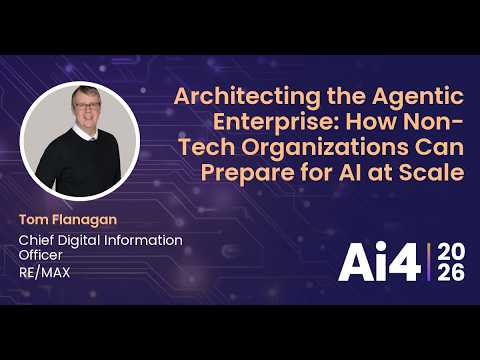
RE/MAX Unifies AI Agents Under SkyView to Halt Enterprise Sprawl
Ai4
Bolting standalone AI tools onto legacy systems creates unmanageable operational drag unless enterprises centralize data architecture, enforce agent observability, and automate back-office tasks rather than human relationships.
## Background
Published on YouTube by Ai4 on August 14, 2026, this session features Tom Flanagan, Chief Digital Information Officer at RE/MAX, discussing how non-tech enterprises can prepare for the agentic AI era. The presentation outlines the architectural, governance, security, and observability frameworks necessary to scale autonomous AI systems securely and effectively beyond initial experimentation.
## TL;DR
Tom Flanagan explains how RE/MAX, a relationship-first global real estate network, navigates the shift from simple prompting to a scalable, autonomous digital workforce. Guided by the core principle of automating tasks rather than relationships, the organization addressed the sprawl of disconnected, bolted-on tools by establishing an enterprise 'operating system of intelligence.' Flanagan details a comprehensive architectural framework spanning agent identity, centralized data lakehouses, cross-functional governance, and Datadog observability, culminating in their unified 'SkyView' platform. The transition emphasizes cultural readiness, executive modeling, psychological safety for employees, and evaluating AI success through tangible business ROI rather than vanity token metrics.
## Atmosphere & style
The presentation is pragmatic, structured, and authoritative, delivering real-world executive insight rather than speculative AI hype. Flanagan communicates with the clarity and discipline of an enterprise architect who deeply understands the friction of non-technical legacy businesses. It feels grounding and actionable, balancing technical rigor—such as agent telemetry and identity governance—with an empathetic approach to workplace change management and leadership modeling.
## Key takeaways
- [00:04](https://www.youtube.com/watch?v=bXIwU7Jj0LM&t=4s) Enterprise AI has rapidly shifted from simple prompt-and-paste interactions to copilots, workflow automations, and autonomous agents operating as a collaborative digital workforce.
- [00:04](https://www.youtube.com/watch?v=bXIwU7Jj0LM&t=4s) Grassroots automation by non-technical staff—such as using an agent to cross-reference attendance rosters and issue course invoices—can instantly recover hours of administrative overhead.
- [04:15](https://www.youtube.com/watch?v=bXIwU7Jj0LM&t=255s) Organizations in relationship-driven industries should anchor their AI strategy on the core philosophy of automating tasks, not relationships.
- [04:15](https://www.youtube.com/watch?v=bXIwU7Jj0LM&t=255s) Automating back-office burdens like CRM data hygiene and paperwork can return roughly 10 hours per week to professionals, allowing them to reinvest time in face-to-face client interactions.
- [04:15](https://www.youtube.com/watch?v=bXIwU7Jj0LM&t=255s) Deploying consumer-facing conversational AI portals can guide property discovery and answer hyper-local questions while routing qualified leads directly to human operators.
- [07:30](https://www.youtube.com/watch?v=bXIwU7Jj0LM&t=450s) Decentralized adoption of disconnected, bolted-on AI point solutions creates severe technical sprawl, workflow friction, and compounded technical debt.
- [07:30](https://www.youtube.com/watch?v=bXIwU7Jj0LM&t=450s) Enterprises need a centralized operating system for intelligence backed by unified data lakehouses to break down legacy data silos.
- [10:11](https://www.youtube.com/watch?v=bXIwU7Jj0LM&t=611s) Governing an agentic enterprise requires explicitly defining agent identities, operational permissions, and cross-functional policies involving legal and finance.
- [10:11](https://www.youtube.com/watch?v=bXIwU7Jj0LM&t=611s) Enterprise observability and telemetry tools like Datadog are essential to trace agent decision paths and eliminate operational blind spots.
- [10:11](https://www.youtube.com/watch?v=bXIwU7Jj0LM&t=611s) A non-negotiable human-in-the-loop framework ensures departmental leaders maintain ultimate accountability over autonomous agent actions.
- [14:01](https://www.youtube.com/watch?v=bXIwU7Jj0LM&t=841s) Consolidating internal and external AI capabilities into a single interface (such as SkyView) provides a governed gateway for enterprise workflows and field operations.
- [14:01](https://www.youtube.com/watch?v=bXIwU7Jj0LM&t=841s) Executive modeling, targeted leadership coaching, and establishing a sanctioned 'AI safe space' are crucial to alleviate employee anxieties regarding job displacement.
- [14:01](https://www.youtube.com/watch?v=bXIwU7Jj0LM&t=841s) Organizations must abandon superficial vanity metrics like 'token maxing' and measure AI investments strictly through tangible business productivity and ROI.
## Detailed walkthrough
### [00:04](https://www.youtube.com/watch?v=bXIwU7Jj0LM&t=4s) From Prompting to Agents: An Industry Evolution
Tom Flanagan, Chief Digital Information Officer at RE/MAX Holdings based in Denver, Colorado, reflects on the dramatic transformation of artificial intelligence within the context of a traditionally non-technical, "belly-to-belly industry that's built on relationships." Real estate has historically relied on high-touch human interactions, yet the launch of OpenAI's ChatGPT in November 2022 signaled an immediate paradigm shift. As an author who had recently completed a book, Flanagan was not initially blown away by the stylistic prose generated by early models, but the sheer velocity of the output and the broader horizon of possibilities made it obvious that the entire real estate operating model was about to transform.
The subsequent release of Google's NotebookLM (later evolved under the Gemini ecosystem) marked a breakthrough moment for corporate workflows. Flanagan used it to ingest 200-page operating agreements, commercial leases, and legal contracts privately, interrogating the documents for specific ownership structures and push-pull mechanisms within seconds—effectively acting like "a lawyer in my back pocket." That era of simple prompting, where users copied text from a browser and pasted it across disparate apps, quickly evolved into co-pilots, then into automated workflow integrations with email and calendars, and has now arrived at autonomous AI agents working independently. Looking ahead, Flanagan envisions a collaborative "digital workforce" where human employees manage networks of specialized autonomous bots and sub-agents.
Within RE/MAX—a global network supporting over 140,000 real estate agents—grassroots agent creation has already begun delivering measurable impact. A technical trainer within the organization automated her administrative routine by deploying an autonomous AI agent capable of taking webinar attendance, cross-referencing attendees against registration rosters, and automatically generating and sending invoices for paid training courses, recouping three hours of manual labor per session.
---
[04:15](https://www.youtube.com/watch?v=bXIwU7Jj0LM&t=255s) Strategic AI Pillars: Agents, Consumers, and Operations
Navigating AI adoption in a relationship-driven enterprise requires a clear organizational compass. RE/MAX anchored its strategy on a single core principle: "automate tasks, not relationships." AI is treated strictly as an operational lever to enhance human productivity rather than replace human connection. To execute this vision, the enterprise structured its AI initiatives across three distinct domains:
```
+--------------------------------------------------------------------+
| RE/MAX AI Strategic Pillars |
+--------------------------------------------------------------------+
| 1. Agent Experience | 2. Consumer Experience | 3. Operations |
| - Automate CRM & data | - "Max" AI Chat on Web | - Copilot/Gemini|
| - Streamline paperwork| - Guided property tour | - Vibe Coding |
| - Gain 10 hrs/wk face | - Real-time tax & info | - Cursor & dev |
| time with clients | - Global agent routing | acceleration |
+------------------------+-------------------------+-----------------+
```
On the agent experience front, real estate professionals continue to lose substantial working hours to administrative burdens, including CRM updates, database hygiene, repetitive social media production, and closing paperwork. RE/MAX calculated that automating these back-office tasks could return roughly 10 hours per week directly to each agent. Reinvesting those hours into face-to-face client interactions directly drives listing volume, sales transactions, and agent commissions.
For the consumer journey, RE/MAX introduced an interactive AI assistant named "Max" onto remax.com—one of the top five most-visited real estate portals in the United States alongside Zillow, Realtor.com, and Homes.com. The conversational agent provides guided property discovery, answers complex hyper-local questions such as property tax calculations, and routes qualified leads directly to local agents across domestic and international markets. Operationally, the internal organization deployed Microsoft Copilot and Google Gemini across business units, while equipping technical teams with vibe coding platforms such as Lovable and AI-native developer environments like Cursor.
---
[07:30](https://www.youtube.com/watch?v=bXIwU7Jj0LM&t=450s) The Challenge of Bolted-On AI and the Need for an OS of Intelligence
Rapid, decentralized adoption created an unintended byproduct: severe technical sprawl. In the rush to be AI-forward and empower departments, dozens of standalone AI tools were bolted onto legacy infrastructure without integration or cross-communication. Rather than streamlining operations, this fragmented collection of point solutions introduced organizational friction, fractured workflows, and compounded technical debt.
This operational drag made it clear that every enterprise must establish a centralized "operating system for intelligence." For a legacy organization founded in 1973, significant historical records were originally non-digital. Critical enterprise data assets—spanning franchise membership records, billing systems, and Multiple Listing Service (MLS) property feeds—were siloed across disconnected repositories without an authoritative single source of truth.
Traditional IT management followed a straightforward lifecycle of deploying, maintaining, and supporting software. In contrast, managing an enterprise AI footprint requires continuous platform evaluation, cross-departmental enablement across finance and sales, proactive coaching, and rigorous outcome tracking. Left ungoverned, the prospect of managing tens of thousands of individual digital workers created by employees could easily spiral out of control.
---
[10:11](https://www.youtube.com/watch?v=bXIwU7Jj0LM&t=611s) The Agentic Enterprise Architectural Framework
To prevent agent sprawl from derailing operational integrity, Flanagan established an enterprise architectural framework designed to govern autonomous agents systematically before widespread deployment:
- **Identity:** Explicitly defining the identity, operational scope, and access permissions of every agent deployed across the company.
- **Data Foundation:** Constructing centralized data lakehouses to establish a clean, queryable single source of truth for agents to access real-time property, billing, and membership data.
- **Cross-Functional Governance:** Updating governance frameworks collaboratively with legal and finance teams rather than treating policy purely as an IT mandate, ensuring guidelines remain lightweight, adaptive, and practical.
- **Enterprise Security and Risk:** Implementing rigorous guardrails, automated policing mechanisms, and compliance controls essential for a publicly traded organization.
- **Observability and Telemetry:** Integrating enterprise monitoring stacks such as Datadog to provide real-time tracing and telemetry into agent decision paths, mitigating the widespread industry blind spot where operators build autonomous tools without visibility into their background operations.
- **Human Oversight:** Enforcing a non-negotiable "human-in-the-loop" model where departmental owners maintain explicit accountability over agent actions.
- **Adoption and Trust:** Creating an "AI safe space" sanctioned by corporate leadership and the board of directors, encouraging employees to solve real business problems without fear.
---
[14:01](https://www.youtube.com/watch?v=bXIwU7Jj0LM&t=841s) Consolidating into SkyView and Leading Cultural Readiness
To dismantle the maze of bolted-on tools, RE/MAX consolidated its internal and external AI capabilities into a unified enterprise interface called **SkyView**. Powered by high-speed multimodal models (utilizing Google Gemini Flash), SkyView serves as an intelligent single pane of glass. Corporate staff can query human resources policies, inspect dental insurance coverage, or launch UKG enterprise workflows directly to pull payroll data. Simultaneously, all 140,000 network agents can authenticate into SkyView to manage profile bios and run localized real estate tasks through a governed gateway.
Scaling agentic systems fundamentally depends on executive leadership setting the organizational culture. RE/MAX CEO Erik Carlson (formerly CEO of DISH Network) actively champions AI experimentation and was even observed "vibe coding" within established governance boundaries. To foster top-down literacy, Flanagan instituted weekly executive leadership training sessions, teaching custom AI workflows tailored to each department head's operational domain.
```
+-------------------------------------------------------+
| Executive AI Readiness Flywheel |
+-------------------------------------------------------+
| [Executive Modeling] CEO & ELT actively build/use AI |
| v |
| [Targeted Coaching] Weekly department-specific tips |
| v |
| [Psychological Safety] AI Safe Space vs. fear of loss|
| v |
| [Outcome Discipline] Focus on ROI over token metrics |
+-------------------------------------------------------+
```
Flanagan concludes with guidance for leaders navigating rapid AI shifts in non-technical sectors. Addressing psychological safety is paramount: enterprise leaders must acknowledge valid employee anxieties regarding job displacement, leaning into empathetic change management rather than pure technical implementation.
Finally, organizations must shift their performance metrics away from superficial activity counters. Tracking buzzwords like "token maxing" merely incentivizes "AI slop" and empty busywork. Enterprise maturity requires discarding vanity usage metrics and anchoring all agentic investments firmly to tangible business value and operational productivity.
## Notable quotes
> [00:04](https://www.youtube.com/watch?v=bXIwU7Jj0LM&t=4s) belly-to-belly industry that's built on relationships — Tom Flanagan
> [00:04](https://www.youtube.com/watch?v=bXIwU7Jj0LM&t=4s) a lawyer in my back pocket — Tom Flanagan
> [00:04](https://www.youtube.com/watch?v=bXIwU7Jj0LM&t=4s) digital workforce — Tom Flanagan
> [04:15](https://www.youtube.com/watch?v=bXIwU7Jj0LM&t=255s) automate tasks, not relationships — Tom Flanagan
> [07:30](https://www.youtube.com/watch?v=bXIwU7Jj0LM&t=450s) operating system for intelligence — Tom Flanagan
> [10:11](https://www.youtube.com/watch?v=bXIwU7Jj0LM&t=611s) human-in-the-loop — Tom Flanagan
> [10:11](https://www.youtube.com/watch?v=bXIwU7Jj0LM&t=611s) AI safe space — Tom Flanagan
> [14:01](https://www.youtube.com/watch?v=bXIwU7Jj0LM&t=841s) vibe coding — Tom Flanagan
> [14:01](https://www.youtube.com/watch?v=bXIwU7Jj0LM&t=841s) token maxing — Tom Flanagan
> [14:01](https://www.youtube.com/watch?v=bXIwU7Jj0LM&t=841s) AI slop — Tom Flanagan
## Mentioned
Tom Flanagan, Erik Carlson, RE/MAX Holdings, Ai4, OpenAI, ChatGPT, Google, NotebookLM, Google Gemini, Gemini Flash, Microsoft Copilot, Max, SkyView, Lovable, Cursor, Datadog, UKG, DISH Network, Zillow, Realtor.com, Homes.com
## Video description
Tom Flanagan - Chief Digital Information Officer, RE/MAX
As AI moves from prompts to agents, the real challenge to enterprise adoption is no longer experimentation but architecture. In this session, Tom Flanagan, CIO at REMAX, will share how senior IT leaders can prepare their organizations for the agentic era: from the infrastructure, governance and guardrails to support a non-technical workforce to the security, privacy and observability needed to deploy AI responsibly at scale.
Drawing on his experience leading enterprise AI initiatives, Tom will discuss the foundational decisions organizations must make before agents can be deployed broadly. He'll explore how IT leaders can design the systems, controls and operating frameworks needed to support a secure, scalable and trusted agentic ecosystem.
This session is designed for enterprise executives and transformation leaders focused on scaling AI beyond experimentation into trusted, secure and measurable business impact.
According to Tom Flanagan, Chief Digital Information Officer at RE/MAX Holdings, non-technical enterprises scaling artificial intelligence must anchor their strategy on augmenting human relationships rather than replacing them. Successfully deploying autonomous agents across relationship-driven industries requires shifting from fragmented point solutions to centralized data architecture, rigorous observability, and executive-led cultural change.
From Prompting to Autonomous Workflow Agents (0:04)
Flanagan outlines the progression of enterprise generative AI from early prompt-and-paste text generation into autonomous agents capable of independent execution. Following OpenAI's November 2022 release of ChatGPT, Flanagan utilized Google's NotebookLM to interrogate 200-page commercial leases and legal agreements for ownership terms in seconds, demonstrating AI's capacity as an immediate analytical assistant. That workflow has since progressed from copilots and calendar integrations into multi-agent systems, with Flanagan projecting a future digital workforce where employees supervise specialized autonomous sub-agents.
Grassroots agent creation is already delivering operational returns within RE/MAX's global network of 140,000 real estate professionals. In one internal deployment, an enterprise technical trainer automated webinar administration by using an autonomous agent to take attendance, cross-reference registration rosters, and dispatch invoices for paid courses, eliminating three hours of manual labor per session.
Strategic Pillars: Automating Tasks, Not Relationships (4:15)
In relationship-centered sectors like real estate, RE/MAX anchors AI adoption to the principle of automating administrative tasks rather than human interactions. The company divided its roadmap into three strategic domains: agent experience, consumer experience, and internal operations. For agents, routine administrative burdens such as CRM updates, database hygiene, and closing paperwork consume critical selling hours. RE/MAX calculated that automating back-office work could return roughly 10 hours per week directly to each agent, freeing time for client-facing activities that drive transaction volume.
On the consumer side, the organization introduced 'Max,' a conversational assistant on remax.com that answers hyper-local queries like property tax estimates and routes qualified leads directly to local agents. Internally, the company deployed Microsoft Copilot and Google Gemini across corporate units, alongside developer-enablement environments like Lovable and Cursor to accelerate software delivery.
Governing Tool Sprawl with Enterprise Architecture (10:11)
Unchecked decentralized adoption initially led to technical sprawl, as dozens of standalone AI tools were bolted onto legacy systems without cross-communication. For an enterprise founded in 1973, siloed legacy data across franchise memberships, billing, and Multiple Listing Service (MLS) feeds exacerbated organizational friction. Flanagan argues that managing an expanding digital workforce requires shifting from traditional software maintenance to an integrated operating framework before deploying agents at scale.
The resulting architectural model establishes explicit agent identities, scopes, and permissions, anchored by centralized data lakehouses that serve as a queryable single source of truth. Governance policies are designed collaboratively with legal and finance teams rather than imposed strictly by IT. Crucially, the framework incorporates telemetry stacks such as Datadog for tracing agent decision pathways, paired with non-negotiable human-in-the-loop oversight to ensure departmental accountability.
Consolidated Platforms and Executive-Led Cultural Change (14:01)
To eliminate point-solution fragmentation, RE/MAX unified its AI capabilities into SkyView, an internal and external interface powered by Google Gemini Flash. The unified system allows corporate staff to review HR policies, verify insurance coverage, and run UKG payroll workflows, while providing authenticated access for 140,000 network agents to perform localized real estate tasks under governed security guardrails.
Flanagan emphasizes that technical architecture must be matched by proactive leadership and change management. CEO Erik Carlson actively models AI experimentation, supported by weekly leadership training sessions tailored to specific departmental workflows. Leaders must establish psychological safety to address valid employee concerns about job displacement, while strictly avoiding vanity metrics such as 'token maxing' that generate busywork in place of tangible business value.
Flanagan concludes that enterprise AI readiness demands a transition from uncoordinated experimentation to disciplined systems engineering. By establishing unified data lakehouses, continuous telemetry, and leadership-backed psychological safety, non-technical organizations can harness autonomous agents to eliminate operational friction without eroding core human relationships.
## Background
该内容由 Ai4 于 2026 年 8 月 14 日发布在 YouTube 平台上。视频记录了 RE/MAX 首席数字信息官 Tom Flanagan 的主题演讲,重点分享传统非技术型企业如何从基础设施、治理机制、安全防护与可观测性等底层架构入手,为迎接规模化智能体(Agentic)时代并实现可衡量的业务价值做好充分准备。
## TL;DR
Tom Flanagan 系统梳理了企业 AI 从 Prompt 提示词、副驾驶协同到自主智能体与数字劳动力的演进路径,确立了“自动化任务而非人际关系”的战略核心。针对零散“外挂式”AI 工具导致的技术债务与系统失控问题,他提出了涵盖身份、数据湖仓、跨部门治理、安全、可观测性、人类监督与安全创新空间的七大架构支柱。RE/MAX 通过构建由 Gemini 驱动的统一企业级智能门户 SkyView,整合了内部员工运营与全球 14 万经纪人网络。最后,他强调企业应正视员工的恐惧心理,坚决停止以代币消耗等“活动量指标”衡量成功,将关注点重新聚焦于真实的业务价值转化。
## Atmosphere & style
整场演讲洋溢着务实沉稳且极具实战指导性的高管分享基调,摒弃了空洞的技术概念炒作,紧密贴合传统高接触度行业的转型现实。Flanagan 的叙述条理清晰、循序渐进,既真诚剖析了工具膨胀与技术债务的弯路教训,也展现出对一线员工心理的敏锐洞察与同理心。整体氛围兼具战略层面的决断力与落地层面的亲和力,给观众带来一种脚踏实地、极具启发性的数字化转型沉浸感。
## Key takeaways
- [00:04](https://www.youtube.com/watch?v=bXIwU7Jj0LM&t=4s) 企业 AI 应用经历了从提示词(Prompt)、协同副驾驶(Copilot)、自动化工作流、自主智能体(Agentic Era)到全天候数字劳动力(Digital Workforce)的清晰演进路径。
- [03:25](https://www.youtube.com/watch?v=bXIwU7Jj0LM&t=205s) RE/MAX 确立的 AI 核心哲学是“自动化任务,而非人际关系”,AI 的本质是帮助员工与经纪人省去繁琐行政工作,以释放更多面对面服务客户的时间。
- [03:25](https://www.youtube.com/watch?v=bXIwU7Jj0LM&t=205s) RE/MAX 的 AI 落地聚焦于三大业务支柱:经纪人体验(缩减文书与 CRM 维护)、消费者体验(Max 智能搜房助手)以及企业运营与研发(全员 Copilot/Gemini 与 Vibe Coding)。
- [07:34](https://www.youtube.com/watch?v=bXIwU7Jj0LM&t=454s) 业务部门野蛮采购“外挂式”独立 AI 工具会导致工具膨胀与数据孤岛,迅速演变为严重的技术债务,迫使企业转向构建统一的“智能操作系统”。
- [07:34](https://www.youtube.com/watch?v=bXIwU7Jj0LM&t=454s) 在面向成千上万个自主数字员工的智能体时代,企业必须建立统一的数据湖仓作为“单一事实来源”,否则系统与数据将迅速失控。
- [09:45](https://www.youtube.com/watch?v=bXIwU7Jj0LM&t=585s) 构建智能体企业架构需要七大核心支柱支撑:身份、数据、跨部门轻量治理、安全防线、可观测性与遥测、人类监督(人在回路)以及安全试验空间。
- [09:45](https://www.youtube.com/watch?v=bXIwU7Jj0LM&t=585s) AI 与 Vibe Coding 降低了非技术人员的软件开发门槛,但企业必须通过 Datadog 等遥测监控工具对智能体内部调用链与运行状态进行严格的可观测性管理。
- [13:55](https://www.youtube.com/watch?v=bXIwU7Jj0LM&t=835s) RE/MAX 剥离冗余独立工具,推出了基于 Gemini 3.5 Flash 的统一企业智能门户 SkyView,实现了内部员工福利/HR 结算与全球 14 万经纪人业务流程的一站式整合。
- [13:55](https://www.youtube.com/watch?v=bXIwU7Jj0LM&t=835s) 企业高管层的亲身践行(如 CEO 亲自尝试 Vibe Coding、每周开展专属 AI 培训)是自上而下推动传统非技术组织转型、消除员工抵触情绪的关键保障。
- [16:34](https://www.youtube.com/watch?v=bXIwU7Jj0LM&t=994s) 企业必须坚决停止以 Token 消耗量或 AI 调用频率等“活动量指标”来衡量成功,避免产生低质“AI 垃圾内容”,应全面聚焦于真实的业务价值产出。
## Detailed walkthrough
### [00:04](https://www.youtube.com/watch?v=bXIwU7Jj0LM&t=4s) 房地产行业的 AI 启蒙与演进历程
来自科罗拉多州丹佛市 RE/MAX Holdings 的首席数字信息官(Chief Digital Information Officer)Tom Flanagan 开启了他的分享。他开门见山地指出,房地产是一个极其注重面对面交流("belly-to-belly")与高接触度(high-touch)的人际关系型行业。回顾 2022 年 11 月 OpenAI 发布 ChatGPT 的那天,作为一名刚写完一本书的作者,Flanagan 虽未被其早期的文笔惊艳,却被其惊人的生成速度与无限潜力深深震撼。他当即意识到:这项技术必将彻底重塑整个房地产行业的运作方式。
不久之后,Google 推出了 NotebookLM(现为 Gemini Notebook),这在 Flanagan 眼中成为了真正的“游戏规则改变者”。他将长达 200 页的公司运营协议、合同与租赁文件以私密方式上传,直接提问“这份协议中的买卖条款(push-pull)是什么?所有权结构如何?”,几秒钟内便能获得极其精准的回答,体验就像“口袋里随时揣着一名私人律师”。这不仅极大地释放了专业文本处理的生产力,也拉开了企业 AI 演进的序幕。
在这四年间,企业应用 AI 经历了清晰的演进路径:
- **Prompt 提示词阶段**:用户向语言模型提问获取洞察,手动复制粘贴到其他应用中。
- **副驾驶(Copilot)协同阶段**:AI 嵌入工作流,实现人机协同交互。
- **自动化工作流阶段**:将大语言模型连接至电子邮件、日历及各类办公软件,系统性提升流程效率。
- **自主智能体(Agentic Era)时代**:自主 AI 智能体能够独立执行端到端的多步骤复杂任务。
- **数字劳动力(Digital Workforce)未来**:人类与自主 AI 智能体及子智能体展开全天候无缝协作。
---
### [03:25](https://www.youtube.com/watch?v=bXIwU7Jj0LM&t=205s) 核心哲学与三大战略支柱:赋能经纪人、消费者与企业运营
在 RE/MAX 这样一个庞大的人脉网络中(全球拥有超过 14 万名顶尖房产经纪人),AI 的引入必须有清晰的价值锚点。Flanagan 举例说明:RE/MAX 的一位技术培训师原本需要手动处理大量的线上研讨会与实操培训,后来她自主构建了一个 AI 智能体,能够自动点名、核对出勤与报名名单,甚至对付费课程自动生成并发送账单,单次课程即可为她节省整整 3 个小时。
基于此,RE/MAX 确立了 AI 发展的核心指导原则——“**自动化任务,而非人际关系**”("automate tasks, not relationships")。AI 的本质是改善生活与提高效率的实用工具。在此指导下,RE/MAX 将 AI 战略拆解为三大核心支柱:
```mermaid
flowchart TD
accTitle: RE/MAX AI 战略的三大业务支柱
subgraph CoreStrategy["RE/MAX AI 战略核心支柱"]
A["经纪人体验 (Agent Experience)<br/>• 缩减繁琐行政与文书<br/>• 自动化 CRM 与社媒生成<br/>• 释放面对面服务客户时间"]
B["消费者体验 (Consumer Experience)<br/>• remax.com 智能搜索<br/>• 网站 AI 助手 Max<br/>• 实时答疑与全球房源撮合"]
C["运营与研发 (Operations & Engineering)<br/>• 全员配备 Copilot & Gemini<br/>• Vibe Coding 工具 (Lovable)<br/>• 工程师采用 Cursor 等"]
end
```
- **经纪人体验(Agent Experience)**:即使到了现在,房产经纪人依然在客户关系管理(CRM)维护、社交媒体内容制作和繁复文书上耗费大量精力。如果每周能通过 AI 为经纪人节省 10 个小时的行政琐事,他们就能多出 10 个小时面对面服务客户,从而促成更多房源委托与交易转化。
- **消费者体验(Consumer Experience)**:作为全美访问量前五的房产网站(紧随 Zillow、realtor.com 与 homes.com 之后),remax.com 上线了名为“Max”的 AI 聊天界面,不仅能解答税费等实时专业问题,还能精准根据全球房源将买家定向引流给当地经纪人。
- **企业运营(Operations)**:为员工提供微软 Copilot 与 Google Gemini;在工程研发端引入 Cursor;在业务端推广 Lovable 等“氛围编码”(Vibe Coding)工具,赋能非技术人员快速构建实用工具。
---
### [07:34](https://www.youtube.com/watch?v=bXIwU7Jj0LM&t=454s) “外挂式”工具的陷阱与智能操作系统的必要性
随着业务部门自发引入各种 AI 工具,RE/MAX 很快遭遇了严峻的“工具膨胀”挑战。各个部门为了拥抱 AI,大量采购和拼贴独立的 AI 软件,导致这些工具如同“外挂”(bolted-on)一样散落在各处,彼此之间无法通信,缺乏统一的生态底座。这种野蛮生长不仅未能带来预期的整体协同效应,反而迅速演变为严重的技术债务(Technical Debt),极大地增加了企业的系统复杂度。
```mermaid
flowchart LR
accTitle: 从外挂式工具混乱到统一智能底座架构
subgraph Problem["混乱的外挂式架构 (Bolted-on Sprawl)"]
direction TB
T1["孤立 AI 工具 A"] -.- T2["孤立 AI 工具 B"]
T2 -.- T3["独立智能体 C"]
T3 -.- T4["产生技术债务与数据孤岛"]
end
subgraph Solution["统一智能操作系统 (OS for Intelligence)"]
direction TB
D1["单一事实来源 (Data Lakehouse)"] --> G1["统一治理与安全框架"]
G1 --> P1["集中化门户 & 智能体底座 (SkyView)"]
end
Problem -->|架构重构与沉淀| Solution
```
面对这种局面,Flanagan 深刻意识到:**每家企业都需要一套属于自己的“智能操作系统”(Operating System for Intelligence)**。对于创立于 1973 年的传统老牌企业 RE/MAX 而言,大量历史业务数据、加盟商会员体系、财务结算和 MLS(多重上市服务系统)房产数据长期缺乏统一的“单一事实来源”(Single Source of Truth)。在 AI 时代之前,IT 部门的职责仅仅是部署、维护和技术支持;而在 AI 时代,企业必须选择匹配自身业务的平台、实施全方位治理、赋能一线部门、开展持续培训并精确量化业务产出。当企业面临管理成千上万个自主数字员工时,没有统一的底座,系统将迅速失控。
---
### [09:45](https://www.youtube.com/watch?v=bXIwU7Jj0LM&t=585s) 智能体企业架构的七大核心支柱
为了保障非技术型企业在 Agentic 时代的稳健扩展,Flanagan 总结并提炼出了一套经过实践检验的七大架构支柱:
```mermaid
flowchart TD
accTitle: 智能体企业架构的七大核心支柱
subgraph Foundations["基础底座层"]
ID["1. 身份 (Identity)<br/>明确智能体权限与角色定位"]
DT["2. 数据 (Data Lakehouse)<br/>统一湖仓与单一事实来源"]
end
subgraph Controls["管控与合规层"]
GV["3. 治理 (Governance)<br/>法务、财务与技术跨部门轻量机制"]
SC["4. 安全 (Security)<br/>上市公司级风险控制与合规防线"]
end
subgraph Operations["运行与保障层"]
OB["5. 可观测性 (Observability)<br/>利用 Datadog 等进行遥测追踪"]
HO["6. 人类监督 (Human Oversight)<br/>坚持 Human-in-the-loop 与责任制"]
AD["7. 落地信任 (Adoption & Safe Space)<br/>构建安全包容的创新试验环境"]
end
Foundations --> Controls
Controls --> Operations
```
- **身份(Identity)**:清晰界定每一个 AI 智能体的身份定位、操作权限与归属关系。
- **数据(Data)**:构建企业级数据湖仓(Data Lakehouse),打通分散的数据壁垒,为智能体检索和处理数据提供权威输入。
- **治理(Governance)**:治理绝非纯粹的 IT 技术事务,必须由技术、法务、财务等多部门跨职能协同制定,保持轻量且敏捷,以适应快速迭代的外部环境。
- **安全(Security)**:作为上市公司,RE/MAX 对合规与网络安全风险采取零容忍态度,将安全边界作为不可动摇的底线。
- **可观测性与遥测(Observability & Telemetry)**:AI 和“氛围编码”(如 Claude Code 等)极大地民主化了软件工程,让非技术业务人员能够自行开发交易管理平台或数据看板。但许多人忽视了监控智能体的内部运转。企业必须引入诸如 Datadog 等遥测监控工具,掌握智能体调用链与运行状态。
- **人类监督(Human Oversight)**:严格贯彻“人在回路中”(Human-in-the-loop)原则,确保每一个自动化业务流都有明确的责任人和审查机制。
- **采纳与安全空间(Adoption & AI Safe Space)**:向董事会汇报并在治理政策中确立“AI 安全空间”,鼓励员工保持好奇心、尝试用 AI 解决业务痛点,同时由完善的安全防护网兜底。
---
### [13:55](https://www.youtube.com/watch?v=bXIwU7Jj0LM&t=835s) SkyView 平台整合与高管领导力实践
为了终结零散工具带来的内耗,RE/MAX 剥离冗余的外挂软件,推出了统一的企业级智能门户——**SkyView**。该平台底层基于 Gemini 3.5 Flash 驱动,具备极高的数据响应速度,实现了面向员工与全球经纪人的能力统一:
- **企业内部员工端**:员工可一站式查询企业福利待遇、牙科保险明细,甚至直接在对话界面内唤起人力资源平台 UKG,实时获取薪酬结算数据。
- **全球经纪人网络端**:14 万名经纪人可通过该统一入口更新个人资料、维护房源档案并管理日常业务流程。
这一变革之所以能够顺利落地,核心在于最高管理层的亲身践行。RE/MAX 控股首席执行官 Eric Carlson(曾任 DISH Network 首席执行官)不仅高度拥抱 AI,甚至在合规治理框架下亲自尝试“氛围编码”(Vibe Coding)。Flanagan 每周为主管领导团队(Executive Leadership Team)开设专属的 AI 培训小课堂,结合不同业务条线分享落地技巧,自上而下激发了整个组织的创新热情,为技术转型提供了坚实的组织保障。
---
### [16:34](https://www.youtube.com/watch?v=bXIwU7Jj0LM&t=994s) 消除员工恐惧与停止“活动量指标”崇拜
对于正准备启动 AI 变革的传统非技术企业,Flanagan 强调了心态与文化建设的重要性。在 AI 技术日新月异的当下,没有人是绝对的专家,企业不必因起步稍晚而焦虑。更重要的是,领导者必须正视员工对于“AI 替代工作”的真实恐惧与抵触心理,积极建立信任与赋能机制,让员工认识到 AI 是提升个人价值的杠杆,而非取代人类的威胁。
在演讲的最后,Flanagan 向全体企业管理者发出了明确的呼吁:**坚决停止以“AI 活动量”作为衡量成功的标准**。
- 盲目追求“代币最大化”(Token Maxing)或堆砌调用次数,本质上是在催生低质的“AI 垃圾内容”(AI Slop)。
- “忙碌”并不等于“高效”,企业不应沉迷于虚无的 AI 使用频率指标,而应聚焦于真实的业务价值转化(Business Outcomes)。通过夯实底层架构与治理体系,非技术型实体企业同样能够在 Agentic 时代稳步构建核心竞争力。
## Notable quotes
> [00:04](https://www.youtube.com/watch?v=bXIwU7Jj0LM&t=4s) 房地产是一个极其注重面对面交流("belly-to-belly")与高接触度(high-touch)的人际关系型行业。 — Tom Flanagan
> [00:04](https://www.youtube.com/watch?v=bXIwU7Jj0LM&t=4s) 这份协议中的买卖条款(push-pull)是什么?所有权结构如何?几秒钟内便能获得极其精准的回答,体验就像口袋里随时揣着一名私人律师。 — Tom Flanagan
> [03:25](https://www.youtube.com/watch?v=bXIwU7Jj0LM&t=205s) 自动化任务,而非人际关系(automate tasks, not relationships)。 — Tom Flanagan
> [03:25](https://www.youtube.com/watch?v=bXIwU7Jj0LM&t=205s) 如果每周能通过 AI 为经纪人节省 10 个小时的行政琐事,他们就能多出 10 个小时面对面服务客户,从而促成更多房源委托与交易转化。 — Tom Flanagan
> [07:34](https://www.youtube.com/watch?v=bXIwU7Jj0LM&t=454s) 每家企业都需要一套属于自己的“智能操作系统”(Operating System for Intelligence)。 — Tom Flanagan
> [07:34](https://www.youtube.com/watch?v=bXIwU7Jj0LM&t=454s) 在 AI 时代,企业必须选择匹配自身业务的平台、实施全方位治理、赋能一线部门、开展持续培训并精确量化业务产出。 — Tom Flanagan
> [09:45](https://www.youtube.com/watch?v=bXIwU7Jj0LM&t=585s) 治理绝非纯粹的 IT 技术事务,必须由技术、法务、财务等多部门跨职能协同制定,保持轻量且敏捷,以适应快速迭代的外部环境。 — Tom Flanagan
> [16:34](https://www.youtube.com/watch?v=bXIwU7Jj0LM&t=994s) 坚决停止以“AI 活动量”作为衡量成功的标准。 — Tom Flanagan
> [16:34](https://www.youtube.com/watch?v=bXIwU7Jj0LM&t=994s) 盲目追求“代币最大化”(Token Maxing)或堆砌调用次数,本质上是在催生低质的“AI 垃圾内容”(AI Slop)。 — Tom Flanagan
> [16:34](https://www.youtube.com/watch?v=bXIwU7Jj0LM&t=994s) “忙碌”并不等于“高效”,企业不应沉迷于虚无的 AI 使用频率指标,而应聚焦于真实的业务价值转化(Business Outcomes)。 — Tom Flanagan
## Mentioned
Tom Flanagan, RE/MAX Holdings, Ai4, OpenAI, ChatGPT, Google, NotebookLM, Gemini, Gemini 3.5 Flash, Microsoft Copilot, Cursor, Lovable, Zillow, realtor.com, homes.com, Max, SkyView, Datadog, Claude Code, Eric Carlson, DISH Network, UKG
## Video description
Tom Flanagan - Chief Digital Information Officer, RE/MAX
As AI moves from prompts to agents, the real challenge to enterprise adoption is no longer experimentation but architecture. In this session, Tom Flanagan, CIO at REMAX, will share how senior IT leaders can prepare their organizations for the agentic era: from the infrastructure, governance and guardrails to support a non-technical workforce to the security, privacy and observability needed to deploy AI responsibly at scale.
Drawing on his experience leading enterprise AI initiatives, Tom will discuss the foundational decisions organizations must make before agents can be deployed broadly. He'll explore how IT leaders can design the systems, controls and operating frameworks needed to support a secure, scalable and trusted agentic ecosystem.
This session is designed for enterprise executives and transformation leaders focused on scaling AI beyond experimentation into trusted, secure and measurable business impact.
[Source](https://www.youtube.com/watch?v=bXIwU7Jj0LM)
Source quotes
[0:04] Tom Flanagan: 房地产是一个极其注重面对面交流("belly-to-belly")与高接触度(high-touch)的人际关系型行业。
[0:04] Tom Flanagan: 这份协议中的买卖条款(push-pull)是什么?所有权结构如何?几秒钟内便能获得极其精准的回答,体验就像口袋里随时揣着一名私人律师。
[3:25] Tom Flanagan: 自动化任务,而非人际关系(automate tasks, not relationships)。
[3:25] Tom Flanagan: 如果每周能通过 AI 为经纪人节省 10 个小时的行政琐事,他们就能多出 10 个小时面对面服务客户,从而促成更多房源委托与交易转化。
[7:34] Tom Flanagan: 每家企业都需要一套属于自己的“智能操作系统”(Operating System for Intelligence)。
[7:34] Tom Flanagan: 在 AI 时代,企业必须选择匹配自身业务的平台、实施全方位治理、赋能一线部门、开展持续培训并精确量化业务产出。
[9:45] Tom Flanagan: 治理绝非纯粹的 IT 技术事务,必须由技术、法务、财务等多部门跨职能协同制定,保持轻量且敏捷,以适应快速迭代的外部环境。
[16:34] Tom Flanagan: 坚决停止以“AI 活动量”作为衡量成功的标准。
[16:34] Tom Flanagan: 盲目追求“代币最大化”(Token Maxing)或堆砌调用次数,本质上是在催生低质的“AI 垃圾内容”(AI Slop)。
[16:34] Tom Flanagan: “忙碌”并不等于“高效”,企业不应沉迷于虚无的 AI 使用频率指标,而应聚焦于真实的业务价值转化(Business Outcomes)。
Source quotes
[0:04] Tom Flanagan: belly-to-belly industry that's built on relationships
[0:04] Tom Flanagan: a lawyer in my back pocket
[0:04] Tom Flanagan: digital workforce
[4:15] Tom Flanagan: automate tasks, not relationships
[7:30] Tom Flanagan: operating system for intelligence
[10:11] Tom Flanagan: human-in-the-loop
[10:11] Tom Flanagan: AI safe space
[14:01] Tom Flanagan: vibe coding
[14:01] Tom Flanagan: token maxing
[14:01] Tom Flanagan: AI slop
Original transcript
[0:04] Again, I'm Tom Flanagan. I'm the Chief Digital
Information Officer at RE/MAX Holdings in Denver,
[0:10] Colorado. And I'm excited to share my experience
with you this afternoon. Um and my experience is
[0:17] of scaling AI at a non-tech organization. And so
hopefully some of this content will resonate with
[0:24] you. And by the way, if you have any questions, I
know we only have little less than 20 minutes now.
[0:29] I'm happy to hang out and answer any questions uh
that you may have. And so I work in real estate.
[0:36] It is a belly-to-belly industry that's built
on relationships. It's extremely high-touch.
[0:44] And gosh, I remember 4 years ago, November 2022,
when OpenAI released ChatGPT. And the first day it
[0:53] was released, I signed up and I started using
it. And as a writer, as she just mentioned,
[0:58] I just finished writing a book. But as a writer,
I wasn't super impressed with the writing
[1:03] per se, but I was very impressed with how quick
the output was and all the other possibilities um
[1:11] that ChatGPT brought. And I knew immediately, and
not to sound too dramatic, but I knew immediately
[1:18] that this was going to change the real estate
industry and how people work in the industry.
[1:24] And then a short time after ChatGPT was
released, uh Google released uh NotebookLM,
[1:31] which is now called Gemini Notebook, as you
probably know. And that was a game-changer for
[1:35] me. I was able to privately upload things like
operating agreements and contracts and leases,
[1:43] and just simply ask answers and get incredibly
accurate information returned in seconds. It was
[1:50] like having a lawyer in my back pocket, right? If
I had a super long 200-page operating agreement,
[1:57] I could say, "Hey, what's the push-pull in this
operating agreement? What's the ownership model
[2:02] look like?" And to get those answers in real time
was incredibly um valuable. But, that was 4 years
[2:09] ago. A lot has shifted and a lot has changed. I
want to talk about that shift and take a moment
[2:15] to sort of walk through what that looks like,
right? And so, as I mentioned with ChatGPT, we
[2:21] began with prompting, right? And a lot of people
would go to ChatGPT or another language model and
[2:27] ask a question or ask for some additional content
or insight, and then they would copy and paste
[2:33] that information and typically put it into another
application, right? We all live this. We all did
[2:37] this. And then we transitioned to co-pilots and
having that collaboration with AI. And then came
[2:45] automated workflows, right? And we started to see
efficiency. We could connect these language models
[2:51] to our productivity apps, to email, to calendar,
to all of these things. And then this year,
[2:58] we entered the ejecting ejecting era, where now we
have autonomous AI AI bots working independently.
[3:05] Um and then we're also transitioning to this
next phase that I like to call the digital
[3:10] workforce, where we're going to be collaborating
with these autonomous AI chatbots and AI agents
[3:18] uh and sub-agents on a daily basis, right?
Totally that human-AI collaboration.
[3:25] And so, this has been really interesting to
sort of live through so quickly in the last
[3:30] few years. And just to give you an example,
um one of my technical trainers at RE/MAX,
[3:35] um she does a lot of webinars, a lot of in-person
training. Some of that is free for the agents in
[3:40] the in the RE/MAX network. We have over 140,000
real estate agents in the RE/MAX network. Um some
[3:48] of the most trusted and productive real estate
agents in the world, for that matter. And so, she
[3:54] has built an autonomous AI agent that can actually
take attendance in her meetings, cross-reference
[4:00] that with the registrations, and even um create
billing and deliver that billing to the agents if
[4:07] it's a paid class. And so, really exciting stuff
because that saves her 3 hours per class. And so,
[4:14] she loves that. And so, moving on from the
evolution, one of the guiding lights that we have
[4:20] at Remax coming in such a high-touch industry, a
people business, is we believe that you automate
[4:28] tasks, not relationships, right? We believe that
AI is a tool, and tools should be useful, improve
[4:34] one's lives, and improve efficiency. So, that's
our guiding light. And when we started to take a
[4:41] look at our strategic vision for AI, we broke it
down into three categories, three buckets. There
[4:48] was the real estate agent experience, the consumer
experience, of course, and then operations,
[4:55] right? And when I think about real estate
experience, the real estate agent experience,
[5:01] um even though in it's 2026, real estate agents
and professionals still spend a tremendous amount
[5:08] of time on administrative tasks, right? They're
doing things like maintaining their database,
[5:14] updating their CRM, they're creating a whole slew
of time-consuming social media content. Um that's
[5:22] a whole other conversation and presentation, but
they spend a lot of time on these tasks. Even
[5:28] paperwork. Even in 2026, real estate professionals
do a lot of paperwork. If you purchased a home,
[5:34] you probably know this, right? Um and so, on the
and so, we think if you we believe if you can
[5:41] spend if you can save a real estate agent 10 hours
a week on those administrative tasks, that is 10
[5:47] hours that they can dedicate face-to-face
with their client, their customer, right?
[5:53] And if you can have more face time with your
customers, that's going to lead to more listings,
[5:58] more sales, and and ultimately, you know,
more income. And then on the consumer side,
[6:03] we wanted to bring a chat interface to remax.com.
Right behind Zillow and realtor.com and homes.com,
[6:11] Remax is in the top five most visited real
estate related websites in the country. And so,
[6:18] we wanted to give the consumer and the website
user this personalized search and guided tour
[6:25] and journeys, which which we did. And then on the
operational side, right, we gave our team members
[6:32] both Copilot and Gemini. Right? We gave them
vibe coding programs like lovable. And we used
[6:40] a whole bunch of programs on the engineering side
including Cursor. Um, and others as well. And so,
[6:47] here's just an example on remax.com, we put
this chatbot on the website. It's called Max, of
[6:53] course. And it can help answer real-time questions
to consumers, right? Which is incredibly powerful,
[7:01] right? They can answer things like taxes, and
they can even connect the website user to a
[7:08] Remax real estate agent in their marketplace cuz
we have listings all over the world on remax.com.
[7:14] Um, and cross Canada, cross the entire world.
And so, it's really powerful and really saves the
[7:21] customer and our website users a treme- tremendous
amount of time. And also, it's a great lead gen
[7:26] tool as well. And so, the challenge was though,
and you probably know where I'm going with this,
[7:35] uh, we had bolted on so many different AI
tools, right? We wanted to be AI forward,
[7:42] we want it to be efficient, we want it to maximize
our efforts and educate our team members, but the
[7:49] reality of the situation is we had all of these AI
tools and many of them were just standalone tools,
[7:56] right? They didn't communicate, there wasn't
an ecosystem, they were just all bolted on.
[8:02] And that actually is where the complexity began.
It actually contributed to our technical debt.
[8:09] It just made things a lot more complicated. And
so one of the things that I saw or recognized
[8:16] almost instantly is that every enterprise needs
an operating system for intelligence. And that
[8:23] means something different for every company. So
at RE/MAX, you know, we're a legacy company, we
[8:28] were founded in 1973. We had a tremendous amount
of information and data that wasn't digital,
[8:35] right? From the 1970s. And so important
data sets for us were things like membership
[8:41] for our franchises, billing, and
of course property data, which
[8:45] is all of that MLS data when you go to a real
estate-related website and look at properties,
[8:50] right? And so at the time we didn't have a single
source of truth and that became a huge opportunity
[8:57] for us. And so before AI, things were pretty
pretty simple to be honest, you know, you would
[9:04] deploy technology, you would maintain it, and
then of course you would support it. After AI,
[9:10] things got a little bit more complicated, right?
You'd have to choose the right AI platform for
[9:15] your organization, right? And we had a bunch
of them. And then you'd have to govern it and
[9:21] enable it. And when I say enable it, you've got
to put it in the hands of like your sales team.
[9:25] You've got to put it in the hands of your finance
team, all these different departments throughout
[9:31] an organization. Then you have to coach and
train them and measure outcomes so you can see,
[9:37] where that complexity was growing and I I've lived
it the last few years. And so, now that we've
[9:45] entered the agentic era, just imagine managing
100,000 digital employees. And so, when I she had
[9:52] that tidbit of technical training of building that
[snorts] AI agent to help her with her training
[9:58] and webinars, all of our employees are doing
that. And boy, we quickly realized, you know,
[10:05] this could get off the rails pretty quickly,
right? And so, I really started to think about,
[10:11] you know, a framework and what a framework could
actually do. So, I just want to share this with
[10:17] you today. A lot of it is practical and but I just
want to go through it step by step, right? So,
[10:24] the first thing is identity, right? Who is that
AI agent? And then data, right? I mentioned one
[10:32] of the big projects that RE/MAX was creating these
data lake houses and having that single source of
[10:38] truth that we could just tap into, that we could
create AI agents to tap in, retrieve and and work
[10:45] with that data. [snorts] That was really a big
project that's actually continuing to this day,
[10:51] but it was something that was critical to us. And
then governance, this year we updated governance
[10:57] document and we wanted it to be lightweight and
flexible cuz this industry is changing so fast,
[11:04] not just the AI sector, but real estate as well.
And one of the things I want to point out in this
[11:10] discussion with governance is it was not a
technology initiative. We worked with legal,
[11:15] we worked with finance, we made this a
cross-functional project and we collaborated
[11:20] with all of our team members on this and that made
the project really successful. And then there's
[11:26] security, right? Like, how do we protect this?
How do we police this and how do we police these
[11:33] AI agents? RE/MAX is a publicly traded company. We
take compliance, we take risk extremely serious.
[11:41] We've invested a lot in our security and risk
department and cybersecurity. And so, obviously,
[11:47] that was um non-negotiable for us, right? And
to have that built in. And then observability,
[11:53] this one was really important to me and sort
of new um with AI. In the real estate industry,
[12:00] I have a lot of friends and colleagues who are
building their own software. They're solving their
[12:05] own problems, and I love that. One of the things
that I love about AI is that it's democratized
[12:12] engineering and program- programming, right? Uh
with Cloud Code, you can now have an operator in
[12:17] the real estate industry who may build their own
transaction management platform or their own data
[12:23] dashboard. They are solving their own problems.
Previously, off-the-shelf expensive SaaS um
[12:30] didn't work for a lot of small businesses, right?
It was like putting a square peg in a round hole,
[12:35] and it was very expensive. A lot of businesses
can't afford expensive enterprise SaaS. And so,
[12:41] but one of the things that I noticed that a lot
of my friends and colleagues weren't doing is they
[12:45] had no observability and they had no telemetry,
right? They had no vision into what these
[12:50] AI agents were doing, and that's critical, right?
And that is something I personally been helping
[12:55] with them, personally learning. The good news is
there's a lot of products out there and a lot of
[13:00] platforms. We use Data Dog and some other ones,
and so um but no shortage of those programs. So,
[13:06] I highly encourage that. And then human oversight,
right? At RE/MAX, we believe in human in the loop.
[13:13] And and that's really important to see
who's accountable and who's overseeing
[13:18] in these different departments, these agentic AI
bots. And then adoption, will people trust what
[13:24] you built? One of the thing that was important
One of the things that was important that we
[13:28] shared with our board of directors and it's in
our governance is creating an AI safe space,
[13:35] right? We want people to be curious. We want
them to solve their own problems. We want them
[13:39] to be efficient. Um but we also want it to be
safe, right? And so we've updated our AI policy.
[13:47] We updated our governance so they're much more
cohesive and so that was really uh critical
[13:52] um for us. And so I mentioned we had all these
bolted on AI uh you know, bots and agents and
[14:01] all the software and all these AI tools. And
so we were like, we need to peel this back. Now
[14:07] that we're in the agentic era, we need to simplify
this and come up with a sort of new mindset here.
[14:14] And so we just launched um SkyView. Um so we
took all of that stuff I sort of mentioned
[14:19] in the beginning and uh we consolidated it and
wrapped it in a new AI interface. We're using
[14:25] Gemini 3.5 Flash. It's super fast. Um but
what's great is that any team member or uh
[14:33] uh employee at corporate can go to SkyView and
they can type something in, ask about benefits,
[14:40] right? They can ask about their dental
insurance. They can actually even launch UKG
[14:46] right from that platform and you can get payroll
information. So really valuable, but it's not just
[14:50] for the employees. All those 140,000 agents that
I mentioned can log in and they can do things like
[14:56] update their bio, which is really neat, right? So
if you're a real estate agent in Denver, Colorado
[15:02] for example, you could log into SkyView, you could
access your information. Um you can do all these
[15:07] things and there's a lot on the road map, too. So
I share this with you is because I wanted to show
[15:12] you that we're peeling back the layer. We had all
these bolted on tools and we're really trying to
[15:18] simplify things and uh bring that agentic era
to all of our workflows, which is pretty cool.
[15:26] The other thing that I learned, too, is uh
it really begins with leadership. And so,
[15:31] Eric Carlson is the CEO at RE/MAX Holdings. He
was previously the CEO at DISH Network, and he
[15:38] himself uses AI uh and embraces it. And I even
caught him vibe coding one time, right? And so,
[15:45] that was really cool to see the CEO um doing that.
And of course, he did it with all the governance
[15:51] and all that other stuff. Um and it was just
really cool. And so, we actually had me teaching
[15:56] our executive leadership team um uh weekly AI
tips. And so, we would sit together and I would
[16:02] teach them AI, and it would be sort of different
tips for their own departments and verticals.
[16:07] And it was really cool, and that built
excitement, that educated them, and that
[16:11] helped with the embracing of new technology.
Then, of course, team readiness um is critical
[16:17] as well. And then, operating discipline, right?
And that's the framework, and that's when I
[16:22] realized when we before we were beginning to do
agentic AI that we needed that framework before
[16:28] beginning. Uh we did not do that previously. So,
it was great to have that framework. And then,
[16:35] um beginning. So, if you're somebody in the
audience and you're just beginning to do all
[16:39] this stuff. By the way, I will say that this
has emerged so quickly over the last few years.
[16:44] If you're feeling like you're behind, if you're
feeling that you need to get going with AI, um
[16:50] don't worry about that. This in this industry is
moving so quickly on a daily basis. If you think
[16:56] you're an expert one day, you're a beginner the
next, and vice versa. Stay with us, learn, um um
[17:02] but I would recommend uh building that foundation,
that framework. Also, prepare your people.
[17:08] They're still AI is obviously a very polarizing
topic. There's fear of job loss, there's fear of
[17:15] an employee using AI, and then having their job
replaced by it. All of that is real and human,
[17:21] right? So, lean into that. Encourage your
people, and then measure business outcomes.
[17:28] And then the other thing I want to leave you
with, too, is a call to action, a takeaway,
[17:33] and that is stop measuring AI activity.
Buzzwords like token maxing, for example,
[17:42] um I would argue that that is a catalyst for
AI slop, right? It's contributing to AI slop.
[17:49] Also, I would argue um that it's better to be
productive than busy, right? So, don't measure
[17:56] AI um activity. Uh stop measuring business
value. Um with that said, I just want to thank
[18:03] you. If anybody has any questions uh for me, I'm
happy to chat outside. Um particularly those in
[18:09] non-technical sectors. You know, if you're working
in the high-tech industry, totally get it. But,
[18:14] these have been my experiences working
at a non-technical, belly-to-belly people
[18:19] industry in the United States. So, hope
you found some value there. Thank you.