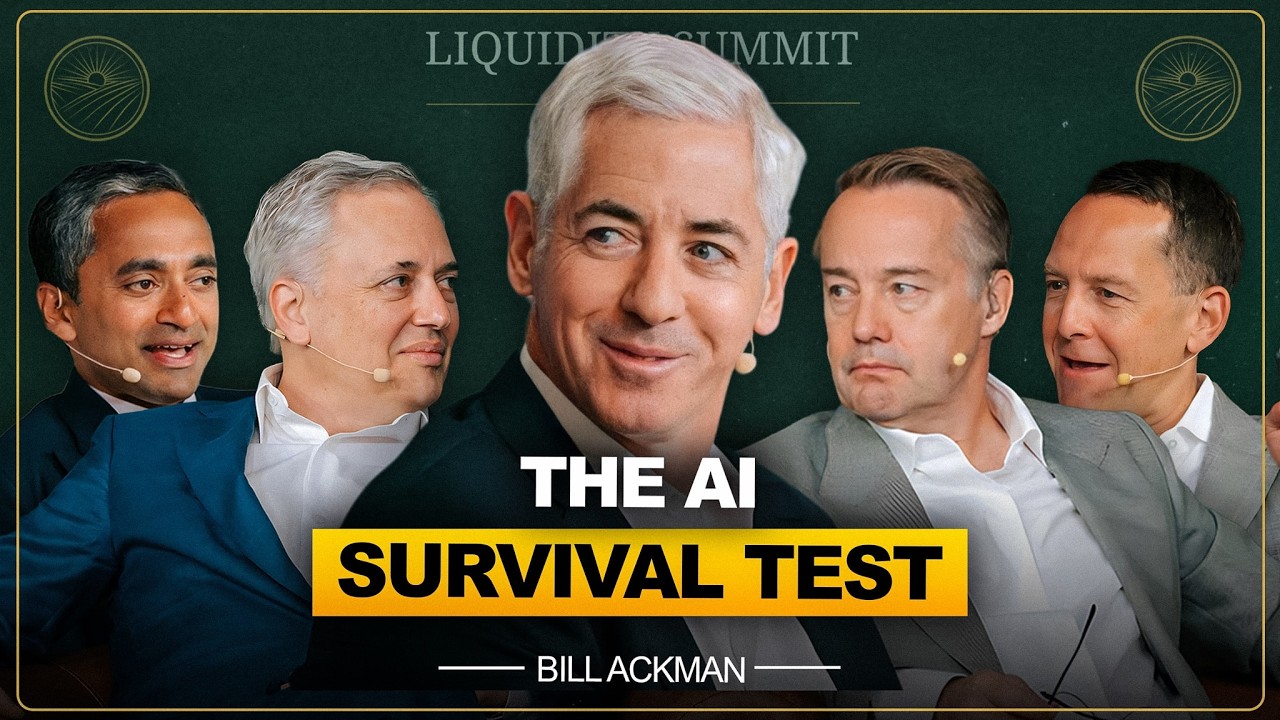
Ackman Shifts Howard Hughes to Insurance to Build Next Berkshire
All-In Podcast
Pershing Square is pivoting away from traditional real estate reinvestment at Howard Hughes to accumulate premium float and invest surplus equity into compounding common stocks.
## Background
Published on June 3, 2026, by the All-In Podcast on YouTube, this episode features legendary activist investor Bill Ackman joining the hosts to discuss his evolving investment philosophy. The conversation covers the impact of AI on portfolios, predicting market moves, owning founder-led companies, and his vision for building the next Berkshire Hathaway.
## TL;DR
Pershing Square CEO Bill Ackman joins the All-In Podcast to discuss his transition from a short-term activist to a long-term compounder focused on business quality. He shares his views on the disruptive threats and massive opportunities of the AI era, warning of a 'SaaS apocalypse' while identifying undervalued tech giants. Ackman also details his ambitious plan to transform the Howard Hughes Corporation into an insurance-backed compounding machine modeled after Berkshire Hathaway. Throughout the discussion, he reflects on the power of founder-led companies, his viral market calls, and his unfiltered presence on social media.
## Atmosphere & style
The episode has a high-energy, intellectual, and conversational atmosphere, blending sophisticated financial theory with lighthearted banter. Ackman is candid, reflective, and highly confident, laughing off his 'most verbose' reputation while passionately defending his public market calls. The dynamic between Ackman and the hosts is warm and collaborative, capturing the fast-paced, insider feel of a high-stakes investment summit.
## Key takeaways
- [00:00](https://www.youtube.com/watch?v=_TJFqEhxQg4&t=0s) Ackman's investment philosophy has evolved from rapid, aggressive activism to focusing on long-term, durable, and non-disruptable business growth.
- [00:00](https://www.youtube.com/watch?v=_TJFqEhxQg4&t=0s) In the early days, Pershing Square had to aggressively force its way into corporate boardrooms, whereas today, S&P 500 CEOs openly welcome their involvement.
- [04:41](https://www.youtube.com/watch?v=_TJFqEhxQg4&t=281s) The threat of rapid AI disruption has made existing businesses highly vulnerable, creating what Ackman views as a potential 'SaaS apocalypse' for niche software companies.
- [04:41](https://www.youtube.com/watch?v=_TJFqEhxQg4&t=281s) Short-term capital rushing to AI hardware has left durable, high-quality platforms like Microsoft, Meta, and Amazon undervalued relative to their long-term cash generation.
- [07:37](https://www.youtube.com/watch?v=_TJFqEhxQg4&t=457s) Ackman views valuation as a 'tether' or rubber band that inevitably snaps back when stretched too far in either direction.
- [10:41](https://www.youtube.com/watch?v=_TJFqEhxQg4&t=641s) Late-stage private companies like SpaceX must be underwritten like venture capital, where competitive advantages and execution speed are critical in the AI era.
- [14:31](https://www.youtube.com/watch?v=_TJFqEhxQg4&t=871s) Despite massive hype, enterprise AI adoption is still in its infancy, with a McKinsey study indicating that 95% of enterprise AI initiatives fail.
- [15:54](https://www.youtube.com/watch?v=_TJFqEhxQg4&t=954s) Founder-led companies possess the boardroom authority and long-term alignment necessary to make bold, existential decisions that professional CEOs typically avoid.
- [18:50](https://www.youtube.com/watch?v=_TJFqEhxQg4&t=1130s) Ackman is applying the Berkshire Hathaway playbook to the Howard Hughes Corporation, aiming to turn its real estate cash flows into an insurance compounding machine.
- [24:40](https://www.youtube.com/watch?v=_TJFqEhxQg4&t=1480s) Modern market dynamics allow stock valuations to detach from fundamentals based entirely on 'vibes' and social media communities, which companies can leverage to lower their cost of capital.
- [28:33](https://www.youtube.com/watch?v=_TJFqEhxQg4&t=1713s) Ackman embraces his unfiltered, long-form presence on X (formerly Twitter), preferring to post directly to his 2.2 million followers without extensive legal or PR editing.
## Detailed walkthrough
### [00:00](https://www.youtube.com/watch?v=_TJFqEhxQg4&t=0s) The Evolution of Bill Ackman's Investment Philosophy
The segment opens with a brief, high-energy montage introducing Pershing Square CEO and founder Bill Ackman as "one of the most provocative" and "legendary activist" investors in the country. The hosts share some lighthearted banter about OpenAI's CFO, Sarah Friar, who had spoken earlier. Ackman jokes that he was so impressed by her that he thought "she should be CEO of OpenAI," while co-host Jason Calacanis quips that Sam Altman should instead be the chair.
Turning to the core discussion, the hosts ask Ackman about the apparent evolution of his investment model. Historically known as a loud, aggressive activist who entered and exited positions rapidly, Ackman has recently pivoted toward discussing permanent, long-term holdings. Ackman confirms this shift, explaining that his philosophy has evolved to appreciate "business quality" above all else—specifically, "long-term, durable, protected, non-disruptable growth." He notes that when an investor is smaller and more liquid, they do not have to think as long-term, but managing a massive, concentrated fund forces a different perspective.
While he claims he is still "as activist as I've ever been," Ackman points out that much of his activism has migrated to Twitter (now X) rather than playing out exclusively in corporate boardrooms. He shares a colorful anecdote from the early days of Pershing Square when they were completely unknown. They bought a 10% stake in Wendy's International, which owned the Canadian coffee and donut chain Tim Hortons. Because Tim Hortons was worth more than the entirety of Wendy's, Ackman had a simple thesis: "buy Wendy's, spin off Tim Hortons, double our money." However, the Wendy's CEO repeatedly refused to return his calls. To force the issue, Ackman called a friend at Blackstone, got Steve Schwarzman to write a public fairness opinion on the spin-off's value, and filed it publicly. Six weeks later, Wendy's spun off Tim Hortons.
- **The Wendy's Exit:** The Wendy's CEO eventually called Ackman back to thank him. The CEO had been fired but received a massive exit package, leaving him very happy with the outcome.
- **Access and Reputation:** In the early days, Pershing Square had to "bang down the door," go on CNBC, and present at conferences to get attention. Today, S&P 500 CEOs welcome them openly, sometimes even tweeting their support when Pershing Square buys a stake.
- **The Role of a Large Shareholder:** Ackman argues that the best investments require no board seats or intervention. However, in public markets dominated by short-term analysts, a large, supportive shareholder on the board acts as a crucial buffer, allowing management to make multi-year or decade-long decisions even if they hurt short-term quarterly earnings.
---
### [04:41](https://www.youtube.com/watch?v=_TJFqEhxQg4&t=281s) Underwriting Business Quality in the AI Era
The conversation shifts to how Ackman evaluates the rapidly growing AI landscape. He notes that Pershing Square is heavily exposed to the "AI complex" through its large holdings in tech giants like Microsoft, Meta, and Amazon. In today's market, Ackman asserts, "either directly or indirectly you're invested in AI... or it's a threat."
For a long-term, concentrated investor, the single hardest task is determining the risk of disruption. Ackman observes that the threat of "two guys, two women from Stanford in a garage" disrupting an incumbent has risen dramatically. We are living in the greatest era in history to build a business due to unlimited access to compute, capital, and talent, which simultaneously makes existing businesses highly vulnerable.
When asked if he runs toward the chaos of new AI startups or seeks refuge in durable, AI-defensible businesses, Ackman explains his market philosophy. He notes that short-term capital always rushes to the "new new thing"—currently chips, semiconductors, and energy—which often leaves incredibly high-quality, established companies behind. He draws a parallel to the dot-com bubble of 2000, recalling how investors got so swept up in internet startups that Berkshire Hathaway traded at its lowest historical valuation because people dismissed it as "old stuff." Ackman believes a similar phenomenon is happening today, leaving massive platforms like Amazon, Meta, and Microsoft undervalued relative to their actual durability.
- **SaaS Vulnerability:** Ackman is cautious about the "SaaS apocalypse." He worries more about companies like Salesforce than platforms like Microsoft.
- **Niche Software Risk:** Niche software companies charging high annual fees (e.g., $30,000/year) are highly vulnerable to AI disruption. In contrast, Microsoft's platform—where the average customer pays a modest fee of around $50 per seat—is far more secure and valuable.
---
### [07:37](https://www.youtube.com/watch?v=_TJFqEhxQg4&t=457s) Market Conviction, COVID-19, and Valuation "Tethers"
The hosts bring up Ackman's highly publicized, viral market calls. They highlight his emotional March 2020 CNBC appearance during the onset of COVID-19, where he warned of impending economic doom right before the market bottomed, and his subsequent highly profitable pivot to the long side. They also note his recent public declarations that the market was poised to rip higher. They ask where this intense, public conviction comes from, especially when it leaves him highly exposed to being proven wrong.
Ackman laughs, recalling that his high school yearbook epithet was "most verbose," accompanied by a friend's quote: "a closed mouth gathers no foot." He explains that he has always had an innate desire to speak the truth and share ideas that need to be discussed.
Recalling the March 2020 incident, Ackman explains that his primary concern was for the country. He believed the U.S. needed a decisive, two-week shutdown to let the virus cool down and prevent hospitals from being overwhelmed. When President Donald Trump did not immediately order a shutdown, Ackman went on television specifically to reach the administration. His message was that a temporary shutdown would allow the country to recover, and because stocks were incredibly cheap, investors would make a fortune on the rebound. Ackman describes valuation as a "tether" or a rubber band: when it stretches too far in either direction, it inevitably snaps back. Recently, he called the market up because high-quality companies had simply become "crazy cheap" relative to the present value of the cash they will generate over their lifetimes.
---
### [10:41](https://www.youtube.com/watch?v=_TJFqEhxQg4&t=641s) Underwriting Late-Stage Venture: SpaceX, OpenAI, and Portfolio AI Adoption
The hosts ask Ackman how he evaluates highly hyped, late-stage private companies like SpaceX, OpenAI, Anthropic, and Palantir, which often trade at astronomical multiples of 50x to 150x revenue. They point out that high-net-worth individuals frequently clamor to get into these companies through double-fee-loaded Special Purpose Vehicles (SPVs), sometimes risking getting wiped off the cap tables.
Ackman explains that a company like SpaceX must be underwritten like a venture capital investment, relying on the classic business school framework of "people, opportunity, context, and deal." On "people" and "opportunity," Ackman calls SpaceX a "one of one" company. The "context" is highly favorable, noting that competitor Blue Origin is "way behind." The "deal" (valuation) is the complicated part. To justify a valuation of $750 billion or $1 trillion, an investor must project five years out and model the trajectory of Starlink and SpaceX's near-monopoly on low-cost space launches. Ackman notes that time has become incredibly valuable in the AI era; losing even a couple of months due to regulatory delays can ruin a company's competitive edge.
- **Personal Investments:** Ackman reveals that he is personally invested in Elon Musk's X and xAI through an SPV, noting that investor Ron Baron originally convinced him to look at SpaceX.
- **Late-Stage Venture Dynamics:** Ackman views Anthropic, OpenAI, and Palantir as late-stage venture investments (Series D or E) rather than seed deals. They have proven they can generate massive revenue, but their capital commitments remain incredibly high.
- **OpenAI's Capital Demands:** Ackman praises OpenAI CFO Sarah Friar's clarity on capital allocation but notes that OpenAI's massive capital expenditures relative to its current revenues make its "degree of difficulty" very high.
- **AI in the Fortune 500:** Based on his conversations with Fortune 500 CEOs, Ackman reports that AI is the number-one priority and threat on every executive's radar. Every CEO in America is actively trying to figure out how to deploy AI, find internal champions, or recruit outside talent to avoid being left behind.
[14:31](https://www.youtube.com/watch?v=_TJFqEhxQg4&t=871s) The AI Threat and Opportunity in the Enterprise
Artificial intelligence is simultaneously viewed as a massive opportunity and a looming threat by corporate boards. For any CEO today, the very first question at every board meeting is bound to be about how the company is addressing both sides of the AI coin. However, despite this being top of mind, actual early success in deploying AI at scale remains elusive.
A McKinsey study indicates that 95% of enterprise AI initiatives fail, a statistic that aligns with Chamath Palihapitiya's observation that 80% to 90% of enterprises simply do not know how to deploy the technology. This gap between the promise of AI and its actual return on investment (ROI) has given rise to a highly sought-after role in Silicon Valley: the "forward deployed engineer," which is essentially an IT consultant tasked with bridging this execution gap. Aside from basic back-office compliance and legal use cases—such as those implemented at Pershing Square—large-scale, highly effective enterprise AI adoption is still in its infancy.
- **McKinsey Study:** 95% of enterprise AI initiatives fail.
- **Pershing Square AI Use Case:** Primarily utilized in legal and compliance back-office functions.
---
[15:54](https://www.youtube.com/watch?v=_TJFqEhxQg4&t=954s) Founder-Led Companies vs. Professional CEOs
There is a stark contrast in how founder-led companies navigate rapidly changing technological and market environments compared to those run by professional CEOs. In the venture capital underwriting model, investors back a founder's capacity to lead and radically redirect an organization. This freedom to make bold, existential decisions is often absent in non-founder-led companies, especially during industry disruptions like the "SaaS apocalypse."
The average tenure of an S&P 500 CEO is only about three to three and a half years. These hired executives are typically focused on short-term compensation and lack a significant economic stake in the business, incentivizing them to avoid mistakes that could get them fired. In contrast, a founder's entire life, reputation, and wealth are tied to the company. Founders possess the boardroom authority—either through super-voting shares or massive economic stakes—to make challenging, long-term calls. This dynamic is exemplified by Mark Zuckerberg's highly criticized, yet ultimately brilliant, early acquisitions of Instagram and WhatsApp.
- **S&P 500 CEO Tenure:** Approximately 3 to 3.5 years on average.
- **Boardroom Influence:** Pershing Square often acts as the largest or second-largest non-index shareholder when joining a board, granting them a disproportionate voice.
---
[18:04](https://www.youtube.com/watch?v=_TJFqEhxQg4&t=1084s) Ben Graham's Value Investing vs. Modern Realities
While Benjamin Graham remains a foundational figure for teaching investors to view a stock certificate as an actual interest in a business rather than a mere piece of paper, his specific methodology was product of a different era. Graham primarily focused on liquidations, buying companies that were trading below the cash on their balance sheets. In those days, before the SEC's digital Edgar system, finding these opportunities required physically traveling to a company's headquarters to retrieve a 10-K filing.
Despite his reputation for deep value liquidations, Graham actually made the vast majority of his wealth through a long-term compounder: GEICO. This shift from buying cheap, dying assets to owning high-quality, compounding businesses laid the groundwork for modern investment strategies.
---
[18:50](https://www.youtube.com/watch?v=_TJFqEhxQg4&t=1130s) Building Berkshire Hathaway 2.0 with Howard Hughes
The financial history of Berkshire Hathaway reveals that Warren Buffett created the vast majority of his wealth not through picking random stocks, but through the ownership of insurance operations. An insurance business has two jobs: writing policies (collecting premiums in exchange for future claims) and investing the upfront cash (the float). While most insurance companies focus strictly on the liability side, Buffett focused heavily on the asset side.
Historically, top-tier investment talent goes to hedge funds or major asset managers like Fidelity and Wellington, rather than traditional insurance companies. Buffett, owning a massive stake in Berkshire, bypassed this talent bottleneck. While Buffett started with a failing textile company and pivoted to insurance, a similar playbook is being applied to the Howard Hughes Corporation.
Howard Hughes is a unique real estate company that owns master-planned communities—essentially small cities—such as Summerlin near Las Vegas, spanning 26,000 acres. Because its development timeline is measured in decades rather than quarters, Wall Street has historically ignored it, allowing it to trade at a steep discount to its liquidation value. The strategy is to stop reinvesting all of the company's cash flow back into real estate, and instead redirect that cash into building an insurance compounding machine.
- **Summerlin Asset:** A master-planned city spanning 26,000 acres of commercial and residential land near Las Vegas.
- **Howard Hughes Market Cap:** Approximately $4 billion, trading at a discount to its liquidation value at $63 a share.
- **Investment Strategy:** 100% of the insurance float will be kept in short-term Treasuries (no risk to policyholder funds), while 100% of the surplus equity will be invested in common stocks.
---
[23:03](https://www.youtube.com/watch?v=_TJFqEhxQg4&t=1383s) The General Growth Restructuring and Cost of Capital
The path to acquiring Howard Hughes began with one of the most successful and contrarian equity investments ever made: the restructuring of General Growth Properties. Pershing Square bought into the bankrupt company at a $200 million market cap while it was burdened with $27 billion in debt. Believing the assets were worth more than the liabilities, they executed a historic Chapter 11 restructuring where the equity holders preserved their stakes. Two years later, the stock surged from $0.34 to $34. As part of this restructuring, Howard Hughes was spun off as a collection of non-core assets that analysts disliked.
For fifteen years, Howard Hughes struggled to unlock value because the market penalizes real estate developers with a high cost of capital. In contrast, companies like SpaceX and Tesla enjoy an incredibly low cost of capital because of the "army of believers" built by Elon Musk. By transforming Howard Hughes from a pure real estate play into an insurance-backed compounding vehicle, the business can achieve much higher returns on capital.
- **General Growth Restructuring:** Stock rose from $0.34 to $34.00 post-bankruptcy.
- **Pershing Square GGP Stake:** Acquired 27% of the company at a $200 million valuation.
---
[24:40](https://www.youtube.com/watch?v=_TJFqEhxQg4&t=1480s) Social Media, "Vibes," and Market Dynamics
The mechanics of modern markets have shifted due to the rise of social media, retail armies, and high-profile personalities. While individual follower growth on Twitter does not fundamentally alter market structures, figures like Ryan Cohen of GameStop represent a genuine shift. Today, a stock can trade at a valuation completely detached from its underlying fundamental value, driven entirely by "vibes" and the ability to rally online communities.
Intuitively, a rising stock price actually increases the intrinsic value of a company. A higher stock price lowers the cost of capital, providing the financial flexibility to issue stock, raise cheap capital, and acquire other businesses. Elon Musk masterfully leveraged this feedback loop to build Tesla, utilizing an army of passionate followers to fund and realize his vision.
---
[26:24](https://www.youtube.com/watch?v=_TJFqEhxQg4&t=1584s) Three Ways to Invest with Pershing Square
For investors looking to align themselves with Bill Ackman, there are three distinct avenues, each serving a different strategic purpose:
1. **Pershing Square (The Management Company):** This entity receives fees from three permanent capital vehicles. It is a highly lucrative, zero-CapEx royalty on the compounding of those underlying assets. Over 22 years, a dollar invested in Pershing Square grew 27 to 28 times net of fees. If the firm continues to compound at historical rates, assets under management could grow from $25 billion to nearly $1 trillion over the next 22 years without needing to add overhead or hire additional staff.
2. **PSUS (Pershing Square USA):** A public vehicle representing a portfolio of the firm's best investment ideas, which has historically traded at an 18% discount to cash and charges a flat 2% fee with no incentive fee.
3. **Howard Hughes:** For those who want to bet on the creation of the next Berkshire Hathaway-style compounding machine.
- **Historical Performance:** A dollar invested in Pershing Square 22 years ago grew 27x to 28x net of all fees (and would have been mid-40s under the public vehicle's fee structure).
- **AUM Projection:** Potential to scale from $25 billion to $1 trillion in 22 years through compounding.
[28:33](https://www.youtube.com/watch?v=_TJFqEhxQg4&t=1713s) The Art of the Long Tweet and the Impulse to Hit Send
The conversation turns to Bill Ackman's famously long-form posts on X (formerly Twitter), which have become so legendary they inspired a parody meme featuring an "extended iPhone" that is a foot tall. Ackman laughs, noting that the giant phone was actually his Halloween costume. The hosts tease him, suggesting that in the past, he would have written something shorter, but simply "didn't have the time" to edit it down. Ackman admits that he generally does not let other people read or edit his posts before they go live.
There are rare exceptions to this rule, however. For his tweet regarding Neri Oxman and the MIT plagiarism allegations (referred to as the "Ronda tweet"), which carried significant legal implications, Ackman did consult his communications person and a friend who is a lawyer. Even then, his patience was thin: "I only gave him a few minutes cuz I was so excited." Ackman explains that once he writes something he really likes, his instinct is to "damn the torpedoes" and just push it out. The hosts relate to this frantic energy, noting that they also experience that sudden, impatient "fuck it" moment right before hitting send. Ackman marvels at the sheer, modern power of the platform, noting how incredible it is to "share your view and push a button and reach 2.2 million people." To close out the session, Ackman suggests taking a live photo on stage to post immediately to his followers.
- Ackman's long-form tweets became so famous they inspired a Halloween costume featuring a foot-tall, elongated iPhone.
- He rarely uses editors or lawyers, though he gave a lawyer friend a few minutes to review his high-stakes tweet regarding the MIT plagiarism controversy.
- Ackman boasts a direct reach of 2.2 million followers on X, highlighting the unprecedented power of instant, unfiltered mass communication.
## Notable quotes
> [00:00](https://www.youtube.com/watch?v=_TJFqEhxQg4&t=0s) buy Wendy's, spin off Tim Hortons, double our money. — Bill Ackman
> [04:41](https://www.youtube.com/watch?v=_TJFqEhxQg4&t=281s) either directly or indirectly you're invested in AI... or it's a threat. — Bill Ackman
> [07:37](https://www.youtube.com/watch?v=_TJFqEhxQg4&t=457s) a closed mouth gathers no foot. — Bill Ackman
> [10:41](https://www.youtube.com/watch?v=_TJFqEhxQg4&t=641s) people, opportunity, context, and deal. — Bill Ackman
> [23:03](https://www.youtube.com/watch?v=_TJFqEhxQg4&t=1383s) army of believers — Bill Ackman
> [28:33](https://www.youtube.com/watch?v=_TJFqEhxQg4&t=1713s) I only gave him a few minutes cuz I was so excited. — Bill Ackman
> [28:33](https://www.youtube.com/watch?v=_TJFqEhxQg4&t=1713s) damn the torpedoes — Bill Ackman
> [28:33](https://www.youtube.com/watch?v=_TJFqEhxQg4&t=1713s) share your view and push a button and reach 2.2 million people. — Bill Ackman
## Mentioned
Bill Ackman, Sarah Friar, Sam Altman, OpenAI, Pershing Square, Wendy's International, Tim Hortons, Blackstone, Steve Schwarzman, Microsoft, Meta, Amazon, Salesforce, Donald Trump, SpaceX, Anthropic, Palantir, Ron Baron, Elon Musk, xAI, McKinsey, Chamath Palihapitiya, Mark Zuckerberg, Instagram, WhatsApp, Benjamin Graham, GEICO, Warren Buffett, Berkshire Hathaway, Fidelity, Wellington, Howard Hughes Corporation, General Growth Properties, Tesla, Ryan Cohen, GameStop, PSUS, Neri Oxman, MIT
阿克曼推动 Howard Hughes 转型保险业,意在打造下一个伯克希尔
Pershing Square 正在转变 Howard Hughes 传统的房地产再投资策略,转而积累保费浮存金,并将富余资金投资于具备复利潜力的普通股。
Pershing Square 首席执行官 Bill Ackman 做客 All-In Podcast,讨论了他从短期激进维权投资者向专注于商业质量的长期复利投资者的转变。他分享了对 AI 时代颠覆性威胁与巨大机遇的看法,在警告潜在“SaaS 大崩盘”的同时指出了被低估的科技巨头。Ackman 还详细阐述了他雄心勃勃的计划,即以 Berkshire Hathaway 为蓝本,将 Howard Hughes 公司打造成依托保险业务的复利投资平台。在整场讨论中,他还探讨了创始人主导型公司的力量、他引发广泛热议的市场判断,以及他在社交媒体上的直率发声。
Ackman 的投资理念已从迅速、激进的维权主义,转变为专注于长期、持久且不易被颠覆的业务增长。 (0:00)
早期,Pershing Square 必须强行介入企业董事会,而如今,标普 500 指数成分公司的首席执行官们已公开欢迎他们的参与。 (0:00)
AI 快速颠覆的威胁使现有业务变得高度脆弱,在 Ackman 看来,这可能会给细分市场软件公司带来一场潜在的“SaaS 大崩盘”。 (4:41)
短期资金涌入 AI 硬件领域,导致 Microsoft、Meta 和 Amazon 等持久、优质的平台相对于其长期现金生成能力处于被低估状态。 (4:41)
Ackman 将估值视为一条“系绳”或橡皮筋,一旦朝任一方向拉得过长,终究会弹回。 (7:37)
Reading summary
Pershing Square founder Bill Ackman argues that navigating contemporary markets requires prioritizing durable, AI-defensible platforms over vulnerable point solutions while leveraging long-term corporate governance structures. Reflecting on his firm's shift from short-term agitator to permanent capital allocator, Ackman outlines strategies spanning large-cap technology, late-stage venture underwriting, and structural corporate reinvention.
Evolution Toward Business Quality and Governance (0:00)
Ackman has transitioned Pershing Square from rapid-turnaround activist campaigns to long-term ownership of high-quality, durable businesses. In the firm's early days, tactics required public campaigns and outside fairness opinions to force corporate actions, such as acquiring a 10% stake in Wendy's International to drive the spin-off of Tim Hortons. Today, managing concentrated capital has led Ackman to value non-disruptable growth that requires minimal board intervention. When Pershing Square does take board seats, it positions itself as a buffer against quarterly market pressures, granting executives room to execute multi-year strategies.
Underwriting AI Defensibility and Disruption Risks (4:41)
Ackman assesses the market as split between beneficiaries of artificial intelligence and businesses vulnerable to disruption. Pershing Square maintains exposure to the AI sector through major holdings in Microsoft, Meta, and Amazon, which Ackman views as undervalued relative to their durability, drawing a comparison to Berkshire Hathaway's depressed valuation during the 2000 dot-com bubble. In contrast, he cautions against niche software-as-a-service (SaaS) providers charging high annual fees—such as Salesforce—which face acute displacement risks from low-cost startup alternatives, whereas broad platforms charging modest per-seat fees remain well-defended.
Founder Governance vs. Enterprise AI Friction (14:31)
Enterprise AI adoption faces steep execution hurdles, highlighted by a cited McKinsey study indicating that 95% of enterprise AI initiatives fail. Chamath Palihapitiya similarly observed that 80% to 90% of enterprises lack the expertise to deploy AI effectively, creating high demand for forward-deployed engineers. Ackman links strategic agility in this environment to corporate leadership models, noting that typical S&P 500 CEOs average tenures of only 3 to 3.5 years and tend to avoid career-threatening operational risks. Conversely, founder-led firms backed by substantial equity stakes or super-voting power—such as Meta during its acquisitions of Instagram and WhatsApp—possess the autonomy required to navigate technical disruption.
Evaluating Late-Stage Capital and Platform Assets (10:41)
In late-stage private markets, Ackman views entities like OpenAI, Anthropic, and Palantir as mature venture bets facing substantial ongoing capital expenditure requirements relative to current revenues. For companies such as SpaceX, where Ackman holds personal exposure through special purpose vehicles alongside stakes in X and xAI, underwriting hinges on long-term market dominance in low-cost orbital launch and Starlink trajectory. Ackman warns that maintaining competitive advantages requires rapid execution, as even minor regulatory delays can impair underwriting assumptions at elevated private valuations.
Replicating Compounding Holding Models at Howard Hughes (18:50)
Drawing inspiration from Berkshire Hathaway's use of insurance float, Ackman is pursuing a structural overhaul of Howard Hughes Corporation. Originating from Pershing Square's restructuring of General Growth Properties—where the firm purchased a 27% stake out of bankruptcy at a $200 million valuation before the stock advanced from $0.34 to $34.00—Howard Hughes manages major assets, including the 26,000-acre Summerlin master-planned community. Trading at approximately a $4 billion market capitalization ($63 per share), the entity plans to divert capital from pure real estate development toward building an insurance platform, keeping 100% of insurance float in short-term Treasuries while deploying surplus equity into common stocks.
Ackman identifies modern market shifts driven by social media distribution and direct retail communication, which can lower a firm's cost of capital independently of near-term fundamentals. However, the operational viability of transforming asset-heavy enterprises like Howard Hughes into Berkshire-style compounding engines, alongside the broader enterprise struggle to achieve measurable returns on massive AI capital investments, remains an ongoing market test.
[0:00] Bill Ackman: buy Wendy's, spin off Tim Hortons, double our money.
[4:41] Bill Ackman: either directly or indirectly you're invested in AI... or it's a threat.
[7:37] Bill Ackman: a closed mouth gathers no foot.
[10:41] Bill Ackman: people, opportunity, context, and deal.
[14:31] Chamath Palihapitiya: forward deployed engineer
[23:03] Bill Ackman: army of believers
[28:33] Bill Ackman: I only gave him a few minutes cuz I was so excited.
[28:33] Bill Ackman: damn the torpedoes
[28:33] Bill Ackman: share your view and push a button and reach 2.2 million people.
Original transcript
[0:00] One of the most provocative and [music]
[0:01] interesting investors in the country.
[0:04] >> A legendary activist investor.
[0:05] >> Pershing Square CEO and founder Bill
[0:08] Ackman.
[0:10] >> Taking [music] a short position and
[0:11] going public with it is a pretty serious
[0:13] business.
[0:14] Interestingly, [music] some of the best
[0:15] businesses in the world are trading at
[0:16] the lowest multiples.
[0:18] >> We're kind of the rebirth of the
[0:19] closed-end [music] investment company
[0:21] universe.
[0:22] >> What did you think of Zara, the CEO of
[0:24] OpenAI?
[0:25] >> I'm sorry.
[0:26] >> CFO.
[0:27] Felt like the CEO.
[0:28] >> Yeah, I I was Stop with that stuff.
[0:31] >> Uh actually, I was super impressed.
[0:34] Uh made me a lot more bullish on OpenAI,
[0:36] and I thought
[0:36] >> Right?
[0:37] >> I thought she should be CEO of OpenAI.
[0:38] >> [laughter]
[0:39] >> That's what I thought.
[0:39] >> I think Sam should be I think Sam should
[0:41] be chair. I think he's much better.
[0:43] >> a question I wanted to ask her that we
[0:44] didn't get time, which was what's it
[0:45] like working with Sam?
[0:47] >> I mean, that could have been like the
[0:49] hours in the documentary.
[0:51] >> [laughter]
[0:52] >> I wanted to kick this off at So, thank
[0:54] you so much for being here. We've tried
[0:56] a number of times to get you to All-In,
[0:58] and it's great to to finally have you.
[1:00] You obviously are a legend doesn't need
[1:02] much of an introduction. Lately, in the
[1:05] the last number of call it years or
[1:06] months or quarters or what have you, it
[1:08] seems like your investment philosophy
[1:11] may be changing. Your model, where
[1:13] you've been activist and you've entered
[1:15] positions and exited positions, and
[1:16] lately you've talked a lot about more
[1:18] kind of permanent long-term holdings.
[1:20] Would love to hear a little bit about if
[1:21] that is actually a change and how your
[1:23] evolution in your investment model has
[1:26] kind of changed over over time.
[1:27] >> Uh sure. So, I would say the biggest
[1:29] change over time is an appreciation for
[1:31] the importance of I would call business
[1:33] quality. Long-term, durable, protected,
[1:37] non-disruptable growth, I would say.
[1:39] Early days, you're
[1:41] smaller, more liquid investor, you don't
[1:43] have to think as long-term. As you
[1:45] become a bigger, concentrated investor,
[1:48] uh
[1:49] >> [snorts]
[1:49] >> and over time you learn the importance
[1:51] of durable kind of growth. That's the
[1:52] most important factor.
[1:54] Uh I would say I'm as
[1:56] activist as I've ever been um but more
[1:59] of it's on Twitter than it than uh I
[2:02] would say
[2:03] in the corporate context. And the reason
[2:04] for that is when I started in uh
[2:07] Pershing Square
[2:08] no one sort of knew who we were.
[2:10] And so
[2:11] I actually one of our first investments
[2:13] was Wendy's International. Wendy's owned
[2:15] Tim Hortons, the Canadian coffee and
[2:17] donut chain, and the value of Tim
[2:18] Hortons was more than the entire value
[2:19] of Wendy's. We had this very simple
[2:21] idea: buy Wendy's, spin off Tim Hortons,
[2:24] double our money.
[2:25] And uh we bought 10% of the company and
[2:27] I called the CEO and he didn't return my
[2:29] call. And I called him again, he didn't
[2:31] return my call. I literally couldn't get
[2:32] a return phone call. That was the
[2:34] beginning. Uh so we actually I called a
[2:37] friend who worked at Blackstone and
[2:38] Steve Schwarzman agreed to write a
[2:39] fairness opinion on what Wendy's would
[2:41] be worth if we spun off Tim Hortons.
[2:43] We kind of mailed it in, filed it
[2:44] publicly, and 6 weeks later they spun
[2:46] off Tim Hortons.
[2:48] >> And then the CEO finally called me back
[2:50] and uh he thanked me uh and he had
[2:53] gotten fired uh
[2:55] and and uh but he thanked me cuz he had
[2:57] a huge exit package and
[2:58] >> [laughter]
[2:59] >> and
[2:59] and he was very happy. But so in the
[3:01] beginning we couldn't get a return phone
[3:03] call, so we had to and we were small, so
[3:05] we had to go to a conference and we had
[3:07] to, you know, do presentations and go on
[3:09] CNBC. What happens over time is you join
[3:11] boards of directors, you become known as
[3:13] an investor, you know, we're kind of a
[3:14] constructive
[3:16] shareholder. Um I know pretty much every
[3:18] CEO in the S&P 500 either directly or
[3:21] one person removed. And you know, maybe
[3:24] I age I've aged a bit um but you build
[3:27] kind of a reputation and today we buy a
[3:29] stake in a company
[3:30] sometimes they'll put out a tweet saying
[3:32] you know, we welcome Pershing Square as
[3:33] a shareholder, but they open the door
[3:34] for us. You know, in the beginning we
[3:36] had to bang down the door and today so
[3:38] we we get very deeply involved in our
[3:40] companies if it's needed. [snorts]
[3:41] Uh other companies we own, there's no
[3:43] nothing for us to do, just be the you
[3:45] know, just clap.
[3:46] >> Hm. So you are you are considered a
[3:48] value add investor.
[3:49] >> Yeah, but we only want to add value. I
[3:51] The conversation last night was kind of
[3:53] an interesting one. You know, the best
[3:54] investments are one where you don't need
[3:55] to join the board and do anything.
[3:57] >> Well, that may be in a startup, but in a
[3:59] mature business, it may be
[4:00] >> No, I think in in the public company
[4:02] context, one of the valuable things we
[4:04] can do, that you know, the problem of
[4:05] being a public company today is kind of
[4:07] the very short-term nature of markets,
[4:10] analysts, etc. And obviously to run a
[4:12] business, a business is a, you know, a
[4:15] good one is a forever thing. And you
[4:16] want to make decisions in the context of
[4:18] decades sometimes or certainly three,
[4:20] five years. And how can you do that when
[4:22] someone's asking about the tax rate in
[4:23] the second quarter?
[4:25] Um and having a big shareholder on the
[4:26] board, where you can kind of test ideas
[4:29] out with the big shareholder before you
[4:30] expose them to the public, where the big
[4:32] shareholder can say, "I'm supportive of
[4:34] this initiative even though it's going
[4:35] to hurt earnings in the next few
[4:36] quarters." is a helpful thing.
[4:38] >> I just want to connect this last
[4:39] conversation with Sarah to this.
[4:41] Um
[4:42] are you an investor in the AI complex?
[4:44] And
[4:46] how do you underwrite business model
[4:47] quality from what you see on the outside
[4:50] and in the entire complex?
[4:52] >> I mean, yes, effectively we're an
[4:53] investor. We're Actually today we own
[4:55] Microsoft, we own Meta, we own Amazon.
[4:58] Uh actually I think you're either
[5:00] directly or indirectly you're invested
[5:01] in AI. Yeah. Or it's a threat. So you
[5:03] have to you have to understand it.
[5:05] Um how do I think about AI in a business
[5:08] model context?
[5:08] >> model quality, yeah.
[5:09] >> Look, when you're a concentrated
[5:11] investor or an investor generally and
[5:13] you're long-term investor, the most
[5:14] important and most challenging thing to
[5:16] do is determine what's the risk of
[5:18] disruption. What's the risk of two guys,
[5:21] two women from Stanford in a garage, you
[5:23] know, coming up with something? That
[5:24] risk I think has gone up uh
[5:26] dramatically. This is the greatest era
[5:28] in history to to build a business,
[5:30] right? There's unlimited access to
[5:32] compute, you know, certainly for a
[5:34] startup, uh unlimited access to capital,
[5:37] uh and a lot of incredible talent, which
[5:40] means that the probability of your being
[5:42] disrupted has gone up enormously. So the
[5:44] hardest thing you have to do as an
[5:45] investor is
[5:47] understand, you know, and and that's
[5:49] really where we spend most of our time.
[5:50] >> in a moment like this then? Do you swing
[5:53] towards the chaos or do you reposition
[5:55] to things that are maybe more durable
[5:57] and defensible from AI where the
[5:59] destructibility is less?
[6:01] >> What's interesting about markets is
[6:02] people always
[6:04] bring their eye to the new new thing.
[6:06] Um and the new new thing is sort of
[6:07] chips and semiconductors and energy and
[6:10] that's where, you know,
[6:11] uh
[6:12] the shorter-term capital's going. What
[6:14] tends to happen is really high-quality
[6:17] things get left behind. Um and the same
[6:20] thing really happened, you know, I was I
[6:22] was there in 2000, you know, when the in
[6:24] the in the in that sort of bubble. This
[6:26] is, you know, this is different. I'm not
[6:27] saying this is
[6:28] um but there's some analogies and the
[6:30] analogies are people got excited about
[6:32] internet stocks and Berkshire Hathaway
[6:34] traded at the lowest valuation I think
[6:36] it ever traded at in its history as
[6:37] people said, "Okay, that's all old
[6:39] stuff." I think a similar thing is
[6:40] happening today in a in a sense to
[6:42] Amazon and Meta, Microsoft.
[6:45] >> Those are the ones that
[6:46] >> These are these are old-fashioned
[6:47] companies in kind of this, you know, the
[6:50] open AI
[6:50] >> So they're undervalued in your mind?
[6:52] >> Yes.
[6:53] >> What else is undervalued? What about the
[6:54] SaaS apocalypse though? Is it oversold
[6:56] at this point?
[6:57] >> Uh again, I think it's a careful
[6:59] analysis. I worry more about a
[7:00] Salesforce um than I do about your kind
[7:03] of
[7:04] um I think you got to do the work. I
[7:06] think it's one company at a time, but I
[7:07] think if, you know, if your software
[7:09] company today, you have to be as AI
[7:11] enabled as you can. You can I I think
[7:14] there have been sort of monopolistic
[7:17] type profit taking off of customers when
[7:20] someone had a kind of a niche software
[7:22] product that charging, you know, 30,000
[7:24] a year or something like this. I think
[7:26] those companies are really at risk. Uh
[7:28] you know, Microsoft when the average
[7:29] customer's paying, I don't know, 50
[7:31] bucks a seat or some small number, uh
[7:34] that platform's worth a lot more uh and
[7:36] is less of risk.
[7:37] >> I want to go back um
[7:39] to COVID because you had an incredibly
[7:43] viral moment
[7:45] where you were on CNBC at that moment
[7:48] and you pounded the table and you said
[7:50] this is what's going to happen and
[7:51] literally the market just ripped and you
[7:54] you were
[7:55] well first it went traded massively down
[7:57] you were right on that side of the trade
[7:58] and then you were on the right side of
[7:59] the trade when it ripped back up. And
[8:01] then I think it was maybe a month or two
[8:02] ago I think publicly you basically
[8:05] pounded the table and said this market's
[8:07] going way higher.
[8:08] Can you just put us in your head like
[8:11] where does that
[8:13] desire to be so
[8:16] active and
[8:18] you know you you it gives you so much
[8:20] room to be wrong but then when you're
[8:22] right it does add to the lore of Bill
[8:24] Ackman of which you have a lot so how do
[8:26] you balance that where does it come from
[8:27] like why in these moments do you just
[8:29] get so convicted that the that the
[8:31] conviction just has to spill out and
[8:33] then you're just so out there?
[8:34] >> So I've always been like
[8:36] my high school yearbook epithet was most
[8:39] verbose. Uh me too.
[8:42] >> [laughter]
[8:42] >> And that and actually my my friend
[8:44] actually lives around here
[8:46] uh
[8:46] he he has quote that he put next to my
[8:48] name in my yearbook says a closed mouth
[8:51] gathers no foot that was his.
[8:54] And so that's kind of what I've lived by
[8:55] I've always had this sort of desire to
[8:56] speak the truth about things and
[8:59] you know was just talking with Jake
[9:01] actually we had breakfast this morning.
[9:03] Uh and we're talking about my Rhonda
[9:05] post do you remember that one so you
[9:07] know there's just certain things that
[9:08] need to be shared and discussed. But
[9:10] with respect respect to markets I
[9:12] actually what happened was
[9:13] I was concerned about the country
[9:16] because I felt we needed to have a
[9:19] basically a two-week pause and this is
[9:21] March of
[9:23] or February I guess it was March
[9:25] of 2020 and I assumed we were going to
[9:27] just do a short-term shutdown let the
[9:29] virus cool down as hospitals were going
[9:31] to getting overwhelmed.
[9:33] And
[9:35] the president hadn't done that yet I was
[9:36] kind of surprised by this.
[9:38] And so that that was what inspired me to
[9:40] go on TV as a way to reach uh President
[9:43] Trump and say, "Look, we need to shut
[9:44] down the country just for 2 weeks, you
[9:46] know, like uh
[9:47] and I said, "Look, you do this, okay?
[9:49] The virus will blow over. Stocks are at
[9:52] an incredibly cheap valuation. If we
[9:53] handle this correctly, you're going to
[9:54] make a ton of money, and we're buying."
[9:57] You know, valuation is like a tether on
[9:59] the market, right? When it gets too
[10:00] high, it's like this rubber band that's
[10:02] stretching. And inevitably, it bounces
[10:04] back. But it works the other way as
[10:06] well. When stocks get too cheap, there's
[10:08] this, you know, the the rubber band's
[10:09] actually pulling valuations up.
[10:11] >> Right.
[10:12] >> And and so there are there are certain
[10:13] moments where it gets to that place.
[10:15] And sometimes, actually, if you call
[10:17] that out, it causes people to have kind
[10:19] of a psychological reset.
[10:20] >> What happened recently that caused you
[10:22] to call that out?
[10:23] >> Stocks just got crazy cheap. Just
[10:25] incredibly cheap of really high-quality
[10:27] companies.
[10:28] >> Right.
[10:28] >> What I don't know I
[10:29] I don't know why
[10:30] >> extremely cheap in fundamentals and
[10:32] >> Fundamentals based on, you know, what's
[10:34] the value of a financial asset's present
[10:36] value of the cash it generates over its
[10:37] life. On that basis, stocks are of
[10:39] really high-quality companies are really
[10:41] cheap.
[10:41] >> Is there any way to underwrite and you
[10:43] know, I don't want to pick on specific
[10:45] companies, but we have the three that
[10:46] are going public, and then you have like
[10:48] a Palantir, let's say.
[10:50] And these things have become in very
[10:52] popular in pop culture, in maxing
[10:55] on subreddits, on, you know, the
[10:58] public's consciousness, high-net-worth
[11:00] individuals wanting to buy into SPVs
[11:03] that are double
[11:05] loaded and then getting wiped off the
[11:06] cap tables.
[11:08] Is there any way to underwrite 100 times
[11:11] revenue, 50 times revenue, 150 times
[11:13] revenue in these companies, or are these
[11:15] just tremendously overvalued because of
[11:17] the demand side?
[11:19] >> I think you underwrite a SpaceX the way
[11:21] you underwrite a venture capital
[11:24] investment.
[11:24] >> Interesting. Explain that. Unpack it.
[11:26] >> So, everyone here invests in venture,
[11:28] right? You know, you bet on, you know,
[11:30] who's running it, right? The talent is
[11:32] enormous. Um it's people who they taught
[11:35] me
[11:36] I had a professor business school he
[11:37] said people opportunity context deal.
[11:40] So on people SpaceX
[11:42] >> One of one.
[11:43] >> Yeah. Opportunity one of one.
[11:46] Context you know, incredible and
[11:48] actually you know, feel bad for Blue
[11:50] Origin but not harmful to SpaceX the
[11:53] fact that you know, they're they're
[11:55] biggest
[11:55] >> way behind.
[11:56] >> Then you get to deal, okay? That's the
[11:59] more complicated question for SpaceX.
[12:01] Again, we don't know what the valuation
[12:02] is going to be but if it's a billion a
[12:03] trillion 750 billion dollars then you
[12:06] say, okay, well, let's think five years
[12:08] out. What does this company look like?
[12:10] You know, what is Starlink? What's the
[12:12] trajectory of Starlink?
[12:14] You know, SpaceX's you know, near
[12:16] monopoly in terms of low cost space
[12:18] launch that's going to become
[12:19] increasingly important and even Amazon
[12:21] is going to have to become an even
[12:22] bigger customer because they're not you
[12:24] know, Blue Origin's you know, and and
[12:26] time I would say has become increasingly
[12:29] valuable in the AI era, right? You you
[12:31] delay a model we were talking David and
[12:33] I were talking about the administration
[12:34] and and his kind of stepping in for the
[12:37] president not to sign that executive
[12:38] order to kind of slow us down.
[12:39] >> Allegedly.
[12:40] >> You lose a month, you lose a couple of
[12:42] months today and it means a lot. So I
[12:44] think the only question I have and I
[12:45] haven't done the math, I you know, I I
[12:47] actually invested in X
[12:49] I invested in XAI. I'm in an SPV.
[12:52] >> Ron Baron said, Bill you got to invest
[12:53] in SpaceX so
[12:55] >> so I'm I'm I'm in so now I have so
[12:57] obviously I'm rooting for kind of a good
[12:58] outcome.
[12:59] I just doesn't I haven't done the
[13:01] Yeah, you have to
[13:01] >> What about Anthropic, OpenAI and
[13:04] Palantir?
[13:04] >> Okay, I'm sorry.
[13:05] >> Uh Anthropic, OpenAI, Palantir also fall
[13:08] into this category. Do you underwrite
[13:10] those as venture investments as well and
[13:11] have you done the the work on those?
[13:13] >> They're venture investments that do what
[13:15] what's helpful is they're not seed or
[13:18] series A, right? They're
[13:20] you know, D or E but they're still like
[13:22] venture investments. These companies
[13:23] have proven they can generate a lot of
[13:25] revenues and actually I was just saying
[13:27] on Sarah, I thought she had a very, very
[13:29] thoughtful
[13:30] explanation on how they think about
[13:32] committing capital, right? And and
[13:34] that's the thing I haven't heard from on
[13:36] OpenAI, which is why if I were OpenAI,
[13:39] I'd be getting that message out because
[13:40] you know, from the outside,
[13:42] you're like, it's a pretty interesting
[13:43] business model. You got a company that's
[13:44] spending making capital commitments
[13:46] that's massively in excess of, you know,
[13:48] revenues. And how do you do that and
[13:49] get, you know, it's it's degree of
[13:51] difficulty, I would say, is hard.
[13:52] >> Your perch on the boards of, let's call
[13:55] it these more traditional Fortune 500
[13:57] type businesses and your conversations
[13:59] with those CEOs, how are they thinking
[14:02] about AI? Is it something that they're
[14:04] tipping into into with pilots? Are they
[14:07] doing transformation initiatives? Do
[14:09] they think this doesn't really apply to
[14:11] us? We'll deal with it later. What
[14:13] what's your sense of how they're
[14:15] adopting or embracing AI?
[14:16] >> say every CEO in America today is like,
[14:19] how do I use AI? How does it apply to my
[14:22] business? How is it a threat?
[14:24] They got to find an internal champion.
[14:25] They maybe have to recruit someone from
[14:27] the outside. I would say it's on the
[14:28] hierarchy of things they worry about,
[14:29] it's probably number one as both an
[14:31] opportunity and a threat. So, if you're
[14:33] not paying attention to it, you're
[14:35] you're I mean, your board is going to
[14:37] be, you know, asking you with first
[14:39] question every meeting about, you know,
[14:40] what how we dealing with the AI threat?
[14:42] How we dealing with the AI opportunity?
[14:44] So, it's absolutely top of mind.
[14:46] >> Are you seeing much early success? I
[14:48] mean,
[14:49] through your, you know, again, through
[14:50] your visibility into these companies. I
[14:52] mean, there's a lot of mixed signals
[14:54] that we get like McKinsey did a study
[14:56] and said that 95% of enterprise
[14:59] initiatives actually fail. Chamath,
[15:02] you've made this point around 80, 90,
[15:03] that a lot of these enterprises don't
[15:05] really know how to deploy AI. The the
[15:08] you know, the fanciest title in Silicon
[15:10] Valley these days is a forward deployed
[15:12] engineer, which is basically a like an
[15:15] IT consultant who can close the gap
[15:17] between the promise of AI and the ROI of
[15:20] it. And I think people are just trying
[15:23] to figure out like how do we how do we
[15:24] use this thing? I mean, have you seen
[15:26] much actual success? Is this the Is this
[15:29] the question right now? Is this how do
[15:30] we bridge this gap?
[15:31] >> So, I haven't seen much success
[15:34] other than I mean, I'll give you the
[15:36] Pershing Square
[15:37] story. You know, we're a tiny little
[15:38] company. How are we using AI today? The
[15:40] first use case is really on the legal
[15:42] side. Um [snorts]
[15:44] and
[15:44] you know, kind of almost almost you call
[15:46] it a compliance back office type you
[15:48] know, functionality. I think we're still
[15:50] super super early in terms of big
[15:52] companies using AI effectively.
[15:54] >> Can I ask or test a thesis with you? You
[15:57] know, the the venture underwriting model
[15:59] where you think about people, you're
[16:00] underwriting a founder and their
[16:02] capacity to lead and redirect the
[16:03] organization in a changing environment.
[16:07] In technology environment, market
[16:08] environment and whatnot. And we have
[16:11] seen repeatedly similar success at scale
[16:13] if the company is still founder led
[16:15] where the founder feels like they have
[16:16] the authority to make all the radical
[16:18] decisions needed to make sure that that
[16:20] company persists and changes as needed
[16:22] in a changing environment. Have you
[16:24] looked at founder led companies versus
[16:26] non-founder led companies where perhaps
[16:29] the founders really do have an inherent
[16:31] advantage in being able to navigate the
[16:33] changing environment and actually
[16:35] generate outsized returns over time? And
[16:37] I ask this particularly as it relates to
[16:39] the SaaS apocalypse and if you take a
[16:40] look at the companies that are founder
[16:42] led today versus not, if you're not
[16:44] founder led, you have an incentive to
[16:45] not make a mistake and get fired. If
[16:47] you're founder led, you don't give a
[16:48] Your job is to make sure the
[16:49] company
[16:50] >> Yeah, I think the answer is exactly what
[16:51] you said. I think the problem is that
[16:52] the average life of an S&P 500 CEO is
[16:55] probably
[16:56] I don't know, 4 years or 3 or 3 and 1/2
[16:58] years or something like this.
[16:59] And you're focused on, you know, kind of
[17:01] shorter term compensation. You don't
[17:03] generally don't have a big economic
[17:04] stake in the business. You're a founder,
[17:06] this is your entire life. It's your
[17:07] entire reputation. It's not like you're
[17:09] going to go get another job. You got to
[17:11] kind of make it work. And also when
[17:12] you're in the board room, you have the
[17:14] authority of either being a major
[17:15] voting, you know, voice, or or a um
[17:19] you've got a huge economic stake in the
[17:20] company. You know, when we join a board
[17:22] of a company, we're often the largest or
[17:24] the sec- the largest non-index fund type
[17:26] shareholder. That kind of gives us, you
[17:28] know, a little bit of a disproportionate
[17:29] voice in the boardroom. Imagine if you
[17:31] have that and you're CEO of the company,
[17:33] right? So, I think that does give you
[17:34] and and also if you've gotten to be a
[17:36] successful founder over time,
[17:38] uh guaranteed that you've made a number
[17:40] of very challenging call calls over time
[17:42] that turned out to be right, otherwise
[17:44] you wouldn't be there. And so, you look
[17:45] at Mark Zuckerberg, right, when he
[17:47] bought, I don't know, Instagram,
[17:48] everyone's like shocked at the price
[17:50] paid or WhatsApp, you know, they seemed
[17:51] like, you know, sort of outside the you
[17:53] know, the company only had, whatever, 19
[17:54] employees or something when he paid a
[17:56] billion something. Um but you make
[17:58] enough of those calls um
[18:00] and uh
[18:02] you can make the other challenging call.
[18:04] >> antithetical to a Ben Graham investing
[18:06] model? Like, you have to have a
[18:07] different set of skills as an investor
[18:09] to to identify this talent versus
[18:11] >> Yeah, so I mean, Ben Graham is a really
[18:13] important voice for investors in that he
[18:16] said, "Look, you got to think about a
[18:17] business
[18:18] a stock certificate is an interest in a
[18:20] business as opposed to just this piece
[18:21] of paper." That's probably one of his
[18:23] most important kind of aphorisms. But he
[18:25] was investing for the most part in
[18:27] liquidations. He was in that you know,
[18:29] in the days of Ben Graham where there
[18:31] weren't there's no Edgar system and nor
[18:34] to get a 10K filing, you had to go to
[18:35] the headquarters of the company. There
[18:37] were a lot of stocks trading at, you
[18:38] know, basically the cash on the balance
[18:39] sheet. And his business model was, you
[18:41] know, buying these things at stupidly
[18:42] cheap prices and eventually Um but Ben
[18:45] Graham made most of his money investing
[18:47] in I don't know, Geico or something. Uh
[18:50] you know, not
[18:50] >> Tell us a little bit about you know,
[18:53] there's a sort of activist and
[18:54] significant shareholder, but then
[18:56] there's Howard Hughes, and you've talked
[18:58] a little bit about Berkshire Hathaway
[19:00] 2.0 or just being inspired by that
[19:02] Chamath you were inspired by for a long
[19:04] time.
[19:04] >> Well, Bill Bill just took Pershing
[19:05] Square public.
[19:06] >> Yeah, but with with the Howard Hughes
[19:08] Corporation specifically, tell tell us
[19:10] about that effort cuz you're operating
[19:12] that business.
[19:13] >> There's a book uh I think it's called
[19:14] The Financial History of Berkshire
[19:15] Hathaway. That's for geeks. Um it
[19:18] basically this guy
[19:20] went back and read every 10-K
[19:23] whatever you actually went through the
[19:24] filings, looked at every deal that
[19:26] Buffett ever did, and you follow him
[19:28] over 60-year period of time. And the
[19:30] vast majority of the value he created at
[19:32] Berkshire was through it actually the
[19:34] ownership of insurance operation.
[19:36] And what's interesting about insurance
[19:38] is that
[19:40] you know, running an insurance company
[19:41] you have two jobs. One is you you know,
[19:43] write business, right? You take risk. Um
[19:46] you collect premiums in exchange for the
[19:47] obligation to pay future claims. And
[19:49] then you get that you get money up
[19:51] front, and your responsibility is to
[19:53] invest that money. Uh
[19:55] the vast majority of insurance companies
[19:56] focus only on the liability side of the
[19:58] balance sheet. Buffett was really the
[19:59] first to do focus on actually more on
[20:02] the asset side of the balance sheet than
[20:04] on the liability side. And over time
[20:06] on the liability side, if you if you
[20:07] manage the assets of an insurance
[20:09] company well and the liabilities well,
[20:11] you can build this enormously profitable
[20:13] compounding tax-efficient machine over
[20:15] time. And the question is why haven't
[20:17] other people done this?
[20:19] And the answer is if you're really good
[20:20] at investing, you go work for a hedge
[20:22] fund, you go work for Fidelity, you go
[20:25] work for Wellington,
[20:27] but you don't go work for an insurance
[20:28] company. So the insurance company's
[20:30] ability to recruit investment talent is
[20:32] very limited. Buffett owned half the
[20:34] company, he was really good at
[20:35] investing, which is why it worked. So
[20:37] what we're doing is we're you know,
[20:38] Buffett started with a crappy textile
[20:40] company. He effectively liquidated it
[20:42] over time, reinvested in insurance, and
[20:44] then invested the assets well.
[20:47] Howard Hughes is actually really
[20:48] interesting company, but it's a business
[20:49] that Wall Street has not cared about for
[20:51] a long period of time. We created it out
[20:53] of the bankruptcy of of General Growth,
[20:55] it was a spin-off of all the other
[20:57] assets.
[20:58] And it's a company that owns these small
[20:59] cities. So I bet a lot of people here
[21:02] have heard of Summerlin because a lot of
[21:04] the tech community has moved from
[21:05] California to Las Vegas,
[21:07] but we own a this small city, 26,000
[21:10] acres of land.
[21:13] We own all the commercial land, we own
[21:14] all the residential land, we sell lots
[21:16] of home builders, we build a downtown,
[21:18] we build buildings.
[21:19] It's a bit like the Irvine company. You
[21:22] know, Don Bren created probably a
[21:23] hundred billion dollars of personal
[21:25] wealth managing a small city. It's a
[21:26] super cool company, but the time frame
[21:29] is decades as opposed to quarters.
[21:31] So, Wall Street's never cared, it's
[21:33] always traded at a huge discount. So,
[21:34] Buffett bought into a textile business
[21:37] at a discount to liquidation value. At
[21:39] $63 a share, you're owning Howard Hughes
[21:41] at a discount to liquidation value. What
[21:43] we're doing is instead of reinvesting
[21:44] all the cash the business generates into
[21:46] real estate, we're going to reinvest all
[21:47] the cash into insurance.
[21:50] We're going to next within the next week
[21:51] or so.
[21:52] >> You're in the business of building this
[21:53] flywheel.
[21:54] >> We're going to build this into a
[21:55] compounding machine over the next 50
[21:57] years. It's something I've always wanted
[21:58] to do. We have the benefit of
[22:00] understanding both the insurance side of
[22:02] the business and we can manage the
[22:03] assets well. You can buy it at, you
[22:06] know, whatever, 60 cents on the dollar.
[22:08] >> How do you think about investing the
[22:09] assets of this insurance company? So,
[22:11] >> So, what Buffett did is he took 100% of
[22:12] the insurance float and put the money in
[22:15] short-term treasuries. So, he took no
[22:16] risk on kind of policy holder funds.
[22:19] He took 100% of the surplus of the
[22:20] insurer, the equity, and invested in
[22:22] common stocks. And that's what we're
[22:24] going to do.
[22:25] And I think we can build a really
[22:26] profitable insurance company. We're
[22:27] starting at a very small scale. The
[22:29] company's got like a four billion dollar
[22:31] market cap. And the goal is to build it
[22:32] into a trillion dollar thing over time.
[22:35] Compounding. The other thing Buffett did
[22:36] well is that he didn't issue any stock
[22:38] or not for a very long time. So, they,
[22:40] you know, he started with a million
[22:41] shares and today is effectively like a
[22:43] million and a half.
[22:43] >> this is the future for very talented
[22:46] managers like yourself versus the
[22:48] traditional long short fund or do you
[22:49] think they sit side by side?
[22:51] >> I think it's hard to do this cuz you
[22:53] need control of a public company and you
[22:55] have to be not in a get-rich-quick
[22:58] mindset. And there, if you're in the
[22:59] get-rich-quick, it's easy to go to
[23:01] Citadel and Millennium or one of these.
[23:03] >> Why does it have to be public?
[23:04] >> Why does it have to be public? It
[23:05] doesn't. It doesn't have to be public.
[23:07] >> Why did you choose to take it?
[23:09] >> Uh you know, we we got here by accident,
[23:12] right? So, the most successful equity
[23:14] investment we've ever made is we bought
[23:15] this company called General Growth. We
[23:16] bought the stock of a company going
[23:17] bankrupt. Sort of the most contrarian
[23:19] investment you can make. Stock [snorts]
[23:21] went from, you know, uh $20 market cap
[23:23] to $100 million, and we bought
[23:25] a basically a
[23:27] uh a third of the company or 27% of the
[23:29] company at uh $200 million market cap,
[23:32] and there was $27 billion of debt. And
[23:34] the bankruptcy emerged, and the strategy
[23:36] we said is, "Look, the assets are worth
[23:37] more than the liabilities. We're going
[23:38] to do the first uh
[23:40] restructuring where the equity gets to
[23:42] keep their investment in the company."
[23:43] Two years later, we emerged from Chapter
[23:45] 11. The stock went from $0.34 to $34.
[23:48] But, part of the restructuring was
[23:49] spinning off this thing called Howard
[23:51] Hughes. It was really all of the junk
[23:53] that didn't belong in the company that
[23:54] the analysts hated. Um and so, we we did
[23:57] it
[23:58] uh with sort of an inverted investment.
[24:01] And you know, 15 years later, we haven't
[24:03] really created much value with it. So,
[24:04] we said, "Look, we've got to you know,
[24:05] the market doesn't like this thing. The
[24:07] market A company has to earn a return in
[24:10] excess of its cost of capital in order
[24:11] for a stock to go up.
[24:13] And the you know, Elon's done an amazing
[24:14] job keeping the cost of capital of his
[24:16] companies really low. You know, if
[24:17] SpaceX goes public at a trillion $750
[24:19] billion,
[24:20] it'll probably be the lowest cost of
[24:21] capital
[24:22] equity capital transaction in the
[24:25] history of the world. The problem with
[24:26] this company, cuz it's real estate, cuz
[24:28] it's development, cuz it's land
[24:29] ownership, the market says, "The cost of
[24:31] capital is really high, and you can only
[24:32] earn a certain return on real estate."
[24:34] So, what we're doing is we're
[24:35] repurposing the real estate assets, and
[24:37] we're transforming the company into a
[24:39] much higher returning Well, the last few
[24:41] years, you've become incredibly famous.
[24:42] I mean, just to kind of put a fine point
[24:44] on the word. How does that
[24:46] change and influence the way that
[24:48] markets work? Because like, you know,
[24:50] your voice gets amplified now.
[24:52] You also have other places where other
[24:54] voices get heard, many people's whose
[24:56] names you don't even know. You go into
[24:57] Wall Street bets and every random Tom,
[24:59] Dick, and Harry with an opinion. Tell us
[25:01] the way the markets have changed with
[25:05] notoriety, fame, social media influence,
[25:08] not just yours, but in general.
[25:09] >> Yeah, I don't think markets have changed
[25:11] as a result of anything that's happened
[25:13] with me or follower growth on on
[25:15] Twitter. I think the Ryan Cohen guy, you
[25:18] know, the GameStop guy.
[25:20] >> Yeah.
[25:20] >> You know, that is a change in markets
[25:22] when
[25:23] um you know, a stock can trade at a
[25:25] valuation well above the its value
[25:29] simply on the personality and the
[25:31] ability to
[25:33] >> Vibes.
[25:34] >> Vibes.
[25:34] >> To gather up, you know, armies of
[25:37] followers. You know, the
[25:38] fascinating thing about liquidity and
[25:41] valuation is
[25:43] the higher a stock price goes
[25:46] and it's going to sound sort of
[25:48] intuitive, but it's not.
[25:50] The more valuable the company becomes.
[25:52] You know, there's [snorts] actually the
[25:53] increase in value the company increases
[25:55] the value of the company, right? Because
[25:57] it lowers the cost of capital, it gives
[25:59] you more flexibility, gives you the
[26:00] ability to issue stock, raise capital,
[26:04] acquire other businesses. And so, you
[26:06] know, getting back to the Elon example,
[26:09] uh it's really his I mean, I would say
[26:11] he's a better example of this. We've not
[26:12] taken advantage of this at all. Maybe we
[26:14] should. But he builds an army of
[26:16] believers and followers
[26:18] uh that enabled
[26:20] uh Tesla to be built.
[26:22] Um
[26:23] You know, the
[26:23] >> Let me maybe help Marcus.
[26:24] >> And as we wrap up with a somewhat of a
[26:26] pointed question, you're an incredible
[26:28] investor. If there are people if we want
[26:30] to be maximally aligned with Bill
[26:32] Ackman,
[26:34] is the best way to be an LP in Pershing
[26:36] Square or is it best to go into the
[26:38] market and buy
[26:40] >> So, we have two I think there are three
[26:42] ways you can invest with us that are all
[26:45] different and a little cheap different
[26:46] things. One is something I think called
[26:48] Pershing Square, which is the management
[26:49] company of Pershing Square. I think it's
[26:51] one of the most interesting, kind of
[26:53] intellectually, businesses because it's
[26:55] a
[26:56] uh it's the entity that receives fees on
[26:58] these three permanent capital vehicles
[27:00] we manage. So, it's a royalty on the
[27:02] compounding of investments in these
[27:05] entities. And there's no CapEx in the
[27:07] business. So, we're going to pay out
[27:08] basically all of our profits
[27:10] and we're going to grow as quickly as
[27:11] the underlying assets uh compound. So,
[27:14] [snorts] if you invested a dollar in
[27:15] Pershing Square, you know, 22 years ago,
[27:19] that's that became
[27:21] um
[27:22] you know, uh
[27:23] 20 uh
[27:25] I think
[27:26] I should know this number. It's like 27
[27:28] or 28 times net of all fees.
[27:30] >> Wow.
[27:30] >> Okay. Over over 22 years. Had we charged
[27:33] the fees of this public vehicle, uh that
[27:35] number would have been um you know, uh
[27:38] 37 times.
[27:39] >> I'm sorry. No, more than something in
[27:41] the mid-40s.
[27:42] >> Okay.
[27:42] >> What this means is we now have a public
[27:44] vehicle that charges only a 2% fee.
[27:46] We've got a one in London that charges
[27:48] an incentive fee. If we compound at the
[27:50] rates we have historically, we'll have
[27:52] 35 times the assets under management
[27:55] uh in 22 years. So, we'll go from 25
[27:56] billion of assets to something
[27:57] approaching a trillion. We don't have to
[27:59] hire another person.
[28:01] Uh and we don't have to spend another
[28:02] dollar, if you will, on overhead. That
[28:04] That's a pretty interesting business.
[28:05] So, I like that one. So, Pershing
[28:06] Square.
[28:07] You want to invest with us as an
[28:08] investor, invest in something called
[28:10] PSUS. And you own a portfolio of our
[28:12] best ideas and it's trading at an 18%
[28:14] discount to cash. You want to believe
[28:16] that we can build the next Berkshire
[28:17] Hathaway, you own Howard Hughes. We've
[28:19] got three different ways.
[28:20] >> Yeah, I'll put some Howard Hughes. I
[28:21] think
[28:22] following you on Twitter and going the
[28:24] going direct movement
[28:26] does allow you to communicate directly
[28:29] your vision and and that actually makes
[28:31] it much easier to to place the bet. And
[28:33] so, I I do think it has a profound
[28:34] impact cuz
[28:35] prior to your
[28:37] extremely long tweets that have been
[28:41] parodied now, there's an incredible meme
[28:43] of a Bill Ackman tweet coming in, which
[28:45] is
[28:46] >> you did that with your extended iPhone
[28:47] that's a foot tall.
[28:48] >> No, it was that was my Halloween
[28:50] costume.
[28:50] >> Yes.
[28:53] You would have written something
[28:54] shorter. You just didn't have the time,
[28:55] yeah?
[28:57] >> Yeah, I guess. I don't let other people
[28:59] read, you know,
[29:00] >> Do you do you do you like having a
[29:02] lawyer or anybody read it?
[29:04] >> On the the Ronda tweet, which had some
[29:06] legal implications, I did have my
[29:08] communications guy and a lawyer.
[29:10] >> Yeah.
[29:10] >> A friend who's a lawyer read it, but I
[29:12] only gave him a few minutes cuz I was so
[29:13] excited. Once I write something I really
[29:15] like,
[29:16] >> I just want to
[29:16] I got to push it. Yes, I agree. I agree.
[29:19] >> And the torpedoes.
[29:21] >> I
[29:21] >> Tom does this, too. He starts getting a
[29:22] little bit frantic when he's writing
[29:23] something and then he's like, "Fuck it."
[29:25] He just hits send.
[29:26] >> [laughter]
[29:26] >> I just hit send.
[29:27] >> By the way, it's a very powerful thing
[29:29] to be able to share your view and push a
[29:30] button and reach 2.2 million people. So,
[29:32] I'll I'll I'll have to Why don't we just
[29:33] take a picture on stage and I'll send it
[29:35] out.
[29:35] >> Let's do it. Let's do it. Let's do it.
[29:36] Let's do it.
[29:37] >> Liquidate it.
[29:38] >> Gone all in?
[29:39] >> All right.
[29:40] >> All right.
[29:40] >> Relax. Thank you.