Inside Houston Methodist Hospital: Deploying AI in Practice With Houston Methodist Hospital
Ai4
AI-assisted summary of Inside Houston Methodist Hospital: Deploying AI in Practice With Houston Methodist Hospital — original source. Check the original for full context.
Source published:
Detailed notes
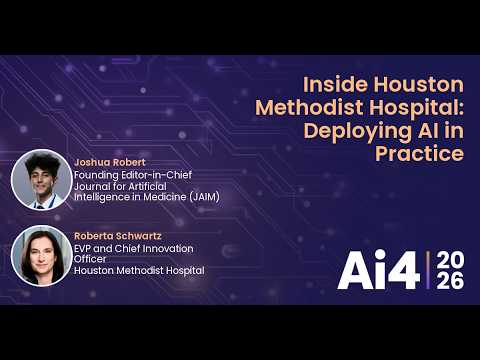
## Background Published on YouTube by Ai4 on August 15, 2026, this fireside chat features Joshua Robert, Founding Editor-in-Chief of the Journal for Artificial Intelligence in Medicine (JAIM), in conversation with Dr. Roberta Schwartz, Executive Vice President and Chief Innovation Officer at Houston Methodist Hospital. The session outlines real-world case studies of how the health system evaluates, prioritizes, and scales artificial intelligence across both clinical and operational domains while navigating organizational and technical hurdles.
## TL;DR Dr. Roberta Schwartz explains Houston Methodist Hospital's rigorous evaluation framework, emphasizing that enterprise adoption requires broad platform capability rather than isolated point solutions. She addresses the internal tug-of-war between HR retention messaging and CFO cost-reduction expectations, showing how AI like radiology triage and scheduling agents streamlines care even without lowering per-scan reading times. Schwartz also highlights the disruption of traditional entry-level career ladders as administrative tasks are automated, differentiating mature operational bots from early-stage autonomous clinical concepts. Concluding with an analysis of demographic pressures and specialist shortages, she calls on healthcare leaders to gain hands-on technical literacy and lead workforce transformations with radical transparency and empathy.
## Atmosphere & style The session has a brisk, candid, and refreshingly unvarnished tone, driven by Dr. Schwartz’s sharp executive realism, self-deprecating wit, and refusal to sugarcoat uncomfortable organizational truths. Joshua Robert provides an engaging, peer-level sounding board, balancing clinical curiosity with lighthearted banter about specialty choices and clinician skepticism. The conversation feels less like a standard tech promotional keynote and more like an authentic, behind-the-scenes postmortem on the messy human, cultural, and financial friction of deploying AI inside a major health system.
## Key takeaways - [00:04](https://www.youtube.com/watch?v=XUeGwUSyKPk&t=4s) Only about 1% of pitched healthcare AI solutions secure a hospital pilot, as health systems aggressively filter out point solutions and undifferentiated DIY agent platforms. - [01:54](https://www.youtube.com/watch?v=XUeGwUSyKPk&t=114s) Narrow point solutions create insurmountable integration and maintenance overhead; enterprise adoption requires platforms with the architectural aperture to expand horizontally across multiple clinical and administrative workflows. - [04:33](https://www.youtube.com/watch?v=XUeGwUSyKPk&t=273s) AI return on investment cannot be evaluated through a single monolithic framework; for example, emergency triage AI delivers value by reprioritizing worklists and speeding downstream care rather than speeding up individual radiologist reading times. - [06:00](https://www.youtube.com/watch?v=XUeGwUSyKPk&t=360s) Deploying generative and agentic AI creates organizational tension between HR commitments to job security and CFO demands for measurable headcount and budgetary efficiencies. - [08:40](https://www.youtube.com/watch?v=XUeGwUSyKPk&t=520s) Clinician adoption is being accelerated externally by a consumer AI wave, with patients arriving at appointments pre-armed with algorithmic diagnoses and specific medication requests. - [09:40](https://www.youtube.com/watch?v=XUeGwUSyKPk&t=580s) Physicians will rapidly adopt point-of-care tools like OpenEvidence when they eliminate friction, even accepting novel data-sharing or advertising arrangements in exchange for high-utility decision support. - [11:37](https://www.youtube.com/watch?v=XUeGwUSyKPk&t=697s) Executive leadership must practice radical transparency regarding AI's disruptive impact on clinical practice instead of relying on reassuring platitudes that mask the scale of impending change. - [12:51](https://www.youtube.com/watch?v=XUeGwUSyKPk&t=771s) Automating routine administrative functions eliminates traditional entry-level roles, posing a major structural challenge for training non-expert staff into future domain experts. - [15:00](https://www.youtube.com/watch?v=XUeGwUSyKPk&t=900s) Routine operational workflows such as call center scheduling and back-office tasks are mature targets for bot automation, whereas autonomous clinical diagnosis and prescribing remain in their earliest experimental infancy. - [17:31](https://www.youtube.com/watch?v=XUeGwUSyKPk&t=1051s) An aging Baby Boomer demographic combined with acute specialist shortages makes AI capacity augmentation essential to prevent widening disparities in healthcare access. - [19:00](https://www.youtube.com/watch?v=XUeGwUSyKPk&t=1140s) Healthcare leaders must achieve personal technical literacy and hands-on experimentation while guiding their organizations through cultural transformation with patience and empathy.
## Detailed walkthrough ### [00:04](https://www.youtube.com/watch?v=XUeGwUSyKPk&t=4s) Introduction and the 1% Threshold for Hospital AI Adoption
Joshua Robert, Founding Editor-in-Chief of the *Journal for Artificial Intelligence in Medicine* (JAIM), opens the session on deploying AI in high-stakes clinical environments where patient lives are on the line and health systems remain intensely risk-averse. He introduces Dr. Roberta Schwartz, Executive Vice President and Chief Innovation Officer at Houston Methodist Hospital—which, as of the day of the talk, marked 15 consecutive years ranked as the number one hospital in Texas. Schwartz, formerly Director of Business Development at the Icahn School of Medicine at Mount Sinai and recognized among the Top 25 Women Leaders in Modern Healthcare, founded and leads the Center for Innovation at Houston Methodist.
Joshua poses the fundamental entry question for health tech innovators: with countless vendors claiming to possess revolutionary AI that will transform medicine, what truly separates the 1% of solutions that secure a pilot from the 99% that get rejected at the door?
Schwartz reflects on the sheer volume of vendor pitches and how the landscape has shifted. At standard healthcare conferences like HLTH and ViVE, she can typically walk down the exhibit floor making rapid "yes, no, yes, no" determinations. However, the current wave of generative and agentic AI is "kicking my ass," she jokes, calling herself "self-prescribed pathetic" because she has not yet "vibecoded" anything herself. The market dynamic has radically pivoted from vendors pitching pre-built, targeted solutions to selling DIY tools where health systems are expected to build their own agents.
```mermaid flowchart TD accTitle: Hospital AI Vendor Evaluation Funnel accDescr: Visual representation of how Houston Methodist filters vendor pitches down to enterprise-ready solutions.
subgraph Inflow ["Vendor Market Inflow"] A["1,000+ Pinpoint Point Solutions<br/>(Single-use AI, DIY Agent Platforms)"] end
subgraph Filter ["Enterprise Evaluation Filters"] B{"Aperture Test:<br/>Can underlying tech expand beyond one niche?"} C{"Value & Impact Test:<br/>Is the clinical/operational pain point massive?"} D{"Internal Expert Review & RFP:<br/>IT, Clinical, & Domain Validation"} end
subgraph Outcome ["Adoption Funnel"] E["99% Rejected / Filtered Out"] F["Top 1% Approved for Hospital Pilot"] end
A --> B B -- "Narrow / Single-use" --> E B -- "Broad Platform Aperture" --> C C -- "Marginal ROI" --> E C -- "High-Impact Value" --> D D --> F ```
---
[01:54](https://www.youtube.com/watch?v=XUeGwUSyKPk&t=114s) The Problem of Point Solutions vs. Expanding the Aperture
Schwartz details why narrow point solutions struggle to gain enterprise traction. In radiology alone, there are over a thousand different AI applications—one algorithm detects lung nodules on a chest X-ray, another finds rib fractures or signs of osteoarthritis, while others focus on retinal imaging. An enterprise health system cannot realistically procure, integrate, and maintain hundreds of distinct pinpoint tools unless a specific problem represents an overwhelmingly severe, urgent pain point.
Instead, the vendors that make it into the top 1% are those that may enter through a single use case but possess the architectural "aperture" to expand across multiple clinical and operational domains using the same underlying platform. Facing an exhibit floor with a hundred undifferentiated AI agent builders, Schwartz does not rely on vendor hype; she defers to Houston Methodist's domain experts across IT, marketing, and clinical specialties to run comprehensive, RFP-style market analyses to benchmark the full field before choosing a partner.
- **Market fragmentation:** More than 1,000 AI solutions exist in radiology alone, creating insurmountable integration and management overhead for health systems if bought piecemeal. - **The "Aperture" requirement:** Successful enterprise vendors must demonstrate that their core platform can scale horizontally into adjacent clinical and administrative workflows. - **Internal vetting:** Enterprise evaluation relies on cross-functional domain experts and rigorous market sweeps rather than single-stakeholder pilot requests.
---
[04:33](https://www.youtube.com/watch?v=XUeGwUSyKPk&t=273s) Tailoring ROI Models and Navigating the CFO vs. HR Dilemma
When evaluating AI value, Schwartz emphasizes that there is no single monolithic "ROI model" across healthcare. Each use case requires its own distinct framework: - In pulmonary embolism (PE) detection, the return must be measured in true reductions in length of stay (LOS), saved brain cells, and saved lives—not merely flagging incidental findings three hours early if that time delta has no clinical consequence.
Schwartz recounts a debate with a Houston Methodist radiologist after deploying Aidoc. The radiologist argued the AI was not delivering on its promises because his per-scan reading time had not decreased. Schwartz pointed out that while his individual reading speed remained unchanged, the software fundamentally reorganized the worklist by triaging positive scans straight to the top of the queue. Consequently, the emergency department gained enormous operational certainty: if an ED physician does not hear from radiology within 30 minutes, they can be reasonably confident the scan is negative, dramatically accelerating downstream emergency care.
Establishing return on investment becomes particularly delicate with agentic and generative AI because internal stakeholders demand conflicting narratives. Human Resources leadership insists on messaging to staff that "it's okay, we won't get rid of anybody," whereas the Chief Financial Officer directly demands to know headcount reductions: "Hey, how are you getting rid of people?"
Schwartz highlights the institutional fortitude required to enforce real productivity shifts. When an internal department requested a $200,000 AI solution because "it can do so much more that we couldn't get to," Schwartz asked how many fewer staff members they would need. When the team replied they would keep the exact same staffing levels, she pushed back: "So what you're telling me is you want $200,000 more and the same amount of people? Yes. No."
| Stakeholder / Domain | Metric Focus & Strategic Expectation | Organizational Tension | |:--- |:--- |:--- | | **Emergency / Radiology (e.g., Aidoc PE)** | Worklist triage, accelerated intervention for positive scans, true Length of Stay (LOS) reduction. | Radiologist reading time per scan does not change, but ED clinical workflow speeds up significantly. | | **Human Resources (HR)** | Workforce morale, psychological safety, culture maintenance ("no one will be replaced"). | Clashes directly with financial ROI demands for measurable headcount and budget efficiencies. | | **Chief Financial Officer (CFO)** | Hard dollar savings, labor efficiency, tangible reduction in operational run-rate costs. | Creates friction when departments want expensive AI tools to expand scope without reducing headcount. |
---
[08:40](https://www.youtube.com/watch?v=XUeGwUSyKPk&t=520s) Overcoming Clinician Inertia and the Consumer-Driven AI Wave
Transitioning to clinical adoption, Joshua notes that physicians are rigorously trained in evidence-based medicine and risk aversion, asking how leaders separate valid skepticism from pure resistance to change. Schwartz responds candidly: clinicians—like all humans—fundamentally dislike change. People order the same dish at restaurants despite extensive menus and take the same commute to work even when navigation apps suggest a two-minute shortcut. When told an AI will triage patients or suggest diagnoses, clinicians reflexively dismiss it with "the AI is not that good."
However, physician behavior is being forced to adapt not from top-down mandates, but from an external consumer wave: - Primary care clinics are observing measurable drops in routine visits because patients are utilizing consumer AI tools for at-home self-diagnosis. - Patients no longer arrive with a few printouts from a search engine; they walk in with their problems pre-analyzed, differential diagnoses compiled, and explicit lists of prescriptions they want approved.
At the same time, clinician-facing AI tools that remove friction are witnessing viral adoption. Schwartz points out that two years ago, almost no one had heard of OpenEvidence, whereas today many physicians feel they "cannot survive without OpenEvidence." Doctors are so eager to access streamlined decision support that they willingly accept business models where data is shared with pharmaceutical partners or community advertising is introduced—signaling a massive shift in how physicians consume technology and recommendations at the point of care.
[11:37](https://www.youtube.com/watch?v=XUeGwUSyKPk&t=697s) Clinician Skepticism, Radiologist Anxiety, and Radical Transparency
When introducing AI triage tools to clinicians, enthusiasm is rarely the default reaction. Radiologists in particular voice deep anxieties about whether AI is being brought in to replace them. While Roberta Schwartz emphasizes that replacement is not the goal, she is candid about the reality: AI will fundamentally alter the way they practice medicine and conduct their daily business. Clinicians inherently approach emerging technological claims with "10 pounds of skepticism and one pound of optimism and excitement," making the rare individuals who enter the field with enthusiasm a true anomaly.
Addressing how leadership must communicate these disruptive shifts to thousands of employees across a large health system, Schwartz advocates for uncompromising honesty over comforting platitudes. She frequently observes audience members approaching her after keynotes to praise her candor, only to immediately whisper, "Did you have to say that?" Despite the discomfort it can cause, Schwartz insists that full transparency is the only viable path forward. Healthcare organizations must actively involve their workforce in designing and adopting these transformations rather than disguising the scale of impending change.
[12:51](https://www.youtube.com/watch?v=XUeGwUSyKPk&t=771s) The Entry-Level Career Pipeline and Transitioning to Expert Teams
While mid-career and senior personnel generally possess the institutional knowledge to adapt, retire, reskill, or transition into emerging roles as natural attrition takes its course, Schwartz expresses profound concern for new graduates. Foundational entry-level positions—such as front-desk registration staff and appointment schedulers—traditionally served as the primary training grounds where young professionals gained industry literacy and initial workplace experience. As these routine administrative tasks are automated, those traditional career stepping stones are rapidly disappearing.
```mermaid flowchart TD accTitle: The AI Capability Gap and Career Ladder Disruption subgraph Traditional["Traditional Healthcare Career Pipeline"] direction TB T1["Entry-Level Roles<br/>(Schedulers, Registrars)"] --> T2["Mid-Level Staff"] --> T3["Domain Experts"] end subgraph AIEra["AI-Driven Healthcare Model"] direction TB A1["Automated Tier<br/>(AI Agents, Bots)"] -. "Missing On-Ramp".-> A2["Expert Tier<br/>(Human + AI Hybrids)"] end ```
This structural shift introduces a fundamental training dilemma: non-expert, task-based tiers are increasingly handled by autonomous systems, while high-value tiers require sophisticated human-AI collaboration. The central leadership challenge is figuring out how to develop a workforce from baseline non-expert to domain expert when the entry-level rungs of the ladder no longer exist. Schwartz stresses that leaders must communicate the arrival of AI "often, loud, again, again, in every different kind of mode, in every different kind of medium," ensuring staff are supported and educated for the next generation of hybrid jobs rather than left behind.
- **Non-Expert Layer:** Repetitive, rules-based administrative and operational tasks automated by standalone AI agents. - **Expert Layer:** Advanced diagnostic, clinical, and operational workflows managed by multidisciplinary human-AI collaborative teams. - **Communication Mandate:** Relentless, transparent, multi-channel messaging to prepare employees for reskilling rather than concealing automation roadmaps.
[15:00](https://www.youtube.com/watch?v=XUeGwUSyKPk&t=900s) Business Automation vs. Autonomous Clinical Visions
The immediate, low-friction frontier for healthcare AI remains business operations. Schwartz recalls a telling moment when a finance team member asked her directly, "Are you trying to botize me?" to which she frankly replied, "I am actually." Today, operational automation is well integrated at Houston Methodist Hospital; callers dialing into the hospital are just as likely to interact with their conversational AI bot agent, "Zoey," as they are with a human scheduling coordinator.
```mermaid flowchart LR accTitle: Spectrum of Healthcare AI Maturity subgraph Operational["High Maturity (Operational)"] direction TB O1["Call Center Scheduling<br/>('Zoey' AI Agent)"] O2["Routine Back-Office<br/>& Business Tasks"] end subgraph Transition["Moderate Maturity (Exception Handling)"] direction TB T1["Prescription Routing<br/>& Delivery Exceptions"] end subgraph Clinical["Early Infancy (Clinical Judgment)"] direction TB C1["Autonomous Diagnostic Packages<br/>(Full-Body MRI + Labs)"] C2["Algorithm-Generated Compounding"] end Operational --> Transition --> Clinical ```
Clinical operations represent a far more controversial frontier. Schwartz recounts an intense, two-hour executive debate at a C-suite healthcare forum sparked by a speaker claiming that annual medical exams will eventually consist entirely of blood work and a whole-body MRI scanned directly by AI. Under that proposed model, algorithms would independently determine diagnoses and formulate customized medication regimens delivered straight from an automated compounding pharmacy. While that extreme vision illustrates the radical outer edge of the automation continuum, Schwartz emphasizes that complex clinical decision-making remains in its earliest infancy and requires rigorous human judgment, standing in stark contrast to mature administrative and banking workflows.
[17:31](https://www.youtube.com/watch?v=XUeGwUSyKPk&t=1051s) Demographic Pressures, Specialist Shortages, and Cultural Transformation
The urgency to operationalize AI is compounded by an impending demographic crisis. As the massive Baby Boomer cohort ages—ranging from newly turned 65-year-olds to those in their mid-eighties—and the number of centenarians expands, the demand for medical care will drastically outstrip the available supply of physicians, nurses, and healthcare aides. Hands-on practitioners like surgeons retain high occupational security, but medical specialty access is already severely constrained. Schwartz notes that even high-profile individuals regularly reach out to her executive office begging for assistance in securing appointments with neurologists, urologists, and gastroenterologists. Without aggressive AI integration to augment clinical capacity, healthcare risks exacerbating systemic inequities, creating severe divides between those who can access timely care and those who cannot.
Joshua Robert humorously remarks that the safety of tactile fields will influence him to choose surgery for his upcoming residency specialty, while Schwartz applauds Robert's initiative in founding the *Journal for Artificial Intelligence in Medicine* (JAIM) so early in his medical career. Closing the discussion, Schwartz issues a clear call to action for healthcare leaders: they must actively "lean in," learn the underlying technologies, write and experiment with code directly, and guide their workforces through cultural change with sustained time, patience, energy, and genuine empathy.
- **Baby Boomer Surge:** A rapidly expanding aging demographic (ages 65 to 85+) and growing centenarian population placing unprecedented strain on existing clinical infrastructure. - **Provider Supply Deficit:** Critical shortages spanning medical doctors, registered nurses, and allied healthcare aides across both rural and urban health ecosystems. - **Specialty Bottlenecks:** Pronounced access barriers in high-demand specialties including neurology, urology, and gastroenterology. - **Actionable Advice:** Leaders must achieve personal technical literacy, experiment hands-on, and lead organizational culture change with empathy and commitment.
## Notable quotes > [04:33](https://www.youtube.com/watch?v=XUeGwUSyKPk&t=273s) it's okay, we won't get rid of anybody — Human Resources leadership
> [04:33](https://www.youtube.com/watch?v=XUeGwUSyKPk&t=273s) Hey, how are you getting rid of people? — Chief Financial Officer
> [04:33](https://www.youtube.com/watch?v=XUeGwUSyKPk&t=273s) So what you're telling me is you want $200,000 more and the same amount of people? Yes. No. — Roberta Schwartz
> [08:40](https://www.youtube.com/watch?v=XUeGwUSyKPk&t=520s) the AI is not that good — Clinicians
> [08:40](https://www.youtube.com/watch?v=XUeGwUSyKPk&t=520s) cannot survive without OpenEvidence — Roberta Schwartz
> [11:37](https://www.youtube.com/watch?v=XUeGwUSyKPk&t=697s) 10 pounds of skepticism and one pound of optimism and excitement — Roberta Schwartz
> [11:37](https://www.youtube.com/watch?v=XUeGwUSyKPk&t=697s) Did you have to say that? — Audience member
> [12:51](https://www.youtube.com/watch?v=XUeGwUSyKPk&t=771s) often, loud, again, again, in every different kind of mode, in every different kind of medium — Roberta Schwartz
> [15:00](https://www.youtube.com/watch?v=XUeGwUSyKPk&t=900s) Are you trying to botize me? — Finance team member
> [15:00](https://www.youtube.com/watch?v=XUeGwUSyKPk&t=900s) I am actually. — Roberta Schwartz
## Mentioned Joshua Robert, Roberta Schwartz, Journal for Artificial Intelligence in Medicine (JAIM), Houston Methodist Hospital, Center for Innovation at Houston Methodist, Icahn School of Medicine at Mount Sinai, HLTH, ViVE, Aidoc, OpenEvidence, Zoey
## Video description Joshua Robert - Founding Editor-in-Chief, Journal for Artificial Intelligence in Medicine (JAIM) Roberta Schwartz - EVP and Chief Innovation Officer, Houston Methodist Hospital
Many health systems have moved past experimentation. The challenge now is operationalizing AI responsibly at scale. This fireside chat presents a real case study of how Houston Methodist Hospital evaluates, prioritizes, and deploys artificial intelligence across clinical and operational environments.
We examine where AI has delivered measurable value, where implementation stalled, and the organizational and technical barriers encountered along the way. The conversation also covers governance, clinician adoption, and how leadership plans to expand AI use safely over time.
Attendees will leave with practical insights into what enables enterprise AI deployment and how leaders can approach their next AI initiative.
[Source](https://www.youtube.com/watch?v=XUeGwUSyKPk)