## Background
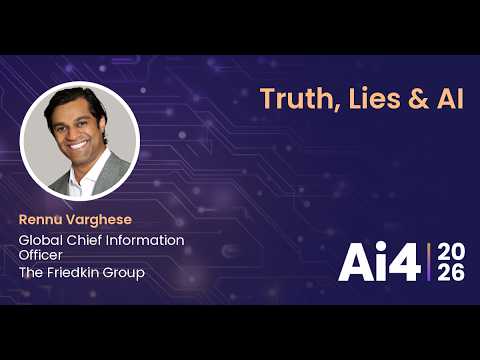
This presentation was published on YouTube by the channel Ai4 on August 15, 2026. According to the page description, Rennu Varghese, VP & CIO at The Friedkin Group, shares practical insights, pitfalls, and lessons learned from scaling AI across a diverse portfolio of businesses.
## TL;DR
Rennu Varghese addresses the common top-down boardroom pressures and budget traps associated with implementing AI enterprise-wide. He emphasizes that AI adoption is fundamentally a human challenge rather than a purely technical one, citing a framework where 70% of success depends on people and organizational culture. To drive adoption, the company deployed varied educational channels, fostered grassroots communities of practice, and utilized gamification tactics like gift cards and recognition.
## Atmosphere & style
The presentation is pragmatic, candid, and humorous, blending executive advice with real-world corporate anecdotes. Varghese engages the audience directly through polling and lighthearted jokes about internal corporate dynamics and HR reactions. The overall tone feels conversational yet highly instructive, translating complex organizational transformation into relatable, human-centered lessons.
## Key takeaways
- [00:04](https://www.youtube.com/watch?v=gKhMN1rnli4&t=4s) Executive leadership often exerts top-down pressure on IT to implement AI quickly, frequently driven by the desire to reduce headcount without a clear operational strategy.
- [00:04](https://www.youtube.com/watch?v=gKhMN1rnli4&t=4s) Accepting a blank-check budget for AI without a clear strategic plan is a major trap that can lead to unplanned career transitions for IT leaders.
- [00:04](https://www.youtube.com/watch?v=gKhMN1rnli4&t=4s) Successful AI deployment across a complex enterprise portfolio requires a structured approach to maintain focus, sanity, and team cohesion.
- [21:08](https://www.youtube.com/watch?v=gKhMN1rnli4&t=1268s) According to the 10/20/70 rule for AI transformation, algorithms account for 10% of success, data and compute account for 20%, and people, culture, and business process change account for 70%.
- [21:08](https://www.youtube.com/watch?v=gKhMN1rnli4&t=1268s) Organizations should avoid getting stuck in prolonged debates over model selection (e.g., Claude vs. Gemini) or infrastructure (e.g., Snowflake vs. Databricks), focusing instead on human behavior and cultural change.
- [21:08](https://www.youtube.com/watch?v=gKhMN1rnli4&t=1268s) Demystifying AI hype and building enterprise-wide capability requires multi-channel education, including weekly newsletters, hands-on clinics, data literacy courses, and interactive events.
- [21:08](https://www.youtube.com/watch?v=gKhMN1rnli4&t=1268s) Establishing grass-roots communities of practice across specialized areas like Generative AI, BI, Data Management, and Process Automation breaks down departmental silos and drives practical adoption.
- [21:08](https://www.youtube.com/watch?v=gKhMN1rnli4&t=1268s) Gamifying AI adoption using tangible incentives—such as free food, gift cards, and public recognition—dramatically increases employee engagement through hackathons and literacy challenges.
## Detailed walkthrough
### [00:04](https://www.youtube.com/watch?v=gKhMN1rnli4&t=4s) "We Need to Do Some AI": The Boardroom Pressure and Big-Budget Temptation
Rennu Varghese kicks off the session by taking a quick show of hands from the audience to gauge the split between executive leadership (CIOs) and hands-on technical practitioners (architects, engineers, coders). Addressing the leaders in the room, he asks if they have experienced top-down pressure from CEOs or boards demanding to "do some AI" or asking whether implementing intent-based tools can reduce headcount. He notes how common these mandates have become, describing his own company's journey as starting with an abrupt call from executive leadership: "We want to implement AI in the company. We are not too sure what that means. You seem to know something about it. Get a few people and implement it for everyone."
The real kicker was when executive leadership asked, "How much budget do you need?" Varghese points out that while the "bad fairy" on his shoulder urged him to take the easiest budget offer of his life and run with it, doing so without a strategy would have led to a "very quick, unplanned career transition." Instead of grabbing blank### "How Many Have Heard Some Variation of This Question?"
Rennu Varghese, Global CIO for The Friedkin Group, kicks off the presentation by polling the room to gauge who is in attendance—asking for a show of hands from leaders, CIOs, architects, engineers, and coders. Turning directly to the business executives in the audience, Varghese asks how many have faced the inevitable directive from their CEO or board of directors: "We need to do some AI. What are we doing about AI?" He highlights his current "favorite" variant of that question—whether the company can simply implement "some AI" to cut headcount.
```
[ Top-Down Executive Mandate ]
│
▼
"We need to do some AI."
│
▼
"Can we implement intent & reduce headcount?"
│
▼
[ Dangerous Dilemma: Take Easy Money or Lead? ]
```
Varghese recounts how The Friedkin Group’s own journey began with a call from top leadership stating that they wanted to deploy AI, recognized Varghese knew something about it, and suggested getting a few people together to implement it company-wide. The kicker came when leadership asked, "How much do you need?" Varghese describes this as an extremely dangerous question to receive and an even more dangerous one to answer. While the "bad fairy" on his shoulder urged him to take the easiest budget he would ever be offered and run with it, Varghese knew doing so would lead to a very quick, unplanned career transition. Instead, the organization took a structured approach that ultimately yielded massive value.
- The session focuses on scaling AI across a complex enterprise portfolio without losing focus, sanity, or team spirit.
- Varghese'
Here is the detailed walkthrough of the transcript:
[21:08](https://www.youtube.com/watch?v=gKhMN1rnli4&t=1268s) The Human Factor: Culture, Education, and Gamification
Reflecting on the AI transformation journey, Rennu Varghese highlights that bringing AI into an organization is rarely a purely technical challenge—it is fundamentally a human one. Referencing the "10/20/70 rule," Varghese explains that algorithms account for only 10% of the equation and data/compute make up 20%, while a staggering 70% comes down to people. It is far too easy to get trapped in "religious discussions" over selecting the ultimate model—debating Claude Sonnet vs. Opus vs. Gemini, or re-hashing the eternal Snowflake vs. Databricks debate. Real transformation requires altering human behaviors, mindsets, and day-to-day ways of working. Culture must be intentionally ignited; without a cultural shift, even the most brilliant algorithms and talented data scientists will fail to achieve scale.
To counter the surrounding hype and open eyes to real possibilities, the leadership team went all-in on education. They deployed multiple learning channels: weekly newsletters during the launch of their "Trailblazer" platform, hands-on clinics, online data literacy courses, and even hosting movie screenings in their on-site theater. Recognizing that top-down leadership alone cannot sustain momentum, they focused heavily on cultivating grassroots communities of practice. These communities break down organizational silos and allow cross-pollination across diverse functions—such as accounting, marketing, and engineering—sparking practical ideas tailored to each department's distinct needs. Regular bi-weekly sessions bring together employees across the company to discuss Generative AI and personal productivity. They have established specialized communities for Business Intelligence, Data Management, and Process Automation, leveraging the frontline employees who interact with these challenges daily.
To further boost engagement, Varghese candidly advocates for gamifying initiatives. Joking that HR usually cringes at his philosophy, he insists that the three greatest motivators for employees are simple: free food, gift cards, and public recognition ("everyone's the hero in their own story"). Leveraging these incentives, the company gamified internal programs ranging from "ChatGPT Olympics" and data literacy challenges to an upcoming non-technical process hackathon.
- **10/20/70 AI Rule**: 10% algorithms, 20% data and compute, 70% people and culture.
- **Active Communities of Practice**:
- Generative AI & Personal Productivity (meets bi-weekly)
- Business Intelligence (BI)
- Data Management
- Process Automation (recently launched)
- **Incentives for Gamification**: Free food,
## Notable quotes
> [00:04](https://www.youtube.com/watch?v=gKhMN1rnli4&t=4s) We need to do some AI. What are we doing about AI? — Executive Leadership
> [00:04](https://www.youtube.com/watch?v=gKhMN1rnli4&t=4s) We want to implement AI in the company. We are not too sure what that means. You seem to know something about it. Get a few people and implement it for everyone. — Executive Leadership
> [00:04](https://www.youtube.com/watch?v=gKhMN1rnli4&t=4s) How much budget do you need? — Executive Leadership
> [21:08](https://www.youtube.com/watch?v=gKhMN1rnli4&t=1268s) everyone's the hero in their own story — Rennu Varghese
## Mentioned
Rennu Varghese, The Friedkin Group, Claude Sonnet, Opus, Gemini, Snowflake, Databricks, ChatGPT Olympics, Trailblazer
## Video description
Rennu Varghese - Global Chief Information Officer, The Friedkin Group
AI isn’t just another tech rollout—it’s a mindset shift. In this honest and practical session, Rennu Varghese, VP & CIO at The Friedkin Group, shares what it really takes to bring AI to life across a diverse portfolio of businesses. From early experiments to full-scale adoption, discover the lessons learned, pitfalls avoided, and unexpected wins along the way. This is the story of how one company turned curiosity into capability—and scaled AI without losing focus, sanity, or team spirit.
Friedkin Group CIO拒绝高管的AI“空白支票”指令
The Friedkin Group的AI规模化成功有70%取决于改变员工文化,而非挑选更优模型或接受缺乏策略的预算。
Rennu Varghese探讨了在全企业推行AI时常见的自上而下的董事会压力及预算陷阱。他强调,AI的落地应用从根本上说是人的挑战,而非纯技术问题,并引用了一个认为70%的成功取决于人员与组织文化的框架。为了推动采纳应用,该公司采用了多样化的培训渠道,培育基层实践社群,并运用礼品卡和表彰等游戏化策略。
高管层往往会对IT部门施加自上而下的压力以要求快速实施AI,这通常是由削减人员编制的诉求所驱动,且缺乏明确的运营策略。 (0:04)
在缺乏清晰战略规划的情况下接受AI的“空白支票”预算是一个重大陷阱,可能导致IT领导者面临意料之外的职业变动。 (0:04)
在复杂的企业业务组合中成功部署AI,需要结构化的方法来保持专注、清醒及团队凝聚力。 (0:04)
根据AI转型的10/20/70法则,算法占成功的10%,数据与算力占20%,而人员、文化及业务流程变革则占70%。 (21:08)
组织应避免陷入关于模型选择(如Claude对比Gemini)或基础设施(如Snowflake对比Databricks)的旷日持久的争论,而应将重心转向人的行为与文化变革。 (21:08)
Reading summary
Rennu Varghese, Global CIO of The Friedkin Group, argues that enterprise AI success depends on human behavior and cultural enablement rather than tool selection or unguided spending. In his view, sustainable adoption requires resisting open-ended executive mandates in favor of structured literacy, grassroots communities, and practical incentives.
Resisting Vague Mandates and Unstructured Budgets (0:04)
Enterprise technology leaders face mounting top-down directives from boards and chief executives demanding to deploy artificial intelligence or evaluate headcount reductions. Varghese recounts that The Friedkin Group's leadership initially asked him to assemble a small team to implement AI broadly across the company, offering an open-ended budget to do so.
Prioritizing Organizational Culture Over Technical Debates (21:08)
Varghese frames organizational transformation through a 10/20/70 rule, positing that algorithms account for only 10% of an initiative, data and compute represent 20%, and people and culture constitute the remaining 70%. Consequently, high-performing technical models and data science teams cannot achieve scale if underlying human mindsets and daily workflows remain unchanged.
He cautions against getting mired in technical disputes over platform and model selection, such as comparing Claude Sonnet, Opus, and Gemini, or debating Snowflake against Databricks. Instead of over-focusing on the technical stack, organizations must deliberately cultivate culture and behavior to turn technological capabilities into operational value.
Driving Adoption Through Grassroots Communities and Incentives (21:08)
To counter AI hype and build internal capability, The Friedkin Group deployed a multifaceted educational rollout. This program included weekly newsletters supporting the internal "Trailblazer" platform, hands-on clinics, online data literacy courses, and educational movie screenings in an on-site theater.
The organization also established cross-functional, grassroots communities of practice across business units like marketing, accounting, and engineering. These groups include bi-weekly meetings on generative AI and personal productivity, alongside dedicated forums for business intelligence, data management, and process automation. Participation is reinforced through gamified initiatives—such as a "ChatGPT Olympics," data literacy challenges, and non-technical hackathons—supported by tangible motivators including free food, gift cards, and public recognition.
Varghese concludes that scaling enterprise AI requires focusing on frontline workers and behavioral adoption rather than relying strictly on top-down mandates or technical tooling.
## Background
该视频由 Ai4 频道于 2026 年 8 月 15 日发布在 YouTube 平台上。视频记录了 The Friedkin Group 的副总裁兼全球首席信息官 Rennu Varghese 主讲的一场公开演说,分享了他如何在旗下多元化的企业帝国中,从早期探索到全规模推广落地 AI,并成功保留团队凝聚力与经营序力的实用经验。
## TL;DR
面对高层盲目追求 AI 技术的压力,The Friedkin Group 启动了“Project Trailblazer(开拓者项目)”,遵循以需求为导向、以价值为指引和点燃企业文化的原则。公司采取双轨制策略,将生成式 AI 的自下而上民主化推广与传统数据模型的严密管控结合,并由独立财务团队追踪实际业务收益。演讲者强调 AI 的本质是“人的问题”,通过游戏化活动、打造内部交流平台以及化解员工失业恐惧,成功在没有裁员的情况下实现了全员赋能。
## Atmosphere & style
整场演讲幽默风趣、接地气且充满实战智慧。演讲者以极其坦诚的态度剖析了企业推动 AI 时面临的高层焦虑与员工恐惧,善用贴切的比喻(如攀登珠峰、整理混乱的书店)和生动的讲故事技巧拉近与听众的距离。现场氛围轻松活跃、充满启发性,既有令人会心一笑的行业自嘲,又有充满激情与远见的领导力鼓舞。
## Key takeaways
- [00:04](https://www.youtube.com/watch?v=gKhMN1rnli4&t=4s) 企业的 AI 之旅常始于高层缺乏实质规划的“AI 焦虑”,CIO/技术领导者需警惕盲目追逐预算,应将重点转向解决实际业务痛点。
- [01:58](https://www.youtube.com/watch?v=gKhMN1rnli4&t=118s) The Friedkin Group 作为一家业务涵盖汽车、影视、酒店、体育等多领域的庞大企业,在推进 AI 时必须避开“一刀切”模式,面对复杂的业务场景。
- [03:22](https://www.youtube.com/watch?v=gKhMN1rnli4&t=202s) 公司确立 Project Trailblazer 项目,以“以需求为导向”、“以价值为指引”和“点燃企业文化”三大核心原则推动 21 世纪数字化转型。
- [05:40](https://www.youtube.com/watch?v=gKhMN1rnli4&t=340s) 面对业务部门对 AI 的抵触,教育是破解炒作与戒心的解药,公司通过引入成熟用例库与外部专家研讨,成功激发出 250 个潜在用例。
- [12:43](https://www.youtube.com/watch?v=gKhMN1rnli4&t=763s) 采用双轨制策略推进 AI:生成式 AI 采取自下而上的民主化推广,传统数据模型则采取自上而下的严密管控与阶段门禁(Stage Gates)。
- [12:43](https://www.youtube.com/watch?v=gKhMN1rnli4&t=763s) 在财务部门内部设立独立的“价值追踪小组”,与项目团队形成健康的监督关系,确保 AI 项目效益的真实性。
- [17:27](https://www.youtube.com/watch?v=gKhMN1rnli4&t=1047s) AI 不会直接取代员工,而是掌握 AI 的人会取代不使用 AI 的人;公司通过转岗与技能重塑,实现未因 AI 裁减任何一名员工。
- [21:08](https://www.youtube.com/watch?v=gKhMN1rnli4&t=1268s) AI 转型本质是“人的问题”(遵循 10-20-70 法则,70% 取决于人与文化),改变团队行为与思维方式才是成功的关键。
- [24:47](https://www.youtube.com/watch?v=gKhMN1rnli4&t=1487s) 通过礼品卡激励、黑客松、内部 Wiki“人民广场”以及搭建允许安全试错(Safe to Fail)的容错文化,全面点燃全员参与热情。
- [29:22](https://www.youtube.com/watch?v=gKhMN1rnli4&t=1762s) 善用“讲故事”(Storytelling)的能力,用具象化的对比场景向管理层解释数据治理(Data Governance)的重要性。
- [33:16](https://www.youtube.com/watch?v=gKhMN1rnli4&t=1996s) 变革管理(Change Management)是领导者的核心责任,绝不能将其全权外包给 HR 部门。
- [33:16](https://www.youtube.com/watch?v=gKhMN1rnli4&t=1996s) 糟糕的流程是 AI 走向灭亡的坟场;无法通过引入智能体(Agentic AI)直接摆脱“流程债务”,必须先优化基础流程。
## Detailed walkthrough
### [00:04](https://www.youtube.com/watch?v=gKhMN1rnli4&t=4s) 企业的“AI 焦虑”与被动起点
Rennu Varghese(The Friedkin Group 的全球 CIO)以互动开场,了解现场听众的背景(领导者、架构师、程序员等)。他指出,当今许多企业的 AI 之旅往往始于高层的盲目催促。CEO 或董事会常会抛出一些让人头疼的问题:“我们必须做点 AI,你们打算怎么做?”甚至还有人会问:“能不能直接引入一些 AI 意图识别,然后把员工裁掉?”
> "How many of you have heard some variation of this question?... Can we implement some intent and reduce headcount? Anybody heard that one?"
The Friedkin Group 的 AI 之旅同样始于高层的要求。有一天高层打电话说:“我们想在公司推 AI,虽然不太懂具体指什么,但你好像懂点,找几个人给大家搞起来吧。”最危险的是高层接着问:“你需要多少预算?”当时,Rennu 脑海中有个“坏天使”在催促他直接拿钱跑路,因为这是史上最容易拿到的预算;但他深知如果真这么做,很可能会演变成一场职业危机,于是他选择了一条截然不同的道路。
- **组织背景与模式**:AI 项目初期通常缺乏清晰的技术路线与业务定义,仅由高层指令 driven。
- **常见误区**:将 AI 误以为是简单的技术铺设,或盲目追逐预算而缺乏实质业务规划。
---
### [01:58](https://www.youtube.com/watch?v=gKhMN1rnli4&t=118s) 了解 The Friedkin Group:庞大且多元的企业帝国
Rennu Varghese 介绍了 The Friedkin Group 这家极其独特的企业。作为一家总部位于休斯顿(距离他家仅 3 英里)的单氏家族控股公司,它可能是许多人“听过其旗下品牌、却没听过母公司名字”的最大企业帝国。
> "It's single family-owned and it may be the biggest group you've never heard of."
公司的业务版图非常庞大且多元化:
- **汽车分销**:起源于 55 年前,是美国海湾五州(Five Gulf States)的丰田(Toyota)批发分销商。
- **影视娱乐**:西海岸的电影业务,曾出品奥斯卡获奖影片《Anora》(阿诺拉)、《Parasite》(寄生虫)以及热门美剧《Landman》(金牌外交官/陆地人)。
- **奢华酒店**:拥有 Oberoi 奢华酒店品牌。
- **体育投资**:拥有英超埃弗顿(Everton)与意甲罗马(AS Roma)足球俱乐部,最近还获批在休斯顿或奥斯汀组建一支冰球队。
- **其他领域**:高尔夫球场、位于英国的深科技(Deep Tech)投资等。
这种高度多元化的业务组合,意味着在推广 AI 时不能采用单一的“一刀切”模式,而必须面对极其复杂的业务场景。
---
### [03:22](https://www.youtube.com/watch?v=gKhMN1rnli4&t=202s) 数字危机感与 Project Trailblazer 的立项
疫情带来的剧烈震荡让企业意识到,如果不主动转型就只能等待被淘汰(如 Toast 等公司在疫情期间的全面转型)。而在 2022 年底,加州硅谷爆发了一场“地震”——ChatGPT 的问世。突然之间,从 90 岁的老人到上大学的年轻一代,每个人都在谈论 AI。
这种前所未有的革命性技术带来了巨大热度,但也夹杂着海量泡沫。对 The Friedkin Group 而言,领导层的目标非常明确:**要做一家由技术驱动的 21 世纪现代化企业,绝不做留在 20 世纪的老古董**。
```
+------------------------+
| Digital Imperative |
| (Disrupt or be Disrupt)
+-----------+------------+
|
v
+------------------------+
| Project Trailblazer |
+-----------+------------+
|
+---------------------+---------------------+
| | |
v v v
+------------------+ +------------------+ +------------------+
| Lead with Need | | Guided by Value | | Ignite Culture |
+------------------+ +------------------+ +------------------+
```
公司将这一战略行动命名为 **Project Trailblazer**(开拓者项目),并确立了三大核心原则:
1. **以需求为导向 (Lead with Need)**
2. **以价值为指引 (Be Guided by Value)**
3. **点燃企业文化 (Ignite Our Culture)**
---
### [05:40](https://www.youtube.com/watch?v=gKhMN1rnli4&t=340s) 第一原则:以需求为导向,切忌盲目技术崇拜
作为 CIO,Rennu 始终倡导“以需求为导向”,甚至经常在公司里宣讲业务价值而非纯技术,这让很多人感到意外。他认为,技术人员在走出校园进入职场后,重点就应当从单纯追求技术转变为解决实际的业务痛点。
> "My number one mantra from the beginning and even now has been lead with need... Show me the money at the end of the day."
面对多元化的业务群,跨企业推动 AI 转型犹如徒手攀登珠穆朗玛峰。Rennu 强调:**没人会穿着拖鞋、在没有向导(Sherpa)的情况下攀登珠峰**。因此,他们聘请了一家经验丰富的资深咨询公司,借鉴其成功与失败的经验,并直接引入了经过行业验证的成熟 AI 场景库(Use Case Library)。
- **业务高管的初期态度**:当 Rennu 找各业务板块负责人沟通时,大家的态度出奇一致——“AI 确实是个好东西,但只适合别人用”。业务负责人认为现有流程运行顺畅且持续盈利,根本不需要 AI。甚至有高管指着书架上亨利·基辛格(Henry Kissinger)和埃里克·施密特(Eric Schmidt)合著的 AI 著作来证明自己懂 AI,但 Rennu 发现那本书连塑料封膜都还没拆。
- **破局思路**:面对这种抵触,Rennu 意识到“教育是解毒剂(Education is the antidote to hype)”,必须先帮助业务部门学习(Learn),他们才能从 AI 中获益(Earn)。
---
### [08:53](https://www.youtube.com/watch?v=gKhMN1rnli4&t=533s) 启发共创:从 0 到 250 个用例的爆发与筛选
为了消除业务领导者的戒心,项目团队邀请了外部专家进行宣讲。Rennu 开玩笑说,如果请来的外部专家留着白发、带着伦敦腔,那立刻就拥有了“瞬间公信力”——同样的话内部人员说没人听,但给外人付大笔咨询费,大家就会信服。
利用罗伯特·弗罗斯特(Robert Frost)的名言——“思想一旦被新观念拉伸,就再也无法回到原来的维度”,团队组织了各子公司总裁、高管及核心骨干的深度研讨会(Breakout Sessions)。通过一下午的白板头脑风暴,大家共同梳理出了 **250 个用例**。
```
+-----------------------------------+
| 250 Generated Initial Use Cases |
+-----------------+-----------------+
|
v
/---------------------------------\
/ Prioritization Matrix /
/ (Value vs. Feasibility Filter) /
\------------------+----------------/
|
+-----------------------+-----------------------+
| |
v v
+-----------------------+ +-----------------------+
| Strategic Moonshots | | Quick Wins |
| (High Ambition/Tech) | | (High Value/Fast) |
+-----------------------+ +-----------------------+
```
从 0 到 250 个用例引发了新的难题。经过分析,这 250 个用例中很多其实和 AI 毫无关系,有的只是基础自动化、升级硬件、清理数据或是优化无效流程。团队通过“价值与可行性矩阵”进行了优先级排序:
- **低价值/低可行性**:直接淘汰。
- **高价值/高可行性**:立即执行。
- **战略级远景(Moonshots)与近景速赢(Rooftops)结合**:既要有能拉伸团队能力的大胆尝试,也要有能快速见效、建立自信的常规项目。
---
### [12:43](https://www.youtube.com/watch?v=gKhMN1rnli4&t=763s) 双轨制策略:生成式 AI 与传统 AI 的分流推进
针对不同类型的 AI 技术,The Friedkin Group 采用了**双轨制(Bimodal Approach)**推进策略:
#### 1. 生成式 AI(Generative AI):自下而上的民主化推广
- **工具部署**:引入企业级 ChatGPT、Claude 和 CoPilot,签署了所有必要的 PII 和隐私协议,确保数据绝对不泄漏、不被用于模型训练。
- **消除误解**:许多员工习惯了 ERP 系统思维,误以为后台管理员能看到自己输入的私密提问。Rennu 甚至亲自演示后台界面,向员工证明管理员“什么也看不到”,以此建立信任。
- **文化激活**:在各部门培养 AI Champion(AI 倡导者),并通过“ChatGPT 奥林匹克竞赛”、“数据素养大赛”等趣味游戏化(Gamification)方式推动全员使用。
- **效果**:代码编写与日常办公效率显著提升,但也带来了“人人都是程序员,写完代码就让 IT 部署到生产环境”的新甜蜜负担。
#### 2. 传统数据模型(Traditional AI):自上而下的严密管控
- **技术栈**:采用线性回归、统计数据模型等拥有上百年历史的成熟技术,但它们正是企业的“造血机器”(Money Makers),直接为收入和利润做贡献。
- **阶段门禁(Stage Gates)管控**:
1. **概念验证 (PoC)**:数据科学家在笔记本电脑(Jupyter Notebook)上快速验证可行性。
2. **最小可行产品 (MVP)**:小范围生产环境试点。
3. **工业化/规模化 (Operationalization)**:全流程全面上线。
- **严格的 KPI**:每个门禁节点都有明确的 KPI 考核,未达标者直接止损。
- **独立价值追踪(Value Tracking)**:为了不让研发团队既当选手又当裁判,公司在**财务部门**内部成立了独立的“价值追踪小组”。虽然财务与项目团队之间偶有摩擦,但这种“健康的紧张关系”确保了项目收益的真实性。
---
### [17:27](https://www.youtube.com/watch?v=gKhMN1rnli4&t=1047s) 化解恐惧:AI 不是来抢工作的,而是改变工作形态
在与员工沟通的过程中,Rennu 发现对很多普通员工而言,“AI”在他们心里的拼法其实是 **J-O-B L-O-S-S(失业)**。历史上每次提到效率提升,往往都伴随着裁员,因此员工对 AI 充满了天然的恐惧。
作为一名 AI 乐观主义者,Rennu 明确表示:**AI 会重塑工作,但长远来看它会创造更多就业机会**。他用来安抚员工的核心观点是:
> "It's not AI that's going to come for your job. It's another person doing your job, but learn to use AI very effectively that gives them 2x, 5x, 10x productivity. That's the person to be afraid of."
为了进一步说明技术的历史规律,他引用了《悲观主义者档案》(Pessimists Archive)中的有趣案例:
- **自动取款机(ATM)**:数十年前 ATM 出现时,人们预测银行柜员将消失;50 年后的今天,银行分行、ATM 和银行从业人员数量均创历史新高。
- **放射科医生**:大约 10 年前,AI “教父”(刚好也参加了本次 Ai4 展会)曾预测放射科医生这个职业将被 AI 彻底终结;而 10 年后的今天,市场上仍有超过 4,000 个放射科医生的职位空缺。
在 The Friedkin Group 内部,公司不仅**没有因为 AI 裁掉任何一名员工**,反而新增了多个专门运用 AI 的岗位,全力帮助员工提升技能与职业演进。
<ElicitationsGroup message="想要深入探讨 The Friedkin Group 的 AI 落地细节?可以了解以下方向:">
<Elicitation label="了解如何建立财务独立的 AI 价值追踪机制" query="请详细说明 Enterprise AI 落地中,如何由财务部门主导建立独立的 AI 价值追踪(Value Tracking)与 KPI 评估机制?"/>
<Elicitation label="探索生成式 AI 的企业级安全部署方案" query="企业在引入 ChatGPT 和 Claude 时,需要签署哪些合规协议(如 PII、HIPAA)以及如何设计数据隔离架构?"/>
</ElicitationsGroup>
以下是该部分视频转录内容的详细文字整理与分析:
### [21:08](https://www.youtube.com/watch?v=gKhMN1rnli4&t=1268s) AI转型本质是“人的问题”:文化点燃与全员赋能
AI 转型表面上是技术变革,但本质上绝非纯粹的技术难题,而是一个深刻的“人的问题”。业界常提到“10-20-70法则”:10% 取决于算法,20% 取决于数据与算力,而高达 70% 则取决于人。大家很容易陷入无休止的“宗教式争论”——到底是选 Claude Sonnet 还是 Opus,是选择 Gemini 还是其他模型,或者是 Snowflake 与 Databricks 之争。演讲者调侃道这些争论的答案其实很明确,但他不会当场透露。
推动变革的真正核心在于改变行为、思维方式与工作习惯。无论拥有多顶尖的算法或 AI 工程师,如果文化没有转变,一切努力都会付诸东流。教育是破解 AI 炒作的解药。为了重塑企业文化,公司采取了全方位的教育手段:发布每周通讯、举办诊所答疑、提供在线数据素养课程,甚至组织员工在影院看电影。此外,自上而下的推动不可持续,公司积极组建实践社区(Communities of Practice),打破部门与子公司之间的壁垒,促进会计、营销与工程团队之间的思想碰撞,从基层培养 AI 倡导者。
```
┌─────────────────────────────────┐
│ AI 转型成功要素 (10-20-70) │
└────────────────┬────────────────┘
│
┌───────────────────────┼───────────────────────┐
▼ ▼ ▼
┌──────────────┐ ┌──────────────┐ ┌──────────────┐
│ 算法模型 │ │ 数据与算力 │ │ 文化与员工 │
│ ( 10%) │ │ ( 20%) │ │ ( 70%) │
└──────────────┘ └──────────────┘ └──────────────┘
```
- 演讲者提到他们每两周举办一次生成式 AI 与个人生产力交流会,曾邀请 OpenAI 开展研讨,目前也在尝试联系 Anthropic。
- 公司已建立多个实践社区,涵盖商业智能(BI)、数据管理以及最新成立的自动化(Automation)社区。
---
### [24:47](https://www.youtube.com/watch?v=gKhMN1rnli4&t=1487s) 游戏化驱动、打造“人民广场”与允许失败的文化
为了进一步提升全员参与度,公司将 AI 推广彻底“游戏化”(Gamify)。人力资源部门听到这些做法可能会感到无奈,但演讲者打趣指出,激励员工的三大神器莫过于“免费食物、礼品卡以及名誉宣传”。无论是 $20 还是 $100 的亚马逊礼品卡,都能极大激发大家的积极性。公司借此举办了 ChatGPT 奥运会、数据素养竞赛,以及针对全员开放的流程黑客松。
每一次革命都需要一个“人民广场”(Town Square)作为聚集地。鉴于公司旗下企业众多且地理位置分散,他们搭建了一个内部 Wiki,作为 Trailblazer 项目的一站式协作平台,集中发布活动、竞赛榜单、培训资源与最新动态。此外,公司已连续三年举办名为 Ignite 的内部 AI 峰会,设立展位让项目团队通过海报和显示屏展示真实案例,甚至在峰会上抽奖送出了一只机器人狗。
演讲者强调,恐惧是创新的天敌。面对高标准、完美主义的团队氛围,必须建立“允许安全失败”(Safe to Fail)的容错文化。只要不是做蠢事,出于理性评估的风险试错是完全被认可的。即使某些早期项目因随后出现的 Claude Code 或 Codex 等新技术而被颠覆,也没有人因此失去工作。
- 内部 Wiki 整合了 Slack 频道、实践社区资讯、培训课程及竞赛公告。
- Ignite 峰会依托公司自有的演播厅和影院举行,极大地打破了部门孤岛并建立了统一的认知框架。
---
### [29:22](https://www.youtube.com/watch?v=gKhMN1rnli4&t=1762s) 用“讲故事”破解数据治理难题
演讲者分享了一个技术人员常忽视的超能力——“讲故事”(Storytelling)。人类数千年来都在通过故事建立情感共鸣和具象画面。当演讲者尝试向管理层解释数据治理(Data Governance)的重要性时,如果使用 NIST 或 DAMA 等理论框架,很难引起共鸣。
为了直观展示数据治理的必要性,演讲者使用了一张极其混乱、堆积如山的图书捐赠活动照片,并向高管们比喻:“想象一下你在开这样一家书店,顾客来买书,你根本不知道有没有库存,找也找不到,顾客转身就去 Amazon 购买了。你既无法补充热销书,也无法清理滞销书。”随后,他展示了一张排列整齐、管理井井有条的现代化书店照片。这种强烈的对比让管理层瞬间理解了数据治理的价值,此后演讲者再也不需要为此类需求进行拉锯式辩论。
- 完美的数据是不存在的,试图一次性修复所有数据不可行;正确做法是找出对业务最关键的数据子集,精细化整理并迭代推进。
- 演讲者幽默地提到:“上次你在 Party 上怀念一张 Excel 表格是什么时候?Excel 确实让我流过泪,但那绝不是喜悦的泪水,而是我的预算报表。”
---
### [33:16](https://www.youtube.com/watch?v=gKhMN1rnli4&t=1996s) 变革管理与避开“流程债务”的陷阱
在总结 AI 项目的经验教训时,演讲者特别强调了变革管理(Change Management)。虽然公司配备了专门的工作组和咨询顾问,但如果重新来过,他会加倍投入变革管理。他个人更推崇约翰·科特(John Kotter)的变革管理模型。同时他强调,变革管理是领导者的核心责任,绝不能将其全权外包给 HR 部门,因为员工最终听从的是能领导他们、具备公信力并支付他们薪水的人。
比技术债务更可怕的是“流程债务”(Process Debt)。当今大多数业务流程是几十年来为传统组织架构和人工操作设计的,经历了一层又一层的临时打补丁。过去人们尝试用 RPA 来自动化这些混乱流程,或者指望更换 ERP(如 SAP 迁移)来解决问题,甚至频繁更换 CIO,但大多以失败告终。
如今,人们试图通过引入智能体(Agentic AI)来解决一切,但“你无法通过智能体化来摆脱一个糟糕的流程”。糟糕的流程就是 AI 走向灭亡的坟场。在推动 AI 规模化落地时,切忌“在牛道上铺水泥”(Pave the cow path),必须先优化基础流程。
```
┌───────────────────────────────────────────────────────────┐
│ 传统臃肿/混乱的业务流程 │
└─────────────────────────────┬─────────────────────────────┘
│ 试图直接套用新技术
▼
┌───────────────────────────────────────────────────────────┐
│ RPA / ERP 升级 / Agentic AI(智能体化失败) │
├───────────────────────────────────────────────────────────┤
│ 结果:流程债务未消除,AI 规模化落地失败("AI goes to die") │
└───────────────────────────────────────────────────────────┘
```
- 演讲者引述诗句“唯一的出口永远是穿过去”(The only way is always through),指出面对快速迭代的技术(如微软将一切命名为 Co-pilot、开源模型争端等),唯一的应对之道就是持续学习、勇于开拓(Trailblazing)。
- 讲座在引用泰德·拉索(Ted Lasso)式哲理名言“保持好奇心”(Be curious)中圆满结束。
## Notable quotes
> [00:04](https://www.youtube.com/watch?v=gKhMN1rnli4&t=4s) How many of you have heard some variation of this question?... Can we implement some intent and reduce headcount? Anybody heard that one? — Rennu Varghese
> [01:58](https://www.youtube.com/watch?v=gKhMN1rnli4&t=118s) It's single family-owned and it may be the biggest group you've never heard of. — Rennu Varghese
> [05:40](https://www.youtube.com/watch?v=gKhMN1rnli4&t=340s) My number one mantra from the beginning and even now has been lead with need... Show me the money at the end of the day. — Rennu Varghese
> [08:53](https://www.youtube.com/watch?v=gKhMN1rnli4&t=533s) Education is the antidote to hype — Rennu Varghese
> [17:27](https://www.youtube.com/watch?v=gKhMN1rnli4&t=1047s) It's not AI that's going to come for your job. It's another person doing your job, but learn to use AI very effectively that gives them 2x, 5x, 10x productivity. That's the person to be afraid of. — Rennu Varghese
> [21:08](https://www.youtube.com/watch?v=gKhMN1rnli4&t=1268s) 10% is algorithm, 20% is data and compute, 70% is people. — Rennu Varghese
> [28:27](https://www.youtube.com/watch?v=gKhMN1rnli4&t=1707s) Fear is the enemy of innovation. — Rennu Varghese
> [37:55](https://www.youtube.com/watch?v=gKhMN1rnli4&t=2275s) The only way is always through — Rennu Varghese
> [38:20](https://www.youtube.com/watch?v=gKhMN1rnli4&t=2300s) Be curious — Rennu Varghese
## Mentioned
Rennu Varghese, The Friedkin Group, Toyota, Anora, Parasite, Landman, Oberoi, AS Roma, Everton, ChatGPT, Henry Kissinger, Eric Schmidt, Robert Frost, Claude, Claude Sonnet, Claude Opus, Claude Code, Codex, CoPilot, Gemini, Snowflake, Databricks, OpenAI, Anthropic, NIST, DAMA, John Kotter, Ted Lasso
## Video description
Rennu Varghese - Global Chief Information Officer, The Friedkin Group
AI isn’t just another tech rollout—it’s a mindset shift. In this honest and practical session, Rennu Varghese, VP & CIO at The Friedkin Group, shares what it really takes to bring AI to life across a diverse portfolio of businesses. From early experiments to full-scale adoption, discover the lessons learned, pitfalls avoided, and unexpected wins along the way. This is the story of how one company turned curiosity into capability—and scaled AI without losing focus, sanity, or team spirit.
[Source](https://www.youtube.com/watch?v=gKhMN1rnli4)
Source quotes
[0:04] Rennu Varghese: How many of you have heard some variation of this question?... Can we implement some intent and reduce headcount? Anybody heard that one?
[1:58] Rennu Varghese: It's single family-owned and it may be the biggest group you've never heard of.
[5:40] Rennu Varghese: My number one mantra from the beginning and even now has been lead with need... Show me the money at the end of the day.
[8:53] Rennu Varghese: Education is the antidote to hype
[17:27] Rennu Varghese: It's not AI that's going to come for your job. It's another person doing your job, but learn to use AI very effectively that gives them 2x, 5x, 10x productivity. That's the person to be afraid of.
[21:08] Rennu Varghese: 10% is algorithm, 20% is data and compute, 70% is people.
[28:27] Rennu Varghese: Fear is the enemy of innovation.
[37:55] Rennu Varghese: The only way is always through
[38:20] Rennu Varghese: Be curious
Source quotes
[0:04] Executive Leadership: We need to do some AI. What are we doing about AI?
[0:04] Executive Leadership: We want to implement AI in the company. We are not too sure what that means. You seem to know something about it. Get a few people and implement it for everyone.
[0:04] Executive Leadership: How much budget do you need?
[21:08] Rennu Varghese: everyone's the hero in their own story
Original transcript
[0:04] Just so I know who's in the audience. How many of
you are in leadership role? CIO, CIO. All right,
[0:12] good. How many of you are architects, engineers,
coders? All right, we got some that are a bit of
[0:19] bit of both. So, let's start with a quick
show of hands given we have a number of
[0:23] leaders here. How many of you have heard some
variation of this question? Raise your hands.
[0:29] can be from your CEO. It can be from your
board. We need to do some AI. What are we
[0:38] doing about AI? And my favorite question these
days, can we implement some intent and reduce
[0:46] headcount? Anybody heard that one? If you have
an answer to that, please let me know. So,
[0:54] our journey started the way most companies do.
One day I had a call from uh the leadership from
[1:00] the top of the house that went something
like this, right? We want to implement AI
[1:06] in the company. We are not too sure what that
means. You seem to know something about it.
[1:12] Get a few people and implement it for everyone.
Now you and the kicker was how much do you need?
[1:20] Now you see your co that's an extremely dangerous
question to be asked and an even more dangerous
[1:26] one to answer right and then there was the bad
fairy on my shoulder saying this is the easiest
[1:32] budget you're ever going to get in your life
take it and run fortunately that's not what we
[1:39] did that would have been a very quick unplanned
career transition for me and we would not be here
[1:46] talking about this topic today right so we went
about it a different way. We got a lot of value
[1:52] from it and that's the journey I'm here to show
share with you today. But before that, I'm Renu
[1:58] Vis and global CIO for a group of companies called
the Freedkin Group. It's a big group of companies.
[2:05] It's single familyowned and it may be the biggest
group you've never heard of. Their headquarters
[2:10] are three miles from my house in Houston. I'd
never heard of them, but I'll bet you when I
[2:15] talk about some of the brands we have, you would
have heard about them, right? We got our start
[2:20] about 55 years ago as a wholesale distributor of
Toyotas in the five Gulf States. And from there,
[2:28] it followed various passions. We have a couple
of movie businesses on the West Coast. If you've
[2:33] heard of uh the movie Anora of Parasite from a few
years ago or the Landman TV series, they are ours.
[2:40] the Ober luxury hotels. That's our brand. Uh any
soccer fancier if you've heard of Everton as Roma
[2:51] those are part of our group of companies. Uh a
couple of golf courses deep tech investment based
[2:58] out of the UK. Um recently we got approval to
build a hockey team either in uh Houston or Austin
[3:09] and by the time off stage I may get a call
saying we bought something else right so it's
[3:14] a very diverse group and the most amazing culture
I've ever been part of uh and very proud to uh
[3:22] have been on this journey with them. But first why
like why did AI matter? We had come, we were still
[3:31] fresh off this thing called the pandemic that
all of you may have heard of and you've seen the
[3:36] level of disruption that caused. Companies had to
pivot almost overnight or they were not companies
[3:42] at all. Right? The all all of a sudden everybody
was offering delivery services, online ordering.
[3:50] Companies had to pivot. If you heard of a company
called Toast, they had to pivot their business
[3:55] entirely or they would not have been a company,
right? So that level of disruption was huge and
[4:03] we did not want to get disrupted. And then late
in 2022, there was an earthquake that happened
[4:09] that was maybe the biggest earthquake that no
meteorologist ever saw coming or recorded. It did
[4:16] not register on any of their scales. It happened
in California in Silicon Valley and that was
[4:23] called Chad GPT, right? All of a sudden, everybody
is an AI expert. My 90-year-old parents and my
[4:33] collegegoing daughter, everybody knows AI. This
is one of the most powerful, revolutionary, and
[4:40] disruptive things that I've seen in my career. And
it's a very exciting time, but it also creates a
[4:46] lot of hype, right? So there's a lot of hype that
was caused by it. So for us the sense of urgency
[4:52] was high. The Fritkin group is an innovative group
of companies and our leadership were clear that we
[4:58] wanted to be a company built for the 21st century
powered by technology and not be a 20th century
[5:05] company. For us it was a disrupt or be disrupted.
And that became a digital imperative to boldly
[5:13] explore the frontiers of technology to innovate
and add enduring value. And I'll come back to
[5:19] that enduring value bit because that is super
super important. And that whole initiative is
[5:25] what became project trailblazer. And we had three
guiding principles and that's what I'll talk about
[5:31] today. It's lead with need, be guided by value
and ignite our culture. My number one mantra
[5:40] from the beginning and even now has been lead
with need. And people find it sometimes a bit
[5:46] odd coming from the CIO who they think should
be evangelizing technology when they hear me
[5:51] evangelize business value right and nowadays I get
emails I say this so often that I get emails from
[5:58] people that say I know it's lead with need but
what do you think about this technology? Right?
[6:04] But at least as that discussion is there that
it's about leading with need and it's always
[6:10] about business outcomes right like not about
it I'm I'm a technologist I love technology
[6:17] uh when it stopped being just about technology for
me was when I got out of grad school and I entered
[6:23] the corporate workforce um it was always about
solving a business problem and ultimately what
[6:30] pain was AI going to solve for us what opportunity
was it going to create? And for business leaders,
[6:36] it's always show me the money at the end of the
day, right? And this was our first time as a
[6:43] company stepping our foot into AI and undertaking
a a massive transformation of this kind. It was
[6:50] definitely my first time leading a transformation
like this across not one company, across a varied
[6:56] uh group of companies. It's like climbing Everest,
right? Nobody climbs Everests in flip-flops and
[7:04] nobody climbs it without a sharper and I suggest
you do not do that either, right? Like don't try
[7:10] to take this on this journey on your own. What we
did was we got an experienced consulting company
[7:16] whose name you would have heard of that had been
there done that many times and they'd made these
[7:22] mistakes at other places and if I could learn from
those mistakes and not repeat them I was willing
[7:28] to take that on. The other advantage they brought
was they had a library of use cases that that were
[7:35] tested and proven applicable to our industries.
Right? So that was extremely valuable to us. And
[7:43] then I went and spoke to different business
leaders about AI and everybody was unanimous
[7:49] about this. AI was absolutely a fantastic
thing and extremely useful for somebody else.
[7:58] They had all done this for decades. They knew
their processes. They were making money. The
[8:03] teams knew what they were doing. So no AI needed
here. One of them I joke with him now. He's he's
[8:10] a good friend now. Like even pointed to a book
on his shelf saying, "See, I have that book about
[8:15] AI." And this was the book Eric Schmidt and Henry
Kissinger wrote. I tactfully let it slip that that
[8:22] book still had its plastic wrap on. Right. But
we've uh moved on that from there. It was easy
[8:29] to get depressed. Like I'd been charged with
leading this AI transformation and now I had
[8:35] business leaders saying no I AI needed here and
honestly I did not blame them right like you know
[8:41] they had never seen the value in it. They had
not experienced what AI could do for them. So
[8:46] rather than getting depressed or being dejected
it was an opportunity. Right? So education is
[8:53] the antidote to a lot of this hype and we had to
help them learn before they could earn from AI
[9:00] and for that we leveraged the multiple sources.
One of those was the consulting company I spoke
[9:06] about. We had external speakers from there. And
something I realized then was um if your external
[9:13] speaker or expert happens to have white hair
and a British accent, it's instant gold. It was
[9:18] instant credibility. The other thing too was you
could be telling your company something and you
[9:24] know they could may or may not listen to you.
Now pay good money to someone, someone that's
[9:29] an outsider. Have them come into your company
and repeat the exact same thing. Right? I see
[9:35] a lot of you laughing. So I'm not the only one
in that boat. Instant credibility. Right? So I
[9:42] was fine with all of that. I was uh more about
affecting the change. And there's a quote often
[9:50] attributed to Robert Frost that goes something
like a mind once stretched by a new idea never
[9:56] returns to its original dimensions. Right? And so
we had to show them the art of the possible. It
[10:02] was very important for me that this was done with
our leaders with our companies and I never wanted
[10:10] anyone to feel this was done to them. Right? That
was a quick way for people to reject uh what we
[10:17] were trying to do. And so we created cohorts from
each company like the presidents of the company,
[10:22] their leadership teams and you know influential
people within those companies and we ideiated and
[10:28] co-created with them and this took one afternoon
like we had breakout sessions, whiteboards all of
[10:35] that. We gathered together at the end of the day
and we had 250 use cases. So that was exciting.
[10:44] But then now we had a whole another problem. We
started with zero use cases, no AI needed. So now
[10:51] we have 250 use cases. But it wasn't possible to
do all 250 of them. And we didn't want to crush
[10:59] the butterfly by telling people, oh, you know,
like your department doesn't need a use case or
[11:05] two. Like it was bringing people on that journey.
And most of these 250 use cases had nothing to do
[11:11] with AI at all. Right. Some of it was straight
up automation. In some places, they just needed
[11:18] some new hardware. Maybe they needed to fix your
data. Or maybe they need to eliminate a process.
[11:24] Some of it was just not uh needed at all. And
so what we did was we prioritized based on value
[11:31] and feasibility. Uh you know there is what's low
value, low feasibility like we just threw away. No
[11:38] point in uh trying to focus on any of that. what
was high value, high feasibility was a no-brainer,
[11:46] right? And we definitely wanted some moonshots and
we wanted to we wanted to take on some hard things
[11:53] and we wanted to stretch our capabilities and get
stronger better and learn things as a company. Yet
[12:00] at the same time on our way to the moon, we did
not want to forget the rooftop, right? We needed
[12:05] some quick wins that were valuable that also had
build confidence within our teams, right? So, we
[12:12] picked a mix of um really ambitious moonshots and
some that were no-brainers. And so, I said some
[12:18] of those were not AI at all, but that was fine. We
wanted to get the creative juices going. We wanted
[12:24] to get people on the boat and then get going from
there, right? Like, so don't wait for the perfect
[12:30] use case. It's more important to get going,
but be bold, be ambitious. At the same time,
[12:36] bring your team along, give them some quick wins.
And all AI is not the same, right? So we had a
[12:43] biodal approach and how we dealt with this like
generative AI our approach to it was democratize
[12:50] it like we went very bottoms up with gen Gen AI.
It was chat GPT at the time. Now there's cloud and
[12:58] copilot and you know every day there is something
new each claiming to be better than the other. But
[13:04] what we did was we got enterprisegrade versions
of these tools. You know, we got enterprise grade
[13:10] chat GPT. We have enterprise grade cloud. We have
co-pilot and we signed all the PII hip hop every
[13:16] addendum we could sign we did. And then it was a
campaign of education letting our teams know that
[13:24] the big fear of us all our data is going to leak
right and there were some stories in the press
[13:29] about uh leakages from other companies and so to
assure them that our data would not be trained on
[13:35] nobody could see the data and in the early days of
Gen AI a lot of people used to an ERP just could
[13:43] not get their heads around it there was no analog
they thought this is like an ERP I type something
[13:48] in somewhere and it's sitting in a database
and an admin can go see it. And so that was
[13:54] again educating people to get over all of these
misunderstandings and like literally putting up in
[13:59] the screen in front of them and telling them I'm
an admin like I can see literally nothing right
[14:05] and so we had to build that confidence with them
and then we created champions within each of those
[14:11] groups and we gified the heck out of it right
we had a chat GPT Olympics we had data literacy
[14:19] uh contests uh and we made a big splash about
it uh and that was quite valuable to us right
[14:26] there's a lot of value we getting from it there's
a lot of efficiency we are seeing uh especially
[14:31] in the past year after these coding AI tools came
like it's it's amazing what people can do it comes
[14:38] with some other risks but those are things we have
to manage all of a sudden everyone's a developer
[14:44] right and it's like I built this can you put
that into production now for me right that's
[14:49] it's it's okay we'll deal with that that's that's
a better problem to have. Um but it shifted the
[14:56] mindset and we've been challenged in quantifying
in dollar terms exactly about the what the value
[15:01] is. We know there is value there but you know
that's what we're going with for now. And then
[15:07] there were a handful of use cases right and these
were all using 150 200 year old techniques called
[15:15] regression statistical data models. These are
the money makers for us and there's quantifiable
[15:22] dollar value we're getting from those right to our
revenue and to our profit. Given the investment
[15:28] we have to make and the the opportunity for
disruption this could have to the business. These
[15:35] use cases we went about quite a bit differently.
It was not bottoms up democratized. These were
[15:41] a lot more top down and the typical stage gates
you'd think of in big enterprise projects, right?
[15:49] KPIs and we we did this in three phases. We had
a P proof of concept which was literally data
[15:55] scientists with their notebooks on a laptop. We
just wanted to prove there was value in it and if
[16:01] there was we move forward. We did an MVP which was
a limited scale production deployment and if there
[16:06] was value there and then we went into full-blown
industrialization and operationalizing that use
[16:12] case. At each of these gates, we had KPIs and we
had to hit those KPIs within a certain threshold
[16:19] or the use case would not go forward. Right?
So, we were a lot more rigorous about this and
[16:24] we wanted to make sure we were getting value
from that and the and we had to show there was
[16:31] value from that and the teams that were already
stressed with building and developing the project,
[16:37] right? We didn't want to burden them with
also kind of proving value and dollar value
[16:42] from those projects. So we created a separate
value tracking function and that function stayed
[16:47] within the finance organization and occasionally
it c causes some tension between finance and the
[16:54] project teams but that's a healthy tension right
we're trying to get to the right answer and if you
[16:59] know if you've done this you know it's not easy
for for a business into which you introduce AI
[17:05] it's difficult to disagregate how many cents of a
dollar came from AI how much was market condition
[17:12] how much was organic growth right so we may not
get a perfect answer but we got a good enough
[17:18] answer there right so now we had need we had value
and there was a lot of buzz about AI but there's
[17:27] one thing that I realized as I was talking to more
and more people we spoke about AI but internally a
[17:36] lot of our staff this is how they spelled it job
loss right invariably Every conversation about AI
[17:46] ends up here. Every conversation about automation
ends up here. And I get this question quite a bit.
[17:54] Am I going to lose my job because of AI? Now, you
see a lot in the press from people that are a lot
[18:02] more qualified and famous and all of that. But
I'm an AI optimist. Like I'll state for the record
[18:10] that AI will shape jobs. It's going to change the
nature of jobs, but over time I think it's going
[18:17] to create more jobs. And how I tell our people
is it's not AI that's going to come for your job.
[18:24] It's another person doing your job, but learn
to use AI very effectively that gives them 2x,
[18:30] 5x, 10x productivity. That's the person to
be afraid of. not uh not a tool as such and
[18:40] um you know maybe it's decades of corporate
euphemism that you know caused people to spell
[18:45] AI or automation in this manner when managers
said efficiency productivity gains it invariably
[18:53] meant headcom reduction or layoffs right and so
that's some of his uh we had we just have to get
[19:00] over and this fear of AI and of technology is not
you. If you want a good laugh, go read something
[19:07] called the pessimists archive. It's hilarious,
right? Like the sort of stuff you'll find in it.
[19:14] I'll give you two examples here. Um, a few decades
ago, ATMs arrived. I was too young to remember it,
[19:21] but I'm told that uh there was a lot of fear that
ATMs were going to eliminate bankers. Guess what?
[19:29] 50 years later, there's more banks, more bank
uh branches, more ATMs, and more bankers than
[19:37] ever. About 10 years ago, none other than the
godfather of AI, and he happens to be here at this
[19:45] conference. If you're lucky enough to run into
him, please ask him what he thinks about this.
[19:51] About 10 years ago, he predicted radiologists
were done as a career and AI was going to do this.
[19:57] all 10 years later according to some sources
there's over 4,000 uh open radiologist jobs
[20:06] right so I think this is over time going to create
opportunity and there is fear and all of that in
[20:12] the short term uh and it doesn't help that CEOs of
companies go and say we reduce 5,000 we reduce X
[20:19] but uh if you read their quarterly reports like
very few of them attribute that due to AI Jesse
[20:28] famously a few years ago I had to walk back a few
things and I I heard a talk at Gartner one time
[20:34] and these there are people that study this right
I'm not a economist or a financial researcher what
[20:40] they said is like from the research they've done
it's less than 1% of the job losses they could
[20:46] attribute to AI and come 2029 they did not expect
that one person to get any better right in their
[20:54] own company we've added some roles that are to
use AI, right? And we've not we've not eliminated
[21:01] a single role because of AI. We're helping people
evolve and learn skills and all of that. And so it
[21:08] turned out that this transformation, although it
was about AI, it turned out to be not a technology
[21:15] problem for the most part. This was a human
problem. this transformation and you may have
[21:21] seen or heard about 10 2070 that's a 10% of it's
your algorithms or something 20% of it the the
[21:30] data and compute and 70% people and it's easy to
get get into religious discussions about picking
[21:38] the perfect model is it sonnet is it opus is it
something else is it Gemini or I don't want to
[21:45] hear another debate about snowflake versus data
bricks The answer is clear but I'm not going
[21:50] to tell you what that answer is. Ask me later
on. A lot of this is about people right? Such
[21:57] a transformation is about changing behavior. It's
about changing mindset. It's about changing ways
[22:03] of working. And that is difficult right? It was
difficult then. It is still difficult uh now. And
[22:11] so it was important for us to ignite our culture.
And this is something I cannot stress enough,
[22:18] right? You can have the best algorithms, the best
data scientists, the best AI engineers, but if you
[22:24] do not shift your culture, all of that's going to
go by the wayside. Like you will not be able to
[22:30] scale AI or any of that. But education truly was
the antidote to hype and it's was opening people's
[22:38] eyes and the possibility, right? And we went all
out on this. We had multiple forums. We had for a
[22:46] while we sent out a weekly newsletter as we were
launching Trailblazer. Uh we had uh clinics. We
[22:53] had um uh online courses. You know, we show people
movies in the theater. So, we went all in. We had
[23:00] multiple forms of that. Uh we have uh online data
literacy courses. So there's not enough that you
[23:08] can invest into educating your teams and some
of them may need a push uh more than others and
[23:15] we also wanted to build communities of practice
right it wasn't sustainable for me of leadership
[23:20] to be pushing this all the time we wanted to to
build some grounds well and we wanted to break
[23:26] down silos between companies between departments
we wanted them to cross-pollinate ideas how an
[23:33] accounting team may use AI would be different from
how a marketing team uses AI would be different
[23:38] from how an engineering team uses AI but then they
spark ideas right and it's helpful for us to build
[23:47] some of this evangelist from the ground up and
cross-pollinate ideas between them and so that's
[23:53] what we did right we built multiple communities
of practice we have a thriving genai and personal
[23:59] productivity uh community that we meet every
two weeks or so and we share ideas and for a
[24:07] while we had open AI come and do sessions for
us when they used to I've tried tried that with
[24:13] anthropic had no luck so far if any of you have
an inside track please let me know but you know
[24:20] we left no stone unturned there and we've launched
multiple communities of practice we have one for
[24:26] BI we have one for data management last week we
launched uh one for automation and like our teams
[24:35] are on the front lines and dealing with this every
day. It's not necessarily the leadership that's
[24:40] always on the front lines learning and reading
all this stuff. And the the next thing we did
[24:47] was gify. Right? This is not in any HR manual that
I've seen. And I say this often and our HR people
[24:55] cringe whenever I say this. I tell them that, you
know, the three biggest motivators of our people
[25:04] are free food, gift cards, and some publicity
with their names, right? Everyone's the hero
[25:11] in their own story after all. And who it is like
free food, a drink or an Amazon gift card, doesn't
[25:17] matter. It's $20 or 100, they got something for
free. And I was not beyond taking advantage of
[25:24] uh that tendency, right? So we gified the heck
out of everything we mentioned chat GPT Olympics
[25:31] uh data literacy and this year we are going to
have a process hackathon and it's got nothing
[25:37] to do with technology so it's open to anyone
and we'll talk about why process matters in
[25:42] in a a few slides and every revolution has a town
square of some kind right there's a meeting place
[25:51] uh here that about 250 years ago a group of
revolutionary Aries met in some bar in Boston
[25:58] and that country celebrated its 250th anniversary
not too long ago. Right? So every historical
[26:04] revolution uh or spring nowadays as they call it
pass the town square and given how spread out we
[26:11] were and the the different companies we had like
getting together physically was not feasible. We
[26:18] technologists after all. So we created an internal
meeting place that was like an internal wiki
[26:25] uh where we it's a one-stop shop for all things
Trailblazer. You can find your communities of
[26:31] practice, upcoming events, winners of contests,
upcoming contests, uh all the training that's
[26:37] available. We publish news articles of exciting
thing that's happening there. So we found this
[26:43] very useful right to have an internal wiki and
a collaboration place. We have Slack channels
[26:48] that are very active these days. And then we also
created an internal AI conference, a trailblazer
[26:56] summit that we call Ignite. We've done this three
years in a row. And over the three years I could
[27:01] see the excitement building and what people want
to hear. And then we have booths where each of the
[27:07] uh uh project teams they present their use cases
like big posters and monitors and like it's very
[27:13] very interactive and true to form we gify that as
well. Last year we gave gave away a robot dog. I
[27:22] don't know what happened to it, but someone for
sure got it. And there was a lot of excitement
[27:27] about that dog. And this is a picture from when
we did the summit two years ago. And we are lucky
[27:34] that we have an internal events team that can
help us with all of this. We have an in-house
[27:40] auditorium. We have an in-house movie theater.
We're in the movie business after all. But it
[27:45] doesn't matter even if you don't have all of that.
Like create something. It's a right of passage for
[27:50] people. It helps break down silos. It creates a
shared mental model and not everyone's going to
[27:56] be involved in building out an AI use case, but
it lets them see what's possible. It gets them
[28:01] excited and they know who to talk to if they have
a similar uh problem they are solving. So now all
[28:09] of this is good, but innovation does not happen
where fear exists, right? So we had to create a
[28:15] culture where say it was safe to fail and this was
quite difficult for us. It is still difficult like
[28:24] we have a lot of high achieving perfectionist type
of people and for them everything has to be to the
[28:31] tea. We got to hit the numbers. We have to hit the
date and you cannot innovate without taking some
[28:37] risk or having some failures. Right? And so this
is something we had to get into people is that
[28:42] it was okay to fail. It was not okay to do stupid
things. But it was okay to take a calculated risk
[28:48] and fail. And we've been on this journey 3 years
now. And in the past 3 years, we've had some use
[28:56] cases that have not gone the way we thought
it would go. But that was fine. Nobody lost
[29:01] their job because of it. And we make sure we
tell that story or when we started the project
[29:07] it was a great idea. But then clawed code and
codex did not exist. Once those tools came out,
[29:14] it changed the equation entirely. Right? And these
things happened and that is okay, right? And then
[29:22] there's one thing that's an absolute superpower
that I've learned to use over time and I don't see
[29:29] hardly enough people using this in the industry
and it's got nothing to do with technology. It's
[29:35] something humans have been doing for thousands of
years. I bet all of you have done this. All of you
[29:41] have heard this. Maybe from when you were a few
days old. Storytelling, right? We've been telling
[29:49] and hearing stories for thousands of years. Why?
Because they move us. Like they connect to us in
[29:56] some way. They move move an emotion in us. They
create a mental picture for us. And how many of
[30:05] you have had to explain data governance and the
importance of good data to your leadership? Okay,
[30:14] it's good. Good number of people. And if maybe you
used NIST or DAME or some theoretical framework
[30:22] to explain to people the importance of data
governance and why they need good data. And
[30:28] after hearing all of this list talk, your leaders
may have gone up gone out excited saying yes,
[30:35] I need me some of that data governance stuff.
Mine did not. So then I had to try something
[30:42] else. I'm a firm believer that every picture tells
a story. Every year we do a book drive or multiple
[30:49] book drives for charity and whatnot. And it sort
of looks something like this. And explain to them,
[30:55] imagine running a bookstore like this. And that's
your business. A customer comes in for a book. You
[31:02] may or may not have that book. You don't know.
Good luck trying to find it in this pile. And
[31:07] guess what? People these days are not patient.
You cannot find the book. They walk to the next
[31:12] bookstore or to Amazon and you lost that sale
forever. Then you don't want to hold on to books
[31:19] that are not selling. You want the hot books,
whatever they are. So you want to know which books
[31:25] are selling fast. You want to know what your stock
is so you can replenish them, sell them and make
[31:31] money. And the books that are not selling, you
want to clear them off your shelf and make space
[31:36] for them. And that's the way you can manage your
store better. Then I showed them this picture.
[31:47] Do you think I needed to explain a whole lot
more on the importance of good data and data
[31:52] governance? That's the last time I ever had to
justify the need for good data and data governance
[31:59] to anyone, right? And that was about two and a
half years ago. Since then, the discussions moved
[32:04] on. It's on to like how do we get our data in
good enough shape. And then once people got this,
[32:10] it's like we want to fix all of our data like it's
not possible. Perfect data is a myth. It doesn't
[32:17] exist. You want to know which you which subsets
of data matter for what you're trying to do.
[32:23] curate them, improve them, edit iterate and move
on to the next one. Like fixing all of it in one
[32:29] go is an incredibly difficult thing to do and
I don't think we'll be successful. So leverage
[32:36] storytelling, right? And there are a lot of good
books out there. There are a lot of good YouTube
[32:40] videos and a lot of this is about painting a
picture in people's mind of what's possible.
[32:46] like I I haven't been moved. Uh just to ask
you when's the last time you were at a happy
[32:53] hour and you discussed a spreadsheet you saw with
nostalgia? It's like a that pivot table that was
[33:01] so moving. Spreadsheets have brought me to tears
but those were not tears of joy. Those were my
[33:08] budget reports at times. Right? So please leverage
storytelling. And so these were the three things
[33:16] at the beginning I told you I'd talk about that
was lead with need be guided by value and ignite
[33:21] your culture. Now if you think this was all fun
and games so far and you know everything went
[33:26] swimmingly that's not true. Uh there were some
lessons learned for us and I'll talk a little
[33:31] bit about some of that. The first thing was change
management right we were deliberate about change
[33:37] management knowing the 10 2070 and how important
culture and people were. We focused a lot on
[33:44] change management. We had a change management
work stream. We had a change management consultant
[33:49] uh you know and we were deliberate about it but
if I were to have a doover I would double down
[33:55] or triple down on this like there's no amount
of it that's not enough. And people get hung up
[34:00] on prosai or some other framework or the other.
It doesn't matter right I'm personally a fan of
[34:06] the John Carter uh model of change management. It
takes people on the journey. It puts people at the
[34:13] front of it. And the other thing is we went around
and we spoke at town halls at business leaders
[34:20] meetings. You know, we did a lot of one-on- ones.
All that's good to create a shared language and
[34:26] pass the same message to different teams. But
ultimately uh people listen to who leads them.
[34:33] They listen to who has credibility with them.
And let's be honest, they listen to who pays
[34:37] them ultimately. So if you're a leader, change
management and leading that culture change is
[34:44] your responsibility. It's not HR's responsibility.
You cannot outsource change management and culture
[34:50] change to HR because they are the people people.
And the one thing people do not talk enough about
[34:59] at all and we talk a lot about technical debt. We
need good data and that's a reason why we cannot
[35:06] scale AI. All of that's true to some extent, but
one thing people rarely talk about is something I
[35:12] call process debt, right? Most of our processes
were built for org shots and teams and humans
[35:20] and then we try to automate them, right? And
it it doesn't work. We a lot of these evolved
[35:25] organically over time. It got layered on. Somebody
patched a process 10 years later. You're not too
[35:32] sure exactly why things are done the way they
are. you talk to people and this is how uh it was
[35:38] uh always done and then in the old days and I
mean old days in AI terms right a few years ago
[35:46] somebody would have had an innovative idea saying
let's automate it and a lot of it was you know
[35:52] a spreadsheet ended up someplace someone opened
that in the morning at 9:00 a.m. something to it,
[35:58] put it into another folder, then another person
picked it up, did something to it. In the end,
[36:03] nobody knows the process. And someone said, "Ah,
there's this innovative thing called RPA. Anyone
[36:08] remember that? Let's apply some RPA." Guess
what? That did not work. Then they're like,
[36:14] "Ah, a steering committee got together and maybe
said, "This is a technology issue. We need a new
[36:20] ERP that's going to fix all of this. Worse, we
need a new CIO cuz this is a technology issue.
[36:28] If any of you had to deal with an SAP migration,
did not change process. You know how that went
[36:36] not too well. Chances are that company did get a
new CIO, right? But nowadays, people are smarter.
[36:44] Let's apply some agentic into it and that's going
to solve everything. But I'll guarantee you this,
[36:49] right? You cannot agentify your way out of a bad
process. This is what I call process death. And
[36:57] I'll state that this is where AI goes to die.
This is why AI doesn't scale. It's not because
[37:02] you did not pick the perfect model or you chose
open AI over cloud or any of that. This is an area
[37:10] that doesn't get enough focus and where AI often
goes to die. And if you want to scale AI in your
[37:16] companies, don't pave the cow path right now. All
of this is changing so fast, right? And how do we
[37:26] keep up? The there's a poet that said the only way
is always through, right? And I'd say that for me,
[37:35] it's always being a trailblazer. There's no way
to not stop learning. Every day we've got to be
[37:41] blazing new trails. Like every day there's a new
AI model. Microsoft keeps renaming their products.
[37:47] Everything is co-pilot now. If any day Microsoft
renames themselves to co-pilot, you heard it
[37:53] here first, right? People are fighting about
open models. One day a model's getting banned,
[37:59] the next day it's getting unbanned. And there's
a lot going on. And we've got to keep learning,
[38:05] right? We have to keep being trailblazers. That's
the only way through. And this is a super fun time
[38:11] to be a technologist. I'm very happy uh that this
is a path I chose. But as we are nearing time,
[38:20] I want to leave you with some words of
inspiration from the greatest psychologist
[38:24] and philosopher of our time. Be curious. All
right. Have a good evening and thank you.