BMO Chief AI Officer Shifts Focus to Revenue Growth Over LLMs
Ai4
Large language models fail to yield balance-sheet returns due to high compute costs and privacy bounds, driving banks toward small targeted models that boost revenue over mere efficiency.
## Background
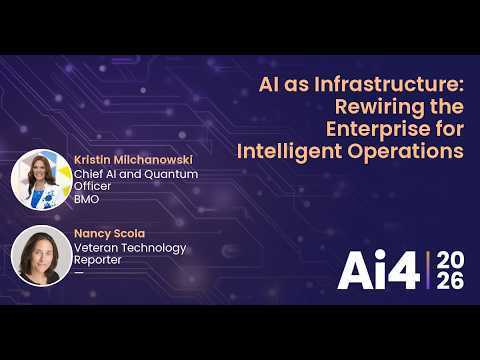
Published on YouTube by Ai4 on August 21, 2026, this video features BMO's Chief AI and Quantum Officer Kristin Milchanowski in conversation with technology reporter Nancy Scola. The session focuses on how modern organizations can move past simple AI experimentation to rewire enterprise operations for durable economic value.
## TL;DR
BMO's Kristin Milchanowski explains how the 200-year-old financial institution integrates artificial intelligence into its operational architecture through automation, augmentation, and client insights. She addresses the limitations of off-the-shelf Large Language Models regarding cost and data privacy, highlighting a strategic industry pivot toward Small Language Models and embedded infrastructure. By leveraging existing regulatory governance frameworks, prioritizing top-line revenue expansion over pure cost-cutting efficiency, and rolling out bank-wide AI training, BMO drives decision velocity while preparing for the arrival of quantum computing.
## Atmosphere & style
The conversation carries a pragmatic, authoritative, and candid tone as an industry expert cuts through corporate AI hype with real-world financial realities. Nancy Scola's structured, inquisitive journalism prompts honest insights from Milchanowski, who engages the live audience with direct anecdotes and clear strategic frameworks. The discussion feels forward-looking yet grounded, balancing rigorous enterprise governance with genuine enthusiasm for technological transformation.
## Key takeaways
- [00:04](https://www.youtube.com/watch?v=M7u-znSZSpM&t=4s) BMO approaches AI through three core pillars: process automation, employee augmentation, and data-driven client insights.
- [01:52](https://www.youtube.com/watch?v=M7u-znSZSpM&t=112s) Capital markets at BMO have utilized AI for 38 years, framing modern agentic AI as a natural evolution rather than a complete departure.
- [01:52](https://www.youtube.com/watch?v=M7u-znSZSpM&t=112s) Off-the-shelf Large Language Models carry heavy operational costs and fail to demonstrate clear balance-sheet ROI due to financial data privacy boundaries.
- [04:46](https://www.youtube.com/watch?v=M7u-znSZSpM&t=286s) Enterprise adoption will transition over the next 12 to 18 months toward Small Language Models (SLMs) and targeted question models integrated directly into cloud infrastructure.
- [04:46](https://www.youtube.com/watch?v=M7u-znSZSpM&t=286s) Rather than seeking isolated process efficiency, organizations should embed AI into core systems to increase decision velocity and drive top-line revenue growth.
- [06:42](https://www.youtube.com/watch?v=M7u-znSZSpM&t=402s) Established banks can innovate faster by reusing existing compliance frameworks and governance patterns to bypass redundant, multi-step review committees.
- [09:01](https://www.youtube.com/watch?v=M7u-znSZSpM&t=541s) AI investments deliver measurable balance-sheet impact when focused on scaling top-line revenue generation rather than capturing unrecovered time savings.
- [12:44](https://www.youtube.com/watch?v=M7u-znSZSpM&t=764s) BMO achieved top-tier global enterprise adoption by rolling out generative AI tools and training to 100% of its workforce regardless of job title.
- [15:06](https://www.youtube.com/watch?v=M7u-znSZSpM&t=906s) Client-facing AI implementations require strict data transparency, empathy-first product design, and continuous customer consent.
- [15:06](https://www.youtube.com/watch?v=M7u-znSZSpM&t=906s) Quantum computing advantage is projected to arrive within 12 to 18 months, revolutionizing risk modeling and financial forecasting.
## Detailed walkthrough
### [00:04](https://www.youtube.com/watch?v=M7u-znSZSpM&t=4s) Deploying AI Across Automation, Augmentation, and Client Insights
Nancy Scola, a Washington DC-based technology journalist, opens the conversation by introducing Kristin Milchanowski, Chief AI and Quantum Officer at the Bank of Montreal (BMO). Scola notes that BMO is an ideal case study for integrating AI into an established institution: founded in 1817—50 years before Canada became a country—it is now the eighth-largest bank in North America, serving 13 million customers. When asked how BMO actively uses AI today, Milchanowski explains that their product development focuses on three primary disciplines: automation, augmentation, and enhancing client experience through data insights.
When describing augmentation, Milchanowski highlights how AI helps bankers perform their roles faster and smarter. She references internal financial service tools like AIM and ARM, specifically noting how ARM operates within Treasury and Payment Services to accelerate complex operational workflows for bank personnel.
- **BMO Scale:** Founded in 1817, 13 million customers, 8th largest bank in North America.
- **Three Strategic AI Pillars:** Automation, Augmentation, and Client Experience/Insights.
- **Augmentation Tools:** In-house products like AIM and ARM streamline treasury and payment processes.
[01:52](https://www.youtube.com/watch?v=M7u-znSZSpM&t=112s) Why a 200-Year-Old Bank Needs AI & The Reality of LLMs
Addressing why a two-century-old successful institution needs to modernize, Milchanowski demystifies AI by pointing out that it is not new. While agentic AI and Large Language Models (LLMs) are recent developments, foundational AI has been around for 40 years. BMO’s capital markets division has leveraged AI for 38 years, and its cybersecurity infrastructure runs on machine learning. Developing modern agents is simply a natural extension of existing capabilities.
However, when asked if LLMs have delivered massive speed increases across the bank, Milchanowski offers a candid assessment: "LLMs aren't quite the magic we thought they were going to be." She notes that high operational costs and strict financial privacy bounds limit off-the-shelf LLMs. Banks cannot allow proprietary data to exit their firewalls to train external frontier models. Furthermore, when polling the room on who has seen a clear balance-sheet return on investment (ROI) from LLMs to discuss with shareholders, zero audience members raise their hands.
- **Legacy AI at BMO:** Capital markets have used AI for 38 years; cybersecurity is built on AI infrastructure.
- **Data Privacy Imperative:** Financial institutions will not permit internal data to leave corporate boundaries to train external frontier models.
- **The LLM ROI Deficit:** LLMs carry massive compute/run costs and currently struggle to show direct balance-sheet ROI across the industry.
[04:46](https://www.youtube.com/watch?v=M7u-znSZSpM&t=286s) Small Language Models and Embedding AI as Infrastructure
Responding to Scola's question on why startups haven't built custom financial models that preserve data privacy, Milchanowski predicts a major shift over the next 12 to 18 months toward Small Language Models (SLMs) and targeted Small Question Models. These lighter, hyper-focused architectures hold far more relevance and practical traction for heavily regulated entities.
```
[ BMO Infrastructure Stack (Big Tech Platforms) ]
│
┌────────────────┴────────────────┐
▼ ▼
[ Data Flow In / Out ] [ Embedded AI Products ]
│ │
└────────────────┬────────────────┘
▼
[ Decision Velocity ]
│
▼
[ Revenue Growth ]
```
Milchanowski urges organizations to avoid "bolting on" AI as an isolated top layer. Instead, BMO's strategy involves embedding AI directly into the existing infrastructure stack hosted by their primary big-tech providers. By embedding AI inside the core architecture where data already flows, the bank increases its "decision velocity"—making better, smarter, and faster business decisions that drive true revenue growth rather than mere cost-cutting efficiency.
- **12–18 Month Outlook:** Industry transition from broad LLMs toward Small Language Models (SLMs) and domain-specific question models.
- **Architecture Strategy:** Deeply integrate AI into existing big-tech cloud infrastructure rather than maintaining standalone AI "bolt-ons."
- **Core Metric:** Prioritizing "decision velocity" to unlock revenue growth over isolated efficiency metrics.
[06:42](https://www.youtube.com/watch?v=M7u-znSZSpM&t=402s) Innovating Within Heavy Regulation Through Reusable Governance
Scola brings up the strict regulatory environment governing banks, asking how BMO innovates without running afoul of regulators. Milchanowski frame this constraint as BMO's upper hand. Because banks are built on trusted foundations, they possess decades of expertise in governance, compliance, and risk controls.
Rather than building custom governance checks for every new AI initiative, BMO leverages reusable control frameworks. If a new AI agent or model is built by the same team, using the same architecture and security patterns, it skips redundant multi-department reviews across cyber, corporate security, and architecture teams. It moves through established governance channels automatically, allowing the bank to move significantly faster than unseasoned tech entrants.
- **Regulatory Advantage:** Deep legacy experience with governance frameworks allows banks to scale AI safely.
- **Fast-Track Governance:** Pre-approved control patterns allow similar AI agents and models to bypass redundant 50-step committee reviews.
[09:01](https://www.youtube.com/watch?v=M7u-znSZSpM&t=541s) Driving ROI by Targeting Revenue Growth Over Efficiency
Addressing how to justify AI expenditures before they hit the balance sheet—a topic detailed in her book, *Return on Intelligence*—Milchanowski shares a strategic lesson: focus on revenue growth rather than cost reduction. When BMO's executive team questioned why she wasn't focusing solely on optimizing processes and cutting operating costs, she countered that efficiency plays rarely show up on the bottom line.
To illustrate, Milchanowski uses an anecdote featuring an attendee in the audience named Imran. If an automated tool saves Imran 4 hours a day, those 4 hours are absorbed into other daily tasks and never reflect on the balance sheet. However, if an AI tool empowers Imran to effectively engage his 10th, 11th, and 12th potential clients—generating an extra $5 million a month in sales—that top-line expansion directly hits the bottom line while delivering operational efficiency as a byproduct.
- **Book Reference:** *Return on Intelligence* by Kristin Milchanowski.
- **Strategic Shift:** Focus AI tools on top-line revenue generation rather than pure cost reduction.
- **Scaling Playbook:** Prove value with targeted wins on individual sales roles, present metrics via an executive scorecard, and secure funding to scale.
[12:44](https://www.youtube.com/watch?v=M7u-znSZSpM&t=764s) Enterprise Adoption, "Digital Natives," and the Exceptionally Curious
Addressing workforce adoption across BMO's tens of thousands of employees, Milchanowski shares that BMO made an intentional decision early on to roll out generative AI tools and an "AI for All" training program to every single employee across the bank, regardless of title.
Milchanowski notes that while "digitally native" employees and self-described "AI geeks" adapt quickly, the second major group of winners consists of the "exceptionally curious"—employees with no prior AI experience who are eager to learn. Working with Microsoft on their enterprise generative AI rollout, Microsoft informed BMO that they achieved among the highest user adoption percentages across Microsoft's entire global client base.
- **Inclusive Deployment:** Rolled out generative AI tools and "AI for All" training to 100% of the workforce.
- **The Two AI Winner Profiles:** Digitally native employees and the "exceptionally curious."
- **Adoption Benchmark:** Microsoft confirmed BMO achieved top-tier user adoption percentages compared to global enterprise peers.
[15:06](https://www.youtube.com/watch?v=M7u-znSZSpM&t=906s) Designing for Client Trust, Empathy, and the Arrival of Quantum
Looking at customer-facing AI, Milchanowski stresses that trust and absolute transparency are non-negotiable. Banks must clearly inform clients when AI is involved, maintaining optionality and client consent. Furthermore, BMO builds customer products using empathy-first design, ensuring tools meet actual user needs while financial advisors leverage AI to optimize client investment portfolios.
Closing the discussion on future technologies, Milchanowski expresses intense enthusiasm for quantum computing, predicting that "quantum advantage" will arrive within the next 12 to 18 months. While quantum currently resides within BMO’s dedicated research team, she anticipates that productionized quantum outputs will fundamentally transform financial forecasting and risk modeling across banking.
- **Client Design Principle:** Designing with empathy and complete transparency regarding AI involvement.
- **Quantum Advantage Timeline:** Anticipated within 12–18 months, initially revolutionizing financial forecasting and complex predictive modeling.
## Notable quotes
> [01:52](https://www.youtube.com/watch?v=M7u-znSZSpM&t=112s) LLMs aren't quite the magic we thought they were going to be. — Kristin Milchanowski
> [01:52](https://www.youtube.com/watch?v=M7u-znSZSpM&t=112s) LLMs carry massive compute/run costs and currently struggle to show direct balance-sheet ROI across the industry. — Kristin Milchanowski
> [04:46](https://www.youtube.com/watch?v=M7u-znSZSpM&t=286s) These lighter, hyper-focused architectures hold far more relevance and practical traction for heavily regulated entities. — Kristin Milchanowski
> [04:46](https://www.youtube.com/watch?v=M7u-znSZSpM&t=286s) By embedding AI inside the core architecture where data already flows, the bank increases its 'decision velocity'—making better, smarter, and faster business decisions that drive true revenue growth rather than mere cost-cutting efficiency. — Kristin Milchanowski
> [06:42](https://www.youtube.com/watch?v=M7u-znSZSpM&t=402s) Because banks are built on trusted foundations, they possess decades of expertise in governance, compliance, and risk controls. — Kristin Milchanowski
> [06:42](https://www.youtube.com/watch?v=M7u-znSZSpM&t=402s) If a new AI agent or model is built by the same team, using the same architecture and security patterns, it skips redundant multi-department reviews across cyber, corporate security, and architecture teams. — Kristin Milchanowski
> [09:01](https://www.youtube.com/watch?v=M7u-znSZSpM&t=541s) When BMO's executive team questioned why she wasn't focusing solely on optimizing processes and cutting operating costs, she countered that efficiency plays rarely show up on the bottom line. — Kristin Milchanowski
> [09:01](https://www.youtube.com/watch?v=M7u-znSZSpM&t=541s) If an automated tool saves Imran 4 hours a day, those 4 hours are absorbed into other daily tasks and never reflect on the balance sheet. — Kristin Milchanowski
> [12:44](https://www.youtube.com/watch?v=M7u-znSZSpM&t=764s) Working with Microsoft on their enterprise generative AI rollout, Microsoft informed BMO that they achieved among the highest user adoption percentages across Microsoft's entire global client base. — Kristin Milchanowski
> [15:06](https://www.youtube.com/watch?v=M7u-znSZSpM&t=906s) quantum advantage will arrive within the next 12 to 18 months. — Kristin Milchanowski
## Mentioned
Kristin Milchanowski, Nancy Scola, Bank of Montreal (BMO), BMO, AIM, ARM, Return on Intelligence, Imran, Microsoft, Ai4
## Video description
Kristin Milchanowski - Chief AI and Quantum Officer, BMO
Nancy Scola - Veteran Technology Reporter, —
This is not about adopting AI — it is about redefining how organizations operate. Winners will be those who turn intelligence into durable economic value.
• Execution, not experimentation, defines success
• Intelligence is abundant; judgment and trust are scarce
• Value comes from business outcomes, not technical capability
• Winning organizations align technology, governance, workforce, and operating model
Kristin Milchanowski, Chief AI and Quantum Officer at Bank of Montreal (BMO), argues that enterprise AI delivers measurable value not through standalone, efficiency-focused large language models, but by embedding targeted models directly into core infrastructure to drive decision velocity and top-line revenue growth.
LLM Limitations and the Shift Toward Targeted Models (1:52)
While BMO has deployed foundational artificial intelligence in capital markets for 38 years and relies on machine learning for cybersecurity, Milchanowski cautions that modern Large Language Models (LLMs) have failed to meet expectations. Off-the-shelf LLMs carry significant compute and operational expenses, yet an informal poll of industry peers revealed zero executives able to demonstrate clear balance-sheet returns to shareholders. Furthermore, strict financial data privacy rules prohibit regulated institutions from transmitting proprietary internal records outside corporate firewalls to train external frontier models.
Because of these operational and security boundaries, Milchanowski forecasts that the enterprise landscape will shift over the next 12 to 18 months toward Small Language Models (SLMs) and hyper-focused Small Question Models. These compact, domain-specific architectures provide a more practical, compliant alternative for heavily regulated institutions requiring rigorous data containment.
Prioritizing Decision Velocity and Revenue Over Cost Reduction (4:46)
Milchanowski advises organizations against treating AI as an isolated, "bolted-on" software layer. Instead, BMO integrates AI capabilities directly into the core infrastructure stack maintained by its primary cloud and technology partners. Embedding analytical models directly where enterprise data already flows enhances "decision velocity," enabling staff to make faster, higher-quality business choices that translate into measurable financial gains.
Drawing from her book, Return on Intelligence, Milchanowski stresses that AI business cases should focus on top-line revenue expansion rather than labor-hour reductions. In internal workflows, automated time savings—such as freeing four hours in an employee's workday—are routinely absorbed by routine administrative tasks without appearing on the corporate balance sheet. Conversely, equipping front-line personnel with augmentation tools (such as BMO's internal ARM platform in Treasury and Payment Services) to secure new commercial clients directly expands top-line performance, leaving operational efficiency as a secondary benefit.
Accelerating Deployment Through Reusable Governance Frameworks (6:42)
Heavily regulated operating environments are frequently viewed as a barrier to technological innovation, but Milchanowski characterizes established compliance structures as a strategic advantage for incumbent banks. Rather than subjecting every new algorithm to bespoke evaluation, BMO utilizes standardized, reusable control frameworks across its engineering pipelines.
Under this model, when an internal team builds a new AI agent using pre-approved technical architectures, data handling procedures, and cybersecurity patterns, the system automatically advances through established oversight channels. By bypassing redundant, multi-department reviews across corporate risk, architecture, and security committees, the institution accelerates deployment timelines while maintaining strict regulatory compliance.
Workforce Adoption, Client Trust, and Emerging Quantum Capabilities (12:44)
To drive internal adoption across BMO's 13 million-customer enterprise, leadership introduced generative tools alongside an "AI for All" educational curriculum to 100% of staff. According to Milchanowski, the highest rates of sustained engagement emerged from two distinct segments: digitally native employees and "exceptionally curious" workers without prior technical backgrounds. Implementation partner Microsoft confirmed that BMO achieved user adoption rates ranking among the highest in its global enterprise client base.
Regarding external applications, Milchanowski emphasizes that client-facing AI requires absolute operational transparency, empathy-led product design, and explicit customer consent. Looking ahead, she anticipates that "quantum advantage" will arrive within 12 to 18 months, shifting from internal research environments into active production to transform complex financial forecasting and institutional risk modeling.
Milchanowski's operational model ties AI returns directly to infrastructure integration, top-line revenue metrics, and pre-cleared governance pathways. However, the long-term viability of this strategy hinges on whether projected shifts toward small language models and commercially viable quantum computing materialize within her 12-to-18-month horizon.
精炼阅读摘要
蒙特利尔银行(BMO)首席人工智能与量子官 Kristin Milchanowski 指出,大语言模型目前普遍面临高运行成本与缺乏平衡表回报的困局;企业应避免将 AI 视为孤立的外挂工具,而应将其深度嵌入核心基础设施以提升决策速度,并通过推动业务增收和复用合规架构来切实兑现商业价值。
大语言模型的回报局限与小模型架构转向 (1:52)
Milchanowski 指出,虽然 BMO 拥有超过两百年历史,但应用 AI 并非新鲜事,其资本市场业务应用 AI 已达 38 年,网络安全体系也长期依托机器学习运行。然而针对当下的大语言模型(LLM),她直言其表现并未达到预期那般神奇。受限于高昂的算力与运营成本,以及金融机构绝不允许内部专有数据流出防火墙训练外部前沿模型的严格隐私限制,现场受众中甚至无人能举手证明其大模型投资获得了可向股东展示的直接资产负债表回报(ROI)。
基于这些现实约束,Milchanowski 预测未来 12 至 18 个月内,行业将转向更轻量、针对特定金融领域的“小语言模型”(SLM)以及聚焦特定问题的小型模型。BMO 明确反对将 AI 作为独立的顶层外挂结构,而是选择将 AI 直接嵌入由大型科技合作方托管的现有底层基础设施堆栈中。她强调,让 AI 与核心数据流直接结合,能够显著提高银行的“决策速度”(Decision Velocity),通过更快、更明智的商业决策来拉动真实的收入增长,而非仅限于局部的效率优化。
以可复用合规架构突破强监管瓶颈 (6:42)
在强监管环境下,金融机构的创新常被外界认为步履维艰,但 Milchanowski 认为严格的合规与风控传统反而是老牌大型银行的核心竞争优势。成熟银行在数十年的业务运营中已经建立了深厚的治理体系、合规标准和风险控制经验,这是缺乏经验的新兴科技进入者所不具备的护城河。
为了在不触碰合规红线的前提下实现快速创新,BMO 并没有为每一个独立的 AI 项目从零搭建审查流程,而是采用了“可复用控制框架”(Reusable Control Frameworks)。在这一机制下,如果新的 AI 代理或模型是由同一支团队在已获批准的技术架构与安全规范下开发的,便可自动通过既定治理通道,跳过涉及网络安全、企业安全及架构团队的冗余多部门多道重审流程。这种预先批准的控制模式既守住了安全底线,又大幅压缩了落地周期。
聚焦顶线营收增长而非单纯削减成本 (9:01)
在其著作《智力回报》(Return on Intelligence)中,Milchanowski 详述了如何证明 AI 支出的商业合理性,并强调核心策略是聚焦营收增长而非削减成本。她透露,BMO 高管层曾质询为何不将重点放在优化流程和削减营运支出上,但她反驳称单纯的效率提升极少能在企业资产负债表的净利润中清晰显现。
Milchanowski 以现场参会者 Imran 的业务场景举例说明:如果某款自动化工具每天为 Imran 节省 4 个小时,这 4 个小时通常会被其他零散日常事务所吸收,无法反映在财务报表上;相反,若利用 AI 工具赋能 Imran 深度拓展第 10、第 11 和第 12 个潜在客户,并由此每月额外促成 500 万美元的销售额,这种顶线业务扩张便会直接转化为底线收益。她认为,AI 的商业化推进路径应是在销售等关键角色中验证具体成效,通过高管计分卡展示可量化的业务增量,从而获取持续规模化推广的资金。
全员推广实践与量子计算的前瞻布局 (12:44)
在推动全行数万名员工采纳新技术方面,BMO 采取了全面的普惠部署策略,向全行员工普及生成式 AI 工具并推行“AI for All”培训计划。Milchanowski 观察到,除“数字原生代”和技术爱好者能够迅速上手外,另一类表现优异的群体是那些此前毫无技术经验但“极具好奇心”的员工。在与微软合作的生成式 AI 企业级落地项目中,微软确认 BMO 的用户采纳率在其全球企业客户中位居前列。在客户端交互层面,银行严格遵循以共情为导向的设计准则,始终保持 AI 参与的完全透明度并获取客户授权。
在展望前沿技术时,Milchanowski 对量子计算的发展表达了极高期待,并预测“量子优势”(Quantum Advantage)将在未来 12 至 18 个月内到来。虽然量子技术目前仍处于 BMO 内部专门研究团队的探索阶段,但她预计一旦量子计算成果投入生产环境,将彻底革新银行业的财务预测体系与复杂的金融风险建模。
Milchanowski 阐述了将 AI 从单点试验推向底层基础设施的系统化路径,但行业向小语言模型与小问题模型的转型能否如期解决大模型的投资回报困境,以及其所预测的量子计算在 12 至 18 个月内实现生产化应用的预期能否兑现,仍需依赖底层算力突破与实际业务场景的持续检验。
Detailed notes — zh
## Background
该内容由 Ai4 频道于 2026 年 8 月 21 日发布在 YouTube 平台上。视频记录了资深科技记者 Nancy Scola 与蒙特利尔银行(BMO)首席人工智能与量子计算官 Kristin Milchanowski 的对谈,围绕“将 AI 作为基础设施重塑企业智能运营”展开,强调企业应超越单纯的技术试验,将技术、治理与业务目标深度对齐以创造持久的商业价值。
## TL;DR
本场对话深入剖析了拥有两百年历史的蒙特利尔银行(BMO)如何将 AI 深度嵌入底层基础设施,而非作为独立插件外挂使用。嘉宾 Kristin Milchanowski 直言当前通用大模型(LLM)受制于数据主权与成本尚未在财报中显现明确 ROI,并预测行业未来将转向专有小模型(SLM)。她强调衡量 AI 价值必须聚焦于拉动营收增长与提升决策速度,而非单纯计算节省工时。此外,访谈还探讨了 55,000 名员工的普及化落地经验、以共情为核心的产品设计,以及前置治理体系与量子计算的未来潜力。
## Atmosphere & style
对谈整体呈现出务实、坦率且极具战略高度的专业氛围,彻底剥离了浮躁的行业炒作,紧扣金融强监管场景的现实约束。嘉宾 Kristin 表达干练清晰,在直面大模型落地瓶颈与现场观众缺乏 ROI 案例的尴尬事实时坦诚不讳,并给出了极具操作性的商业闭环框架。整场对话在严密审慎的风控底线与前瞻性的量子科技视野之间形成了极具说服力的张力,如同一场高浓度的企业智能化转型公开课。
## Key takeaways
- [00:04](https://www.youtube.com/watch?v=M7u-znSZSpM&t=4s) 作为一家拥有两百多年历史的银行,BMO 应用 AI 已有近 40 年历史,目前的 AI Agent 只是其成熟底层技术架构的自然延伸,主要落地于流程自动化、员工赋能和客户体验升级三大方向。
- [02:48](https://www.youtube.com/watch?v=M7u-znSZSpM&t=168s) 通用大模型(LLM)在金融强监管行业尚未显现出明显的资产负债表回报,核心阻碍在于高昂的运行维护成本以及严禁客户与核心数据外泄用于外部模型训练的数据主权红线。
- [03:30](https://www.youtube.com/watch?v=M7u-znSZSpM&t=210s) 面向强监管场景,针对特定业务领域的轻量化小语言模型(SLMs)和专用问答模型,将在未来 12 到 18 个月内获得更切实际的落地应用与产业吸引力。
- [05:32](https://www.youtube.com/watch?v=M7u-znSZSpM&t=332s) 推进 AI 落地最忌讳将其作为孤立的独立插件硬性“外挂”,企业必须将 AI 深度嵌入到底层基础设施与现有云技术栈中,实现技术与数据的有机整合。
- [06:20](https://www.youtube.com/watch?v=M7u-znSZSpM&t=380s) “AI 即基础设施”的核心价值是释放“决策速度(Decision Velocity)”,使全行业务依托高效的数据双向吞吐更快做出优质决策,从而直接带动业务营收增长。
- [07:40](https://www.youtube.com/watch?v=M7u-znSZSpM&t=460s) 金融业成熟的百年风控与治理体系是 AI 创新的加速器而非阻碍,只要新模型遵循标准治理规范,便能直接复用合规流程,避免因重复审查而拖慢落地节奏。
- [09:01](https://www.youtube.com/watch?v=M7u-znSZSpM&t=541s) 衡量 AI 投资回报率(ROI)必须聚焦于“创造新增营收”而非单纯“降本提效”;为员工节省碎片化时间极难转化为报表利润,但赋能业务拓展新客户能直接拉动经营净利。
- [11:20](https://www.youtube.com/watch?v=M7u-znSZSpM&t=680s) 企业推进 AI 规模化应采取小步快跑策略,优先在单一销售或业务场景中用小额预算验证增收成效,凭借扎实的指标记分卡(Scorecard)向高管层争取持续投资。
- [12:44](https://www.youtube.com/watch?v=M7u-znSZSpM&t=764s) 组织变革应打破层级界限推行全员普及(AI for All);在实践中,“数字原生代”与“抱有极强好奇心”的员工是驱动 AI 工具高频应用的核心力量。
- [14:10](https://www.youtube.com/watch?v=M7u-znSZSpM&t=850s) 面向客户端的 AI 产品设计必须坚持“以共情为核心(Designing with Empathy)”,在确保合规与透明度的前提下打造无缝体验,将技术红利切实回馈给客户。
- [17:49](https://www.youtube.com/watch?v=M7u-znSZSpM&t=1069s) 企业前置构建“治理与信任飞轮”至关重要,尽早确立模型校验、身份认证与编排机制,能够大幅降低后续规模化创新所需的合规与决策阻力。
- [18:30](https://www.youtube.com/watch?v=M7u-znSZSpM&t=1110s) 量子优势(Quantum Advantage)的实用化拐点预计在未来 12 到 18 个月内到来,其工程化落地将首先对金融业的前瞻性预测与复杂风险建模产生颠覆性影响。
## Detailed walkthrough
### [00:04](https://www.youtube.com/watch?v=M7u-znSZSpM&t=4s) 拥有两百年历史的银行如何将 AI 融入企业底层
科技记者 Nancy Scola 在开场中介绍,本场圆桌讨论的主题为“AI 作为基础设施:重构企业智能运营体系”。对谈嘉宾是来自蒙特利尔银行(Bank of Montreal,简称 BMO)的首席人工智能与量子计算官(Chief AI and Quantum Officer)Kristin Milchanowski。BMO 创立于 1817 年(比加拿大建国还早 50 年),是北美第八大银行,服务超过 1300 万客户。
Kristin 介绍,BMO 内部主要在三个方向部署 AI:
1. **自动化(Automation)**:替代重复性、机械化的流程。
2. **员工赋能/增强(Augmentation)**:协助银行员工更聪明、更快、更高效地工作(如财资与支付服务团队使用的 AIM 与 ARM 等工具)。
3. **客户体验(Client Experience)**:为客户提炼并提供更有价值的洞察与见解。
当被问及为何一家历经 200 多年风雨的老牌银行还要急于推进 AI 时,Kristin 指出,AI 对 BMO 而言根本不是新鲜事。尽管基于 LLM 的 Agent 是近年的新热点,但 BMO 的资本市场业务使用 AI 已经有 38 年历史,网络安全防御也是全套由 AI 驱动。当前构建 Agent 只是银行成熟技术底座的“自然延伸”。
---
### [02:48](https://www.youtube.com/watch?v=M7u-znSZSpM&t=168s) 大模型(LLM)的幻灭与数据围墙的现实
针对当前 LLM 是否真的带来了全行业流程加速,Kristin 坦率地给出否定答案:“坦白讲,目前还没有。”她坦言最初对大语言模型抱有很高的提效假设,但现实证明 LLM 远没有人们预想的那么神奇,核心阻碍在于成本与数据主权合规:
```mermaid
flowchart TD
accTitle: LLM Deployment Bottlenecks in Banking
subgraph Bottlenecks["LLM 落地金融业的核心瓶颈"]
C1["高昂的运行与微调成本"]
C2["数据主权限制:金融数据绝对禁止外流用于训练外部前沿模型"]
C3["通用模型缺乏金融强监管场景的针对性适配"]
end
Bottlenecks --> Outcome["财务回报不明显,短期难以直接体现于资产负债表"]
Outcome --> Transition["未来 12-18 个月转向小语言模型 (SLM) 与专用问答模型"]
```
- **严禁数据外泄**:在严监管的金融业,没有任何一家合规银行会允许内部数据流出企业围墙去训练外部的前沿大模型(Frontier Models)。即便做微调,也必须在内部隔离的私有云或本地环境中运行,而这套基础设施的运行成本极其高昂。
- **ROI 尚未显现**:现场主持人询问台下观众有谁已经在公司资产负债表上看到了可向股东汇报的明确 AI 投资回报率(ROI),现场无一人举手。
- **未来趋势转向小模型**:Kristin 预测,未来 12 到 18 个月内,针对特定领域的小语言模型(SLMs)和专用问答模型(Question Models)将在强监管行业获得更大的实际吸引力。
---
### [05:32](https://www.youtube.com/watch?v=M7u-znSZSpM&t=332s) AI 即基础设施:追求“决策速度”而非简单拼凑
Kristin 强调,企业推进 AI 最糟糕的做法就是把 AI 当作独立插件“硬生生外挂(bolt-on)”到现有架构上。BMO 的核心策略是将 AI 深度嵌入到底层基础设施技术栈中,直接利用现有的云服务与大型科技合作伙伴底层支撑:
```mermaid
flowchart LR
accTitle: AI as Infrastructure vs External Bolt-on
subgraph Bad["传统外挂模式 (Bolt-on)"]
direction TB
B1["业务流程"] -. 割裂调用.-> B2["外挂独立 AI 工具"]
B2 -. 低效集成.-> B3["难以形成系统决策合力"]
end
subgraph Good["底层基础设施模式 (AI as Infrastructure)"]
direction TB
G1["底层基础设施技术栈"] --- G2["原生嵌入 AI 能力"]
G2 --> G3["畅通的数据吞吐与流转"]
G3 --> G4["提升决策速度 (Decision Velocity)"]
G4 --> G5["驱动业务营收增长"]
end
```
这种架构模式让企业得以释放“决策速度(Decision Velocity)”——让全行业务在数据双向流转中更快、更准、更智能地做出决策,从而直接带动收入增长,而不仅是做局部的效率节省。
在合规与治理方面,金融机构天然具备领先优势。因为银行拥有上百年建立的成熟风险控制与治理体系,只要新建的模型和 Agent 遵循既有的治理与架构规范,就可以直接复用安全、合规与风控流程,无需每次都拉上网络安全、企业架构等部门推倒重来做 50 次重新审批,反而能极大加快创新落地。
---
### [09:01](https://www.youtube.com/watch?v=M7u-znSZSpM&t=541s) 衡量真实 ROI:为什么必须死磕“增收”而非“降本提效”
在谈到其著作《Return on Intelligence》的核心逻辑时,Kristin 解构了企业衡量 AI 价值时的常见陷阱:为什么管理层不能一味只盯“降本增效”。
```mermaid
flowchart TD
accTitle: Efficiency vs Revenue Focus Comparison
subgraph PathA["纯效率视角 (难以反映在财报中)"]
A1["为员工节省 4 小时工作时间"] --> A2["员工将空闲时间用于其他日常琐事"]
A2 --> A3["资产负债表与净利润无明显变化"]
end
subgraph PathB["营收增长视角 (直接拉动 Bottom Line)"]
B1["打造 AI 工具赋能业务拓展"] --> B2["销售人员能够触达第 10、11、12 个新客户"]
B2 --> B3["每月直接创造 500 万美元新增收入"]
B3 --> B4["在实现增收的同时自然倒逼流程效率优化"]
end
```
- **效率不等于利润**:如果仅把某位员工(如现场提到的同事 Imran)每天的工作流程自动化、节省 4 小时,这 4 小时通常会被其他日常工作填满,并不会直接反映在财务报表的净利润(Bottom Line)上。
- **增收带动效率**:相反,如果给该员工提供一款 AI 工具,帮助其高效跟进原先无暇顾及的第 10、11、12 个潜在客户,促成每月 500 万美元的新增销售额,这笔收益会直接计入财报底线。在实现业务扩张的过程中,流程效率自然得到了解决。
- **小步快跑与记分卡汇报**:通过建立指标记分卡(Scorecard),用极小的初始投资在单个销售或业务场景中验证增收闭环,拿着确凿数据向执行委员会和董事会证明成效,进而获得更多预算进行规模化推广。
---
### [12:44](https://www.youtube.com/watch?v=M7u-znSZSpM&t=764s) 全员普及 AI 与以共情为核心的产品设计
BMO 拥有约 55,000 名员工。在组织变革上,高管团队早期就做出了明确决策:不按职位或级别筛选,而是将生成式 AI 工具直接下发给全体员工,并推行全员“AI for All”培训。
- **两大胜出群体**:在生成式 AI 时代,企业内部最终跑出来的往往有两类人:
1. **数字原生代(Digitally Native)**:从小伴随科技成长、精通技术的极客。
2. **极具好奇心的人(Exceptionally Curious)**:哪怕过往从未接触过 AI,但只要抱有强烈好奇心并乐于探索尝试。
- **极高的采用率**:BMO 与微软合作部署的企业级生成式 AI 工具,其用户活跃采用率在微软所有企业客户中名列前茅。
- **以共情设计(Designing with Empathy)**:在面向客户(C端)场景中,银行的核心基石是信任与透明度。无论是智能划转资金还是财务顾问辅助,AI 产品必须事先充分评估客户真实诉求,让交互流程丝滑、无缝,把收益真正反馈给客户(例如帮助财务顾问协助客户实现资产增值)。
---
### [17:49](https://www.youtube.com/watch?v=M7u-znSZSpM&t=1069s) 跨行业启示与量子计算前瞻
针对其他行业如何借鉴金融业的 AI 落地经验,Kristin 指出关键在于**前置构建治理与信任飞轮(Trust Flywheel)**:
```mermaid
flowchart LR
accTitle: Trust and Governance Flywheel
A["投入资源前置搭建治理规范与控制流程"] --> B["建立身份认证、模型校验与编排机制"]
B --> C["形成可信基础 (Trust Base)"]
C --> D["大幅减少后续创新决策与合规阻力"]
D --> E["实现更敏捷的规模化创新落地"]
E --> A
```
在访谈尾声,Kristin 展望了接下来的技术突破点:**量子优势(Quantum Advantage)**。她认为量子计算的实用化拐点在未来 12 到 18 个月内就将到来。目前 BMO 正将其作为前沿科研进行重点储备;一旦量子计算结果实现工程化与生产化落地,预计将首先颠覆金融行业的预测与风险建模能力。
## Notable quotes
> This is not about adopting AI — it is about redefining how organizations operate. Winners will be those who turn intelligence into durable economic value. — Kristin Milchanowski
> Execution, not experimentation, defines success — Kristin Milchanowski
> Intelligence is abundant; judgment and trust are scarce — Kristin Milchanowski
> Value comes from business outcomes, not technical capability — Kristin Milchanowski
> Winning organizations align technology, governance, workforce, and operating model — Kristin Milchanowski
> [02:48](https://www.youtube.com/watch?v=M7u-znSZSpM&t=168s) 坦白讲,目前还没有。 — Kristin Milchanowski
## Mentioned
Kristin Milchanowski, Nancy Scola, 蒙特利尔银行 (Bank of Montreal / BMO), Ai4, 《Return on Intelligence》, 微软 (Microsoft), AIM, ARM
## Video description
Kristin Milchanowski - Chief AI and Quantum Officer, BMO
Nancy Scola - Veteran Technology Reporter, —
This is not about adopting AI — it is about redefining how organizations operate. Winners will be those who turn intelligence into durable economic value.
• Execution, not experimentation, defines success
• Intelligence is abundant; judgment and trust are scarce
• Value comes from business outcomes, not technical capability
• Winning organizations align technology, governance, workforce, and operating model
[Source](https://www.youtube.com/watch?v=M7u-znSZSpM)
Source quotes
Kristin Milchanowski: This is not about adopting AI — it is about redefining how organizations operate. Winners will be those who turn intelligence into durable economic value.
Kristin Milchanowski: Execution, not experimentation, defines success
Kristin Milchanowski: Intelligence is abundant; judgment and trust are scarce
Kristin Milchanowski: Value comes from business outcomes, not technical capability
Kristin Milchanowski: Winning organizations align technology, governance, workforce, and operating model
[2:48] Kristin Milchanowski: 坦白讲,目前还没有。
Source quotes
[1:52] Kristin Milchanowski: LLMs aren't quite the magic we thought they were going to be.
[1:52] Kristin Milchanowski: LLMs carry massive compute/run costs and currently struggle to show direct balance-sheet ROI across the industry.
[4:46] Kristin Milchanowski: These lighter, hyper-focused architectures hold far more relevance and practical traction for heavily regulated entities.
[4:46] Kristin Milchanowski: By embedding AI inside the core architecture where data already flows, the bank increases its 'decision velocity'—making better, smarter, and faster business decisions that drive true revenue growth rather than mere cost-cutting efficiency.
[6:42] Kristin Milchanowski: Because banks are built on trusted foundations, they possess decades of expertise in governance, compliance, and risk controls.
[6:42] Kristin Milchanowski: If a new AI agent or model is built by the same team, using the same architecture and security patterns, it skips redundant multi-department reviews across cyber, corporate security, and architecture teams.
[9:01] Kristin Milchanowski: When BMO's executive team questioned why she wasn't focusing solely on optimizing processes and cutting operating costs, she countered that efficiency plays rarely show up on the bottom line.
[9:01] Kristin Milchanowski: If an automated tool saves Imran 4 hours a day, those 4 hours are absorbed into other daily tasks and never reflect on the balance sheet.
[12:44] Kristin Milchanowski: Working with Microsoft on their enterprise generative AI rollout, Microsoft informed BMO that they achieved among the highest user adoption percentages across Microsoft's entire global client base.
[15:06] Kristin Milchanowski: quantum advantage will arrive within the next 12 to 18 months.
Original transcript
[0:04] Good morning everyone. Uh, as was mentioned,
I am Nancy Skola. I'm a technology journalist
[0:10] based in Washington DC. And I'm happy to be here
this morning to moderate our conversation on the
[0:15] topic of AI is infrastructure and specifically
how do you go about successfully baking AI into
[0:20] an existing established organization? And we have
the perfect guest here to discuss that. We have
[0:26] Kristen Milchinowski. Kristen is the chief AI and
quantum officer at the Bank of Montreal, better
[0:32] known as Beimo. And when we talk about established
institutions, Beimos was founded way back in 1817,
[0:39] a full 50 years before Canada was even a country.
So it's been around for a while. And today,
[0:43] Beimo is the eighth largest bank in North America
with some 13 million customers. So it's a big
[0:48] institution. So Kristen, let's start here. How
exactly is BEIMO using AI? Can you give us a
[0:53] few of your favorite uh concrete examples? Yeah,
absolutely. So good morning everybody. Thanks for
[0:57] having me. Um, we we are deploying AI in three
specific areas. So, we use it for automation,
[1:04] augmentation, and then really this client
experience where we're bringing um forth more
[1:11] um insights for our for our clients. And so, all
of our products that we're developing are along
[1:16] those three um areas. Um, so when you think of
augmentation, that's all about helping your banker
[1:26] uh do their job better, smarter, faster. Um, and
we have products like AIM and ARM if you're in
[1:33] the financial services sector, which is probably
why you climbed five escalators to get here. Um,
[1:39] and what we do with a arm is in our like the
treasury payment services area and it helps
[1:46] speed up the whole process for for our bankers.
But those are kind of the the three disciplines
[1:52] where we're first um marching towards. Okay. Why
does Beimo need to adopt AI? This might seem like
[1:58] a silly question, but the bank's been around
for more than 200 years. It's been successful
[2:02] for more than 200 years. Why bother? Why does it
need to to to modernize in this way? Yeah. So one
[2:07] of the things I like to uh remind everybody
is that um AI is not new. So maybe this agent
[2:15] um in LLMs that part is new but AI has been
around for 40 years and our entire capital
[2:21] markets business has been leveraging AI for 38
years. Um our cyber security runs on on AI like
[2:29] the our infrastructure is already uh AI equipped
and enabled and and running massive processes for
[2:36] the bank. Um so this uh agent creation is a
natural extension of something we already do
[2:42] well. Um so that's sort of the the why is because
it's a natural extension. And you mentioned this
[2:48] the speeding up of processes. Is that like a
big part of the gain that you're that you're
[2:52] seeing across organizations? I would say not
yet. Uh genuinely. So, um I would hope I would
[2:59] have I did have hopes. I had a hypothesis that
um LLMs would help us speed up things. Um but it
[3:05] turns out that LLMs aren't quite the magic we
we thought they were going to be. Please tell
[3:10] us why. Yeah. Um so I think I think the the part
part of it is because they do cost uh quite a bit
[3:18] of money to run. Um but then also because they're
not tailored to um uh an institution uh that has
[3:27] that is bound by what it allows to go inside and
outside of its walls. So in financial services,
[3:34] none of us are going to allow our data to train
some outside frontier model. That is I I'm I'm
[3:41] confident to say none of us in financial services
would allow for that. if you're one of them then
[3:46] you want to be an exception perhaps maybe talk to
a peer uh because it's not healthy. Um but but so
[3:53] so you know people say never say never but that's
this is one area where I I feel pretty confident
[3:58] that no one's going to be allowing their things
to travel um outside other models to be externally
[4:05] retrained. We might do it internally or without
in a cloud environment but it's still contained.
[4:10] Okay. And the cost of that is just ginormous.
And um how many people are seeing a return on
[4:17] investment so far? Um that's hitting their balance
sheet that you can talk to shareholders about.
[4:27] And that's not unique to financial services. So
just for the audio uh version of this, no one
[4:33] in the audience raised their hand. Um, so this is
this is why I'm not like they're not as magical as
[4:40] as I thought that they may be. Okay. I'm sorry. Go
ahead. Yeah. No, no. So, the answer is going to be
[4:46] Yeah. This is so I'm a journalist, so I don't know
too much about business, you know, making money.
[4:50] But the it seems like a business opportunity. Why
haven't there been startups saying, "Let's build
[4:56] AI, customize AI for the financial services sector
that lets institutions hang on to their data?"
[5:01] Seems like somebody would step into that. you have
a lot of people probably in this room stepping
[5:06] right on in. Um, and and what we're finding now, I
think what's going to become more popular and part
[5:12] of the conversation in the next 12 to 18 months
are the small language models and this the large
[5:18] question models or even the small question models.
Those are probably going to have uh more traction
[5:24] and more relevance to um heav heavy regulated
entities. Okay, we we want to talk a little bit
[5:32] about this idea of AI as infrastructure rather
than when we were prepping for this panel, you
[5:36] talked about one of the worst things you can do
is just bolt AI onto the an existing organization.
[5:40] Why is that so important and how does that how do
you actually operationalize that in in practice?
[5:45] Um, so the the notion is that what I'd like um
to to see more institutions do is embed their AI
[5:56] products into their infrastructure stack. So part
of our winning strategy at Beimo is that we are um
[6:04] leveraging our big tech providers that we already
operate our infrastructure off of. uh and and in
[6:11] leveraging those big tech providers since they're
already running our infrastructure when I embed
[6:16] the AI inside that infrastructure then my decision
like my I can utilize the data flow in and out
[6:23] for better decision making which then helps
all processes um advance better. So I'm after
[6:31] what's called decision velocity. I'm after how
do I make better, smarter, faster decisions for
[6:36] the business because that then leads to revenue
growth and not just pure efficiency plays. Okay,
[6:42] that makes sense. The so beimo like other big
financial institutions is heavily regulated. Yeah,
[6:47] you kind of can't afford to mess up, right? In
part because regulators don't love it when heavily
[6:50] regulated industries, you know, mess up. How do
you innovate within those constraints? [gasps] Um
[6:58] so financial institutions have a history of um
being trusted foundations. So we have a legacy of
[7:06] uh governance uh controls. These are things
that we're really really good at as a bank
[7:12] um that we people bank with banks because they
trust uh that their money is going to be secure
[7:19] at the end of the day. So we have uh experience
with innovation over the years embedded in these
[7:26] processes. So for for financial services, we're
actually have an upper hand because we're all all
[7:33] of us in financial services are exceptionally good
at governance processes. Um so we know when when
[7:39] you have um all of those processes already in
place, you're able to uh innovate more quickly.
[7:46] So an example that I can give you is um I don't
have to redecision something. I I know how to
[7:56] permit certain types of agents or I know how to
permit certain types of models to be developed
[8:04] um that don't have to go through 50 different
new redecisions with the cyber team and corporate
[8:12] security and architecture and engineer. Like
the list is is pretty long because we have a
[8:18] process in place that if it looks and feels just
like the same thing that just was and it's built
[8:24] in the same fashion and it was built by the
same team and people like when the controls
[8:28] are working and functioning it just follows the
same uh machine basically of of governance flows.
[8:36] So it's it's something that kind of actually goes
faster because I don't have to pause and ask new
[8:43] decisions. How do we Yeah. So the idea there
would be we already know how we audit account.
[8:48] I'm making something up. Audit accounts.
So if we introduce AI into that process,
[8:52] we're still going to use the same governance
process. Same governance process. It's not a
[8:57] new governance. It's not a brand new sort of
Okay. Right. Okay. Um return on investment.
[9:01] You talk about this a lot. How do you if it's not
hitting the balance sheet yet, how do you justify,
[9:06] you know, AI costs money, it costs focus,
it costs time, other resources. How do you
[9:10] how do you justify this internally when you're not
necessarily seeing the financial benefits yet? So,
[9:15] this was the big the big question that a lot of
us are are still facing, but it's also why I wrote
[9:21] the book return on uh intelligence is because how
do you do just that? And there's a whole process
[9:29] um that's really relevant for us to start finding
a return. Um, one of it, uh, it starts with trying
[9:37] to embed, um, the as much of your AI into your
infrastructure as possible versus just a bolt-on.
[9:44] That helps. Um, but the other, you know, trick
that I have found work for us in this space is,
[9:54] um, targeting revenue growth. Um, and this is one
that even um my own executive team was challenging
[10:02] me on like why why are you like there's so
much efficiency that needs to be had. There's
[10:08] so so much um you know processes that need to be
optimized and automated. There's there's just a
[10:14] lot out there. How come uh you're not focusing
on the reducing or reducing the operating cost
[10:22] increasing the efficiency? And I said, ' Because
if you only focus there, you're never going to
[10:29] see your revenue number increase. But if I focus
all on revenue, you actually have to address some
[10:38] efficiencies at the end of the day. Um, so for an
example, if I make my friend Imran, who's here,
[10:44] if I make his day four hours more efficient
because I automated something in his world,
[10:52] does that efficiency for that individual make
it to my balance sheet? No. Why? Because Iron's
[11:02] going to fill those four hours with something else
likely, hopefully productive, right? Um, and so we
[11:10] don't as a whole, all of us at our institutions
don't see that efficiency gain. But if I created
[11:16] a product for Imran to sell quality products to
his 10th, 11th, 12th customer that he doesn't
[11:25] have time to get to today. That creates Imran 5
more million a month. That hits your bottom line.
[11:35] But in doing that, I also made him more efficient,
right? So, it's it's a it's a win-win. It's just
[11:42] shifting that perspective. So, that's a that's
a big Yeah. Yeah. And then, can you go to your
[11:48] executive team and say, "Listen, he's, you know,
made double the sales he made last month. We've
[11:54] implemented AI in the meantime, therefore the AI
is paying off." Like, how do you It seems like
[11:58] the sort of cause and effect that you can go to
your executive board and say, "It was worth the
[12:02] money you put into this thing." That seems like
a challenge. Absolutely. No, you and you do. So,
[12:06] we track it. Uh we have uh metrics, a scorecard
that we report to um our executive team. I highly
[12:13] encourage all of you to to have the same um
and and when when you have that scorecard,
[12:19] then you can take wins like this and and prove
it, right? And what I also like is that it took
[12:25] a very small investment to do this kind of example
and and it was just for one salesperson. But what
[12:33] happens is that I had that success and now I'm
able to show it to our executive committee and to
[12:38] our board and then they love it. And so then you
get more money to then start scaling something. So
[12:44] starting small is is also part of the the trick of
the game. Do you So BO has about 33,000 employees,
[12:51] right? 55 I'm sorry. Wikipedia. Okay. Uh the
um how many of them are enthusiastic about the
[12:59] robust use of AI within the bank or did they not
have to be because it's being so baked in at the
[13:04] infrastructure level they're not necessarily
even seeing it. Does that make sense? Like
[13:08] how it does. It does. It does make sense.
So, I'm really excited because we early on
[13:13] um as an executive team made um a very conscious
choice that we were going to deploy um our our uh
[13:22] generative AI tools to every single employee
and we deployed an AI for all training that
[13:31] went to every single employee. And that was very
very intentional because we wanted everyone to
[13:39] understand this is for all of us. Uh and we didn't
want to leave anyone out just because of job title
[13:46] or job role. And in doing that we also knew that
there were probably going to be two winners in
[13:54] this generative AI world. One naturally are going
to be the people who are digitally native. we
[14:00] grew up with technology or you're an AI geek like
myself like we're going to be really good at this,
[14:06] right? But the other winners are people who may
have never touched AI in their life um who who are
[14:15] just curious. So the winners in this space are the
digitally native and the exceptionally curious.
[14:22] And we have taken that and really embraced it
with our learning and development team and in
[14:28] we've been for a couple years now just trying to
get people to be more curious and lean into the
[14:34] conversation. Um and and so in doing that we have
seen the adoption rate across our firm just go up
[14:44] and up and up. And uh the generative AI tool that
we rolled out um was with Microsoft and Microsoft
[14:51] has told us that we are some of the highest like
percentage-wise of user adoption of any of their
[14:59] clients. So that's proof point for me that people
are buying in and using. Yeah, that makes sense.
[15:06] When I was reading up on how banks are using AI,
they talk about some of the um customerf facing
[15:12] use cases which I as a c bank banking customer
found particularly interesting. The idea that you
[15:16] could set up an agent to say move money between
my accounts when x condition is triggered that
[15:20] sort of thing. How much are you willing to trust
that the customers are willing to buy into the
[15:26] uses of AI or is that something that's sort of
like down the road that you'd even think about
[15:30] this? So trust and transparency and banking are
really important factors in everything that we do.
[15:35] So transparency means that we're going to interact
with our clients and let them know exactly what it
[15:40] is um that we're doing so that there's optionality
and buy in and desire there. We're not going to
[15:46] um Yeah. So um those things are are really really
important. That's going to be important for all
[15:52] banks though. That's not going to be just
unique to to me and and where I sit. That's
[15:57] um just something that's natural for a bank to
be really good at doing is is being transparent.
[16:02] again um but not unique just to us. Um and so
in in that um going back to one of your other
[16:12] points about asking um about like or do they even
know, right? I do want a client's experience to
[16:19] be flawless. Uh I think that that would be
something that you all would want with your
[16:24] client experience. You want it to be flawless,
seamless. Um, and and so how do you integrate a
[16:30] user experience and journey that makes them feel
good and achieve the goals that they want? And
[16:36] um, so we we often develop our tools. I I'm big
on empathy, designing with empathy upfront. And
[16:42] part of designing with empathy is um, making sure
we have a user base evaluating what their needs
[16:48] are and then designing a product to to meet
that look and feel. Okay. In a perfect world,
[16:54] are there the benefits of AI, Beimo's use
of AI, do they acrue to the customer at all
[16:59] or is it really all the upside is sort of on the
bank side, making it more efficient, more sales,
[17:03] that sort of thing? I do think that um everything
that we do is for that client experience. So,
[17:09] I think it does acrue for for the client. We're
here to to um boldly grow the good for for our
[17:16] clients as well. Like that's that's part of our
mission statement and what we believe in. Um, so
[17:22] it's it's all part of that ecosystem of of growing
things for them as well. Um, and I there are tools
[17:31] already in place where um we we help our financial
advisors help our clients make more money with
[17:38] their money. I mean this is this is the in their
investment portfolios and everything. So it's it's
[17:44] a part of u why we're in business is to help our
clients grow. Okay. You mentioned we were talking
[17:49] before the panel the idea that a lot of uh other
industries could learn from the financial services
[17:54] industry financial services industry adoption of
AI just because it is an industry where you not
[17:59] a lot can go wrong what are the lessons you're
sitting at the bar over coffee later talking to
[18:04] somebody from a completely different industry what
can they take away from the financial services
[18:08] industry I think um the the trust factor is is
really really big so all the things that we do
[18:14] today around setting up our governance and control
process processes um first um and making sure that
[18:23] because that's a flywheel. Once you have you spend
the time, it takes a while. Um, but spend the time
[18:29] and the investment in that part um as soon as
you do that and you have your validation and your
[18:35] orchestration, your identity steps locked in um
you could just really uh innovate much faster and
[18:44] I think that's the big win from financial services
that can translate to other sectors to help their
[18:49] flywheel move more quickly. So get buy in and
trust on in the front end and it buys you a lot
[18:55] of space to experiment a bit more to move more
quickly. Yeah. Okay. Um with the little bit of
[19:02] time we have left, what are you most excited about
next? What are you going to build, deploy, iterate
[19:06] that you're most excited about next? So, I really
I I believe that quantum um advantage is arriving
[19:12] uh very very soon, if not uh already around the
corner. So, um I'm really excited about what
[19:19] that's going to unlock for um for the world in the
next um 12 18 or so months. What does that mean
[19:26] for Beimo Quantum? You know, for for Beimo, it's
being on the cutting edge of research. So, for
[19:31] now, it'll just stay part of our research team,
but eventually when all the different companies
[19:36] figure out how to productionalize the results out
of a quantum machine, um I I think it's going to
[19:41] change the way we forecast, uh is probably one of
the first areas it'll mean for for banking. Okay.
[19:47] Excellent. Thank you so much, Kristen. Thank
you for your time, everybody. Appreciate it.