Ancestry Automates 75% of Record Ingestion via Multi-Model AI Stack
Ai4
Enterprise generative AI delivers scalable customer utility only when anchored to proprietary graph databases and verifiable source records rather than synthetic novelty features.
## Background
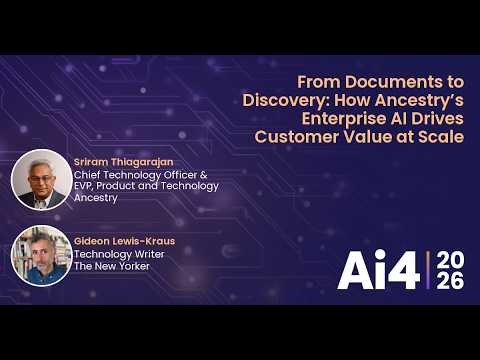
Published on YouTube by Ai4 on August 19, 2026, this fireside chat features Ancestry CTO Sriram Thiagarajan in conversation with The New Yorker technology writer Gideon Lewis-Kraus. The session explores how Ancestry leverages enterprise-scale AI, a model-agnostic gateway, and privacy-first governance to transform over 71 billion historical records into meaningful customer discoveries.
## TL;DR
Ancestry CTO Sriram Thiagarajan details how the platform transitioned from manual transcription and classical machine learning to an advanced multi-model generative AI ecosystem. The platform powers features like Ancestry AI Stories by synthesizing disparate records into factual, citation-backed biographical narratives without hallucinated filler. To resolve complex historical identity disambiguation across billions of records, Ancestry relies on its custom 14-billion-profile 'Brick Tree' graph engine alongside strict inference cost controls and privacy guardrails. This architecture now automates over 70% of Ancestry's digitization pipeline, scaling throughput to roughly 10 million digitized records per day.
## Atmosphere & style
The exchange carries the measured, pragmatic tone of an enterprise deep-dive, balancing complex systems architecture with a clear respect for personal family history. Gideon Lewis-Kraus steers the conversation toward genuine engineering trade-offs like disambiguation and LLM orchestration, while Thiagarajan responds with confident, no-nonsense clarity. The discussion feels refreshingly grounded, deliberately rejecting flashy generative gimmicks in favor of factual integrity, responsible governance, and tangible customer utility.
## Key takeaways
- [00:04](https://www.youtube.com/watch?v=_-JUf72NQuA&t=4s) Ancestry AI Stories synthesizes disparate historical documents into coherent, multi-source biographical narratives equipped with interactive citations and audio narration.
- [00:04](https://www.youtube.com/watch?v=_-JUf72NQuA&t=4s) The platform enforces strict factual grounding guardrails to prevent generative AI from hallucinating or inventing narrative filler between verified historical records.
- [00:04](https://www.youtube.com/watch?v=_-JUf72NQuA&t=4s) Within five months of rollout, users generated 1.5 million AI Stories across Ancestry's catalog of over 9 billion applicable historical records.
- [04:29](https://www.youtube.com/watch?v=_-JUf72NQuA&t=269s) Ancestry's data ingestion evolved over three decades from physical scanning and outsourced manual transcription to in-house computer vision for complex handwritten documents.
- [07:01](https://www.youtube.com/watch?v=_-JUf72NQuA&t=421s) Ancestry built a model-agnostic infrastructure utilizing roughly a dozen specialized proprietary and open-source models, preventing lock-in to any single vendor.
- [07:01](https://www.youtube.com/watch?v=_-JUf72NQuA&t=421s) The company's responsible AI policy strictly prohibits exposing customer data to external third-party LLM vendors for model training.
- [07:01](https://www.youtube.com/watch?v=_-JUf72NQuA&t=421s) To optimize inference costs, Ancestry routes heavy digitization workloads to self-hosted open-source models on AWS rather than relying exclusively on per-token commercial APIs.
- [12:00](https://www.youtube.com/watch?v=_-JUf72NQuA&t=720s) To solve identity disambiguation across identical names, Ancestry built the 'Brick Tree' graph database, which maps relationships across more than 14 billion ancestor profiles.
- [12:00](https://www.youtube.com/watch?v=_-JUf72NQuA&t=720s) The disambiguation engine evaluates billions of potential graph traversals to triangulate identities using geography, kinship networks, and timeline constraints.
- [15:29](https://www.youtube.com/watch?v=_-JUf72NQuA&t=929s) AI and computer vision now automate 70% to 75% of Ancestry's record digitization, scaling processing capacity to roughly 10 million records per day.
- [15:29](https://www.youtube.com/watch?v=_-JUf72NQuA&t=929s) Ancestry focuses its AI roadmap on deep factual utility and multi-sensory discovery rather than superficial generative novelties like animated avatars.
## Detailed walkthrough
### [00:04](https://www.youtube.com/watch?v=_-JUf72NQuA&t=4s) Ancestry AI Stories Demo: Turning Historical Records into Factual Narratives
Sriram Thiagarajan introduces Ancestry as the world's largest online family history platform, dedicated to helping users discover, preserve, and share their unique family stories. To demonstrate practical enterprise AI application, he showcases a live demo of "Ancestry AI Stories." The feature works by synthesizing disparate historical documents collected worldwide across the company's platform and weaving them into coherent narratives for individual ancestors.
In the demo, Thiagarajan walks through the profile of a real employee's ancestor named Roland W. Nauer. On Roland's timeline, the AI consolidates around ten different government and military records from World War I—including draft registration cards, specific battle locations, and discharge papers—alongside contemporary newspaper articles. Instead of allowing the AI to invent filler details, the system operates strictly under the constraint of factual groundedness: "we don't let AI fill the gaps or make up stories. This is based on real records, but connecting the dots across the records about a person to weave that end-to-end unique story."
The platform presents these synthesized biographies with full source citations, interactive timelines, and audio narration. Thiagarajan shares an audio clip: *"Days after his 26th birthday in the spring of 1918, the paper trail catches Roland W. Nauer in Beaver, Utah being inducted into the United States Army."* Users can click directly on any citation to inspect the underlying source document, ranging from structured tabular data to raw historical scanned images.
```mermaid
flowchart TD
accTitle: Ancestry AI Stories Data Flow
subgraph Sourcing["Record Sourcing"]
A["Scanned Historical Records"]
B["Newspaper Archives"]
C["Government & Census Data"]
end
subgraph Extraction["Multi-Model Extraction"]
D["Computer Vision & OCR"]
E["Entity & Relationship Extraction"]
end
subgraph Synthesis["Grounding & Narrative Generation"]
F["Factual Grounding Guardrails"]
G["Ancestry AI Stories Engine"]
end
subgraph Output["Multimodal User Experience"]
H["Interactive Timeline & Citations"]
I["Narrative Text & Voice Audio"]
end
A --> D
B --> D
C --> D
D --> E
E --> F
F --> G
G --> H
G --> I
```
- **Feature scale**: The underlying storytelling feature operates across more than 9 billion records.
- **User adoption**: 1.5 million AI stories were generated by Ancestry customers within roughly five months of launch.
- **Total repository**: Ancestry hosts approximately 71 billion total historical records across its entire platform.
---
[04:29](https://www.youtube.com/watch?v=_-JUf72NQuA&t=269s) Evolution of Digitization: From Industrial Scanners to Transformers
Gideon Lewis-Kraus asks about the historical progression of Ancestry's tech stack, noting that the underlying work long predates the modern generative AI boom. Thiagarajan explains that Ancestry has engaged in content digitization for over 30 years. Initially, this involved physical partnerships with archival institutions, museums, libraries, and government bodies worldwide to access microfiches and paper records dating back to the invention of the printing press. Teams operated industrial-scale scanners on-site at institutions like the National Archives to capture optical images, which were then manually transcribed and indexed via large-scale business process outsourcing (BPO) operations to extract names, dates, and relationships.
About a decade ago, Ancestry automated this workflow by applying classical machine learning and open Computer Vision (CV) models developed by their in-house data science teams. This automation evolved to accurately decipher handwritten text, such as handwritten family notes and variable handwriting from census workers on historical census rolls.
When transformer models emerged two to three years prior, Ancestry began experimenting with them internally before OpenAI released ChatGPT. This background enabled them to seamlessly adopt large language models (LLMs) to enhance content digitization while maintaining strict guardrails anchored in verifiable truth.
---
[07:01](https://www.youtube.com/watch?v=_-JUf72NQuA&t=421s) Multi-Model Infrastructure, AI Governance, and Cost Optimization
Addressing how the shift from narrow, bespoke algorithms to broad generative models altered internal workflows, Thiagarajan explains Ancestry's architectural and governance strategy. From day one, the engineering team avoided vendor lock-in with any single model provider by establishing two core principles:
1. **Responsible AI Policy**: A strict privacy and governance framework guaranteeing that customer data is never exposed to third-party LLMs for external training or subject to model misinterpretation.
2. **Model-Agnostic Infrastructure**: Deploying a diverse suite of approximately a dozen specialized models—spanning proprietary commercial APIs and fine-tuned open-source models hosted in-house on AWS.
The AI Stories feature itself leverages five distinct models working in concert. To orchestrate this, Ancestry custom-engineered its own internal AI gateway and infrastructure over two and a half years. As cloud providers and model vendors (including AWS, Google, OpenAI, Anthropic, and OpenRouter) launched native enterprise gateway features, Ancestry pragmatically migrated non-differentiating components to commercial solutions to maximize scaling efficiency.
Because Ancestry had deep institutional machine learning experience, the team aggressively managed inference costs from the outset. They optimized prompt engineering, minimized token usage, and routed heavy digitization workloads to self-hosted open-source models where costs are bounded by raw AWS compute rather than variable per-token API fees. Rather than deploying AI indiscriminately across the entire platform, Ancestry focused engineering efforts on high-value domains: content digitization and resolving complex multi-generational human relationships across up to 14 generations.
---
[12:00](https://www.youtube.com/watch?v=_-JUf72NQuA&t=720s) Solving Identity Disambiguation and the Custom "Brick Tree" Graph
Lewis-Kraus introduces what he calls the "Joseph Smith problem"—the profound challenge of identity disambiguation when thousands of historical individuals share identical names, live in the same geographic areas (such as a single New York county), or have misspelled names across documents. Thiagarajan explains that distinguishing whether two records belong to the same historical individual is resolved through Ancestry's proprietary "connecting the dots" algorithms.
```mermaid
flowchart LR
accTitle: Ancestry Graph Disambiguation Engine
subgraph Input["Record Ingestion"]
R1["Record A: Location, Date, Name"]
R2["Record B: Varied Spelling, Kinship"]
end
subgraph Engine["Disambiguation & Triangulation"]
G["Brick Tree Graph Engine\n(14B+ Linked Profiles)"]
T["Multi-Parameter Triangulation\n(Dates, Locations, Kinship)"]
end
subgraph Output["Confidence Evaluation"]
C1["High Confidence Match\n(Automated Discovery Hint)"]
C2["Probabilistic Match\n(Suggested User Research)"]
end
R1 --> G
R2 --> G
G --> T
T --> C1
T --> C2
```
To power this cross-referencing, Ancestry built a custom graph database called the **Brick Tree**.
- The graph maps relationships across more than 14 billion ancestor profiles.
- For any single individual profile, the system evaluates billions of possible associative graph traversals, both linearly and non-linearly.
- Disambiguation algorithms triangulate identity across multi-dimensional parameters, including geographic locations, timeline bounds, life events (births, marriages, deaths), and kinship networks.
- When confidence is absolute, the system automatically links records; when probabilistic ambiguity remains, the platform suggests the record as a hint for the user to research and verify manually.
---
[15:29](https://www.youtube.com/watch?v=_-JUf72NQuA&t=929s) Scaling Digitization Throughput and the Future Roadmap
When asked about platform metrics, Thiagarajan explains that discovery efficacy is measured directly by user engagement with "hints" (the well-known "shaky leaf" icon that alerts users to newly surfaced records matching their family tree). AI-assisted extraction and graph matching have significantly boosted hint quality and throughput.
The structural impact on Ancestry's digitization pipeline has been transformative:
- **Historical throughput**: In the prior year, Ancestry digitized roughly 4.5 billion records.
- **Current throughput**: The platform currently digitizes approximately 10 million records per day, on track to exceed 8 billion records digitized annually.
- **Process shift**: AI, computer vision, and handwriting recognition now automate over 70% to 75% of all record digitization, driving manual BPO transcription down to just 25%.
Looking ahead, Thiagarajan emphasizes that Ancestry remains anchored in genuine customer utility rather than superficial generative novelties: *"We're not in the business of making dead people dance using AI and having all these avatars and characters."* As compute and inference costs decline, Ancestry plans to expand beyond text and audio narration by combining "sight, sound, and motion" into visually immersive, rich media family discoveries, while continuously refining their AI graph triangulation to connect human family trees globally.
## Notable quotes
> [00:04](https://www.youtube.com/watch?v=_-JUf72NQuA&t=4s) we don't let AI fill the gaps or make up stories. This is based on real records, but connecting the dots across the records about a person to weave that end-to-end unique story. — Sriram Thiagarajan
> [00:04](https://www.youtube.com/watch?v=_-JUf72NQuA&t=4s) Days after his 26th birthday in the spring of 1918, the paper trail catches Roland W. Nauer in Beaver, Utah being inducted into the United States Army.
> [15:29](https://www.youtube.com/watch?v=_-JUf72NQuA&t=929s) We're not in the business of making dead people dance using AI and having all these avatars and characters. — Sriram Thiagarajan
## Mentioned
Sriram Thiagarajan, Gideon Lewis-Kraus, Roland W. Nauer, Ancestry, The New Yorker, Ai4, Ancestry AI Stories, National Archives, ChatGPT, OpenAI, AWS, Google, Anthropic, OpenRouter, Llama, Brick Tree
## Video description
Sriram Thiagarajan - Chief Technology Officer & EVP, Product and Technology, Ancestry
Gideon Lewis-Kraus - Technology Writer, The New Yorker
What if enterprise AI's greatest competitive advantage isn't speed or efficiency—but the ability to unlock meaning and deepen customer value? This fireside chat will explore how Ancestry transformed 71 billion historical records into living family stories using enterprise-scale AI, while maintaining a privacy-first architecture and responsible governance framework.
Why this matters: as AI moves from experimental to mission-critical, enterprise leaders face a critical choice—optimize for productivity alone, or scale at the intersection of business and customer value. Attendees will learn how Ancestry architected a model-agnostic AI gateway that supports OpenAI, Llama, and custom models while maintaining governance standards; how the team built an engineering culture that moves fast without sacrificing responsible AI principles; and how to put the extensive discovery capabilities of AI into the hands of its customers. The session will conclude with a demonstration of AI Stories—Ancestry's breakthrough feature that shows exactly how this transformation works in practice.
If you're a CIO, CAIO, or technology leader navigating the practical realities of embedding AI into core products, scaling responsibly, and balancing innovation with governance, this session offers concrete strategies and real-world proof points you can bring back to your organization.
Ancestry通过多模型AI技术栈实现75%记录摄入自动化
企业级生成式AI只有锚定专有图数据库和可验证的源记录、而非合成的新奇功能时,才能提供可扩展的客户实用价值。
Ancestry首席技术官Sriram Thiagarajan详细阐述了该平台如何从人工转录和传统机器学习过渡到先进的多模型生成式AI生态系统。该平台为Ancestry AI Stories等功能提供支持,通过整合零散记录生成有据可查、附带引用的真实传记叙事,且不含虚构的填充内容。为了在数十亿条记录中解决复杂的历史身份消歧问题,Ancestry依靠其定制的包含140亿个人档案的“Brick Tree”图引擎,并辅以严格的推理成本控制和隐私护栏。目前,该架构使Ancestry超过70%的数字化流程实现自动化,每日数字化记录处理吞吐量扩展至约1000万份。
Ancestry AI Stories将零散的历史文献整合为连贯的多源传记叙事,并配备交互式引用和语音旁白。 (0:04)
该平台执行严格的事实依据护栏,以防止生成式AI在经核实的历史记录之间产生幻觉或虚构叙述填充内容。 (0:04)
在推出后的五个月内,用户在Ancestry超过90亿份适用历史记录的目录中生成了150万个AI Stories。 (0:04)
三十年来,Ancestry的数据摄入方式经历了演变,从实物扫描和外包人工转录,发展到用于处理复杂手写文档的自研计算机视觉技术。 (4:29)
Ancestry构建了与模型无关的基础设施,利用了大约十几种专用的专有和开源模型,避免受制于任何单一供应商。 (7:01)
Reading summary
Ancestry applies a model-agnostic artificial intelligence architecture alongside a 14-billion-profile graph database to automate historical record digitization, resolve identity ambiguities, and generate fact-checked biographical narratives at scale.
Grounded Storytelling and Multimodal Narrative Generation (0:04)
Ancestry's AI Stories feature synthesizes fragmented historical records into unified timelines supported by citations and synthesized audio narration. To prevent hallucination, the engineering architecture enforces strict factual guardrails: the system connects documented evidence rather than allowing models to invent connective details or fill biographical gaps. For instance, in a case study of soldier Roland W. Nauer, the system integrated draft registration cards, specific battle locations, discharge papers, and contemporary newspaper articles, enabling users to click citations to inspect the original archival scans.
Digitization Evolution from Manual Indexing to Transformers (4:29)
Ancestry's data acquisition evolved over three decades, progressing from on-site industrial scanning of microfiches and manual transcription by outsourced business operations to automated machine learning. Approximately a decade ago, the company introduced computer vision and classical machine learning models to decipher historical handwriting on census rolls and personal records. Pre-dating the public rollout of modern generative AI, the team tested transformer architectures to accelerate ingestion.
This pipeline transition altered operational throughput. In the prior year, Ancestry digitized roughly 4.5 billion records; current throughput stands at approximately 10 million records per day, pacing the platform to surpass 8 billion records annually. Automated computer vision and handwriting models now process 70% to 75% of records, decreasing manual outsourced transcription to 25%.
Model-Agnostic Infrastructure and Inference Cost Management (7:01)
To prevent vendor lock-in, Ancestry built an internal gateway deploying approximately a dozen specialized models, combining commercial APIs with open-source models hosted internally on AWS. The AI Stories feature alone coordinates five separate models. The architecture adheres to an internal responsible AI framework ensuring customer data is never shared with third-party providers for external model training.
To control operational expenses, the team actively manages prompt efficiency, minimizes token usage, and routes data-intensive digitization tasks to self-hosted open-source models, capping costs at underlying compute infrastructure rather than variable per-token API rates. AI engineering efforts remain targeted on high-utility workflows, notably content transcription and mapping human relationships spanning up to 14 generations.
Resolving Identity Disambiguation with the Brick Tree (12:00)
Differentiating between historical individuals with identical names, similar life dates, or overlapping locations—referred to as the 'Joseph Smith problem'—is handled by Ancestry's proprietary 'Brick Tree' graph database. Containing over 14 billion linked ancestor profiles, the engine calculates billions of associative and linear graph traversals for an individual record.
The underlying algorithms triangulate identity across multi-dimensional criteria, assessing timeline boundaries, geographic locations, vital events such as births and marriages, and broader kinship networks. When data yields absolute certainty, records link automatically; when probabilistic ambiguity remains, the platform generates user hints for manual customer evaluation.
According to speaker Sriram Thiagarajan, Ancestry intends to incorporate rich media—combining sight, sound, and motion—as inference costs decrease, while actively rejecting generative novelties like animated historical avatars in favor of verifiable genealogical discovery.
精炼阅读摘要
Ancestry 技术负责人 Sriram Thiagarajan 阐述了该公司如何利用多模型架构、严格的事实约束以及覆盖超 140 亿档案的自研图数据库,将 710 亿份历史档案转化为高保真的家族叙事,展示了企业级 AI 在数据数字化与实体消歧领域的规模化落地途径。
基于事实约束与多源档案的叙事重构 (0:04)
在 Ancestry AI Stories 的实际演示中,系统展示了如何为具体历史人物(如员工先辈 Roland W. Nauer)自动构建生平传记。该算法聚合了一战征兵登记卡、具体服役交战地点、退伍证明及同时期的历史报纸等约 10 份离散记录,并合成带有完整文献引用的时间线和语音旁白。用户可以直接点击引用条目,核对背后的原始扫描图像或结构化表格数据。
Thiagarajan 强调,该系统的核心设计原则是严格的事实落地(factual grounding),严禁 AI 编造情节或填充历史空白,叙事必须完全建立在可核验的实体记录之上。目前该功能已接入 Ancestry 平台超 710 亿历史档案库中的 90 亿份记录;在功能发布后约五个月内,平台用户已累计生成了 150 万个 AI 家族故事。
三十年数字化演进与模型无关架构 (4:29)
Ancestry 的数字化历程始于 30 多年前,最初依靠在国家档案馆等机构现场使用工业扫描仪翻拍微缩胶片与纸质文献,并通过大规模业务流程外包(BPO)进行人工转录与索引。约十年前,内部数据科学团队引入经典机器学习与计算机视觉模型,实现了历史人口普查表及手写家族便条的自动化识别。两至三年前,团队在 ChatGPT 问世前便开始探索 Transformer 架构,为后续无缝接入大语言模型(LLM)奠定了工程基础。
在模型治理方面,Ancestry 确立了两大原则:一是责任 AI 政策,严格禁止客户数据被第三方用于外部大模型训练;二是“模型无关”架构,工程团队在 AWS 上托管微调开源模型,并结合商业专有 API,调度约 12 个专用模型(其中 AI Stories 单一功能即由 5 个模型协同驱动)。随着主流云厂商推出原生网关服务,Ancestry 逐步将非差异化的网关组件迁移至商业方案,以优化系统扩展效率。
算力成本控制与“Brick Tree”消歧图谱 (12:00)
针对大规模调用大语言模型带来的高昂推理开销,Ancestry 通过优化提示词工程、最小化 Token 消耗量,并将繁重的内容数字化工作分流至自托管的开源模型,从而将成本锁定在可控的基础算力层面,而非支付浮动的 API 费用。技术资源被集中投放于高价值领域,特别是档案内容数字化,以及纵跨多达 14 代的人类亲属关系推演。
面对同名同姓、地理相近及拼写变异带来的“约瑟夫·史密斯难题”(Joseph Smith problem),Ancestry 构建了名为“Brick Tree”的自研图数据库。该图谱收录了超 140 亿个先辈档案节点,针对单一个人档案可进行数十亿次线性和非线性图遍历。消歧算法综合地理位置、时间跨度、关键生命事件(出生、婚姻、死亡)与亲属关系网络进行多维比对,在确定性极高时自动关联,在概率匹配时则以“提示”(hint)形式交由用户手动核实。
吞吐量激增与拒绝娱乐化的多模态路线 (15:29)
目前,以计算机视觉与手写识别为代表的 AI 技术已覆盖 Ancestry 整体档案数字化工作流的 70% 至 75%,使人工外包转录比例降至 25%。平台数字化吞吐量从去年的约 45 亿份记录跃升至目前的每日约 1000 万份,全年数字化总量预计将超过 80 亿份。发现效率的提升也显著提高了用户对“晃动绿叶”(新匹配记录提醒)的互动率。
在未来技术路线上,Thiagarajan 明确表示 Ancestry 不会追逐“用 AI 让逝者跳舞或制作虚拟化身”等缺乏实用价值的视觉噱头,而是致力于严肃的历史发现。随着计算与推理成本进一步降低,平台计划将视觉、声音与动态媒介融合为更沉浸的富媒体发现体验,同时持续优化基于知识图谱的全球人类家族树关联网络。
Ancestry 的实践表明,生成式 AI 在高准确度要求的传统垂直行业中,必须与图数据库、计算机视觉及严格的事实核查机制深度集成。然而,在跨越数十代、涉及数十亿节点的庞大家族网络中,概率性匹配在多大程度上能完全替代人工考据,以及多模态富媒体如何在不损害历史严肃性的前提下持续控制算力成本,仍是该技术路径面临的长期考量。
Detailed notes — zh
## Background
本视频由 Ai4 于 2026 年 8 月 19 日在 YouTube 平台发布,记录了 Ancestry 首席技术官 Sriram Thiagarajan 与《纽约客》科技作家 Gideon Lewis-Kraus 展开的炉边对谈。内容主要探讨 Ancestry 如何通过企业级 AI 架构与责任制治理框架,将平台积累的 710 亿份海量历史档案转化为有温度的家族故事,在保障隐私与事实严谨性的同时规模化释放客户价值。
## TL;DR
对谈详细回顾了 Ancestry 从早期物理扫描、人工索引到引入经典机器学习与 Transformer 大模型的三十年技术演进历程,并重点展示了已生成超 150 万个故事的突破性功能“AI Stories”。为了攻克历史同名人群的实体消歧难题,团队自研了涵盖 140 亿先辈档案的 Brick Tree 图数据库,并搭建了私有化多模型 AI 网关以极致压缩 Token 与推理成本。目前平台档案数字化年处理量突破 80 亿条,AI 自动化占比达 70% 以上;Ancestry 明确拒绝娱乐化动态虚拟人噱头,坚守严谨的事实护栏,未来将进一步拓展视听动一体的多模态沉浸式发现体验。
## Atmosphere & style
整场炉边对谈洋溢着严谨务实且富有深度的工程技术气息,主持人 Gideon 的提问切中底层架构与数据痛点,CTO Sriram 的回应则条理清晰、冷静克制。对话在剖析图数据库、多模型路由与成本控制等硬核技术细节的同时,始终贯穿着对家族历史与真实人性的温情敬畏。现场摒弃了浮夸的 AI 概念炒作,展现出一种将前沿技术脚踏实地嵌入核心业务场景的深厚底蕴与专业张力。
## Key takeaways
- [00:04](https://www.youtube.com/watch?v=_-JUf72NQuA&t=4s) Ancestry 推出“AI Stories”功能,将全球分散的历史档案串联,自动生成具备事实依据和文献引用的连贯祖先生平叙事,已为用户生成超 150 万个故事。
- [00:04](https://www.youtube.com/watch?v=_-JUf72NQuA&t=4s) 平台设定严苛的事实护栏(Guardrails),禁止 AI 虚构或填补未经证实的情节,所有叙事均附带原始扫描档案和文献佐证。
- [04:29](https://www.youtube.com/watch?v=_-JUf72NQuA&t=269s) Ancestry 的数字化历程跨越 30 年,经历了物理扫描、人工外包索引(BPO)、传统机器学习手写识别,最终演进到生成式 Transformer 模型。
- [07:06](https://www.youtube.com/watch?v=_-JUf72NQuA&t=426s) 实行严格的“责任制 AI 政策”(Responsible AI Policy),确保客户隐私数据不泄露给第三方,且绝不用于训练公共外部大模型。
- [07:06](https://www.youtube.com/watch?v=_-JUf72NQuA&t=426s) 采用模型无感(Model-Agnostic)架构与自研 AI 网关(AI Gateway),单场景协同运行多种模型,并在 AWS 私有化部署精调开源模型以降低 Token 成本。
- [10:16](https://www.youtube.com/watch?v=_-JUf72NQuA&t=616s) 面对历史档案中同名同姓、同地域的“约瑟夫·斯密难题”(Joseph Smith Problem),团队利用多维度交叉印证攻克实体消歧(Disambiguation)挑战。
- [12:58](https://www.youtube.com/watch?v=_-JUf72NQuA&t=778s) 自研代号为“Brick Tree”的专用图数据库,收录超 140 亿个先辈档案实体,支持线性与非线性的高维遍历三角定位。
- [15:28](https://www.youtube.com/watch?v=_-JUf72NQuA&t=928s) 通过自研手写体识别和自动化机器学习管线,档案自动处理比例达 70%~75%,年数字化处理量预计突破 80 亿条大关。
- [17:31](https://www.youtube.com/watch?v=_-JUf72NQuA&t=1051s) 坚持以“Hints(摇晃的绿叶)”所代表的用户发现价值为核心指标,拒绝制作娱乐化或动态化逝者形象的 AI Avatar 噱头,专注深层情感共鸣与多模态叙事演进。
## Detailed walkthrough
### [00:04](https://www.youtube.com/watch?v=_-JUf72NQuA&t=4s) Ancestry 平台定位与“AI Stories”功能实机演示
作为全球最大的在线家族历史平台,Ancestry 致力于帮助用户探索、保存和分享独特的家族故事。用户可以在平台上构建家族树,挖掘祖辈鲜为人知的事迹。在演讲开场,Sriram Thiagarajan 首先展示了团队利用人工智能打造的突破性功能——Ancestry AI Stories。该功能的核心在于:将平台多年来从全球收集的海量零散历史档案进行系统化串联,自动为特定祖先生成真实严谨的生动生平。
以现场演示的真实案例为例,用户想了解 Ancestry 内部员工的先辈罗兰(Roland W. Nauer)的生平。在时间线页面中,AI 汇聚了该先辈在第一次世界大战期间的近 10 份不同政府官方记录(包括兵役登记、参战地点、退役时间等),并结合当时的报纸报道进行综合分析。AI 将多份文档中的人名、地点、亲属关系等要素相互印证,自动生成了一篇叙事连贯的事实传记。针对内容真实性,Sriram 强调平台设定了极其严格的边界:“我们不允许 AI 凭空填补空白或编造故事,所有的内容都必须基于真实历史记录。”演示中还展示了语音旁白播报(如:“1918 年春天,在他 26 岁生日后的几天,纸质档案记录了罗兰在犹他州比弗县应征加入美国陆军……”),未来平台还计划融合视觉、声音与动态影像,为用户提供完整的视频化家族历史。
每一段 AI 生成的叙事均附带严格的文献引用与原始档案超链接,涵盖扫描图片、表格数据等各类复杂历史凭据。目前该功能已应用到平台超过 90 亿份历史档案中,在全面上线约 5 个月的时间里,系统已为用户自动生成了超过 150 万个 AI 故事。
```mermaid
flowchart TD
accTitle: Ancestry AI Stories 数据生成流程
subgraph S1["多源档案采集与识别"]
A["全球实体历史档案<br>(政府记录/报纸/人口普查)"] --> B["高精度 OCR 与表格识别"]
B --> C["实体与关系抽取<br>(姓名/地点/时间/事件)"]
end
subgraph S2["多模型综合推理与合成"]
C --> D["跨档案多点对齐与消歧"]
D --> E["严苛事实护栏引擎<br>(禁止无依据虚构)"]
E --> F["AI 叙事文本与时间线生成"]
end
subgraph S3["多模态呈现与溯源"]
F --> G["音频旁白合成与未来视频管线"]
F --> H["端到端事实引证<br>(溯源至原始档案扫描件)"]
end
```
- 平台核心数据规模:平台累计积累超过 710 亿份历史档案,其中已有超 90 亿份档案接入了故事生成处理系统。
- 业务转化数据:AI Stories 上线大规模运行约 5 个月,已累计生成超 150 万份专属家族故事。
- 产品形态路线:已上线文本叙事与语音合成播报功能,目前正在推进“视、听、动”结合的多模态视频呈现形式。
---
### [04:29](https://www.youtube.com/watch?v=_-JUf72NQuA&t=269s) 三十年数字化演进:从物理扫描、外包索引到 Transformer 模型
Gideon Lewis-Kraus 指出,Ancestry 的档案数字化探索远早于当前大语言模型的爆发期。Sriram 回顾了过去 30 年的技术演进路径。早期 Ancestry 依赖深度的人工与物理流程:团队与全球各大档案馆、博物馆、政府机构、图书馆建立独家合作,寻找自印刷术发明以来或以缩微胶片形式保存的各类纸质记录。Ancestry 在国家档案馆等机构部署了工业级扫描仪,由工作人员手动将文件扫描为 OCR 图像格式。
在早期,扫描后的数据需要依托庞大的业务流程外包(BPO)团队进行纯手工索引录入,逐一提取姓名、字段与亲属关联。转折发生在约 10 年前,Ancestry 的数据科学团队开始引入基于 OpenCV 的传统经典机器学习算法,逐步实现了文档的自动化解析,甚至能够精准辨识人口普查员在表格中留下的手写体笔记。
大约两到三年前,早在 OpenAI 正式发布 ChatGPT 之前,Ancestry 就已经开始深入实验 Transformer 架构模型。正是得益于长达十年的自动化数字化积累,当生成式 AI 浪潮来临时,团队能够水到渠成地将 LLM 与基于事实真理的严格护栏机制结合,将原先机械式的索引提取推进到了高阶的内容叙事生成。
- 档案采集生态:涵盖全球国家档案馆、历史博物馆、各级图书馆等机构的手写档案、报纸以及缩微胶片(Microfiches)。
- 算法演化节点:10 年前引入 OpenCV 与经典机器学习实现手写体(如人口普查表)自动化识别;2 至 3 年前启动 Transformer 模型预研。
---
### [07:06](https://www.youtube.com/watch?v=_-JUf72NQuA&t=426s) 责任制 AI 治理、多模型路由与自研 AI 网关架构
在探讨从针对特定任务的定制机器学习模型向通用生成式大模型转型的过程中,Gideon 询问团队的技术工作流、招聘方向以及早期算法积累是否面临颠覆。Sriram 解释道,团队在技术路线选择上从一开始就确立了“不绑定单一模型”的基本原则,并在启动任何 AI 功能开发前推行了两大核心支柱:
第一是制定内部“责任制 AI 政策”(Responsible AI Policy)。团队做出严正承诺,绝不将客户数据泄露给第三方,严防用户数据在未经许可的情况下被用于训练外部公共模型,同时确保生成内容不被 AI 歪曲解读。第二是构建支持模型无感(Model-Agnostic)的灵活架构。Sriram 透露,光是 AI Stories 这一个应用场景底层就协同运行着 5 种不同的模型;平台整体则常态化使用十几种模型,包括基于 AWS 私有化部署并由内部团队精调的开源模型。由于需要对数十亿级别的档案进行低延迟、低成本的处理,完全依赖商业 API 并不现实,必须依托自研精调模型来极度压缩 Token 消耗。
Ancestry 在过去两年半中完全自主研发了包含 AI Gateway(AI 网关)在内的整套 AI 基础设施。尽管后来市面上陆续出现了 OpenRouter、AWS、Google 以及 OpenAI、Anthropic 官方推出的同类网关工具,Ancestry 始终保持开放心态,毫不留恋早期自研代码:“如果第三方商业解决方案在扩展效率上更具优势,我们会毫不犹豫地选择迁移。”
- 隐私与治理准则:建立严格的客户数据保护防线,禁止第三方将平台用户数据用于底层 LLM 训练。
- 多模型协同实况:AI Stories 功能单点依赖 5 种不同模型;整体业务矩阵运行十余种大/小模型。
- 算力基础设施:在 AWS 上私有化托管精调开源模型,自主搭建 AI 网关控制流量、路由并优化 Token 吞吐。
---
### [10:16](https://www.youtube.com/watch?v=_-JUf72NQuA&t=616s) 推理成本控制与家族图谱中的“实体消歧难题”
关于推理成本的演变,Sriram 表示随着模型优化和基础设施迭代,单次推理成本较最初上线时已经出现了显著下降。由于 Ancestry 在机器学习领域深耕多年,工程团队对底层运行成本和计算开销有着极其敏锐的商业直觉,从早期的 Prompt 工程优化、Token 精简,到大规模转用私有化开源模型,团队通过“只承担 Compute 计算成本、免除第三方 Token 费用”的策略大幅摊薄了长期运营支出。
在 AI 落地策略上,Ancestry 拒绝盲目跟风在所有产品线无节制铺设 AI,而是精准聚焦于两到三个核心痛点:一是大规模内容数字化,二是全球跨越 14 代人的超复杂家族关系图谱挖掘。这种“在实践中迭代学习”(Learning by doing)的研发文化,帮助团队在技术激变中稳住了节奏。
在访谈第一部分的尾声,Gideon 抛出了一个极为关键的行业痛点:虽然大模型的幻觉问题已有所缓解,但 Ancestry 面临着一个极其独特的棘手挑战——即所谓的“约瑟夫·斯密难题”(Joseph Smith Problem)。在浩瀚的历史长河中,同名同姓、甚至生活在同一个县份或时代的先辈比比皆是。面对高度重叠的身份线索,如何利用 AI 对碎片化档案进行精准消歧(Disambiguation),判定两份记录是否确实指向同一个人,成为了平台最核心的技术分水岭。
- 降本增效抓手:利用早期 Prompt 精简、Token 压缩及私有化开源模型替代纯商业 API 调用。
- 关键复杂度场景:支撑全球范围内跨越 14 代人的家族血缘与历史关联推理计算。
- 核心技术挑战(实体消歧):同名同姓、同地域人群在历史多源数据交叉时的精准实体对齐与防误判机制。
### [12:58](https://www.youtube.com/watch?v=_-JUf72NQuA&t=778s) 跨文档“连点成线”与自研图数据库 Brick Tree
在处理历史档案时,最棘手的挑战之一是信息的混乱与拼写的不一致——例如同一个姓氏“Smith”在不同历史时期的多份档案中可能出现各种拼写错误。Ancestry 将自身积累的深厚行业经验转化为独特的算法体系,内部称之为“连点成线”(connecting the dots)。通过这套算法,系统可以在某些场景下以“绝对的确定性”断定两条记录属于同一人,而在确定性稍低的场景下,则会作为高置信度的推测推荐给用户,提示其结合站外资料做进一步考证。随着现代 AI 技术的引入,跨越数十亿条档案、在庞大且异构的数据集中进行穿梭与关联变得前所未有地高效。
针对 Gideon Lewis-Kraus 提出的“这种三角定位(triangulation)在底层究竟如何运作”的疑问,Sriram Thiagarajan 透露 Ancestry 在内部自主构建了一套专用的图数据库,代号为“Brick Tree”。在这个图谱中,平台上的每一个档案人物都与其他人物形成网络关联,系统内已收录超过 140 亿个先辈档案(ancestor profiles)。从理论上讲,人类随着时间的推移,最终都能通过某种脉络彼此相连。Ancestry 利用不断迭代的传统机器学习(Classical ML)模型提炼人物关系,通过多条遍历路径推断个体之间的关联。单一用户在系统中可能会延伸出数十亿条潜在关联记录,而核心算法能够同时进行线性和非线性的高维遍历,结合地理空间(location)、姓名拼写、生存年代以及生老病死等关键人生事件(birth, marriage, death)进行多维度交叉印证。
```mermaid
flowchart TD
accTitle: Brick Tree 多维三角定位架构
subgraph Input["原始海量历史数据"]
R1["拼写变体与错误档案"]
R2["生命事件记录 (出生/结婚/死亡)"]
R3["时空与地理位置标记"]
end
subgraph Core["核心图数据库与算法引擎"]
BT[("Brick Tree 图数据库<br/>(140+ 亿先辈档案)")]
ML["机器学习推断与遍历引擎"]
TRI{"多维三角定位校验<br/>(线性与非线性匹配)"}
end
subgraph Output["用户交付与置信度分层"]
High["绝对确定性匹配"]
Low["高置信度提示 (Hints / 摇晃绿叶)"]
end
Input --> BT
BT --> ML
ML --> TRI
TRI -->|"高置信度"| High
TRI -->|"概率推荐"| Low
```
- **Brick Tree 图数据库**:Ancestry 内部自研的图基础设施,支撑超过 140 亿个先辈档案实体的高维关系网络。
- **高维遍历与三角定位**:利用传统机器学习与现代 AI 算法,结合地理位置、姓名、时间线以及婚姻与死亡证明等社会关联,实现线性和非线性的网络路径穿梭。
---
### [15:28](https://www.youtube.com/watch?v=_-JUf72NQuA&t=928s) 衡量发现价值:摇晃的树叶与数十亿记录的数字化飞跃
当被问及在大语言模型或高维几何记录空间中是否发现过反直觉的语言学奇观时,Sriram Thiagarajan 直言团队的核心研发重心并非验证纯学术假设,而是务实地围绕“为客户带来新发现”展开。平台有效性与用户参与度的核心衡量指标之一是“线索”(Hints)的分发质量——在 Ancestry 的家谱树界面中,这就是标志性的“摇晃的绿叶”(shaky leaf),它代表系统为用户挖掘到了某位祖先的新档案线索,提示用户查阅确认。AI 技术的大规模应用显著提升了这一机制的精准度与召回率。
在内容数字化(Content Digitization)方面,技术的结构性赋能带来了惊人的吞吐量提升。就在访谈进行的那一天,平台单日处理的数字化记录就达到了约 1,000 万条。回顾处理规模的飞跃,Ancestry 前一年全年的档案数字化总量约为 45 亿条,而当前这一年预计将突破 80 亿条大关。在这庞大的数据洪流中,70% 以上(甚至达到 75%)的处理工作已全面由 AI、专有手写文字识别技术(Handwriting Recognition)和机器学习模型构成的自动化管线接管,人工干预的比例已经急剧收缩至 25% 左右。这种生产力维度的重构,直接重塑了整个历史档案工程的底层经济学模型。
- **数字化产能激增**:从年处理约 45 亿条档案跃升至超过 80 亿条,单日数字化能力达到约 1,000 万条。
- **自动化管线占比**:结合自研手写体识别模型、机器学习与 AI,自动化处理比例攀升至 70%~75%,人工数字化比例降至 25%。
- **核心北极星指标**:以“Hints(摇晃的绿叶)”作为衡量平台活跃度与客户发现价值的核心度量衡。
---
### [17:31](https://www.youtube.com/watch?v=_-JUf72NQuA&t=1051s) 拒绝噱头:从 150 万个真实故事走向多模态未来
在对谈的尾声,话题转向了 Ancestry 的未来技术路线图。Sriram Thiagarajan 明确阐述了产品伦理与价值底线,他旗帜鲜明地表示:“我们做 AI 绝不是为了通过算法去让逝者起舞,搞什么动态虚拟人化身或虚假人设(we're not in the business of making dead people dance using AI and having all these avatars and characters)。”Ancestry 始终专注于促成深沉而有意义的情感发现——当用户第一次了解到祖父、曾祖父母的真实人生经历时,往往会第一时间将这些故事自发分享给整个家族。这种强烈的共鸣使得其新推出的“AI Stories”功能在极短的时间内便促成用户自发创建了多达 150 万个家族故事。
展望下一步演进,随着未来模型推理与数据处理成本的持续下行,Ancestry 计划在现有叙述性文本和音频体验的基础上,探索加入“视、听、动”(sight, sound, and motion)全方位的多模态元素,为用户呈现更具沉浸感的视觉化历史发现体验。与此同时,工程团队将持续迭代各种 AI 方案,不断攻克“人类亲缘关联”(human relatedness)这一庞大且复杂的拓扑难题,在保护真实性的前提下,更精准、深层地把跨越时空的人们连接在一起。
- **拒绝浅层噱头**:坚守严肃的情感与家族价值,明确排斥让逝者动态化或制作娱乐化 AI Avatar 的路径。
- **AI Stories 爆发式增长**:短时间内用户通过该功能自主生成了超过 150 万个家族故事。
- **沉浸式多模态蓝图**:待推理与算力成本进一步降低后,将引入融合视觉、声音与动态影像的沉浸式叙事,并持续深化人类亲缘图谱的算法解析精度。
## Notable quotes
> [00:04](https://www.youtube.com/watch?v=_-JUf72NQuA&t=4s) 我们不允许 AI 凭空填补空白或编造故事,所有的内容都必须基于真实历史记录。 — Sriram Thiagarajan
> [00:04](https://www.youtube.com/watch?v=_-JUf72NQuA&t=4s) 1918 年春天,在他 26 岁生日后的几天,纸质档案记录了罗兰在犹他州比弗县应征加入美国陆军……
> [07:06](https://www.youtube.com/watch?v=_-JUf72NQuA&t=426s) 如果第三方商业解决方案在扩展效率上更具优势,我们会毫不犹豫地选择迁移。 — Sriram Thiagarajan
> [10:16](https://www.youtube.com/watch?v=_-JUf72NQuA&t=616s) 只承担 Compute 计算成本、免除第三方 Token 费用 — Sriram Thiagarajan
> [12:58](https://www.youtube.com/watch?v=_-JUf72NQuA&t=778s) 连点成线 — Sriram Thiagarajan
> [17:31](https://www.youtube.com/watch?v=_-JUf72NQuA&t=1051s) we're not in the business of making dead people dance using AI and having all these avatars and characters — Sriram Thiagarajan
> [17:31](https://www.youtube.com/watch?v=_-JUf72NQuA&t=1051s) 我们做 AI 绝不是为了通过算法去让逝者起舞,搞什么动态虚拟人化身或虚假人设 — Sriram Thiagarajan
> [17:31](https://www.youtube.com/watch?v=_-JUf72NQuA&t=1051s) 视、听、动 — Sriram Thiagarajan
## Mentioned
Ancestry, Sriram Thiagarajan, Gideon Lewis-Kraus, The New Yorker, Ai4, AI Stories, Roland W. Nauer, OpenCV, Transformer, ChatGPT, OpenAI, Llama, AWS, Google, Anthropic, OpenRouter, Brick Tree, Joseph Smith
## Video description
Sriram Thiagarajan - Chief Technology Officer & EVP, Product and Technology, Ancestry
Gideon Lewis-Kraus - Technology Writer, The New Yorker
What if enterprise AI's greatest competitive advantage isn't speed or efficiency—but the ability to unlock meaning and deepen customer value? This fireside chat will explore how Ancestry transformed 71 billion historical records into living family stories using enterprise-scale AI, while maintaining a privacy-first architecture and responsible governance framework.
Why this matters: as AI moves from experimental to mission-critical, enterprise leaders face a critical choice—optimize for productivity alone, or scale at the intersection of business and customer value. Attendees will learn how Ancestry architected a model-agnostic AI gateway that supports OpenAI, Llama, and custom models while maintaining governance standards; how the team built an engineering culture that moves fast without sacrificing responsible AI principles; and how to put the extensive discovery capabilities of AI into the hands of its customers. The session will conclude with a demonstration of AI Stories—Ancestry's breakthrough feature that shows exactly how this transformation works in practice.
If you're a CIO, CAIO, or technology leader navigating the practical realities of embedding AI into core products, scaling responsibly, and balancing innovation with governance, this session offers concrete strategies and real-world proof points you can bring back to your organization.
[Source](https://www.youtube.com/watch?v=_-JUf72NQuA)
Source quotes
[0:04] Sriram Thiagarajan: 我们不允许 AI 凭空填补空白或编造故事,所有的内容都必须基于真实历史记录。
[0:04] 1918 年春天,在他 26 岁生日后的几天,纸质档案记录了罗兰在犹他州比弗县应征加入美国陆军……
[7:06] Sriram Thiagarajan: 如果第三方商业解决方案在扩展效率上更具优势,我们会毫不犹豫地选择迁移。
[10:16] Sriram Thiagarajan: 只承担 Compute 计算成本、免除第三方 Token 费用
[12:58] Sriram Thiagarajan: 连点成线
[17:31] Sriram Thiagarajan: we're not in the business of making dead people dance using AI and having all these avatars and characters
[17:31] Sriram Thiagarajan: 我们做 AI 绝不是为了通过算法去让逝者起舞,搞什么动态虚拟人化身或虚假人设
[17:31] Sriram Thiagarajan: 视、听、动
Source quotes
[0:04] Sriram Thiagarajan: we don't let AI fill the gaps or make up stories. This is based on real records, but connecting the dots across the records about a person to weave that end-to-end unique story.
[0:04] Days after his 26th birthday in the spring of 1918, the paper trail catches Roland W. Nauer in Beaver, Utah being inducted into the United States Army.
[15:29] Sriram Thiagarajan: We're not in the business of making dead people dance using AI and having all these avatars and characters.
Original transcript
[0:04] Uh thank you everyone for joining. My name is
uh Sriram Thiagarajan. I lead uh product uh
[0:11] and technology for uh ancestry.com. For those of
you uh that don't know Ancestry or haven't heard,
[0:18] uh we are the largest online family history
platform where our customers can come in and
[0:23] build their family trees and find interesting
factoids and stories. Um so, we uh help our
[0:30] customers discover, preserve, and uh share their
unique family stories. And having said that, I'll
[0:36] just show a quick demo of the feature uh first
on what we built in uh using AI. And then Gideon
[0:46] can ask me all sorts of questions. Um Um So,
uh with that context, we built a feature called
[0:53] Ancestry AI Stories. Um which stitches uh
unique information behind records that we
[1:02] collect about individuals from across the world
uh as they come into our platform. So, just to
[1:08] we'll get up just to show uh how this thing
works. So, you come in and build your family
[1:14] tree on our platform. You want to know an
interesting story about your ancestor Roland.
[1:20] And this is a real story one of our employees. Um
and you can see that on the timeline page, we show
[1:28] uh everything we know about that ancestor. And
this is um made possible by collecting records
[1:35] from around the world that we've done
over the past uh 30 years and extracting
[1:41] uh name, place, relationship, locations uh using
machine learning models in the past and AI today.
[1:48] Um and you can see the um um World War I uh
story. Roland has served in the World War I.
[1:56] Uh and there are like 10 different records,
government records, uh that talk about how Roland
[2:05] had registered for the draft, you know, which
battle, you know, which location he fought in,
[2:10] when did he get discharged from the military,
etc. And our AI takes all of that, it synthesizes
[2:18] making connections about that person across uh
multiple records including any newspaper articles
[2:24] from that time, and we produce a narrative
based on facts. So, the the distinction here
[2:32] is that we don't let AI fill the gaps or make
up stories. This is based on real records, but
[2:39] connecting the dots across the records about a
person to weave that end-to-end unique story. And
[2:46] you know, using voice days after his
26th birthday in the spring of 1918,
[2:52] the paper trail catches Roland W. Nauer in Beaver,
Utah being inducted into the United States Army.
[2:59] So, just as a snippet of, you know, audio stories
being displayed in audio, and eventually we'd like
[3:06] to combine sight, sound, and motion to to give
our users a video version of the stories as well.
[3:14] And uh you know, if you want you can read
the narrative, and we also, you know, give
[3:21] the timelines that are on how the story evolved,
and more importantly, all the facts uh that are
[3:30] citations that are listed here are the real
documents that we sourced information from.
[3:36] And if you look at one of those documents, you can
see, you know, it's some of them are tabular data,
[3:41] some of them are just images, but we
use AI to sort of make sense out of
[3:46] all of these and connecting those documents
together. And if you want to deep dive, we'll let
[3:52] our customers going to specific aspects of uh this
particular uh lifetime in the military for Roland.
[4:01] Um and obviously we do it for more
than 9 billion records today uh across
[4:07] our platform and 1.5 million AI stories have been
generated uh today since launch, which is about
[4:13] at scale probably about five odd months or so.
So, that's the um [clears throat] demo on how
[4:21] a practical use case of how we use AI at Ancestry.
Thank you so much, Saurabh. So, one of the things
[4:29] you told me before we spoke was that this long
predates the current era of generative AI. So,
[4:36] at what point did you guys realize that this sort
of thing was going to be possible and what did
[4:41] what did it look like initially? Yeah. Initially,
I mean, we've been in uh the digitization of
[4:47] content uh business for a while in order to, you
know, provide those discoveries to our customers
[4:54] uh in a very manual fashion for the past
30 years as I mentioned. Uh we used to
[5:00] collect The way we do content collection is we
actually have exclusive relationships in many
[5:06] cases with archival institutions, uh museums,
other government organizations, libraries,
[5:11] historical institutions. Uh and we source
every kind of record that was kept manually
[5:18] over the many, many years since the invention of
printing press um or in in in microfiches, etc.
[5:25] Um and we have industrial-scale scanners at,
you know, be it national archives or be it uh
[5:31] uh other historical museums and we literally
physically people scan these documents into OCR
[5:37] format. And then we uh used to manually index
through a large BPO operation, um extract name
[5:46] fields and relationships that we can infer from
those documents. And then about 10 years ago,
[5:52] we started applying our classical machine learning
models built built on open computer vision
[5:57] uh using with our data science team. And then that
started getting automated uh to the point that we
[6:06] we could read handwrite handwritten documents
um of people or in census document where a
[6:12] census worker uh you know, fills in the gap
or writes information about a family, etc.
[6:17] Uh so, we've been in this space for, you know,
as as I said in in in an automated digitization
[6:24] um content digitization space for about 10
years. And then about two, three years ago when
[6:31] uh the transformer models uh came into being, we
were experimenting with the transformer model even
[6:36] before ChatGPT came out from OpenAI. So, um it was
a natural progression for us and then in sort of
[6:45] experiment in experimenting with those
models, we figured we could take the
[6:50] you know, this digitize content digitization
process a step further um by using, you know,
[6:56] LLMs, but along with the guardrails that is
grounded in truth and facts that we want. Well,
[7:01] we'll get to that guardrails in a minute, but for
as I mean, this is kind of a technical question,
[7:06] but I think we can assume that some of
the people in the audience will have
[7:08] processing this technical question for their
own businesses. Um what was the process like in,
[7:15] you know, being better less unpilled? Meaning like
when you went from using bespoke machine learning
[7:20] models that involved a lot of um you know,
narrow algorithmic processing to like these broad
[7:29] generative models that that don't require the
same kind of algorithmic finesse. Like what
[7:34] has that looked like for you guys? How has that
changed your workflows? How has that changed your
[7:38] recruiting or your approach to these things?
Does it feel like those first five years of
[7:44] developing those algorithms a waste of time?
Yeah, the great question. I mean, first initially
[7:51] even from the beginning we didn't believe that
we would get locked in with just one model.
[7:57] So before we built any feature, there are
two things that we did. One is coming up with
[8:01] out of the responsibility AI policy internally.
Um on how we use AI to uh train our customers'
[8:10] data as well as the you know feature output that
we provide. And then second um building in Because
[8:18] you because you guarantee that it's not going to
go the data is not going to go to a third party or
[8:22] Right, but because because we don't want it to AI
the data to be misinterpreted by AI or you know,
[8:29] by by mistake training you know, third-party
LLMs which we don't want our customer data
[8:36] for them to be trained on. And then secondly, uh
we believe that models will grow over time from
[8:44] large language models to smaller models depending
on the use case. We you know, we have about dozen
[8:50] models and we use different things even in the AI
stories use case that you saw. This thing runs off
[8:56] of a five different models. Uh and we also
have open-source models that we host in-house.
[9:03] When I say in-house, on AWS. Um but fine-tuned
by us for you know, if you're digitizing
[9:11] 9 billion records for storytelling and our
platform has about 71 billion records. So to
[9:16] digitize at scale, you need to have your in-house
expertise and minimize token usage etc. So we
[9:25] use multiple models and we built all of the AI
infrastructure as I said, the AI gateway included
[9:34] on our own for for the first you know, two and a
half years or so. Then we started seeing companies
[9:39] like you know, Open Router, AWS, Google, and
even including OpenAI and Anthropic come out with
[9:47] lot of those features, infrastructure features
that we had already built. But you know,
[9:52] we were already open and we're not very you know,
protective of what we build. If it makes sense
[9:58] from a scaling efficiency perspective, we would
migrate to a solution and we have done over time
[10:04] migrated some of what we had built to what
is now available as a commercial solution.
[10:11] And I mean, how has your approach how have
inference costs changed for you over time?
[10:16] It has definitely come down ever since
we first you know, launched the feature.
[10:22] But as I said, we're very careful about the good
thing I would say about Ancestry, luckily for us,
[10:28] since we were very deep in the machine
learning area before, we had our teams had
[10:36] very deep understanding of how AIs work, how
eventually what will be the cost to operate.
[10:45] So right from being efficient in the early days
of prompt engineering to minimizing you know,
[10:50] tokens and then eventually be a lot of the things
that we do are in our open source models which
[10:57] you you incur compute costs, but you don't
have to spend money on third-party tokens.
[11:03] I mean, this is all through experimentation and
learning. You asked me the previous question
[11:07] on how did we keep up with
this is is in a lot of times
[11:12] we do things not even launch features, but to
learn how to do it and is this even beneficial
[11:19] for our customers and really nearly we didn't
use AI across the board on our platform.
[11:25] We specifically picked two or three areas.
One is content digitization. Second is the uh
[11:31] relationship and discovery in a relating one
person to another through and everybody in the
[11:38] world through like 14 generations it is not an
easy task even from a computational perspective
[11:46] and technology perspective. Um so a lot of
which you know we iteratively learned over the
[11:51] years and that mindset of of of learning by
doing is another reason why we were able to
[12:00] embrace the idea. So then to turn to I mean what I
think is kind of the most interesting problem here
[12:06] is you know everyone to varying degrees has some
issue with hallucination although it seems like
[12:11] it's certainly been mitigated considerably over
time but you guys have this very uniquely tricky
[12:19] you know what one might be tempted to call the
Joseph Smith problem which is what do you do about
[12:26] how do you differentiate between all of the
Joseph Smiths? Yeah I mean that that's the
[12:31] challenge and interesting you know ways to develop
solutions about you know people have multiple
[12:40] multiple [clears throat] people have the same
first name and last name or same last name they
[12:44] may be in the same you know county in New York
so how do you you know disambiguate and uniquely
[12:51] determine does this record about this Joe Smith is
same as this other record and it is the same Joe
[12:58] Smith and and and and your record your names are
spelled incorrectly across multiple records. And
[13:05] this is where our own institutional knowledge that
we have developed in terms of our algorithms to
[13:12] uniquely we call it connecting the dots
uniquely connect the dots so that we can
[13:18] you know with in some cases absolute confidence
say that this is the person and other cases where
[13:23] we can we will suggest that this is likely the
same person and you may have to do some other,
[13:29] you know, research outside of the platform to
do it. Um but for most purposes, especially with
[13:36] AI now, we're able to traverse across multiple
record collections across billions of records,
[13:40] it is made it is made as made it lot easier. Can
Can you speak with any greater specificity about
[13:47] like what that triangulation process looks like?
Yeah. So, you know, we have uh just to give you
[13:53] a sample that we have built our own custom graph
database. Internally we call it the brick tree.
[13:58] Every profile um is connected to every other
profile uh on our platform, meaning, you know,
[14:07] there are, you know, 14 plus billion answers or
profiles that we have uh on our platform. And um
[14:14] in theory, you can be connected to
everybody in the world through some
[14:18] sort of a connection over time, right? Um so,
uh we'd built our own graph database. We had
[14:26] uh used our classical machine learning models
were refined to extract that relationships and
[14:32] how we infer that one person is connected to the
other through multiple uh traversal paths on our
[14:38] on our platform. And um um and if you if you
take a representation of just one individual,
[14:45] um they will have probably billions of record
associations with uh multiple other people.
[14:52] Uh you may or may not be interested in all
of those connections and and stuff, but
[14:56] our algorithms are able to figure out um how to
both linearly and non-linearly uh go and look at
[15:04] how people are related. And be You know, and
there's several different parameters through
[15:09] which we do this triangulation, be it by location,
be it by um you know, names, be it by the uh
[15:17] the time when they lived, be it by associate be
it by association either through birth, marriage,
[15:23] deaths, you know, you name it. Um you know, all
all sorts of combinations. When you look at I mean
[15:29] this is obviously not something that's come up in
linguistic research through um through the large
[15:35] language models, when you guys look at the like
high-dimensional geometry of your record space,
[15:44] have you guys found interesting patterns that have
emerged through those kinds of examinations? Um
[15:51] in in terms of we haven't done, you know, uh
I would say any specific um to validate any
[15:58] specific, you know, kind of hypothesis or anything
like that. Mostly, you know, our research and our
[16:04] implementation has been to bring new discoveries
to our customers. Um and and um you know,
[16:12] we measure the the efficacy of our platform,
the richness of engagement on our platform
[16:19] um by by constantly looking at how many hints
to our do our customers uh get. Hints meaning we
[16:27] found new information about one of your ancestors
and, you know, go off, you know, check it out.
[16:32] That's called a hint, which is a shaky leaf on the
tree if you build your family tree on Ancestry.
[16:39] Um we found that that is improved. Uh we were able
to improve that using uh you know, some of the
[16:46] AI techniques that I mentioned. And um in terms
of the content digitalization, uh like as we
[16:52] are speaking today, we'll be digitizing about 10
million records. Uh so we've gone from last year,
[16:58] you know, give or take about we digitized over
the year about four and a half billion records.
[17:03] And this year we'll probably do north of 8 billion
and about uh 70 plus percent of them will be done
[17:11] through our combination of we still are doing
multiple we we still have some machine learning
[17:17] models. We still have our own handwriting
recognition. And these AI combined will be,
[17:22] you know, 75% whereas the manual digitization
has come down to 25%. So, that's the scale you're
[17:27] talking about how structurally it has helped
our business. So, in the last minute we have,
[17:32] where does this go from here? Like, what is
the the road map to the future? Yeah. So, we
[17:37] we one of the things that we're very particular
about is what customer value we're adding
[17:44] by bringing these features forward to
our customers. You know, I say that
[17:49] we're not in the business of making dead
people dance using AI and having all these
[17:53] avatars and characters and, you know, stuff like
that. Um, you know, these meaningful discoveries
[17:59] when people learn about their grandfather,
great grandparents, and and whatnot,
[18:05] uh, instantly they are sharing their stories with
their family. But, they said in a very short time
[18:10] frame, uh, our customers have created 1.5 million,
uh, stories. Uh, we want to take this to even more
[18:17] engaging level if we can, you know, if the cost
of inference and processing comes down over time,
[18:22] can we add sight, sound, and
motion and give even more visual,
[18:27] uh, visually immersive discoveries
to our customers in addition to
[18:31] uh, audio or narrative test. So, that's
one. And we'll continue to figure out how,
[18:36] you know, we talked about establishing this human
relatedness, you know, problem. We'll continue to,
[18:41] uh, test with different, uh, AI solutions to
see how we can accurately, uh, connect people
[18:47] together. Wonderful. Well, thank you so much
for being with us. Thank you. Appreciate it.