RSM Tells CIOs to Scrap Task-Level AI for Multi-Agent Orchestration
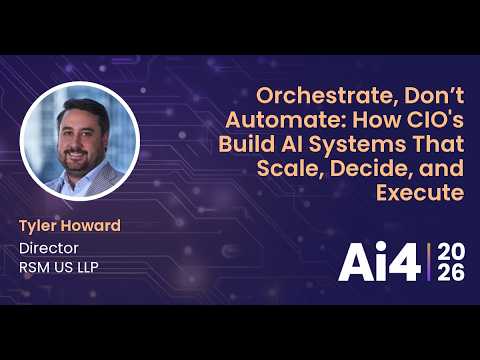
Ai4
Chasing 100% automation inflates operational unit costs on edge cases, requiring enterprises to deploy multi-agent orchestration with strict human-in-the-loop risk thresholds to secure scalable returns.
AI-assisted summary of Orchestrate, Don't Automate: How CIO's Build AI Systems That Scale, Decide, and Execute with RSM US — original source. Check the original for full context.
Source published:
Detailed notes
## Background Published on YouTube by the Ai4 channel on August 21, 2026, this presentation features Tyler Howard, Director at RSM US LLP. According to the description, the session provides a practitioner-level blueprint for CIOs and CTOs to move beyond single-model point solutions toward production-grade, multi-AI orchestration platforms that unify enterprise data, incorporate human oversight, and scale across operational functions.
## TL;DR Tyler Howard argues that enterprise AI initiatives frequently stall when organizations pursue isolated task automation and single-use point tools instead of an intentional orchestration platform. Drawing on case studies from high-volume healthcare operations and multi-agent sales lead prioritization, Howard illustrates how activating dormant historical data and coordinating specialized models dramatically enhances human decision-making. He cautions against the costly trap of pursuing 100% touchless automation, advocating instead for strict financial thresholds, role-based observability, and granular transaction-level cost tracking. To achieve sustainable production deployment, organizations must anchor their AI architectures in four core tenets: outcome-driven design, grounded data foundations, proactive governance, and reusable, scalable orchestration.
## Atmosphere & style Delivered from the stage at a Las Vegas industry conference, the talk carries the pragmatic, no-nonsense tone of an experienced implementation consultant speaking directly to enterprise technology leaders. Howard cuts through foundational model hype to focus on the unglamorous realities of data plumbing, unit economics, and operational risk. The delivery is structured, analytical, and authoritative, offering a clear-eyed roadmap that balances ambitious enterprise transformation with practical governance constraints.
## Key takeaways - [00:04](https://www.youtube.com/watch?v=uDbeZWPFqr8&t=4s) Organizations must move beyond isolated point solutions and bots, which create functional silos, toward an enterprise-grade orchestration platform that unifies workflows across business boundaries. - [01:39](https://www.youtube.com/watch?v=uDbeZWPFqr8&t=99s) Treating AI as ad-hoc task automation traps teams in an inefficient cycle of constantly rebuilding data plumbing from scratch, resulting in zero scalability and wasted capital. - [02:05](https://www.youtube.com/watch?v=uDbeZWPFqr8&t=125s) Enterprise AI initiatives typically stall across four critical pillars: poor data quality and architecture, cloud security and governance policies, technical talent gaps, and a lack of long-term sustainable funding. - [04:49](https://www.youtube.com/watch?v=uDbeZWPFqr8&t=289s) Prompts and standalone models cannot scale on their own; enterprise value is unlocked only by orchestrating data models, prompt layers, business logic, and automated checks into end-to-end workflows. - [05:30](https://www.youtube.com/watch?v=uDbeZWPFqr8&t=330s) Orchestration eliminates manual cross-system swivel-chairing by synthesizing disparate data and dynamically populating downstream operational work queues across multiple teams. - [08:27](https://www.youtube.com/watch?v=uDbeZWPFqr8&t=507s) Unlocking dormant enterprise assets, such as years of untranscribed call recordings combined with CRM data, provides the context necessary to power real-time predictive lead scoring and next-best-action guidance. - [10:17](https://www.youtube.com/watch?v=uDbeZWPFqr8&t=617s) AI delivers the highest ROI when designed to augment human domain expertise and accelerate onboarding, allowing novice workers to perform like top-tier revenue generators using structured playbooks. - [10:45](https://www.youtube.com/watch?v=uDbeZWPFqr8&t=645s) Multi-agent systems can coordinate engagement strategies based on customer demographics, routing younger audiences to digital channels like SMS and reserving voice outreach for high-value prospects. - [12:19](https://www.youtube.com/watch?v=uDbeZWPFqr8&t=739s) Automating 100% of transactions is an unrealistic goal; systems should enforce strict financial and risk thresholds that route edge cases to humans with pre-synthesized case context. - [12:55](https://www.youtube.com/watch?v=uDbeZWPFqr8&t=775s) Long-term production success requires persona-based visibility, delivering daily task flags for operational analysts, team velocity metrics for directors, and aggregate ROI and compliance tracking for CIOs. - [15:08](https://www.youtube.com/watch?v=uDbeZWPFqr8&t=908s) Attempting to automate the final tail of complex exceptions creates diminishing returns; organizations should automate high-volume processes while deliberately routing edge cases to human operators. - [15:35](https://www.youtube.com/watch?v=uDbeZWPFqr8&t=935s) Managing operational unit economics requires tracking granular runtime costs per transaction and per task, rather than fixating on foundational model hype or broad annual platform licensing fees. - [16:37](https://www.youtube.com/watch?v=uDbeZWPFqr8&t=997s) A scalable enterprise AI architecture rests on four core pillars: being outcome-driven, remaining data-grounded, embedding governance and auditability by design, and orchestrating modular components at scale.
## Detailed walkthrough ### [00:04](https://www.youtube.com/watch?v=uDbeZWPFqr8&t=4s) Moving Beyond Point Solutions to Enterprise Transformation
Tyler Howard, Director of the Custom Applications AI team within RSM US LLP's consulting practice, introduces his focus at the tail end of a long conference week in Las Vegas. While RSM is broadly known as an audit, tax, and advisory firm, Howard's specialized practice concentrates on designing and building complex, custom AI workflows rather than delivering pre-packaged point solutions or standalone bot products. Drawing on insights from RSM's annual client survey, where artificial intelligence took center stage, Howard points out a glaring disconnect across industry leadership: while enterprise appetite for transformation is exceptionally high, organizations routinely struggle to bridge the gap between initial interest and scalable enterprise execution.
The core challenge stems from treating AI as an isolated, single-use-case tool. When organizations deploy one-off point solutions, they trap themselves in functional silos that fail to scale or cross team boundaries. Howard emphasizes that the objective of modern AI initiatives must shift toward creating an enterprise-grade orchestration platform that unifies workflows, drives ongoing engagement, and fundamentally transforms how the business operates.
- **Survey Context:** Annual RSM client survey highlighted strong executive appetite for AI, yet revealed persistent execution hurdles. - **Consulting Focus:** Building production-grade custom architectures and multi-system workflows rather than off-the-shelf point tools.
---
[01:39](https://www.youtube.com/watch?v=uDbeZWPFqr8&t=99s) The Trap of Task Automation and Why AI Deployments Stall
Reflecting on the history of enterprise technology, Howard observes that organizations have been discussing task automation since the early 2000s—progressing through automated scripting and basic workflow tools without achieving true enterprise scalability. Deploying isolated point solutions forces teams into an inefficient cycle: whenever a new use case arises or an existing tool fails to meet the specific requirements of another group, engineering teams are forced to start from scratch. This "zero scalability, zero investment" dynamic wastes valuable capital because teams constantly rebuild the underlying data plumbing rather than leveraging an intentional, reusable data foundation.
```mermaid flowchart TD accTitle: Enterprise AI Deployment Foundation vs Stalling Factors subgraph StallingFactors["Core Roadblocks to AI Deployment"] A["Poor Data Quality & Pipeline Architecture"] B["Cloud Security & Policy Restrictions"] C["Talent & Operational Skill Gaps"] D["Lack of Long-Term Sustainability"] end
subgraph SolutionPlatform["Orchestrated Foundation"] E["Unified Enterprise Data Layer"] F["Shared Audit & Governance Framework"] G["Cross-Functional Scalable Architecture"] end
A --> E B --> F C --> G D --> G ```
Howard outlines the four critical pillars where deployments typically stall, warning that if an organization cannot confidently address all four, projects lose momentum, executive support, and organizational interest:
- **Data Layer and Data Quality:** Failing to construct a clean, reliable data architecture before attempting to deploy models. - **Security, Governance, and Policies:** Managing cloud environments, preventing proprietary data leakage, and monitoring the specific types of data moving through external models. - **Talent and Skill Gaps:** Navigating the difference between staff who have the appetite to engage with AI and specialists who possess the technical skills to maintain and manage solutions in production. - **Sustainability and Growth Confidence:** Maintaining organizational focus and funding beyond proof-of-concept experimentation.
---
[04:49](https://www.youtube.com/watch?v=uDbeZWPFqr8&t=289s) The Orchestration Imperative: Connecting End-to-End Enterprise Workflows
While generative, predictive, and natural language models are widely adopted for daily tasks—such as internal HR policy chatbots or support query assistants—executives frequently express an "all-in mentality" demanding measurable business transformation and direct revenue generation. Howard argues that simple prompts and agents cannot achieve scalability on their own; value is unlocked exclusively through orchestration. Orchestration coordinates data models, prompt layers, business logic, and automated checks to deliver end-to-end workflow validation, bringing enterprises closer to reliable, touchless automation while maintaining critical checks and balances.
```mermaid flowchart LR accTitle: Multi-Team Orchestrated Healthcare Workflow subgraph Ingestion["Intake & Processing"] T["20M Annual Transactions"] --> M["Variable Data Models"] end
subgraph OrchestrationEngine["AI Orchestration Engine"] M --> D["Decision Logic & Context Synthesizer"] D --> H{"Human Review Threshold Met?"} end
subgraph Execution["Cross-Functional Routing"] H -- "Yes: High Risk / High Value" --> E["Human Escalation & Validation"] H -- "No: Touchless Execution" --> Q["15 Work Queues Across 4 Downstream Teams"] E --> Q end ```
To illustrate this cross-functional value, Howard shares a case study from a healthcare client. The project initially targeted a single workflow processing 20 million transactions in its first year. Instead of confining the AI to that initial silo, RSM engineered an orchestration layer that synthesized transaction outputs, restructured the underlying data, and dynamically populated 15 separate work queues across four distinct downstream operational teams. By extracting analysts from the friction of manually juggling four disparate internal and external core systems, the AI constructed an integrated narrative for each case, substantially improving decision accuracy and downstream speed.
- **System Interoperability:** Eliminates the need for operational analysts to cross-reference multiple disconnected systems to compile case histories. - **Multi-Model Adaptability:** Embraces variable model usage suited to specific tasks rather than locking the enterprise into a single rigid model or proprietary drag-and-drop platform burdened by inflexible licensing and hosting constraints. - **Human-in-the-Loop Safeguards:** Places human oversight at critical business thresholds and high-value revenue checkpoints to satisfy strict auditability and risk management standards.
---
[08:27](https://www.youtube.com/watch?v=uDbeZWPFqr8&t=507s) Case Study: Transforming Sales Lead Orchestration and Unlocking Dormant Data
Howard turns to a detailed case study of a sales organization comprising several hundred licensed agents. The client was ingesting leads from multiple sources—including multi-channel marketing campaigns, email outreach, digital inbound funnels, and purchased third-party prospect lists. Historically, all incoming prospects were dumped into a generic pool, forcing agents to cold-call down a flat list with minimal context. When RSM evaluated the workflow, they recognized that the sales force possessed deep domain expertise, with many agents holding over 25 years of industry experience. Rather than attempting to replace human sales skills with AI, the goal was to arm these high-performing agents with comprehensive context and intelligence before they initiated a call.
RSM tackled the challenge by uniting 15 years of structured CRM data with external demographic indicators and uncovering a massive, untapped asset: 10 years of archived customer phone calls and outreach recordings that had never been transcribed or leveraged for machine learning. By transcribing and training models on this dormant audio data, the orchestration platform began analyzing incoming leads in real time, diagnosing customer intent, identifying product affinities, and surfacing the exact next best action for each licensed professional.
- **Empowering Expert Human Talent:** Focusing AI on data synthesis and contextual lead prioritization so seasoned agents can focus on high-touch client conversations. - **Activating Dormant Data Assets:** Converting 10 years of un-transcribed historical voice recordings into actionable training data and behavioral insights. - **Multi-Source Data Fusion:** Combining third-party purchased leads, inbound marketing signals, demographic details, and deep CRM histories into a prioritized lead orchestration pipeline.
[10:17](https://www.youtube.com/watch?v=uDbeZWPFqr8&t=617s) Tailored Engagement and Multi-Agent Sales Orchestration
When engaging leads, determining the right contact channel is critical. Demographics dictate interaction preferences: making a cold phone call to a 22-year-old rarely succeeds because "they're going to hang up," whereas reaching them via marketing emails, text messages, or digital product information yields far better results. Conversely, for high-value or experienced leads, the orchestration engine equips sales representatives with rich, contextual guidance. Instead of operating with no targets or structure beyond a vague directive to sell products, reps receive an AI-generated structured playbook detailing the exact narrative to pitch, optimal call times, availability windows, and specific product recommendations.
This capability stems from a strong data foundation paired with continuous human-in-the-loop controls. Because customer interactions involve sensitive personal information, strict end-to-end data management ensures no proprietary data leaks externally. Crucially, the solution avoids relying on a single model or isolated prediction. It coordinates multiple autonomous agents working alongside human analysts. This system delivers immense ROI: new sales hires coming off the street with zero prior experience transition from earning a flat hourly rate to driving exponential revenue growth for the organization.
```mermaid flowchart TD accTitle: Multi-Agent Lead Orchestration Architecture subgraph INTAKE["Data Foundation & Intake"] D1["Demographic & Lead Data"] D2["Interaction History"] end
subgraph AGENTS["Multi-Agent Orchestration Layer"] A1["Channel Selector\n(Email / Text vs. Voice)"] A2["Timing & Script Generator\n(Story, Call Time, Focus)"] end
subgraph EXECUTION["Human-in-the-Loop Execution"] H1["Sales Analyst Playbook"] H2["Financial Threshold Checks"] H3["Customer Engagement & Revenue"] end
D1 --> A1 D2 --> A2 A1 --> H1 A2 --> H1 H1 --> H2 H2 --> H3 ```
- **Demographic Channel Matching:** Directs younger demographics toward automated SMS and email sequences while reserving voice calls for high-touch prospects. - **Dynamic Sales Scripting:** Provides novice reps with bespoke narratives, timing guidance, and targeted product focus. - **Multi-Step Agent Architecture:** Replaces brittle single-prompt models with specialized, cooperating agents. - **Fast Ramp-Up:** Transforms entry-level workers into top-performing revenue generators rapidly.
---
[12:19](https://www.youtube.com/watch?v=uDbeZWPFqr8&t=739s) Risk Thresholds, Exceptions, and Persona-Based Visibility
Designing enterprise AI systems requires addressing risk, financial exposure, and inevitable workflow exceptions upfront. Automated systems should never claim to "handle 100% of your transactions 100% of the time perfectly"—edge cases and high-stakes scenarios will occur. Establishing strict financial thresholds ensures that whenever an action exceeds a specific monetary value, the system automatically routes the case to a human approval workflow, arming the reviewer with fully contextualized data to make an informed decision.
```mermaid flowchart LR accTitle: Enterprise AI Persona-Based Tracking subgraph AGENT["AI Orchestration Engine"] E1["Execution & Event Logging"] end
subgraph PERSONAS["Role-Specific Dashboards"] P1["Analyst View\nDaily tasks & operational flags"] P2["Director View\nWorkflow health & team velocity"] P3["CIO View\nSystem ROI & compliance posture"] end
E1 --> P1 E1 --> P2 E1 --> P3 ```
To prevent AI initiatives from stalling in isolated pilot stages, organizations must maintain holistic operational visibility structured around distinct user personas: - **Analyst Persona:** Daily operational insights, immediate flags, and contextual tasks. - **Manager / Director Persona:** Team throughput, approval queues, and workflow bottlenecks. - **CIO / Executive Persona:** Macro governance, aggregate ROI, cross-system performance, and total cost visibility.
Many organizations complete a proof-of-concept (POC) believing that simply checking security boxes is sufficient. However, long-term success demands active governance frameworks and clear people-centric processes to prevent teams from feeling hesitant or taking steps backward when transitioning into production.
---
[15:08](https://www.youtube.com/watch?v=uDbeZWPFqr8&t=908s) Operational Unit Economics and the 100% Automation Trap
A common failure mode in enterprise AI adoption is obsessing over the latest foundational model without understanding operational unit economics. As usage scales, operational costs increase dramatically. Organizations must look past high-level annual software licenses or cloud hosting fees to track the granular cost per task and runtime cost per transaction.
Trying to automate the final tail of complex exceptions leads to diminishing returns and bloated operational spending. Rather than chasing a 100% automated output, organizations should identify high-volume, low-hanging fruit for automated execution and deliberately route edge cases to human operators. This intentional design keeps the payback period short and ensures cost structures remain sustainable.
| Metric Focus | Low-Maturity Approach | Scalable Orchestration Approach | |:--- |:--- |:--- | | **Automation Target** | 100% full automation (unrealistic & costly) | High-volume automation + intentional human-in-the-loop exception routing | | **Cost Tracking** | Broad annual hosting / SaaS platform fees | Granular runtime cost per transaction and unit cost per task | | **Model Selection** | Chasing the newest, largest model indiscriminately | Right-sized models and reusable prompt modules matched to task complexity | | **Exception Handling** | Undefined, causing workflow failures | Automated escalation triggered by financial and risk thresholds |
---
[16:37](https://www.youtube.com/watch?v=uDbeZWPFqr8&t=997s) Blueprint for Scaling: Four Core Tenets of Enterprise Orchestration
Building enterprise AI that scales reliably requires shifting focus from isolated task automation to an overarching architectural framework. Four core pillars define this blueprint:
```mermaid flowchart LR accTitle: Four Pillars of Enterprise AI Orchestration P1["1. Outcome-Driven\nAligns personas & secures executive buy-in"] P2["2. Data-Grounded\nCloud integrations as real-time assets"] P3["3. Governed by Design\nAuditability & risk management from Day 1"] P4["4. Orchestrated at Scale\nReusable prompts, agents, and modular workflows"]
P1 --> P2 --> P3 --> P4 ```
1. **Outcome-Driven:** Ground every project in measurable business results and clear personas. Delivering concrete value secures stakeholder buy-in, user adoption, and ongoing executive sponsorship. 2. **Data-Grounded:** Leverage modern cloud platforms and integration layers so enterprise data acts as a continuous operational asset rather than a friction point, delivering information at the speed and time required. 3. **Governed by Design:** Embed governance, tool compliance, operational observability, and auditability directly into the platform architecture from day one rather than treating compliance as a late add-on. 4. **Orchestrated at Scale:** Build systems using modular, reusable building blocks—including specialized agents, master prompts, and standardized workflow templates—that can be repurposed across departments from sales to finance and operations.
## Notable quotes > Most organizations are automating tasks. The leaders are orchestrating intelligence. — Tyler Howard
> This session is not about a single tool or industry. It’s a blueprint CIOs and CTOs can apply as AI moves from curiosity to core enterprise capability. — Tyler Howard
> [01:39](https://www.youtube.com/watch?v=uDbeZWPFqr8&t=99s) zero scalability, zero investment — Tyler Howard
> [04:49](https://www.youtube.com/watch?v=uDbeZWPFqr8&t=289s) all-in mentality — Tyler Howard
> [10:17](https://www.youtube.com/watch?v=uDbeZWPFqr8&t=617s) they're going to hang up — Tyler Howard
> [12:19](https://www.youtube.com/watch?v=uDbeZWPFqr8&t=739s) handle 100% of your transactions 100% of the time perfectly — Tyler Howard
> [16:37](https://www.youtube.com/watch?v=uDbeZWPFqr8&t=997s) Outcome-Driven — Tyler Howard
> [16:37](https://www.youtube.com/watch?v=uDbeZWPFqr8&t=997s) Data-Grounded — Tyler Howard
> [16:37](https://www.youtube.com/watch?v=uDbeZWPFqr8&t=997s) Governed by Design — Tyler Howard
> [16:37](https://www.youtube.com/watch?v=uDbeZWPFqr8&t=997s) Orchestrated at Scale — Tyler Howard
## Mentioned Tyler Howard, RSM US LLP, Ai4, Las Vegas
## Video description Tyler Howard - Director, RSM US LLP
Most organizations are automating tasks. The leaders are orchestrating intelligence.
In this session, I will share how we designed and delivered a production grade AI orchestration platform that moves beyond single model point solutions to a fully integrated, multi-AI architecture. One that unifies data, reasons across context, inserts human judgment where required, and executes decisions reliably across real enterprise workflows.
While customer engagement is a powerful example, the architecture and lessons are broader. This is a practitioner level look at what separates proof of concept from production including how to design data foundations for orchestration, not experimentation, where automation breaks down and human oversight must remain and the architectural patterns that allow AI systems to scale across functions — from customer engagement to operations, finance, and IT.
This session is not about a single tool or industry. It’s a blueprint CIOs and CTOs can apply as AI moves from curiosity to core enterprise capability.
[Source](https://www.youtube.com/watch?v=uDbeZWPFqr8)