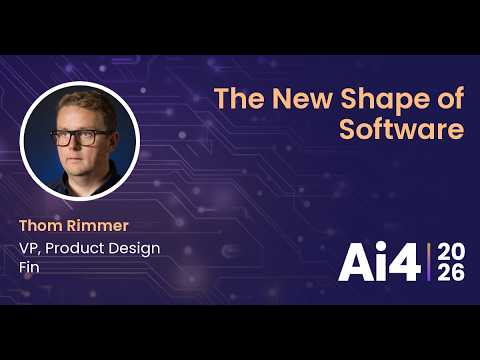
Fin Hits $100 Million ARR, Sells to Salesforce After AI Agent Bet
Ai4
As generative AI collapses software execution costs to zero and erases feature moats, product defensibility survives only in underlying proprietary data and high-level strategic taste.
## Background
Published on YouTube by Ai4 on August 16, 2026, this talk features Thom Rimmer, VP of Product Design at Fin. The presentation explores how artificial intelligence is collapsing traditional interface design into conversational experiences, compelling Fin to reinvent how they build software and envision the future of digital products.
## TL;DR
Thom Rimmer details how Fin (formerly Intercom) successfully pivoted away from traditional per-seat SaaS to become an agentic AI powerhouse, reaching $100 million in ARR and agreeing to acquisition terms with Salesforce. He argues that natural language interfaces are dissolving traditional software categories and eliminating wasted 'tool time' in favor of direct, conversational goal achievement. As product design shifts from styling visual screens to orchestrating autonomous agent thinking, internal workflows have mirrored this evolution—with over 90% of Fin's pull requests authored by AI. Consequently, feature moats have vanished, leaving true competitive defensibility exclusively at the edges: underlying proprietary data and top-tier strategic design taste.
## Atmosphere & style
The presentation delivers a pragmatic, urgent, and bracingly optimistic narrative on the disruption of software design. Speaking with the candid authority of a seasoned design leader who actively blew up his own twenty-year craft, Rimmer balances high-level philosophical reflections with concrete, hard-nosed engineering metrics. The talk feels less like theoretical futurism and more like a live report from an experimental frontline, inspiring builders to shed legacy habits and embrace high-velocity execution.
## Key takeaways
- [00:04](https://www.youtube.com/watch?v=JbF_SbKJSEc&t=4s) Intercom pivoted completely to build Fin as an AI agent after realizing AI would obsolete their per-seat business model, eventually reaching $100M in ARR and an acquisition agreement with Salesforce.
- [00:04](https://www.youtube.com/watch?v=JbF_SbKJSEc&t=4s) Value in software is draining away from the traditional UI layer and shifting both downward into raw model capabilities and upward into delivery and packaging.
- [02:58](https://www.youtube.com/watch?v=JbF_SbKJSEc&t=178s) AI acts as a convergent force that dissolves traditional software category boundaries, forcing products to expand horizontally and absorb neighboring domains.
- [02:58](https://www.youtube.com/watch?v=JbF_SbKJSEc&t=178s) Conversational interfaces are not radical science fiction, but a return to humanity's natural dialogue-driven interaction model after decades of GUI detour.
- [05:23](https://www.youtube.com/watch?v=JbF_SbKJSEc&t=323s) Users drive modern software by asking for outcomes rather than manually navigating menus, effectively eliminating the career value of tool mastery.
- [08:30](https://www.youtube.com/watch?v=JbF_SbKJSEc&t=510s) Operator functions as an internal agent that builds and maintains customer-facing agents, completely deleting 'tool time' in favor of 'goal time.'
- [11:45](https://www.youtube.com/watch?v=JbF_SbKJSEc&t=705s) Product design has fundamentally transitioned from designing visual layouts and CRUD screens ('How does this look?') to engineering autonomous decision-making ('How does this think?').
- [13:57](https://www.youtube.com/watch?v=JbF_SbKJSEc&t=837s) Multi-step agentic chains face severe compounding error degradation, requiring organizations to operate like experimental testing labs rather than linear software factories.
- [15:28](https://www.youtube.com/watch?v=JbF_SbKJSEc&t=928s) Because AI automates the execution middle of development, strategic direction and taste at the edges become the primary bottlenecks and differentiators.
- [16:59](https://www.youtube.com/watch?v=JbF_SbKJSEc&t=1019s) Fin embedded design taste and evaluation skills directly into CI/CD pipelines to safeguard product quality as roughly 20% of PRs became fully autonomous.
- [18:16](https://www.youtube.com/watch?v=JbF_SbKJSEc&t=1096s) 'Fast gets good before good gets fast': high-velocity iteration consistently beats slow, cautious planning cycles.
- [19:29](https://www.youtube.com/watch?v=JbF_SbKJSEc&t=1169s) Traditional feature moats have vanished due to low-cost LLM code generation, leaving defensibility solely in proprietary data at the bottom and product taste and execution at the top.
## Detailed walkthrough
### [00:04](https://www.youtube.com/watch?v=JbF_SbKJSEc&t=4s) Blowing Up Intercom to Build Fin
After spending twenty years mastering the craft of interface design—the buttons, layouts, and microscopic polish that most people never notice—Thom Rimmer observes that this foundational craft is rapidly vanishing. Yet, rather than despairing over the demise of the traditional screen, he views this fundamental shift in how customers interact with software as potentially the best thing to happen to his career and the software industry in three decades. Rimmer leads product design at Fin, the company previously known as Intercom. For over a decade, Intercom stood as a SaaS pioneer, serving roughly 35,000 customers and processing half a billion messages every month.
When ChatGPT arrived, the leadership team was confronted with an existential question: could AI completely replace the human customer service industry? Answering "yes" meant their entire per-seat business model was obsolete. Rather than making safe, incremental tweaks, the company decided to bet everything, blowing up its existing structure to build an AI agent that performs the very customer service work human agents were previously paid to do. Roughly three and a half to four years later, that high-stakes wager paid off: Fin crossed $100 million in ARR, achieved explosive growth, and agreed to definitive acquisition terms with Salesforce.
Rimmer emphasizes that surviving this transition demands massive swings and tuning out naysayers. Those who settle for comfortable, superficial AI features meant for LinkedIn posts will not survive. Underneath this disruption is a dual migration of value: value is draining away from the surface layer—the toggles, controls, and UI—and dropping down into the raw capabilities of underlying models and harnesses, while simultaneously rising up into how those capabilities are packaged and delivered to the end user.
```
[ Upward Shift: Packaging & Delivery to Customers ]
▲
│
[ Traditional UI / Toggles / Buttons ] ──► (Value Draining Away)
│
▼
[ Downward Shift: Raw Model Capabilities & Harness ]
```
- Intercom operated as a major SaaS player with ~35,000 customers and 500 million messages per month before pivoting.
- Fin crossed $100 million in annual recurring revenue (ARR) and announced acquisition terms with Salesforce.
- Superficial adaptations designed for quick social media praise are doomed in the AI era.
---
[02:58](https://www.youtube.com/watch?v=JbF_SbKJSEc&t=178s) The Dissolving Box and the Return to Conversation
For decades, software products occupied well-defined boundaries. Teams built neat boxes around what a piece of software did, making it obvious what fell inside or outside a category. AI acts as a convergent force that dissolves those walls. The historic divisions separating search from chat or products from services have melted away, causing tools to expand horizontally and encroach on neighboring domains—such as Notion expanding broadly, or Gong and Guru cannibalizing each other's spaces. This leaves product builders with a fundamental dilemma: where does a product actually end, and where do its boundaries lie?
While replacing deep, button-heavy interfaces with conversational prompts feels like radical science fiction, Rimmer argues it is actually a return to humanity's oldest behavioral roots. He points to a 4,000-year-old Mesopotamian clay tablet containing the world's oldest recorded customer complaint, in which an ancient buyer angrily berated a merchant over poor-quality copper. For thousands of years, commerce and communication were inextricably linked through direct human dialogue. The graphical user interfaces of the past few decades were merely a detour; software is simply "going home" to conversational roots.
Historically, humans have controlled computers through two primary paradigms: the command line, which was immensely powerful but steep to learn, and the graphical user interface (GUI), which lowered the learning curve but imposed strict guardrails designed by interface gatekeepers. Natural language represents the third paradigm: users simply state what they want in plain terms, stripping away the artificial constraints of menus and buttons.
---
[05:23](https://www.youtube.com/watch?v=JbF_SbKJSEc&t=323s) Driving Software by Asking and Deleting "Tool Time"
To illustrate how user intent is decoupled from software mechanics, Rimmer uses a basic spreadsheet scenario. If a user wants negative numbers highlighted in red, the legacy GUI workflow demands knowing the exact feature name—"conditional formatting"—hunting through menus, and configuring rules. Even early agentic browser experiments merely mimicked human hands clicking through those same steps. Today, users do not care how the software achieves the outcome or what the feature is named; they only care that the numbers magically turn red. Users no longer drive software by clicking; they drive it by asking.
This shift upends the meaning of software expertise. In previous years, professionals took pride in being a "Figma ninja" or "Sketch ninja," where encyclopedic mastery of menu layouts was a legitimate career skill. When anyone can achieve identical outcomes through natural language, tool mastery loses its value. This evolution mirrors past consumer hardware transitions—much like the iPod felt sudden despite following a lineage of Discmans, MiniDisc players, and early MP3 players, AI interfaces have progressed rapidly from bolted-on chat widgets, to configuration assistants, to absorbing the entire application until the interface all but disappears.
When Fin originally launched three years ago as a generative agent, it replaced rigid, frustrating chatbots with human-grade conversation, yet it remained trapped inside a standard corner chat module. The subsequent release of Fin for Sales moved the messenger front-and-center, offering a sleeker aesthetic, but it was still fundamentally a chat box sitting on top of a website.
---
[08:30](https://www.youtube.com/watch?v=JbF_SbKJSEc&t=510s) Operator: The Agent That Builds Agents
The paradigm shifted entirely with the creation of Operator. While Fin acts as an outward-facing agent for customers, Operator serves as an internal agent for teammates—effectively "the agent that builds the agent." Rather than requiring human operators to step through instructions, Operator autonomously determines the best next action, tests its implementation, manages internal knowledge bases, and proactively surfaces its work for human sign-off.
Prior to Operator, tuning Fin required tedious manual overhead: customer support teams juggled spreadsheets, cross-referenced internal docs, and clicked through endless configuration screens to boost automation rates. Operator eliminated this friction by turning setup and maintenance into an ongoing dialogue. With Operator entering General Availability (GA), Rimmer references design pioneer Jared Spool’s distinction between two types of interaction time:
- **Tool Time:** The wasted overhead spent navigating the interface, browsing menus, and clicking buttons, which provides zero inherent value.
- **Goal Time:** The meaningful time spent actually accomplishing the intended objective.
While conventional software design attempts to minimize tool time by making buttons more intuitive, Operator deletes tool time altogether. Rimmer clarifies that GUIs are not entirely dead; some tasks remain objectively superior with tactile visual controls. In photo editing software like Photoshop, dragging an exposure slider is far more efficient than repeatedly typing "make this a bit darker" five times. The ultimate power lies in conversational systems paired dynamically with necessary UI elements like charts, tables, and sliders.
---
[11:45](https://www.youtube.com/watch?v=JbF_SbKJSEc&t=705s) From Crafting Screens to Engineering Thinking
Designing conversational systems reveals just how agonizing traditional software development has always been. For fifty years, software has revolved around CRUD (Create, Read, Update, Delete) interfaces built on the premise that humans must do all the thinking, memorize multi-step flows, and wait for visual screen confirmations. Product designers spent entire careers agonizing over onboarding flows, progressive disclosure, empty states, and feature discoverability—hoping against hope that users might notice an unprompted tooltip or open a changelog email instead of sending it directly to the trash.
Autonomous agents render most of that scaffolding obsolete. An agent does not require onboarding screens or tooltips; it requires robust foundational AI, structured parameters from the user, and an intelligible decision trail. Consequently, product design flips from asking "How does this look and operate?" to "How does this think?"
```
TRADITIONAL DESIGN INQUIRY AGENTIC DESIGN INQUIRY
┌───────────────────────────┐ ┌───────────────────────────┐
│ How does this LOOK │ ──► │ How does this THINK? │
│ and OPERATE? │ │ │
│ (Buttons, menus, layouts) │ │ (Evals, logic, autonomy) │
└───────────────────────────┘ └───────────────────────────┘
```
Rimmer challenges product teams to audit their own interfaces and recognize how much of their real estate is purely navigational overhead—wayfinding menus, sprawling settings, complex dashboards, and static reporting views. When an agent can synthesize information and execute tasks on command, those intermediary screens disappear. The fundamental question for product teams is no longer how to sprinkle AI onto an existing interface, but what happens when AI completely absorbs the core job the product was invented to perform.
---
[13:57](https://www.youtube.com/watch?v=JbF_SbKJSEc&t=837s) Operating Like a Lab: Compounding Errors and Agentic Development
AI has transformed not only the shape of Fin's end product, but also the internal engineering workflows used to build it. Approximately 94% of Fin's pull requests (PRs) are authored by Claude Code. Autonomous agents explore divergent implementation paths simultaneously and construct complex, full-stack features in hours or days, pushing the marginal cost of building software toward zero.
This velocity introduces a critical trap: compounding error rates across multi-step chains. If five discrete sub-tasks each boast a 95% or 96% success rate, the end-to-end reliability of that chain degrades to roughly 80–88%. Because an application that fails one out of every ten times is unacceptable in production, knowing precisely where to keep a human in the loop is a crucial skill. Product teams must avoid being seduced by rapid prototypes—while a two-hour session with Claude can produce a dazzling demo, engineering that prototype into a bulletproof enterprise product can still take up to 24 months. Modern software organizations must abandon the mindset of a predictable assembly-line "factory" and instead operate like a rigorous experimental "lab," continuously stress-testing model behaviors through rigorous evaluations.
- ~94% of Fin's internal pull requests are written directly by Claude / Claude Code.
- A five-step agentic chain with ~96% accuracy per step compounds down to sub-90% overall reliability.
- Software teams must operate as experimental testing labs rather than linear production factories.
[15:28](https://www.youtube.com/watch?v=JbF_SbKJSEc&t=928s) The Shift in Constraints: From Execution Bottlenecks to Strategic Direction
Execution used to be the primary bottleneck for product teams; getting software built and shipped was an uphill battle. With AI owning the middle of the development pipeline—generating interfaces, writing code, producing variations, and deploying—that execution constraint has effectively evaporated over the span of six to twelve months. However, constraints never truly disappear; they simply shift to the edges. When anyone can build anything almost instantly, the differentiator is no longer the ability to build, but having the clarity to choose what to build and why it matters.
More AI does not inherently provide more clarity—it merely generates abundance. Managing AI development without clear guardrails feels less like leading a traditional engineering team and more like "leading a thousand people who all started independently at the same time without context of each other." Without strategic direction, speed simply amplifies noise. Moving at breakneck speed makes poor decisions even more damaging, as teams can drift drastically off target in record time. This is precisely where design teams must step up: not by "painting pictures of the product that they wish they could build in Figma," but by defining the strategic trajectory and holding the quality bar at the highest standard.
```
THE VALUE SHIFT IN AI SOFTWARE
PAST: Execution Bottleneck PRESENT: Value at the Edges
┌─────────────────────────┐ ┌─────────────────────────┐
│ Strategy & Direction │ │ Taste & Direction │◄── High Moat
├─────────────────────────┤ ├─────────────────────────┤
│ Execution: Code, UI, QA │◄─Bott- │ AI Autonomous Middle: │
│ (Manual Engineering) │ leneck│ Generation, Code, QA │◄── Free/Noise
├─────────────────────────┤ ├─────────────────────────┤
│ Foundations │ │ Proprietary Data/Models │◄── High Moat
└─────────────────────────┘ └─────────────────────────┘
```
- **Noise vs. Clarity:** Speed without direction turns abundance into organizational chaos.
- **The Modern Designer's Role:** Moving away from static UI mockups in Figma toward setting product direction and enforcing taste across the entire system.
---
[16:59](https://www.youtube.com/watch?v=JbF_SbKJSEc&t=1019s) Autonomous Agent Pipelines and Codifying Design Taste
Fin put these principles into practice with an initial goal of doubling company productivity within twelve months, ultimately tripling it in just nine. Nearly one in five pull requests (PRs) across the company are now completely autonomous—initiated, written, tested via QA, and deployed entirely by agents without any human involvement. While this autonomous loop dramatically accelerates throughput, it introduces the serious risk of subtle quality erosion that can go unnoticed until it is too late.
To prevent standards from slipping, the design team focused on embedding human taste directly into the platform's foundational architecture. Beyond standard UI components in a design system, they codified the design team's thought processes, taste, and qualitative judgment into automated "skills" integrated directly into the CI/CD deployment pipeline. These automated checks evaluate generated software before it reaches production, ensuring that product quality travels with the system rather than relying on manual, person-by-person oversight.
- **Productivity Gains:** Fin tripled productivity in 9 months, surpassing their original goal of doubling it in 12 months.
- **Autonomous Development:** Approximately 20% of PRs are fully agentic end-to-end (initiation, coding, QA, and deployment).
- **Systemic Quality Checks:** Craft is preserved by embedding design evaluation skills and guardrails directly into the deployment pipeline.
---
[18:16](https://www.youtube.com/watch?v=JbF_SbKJSEc&t=1096s) Speed, Psychology, and Why Fast Gets Good First
When evaluating the balance between velocity and polish, the evidence shows that "fast gets good before good gets fast." Teams that prioritize high velocity and iteratively fix quality along the way consistently outperform and outdistance those that move cautiously. Fin transitioned away from two-year planning horizons to nimble three-to-four-month cycles, allowing them to ship nine major product launches in just two months—a feat that previously would have required years in the traditional SaaS paradigm.
The widening gap between fast-moving and slow-moving organizations is not dictated by access to tooling, as foundational AI technology is widely accessible to everyone. The true differentiator is human psychology. Risk aversion, legacy habits, and sunk-cost fallacies cause people and organizations to adapt far more slowly than the technology itself evolves. Culture and the willingness to adapt remain the only variables teams have complete agency over.
- **Launch Velocity:** 9 major product launches shipped within a 2-month span.
- **Planning Cycles:** Reduced from 2-year roadmaps down to 3-to-4-month planning intervals.
- **Organizational Friction:** Cultural inertia, sunk costs, and risk aversion—not access to technology—are the real bottlenecks to AI adoption.
---
[19:29](https://www.youtube.com/watch?v=JbF_SbKJSEc&t=1169s) The Disappearance of Product Moats and Defensibility at the Edges
With software creation costs approaching zero, traditional product feature moats have vanished. A Fin engineer was able to clone an entire competitor's product using Claude in just a few days, and competitors routinely copy Fin's own best features with equal speed. In an era where surface-level UI and features are trivial to replicate, defensibility exists only at the extreme edges: at the bottom, through proprietary data and specialized models that cannot be copied over a weekend, and at the top, through superior product taste and strategic execution.
Product teams must evolve to own entire jobs-to-be-done rather than discrete features, treating conversational interaction design with the same rigor once reserved for pixel layouts. Despite rapid progress, the industry is still at the bottom inflection point of the innovation S-curve. The decades spent perfecting screens, buttons, and visual controls were ultimately a detour; collapsing these into intelligent, agentic systems represents one of the most exciting and impactful shifts in software history.
- **Zero Feature Moats:** Competitor products and proprietary features can be cloned in a matter of days using modern LLMs like Claude.
- **The Two True Moats:** Proprietary data and custom fine-tuned models at the infrastructure layer, combined with high-level design taste and strategic direction at the top.
- **Core Playbook for Product Teams:** Own end-to-end customer jobs, protect the underlying data model, design conversational flows as rigorously as graphical interfaces, and shift focus entirely to high-leverage edge decisions.
## Notable quotes
> [00:04](https://www.youtube.com/watch?v=JbF_SbKJSEc&t=4s) value is draining away from the surface layer—the toggles, controls, and UI—and dropping down into the raw capabilities of underlying models and harnesses, while simultaneously rising up into how those capabilities are packaged and delivered to the end user. — Thom Rimmer
> [02:58](https://www.youtube.com/watch?v=JbF_SbKJSEc&t=178s) software is simply 'going home' to conversational roots. — Thom Rimmer
> [02:58](https://www.youtube.com/watch?v=JbF_SbKJSEc&t=178s) where does a product actually end, and where do its boundaries lie? — Thom Rimmer
> [05:23](https://www.youtube.com/watch?v=JbF_SbKJSEc&t=323s) Users no longer drive software by clicking; they drive it by asking. — Thom Rimmer
> [08:30](https://www.youtube.com/watch?v=JbF_SbKJSEc&t=510s) the agent that builds the agent — Thom Rimmer
> [08:30](https://www.youtube.com/watch?v=JbF_SbKJSEc&t=510s) Tool Time: The wasted overhead spent navigating the interface, browsing menus, and clicking buttons, which provides zero inherent value. Goal Time: The meaningful time spent actually accomplishing the intended objective. — Jared Spool
> [11:45](https://www.youtube.com/watch?v=JbF_SbKJSEc&t=705s) How does this look and operate? to How does this think? — Thom Rimmer
> [15:28](https://www.youtube.com/watch?v=JbF_SbKJSEc&t=928s) leading a thousand people who all started independently at the same time without context of each other. — Thom Rimmer
> [15:28](https://www.youtube.com/watch?v=JbF_SbKJSEc&t=928s) painting pictures of the product that they wish they could build in Figma — Thom Rimmer
> [18:16](https://www.youtube.com/watch?v=JbF_SbKJSEc&t=1096s) fast gets good before good gets fast. — Thom Rimmer
## Mentioned
Thom Rimmer, Jared Spool, Fin, Intercom, Salesforce, ChatGPT, Claude, Claude Code, Notion, Gong, Guru, Figma, Sketch, Photoshop, Operator, Fin for Sales, iPod, LinkedIn, Ai4
## Video description
Thom Rimmer - VP, Product Design, Fin
AI will change almost everything we do in some way, and some things we do in every way. Product design is one of the latter. Product designers have spent entire careers perfecting the art of interfaces and controls, only to have AI collapse interaction to a simple chat box. Fin's VP of Product Design Thom Rimmer describes how the Fin team changed everything about how they build, and how they're thinking about the software future AI is pushing us all towards.
Thom Rimmer, head of product design at Fin (formerly Intercom), argues that generative AI is dissolving conventional graphical interfaces and feature moats, shifting software's economic value away from intermediate UI controls and toward underlying model capabilities, strategic product taste, and autonomous agents.
Dissolving Interface Boundaries and Eliminating Tool Time (2:58)
Rimmer contends that graphical user interfaces were a multi-decade historical detour, asserting that natural language marks a return to direct conversational interaction where users state desired outcomes rather than navigating mechanical controls. As conversational AI advances, legacy software divisions separating search, chat, products, and services are dissolving. Citing design pioneer Jared Spool, Rimmer distinguishes between "goal time" (achieving the core objective) and "tool time" (wasted overhead navigating menus and settings). While traditional design optimized tool time through better button placement, conversational systems eliminate it entirely—such as requesting highlighted spreadsheet numbers without manually configuring conditional formatting rules.
Fin enacted this shift by disrupting Intercom's existing per-seat SaaS business—which served roughly 35,000 customers and handled 500 million monthly messages—to deploy an AI agent performing customer service directly. The company subsequently crossed $100 million in ARR and agreed to definitive acquisition terms with Salesforce. To streamline maintenance, Fin introduced Operator, an internal agent that configures, tests, and manages the customer-facing Fin agent through dialogue. However, Rimmer qualifies that graphical controls remain superior for certain tactile actions, such as photo exposure sliders, indicating that future interfaces will blend conversation with dynamic visual components.
Autonomous Engineering Velocity and Compounding Error Risks (13:57)
Internally, Fin restructured its development workflows around autonomous pipelines: approximately 94% of pull requests (PRs) are authored by Claude Code, and nearly 20% are initiated, written, tested, and deployed end-to-end without human intervention. This acceleration enabled Fin to triple internal productivity in nine months—surpassing its initial target of doubling output in twelve—and ship nine major product launches across a two-month span while compressing planning cycles from two-year roadmaps to three-to-four-month intervals.
Despite these throughput gains, Rimmer warns of a critical reliability hazard in multi-step agentic execution. In sequential workflows, individual steps with 95% to 96% accuracy compound down to an end-to-end reliability of roughly 80% to 88% across a five-step chain, which remains unacceptable for production enterprise software. Consequently, software organizations must abandon assembly-line mindsets and operate as experimental testing labs, identifying where human-in-the-loop oversight is mandatory and validating model performance with rigorous evaluations.
Vanishing Feature Moats and Defensibility at the Edges (15:28)
Because foundation models push the marginal cost and time of software development toward zero, traditional feature-level moats have evaporated. Rimmer points out that a Fin engineer cloned a competitor's product using Claude in days, while competitors replicate Fin's capabilities at comparable speed. When execution constraints disappear, rapid building without clear guardrails merely amplifies organizational noise and accelerates strategic misalignment.
As a result, defensibility has shifted entirely to the outer edges of the system: proprietary data and domain-specific models at the bottom, and high-level product taste and strategic direction at the top. To safeguard product quality against erosion from rapid autonomous deployment, Fin codified human design taste and qualitative judgment into automated evaluation "skills" embedded directly within CI/CD pipelines. Designers are thus repositioned away from crafting static screen mockups in Figma toward directing the system's strategic trajectory and enforcing standards.
Rimmer observes that human psychology, organizational risk aversion, and cultural inertia—rather than access to AI technology—are the primary bottlenecks slowing adoption, while cautioning that engineering a flashy two-hour prototype into a dependable enterprise product can still require up to 24 months.
## Background
本内容由 YouTube 频道 Ai4 于 2026 年 8 月 16 日发布,主讲人为 Fin 产品设计副总裁 Thom Rimmer。演讲主要探讨了生成式 AI 如何将复杂的软件交互坍缩为一个简单的对话框,并详细阐述了 Fin 团队在这一浪潮下如何重塑产品研发流程与定义软件的未来形态。
## TL;DR
面对生成式 AI 对传统客服软件的颠覆,Intercom 全面转型为 AI Agent 产品 Fin,不仅实现了超 1 亿美元 ARR 并达成被 Salesforce 收购的协议,还彻底颠覆了人机交互与研发范式。演讲指出,传统 GUI 正在消退,软件价值正在向底层的模型能力与顶层的战略品味两端位移,而中间层的功能与界面极易被快速复刻。在内部,团队借助 Claude Code 实现了 94% 的 PR 由 AI 编写,生产力大幅飙升 3 倍,使得产品团队的职责从绘制界面转变为把控战略航向与死守质量门槛。
## Atmosphere & style
整场演讲充满前沿洞察与强烈的危机紧迫感,主讲人以清晰从容且极具信服力的语调,带领听众回顾了一场孤注一掷的公司生死突围。叙事风格兼具宏大的历史文明视角与扎实硬核的工程实战反思,既有直面传统界面工艺瓦解的冷峻客观,又洋溢着拥抱范式转移的极客兴奋感,令人深切感受到软件黄金时代再次开启的激荡与澎湃。
## Key takeaways
- [00:04](https://www.youtube.com/watch?v=JbF_SbKJSEc&t=4s) 面对 ChatGPT 带来的商业模式颠覆危机,Intercom 孤注一掷全面转向 AI Agent(Fin),不仅 ARR 突破 1 亿美元并达成被 Salesforce 收购的协议,也证明在 AI 时代必须颠覆性重构而非表面修补。
- [02:10](https://www.youtube.com/watch?v=JbF_SbKJSEc&t=130s) 软件价值正发生双向位移:传统表层 UI 控件的价值被迅速掏空,价值向下沉降至底层推理模型与系统 Harness,向上攀升至端到端业务交付与高阶解决方案。
- [04:09](https://www.youtube.com/watch?v=JbF_SbKJSEc&t=249s) 自然语言对话界面并非凭空捏造的未来主义,而是人类在经历了数十年以屏幕为介质的探索后,重新回归最原始、最自然的直接沟通本能,软件操控全面由“点击”转向“发问”。
- [07:00](https://www.youtube.com/watch?v=JbF_SbKJSEc&t=420s) 从初代的辅助聊天窗口演进到自主型 Agent(如 Operator),软件正在实现“由智能体去制造与维护其他智能体”,从而摆脱繁琐的手动配置流程。
- [09:18](https://www.youtube.com/watch?v=JbF_SbKJSEc&t=558s) 自主型 Agent 的核心价值在于彻底消除了用户摸索界面和层级菜单的“工具时间(Tool time)”,让精力 100% 聚焦于交付实际业务价值的“目标时间(Goal time)”。
- [10:57](https://www.youtube.com/watch?v=JbF_SbKJSEc&t=657s) 图形用户界面(GUI)正在走向消退,传统以 CRUD 和界面寻路为核心的设计范式被打破,软件设计的第一命题从“它看起来如何、怎么操作”转变为“它如何进行思考”。
- [14:04](https://www.youtube.com/watch?v=JbF_SbKJSEc&t=844s) 虽然 94% 的代码 PR 已由 Claude 编写且边际成本趋零,但串联链路中的“复合错误率”会导致系统整体可靠性急剧衰减,必须建立严苛的 Eval 评估体系与人工监督边界。
- [15:47](https://www.youtube.com/watch?v=JbF_SbKJSEc&t=947s) “没有方向的速度只是纯粹的噪音”,团队在 9 个月内将生产力提升 3 倍,并通过将设计品味和审查标准固化至自动化管线,实现了近 20% 代码 PR 的全自主闭环部署。
- [18:25](https://www.youtube.com/watch?v=JbF_SbKJSEc&t=1105s) 产品交付周期已由“月和季度”压缩至“天和周”,快慢团队之间的鸿沟日益扩大,而阻碍提速的真正瓶颈在于组织的心理惯性与路径依赖,而非技术本身。
- [19:29](https://www.youtube.com/watch?v=JbF_SbKJSEc&t=1169s) 当单一功能与代码能在数天内被 AI 迅速克隆时,传统功能护城河已不复存在;真正的壁垒只剩两端:底层的专有数据资产/模型,以及顶层的产品品味与战略方向判断。
- [20:22](https://www.youtube.com/watch?v=JbF_SbKJSEc&t=1222s) 行业目前仍处于 S 曲线拐点的最底部,过去几十年精心打磨的繁复屏幕控件本质上只是发展过程中的一段“弯路”,AI 正在让软件重新回归解决问题的本质。
## Detailed walkthrough
### [00:04](https://www.youtube.com/watch?v=JbF_SbKJSEc&t=4s) 界面工艺的消逝与颠覆性的公司豪赌
在过去整整二十年里,产品设计师的工作核心始终聚焦于方寸屏幕之间——精雕细琢每一个按钮、推敲每一处排版布局,以及打磨绝大多数用户甚至难以察觉的微小细节。然而,这项支撑了无数设计师职业生涯的传统手艺,如今正处于迅速瓦解的边缘。在当今任何软件产品中,用户真正触摸、感知与交互的界面层,正在发生根本性的蜕变。这不仅是产品形态的重塑,甚至被视为过去两三十年间软件行业所迎来的最激动人心的变革。
这场行业巨变的前沿阵地正是由 Intercom 演变而来的 Fin。在过去十余年间,Intercom 是一家体量庞大且极为成功的 SaaS 巨头,坐拥约 35,000 家客户,每月处理高达 5 亿条消息,是连接在线企业与终端用户的行业先驱。然而,ChatGPT 的横空出世引发了一场无法回避的生死拷问:生成式 AI 是否会彻底颠覆并取代人工客户服务?如果答案是肯定的,那么原先按人工客服席位收费(Per-seat)的商业模式将瞬间归零。面对可能遭遇的覆灭危机,公司极早便做出了一个孤注一掷的决断:赌上整家公司的命运,全面转向构建能够完全替代传统人工客服工作的 AI Agent。
经过三年半到近四年的全力突围,这场豪赌换来了惊人的回报:Fin 的年度经常性收入(ARR)近期跨越了 1 亿美元大关,业务呈现惊人增长,并在近期宣布了将被 Salesforce 正式收购的最终协议。但成功的代价是打碎重来——从战略方向、产品架构、定价策略、研发流程,到整个团队的自我认知,乃至门牌上的公司名字,一切都被推倒重写。这种生死转型的沉痛教训在于:面对 AI 时代,要么全力挥棒(Swing really big),要么被淘汰出局;那些为了迎合 AI 趋势而在 LinkedIn 或博客上发布不痛不痒的微小改良、走安全舒适路线的产品与团队,注定无法在全新纪元中生存。
- **原业务规模**:拥有约 35,000 家企业客户,每月消息处理量达 5 亿条。
- **转型成果**:AI Agent 产品 Fin 突破 1 亿美元 ARR,并达成被 Salesforce 收购的确定性条款。
- **战略教训**:摒弃表面化的修补适配,面对技术范式转移必须进行颠覆性自我重塑。
---
### [02:10](https://www.youtube.com/watch?v=JbF_SbKJSEc&t=130s) 价值的双向位移与软件边界的融化
AI 正在深刻改变软件的终极形态以及软件的构建方式。而在这两重变革的底层,发生着一场关于“软件价值究竟沉淀在何处”的巨大位移。价值正在以一种肉眼可见的速度撤离表面层——那些曾经耗费团队数年心血打磨的开关、按钮和交互界面,其核心价值正大幅缩水。一方面,价值向下沉降(Dropping down),流向底层大模型、系统 Harness 以及原生的底层推理能力;但与此形成悖论的是,价值同时也在向上攀升(Moving upwards),流向如何将这种强大能力进行产品化包装并交付给最终用户的解决方案层。
伴随着价值的位移,传统软件那道维持了数十年的清晰物理边界正在被彻底瓦解。过去,软件开发者可以画出一个边界清晰的“盒子”,界定好软件内部的功能范围与外部边界,每个用户也心知肚明这个工具是用来做什么的。然而,AI 作为一种强大的聚合力量,正将所有刻意划定的品类与护城河统统融化。搜索与聊天的界线、产品与服务的鸿沟正消失殆尽,各类工具都在沿着外延横向扩张并蚕食邻近领域(例如 Notion 的横向功能扩展,或是 Gong 与 Guru 之间相互渗透的品类争夺)。这给当下所有产品团队带来了一个极为棘手的命题:“你的产品现在究竟该在哪里停下脚步?”
```mermaid
flowchart TD
accTitle: 软件价值位移与传统交互层消解
subgraph ValueUp ["向上位移:交付与包装"]
A["高阶价值交付"] --> B["端到端业务结果与方案打包"]
end
subgraph UI ["表面层价值流失"]
C["传统 UI / 控件 / 按钮"] -.->|"价值迅速被掏空"| D["对话化与无形交互"]
end
subgraph ValueDown ["向下位移:底层能力"]
E["推理模型与架构 Harness"] --> F["原生认知与执行算力"]
end
```
---
### [04:09](https://www.youtube.com/watch?v=JbF_SbKJSEc&t=249s) 4000年前的泥板:交互界面的本能回归
当下软件从布满丰富按钮、层级深厚且复杂的图形界面,快速坍缩为一个看似极简的对话框。表面上看,通过自然语言直接向系统发出指令是一种充满科幻感的未来交互,但其实质却是一场重返人类文明基石的“复古倒退”。在距今约 4,000 年前的美索不达米亚平原上,诞生了人类历史上已知最早的一块刻在黏土泥板上的客户投诉信——一位买家愤怒地向商人控诉其运送的铜矿石品质恶劣。这个经典的商业案例揭示了一个本质规律:商业交易自诞生之初,便与“对话沟通”紧紧绑定在一起。在人类历史的大部分时间里,商业行为的促成均是通过人与人之间的直接交谈实现的。因此,转向对话交互绝非凭空臆造的未来主义,而是人类在经历了几十年以屏幕为介质的“歧路”后,重新回到了最原始、最自然的交互本能。
回顾过去数十年的人机交互史,人类掌控计算机主要经历了两条路线:第一种是强大但学习门槛极高的命令行界面(CLI);第二种则是易于上手但限制极多的图形用户界面(GUI)。在 GUI 时代,产品设计师如同“守门人”一般,通过绘制固定的按钮、滑块和控件,严格限制了用户在软件中能做什么、不能做什么。而今第三种交互方式正式降临:人们只需使用大白话直接表达诉求即可。
以电子表格操作为例:如果用户希望将一列数字中的所有负数标红,在传统 GUI 逻辑下,用户必须先知道软件中存在一个叫做“条件格式”(Conditional Formatting)的专门术语,接着在一级又一级的嵌套菜单中翻找并完成配置。后来出现的浏览器自动化 Agent 虽然能模拟人手点击,但本质仍是在走老路。而在全新的交互语境中,用户根本不需要关心功能叫什么名字,也不需要学习复杂的菜单层级,只要说一句“把负数变成红色”,期望的结果便神奇般地呈现在眼前。“功能本身从来不是目的,最终的结果才是目的。”人们操控软件的动作,已经由机械的“点击”全面转向自然的“发问”。
- **控制计算机的三种范式**:
1. 命令行(Command Line):能力极为强大,但学习难度极高。
2. 图形界面(GUI):上手容易,但交互受到设计者设定的控件极大限制。
3. 自然语言界面(Plain Language):用日常语言直述意图,由系统直接达成结果。
- **技能维度的瓦解**:以往简历上引以为傲的“Figma 大师”或“Sketch 专家”等对特定工具操作极其娴熟的技能,在“发问即可获得结果”的时代正失去原本的职业壁垒。
---
### [07:00](https://www.youtube.com/watch?v=JbF_SbKJSEc&t=420s) 从极简界面到能够自我演进的 Agent
这一轮人机交互变革如同当年的 iPod 替代 MP3 播放器一样,看似在一夜之间爆发,实则是“漫长酝酿后的瞬间倾泻”(Arrived gradually, then arrived all at once)。软件交互在短时间内经历了从极限界面(Maximal UI)向极简界面(Minimal UI)的剧烈收缩:最初,AI 只是作为一个外挂聊天窗口嵌入在应用边缘;随后,它变成了帮助用户配置软件的向导;紧接着,AI 开始全面吞噬应用本身,剥离绝大多数界面的存在必要;直到最后,思考与实际任务由 AI 全权接管,界面本身已名存实亡,甚至引发了“如果工作已经全自动完成,软件应用本身究竟身在何处”的哲学追问。
这种演进逻辑直接体现在 Fin 的产品迭代进程中。三年前,团队推出了突破性的 Fin,彻底打破了过去基于呆板脚本的客服机器人,带来了人类水平的生成式 Agent。但在当时,它依然被包裹在一个挂在屏幕右下角的传统聊天弹窗内。到了今年四月,团队推出专为销售场景打造的 Fin for sales,对体验进行了大刀阔斧的重塑:将沟通窗口移至屏幕正中底部,设计更具存在感、响应更流畅优雅,但归根结底,它仍是一个挂载在网站或产品上方的对话层。
真正的分水岭是自主型 Agent——Operator 的诞生。如果说 Fin 是服务于外部客户的 Agent,那么 Operator 就是赋能团队内部成员的 Agent:它是一个“能够制造 Agent 的 Agent”(The agent that builds other agents)。与以往需要人类一步一步指导流程的工具不同,Operator 具有高度的目标导向性:它深知团队的最终业务目标,能够自主判断下一步的最优解、进行自我测试,并仅在需要关键裁决时带着成果向人类寻求审批。在 Operator 出现之前,客户为了调优 Fin,通常需要手动维护大量电子表格和知识文档,来回反复核验;而如今,这种繁琐沉重的工具操作与配置逻辑,正在被自主执行的 AI 彻底替代。
- **三代产品演进路径**:
- **Fin 初代**:引入生成式大模型取代死板脚本,实现人类级别的对话能力,但外壳仍为传统客服聊天气泡。
- **Fin for sales**:交互界面升级,居中置底且视觉更加精致灵动,仍属于嵌入式对话窗口。
- **Operator**:自主性质变,负责知识库管理与 Fin 的维护构建,具备自主推理与测试能力,彻底摆脱了人类手动按步骤操作软件的繁琐流程。
### [09:18](https://www.youtube.com/watch?v=JbF_SbKJSEc&t=558s) 告别繁琐设置:Operator 的登场与消除“工具时间”
在过去,即使对于最终用户而言 Fin 的表现十分惊艳,但对于后台团队成员来说,维护文档、进行配置依然是一个相当繁重且困难的手动过程。想要达到高自动化率往往需要付出巨大心力。而 Operator 的出现彻底颠覆了这种工作流——所有的手动配置工作全部消失,取而代之的是纯粹的自然语言对话。用户只需与它交谈,Operator 就会自动完成所有任务。市场对 Operator 的反响极其热烈,客户需求堪称“狂热(wild)”,完全超出了以往的任何预期。本周 Operator 正式进入 GA(全面可用)阶段,团队在现场展位 531 提供了专家咨询,并在当天下午 4:30 安排了实况 Demo 演示。
```mermaid
flowchart LR
accTitle: Jared Spool 软件时间分类模型
subgraph S["用户在软件中的总时长"]
direction TB
TT["工具时间 (Tool Time)<br/>• 寻找按钮与层级菜单<br/>• 学习操作逻辑与路径<br/>• 价值产出:0 (纯消耗)"]
GT["目标时间 (Goal Time)<br/>• 达成核心工作目标<br/>• 交付实际业务价值<br/>• 真正的核心体验"]
end
TT -- "Operator 彻底消除" --> GT
```
Operator 能够带来质的飞跃,其核心在于它消除了设计界传奇人物 Jared Spool 所提出的“工具时间(Tool time)”,让用户完全聚焦于“目标时间(Goal time)”。Jared Spool 将人在软件中花费的时间划分为两类:
- **工具时间(Tool time)**:指用户在操作界面本身上耗费的时间,例如寻找按钮、摸索菜单层级。这一过程不会产生任何实际价值,过去衡量一个软件或团队是否优秀,核心指标就是工具时间与目标时间的比例。
- **目标时间(Goal time)**:指用户真正用来完成其最初预定目标的有效时间。
优秀的软件以往只能尽可能缩短工具时间,而 Operator 则将其彻底抹去。用户不再需要去“操控(driving)”应用程序,而是通过对话交互,界面仅在真正相关时才会按需呈现。
---
### [10:57](https://www.youtube.com/watch?v=JbF_SbKJSEc&t=657s) 图形界面的消退与“思考模式”的设计重构
作为设计负责人,Thom Rimmer 明确表示,图形用户界面(GUI)虽然还算不上“彻底死亡”,但它确实已经“一只脚踏进了坟墓”。之所以另一只脚依然充满活力,一方面是因为用户的认知习惯与行为模式需要漫长的时间来转变;另一方面,某些特定场景下传统界面确实体验更好。例如在 Photoshop 中修图时,用户绝对不希望连打 5 遍提示词“请把这里调暗一点”,直接拖拽滑块(slider)要高效直观得多。最强大的对话式界面,正是当它与必要的图表、可视化组件、表格和滑块等 UI 元素完美配合时诞生的。
回溯过去三四十年的软件开发史,整个行业都在围绕以 CRUD(增删改查)为主导的界面苦苦奋战。这些软件建立在一种固有假设之上:**必须由人类去思考、记住操作流程,最后在屏幕上获取确认反馈**。为了实现让用户“无需指引即可直观理解”、“顺利发现新功能”以及“无视那些没人会读的更新邮件就能学会使用”,整个设计行业构建了一整套庞大的学科体系,包括引导流程(onboarding flows)、空状态设计(empty states)和渐进式呈现(progressive disclosure)。然而在智能体时代,软件的核心问题已经从“它看起来如何、怎么操作”彻底转变为“**它如何进行思考(How does this think?)**”。
- **传统界面反思**:审视现有产品,大量 UI 仅仅是为了辅助用户在系统内“寻路(wayfinding)”——包括繁复的导航栏、仪表盘、报表和设置页面。
- **价值层下沉**:当 Agent 能够直接执行任务并在上下文中按需汇报时,导航和设置页面便失去了存在的意义,软件的表层被极限压缩,真正的核心价值全部沉降到底层的模型中。
- **产品团队的新课题**:团队不该再问“我如何把 AI 加入产品”,而应该深思“**当 AI 能直接完成我的产品最初被发明出来要解决的工作时,会发生什么?**”
---
### [14:04](https://www.youtube.com/watch?v=JbF_SbKJSEc&t=844s) 研发革命:94% 的 PR 由 Claude 编写与复合错误率挑战
在 Fin 内部,AI 不仅重塑了所售产品的形态,也彻底重构了内部的研发流程。目前公司内部约 **94% 的 PR(Pull Request)都是由 Claude Code 编写的**。智能体可以并行探索多种实现方案,在短短数小时或几天内就能构建出极为复杂的全栈功能,使得软件构建的边际成本逼近理论上的零。然而,研发逻辑也随之发生了重大转变:团队必须将任务拆解为精细步骤,清晰界定哪些可以自动化、哪些需要人工介入(Human-in-the-loop),并对“可靠性(reliability)”保持极度严苛的警惕。
```mermaid
flowchart LR
accTitle: 复合错误率与可靠性衰减
subgraph Steps["串联执行链路 (5个步骤)"]
direction LR
S1["步骤 1<br/>95-96%"] --> S2["步骤 2<br/>95-96%"]
S2 --> S3["步骤 3<br/>95-96%"]
S3 --> S4["步骤 4<br/>95-96%"]
S4 --> S5["步骤 5<br/>95-96%"]
end
Steps --> Result["最终整体可靠性<br/>衰减至 ~88%"]
```
在多步骤串联任务中,模型极易陷入“复合错误陷阱”:如果把 5 个单步成功率为 95%~96% 的环节串在一起,最终的整体可靠性将暴跌至 88% 左右。一旦系统每 10 次调用就会失败 1 次,就必须保留关键的人工监督。因此,精准判断 AI 在何种场景下“足够好”,已经成为一项核心专业技能。团队也吸取教训“切勿迷信 Demo”——在 Claude 中花 2 小时跑通一个惊艳的原型并不难,但要将其打磨至能交付给客户的稳健生产级别,往往需要后续长期的持续工程化。团队的运作方式变得更像“实验室”而非“流水线”:通过持续的 Eval 评估体系验证模型输出,保留最优方案。
---
### [15:47](https://www.youtube.com/watch?v=JbF_SbKJSEc&t=947s) 生产力暴增 3 倍:将设计品味铸入自动化部署流
当执行与编码不再是瓶颈,产品团队面临的最大制约因素转移到了“方向的选择”——即决定构建什么、为什么构建,并确保其质量卓越。AI 带来了极大的生产力过剩,如果缺乏战略方向,管理 AI 就像在指挥一千个互不沟通、同时独立开工的人,最终只会制造巨大的噪音。“**没有方向的速度只是纯粹的噪音(Speed without direction is just noise)**”。在超高移速下,一个错误的决策会导致团队以更快的速度偏离目标。
在这种新常态下,设计团队的职责不再是在 Figma 里绘制理想化的产品蓝图,而是设定产品的战略航向,并死守最高的质量标准门槛。Fin 在这套全新研发机制下取得了突破性成果:
- **生产力跃升**:原本设定的目标是在 12 个月内将公司生产力翻倍,最终仅用了 **9 个月就实现了生产力提升至 3 倍(tripled)**。
- **全自主开发闭环**:近 **20%(五分之一)的 PR 实现了完全无人工参与**——由 Agent 自主发起、自主完整编写、自主完成 QA 测试,并由 Agent 最终部署上线。
- **品味基础设施化**:为了防止全自动流水线导致产品质量在无形中下滑,设计团队将自身的“审美与设计品味(taste)”深度固化到底层系统和自动化部署管线中。除了传统的组件设计系统,团队还将设计审查逻辑与思考技能转化为自动化检查节点,确保质量门槛伴随系统自身生效,而非依赖个别人员的肉眼审查。正如团队在速度与质量权衡中所领悟到的:“**走得快的团队,会在走得好的团队变快之前,先一步把质量做好(Fast gets good before good gets fast)。**”
### [18:25](https://www.youtube.com/watch?v=JbF_SbKJSEc&t=1105s) 研发速度的代际差距与组织心理的真正瓶颈
那些在推进中不断试错、边走边修补质量的团队,如今已经远远领先于同行。在过去的传统 SaaS 时代,发布九次重大产品更新可能需要耗费数年时间;而现在,团队在短短两个月内就完成了九次重大产品发布,交付周期从以往的“月、季度、年”直接压缩到了“天和周”。传统的两年期规划周期已被彻底淘汰,取而代之的是三到四个月的敏捷规划周期。快团队与慢团队之间的鸿沟每一天都在持续拉大,正如演讲者所强调的:“在当下,原地踏步就等于倒退。”("Standing still is moving backwards today.")
这种差距的根源并不在于技术本身。从根本上说,每个人能接触到的底层技术几乎是一样的,技术迭代极快且具有普遍性。真正构成阻碍的是人的因素:心理惯性、旧习惯、风险厌恶以及沉没成本。组织文化以及团队对变革的响应和适应方式,才是团队唯一拥有完全主动权、能够切实产生改变的关键领域。
- **极速发布能力**:2 个月内完成 9 次重大产品发布,彻底颠覆了以往 SaaS 时代的研发节奏。
- **规划周期重构**:从旧时代的 2 年长期规划缩短至 3 到 4 个月的敏捷迭代周期。
- **核心制约因素**:技术对所有人均等开放,真正的制约来自团队的心理防线、对既有工作流的路径依赖与组织适应力。
---
### [19:29](https://www.youtube.com/watch?v=JbF_SbKJSEc&t=1169s) 软件贬值时代的“护城河”重构:数据底层与产品品位
面对软件构建成本无限趋近于零的新现实,产品团队的工作范式必须全面重塑。团队应当去全盘负责一项“完整的工作任务”(Own an entire job),而不是沉湎于打磨单一功能。传统的界面设计正在被对话设计取代,设计师必须拿出过去雕琢屏幕的专注度去设计人机对话。产品团队的核心精力必须向价值的两端(The Edges)迁移——即在源头决定“该构建什么”,以及在终端判断“产出的质量是否达标”。
```mermaid
flowchart TD
accTitle: AI时代软件防御性价值模型
subgraph DefensibleTop["顶层防线:人类核心能力"]
Taste["品位、方向感与审美 (Taste & Direction)"]
Judge["价值定义与严苛验收 (Edges: What to build & Quality judgment)"]
end
subgraph Middle["极度商品化/无壁垒区"]
Code["传统 UI 界面、功能代码与交互控件<br/>(极易被 Claude/LLM 在数天内克隆)"]
end
subgraph DefensibleBottom["底层防线:专有壁垒"]
Apex["专有模型/算法 (Apex)"]
Data["不可复制的独家业务数据资产"]
end
DefensibleTop --> Middle
Middle --> DefensibleBottom
```
当编写软件变得近乎免费时,传统的“功能型产品护城河”已不复存在。团队工程师曾利用 Claude 在短短几天内完整克隆了竞争对手的整套产品;同样地,自身最好的功能也会迅速被对手抄袭。在这种环境下,真正具有防御性的壁垒只剩下两端:底层是凭借独家数据训练出来的专属模型(如 Apex),这是竞争对手无法在一个周末内复制的资产;顶层则是团队独特的产品品味(Taste)、方向把控与评判标准。
- **设计重心的转移**:从屏幕布局全面转向人机对话链路设计;产品工作退守至两端——“决定做什么”与“判断好不好”。
- **功能壁垒的消失**:借助 AI 代码工具,完整竞品功能可在数天内被复刻,代码与功能本身不再构成商业壁垒。
- **双重核心护城河**:
1. **底层(Underneath)**:建立在独家私有数据基础上的专属模型架构(如 Apex);
2. **顶层(On Top)**:团队不可替代的审美品味、战略方向感与严苛的质检判断。
---
### [20:22](https://www.youtube.com/watch?v=JbF_SbKJSEc&t=1222s) S 曲线起点:告别界面弯路,迈入产品黄金时代
从宏观的创新 S 曲线来看,整个行业目前依然处于曲棍球棒拐点(Hockey stick inflection)最底部的一个极小点上,变革才刚刚拉开序幕。行业在过去几十年里倾注心血打造的繁复屏幕界面和控制控件,本质上并不是最终产品,它们只是技术发展路径上的一段“弯路”("They were just the detour along the way.")。
随着 AI 抹平了交互障碍,软件正在回归其解决问题的本质。这对于整个行业、优秀的产品与设计团队而言,是长久以来发生过的最好机遇,也是职业生涯中最具影响力和趣味性的阶段。演讲最后,发言人邀请现场观众前往 531 号展位体验全新的客户服务方案,并欢迎同行在会后进行深入交流。
## Notable quotes
> [00:04](https://www.youtube.com/watch?v=JbF_SbKJSEc&t=4s) Swing really big — Thom Rimmer
> [02:10](https://www.youtube.com/watch?v=JbF_SbKJSEc&t=130s) 你的产品现在究竟该在哪里停下脚步? — Thom Rimmer
> [04:09](https://www.youtube.com/watch?v=JbF_SbKJSEc&t=249s) 功能本身从来不是目的,最终的结果才是目的。 — Thom Rimmer
> [07:00](https://www.youtube.com/watch?v=JbF_SbKJSEc&t=420s) Arrived gradually, then arrived all at once — Thom Rimmer
> [07:00](https://www.youtube.com/watch?v=JbF_SbKJSEc&t=420s) The agent that builds other agents — Thom Rimmer
> [10:57](https://www.youtube.com/watch?v=JbF_SbKJSEc&t=657s) How does this think? — Thom Rimmer
> [10:57](https://www.youtube.com/watch?v=JbF_SbKJSEc&t=657s) 当 AI 能直接完成我的产品最初被发明出来要解决的工作时,会发生什么? — Thom Rimmer
> [15:47](https://www.youtube.com/watch?v=JbF_SbKJSEc&t=947s) Speed without direction is just noise — Thom Rimmer
> [15:47](https://www.youtube.com/watch?v=JbF_SbKJSEc&t=947s) Fast gets good before good gets fast — Thom Rimmer
> [18:25](https://www.youtube.com/watch?v=JbF_SbKJSEc&t=1105s) Standing still is moving backwards today. — Thom Rimmer
> [20:22](https://www.youtube.com/watch?v=JbF_SbKJSEc&t=1222s) They were just the detour along the way. — Thom Rimmer
## Mentioned
Thom Rimmer, Fin, Intercom, Salesforce, ChatGPT, Notion, Gong, Guru, Figma, Sketch, iPod, Fin for sales, Operator, Jared Spool, Photoshop, Claude, Claude Code, Apex, Ai4
## Video description
Thom Rimmer - VP, Product Design, Fin
AI will change almost everything we do in some way, and some things we do in every way. Product design is one of the latter. Product designers have spent entire careers perfecting the art of interfaces and controls, only to have AI collapse interaction to a simple chat box. Fin's VP of Product Design Thom Rimmer describes how the Fin team changed everything about how they build, and how they're thinking about the software future AI is pushing us all towards.
[Source](https://www.youtube.com/watch?v=JbF_SbKJSEc)
Source quotes
[0:04] Thom Rimmer: Swing really big
[2:10] Thom Rimmer: 你的产品现在究竟该在哪里停下脚步?
[4:09] Thom Rimmer: 功能本身从来不是目的,最终的结果才是目的。
[7:00] Thom Rimmer: Arrived gradually, then arrived all at once
[7:00] Thom Rimmer: The agent that builds other agents
[10:57] Thom Rimmer: How does this think?
[10:57] Thom Rimmer: 当 AI 能直接完成我的产品最初被发明出来要解决的工作时,会发生什么?
[15:47] Thom Rimmer: Speed without direction is just noise
[15:47] Thom Rimmer: Fast gets good before good gets fast
[18:25] Thom Rimmer: Standing still is moving backwards today.
[20:22] Thom Rimmer: They were just the detour along the way.
Source quotes
[0:04] Thom Rimmer: value is draining away from the surface layer—the toggles, controls, and UI—and dropping down into the raw capabilities of underlying models and harnesses, while simultaneously rising up into how those capabilities are packaged and delivered to the end user.
[2:58] Thom Rimmer: software is simply 'going home' to conversational roots.
[2:58] Thom Rimmer: where does a product actually end, and where do its boundaries lie?
[5:23] Thom Rimmer: Users no longer drive software by clicking; they drive it by asking.
[8:30] Thom Rimmer: the agent that builds the agent
[8:30] Jared Spool: Tool Time: The wasted overhead spent navigating the interface, browsing menus, and clicking buttons, which provides zero inherent value. Goal Time: The meaningful time spent actually accomplishing the intended objective.
[11:45] Thom Rimmer: How does this look and operate? to How does this think?
[15:28] Thom Rimmer: leading a thousand people who all started independently at the same time without context of each other.
[15:28] Thom Rimmer: painting pictures of the product that they wish they could build in Figma
[18:16] Thom Rimmer: fast gets good before good gets fast.
Original transcript
[0:04] Hey, it's great to be here. For 20 years
my job as a designer has been the screen,
[0:08] like the buttons, the layouts, the small moments
of polish that most people don't even notice.
[0:13] The craft that I've built my entire career on, and
I think it's kind of disappearing at this point.
[0:17] If you build products of any type today, the
bit that your customers actually touch and feel
[0:22] and interact with, that's changing fundamentally.
And it might be the best thing that's happened to
[0:27] my career and the best thing that's happened
to software in two to three decades.
[0:31] Today I'm going to talk to you about why and what
it means for what you build next. I'm Thom, I lead
[0:35] product design at a company called Finn. You
might know us better by our old name, Intercom.
[0:40] I've had a front row seat, we've had a front
row seat to this change for the last 3 years
[0:44] because we blew up the
entire company to build Finn.
[0:47] For over a decade Intercom was a pretty big and
successful SaaS company, about 35,000 customers,
[0:53] half a billion messages a month, one of the
pioneers in connecting online businesses with
[0:57] their customers. And then ChatGPT landed. And
there was one question we just couldn't not ask
[1:03] ourselves. Could something like this just replace
the human customer service industry altogether?
[1:09] And if the answer was yes, our entire
business model was completely done.
[1:13] So we made a call, made a call very early, and we
bet the entire company. And we built an AI agent
[1:18] that does the job that customers pay us per seat
for their human agents to do customer service.
[1:25] If you fast forward to about 3 and 1/2 years, come
up to 4 years now, the bet worked, like it paid
[1:29] off. Like Finn recently crossed 100 million ARR,
it's growing at an absolutely astonishing rate,
[1:35] and a month ago we announced definitive
terms to be acquired by Salesforce.
[1:38] But it wasn't easy to get to where we
are today. We had to change literally
[1:42] everything. Like the strategy, the product,
the pricing, how we build, who we are,
[1:46] right down to the name on the door, we changed
everything. And what did we learn? Like we learned
[1:51] that you have to swing really big, like really
big. And you have to ignore the people that tell
[1:56] you you're crazy when you are swinging big. The
people who make really small, safe, comfortable
[2:02] adaptations to accommodate AI, the the site
type of thing looks great on a LinkedIn
[2:05] post or like a blog post. Those people,
they're not going to make it in this era.
[2:10] Because AI changes almost everything we do in some
way and some things we do in absolutely every way.
[2:16] Software and how we design it is one of the things
it changes utterly. Like AI is changing the shape
[2:21] of software, but it's also changing how we
go about building that software. Underpinning
[2:25] both though is a a monumental shift in where the
value lies in software. It's leaving the surface,
[2:30] it's leaving the toggles and the buttons and
the UI that we built for years, and it's moving
[2:34] downwards, it's dropping down. It's moving
towards the model and the harness underneath,
[2:38] the raw capability. But kind of paradoxically,
it's also moving upwards at the same time.
[2:42] It's moving upwards towards how we deliver that
capability and how we package it to customers.
[2:48] Uh so, I want to talk about both of those shifts,
uh starting with how AI is shaping the future
[2:53] of software, the software that teams like
mine design and build every single day.
[2:58] So, for years, like decades even, the product
that we built was pretty stable and it had
[3:01] pretty clear edges. You could actually draw like
a pretty neat box around what the software did,
[3:06] and everyone knew what it was for and what was
inside it and what wasn't inside that box. And
[3:10] AI dissolves that box, it's a convergent force.
Like uh all the walls and the categories that
[3:15] we invented to categorize software, they're all
melting away at this point. Like the line between
[3:20] search and chat, the line between product and
service, uh between uh like they're all melting,
[3:25] they're all gone like at this point. Uh every tool
is growing outwards and swallowing the next ones
[3:31] along the line. We're kind of seeing this
already, like Notion is expanding horizontally.
[3:35] Like Gong and Guru are kind of eating at each
other from different directions. This is happening
[3:39] in a lot of different categories. Uh which
leaves us with one genuinely hard question, like
[3:44] where does your product actually stop now? Like
what's its focus and what are its boundaries?
[3:49] So, all the things on the left look really
familiar. and quite wildly, they already
[3:53] look like the thing on the right in most pieces of
software. We've gone from having like very brief
[3:58] like deep, broad, crude interfaces with lots of
specific buttons and toggles and UI to having
[4:04] a conversational interface where you just ask
the system to do the thing you want it to do.
[4:09] Uh this may seem totally new, but it's actually
a recession back to I guess like the base of
[4:14] everything. Uh this is a clay tablet from
Mesopotamia. It's about 4,000 years old, and
[4:19] it's the world's oldest customer complaint, very
relevant for our category. Uh it's a man furious
[4:24] with his merchant about the quality of his copper
that he's been delivered. Uh I love this example
[4:29] because it tells you something really important,
like commerce and conversation have been bound
[4:32] together since almost the beginning of time. Uh
for almost all of that time, business and action
[4:38] were completely connected in the same way. They
were connected directly through people, through
[4:42] conversation. So, when I tell you the interface
is uh turning back to conversation, it's not
[4:46] science fiction, it's not the future. It's just
a recession to back to the oldest method we ever
[4:51] had. Uh the screens were the detour along the way.
We're going home almost to like our human roots.
[4:57] So, for the past few decades, we've had two main
ways to control computer. The command line, which
[5:02] was really powerful, but pretty difficult to learn
for people, and then the graphic interface, which
[5:06] was easier to learn, but fairly restrictive. And
the gatekeepers, people like me, who designed that
[5:12] interface, like they designed the controls and
the buttons and the switches and limited what you
[5:16] could do with that software. Now, there's a third
way. You just say what you want in plain language.
[5:23] So, if you take this spreadsheet
example, um I've got a list of numbers,
[5:27] and I want all the negative numbers to turn red.
So, I need to know that there's a feature called
[5:32] conditional formatting, if anyone's a bit of an
Excel jockey, it's called conditional formatting.
[5:36] Uh you have to find it in the right menu.
You have to click your way through that menu,
[5:40] and I guess we got agents who control
browsers at one point. We got like
[5:44] agentive browsers who could do that for
us, but really they were just our hands.
[5:48] They were still doing the same job. You just
weren't individually directing it to do it.
[5:53] But pretty quickly we get to a place where users
stop caring about how the app works all together,
[5:58] and they only care about the end result at the end
of it. And I just want the app to do it for me,
[6:03] and it happens and I have no idea what
the feature was called. I have no idea
[6:06] what conditional formatting was. I just
wanted it to be red. Magically it was red.
[6:11] And because the feature was never really
the point, the outcome was always the point.
[6:14] Uh so in this world people drive software not
by clicking, they drive software by asking.
[6:21] Not everyone feels the same about this though.
Um it's pretty big change like especially for
[6:25] people like me, especially for product teams who
go and build that software day day and day out.
[6:29] It changes who has to learn your product. And
it changes what it means to learn a product at
[6:34] the same time. Like knowing where every button
was uh and that was a real skill. Like it um
[6:40] But when anyone gets the result by asking, it's
not really the skill anymore. Like mastery of
[6:43] the tool is not the job. I'm a designer. Most
people on their LinkedIn used to put like I'm
[6:48] a Figma ninja, or like I'm a Sketch ninja. It's
kind of like silly when you look back at it,
[6:52] but it was actually a job at that point.
You were a master of an individual tool,
[6:55] and that applied in every single category.
Uh and all made sense at that point.
[7:00] And this all feels sudden like most
shifts do. Um the iPod felt brand new,
[7:05] but it came after the Discman, after the mini
disc player, after tons of MP3 players. This
[7:10] one's been rolling towards us for many years. It's
arrived gradually, then it's arrived all at once.
[7:16] Uh we've moved from maximal UI right
down to minimal UI UI very very quickly.
[7:21] So like first AI chat arrived as like a layer
bolted on top of the app. Then it emerged as
[7:25] a way to configure your app for you, then
it starts to absorb the app all together.
[7:30] Then it removes the mode the need for most of
the interface at all. Then the AI starting to
[7:35] do the thinking and the work and the interface is
barely there. And then finally, you start to pose
[7:40] the question like where is the app? Like where
the work's actually happening anyway anymore?
[7:46] Uh we've seen this play out in our own product.
Like we 3 years ago we launched Finn, and that
[7:51] was a real leap. Like a generative agent instead
of a rigidly scripted chatbot. It took chat, which
[7:55] was frankly pretty pretty shitty at the time,
and made it really good, like human level good.
[8:01] Uh but the interface in which it showed up was
still the same one that we used when there was a
[8:04] human agent at the other end of the conversation.
It was just packaged in the same way.
[8:09] And then this April we launched Finn for sales,
and we gave that new end user experience like
[8:13] a complete overhaul. The messenger now sits in
the middle at the bottom. It's far more present.
[8:17] It's not hidden away in the bottom corner. It's
sleeker. It feels beautiful. It responds really
[8:22] well. But it's still a chat window bolted on top
of the product or bolted on top of your website.
[8:27] The main thing that's changed is you're talking to
an agent. You're not talking to a human. Nothing
[8:30] else has really changed in that world. And then
we built Operator. And Operator is very different.
[8:37] Uh Finn is an agent for your customers. Operator
is an agent for your teammates. Uh it's the agent
[8:42] that builds the agent. It's building Finn. It
like manages your knowledge. It keeps the whole
[8:47] system running. It's the agent that builds
other agents. Uh and here's the difference,
[8:51] like you don't walk Operator through the steps.
It works out the next best move on its own, and
[8:56] then it tests it, comes back to you, and it comes
back for approval of that work. It doesn't wait
[9:00] to be told. It's goal-orientated. It knows what
the end goal is and what your team's end goal is.
[9:04] And it figures that out, and it figures out what
needs to be done, and it does the work for you.
[9:09] Before Operator, improving Finn meant some
of our customers had spreadsheets and docs,
[9:14] and they would do lots of manual processes, lots
of checks back and forth. They were clicking into
[9:18] those docs. They were going back and forth.
Like Finn was incredible for the end user.
[9:21] For the teammate, it was still a pretty
manual process, like pretty difficult, hard.
[9:26] Getting that thing set up, getting it to like
a high automation rate was pretty difficult. Um
[9:31] Operator's changed that. Like completely changed
that. All that manual work's gone now. It's just a
[9:35] conversation. You chat to it, and Operator does
the work and our customers love it. Like the
[9:39] demand for operator has been wild. Like absolutely
wild. Like nothing we've ever seen before.
[9:45] Operator's moving to GA this week. Uh if you
make sure you stop by booth 531 and meet some
[9:51] of our Finn experts. There's also a few people in
the room will be hanging out afterwards and I'll
[9:54] be hanging around outside. We'll also be doing
a live demo at 4:30. So come on for that demo
[9:58] but you can also book an individual demo using
the QR code. I'm going to go past this. I'll
[10:02] put it back up at the end again. So the reason
why operator is so good. Like operator is so
[10:07] good because it knocks out something called tool
time and focuses on goal time. So there's a guy
[10:11] called Jared Spool. He's like the OG of design.
Like everybody knows him in the design industry.
[10:16] Um and he's split the time he's spending software
into two categories. Tool time and goal time. Tool
[10:20] time is uh the time that you spend operating the
interface. Like finding the button, finding the
[10:24] menus. And goal time is the time that you spend
actually doing the thing that you wanted it to do.
[10:29] Uh tool time adds nothing. Like adds absolutely
no value at all. And the ratio between the two is
[10:34] basically a measure of how good your software
was and how good your software team was.
[10:38] The more intuitive a feature is like the less
time it took for you to learn it and to get you
[10:42] through it and to understand how it works.
And operator doesn't just shrink tool time.
[10:47] It completely deletes it. There is none of
that anymore. Uh you're not driving the app.
[10:51] You're having a conversation and the interface
only shows up when it's genuinely relevant.
[10:57] Now I'm not going to stand here as a designer
as a design leader and tell you that my
[11:00] industry is dead. That like the graphic
user interface has one foot in the grave.
[11:03] It certainly has one foot in it. It doesn't
have both foot in. It's not fully dead.
[11:07] Um the other foot's very much alive and
kicking and will be for a long time to come.
[11:11] Partly because products and habits take
lots of time to change. Like people
[11:16] quite funnily take a lot of time to change. Uh
mostly because some things are just better within
[11:21] interface. Like uh if you imagine editing a photo
in Photoshop, you don't want to write five times
[11:26] make this a bit darker. That would just be a silly
non-efficient process. You just want a little
[11:30] slider. So you can drag that slider up and down.
So, sometimes the interface is actually better.
[11:35] Like, conversational interfaces are most powerful
when they're accompanied by necessary UI. Like,
[11:39] they're accompanied by charts, visualizations,
tables, sliders, that type of thing.
[11:45] But, going through this all makes you realize
something. When you start designing for the
[11:48] conversation as the main event, you suddenly
start to appreciate how hard building good
[11:52] software was in the first place. Like, we fought
that fight for 30, 40, 50 years since the software
[11:58] industry started to begin. Like, most interfaces
were CRUD, create, read, update, delete. And
[12:04] they were built on the assumption that the human
does the thinking, remembers the process, and then
[12:09] needs a confirmation on the screen afterwards.
And the craft of it was brutal. Like, building
[12:14] something a person just intuitively understands
is really hard. Getting them to discover that that
[12:20] feature is even harder. And then getting them
to learn it with no walk-through, no tool tip,
[12:25] no like change log email that they're inevitably
never going to open and ends up in the trash can.
[12:29] Like, that's even harder. And then getting them
to do that while you're still shipping other
[12:33] features simultaneously at the same time, so the
product surface is changing. Almost impossible.
[12:39] Agents like Operator need none of that. They don't
need any of that. Like, they need good AI to power
[12:43] them. They need clear structure from the user and
the decision trail that they're able to follow.
[12:48] So, the question flips from how does this
look and operate to how does this think?
[12:53] We built entire disciplines around the old problem
though. Like, onboarding flows, empty states,
[12:57] progressive disclosure, like whole careers spent
answering the question of how do you get somebody
[13:01] to do something without actually just telling them
how to do it. The craft, the thing that we spent,
[13:05] I spent absolutely decades learning, it might just
be a relic at this point. It may no longer exist.
[13:11] Now, take everything that I've shown you and
turn it on your own product. Like, how much
[13:15] of your UI exists to navigate somebody around
something? Like, how many of your screens are
[13:20] just wayfinding? They're just menus, they're just
like navigations, dashboards, settings, reports.
[13:25] What happens when an agent can just do the thing?
Uh the navigation disappears, the setting screen
[13:30] disappears, the dashboard that existed to surface
information that the agent can now just tell you
[13:35] in context, they just disappear. So, the question
every product team should be asking themselves is
[13:40] not how do I add AI to my product, it is what
happens when the AI handles the job my product was
[13:45] invented to do in the first place. So, the shape
of software is changing fundamentally, surface
[13:51] is thinning, the value is dropping down into the
model, and what you build as a team is changing
[13:57] pretty dramatically. But, AI also changes the
nature of how you build software as a team, too.
[14:04] So, at Finn, we didn't just become an AI
company in terms of the shape of the product
[14:08] that we build and sell, we also changed how we
build that product completely. Right now, about
[14:13] 94% of our PRs are written by Claude. They're
written by Claude code. Agents explore many
[14:19] ideas simultaneously, they build really complex
full-stack features in like hours or days now.
[14:25] And the cost of building software is hitting
to like a theoretical zero this point. Like,
[14:29] and that changes the shape of the work itself.
You start with the problem, you break down the job
[14:34] into steps, you decide what can be automated, what
can't be automated, you decide where a human has
[14:38] to stay in the loop. Uh and you become obsessed
with reliability cuz herein lies a massive trap.
[14:45] Like, if you chain five steps together
that all have like a 95-96% reliability,
[14:49] you end up with something like 88% reliability.
Like, errors compound. And when something only
[14:53] works nine times out of 10, a human still has to
be in the loop really critical. Uh so, a tool like
[15:00] that means that it's a real skill. Like, judging
where AI is good enough is a real skill now.
[15:05] Uh you also learn pretty fast not to trust the
demo. This is throwing a bit of shade on Apple,
[15:09] but like 2 hours in Claude and you get something
that looks really fantastic, and then the next 24
[15:14] months happen afterwards where it takes you to get
to a point where it's like robust enough to put
[15:18] into a customer's hands. So, you You like a lab,
not a factory. Like, you try something, you test
[15:23] what the model actually produces, you run evals,
like you understand whether it's good or it's not,
[15:28] and you keep what wins. And the quality is
decided below that surface. It's decided at
[15:32] the model layer. Uh so, execution for product team
used to be a major constraint. Like getting the
[15:37] thing actual built was a bottleneck. Uh but um
that's gone. Like I just told you that's gone,
[15:42] but constraints don't disappear altogether. They
often just move to somewhere else. And this one
[15:47] moves to direction. Like choosing what to build
and why it matters. And ensuring that that thing
[15:51] is actually good as well. Because when anyone can
build anything, building stops being the thing
[15:56] that sets you apart from another company, from
your competitors. Choosing what to build in the
[15:59] first place is the thing that sets you apart.
So, AI already owns the middle of the process.
[16:04] Like it owns generating interfaces, it owns
generating code, like variations, like deploying.
[16:10] That part's real and it's scaled incredibly
rapidly over the last like 6 to 12-month period.
[16:17] But like AI more AI doesn't give you more
clarity. It just gives you abundance. Like
[16:23] um it's less like leading a team of engineers,
it's less like leading your product team anymore.
[16:27] It's more like leading a thousand people who
all started independently at the same time
[16:31] without context of each other. Uh it just becomes
noise. And speed without direction is just noise.
[16:36] Uh the faster everything moves, like a bad
decision becomes worse now because you can
[16:41] end up further off target. Uh and that's where
a design team earns their keep. That's where
[16:45] my team earns their keep. Uh it's not in painting
pictures of the product that they wish they could
[16:49] build in Figma anymore. It's in uh setting the
direction, the strategic direction for where the
[16:53] product should go, and then holding the bar to
the absolute highest level. So, does any of this
[16:59] actually work? Like um look at these two shifts
and what they produced for us at Thin. Like we set
[17:04] out to double our productivity as a company inside
12 months, and we tripled it in 9 months. Uh
[17:09] and the part that still surprises me, nearly one
in five of our PRs now have absolutely no human
[17:14] involved at all. They are initiated by the agent,
they are completely built by the agent. They are
[17:19] then QA'd by the agent and then deployed by the
agent. There's no human involved at all. So, it's
[17:22] like a cyclical loop of product development that
happens based on the guardrails that we give it.
[17:27] So, but there's a lot of danger in that. Like
danger of quality slipping. Danger of that
[17:32] happening quietly while you don't notice. So, my
team, the design team, have invested a lot of time
[17:37] and energy in baking what we call our like taste
into the foundations into of the system itself.
[17:42] Like everyone's contributed to this, absolutely
everyone in the company. Uh we put a lot of time
[17:46] and energy into like components, what would be
known as like traditionally like a design system,
[17:50] but we also spend a lot of time in building
skills. Skills that replicate the thought
[17:54] processes and skills that replicate like the taste
and the judgment of our design team, and we put
[17:58] them in the deployment pipeline. So, there are
checks now against the software that's deployed.
[18:02] So, the bar still holds and it travels with
the system. It doesn't travel with the people.
[18:06] Uh the craft of design hasn't left us. Like we're
still incredibly like diligent about the craft of
[18:11] design. It's just moved into the foundations
of the way that we go about building software.
[18:16] Uh so, here's what we learned about
the speed and quality trade-off though.
[18:19] Like fast gets good before um good gets
fast. Like the teams that move really quickly
[18:25] and fix quality as they went along are the teams
that are miles ahead of the other teams today.
[18:32] We shipped nine major product launches in 2
months. That's worlds away from our SaaS era,
[18:37] like absolute worlds away. It would have
taken us years to do that in the previous era.
[18:41] And we're doing that now in days and weeks, not
months, quarters, years. We no longer have 2-year
[18:45] planning cycles. We have 3-to-4-month planning
cycles. The gap's widening. Like standing still
[18:50] is moving backwards today. Like the distance
between teams that move fast and distance
[18:55] between teams that move slowly is growing
every single day as we're sat here today.
[18:59] And here's why that gap exists. It's
not necessarily the technology, like
[19:03] fundamentally everybody has access to almost
the same technology. Um the technology's
[19:07] changing fast and that's happening to you, but
people change incredibly slowly. And psychology,
[19:13] habits, risk aversion, like sunk costs, the real
constraints, like um you've got control over that.
[19:19] Like you have control over the people and the
have the way the culture and the way that you
[19:23] respond and adapt to this. That's the one thing
that you have complete agency to affect change on.
[19:29] So what should product teams do in this world?
They should own an entire job, not a single
[19:32] feature. Um they should guard the model and
the data underneath it. That's the moat now.
[19:36] Design the conversation uh with the same
care and attention that you would have
[19:40] designed the screen with. Um to do that you
have to move your attention to the edges,
[19:44] like deciding what to build and judging whether
it's good enough. That's the work that's left now.
[19:48] So let me pull all back together. Like what
you build changing, how you build changing,
[19:52] and then both uh are at the point at the same
really difficult truth for us all to read.
[19:57] When building software is nearly free, there's
no product moats left anymore. Like one of our
[20:00] engineers clawed like used claw to clone an
entire competitor's product in a few days.
[20:05] And the same happens to us. Like the inverse
happens to us. Like our best features are also
[20:08] copied. And it's happening and flattering at
the same time. So what's actually defensible
[20:13] now? Like two things, the edges the values move
to. Underneath our model apex, which is trained
[20:17] on data nobody else has. You can't copy that in
a weekend. And on top the taste and direction.
[20:22] Um but still very early though. Like in the
S-curve of innovation we're a tiny dot at the
[20:26] bottom of the hockey stick inflection.
We're still super early in all of this.
[20:30] Uh the screens, the features that we all spent
decades crafting, they were never really the
[20:33] product. They were just the detour along the way.
Um that's why I meant what I said at the start.
[20:38] Like this is the best thing that's ever happened
to our industry in a very long time. It's the
[20:41] most interesting version of the job I've ever had.
And for the right like team, right product team,
[20:46] right design team, it's the most impactful
they could ever be as well. Uh so thanks so
[20:50] much for listening to me. Uh come and find us at
booth 531. Come and get a demo of how uh perfect
[20:56] customer experiences are now possible within.
And we'll also be hanging around afterwards.