## Background
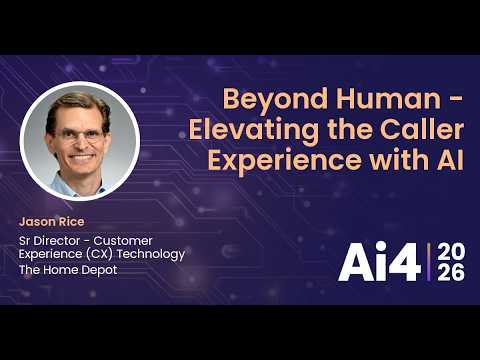
This video was published on YouTube by Ai4 on August 18, 2026. It features Jason Rice, Senior Director of Customer Experience (CX) Technology at The Home Depot, discussing how the company transformed its legacy call center technology by adopting an "AI-first" mindset and deploying multi-agent systems.
## TL;DR
The Home Depot modernized its customer service phone infrastructure by moving from rigid, deterministic IVR trees to an AI-first conversational architecture. Partnering with Google to deploy Dialogflow CX agents allowed the team to rapidly deploy new voice agents, connect enterprise tools directly to phone systems, and overcome testing challenges associated with infinite caller interaction paths. This ongoing transformation enables real-time product discovery and dynamic customer resolution across millions of annual calls.
## Atmosphere & style
The presentation carries a lighthearted yet informative tech-talk vibe, opened by humor around 1980s retro green-screen visual aesthetics. Jason Rice delivers a candid, engaging presentation that balances corporate technical strategy with practical engineering insights. Listeners experience an inspiring narrative arc tracing the journey from customer frustration with legacy phone systems to cutting-edge AI orchestration.
## Detailed walkthrough
Here is a detailed, faithful walkthrough of the provided transcript segment.
---
[00:04](https://www.youtube.com/watch?v=dpJS2n2sJTw&t=4s) Introduction and the "Futuristic" Retro Aesthetics
Jason Rice, Senior Director of Customer Experience (CX) Technology at The Home Depot, opens his talk on leveraging AI to enhance the caller experience. Addressing the audience, he acknowledges that attendee eyes may be drawn to his presentation slides, which sport a distinctive green-screen visual theme. While some audience members laugh, recognizing them as retro 1980s-era terminal screens, Rice jokingly defends the aesthetic choices: growing up, green-on-black terminals were precisely what the future was supposed to look like.
He points out that classical science fiction heavily featured green phosphor displays, and draws a cheeky modern connection: because the technology industry is currently pouring all available graphics processing power into AI training while user interfaces collapse into simple text chats, the sci-fi creators of past decades might have actually predicted our exact present. He promises the audience that for the next 20 minutes, they will be looking at the "absolute future."
- **The Home Depot Call Center Footprint:** Millions of calls are processed annually across thousands of physical retail stores, centralized contact centers, and diverse lines of business.
- **Department & Intent Diversity:** Inbound callers target specific physical departments (e.g., Garden, Pro Desk, Service Desk) or central support (e.g., online order tracking, home installation services).
- **The 60-Second Barrier:** Most customer interactions with traditional interactive voice response (IVR) systems or automated bots last under one minute because callers actively rush through the automation to reach a human agent.
- **Common Call Driver Use Cases:**
* Product availability and store stock inquiries.
* Order status and pickup readiness.
* Holiday store hours and special services (e.g., Tool Rental).
* Order modifications (e.g., changing pickup authorization to a different person).
---
[00:48](https://www.youtube.com/watch?v=dpJS2n2sJTw&t=48s) The Baseline: Audio Demonstration of Legacy IVR Systems
Rice shifts to demonstrating where The Home Depot started by playing a real recorded call between an internal engineer and their legacy automated phone system. The recorded prompt greets the engineer with a standard, rigid message: *"Thank you for calling The Home Depot. I can help with order management, installation services, and more. Tell me how I can help."* The engineer responds naturally: *"I placed an order yesterday but didn't receive the email confirmation."* The legacy system responds deterministically by reading a generic template advice script suggesting the user log into their online account under "My Account," before immediately offering to transfer the caller to a human representative.
```
+------------------------------------------------------------------+
| LEGACY IVR ROUTING FLOW |
+------------------------------------------------------------------+
| Caller Query ---> [ Single Keyword/Intent ] |
| | |
| v |
| [ Hardcoded Script ] |
| "Log into My Account" |
| | |
| v |
| [ Immediate Human Transfer ] |
+------------------------------------------------------------------+
```
Rice explains that this deterministic design provided little to no actual value to the customer. The system merely served as a minor barrier before handing off every complex request to human contact center agents.
- **Legacy Architecture Details:**
* Built on legacy systems, including early Dialogflow implementations (original "ES" / Essentials version).
* Heavy reliance on Dual-Tone Multi-Frequency (DTMF) keypress menus ("Press 1 for X, press 2 for Y").
* Massive, complex store call trees spanning multiple developer screens.
- **The Omni-Channel Disconnect:** Callers received completely isolated experiences depending on whether they called an individual local store or the central dot-com customer support line.
- **The Strategic Goal:** Align the telephonic experience with the broader retail "interconnected" strategy, making phone interactions mirror what a customer sees online or inside a physical store.
---
[04:45](https://www.youtube.com/watch?v=dpJS2n2sJTw&t=285s) The AI Trial and the Critical Mindset Shift
The Home Depot’s journey toward modern AI began 1.5 to 2 years prior with a targeted AI trial. Facing widespread internal skepticism and resistance from stakeholders who believed traditional deterministic logic was safer and more controllable, the team built a scoped Dialogflow playbook dedicated strictly to handling order status intents. The trial performed exceptionally well, proving the viability of conversational AI to leadership and technical teams.
However, moving from a successful pilot to full implementation required an uncomfortable organizational shift: transitioning to an "AI-first" mindset. Initially, the team tried to retain rigid, deterministic control over the entry points, attempting to manually route callers into isolated playbooks (e.g., manually identifying an order status request before passing control). True transformation occurred only when developers surrendered entry-level control and allowed the central AI agent to orchestrate and handle the interaction directly.
```
OLD APPROACH (Bolted-on AI Trial):
Call ---> [ Deterministic Router ] ---> [ Order Status Playbook ]
---> [ Legacy DTMF Trees ]
NEW APPROACH (AI-First Control):
Call ---> [ Central AI Orchestrator ] ---> [ Multi-Agent Systems ]
---> [ Contextual Resolution ]
```
---
[07:00](https://www.youtube.com/watch?v=dpJS2n2sJTw&t=420s) Agent Proliferation and Accelerating with Google CX Agents
Around the same time, AI development expanded rapidly across the entire enterprise. Teams built various Agent Development Kit (ADK) agents for messaging channels, custom product-discovery selling agents, and dedicated resolution bots. However, because phone interactions carry unique real-time audio constraints compared to text-based messaging, connecting voice channels to these underlying systems remained a technical challenge.
The primary catalyst for solving this was partnering with Google to deploy their latest customer experience stack—specifically Google Dialogflow CX / CXAS agents. Working directly with Google, the team built and shipped a brand-new store voice agent to an active retail store in just 21 days. This deployment unlocked the ability to link pre-existing enterprise ADK agents (such as web selling and discovery tools) directly to telephony endpoints without rebuilding core logic from scratch.
---
[08:46](https://www.youtube.com/watch?v=dpJS2n2sJTw&t=526s) Overcoming Operational Gaps: Evals, Synthetic Testing, and Dashboards
Transitioning from deterministic decision trees to AI-first flows created infinite customer interaction paths. In a traditional tree, every single branch and endpoint is explicit; with an AI model, callers can navigate through an infinite permutation of dialogue options. This reality
[16:53](https://www.youtube.com/watch?v=dpJS2n2sJTw&t=1013s) Instant Product Insights Across Vast Catalogs
Jason Rice highlights how advanced AI capabilities directly empower customers during phone interactions. Callers can inquire about highly granular details for virtually any product in the store's massive catalog, or ask broad, exploratory pricing questions across entire product lines. Instead of a customer waiting on hold while a human representative spends minutes scrolling, searching, and sorting through multi-page inventories, the AI scans the full ecosystem in real time and immediately outlines price ranges and product variations.
The underlying infrastructure and AI models are advancing far faster than standard corporate forecasting can keep up with. Every time the team assumes they have maxed out what the system can handle, underlying technological improvements unlock capabilities that surpass what was thought possible just months earlier.
- **Cross-catalog analysis:** AI summarizes general price ranges instantly without requiring manual search filtering.
- **Velocity of innovation:** System capabilities scale faster than typical product roadmaps can anticipate.
---
[17:45](https://www.youtube.com/watch?v=dpJS2n2sJTw&t=1065s) Demo: Real-Time AI Customer Call Walkthrough
Rice plays a live recording of a test call made
## Notable quotes
> [00:04](https://www.youtube.com/watch?v=dpJS2n2sJTw&t=4s) growing up, green-on-black terminals were precisely what the future was supposed to look like. — Jason Rice
> [00:04](https://www.youtube.com/watch?v=dpJS2n2sJTw&t=4s) because the technology industry is currently pouring all available graphics processing power into AI training while user interfaces collapse into simple text chats, the sci-fi creators of past decades might have actually predicted our exact present. — Jason Rice
> [00:48](https://www.youtube.com/watch?v=dpJS2n2sJTw&t=48s) Thank you for calling The Home Depot. I can help with order management, installation services, and more. Tell me how I can help. — Legacy IVR System
> [00:48](https://www.youtube.com/watch?v=dpJS2n2sJTw&t=48s) I placed an order yesterday but didn't receive the email confirmation. — Internal Engineer
## Mentioned
Jason Rice, The Home Depot, Ai4, Dialogflow, Dialogflow CX, Google, Agent Development Kit (ADK), Garden, Pro Desk, Service Desk, Tool Rental
## Video description
Jason Rice - Sr Director - Customer Experience (CX) Technology, The Home Depot
What if your company could handle customer calls not just efficiently, but with an intelligence that goes beyond human capabilities? For years, our caller experience was fragmented, relying on a mix of legacy systems that couldn't keep up with our interconnected digital world. In this talk, I will share our journey of transforming this landscape by adopting an "AI-first" mindset. You will learn how we moved from basic AI trials to deploying sophisticated multi-agent systems, drastically improving our containment rates and achieving a complete shift in development speed. Join me to discover the key learnings from our transformation, and see how you can apply these strategies to elevate your own customer experience.
家得宝采用谷歌AI系统取代门店电话客服菜单
将初始交互控制权移交给中央AI协调器,在复杂的零售商品目录中实现即时电话自动化。
家得宝(The Home Depot)对其客户服务电话基础设施进行了现代化改造,从刻板、确定性的IVR语音导航树转向AI优先的会话式架构。通过与Google合作部署Dialogflow CX智能体,团队得以迅速上线新的语音智能体,将企业工具直接连接到电话系统,并攻克了无限来电交互路径所带来的测试难题。这项持续推进的转型在每年数以百万计的通话中,实现了实时商品查找与动态客户问题解决。
家得宝从刻板的IVR电话树转向AI优先的会话式架构,以升级客服电话基础设施。
通过与Google合作部署Dialogflow CX智能体,团队实现了语音智能体的快速部署及企业工具的直连。
该转型攻克了复杂交互路径的测试挑战,并在每年数百万通电话中支持实时商品查找与动态问题解决。
Reading summary
Jason Rice, Senior Director of CX Technology at The Home Depot, outlines the retailer's transition from rigid, deterministic phone trees to an AI-first orchestration architecture that resolves complex customer inquiries in real time.
Bottlenecks in Legacy Call Architecture (0:48)
The Home Depot processes millions of calls annually across thousands of retail stores, contact centers, and varied lines of business. Inbound inquiries range from inventory checks and tool rental availability to order tracking and pickup reauthorizations. Under the company's legacy Interactive Voice Response (IVR) setup—built on early Dialogflow Essentials and Dual-Tone Multi-Frequency (DTMF) keypress menus—customer interactions routinely stalled.
Most caller engagements lasted under 60 seconds primarily because customers rushed through hardcoded scripts to reach a live representative. Furthermore, the legacy telephony stack created an omnichannel disconnect: customers received isolated, inconsistent experiences depending on whether they reached a local store department or the central dot-com customer support line.
Transitioning to AI-First Orchestration (4:45)
The organization's shift toward conversational AI started 1.5 to 2 years prior through a targeted trial for order status intents. While the pilot confirmed the viability of natural language processing, expanding the technology met internal resistance from stakeholders who viewed deterministic, hardcoded logic as safer and easier to control.
Rice emphasizes that scaling required an organizational mindset shift. Initial designs attempted to maintain deterministic entry routers that manually passed callers into isolated AI playbooks. Breakthrough progress occurred only after developers yielded front-door routing control to a central AI orchestrator capable of managing multi-agent systems and directly resolving caller context.
Bridging Telephony Constraints in Rapid Deployments (7:00)
Enterprise teams had already developed specialized Agent Development Kit (ADK) agents for digital text channels, including selling and discovery tools. However, adapting these systems to voice telephony introduced strict real-time audio constraints that text chat does not require.
To overcome voice latency and integration hurdles, The Home Depot partnered with Google to deploy Dialogflow CX and CXAS agents. This architecture allowed engineers to connect existing web-based ADK selling agents directly to phone systems without rewriting core logic, enabling the deployment of a new store voice agent to an active retail location in 21 days.
Dynamic Catalog Inquiries and Unbounded Dialogue (16:53)
Moving away from predetermined call trees replaced explicit navigational branches with an infinite permutation of dialogue paths. In practical use, callers can request granular item specifications or broad price-range summaries across entire product categories. The AI searches the catalog in real time, eliminating the multi-minute hold times previously required for human agents to scroll inventory records.
Rice noted that underlying infrastructure and AI model capabilities are scaling faster than traditional corporate roadmaps predict, repeatedly unlocking operational capabilities thought unattainable just months earlier.
While AI orchestration resolves structural IVR latency and catalog discovery barriers, replacing closed decision trees introduces operational challenges around unbounded conversational flows. The presentation transcript concludes mid-demonstration without fully detailing the evaluation metrics and synthetic testing frameworks developed to govern these multi-agent voice interactions.
精炼阅读摘要
The Home Depot 客户体验技术高级总监 Jason Rice 阐述了企业如何打破传统交互式语音应答系统的死板限制,通过从确定性规则转向“以人工智能为先”的统一编排架构,将庞大的商品目录与多代理生态深度整合到电话呼叫流程中。
传统IVR系统局限与全渠道体验脱节 (0:48)
The Home Depot 每年通过数千家实体门店、集中联络中心以及各类专业服务业务线(如园艺部、专业服务台、工具租赁和在线支持等)处理数百万通客户电话。然而,传统的交互式语音应答(IVR)系统普遍依赖双音多频(DTMF)按键菜单与复杂冗长的分支树,导致大部分呼叫停留在“60秒障碍”内,即客户为了规避死板的自动化流程而急于转接人工代表。在 Rice 展示的录音测试中,当工程师询问未收到订单确认邮件的问题时,旧系统仅能根据单一关键词机械朗读“请登录账户”等固定脚本并直接提示转接,未能提供实质帮助。此外,客户拨打实体门店与拨打官方支持热线获得的是完全隔离的体验,与企业线上线下一体化的全渠道互联战略存在明显断层。
订单试点突破与以AI为先的思维转型 (4:45)
该团队在一年半至两年前启动了针对订单状态查询的定向 Dialogflow 试点。在克服内部对于确定性逻辑更安全、更易受控的普遍质疑后,该试点验证了对话式 AI 的实用性。然而,从单点试点走向全面落地的核心挑战在于组织观念的重构,即彻底转向“以 AI 为先”的理念。技术团队初期曾试图保留入口端的确定性控制,仅在识别出特定意图后手动将其分流至孤立的预设流程;但最终的实践证明,开发团队必须放弃入口层级的死板干预,由中央 AI 代理直接负责意图理解与交互编排,才能真正实现端到端的高效自动化。
依托Google CX实现多代理快速串联 (7:00)
随着企业内部逐步构建起用于消息通道、商品发现与特定问题处理的代理开发套件(ADK)代理,如何将这些底层系统扩展到具有低延迟和严格音频约束的电话语音渠道成为了技术关键。通过与 Google 合作并部署 Google Dialogflow CX 与 CXAS 架构,团队在 21 天内便完成了一套全新门店语音代理的开发与上线试运行。该方案打破了重新开发底层逻辑的需要,直接将现有的企业销售与探索工具链接至电话呼叫端点,实现了文本与语音渠道的无缝衔接。
应对无限交互路径与海量目录即时解析 (16:53)
从传统的确定性决策树转向 AI 优先架构后,用户交互不再局限于预设分支,而是演变为无限种对话路径组合,促使团队重新审视模型评估、合成测试与监控体系。在业务支持端,AI 展现出了直接扫描庞大产品目录并实时总结价格区间的能力,使得客户能够在电话中自由提出探索性或高度细节化的问题,而无需像以往那样等待人工代表在多页库存中手动翻找与筛选。Rice 指出,底层技术与模型能力的迭代速度已经超出了传统产品路线图的规划预期,基础设施的每次升级都在快速突破既有的系统能力上限。
The Home Depot 的实践印证了放弃严格硬编码路由并交由中央 AI 进行多代理编排的可行性;但在对话分支走向无限可能的新范式下,企业如何在模型能力迅速超越原有规划周期的背景下保持严密的测试评估与运营控制,仍是推进智能化语音系统不可忽视的长期课题。
Detailed notes — zh
## Background
该内容由 Ai4 频道于 2026 年 8 月 18 日发布在 YouTube 平台。视频记录了家得宝(The Home Depot)客户体验技术高级总监 Jason Rice 的主题演讲,介绍家得宝如何摆脱传统割裂的话务系统,通过树立“AI 优先”理念和部署先进的多智能体架构,全面重塑客户通话体验并大幅提升研发交付效率。
## TL;DR
演讲系统回顾了家得宝从传统庞杂且体验割裂的 IVR 呼叫树,向大模型驱动的“AI 优先”全渠道智能体体系转型的全过程。通过引入 Google CES 与 CX 智能体生态,团队仅用 21 天便完成首家门店语音 Agent 试点,并实现了跨渠道导购与服务能力的复用。面对概率性 AI 带来的“无限终点”挑战,团队建立起覆盖全生命周期的自动化 Evals、生产端合成测试以及基于垫话(filler phrases)的延迟优化机制。同时,工程团队在内部落地了“机器人构建机器人”的智能体研发流水线(Agentic Development),将新功能迭代周期从数周骤降至数小时。
## Atmosphere & style
整场演讲幽默自如且充满前沿技术落地的实战质感。Jason 开场借由复古绿屏风格的幻灯片调侃科幻预言,迅速活跃了现场气氛,随后的分享不仅逻辑清晰、切中大企业架构转型的痛点,还穿插了真实的测试通话录音与“建露台工匠转变为机器人调度者”的生动比喻。听众在轻松专注的氛围中,既能感受到大厂技术管理者直面模型延迟与边缘情况时的务实严谨,又能体会到 AI 技术全面超越传统人类服务边界所带来的震撼与信心。
## Key takeaways
- [00:04](https://www.youtube.com/watch?v=dpJS2n2sJTw&t=4s) 家得宝每年跨门店与呼叫中心处理数千万通电话,传统 IVR 存在严重的体验割裂与用户急于绕过机器人的痛点。
- [02:48](https://www.youtube.com/watch?v=dpJS2n2sJTw&t=168s) 传统的确定性话务系统技术栈杂乱且维护成本极高,线上与门店呼叫体系脱节,无法满足全渠道零售的需求。
- [04:45](https://www.youtube.com/watch?v=dpJS2n2sJTw&t=285s) 从订单状态试点突破后,团队实现了从控制确定性路由到彻底让渡控制权给大模型的“AI 优先”心智转变。
- [06:58](https://www.youtube.com/watch?v=dpJS2n2sJTw&t=418s) 借助 Google CES 技术栈,家得宝仅耗时 21 天便在试点门店上线了能复用全渠道 ADK 能力的新一代语音智能体。
- [08:46](https://www.youtube.com/watch?v=dpJS2n2sJTw&t=526s) 面对 AI 带来的“无限终点”交互,团队构建了覆盖全生命周期的 Evals 评估体系与跨系统生产环境合成测试基建。
- [10:15](https://www.youtube.com/watch?v=dpJS2n2sJTw&t=615s) 建立跨部门统一的监控看板,并引入路由智能体(Routing Agent)将客户精准分流至专业团队,避免服务台过载。
- [13:20](https://www.youtube.com/watch?v=dpJS2n2sJTw&t=800s) 采用 Google CXA Scrappy API 打造多智能体研发流水线,实现“AI 辅助开发 AI”,将新功能开发周期由数周缩短至数小时。
- [14:50](https://www.youtube.com/watch?v=dpJS2n2sJTw&t=890s) 工程师角色完成了从传统手艺人到“机器人管理者(Bots building bots)”的心智升级,专注于统筹专业 AI 协作流。
- [16:22](https://www.youtube.com/watch?v=dpJS2n2sJTw&t=982s) “Beyond Human”体验展现了超越人工客服的知识广度与响应速度,能够轻松应对复杂产品安装指导与大范围模糊比价。
- [19:39](https://www.youtube.com/watch?v=dpJS2n2sJTw&t=1179s) 转型核心启示在于彻底贯彻 AI 优先、利用拟人化语音提升交互留存率,并通过过渡提示语(filler phrases)与评估库化解模型延迟与边界风险。
## Detailed walkthrough
### [00:04](https://www.youtube.com/watch?v=dpJS2n2sJTw&t=4s) 极简复古风幻灯片与家得宝的呼叫中心全貌
演讲者 Jason Rice(The Home Depot 客户体验技术高级总监)在开场时感谢观众的到来,并幽默地调侃起自己现场的演示文稿。台下观众看到幻灯片时发出了笑声,因为那些界面看起来极为独特——既像来自未来,又像 20 世纪 80 年代的老式绿屏(green screens)。Jason 笑着解释道,在自己成长的年代,科幻作品中描绘的未来恰恰就是这种绿色终端屏幕;如今所有的顶级 GPU 算力都在为 AI 提供动力,而各种图形 UI 界面也都在向纯聊天交互(Chat)演变,某种意义上,当年的科幻创作者或许真的预言了人机交互的终极形态。
玩笑过后,Jason 切入正题,介绍了 The Home Depot(家得宝)复杂而庞大的客户呼叫生态。作为全美顶尖的家居零售巨头,家得宝每年要跨各个门店、不同呼叫中心处理高达数千万通电话,业务场景异常繁杂:
- **多样化的业务条线与门店部门**:顾客拨打门店电话可能只想转接花园区(Garden)、专业客户服务台(Pro Desk)或售后服务台(Service Desk);而拨打集中客服热线则可能是咨询线上订单进展或家装服务项目(Home Services)。
- **短促且目的性极强的通话习惯**:与许多企业类似,家得宝大部分 IVR(交互式语音应答)或 Bot 的通话时长都不足一分钟。其原因非常现实——大部分顾客与语音机器人对话时的唯一诉求就是尽快绕过机器人,接入能够真正解决问题的人工客服。
- **高频呼叫诉求类型**:包括查询某家门店是否有现货(Product availability)、订单履约状态(是否备好可自提)、节假日营业时间、工具租赁服务(Tool rental),或者因临时无法到店而变更自提人信息等。
---
### [02:48](https://www.youtube.com/watch?v=dpJS2n2sJTw&t=168s) 传统 IVR 的局限与割裂的客户体验
为了让大家真切体会过去的呼叫体验,Jason 现场播放了一段团队工程师与家得宝旧版传统系统通话的录音。在录音中,用户表示自己前一天下了单但没收到确认邮件;系统给出的回应极其机械死板:“温馨提示,如果您是在登录家得宝账户的状态下下的单,也可以登录并在‘我的账户-线上订单’页面查看订单号和确认信息。让我为您转接可以提供帮助的人员。”
Jason 指出,这就是最典型的传统确定性(deterministic)IVR 体验。系统虽然试图给出一些引导信息(例如建议去官网查看),但缺乏任何深度交互能力,立刻就甩给了人工坐席,对顾客而言并没有创造真正的价值。
深入剖析旧系统的技术架构,家得宝当时面临着极其沉重的历史包袱与体验割裂:
- **杂乱的技术堆栈**:系统中混杂着早期的 Google Dialogflow ES 版本、传统的 DTMF 按键流程(“按 1 处理这个,按 2 处理那个”),以及错综复杂的传统呼叫树。
- **庞大到失控的呼叫树**:门店端旧的 IVR 流程图庞大无比,需要多块屏幕才能完整展示全部节点。
- **线上与线下的完全脱节**:顾客拨打线下门店和拨打线上呼叫中心时,听到的是两套完全不同、互不相通的话务系统。然而在现代全渠道零售(Interconnected Retail)理念下,零售商追求的是线上线下无缝衔接,顾客在 App 或官网上看到的信息应与门店完全一致。这种相互割裂的语音体验早已无法适应业务发展。
```mermaid
flowchart TD
accTitle: Legacy Disconnected IVR Architecture
subgraph Legacy["传统割裂的话务架构"]
A["顾客拨打门店电话"] --> B["传统门店呼叫树 (巨大且复杂的 DTMF / ES)"]
B --> C["机械转接人工坐席"]
D["顾客拨打线上客服"] --> E["独立的线上联络中心系统"]
E --> C
end
```
---
### [04:45](https://www.youtube.com/watch?v=dpJS2n2sJTw&t=285s) 破冰试水:从订单状态试点到“AI 优先”的心态转变
家得宝的智能化转型并非一蹴而就。大约一年半到两年前,团队开启了第一次 AI 试验。当时组织内部充斥着对 AI 的怀疑态度(AI skepticism),许多人固执地认为概率性的 AI 绝不可能胜过经过严密验证的确定性流程。为了打破僵局,团队决定采取小步快跑的策略:在 Dialogflow 中针对高频的“订单状态”(Order Status)意图构建了一个 Playbook 试验模块。
测试结果出乎所有人的预料:AI 模块的表现极为优异,成功率与体验大幅提升。这一成绩彻底扭转了团队内对 AI 的认知偏见,推动整个部门迈入了下一阶段——**AI 优先(AI-First)的心态转变**。
Jason 强调,从确定性逻辑走向 AI 优先是一场痛苦的思想蜕变。起初,团队虽然引入了 Playbook,但人类工程师依然试图牢牢掌控前置路由:
- 人类仍然想由传统的网关来判断用户是否在问订单状态,再分发给订单 Playbook;
- 或者判断用户是否在问门店营业信息,再分发到营业时间模块。
人性天然排斥放弃对确定性规则的掌控感,但这种“给旧系统打 AI 补丁”的做法严重限制了 AI 的上限。家得宝最终下定决心彻底放手,将入口控制权完全移交给 AI,由大模型主导意图理解与路由调度。正是这一“AI 优先”的理念转折,带来了整个交互体验的质的飞跃。
---
### [06:58](https://www.youtube.com/watch?v=dpJS2n2sJTw&t=418s) 智能体爆发与 21 天落地新一代门店 Agent
随着技术理念的转变,家得宝内部涌现出了大量的智能体(Agent)开发浪潮。团队基于 ADK 构建了面向各种业务场景的专用 Agent,例如部署在官网辅助用户挑选商品的导购销售 Agent(Selling Agents)、处理售后纠纷的解决 Agent(Resolution Agents)等。不过初期这些智能体大多运行在文本消息(Messaging)渠道,而语音通话由于对实时性、断句和容错要求极高,复杂度远超文本。
转折点出现在家得宝引入了最新的 Google 技术栈——Google CES(Customer Experience Suite)与 CX 智能体体系。通过与 Google 团队紧密合作,家得宝为门店场景打造了全新的综合性语音 Agent:
- **惊人的上线速度**:双方团队密切配合,仅耗时 **21 天** 就成功将全新智能体部署落地到了第一家试点门店中。
- **全渠道智能体能力复用**:新架构直接解锁并复用了此前在文本端沉淀的所有 ADK Agent 能力。当语音电话中的顾客提出复杂的商品选购或导购问题时,系统无需重新开发一套语音逻辑,直接将调用路由到底层的销售 Agent 上,实现了跨渠道、一致性极强的核心能力复用。
```mermaid
flowchart LR
accTitle: Modern AI-First Caller Architecture
Caller["进线呼叫 (语音电话)"] --> FrontAI["Google CES / CX 语音核心入口 (AI 优先掌控)"]
subgraph AgentEcosystem["企业统一智能体与服务生态"]
FrontAI --> Agent1["导购销售 Agent (复用 ADK 模块)"]
FrontAI --> Agent2["订单/售后解决 Agent"]
FrontAI --> Agent3["外部服务 (短信/履约系统)"]
end
```
---
### [08:46](https://www.youtube.com/watch?v=dpJS2n2sJTw&t=526s) 运营挑战:无限终点下的评测与端到端监控
系统跑通并不意味着万事大吉,团队很快遭遇了严峻的运营挑战(Operational gaps)。Jason 坦言,传统确定性系统即使规模再庞大,其分支路径与终端节点(Endpoints)终究是有限且已知的;然而一旦转向 AI 优先,交互分支便演变成了“无限终点”(Infinite endpoints),用户提问的方式千奇百怪,工程师根本不可能预设或遍历所有的交互分支。
为了在失控风险中维持企业级的可靠运行,团队不得不从零搭建一整套严密的配套运营基建:
- **全生命周期持续评估(Evals)**:评估体系成为了生命线。团队开始构建无所不在的自动化 Eval 指标,并且必须持续更新——每次只要上线新功能或调整 Prompt,对应的评估集就必须同步扩展。
- **跨系统的生产环境端到端(E2E)合成测试**:新一代智能体具备在通话期间直接向顾客发送 SMS 短信(如发送商品链接、提货码)的能力。这项能力不仅依赖 IVR 内部系统,还联动了家得宝底层的第三方消息通信管道。为此,团队构建了在生产环境中不间断运行的合成测试(Synthetic tests),实时模拟真实呼叫,以验证当 Agent 触发发短信指令时,外部短信网关确实能把短信送达用户手机。
- **监控维度的全面重塑**:以往只检测“服务进程是否在线(Up/Down)”的传统基础监控彻底失效,系统需要全新维度的深度观测手段来捕捉 AI 的语义漂移与业务达成率。
### [10:15](https://www.youtube.com/watch?v=dpJS2n2sJTw&t=615s) 建立标准化评估与跨渠道体验的弥合
在推出智能体后,一系列全新的运营挑战随之浮出水面。管理者必须时刻关注拦截率(containment numbers)的动态变化、系统延迟(latency)以及智能体对查询的响应速度(time to response)。为了有效监管智能体的运行状态,团队打破了产品(Product)、工程(Engineering)与数据科学(Data Science)部门之间的壁垒,共同制定了统一的衡量标准。通过构建包含 4 至 5 个核心监控看板的仪表盘体系,管理层每天早晨都会全面审查业务指标以及 IT 性能故障等技术数据,以确保 AI 智能体的稳定高效运转。
与此同时,家得宝(The Home Depot)着力填补线上线下的体验鸿沟。以往,线上与实体门店的库存被割裂管理;而随着业务模式转型,越来越多线上订单直接从离用户最近的实体店发货。这就要求交互体验必须高度本地化(localized)——当顾客拨打电话定位到某家特定门店时,智能体提供的库存信息和视觉体验必须与线上完全对齐。
此外,智能路由(Routing)被提升为核心能力。在过去确定性的流程中,路由相对简单;而在无限可能的 AI 对话流中,转向人工客服(Human fallback)成为了保底手段。为了避免所有复杂电话一转接就涌向服务台(service desk),家得宝专门构建了路由智能体(Routing Agent),精准识别客户需求并将电话分流至专业团队(如 Pro 专营服务台或特定商品部门)。这一转变使得 IVR 从单纯的“基础解答与转接工具”升级为兼具“产品销售与深度服务”功能的综合客户体验平台。
* **指标与数据看板**:打破部门共识,每日监控 Latency、Time to Response、Containment Rate 及系统 Error。
* **体验本地化**:对接线上与门店库存,确保电话端与 App/官网的体验一致。
* **路由智能体**:精准分流客户至专业部门(如 Pro 部门),避免无差别涌入 Service Desk。
---
### [13:20](https://www.youtube.com/watch?v=dpJS2n2sJTw&t=800s) 智能体化开发(Agentic Development)与研发效率飞跃
随着客户端 AI 智能体的成熟,工程团队研发模式的变革(Agentic Development)成为了下一个重大突破口。Google 推出了名为 `CXA Scrappy` 的 API,允许开发人员通过代码、命令行以及 CI/CD 流水线直接与云端智能体交互。利用这一工具,团队在 Anti-gravity 框架下构建了包含规划智能体(Planner Agent)、实现智能体(Implement Agent)和测试评估智能体(Eval Agent)的多智能体工作流。这些智能体能够自动生成代码、评估覆盖率(Code Coverage)与测试覆盖率(Test Coverage),确保代码质量达到标准后方可发布。
```mermaid
accTitle: 智能体化研发与测试流水线
flowchart LR
subgraph Dev["研发智能体阶段"]
A["Planner Agent\n(需求规划)"] --> B["Implement Agent\n(代码实现)"]
end
subgraph Test["测试与发布阶段"]
B --> C["Eval Agent\n(构建评估)"]
C --> D["Coverage Check\n(代码与测试覆盖率检查)"]
D --> E["CI/CD Pipeline\n(自动化发布)"]
end
```
这种“用 AI 辅助开发 AI”的方式带来了令人惊叹的开发速度飞跃:**原本需要数周才能完成的新功能开发,如今缩短至几个小时即可完成**。由于研发节奏极快,依赖人工进行测试评估已不再现实,团队大幅提升了对自动化 AI Evaluation 的依赖,以此保障系统的安全与稳定。
* **工具支持**:采用 Google `CXA Scrappy` API 实现 CI/CD 流水线与云智能体的深度联动。
* **多智能体协作**:部署 Planner Agent、Implement Agent 与 Eval Agent 构成的自动化开发流水线。
* **开发周期缩短**:新功能开发迭代时间从**数周(weeks)**降至**数小时(hours)**。
---
### [14:50](https://www.youtube.com/watch?v=dpJS2n2sJTw&t=890s) 工程师角色的心智转变:从匠人到“机器人管理者”
讲述者以家得宝擅长的家居装修行业作类比,形象地阐述了工程师角色在 AI 时代的心智转变(Mindset Shift):
1. **工匠阶段(无 AI 工具)**:工程师就像手握锤子建造木露台(Deck Builder)的传统匠人,纯靠手工打造系统。
2. **效率工具阶段(早期 AI 工具)**:给工匠配备了一把钉枪(Nail Gun)。工程师依然是手艺人,只是施工速度大幅提升。
3. **智能体管理阶段(Agentic AI)**:工程师不再亲自动手打造露台,而是转变为“指挥机器人的管理者”。现场有专门钉板条的机器人、锯木头的机器人和搬运工具的机器人,工程师只需统筹协调这些机器人的工作流。
过去的误区在于,工程师虽然在开发酷炫的客户侧 AI 智能体,但自己却仍在“纯手工”写代码;而家得宝追求的目标则是让**机器人来构建机器人(Bots building bots)**。
* **传统阶段**:纯手工打造系统,如同拿着锤子建造露台的匠人。
* **初级 AI 阶段**:使用 AI 代码生成(如钉枪),提升单兵生产力,但本质未变。
* **终极 AI 阶段**:工程师转型为管理者,指挥不同的专业 AI Bot 协作构建与维护系统。
---
### [16:22](https://www.youtube.com/watch?v=dpJS2n2sJTw&t=982s) 超越人类能力(Beyond Human)的客户体验演练
家得宝将这一终极体验命名为“Beyond Human”。AI 不仅能以极快的速度解决大部分常见问题,还掌握了庞大的产品知识库。它不仅能回答“有没有货”,还能指导用户如何安装 Ring 智能门铃并将其与 App 联调。对于横跨整个产品线的大范围咨询(如“这类产品大致价格区间是多少?”),AI 能瞬时扫描全库并给出价格范围,而人工客服则需要花相当长时间去翻页、筛选和计算。
演讲现场播放了一段在测试环境录制的实际通话录音:
> **AI 语音助手**:“感谢致电 North Annapolis 家得宝,我是本店的店内助手(Store Assistant),请问有什么可以帮您?”
> **客户**:“我想买最新款的 Nest 温控器,请问你们有现货吗?”
> **AI 语音助手**:“我为您找到了几款最新 Nest 温控器的选择,店内和线上均有销售。为了精准定位,请问您找的是第几代产品,或者有什么具体功能要求吗?”
> **客户**:“哪一代是最新的?”
> **AI 语音助手**:“最新的版本是第四代 Nest Learning Learning Thermostat。我们有几种不同的外观饰面可选。需要我发您一个安全链接直接下单吗?”
> **客户**:“先不用。我听说它在不运行的时候能在屏幕上显示图像,是真的吗?”
> **AI 语音助手**:“是的,它有一项名为 Farsight 的功能。当您靠近时,它可以显示时间、温度乃至天气信息。”
这段对话充分体现了 AI 的应变与知识深度。面对模糊的询问、跳跃式的提问(如查询隐晦功能),AI 都能轻松理解并准确解答。家得宝拥有庞大的商品目录,要求每一个基层员工掌握所有商品的细节是不切实际的,而 AI 智能体则完美弥补了这一缺口。
* **功能解答示例**:指导用户安装 Ring 智能门铃与 App 绑定;解释 Nest 温控器第四代的 Farsight 靠近显示功能。
* **大范围检索**:瞬时扫描全线商品并提供价格区间,无需人工逐页翻查。
* **服务形态转变**:能够适应客户模糊、跳跃式的自然语言问答,大幅提升沟通效率。
---
### [19:39](https://www.youtube.com/watch?v=dpJS2n2sJTw&t=1179s) 核心经验总结
在演讲的尾声,讲者总结了家得宝在这次 AI 转型中的核心经验:
1. **树立“AI 优先”的心智(AI-first mindset)**:学会让渡控制权,相信并让 AI 自主运行。
2. **对话尽可能拟人化(Humanize the conversation)**:鉴于许多客户尚不习惯与 AI 交流,越逼真的语音越能提升交互意愿。家得宝甚至巧妙地将开场的法律条款提示音设计得较为机械,形成鲜明对比,从而使后段逼真的 AI 语音更能吸引客户持续沟通。
3. **重视边缘情况(Corner cases abound)**:在无限流程的交互场景下,极端的边缘情况层出不穷,必须建立完备的兜底机制。
* **让渡控制权**:相信 AI 的能力,敢于将核心交互交给 AI 执行。
* **拟人化策略**:故意将前置法律声明留作机械音,反衬出后续 AI 助手的自然拟人感,提高用户留存率。
### [20:16](https://www.youtube.com/watch?v=dpJS2n2sJTw&t=1216s) 应对模型延迟与演讲总结致谢
在评估与系统保障方面,建立一套完善的评估库(Evaluation Library)能够全面覆盖各种潜在风险与边界情况。与此同时,系统延迟问题依然不可忽视。尽管当前的大语言模型功能极其强大,但在面对某些复杂问题时,生成和处理的速度仍可能放缓。为了避免客户在长时间静默等待中产生挫败感,系统应巧妙加入“垫话”(filler phrases)等过渡性提示语,在模型处理期间维持自然的对话互动,从而优化整体等待体验。
Jason Rice 在演讲结语中表示,希望大家能从这次分享中有所收获,并非常期待在会后与现场观众进行深入交流与链接。他邀请大家扫描屏幕上的二维码留下联系方式,随时关注 The Home Depot 在客户体验与 AI 创新领域正在推进的各项前沿探索,并对所有到场聆听的参会者表达了诚挚的谢意。
- **延迟缓解策略**:在 AI 模型处理复杂查询产生延迟时,适时插入 filler phrases 缓冲等待时间,提升用户交互体验。
- **评估体系保障**:利用健全的评估库(Evaluation Library)对 AI 应用进行兜底与全方位监测。
- **互动与后续交流**:参会者可通过扫描二维码与 The Home Depot 团队保持联络,持续了解其在客户体验技术方面的最新实践。
## Notable quotes
> [02:48](https://www.youtube.com/watch?v=dpJS2n2sJTw&t=168s) 温馨提示,如果您是在登录家得宝账户的状态下下的单,也可以登录并在‘我的账户-线上订单’页面查看订单号和确认信息。让我为您转接可以提供帮助的人员。 — 旧版传统系统
> [04:45](https://www.youtube.com/watch?v=dpJS2n2sJTw&t=285s) 人类仍然想由传统的网关来判断用户是否在问订单状态,再分发给订单 Playbook;或者判断用户是否在问门店营业信息,再分发到营业时间模块。 — Jason Rice
> [16:22](https://www.youtube.com/watch?v=dpJS2n2sJTw&t=982s) 感谢致电 North Annapolis 家得宝,我是本店的店内助手,请问有什么可以帮您? — AI 语音助手
> [16:22](https://www.youtube.com/watch?v=dpJS2n2sJTw&t=982s) 我想买最新款的 Nest 温控器,请问你们有现货吗? — 客户
> [16:22](https://www.youtube.com/watch?v=dpJS2n2sJTw&t=982s) 我为您找到了几款最新 Nest 温控器的选择,店内和线上均有销售。为了精准定位,请问您找的是第几代产品,或者有什么具体功能要求吗? — AI 语音助手
> [16:22](https://www.youtube.com/watch?v=dpJS2n2sJTw&t=982s) 哪一代是最新的? — 客户
> [16:22](https://www.youtube.com/watch?v=dpJS2n2sJTw&t=982s) 最新的版本是第四代 Nest Learning Learning Thermostat。我们有几种不同的外观饰面可选。需要我发您一个安全链接直接下单吗? — AI 语音助手
> [16:22](https://www.youtube.com/watch?v=dpJS2n2sJTw&t=982s) 先不用。我听说它在不运行的时候能在屏幕上显示图像,是真的吗? — 客户
> [16:22](https://www.youtube.com/watch?v=dpJS2n2sJTw&t=982s) 是的,它有一项名为 Farsight 的功能。当您靠近时,它可以显示时间、温度乃至天气信息。 — AI 语音助手
## Mentioned
Jason Rice, The Home Depot, Ai4, Google, Google Dialogflow ES, Google CES, ADK, CXA Scrappy, Anti-gravity, Nest Learning Thermostat, Ring
## Video description
Jason Rice - Sr Director - Customer Experience (CX) Technology, The Home Depot
What if your company could handle customer calls not just efficiently, but with an intelligence that goes beyond human capabilities? For years, our caller experience was fragmented, relying on a mix of legacy systems that couldn't keep up with our interconnected digital world. In this talk, I will share our journey of transforming this landscape by adopting an "AI-first" mindset. You will learn how we moved from basic AI trials to deploying sophisticated multi-agent systems, drastically improving our containment rates and achieving a complete shift in development speed. Join me to discover the key learnings from our transformation, and see how you can apply these strategies to elevate your own customer experience.
[Source](https://www.youtube.com/watch?v=dpJS2n2sJTw)
Source quotes
[2:48] 旧版传统系统: 温馨提示,如果您是在登录家得宝账户的状态下下的单,也可以登录并在‘我的账户-线上订单’页面查看订单号和确认信息。让我为您转接可以提供帮助的人员。
[4:45] Jason Rice: 人类仍然想由传统的网关来判断用户是否在问订单状态,再分发给订单 Playbook;或者判断用户是否在问门店营业信息,再分发到营业时间模块。
[16:22] AI 语音助手: 感谢致电 North Annapolis 家得宝,我是本店的店内助手,请问有什么可以帮您?
[16:22] 客户: 我想买最新款的 Nest 温控器,请问你们有现货吗?
[16:22] AI 语音助手: 我为您找到了几款最新 Nest 温控器的选择,店内和线上均有销售。为了精准定位,请问您找的是第几代产品,或者有什么具体功能要求吗?
[16:22] 客户: 哪一代是最新的?
[16:22] AI 语音助手: 最新的版本是第四代 Nest Learning Learning Thermostat。我们有几种不同的外观饰面可选。需要我发您一个安全链接直接下单吗?
[16:22] 客户: 先不用。我听说它在不运行的时候能在屏幕上显示图像,是真的吗?
[16:22] AI 语音助手: 是的,它有一项名为 Farsight 的功能。当您靠近时,它可以显示时间、温度乃至天气信息。
Source quotes
[0:04] Jason Rice: growing up, green-on-black terminals were precisely what the future was supposed to look like.
[0:04] Jason Rice: because the technology industry is currently pouring all available graphics processing power into AI training while user interfaces collapse into simple text chats, the sci-fi creators of past decades might have actually predicted our exact present.
[0:48] Legacy IVR System: Thank you for calling The Home Depot. I can help with order management, installation services, and more. Tell me how I can help.
[0:48] Internal Engineer: I placed an order yesterday but didn't receive the email confirmation.
Original transcript
[0:04] Thank you all for coming this afternoon.
[0:06] I'm very excited to share our journey
[0:08] with how we've leveraged AI to enhance
[0:11] our caller experience, which I think is
[0:13] a very very realistic and great use case
[0:16] for AI and something that a lot of
[0:19] companies are exploring. Now, as you
[0:22] look up at the screens, you may have
[0:23] said to yourself, "Well, wow, he's got
[0:26] some futuristic looking slides there,"
[0:28] which I tried to do because, you know,
[0:30] it's an AI conference. And then I I
[0:32] heard some folks laugh because some
[0:33] people may think, well, wait a minute,
[0:35] those look like 80s era green screens.
[0:38] Um, and so I would argue that, you know,
[0:41] as I was growing up, that was what the
[0:43] future looked like. So, you can see
[0:46] this, you know, look at the future. It
[0:48] has those kind of green screens. And if
[0:51] you actually look at science fiction,
[0:52] all the most popular science fiction
[0:54] series that are out there, they all have
[0:57] screens that look like this. And it got
[0:59] me to thinking, well, you know, we are
[1:01] using all of the graphics cards to power
[1:03] AI. And all the UI interfaces are just
[1:06] turning into chats. So maybe those
[1:08] science fiction creators were on to
[1:10] something that this is actually where
[1:12] we're heading. So for the next 20
[1:14] minutes, be um prepared to be wowed by
[1:17] looking at the absolute future. Uh so
[1:20] first a little bit about the Home Depot.
[1:22] Very great company to work for with a
[1:24] very diverse caller landscape. So you
[1:27] know we have many millions of calls that
[1:29] we get per year across our stores, a
[1:34] bunch of different lines to different
[1:35] contact centers.
[1:37] We have multiple, you know, store
[1:39] departments and multiple lines of
[1:41] business. So when you're calling a
[1:43] store, you may be trying to get to the
[1:44] garden, the protest, the service desk,
[1:46] or you may be calling centrally because
[1:48] you got an online order, or you have a
[1:50] home services project. So we have a lot
[1:52] of different cases. And like a lot of
[1:55] companies, most of our IVR or bot
[1:58] conversations last less than one minute.
[2:01] Well, as we all know, most customers
[2:03] when they start talking to a bot, their
[2:05] goal is to get through the bot, right?
[2:07] To get to the actual human that can help
[2:09] them. So, pretty standard uh landscape.
[2:12] Some of our calling types that we get,
[2:15] product availability is an obvious one,
[2:17] right? Hey, is this in the store? Hey, I
[2:20] want to understand my order status. Is
[2:22] it ready for me to pick up? Is your
[2:24] store open? I know it's a holiday. Hey,
[2:28] um do you have tool rental? Or hey, I
[2:30] need to make a change to my order. I
[2:32] can't pick it up anymore. Can I put
[2:33] somebody else in? Right? Those are just
[2:35] an example. So today I'm going to cover
[2:38] our journey of how we went from an old
[2:40] legacy system to something that I titled
[2:43] Beyond Human because it has a lot of
[2:45] really great capabilities. So in order
[2:48] to start our journey though, let's play
[2:50] a call from where we came from. So this
[2:51] is one of the engineers on our team
[2:53] talking to our old legacy system.
[2:54] >> Thank you for calling the Home Depot. I
[2:56] can help with order management,
[2:58] installation services, and more. Tell me
[3:01] how I can help. I uh placed an order
[3:04] yesterday but didn't receive the um
[3:07] email confirmation.
[3:09] >> Got it. Just so you know, if you placed
[3:11] the order while you were logged into
[3:13] your account with the Home Depot, you
[3:15] can also log in to view your order
[3:17] number and confirmation in the online
[3:19] orders section of my account. Let me
[3:22] connect you with someone who can help.
[3:25] So, pretty standard IVR experience,
[3:28] right, that we're used to. We just want
[3:29] to get through something like that. Now
[3:31] you saw it's very deterministic. We
[3:33] tried to give some indicators of hey did
[3:36] you know you can go online to do this
[3:38] right but then we handed right off to a
[3:40] human. So not a ton of value for our
[3:42] customers. So that's where we started.
[3:45] So today we're going to run through our
[3:46] journey of how we elevated that. So
[3:49] first if we talk about those legacy
[3:51] systems. So we had a wide range of
[3:53] stuff. Um, a lot of Google dialogue
[3:56] flow, the original yes version, some
[3:59] DTMF flows, you know, press one for
[4:01] this, press two for that. Uh, we have a
[4:04] variety of call trees. Our store call
[4:06] tree, the legacy one, it's just huge.
[4:08] You know, it takes multiple screens to
[4:09] even look at all of the the things. And
[4:12] where it really sort of struck me was we
[4:15] had a disconnected experience. when you
[4:18] called into our stores, you got one
[4:19] thing, you got a totally different thing
[4:21] when you called the online contact
[4:23] contact center or someplace else.
[4:25] [gasps] While in retail, what we've seen
[4:27] is everything is becoming
[4:29] interconnected. So, we want our online
[4:31] experience to match our store
[4:32] experience. Whatever you see online, we
[4:34] want you to be able to see in there. So,
[4:36] it made no sense anymore to have all
[4:37] these disconnected phone experiences.
[4:39] How do we make it match that
[4:41] interconnected experience we have
[4:43] everywhere else? [sighs] So, we go back
[4:45] to our journey. I know before I drew it
[4:47] as a straight line. No journey is
[4:49] actually a straight line though, right?
[4:50] We have lots of different sort of things
[4:52] we encountered. So the first thing we
[4:55] did was what I would call an AI trial.
[4:58] Uh and it started about a year and a
[5:00] half, two years ago. And like a lot of
[5:04] places, a lot of AI skepticism existed.
[5:07] You know, folks weren't sure. A lot of
[5:09] our people thought, you know, no, that's
[5:11] not going to be better than the
[5:12] deterministic, right? So, like a lot of
[5:14] places, we did a trial. And what we did
[5:17] was we built a dialogue flow playbook
[5:19] for just order status intents. We're
[5:21] just going to try it out. And we put
[5:23] that in. [gasps] And what we saw was,
[5:25] wow, it performed really, really well.
[5:28] It actually was something here. So, we
[5:30] learned from that and it started to
[5:31] change our thinking and change our minds
[5:34] on that. So, with those significant
[5:36] results, we wanted to actually move
[5:38] forward and start to see what else could
[5:40] we do with this. And so that put us back
[5:43] on our journey and the next big phase
[5:46] for us was actually a mindset shift. So
[5:49] we had to shift our thinking to be AI
[5:51] first. So what do I mean by that? You
[5:55] know, as those playbooks expanded, we
[5:57] were still trying to control the front.
[5:59] We still wanted to master and have the
[6:02] routing that it then had. So I wanted to
[6:04] determine if you really needed order
[6:05] status and I'd send you off to my order
[6:07] status playbook. I wanted to determine
[6:09] that you needed store info and it send
[6:11] you off somewhere else. And really, like
[6:13] any transition, change is hard. We as
[6:16] humans have trouble letting go of the
[6:18] control that we're used to with those
[6:19] deterministic flows. And so, it was
[6:22] necessary though for us to shift our
[6:23] thinking and give the AI control. And
[6:26] switching to that AI first mindset was
[6:28] where we fought saw our big first step
[6:31] of unlocks. So if I sort of visualize
[6:34] this, imagine that I have all these
[6:35] different call trees, right, with
[6:37] different flows throughout them. And
[6:39] when we ran our AI trial, right, we just
[6:41] bolted it on. Let's just do something
[6:43] small. Let's not try to harm anything
[6:45] and see if it's valuable. And it was
[6:48] good, but it wasn't until we made the
[6:50] switch and said, "No, give AI control.
[6:53] Let AI run it." That we then started to
[6:55] see the big shifts.
[6:58] So that leads us back to our journey and
[7:00] the next phase on it was really about
[7:02] agent proliferation. So we weren't doing
[7:05] this in a vacuum in inside of our
[7:07] company. There was a lot of expansion of
[7:10] AI development throughout the shop. So
[7:13] we saw ADK agents being built for a lot
[7:16] of different use cases which was great
[7:18] but it was mostly messaging right phones
[7:21] are complex. It's much easier in a
[7:23] messaging scenario.
[7:25] Um, we saw custom selling agents which
[7:28] uh you can find online now to help
[7:31] customers find products. We found
[7:33] resolution agents. So the goal though
[7:35] was how do we unlock those because we
[7:37] were seeing excellent value inside of
[7:40] them.
[7:42] So that leads us back to the next phase
[7:44] of our journey which was an accelerant
[7:48] for us. And so that accelerant was the
[7:52] latest Google stack, the Google CES
[7:56] CXASS agents. So Google came in and
[8:00] partnered with us to build a brand new
[8:02] store agent.
[8:04] And we were able to ship that to one
[8:07] store within 21 days. So we saw and
[8:10] partnered with them on the power of this
[8:12] platform and the abilities and the
[8:14] things it could do.
[8:17] And what gave us that big unlock is all
[8:20] those ADK agents that I was talking
[8:22] about previously, we could put them in
[8:24] with the phone, it unlocked those
[8:26] powers. So now I had this selling agent
[8:29] that I could wire up to my phone and as
[8:32] customers asked questions that it could
[8:35] handle, I could route them down there
[8:37] and it wasn't something I had to build
[8:39] all over again. I could use that same
[8:42] information throughout my experience.
[8:46] So, back to our journey. It sounds like
[8:50] it's going great. Everything's running
[8:52] as expected, but we actually ran into
[8:54] some operational gaps. And what we found
[8:58] was, you know, I have a lot of control
[9:01] when I'm doing a deterministic flow. No
[9:03] matter how big it is, I know all the end
[9:05] points. When I start to go AI first, I
[9:09] have infinite endpoints. There's so many
[9:11] different ways a caller can go down and
[9:14] interact with the agent now that it was
[9:16] possible for me to know and understand
[9:18] them all. So it was necessary for me to
[9:21] start building a lot of infrastructure
[9:22] to be able to manage and operate that
[9:25] new AI agent. So eval became critical.
[9:29] So we started to build all sorts of
[9:31] evals and we build them continuously.
[9:34] Anytime we're putting in new features, I
[9:36] have to build new eval.
[9:38] I had to get some end to-end tests
[9:40] going. So you'll see and hear a call in
[9:42] a bit. We have the ability to send out
[9:44] SMS texts to our customers. That's not
[9:47] just inside of my IVR system. That's
[9:49] leveraging other systems that I have at
[9:51] Home Depot. I needed to make sure those
[9:53] were always running. So, I needed
[9:54] synthetic tests that ran in production
[9:56] that could test that, yeah, the agent
[9:59] could send that SMS via the other
[10:01] service that I had at Home Depot and it
[10:02] would actually show up for the customer.
[10:05] I had to get the right monitoring. The
[10:09] kind of just traditional monitoring that
[10:11] I had before that says the system was up
[10:13] wasn't sufficient any longer. I needed
[10:15] to know were any of my containment
[10:17] numbers actively changing when I was
[10:19] putting changes out. Was I impacting
[10:21] anything? What was my latency looking
[10:24] like? What was my time to response on
[10:27] agent queries? All these new things
[10:30] started to come to the surface that were
[10:32] necessary for me to pay attention to in
[10:35] order to operate it. And I also needed
[10:37] to standardize measurement. We needed to
[10:40] all agree from product to engineering to
[10:43] data science on how are we actually
[10:45] going to effectively gauge how our
[10:47] agents are doing. And so we started to
[10:49] build all sorts of dashboards where I
[10:51] went from very few metrics. I now have
[10:54] four to five dashboards. I go check
[10:56] every morning to make sure and
[10:58] understand how my AI agent is running.
[11:00] Looking at all sorts of things from
[11:02] business metrics to IT based metrics on
[11:06] performance errors, things like that.
[11:10] We also had some experience gaps. We
[11:13] were used to treating the stores and
[11:16] online separately. So if you called to
[11:18] ask about inventory online, we just
[11:21] treated it as one giant amount of
[11:23] inventory. Reality is we started
[11:25] shifting our experience so that we're
[11:26] shipping more things out of the store
[11:28] even if you bought them online. So it
[11:30] was very necessary for me to start
[11:32] localizing that experience so that when
[11:34] you called and you localized to a store,
[11:37] if you were calling that store, I wanted
[11:38] to match if you had that same experience
[11:41] online. So if you were localized to a
[11:43] store online, you got the same sort of
[11:45] inventory look and feel.
[11:48] I had to get the right routing. It was
[11:50] very easy when I had that deterministic
[11:53] flow to route to the right places. Now
[11:56] that I had an infinite flow, routing to
[11:59] the human is my fallback. If the agent
[12:01] can't do or help the customer, then I
[12:04] always want to be able to get them to a
[12:06] person. But making sure they got to the
[12:08] right person was now critical. So I had
[12:11] to build in a routing agent specifically
[12:13] to make sure I was handling all of the
[12:15] use cases. So it wasn't just constantly
[12:17] sending phone calls to the service desk,
[12:20] right? If a customer called and they
[12:22] needed to get to the proes, I needed to
[12:23] make sure that worked or to any
[12:25] department. So it's critical that
[12:27] routing became first class in everything
[12:30] that I did.
[12:32] And then as I talked about, I wanted the
[12:34] experience to be interconnected. I
[12:36] needed to match exactly what you were
[12:38] seeing because the reality is that's
[12:39] what happens. A lot of customers are
[12:41] online, maybe they see the inventory is
[12:43] low, they want to call and just go,
[12:45] "Hey, is this actually right?" Right? Is
[12:47] what I'm seeing match what's in the
[12:49] physical world?
[12:51] And then it was also not just for
[12:54] support anymore. Previously, my IVR was
[12:57] really, hey, I can handle the basic use
[12:59] cases for you and get to to a human. Now
[13:02] we had an IVR with all sorts of
[13:04] capabilities. Ability to sell products,
[13:06] ability to drastically help customers.
[13:09] It was more than just a support tool.
[13:11] Now this is a customer experience tool.
[13:14] This is something that drastically
[13:15] improved things for our customers.
[13:18] So that brings me back to our journey.
[13:20] We're getting closer and closer to that
[13:22] instate. But the next big unlock for us
[13:25] actually had to do with the way we were
[13:26] building. So now it was about getting to
[13:29] agentic development. While we were
[13:31] building these great AI agents for our
[13:33] customers, we also had to be doing it
[13:36] successfully from the engineering side.
[13:40] And so continued enhancements in the
[13:42] platforms really unlocked this for us.
[13:43] Google released an API called CXA
[13:46] Scrappy that allowed us to interact with
[13:48] those cloud agents from our code and
[13:50] from the command line from CI/CD
[13:52] pipelines.
[13:54] So now I could do all sorts of things in
[13:56] anti-gravity as well to build quicker to
[13:59] respond quicker to anything that was
[14:01] coming up. I had multi- aent flows. So
[14:05] you know the same things you're probably
[14:06] used to planner agents, implement
[14:08] agents, an agent that builds eval, an
[14:10] agent that then actually looks and say,
[14:12] "Do I have enough code coverage and test
[14:14] coverage on this to feel confident when
[14:17] it gets sent out?" And each agent would
[14:19] flow through and now I could quickly
[14:21] move changes. And this was just a
[14:23] complete shift in speed for us. What
[14:25] used to take weeks to develop in new
[14:27] changes I could now do in hours.
[14:31] And it really increased our reliance
[14:33] though on those evaluations. I needed to
[14:36] be using AI to make sure that I was safe
[14:38] and what I was building was strong and
[14:41] good because we're moving at such a
[14:43] quick pace. Couldn't rely on humans to
[14:45] do all those eval anymore and to make
[14:47] sure that my IVR was good.
[14:50] Now, I like to use analogies and
[14:52] obviously we're in the home improvement
[14:53] industry. So, if I think about my
[14:55] engineers and the way they were before
[14:57] they used any AI tools, they were a lot
[14:59] like this deck builder. They were
[15:00] artisans building that deck and working
[15:03] on it. And when the first set of AI
[15:05] tools came out, it was like giving them
[15:07] a nail gun. They were still the
[15:09] craftsman. They were still feeling good
[15:11] about their trade. They were just
[15:13] working a lot faster. And so, when you
[15:15] talk to engineers, it's like, are you
[15:16] using AI? you're being as productive as
[15:18] possible. She Yeah, are you kidding me?
[15:20] I'm so much faster now.
[15:22] [sighs and gasps] But this wasn't where
[15:24] we wanted to be. And so it was a
[15:26] complete mind shift with our engineers
[15:28] as well because what we wanted our
[15:29] engineers to be doing is this. It was a
[15:33] shift away. They were no longer the deck
[15:35] builders. They were controlling bots.
[15:38] Right now I have bots that are doing the
[15:41] nailing the boards. I have bots cutting
[15:42] the boards. I have bots managing the
[15:45] tools. bots moving things. We wanted our
[15:48] engineers to be managing all those
[15:50] different bots that were doing all the
[15:51] parts of the pipeline.
[15:53] Additionally, because we were building
[15:55] customerf facing AI that had all sorts
[15:58] of cool AI capabilities, often we would
[16:00] get confused. So, we talked to our
[16:02] engineers and it's like, "Hey, are you
[16:04] using all the latest AI stuff? Are you
[16:05] being as productive as possible?" And
[16:07] we're like, "Yes, I'm building this
[16:09] great amazing thing. Are you kidding?"
[16:12] But it was sort of like this picture,
[16:14] right? they're still doing it by hand as
[16:16] they're building these AI agents. And we
[16:18] wanted the bots to be building the bots.
[16:22] So that got us to the experience that
[16:25] we're continuing to enhance and always
[16:27] working on which I call behind beyond
[16:29] human. So now it has much quicker
[16:32] resolution for many of the use cases
[16:34] that our customers call in with. It has
[16:38] vast amounts of product information.
[16:40] We've had customers interact with it to
[16:42] ask how to do things like install their
[16:45] Ring doorbell. How do I integrate that
[16:47] with the app? And because we have the
[16:49] whole product catalog there from the
[16:51] selling agent, I can just unleash all
[16:53] those capabilities now to a customer.
[16:55] They can ask very detailed things about
[16:57] any of the products that we have. And
[16:59] I'll showcase this in a second for you.
[17:02] It can also scan across the entire
[17:04] product line. So, we've had customers
[17:07] call and go, "Hey, I just in general,
[17:09] what does this cost? Like, how much is
[17:11] this sort of thing?" And it can look
[17:13] across and go, "Hey, yeah, it ranges
[17:14] from here to here." Right? That's
[17:16] something that if I, you know, got to a
[17:18] person, it would take them a while
[17:19] scrolling through pages and looking and
[17:21] sorting, right? But the AI can do it
[17:23] just like that.
[17:25] And in reality, it's developing so much
[17:28] faster than you can even think or
[17:31] forecast. The minute we say like, "Hey,
[17:33] this is as far as we can build in this
[17:34] thing. This is as much as it can do. The
[17:37] models, the infrastructure, everything
[17:38] starts increasing and changing and it's
[17:41] way more capable than we even thought a
[17:43] few months ago.
[17:45] So, that brings us back to the
[17:46] completion of that journey. I hope you
[17:48] enjoyed it. Now, I'm going to play you a
[17:50] call that I recorded um in our test
[17:52] environment. So, here, listen to this
[17:54] one.
[17:55] >> Thank you for calling the North
[17:56] Annapolis Home Depot. I'm the store
[17:59] assistant. How can I help?
[18:03] I was interested in buying the latest
[18:05] version of the Net Thermostat. Do you
[18:08] know if you have that in stock?
[18:10] >> I found several options for the latest
[18:13] Nest thermostat available both in store
[18:16] and online. To narrow it down, could you
[18:19] please specify which generation you're
[18:21] looking for or any particular features?
[18:25] >> Which generation is the newest one?
[18:29] The latest is the fourth generation NEC
[18:32] learning thermostat. We have a few
[18:34] different finishes available. Would you
[18:36] like a secure link to order one?
[18:39] >> Um, not yet. I also heard that when it's
[18:44] not running, it can show like images on
[18:47] it. Is that true?
[18:50] >> That's right. It has a feature called
[18:53] Farsight that can display things like
[18:55] the time, temperature, or even the
[18:57] weather when you approach it.
[19:00] >> So, notice a drastic difference from
[19:02] that call and the one I played in the
[19:04] beginning, right? I was very vague in
[19:06] what I wanted. Hey, I want the latest
[19:08] version. Do you have that? Like, I was
[19:10] bouncing all over the place asking
[19:13] questions. I hear it can do something.
[19:15] Is that true? And the AI was able to
[19:18] adapt and respond to all of those and
[19:20] provide just a completely different
[19:21] level of customer service that only it
[19:24] can do knowing it had all those details
[19:27] about the Nest thermostat, right?
[19:29] Otherwise, if I have a human, I have to
[19:30] have somebody who knew all those things
[19:32] and actually understood all the
[19:34] products. And when you consider the size
[19:35] of our product catalog, that's not
[19:37] necessarily possible. [sighs] So to wrap
[19:40] up, I just want to cover our major
[19:42] learnings. So adopt an AI first mindset,
[19:45] right? Give up control. Let the AI run.
[19:49] Humanize the conversation as much as
[19:51] possible. Again, most customers still
[19:53] haven't learned to appreciate the power
[19:56] of these. They just want to get through
[19:57] human. So, the more it can sound human,
[19:59] the more likely they are to interact
[20:00] with it. We've done things like make the
[20:02] legal ease at the front of the call
[20:04] sound more robotic. So, by the time the
[20:06] more realistic AI comes in, they're more
[20:08] likely to interact with it. Corner cases
[20:11] abound. It's a now infinite sort of
[20:14] scenario. So make sure you build an
[20:16] evaluation library that keeps you
[20:17] covered. And then latency still exists,
[20:20] right? While these models are very
[20:22] powerful, often times with some of these
[20:23] questions, they can slow down. So try to
[20:25] add filler phrases and other things to
[20:27] make it so that customers aren't
[20:29] frustrated.
[20:31] I hoped you enjoyed this talk. I um
[20:34] would love to connect with anybody
[20:35] afterwards, but we'd love for you to
[20:37] connect with us, too. Feel free to scan
[20:39] this QR code and share your information
[20:42] and you can keep in touch about all the
[20:44] great things we're doing at the Home
[20:45] Depot. Thank you all for coming.