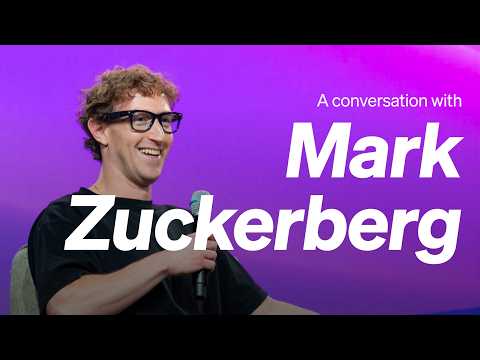
Zuckerberg Sees AI Automating Ads, Driving Meta Messaging to $10B
Stripe
Meta is aggressively eliminating human labor constraints by transforming advertising into a fully automated system and replacing customer support with conversational AI agents.
## Background
Published on May 8, 2025, by Stripe on YouTube, this video features a conversation between Meta CEO Mark Zuckerberg and Stripe President John Collison at Stripe Sessions. The discussion explores how advanced technologies, particularly artificial intelligence, are reshaping the global economy.
## TL;DR
Mark Zuckerberg shares his strategic vision for Meta's massive AI investments, detailing how AI is transforming advertising into an automated results engine and driving messaging-based commerce. He discusses the future of personalized AI and smart glasses as the next major computing platform, while offering a candid look at his hands-on leadership style, his rejection of traditional delegation, and how Meta's long-term bets are fueled by its highly profitable core business. The conversation wraps up with reflections on the legacy of the Libra stablecoin project and advice for modern entrepreneurs leveraging global platforms to stay lean and scale rapidly.
## Atmosphere & style
The conversation is intellectually stimulating, candid, and forward-looking, blending high-stakes business strategy with lighthearted personal anecdotes. Zuckerberg speaks with a relaxed yet intense focus, showing a deep passion for product design and a playful willingness to joke about industry rivals and his own childhood projects. The dynamic between the two leaders is collaborative and high-trust, creating an engaging, reflective atmosphere that feels like a peek behind the curtain of Silicon Valley's grandest ambitions.
## Key takeaways
- [00:09](https://www.youtube.com/watch?v=gF12Xn3C-0c&t=9s) Meta's massive $65 to $70 billion annual capital expenditure in AI is a long-term bet that Zuckerberg believes will bear fruit, even if the industry is currently in a build-out phase.
- [03:16](https://www.youtube.com/watch?v=gF12Xn3C-0c&t=196s) Meta is transforming advertising into a fully automated 'business results machine' where AI handles targeting and generates thousands of creative variations in real-time.
- [05:24](https://www.youtube.com/watch?v=gF12Xn3C-0c&t=324s) Conversational AI agents on messaging platforms are poised to become Meta's next major revenue pillar, unlocking messaging-based commerce in developed nations where human labor costs previously made it prohibitive.
- [11:24](https://www.youtube.com/watch?v=gF12Xn3C-0c&t=684s) Zuckerberg views smart glasses as the ultimate form factor for personal AI, allowing the assistant to see and hear what the user does to provide continuous, contextual help.
- [17:39](https://www.youtube.com/watch?v=gF12Xn3C-0c&t=1059s) Rather than focusing on job displacement, Zuckerberg emphasizes using AI to give employees '10x leverage' and enable services that were previously not cost-effective.
- [18:20](https://www.youtube.com/watch?v=gF12Xn3C-0c&t=1100s) Operating under the constraints of mobile platform gatekeepers like Apple and Google has driven Meta's urgency to build and control the next computing platform through AR and spatial computing.
- [30:41](https://www.youtube.com/watch?v=gF12Xn3C-0c&t=1841s) Zuckerberg rejects traditional corporate delegation, preferring to dive deep and stay hands-on with projects he personally cares about while aggressively minimizing recurring standing meetings.
- [34:39](https://www.youtube.com/watch?v=gF12Xn3C-0c&t=2079s) Meta's leadership relies on a highly collaborative, long-tenured 'Small Group' of 25 to 30 leaders who have risen through the ranks and share deep trust.
- [40:40](https://www.youtube.com/watch?v=gF12Xn3C-0c&t=2440s) Zuckerberg reflects on the legacy of the Libra stablecoin, acknowledging that while the project failed, the thesis was correct, and praises Stripe's acquisition of Bridge as a better-suited execution of global payments infrastructure.
- [44:34](https://www.youtube.com/watch?v=gF12Xn3C-0c&t=2674s) Modern entrepreneurs have a massive advantage over those from 20 years ago because they can outsource core infrastructure to platforms like Stripe and Meta AI, allowing them to remain incredibly lean.
## Detailed walkthrough
### [00:09](https://www.youtube.com/watch?v=gF12Xn3C-0c&t=9s) The AI Bubble vs. Reality
The conversation kicks off with lighthearted banter about the unpredictability of live AI demos. "Obviously, live demos are so much worse when they're AI-based because you just get a different thing every time," the speaker notes, adding that it brings an element of suspense that makes you feel "really alive."
The discussion quickly shifts to Meta's massive footprint in the AI landscape. Outside of cloud hyperscalers, Meta is the largest buyer of GPUs in the United States. When asked how his perspective on AI has evolved over the past year, Mark Zuckerberg explains that the high-level trajectory is "on track." While the broader industry debates whether AI is currently in a bubble or about to transform the economy immediately, Zuckerberg suggests that even if it is a bubble that takes longer to build out, the massive capital expenditure—amounting to $65 to $70 billion a year—will eventually bear fruit.
Historically, being more ambitious has been highly predictive of where the industry actually ends up. Meta AI has already reached roughly one billion monthly active users across its suite of apps. Zuckerberg admits that they constantly set aggressive goals for their teams, only to surpass them and realize they should have aimed even higher.
---
[03:16](https://www.youtube.com/watch?v=gF12Xn3C-0c&t=196s) The Ultimate Business Results Machine
Zuckerberg outlines two primary versions of Meta's "business agent" strategy. The first is the total automation and transformation of the advertising system. Historically, running ads required manual creative work, precise audience targeting, and complex measurement. Meta's ultimate goal is to build a system where a business simply states its objective, specifies its budget, connects its bank account, and lets the AI deliver the results.
This highly automated approach could fundamentally expand the advertising market. Zuckerberg points out that advertising has historically represented about 1% of global GDP, but much of that has been highly inefficient—such as buying a billboard where three-quarters of the viewers are not target customers. By turning advertising into an "AI business results machine," the overall internet economy will grow, and advertising's share of global GDP is likely to increase.
- **The Shift in Targeting:** Early on, Facebook ads relied heavily on user-inputted demographic data (e.g., targeting women aged 18 to 28 in a specific city). Today, Meta actively discourages advertisers from constraining the AI. Unless there is a strict legal or business reason, advertisers are told to let the AI find the audience, as it is far better at predicting customer interest than humans.
- **Creative Testing:** Instead of manually hacking together a single creative asset, the AI will soon be able to generate 4,000 different variations of an ad, test them in real-time, and optimize for the best performer.
---
[05:24](https://www.youtube.com/watch?v=gF12Xn3C-0c&t=324s) Messaging-Based Commerce and the Next Revenue Pillar
The second major focus for Meta's business agents is conversational AI for customer support and sales. Zuckerberg predicts that just as every business eventually needed an email address, a website, and a social media presence, every business in the future will have an AI agent living on messaging platforms.
He shares a striking precedent from Southeast Asia. In countries like Thailand and Vietnam, where the cost of human labor is relatively low, a massive portion of the economy already runs entirely through messaging. Businesses hire staff dedicated solely to answering customer inquiries and closing sales via chat. Even though Thailand and Vietnam rank in the 30s globally by GDP, they are Meta's 10th and 11th largest revenue-generating countries because of this deeply ingrained messaging commerce.
In developed countries like the US, this model hasn't taken off because the cost of human labor makes it too expensive for a local business, like a hair salon, to have someone answering messages all day. AI agents will eliminate this labor constraint, allowing businesses to offer high-quality, low-latency, personalized conversational experiences. Business messaging is already a $10 billion revenue stream for Meta and is poised to become the next major pillar of their business, particularly as they begin to monetize WhatsApp more aggressively.
---
[11:24](https://www.youtube.com/watch?v=gF12Xn3C-0c&t=684s) The AI Tech Race and Market Structure
The host notes that this feels like the first true "tech race" in Silicon Valley since the computing boom of the 1980s, with the industry leader changing every six months and the dynamics of value capture remaining highly uncertain.
Zuckerberg agrees that AI will transform every category, dismissing the binary debate of whether it will be a consumer-only or enterprise-only phenomenon. "It's going to be everything," he says, comparing it to the early days of the internet. While companies initially competed to build the single best general-purpose model, Zuckerberg expects the market to specialize.
Meta's consumer strategy is heavily indexed toward "personal AI" rather than pure productivity. This means building conversational, voice-centric systems that get to know the user over time, similar to how feed algorithms understand user preferences. Zuckerberg highlights smart glasses as the ultimate form factor for this vision. Glasses allow the AI to see what the user sees, hear what they hear, and offer contextual assistance throughout the day without requiring the user to explain their situation from scratch every time. This highly personalized, continuous relationship contrasts with the focus of companies like Anthropic or Cursor, which are deeply optimized for specialized tasks like coding agents.
### [15:05](https://www.youtube.com/watch?v=gF12Xn3C-0c&t=905s) The Overhang of Personalization in AI
The conversation shifts to the massive potential for personalization in AI, which remains largely untapped. It is noted that while general language recognition models are highly advanced, they still struggle with basic personal tasks. For instance, Siri often fails to understand a user's voice, which is ironic because the system has access to years of that specific user's voice data. "Your job is not to recognize any voice under the sun," the speaker points out, "it's just to recognize my voice." The same gap exists in handwriting recognition, where personalized models would be trivial to build but do not yet exist.
The speakers agree that the industry is only beginning to scratch the surface of personalization. Currently, AI products are starting to learn from past conversations, but the future will involve connecting more personal services to AI. For Meta, this means integrating messaging, smart glasses, and other services to infer and remember key details from a user's history over time. Looking ahead five years, they anticipate a "wild time" of rapid advancement, noting that the pace of change has accelerated dramatically compared to three years ago.
- **Meta's Integration Strategy:** Connecting messaging, smart glasses, and other Meta services to allow AI to remember and infer context from long-term user conversations.
- **The Pace of Change:** Both speakers agree that the current era of AI development is "ramping" much faster and is far louder than the relatively quiet landscape of three years prior.
### [16:39](https://www.youtube.com/watch?v=gF12Xn3C-0c&t=999s) Rethinking Leverage and Job Displacement
The discussion turns to how companies must rethink their product designs and organizational structures in the AI era. Rather than focusing on AI replacing human jobs—which they view as the wrong mental model—the real excitement lies in giving employees "a ton more leverage." While a deep recession might force companies to use AI purely for cost efficiency, the true value of AI is enabling services that were previously not cost-effective.
As an example, providing voice customer support for billions of Meta users was historically impossible because Meta's free business model could not support the massive cost of human agents. However, a voice AI capable of answering 90% of user questions changes the math entirely. With AI handling the bulk of the volume, it suddenly becomes economically viable to hire human agents to handle the remaining 10% of complex questions. This represents a "10x leverage" that fundamentally alters business viability.
### [18:18](https://www.youtube.com/watch?v=gF12Xn3C-0c&t=1098s) Being Early to Tech Trends and the Smartphone Legacy
The host argues that Mark Zuckerberg has a history of being early to major technology trends. Examples include building "Zucknet"—a private chat app for his father's dental office—at age 11 in 1996, acquiring Oculus 11 years ago when AR/VR was not yet popular, and founding the FAIR (Facebook AI Research) lab in 2013 long before the current AI boom. Zuckerberg jokes that building Zucknet was a great business model for a kid: "do useful things for your parents in order to get a computer." When asked if being early is part of his self-identity, Zuckerberg admits it is more fun to be early, though Meta has also had to claw its way back when late to trends, such as with Reels competing against TikTok.
Zuckerberg reflects on how starting Meta in 2004 meant they were in an existential survival phase when the iPhone launched in 2007, preventing them from shaping the smartphone platform. This has led to a complicated dynamic where Meta must deliver its services through its primary competitors, Apple and Google. Zuckerberg notes the awkwardness of this setup, joking about avoiding "the Apple thing" because "Tim's had a bad week, I'm not going to pile on," while adding that "Sundar is cool."
- **Zucknet (1996):** A messaging system Zuckerberg built as a child to connect the computers in his father's dental office.
- **Oculus Acquisition (2014):** Acquired 11 years prior to the interview, long before virtual reality was a mainstream tech trend.
- **FAIR Lab (2013):** Meta's early bet on fundamental AI research, established a decade before the generative AI boom.
- **The Competitor Tax:** Zuckerberg estimates that if Meta were not blocked or taxed by platform gatekeepers (primarily Apple), the company "might be twice as profitable" as it is today due to higher engagement and fewer restrictions on consumer-friendly features.
### [23:20](https://www.youtube.com/watch?v=gF12Xn3C-0c&t=1400s) Shaping the Next Computing Platform
Because of the constraints imposed by mobile platform owners, Zuckerberg is determined to help shape the next computing platform: AR glasses and spatial computing. Since Meta does not have a legacy of building operating systems, Zuckerberg assumes that if they release AR glasses in the same year as Apple, Google, or Microsoft, "the tie goes to them" because of their established ecosystems. Therefore, Meta's strategy is to be both better and significantly earlier, investing heavily before the market is fully ready.
Zuckerberg highlights that Meta's VR products are already "better and 10 times cheaper than Apple's," and their smart glasses are selling millions of units. He envisions glasses as the "ultimate social platform" because holograms will deliver a true sense of physical presence that no flat screen can replicate. Additionally, glasses are the ideal form factor for AI because they allow the assistant to see what the user sees and hear what they hear, making a 10-year investment cycle highly worthwhile.
### [25:04](https://www.youtube.com/watch?v=gF12Xn3C-0c&t=1504s) Leadership, Civilization, and the "Small Group"
The host shares an anecdote from Microsoft's strategic investment in Meta in 2007. A mutual friend, Charlie Songhurst, had an investment thesis that Meta was a safe bet because Zuckerberg was capable of beating the *Civilization* AI on "Deity" difficulty—the hardest of the game's eight levels. Zuckerberg laughs, pointing out that the *Civilization* AI has "always been famously bad," so beating other human players is actually much more impressive. However, he agrees with the underlying philosophy: mastering a difficult game or discipline demonstrates the dedication and learning capacity required to master other complex fields.
When comparing his management style to Nvidia CEO Jensen Huang's famous system of 60 direct reports and no one-on-ones, Zuckerberg explains that he does not enjoy managing people and has structured Meta differently. Meta is organized into roughly 15 product groups reporting to three key leaders: Chris Cox (apps), Javier Olivan (infrastructure, ads, integrity), and Andrew "Boz" Bosworth (future tech platforms). Rather than managing through a massive flat layer of direct reports, Zuckerberg works with a highly collaborative, non-hierarchical "Small Group" of 25 to 30 key leaders who maintain full context on everything happening across the company.
- **The "Small Group":** A core leadership circle of 25 to 30 people at Meta who are kept in the loop on all major company context, acting as the "core army" to get things done.
- **One-on-Ones:** Zuckerberg does not conduct traditional one-on-one meetings with his direct reports, believing that leaders at that level should be entirely self-managing, though he values management for the broader organization.
### [30:41](https://www.youtube.com/watch?v=gF12Xn3C-0c&t=1841s) The Myth of Delegation
Zuckerberg shares a contrarian view on leadership, stating, "I basically don't believe in delegation." While the traditional corporate orthodoxy dictates that a leader's job is to hire good people and hand off responsibilities, Zuckerberg rejects this as a blanket rule. He acknowledges that because of Meta's scale, he cannot possibly be involved in every decision, meaning his executives must run their organizations independently. However, for the projects he personally cares about, he believes in deep, hands-on involvement rather than stepping back.
[31:03](https://www.youtube.com/watch?v=gF12Xn3C-0c&t=1863s) Hands-On Leadership and the Myth of Delegation
Mark Zuckerberg rejects the traditional corporate wisdom of hands-off delegation. He believes that if a founder is running a company and is ultimately on the hook for everything, it makes no logical sense to stay out of important decisions, regardless of where they sit in the organizational hierarchy. While he acknowledges that a leader must have the humility to realize they might not have immediate context when diving deep into a new area, he strongly advocates for a culture where hierarchy is minimized and the founder can "dive into whatever you want."
To maintain the context needed for these deep dives, Zuckerberg aggressively minimizes standing meetings. He only attends two recurring weekly meetings: an open-ended strategy discussion and an operational meeting to review company priorities. Beyond those, he does quarterly earnings calls and board meetings, but completely avoids recurring, scheduled one-on-one meetings. Instead, he prefers to talk to his team constantly and dynamically when there is a specific topic to discuss, keeping his calendar open. Zuckerberg admits he gets frustrated and enters a "bad mood" if his entire day is scheduled, leaving him no time to focus on the most important, pressing issues. "You have too many days like that in a row and I just like explode," he shares.
- **Weekly Standing Meetings:** Only two (one open-ended strategy session, one operational priority review).
- **One-on-Ones:** No recurring scheduled one-on-ones; communication is dynamic and ad-hoc.
- **Calendar Philosophy:** Keep a meaningful block of time open daily to avoid frustration and allow spontaneous deep dives.
---
[34:39](https://www.youtube.com/watch?v=gF12Xn3C-0c&t=2079s) Building a High-Trust, Densely Connected Leadership Team
A key factor that enables Zuckerberg to operate with so much free time is the strength and tenure of Meta's senior leadership team. Meta has about 15 different product groups, and remarkably, none of the current leaders started their careers at the company running a product group. Instead, they rose through the ranks from diverse starting points: some began as designers, data analysts, engineering directors, and two members of the current management team actually started as administrative assistants.
Zuckerberg emphasizes that building a company is a deeply human, people-driven endeavor rather than just an intellectual exercise. He prioritizes building a "dense network of connections" where team members trust each other, understand each other's "APIs" (their strengths and weaknesses), and share a long history of working together. This level of trust and mutual understanding cannot be hired from the outside; it must be built over time. Rather than obsessing over org charts and reporting lines, Zuckerberg subscribes to the philosophy that "culture eats strategy for breakfast," focusing his energy on bringing his core group together to share context across the entire company.
---
[37:15](https://www.youtube.com/watch?v=gF12Xn3C-0c&t=2235s) Balancing Short-Term Execution and Long-Term Bets
When asked how he manages the tension between investing in iterative, short-term improvements and funding massive, long-term bets that won't contribute to the P&L for years, Zuckerberg explains that he does not use a strict quantitative or financial framework. Instead, his approach is people-centric. He ensures that the core, highly profitable business is staffed with amazing leaders who get all the resources they need. Because the core business performs so well, it generates the financial surplus and talent density required to fund long-term projects like Llama or the Ray-Ban Meta smart glasses.
Zuckerberg views resource allocation through the lens of talent rather than just capital, asking "where are you going to allocate the best people and like who gets to eat first." The more profitable the company is, the more it can afford to try different things, and the larger its talent surplus, the more ambitious those extra bets can be.
---
[40:40](https://www.youtube.com/watch?v=gF12Xn3C-0c&t=2440s) The Evolution of Stablecoins and the Legacy of Libra
Reflecting on Meta's 2019 attempt to launch the Libra stablecoin, Zuckerberg explains that his original thesis was rooted in the natural evolution of social apps. He believes that if someone were to build a social app from scratch today, they would start with a private, encrypted messaging platform rather than an algorithmic feed. On top of that secure messaging foundation, features like location sharing, calling, and payments are self-evident necessities. Because messaging is inherently global, and sending money across borders remains "surprisingly crazily difficult," Meta saw a clear need for a global stablecoin standard.
While Libra did not succeed, Zuckerberg notes that the underlying thesis was correct, as evidenced by the massive adoption of stablecoins today. He praises Stripe's recent acquisition of Bridge and its work in building out a global payments standard, admitting that financial services are deeply tied to a company's DNA. "Honestly, what you're doing makes much more sense than what we were doing," Zuckerberg tells the host, noting that Stripe's deep talent density in payments makes them far better suited to succeed in this space than Meta ever was.
---
[44:34](https://www.youtube.com/watch?v=gF12Xn3C-0c&t=2674s) Advice for the Next Generation of Entrepreneurs
In his closing remarks, Zuckerberg offers advice to the thousands of entrepreneurs in the audience. He points out that starting a company today is fundamentally different than it was 20 years ago. Back then, founders had to build every single operational competency from scratch. Today, robust platforms exist to handle these complexities. Startups can run their entire financial infrastructure using Stripe, and they can find and interact with customers using sophisticated AI platforms.
This shift allows modern startups to remain incredibly lean, talent-dense, and hyper-focused on their core, passionate ideas without needing to duplicate standard business functionalities. By outsourcing key infrastructure to specialized platforms, small teams can scale globally with unprecedented speed and focus entirely on the unique value they bring to the world.
[46:10](https://www.youtube.com/watch?v=gF12Xn3C-0c&t=2770s) A Vision for Human Empowerment and Collaboration
Mark Zuckerberg shares an inspiring, long-term vision for the future of technology and human productivity. He imagines a world where individuals are deeply empowered to focus on their core ideas rather than getting bogged down by technical or administrative hurdles. By leveraging advanced tools that "hopefully is going to be with you for 10 plus years and that you'll just do kind of amazing stuff with," people will be able to collaborate and achieve monumental goals. Zuckerberg believes this shift will allow humanity to "accomplish things at larger scale than has ever been possible before at any other point in human history," leaving creators and builders with an unprecedented amount of resources and capabilities to work with.
[46:39](https://www.youtube.com/watch?v=gF12Xn3C-0c&t=2799s) Wrapping Up and Looking Ahead to the Keynote
As the session winds down, the host takes the stage to wrap up the discussion and guide the audience toward the evening's social activities. He invites all attendees to join the welcome reception happening immediately outside the hall. Looking forward to the next day, the host promises a bright and early start with what he describes as "the biggest product keynote that we've ever had." He teases that the team has been intensely "jamming in the ships" to pack the presentation with major updates, concluding the session by leading the crowd in a warm round of applause to thank Mark Zuckerberg for his insights.
- The welcome reception takes place immediately following the session just outside the main hall.
- The upcoming morning session features the largest product keynote in the event's history, showcasing a massive lineup of new product shipments and announcements.
## Notable quotes
> [00:09](https://www.youtube.com/watch?v=gF12Xn3C-0c&t=9s) Obviously, live demos are so much worse when they're AI-based because you just get a different thing every time. — Mark Zuckerberg
> [03:16](https://www.youtube.com/watch?v=gF12Xn3C-0c&t=196s) Unless there is a strict legal or business reason, advertisers are told to let the AI find the audience, as it is far better at predicting customer interest than humans. — Mark Zuckerberg
> [15:05](https://www.youtube.com/watch?v=gF12Xn3C-0c&t=905s) Your job is not to recognize any voice under the sun, it's just to recognize my voice. — John Collison
> [18:20](https://www.youtube.com/watch?v=gF12Xn3C-0c&t=1100s) Do useful things for your parents in order to get a computer. — Mark Zuckerberg
> [18:20](https://www.youtube.com/watch?v=gF12Xn3C-0c&t=1100s) Tim's had a bad week, I'm not going to pile on. — Mark Zuckerberg
> [23:20](https://www.youtube.com/watch?v=gF12Xn3C-0c&t=1400s) The tie goes to them. — Mark Zuckerberg
> [30:41](https://www.youtube.com/watch?v=gF12Xn3C-0c&t=1841s) I basically don't believe in delegation. — Mark Zuckerberg
> [31:03](https://www.youtube.com/watch?v=gF12Xn3C-0c&t=1863s) You have too many days like that in a row and I just like explode. — Mark Zuckerberg
> [34:39](https://www.youtube.com/watch?v=gF12Xn3C-0c&t=2079s) Culture eats strategy for breakfast. — Mark Zuckerberg
> [37:15](https://www.youtube.com/watch?v=gF12Xn3C-0c&t=2235s) Where are you going to allocate the best people and like who gets to eat first. — Mark Zuckerberg
> [40:40](https://www.youtube.com/watch?v=gF12Xn3C-0c&t=2440s) Honestly, what you're doing makes much more sense than what we were doing. — Mark Zuckerberg
> [46:10](https://www.youtube.com/watch?v=gF12Xn3C-0c&t=2770s) Accomplish things at larger scale than has ever been possible before at any other point in human history. — Mark Zuckerberg
## Mentioned
Mark Zuckerberg, John Collison, Meta, Stripe, Meta AI, Llama, Ray-Ban Meta, Oculus, FAIR, Apple, Google, Sundar Pichai, Tim Cook, Jensen Huang, Nvidia, Chris Cox, Javier Olivan, Andrew Bosworth, Libra, Bridge, Civilization
Mark Zuckerberg argues that Meta's massive capital investments in artificial intelligence and custom hardware are establishing a new foundation for personal computing and business automation, despite industry debates over an AI bubble. He contends that long-term technological leadership requires deep founder involvement, funding speculative platforms from core business profits, and escaping the platform constraints imposed by mobile gatekeepers.
Automating Commerce Through Ads and Messaging Agents (3:16)
Zuckerberg outlines a two-pronged strategy to transform business interactions with AI: fully automating digital advertising and scaling conversational messaging agents. Meta is transitioning its ad platform toward a model where businesses provide only an objective, a budget, and bank access, allowing AI models to generate thousands of creative variants and determine targeting autonomously. Zuckerberg forecasts that eliminating advertising inefficiencies will expand digital advertising beyond its historical ceiling of roughly 1% of global GDP.
Simultaneously, Meta is positioning messaging-based AI agents as its next major commercial pillar, currently generating $10 billion in revenue. Citing Southeast Asian markets like Thailand and Vietnam—which rank in the 30s by global GDP but represent Meta's 10th and 11th largest revenue sources due to chat-based commerce—Zuckerberg expects conversational AI to make messaging-based sales and customer support economically viable in high-labor-cost economies like the United States.
Personal AI and Escaping Mobile Gatekeeper Constraints (11:24)
Rather than focusing strictly on enterprise productivity or coding agents, Meta is prioritizing continuous, contextual "personal AI." Zuckerberg views smart glasses as the definitive form factor for this relationship, as on-device cameras and microphones enable the assistant to share the user's sensory environment and provide context-aware support without repetitive prompt framing.
This hardware push is driven in part by Meta's desire to own the next computing platform after missing the smartphone OS transition in 2007. Zuckerberg attributes significant lost revenue to mobile platform operators, estimating that Meta could be twice as profitable today without the rules and economic "taxes" imposed primarily by Apple. To counter incumbent advantages in operating systems, Meta's strategy is to release cheaper, superior consumer hardware—such as Ray-Ban Meta glasses and VR headsets—significantly ahead of competitors.
Hands-On Leadership and Flat Context-Driven Management (30:41)
Zuckerberg rejects standard corporate delegation orthodoxy, maintaining that accountable founders should directly intervene in projects they care about rather than delegating decisions away. To preserve context and responsiveness, he eliminates standing one-on-one meetings, limits his weekly schedule to two recurring strategy and operational sessions, and keeps wide blocks of calendar time open for deep technical dives.
Operationally, Meta relies on a "Small Group" of 25 to 30 high-context leaders across its 15 product groups rather than an expansive layer of direct reports. Zuckerberg emphasizes long-term organizational tenure and internal mobility—noting that management members include former designers, data analysts, and administrative assistants—which fosters a high-trust internal network capable of executing rapid strategy pivots without rigid hierarchy.
Core Surpluses, Long-Term Bets, and Infrastructure Focus (37:15)
Meta sustains $65 billion to $70 billion in annual capital expenditures by directing talent and financial surpluses from its highly profitable core applications into long-term initiatives like open-source Llama models and spatial computing. Rather than applying rigid quantitative formulas to research and development, Zuckerberg prioritizes staffing the mature advertising engine first, using its surplus cash flow to underwrite multi-year investment cycles.
Reflecting on past initiatives, Zuckerberg notes that while Meta's 2019 Libra currency project faltered, the underlying thesis behind global stablecoins has been validated by widespread market adoption. He acknowledges that payments infrastructure aligns better with dedicated financial platforms like Stripe than Meta's social product culture, noting that modern startups benefit from outsourcing commoditized business infrastructure to focus entirely on specialized value.
Zuckerberg frames Meta's heavy capital expenditures as a necessary risk, maintaining that aggressive over-investment historically proves more accurate than underestimating technological shifts. However, Meta's long-term returns remain contingent on whether consumer adoption of wearable AI hardware and automated business messaging can materialize at scale before the costs of running hyperscale AI infrastructure outpace core advertising growth.
[0:09] Mark Zuckerberg: Obviously, live demos are so much worse when they're AI-based because you just get a different thing every time.
[3:16] Mark Zuckerberg: Unless there is a strict legal or business reason, advertisers are told to let the AI find the audience, as it is far better at predicting customer interest than humans.
[15:05] John Collison: Your job is not to recognize any voice under the sun, it's just to recognize my voice.
[18:20] Mark Zuckerberg: Do useful things for your parents in order to get a computer.
[18:20] Mark Zuckerberg: Tim's had a bad week, I'm not going to pile on.
[23:20] Mark Zuckerberg: The tie goes to them.
[30:41] Mark Zuckerberg: I basically don't believe in delegation.
[31:03] Mark Zuckerberg: You have too many days like that in a row and I just like explode.
[34:39] Mark Zuckerberg: Culture eats strategy for breakfast.
[37:15] Mark Zuckerberg: Where are you going to allocate the best people and like who gets to eat first.
[40:40] Mark Zuckerberg: Honestly, what you're doing makes much more sense than what we were doing.
[46:10] Mark Zuckerberg: Accomplish things at larger scale than has ever been possible before at any other point in human history.
Original transcript
[0:09] Welcome.
[0:11] Thanks. Good to be here. This doing the
[0:13] live demo thing. Yeah, I know.
[0:15] Obviously, live demos are so much worse
[0:17] um when they're AI based because you
[0:20] just get a different thing every time.
[0:21] It's like it's over the It adds an
[0:23] element of Exactly. It just gets you
[0:25] really alive. Yeah. Um, so this is, um,
[0:28] the last public speaking appearance you
[0:29] did was Theo Van. He actually took a lot
[0:31] of the questions that I wanted to ask.
[0:34] Um, but, uh, same kind of vibe. Exactly.
[0:38] Yeah. Um, here at Stripe Sessions. Um,
[0:41] so we obviously just talked a whole
[0:43] bunch about AI. Uh, you are, I mean,
[0:48] arguably just the largest AI company,
[0:49] right? you are the largest buyer of GPUs
[0:53] in the US outside of you know a cloud
[0:55] hyperscaler um from my deep research
[1:00] um how is your thing on AI just evolved
[1:04] over the past year haven't been moving
[1:06] slowly yeah I mean I think the high
[1:08] level is it's on track how so well well
[1:11] I mean I think I think one of the big
[1:13] questions is I I think it's
[1:17] like I think most people at this point
[1:19] view that AI is going to transform
[1:21] pretty much every category of product
[1:23] and every part of the economy and all
[1:24] that. the the big question is to what
[1:28] extent are we in a bubble versus to what
[1:30] extent um you know is this gonna be a
[1:34] big thing soon and you know I mean I
[1:36] think one of the one of the I mean you
[1:38] were just talking about this I think
[1:39] right before I I I came out you know
[1:42] it's even if it is a bubble and it takes
[1:44] a bit longer to build out that's not
[1:46] necessarily the end of the world
[1:48] although it will be expensive um for
[1:51] certain people well yeah when you're
[1:53] spending 65 to 70 billion in capex a
[1:56] year. You'd like it to come when you
[1:58] think it's going to come, but you know,
[1:59] it's but um but but I think the main
[2:02] question is sort of
[2:05] is that is this going to be a kind of
[2:07] five to 10 year thing? And in some ways
[2:09] it probably will to get built into every
[2:12] enterprise workflow and things like
[2:14] that. But I don't know. I mean the the
[2:16] more time that the kind of the more that
[2:18] we work on this, it actually seems like
[2:22] all the things that we think are going
[2:23] to happen happen sooner and being even
[2:27] more ambitious
[2:29] um has been more predictive over the
[2:32] last few years about where things are
[2:35] likely going to be in the industry. So I
[2:37] mean like we keep on you know building
[2:40] you know setting goals for our teams.
[2:42] You know, Meta AI is
[2:45] like right about a billion people
[2:47] monthly active using it across our apps.
[2:50] Um, you know, we keep on setting these
[2:52] goals for, you know, what do we think is
[2:54] going to be the most used AI? What do we
[2:56] need to do? And we keep on passing them
[2:58] and then like others in the industry
[3:00] keep on passing their goals too. and
[3:02] we're like, "Ah, we should have had even
[3:03] higher goals." And um you know how much
[3:06] AI is accelerating all of the like all
[3:09] of the uh business agent stuff that
[3:12] we're doing and advertising and changing
[3:13] that. It's like it's it's all just
[3:15] happening very quickly. Do you want to
[3:16] describe the business agent stuff
[3:17] briefly for people who are unfamiliar?
[3:18] Maybe everyone's familiar. Yeah. Yeah.
[3:19] Well, I mean there's two basic versions
[3:20] of this and I I think this is probably
[3:22] good context for for folks here to have.
[3:23] I mean there's one is just the
[3:25] transformation of the ad system, right?
[3:27] where, you know, it used to basically be
[3:30] if you wanted to run ads, you had to
[3:32] like come up with your own creative and
[3:33] you had to come up with who you wanted
[3:35] to reach. You had to kind of have a
[3:36] sense of who your customers were and do
[3:38] a lot of your own measurement. And over
[3:40] time, we've just like automated more and
[3:41] more of this stuff. So, the the basic
[3:43] end goal here is any business can come
[3:46] to us um say what their objective is. I
[3:49] want to get new customers to do this
[3:51] thing. I want to sell these things. Tell
[3:53] us how much they're willing to pay to
[3:55] achieve those results. connect their
[3:57] bank account and then we just deliver as
[3:59] many results as we can. And in in a way,
[4:02] I mean, it's kind of like the ultimate
[4:04] business results machine. It's probably
[4:06] I think it'll be one of the most
[4:07] important and valuable AI systems and
[4:11] and and kind of business systems that
[4:13] gets built. Now, I mean, obviously
[4:14] there's a whole ecosystem around this
[4:16] stuff. No one company is going to do
[4:17] everything in advertising. there are,
[4:19] you know, all these companies that
[4:20] specialize in doing creative work and
[4:22] they'll keep on doing that and uh but
[4:25] but it will be possible in the future
[4:27] that if you're running a small business
[4:28] or maybe even a larger one, you won't
[4:30] even need to have to start off with a
[4:31] creative. Maybe you can, maybe you'll
[4:33] get better results, but but um you could
[4:36] just come with a goal um and and uh how
[4:39] much that's worth to you and we'll just
[4:40] kind of deliver results across our
[4:42] platform. So, I think that that's cool
[4:44] and I think is going to um pretty
[4:47] dramatically change what advertising is.
[4:50] Historically, advertising has been about
[4:51] 1% of global GDP, but that includes all
[4:55] the stuff that's really inefficient.
[4:56] Like you buy a billboard and you know
[4:58] like threequarters of the people who see
[4:59] the billboard are not target customers.
[5:01] So when you actually can change it so it
[5:03] it turns into this like AI business
[5:04] results machine. I I think that you know
[5:06] just like the overall internet economy
[5:08] is going to grow. I would guess that
[5:09] what we currently think of advertising
[5:11] will sort of grow as a as a field and
[5:13] will be a larger portion of of global
[5:15] GDP. Um it's interesting. I mean a lot
[5:18] of a lot of innovative companies are are
[5:19] experimenting with different kinds of
[5:20] automation with our platforms and that's
[5:22] kind of a fun thing that we can get
[5:24] into. The the other part of what we're
[5:26] doing on business agents is um this
[5:29] notion
[5:31] that you know just like every business
[5:34] today has an email address and um you
[5:39] know and a website and a social media
[5:41] presence in the future every business is
[5:43] going to have an AI agent that lives in
[5:45] the different messaging platforms that
[5:48] their customers can do customer support
[5:50] and sales through. Um and you know
[5:54] there's sort of this wild precedent that
[5:56] we've seen so far in a couple of
[5:57] countries where like Thailand and
[6:00] Vietnam are kind of these interesting
[6:01] cases for us where there are there's
[6:04] relatively low cost of human labor and
[6:07] because of that a lot of the economy is
[6:08] sort of developed around messaging. Um
[6:11] and basically like a large number of
[6:13] businesses out there can afford to have
[6:15] people who just do manual customer
[6:17] support and sales through messaging. And
[6:19] it's at the point where even though
[6:22] Thailand and Vietnam are like ranked in
[6:24] the top I think they're in the 30s by
[6:26] global GDP. They're they're actually
[6:28] Meta's number 10 and 11 revenue
[6:30] countries. And um it's just because so
[6:33] much commerce in those places goes
[6:35] through the messaging platforms already.
[6:36] But that hasn't really come to a lot of
[6:38] developed countries yet for a number of
[6:40] reasons including the kind of cost of
[6:42] labor. But I think when you get to the
[6:44] point where every business just has a
[6:45] business agent that is an AI agent that
[6:47] can do customer support and sales, I I
[6:50] think that that's just going to
[6:50] turbocharge. And you know, most of our
[6:52] business today, it's it's Facebook and
[6:54] Instagram and ads in there. WhatsApp
[6:56] really from a revenue perspective at
[6:57] least is sort of just getting started.
[6:59] And I think that that's kind of going to
[7:00] be the next pillar of the business. So
[7:02] sorry, that's quite interesting.
[7:03] Basically, you're saying that when cost
[7:05] of labor is not an issue, you see people
[7:07] have much more messaging based business
[7:10] experiences, kind of UIs at some level
[7:12] for how you do things. And the reason
[7:14] that we don't see as much of it in the
[7:15] US is just it's too expensive to have
[7:17] someone at your, you know, hair salon
[7:19] just responding to messages all day. And
[7:21] that's one of your predictions for how
[7:23] it seems like people actually want to
[7:24] interact with. Yeah, totally. I I mean I
[7:27] I think that there's there is some path
[7:31] determinism here and you know I think
[7:34] that the whole messaging ecosystem
[7:35] developed differently in some of these
[7:37] places where the cost of human labor was
[7:38] lower but overall I think people are
[7:42] going to contact more businesses for
[7:43] more things when they get very high
[7:45] quality low latency personalized
[7:47] responses. Um, and now I mean of course
[7:50] in the in the kind of modern web you'll
[7:52] be able to have a business agent that is
[7:54] a chatbot on your website too. So I mean
[7:57] how much of that is happening through
[7:59] messaging services versus apps or having
[8:01] this just embedded everywhere I'm not
[8:03] sure. But um overall what we do see you
[8:07] know across our platform is just a a
[8:08] business messaging is growing very
[8:10] quickly. It's you know about10 billion
[8:12] of revenue now continues to grow
[8:14] quickly. Um, and yeah, I think that this
[8:16] is probably going to be the next kind of
[8:17] new pillar of our business and and the
[8:19] stuff that we're doing. And then in the
[8:21] first point you made, it sounds like
[8:22] you're basically saying that execution
[8:24] friction just gets in the way of a lot
[8:26] of things like, you know, maybe the more
[8:28] be more confetti animations in the world
[8:30] if it was just, you know, a single uh
[8:32] line to uh get them to happen. Uh, and
[8:34] similarly, you think that many
[8:36] businesses would actually go out and do
[8:37] more. It's not that they're not
[8:38] economically willing to pay $20 to get
[8:41] an acquired user or something like that.
[8:42] it's just all the steps that go into the
[8:44] data analytics and the creative and
[8:46] everything like that mean that they
[8:47] don't actually get the right outcome for
[8:48] their businesses and so less friction in
[8:51] execution well that and also um I think
[8:55] we've just reached a point where the AI
[8:57] is more effective at a lot of things
[9:00] that that different businesses do. So I
[9:02] mean it's like okay if you're starting a
[9:04] company there's normally like some core
[9:06] idea or something that you're trying to
[9:07] do and then there's like all these other
[9:09] things that you need to do to make a
[9:11] company work and like okay if you want
[9:12] to reach customers you've had to you
[9:14] know like basically go find ways to do
[9:17] marketing and then okay you want to make
[9:18] sure your marketing works well so you
[9:19] need to like find ways to measure your
[9:20] marketing and all this and I do think a
[9:22] bunch of that stuff we're just getting
[9:23] to the point where the AI can do it
[9:26] better than sort of the average people
[9:29] who are doing that which makes it so
[9:30] that more companies can get started more
[9:32] easily. I mean, this is also a big theme
[9:34] for Stripe, right? It's like, okay,
[9:35] companies also needed to spend all this
[9:36] time doing all this different stuff with
[9:38] financial services and payments. Now,
[9:39] they don't have to. So, I think what
[9:41] that allows is just way more people in
[9:43] the world to focus on what their core
[9:45] idea is and and kind of execute that and
[9:47] have a core talent dense team of people
[9:49] who are like focused on that idea and
[9:52] more of the stuff that's like not the
[9:53] core part of of building your company is
[9:55] is going to be able to be offloaded. So,
[9:58] you know, in the future, um you know, if
[10:00] you were working with a a um creative
[10:03] agency to to make creative, you'll
[10:05] probably keep doing that. If you aren't,
[10:07] then um then, you know, and you're just
[10:10] kind of hacking something together and
[10:11] throwing it into Meta's ad system. Well,
[10:12] now we're going to be able to come up
[10:13] with like 4,000 different versions of
[10:15] your creative and just test them and
[10:17] figure out which one works best. You
[10:19] know, it used to be that um on the
[10:21] targeting side, like the the way that
[10:23] our business kind of got started on the
[10:24] ad side was because people put all this
[10:27] profile information into Facebook early
[10:28] on. It used to be like a great place for
[10:31] a business to say, "Okay, I think my
[10:33] product is like I think like women
[10:35] between like, you know, 18 and 28 in
[10:38] this city are really going to love this
[10:39] thing." and like Facebook early on it
[10:41] was like the best place to go reach them
[10:43] because okay we we kind of knew who
[10:45] people were and and and had all this
[10:47] people had input all this demographic
[10:49] information at this point we basically
[10:51] encourage advertisers not to restrict
[10:53] what the AI can do like we're like all
[10:55] right look if you think that like women
[10:57] in in kind of this age range are going
[10:59] to be um more receptive then yeah give
[11:02] us that hint as as kind of a an input to
[11:05] the system but you know unless you
[11:07] really have a reason why you don't want
[11:08] to sell to other people. Don't constrain
[11:10] who are going to reach to just that
[11:12] because the AI is actually probably
[11:14] going to be able to find who is going to
[11:16] be interested in your product better
[11:17] than you can. And that just means that
[11:20] okay, you just focus on building the
[11:21] best product. More stuff that's awesome
[11:23] is going to happen in the world. The
[11:24] Hello Kitty effect. Um
[11:27] so last question on AI. I'm not familiar
[11:29] with that reference. Oh, never mind.
[11:31] Um, so just on AI and market structure,
[11:35] obviously you guys are so interesting
[11:37] here
[11:38] because unlike a lot of the pure play AI
[11:40] companies, you were off doing stuff
[11:42] doing a lot of production AI and then
[11:44] also decided to get into the AI business
[11:47] and also you know Llama, you're uh well,
[11:50] one of your big bets is uh is open
[11:52] source. I guess you're also wearing the
[11:53] uh what are your meta bands saying to
[11:56] you about me right now? like what are
[11:57] they what Bluetooth? No, they're they're
[12:00] off. Um I I left my phone backstage.
[12:02] Their Bluetooth connection is severed.
[12:04] But um I'm picturing like a Terminator
[12:06] style UI. Well, look, you know, I'm like
[12:08] I'm like famously awkward. I need some
[12:10] input as I'm, you know, as we're doing
[12:13] these so I can make sure I don't say
[12:14] anything stupid. Yeah, John, not
[12:15] Patrick. Um but
[12:18] uh no. Okay. So anyway, you guys are
[12:21] doing a lot in AI and I'm just curious
[12:22] for your thoughts on market structure
[12:24] because it's a super fast evolving like
[12:27] it feels to me like the first time since
[12:29] I moved to the valley that we've been in
[12:30] a tech race. you um read about uh the
[12:33] development of you know the computing
[12:34] industry in uh the 1980s and there's a
[12:37] new leader every six months and we
[12:39] didn't have a good tech race uh for a
[12:41] while and now we do where it's
[12:42] constantly evolving leaders and it's
[12:44] just not clear even where the value
[12:46] capture happens and so I'm curious how
[12:48] you see the chessboard.
[12:50] Well I I mean I think this is going to
[12:53] transform every category. So I I think
[12:56] people are like oh is it going to be
[12:57] primarily a consumer thing or is it
[12:59] going to be primarily an enterprise
[13:00] thing? it's going to be everything. So,
[13:02] it's kind of like at the internet, it's
[13:03] like what is the point of the internet?
[13:05] Is it going to be consumer or
[13:06] enterprise? It's like there are going to
[13:08] be a lot of opportunities, right? So, I
[13:10] I think we we were kind of in this zone
[13:13] early on where, you know, people were
[13:15] competing to build the kind of best
[13:18] general model and my guess is that that
[13:20] stuff is just going to start
[13:21] specializing a little bit. There's um
[13:24] there's obviously I mean it's
[13:26] intelligence by its nature is general.
[13:29] So you're not going to be able to just
[13:30] build something that is focused on kind
[13:32] of one area and and only go deep in that
[13:35] and not be good at other things. Um but
[13:38] I do think it'll be the case that the
[13:40] products and ecosystems and the areas of
[13:43] research that that different companies
[13:45] emphasize will be focused on on
[13:46] different areas. And um you know what
[13:48] we're so we're doing some of the
[13:50] business stuff we just talked about.
[13:52] We're also on the consumer side very
[13:53] focused on like personal AI right more
[13:57] than than kind of productivity. So, you
[13:59] know, what is that? It's going to be um
[14:01] probably more conversational, probably
[14:03] index a little bit more towards voice,
[14:05] be more personalized. Um, you know, I
[14:08] think people are going to want a system
[14:10] that gets to know them well and that
[14:12] kind of understands them in the way that
[14:14] their feed algorithms do. Um, and and
[14:18] honestly that they don't have to like,
[14:20] you know, ramp up from scratch because
[14:21] it's already connected to some of that
[14:23] stuff. Um, and like as you walk through
[14:26] the world and you have your glasses like
[14:27] it, you can, you know, it's like glasses
[14:29] are kind of the perfect form factor for
[14:31] AI because you can let an AI see what
[14:33] you see and hear what you hear and talk
[14:34] to you throughout the day and it should
[14:36] all just kind of get to know you, right?
[14:37] And it shouldn't be like every time you
[14:39] do a query, it's like, you know, you're
[14:41] just kind of starting from scratch and
[14:43] you need to provide it all the details.
[14:44] So that's kind that's going to be kind
[14:45] of our game on the consumer side. And
[14:47] that's a little bit different from, you
[14:49] know, a company like, you know,
[14:50] Anthropic or Curser who, you know,
[14:52] Claude can do a lot of stuff, but like
[14:54] they're really focused on coding and
[14:56] coding agents and like that's going to
[14:58] be a massive massive part of the
[15:00] economy, right? Where there's like all
[15:02] these knowledge workers and engineers
[15:03] and they'll all be turbocharged by now
[15:05] having more, you know, every engineer is
[15:07] going to be a tech lead that has like
[15:08] effectively an army that is working for
[15:10] them. It is striking to me what an
[15:12] overhang there is of personalization in
[15:14] AI, the ability to improve products.
[15:16] Like it's kind of funny to me that Siri
[15:18] cannot understand uh my voice to save
[15:20] its life. And it's kind of funny, right?
[15:22] Because it's a general language
[15:25] recognition model, but you have so much
[15:27] of my voice to go off. Like your job is
[15:29] not to recognize any voice under the
[15:30] sun. It's just to recognize my voice.
[15:32] And you know, similarly, you know, it
[15:33] would be trivial to have personalized
[15:35] handwriting recognition models, but we
[15:36] don't have those yet. And so it's just
[15:38] interesting to me how little
[15:39] personalization there is compared to how
[15:41] much we'll obviously have in in five
[15:42] years time. No, I mean I think it's very
[15:45] little right now. I think we're just
[15:46] starting to scratch the surface with
[15:48] some of these products on like, okay,
[15:50] they learn from what you've talked about
[15:53] in the past and what you've told them in
[15:55] that model, but I I think it's pretty
[15:56] clear that you're going to want to
[15:58] connect more and more things to your AI.
[16:01] Um, you know, so from our world, it's
[16:02] going to be, you know, starting with the
[16:04] other meta services, um, messaging,
[16:08] glasses, like all of that, as well as
[16:10] just be able to infer and and kind of
[16:13] remember the key things from all the
[16:15] conversations that you've had over time.
[16:16] No, it's going to be really good. I'm
[16:18] very excited for the Stripe sessions in
[16:20] five years time and what we're uh, it's
[16:21] going to be. Yeah. No, it's going to be
[16:22] wild. It's going to be a wild time. Does
[16:23] it feel like a wild time to you? Like
[16:25] again, it feels Oh, yeah. It's the
[16:26] craziest, but like it's very Yeah, it's
[16:28] very different to three years ago.
[16:29] things were just quieter three years
[16:31] ago. Um, maybe not for you. Well, I
[16:33] think it was starting three years ago.
[16:34] It's getting it's it's ramping. It's
[16:36] ramping.
[16:39] Um, I I don't know. I think it's the
[16:41] most exciting time that But it's
[16:44] like Yeah. No, it's really good there. I
[16:47] mean, it's I I think it's just there's
[16:49] but I do think that everyone needs to
[16:50] kind of rethink a lot of the the
[16:52] different ways that their products work.
[16:54] And and over time, I think that there
[16:55] are going to be a lot of opportunities
[16:56] for just building companies in different
[16:59] ways, too. And there's the version of
[17:00] this where like everyone at your company
[17:02] just gets a ton more leverage. Um, and
[17:07] that that's the version that I'm kind of
[17:10] excited about. Um, you know, people are
[17:13] I think very fixated on this notion of O
[17:16] AI is going to be able to like replace
[17:18] people's jobs. I I kind the wrong mental
[17:20] model. Yeah. I mean, I guess if you're
[17:22] if we get into like some kind of really
[17:24] deep recession and the order of the day
[17:26] is like we need everything needs to be
[17:28] more efficient, I guess AI can be used
[17:30] to to make things more efficient. But
[17:32] but um yeah, I mean across what we do,
[17:35] there are all these places
[17:37] where there's stuff that just like
[17:39] wasn't cost-effective to do before like
[17:42] um like provide voice customer support
[17:45] for everyone who uses Meta. It's like
[17:47] all right
[17:48] there's billions of people use you know
[17:50] it's like that would cost so much right
[17:52] to do it's like we would cost us so much
[17:54] and we don't we don't charge for our
[17:55] product so it like our business model
[17:56] doesn't quite support that but you know
[17:59] okay maybe now if you could have a voice
[18:01] AI that could answer 90% of people's
[18:03] questions um maybe now it actually
[18:06] becomes maybe now it makes sense to go
[18:09] hire the people to go answer the other
[18:10] 10% of questions that the AI can't
[18:12] because you could kind of again you're
[18:14] just getting this like 10x leverage and
[18:15] it's it's just super super powerful.
[18:18] This is where someone whispers Jeff's
[18:20] paradox uh from offstage. Um but okay,
[18:23] as we live through this very fast
[18:26] changing landscape, you are positioning
[18:28] meta for it. And one thing as I was
[18:30] preparing for this that I was observing
[18:32] is it feels like you
[18:36] uh are early to a lot of tech trends. So
[18:39] here's my here's my argument for this.
[18:41] you um built your own chat app when you
[18:44] were 11 before AIM took off. This was in
[18:47] 199. Yeah. Got it. Got to got to connect
[18:50] my dad's uh different the different
[18:52] offices and his dental office. I I built
[18:54] him Zucknet. Yeah. So with the computers
[18:56] at your dad's dentist office um you know
[18:59] the Oculus had had to convince him to
[19:01] get me a computer. You know it's like
[19:03] Okay. So it's a good business model of a
[19:05] kid is like do useful things for your
[19:07] parents in order to get computer. Um,
[19:09] see it's always been about business
[19:11] messaging. Um, so, uh, really has been.
[19:14] You acquired Oculus 11 years ago. Like
[19:16] AR was not a cool thing, uh, 11 years
[19:19] ago. Um, I don't know, is it fair to say
[19:22] that fair uh, the AI lab uh, was kind of
[19:25] one of the earliest big things you guys
[19:27] did in AI, but that was 2013 again
[19:29] before the entire current trend. I want
[19:31] to get to Libra later on, the thing
[19:33] people are obviously most excited to
[19:34] hear about, but that thing's dead.
[19:39] But just but the good news is you have
[19:40] reincarnated the idea with bridge into
[19:43] something that is going to do much
[19:45] better because now there's actually a
[19:46] company that is fully focused on this
[19:48] that's going to absolutely nail the
[19:49] opportunity globally. We are seeing a
[19:51] lot of stablecoin growth as we uh show
[19:53] the chart but I guess is this part of
[19:54] your self identity being early to tech
[19:57] trends and this is how meta stays ahead
[20:00] and this is kind of how you have been
[20:02] good at what it is that you do. Uh, I
[20:05] mean, well, it's certainly more fun when
[20:06] you're early than you're late, but I
[20:08] mean, there's plenty of things that I'm
[20:09] late to and have to kind of claw our way
[20:11] back into the game, which I think we're
[20:13] pretty good at that, too. But, um, I I
[20:15] don't know. What were we late to? I
[20:16] mean, like reals, right? Tik Tok got to
[20:18] be pretty big before we're like, "Okay,
[20:20] we need to go win." Um, but is pretty
[20:23] big. Seems like people are watching a
[20:24] lot of real. You did fine on reals.
[20:26] We're doing okay. We're doing okay. Um,
[20:28] but but I mean, you know, Tik Tok is a
[20:30] is a very big competitor. Um, and yeah.
[20:35] So, yeah. So, there's some things that
[20:36] we're that we're kind of ahead on, some
[20:38] things that we're behind on. I think
[20:39] that's the nature of the world. If
[20:41] you're behind on everything, that
[20:42] probably doesn't work. Um,
[20:44] for for um the next computing
[20:48] platforms and I guess the way I thought
[20:50] about it was I started the company in
[20:52] 2004 like the smartphone or the iPhone
[20:56] at least came out in 2007. So, you know,
[20:58] we were still in the phase of just like
[20:59] existential trying to survive and like
[21:03] kind of be a reasonable company at the
[21:05] time that all the smartphone stuff was
[21:07] getting done. So, we obviously weren't
[21:08] going to play any role in in defining
[21:10] that. And the smartphone overall, I
[21:12] think, has been, you know, it's been
[21:14] great in a bunch of ways. Now, everyone
[21:15] has a computer in their pocket that they
[21:17] could bring with them all day long. And
[21:19] um great for communicating, great for
[21:22] entertainment, great for utility. It's
[21:24] good. The thing that's complicated for
[21:26] us is like we deliver our services
[21:29] through our competitors, right? So Apple
[21:31] and Google probably, you know, two of
[21:32] our biggest competitors. It is awkward,
[21:35] right, to um to basically um have the
[21:38] main kind of way that you distribute
[21:39] your service. You run into Tim and
[21:41] Sundar. Is it like is it awkward? Um
[21:45] God, you know, I'm gonna dodge the Apple
[21:47] thing again. You're you're really trying
[21:48] to drag me in here.
[21:50] Um Tim's had a bad week. I'm not going
[21:53] to pile on. Um the
[21:57] um no but Sundar is cool. I like
[22:01] Sundar. Um
[22:03] um but uh no it's look it's it's
[22:06] complicated right? It's complicated
[22:08] delivering your your services through
[22:09] competitors who are trying to compete
[22:11] with your thing.
[22:13] um you know so you know it's like if
[22:16] you're Apple they like really want
[22:18] iMessage to win and they don't you know
[22:20] it's like it's the more things that are
[22:22] crossplatform the easier it is for
[22:24] people to switch from iPhones to Android
[22:26] phones right so it's like all right they
[22:27] can probably survive Spotify but you
[22:30] know it's like but like the more things
[22:33] that are like iMessage is such a huge
[22:34] lock in for them so I think that that's
[22:36] it's a big deal so anyhow going back to
[22:39] the main question though I I kind of So
[22:42] there are all these things over time
[22:43] that Google but especially Apple have
[22:45] just been like you can't do these things
[22:47] that you think that that I think are
[22:49] good consumer things to do. And at some
[22:51] point we ran this calculation and we're
[22:53] like all right if we were able to do all
[22:54] the things that we thought were good
[22:57] like between the additional engagement
[22:59] and usage of our apps and the random
[23:02] taxes and stuff like I think we might be
[23:04] twice as profitable as a company or
[23:07] something as we are now. So it's um and
[23:10] and obviously like I mean I mostly I'm I
[23:13] honestly get more offended by like the
[23:15] consumer things that we just think are
[23:16] good that they just block us from doing.
[23:18] You just can't do the consumer so it's
[23:20] like okay we really should try to play a
[23:23] role in shaping the next computing
[23:24] platform. And now we're not a company
[23:27] that has like built operating systems
[23:29] and computing platforms. So my general
[23:30] assumption is if we show up the same
[23:33] year as Apple or Google with Android or
[23:37] you know even Microsoft with with
[23:38] Windows, you know, if they they kind of
[23:40] build the same kind of AR glasses the
[23:43] same year, I I kind of assume the tie
[23:45] goes to them because they have like they
[23:47] have a much a kind of bigger um kind of
[23:50] base of of stuff built out. So my view
[23:53] is that we have to be better and earlier
[23:57] and maybe that will mean that we need to
[23:59] invest a little bit like a lot in
[24:02] advance of of when the market is ready
[24:04] for prime time. But but I mean look,
[24:06] we're doing it. I think our I mean our
[24:08] um our VR products I think are better
[24:10] and 10 times cheaper than than Apple's.
[24:13] Um our AR stuff, the glasses, I mean the
[24:16] things that I'm wearing now, it's like
[24:17] going really well. We're selling many
[24:19] millions of units and just going to keep
[24:21] on expanding into more styles, more
[24:24] functionality. We'll kind of add the
[24:25] holograms in. Um, so yeah. No, I feel
[24:29] good about that. I I think that this is
[24:30] going to be like these the glasses
[24:33] especially are going to be like the
[24:35] ultimate social platform because
[24:36] holograms will deliver this like the
[24:39] this feeling of presence like you're
[24:41] there with another person and that's
[24:43] something that like no screen today can
[24:45] deliver. So, it's like in the future,
[24:46] maybe I'll just like beam in as a
[24:48] hologram to this and and um and that
[24:51] that'll be pretty cool. Um but between
[24:54] that and and glasses being the ultimate
[24:56] device for AI that can like you know see
[24:58] what you see and hear what you hear, I
[25:00] think this is one that is worth
[25:01] investing in 10 years ahead.
[25:04] Um okay, I want to ask about leadership.
[25:09] Um so Microsoft invested in uh Meta in
[25:14] 2007. uh that big um strategic
[25:16] investment and our mutual friend uh
[25:18] Charlie Sonhurst was involved in that
[25:20] investment at the time and he said that
[25:23] a big part of his uh investment thesis
[25:26] for why it made sense for Microsoft to
[25:28] invest in meta was because you were able
[25:30] to beat the civ uh AI on deac level
[25:34] difficulty which is the top of the eight
[25:37] difficulty levels. Um what do you think
[25:39] about this as a an investment thesis in
[25:41] meta? Uh, well, I mean, the well, the
[25:43] civ AI has always been famously bad. Um,
[25:47] so I I I think it's beating all the
[25:49] other people that is actually more
[25:51] impressive than beating the deity mode.
[25:52] But, um, I don't know. I I think I don't
[25:55] know games. Yeah,
[25:59] I I definitely there's one theory on
[26:04] kind of hiring or investing in people
[26:06] which is like being able to be excellent
[26:08] at one thing is sort of shows that
[26:11] someone has the discipline to be able
[26:14] to become excellent at something right
[26:17] so whether you're like a Olympian
[26:21] athlete or you know good at any one area
[26:25] like like I think that that level of
[26:27] achievement it sort of requires a you
[26:30] know basic level of dedication a ability
[26:32] to basically learn new things and master
[26:36] things and I think in general people who
[26:37] can do that you know it's kind of like
[26:39] the thinking on going to school right
[26:41] it's like okay maybe you learn some
[26:43] stuff in your courses but really in
[26:45] theory you're supposed to learn how to
[26:46] think and learn new things and um so I
[26:49] don't know I didn't I didn't actually
[26:50] know that that he wanted to invest
[26:51] because I was good at like I'm sure they
[26:53] told you I was picking like the things
[26:55] that like I might be good that I
[26:56] wouldn't I wasn't going to think that
[26:57] like Civ is like that meaningful of one
[26:59] of them, but I'm glad to know that
[27:00] that's what got the deal done. It's like
[27:03] the all those thousands of hours playing
[27:04] Civ. Um it actually are actually useful.
[27:07] Exactly. Go back and tell your parents.
[27:09] It's like I just want to correct the
[27:10] record about video games. Yeah. Um so
[27:14] last year we had uh uh Jensen Hang here
[27:17] and he uh had a conversation with
[27:19] Patrick and he described his management
[27:22] uh system which as you probably know is
[27:25] um somewhat singular. He has 60 direct
[27:27] reports, doesn't do any one-on- ones,
[27:29] and it kind of goes from there. Um, do
[27:32] you have a an unusual management system
[27:35] like what would be in the Mark
[27:36] Zuckerberg management book? Where do you
[27:39] differ from the orthodoxy? Um, that's a
[27:43] good
[27:45] question.
[27:47] So, I don't have 60 direct reports.
[27:52] Um I I don't even like managing people.
[27:55] Um so I don't I mean that's different
[27:57] from the orthodoxy some books, you know.
[27:59] Um no. So so actually the way that we've
[28:01] set up the company is we have like there
[28:04] there are a bunch of really great
[28:06] leaders who sort of we have like 15
[28:08] different product groups. Everything
[28:09] from like Facebook to Instagram to our
[28:11] ad system to VR to the glasses to like
[28:15] all the different stuff.
[28:16] I kind of think that the people who run
[28:18] those 15 groups or so are like the
[28:24] people who are running like the real
[28:25] things and then but I I don't want to
[28:27] have 15 direct reports and um so we kind
[28:31] of have organized the company
[28:33] thematically where you know all the apps
[28:35] report to uh Chris and all the kind of
[28:37] crosscutting services like the ads and
[28:39] the infra and the integrity systems and
[28:41] all that stuff report to Javi and and a
[28:43] lot of the like future tech platform
[28:44] stuff reports to Bos.
[28:46] And that's great. Um, but I've also set
[28:48] it up so I just like go to the people
[28:50] who obviously those people are all
[28:52] brilliant and I work with them super
[28:53] closely, but I also go like directly to,
[28:56] you know, the people who are running
[28:57] whatever the thing is that I care about.
[28:59] Um, so we're very non- hierarchical in
[29:01] that way. I think of our management team
[29:03] is not really my just my direct reports.
[29:06] It's sort of like this broader group of
[29:09] like 25 to 30 people who I try to
[29:13] include in everything. Um, so you don't
[29:15] have 60 direct reports. That would be
[29:17] crazy. However, there are 25 to 30
[29:21] people to whom you go and direct the
[29:23] work. Probably more. But I but I um but
[29:27] but at least 60 direct reports. Well,
[29:30] what's the point of having direct
[29:31] reports if you don't if you're not going
[29:32] to like do one-on- ones? Well, I
[29:34] actually don't do one-on- ones with the
[29:35] people who report to me either, but but
[29:36] it's so so so let me stop that sentence
[29:38] and cut that off. But why would you have
[29:39] 60 of them if you aren't going to do
[29:41] direct like I actually believe
[29:42] management is important, right? and and
[29:44] like part of the reason why I don't have
[29:45] all other people to do. I think if
[29:47] you're going to report to me, you need
[29:48] to be able to manage yourself, but um
[29:51] but but I but I believe that for the
[29:52] rest of the company, management is um is
[29:55] is is kind of important and and it's
[29:57] like an important way that people grow.
[29:59] But I for the team, I like want to have
[30:03] sort of the largest group that I think
[30:05] can basically have context on every
[30:07] single thing that's happening across the
[30:08] company. And um so that way they can go
[30:12] do as much as possible. And so that's
[30:15] why I have this group that I sort of
[30:17] ironically call small group, but it's
[30:19] like you know 25 to 30 people and um and
[30:22] that's like group auditorium all these
[30:24] things and and that's like and I I
[30:26] invest a lot of time in like making sure
[30:28] that there's a group that's very
[30:29] connected to each other and that have
[30:32] all the context on what's going on
[30:33] inside the company and that's sort of
[30:35] like the core army that can go get like
[30:38] anything done. across the company. But I
[30:41] guess the other thing that maybe is
[30:44] nonorthodoxy, it may be like a little
[30:46] pathier to explain this. I basically
[30:48] don't believe in delegation. Um, you
[30:51] know, I think that there's sort of this
[30:52] theory that a lot of people have, which
[30:53] is like, all right, the job of a leader
[30:54] is like you hire people and you delegate
[30:56] things to them. My theory is there's so
[30:59] much going on across the company that I
[31:00] can't possibly get involved in all of
[31:02] it. So all these people are going to
[31:03] have like a ton of stuff that they're
[31:05] going to do. But fundamentally, if there
[31:07] is a decision that I want to be involved
[31:09] with, I'm going to be involved in it. I
[31:11] don't I just I don't believe in
[31:12] delegating. Um like it's it's like if
[31:14] and I I think that that's generally a
[31:17] good way for founders to operate. I I
[31:20] think it's like if you're running the
[31:21] company and you're on the hook for
[31:22] everything and there's like something
[31:23] that's important at whatever level of
[31:25] detail in the organization, I don't get
[31:27] like the logic of saying like I don't
[31:30] I'm not going to be involved in that.
[31:31] Now, I mean, you want to be you want to
[31:33] have humility and know that like if
[31:35] you're diving into some decision, you
[31:36] may not have the most context
[31:38] immediately, but um but I generally
[31:41] think that you want to be able to just
[31:44] have the cultural expectation that
[31:46] things are not going to be so
[31:47] hierarchical and like you're just going
[31:49] to dive into whatever you want. Well,
[31:51] and so what is a week in the life of
[31:52] Mark where it's striking to me that you
[31:54] do often have a lot of context on these
[31:56] product things? Uh but at the same time,
[31:58] you know, you've been running the
[31:59] company for 21 years. you uh you
[32:01] presumably don't have to do the things
[32:02] that you don't want to do. And so I'm
[32:04] curious how you organize your time to
[32:06] actually spend time on the things that
[32:08] you um you know you think is valuable
[32:10] for the company that you want to work on
[32:12] and just so you have the context to to
[32:14] be able to make these decisions. Just
[32:16] yeah I guess I um you know I really try
[32:19] to minimize standing meetings. So I mean
[32:21] I do two things weekly with this like
[32:23] small group zone, right? there's like an
[32:24] open-ended kind of strategy discussion
[32:26] and then I go through like our I have an
[32:28] operational meeting where I like
[32:29] basically go through company priorities
[32:31] and that is it right so the point of not
[32:34] having one-on-one sorry the only
[32:36] recurring meetings you're in are these
[32:37] okay yeah well I mean I do earnings once
[32:39] a quarter and like okay but like um yeah
[32:42] we have a board meeting current calendar
[32:44] hold yeah board meeting you know like
[32:46] stuff like that but but like um but in
[32:49] general no I try to cut down on that um
[32:52] you know and when I say I don't have
[32:53] one-on-one I don't have like recurring
[32:55] scheduled 101 ones. I talk to all these
[32:57] people constantly. Um, and more than
[32:59] they want to talk to me, I'm I'm sure.
[33:02] Um, and but I do it when I have
[33:05] something that I I want to talk to them
[33:07] about or if they want to talk to me, I I
[33:09] try to generally keep a bunch of time
[33:11] open so that way like stuff is pretty
[33:13] dynamic and like you wake up in the
[33:15] morning and you're like, "Okay, I need
[33:16] to work on these three things today and
[33:18] I want to make sure that I have a block
[33:19] of time where I can go do that." I get
[33:22] really frustrated and bad mood if like
[33:25] my whole day is scheduled and there's
[33:27] like a thing that I know is really
[33:28] important and I like don't get time to
[33:30] do it because I'm sitting in other
[33:31] things that are not the most important
[33:33] thing to be doing. It's like like you
[33:35] have too many days like that in a row
[33:36] and I just like explode. So I I think
[33:38] it's just like you want to make sure
[33:40] that you keep like a meaningful amount
[33:43] of your time I I think open so that way
[33:46] you can just go talk to the people that
[33:49] that you want to either about whatever
[33:51] you want to get done or whatever you
[33:52] want to learn about about what's going
[33:53] on in the organization. So um very few
[33:56] recurring meetings uh but you have to
[33:58] turn up to earnings. Um
[34:01] uh I mean yeah I I I haven't won that
[34:05] argument with Susan yet.
[34:07] Okay. Well, I'm not going to wait into
[34:09] that, but um very few recurring
[34:10] meetings. Um sorry meta investors. Um
[34:14] decided here it's like now look what
[34:15] you've done. Exactly. Very few recurring
[34:17] meetings. Uh diving deep with the core.
[34:19] I I think going to earnings is actually
[34:21] pretty good for the record for everyone
[34:23] who's live streaming this. Very good
[34:25] high leverage. Good use of time.
[34:26] Excellent. Um very few recurring
[34:29] meetings, diving deep with the people um
[34:31] that you actually need to spend time on
[34:33] and uh tons of free time. It sounds like
[34:36] that's part of what has allowed you to
[34:38] actually be ready for these new things.
[34:39] Yeah, that and like really good people.
[34:41] Yeah. Right. I think like it's that's
[34:43] what struck me about the meta senior
[34:44] leadership team. Um very strong leaders
[34:46] who've been at the company a very long
[34:48] time. Yeah. Um we have we have a a
[34:50] tenure team. I mean one of the things
[34:51] that's interesting so we have so have
[34:54] these like 15 or so different product
[34:55] groups. One of the things I think is
[34:57] really cool is none of them actually
[35:00] started at the company running a product
[35:01] group. So like I mean just a completely
[35:04] different set of things like some
[35:06] started as a designer, some started as a
[35:08] data analyst. Um one started as an admin
[35:12] um one um two actually now on our
[35:14] management team started as admins. Um
[35:17] and uh some started as like an
[35:19] engineering director or something and
[35:20] then you know eventually kind of got to
[35:23] be a VP running a running a big group.
[35:25] Like but it's literally like part of the
[35:26] process for me is that it's not just
[35:30] like is this person good. It's like you
[35:32] want to have a dense network of
[35:35] connections so that way you know it's
[35:37] ultimately like getting things done is a
[35:39] people driven thing um as much as it is
[35:42] kind of an intellectual exercise. And um
[35:45] I think it's just really valuable when
[35:47] you're running a team to have a team
[35:50] that is densely connected that trusts
[35:52] each other that understands like each
[35:54] other's APIs and like how um you know
[35:57] what they're good at, what their what
[35:58] their weaknesses are and um just has
[36:01] like a long history and trust of having
[36:04] worked together on a bunch of things.
[36:05] That's like you can't hire that. You
[36:07] have to build that. Um, and so I think a
[36:10] lot of people think about, you know, how
[36:13] they want to run their company in terms
[36:14] of like what is the org chart, right?
[36:17] It's like how many people report to you,
[36:19] whatever. Like it's, you know, I I
[36:22] actually think like the people and the
[36:24] culture. Um, you know, what's what's the
[36:27] the saying culture eats strategy for
[36:30] breakfast or whatever, right? It's like
[36:31] I do think that there's like Yeah, it's
[36:33] it like it doesn't matter what lines you
[36:34] draw or like or all that. you you just
[36:37] need you need to have really good people
[36:38] and I think you need to make sure that
[36:40] they um work well together and no matter
[36:43] like different people have different
[36:44] ways of doing that. Um you know one of
[36:47] the ways that I do it is I just like
[36:49] think okay if you want to get a group to
[36:50] work well together let's like get a
[36:51] group and like we'll spend a lot of time
[36:53] together going through all the context
[36:54] of everything across the company and
[36:56] like that's kind of that's what what
[36:58] that's what's worked for me. It doesn't
[37:00] mean that it has to be what what um what
[37:02] what is the case for everyone, but but
[37:03] that's at least what what's worked for
[37:05] me. In a way, I think this is like a an
[37:08] oldfashioned management philosophy of,
[37:09] you know, a high trust group that spent
[37:11] lots of time together that's pretty well
[37:12] bonded. And so there's there's some ways
[37:14] in which you're embracing the the
[37:15] orthodoxy. And sorry, I have a very um
[37:17] oddly um specific question, but I was
[37:20] just wondering like you're everyone here
[37:24] is running a business where there's a
[37:26] tension between investing in the current
[37:29] thing that's um working and we could
[37:33] just do an iterative improvement or you
[37:36] know your version of the meta ray bands
[37:38] or uh you know llama or some new thing
[37:40] that could be a huge business in future
[37:42] but just like it's not going to show any
[37:45] uh interesting P&L contribution this
[37:47] year or next year. And I think that
[37:49] problem is interestingly scale
[37:50] invariant. Like we had it when we were
[37:52] 10 people at Stripe. We were at it when
[37:53] we were a thousand people at Stripe. We
[37:54] still have it. We're always debating
[37:56] between the, you know, this year payoff,
[37:58] next year payoff, 10 years from now
[38:00] payoff. Do you do you think about that
[38:02] question quantitatively? Do you just do
[38:04] stuff that you think is cool? Like you
[38:06] see what I mean by the the problem,
[38:07] right? Every single business facing time
[38:09] horizons. Yeah.
[38:12] Um, I don't know that there's one answer
[38:14] to it. Obviously, some of that depends
[38:16] on like how profitable is your business
[38:18] and how many bets can you take long
[38:19] term. Like obviously when you're getting
[38:21] started, you're like just trying to be
[38:22] very profitable. Yeah. Step Yeah. Step
[38:24] one. Yeah. Um, well, I mean, look, yeah,
[38:27] I think every business goes through the
[38:28] phase early on where you're just trying
[38:30] to like survive and become a stable and
[38:32] self-sustaining thing. And you you
[38:35] obviously want to do that in a way that
[38:38] is has an eye towards the future.
[38:41] Um but I think that there is this just
[38:43] sort of like grappling to get to some
[38:45] kind of sustainability part. That's the
[38:48] beginning of of a business. Um and then
[38:51] after that, you know, you can you can
[38:52] make different bets.
[38:55] Um I don't have a specific kind of
[38:59] quantitative or financial framework for
[39:01] this.
[39:04] Um it might be better if I did.
[39:07] Um, but I I kind of just think like you
[39:10] want to get really good people to do all
[39:12] of the different things and then you
[39:15] want to do all of the things that you're
[39:16] doing well. And so I I think like part
[39:20] of this is um we can do the long-term
[39:23] stuff because we do really well at the
[39:26] core business. And you know on a
[39:28] day-to-day basis like I'm not spending
[39:30] really any time like doing the
[39:33] improvements to the recommendation
[39:34] algorithm in feed or Instagram or the ad
[39:38] system but like the people who are
[39:40] running those teams are amazing and they
[39:42] get whatever resources they need right
[39:44] because like that's just like
[39:46] fundamentally I mean that's those are
[39:47] the core products that people come to
[39:49] the the company to to use. Um, and I
[39:53] think that there's so much more upside
[39:55] in terms of delivering better
[39:56] personalized experiences, the business
[39:58] um, AI platform that that I talked about
[40:01] earlier, all that stuff. Um, and so we
[40:05] you gota so you want to make sure you
[40:06] have so I think about stuff maybe more
[40:08] in terms of people than finances which
[40:10] is like where are you going to allocate
[40:12] the best people and like who gets to eat
[40:14] first and then and then there's just a
[40:17] question of okay like the more
[40:20] profitable you are the more you can try
[40:23] different things on top of that and the
[40:25] more of a surplus you have in talent the
[40:28] more you can do good things um good
[40:31] additional things But like yeah, I'm I'm
[40:34] probably more people focused on on that
[40:36] than than kind of more about management
[40:37] bandwidth. Yeah. Um we're almost out of
[40:40] time and I can't believe I haven't got
[40:41] back to um the most important thing to
[40:43] talk about which is um uh payments and
[40:46] uh stable coins. Let's do it. Uh and uh
[40:48] your earlier No, no. I I guess I'm just
[40:50] curious what got you really excited
[40:51] about Libra and getting into the payment
[40:53] the stable coin space in 2019. You know,
[40:56] Libra obviously didn't work out. Now
[40:58] we're seeing huge amounts of stable coin
[40:59] adoption, but I'm just curious, what was
[41:01] your thesis back then? Well, so, so I
[41:05] kind of have this view that if you're
[41:07] starting a social app from scratch
[41:10] today, rather than starting it with a
[41:13] feed, I think that's a big thing, too.
[41:15] It's sort of evolved into this like
[41:16] algorithmic discovery engine. I think
[41:18] you'd start it off as a messaging
[41:19] platform and basically the atomic unit
[41:21] is like a onetoone encrypted message
[41:23] that's like super private and secure and
[41:26] then you build like really secure ways
[41:29] for people to share all the things that
[41:31] they want on top of that. So like
[41:32] encrypted calls, encrypted location
[41:34] sharing, all this stuff. It it just
[41:36] seems journalist from the Atlantic and
[41:37] like it seems self-evident to me that um
[41:40] again not going to take the bait. Um but
[41:42] uh uh but you know it's like you're like
[41:45] journalist level like trying to get me
[41:47] in trouble here.
[41:49] Um but um but it seems sort of
[41:54] self-evident that like being able to pay
[41:56] and send money to people should be a
[41:59] core part of this. And so how that
[42:02] works, whether it's a stable coin or
[42:04] fiat or whatever, is perhaps less
[42:06] important except that our messaging
[42:07] systems are inherently global. And as
[42:10] you know, sending money to people across
[42:13] lines, country lines is like
[42:17] surprisingly crazily difficult, right?
[42:20] So we're like, okay, we're not a
[42:22] financial services company. Um, but it
[42:26] just seems like this thing is so broken
[42:28] that like someone needs to build a
[42:29] stable coin and and the thing that needs
[42:31] to exist is basically it needs to have a
[42:33] certain amount of scale in order to
[42:34] become a standard. And you know our our
[42:37] take on that was like all right maybe we
[42:38] can do that because you know Meta is a a
[42:42] kind of large enough company to to kind
[42:43] of build this in a standard and like
[42:45] WhatsApp is a large enough app that
[42:46] maybe if you get people transacting in
[42:48] that that's becomes a standard.
[42:49] Honestly, what you're doing makes much
[42:51] more sense than what we were doing. like
[42:52] it like it just I think these things are
[42:54] very DNA driven and like you guys are
[42:58] the I I think the the best think about
[43:00] it last you know the best you know like
[43:01] financial services payments company um I
[43:06] you know whereas this was a project for
[43:08] us this is like your whole company is
[43:10] making this thing go well and your
[43:11] talent density I mean just going back to
[43:13] the question we were talking about
[43:14] before um is super deep in in these
[43:18] areas and you have like all all these
[43:20] awesome people like very interconnected
[43:21] to the are going to do this and that's
[43:23] why I mean I think you guys are just
[43:25] kind of steadily building what I think
[43:26] is going to be one of the most valuable
[43:28] companies in the history of the world
[43:29] and I really admire the way that you
[43:31] guys run the company and all that. Um
[43:35] and I think everyone everyone who uses
[43:36] your platforms is along for the ride and
[43:38] they're going to all benefit from from
[43:40] all the innovation that you that that
[43:41] you bring.
[43:42] Um, no. What you guys did with buying
[43:45] bridge, um, building it out as a
[43:47] standard, you know, getting to critical
[43:49] mass on on reach, um, having it be a
[43:52] global thing across the global network
[43:54] that you're building out. Um, it
[43:56] honestly it makes a lot of sense to me.
[43:58] I I think it's I think it's going to
[43:59] work. Um, and I think you guys are are
[44:02] probably the, you know, much better
[44:04] company to do this, I think, than than
[44:06] than we would have been. And, um, I'm
[44:09] glad it's happening. Oh, I hopefully
[44:11] there's some collabs in future. We're
[44:12] we're very intrigued where I think part
[44:14] of our
[44:15] enthusiasm has been born out of um all
[44:20] our work on this over the past 15 years
[44:22] and again this idea of borderless
[44:23] financial services like you're saying
[44:24] you know when you start working on
[44:25] messaging and then you try to put in any
[44:27] kind of payments or financial services
[44:29] those uh quickly uh seem apparent and so
[44:31] we're very excited about that and the
[44:32] adoption shows it. Um very last
[44:34] question, any advice for this group? You
[44:36] have thousands of entrepreneurs in the
[44:38] room, people at earlier stages uh in
[44:40] their journey. Um I know it's kind of
[44:42] hard to provide generalized advice, but
[44:44] based on everything you're thinking
[44:45] about right now. Well, I mean, I think
[44:47] we've talked about a bunch of the
[44:48] themes, right? So, one is
[44:51] the way that AI and these internet
[44:55] platforms are developing. a lot of the
[44:57] things that if you were starting
[44:58] whatever you're starting 20 years ago,
[45:00] you would have had to have built up all
[45:01] these different competencies inside your
[45:02] company and now they're just great
[45:04] platforms to do it. I mean, you can run
[45:06] your whole
[45:07] business using all the different things
[45:09] that Stripe has. And I mean, that's
[45:12] awesome. Like, we didn't have that when
[45:13] we were getting started, right? We had
[45:14] to build up all this stuff. Um, you
[45:16] know, you can you can basically find
[45:18] customers and interact with your
[45:20] customers using all of the AI stuff that
[45:22] that I talked about earlier. So, it's
[45:23] like I think that that just what does
[45:25] that mean? I think it means that you can
[45:27] focus on like the core idea of what your
[45:28] company is better and and and I think
[45:31] that this is just going to lead to like
[45:33] much better quality stuff that gets
[45:34] created around the world because now
[45:37] you're just be able to have these like
[45:38] very small talent dense teams that are
[45:40] like passionate about an idea which
[45:42] maybe gets to the management philosophy
[45:43] thing which is like yeah I mean make
[45:46] sure that you know it's if if you
[45:48] actually don't need to end up
[45:49] duplicating all this different
[45:50] functionality and you can you can
[45:52] outsource key parts of what you're doing
[45:54] to a company like Stripes platform which
[45:56] I think is going to make it so easy to
[45:59] scale in all these places around the
[46:00] world and run your business better. What
[46:02] does that mean? It means that like your
[46:03] company can all be people who are really
[46:05] passionate about the core thing that
[46:07] you're doing and that you can get
[46:09] started on building that team that
[46:10] hopefully is going to be with you for 10
[46:12] plus years and that you'll just do kind
[46:14] of amazing stuff with. And I don't know,
[46:16] I think that's a pretty cool vision for
[46:17] the future is that uh people are going
[46:19] to be much more empowered to focus on
[46:20] the core idea and and be able to work
[46:22] together to accomplish things at larger
[46:25] scale than has ever been possible before
[46:27] at any other point in human history.
[46:29] People have a lot to work with.
[46:39] So we are going to wrap. We're going to
[46:41] see you at the welcome reception right
[46:42] outside now. Well, then uh the next
[46:44] thing that we'll have here is tomorrow
[46:46] morning bright and nearly like uh
[46:48] Patrick mentioned, we are going to have
[46:49] the biggest product keynote that we've
[46:52] uh ever had. Really, we just like we're
[46:53] jamming in the ships and there's uh
[46:55] there's I don't want to get you too
[46:56] excited, but there's a lot there. But
[46:58] please join me in thanking Mark
[47:00] Zuckerberg. Thank you.
[47:02] Thank
[47:04] you. Thank you.