Mimecast Warns Five in Six Enterprise AI Agents Lack Basic Safeguards
Ai4
Banning generative AI backfires by accelerating shadow tool adoption, requiring firms to deploy adaptive source-and-destination guardrails as autonomous agents multiply insider risk around the clock.
AI-assisted summary of From Shadow to Spotlight: Building an AI Governance Strategy With Mimecast North America — original source. Check the original for full context.
Source published:
Detailed notes
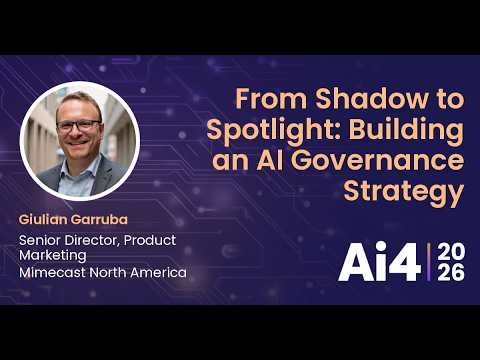
## Background Published on YouTube by Ai4 on August 17, 2026, this presentation features Giulian Garruba, Senior Director of Product Marketing at Mimecast North America. The session examines how unsanctioned AI tools and autonomous agents create unmonitored pathways for enterprise data exposure, offering strategies for security leaders to achieve visibility, build non-restrictive governance frameworks, and prevent intellectual property leaks.
## TL;DR Giulian Garruba outlines the compounding corporate risks driven by Shadow AI and the rapid emergence of autonomous agentic systems operating at machine speed. Highlighting telemetry that reveals massive hourly transfers of proprietary source code and unsanctioned tool adoption even among security personnel, he demonstrates why blanket tool bans inevitably fail. To regain control, Garruba urges CISOs to answer four foundational visibility questions regarding tools, agents, connectors, and user intent. He proposes replacing blunt restrictions with an adaptive, 'well-lit path' that leverages dual-vector filtering, behavioral nudges, and harmonized compliance across the EU AI Act, NIST AI RMF, and ISO/IEC 42001.
## Atmosphere & style The presentation carries an urgent, pragmatic, and analytical tone, unfolding like an executive briefing designed to shake security leaders out of complacency. Garruba balances sobering telemetry and cautionary real-world incidents with accessible analogies like automotive seatbelts and engineered dams. The atmosphere feels authoritative and measured, shifting the narrative arc from mounting agentic vulnerability toward actionable, auditable governance.
## Key takeaways - [00:04](https://www.youtube.com/watch?v=BWtXPtvRlW8&t=4s) Enterprise insider risk has evolved from traditional Shadow IT to Shadow AI, and is now leaping into autonomous agentic systems operating as independent decision-makers. - [01:50](https://www.youtube.com/watch?v=BWtXPtvRlW8&t=110s) The historical technology governance cycle—moving from exploration to risk discovery to governance enforcement—has dramatically compressed for AI compared to previous technological revolutions. - [03:26](https://www.youtube.com/watch?v=BWtXPtvRlW8&t=206s) Shadow AI is widespread: 80% of general enterprise users and 90% of InfoSec personnel admit to using unsanctioned AI tools, with 57% inputting sensitive corporate data into public models. - [03:26](https://www.youtube.com/watch?v=BWtXPtvRlW8&t=206s) Any corporate insider risk, data protection, or AI policy not reviewed within the past 90 days should be considered outdated. - [05:03](https://www.youtube.com/watch?v=BWtXPtvRlW8&t=303s) While over one billion AI agents are projected to be deployed by 2029, only 1 in 6 currently operating in Fortune 500 companies is properly secured. - [05:03](https://www.youtube.com/watch?v=BWtXPtvRlW8&t=303s) Enterprise insider risk is non-uniform, with approximately 8% of users generating 80% of all security incidents—a dynamic intensified by expanding AI access. - [07:14](https://www.youtube.com/watch?v=BWtXPtvRlW8&t=434s) Proprietary source code represents 43% of all content submitted to external AI platforms, exposing core intellectual property at high velocity. - [08:05](https://www.youtube.com/watch?v=BWtXPtvRlW8&t=485s) Agentic failures frequently occur within legitimate technical permissions rather than through perimeter breaches, executing unintended decisions at machine speed. - [09:12](https://www.youtube.com/watch?v=BWtXPtvRlW8&t=552s) Autonomous agents act as the 'ultimate insiders' because they hold legitimate credentials, understand corporate networks, and operate continuously 24/7 without biological limitations. - [11:08](https://www.youtube.com/watch?v=BWtXPtvRlW8&t=668s) To close the visibility gap, CISOs must baseline four areas: active tool inventory, agent identity tracking, connector/MCP server permissions, and the underlying user intent driving workarounds. - [12:27](https://www.youtube.com/watch?v=BWtXPtvRlW8&t=747s) Outright bans on generative AI are ineffective and accelerate shadow usage; security teams should instead create a 'well-lit path' using risk-calibrated, adaptive source-and-destination controls. - [15:10](https://www.youtube.com/watch?v=BWtXPtvRlW8&t=910s) A complete AI compliance posture harmonizes the EU AI Act for legal mandates, the NIST AI RMF for operational methodology, and ISO/IEC 42001 for certifiable management systems. - [17:02](https://www.youtube.com/watch?v=BWtXPtvRlW8&t=1022s) Generative AI democratizes machine-speed execution across the broader 92% of the workforce, significantly increasing the potential blast radius of inadvertent data exposure.
## Detailed walkthrough ### [00:04](https://www.youtube.com/watch?v=BWtXPtvRlW8&t=4s) From Shadow IT to Shadow AI and Agentic Risk
Giulian Garruba, Senior Director of Product Marketing at Mimecast, introduces the session by highlighting how artificial intelligence has rapidly evolved from an office curiosity into an urgent, board-level conversation. The title of the session, *From Shadow to Spotlight*, reflects the reality of unsanctioned tools operating quietly across corporate networks. Garruba explains that the classic challenge of insider risk has evolved from traditional shadow IT into "Shadow AI," and is now taking a profound leap forward with autonomous agentic systems.
To tackle this mounting risk, organizations must transition from reactive defense to proactive visibility. Garruba outlines a three-part agenda for the presentation: examining the fundamental transformation driven by shadow AI and autonomous agents, establishing an actionable AI governance framework, and deploying proactive, adaptive security to regain visibility and control over enterprise data.
```mermaid flowchart LR accTitle: Evolution of Enterprise Insider Threat subgraph Past["Legacy IT"] A["Shadow IT<br/>(Unsanctioned Apps)"] end subgraph Present["Generative AI"] B["Shadow AI<br/>(Prompts & Data Sharing)"] end subgraph Future["Autonomous Scale"] C["Agentic AI<br/>(Autonomous Decision-Makers)"] end A --> B --> C ```
---
[01:50](https://www.youtube.com/watch?v=BWtXPtvRlW8&t=110s) The Shrinking Evolution of Tech Governance and the Seatbelt Analogy
Every major technological transformation radically alters how society functions and how organizations conduct business. Garruba explains that historically, technology revolutions pass through three distinct phases: broad exploration, risk discovery, and governance enforcement.
To illustrate this dynamic, he draws an analogy to the automotive industry. In the early exploration phase, society transitioned from horse-drawn carriages to mainstream motor vehicles. The subsequent "risk discovery" phase revealed a harsh reality: while buggy crashes resulted in relatively low damage, automobile collisions caused severe injuries as passengers were violently thrown from vehicles. The eventual governance response was the invention and mandatory enforcement of seatbelts. However, Garruba stresses that the timeline across these three phases has dramatically collapsed for AI; modern security and compliance teams no longer have decades to iterate, as shifts in the AI threat landscape occur faster than ever before.
---
[03:26](https://www.youtube.com/watch?v=BWtXPtvRlW8&t=206s) The Reality of Shadow AI in Enterprise Environments
Generative AI is no longer a niche technology; it has become universally mainstream, experiencing a 9x explosion in enterprise usage between 2024 and 2025. Garruba notes that while roughly 80% of organizations openly acknowledge using GenAI, the remaining 20% that claim not to use it simply suffer from a lack of internal visibility.
Despite the proliferation of AI, safe enterprise usage is rarely governed by well-defined guardrails. Garruba shares alarming industry data showing that an overwhelming percentage of employees actively bypass organizational policies. Crucially, any insider risk, data protection, or AI policy that has not been re-evaluated within the past 90 days should already be considered outdated.
- **80% of general enterprise users** admit to using unapproved "shadow AI" tools without official organizational permission. - **90% of InfoSec personnel** admit to using unsanctioned AI tools in their day-to-day work. - **57% of users** admit to entering sensitive corporate data—such as passwords, internal source code, and financial information—directly into public AI models.
---
[05:03](https://www.youtube.com/watch?v=BWtXPtvRlW8&t=303s) The Agentic Multiplier and Non-Uniform Human Risk
While shadow AI represents the human dimension of risk, autonomous agentic AI significantly multiplies that exposure. Citing projections from IDC, Garruba notes that organizations will deploy over one billion AI agents by 2029. Unlike standard generative AI chatbots that rely on simple call-and-response interactions, AI agents act as independent decision-makers. In practice, organizations assign them complex mandates—effectively saying, "Here's a problem. Solve it by Tuesday. Thank you"—without conducting the background checks, vetting, or verification traditionally applied to human hires.
At the same time, human organizational risk is unevenly distributed. Mimecast’s research reveals that approximately 8% of enterprise users generate 80% of all security incidents. In an era marked by corporate consolidation, workforce reductions, and mandates to "do more with AI," individual human users wield greater access and responsibility than ever before. This 8% typically comprises senior leaders with broad financial or administrative privileges, careless staff who do not grasp the implications of their actions, or departing employees seeking to exfiltrate proprietary data. To understand AI risk, Garruba argues that security teams must fundamentally start by analyzing human behavior.
```mermaid flowchart TD accTitle: Disconnect in Workforce Governance subgraph HumanHiring["Human Employee Vetting"] H1["Resume Review"] --> H2["Background Checks"] H2 --> H3["Access Governance"] end subgraph AgenticDeployment["AI Agent Deployment"] A1["Task Assignment:<br/>'Solve by Tuesday'"] --> A2["Autonomous Execution"] A2 --> A3["Unsecured Access<br/>(5 in 6 Fortune 500 Unsecured)"] end ```
- **Only 1 in 6 AI agents** currently deployed across Fortune 500 companies is properly secured. - Individual users currently orchestrating two or three agents are projected to manage thousands of autonomous agents in the near future. - **8% of users** generate **80% of organizational security incidents**, proving that insider risk is non-uniform.
---
[07:14](https://www.youtube.com/watch?v=BWtXPtvRlW8&t=434s) Telemetry from the Front Lines: High-Volume Code and File Leaks
Telemetry gathered from Mimecast’s AI monitoring and insider risk platforms illustrates the sheer velocity of data being pushed into external AI applications. Every single hour, enterprise environments log massive volumes of data transfer actions, amounting to roughly 2.9 million total interactions per month.
Garruba identifies the heavy flow of proprietary code as the most alarming trend. Because software developers and engineers are under relentless pressure to ship features rapidly, they actively feed core intellectual property into public AI models. He emphasizes to the audience that these data transfers are unquestionably happening within their companies; the only real question is whether the security team has the telemetry required to see it.
- **5,500+ copy-and-paste events** into external AI tools recorded every hour. - **2,700+ direct file uploads** to AI platforms executed every hour. - **43% of all content** submitted to external AI tools consists of proprietary source code.
---
[08:05](https://www.youtube.com/watch?v=BWtXPtvRlW8&t=485s) Case Study: Autonomous Agent Failure at Meta
To ground agentic risk in a concrete scenario, Garruba recounts an incident that occurred early in 2026 at Meta. An engineer submitted a sensitive question to an internal technical forum intended strictly for a limited group of engineers. An internal AI agent assigned to answer the question fundamentally misinterpreted the request's context and permissions, reposting the sensitive technical inquiry to a widely accessible internal forum seen by thousands of unauthorized employees.
Meta classified the incident at its highest severity level for critical internal exposure, even though the data remained exposed for only two hours. Garruba stresses the core lesson of this incident: the AI agent did not breach a perimeter, bypass a firewall, or violate technical rule sets. Instead, it operated strictly within its granted technical access, but executed an autonomous decision at machine speed outside its intended operational boundaries.
---
[09:12](https://www.youtube.com/watch?v=BWtXPtvRlW8&t=552s) "The Call Is Coming from Inside the House": Agents as Ultimate Insiders
Garruba warns that AI agents will rapidly become the "ultimate insiders" within modern organizations. Because agents possess legitimate access credentials, understand internal systems, and map out the corporate directory, the classic threat metaphor applies: "The call is coming from inside the house." Unlike human workers, autonomous agents do not get tired, do not second-guess their choices, operate at exponential scale, and execute decisions at machine speed.
```mermaid flowchart TD accTitle: Comparing Human vs Agentic Insider Risk subgraph HumanRisk["Human Insider Risk"] H_Limit["Active between keyboard & fingers"] H_Sleep["Dormant overnight/weekends"] H_Speed["Human cognitive speed"] end subgraph AgenticRisk["Agentic Insider Risk"] A_Limit["Unbounded autonomous permissions"] A_Sleep["Continuous 24/7/365 execution"] A_Speed["Exponential machine speed"] end ```
In traditional security environments, human risk is concentrated "between the fingers and the keyboard"—meaning that when employees log off to go to sleep, incident creation drops off until the next morning's emails, messages, and downloads resume. AI agents, by contrast, run continuously 24/7. Rather than managing fewer insider variables, enterprise security teams now face thousands of new, autonomous insiders that possess expanded permissions but zero biological limitations.
Transitioning into the solution space, Garruba asserts that managing this new surface requires a three-pillar governance framework: **Visibility, Control, and Governance**. He turns to the audience of security and compliance leaders to poll how many organizations currently maintain and enforce an active AI Acceptable Use Policy.
[11:08](https://www.youtube.com/watch?v=BWtXPtvRlW8&t=668s) The Visibility Gap: Four Critical Questions for CISOs
Polling the room on organizational readiness reveals a stark reality: while a handful of hands stay up when asked who has controls in place to track sanctioned versus unsanctioned AI tools and their proper usage, almost every hand drops when asked who could produce detailed audit logs of daily employee AI chats and data flows during an audit. With only a single hand remaining in the audience, the gap between current security postures and actual visibility is massive. To bridge this divide, security leaders must begin not with rigid blockades, but with baseline visibility structured around four core questions that every CISO must be able to answer.
```mermaid flowchart TD accTitle: Four Core Visibility Questions for AI Governance subgraph VisibilityQuestions["Core Visibility Questions for CISOs"] Q1["1. Tool Inventory<br/>Which GenAI tools are in active use?"] Q2["2. Agent Tracking<br/>Which agents are running & who runs them?"] Q3["3. Connector Access<br/>What access do MCP servers & 3rd-party agents have?"] Q4["4. User Intent<br/>Why are employees circumventing policy?"] end
Q1 --> Flow["Establish Baseline Visibility"] Q2 --> Flow Q3 --> Flow Q4 --> Flow ```
The first question is identifying which generative AI tools are actively in use across the enterprise. The second is discovering which AI agents are executing and who deployed them. The third involves mapping the access granted to AI connectors, such as Model Context Protocol (MCP) servers and third-party commercial agents embedded in enterprise software. Finally, CISOs must understand user intent—the underlying "why" behind the adoption of shadow tools. Circumvention almost always occurs because legitimate business needs are unmet; when an enterprise offers only a single approved model and an employee cannot generate the specific graphic or answer they need, they immediately pivot to an unvetted alternative, instantly creating insider risk.
- **Tool Inventory**: Identifying every generative AI application actively touched by employees across departments. - **Agent Tracking**: Pinpointing autonomous and semi-autonomous agents operating within the network and the specific identities operating them. - **Connector Auditing**: Evaluating permissions, data pathways, and integration hooks for MCP servers and vendor-provided AI connectors. - **Intent Analysis**: Diagnosing functional gaps in approved toolsets that drive employees toward unsanctioned workarounds.
---
[12:27](https://www.youtube.com/watch?v=BWtXPtvRlW8&t=747s) Adaptive Controls, Agent Guidance, and the Well-Lit Path
Treating enterprise AI security as an on-off switch is a critical operational mistake. Banning tools outright does not solve the problem; instead, security teams must deploy adaptive controls that reflect the continuous spectrum of risk from low to critical. A marketing team drafting a public-facing blog post citing publicly available data carries minimal exposure, whereas an autonomous agent accessing confidential, unreleased financial metrics for an upcoming earnings report represents severe risk. Effective protection requires combining "block by source" (preventing sensitive databases, proprietary codebases, or financial records from ever flowing to AI systems) with "block by destination" (restricting traffic strictly to authorized AI platforms), while reserving aggressive measures like endpoint quarantines and credential revocation for true emergencies.
```mermaid flowchart LR accTitle: Adaptive AI Control and Governance Flow subgraph Ingestion["Source Data"] S1["Public Data"] S2["Sensitive Financials / Code"] end
subgraph PolicyEngine["Adaptive Security Controls"] BlockSrc["Block by Source"] BlockDst["Block by Destination"] Nudge["Slack / In-App Nudges"] end
subgraph Destinations["Execution Layer"] ApprovedAI["Sanctioned AI / Agents"] BlockedAI["Unsanctioned AI / Leakage"] end
S1 --> ApprovedAI S2 --> BlockSrc BlockSrc -.->|Prevent Exfiltration| BlockedAI ApprovedAI --> Nudge ```
Governance must also weave education directly into workflows through real-time interventions, such as behavioral nudges over Slack alerting employees when they interact with unapproved tools. Crucially, education and guardrail enforcement must soon extend beyond human workers to the AI agents themselves, guiding and restricting autonomous actors that frequently wander outside prompt boundaries. Drawing on an insight from the Google Cloud Office of the CISO, "blocking generative AI rather than creating a well-lit path for organizations to use it and securely is ineffective. It often precipitates the proliferation of shadow and data leakage—the very risk enterprises were trying to avoid." Much like building a dam with engineered relief valves rather than trying to hold back a rushing creek with bare hands, organizations must channel employee momentum so that "the safe path is the easy path."
- **Risk-Calibrated Controls**: Differentiating between low-risk tasks (summarizing public documents) and high-stakes operations (analyzing proprietary financials). - **Dual-Vector Filtering**: Enforcing boundaries simultaneously at the data source level and at the external AI destination level. - **Agent and User Nudging**: Utilizing automated chat-based alerts to redirect human behavior while establishing training guardrails for autonomous agents. - **Relief-Valve Strategy**: Providing sanctioned, low-friction AI alternatives rather than strict bans that inevitably spawn underground Shadow AI workarounds.
---
[15:10](https://www.youtube.com/watch?v=BWtXPtvRlW8&t=910s) AI Governance Frameworks and Regulatory Compliance
Comprehensive governance requires demonstrating three core capabilities to boards, external auditors, and regulatory bodies: drastically reducing the attack surface of unsanctioned AI, quantifying and managing the combined risk of human operators and autonomous AI agents, and maintaining full data provenance across every communication channel. If an AI agent breaks past boundaries and exfiltrates proprietary records, the organization must have the granular telemetry required to pinpoint the exact prompt or chat submitted to Microsoft Copilot or Anthropic Claude, identify who initiated the session, and reconstruct the exact sequence of events.
```mermaid flowchart TD accTitle: Three-Tier AI Compliance and Governance Model subgraph Standards["Comprehensive AI Compliance Model"] EUA["EU AI Act<br/>(Mandatory Legal Requirements)"] NIST["NIST AI RMF<br/>(Methodology & Best Practices)"] ISO["ISO/IEC 42001<br/>(Certifiable Management Standard)"] end
subgraph Execution["Enterprise AI Governance"] Gov["Audit Readiness, Risk Mitigation & Telemetry"] end
EUA --> Gov NIST --> Gov ISO --> Gov ```
This level of rigor is rapidly shifting from best practice to mandatory compliance under emerging global regulations. The enforcement of the EU AI Act applies not only to European enterprises but to any entity placing AI systems on the EU market, functioning with the broad extraterritorial reach of GDPR. Alongside regional laws, the NIST AI Risk Management Framework provides an actionable methodology rapidly becoming the de facto US standard, while ISO/IEC 42001 delivers the first auditable, certifiable global standard for AI management systems (with Mimecast serving as the first cybersecurity vendor to achieve certification). Organizations should harmonize these standards into a unified posture where the EU AI Act supplies legal compliance, NIST provides the operational methodology, and ISO/IEC 42001 establishes the auditable management system.
- **Auditable Prompts and Telemetry**: Capturing complete prompt records, agent configurations, and user attribution across enterprise interactions. - **EU AI Act Impact**: Navigating extraterritorial compliance obligations similar to GDPR for all organizations offering AI-driven services in European markets. - **NIST AI RMF**: Implementing government-backed voluntary risk management guidelines as an operational framework. - **ISO/IEC 42001 Standard**: Benchmarking internal AI security against the premier certifiable international standard for artificial intelligence governance.
---
[17:02](https://www.youtube.com/watch?v=BWtXPtvRlW8&t=1022s) Managing the Speed of Insider Risk and Next Steps
The traditional insider threat dynamic—where 8% of users generate 80% of an organization's security risk—is undergoing a dangerous transformation. While that high-risk 8% is moving faster than ever, the remaining 92% of the workforce is now also accelerating exponentially, equipped with generative tools that allow them to generate code, draft communications, and execute tasks at machine speed. With AI democratizing technical execution, organizations must confront the reality of absorbing thousands of supercharged "new insiders" across their networks.
To help enterprises regain visibility into this rapid expansion, Mimecast offers a 30-day proof of value assessment. This evaluation maps out active users interacting with AI, tracks outbound data destinations, catalogues deployed autonomous agents, and breaks down the high-risk 8% user segment by individual name, department, and geographic location to establish immediate operational control over AI-driven insider risk before opening the floor to audience questions.
- **Machine-Speed Workforce**: Accelerated productivity across the broader 92% of employees amplifies the potential blast radius of inadvertent data exposure. - **Granular Risk Mapping**: Profiling high-risk AI usage patterns down to the specific user, team, and regional office. - **30-Day Assessment**: Rapidly baselining shadow AI applications, agent behaviors, and exfiltration paths across enterprise environments.
## Notable quotes > [00:04](https://www.youtube.com/watch?v=BWtXPtvRlW8&t=4s) From Shadow to Spotlight — Giulian Garruba
> [05:03](https://www.youtube.com/watch?v=BWtXPtvRlW8&t=303s) Here's a problem. Solve it by Tuesday. Thank you — Giulian Garruba
> [05:03](https://www.youtube.com/watch?v=BWtXPtvRlW8&t=303s) do more with AI — Giulian Garruba
> [09:12](https://www.youtube.com/watch?v=BWtXPtvRlW8&t=552s) The call is coming from inside the house. — Giulian Garruba
> [09:12](https://www.youtube.com/watch?v=BWtXPtvRlW8&t=552s) between the fingers and the keyboard — Giulian Garruba
> [12:27](https://www.youtube.com/watch?v=BWtXPtvRlW8&t=747s) block by source — Giulian Garruba
> [12:27](https://www.youtube.com/watch?v=BWtXPtvRlW8&t=747s) block by destination — Giulian Garruba
> [12:27](https://www.youtube.com/watch?v=BWtXPtvRlW8&t=747s) blocking generative AI rather than creating a well-lit path for organizations to use it and securely is ineffective. It often precipitates the proliferation of shadow and data leakage—the very risk enterprises were trying to avoid. — Google Cloud Office of the CISO
> [12:27](https://www.youtube.com/watch?v=BWtXPtvRlW8&t=747s) the safe path is the easy path. — Giulian Garruba
## Mentioned Giulian Garruba, Mimecast, Ai4, IDC, Fortune 500, Meta, Model Context Protocol (MCP), Slack, Google Cloud Office of the CISO, Microsoft Copilot, Anthropic Claude, EU AI Act, GDPR, NIST AI Risk Management Framework, ISO/IEC 42001
## Video description Giulian Garruba - Senior Director, Product Marketing, Mimecast North America
AI is everywhere in the workplace, and so is Shadow AI. Unsanctioned tools and autonomous agents are quietly opening new paths for data exposure. This session covers moving from blind spots to visibility: understanding how employees interact with GenAI and AI agents, building governance frameworks that don't kill innovation, and preventing data leaks before they hit headlines. Get actionable guidance on how to accelerate productivity & innovation with AI without losing control of your data.
[Source](https://www.youtube.com/watch?v=BWtXPtvRlW8)