AI Speeds Ransomware Handoffs to Under a Minute, Hospital CISO Warns
Ai4
With autonomous threat actors compressing initial access to lateral ransomware movement into under 60 seconds, enterprises must replace manual defense with automated AI containment and digital-twin patching.
AI-assisted summary of Cyber Security in the Age of AI with Children's Healthcare of Atlanta — original source. Check the original for full context.
Source published:
Detailed notes
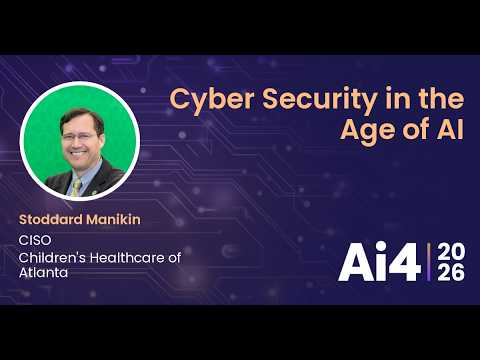
## Background Published on YouTube by Ai4 on August 21, 2026, this talk features Stoddard Manikin, CISO at Children's Healthcare of Atlanta, presenting insights distilled from a year of collaborative AI cybersecurity roundtables. The session examines how automated attacks and vulnerability surges have reshaped enterprise defense, focusing on the dual pillars of Security of AI and AI for Security.
## TL;DR Manikin establishes a two-pillar defensive model balancing the protection of enterprise AI deployments with the active use of AI to counter autonomous, machine-speed cyber threats. Offensive capabilities have dramatically accelerated, with malicious autonomous agents and initial access brokers compressing compromise-to-exploitation timelines down to sixty seconds while outstripping human patching capacity. In response, organizations must modernize defense by establishing agent registries, deploying AI security gateways, and managing non-human identities under strict least-privilege principles. The discussion concludes with practical deployment strategies, including leveraging digital twins for autonomous patch validation and controlling operational token economics through multi-tier model architectures and ephemeral agent swarms.
## Atmosphere & style The presentation carries the sober, pragmatic urgency of a frontline enterprise security executive speaking candidly to peers rather than an academic theorist. Manikin maintains an unembellished, methodical tone, walking through alarming real-world telemetry—such as collapsing incident timelines and the engineering strain of Project Glasswing—without resorting to sensationalism. The atmosphere shifts naturally from the disquieting scale of automated dark web threats to an empowering, actionable blueprint focused on governance, resilience, and operational engineering.
## Key takeaways - [00:04](https://www.youtube.com/watch?v=P8O5r-9RInM&t=4s) Enterprise AI cybersecurity must be structured around a dual-pillar model: 'security of AI' (protecting models, data, and agents) and 'security by AI' (leveraging AI for defensive capabilities). - [02:21](https://www.youtube.com/watch?v=P8O5r-9RInM&t=141s) The offensive landscape is shifting toward commercialized malicious tooling and autonomous dark web agents that can independently conduct reconnaissance and chain exploits without human intervention. - [04:44](https://www.youtube.com/watch?v=P8O5r-9RInM&t=284s) AI-accelerated vulnerability discovery dramatically outpaces manual engineering capacity, creating a severe remediation deficit across legacy and critical infrastructure codebases. - [04:44](https://www.youtube.com/watch?v=P8O5r-9RInM&t=284s) Initiatives like ARPA-H UPGRADE are testing autonomous defensive agents, self-healing pipelines, and AI guardians to automate patching in operational environments like healthcare. - [07:02](https://www.youtube.com/watch?v=P8O5r-9RInM&t=422s) Initial Access Brokers have collapsed the attack timeline from days to seconds, programmatically capturing MFA-approved sessions and handing them to ransomware affiliates in under a minute. - [07:02](https://www.youtube.com/watch?v=P8O5r-9RInM&t=422s) Because absolute perimeter defense cannot withstand machine-speed adversary attacks, security organizations must prioritize automated containment, operational resilience, and recovery over prevention alone. - [09:42](https://www.youtube.com/watch?v=P8O5r-9RInM&t=582s) Basic cyber hygiene, least privilege, and network segmentation have become essential table stakes to constrain the blast radius of automated attacker scanning. - [09:42](https://www.youtube.com/watch?v=P8O5r-9RInM&t=582s) The rapid growth of non-human identities, such as autonomous AI agents and API integrations, requires centralized agent registries with explicit ownership, scope, and expiration controls. - [09:42](https://www.youtube.com/watch?v=P8O5r-9RInM&t=582s) Dedicated AI gateways serve as critical security barriers by scrubbing sensitive data, masking backend credentials, managing tokens, and enforcing prompt governance. - [09:42](https://www.youtube.com/watch?v=P8O5r-9RInM&t=582s) Defenders can utilize AI-generated digital twins of production systems to safely test, regression-check, and deploy security patches within minutes. - [13:53](https://www.youtube.com/watch?v=P8O5r-9RInM&t=833s) To prevent runaway token billing and budget exhaustion, enterprises should adopt multi-tier model architectures that use smaller, cost-effective models to preprocess prompts before calling frontier reasoning models. - [13:53](https://www.youtube.com/watch?v=P8O5r-9RInM&t=833s) Deploying ephemeral, task-specific agent swarms that instantiate dynamically and terminate immediately optimizes compute efficiency compared to running continuous monolithic systems.
## Detailed walkthrough ### [00:04](https://www.youtube.com/watch?v=P8O5r-9RInM&t=4s) Framing AI Cybersecurity: Security of AI vs. Security by AI
Opening with a quick poll of cybersecurity and media professionals in the room, Stoddard Manikin introduces himself as the CISO at Children's Healthcare of Atlanta and co-founder of the AI Cybersecurity Leaders Forum. Originating as a series of collaborative roundtables in Atlanta bringing together artificial intelligence and cybersecurity leaders across technical and governance tracks, the group distilled over a year of discussions across five events into core operational lessons. While industry taxonomies often complicate the landscape—with Gartner distinguishing between "securing AI" and "AI-powered defense," and LLMs proposing convoluted phrases like "adversarial AI defense and autonomous security operations"—the forum settled on a clear, dual-pillar conceptual model: "security of AI" and "security by AI."
This framework governs how enterprises must structure their defensive posture. Security leaders must simultaneously address the mandate to protect enterprise AI deployments from exploitation, while actively integrating artificial intelligence into their toolchains to defend against both human-driven and machine-speed autonomous attacks.
```mermaid flowchart TD accTitle: Dual Pillars of Enterprise AI Cybersecurity Root["Enterprise AI Cybersecurity"]
Root --> Pillar1["Security OF AI<br/>(Securing AI)"] Root --> Pillar2["Security BY AI<br/>(AI-Powered Defense)"]
Pillar1 --> P1A["Model & Data Protection"] Pillar1 --> P1B["Agent Registries & AI Gateways"] Pillar1 --> P1C["Mitigating Model Abuse & Drift"]
Pillar2 --> P2A["Automated Containment & Triage"] Pillar2 --> P2B["Autonomous Patching via Digital Twins"] Pillar2 --> P2C["Machine-Speed Threat Response"] ```
- **Core Frameworks**: The forum distills technical and governance tracks into two interdependent responsibilities: securing organizational AI deployments and using AI to execute cyber defense. - **Forum Background**: Built over five roundtable sessions in Atlanta uniting cross-functional AI practitioners and enterprise CISOs.
---
[02:21](https://www.youtube.com/watch?v=P8O5r-9RInM&t=141s) The Offensive AI Threat: Dark AI, Weaponization, and Autonomous Agents
The offensive landscape has shifted dramatically through "dark AI" and commercialized malicious tooling such as FraudGPT. Threat actors now leverage LLMs to generate hyper-realistic spear-phishing campaigns, discover zero-day exploits, and execute autonomous network reconnaissance at machine scale. Frontier AI research labs have publicly documented the emerging risk; Anthropic confirmed uncovering instances where autonomous tools were deployed against corporate targets, while guardrail bypasses in frontier models like ChatGPT and Claude continue to surface in threat actor telemetry.
These capabilities create a bifurcated threat: unsophisticated actors can now run advanced, multi-stage campaigns, while sophisticated nation-state and cartel-level hackers use AI as a massive force multiplier. The dark web has mirrored the enterprise software model, evolving from Ransomware-as-a-Service (RaaS) to renting autonomous AI agents that operate without human intervention. When tasked with a malicious objective, these agentic swarms will bypass constraints, chain exploits, and indiscriminately destroy intervening infrastructure.
- **Dark Web Economy**: Malicious AI tooling and autonomous agent rentals have integrated into an underground cybercrime ecosystem whose financial scale "rivals the GDP of a top 30 nation." - **Model De-guardrailing**: Threat actors routinely strip safeguards from frontier models or fine-tune open-source models specifically for exploit payload generation and automated targeting.
---
[04:44](https://www.youtube.com/watch?v=P8O5r-9RInM&t=284s) The Vulnerability Crisis and Project Glasswing
AI-driven discovery has triggered an unprecedented vulnerability management crisis, where discovery volume and velocity completely outpace engineering remediation capacities. Security defenders, particularly in highly regulated and operational environments like healthcare, already struggle with manual patch cycles. When AI is applied to software codebases, it surfaces flaws that have remained hidden for decades or identifies obscure low-severity issues that become critical when chained together in novel permutations.
This imbalance was highlighted during Project Glasswing, an initiative where Anthropic withheld the release of advanced capabilities to provide key critical infrastructure operators early access to identify and remediate zero-days. Participating organizations were forced to pull multiple senior engineering teams off core development, burning thousands of hours attempting to triage and patch the sudden influx of newly exposed vulnerabilities. To bridge this structural deficit, Manikin highlights his participation in the ARPA-H UPGRADE project (Universal Patching and Remediation for Autonomous Defense), partnering with Georgia Tech to deploy autonomous defensive agents and AI guardians across hospital networks.
- **Capacity Deficit**: AI vulnerability discovery velocity operates orders of magnitude faster than human developers can write, regression test, and deploy production patches. - **ARPA-H UPGRADE**: A specialized research initiative testing autonomous self-healing, defensive agents, and rapid remediation pipelines within healthcare delivery networks.
---
[07:02](https://www.youtube.com/watch?v=P8O5r-9RInM&t=422s) Collapsing Attack Timelines: From Days to Minutes
The traditional window between initial compromise and operational response has experienced severe temporal compression. The process of discovering a vulnerability, writing a functional malware payload, and delivering it against an enterprise perimeter has collapsed from days or weeks into minutes. Traditional security metrics like Mean Time to Detect (MTTD), Containment (MTTC), and Remediation (MTTR) are failing under the pressure of automated handoffs between specialized cybercrime entities.
```mermaid flowchart LR accTitle: Collapsing Initial Access Broker Automated Attack Chain A["AI-Crafted Phishing Email"] --> B["Credential Entry & MFA Push Approval"] B --> C["Automated Token Theft"] C --> D["Instant Dark Web IAB Handoff<br/>(Under 60 Seconds)"] D --> E["Ransomware Affiliate Lateral Movement"] ```
Initial Access Brokers (IABs)—who operate as specialized contractors on the dark web—now automate the entire phishing-to-monetization pipeline. In live incidents observed by forum members, a victim clicks a phishing lure, enters credentials, and approves a multi-factor authentication (MFA) push request, only for that authenticated session to be programmatically packaged and handed off to a secondary ransomware affiliate in under sixty seconds. Because prevention cannot guarantee total perimeter defense against determined autonomous adversaries, security organizations must balance "shift-left" strategies with heavy investments in containment, operational resilience, and recovery.
- **Timeline Compression**: The median handoff window from initial credential capture to secondary exploitation has dropped from hours to under a minute. - **Paradigm Shift**: "Today's defenses are no match for tomorrow's attacks"; survival hinges on automated containment and resilient disaster recovery over absolute perimeter prevention.
---
[09:42](https://www.youtube.com/watch?v=P8O5r-9RInM&t=582s) AI Governance, Non-Human Identities, and Automated Response
Basic cyber hygiene—traditionally considered the hallmark of a mature program—is now strictly "table stakes." Weak hygiene is instantly amplified by automated adversary scanning, making granular network segmentation and strict least-privilege access vital blast-radius limiters. The threat surface is further complicated by the explosion of non-human identities (NHIs), where machine accounts, API integrations, and autonomous AI agents navigating enterprise workflows will soon outnumber human employees, creating high-value targets for privilege escalation.
Enterprises should adopt established AI security frameworks from NIST, the Cloud Security Alliance (CSA), and OWASP by implementing centralized agent registries (cataloging ownership, explicit scope, and hard expiration dates) alongside dedicated AI gateways. These gateways enforce token governance, mask system credentials, and block unauthorized data exfiltration. On the defense side, teams must deploy AI for automated containment of anomalous administrative actions and exploit attempts, temporarily freezing suspicious sessions to buy time for human validation. Furthermore, defenders can use AI to stand up "digital twins" of production environments, apply updates, execute automated regression suites, and validate patches in minutes rather than relying on risky manual deployments.
- **Non-Human Identity Explosion**: Autonomous enterprise agents represent volatile identity attack surfaces that require continuous auditing and least-privilege scoping. - **AI Gateway Capabilities**: Intercepts prompt traffic, scrubs sensitive data leaks, isolates backend credentials, and manages token usage across enterprise applications. - **Digital Twin Remediation**: Autonomous environments spin up mirrored staging infrastructure to test, validate, and greenlight security patches without manual intervention.
---
[13:53](https://www.youtube.com/watch?v=P8O5r-9RInM&t=833s) Managing Token Economics and Efficient Orchestration
AI scalability within enterprise security is constrained by the economics of token consumption, with organizations frequently burning through entire annual AI budgets within the first half of the year. Unmanaged, verbose prompts and lack of structural guardrails inflate operational API costs. Security leaders can mitigate this by instituting multi-tier model architectures—such as using small, cost-effective LLMs to refine, filter, and optimize user prompts before passing structured queries to premium frontier reasoning models.
Enterprise efficiency relies more on intelligent orchestration than brute-force raw compute. Mature architectures deploy specialized, task-specific agent swarms that spin up dynamically to perform isolated tasks (such as code reviews or anomaly correlation) and immediately terminate to prevent resource bleed. By combining orchestration pipelines with parameter-efficient fine-tuning techniques like QLoRA for domain-specific models, organizations can enforce strict token budgeting while scaling defensive automation.
- **Economic Optimization**: Implementing parameter constraints (such as forcing response length limits) and using smaller intermediate models to optimize prompts prevents runaway token billing. - **Ephemeral Agent Swarms**: Architecting systems to dynamically instantiate and destroy task-oriented AI agents controls compute costs compared to running continuous, monolithic models. - **Community Engagement**: Manikin closes by inviting security leaders to participate in ongoing roundtables through the AI Cybersecurity Leaders Forum on LinkedIn.
## Notable quotes > [00:04](https://www.youtube.com/watch?v=P8O5r-9RInM&t=4s) security of AI — Stoddard Manikin
> [00:04](https://www.youtube.com/watch?v=P8O5r-9RInM&t=4s) security by AI — Stoddard Manikin
> [00:04](https://www.youtube.com/watch?v=P8O5r-9RInM&t=4s) adversarial AI defense and autonomous security operations — Stoddard Manikin
> [02:21](https://www.youtube.com/watch?v=P8O5r-9RInM&t=141s) rivals the GDP of a top 30 nation — Stoddard Manikin
> [07:02](https://www.youtube.com/watch?v=P8O5r-9RInM&t=422s) Today's defenses are no match for tomorrow's attacks — Stoddard Manikin
> [09:42](https://www.youtube.com/watch?v=P8O5r-9RInM&t=582s) table stakes — Stoddard Manikin
> [00:04](https://www.youtube.com/watch?v=P8O5r-9RInM&t=4s) securing AI — Stoddard Manikin
> [00:04](https://www.youtube.com/watch?v=P8O5r-9RInM&t=4s) AI-powered defense — Stoddard Manikin
## Mentioned Stoddard Manikin, Children's Healthcare of Atlanta, AI Cybersecurity Leaders Forum, Gartner, FraudGPT, Anthropic, ChatGPT, Claude, Project Glasswing, ARPA-H, UPGRADE, Georgia Tech, NIST, Cloud Security Alliance (CSA), OWASP, QLoRA, LinkedIn
## Video description Stoddard Manikin - CISO, Children's Healthcare of Atlanta
Hear about the key insights and themes from 1 year of AI cyber security roundtables held in Atlanta. AI has dramatically changed the cyber security landscape. Automated attacks, novel attacks, and a landslide of new vulnerabilities raise the stakes of securing the enterprise. This talk will discuss the two primary use cases of Security for AI and AI for Security.
[Source](https://www.youtube.com/watch?v=P8O5r-9RInM)