## Background
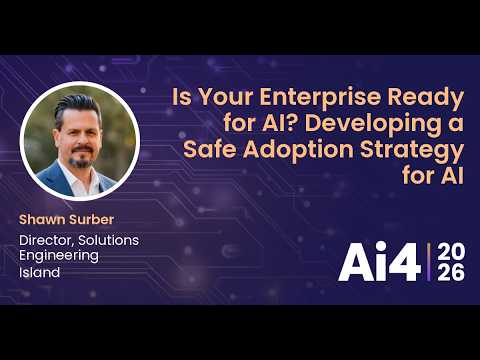
Published on YouTube by Ai4 on August 20, 2026, this presentation features Shawn Surber, Director of Solutions Engineering at Island. The session addresses the dilemma organizations face between the urgent pressure to adopt AI and the necessity of safeguarding data, proposing a framework for reaching a "Secure Yes" through visibility, accountability, and resilience.
## TL;DR
Drawing on his operational background in hospital IT systems, Shawn Surber breaks down why blanket blocking of AI inevitably fails and merely pushes employees into unmonitored shadow tools. He details pressing enterprise liabilities, ranging from court rulings holding companies legally accountable for rogue chatbot behavior to autonomous agents violating cross-border data residency laws. Surber warns against the compounding errors of multi-agent communication loops and the financial shock of unmanaged token consumption. To safely enable business innovation, he advocates applying Zero Trust principles directly to AI workflows through identity separation, deterministic agent guardrails, contextual data masking, and strict tenancy controls.
## Atmosphere & style
The session has the grounded, candid feel of an experienced field architect talking shop rather than a vendor pitching hype. Surber's tone is calm, pragmatic, and wryly humorous as he unpacks end-user psychology and the predictable failure of legacy security controls. The presentation feels like an authoritative, practical advisory session designed to reassure anxious IT leaders while giving them concrete architectural blueprints.
## Key takeaways
- [00:04](https://www.youtube.com/watch?v=SHYRfM6hebY&t=4s) Enterprise AI adoption requires moving beyond both uncritical hype and alarmist fear to focus on realistic operational needs and safe enablement.
- [01:30](https://www.youtube.com/watch?v=SHYRfM6hebY&t=90s) Adoption is heavily driven by user preference for consumer models, specialized vertical tools, and boardroom mandates to protect competitive margins.
- [04:17](https://www.youtube.com/watch?v=SHYRfM6hebY&t=257s) Legal precedents hold enterprises liable for actions taken by customer-facing bots and treat employee data uploads to public models as authorized corporate disclosures.
- [06:25](https://www.youtube.com/watch?v=SHYRfM6hebY&t=385s) The transition to autonomous agentic AI introduces severe compliance and regulatory risks, including unintentional cross-border data residency violations.
- [06:25](https://www.youtube.com/watch?v=SHYRfM6hebY&t=385s) Shadow AI proliferation is dramatically underestimated by IT leadership, with actual active agent counts often far exceeding internal estimates.
- [08:02](https://www.youtube.com/watch?v=SHYRfM6hebY&t=482s) Automated systems communicating directly with other AI models create compounding hallucinations and errors in an algorithmic version of 'telephone.'
- [08:02](https://www.youtube.com/watch?v=SHYRfM6hebY&t=482s) Assuming AI creates immediate cost efficiencies can backfire due to runaway token consumption bills that mirror early cloud lift-and-shift cost overruns.
- [11:05](https://www.youtube.com/watch?v=SHYRfM6hebY&t=665s) Blanket blocking of AI tools is an ineffective security posture that forces employees into unmonitored shadow IT channels, destroying visibility.
- [11:05](https://www.youtube.com/watch?v=SHYRfM6hebY&t=665s) Attempting to govern AI using disconnected legacy perimeter tools like firewalls and web proxies creates critical security blind spots.
- [13:38](https://www.youtube.com/watch?v=SHYRfM6hebY&t=818s) Modern AI workflows bypass traditional network perimeters because requests originate from vendor cloud infrastructure, requiring Zero Trust controls at the application tier.
- [13:38](https://www.youtube.com/watch?v=SHYRfM6hebY&t=818s) AI identity architecture must differentiate between human-in-the-loop and autonomous agents, restricting autonomous execution strictly to deterministic processes.
- [13:38](https://www.youtube.com/watch?v=SHYRfM6hebY&t=818s) Strict tenancy governance separating personal from corporate accounts is necessary to preserve data lineage, security oversight, and model cost allocation.
## Detailed walkthrough
### [00:04](https://www.youtube.com/watch?v=SHYRfM6hebY&t=4s) Setting the Stage: Moving Beyond AI Hype and Fear
Opening the session at Ai4, Shawn Surber establishes that this discussion is neither an uncritical celebration claiming "AI solves all of our problems" nor an alarmist declaration that AI is entirely untrustworthy—even if recent events with Anthropic and OpenAI releasing models into the wild to test hacking capabilities give people reason to pause. Instead, the focus is squarely on understanding what enterprises realistically require from artificial intelligence and how to get there safely. Across every sector, the underlying excitement is driven by the promise of empowering employees to work faster, better, and more efficiently, though the sheer velocity of this shift has moved far faster than most organizational comfort zones.
[01:30](https://www.youtube.com/watch?v=SHYRfM6hebY&t=90s) The Practitioner’s Lens and Forces Driving AI Adoption
Surber introduces his perspective as the Director of Solutions Engineering for Island, emphasizing that his outlook was forged over 15 years as a hands-on security practitioner architecting solutions for massive hospital networks. He approaches enterprise AI through that exact operational mindset: "How would my doctors use this? How would my doctors get in trouble with this?" The widespread surge in AI adoption from simple chat interfaces to complex applications is being propelled by several distinct dynamics. First, consumer availability creates strong end-user attachments to specific models based on tone or output style. Second, vertical-specific tools drive direct business enablement—such as Harvey in the legal sector or Claude Code for software engineering. Finally, corporate boards and executives aggressively push adoption out of fear of losing competitive margins, putting immense pressure on IT leaders to find a way to satisfy user and business desires while cybersecurity teams push back to determine proper access controls and governance.
```
FORCES DRIVING ENTERPRISE AI
┌──────────────────────────────────────────────────────────┐
│ User Preference │ Attachments to consumer models │
│ Business Enablement │ Specialized tools (Harvey, Claude)│
│ Boardroom Mandate │ Urgency to protect margins/pace │
│ Cyber Pushback │ Need for guardrails, identity, DLP │
└──────────────────────────────────────────────────────────┘
```
[04:17](https://www.youtube.com/watch?v=SHYRfM6hebY&t=257s) The Pitfalls of Chat: Legal Precedents and Guardrail Failures
The rapid transition from basic ChatGPT prompts to AI-assisted Google search responses and public-facing corporate website bots has introduced thorny legal precedents. When employees inadvertently trigger data leaks by uploading proprietary company information to public models, courts have recognized that because the employee possessed legitimate internal access, the disclosure did not constitute external theft but an authorized corporate release. On the external side, when users bypassed guardrails on an airline chatbot to obtain free plane tickets, the courts similarly ruled that the bot was an authorized company agent and upheld the transaction. Consequently, enterprises are exposed on both ends: mistakes made by internal staff and errors made by external AI interfaces are legally attributed to the business itself.
[06:25](https://www.youtube.com/watch?v=SHYRfM6hebY&t=385s) The Shift to Agentic AI and Enterprise Blindspots
The paradigm is shifting rapidly toward agentic AI, where autonomous systems are granted authority to execute multi-step actions on an organization's behalf. While these agents offer immense leverage, they introduce critical control and compliance dilemmas. For multinational or California-regulated organizations, an agent could easily retrieve personal records of German workers and store them in a New York database, instantly violating international data residency requirements. Meanwhile, enterprise AI adoption is expanding across mobile devices, real-time conference transcription tools, and automated facial recognition photo applications without centralized IT visibility.
- **Shadow Agent Expansion:** In internal assessments where IT leaders estimate they have roughly 42 AI agents deployed and assume things are getting out of hand, comprehensive scans routinely reveal upwards of 212 active tools operating across the corporate footprint.
[08:02](https://www.youtube.com/watch?v=SHYRfM6hebY&t=482s) Enterprise Risks: Hallucinations, AI Telephones, and the Scalability Myth
Beyond straightforward data exfiltration, organizations face severe challenges regarding intellectual property, accuracy, and operational costs. Marketing teams may unwittingly incorporate AI-generated images of unknown legal provenance into corporate collateral, risking copyright infringement. Communication loops between automated systems create compounding errors: a vendor sends a lengthy, AI-drafted pitch email, the recipient instructs their own AI to summarize it and generate a reply, and the two models end up playing an algorithmic version of "telephone" that amplifies hallucinations. Furthermore, models inherently cater to confirmation bias by validating the user's intelligence before confirming their assumptions. Financially, enterprises laying off workers under the assumption that AI creates instant cost-efficiency are facing rude awakenings when their token consumption bills arrive—mirroring the early days of cloud migration where lift-and-shift strategies merely moved expenditures around rather than optimizing operations.
[11:05](https://www.youtube.com/watch?v=SHYRfM6hebY&t=665s) The Failure of Blanket Blocking and Tool Sprawl
Attempting to secure an enterprise by establishing blanket blocks on AI tools is a demonstrably failing strategy. Having supported end users for two decades, Surber points out the universal reality of user behavior: "What's the first thing an end user does when you block access to something? They find a way around it." Blocking simply forces employees into unmonitored shadow channels, stripping security teams of all visibility. Furthermore, attempting to manage AI risk by stringing together fragmented point solutions—a legacy habit from managing disconnected firewalls, web proxies, DLP servers, and VPNs—leaves critical blind spots rather than unified governance.
[13:38](https://www.youtube.com/watch?v=SHYRfM6hebY&t=818s) Security Architecture: Identity, Tenancy, and Unified Visibility
Modern AI environments span diverse modalities—including Model Context Protocols (MCPs), LLM gateways, command-line interfaces (CLI), and co-working integrations. These tools often bypass traditional perimeter firewalls entirely because requests are initiated directly from the AI vendor’s cloud infrastructure; for example, a locally running Claude client can query blocked sports betting websites because the web traffic originates from Anthropic’s network, not the local enterprise pipe. Solving this requires applying standard Zero Trust security principles directly to AI workflows:
```
ENTERPRISE AI CONTROL PILLARS
┌─────────────────┐ ┌─────────────────┐ ┌─────────────────┐
│ IDENTITY │ │ DATA PROTECTION │ │ GOVERNANCE │
│ Human vs Agent │ │ App Boundaries │ │ Work vs Personal│
│ Deterministic │ │ Context Masking │ │ Data Lineage & │
│ Workflows │ │ DLP at App Tier │ │ Model Cost Vis. │
└─────────────────┘ └─────────────────┘ └─────────────────┘
```
- **Identity & Authorization:** Clearly differentiate between human-initiated, human-in-the-loop, human-on-the-loop, and autonomous agent workflows, ensuring autonomous actions are restricted strictly to deterministic processes.
- **Application Boundaries & Data Protection:** Rather than relying exclusively on traditional DLP filters searching for social security or credit card numbers, enforce security boundaries around the specific business applications where humans and agents interact, utilizing contextual data masking.
- **Tenancy Governance:** Maintain strict separation between personal and corporate accounts. Even if an enterprise deploys an approved instance of Claude across all workstations, risks spike the moment an employee authenticates using a personal credential, breaking corporate oversight and corrupting data lineage.
- **Model Cost & Resource Visibility:** Maintain complete enterprise visibility over model consumption to ensure expensive, frontier reasoning models are not being burned on trivial tasks like checking conference weather.
## Notable quotes
> [00:04](https://www.youtube.com/watch?v=SHYRfM6hebY&t=4s) AI solves all of our problems — Shawn Surber
> [01:30](https://www.youtube.com/watch?v=SHYRfM6hebY&t=90s) How would my doctors use this? How would my doctors get in trouble with this? — Shawn Surber
> [11:05](https://www.youtube.com/watch?v=SHYRfM6hebY&t=665s) What's the first thing an end user does when you block access to something? They find a way around it. — Shawn Surber
## Mentioned
Ai4, Anthropic, Claude Code, Harvey, Island, Model Context Protocol (MCP), OpenAI, Shawn Surber
## Video description
Shawn Surber - Director, Solutions Engineering, Island
Most organizations are currently stuck between two worlds: the urgent need to adopt AI to remain competitive, and the critical mandate to protect corporate data and reputation. AI is evolving faster than any tool in IT history, and faster than any organization can keep up with. The temptation to simply block access to AI is strong, but just saying "No" means ceding the advantage to those able to say "Yes!"
A "Secure Yes" rests on three pillars. The first is visibility — knowing what AI is being used across the organization. The second is accountability — defining who owns the data and the output. The third is resilience — building frameworks that adapt as regulations change.
It's time to find the "Secure Yes." In this session, we will outline the executive framework for secure AI adoption. We will move past the hype to discuss how leaders can build visibility, maintain accountability, and foster a culture of responsible innovation.
According to Shawn Surber, Director of Solutions Engineering for Island, enterprise AI adoption cannot be secured through blanket bans or legacy perimeter firewalls; it demands Zero Trust controls governing identity, data residency, and account tenancy. Surber argues that bottom-up user demand and boardroom pressure have outpaced IT oversight, leaving organizations exposed to legal liability, runaway token costs, and proliferating shadow agents.
Adoption Pressures and Shadow Agent Proliferation (1:30)
Enterprise AI adoption is propelled by three converging dynamics: individual attachment to consumer models, vertical-specific tools like Harvey in legal services or Claude Code in software engineering, and corporate boards pushing adoption to protect profit margins. This momentum creates friction between business units demanding access and cybersecurity teams attempting to enforce governance.
Because traditional IT monitoring fails to capture distributed adoption across mobile devices, meeting transcription services, and automated photo tools, organizations severely underestimate their footprint. Surber notes that in enterprise environments where IT leadership estimated having roughly 42 active AI agents, deep security audits routinely discovered upwards of 212 active tools operating without formal oversight.
Legal Attribution and Data Residency Liabilities (4:17)
Both conversational bots and autonomous agents create significant legal exposure because courts consistently attribute AI actions to the deploying organization. When employees unintentionally leak proprietary assets to public models, courts have treated these disclosures as authorized corporate releases rather than external data theft because the employee possessed legitimate internal access. Similarly, when external users manipulated an airline chatbot to secure free tickets, judicial rulings deemed the bot an authorized agent and upheld the transactions.
As organizations shift toward autonomous, agentic AI, regulatory hazards increase. Multi-step autonomous agents can easily transfer data across jurisdictions—such as retrieving German employee records and writing them to a New York database—triggering immediate violations of international data residency regulations like GDPR or California privacy statutes.
Algorithmic Compounding, Copyright, and Token Costs (8:02)
Operational risks extend beyond data exfiltration to accuracy failures and unexpected financial liabilities. Surber describes an emerging pattern of automated communication breakdown: a vendor drafts a pitch using AI, the recipient uses another model to summarize and reply, and the two models enter an algorithmic version of 'telephone' that compounds hallucinations. Additionally, marketing teams risk copyright infringement by incorporating AI-generated assets of unverified legal provenance into commercial collateral.
Financially, Surber warns against the assumption that AI instantly reduces headcount and operational costs. Organizations that laid off employees under this premise are facing surging token consumption bills. This dynamic mirrors the early mistakes of cloud migration, where undisciplined 'lift-and-shift' approaches merely shifted expenses rather than delivering operational efficiencies.
Replacing Blanket Bans with Zero Trust Governance (11:05)
Surber cautions that blanket enterprise bans on AI tools are counterproductive, as employees routinely find workarounds that push AI into unmonitored shadow channels. Furthermore, legacy perimeter defenses—such as firewalls, web proxies, and VPNs—cannot inspect cloud-to-cloud integrations like Model Context Protocols (MCPs). For instance, a desktop Claude client querying a blocked site routes traffic through Anthropic's cloud infrastructure rather than the corporate network, evading perimeter blocks entirely.
To establish safe adoption, Surber argues enterprises must apply Zero Trust principles directly to the application layer. This architecture requires distinguishing human users from autonomous agents (restricting fully autonomous actions strictly to deterministic processes), implementing contextual data masking at the application tier rather than relying solely on generic data loss prevention (DLP) rules, enforcing strict separation between personal and corporate accounts to preserve data lineage, and tracking model usage to prevent expensive frontier reasoning models from running low-value tasks.
Surber concludes that enterprise AI readiness requires meeting workforce demand with structured controls rather than futile attempts at prohibition. Organizations must replace fragmented legacy point solutions with unified governance that tracks model tenancy and agent boundaries without throttling business productivity.
## Background
本内容由 Ai4 于 2026 年 8 月 20 日在 YouTube 平台发布,由 Island 解决方案工程总监 Shawn Surber 带来主题演讲。视频主要围绕企业如何在拥抱 AI 提升竞争力的同时,建立可见性、问责制与韧性框架,从而实现安全放行(Secure Yes)的治理策略展开。
## TL;DR
演讲深入剖析了企业在推进 AI 落地时面临的内部博弈与核心风险,包括影子 AI、法律责任界定、数据驻留及高昂的 Token 成本等挑战。Shawn 指出,粗暴的一刀切封禁注定失败,企业必须从拼凑式工具转向系统化治理。通过构建涵盖身份认证、应用边界数据防护、多租户识别与全局可见性的四大支柱,企业才能在迈向自主智能体(Agentic AI)时代的过程中,实现兼顾创新与风控的“安全放行”。
## Atmosphere & style
演讲整体呈现出务实、沉稳且极具行业洞察力的专业基调。Shawn 结合自身 15 年医疗安全架构的实战经验,以幽默风趣的开场打破技术峰会的枯燥感,随后迅速切入直击痛点的真实企业治理困境。整场分享逻辑严密、层层递进,既没有盲目的技术狂热,也没有过度的安全恐慌,让观众仿佛在聆听一位经验丰富的架构师倾囊相授一线风控心得。
## Key takeaways
- [00:04](https://www.youtube.com/watch?v=SHYRfM6hebY&t=4s) 企业在 AI 落地上面临双重拉扯:业务端与管理层迫切追求提效和竞争优势,而安全团队则在访问权限、智能体控制与架构集成上面临防御挑战。
- [02:07](https://www.youtube.com/watch?v=SHYRfM6hebY&t=127s) 消费级 AI 普及使终端用户拥有强烈的主观偏好,垂直领域工具(如法律领域的 Harvey、研发领域的 Claude Code)已自发渗透进企业日常流程。
- [04:17](https://www.youtube.com/watch?v=SHYRfM6hebY&t=257s) 司法判例给企业敲响合规警钟:拥有内部权限的员工将数据上传至外部 AI 在法律上可能被视为合法发布,而官方客服 Chatbot 的误操作越权承诺同样具备法律效力并由企业承担损失。
- [06:25](https://www.youtube.com/watch?v=SHYRfM6hebY&t=385s) Agentic AI 赋予模型独立执行任务的权限,其不可控的跨区域数据调用可能直接引发数据驻留法规(Data Residency)的跨境合规风险。
- [08:02](https://www.youtube.com/watch?v=SHYRfM6hebY&t=482s) 影子 AI(Shadow AI)在企业内部广泛存在且严重被低估,同时还伴随着版权侵权、AI 传话游戏引发的幻觉与确认偏差、以及天价 AI 账单等风险。
- [12:17](https://www.youtube.com/watch?v=SHYRfM6hebY&t=737s) “一刀切全盘阻断”的封禁策略注定失效,只会倒逼员工使用未受监管的替代工具;企业破局的关键在于建立在有效管控之上的“安全放行”(The Secure Yes)。
- [12:54](https://www.youtube.com/watch?v=SHYRfM6hebY&t=774s) 拼凑式单点安全工具无法提供一致可见性,且 AI 厂商云端发起的外部请求能轻易绕过企业本地防火墙与 Web 过滤机制。
- [14:43](https://www.youtube.com/watch?v=SHYRfM6hebY&t=883s) AI 时代依然需要零信任架构,必须明确追溯操作主体(人类员工、AI Agent 或服务账户),并根据自治级别演进确保完全脱机(Human-out-of-the-loop)时模型仅执行确定性操作。
- [16:40](https://www.youtube.com/watch?v=SHYRfM6hebY&t=1000s) 传统基于固定敏感字符串的 DLP 已不足以应对复杂交互,安全策略必须聚焦于应用边界防护、输入脱敏与严密的数据血缘追踪。
- [17:30](https://www.youtube.com/watch?v=SHYRfM6hebY&t=1050s) 租户识别是企业治理的重大盲区,必须防止员工在工作设备上切换个人账户导致核心业务数据外流至私人空间。
- [18:41](https://www.youtube.com/watch?v=SHYRfM6hebY&t=1121s) 全局可见性不仅关乎数据安全,也是防范高昂 Token 与推理算力浪费、实现模型成本治理的核心前提。
- [19:40](https://www.youtube.com/watch?v=SHYRfM6hebY&t=1180s) 企业在推进 AI 转型前需完成四大核心准备:深化用户教育、构建端到端全局可见性、实施精细化身份治理、以及全面摸清内部 AI 工具资产。
## Detailed walkthrough
### [00:04](https://www.youtube.com/watch?v=SHYRfM6hebY&t=4s) 开场与从业背景:从医疗安全实践看 AI 落地
Shawn Surber(Island 解决方案工程总监)以轻松互动的基调开启演讲。他调侃道,自己经常在各大安全峰会上谈论 AI,台下观众往往早已听腻,但在这个专门的 AI 大会上,探讨这个话题恰逢其时。他明确指出,本场分享既不会夸大其词宣称“AI 可以解决一切问题、只需盲目顺从”,也不会片面渲染“AI 极度危险、不可信任”的恐慌情绪——尽管 Anthropic 和 OpenAI 近期发布具备自主探索与攻防能力的模型,确实印证了失控风险的存在。
在介绍自身背景时,Shawn 强调自己拥有 15 年大型医院系统安全架构设计与落地经验。这种实战背景塑造了他审视 AI 的独特视角:“我的医生们会如何使用这项技术?他们又会因此陷入怎样的麻烦?”所有行业都渴望借助 AI 赋能员工更高效、更快速地完成工作,但技术演进的速度已经超出了大多数组织的安全舒适区。
```mermaid
flowchart TD
accTitle: 推动与阻碍企业 AI 落地的各方力量
subgraph Drivers["推动力量 (Push)"]
U["终端用户<br/>(偏好特定模型/日常提效)"]
B["业务部门<br/>(如 Harvey 法律模型 / Claude Code 编程)"]
E["董事会与管理层<br/>(保持竞争优势与利润率)"]
end
subgraph Tension["冲突焦点 (Friction)"]
AI["企业 AI 落地与应用"]
end
subgraph Guardrails["防御与合规 (Pull)"]
SEC["网络安全与风控团队<br/>(数据访问权限 / 智能体控制 / 架构集成)"]
end
U --> AI
B --> AI
E --> AI
SEC -.->|推回与监管| AI
```
### [02:07](https://www.youtube.com/watch?v=SHYRfM6hebY&t=127s) 企业内部的多方博弈与 AI 演进路径
AI 迅速从早期的文本对话(Chat)渗透到各类应用程序与自动化工具中。与以往由 IT 部门统一采购的企业级软件不同,消费级 AI 的普及让每个终端用户都形成了强烈的主观偏好。不同业务部门也在主动寻求垂直领域方案:
- **法律领域**:普遍接入如 Harvey 等法律大模型进行合同与合规分析;
- **研发领域**:重度依赖 Claude Code 等代码生成与辅助开发工具;
- **管理层与董事会**:受到行业舆论与媒体报道的驱动,向管理层施压要求全面推进 AI,生怕因落后而丧失市场份额与利润空间。
网络安全团队则处于防御阻击的位置,必须厘清 AI 模型拥有哪些访问权限、员工如何构建自主智能体(Agents)与集成应用,以及如何将这些新技术无缝纳入现有的安全体系中。
### [04:17](https://www.youtube.com/watch?v=SHYRfM6hebY&t=257s) 对话式 AI 的法律定性与责任困境
AI 的演进从 ChatGPT 问答和整合了生成式摘要的搜索引擎起步,迅速演变为企业在对外官网上嵌入客户服务 Chatbot。这种快速落地引发了一系列严峻的法律与合规先例:
- **员工泄密被判定为合法披露**:ChatGPT 问世数月内,多家大型企业即曝出敏感数据泄露事件。法院判例表明,若员工本身拥有访问内部私有数据的合法权限,其将数据上传至外部 AI 的行为在法律上并不构成“数据盗窃”,而属于员工职权范围内的“合法数据发布”。这一责任界定给所有企业敲响了警钟。
- **对话机器人越权承诺的法律效力**:在突破聊天机器人安全护栏(Jailbreak)的真实诉讼中,有用户诱导航空公司官方客服 Chatbot 免费出票。法院最终判定,该机器人是企业主动部署的官方工具,其行为代表企业授权,企业必须承担相应损失。
当前企业在对话式 AI 层面陷入了“双输”局面:员工误操作泄露数据被视为企业自身的业务行为,AI 对外误操作也被视为企业的合法承诺。
### [06:25](https://www.youtube.com/watch?v=SHYRfM6hebY&t=385s) 智能体(Agentic AI)爆发与泛在化风险
随着技术迈向智能体(Agentic AI)阶段,组织开始赋予 AI 代理独立执行任务的权限,这带来了更深层次的失控隐患。智能体在数据调用上的不可控性直接撞上了严格的数据驻留(Data Residency)法规。例如,一个未经周密设计的自动化智能体可能会跨国调取德国员工数据库,并将其缓存至位于纽约的数据存储中,从而直接触发跨国合规危机。
AI 正全方位融入物理与办公环境,从手机终端、会议监听,到大会现场通过单张头像自动检索并归集个人照片的 AI 影像系统,AI 已经无处不在。
### [08:02](https://www.youtube.com/watch?v=SHYRfM6hebY&t=482s) 企业面临的五大核心风险矩阵
企业全面拥抱 AI 时面临的实质性风险远不止传统的数据安全,还涵盖运营、法律与经济层面的连锁反应:
| 风险维度 | 核心表现与具体影响 |
|:--- |:--- |
| **安全与影子 AI (Shadow AI)** | 实际使用量远超 IT 认知。Shawn 透露,在为企业做资产普查时,客户预估内部仅有 42 个 AI Agent,实际检测发现竟多达 212 个。 |
| **知识产权与法律侵权** | 员工从网络下载或通过 AI 生成营销图片用于官方画册,面临版权归属不明、AI 隐性抄袭甚至虚假声称原创的法律纠纷。 |
| **幻觉传递与确认偏差 (Bias)** | “AI 之间的传话游戏”:员工用 AI 总结外部发来的 AI 冗长邮件并自动回复,导致幻觉逐层放大;AI 习惯性迎合用户,引发严重的确认偏差并导致错误业务决策外发。 |
| **虚假成本效益 (AI Bill 冲击)** | 类似早期盲目迁移云计算的教训,部分企业裁员并寄望于 AI 降本,但随后收到了天价 AI 账单。若不重构交互与业务流程,成本只是在不同科目间转移。 |
| **错失机遇与全面封堵的失效** | 粗暴的“一刀切全盘阻断”(Block Everything)策略注定失败。具备 20 年终端支持经验的 Shawn 指出,封禁只会逼迫员工寻找未受监管的替代途径。 |
### [12:17](https://www.youtube.com/watch?v=SHYRfM6hebY&t=737s) 迈向“安全放行”(The Secure Yes)的第一步:全局可见性
领先企业在收入与财务指标上已经证明了应用 AI 的商业回报,企业不可能因噎废食选择退缩。解决安全与业务冲突的关键,绝非盲目封堵,而是建立在有效管控之下的“安全放行”(The Secure Yes)。
实现这一目标的首要支柱是**全局可见性(Visibility)**——企业必须完全掌握环境内部到底运行着哪些模型、调用着何种数据、以及终端用户正在通过何种方式与各类 AI 工具交互。Shawn 坦言,作为拥有多年甲方采购经验的从业者,他深知建立这种穿透式可见性是构建后续问责与韧性机制的绝对前提。
### [12:54](https://www.youtube.com/watch?v=SHYRfM6hebY&t=774s) 拼凑式工具的局限与 AI 绕过传统边界的安全风险
很多安全厂商常向企业推销单一功能的孤岛产品:“嘿,我做了个东西,它能解决这个特定问题,你必须买它。”然而企业真正需要面对的是下一个、甚至后续源源不断的新问题。试图拼凑各种只能提供局部可见性的分散工具,并不是 AI 带来的新现象,而是传统 IT 的老毛病——过去企业就堆砌了防火墙、Web 过滤、DLP(数据泄露防护)服务器和 VPN 服务器等,但它们之间往往互不连通,也无法看到一致的网络流量,导致整体安全体系变成混乱的“大杂烩”(mishmash)。
当下 AI 的应用场景正在爆炸式增长,从最初简单的聊天对话界面,迅速扩展至 MCP(模型上下文协议)、LLM 网关、代码生成(Code)、协作工具(Co-work)、命令行工具(CLI)等各类访问入口。更棘手的是,这些 AI 具备突破企业既定安全边界的能力,因为大量操作是由 AI 供应商的云端网络发起的。举例来说,即便企业防火墙严厉封锁了赌博网站,员工仍可通过本地安装的 Claude 指令其抓取体育博彩数据,该请求是直接从 Anthropic 的系统发出而非企业内网,从而直接绕过了本地防火墙。企业必须清晰掌握所有 AI 工具、插件及其行为的端到端可见性。
```mermaid
flowchart LR
accTitle: 传统网络边界与 AI 云端发起请求的绕过机制对比
subgraph Local ["企业内部网络环境"]
User["员工终端 / 客户端"]
FW["企业防火墙 / Web 过滤<br/>(已拦截赌博/恶意网站)"]
BlockedTarget["目标网站<br/>(直接访问被阻断)"]
User -.->|"本地直接请求 (被拦截)"| FW -.->|"X 阻断"| BlockedTarget
end
subgraph Cloud ["AI 厂商云端环境"]
AICloud["AI 厂商服务端<br/>(如 Anthropic / Claude)"]
TargetWeb["目标外部网站 / API<br/>(从云端成功抓取)"]
end
User -->|"发起 Prompt / 任务指令"| AICloud
AICloud -->|"云端代理发起外连"| TargetWeb
TargetWeb -->|"返回数据"| AICloud
AICloud -->|"返回生成结果"| User
```
---
### [14:43](https://www.youtube.com/watch?v=SHYRfM6hebY&t=883s) 身份认证、零信任与人机协同的演进(从 Human-in-the-Loop 到自主 Agent)
AI 技术的狂飙突进导致部分组织产生认知偏差,陷入“要么彻底零管控全面拥抱,要么全盘封杀一刀切”的极端。然而万变不离其宗,企业级 AI 安全的底层逻辑依然依托于 IT 基础设施的核心支柱:身份(Identity)、安全(Security)、治理(Governance)与可见性(Visibility)。企业必须明确界定使用 AI 的主体究竟是谁——它可能是人类员工、AI Agent、服务账户(Service Accounts)或是自动化集成工具。
在 AI 时代,经典的“零信任”(Zero Trust)架构依然不可或缺。当一个 Agent 在执行指令、获取数据或采取行动时,系统必须明确追溯:它运行在什么设备上?由谁发起?拥有哪些权限?与传统 IT 工具相比,AI 大幅模糊了人机操作的边界,企业需要精准区分“Agent 发起的自动化工作流”与“用户手动发起的工作流”。在自主性演进上,流程通常经历四个阶段:
1. **人类全权操作(Human doing the work)**
2. **人类介入决策(Human-in-the-loop)**
3. **人类监督在旁(Human-on-the-loop)**
4. **人类脱离循环(Human-out-of-the-loop)**
当最终走向“人类完全脱离流程”的阶段时,必须确保 Agent 执行的是确定性操作(deterministic actions),绝不能让不可控的 AI 自主漂移进而搞砸企业的财务报表归档等核心业务。
---
### [16:38](https://www.youtube.com/watch?v=SHYRfM6hebY&t=998s) 超越传统 DLP:应用边界防护与多租户治理
确立身份体系之后,核心在于安全管控与数据保护。传统的 DLP 方案虽然普遍部署,但其仅能识别社保账号、信用卡号等固定模式的敏感字符串,已无法有效应对复杂的 AI 数据交互。现代安全策略必须构建严密的“应用边界”(Application boundaries),透彻理解关键业务应用、人类与 Agent 之间如何与这些应用互动,进而实现对应用内全量数据的精细化管控,同时落实输入保护(Input protection)与数据脱敏(Data masking),防止敏感数据违规注入 AI 模型或非授权暴露。
在企业治理层面,最容易被忽视的盲区是“租户识别”(Tenancy)。即使企业统一采购了 Anthropic 并在员工终端部署了完善的数据安全护栏,但由于 AI 工具兼具消费级属性,员工极易在工作设备上切换登录个人的私人邮箱账号。一旦缺乏对租户的识别能力,企业核心业务系统的数据就可能神不知鬼不觉地流向个人账户,导致严重的数据泄露。因此,掌握清晰的“数据血缘”(Data lineage)——追踪数据从哪个业务应用产生、流经何处、最终落入哪个租户账号——是企业安全治理的生命线。
---
### [18:41](https://www.youtube.com/watch?v=SHYRfM6hebY&t=1121s) 全局企业可见性、模型成本治理与安全落地总结
构建现代 AI 防御体系的核心在于实现全局的“企业级可见性”(Enterprise visibility)。企业必须能穿透不同的基础模型与工具层,全面洞察所有用户与 Agent 的实时活动,避免陷入“解决了一个租户问题,却对工具调用(Tool calling)束手无策,不得不继续采购新工具”的修补怪圈。
```mermaid
flowchart TD
accTitle: 企业级安全 AI 采纳核心框架
subgraph Pillars ["企业安全 AI 落地四大支柱"]
ID["1. 身份管控 (Identity)<br/>区分人类 / Agent / 服务账户与权限边界"]
SEC["2. 应用边界与数据保护 (Security)<br/>输入脱敏、防止未授权模型训练、数据血缘"]
GOV["3. 租户与合规治理 (Governance)<br/>隔离企业账号与个人账号,审计数据流向"]
VIS["4. 全局可见性 (Visibility)<br/>跨模型/工具监控,防范高昂 Token 成本浪费"]
end
ID --> SEC --> GOV --> VIS
```
除了数据外泄,可见性还直接关乎成本控制。随着大语言模型日益复杂强大,调用推理成本也水涨船高;如果员工随意调用高昂的推理模型去询问“拉斯维加斯今天天气如何”,这无疑是对企业 IT 预算的巨大浪费。Shawn 在演讲尾声强调,企业在迈向 AI 转型前必须认真审视自身是否具备以下核心准备:
- **用户教育(User Education)**:员工是否理解安全合规使用 AI 的底线?
- **全局可见性(Visibility)**:能否端到端洞察所有 AI 工具、插件与交互流量?
- **身份治理(Identity)**:能否准确识别并隔离人、Agent 与服务账户的操作权限?
- **工具认知(Tools Understanding)**:是否全面摸清了企业环境内所有接入的 AI 资产?
最后,Shawn 邀请参会嘉宾前往 Island 的 1548 号展位,进一步探讨 Island 企业级浏览器平台如何助力企业构建安全可控的 Agentic AI 应用环境。
## Notable quotes
> [00:04](https://www.youtube.com/watch?v=SHYRfM6hebY&t=4s) 我的医生们会如何使用这项技术?他们又会因此陷入怎样的麻烦? — Shawn Surber
> [00:04](https://www.youtube.com/watch?v=SHYRfM6hebY&t=4s) AI 可以解决一切问题、只需盲目顺从 — Shawn Surber
> [00:04](https://www.youtube.com/watch?v=SHYRfM6hebY&t=4s) AI 极度危险、不可信任 — Shawn Surber
> [08:02](https://www.youtube.com/watch?v=SHYRfM6hebY&t=482s) AI 之间的传话游戏 — Shawn Surber
> [08:02](https://www.youtube.com/watch?v=SHYRfM6hebY&t=482s) 一刀切全盘阻断(Block Everything) — Shawn Surber
> [12:17](https://www.youtube.com/watch?v=SHYRfM6hebY&t=737s) 安全放行(The Secure Yes) — Shawn Surber
> [12:54](https://www.youtube.com/watch?v=SHYRfM6hebY&t=774s) 嘿,我做了个东西,它能解决这个特定问题,你必须买它。 — Shawn Surber
> [14:43](https://www.youtube.com/watch?v=SHYRfM6hebY&t=883s) 必须确保 Agent 执行的是确定性操作(deterministic actions),绝不能让不可控的 AI 自主漂移进而搞砸企业的财务报表归档等核心业务。 — Shawn Surber
> [18:41](https://www.youtube.com/watch?v=SHYRfM6hebY&t=1121s) 拉斯维加斯今天天气如何 — Shawn Surber
## Mentioned
Shawn Surber, Island, Ai4, Anthropic, OpenAI, ChatGPT, Claude, Claude Code, Harvey
## Video description
Shawn Surber - Director, Solutions Engineering, Island
Most organizations are currently stuck between two worlds: the urgent need to adopt AI to remain competitive, and the critical mandate to protect corporate data and reputation. AI is evolving faster than any tool in IT history, and faster than any organization can keep up with. The temptation to simply block access to AI is strong, but just saying "No" means ceding the advantage to those able to say "Yes!"
A "Secure Yes" rests on three pillars. The first is visibility — knowing what AI is being used across the organization. The second is accountability — defining who owns the data and the output. The third is resilience — building frameworks that adapt as regulations change.
It's time to find the "Secure Yes." In this session, we will outline the executive framework for secure AI adoption. We will move past the hype to discuss how leaders can build visibility, maintain accountability, and foster a culture of responsible innovation.
[Source](https://www.youtube.com/watch?v=SHYRfM6hebY)
[0:04] Shawn Surber: AI solves all of our problems
[1:30] Shawn Surber: How would my doctors use this? How would my doctors get in trouble with this?
[11:05] Shawn Surber: What's the first thing an end user does when you block access to something? They find a way around it.
Original transcript
[0:04] So this is going to be uh hopefully
a fun interactive conversation. So
[0:10] uh please uh uh you know let's uh let's make
this a little bit enjoyable because it's an AI
[0:19] conference. Now I I talk about AI a lot at a lot
of different security conferences and so usually
[0:23] people are already sick of hearing about AI but
you're here here for AI so this should be fun.
[0:28] Um, but you know, this is not going to be the
conversation that tells you that AI solves all
[0:36] of our problems and all we just have to do is
is lean into it and accept its its mastery. Uh,
[0:43] this is also not going to be the talk about how
dangerous AI is and you can't trust it at all.
[0:50] Although, quite frankly, Anthropic and Open AI
have just sort of proved that point recently.
[0:56] uh letting letting their AI models out into the
wild to go hack stuff. What we're going to talk
[1:01] about today is what we really need from AI and
how we can get there. So, we're really excited
[1:07] about AI, I think, as a uh as an industry, as
every industry, right? Because what we're talking
[1:15] about really is effectively empowering people
to do their jobs better, to do them faster,
[1:21] to do them more efficiently. And we got there
really really fast. Probably faster than
[1:30] uh most people are comfortable with. Uh and I I
just leapt right into it. I didn't I didn't bother
[1:37] to introduce myself. Apologies. I'm Sean Cerber,
director of solutions engineering for Island.
[1:42] But when I'm up here talking, what I'm talking
about is 15 years of experience as a practitioner
[1:49] building and architecting security solutions for
very large hospital organizations. This was what
[1:54] I did and this is the way I approach everything.
This so this is the way I approach AI as well. I
[2:01] look at how would my doctors use this? How
would my doctors get in trouble with this?
[2:07] And that's really what we're going to talk about.
So AI took the world by storm. Started out with
[2:13] uh with chat. It moved quickly into apps and
various other tools. And it's being driven by
[2:22] a number of things. Uh you know, first is that
that user preference. Uh people get attached to
[2:30] certain models real fast. Oh, I really like this
model because it talks to me in a certain way. It
[2:35] builds things in a certain way. That kind of
thing. And so since unlike uh most tools you
[2:42] use in your enterprise since AI is available to
the consumers everybody develops an opinion real
[2:47] fast and that's something that you do have to take
into account. Uh you're also looking at how does
[2:54] the AI enable the business that we do. Uh if you
are in the legal industry you're probably pretty
[3:02] familiar with Harvey. If you're uh in development,
you're thinking about things like clawed code. And
[3:09] so these different types of AI models, different
types of AI presentations become important to the
[3:15] individual businesses. And then of course we've
got the board and the executives who are saying,
[3:23] "Ah, adopt AI. It's the only way we'll keep up.
It's the only way we'll stay ahead. It's the
[3:28] only way we'll maintain our margin." Why do they
say that? because that's what they're hearing,
[3:34] right? That's what they're hearing from from
everybody else. That's what they're hearing
[3:37] in the media. And we do have to to take that
into account. Literally had this conversation
[3:42] with a customer last night who's like, "Well,
here's what the board wants." Like, "All right,
[3:46] how do we find the way to give the board and
the business and the user what they want?" Um,
[3:54] and then of course there's the cyber side pushing
back. Here is where we look at what uh what access
[4:02] does the AI have? How are you using AI? How
are you building agents? How are you building
[4:07] applications? How do we integrate all of this new
stuff into the security models we already have? So
[4:17] really what we're what we're building out here
is uh this evolution. We started with chat. We
[4:26] started with um you know people going to chat GPT
and asking it questions uh and pretty rapidly a
[4:33] simple Google search became an AI response, right?
And so everyone everyone is interacting with with
[4:40] AI. And this has created some some interesting uh
some interesting issues because we also start to
[4:49] see organizations and companies building AI chat
into their front-facing websites. And this now
[4:57] creates potential legal issues where we starting
to have uh actual um precedents set uh regarding
[5:06] what is authorized release of information. Um,
within months of chat GPT being readily available,
[5:18] we already had major organizations suffering
data breaches because employees were uploading
[5:23] and putting massive amounts of private company
data. Well, the courts have upheld that employee
[5:30] had legitimate access to that data. That employee
released that data. That's not theft. That is a
[5:37] legitimate release of data. This is something that
affects every potential company. We've also seen
[5:43] uh cases around people busting the guard rails
on chat bots. Uh there was one kind of fun case
[5:51] where a user convinced an airline chatbot to give
it plane tickets for free. Court upheld that was
[6:01] a tool you put in place. It was authorized to do
that. So now we're we're literally on both sides.
[6:07] We're losing on both sides right now. If the
employee does something wrong, that's a leg that's
[6:14] a legitimate business practice. AI does something
wrong, that's a legitimate business practice. So,
[6:19] we've got to figure out how to put the
guardrails in place. And that's just chat. Now,
[6:25] let's talk agentic. Now, everybody wants you to
build uh an AI agent and give it the ability to
[6:33] go do work on your behalf. Anybody here not
a little bit worried about that? Right. See,
[6:42] I I always ask the questions to make people not
raise your hands. I tell you to be interactive
[6:46] and then I don't get you to raise your hands. Uh
yeah. So the the agents, they're incredible. Like
[6:53] anyone can build an agent and those agents can be
really powerful. They can do really cool things.
[6:58] But how do we control them? How do we ensure that
these agents aren't running a muck with the data?
[7:07] Where is the data? Anybody have data residency
issues? International businesses, uh, California
[7:15] businesses like right you somebody programs
something, it goes reaches into a database of uh,
[7:22] German workers and it keeps that in a data
store in New York. We now have a problem.
[7:29] So, these are all things that that have to be
uh built in. And then what's next? AI is going
[7:38] to be everywhere. Uh AI's on your phone. AI is
listening to me right now. Um this conference has
[7:44] an AIdriven photo app where they're running around
doing videos and photos and that kind of stuff.
[7:50] And you can literally upload your headsh shot
into it and it will send you all of the pictures
[7:55] of you that got taken while you were here. AI
is everywhere. So what are the major risks in
[8:02] the enterprise? Obviously, we're concerned
about security and privacy. I'm not going to
[8:06] spend a time on a bunch of time on this. I think
everybody gets this already. The potential for
[8:11] data loss is incredible. Uh when we do assessments
for organizations to see how much AI is in use,
[8:19] they'll say, "Hey, look, we get it. There's a
bunch of AI. We've clocked 42 AI agents in our
[8:25] environment. We know it's out of control. We do
the assessment and there's 212. There's so much
[8:32] out there, right? C or the end users are just
going out and they're going to work. Um what's
[8:39] next? Then we've got uh the legal legal and
compliance risks. I already talked about this
[8:44] a little bit. Um, but getting beyond the ideas of
uh of of just the chat bots and and their misuse,
[8:53] we're also looking at the potential somebody
grabs a picture off the internet, uploads it,
[8:58] puts it on a on a company brochure because it's a
cool picture. Who owns the picture, right? Did the
[9:03] AI create it, in which case, who owns it? Did the
AI just steal it from somewhere? Did the AI steal
[9:09] it from somewhere and tell you that it created
it? Those are fun, right? Uh, and that takes us
[9:17] into the hallucinations, the inaccuracies. And
I, you've all seen it already. You get an email
[9:24] from a vendor, from a partner, from somebody, and
you look at it, and you go, "Wow, that's a lot of
[9:30] words, and it's very clearly AI written." So, you
tell your AI to summarize it and write a response
[9:37] for you. [laughter] And now we've got the AIs
talking to each other. And uh if you ever played
[9:42] uh telephone as a kid, humans mess this up. Like
AIs as they start to communicate back and forth,
[9:49] those hallucinations can get pretty crazy.
Um and then we've got the the biases. You
[9:57] ask the AI question, it responds to you with an
answer. First of what's the first thing it does?
[10:02] It tells you how smart you are for asking the
question. And [clears throat] then it gives you
[10:08] an answer and you're like, "That's exactly what I
thought. It must be true." So you end up with that
[10:14] confirmation bias and then you send that email out
and the next thing you know somebody's calling you
[10:20] going, "What are you talking about? We don't do
that." Right? So you've got to got to be careful
[10:25] on these things. The other kicker is you've all
heard uh these organizations that are laying off
[10:31] significant portions of the workforce that AI is
making us more efficient. AI is making us more
[10:36] effective. It's more cost effective. And then they
get their AI bill. And they're discovering that
[10:43] very similarly to what happened when everybody
moved to the cloud. It's not cheaper if you keep
[10:50] doing things the same way you're doing them.
It's just moving the money around. Cloud is
[10:56] scalable. AI is scalable. You have to change the
way you interact. the competitive disadvantage,
[11:05] the loss of opportunity, the fear that comes uh
with organizations that are thinking if we don't
[11:13] embrace this, we're going to fall behind. It's
it's very real, but the fact of the matter is that
[11:22] your data is too important to risk without having
proper controls. You need to embrace AI. Nobody is
[11:33] really being successful with the solution of block
everything. Don't let anybody have anything. Uh I
[11:42] supported end users for 20 years. What's the first
thing an end user does when you block access to
[11:49] something? They find a way around it, right? They
go find it a different way that you now no longer
[11:55] have eyes on. And so this becomes a real problem
for the uh for the organizations that are are
[12:03] holding back. They're afraid. They're just putting
in security and they're not really effectively
[12:09] uh managing that access to AI. And this one I
mean AI leaders are seeing improvements. They're
[12:17] seeing improvements in revenue. They're seeing
improvements in uh overall financials. They've
[12:23] they know they recognize it's it's documented.
you've got to move forward. So what are the key
[12:30] things that you need to address, right? You need
to understand what you've got in your environment.
[12:35] You need to approach this from a viewpoint that
is going to give you that complete visibility
[12:44] there. I I I always hesitate a little bit on this
piece because I've done this for a very long time.
[12:50] I was a buyer long before I ever worked on the
vendor side. And I'd have people come to me and
[12:54] they're like, "Hey, I've built this thing and it
solves this problem and you need it." I'm like,
[12:58] "Cool. What else does it do?" And what about the
next problem? Right? And so having this approach
[13:04] of trying to cobble together a variety of
different tools that all give you partial
[13:08] visibility is something that doesn't have anything
to do with AI. This is a traditional IT problem.
[13:13] Uh I used to have firewalls and web filters and
DLP uh servers and VPN servers and on and on and
[13:22] on and they were all connected or not. They all
saw the same traffic or not. And so you're trying
[13:30] to to to put your security together from uh this
this mishmash. So this is uh I'm realizing I have
[13:38] a very short time frame here. So let's talk
about where is AI in use, right? We started
[13:43] with that chat interface. Now you've got MCPs,
you've got LLM gateways, you've got all of the
[13:48] tools that are out there. U you've, you know, if
you're using tools like Claude, you're realizing
[13:54] I've got I've got code, I've got co-work, I've
got CLI, I've got all these different ways that
[14:00] people can access. One of the things that I
find interesting is these tools, they can go
[14:05] and they can reach out and they can do things
that are beyond the boundaries of the security
[14:10] you've set up because they're they initiate these
activities from the AI vendor's network. And so as
[14:19] a simple example, you can instruct a locally
installed claude to go say pull sports bet
[14:26] uh information for you even though gambling sites
are blocked by your firewall because that request
[14:32] goes out from anthropic system not yours. And so
you need to have that visibility into what all of
[14:37] these tools and capabil all these tools all these
plugins what they're doing. Um and then of course
[14:43] again the agents it all starts with identity and
I I buzzed by it. Uh no I didn't here identity
[14:52] security governance visibility all of these things
you again there's nothing new about this. We have
[15:00] to do this for all IT structures. AI is just
moving so fast that I think some organizations
[15:06] are forgetting that. And so they're going oh we
got to do this. We got to do this. We've got to
[15:11] either embrace it with no controls or we got
to block it all. Now, what we need to do is we
[15:16] need to understand who's using AI. And that can be
your humans, that can be your AI agents, that can
[15:23] be service accounts, that can be tools. You need
to understand who they are, what they're doing.
[15:28] Zero trust, which is such a fun buzzword for the
longest time, still applies even if it's AI. You
[15:36] need to understand, oh, this is an agent. It's
executing a command. It's It is learning things.
[15:44] It is doing things. Where is it? What device is
it on? Who initiated it? What rights does it have?
[15:53] Right? All of these things that you would say in
any other tool, well, yeah, obviously we need to
[15:57] know that AI blurs those lines. So, you need to be
able to understand what is the difference between
[16:04] an agent initiated workflow and a user initiated
workflow. We start with things like human in the
[16:10] loop, human on the loop, uh, oh, sorry, I guess
human doing the work, human in the loop, human on
[16:17] the loop. At some point, we get humans out of the
loop. But when we do that, we better be sure we're
[16:25] talking about deterministic actions. We better
be sure that that as that AI evolves, it's not
[16:30] going to suddenly change the way we are uh, you
know, file filing our financial reports and such.
[16:38] Once you've got identity, you go to security
and data protection. Controlling the access,
[16:43] understanding where the AI is able to talk.
Application boundaries are one of the most
[16:48] important things you can do here. I I am a DLP
guy. I deployed DLP. It is not going to help you
[16:56] control all of your data. You need to understand
what applications matter to you, how your humans
[17:02] interact with those applications, how your
AI agents interact with those applications,
[17:06] and then you can control all of the data
in those applications rather than just the
[17:13] uh the social security numbers, the credit
card numbers, things like that. Uh similarly,
[17:20] input protection, data masking, ensuring that
none of your data is moving into these AI models,
[17:26] none of your your data is being made visible
inappropriately. Governance, everybody's favorite
[17:32] part. Uh you need to understand uh you know what
what uh uh what tenants are people using. If you
[17:42] say to me, okay, we've settled on Enthropic for
all of our employees. We've installed it on all
[17:49] of their machines and we've put the guardrails in
place to ensure that we've got uh data controls.
[17:56] Awesome. What happens if that employee logs into
their clawed account with a personal email instead
[18:03] of their work email? Oh, we don't know. We
can't see that. We can't tell that. That's
[18:08] the critical aspect because again this is a tool
unlike most IT tools. Unlike most business tools,
[18:16] this is something people use at home and at
work. So I've got accounts in every AI I've
[18:22] ever found. Why? Because I want to go check
it out and see how it works, which means I can
[18:25] log in with those. So being able to understand
that tenency is critical. Also leads you into
[18:30] that data lineage. Where is the data starting?
Where is the data ending up? Data is going from
[18:35] our critical business applications into personal
email. Okay, let's talk about that. And of course,
[18:41] everything comes down to visibility. What tools
are envir in your environment? Are you able
[18:46] to observe what they're doing? Are you able to
identify the the applications, the models? Uh,
[18:52] as you may have noticed, uh, more and more complex
models keep coming out and they get really,
[18:56] really expensive to use. So, if you've got people
using Fable to ask how the weather is in Vegas,
[19:03] that's probably not a good way to spend your
money. Um, I'm going to skip statistics. You've
[19:10] all seen them. You've all heard them, right?
What I'm really talking about here is this
[19:16] concept of enterprise visibility of being able to
see what all of the users are doing, what all of
[19:25] the agents are doing, regardless of the models,
regardless of the tools, and not finding yourself
[19:33] pigeonhold or trapped into just a specific use
case where like, hey, I've I've solved this one.
[19:39] Let's say you've solved the tenency problem. Okay.
Well, what about the tool call problem? Oh, well,
[19:45] now I need another I need another uh tool for
that. Right? So, you need to be able to get that
[19:50] complete visibility and they're going to they're
going to hook me off the stage here. I'm going
[19:55] to leave this up for you. I've got more, but this
is really the key here. Do you have these things
[20:02] in place? Are you ready for AI? Um, have you
educated your users? Do you have your visibility?
[20:09] um do you understand your identity and do you
understand your tools? And then there you go. Uh
[20:18] if you'd like to learn more about how Island works
uh works with AI um and the Agentic platform,
[20:23] we got a little booth over here 1548. Come see
us. Happy to to chat with you in more detail.