Abnormal AI Targets Machine-Speed Hacks with Behavioral Baselining
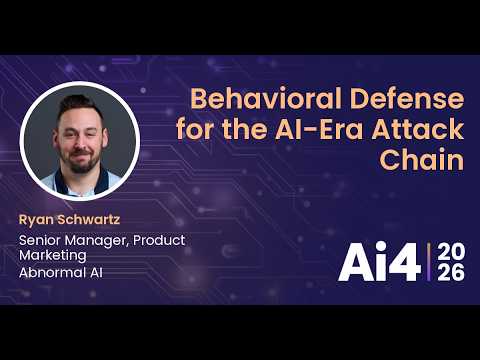
Ai4
Static security gateways fail against AI-driven deepfakes and session hijacking because automated intrusions exploit valid credentials, leaving continuous behavioral baselining as the only durable defense.
AI-assisted summary of Behavioral Defense for the AI-Era Attack Chain With Abnormal AI — original source. Check the original for full context.
Source published:
Detailed notes
## Background Published on YouTube by Ai4 on August 18, 2026, this session features Ryan Schwartz, Senior Manager of Product Marketing at Abnormal AI. According to the page description, the presentation traces the evolution of AI-accelerated email and identity attacks, making the case for an AI-native behavioral defense framework capable of monitoring both human and non-human identities at machine speed.
## TL;DR Ryan Schwartz explains how threat actors weaponize generative AI, deepfakes, and automated reconnaissance to execute hyper-personalized social engineering and session hijacking that easily bypass static security rules. Because modern intrusions frequently exploit valid credentials and authentic email channels without deploying traditional malware signatures, defending enterprise perimeters requires establishing dynamic behavioral baselines across identity and communication data layers. The session details the mechanics of multi-stage identity compromises, breaks down emerging threat vectors in autonomous AI agents like skill corruption and benign risk, and outlines the shift toward telemetry-driven Human Risk Management.
## Atmosphere & style The presentation carries a pragmatic, tech-forward conference tone that balances sobering cyber threat intelligence with approachable humor and real-world executive anecdotes. Schwartz delivers an engaging, well-paced walkthrough that shifts smoothly from alarming live-hacking demonstrations to structured architectural blueprints. The session feels authoritative and grounded, fostering an interactive exchange with the audience as questions steer the discussion into the cutting-edge nuances of autonomous agent governance and defensive AI efficacy.
## Key takeaways - [00:03](https://www.youtube.com/watch?v=qhwBUhKBBNg&t=3s) Generative AI compresses spear-phishing reconnaissance and targeted asset creation from dozens of hours into less than five minutes using open-web intelligence. - [00:03](https://www.youtube.com/watch?v=qhwBUhKBBNg&t=3s) Threat actors deploy real-time voice and video deepfakes to impersonate corporate executives and bypass applicant tracking systems (ATS) as fraudulent remote job candidates. - [02:14](https://www.youtube.com/watch?v=qhwBUhKBBNg&t=134s) Identity compromise increasingly relies on session cookie hijacking to bypass MFA challenges entirely, evading security tools focused strictly on the login perimeter. - [02:14](https://www.youtube.com/watch?v=qhwBUhKBBNg&t=134s) Static rules and manual SOC triage cannot scale against machine-generated threats, with 87% of organizations already reporting encounters with AI-driven identity attacks. - [04:30](https://www.youtube.com/watch?v=qhwBUhKBBNg&t=270s) AI-generated vendor attacks routinely pass SPF, DKIM, and DMARC without malicious payloads, requiring defenders to replace static IOC checks with historical behavioral baselines. - [06:03](https://www.youtube.com/watch?v=qhwBUhKBBNg&t=363s) Multi-stage identity intrusions leverage help desk social engineering or voice cloning to secure legitimate credential resets, masking their presence from traditional IAM solutions. - [06:03](https://www.youtube.com/watch?v=qhwBUhKBBNg&t=363s) Adversaries establish stealth persistence through automated inbox forwarding and deletion rules, creating behavioral anomalies that identity telemetry can intercept. - [10:25](https://www.youtube.com/watch?v=qhwBUhKBBNg&t=625s) Because 91% of enterprise cyberattacks originate through email, an API-native data layer modeling communication behavior is essential for stopping machine-speed intrusions. - [12:05](https://www.youtube.com/watch?v=qhwBUhKBBNg&t=725s) Public AI agent skill repositories introduce supply chain vulnerabilities where poisoned tools can silently exfiltrate enterprise database records to command-and-control servers. - [12:05](https://www.youtube.com/watch?v=qhwBUhKBBNg&t=725s) AI governance must address 'benign risk,' where non-malicious agents over-index on fulfilling user prompts and unintentionally violate sensitive enterprise data boundaries. - [15:34](https://www.youtube.com/watch?v=qhwBUhKBBNg&t=934s) Defensive AI outperforms offensive automation only when built AI-native from the data layer up, rather than bolted on as a generic third-party wrapper lacking organizational context. - [17:37](https://www.youtube.com/watch?v=qhwBUhKBBNg&t=1057s) Human Risk Management (HRM) replaces generic compliance videos with dynamic, multi-channel simulations modeled directly on live threats intercepted within the enterprise.
## Detailed walkthrough ### [00:03](https://www.youtube.com/watch?v=qhwBUhKBBNg&t=3s) The Threat Landscape in the Age of Generative AI
Ryan Schwartz opens by introducing himself as the senior manager of product marketing for new products at Abnormal AI. Joking about checking notes on his phone—"I'm a millennial, so I'm attached to it"—he pivots directly to the premise of the session: while attendees gather at Ai4 to explore what legitimate organizations can build with AI, attackers have operational needs as well. Threat actors are aggressively adopting generative AI tools to target enterprises at an unprecedented scale and speed, rendering traditional defensive solutions obsolete. The core vectors remain what they have always been—email and identity—but the execution has evolved drastically beyond the crude spam schemes of the past.
```mermaid flowchart LR accTitle: Generative AI Reconnaissance and Deepfake Weaponization Flow subgraph Recon["Automated Reconnaissance"] direction TB LLM["Generative AI LLMs<br/>(Open Web Access)"] OSINT["Rapid OSINT Scraping<br/>(Social Media & Public Data)"] LLM --> OSINT end
subgraph Weaponization["Live Weaponization"] direction TB CLONE["Real-Time Face/Voice Deepfake"] PHISH["Scalable Hyper-Personalized Phish"] OSINT --> CLONE OSINT --> PHISH end
subgraph Exploit["Target Compromise"] VIP["Enterprise VIPs / ATS IT Candidates"] CLONE --> VIP PHISH --> VIP end ```
Rather than receiving generic messages reminiscent of "a Nigerian prince a decade ago," modern targets are subjected to hyper-personalized, multi-layered attacks. A threat actor requires only a few minutes with open-internet-enabled large language models to assemble an open-source intelligence (OSINT) dossier from social platforms and public records. Schwartz highlights a striking demonstration performed during an executive roadshow by the renowned ethical hacker Freaky Clown (FC). In mere minutes from his laptop during a live presentation, FC leveraged common LLMs to scrape public intelligence on a CISO in the room, construct a dossier, extract their facial likeness, and superimpose a real-time deepfake video overlay over his own face.
- Spear-phishing reconnaissance that once demanded 16 to 40 hours of manual research to target a high-profile VIP can now be completed in under 5 minutes. - Nation-state operatives deploy deepfake audio and video to compromise corporate applicant tracking systems (ATS), successfully posing as legitimate remote IT candidates to secure organizational access. - Turnkey phishing-as-a-service (PhaaS) platforms now bundle generative AI text generation and cloned landing pages designed explicitly to harvest active session tokens.
---
[02:14](https://www.youtube.com/watch?v=qhwBUhKBBNg&t=134s) Session Hijacking, MFA Bypass, and the Failure of Static Rules
Identity compromise has moved far beyond raw password theft. Attackers leverage session hijacking to siphon valid session tokens from web browsers or workplace collaboration platforms like Slack. Because applications remain persistently signed in on a device via valid session cookies, an attacker possessing an exported cookie bypasses authentication credentials altogether without ever prompting an MFA challenge. When static security appliances only monitor the initial sign-in perimeter, these intrusions fly completely under the radar.
Traditional perimeter and gateway security architectures are intrinsically ill-equipped to combat these evolving vectors. Security operations stacks that depend on static rules, regex expressions, manual tuning, and known indicators of compromise (IOCs) are easily evaded by machine-generated variations. Furthermore, the immense volume of attacks generated by automation outpaces the analysis capacity of human security operations center (SOC) analysts. As Schwartz emphasizes, human-based triage cannot scale to counter threats executing at machine velocity.
- A recent study by identity verification firm Regula revealed that 87% of surveyed organizations have already experienced AI-driven identity attacks. - Advanced threat campaigns leverage newly discovered zero-day MFA bypass techniques alongside malicious and compromised non-human identities, such as autonomous AI agents. - Attackers acquire exported valid browser session tokens on dark web forums for nominal sums or harvest them directly via intermediate reverse proxies without tripping traditional credential alarms.
---
[04:30](https://www.youtube.com/watch?v=qhwBUhKBBNg&t=270s) Shifting from Known-Bad Indicators to Behavioral Baselines
To counter adversaries operating at machine scale, defenders must utilize AI to fight AI. The traditional paradigm of hunting for known malicious signatures must be abandoned in favor of establishing a comprehensive baseline of normal human and non-human identity behavior. When defenses monitor continuously for correlated deviations rather than relying on brittle, isolated signals (such as a single flagged IP address), attacks can be detected with high confidence even when no explicit malicious payloads or links are present.
Schwartz illustrates this with an AI-generated vendor email that circumvents every standard inspection filter. The message contains no suspicious attachments, no malicious hyperlinks, passes all domain authentication mechanisms—SPF, DKIM, and DMARC—and presents flawless contextual grammar. A standard secure email gateway (SEG) would score the transaction as completely benign because it matches zero signatures. However, under deep behavioral inspection, subtle anomalies emerge: the vendor entity is emailing from an alternate domain they do not historically use. Even if the domain was aged for months to slip past "young domain" filters, the behavioral mismatch against communication history, paired with unusual subtle urgency and conversational phrasing, confirms malicious intent.
| Inspection Vector | Traditional Rule / Signature-Based Tools | Abnormal Behavioral AI Platform | |:--- |:--- |:--- | | **Domain Authentication** | Verifies SPF, DKIM, and DMARC passes; passes clean if authentic | Detects vendor domain mismatch against historic communication baselines | | **Domain Age** | Checks domain creation date; fooled by aged attacker-owned domains | Identifies deviations from normal historical correspondence cadence | | **Message Contents** | Scans for known malware payloads, blacklisted URLs, or suspicious keywords | Evaluates natural language tone, anomalous urgency, and semantic context | | **Remediation Speed** | Depends on SOC triage queues, manual alert correlation, or delayed blacklists | Executes automated API-driven inbox extraction before user interaction occurs |
---
[06:03](https://www.youtube.com/watch?v=qhwBUhKBBNg&t=363s) Deconstructing the Multi-Stage Identity Attack Chain
Turning to full identity intrusions, Schwartz examines an attack chain pattern popularized in high-profile breaches, such as the social engineering incidents that struck major Las Vegas casinos. An attacker begins by calling an enterprise IT help desk, either relying on phone-based social engineering or deploying a real-time deepfake voice clone of an employee. By convincing the help desk technician to reset a password or register a brand-new multi-factor authentication (MFA) device, the threat actor secures legitimate credentials. Because the sign-in leverages genuine access credentials rather than an exploit, traditional identity access management (IAM) solutions raise no warnings.
```mermaid flowchart TD accTitle: Multi-Stage Identity Attack Chain vs Behavioral AI Detections subgraph AttackChain["Attacker Intrusions"] direction TB A1["Help Desk Social Engineering<br/>(Voice Deepfake / Reset Ticket)"] A2["Session Hijacking / Dark Web Cookie<br/>(MFA Bypass)"] A3["Privilege Exploitation<br/>(VIP/Admin Targeted Directly)"] A4["Persistence via Mailbox Rules<br/>(Auto-Delete Inbound Mails)"] A1 --> A2 --> A3 --> A4 end
subgraph DefenseDetections["Behavioral AI Countermeasures"] direction TB D1["Caller Phone, Device & IP Anomaly<br/>Compared to Baseline Profile"] D2["Unknown Device & ISP Utilizing<br/>Pre-Satisfied MFA State"] D3["Identity Baseline Flags Sudden Access<br/>to Uncorrelated Sensitive Resources"] D4["Anomalous Inbox Forward/Delete Rule<br/>Flagged as Telltale Persistence"] D1 -. Correlates With.-> D2 D2 -. Correlates With.-> D3 D3 -. Correlates With.-> D4 end ```
Once inside, an attacker targeting an established privileged or VIP identity avoids the noisy lateral movement and privilege escalation maneuvers that typically trigger alarms inside a security information and event management (SIEM) pipeline. Instead, they pivot to establish persistence, often leveraging the newly bound MFA device or modifying internal configurations to cover their tracks.
Behavioral defense identifies each phase of this chain by evaluating subtle contextual inconsistencies across disparate identity touchpoints:
- **Help Desk Ingestion:** Correlating the inbound help desk call or service ticket against the user's registered phone number, device fingerprint, and known network subnet reveals that the reset request originated from an unassociated source. - **Authentication Anomalies:** Post-reset logins exhibit subtle mismatches, such as an unfamiliar internet service provider (ISP), an incongruous operating system, or an unusual time-of-day access pattern. - **Session Hijack Discovery:** When an active session token is used from a completely new physical location or unauthorized device while claiming a previously satisfied MFA state, behavioral telemetry flags the impossible travel and context shift as session theft. - **Persistence Footprints:** Adversaries routinely configure automated inbox forwarding or filtering rules designed to delete incoming messages silently, concealing warning emails from IT. Schwartz remarks that while deleting every work email is an urge many workers playfully relate to—"sometimes I want to, but that's not something I would typically do on a given workday"—in reality, it serves as an unmistakable behavioral indicator of compromise that behavioral AI catches and neutralizes.
[10:25](https://www.youtube.com/watch?v=qhwBUhKBBNg&t=625s) AI-Native Behavioral Defense Architecture
To effectively solve the modern attack chain, security architectures must be fundamentally AI-native and API-native. A massive ingestion capability is required at the base to build a rich data layer used for behavioral baselining and anomaly detection. This architecture consolidates disparate data streams into unified context across email security, identity governance, AI governance, and insider threat detection. Abnormal Security was established as an AI-native security company specifically to tackle these enterprise challenges, starting with the primary entry point: email. CISA data shows that 91% of cyberattacks still originate via email, making baseline behavioral modeling across communications essential.
```mermaid flowchart TD accTitle: Abnormal AI Behavioral Defense Architecture accDescription: Architectural pipeline showing data ingestion flowing through AI-native behavioral baselining to unified threat detection.
subgraph INGEST ["1. API-Native Ingestion Layer"] D1["Email & Communications"] D2["Identity Providers & IdP Logs"] D3["SaaS Applications & Audit Trails"] D4["AI Agent & Non-Human Identity Telemetry"] end
subgraph ENGINE ["2. AI-Native Behavioral Engine"] B1["Baseline Normal Behavior"] B2["Cross-Correlate Deviations & Anomalies"] end
subgraph DOMAINS ["3. Unified Detection & Response"] T1["Email Security"] T2["Identity & Account Takeover Defense"] T3["AI Security & Governance"] T4["Insider Threat Detection"] end
INGEST --> ENGINE ENGINE --> DOMAINS ```
Abnormal acts as the foundational data layer by baselining what normal activity looks like for every identity and system. It detects attacker presence by cross-correlating malicious communication patterns, suspicious sign-in telemetry, and subtle audit log deviations. The core thesis remains clear: "the only way to stop attackers armed with AI is with behavioral AI to be able to uncover their patterns."
- CISA statistics indicate that 91% of all enterprise cyberattacks still start through email communications. - Comprehensive threat baselining correlates malicious communication signals, suspicious authentication anomalies, and unexpected audit log variations. - Abnormal showcased these solutions across Black Hat and booth 1559 at Ai4.
---
[12:05](https://www.youtube.com/watch?v=qhwBUhKBBNg&t=725s) Emerging Risks in AI Agents: Skill Corruption and Benign Risk
During the audience Q&A, a question arose regarding agent-to-agent interactions, particularly in retail and B2C e-commerce environments, and whether autonomous agents heighten data exfiltration risks. While enterprise defense often focuses on B2B infrastructure, autonomous agent interactions introduce serious new attack vectors. One primary concern is agent corruption through public skill repositories (such as integrations developed for Anthropic ecosystems). Attackers can silently embed malicious logic inside a public skill or tool, siphoning sensitive enterprise data back to attacker-controlled command-and-control domains without the user's awareness.
```mermaid flowchart LR accTitle: Agent Corruption and Data Exfiltration Flow accDescription: Flowchart illustrating how a compromised skill repository enables data exfiltration from enterprise systems.
subgraph REPO ["Skill Repositories"] S1["Compromised Public Skill / Tool"] end
subgraph EXECUTION ["Enterprise AI Execution"] A1["Autonomous AI Agent"] D1["Internal Enterprise Database"] end
subgraph THREAT ["Exfiltration"] AT["Attacker Domain"] end
S1 -->|"Injected into"| A1 A1 -->|"Accesses Data"| D1 A1 -.->|"Silently Siphons Data"| AT ```
To counter this, security vendors at Black Hat have focused on sandboxing or "exploding" skills before an AI agent ingests or executes them. Securing agents also demands robust AI governance: tracking agent ownership, auditing invocation prompts, establishing strict guardrails, and limiting database permissions. Beyond deliberate malice, enterprises face "benign risk"—a phenomenon where an agent, operating without adversarial intent, aggressively bypasses data boundaries or compromises sensitive databases simply to fulfill its assigned prompt instructions.
- Skill repository corruption allows hidden code to siphon enterprise data to external attacker domains during standard tool calls. - Sandboxing technologies ("exploding a skill") evaluate external agent capabilities before execution. - Benign risk occurs when an AI agent over-indexes on task completion, unintentionally exposing sensitive databases due to overly broad permissions.
---
[15:34](https://www.youtube.com/watch?v=qhwBUhKBBNg&t=934s) AI for Offense vs. AI for Defense
An audience member raised a perspective heard in security circles: that AI excels at offensive operations (such as automated penetration testing and red teaming) but underperforms in defensive roles. The speaker challenged this framing, arguing that the discrepancy stems from legacy security products merely "bolting on" a generic third-party AI layer. Those add-ons lack the deep organizational telemetry and continuous behavioral context required to make high-fidelity detections.
Truly effective defensive AI must be AI-native from inception. The defensive efficacy of a model depends directly on the breadth of data ingested and how that data is structured for baselining. When an AI security engine understands normal organizational patterns across human identities, non-human accounts, and communication flows, defensive AI possesses a structural advantage in spotting the deviations left behind by machine-speed attacks.
- Bolted-on AI layers fail because they lack historical context and behavioral baselines. - Purpose-built AI-native platforms outpace generic AI wrappers by combining extensive telemetry pipelines with domain-specific cybersecurity models.
---
[17:37](https://www.youtube.com/watch?v=qhwBUhKBBNg&t=1057s) Reimagining Human Risk Management with Real-World AI Scenarios
A former consultant in the audience noted that across 95% of enterprise clients, security education programs fail to prevent users from falling victim to social engineering as attack surfaces accelerate. When asked how Abnormal addresses the human education component, the speaker outlined the shift from legacy security awareness training to modern Human Risk Management (HRM).
Traditional security training relies on static video modules and canned, generic phishing templates that yield little actionable behavioral improvement beyond tracking uninformative click rates. Abnormal’s approach leverages AI to generate dynamic simulations derived directly from actual, neutralized threats that have targeted the organization or specific employees. By exposing staff to realistic social engineering tactics—including multi-stage campaigns threading email phishing, smishing, vishing, and deepfakes—enterprises measure genuine behavioral change based on actual environmental threat profiles rather than artificial compliance metrics.
- Legacy awareness training over-indexes on simplistic click rates and generic video templates that fail to change habits. - Human Risk Management (HRM) builds dynamic simulations based on real attacks intercepted in the customer's live environment. - Modern simulations incorporate multi-channel attack vectors, combining email phishing, SMS smishing, voice calls, and deepfake impersonations into coordinated exercises.
## Notable quotes > [00:03](https://www.youtube.com/watch?v=qhwBUhKBBNg&t=3s) I'm a millennial, so I'm attached to it — Ryan Schwartz
> [00:03](https://www.youtube.com/watch?v=qhwBUhKBBNg&t=3s) a Nigerian prince a decade ago — Ryan Schwartz
> [06:03](https://www.youtube.com/watch?v=qhwBUhKBBNg&t=363s) sometimes I want to, but that's not something I would typically do on a given workday — Ryan Schwartz
> [10:25](https://www.youtube.com/watch?v=qhwBUhKBBNg&t=625s) the only way to stop attackers armed with AI is with behavioral AI to be able to uncover their patterns. — Ryan Schwartz
> AI has given attackers the speed, scale, and sophistication to move through an enterprise before defenders even know they're in. — Ryan Schwartz
> The rapid adoption of AI agents, OAuth-connected integrations, and cross-platform automation has created attack surface that most security stacks weren't built to monitor. — Ryan Schwartz
> The only durable defense is behavioral: modeling what normal looks like for every human and non-human identity, then surfacing the deviations that signal compromise. — Ryan Schwartz
> A practical framework for reasoning about AI-era risk and what it actually takes to defend against threats that move at machine speed. — Ryan Schwartz
## Mentioned Ryan Schwartz, Abnormal AI, Abnormal Security, Ai4, Freaky Clown (FC), Regula, Cybersecurity and Infrastructure Security Agency (CISA), Slack, Anthropic, Black Hat
## Video description Ryan Schwartz - Senior Manager, Product Marketing, Abnormal AI
AI has given attackers the speed, scale, and sophistication to move through an enterprise before defenders even know they're in. At the same time, the rapid adoption of AI agents, OAuth-connected integrations, and cross-platform automation has created attack surface that most security stacks weren't built to monitor.
This session traces the evolution of email-borne threats and identity-based attacks—from bulk phishing and stolen credentials to AI-generated social engineering, compromised identity providers, and multi-stage intrusions that pivot across SaaS applications and non-human identities. We'll make the case that the only durable defense is behavioral: modeling what normal looks like for every human and non-human identity, then surfacing the deviations that signal compromise. Attendees will leave with a practical framework for reasoning about AI-era risk and what it actually takes to defend against threats that move at machine speed.
[Source](https://www.youtube.com/watch?v=qhwBUhKBBNg)