Seattle CISO Sets 2029 Quantum Deadline Over AI Signature Forgery Risk
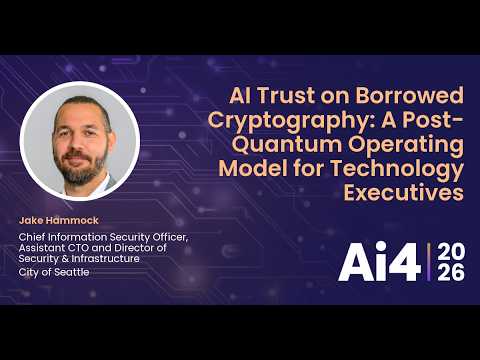
Ai4
Adversaries exploiting classical public-key cryptography will forge AI model signatures and retroactively invalidate historical audit trails, forcing enterprises to deploy hybrid post-quantum architectures before 2029.
AI-assisted summary of AI Trust on Borrowed Cryptography: A Post-Quantum Operating Model for Technology Executives — original source. Check the original for full context.
Source published:
Detailed notes
## Background Published by Ai4 on YouTube on August 17, 2026, this presentation features Jake Hammock, Chief Information Security Officer and Assistant CTO for the City of Seattle. The session outlines a post-quantum operating model for enterprise AI, detailing how to address cryptographic expiration across model signing, identity architecture, supply chain procurement, and migration sequencing.
## TL;DR Enterprise AI systems depend heavily on cryptographic trust anchors—such as RSA and elliptic curve cryptography—that are rapidly approaching quantum obsolescence. While traditional discussions focus on data harvesting, the most acute threat facing AI is signature forgery, which retroactively invalidates model provenance, agent identities, and historical audit logs. Rather than relying on unmanageable raw CBOM scans or disruptive rip-and-replace overhauls, organizations must implement the Trust Half-Life Model to prioritize root trust anchors and non-human identity explosion. Technology leaders are urged to adopt a 36-month hybrid dual-pillar roadmap, enforce strict vendor procurement deadlines aligned to NIST FIPS standards by January 1, 2029, and communicate risk to boards through Annual Loss Expectancy modeling.
## Atmosphere & style The presentation carries the crisp, authoritative urgency of an executive security briefing, grounding high-stakes post-quantum theory in concrete public-sector and enterprise governance. Jake Hammock speaks with pragmatic clarity, cutting through academic doom-mongering to offer methodical engineering frameworks and realistic risk metrics. The delivery feels direct, structured, and strategic, transforming an overwhelming cryptographic cliff into an actionable balance-sheet and architecture mandate.
## Key takeaways - [00:04](https://www.youtube.com/watch?v=sAClh2MQPYM&t=4s) Enterprise AI trust rests on a traditional public key cryptography foundation (RSA and ECC) that has an impending expiration horizon due to quantum advancements. - [03:14](https://www.youtube.com/watch?v=sAClh2MQPYM&t=194s) While PQC debates often focus on data confidentiality and 'Harvest Now, Decrypt Later', the most immediate catastrophic threat to AI is signature forgery. - [03:14](https://www.youtube.com/watch?v=sAClh2MQPYM&t=194s) Compromised signing keys create a bi-directional crisis of trust, retroactively invalidating historical model weights, attestations, and future agent decisions. - [03:29](https://www.youtube.com/watch?v=sAClh2MQPYM&t=209s) Automated CBOM scans often generate overwhelming noise (e.g., 18,000+ findings) without offering actionable prioritization for enterprise risk. - [07:29](https://www.youtube.com/watch?v=sAClh2MQPYM&t=449s) The Trust Half-Life Model prioritizes remediation across three tiers: Threat Vector Identification, Root Trust Anchor Prioritization, and Governance Blast-Radius Velocity. - [10:39](https://www.youtube.com/watch?v=sAClh2MQPYM&t=639s) Non-human to human identity ratios have accelerated past 130:1, with over 80% operating in fully agentic environments relying on fragile RSA and ECC keys. - [10:39](https://www.youtube.com/watch?v=sAClh2MQPYM&t=639s) Even symmetric standards like AES-256 face accelerated risk from Grover's algorithm quantum search capabilities. - [13:00](https://www.youtube.com/watch?v=sAClh2MQPYM&t=780s) The operational timeline for post-quantum resilience has shifted left from 2035 to an aggressive benchmark of January 1, 2029. - [13:00](https://www.youtube.com/watch?v=sAClh2MQPYM&t=780s) Rather than a disruptive rip-and-replace, organizations must pursue a 36-month pragmatic roadmap emphasizing cryptographic inventory visibility and hybrid dual-protocol rollouts. - [15:00](https://www.youtube.com/watch?v=sAClh2MQPYM&t=900s) Supply chain procurement is a primary leverage point; enterprises should enforce strict vendor PQC tolerance clauses aligned with NIST FIPS standards (FIPS 203, 204, 205). - [15:00](https://www.youtube.com/watch?v=sAClh2MQPYM&t=900s) Security leaders should translate technical cryptographic debt into business terms for boardrooms using Annual Loss Expectancy (ALE) risk modeling. - [17:03](https://www.youtube.com/watch?v=sAClh2MQPYM&t=1023s) Achieving resilient AI trust requires constructing a dual-pillar architecture utilizing standardized algorithms like ML-KEM and ML-DSA before legacy infrastructure collapses.
## Detailed walkthrough ### [00:04](https://www.youtube.com/watch?v=sAClh2MQPYM&t=4s) The Fracturing Trust Layer Beneath Enterprise AI
The enterprise AI boom rests on an unspoken currency: trust. Whether organizations are looking at direct large language model outputs, agent-to-agent signatures, certificate authority attestation, or multi-tiered QA inspection models auditing downstream agent behavior, operations run entirely on the presumption that these interactions are authentic and untampered. Beneath this soaring architecture, however, sits a foundation that is actively fracturing. The foundational trust layer of modern enterprise AI is built on traditional public key cryptography—predominantly RSA and elliptic-curve cryptography (ECC)—which possesses a finite expiration horizon in the face of quantum computing advances.
```mermaid flowchart TD accTitle: Enterprise AI Trust Stack Vulnerability accDescription: A diagram illustrating how high-level AI capabilities rest on an increasingly brittle cryptographic foundation.
subgraph AI_Layer ["AI Capability & Trust Layer"] A["Agent-to-Agent Identity & MCP Calls"] B["Model Outputs & Deep QA Inspect Models"] C["Attestations & Signature Registrations"] end
subgraph Crypto_Base ["Vulnerable Cryptographic Foundation"] D["Public Key Cryptography\n(RSA & Elliptic Curve / ECC)"] E["Legacy Data Centers & Un-upgraded HSMs"] end
AI_Layer --> Crypto_Base Crypto_Base -.->|"Fracturing Horizon\n(Post-Quantum Risk)"| F["System-wide Trust Collapse"] ```
Modern systems are engineered like a delicate house of cards. Enterprise engineering teams continually stack ambitious layers on top—beefing up product inventory lines with agent identities, machine-to-machine attestations, dynamic API pipelines, and Model Context Protocol (MCP) or adversarial generation testing frameworks. Yet, while engineering stacks might boast modern TLS 1.3 connections on the client-facing application tier, the back-end data centers, legacy Hardware Security Modules (HSMs), and root key exchanges are frequently ignored with an attitude of kicking the can a decade down the road.
- AI architectures rely intrinsically on cryptographic trust anchors for model signing, agent identity verification, audit registries, and machine-to-machine integrations. - Organizations often upgrade the visible edge (e.g., app-level TLS 1.3) while leaving core data centers and on-prem HSM infrastructure unaddressed. - A standard Cryptographic Bill of Materials (CBOM) scan alone is insufficient to safeguard these systems without a structural operating model.
---
[03:14](https://www.youtube.com/watch?v=sAClh2MQPYM&t=194s) Shifting Threat Vectors: From Data Confidentiality to AI Signature Forgery
In post-quantum cryptography (PQC) discussions, security leaders typically default to the classic "Harvest Now, Decrypt Later" (HNDL) narrative. CISOs historically lean on this doomsday premise to secure capital budgets, warning leadership that adversaries are intercepting encrypted data over the wire today to crack its confidentiality once cryptanalytically relevant quantum computers arrive. While data confidentiality remains a genuine concern, the most immediate and catastrophic danger facing AI systems is signature forgery.
```mermaid flowchart LR accTitle: Threat Evolution from Confidentiality to Signature Forgery accDescription: Flow showing how the attack paradigm shifts from passive harvesting to active historical and runtime signature forgery.
subgraph Legacy_Vector ["Traditional PQC Framing"] H1["Adversary captures wire traffic"] --> H2["Harvest Now, Decrypt Later"] H2 --> H3["Confidentiality Compromise"] end
subgraph AI_Vector ["AI-Centric Trust Framing"] F1["Adversary exploits weak signature/ECC root"] --> F2["Runtime & Historical Forgery"] F2 --> F3["Precursor & Postcursor Invalidation\n(All outputs & audit logs compromised)"] end ```
AI systems are fundamentally anchored in the integrity corner of the CIA triad, rather than confidentiality alone. "AI systems were not built on secrecy. They never were. AI systems were generally built on signatures, attestation signatures: who is doing what at what time." If an adversary compromises or calculates the private signing keys underpinning an AI ecosystem, they do not need to wait years for quantum hardware: - The adversary can forge model weights, corrupt training and execution attestations, and spoof agent authorization payloads. - Breaking the signature layer creates a bi-directional crisis of trust: it invalidates both historical records (precursors) and future decisions (postcursors), rendering every output, audit trail, and embedded workflow historically suspect and fundamentally untrustworthy.
---
[03:29](https://www.youtube.com/watch?v=sAClh2MQPYM&t=209s) The CBOM Reality Check and the Boardroom Mandate
Addressing post-quantum cryptographic risk cannot simply be delegated downward to platform security or cryptography teams as a routine technical chore. With enterprise estates spanning sprawling hybrid networks—such as the City of Seattle managing over 2,700 distinct applications across multiple data centers and cloud environments—cryptographic migration is a board-level governance and balance-sheet risk.
Many security programs attempt to gain visibility by running automated Cryptographic Bill of Materials (CBOM) or Software Bill of Materials (SBOM) discovery tools using standards like CycloneDX. However, raw discovery creates an operational paralysis. Running an enterprise-wide dynamic scan can easily return 18,000 or more cryptographic findings. Dumping an 18,000-row spreadsheet onto an engineering team provides zero actionable signal on where actual enterprise risk resides, especially when dealing with deeply embedded AI wrappers, proprietary intellectual property, and third-party SaaS dependencies.
---
[07:29](https://www.youtube.com/watch?v=sAClh2MQPYM&t=449s) The Trust Half-Life Model and Post-Quantum Prioritization
To resolve the gap between thousands of raw CBOM scan findings and limited engineering bandwidth, organizations need an actionable framework: the **Trust Half-Life Model**. This approach structures post-quantum resilience around identifying an asset's core cryptographic trust anchors and calculating their blast radius before remediation efforts go "underwater."
```mermaid flowchart TD accTitle: The Three-Tier Trust Half-Life Architecture accDescription: Diagram showing the three structural tiers of the Trust Half-Life Model: Threat Vector, Prioritization, and Governance.
subgraph Tier1 ["Tier 1: Threat Vector Identification"] T1["Target Vector Analysis\n(e.g., Active Signature Forgery vs. HNDL)"] end
subgraph Tier2 ["Tier 2: Root Trust Anchor Prioritization"] T2A["Key Management Systems (KMS)"] T2B["Model Signing Roots & CAs"] T2C["Agentic Identity & MCP Wrappers"] end
subgraph Tier3 ["Tier 3: Governance & Blast Radius"] T3A["Remediation Burndown Tracking"] T3B["Underwater Risk Thresholds\n(Blast radius exceeds containment capacity)"] T3C["Board-Level Attestation Reporting"] end
Tier1 --> Tier2 Tier2 --> Tier3 ```
The Trust Half-Life Model functions across three distinct tiers:
1. **Threat Vector Categorization**: Moving beyond generic post-quantum warnings to evaluate explicit threat behaviors, such as runtime signature forgery versus passive data exfiltration. 2. **Root Trust Anchor Prioritization**: Pinpointing the centralized mechanisms that propagate trust downstream, including Key Management Systems (KMS), Model Signing Root Authorities, and autonomous agent identities. If a model root authority or MCP interface is compromised, the containment boundary completely collapses. 3. **Governance and Blast-Radius Velocity**: Quantifying the organization's burndown path against risk exposure for executive leadership. When remediation lag exceeds the lifespan of cryptographic trust anchors, the system is deemed "underwater," signaling where migrations must be sequenced immediately.
- The National Institute of Standards and Technology (NIST) has finalized approvals for approximately six post-quantum cryptographic algorithms, with another nine undergoing active standardization review. - Cryptographic ledgers must explicitly map which internal business unit owns each trust anchor and determine the precise "trust half-life" of each algorithm across the software lifecycle.
[10:39](https://www.youtube.com/watch?v=sAClh2MQPYM&t=639s) Non-Human Identity Explosion and the Fragility of Current Trust Stacks
Implementing post-quantum cryptography is not as straightforward as immediately dropping advanced lattice-based schemes like ML-DSA (Dilithium), stateless hash-based signatures, or ML-KEM (CRYSTALS-Kyber) directly into an existing enterprise tech stack. To prevent operational disruption, organizations must rely on hybrid rollover schemes. However, the operational attack surface has exploded due to an unprecedented surge in machine credentials. Industry telemetry from Palo Alto Networks and CyberArk revealed an alarming ratio of 109 non-human identities for every single human identity in the enterprise, a metric that has already accelerated past 130 to 1. In modern environments, over 80% of these identities are fully agentic systems.
```mermaid flowchart TD accTitle: Post-Quantum Hybrid Migration Operating Model
subgraph S1["Phase 1: Cryptographic Visibility"] A["Catalog Cryptographic Assets"] --> B["Identify Legacy Protocols & RSA/ECC Keys"] end
subgraph S2["Phase 2: Hybrid Rollout & Governance"] B --> C["Deploy Hybrid Protocols (e.g., X.509 / X25519)"] C --> D["Mandate PQC Clauses in Vendor Procurement"] end
subgraph S3["Phase 3: Executive Risk & Dual-Pillar State"] D --> E["Model Financial Exposure (ALE Risk Analysis)"] E --> F["Dual-Pillar Architecture (ML-KEM / ML-DSA / FIPS Standards)"] end ```
This structural shift radically alters where security leaders must allocate PQC migration investments. Enterprises now operate model-signing roots, attestation pipelines, and agentic workflows where certificate authorities are managed directly by autonomous AI systems. The critical vulnerability is that the vast majority of these systems still rely on classical asymmetric algorithms like RSA-2048 and Elliptic Curve Cryptography (ECC), which are fundamentally vulnerable to Shor’s algorithm. Even symmetric baselines like AES-256—often regarded as a safe haven under FedRAMP High standards—are under active theoretical and practical pressure from Grover’s algorithm running on quantum processors leveraging quantum superposition states.
- Non-human to human identity ratios have escalated rapidly from 109:1 to confirmed figures exceeding 130:1. - Over 80% of automated non-human identities operate in fully agentic environments. - Core public key infrastructure (PKI), model-signing authorities, and AI agent certificate authorities remain overwhelmingly anchored to breakable RSA-2048 and ECC key exchanges. - Symmetric encryption standards like AES-256 face accelerated risk from Grover's algorithm quantum search speedups.
---
[13:00](https://www.youtube.com/watch?v=sAClh2MQPYM&t=780s) The 36-Month Pragmatic Roadmap: Visibility Over Rip-and-Replace
The timeline to achieve post-quantum resilience is compressing rapidly. Historically, industry consensus projected a quantum transition horizon around 2035, but target dates have continually shifted left to 2031, 2030, and now a firm benchmark of January 1, 2029. Tackling this migration is a daunting engineering challenge; organizations cannot simply deploy an automated agent to sweep and inspect every cryptographic exchange across legacy, multi-tenant, and tightly interdependent customer architectures. The response must be governed by a structured trust half-life model rather than an abrupt rip-and-replace approach.
The first imperative is gaining comprehensive cryptographic inventory visibility across the entire enterprise stack. Organizations must uncover where unencrypted data flows, pinpoint active versions of RSA, and locate deprecated legacy protocols such as TLS 1.1 lingering across application layers 6 and 7. The second phase establishes a hybrid deployment posture using dual protocols (such as modernized X.509 extensions and hybrid key exchange mechanisms) that allow cryptographic workloads to fail over seamlessly without breaking downstream AI dependencies.
- The target operational horizon for post-quantum cryptographic resilience has shifted left from 2035 to January 1, 2029. - Phase 1 requires total cryptographic inventory visibility across legacy networks, multi-tenant environments, and application layers 6 and 7. - Phase 2 focuses on hybrid dual-stack rollover schemes rather than disruptive rip-and-replace infrastructure overhauls.
---
[15:00](https://www.youtube.com/watch?v=sAClh2MQPYM&t=900s) Supply Chain Procurement Mandates and Financial Risk Prioritization
Because public sector entities and enterprises consume far more technology than they build internally, third-party risk management (TPRM) and procurement language form the cornerstone of defense. The City of Seattle—the 17th largest municipality in the United States—has instituted binding procurement rules mandating that before any new critical technology or service is acquired, the vendor must prove compatibility with post-quantum standards by January 1, 2029. Organizations must work immediately with legal, governance, risk, and compliance (GRC), and procurement teams to insert strict PQC tolerance mandates aligned with the NIST FIPS post-quantum standards registry (including FIPS 203 for ML-KEM, FIPS 204 for ML-DSA, and FIPS 205 for SLH-DSA).
``` +-------------------------------------------------------------------------------+ | PQC MIGRATION GOVERNANCE TIMELINE | +-------------------+-----------------------------------------------------------+ | Milestone | Operational Objective | +-------------------+-----------------------------------------------------------+ | Immediate Action | Insert PQC-readiness clauses into all supplier contracts. | | Months 1 - 36 | Deploy hybrid dual-stack architecture and scan inventory. | | Year 3 Benchmark | Present ALE risk analysis and burndown roadmaps to board. | | Target Deadline | Full critical service tolerance by January 1, 2029. | +-------------------+-----------------------------------------------------------+ ```
A 36-month timeline should not be treated as a sprint toward a complete stack rewrite, but as a window to establish a hybrid dual-architecture foundation. By year three, security executives must be prepared to present an actionable burndown prioritization strategy to their boards of directors and city councils. This strategy translates technical cryptographic debt into clear business risk by calculating the financial exposure of underlying application data through Annual Loss Expectancy (ALE) risk modeling.
- Municipalities and enterprises must enforce vendor compliance with NIST FIPS post-quantum standards for all critical service acquisitions. - Procurement and legal frameworks should establish a compliance cut-off of January 1, 2029 for vendor PQC tolerance. - Executive communication hinges on Annual Loss Expectancy (ALE) risk modeling to justify capital allocation and map out burndown prioritizations.
---
[17:03](https://www.youtube.com/watch?v=sAClh2MQPYM&t=1023s) Dual-Pillar Resilience and the Inevitability of Cryptographic Trust
The target architecture is conceptualized as building a new, resilient pillar directly adjacent to the existing fractured cryptographic foundation. This secondary pillar implements standardized algorithms like ML-KEM and ML-DSA while monitoring ongoing standards evaluations, where NIST is currently reviewing additional round algorithms to expand available cryptographic toolsets.
The most acute operational danger facing native AI systems is the signature forgery threat vector. If classical signature delivery mechanisms are broken, the entire security chain collapses: model signing, provenance attestations, and historical compliance audit trails become retroactively untrustworthy. Security teams cannot wait for universal quantum availability to react, because the integrity and confidentiality of historical AI systems must be guaranteed today. Technology leaders must realize that every AI initiative ultimately rests on the underlying math protecting it: "AI trust truly is a cryptographic decision."
- NIST continues to expand its post-quantum registry, actively evaluating additional candidates to broaden enterprise algorithm choices. - Compromised signature mechanisms invalidate model attestations, software provenance, and automated audit logs retroactively. - Long-term integrity and confidentiality in AI systems require dual-pillar architectural adoption before legacy foundations fail.
## Notable quotes > [00:04](https://www.youtube.com/watch?v=sAClh2MQPYM&t=4s) Enterprise AI is being built on a trust layer already marked for replacement. — Jake Hammock
> [00:04](https://www.youtube.com/watch?v=sAClh2MQPYM&t=4s) The foundational trust layer of modern enterprise AI is built on traditional public key cryptography—predominantly RSA and elliptic-curve cryptography (ECC)—which possesses a finite expiration horizon in the face of quantum computing advances. — Jake Hammock
> [03:14](https://www.youtube.com/watch?v=sAClh2MQPYM&t=194s) AI systems were not built on secrecy. They never were. AI systems were generally built on signatures, attestation signatures: who is doing what at what time. — Jake Hammock
> [03:14](https://www.youtube.com/watch?v=sAClh2MQPYM&t=194s) Breaking the signature layer creates a bi-directional crisis of trust: it invalidates both historical records (precursors) and future decisions (postcursors), rendering every output, audit trail, and embedded workflow historically suspect and fundamentally untrustworthy. — Jake Hammock
> [03:29](https://www.youtube.com/watch?v=sAClh2MQPYM&t=209s) Dumping an 18,000-row spreadsheet onto an engineering team provides zero actionable signal on where actual enterprise risk resides, especially when dealing with deeply embedded AI wrappers, proprietary intellectual property, and third-party SaaS dependencies. — Jake Hammock
> [07:29](https://www.youtube.com/watch?v=sAClh2MQPYM&t=449s) When remediation lag exceeds the lifespan of cryptographic trust anchors, the system is deemed 'underwater,' signaling where migrations must be sequenced immediately. — Jake Hammock
> [10:39](https://www.youtube.com/watch?v=sAClh2MQPYM&t=639s) The operational attack surface has exploded due to an unprecedented surge in machine credentials. Industry telemetry from Palo Alto Networks and CyberArk revealed an alarming ratio of 109 non-human identities for every single human identity in the enterprise, a metric that has already accelerated past 130 to 1. — Jake Hammock
> [13:00](https://www.youtube.com/watch?v=sAClh2MQPYM&t=780s) Historically, industry consensus projected a quantum transition horizon around 2035, but target dates have continually shifted left to 2031, 2030, and now a firm benchmark of January 1, 2029. — Jake Hammock
> [13:00](https://www.youtube.com/watch?v=sAClh2MQPYM&t=780s) The response must be governed by a structured trust half-life model rather than an abrupt rip-and-replace approach. — Jake Hammock
> [15:00](https://www.youtube.com/watch?v=sAClh2MQPYM&t=900s) A 36-month timeline should not be treated as a sprint toward a complete stack rewrite, but as a window to establish a hybrid dual-architecture foundation. — Jake Hammock
> [17:03](https://www.youtube.com/watch?v=sAClh2MQPYM&t=1023s) AI trust truly is a cryptographic decision. — Jake Hammock
> Enterprise AI trust will only be as durable as the cryptographic foundation beneath it. — Jake Hammock
## Mentioned Jake Hammock, City of Seattle, Ai4, National Institute of Standards and Technology (NIST), Palo Alto Networks, CyberArk, ML-KEM (CRYSTALS-Kyber), ML-DSA (Dilithium), SLH-DSA, FIPS 203, FIPS 204, FIPS 205, Shor's Algorithm, Grover's Algorithm, RSA / RSA-2048, Elliptic Curve Cryptography (ECC), AES-256, CycloneDX, Model Context Protocol (MCP), FedRAMP High, X.509, TLS 1.3
## Video description Jake Hammock - Chief Information Security Officer, Assistant CTO and Director of Security & Infrastructure, City of Seattle
Enterprise AI is being built on a trust layer already marked for replacement. Model signing, attestation, agent communication, machine identity, key management, API security, and software supply chain provenance all depend on cryptographic systems with a known expiration horizon. Adversaries are no longer harvesting blindly. They are selecting what to capture today for future decryption, using automation to prioritize high-value data, systems, and relationships. This session gives technology and security executives a practical operating model for post-quantum crypto-agility across AI governance, CBOM analysis, vendor evidence, identity architecture, and migration sequencing. Enterprise AI trust will only be as durable as the cryptographic foundation beneath it.
[Source](https://www.youtube.com/watch?v=sAClh2MQPYM)