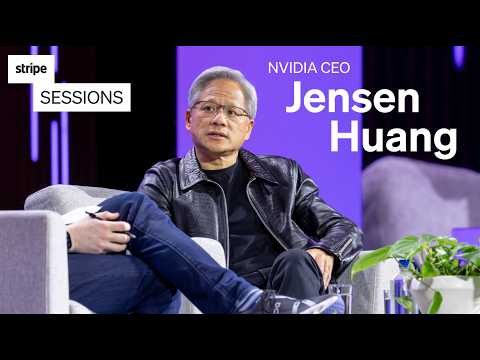
NVIDIA CEO Rejects Spreadsheets to Chase New Token Factories
Stripe
Jensen Huang argues that building multi-trillion-dollar accelerated computing markets requires enduring prolonged operational suffering and relying on first-principles reasoning over financial projections.
## Background
Published by Stripe on YouTube on May 21, 2024, this video features a fireside chat between NVIDIA Founder, President, and CEO Jensen Huang and Stripe Cofounder and CEO Patrick Collison. The discussion focuses on leadership, company culture, and the future of technology in the age of AI.
## TL;DR
In this engaging fireside chat, NVIDIA CEO Jensen Huang shares his unconventional leadership philosophy, emphasizing the necessity of "pain and suffering" to achieve greatness and his flat organizational structure of over 60 direct reports. He details the high-stakes history of CUDA, explaining how deep conviction and reasoning over spreadsheets sustained the company through a decade-long gamble. Looking forward, Huang outlines the transition of the world's data centers to accelerated computing, the rise of "AI factories" producing tokens, and the shift toward iterative planning models. Ultimately, he champions the power of "craft," tenure, and small, highly aligned teams to drive monumental technological shifts.
## Atmosphere & style
The conversation is warm, intellectually rigorous, and punctuated by playful banter and mutual admiration between two prominent tech leaders. Huang brings a charismatic, deeply reflective, and occasionally provocative energy, balancing humorous self-deprecation about his early days cleaning bathrooms with intense conviction about his management style. The dynamic feels like an intimate, high-level meeting of minds where complex business strategies and profound philosophical views on human struggle are discussed with ease and sincerity.
## Key takeaways
- [00:11](https://www.youtube.com/watch?v=8Pfa8kPjUio&t=11s) Patrick Collison introduces Jensen Huang, highlighting his 31-year tenure as the longest-serving tech CEO and NVIDIA's massive growth.
- [05:36](https://www.youtube.com/watch?v=8Pfa8kPjUio&t=336s) Huang argues that greatness requires struggle, stating that passion should not be equated with constant happiness.
- [08:16](https://www.youtube.com/watch?v=8Pfa8kPjUio&t=496s) Reflecting on his early life, Huang shares how cleaning bathrooms and working at Denny's instilled a strong work ethic.
- [10:53](https://www.youtube.com/watch?v=8Pfa8kPjUio&t=653s) Huang explains his flat management style with over 60 direct reports and no private one-on-one meetings to prevent information silos.
- [13:57](https://www.youtube.com/watch?v=8Pfa8kPjUio&t=837s) Huang advocates for public feedback to maximize collective learning, jokingly calling his style "torturing people into greatness."
- [21:48](https://www.youtube.com/watch?v=8Pfa8kPjUio&t=1308s) Huang details his preference for "$0 billion markets" to create entirely new spaces rather than competing for existing market share.
- [23:50](https://www.youtube.com/watch?v=8Pfa8kPjUio&t=1430s) When evaluating long-term projects, Huang relies on words and rigorous reasoning rather than easily manipulated financial spreadsheets.
- [26:25](https://www.youtube.com/watch?v=8Pfa8kPjUio&t=1585s) The launch of CUDA was initially a financial disaster that crushed NVIDIA's margins, but Huang's conviction sustained it for ten years until it paid off.
- [35:38](https://www.youtube.com/watch?v=8Pfa8kPjUio&t=2138s) Huang frames the shift to GPUs as a new industrial revolution where "AI factories" produce valuable floating-point tokens.
- [42:19](https://www.youtube.com/watch?v=8Pfa8kPjUio&t=2539s) The future of AI will transition from simple "one shot" generators to complex, multi-step "planning models."
- [45:32](https://www.youtube.com/watch?v=8Pfa8kPjUio&t=2732s) ChatGPT and Meta's open-source Llama are highlighted as the two most pivotal breakthroughs that democratized computing and generative AI.
- [49:43](https://www.youtube.com/watch?v=8Pfa8kPjUio&t=2983s) Huang advises businesses to aggressively adopt AI, warning that professionals will be replaced by those who use AI rather than the technology itself.
- [51:44](https://www.youtube.com/watch?v=8Pfa8kPjUio&t=3104s) NVIDIA heavily relies on internal AI systems to design its hardware chips and manage software bug databases.
- [56:19](https://www.youtube.com/watch?v=8Pfa8kPjUio&t=3379s) Huang attributes NVIDIA's massive scale with only 28,000 employees to a deep focus on "craft" and tenure over mere operational process.
- [01:02:50](https://www.youtube.com/watch?v=8Pfa8kPjUio&t=3770s) High tenure and shared institutional history allow small, lean teams at both NVIDIA and Stripe to achieve monumental global impact.
## Detailed walkthrough
### [00:11](https://www.youtube.com/watch?v=8Pfa8kPjUio&t=11s) Introduction of the Longest-Serving Tech CEO
Patrick Collison welcomes Jensen Huang to the stage, introducing him with a series of remarkable facts. Huang has served as the CEO of NVIDIA for 31 years, making him the longest-serving CEO in the technology industry. Collison jokes that he and his brother John have only been running Stripe for 14 years, meaning that even if they double their tenure, they will still be second to Huang. Collison highlights key moments from Huang's life, including his time at the Oneida Baptist Institute in Kentucky, Oregon State University, and his early job working as a waiter at Denny's. He also notes that AMD is currently run by Huang's first cousin once removed, Lisa Su. Highlighting NVIDIA's meteoric rise, Collison points out that NVIDIA's market cap was $8 billion when Stripe launched in 2011, and it has since grown more than 200 times that amount.
[02:16](https://www.youtube.com/watch?v=8Pfa8kPjUio&t=136s) Keynote Performance Review and "Software-Defined Money"
As Huang takes the stage, he praises Collison and his brother for their synchronized keynote presentation, jokingly calling it a "duet" and giving it an "A+" grade. Huang commends Stripe's mission and its massive contribution to the global economy, though he playfully admits he did not understand the technical "money stuff," jokingly confusing "KYC" (Know Your Customer) with "Kentucky Fried Chicken." Collison explains that Stripe handles KYC so customers do not have to worry about it.
The conversation shifts to the origin of the term "software-defined financial services." Collison reveals that during a catch-up meeting 18 months prior, Huang had summarized Stripe's business by saying, "Oh, so it's like software-defined networking, but for money." Collison loved the phrase so much that it became a core concept for Stripe, prompting him to joke that he hopes Stripe does not have to pay Huang a licensing fee. Huang laughs, noting, "I got zero equity for that good idea." Collison then transitions to NVIDIA's current massive demand, mentioning Elon Musk's recent announcement that Tesla plans to acquire 85,000 NVIDIA A100 GPUs by the end of the year, remarking on how impressive it is to build a business where rival CEOs publicly compete over who has spent more on your product.
[05:36](https://www.youtube.com/watch?v=8Pfa8kPjUio&t=336s) The Necessity of Pain and Suffering
Collison asks Huang to elaborate on a provocative remark he made at a Stanford Graduate School of Business event: "I wish upon you ample doses of pain and suffering." Huang explains that there is a common misunderstanding around the advice to "choose your career based on your passion." People often equate passion with constant happiness, but Huang argues that building something truly great is incredibly difficult and cannot always be enjoyable. "I don't love every day of my job," Huang admits, adding that joy does not have to be the definition of a good day. While he is not happy every day or even every year, he loves the company "every single second." To achieve greatness, one must struggle, endeavor, and work through hard things.
- **On Passion and Happiness:** Huang believes greatness requires suffering and struggle; easy paths do not lead to great achievements.
- **On Loving the Work:** Despite the daily difficulties and lack of constant happiness, Huang maintains an absolute love for his company.
[08:16](https://www.youtube.com/watch?v=8Pfa8kPjUio&t=496s) From Cleaning Bathrooms to Denny's
When asked if this tolerance for suffering is innate or a product of his upbringing, Huang reflects on his early life. Immigrating to the United States in 1973 at the age of nine with his older brother, he faced a completely foreign environment where nothing was easy. Though his parents were terrific, they were not wealthy and instilled a strong work ethic in their children. While attending the Oneida Baptist Institute in Kentucky—which Huang jokes is a very "different type of institute" than MIT—he was assigned the chore of cleaning the school's bathrooms because he was the youngest student, while the older boys worked on the tobacco farm. Despite the unpleasant nature of the job, he did it "delightfully." He later worked at Denny's, starting as a dishwasher before being promoted to busboy and then waiter, striving to be the absolute best at every job he held.
- **Immigration:** Arrived in the US in 1973 at age 9.
- **First Chores:** Cleaned bathrooms at Oneida Baptist Institute.
- **Denny's Career Path:** Dishwasher $\rightarrow$ Busboy $\rightarrow$ Waiter.
[10:53](https://www.youtube.com/watch?v=8Pfa8kPjUio&t=653s) The 60-Direct-Report Management Style
Collison shifts the discussion to NVIDIA's organizational structure, revealing that Huang has over 60 direct reports. While conventional management wisdom advises against such a wide span of control, Huang firmly believes it is the absolute best practice. He explains that organizational hierarchy often restricts the flow of information, and he does not want anyone's contribution to be limited by "privileged access to information." To prevent this, Huang does not conduct one-on-one meetings. Instead, he holds staff meetings once every two weeks where all 60 leaders are present. He addresses issues, explains his reasoning, and solves problems in front of everyone at the same time, ensuring that the entire leadership team is "working off of the same song sheet."
- **Direct Reports:** 60+ people report directly to Huang.
- **No One-on-Ones:** Huang actively discourages private one-on-one meetings to prevent information silos.
- **Staff Meeting Frequency:** Held once every other week with the entire group.
[13:57](https://www.youtube.com/watch?v=8Pfa8kPjUio&t=837s) Public Feedback and "Torturing People into Greatness"
Collison plays devil's advocate, noting that conventional management values one-on-ones for coaching, career development, and delivering sensitive feedback. Huang counters that he prefers to give feedback publicly in front of the entire group. "Feedback is learning," Huang says, questioning why only one person should benefit from a lesson. By reasoning through a mistake or a problem in front of the whole room, everyone learns how to think through the solution. He believes learning from other people's mistakes and embarrassments is the most efficient way to grow.
Collison then recalls a previous conversation where Huang mentioned he rarely fires people. Huang explains that he would much "rather improve you than give up on you," believing that almost any skill can be learned with the right opportunity. He jokingly summarizes his management philosophy as "torturing people into greatness." He explains that coaches who truly believe in their players push them to their limits because greatness often clicks suddenly, right when someone is on the verge of giving up.
[18:09](https://www.youtube.com/watch?v=8Pfa8kPjUio&t=1089s) Work-Life Balance and a Day in the Life
When asked about his work-life balance, Huang jokes that it depends on who you ask, but he personally finds it great. He works seven days a week, from the moment he wakes up to the moment he goes to bed. Even when he is not actively working, he is constantly thinking about NVIDIA, admitting that he often sits through movies without remembering them because his mind is occupied with work. For Huang, this is not a burden; it is a form of dreaming and fantasizing about what the company can become.
Describing his daily routine, Huang shares that he wakes up at 6:00 AM. He used to wake up at 5:00 AM, but he now stays still and reads in bed for an hour to avoid waking up his puppies, who are sensitive to any vibration in the house. Once he gets to the office, his day is filled entirely with group meetings. He intentionally avoids regular operational or reporting meetings, leaving those to his capable leadership team. Instead, Huang views the CEO's role as a "pinch hitter," jumping in only to solve difficult problems, get stuck projects back on track, or brainstorm new ideas.
[21:48](https://www.youtube.com/watch?v=8Pfa8kPjUio&t=1308s) The Philosophy of $0 Billion Markets
Jensen Huang explains his highly deliberate approach to time management, stating that he tries "really hard not to have Outlook manage my life" and instead chooses to live a life of purpose. This philosophy of intentionality directly feeds into his business strategy. He famously loves "$0 billion markets" because the ultimate goal of any company should be to "go and do something that has never been done before."
Because these ideas are insanely difficult and have no historical precedent, the initial market size is naturally zero. Jensen asserts that he would "rather be a market maker, market creator, than a market taker." He strongly dislikes the concept of market share because it focuses on competing for existing space rather than creating something entirely new out of thin air, much like how Stripe "vaporized" into existence out of nothing.
[23:50](https://www.youtube.com/watch?v=8Pfa8kPjUio&t=1430s) Reasoning with Words over Spreadsheets
Patrick Collison connects this philosophy to Stripe's mission to "grow the GDP of the internet," emphasizing that the verb "grow" is the most critical part because it focuses on creating transactions and businesses that do not yet exist. Jensen agrees, noting that the world's current GDP of around $100 trillion is not a hard limit and could easily scale to $200 trillion or even $1,000 trillion as value creation shifts away from physical constraints.
When evaluating massive, multi-year projects with no existing customer demand, Jensen relies on intuition and rigorous reasoning rather than financial projections. "I hate spreadsheets because you can make spreadsheets do whatever you want," he explains, pointing out that anyone can type in numbers to generate a beautiful chart. Instead, he values words and reasoning: understanding why a problem matters, why it is hard, and why the team believes in it. He embraces hard things because they require resilient, dedicated people and offer a buffer—if a project takes a long time, "you can kind of flounder around for a couple of years and nobody notices."
[26:25](https://www.youtube.com/watch?v=8Pfa8kPjUio&t=1585s) The Technical Origins and Early Disaster of CUDA
When asked about the origins of CUDA, Jensen traces it back to NVIDIA's pioneering work in "accelerated computing." It began in 1993 with the Unified Driver Architecture (UDA), a profound invention that allowed software programmers to directly program virtualized, architecturally compatible IO devices. Later, they attempted to make GPUs programmable for high-level languages with "CG" (C for Graphics), which eventually evolved into CUDA (Compute Unified Device Architecture).
Despite the grand vision, launching CUDA was "an incredible disaster overnight." Because they went after a $0 billion market, the immense cost of building CUDA support into every chip ended up crushing the highly profitable $1 billion market they already enjoyed. Customers refused to pay a premium for a feature that had no existing applications, causing NVIDIA's gross margins to collapse and their market cap to plummet.
[29:21](https://www.youtube.com/watch?v=8Pfa8kPjUio&t=1761s) Commitment Versus Stubbornness
Despite intense pressure from analysts, employees, and the board, Jensen refused to cancel CUDA. He deeply believed that accelerated computing was the only way to solve problems that normal computers could not. He managed to keep the board on his side not with spreadsheets, but by clearly communicating his reasoning and deep conviction. It ultimately took about ten years for the investment to start paying off. Today, Jensen states it would be "impossible" for NVIDIA to be successful in AI without CUDA, calling it "potentially one of the most important inventions in modern computing" as Moore's Law ends and CPU scaling grinds to a halt.
Reflecting on how to distinguish between "determination and commitment versus stubbornness," Jensen explains that the line is fuzzy. He constantly gut-checks his strategies against a short list of first principles, asking if external conditions have changed or if the problem has been solved elsewhere. To survive the lean years, NVIDIA had to be clever and find niche, early monetization opportunities for CUDA, such as CT reconstruction, seismic processing, and molecular dynamics, which sustained the company just enough to buy them time.
- NVIDIA's market cap dropped to approximately $1 billion during the early CUDA crisis.
- It took roughly 10 years for CUDA to transition from a costly gamble to a successful, foundational technology.
- Early niche applications that sustained CUDA included CT reconstruction, seismic processing, and molecular dynamics.
[35:38](https://www.youtube.com/watch?v=8Pfa8kPjUio&t=2138s) The New Industrial Revolution and Token Factories
When Patrick asks what multiple of current global GPU capacity the world will reach in five years, Jensen playfully deflects, joking, "I'm a public company, you crazy person. How nice is it to be private?" However, he reasons through the macro trends: the world has an installed base of about $1 trillion worth of traditional data centers built on general-purpose computing. Because CPU scaling has stopped, these must be replaced with accelerated computing. If the industry continues to grow at 20% annually, this represents a transition of about $2 trillion worth of computers to GPUs over the coming years.
Jensen frames this shift as a new industrial revolution. For the first time in history, humanity is producing "tokens" (floating point numbers) at an extraordinary, industrial scale. These tokens represent artificial intelligence and can be reformulated into English, French, proteins, graphics, videos, or robotic movements. Unlike the old industrial revolution—where factories turned water and coal into steam and electricity—these new "AI factories" take electrons in and output valuable floating-point tokens.
- The world currently has about $1 trillion of installed general-purpose data center infrastructure.
- An estimated $2 trillion of computing infrastructure will need to transition to accelerated computing/GPUs over the next several years.
[40:20](https://www.youtube.com/watch?v=8Pfa8kPjUio&t=2420s) Stripe Banter and the Question of Model Saturation
The conversation takes a lighthearted turn as Jensen praises Stripe, recalling how Patrick had to explain the complex business to him when they first met. Patrick jokingly tries to upsell Jensen to Stripe Billing's usage-based system, to which Jensen laughs that NVIDIA only has about ten transactions, meaning Stripe's economics serving them would be "like nothing." Patrick retorts that Stripe would "happily take the 2.9%" fee anyway, prompting Jensen to jokingly agree with a quick "Done!" before Patrick warns him, "You can't say that. You're a public company."
Patrick then steers the discussion back to the future of AI models, raising the critical question of model saturation. Using Stripe's own Sigma assistant (which converts natural language to SQL) as an example, Patrick notes that while moving from a 7 billion to a 70 billion parameter model yields massive improvements in query accuracy, going ten times larger might be unnecessary for many tasks. He asks whether most enterprise use cases will hit a "good enough" saturation curve, making trillion-parameter or ten-trillion-parameter models redundant in favor of highly efficient models under 100 billion parameters.
[42:19](https://www.youtube.com/watch?v=8Pfa8kPjUio&t=2539s) The Moore's Law of AI Accuracy and the Shift to Planning Models
To understand where artificial intelligence is heading, Jensen Huang suggests breaking the problem down and reasoning it out from historical examples. In 2012, the AlexNet computer vision model achieved roughly 82% accuracy on ImageNet. Over the next seven years, the error rate was cut in half every single year—a trajectory mirroring Moore's law. This compounding improvement doubled the performance, accuracy, and "believability" of the technology annually until it achieved superhuman capabilities. Huang asserts that natural language understanding is on the exact same trajectory. The industry will aggressively chase this believability, doubling accuracy year after year until users interact with the AI and realize, "You know what? This is really, really good."
However, today's language models are primarily "one shot" systems, whereas human reasoning is iterative. Solving complex problems requires formulating a strategy, using tools, researching proprietary data, querying other AI agents, or loop-triggering human intervention (like sending an email and waiting for a response). Consequently, the future of AI lies in "planning models" rather than simple one-shot generators. These central planning models will orchestrate a surrounding ecosystem of specialized models, each possessing distinct skills to traverse a complex problem graph.
- **AlexNet Historical Benchmark:** Achieved ~82% image recognition accuracy in 2012, kickstarting a seven-year cycle where error rates halved annually.
- **The Shift to Iterative AI:** Future models will transition from one-shot responses to multi-step planning, utilizing tools, databases, and agent-to-agent collaboration.
[45:32](https://www.youtube.com/watch?v=8Pfa8kPjUio&t=2732s) The Democratization of AI: ChatGPT and the Llama Revolution
When reflecting on the most pivotal events in AI over the last couple of years, Huang highlights two massive breakthroughs. The first is ChatGPT, developed by Sam Altman, Greg Brockman, and the OpenAI team. By utilizing reinforcement learning from human feedback (RLHF) to ground the technology in human values, OpenAI "democratized computing," making it possible for anyone to act as a programmer.
The second breakthrough, which Huang considers just as important, is Meta's release of Llama—specifically Llama 2. By open-sourcing the model, Meta "democratized generative AI" and activated every major industry, from healthcare and financial services to manufacturing and retail. Open-sourcing Llama engaged startups, researchers, and established enterprises alike, accelerating global research into safety, chain-of-thought reasoning, and reinforcement learning. Without Llama, Huang believes it would have been incredibly difficult to activate this level of global research.
- **ChatGPT's Impact:** Democratized computing by turning natural language into a programming interface.
- **Llama's Impact:** Democratized generative AI by providing an open-source foundation that activated industrial, startup, and safety research worldwide.
[47:29](https://www.youtube.com/watch?v=8Pfa8kPjUio&t=2849s) Defining AGI and the Timeline for Superhuman Benchmarks
Addressing predictions of Artificial General Intelligence (AGI) arriving by 2027—as suggested by Frontier Lab leaders like Anthropic's Dario Amodei—Huang notes that the timeline depends entirely on how the term is defined. From an engineering perspective, a problem can only be solved if it can be measured. If AGI is defined as achieving top-tier results across a specific list of benchmarks—including math tests, English comprehension, medical exams, bar exams, and reasoning tests—Huang is certain we will achieve excellent, superhuman results "within the next five years." Currently, the error rates on these standardized tests are halving every six months.
However, Huang is quick to clarify that this engineering definition does not match what an average "on-the-street person" thinks of when they imagine AGI. If AGI is left as an "undefinable" concept, then the timeline to reach it is similarly undefinable.
- **Engineering Definition of AGI:** Superhuman performance across all standardized benchmarks (math, law, medicine, reasoning).
- **Benchmark Improvement Rate:** Error rates on standard AI benchmarks are currently halving every six months.
- **AGI Timeline:** Highly likely within 5 years under the engineering definition, but undefinable under colloquial, non-measurable definitions.
[49:43](https://www.youtube.com/watch?v=8Pfa8kPjUio&t=2983s) How Businesses Must Respond to the AI Era
For business leaders wondering how to navigate these rapid technological shifts, Huang offers blunt advice: "If you're not engaging AI actively and aggressively, you're doing it wrong." He dismisses the fear of direct replacement, explaining that professionals will not lose their jobs to AI, but rather to "somebody who uses AI." Similarly, companies will not go out of business because of the technology itself, but because a competitor successfully harnessed it.
To illustrate the power of near-zero marginal costs for intelligence, Huang points to how naturally people have adopted tools like Perplexity for everyday queries. He admits that he loves using Perplexity himself, often asking it questions even when he already knows the answer, just to see what it generates. Driving this marginal cost of intelligence down allows businesses to use it in abundance, fueling productivity. Increased corporate productivity leads to higher earnings, which in turn drives employment and broader social growth.
- **The Competitive Threat:** "You're not going to lose your job to AI. You're going to lose your job to somebody who uses AI."
- **The Economic Cycle of Productivity:** Lower marginal cost of intelligence $\rightarrow$ Higher productivity $\rightarrow$ Higher earnings $\rightarrow$ More employment $\rightarrow$ Social growth.
[51:44](https://www.youtube.com/watch?v=8Pfa8kPjUio&t=3104s) How NVIDIA Uses AI Internally to Design Chips and Software
AI has fundamentally transformed NVIDIA's internal operations. As one of the first technology companies to invest heavily in proprietary AI supercomputers, NVIDIA can no longer design its hardware without AI. At night, autonomous AI systems explore vast chip design spaces that would be far too expensive for human engineers to evaluate manually. This process has resulted in chips that deliver significantly higher performance while consuming less energy.
NVIDIA's software development is equally dependent on AI. The design space for optimizing compilers is too massive for humans alone, so AI is used to explore it and to manage the company's bug databases. The AI analyzes code repositories, identifies bugs, determines who is likely responsible, and automatically tasks that person with the fix. Huang jokes that his ultimate goal is to "turn NVIDIA into one giant AI" so that he can finally achieve some work-life balance.
- **AI-Driven Hardware Design:** NVIDIA AIs run overnight to explore vast chip architecture design spaces, optimizing for performance and energy efficiency.
- **Automated Software QA:** AI analyzes NVIDIA's bug databases, diagnoses code issues, identifies the responsible engineers, and assigns the fixes.
[53:05](https://www.youtube.com/watch?v=8Pfa8kPjUio&t=3185s) The Universal Language of AI: From Irish to Robotics
The true surprise of Large Language Models is that "language" does not merely refer to human speech. To illustrate this, the host shares that he and his brother John were educated in Irish, and that LLMs are some of the first entities he has been able to have a fluent dialogue with *as Gaeilge* (in Irish). He also mentions using Suno to generate "Celtic dubstep."
Huang explains that if a model can comprehend human languages and time-series sequences like music, it can easily learn the "language of life" and physical movement. Robotics articulation, for example, is simply a sequence of physical movements that can be tokenized. Because LLMs can learn proprietary languages like SQL, ABAP, Lightning, and Verilog, companies can now place a copilot on top of every tool on earth. While general "super models" will help with broad reasoning, companies with highly specific domains will always need to train and fine-tune their own models. In high-stakes fields like chip design or fraud detection, the difference between 99% and 99.3% accuracy is "the difference between life and death."
- **Tokenizing Physical Movement:** Robotics control is treated as a sequence-based language, allowing LLMs to learn physical articulation.
- **The Value of Fine-Tuning:** General models are insufficient for specialized industries where a fraction of a percent in accuracy represents critical operational success.
[56:19](https://www.youtube.com/watch?v=8Pfa8kPjUio&t=3379s) Family Ties, Silicon Valley's Evolution, and the Power of "Craft"
In a lighter moment, the host brings up a striking family connection: AMD CEO Lisa Su is Huang's first cousin once removed, meaning the world's two premier GPU companies are run by close relatives. Huang smiles, calling Su "extraordinary," but playfully rejects the premise that they are competitors, stating, "We're family... We buy from AMD." He notes they did not grow up together and only met as adults when she was at IBM.
Reflecting on how Silicon Valley has changed since he co-founded NVIDIA in 1993 at age 29, Huang remembers feeling incredibly insecure, showing up to recruit VCs and law firms with acne on his forehead while surrounded by older, suit-wearing executives who "sounded like adults." Today, the culture has flipped: "Now if you don't have acne, I don't think you deserve to start a company." He commends the brilliant young generation of CEOs who possess a level of business maturity that took him decades to acquire.
Finally, the conversation turns to organizational scale. Despite having a market cap of roughly $2 trillion—putting it in league with Microsoft and Apple—NVIDIA operates with only 28,000 employees, a fraction of its peers' headcounts. Huang attributes this efficiency to a focus on "craft" over mere "operational excellence." While processes can make a product good, extraordinary things require "love and care"—qualities that cannot be written into a product spec or a business process. When a company pours ineffable craft and beauty into its work, customers recognize it immediately when they experience it.
- **NVIDIA Employee Efficiency:** NVIDIA achieves its multi-trillion-dollar scale with only 28,000 employees, compared to Microsoft's 160,000 and Apple's 220,000.
- **Tenure and Craft:** "You can achieve operational excellence through process, but craft can only be achieved with tenure."
[01:02:50](https://www.youtube.com/watch?v=8Pfa8kPjUio&t=3770s) The Magic of Tenure and Small Teams
Jensen Huang reflects on the beauty, elegance, and simplicity of Stripe's work, noting that "simplicity is not simple." Achieving true simplicity requires finding a delicate balance—solving a problem just enough without burdening the user too much. This balance cannot be written down in a specification; it is something a team must feel their way toward together. When a team works together over a long period, they codify and encode the magic of the company in a way that no words can describe. Huang emphasizes that he deeply believes in tenure because he dislikes resetting and working with entirely new people. Having deposited years of pain, suffering, joy, and life experience into his colleagues, he wants to carry that shared history forward to the next level rather than starting from scratch.
This deep sense of shared experience and tenure is what allows relatively small teams to achieve monumental things. Huang points out that while NVIDIA has 28,000 employees, it operates like a small team and "punches well above our weight" because of this encoded trust. He commends Stripe for its astonishing leverage, operating with only 7,000 people to support a massive $1 trillion ecosystem, industry, and economy. Expressing immense pride in what the Stripe team has built, Huang concludes with warm encouragement for how much further they can go.
- Stripe supports a $1 trillion ecosystem with a lean team of only 7,000 employees.
- NVIDIA operates with 28,000 employees but maintains the agility and impact of a small team due to high tenure and shared institutional knowledge.
- Huang emphasizes that tenure is vital because it prevents the loss of "pain, suffering, joy, knowledge" and life experience accumulated collectively over time.
## Notable quotes
> [05:36](https://www.youtube.com/watch?v=8Pfa8kPjUio&t=336s) I wish upon you ample doses of pain and suffering. — Jensen Huang
> [05:36](https://www.youtube.com/watch?v=8Pfa8kPjUio&t=336s) I don't love every day of my job. — Jensen Huang
> [02:16](https://www.youtube.com/watch?v=8Pfa8kPjUio&t=136s) I got zero equity for that good idea. — Jensen Huang
> [13:57](https://www.youtube.com/watch?v=8Pfa8kPjUio&t=837s) Feedback is learning. — Jensen Huang
> [13:57](https://www.youtube.com/watch?v=8Pfa8kPjUio&t=837s) torturing people into greatness. — Jensen Huang
> [23:50](https://www.youtube.com/watch?v=8Pfa8kPjUio&t=1430s) I hate spreadsheets because you can make spreadsheets do whatever you want. — Jensen Huang
> [35:38](https://www.youtube.com/watch?v=8Pfa8kPjUio&t=2138s) I'm a public company, you crazy person. How nice is it to be private? — Jensen Huang
> [49:43](https://www.youtube.com/watch?v=8Pfa8kPjUio&t=2983s) If you're not engaging AI actively and aggressively, you're doing it wrong. — Jensen Huang
> [49:43](https://www.youtube.com/watch?v=8Pfa8kPjUio&t=2983s) You're not going to lose your job to AI. You're going to lose your job to somebody who uses AI. — Jensen Huang
> [56:19](https://www.youtube.com/watch?v=8Pfa8kPjUio&t=3379s) Now if you don't have acne, I don't think you deserve to start a company. — Jensen Huang
> [56:19](https://www.youtube.com/watch?v=8Pfa8kPjUio&t=3379s) You can achieve operational excellence through process, but craft can only be achieved with tenure. — Jensen Huang
> [01:02:50](https://www.youtube.com/watch?v=8Pfa8kPjUio&t=3770s) simplicity is not simple. — Jensen Huang
## Mentioned
Jensen Huang, Patrick Collison, Stripe, NVIDIA, AMD, Lisa Su, Elon Musk, Tesla, Oneida Baptist Institute, Oregon State University, Denny's, CUDA, AlexNet, ChatGPT, OpenAI, Sam Altman, Greg Brockman, Meta, Llama, Llama 2, Dario Amodei, Anthropic, Perplexity, Suno, Microsoft, Apple
NVIDIA CEO Jensen Huang argues that transformative technology leadership requires committing to unproven, zero-billion-dollar markets through rigorous first-principles reasoning, sustained long-term conviction, and flat organizational structures built on employee tenure.
Zero-Billion-Dollar Markets and Conviction in CUDA (21:48)
Huang advocates targeting what he terms "$0 billion markets"—unprecedented problem spaces with no existing customer base—rather than competing for established market share. To evaluate these high-risk endeavors, he rejects spreadsheets, arguing that financial models can be easily manipulated to justify any projection, and instead evaluates projects using logical reasoning about why a difficult problem matters. NVIDIA’s development of CUDA exemplifies this approach. Launching the architecture initially created a severe operational crisis: embedding CUDA support into every chip eroded existing high gross margins, and NVIDIA’s market capitalization dropped to roughly $1 billion as customers resisted paying for capabilities without immediate applications.
Despite pushback from the board, employees, and Wall Street analysts, Huang sustained the investment for roughly a decade without relying on financial projections, maintaining support through first-principles explanations of why accelerated computing was necessary to overcome central processing unit scaling limits. To survive the multi-year downturn, NVIDIA identified niche commercial deployments in computed tomography reconstruction, seismic processing, and molecular dynamics. Huang notes that this sustained gamble ultimately made NVIDIA’s modern artificial intelligence hardware viable as general-purpose computing reached physical bottlenecks.
Flat Management and High-Tenure Craft (10:53)
NVIDIA deviates sharply from conventional organizational structures by maintaining more than 60 direct reports under Huang. To prevent corporate hierarchy and information silos, Huang eliminates private one-on-one status meetings, instead conducting bi-weekly staff meetings where all 60 leaders address company problems simultaneously. Huang delivers feedback and resolves issues openly in front of the entire leadership group, arguing that public critique allows all executives to learn how to reason through organizational mistakes rather than confining educational feedback to a single recipient.
Huang pairs this demanding environment with an explicit aversion to firing employees, stating a preference for coaching underperforming staff over starting over with new hires. He attributes NVIDIA's operational efficiency—generating a multi-trillion-dollar market capitalization with approximately 28,000 employees—to this emphasis on tenure and accumulated institutional knowledge. In Huang's view, operational processes can yield competent products, but the highest levels of design and simplicity require "craft," which can only develop when long-standing teams share collective history and mutual trust.
Accelerated Computing as an Industrial Revolution (35:38)
Huang characterizes the rise of artificial intelligence as a modern industrial revolution centered on generating numerical floating-point "tokens" rather than physical commodities. Because traditional CPU scaling has effectively ended, he argues that the global installed base of approximately $1 trillion in general-purpose computing infrastructure must shift toward accelerated computing. Assuming roughly 20% annual industry growth, Huang estimates that about $2 trillion worth of data center computing infrastructure will transition to graphics processing units over the coming years.
Under this paradigm, modern data centers function as "AI factories" that ingest electrical power to continuously produce floating-point tokens. These tokens can be reconstituted into human languages, software code, graphic renderings, molecular structures, or robotic movements, shifting value creation from conventional physical constraints into scalable, software-driven computation.
Model Progression and Benchmark-Driven AGI (42:19)
Comparing modern language models to early deep learning milestones like AlexNet—which launched an era where computer vision error rates halved annually—Huang observes that AI error rates on standardized benchmarks are currently halving every six months. Under a precise engineering definition where artificial general intelligence (AGI) means achieving superhuman scores across standardized examinations in mathematics, medicine, law, and logical reasoning, Huang projects that AGI is highly likely to arrive within five years. However, he emphasizes that this metric does not address colloquial or non-measurable definitions of general intelligence, which remain impossible to forecast.
Huang expects AI architecture to evolve from contemporary "one-shot" generative models toward multi-step "planning models" that can formulate iterative strategies, query internal data repositories, coordinate specialized secondary models, and request human input. While broadly capable foundation models will handle general reasoning, Huang maintains that specialized enterprises will still require fine-tuned, domain-specific models. In high-stakes environments such as autonomous chip design or robotics articulation, small margins in accuracy represent the difference between viable operation and failure.
Huang contends that businesses must aggressively adopt AI to avoid displacement by AI-enabled competitors, though unresolved questions remain regarding the limits of model parameter scaling for ordinary business workflows and how autonomous intelligence will be evaluated beyond standardized benchmarks.
[5:36] Jensen Huang: I wish upon you ample doses of pain and suffering.
[5:36] Jensen Huang: I don't love every day of my job.
[2:16] Jensen Huang: I got zero equity for that good idea.
[13:57] Jensen Huang: Feedback is learning.
[13:57] Jensen Huang: torturing people into greatness.
[23:50] Jensen Huang: I hate spreadsheets because you can make spreadsheets do whatever you want.
[35:38] Jensen Huang: I'm a public company, you crazy person. How nice is it to be private?
[49:43] Jensen Huang: If you're not engaging AI actively and aggressively, you're doing it wrong.
[49:43] Jensen Huang: You're not going to lose your job to AI. You're going to lose your job to somebody who uses AI.
[56:19] Jensen Huang: Now if you don't have acne, I don't think you deserve to start a company.
[56:19] Jensen Huang: You can achieve operational excellence through process, but craft can only be achieved with tenure.
[62:50] Jensen Huang: simplicity is not simple.
Original transcript
[0:11] Welcome back to the stage,
Patrick Collison.
[0:28] -[Patrick] All right.
Good afternoon, folks.
[0:30] I hope you've enjoyed
the Sessions between now
[0:33] and when we last saw you this morning.
[0:36] For this afternoon's keynote,
or fireside chat, I suppose,
[0:40] I'm about to introduce somebody
who needs little introduction.
[0:44] Although a fun fact that you may not know
about Jensen Huang is that
[0:48] he's been a CEO of NVIDIA
for 31 years this month,
[0:51] making him the longest-serving CEO
in the technology industry
[0:55] and therefore logically--
[1:03] John and I have only been doing it
for a mere 14 years.
[1:06] So, even if we double that,
we'll still be second to him.
[1:12] Jensen, well, we'll talk
about this on stage,
[1:15] attended the Oneida Baptist Institute
in Kentucky.
[1:20] We'll definitely be asking him about it.
[1:23] Oregon State, worked as
a waiter at Denny's.
[1:30] There's a Denny's close to here, actually.
[1:32] LSI Logic and then AMD,
which is of course
[1:35] now run by his first cousin once removed.
[1:40] We'll definitely be asking about that.
[1:42] Before he founded NVIDIA in 1993...
[1:45] and NVIDIA's market cap was $8 billion
when Stripe launched in 2011.
[1:53] And it is now, of course, more than
200 times that. So he's been busy since.
[1:59] Please welcome to the stage,
Jensen Huang.
[2:16] -[Jensen] Hey, everybody!
[2:20] -[Patrick] So you watched
the keynote earlier?
[2:22] -I did. I've never seen a duet before.
-[Patrick laughing] So, well--
[2:27] -I've never seen a duet before.
You were so synchronized.
[2:31] It seemed like the two of you knew
each other. It's incredible.
[2:35] -Some acquaintance.
[2:38] You've been doing keynotes a long time.
[2:40] You are the keynote goat.
So give us--
[2:45] -Stop it.
[2:46] -Give us your, like...
we don't have even a signature outfit yet.
[2:49] We're just amateurs here.
So give us--
[2:53] -It's because you're still young.
[2:56] -Well, give us your keynote performance
review. What did you think?
[3:00] -I thought it was A+.
I thought it was A+. I was... really!
[3:06] You explained perfectly
[3:11] the purpose of the company.
What inspires you guys.
[3:15] What keeps you guys up.
What makes you work so hard.
[3:18] The ecosystem that you serve,
the incredible platform you built,
[3:23] the amazing contribution you make
to the world's economy.
[3:26] It's incredible. I thought it was great!
[3:28] And there was a whole bunch of technology
stuff, feature stuff, money stuff.
[3:32] I didn't understand any of that, but...
[3:35] something about a CYK or something,
what was that?
[3:39] -A KYC.
-KYC, yeah.
[3:43] I thought it was--
[3:44] -It's a big deal in our world.
[3:45] -Is that right?
Kentucky Fried Chicken?
[3:48] -We take care of KYC so that you can
associate us with Kentucky Fried Chicken.
[3:52] -Okay. Got it.
[3:54] -Software-defined financial services,
[3:57] this idea, did that make sense to you?
[4:00] -Well, first of all,
I think it's a giant idea.
[4:03] -Do you know where it came from?
[4:07] -You're going to tell me?
[4:09] -So Jensen and I were catching up...
[4:12] -The part that
I loved was how you realized
[4:16] in the very beginning that financial
payments was about code, not finance.
[4:23] I thought that was incredible.
[4:24] And you explained that
the first time we met.
[4:27] So, Jensen and I were catching up
18 months ago or so,
[4:29] and I guess it was a couple
of years since we had last spoken.
[4:32] And so he was asking for the update
on Stripe, and I was explaining.
[4:36] And you said, "Oh, so it's like software-
defined networking, but for money."
[4:43] And that was still ricocheting around
in my mind.
[4:46] That's where we got to this idea for
software-defined financial services.
[4:50] So I hope we don't have to pay
a licensing fee for that.
[4:52] -I got zero equity for that good idea.
[4:54] -All right.
[4:56] You guys are doing okay.
I was thinking about this.
[4:58] Tesla's earnings were reported yesterday,
[5:01] and Elon announced that Tesla
is going to have 85,000
[5:06] A100s by the end of this year.
[5:09] And I was just reflecting on--
[5:12] it's quite a success to sort
of build a business
[5:14] where CEOs kind of compete with
each other to announce
[5:17] who has spent more buying your product.
[5:20] So I think you've done something
quite impressive.
[5:22] But anyway, I actually want to start out
talking a little bit about--
[5:24] -All of my CEO friends,
they all have the most.
[5:32] -So I want to start out talking
a little bit about,
[5:36] a remark you made at a Stanford event
recently, at the GSB, I think.
[5:41] And you said, "I wish upon you
ample doses of pain and suffering."
[5:50] Elaborate.
[5:53] -Well. Let's see.
There is a misunderstanding.
[6:01] There's a phrase that said,
[6:02] "You should choose your career
based on your passion."
[6:08] Usually people connect passion
with happiness.
[6:14] And I think there's something
missing in that.
[6:17] Nothing there is wrong,
but there's something missing.
[6:21] And the reason for that is because
if you want to do great things,
[6:23] and I know this to be true about
you creating Stripe--
[6:27] And by the way,
this is one of the world's finest CEOs,
[6:32] young as he may be, yep.
[6:37] You guys know, I've met a lot of CEOs,
I've heard about a lot of companies,
[6:41] and this is genuinely one of the world's
great visionary companies.
[6:45] And so anyways,
I just want to say that.
[6:48] It's the reason why I just love what...
[6:50] -No more compliments allowed,
it makes us terribly uncomfortable.
[6:53] -I know, I could tell.
I could see him, he's starting to sweat.
[6:57] And so the thing is, when you want
to build something great,
[7:03] it's not easy to do.
[7:05] And when you're doing something
that's not easy to do,
[7:07] you're not always enjoying it.
[7:10] I don't love every day of my job.
[7:13] I don't think every day brings me joy,
[7:15] nor does joy have to be
the definition of a good day.
[7:19] And every day I'm not happy.
[7:21] Every year I'm not happy
about the company.
[7:23] But I love the company
every single second.
[7:27] And so I think that what
people misunderstand is
[7:31] somehow the best jobs are the ones that
brings you happiness all the time.
[7:36] I don't think that that's right.
You have to suffer.
[7:41] You have to struggle.
You have to endeavor.
[7:45] You have to do those hard things
[7:46] and work through it in order to really
appreciate what you've done.
[7:52] And there are no such things that
are great that were easy to do.
[7:56] And so by definition,
I would say therefore,
[8:01] I wish upon you greatness, which,
by my way of saying it,
[8:05] I wish upon you plenty of pain
and suffering.
[8:16] -Anything in your upbringing
that taught you that idea,
[8:19] or is it just somehow innate
to your makeup?
[8:29] -I didn't realize I had
to lay down for this.
[8:36] I'm about to tell you things I've never
told anyone. Not even my family.
[8:43] I was an immigrant.
And when I came in 1973, I was nine.
[8:48] My older brother was almost 11.
[8:50] And this was a foreign country
and there was nothing easy about that.
[8:57] And we also grew up with really,
really terrific parents.
[9:04] But we weren't wealthy. And so they
worked hard, they work hard today.
[9:09] And so they passed along
a lot of life lessons by working hard.
[9:14] I had all kinds of jobs
[9:16] and we went to a school
that included a lot of chores.
[9:23] -It's in Kentucky?
[9:24] -Yeah, Kentucky.
Oneida Baptist Institute.
[9:28] I don't think it's the same as 'MIT',
that 'I' is not the same.
[9:34] It's the same word, but it's different.
It's a different type of institute.
[9:39] But my institute required you to go
to school, and it was a dormitory,
[9:44] and so there were a lot of chores.
[9:45] I was the youngest kid in school,
[9:47] and so all of the other kids
got the hard work.
[9:49] They had to work in the tobacco farm,
and I got the easy job.
[9:53] I was nine years old, and so after they
left, I had to clean all the bathrooms.
[9:58] I never felt that I got the easy job,
[10:02] because what they left behind was...
You can't unsee that kind of stuff.
[10:09] But that was my job and
so I did it delightfully.
[10:12] And then I had plenty of other jobs,
and Denny's was one of them.
[10:17] And I started out as a dishwasher and
became a busboy and became a waiter.
[10:21] And I loved every one of them.
I loved every one of them.
[10:23] Somehow, I've always found...
[10:30] I want to say joy,
but that's not quite right.
[10:32] Just everything that I was doing,
I wanted to do the best I could.
[10:37] And maybe that was kind of ingrained
from the very beginning,
[10:40] but I was definitely the best
bathroom cleaner the world's ever seen.
[10:45] I'm sure of it. Yeah.
[10:47] -So if we fast forward just a little bit,
to the NVIDIA of today,
[10:53] how large is your leadership team?
[10:55] -How large is...?
-Your leadership team.
[10:59] -NVIDIA's leadership team is 60+ people.
[11:04] -And they all report to you?
[11:06] -Yeah, they all report to me.
-60 direct reports?
[11:08] -60 direct reports. Yeah.
[11:09] -Which is not conventionally considered
a best practice.
[11:15] I agree that the best practice...
[11:18] -I'm certain that's the best practice.
[11:19] It's not conventional, but I am certain
it's the best practice.
[11:27] And by the end of this,
I'm going to convince all of you
[11:31] to have 60 people on your direct reports.
[11:34] -The floor is yours.
[11:36] -The reason... first of all,
[11:38] the reason is because the layer of
hierarchy in your company really matters.
[11:43] Information really matters.
[11:46] I believe that your contribution to...
[11:51] the work should not be based on the
privileged access to information.
[11:57] I don't do one-on-ones and I don't...
My staff is quite large,
[12:02] and almost everything that I say,
I say to everybody all at the same time.
[12:06] And the reason for that is because
[12:08] I don't really believe there's any
information that I operate on,
[12:11] that somehow only one or two people
should hear about.
[12:15] And these are the challenges
of the company
[12:18] or this is the problem
I'm trying to solve,
[12:19] or this is the direction
we're trying to go into.
[12:21] These are the new endeavors.
[12:23] This isn't working. That's working well.
[12:25] And so all of this type of information
everybody should be able to hear it.
[12:30] I love that everybody is
working off of the same song sheet.
[12:33] I love that there is no privileged access
to information.
[12:37] I love that we're able to all contribute
to solving a problem.
[12:41] And when you have 60 people in a room
and oftentimes...
[12:44] Well my staff meetings are once
every other week,
[12:47] and it's all based on issues,
whatever issues we have.
[12:51] Everybody's there working
on it at the same time,
[12:54] everybody heard
the reasoning of the problem.
[12:58] Everybody heard the reasoning of the
solution. Everybody heard everything.
[13:02] And so that empowers people.
[13:04] I believe that when you give
everybody equal access to information,
[13:07] it empowers people.
And so that's number one, empowering.
[13:11] Number two,
if the CEO's direct staff is 60 people,
[13:19] the number of layers you've
removed in a company
[13:21] is probably something like seven,
depending on how it is.
[13:24] -60 at every layer, or only 60?
[13:26] As in, if I'm one of the fortunate 60,
do I also have 60 direct reports?
[13:33] -No. I also don't think
that that's scalable downward.
[13:37] And the reason for that is because
you need more and more supervision,
[13:42] depending on certain levels.
[13:45] And at the E-Staff level,
[13:48] if you're so unfortunate to be serving
on NVIDIA's E-Staff,
[13:52] it's very unlikely
you need a lot of managerial.
[13:57] -And so I rarely find myself having
to stand up for conventional wisdom.
[14:02] But if I were to kind of steel mine
the other side, I'd say, well,
[14:05] one-on-ones are where you
provide coaching,
[14:08] where you maybe talk through goals
together, personal goals,
[14:11] career advancement, what have you.
[14:14] Where maybe you give feedback
on something that you see somebody
[14:17] systematically not doing
so well and so forth.
[14:18] So there's all these things
that kind of one is, again,
[14:21] conventionally supposed to do
in the one-on-one.
[14:23] Do you not do those things or
do you do them in a different way?
[14:26] -Really good question.
I do it right there.
[14:31] I do it right there.
[14:32] I give you feedback right there
in front of everybody.
[14:36] And in fact, this is really a big deal.
[14:39] First of all, feedback is learning.
Feedback is learning.
[14:43] For what reason are you
the only person who should learn this?
[14:47] Now you created the conditions
[14:51] because of some mistake that you made
[14:55] or silliness that you brought
upon yourself.
[15:04] We should all learn from that opportunity.
[15:07] So you created the conditions,
but we should all learn from it.
[15:10] Does that make sense?
[15:12] And so for me to explain to you
why that doesn't make sense
[15:15] or how I differ from it--
half the time I'm not right--
[15:18] but for me to reason through it
in front of everybody
[15:21] helps everybody learn how
to reason through it.
[15:24] And so the issue-- the problem I have with
one-on-ones and taking feedback aside
[15:29] is you deprive a whole bunch
of people that same learning.
[15:33] Learning from mistakes,
other people's mistakes,
[15:36] is the best way to learn.
[15:37] Why learn from your own mistakes?
[15:41] Why learn from your own embarrassment?
[15:43] You got to learn from other
people's embarrassment.
[15:44] That's why we have case studies.
Isn't that right?
[15:48] We're trying to read from other people's
disasters, other people's tragedies.
[15:52] Nothing makes us happier than that.
[15:56] -Have you succeeded in getting other
leaders at NVIDIA to adopt this practice,
[16:00] or is that difficult?
[16:02] -I give people the opportunity
to decide for themselves,
[16:05] but I really discourage one-on-ones.
[16:07] I really discourage one-on-ones.
[16:09] Nothing is worse than
the idea that somebody says,
[16:13] "Oh, Jensen wants us to do this."
[16:16] Why does that have to be said to anybody?
Everybody should know.
[16:20] Or somebody said,
"That E-Staff said that."
[16:25] Nothing drives me nuttier than that.
[16:28] -You once told me that you really didn't
like firing people and very seldom did it.
[16:34] Can you elaborate on that?
[16:36] -Well, I'd rather improve you
than give up on you.
[16:41] When you fire somebody,
you're kind of saying--
[16:45] Well, a lot of people say,
[16:47] "It wasn't your fault" or
"I made the wrong choice" or--
[16:52] There are very few jobs--
Look, I used to clean bathrooms,
[16:55] and now I'm a CEO of a company,
I think you could learn it.
[16:59] I'm pretty certain you can learn this.
[17:01] And there are a lot of things in life
that I believe you can learn.
[17:04] And you just have to be given
the opportunity to learn it.
[17:06] I had the benefit of watching a lot of
smart people do a lot of things.
[17:09] I'm surrounded by 60 people.
They're doing smart things all the time.
[17:12] And they probably don't realize it,
[17:14] but I'm learning constantly from
every single one of them.
[17:17] And so, I don't like giving up on people
because I think they could improve.
[17:22] And so there's a--
it's kind of tongue-in-cheek--
[17:24] but people know that I'd rather
torture them into greatness.
[17:29] -That was the phrase that
I was hoping to uncover.
[17:32] Yeah, I remember you mentioned that.
[17:33] -Yeah. So I'd rather torture you into
greatness because I believe in you.
[17:37] And I think coaches that
really believe in their team
[17:43] torture them into greatness.
[17:45] And oftentimes they're so close.
Don't give up, they're so close.
[17:49] Greatness kind of comes all of a sudden,
one day he's like, "I got it".
[17:53] Do you know what I'm saying?
[17:54] That feeling that you didn't
get it yesterday
[17:55] and all of a sudden one day
something clicked. "Oh, I got it."
[17:59] Could you imagine you gave up just
that moment right before you got it?
[18:03] I don't want you to give up on that,
[18:05] so I'll just keep torturing you.
[18:09] -How's your work-life balance?
[18:21] -Well, it depends on who you ask.
[18:24] I think my work-life balance
is really great.
[18:27] It's really great.
I work as much as I can.
[18:38] I feel like he's judging me.
[18:42] I'm older than you.
I have more wisdom than you.
[18:46] So what I...
[18:48] -These are all the highlights
from our conversations
[18:50] that I think more people
should get to hear, so...
[18:54] -Well, I work from the moment
I wake up to the moment I go to bed,
[18:59] and I work seven days a week.
[19:02] When I'm not working,
I'm thinking about working.
[19:05] And when I'm working,
I'm working, and so...
[19:10] And I sit through movies,
but I don't remember them
[19:13] because I'm thinking about work.
[19:17] And so that's--
[19:22] But my work is not, as you know,
it's not working as in,
[19:28] there's this problem and you're
trying to solve this problem.
[19:31] You're thinking about what
the company can be,
[19:34] and are there things that
we could do even better?
[19:37] Or sometimes it's just trying to
solve a problem, you know?
[19:40] But sometimes you're imagining the future.
[19:42] And, boy, if we did this and that.
[19:44] It's working, you're fantasizing,
you're dreaming, right.
[19:49] I mean, that's incredible.
[19:51] -Well, so yeah,
to concretize this a little bit
[19:53] and we will get to talking about AI,
which I hear is a thing these days.
[19:58] -It's a thing.
-Yeah, officially a thing.
[20:01] But to concrete concretize
this a bit like,
[20:04] what does a day in
Jensen's life look like?
[20:08] -Well, I used to wake up at five.
[20:10] These days, I wake up at six
because of my dogs.
[20:13] And the reason why six,
is somehow we decided
[20:16] that six o'clock is when
they should wake up.
[20:19] And I don't know what it is.
I don't mind waking anybody up
[20:24] but I feel guilty when I
wake the puppies up.
[20:29] And it actually burdens me.
So, I don't want to move.
[20:33] They pick up on any vibration in the house
[20:38] and it wakes them up and
so we kind of stay in bed.
[20:43] And I just read in bed until
six o'clock and it's time--
[20:47] -But you're thinking about GPUs?
[20:49] -Oh yeah. Yeah, yeah, sure. I'm obsessed
about GPUs. I mean, what can you do?
[20:54] I'm constantly...
No. I'm just...
[20:57] -And then the day is all, I guess,
group meetings.
[21:00] Because it can't be
one-on-one meetings.
[21:02] -Yeah. I get my work done before I go
to work and then when I get to work...
[21:08] -And how many meetings in a typical day?
[21:12] -Pretty much all day long.
[21:14] And so, I select the meetings that
are really important to me.
[21:17] I try not to have regular meetings,
[21:21] regular operational meetings.
[21:24] Because I've got amazing people in
the company who are
[21:26] doing regular operational meetings.
[21:28] And so we're pinch hitters,
CEOs are pinch hitters.
[21:32] We should be working on the things
that nobody else can or nobody else is.
[21:35] So you're jumping in to projects
that are stuck or off track.
[21:38] -That's right.
-Or new ideas.
[21:40] -Wherever we can move the needle.
No reporting meetings.
[21:44] I hate reporting meetings.
They don't have to report to me.
[21:46] I just have problem meetings.
[21:48] And so problem meetings, or idea meetings,
or brainstorming meetings,
[21:51] or creation meetings, or whatever it is,
[21:53] those are the meetings I go to.
[21:55] And so usually I call them,
[21:58] I try really hard not to have Outlook
manage my life.
[22:01] And so we purposefully decide
[22:03] what kind of things we want to do,
we want to work on.
[22:06] And so I try to
live a life of purpose,
[22:08] and I manage my time accordingly. Yeah.
[22:13] -You used a phrase, once,
$0 billion markets,
[22:17] that $0 billion markets are
your favorite markets.
[22:20] -Yeah.
-What do you mean?
[22:22] -If you take a step back, our purpose,
[22:27] almost all of our purposes should be
[22:30] to go and do something
that has never been done before.
[22:37] That is insanely hard to do.
[22:39] That if you achieve it,
could make a real contribution.
[22:43] I know your company does that.
I try to do that.
[22:47] And if that's the case, it hasn't been
done before, it's incredibly hard to do,
[22:52] It's probably-- and it's never
been done before--
[22:55] that market is probably
$0 billion in size.
[22:59] Because it has never been done before.
[23:01] I'd rather be a market maker,
market creator, than a market taker.
[23:07] To create something new that
never existed before versus thinking share
[23:13] I don't love thinking about share.
I don't like the concept of share.
[23:17] And the reason for that is because
if you think about it in the big picture,
[23:23] Stripe existed out of thin air,
you vaporized.
[23:27] You created something out of vapor.
[23:29] It wasn't as if there was another--
something else.
[23:34] And so I'd like to think that we can
come up with something that is $0 billion.
[23:41] A $0 billion market is a good way
to cause the company to think about
[23:47] how to go create something
for the first time.
[23:50] -So our mission is to grow
the GDP of the internet,
[23:52] and the GDP of the internet--
[23:57] the clause in that usually gets
most of the attention.
[23:59] But I think the most important
part is just the verb "grow".
[24:04] Because, to your point,
we shouldn't be thinking about, well,
[24:08] which are the transactions
that are already happening
[24:11] or which are the businesses
that already exist,
[24:13] we should be thinking about, which are
the transactions that don't exist
[24:15] and which are the businesses
that don't exist.
[24:17] The GDP of the world
is around $100 trillion,
[24:21] but it doesn't have to be $100 trillion.
[24:23] It could be $200 trillion
or $1000 trillion.
[24:26] -That's exactly right.
[24:28] And most of the value we're going
to create over the next several decades
[24:33] are likely not limited by physical things.
[24:39] And so this is a pretty
extraordinary time.
[24:41] -And so with this concept
of $0 billion markets,
[24:45] if I'm at NVIDIA, am I coming to you
with some proposal for some project
[24:49] and maybe there's several billion dollars
of CapEx involved or
[24:53] it's a many-year pursuit or something.
[24:56] And there are no customers for it today,
[25:00] there's no demand
that I can demonstrate for it.
[25:02] And you guys are just making a gut call
to say that,
[25:07] "Yes nobody is doing this today.
We think they could, we think they should.
[25:11] And therefore we're going to pursue it."
[25:13] -Really close. Yeah.
It's kind of like that.
[25:14] And it's a gut call in the sense that
[25:18] your intuition says something
as a starting thesis,
[25:22] but then you have to reason through it.
[25:24] And the reasoning of it is much, much more
important to me than a spreadsheet.
[25:29] I hate spreadsheets because you can make
spreadsheets do whatever you want.
[25:32] You can make any chart you want
out of a spreadsheet.
[25:35] You just got to type in some numbers.
[25:37] And so I don't love spreadsheets
for that reason.
[25:39] I love words for that reason,
words are reasoning.
[25:42] Tell me, how did you reason through this?
What's our intuition?
[25:45] Why do we believe that matters?
Why do we think it's hard?
[25:49] I like hard things because it
takes a long time to do,
[25:53] and if it takes a long time to do...
[25:55] a lot of people who are less committed
probably won't do it.
[26:00] If it's really, really hard to do,
it takes a long time to do,
[26:04] it takes a really resilient
and a really dedicated,
[26:07] really committed person to go after it.
[26:10] And if it also takes a long time to do,
[26:13] you can kind of flounder around
for a couple of years and nobody notices.
[26:17] And so I could be incompetent
for several years
[26:21] and everybody goes,
"Well, who saw it?"
[26:25] -And where did Cuda come from?
[26:29] -Cuda came originally from two ideas.
One is called...
[26:36] I hate to get technical,
[26:38] but we created, we pioneered, this idea
called accelerated computing.
[26:42] Accelerated computing is
like an IO device,
[26:48] something that you sit on PCI Express,
[26:50] if anybody's in the computer business,
[26:52] an IO device that allows the application
to interact with that IO device
[26:58] in such a way as to accelerate parts
of the application.
[27:03] And UDA was an invention in 1993,
and it's really a profound invention,
[27:08] allows the software programmer
to directly program an IO device,
[27:16] write an application directly
to the IO device,
[27:18] because the IO device
is virtualized and...
[27:22] it's architecturally compatible
across multiple generations.
[27:27] It's, anyways, we invented this idea
called accelerated computing,
[27:31] and that was-- we call it unified driver
architecture for whatever reason.
[27:36] And then several years later,
[27:39] we thought we could make our
GPUs more programable
[27:42] to high level programing languages.
[27:44] And we invented this idea called CG,
[27:47] C for graphics, okay.
C for graphics processors.
[27:51] And that opened up
some really exciting opportunities.
[27:57] And we thought, you know what
this is going to work.
[27:59] But CG, the programing model,
wasn't exactly right.
[28:03] And so we invented Cuda which is compute,
with you know...
[28:08] So anyways that's how.
It's a horrible story frankly.
[28:12] Anyways, we invented this idea
called accelerated computing.
[28:15] We pioneered this approach.
[28:16] I guess the real question is
was it a smash hit overnight?
[28:21] -No, it was an incredible
disaster overnight.
[28:27] And it kind of went like this.
[28:29] -This is one of your
$0 billion markets you went after.
[28:32] -Yeah.
-And it was a disaster.
[28:35] -Yeah. Because it was a
$0 billion we went after.
[28:38] But it cost so much to go after
that $0 billion market,
[28:41] it actually crushed
the $1 billion market we were enjoying.
[28:46] And the reason for that is because
[28:50] Cuda added a ton of cost into our chips,
but there were no applications.
[28:57] And if there are no applications,
[28:58] customers don't value the product and
they won't pay you a premium for it.
[29:03] And if people aren't willing to pay
you for it, but your cost went up,
[29:06] then your gross margins get crushed.
[29:09] Our market cap was low and
it went down to really low.
[29:15] I think our market cap went
down to $1 billion or something like that.
[29:19] I wish I had bought it,
but anyways.
[29:21] -Okay. And so therefore you
immediately canceled Cuda
[29:25] and went back to the old strategy.
[29:26] -No, no, I believed in Cuda, because you
reasoned about it. You reason about it.
[29:31] Look, we really believed that
accelerated computing
[29:35] was going to be able to solve problems
that normal computers couldn't.
[29:40] And if we wanted to
extend the architecture
[29:43] to be much more general-purpose,
we had to make that sacrifice.
[29:49] And so I deeply believed in
the mission of our company,
[29:55] I deeply believed in its opportunities.
-And so were analysts--
[29:58] -I deeply, deeply believe
that people were wrong.
[30:01] They just didn't appreciate what we built.
I deeply believed it.
[30:06] -And so weren't analysts and
the board and employees--
[30:08] you've torpedoed this
existing revenue stream.
[30:11] You have this hyped thing that
you're selling a lofty dream around,
[30:17] that nobody seems to actually want.
[30:18] The business is really suffering,
[30:22] Talk us through that. You believed.
[30:26] -Well, it goes something like this,
"Oh, gosh, they're so dumb."
[30:32] Something like that-- denial.
[30:35] No, I'm just kidding.
You go back to what you believe.
[30:38] And if you believe something--
[30:40] -Did the board put pressure
on you during this?
[30:44] -They... I start every conversation with
what I deeply believed
[30:49] and they believed it
because they saw me deeply believe it.
[30:54] And I reasoned about it.
[30:55] It wasn't like it was a spreadsheet,
[30:59] and therefore you've
got to believe the spreadsheet.
[31:01] They had to believe the reasoning,
the words.
[31:03] -How long did it take it to start working?
[31:09] -Probably ten years, yeah.
[31:13] It wasn't that long.
[31:16] Ten years.
It comes and goes.
[31:18] -Ten years.
-Less than a third of your tenure.
[31:21] -Yeah, it comes and goes.
I barely remembered it.
[31:24] The suffering, I barely remembered it.
[31:26] -Could NVIDIA be as successful
in AI without Cuda?
[31:31] -No, impossible.
[31:33] It is potentially one of the most
important inventions in modern computing.
[31:38] We invented this idea called
accelerated computing,
[31:41] and the idea is so simple
but deeply profound.
[31:47] It says the vast majority...
[31:50] a small percentage
of the code of programs
[31:54] occupies, consumes, 99.999%
of the runtime.
[31:59] And this is true for a lot of
very important applications.
[32:03] And that small little kernel,
[32:07] or some several kernels,
can be accelerated.
[32:12] It's not all just parallel processing.
[32:16] It's not as simple as that.
[32:17] But the idea is that
we can take that kernel,
[32:20] that piece of software,
that part of the software,
[32:22] and accelerate the living daylights
out of it.
[32:24] And today, when Moore's Law
has run its course
[32:27] and CPU scaling is basically stopped,
and if we don't accelerate every software,
[32:33] you're going to see extraordinary
computation inflation.
[32:37] Because the amount of computation
the world does
[32:39] is doubling every year still,
[32:41] and yet if CPUs
and general-purpose computers
[32:43] are not increasing in performance
because it stopped,
[32:46] then what's your alternative?
[32:48] Your cost of computing is going
to keep going up exponentially.
[32:50] And so the time has come
for us to do that.
[32:53] -So everyone here runs a business and...
[32:56] -Accelerate everything!
[32:58] -And you heard it here first.
[32:59] And probably everyone has
some version of Cuda
[33:04] or a thing that they think really
makes sense for the sector
[33:09] or makes sense for their
technology or what have you,
[33:12] but where the market doesn't see it yet.
[33:15] Do you think it's possible to extract any
kind of generalizable principles around
[33:19] when you should really doggedly
trust that vision,
[33:23] and when perhaps it's
worth reconsidering
[33:25] in a fashion that we could
extrapolate from,
[33:28] in the case of Cuda and other
"Cudas" that have existed over
[33:31] the course of NVIDIA's history?
[33:32] -Yeah. The question is determination
and commitment versus stubbornness
[33:38] and that line is fuzzy.
[33:43] I gut-checked against
my core beliefs every day,
[33:47] I still do.
And you gut-check against it.
[33:50] The first principles by which you
reason about your strategies,
[33:56] the first principles by which you
reason about your strategies,
[33:58] those first principles are easy to
remember, and it's not a long list.
[34:05] And now the question is,
are those principles,
[34:10] did they change in some
fundamental way?
[34:12] Are external conditions such that they
no longer matter as much as before?
[34:18] Did somebody else solve the problem,
[34:20] and therefore that problem
has now disappeared?
[34:23] Is it that there will never be any need?
[34:28] You gut-check it, right, constantly.
[34:30] And to the extent that--
that's number one, gut check.
[34:34] You have to first of all be really careful
to distill down the first principle,
[34:38] instead of, "I want something",
that's stubbornness.
[34:42] You can't reason about it.
I just want it.
[34:45] We're not five-year-olds, right?
[34:46] And so you've got to reason about it,
number one.
[34:50] Number two, you have to be clever.
[34:52] The fact of the matter is there are a lot
of new companies being created here.
[34:56] It's amazing how many great companies
are in the audience
[35:00] and young companies
in the audience.
[35:02] You have to be clever.
[35:03] And so we found ways to monetize,
[35:08] even in a small way, Cuda.
[35:12] And so we found-- we looked
everywhere for applications.
[35:16] We found an application with
CT reconstruction.
[35:19] We found an application with
seismic processing.
[35:21] We found another application with
molecular dynamics,
[35:25] and so we're constantly looking
for applications.
[35:27] They didn't make it a home run
but it sustained us just enough.
[35:34] And bought us time
for it to really happen.
[35:38] -Okay. So let's talk about about AI.
[35:42] I'm going to just do some math
to ground things here.
[35:44] Let's just say that the total,
[35:46] sort of compute capacity of all
GPUs in the world today is X.
[35:53] What do you think...
[35:56] What multiple of X will
we be at in five years?
[36:04] -First of all, you know that I'm going
to regret saying this.
[36:09] And this is be...
[36:11] I'm a public company, you crazy person.
[36:16] How nice is it to be private?
[36:29] -Safe to say considerably more.
[36:32] -Well, let's reason about it, shall we?
Okay. So let's let's reason about it.
[36:35] Let's reason our way through okay.
[36:37] So first of all, it goes like this.
[36:39] The world has installed about
a trillion dollars worth of data centers.
[36:43] Those trillion dollars worth of data
centers use general-purpose computing.
[36:48] General-purpose computing
has run its course.
[36:51] We cannot continue to process that way.
[36:53] And so the world is going to accelerate
everything, data processing, you name it.
[36:57] And so we're going
to accelerate everything.
[37:00] When we accelerate everything,
every single data center,
[37:02] every single computer
will be an accelerated server.
[37:05] Well, there's about a trillion dollars
worth of computers if we don't grow at all
[37:10] over the next four years that
we have to replace.
[37:13] Four years, six years,
pick your number of years.
[37:16] But if the computer industry continues
to grow at some 20% or so,
[37:20] we'll probably have to replace, over the
course of next, pick your number of years,
[37:24] about $2 trillion worth of computers
with accelerated computing.
[37:29] So just make that GPUs, okay?
[37:32] That's number one.
And this is the second part.
[37:34] This is the reason why,
all of you, Stripe,
[37:38] you're onto something
just absolutely monumental.
[37:42] This idea called, and you've heard me say
an industrial revolution,
[37:48] Let me tell you why.
[37:50] We are producing something
for the very first time
[37:52] that has never been produced before.
[37:55] And we're producing it in
extremely high volume.
[37:57] And the production of this "thing"
[38:00] requires a new instrument
that never existed before.
[38:03] It's a GPU.
[38:05] And the thing that we're producing
for the very first time,
[38:08] for the mathematicians and all the
computer scientists in the room,
[38:11] for all of you, you know that
we're producing tokens.
[38:14] We're producing floating point numbers at
high volume for the first time in history
[38:20] and the floating point numbers have value.
[38:22] The reason why they have value
is because it's intelligence.
[38:25] It's artificial intelligence.
[38:26] You can take these
floating point numbers.
[38:28] You reformulate it in such a way that it
turns into English, French, proteins,
[38:33] chemicals, graphics, images, videos,
robotic articulation,
[38:40] steering wheel articulation.
[38:41] We're producing tokens
at extraordinary scale.
[38:45] Now we've discovered a way
through all of the work that we do
[38:48] with artificial intelligence,
to produce tokens of almost any kind.
[38:52] So now, the world is going to
produce an enormous amount of tokens.
[38:59] Now these tokens are going to be produced
in new types of data centers.
[39:02] We call them AI factories.
[39:05] Back in the last industrial revolution,
water comes into a machine,
[39:10] you light the water on fire, right?
[39:12] Turn it into steam and
then it turns into electrons.
[39:17] Atoms come in, electrons go out.
[39:19] In this new industrial revolution,
[39:21] electrons come in and
floating point numbers come out.
[39:25] And just like the last
industrial revolution,
[39:28] nobody understood why electricity
is so valuable and is now sold,
[39:32] marketed kilowatt hours per dollar.
[39:35] And so now we have
a million tokens per dollar.
[39:39] And so that same logic
[39:42] is as incomprehensible to a lot of people
as the last industrial revolution,
[39:47] but it's going to be completely normal
in the next ten years.
[39:52] These tokens are going to create
new products, new services,
[39:58] enhance productivity
on a whole slew of industries.
[40:02] $100 trillion worth of industries
on top of us.
[40:05] And so this industry is
going to be gigantic.
[40:07] And in order to monetize that, transact
that, you're going to need Stripe.
[40:20] I have to tell you,
this is one of my favorite companies.
[40:23] The first time I met Patrick,
he had to explain Stripe to me.
[40:26] First of all,
it was so complicated.
[40:31] -We tried to refine
the descriptions over time.
[40:33] -First of all, you're in a complicated
business no matter what.
[40:37] But nonetheless,
I was so inspired by it.
[40:41] Incredible what you guys have built.
[40:42] -We're going to get you
migrated to Stripe Billing
[40:44] now that we have
a usage-based billing?
[40:46] -I wish I had a business
that required billing.
[40:50] -I think your public filing suggests
you're doing a lot of billing.
[40:56] We'll follow up on it. All right.
[41:00] -It's only ten transactions.
Just so you know.
[41:04] Your economics serving us is like nothing,
it's like ten transactions.
[41:10] -We'd happily take the 2.9% .
[41:11] But anyway,
we can discuss that separately.
[41:18] -Done!
[41:20] -You can't say that.
You're a public company.
[41:24] Thinking about these token factories.
[41:27] I feel like a big question right now
is whether the models saturate
[41:31] in the sense that, we demoed the
Sigma assistant on stage earlier
[41:35] and you can write some natural language,
and we convert that to SQL.
[41:37] And going from maybe
a 7 billion parameter model
[41:41] to a 70 billion parameter model
or something like that,
[41:44] there might be a significant kind of,
[41:46] consequential improvement in query
accuracy for the user
[41:50] for the typical kinds of queries that
people tend to construct.
[41:52] But maybe going to a model that's ten x
larger than that is sort of unnecessary.
[41:56] Like at some point you get to good enough,
[41:57] you can reliably convert the
natural language to SQL.
[41:59] I think there's a question of,
[42:01] for the use cases for which LLM's
are being deployed,
[42:05] what does that
saturation curve look like,
[42:07] and for how many use cases does one
need a trillion parameter model or
[42:11] a 10 trillion parameter model?
[42:12] Or do we simply reach a point where,
some number that is, say,
[42:16] less than 100 billion,
is sufficient?
[42:19] Do you have any point of view on that,
or is that even
[42:23] a reasonable way to look at the
question in the first place?
[42:26] -Okay, let's break it down.
Let's reason it out.
[42:30] -In public.
[42:31] -Almost everything, every question I get,
[42:33] okay, let's break it down,
let's reason it out.
[42:35] So, let's start with an example.
[42:37] In 2012, AlexNet was a computer vision.
[42:41] ImageNet, image recognition 82%,
or something like that, accuracy.
[42:47] Over the next...
almost not quite ten years,
[42:52] I think it was like seven years,
[42:54] every single year, the accuracy
error reduced in half.
[42:59] Every year the error reduced in half
or otherwise known as Moore's law.
[43:04] So you double the performance,
you double the accuracy,
[43:10] and you double its believability
every single year.
[43:14] Over the course of seven years,
it's now superhuman.
[43:17] Same thing with speech recognition,
[43:19] same thing with
natural language understanding.
[43:22] We want to know,
we want to believe, not know,
[43:27] we want to believe that the answer that's
being predicted to us is accurate.
[43:31] We want to believe that.
[43:33] And so the industry is going to chase
[43:36] that believability or that accuracy,
[43:39] and double its accuracy 2x every year.
[43:46] I believe that's going to be the same
thing with natural language understanding.
[43:50] And of course the problem
space is a lot more complicated,
[43:54] but I have every certainty
[43:56] that we're going to double
its accuracy every single year
[44:00] to the point where it is so accurate.
[44:02] And we've we've largely tested
across many of your examples,
[44:05] when you interact with it that you go,
"You know what?
[44:07] This is really, really good."
[44:08] I believe the answer that it's producing
for me, that condition is very important.
[44:13] The second thing is this.
[44:18] Today's language models, today's AI
[44:20] and everything that
we've shown are one shot.
[44:23] And yet you and I both know that there are
many things that we think about that
[44:27] are not one shot. You have to iterate.
[44:30] And so how do you come up--
How do you reason about a plan?
[44:33] How do you come up with a strategy
to solve a problem?
[44:37] Maybe you need to use tools. Maybe you
have to look up some proprietary data.
[44:41] Maybe you have to do
some research, in fact.
[44:44] Maybe you have to ask another agent.
Maybe you have another ask another AI.
[44:48] Maybe you have to be human in a loop.
Ask a human.
[44:51] Triggering events, send an
email to somebody or text to somebody.
[44:53] Get a response before you can move on to
the next step of that of that plan.
[44:58] And so a large language model has
to iterate and think of a plan.
[45:02] That's not a one shot thing.
[45:04] And once it comes up with a plan
as it traverses that graph,
[45:09] there's a whole bunch
of language models
[45:10] that are going to get
instantiated and initiated.
[45:13] And so I think your
future models are going to iterate.
[45:18] And so instead of a one shot model,
[45:23] it's going to be a planning model
[45:25] with a whole bunch of
other models around it
[45:26] that are particularly good at
particular skills.
[45:29] And so I think
we have a long ways to go.
[45:32] -Meta garnered a lot of attention last
week for the release of Llama 3,
[45:35] which seems to be the most impressive
open-source model thus far.
[45:39] Any thoughts on open-source models?
[45:42] -If you ask me, what are the top
[45:46] most important events in
the last couple of years?
[45:48] I would tell you, of course, ChatGPT,
[45:51] reinforcement learning, human feedback,
[45:52] grounding it to human values and having
the technology necessary to do that.
[45:57] Obviously a breakthrough,
and democratized computing.
[46:03] It made it possible for everybody
to be a programmer.
[46:05] Everybody is now doing amazing
things with it.
[46:08] ChatGPT, the work that OpenAI did,
[46:12] Greg and Sam and the team,
really proud of them.
[46:15] The second thing that I would say
that is just as important,
[46:21] I would say, is Llama,
not Llama 1, but Llama 2.
[46:25] Llama 2 activated just
about every industry
[46:30] to jump into working on generative AI.
[46:35] And it opened the floodgates
of every industry
[46:39] being able to access this technology,
[46:41] health care, financial services,
you name it,
[46:44] manufacturing, you name it,
customer service, retail, all kinds.
[46:48] I think Llama 2 and Llama 3,
[46:52] because it's open-sourced,
it engaged research,
[46:55] it engaged startups, engaged industry.
It made generative AI accessible.
[46:59] I think that's a very big deal.
[47:02] And so I think ChatGPT
democratized computing.
[47:05] I think Llama democratized generative AI.
Does that make sense?
[47:09] And I think without it,
[47:11] it's very hard to have activated all of
the research on safety
[47:16] and all of the different ways
of chains of thoughts.
[47:18] And all the reasoning technology
that's now being developed
[47:22] and all the reinforcement learning stuff.
[47:24] And that stuff would have been very hard
[47:27] to have activated without Llama.
[47:29] -Dario Amodei was on Ezra Klein's
podcast two weeks ago.
[47:34] And he, as many others have,
[47:37] many others in particular who are
involved with Frontier Labs,
[47:42] was predicting AGI in
the relatively near term.
[47:46] Conceivably the next couple of years,
[47:48] years like 2027, and so on,
are frequently thrown around.
[47:52] Thoughts?
[47:54] -Depending on how you define AGI.
[47:57] Now, first of all, as an engineer,
[48:00] you know that we can
only solve a problem,
[48:05] ultimately, if you can measure it.
[48:08] And so you have to express
the problem statement,
[48:11] the mission, somehow,
in some some measurable way.
[48:15] If you told me that AGI is the
list of benchmarks we currently use,
[48:20] there are math tests,
and English comprehension tests,
[48:23] and reasoning tests,
and you got medical exams, and bars,
[48:30] and you make your list of all
of the tests that you want.
[48:33] It doesn't matter what it is,
just make your list.
[48:36] If you make your list, I am certain
[48:39] we will achieve excellent results
in a very nominal amount of time.
[48:44] And if that's the definition of AGI,
I'll make a guess,
[48:48] it's probably definitely within
the next five years.
[48:51] And so all of the tests that we currently
measure these models with,
[48:56] they're improving their accuracy
[48:59] or their error rate is reducing
in half every six months.
[49:03] And so there's no reason why
we shouldn't expect it
[49:06] all to be superhuman pretty soon.
[49:08] -So again, everyone in this audience--
-That doesn't--
[49:10] That doesn't meet the standard.
Just be clear.
[49:13] That doesn't meet the standard
of a normal person thinking it's AGI.
[49:17] Does that make sense?
An on-the-street-person, "Hey AGI."
[49:23] That's probably not what they're thinking,
what I defined it as.
[49:27] The way I defined it is simply
an engineering way of defining it
[49:30] so that you can answer that question.
[49:32] The second way of answering the question
is when can you achieve AGI
[49:35] in an undefined way?
[49:38] If it's undefinable,
then how long would you know?
[49:41] How long would it take? Undefinable.
[49:43] -And so everyone in this audience
again runs a business.
[49:46] And a practical question they/we
all face is
[49:52] how do you know if you're, in the face of
the kinds of changes you just depicted,
[49:58] how does one know, how can one know
[50:00] whether one is responding appropriately,
sufficiently, in the right ways, etc.?
[50:07] Any advice?
[50:08] -If you're not engaging AI actively
and aggressively, you're doing it wrong.
[50:15] You're not going to lose your job to AI.
[50:17] You're going to lose your job
to somebody who uses AI.
[50:20] Your company is not going to go
out of business because of AI.
[50:23] Your company is going to go out of
business because another company used AI.
[50:28] There's no question about that.
[50:30] And so you have to engage
AI as quickly as possible.
[50:32] You have to engage AI
as quickly as possible,
[50:34] so that you could do things that
you think cost too much to do.
[50:39] For example, if the marginal cost of
intelligence was practically zero.
[50:45] There are a lot of things that
you would do now
[50:48] that you wouldn't have done otherwise.
[50:49] And so notice how often we do search
[50:53] and these days notice how
often we ask questions.
[50:56] Any random question,
I'll be asking Perplexity.
[51:00] Right. And so why not.
[51:02] -Or, just gave a talk here at Sessions.
[51:05] -Okay, I love using it.
[51:07] And even if I know the answer,
I'll just ask it anyways,
[51:12] just to see what it comes up with.
[51:14] And so, I think we want that to happen.
[51:18] We want the marginal cost
[51:19] of these type of activities
to be as low as possible
[51:22] so that you use it in abundance.
[51:24] Second, if you could use AI
to be productive--
[51:29] You know that productive companies
leads to higher earnings.
[51:34] Higher earnings leads to more employment.
[51:37] More employment leads to
more social growth.
[51:39] And so, there's a lot of reasons to want
to drive productivity into companies.
[51:44] -And apart from just changing your
manufacturing plans and your CapEx plans,
[51:49] how has AI changed how NVIDIA
works internally?
[51:53] -We were one of the first technology
companies to invest
[51:56] in our own AI supercomputers.
[51:59] We can't design a chip
anymore without AI.
[52:03] At night, our AIs are
exploring design spaces,
[52:08] vast and wide that we would
never do ourselves
[52:10] because it costs too much
money to explore it.
[52:12] And so our chips are so much better.
[52:18] Because of an AI, we could reduce the
amount of energy used for our chips
[52:22] as higher performance.
[52:24] Our software. We can't write software
without AI anymore.
[52:28] We have to explore all the--
[52:30] the design space of optimizing
compilers is too large.
[52:34] We use AIs to file bugs.
[52:38] So our bugs database
[52:40] actually tells you what's wrong with
the code, who's likely involved
[52:46] and activates that person to go fix it.
[52:49] So, I think I want everybody,
[52:53] every organization in our company
to use AI very aggressively.
[52:56] I want to turn NVIDIA into a one giant AI.
How great would that be?
[53:01] And then I'll have work life balance.
[53:05] Are there any favorite examples
you've heard of
[53:08] businesses in maybe some kind of
unexpected sector,
[53:11] some unexpected use case
where you feel that they
[53:14] can serve as a poster child for some
of the dynamics you're describing,
[53:18] where they've really realized
some of this opportunity?
[53:23] -The biggest surprise of AI that shouldn't
be a surprise for a lot of people,
[53:29] is that when we say it's
a large language model,
[53:35] the word language doesn't mean
human language only,
[53:38] and it doesn't mean English only,
or French only,
[53:42] or Irish only, or that's a whole
different language. But...
[53:48] Is there a large language
model for Irish?
[53:50] -I've tried it.
-It works?
[53:53] -Yeah, it works well.
[53:55] John and I spent most of our education
in Ireland, being taught in Irish.
[54:02] And so, these models are
some of the first people
[54:06] I've had the chance to have
a dialog with as Gaeilge [in Irish].
[54:12] -Very surprising.
[54:13] -In many years. Yeah.
[54:14] They do well, and actually I've been--
Have you played with Suno?
[54:17] -Suno?
-Suno is an app for creating music,
[54:24] kind of synthetic music.
-Okay.
[54:26] -And I've been enjoying creating...
-Irish music.
[54:29] -I of course tested it on that.
[54:31] And Celtic dubstep is
a thing that it can do.
[54:35] -Fantastic. Okay. Makes sense.
[54:37] Like if it could do that,
[54:39] then of course it could learn
the language of life.
[54:43] Of course they can learn the--
[54:45] And if a language model
can understand sound
[54:48] which is a sequence time series,
it's a sequence.
[54:52] Why can't it learn robotics articulation
which is a sequence.
[54:57] You just have to figure out
how to tokenize it.
[55:00] And so the idea that all of
a sudden, "Oh hey, look, listen,
[55:04] I could also learn SQL,
I could learn ABAP, I can learn Lightning,
[55:08] I can learn all these proprietary
languages, I can learn Verilog,
[55:10] I can learn, right. So all of a sudden
you realized, hang on a second,
[55:14] I can put a copilot on top of
every tool on the planet.
[55:18] -And to this point,
NVIDIA being one big AI,
[55:21] is the future one of 100,000 models
or 100 million models,
[55:26] or is the future one of one model?
[55:28] And they're just a model
that does all the things.
[55:30] -I think that it would be great
to have super models
[55:37] that help you reason about things,
in general.
[55:40] But, for us, for all companies that
have very specific
[55:47] domain-specific expertise,
[55:49] we're going to have to
train our own models.
[55:52] And the reason for that is because
we have a proprietary language.
[55:54] That difference between 99% and 99.3%
[55:58] is the difference between
life and death for us.
[56:01] And so it's too valuable to us.
[56:03] No different than fraud detection for you,
it's too important to you.
[56:06] -That's been exactly our experience.
-Yeah. It's too important to you.
[56:09] However good the general model is,
[56:12] you're going to want to take that
and fine-tune it, right,
[56:15] improve it into perfection because it's
just too important to you. Yeah.
[56:19] -And so we're going to shortly
run out of time here.
[56:22] And there's a whole bunch of questions
I haven't gotten to yet.
[56:24] I've exercised poor discipline on
the time management front.
[56:28] So there's a bunch that I think
I was told I definitely had to ask you,
[56:33] but there's a couple that I really wanted
to ask and it's only us up here.
[56:36] So, Lisa Sue is your
first cousin once removed?
[56:42] -Yes. Yeah. She's terrific. She's amazing.
[56:44] -And AMD is now--
-She's the CEO of AMD, by the way.
[56:48] -Yeah, and AMD is now one of your
competitors in the GPU space.
[56:52] -No.
[56:55] We're family.
[56:57] -Okay.
-We're all in the industry.
[57:01] -One of your partners in the industry.
[57:02] -Yeah, yeah. We buy from AMD.
[57:04] -What's going on in the water?
[57:06] How did we end up with two of the,
[57:09] arguably the two most important, GPU
companies being run by close relatives?
[57:14] What's going on?
[57:17] -You got to keep it close to the family.
[57:20] No, I have no idea how it happened.
[57:23] We didn't grow up together.
[57:25] -And that makes it even
more interesting, right?
[57:27] -Yeah, yeah. We didn't even know each
other until she was at IBM.
[57:31] And her career is incredible.
And she's really quite extraordinary.
[57:38] -I think this question
requires further study.
[57:40] So you've been operating
in Silicon Valley since the early 90s.
[57:45] -Yes.
[57:47] -How has Silicon Valley culture
changed in that time?
[57:52] -Oh, wow.
[57:55] I haven't thought about
this in a long time.
[57:57] I guess in a lot of ways probably--
Okay, here's one.
[58:04] When I first started NVIDIA,
I was 29 years old, and...
[58:12] I was 29 years old with acne and,
[58:19] you go talk to your talk to your--
go recruit law firms
[58:24] and VCs and I got a big zit on my forehead
[58:28] and, I don't have one today,
so I feel comfortable talking about it,
[58:33] but it could it could happen.
[58:35] And so anyways,
you feel rather insecure
[58:38] because most of CEOs back then wore suits
and they're quite accomplished.
[58:43] And they sound like adults and
they use big words
[58:47] and they talk about business
and things like that.
[58:50] And, so, when you're young,
you feel rather intimidated.
[58:53] You're surrounded by a bunch of adults.
[58:55] Well, now if you don't have acne,
[59:00] I don't think you deserve
to start a company.
[59:08] That's one big difference. Acne.
[59:11] The takeaway from Jensen's speech.
[59:14] What it means is really we've enabled
younger people to be extraordinary.
[59:20] I think the young generation of CEOs,
[59:23] the type of things that you guys know
at such a such a young age,
[59:26] is really quite extraordinary.
[59:27] I mean, it took me decades to learn it.
[59:30] -Last question.
[59:33] -That was a compliment.
See how quickly he changed the...
[59:37] I wasn't saying you have acne.
I was just saying you were smart.
[59:43] -NVIDIA has a market cap
of roughly $2 trillion.
[59:46] And you're now within spitting
distance of Apple and Microsoft.
[59:53] And I just checked and they have
[59:56] 220,000 and 160,000 employees,
respectively.
[60:02] NVIDIA has 28,000 employees, so,
[60:06] less than a fifth of the
smaller of the two there.
[60:11] And then you just said when we
were chatting backstage,
[60:15] and I jotted this down, "You can achieve
operational excellence through process,
[60:22] but craft can only be
achieved with tenure."
[60:26] And so NVIDIA is considerably smaller
than any of the other giants.
[60:32] And you seem to think that
tenure really matters.
[60:34] And I guess that craft really matters.
[60:37] Do you want to say
a little bit more there?
[60:43] -I think extraordinary things-- I think
a lot of good things could be made--
[60:48] good things are made
with operational excellence.
[60:52] But you can't make extraordinary things
through just operational excellence.
[60:58] And the reason for that is because
a lot of the great things
[61:01] in your body of work and
the products that you make,
[61:05] the company you created,
the organizations you've nurtured,
[61:10] it takes loving care.
[61:13] You can't even put it in words.
[61:16] How do you put love and care in an email?
[61:19] And for people to go,
"Oh, I know exactly what to do."
[61:22] You can't put that in a business process,
love and care.
[61:28] -Is Love and Care an NVIDIA catchphrase?
[61:31] -Well I use Love fairly abundantly,
and Care I use abundantly.
[61:38] -At Stripe we talk a lot
about Craft and Beauty.
[61:41] -Yeah, right.
You have to use these words because
[61:43] in a lot of ways there are
no other words to describe it.
[61:48] You can't put in numbers, you can't write
it in the product specification.
[61:52] The product specification says,
[61:53] "I want you to build something great
that's incredibly beautiful.
[61:56] That's in great, great craft."
You can't specify these things.
[62:01] -But I'm sure there's
people at Stripe who think
[62:02] Patrick's always yammering on
about Craft and Beauty.
[62:05] -And it's this kind of--
-I never yammer.
[62:08] I just want to let you know that.
I don't even know what that sounds like.
[62:11] -Okay. Well, yeah.
-Yammering on. Go ahead, go ahead. Yeah.
[62:13] -You're more lucid than I am.
[62:15] I just babble, but, hey,
[62:17] "So Patrick is always going
on about this Craft and Beauty stuff,
[62:20] and wants things to have this particular
ineffable character,
[62:24] but it doesn't directly serve some
customer need and so forth."
[62:28] Like customers aren't coming
to us and saying,
[62:30] "I want the product to be more beautiful."
[62:31] They're saying,
"I want it to feature X or feature Y."
[62:34] And yet we believe that
the Craft and Beauty really matters.
[62:37] Sounds like you're getting at something
similar. Why do you think it matters?
[62:41] -Actually your customers,
even though they didn't say it,
[62:45] they might not have the words to say it,
but when they experience it, they know it.
[62:50] There's no question.
Look...
[62:55] Stripe's work has beauty,
has elegance, has simplicity.
[63:01] Simplicity is not simple,
as you guys know.
[63:03] Simplicity and simple are not...
not the same thing.
[63:06] And it has elegance and
it solves the problem, but just enough,
[63:12] it burdens you, but not too much,
[63:15] and so that balance is hard to find.
[63:18] And you can't specify that,
you just feel your way there.
[63:21] And when you have a team that is with you,
[63:24] that feels the way they're together,
[63:27] in a lot of ways we've codified,
we've encoded,
[63:32] the magic of the company
in a way that no words can describe.
[63:37] And you don't want to lose that.
You don't want to lose that.
[63:40] You want to take that and take it
to the next level next time.
[63:43] And so I don't want to reset.
[63:45] I don't like working with
new people for that reason.
[63:50] Because I've encoded, I've embodied,
I've deposited so much pain,
[63:54] suffering, joy, knowledge. Right.
[63:57] All that experience, life experience.
[63:59] You've encoded it in all the people
that you've worked with.
[64:01] You want to carry it on.
You want to take it to the next level.
[64:04] And that's really the reason why
I really, deeply believe in tenure.
[64:09] And because of that,
small teams could do great things.
[64:13] And NVIDIA is kind of a small team
with 28,000 people,
[64:16] people think we punch well above
our weight because of that reason.
[64:20] And so it's amazing
what you guys have done
[64:24] and how incredibly small you are,
[64:26] 7,000 people supporting
$1 trillion worth of
[64:31] ecosystem and industry and economy
[64:36] and who knows how
far you guys can go.
[64:38] So I'm very proud of you.
[64:39] -Jensen. Thank you.