FPL Architect Maps Blueprint to Ground Agentic AI in Corporate Memory
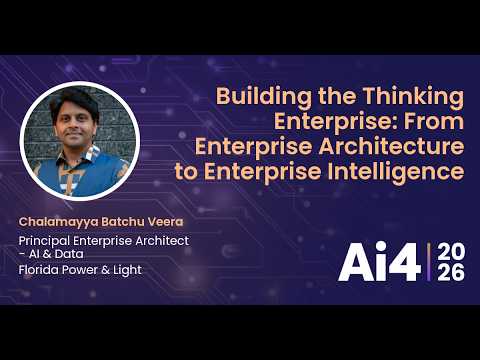
Ai4
Autonomous enterprise agents fail without structured organizational context, requiring architects to convert siloed system records into persistent context and memory layers to automate cross-functional decisions.
AI-assisted summary of Building the Thinking Enterprise: From Enterprise Architecture to Enterprise Intelligence — original source. Check the original for full context.
Source published:
Detailed notes
## Background Published on YouTube by the channel Ai4 on August 21, 2026, this presentation features Chalamayya Batchu Veera, Principal Enterprise Architect for AI & Data at Florida Power & Light. The talk outlines how traditional Enterprise Architecture must transition from documenting technology landscapes into an active Enterprise Intelligence Architecture that connects capabilities, data, policies, and institutional knowledge to power AI-native organizations.
## TL;DR Enterprise AI initiatives frequently stumble because organizations lack connected context, turning straightforward decisions like application decommissioning into months-long cross-silo investigations. To overcome this, Enterprise Architecture must evolve into Enterprise Intelligence Architecture by layering explicit Enterprise Context, institutional Enterprise Memory, and reasoning-driven Enterprise Intelligence atop existing enterprise assets. This blueprint transforms organizations into 'Thinking Enterprises' that adapt continuously and compress multi-week evaluations into days. Ultimately, this centralized intelligence layer grounds domain-specific autonomous agents while upholding a human-centered approach designed to amplify human expertise rather than replace it.
## Atmosphere & style The presentation carries a pragmatic, authoritative, and architectural tone grounded in years of hard-won enterprise systems experience. It begins with an instantly recognizable corporate frustration—the deceptively simple question of retiring an application—before methodically building toward a structured blueprint for the agentic AI era. The pacing is deliberate and reassuring, stripping away generic AI hype to focus on the unglamorous yet vital discipline of data governance, institutional memory, and collaborative human-AI decision-making.
## Key takeaways - [00:04](https://www.youtube.com/watch?v=j_SgY7rXpM8&t=4s) Routine IT decisions, like retiring an application, routinely take weeks or months because knowledge of impacts, integrations, data, and compliance is fragmented across organizational silos. - [00:04](https://www.youtube.com/watch?v=j_SgY7rXpM8&t=4s) Enterprise Architecture's historic mission is not creating new knowledge from scratch, but organizing, connecting, and exposing fragmented context into a shared understanding of how the enterprise operates. - [02:11](https://www.youtube.com/watch?v=j_SgY7rXpM8&t=131s) Traditional EA artifacts were crafted for human consumers who intuitively bridge semantic gaps, whereas AI models cannot infer unstated context on their own. - [02:11](https://www.youtube.com/watch?v=j_SgY7rXpM8&t=131s) To support AI adoption, Enterprise Architecture must evolve into Enterprise Intelligence Architecture, layering Context, Memory, and Intelligence over existing enterprise assets. - [03:56](https://www.youtube.com/watch?v=j_SgY7rXpM8&t=236s) Enterprise Context adds semantic meaning to disconnected catalogs, defining relationships and mapping upstream and downstream dependencies across systems. - [03:56](https://www.youtube.com/watch?v=j_SgY7rXpM8&t=236s) Enterprise Memory functions as a 'Context++' layer, preserving not just current-state snapshots but historical decisions, rationale, events, and lessons learned. - [03:56](https://www.youtube.com/watch?v=j_SgY7rXpM8&t=236s) Enterprise Intelligence acts as a reasoning engine to evaluate scenarios and propose next-best actions while eliminating hallucinations by grounding reasoning in context and memory. - [03:56](https://www.youtube.com/watch?v=j_SgY7rXpM8&t=236s) The ultimate objective of the thinking enterprise is augmenting and amplifying human decision-making rather than replacing human expertise. - [07:49](https://www.youtube.com/watch?v=j_SgY7rXpM8&t=469s) A Thinking Enterprise continuously adapts and learns, reducing complex cross-functional assessments from months to days through queryable institutional memory. - [07:49](https://www.youtube.com/watch?v=j_SgY7rXpM8&t=469s) Transforming into an intelligence-driven architecture requires long-term commitment and architectural discipline; it cannot be resolved in a rapid two-to-three-month sprint. - [11:09](https://www.youtube.com/watch?v=j_SgY7rXpM8&t=669s) Enterprise intelligence must follow core guiding principles: business outcomes first, context and memory enabling intelligence, trust by design, and human-centered collaboration. - [11:09](https://www.youtube.com/watch?v=j_SgY7rXpM8&t=669s) In the emerging agentic era, autonomous domain and strategic agents require a centralized Enterprise Intelligence Services layer to access shared context and institutional memory across silos.
## Detailed walkthrough ### [00:04](https://www.youtube.com/watch?v=j_SgY7rXpM8&t=4s) The Disconnected Enterprise and the Real Role of Enterprise Architecture
Many IT professionals who have spent years building large-scale platforms—such as ERPs, CRMs, cloud modernization, and complex migrations—frequently encounter a deceptively simple question in meetings: *"Can we retire an application X?"* While the question sounds straightforward on the surface, organizations routinely struggle for weeks or months to produce a definitive answer. The reason for this delay is not a lack of data, but rather the extreme fragmentation of ownership across the enterprise.
```mermaid flowchart TD accTitle: Fragmented Knowledge in Application Retirement Decisions subgraph Silos["Fragmented Organizational Silos"] direction TB B["Business Unit<br/><i>Understands business impact</i>"] T["Technology Team<br/><i>Knows upstream & downstream integrations</i>"] D["Data Team<br/><i>Tracks generated information & pipelines</i>"] G["Governance & Risk<br/><i>Monitors compliance & security risk</i>"] end
Q["Question: 'Can we retire Application X?'"] --> Silos Silos --> F["Missing Link: Enterprise Context & Connected Knowledge"] ```
When dissecting the retirement of an application, different organizational units hold disparate pieces of the puzzle: - **Business Teams** understand the direct operational and functional impact. - **Technology Teams** track the technical architecture, upstream feeds, and downstream system dependencies. - **Data Teams** know what specific data sets and information streams are generated and consumed by the application. - **Governance & Risk Teams** understand the compliance mandates, regulatory requirements, and risk exposure tied to the system.
While everyone owns a piece of the answer, no single group owns the complete picture. Enterprise Architecture (EA) has spent decades addressing this exact dilemma. Historically, EA began by producing documentation, establishing standards, enforcing governance, and building roadmaps. Over time, it evolved into uncovering the connections and context between data, systems, and processes. EA never created enterprise knowledge from scratch; its core mission has always been to organize, connect, and expose that knowledge to create a shared understanding of how the enterprise operates.
---
[02:11](https://www.youtube.com/watch?v=j_SgY7rXpM8&t=131s) The Shift from Human Consumers to AI: Introducing Enterprise Intelligence Architecture
A fundamental shift has disrupted enterprise architecture. Historically, EA artifacts and shared context were designed exclusively for human consumption—architects, engineering leaders, C-suite executives, and developers. Humans possess an innate ability to infer missing context and bridge semantic gaps intuitively. AI systems, however, cannot infer unstated organizational context on their own; they require structured, explicit context to generate accurate reasoning and actionable decisions.
To bridge this gap, Enterprise Architecture must evolve into **Enterprise Intelligence Architecture**. Traditional EA established the foundation layer—the baseline structures, ARB (Architecture Review Board) governance artifacts, and operating models. The modern evolution requires building three complementary layers on top of that enterprise foundation: **Context**, **Memory**, and **Intelligence**. Together, these capabilities turn a conventional organization into an adaptive, thinking enterprise.
```mermaid flowchart TD accTitle: Layers of Enterprise Intelligence Architecture subgraph EIArchitecture["Enterprise Intelligence Architecture"] direction TB L4["Enterprise Intelligence<br/><i>Reasoning engine, next-best actions, alternatives</i>"] L3["Enterprise Memory<br/><i>Trusted knowledge store, context++, decision rationale</i>"] L2["Enterprise Context<br/><i>Semantic meaning, relationships, dependency resolution</i>"] L1["Enterprise Foundation & Intelligence Core<br/><i>Existing assets, ARBs, applications, policies, data</i>"] end
L1 --> L2 L2 --> L3 L3 --> L4 ```
---
[03:56](https://www.youtube.com/watch?v=j_SgY7rXpM8&t=236s) The Three Capabilities: Enterprise Context, Memory, and Intelligence
Enterprise Context provides semantic meaning to raw organizational assets. Architects typically maintain inventories of applications, data outputs, access policies, and past Architecture Review Board (ARB) decisions, but these assets exist in disconnected silos. The Context capability weaves these assets together by: - Defining explicit relationships and mapping surrounding ecosystems. - Resolving complex upstream and downstream dependencies to assess systemic impact. - Delivering end-to-end visibility across business capabilities, software assets, and governance constraints.
Without this layer, organizational choices remain trapped in silos. Building context takes considerable time and organizational effort, but it serves as the essential bedrock for higher-level intelligence.
Once context is established, it must be persisted within **Enterprise Memory**. Enterprise Memory serves as the trusted grounding layer for intelligent systems. Rather than merely storing current-state snapshots, Enterprise Memory functions as a "Context++" repository—capturing not just *what* the enterprise knows, but *why* specific decisions were made, what events generated those outcomes, and what institutional lessons were learned along the way.
Sitting at the apex is **Enterprise Intelligence**, acting as the reasoning brain. Powered by grounded context and trusted memory, the intelligence layer evaluates scenarios, constructs alternative paths, and recommends optimal next actions while eliminating common failure modes like model hallucinations. This architecture is designed specifically to amplify human decision-making rather than displace human expertise:
> "Whatever we are doing to build the thinking enterprise, it's all about providing the context, meaning, and intelligence just to amplify our thinking process, but not to replace us."
---
[07:49](https://www.youtube.com/watch?v=j_SgY7rXpM8&t=469s) Blueprint and Execution of the Thinking Enterprise
A **Thinking Enterprise** operates as a continuous learning system that adapts, reasons, and formulates superior operational decisions dynamically. In such an enterprise, questions that previously required three weeks to two months of cross-functional investigation—such as decommissioning an application—can be evaluated in days because context and institutional memory are continuously updated and queryable.
```mermaid flowchart LR accTitle: Logical Blueprint from Enterprise Assets to Services subgraph Assets["1. Enterprise Assets"] A1["ARB Records"] A2["Business & Licensing Docs"] A3["App Inventories"] end
subgraph Core["2. Intelligence Core"] C1["Digitized EA<br/>Shared Understanding"] end
subgraph Capabilities["3. Context & Memory"] K1["Enterprise Context<br/><i>Semantic Meaning</i>"] K2["Enterprise Memory<br/><i>Knowledge & Rationale</i>"] end
subgraph Services["4. Intelligence Services"] S1["Enterprise Intelligence<br/>Services"] end
Assets --> Core Core --> K1 K1 --> K2 K2 --> Services ```
The logical blueprint for this transformation progresses across interconnected tiers: 1. **Existing Enterprise Assets:** Capitalizes on existing artifacts, including procurement records, licensing agreements, application catalogs, business strategy documents, and historical ARB reviews. 2. **Enterprise Intelligence Core:** Digitizes the traditional shared understanding cultivated by EA into an accessible, structured knowledge base. 3. **Enterprise Context & Enterprise Memory:** Synthesizes raw records into connected meaning and preserves long-term institutional rationale. 4. **Enterprise Intelligence Services:** Serves as the queryable interface answering complex strategic and technical questions across the enterprise.
This journey cannot be accomplished in a trivial two-to-three-month sprint. Seasoned architects with ten to fifteen years of organizational tenure still require time to untangle complex system dependencies. Building this automated knowledge and memory layer requires deliberate investment in people, data structures, and architectural discipline.
---
[11:09](https://www.youtube.com/watch?v=j_SgY7rXpM8&t=669s) Core Principles, Technology Mapping, and the Agentic Era
Any durable enterprise intelligence transformation must be governed by foundational architectural principles: - **Business Comes First:** Technology must never drive intelligence for its own sake; business objectives and tangible organizational outcomes must steer adoption. - **Context Enables Intelligence:** AI and advanced analytics cannot generate reliable insights in an organizational vacuum without explicit context. - **Memory Enables Intelligence:** Systems must continuously learn, retain historical lessons, and update their knowledge bases just like a human brain. - **Trust by Design:** Governance, explainability, compliance, and security cannot be retrofitted as an afterthought; they must be baked directly into the core architectural methodology from day one. - **Human-Centered Intelligence:** Systems must operate as a collaborative partnership—"Human + AI"—where technology amplifies human judgment rather than eliminating human oversight.
```mermaid flowchart TD accTitle: Agentic Architecture Leveraging Centralized Enterprise Intelligence subgraph TopLevel["Enterprise Agentic Layer"] EA1["Enterprise Strategy Agent"] EA2["Governance & Compliance Agent"] end
subgraph CentralServices["Centralized Intelligence Services"] EIS["Enterprise Intelligence Services<br/><i>Enterprise Context & Memory Core</i>"] end
subgraph DomainAgents["Domain & Capability Agents"] DA1["Finance Domain Agent"] DA2["HR Domain Agent"] DA3["IT / Cloud Domain Agent"] end
EA1 --> EIS EA2 --> EIS EIS --> DA1 EIS --> DA2 EIS --> DA3 ```
In the emerging agentic landscape, autonomous agents will operate across specific domains, verticals, and departmental capabilities. However, enterprise-wide agents must rely on a centralized layer of **Enterprise Intelligence Services** to infer holistic context, retrieve enterprise memory, and provide cohesive guidance across disparate business functions. Rather than re-inventing existing technology investments, organizations must orchestrate their existing data, application, and governance components into an integrated intelligence layer that powers the next generation of enterprise AI.
## Notable quotes > Enterprise AI is only as intelligent as the enterprise knowledge, context, and relationships it can access, but most organizations have not architected this foundation for AI. — Chalamayya Batchu Veera
> [00:04](https://www.youtube.com/watch?v=j_SgY7rXpM8&t=4s) Can we retire an application X? — Chalamayya Batchu Veera
> [00:04](https://www.youtube.com/watch?v=j_SgY7rXpM8&t=4s) The reason for this delay is not a lack of data, but rather the extreme fragmentation of ownership across the enterprise. — Chalamayya Batchu Veera
> [00:04](https://www.youtube.com/watch?v=j_SgY7rXpM8&t=4s) While everyone owns a piece of the answer, no single group owns the complete picture. — Chalamayya Batchu Veera
> [00:04](https://www.youtube.com/watch?v=j_SgY7rXpM8&t=4s) EA never created enterprise knowledge from scratch; its core mission has always been to organize, connect, and expose that knowledge to create a shared understanding of how the enterprise operates. — Chalamayya Batchu Veera
> [02:11](https://www.youtube.com/watch?v=j_SgY7rXpM8&t=131s) Humans possess an innate ability to infer missing context and bridge semantic gaps intuitively. AI systems, however, cannot infer unstated organizational context on their own; they require structured, explicit context to generate accurate reasoning and actionable decisions. — Chalamayya Batchu Veera
> [03:56](https://www.youtube.com/watch?v=j_SgY7rXpM8&t=236s) Whatever we are doing to build the thinking enterprise, it's all about providing the context, meaning, and intelligence just to amplify our thinking process, but not to replace us. — Chalamayya Batchu Veera
> [03:56](https://www.youtube.com/watch?v=j_SgY7rXpM8&t=236s) Enterprise Memory serves as the trusted grounding layer for intelligent systems. — Chalamayya Batchu Veera
> [07:49](https://www.youtube.com/watch?v=j_SgY7rXpM8&t=469s) A Thinking Enterprise operates as a continuous learning system that adapts, reasons, and formulates superior operational decisions dynamically. — Chalamayya Batchu Veera
> [11:09](https://www.youtube.com/watch?v=j_SgY7rXpM8&t=669s) Technology must never drive intelligence for its own sake; business objectives and tangible organizational outcomes must steer adoption. — Chalamayya Batchu Veera
> [11:09](https://www.youtube.com/watch?v=j_SgY7rXpM8&t=669s) Governance, explainability, compliance, and security cannot be retrofitted as an afterthought; they must be baked directly into the core architectural methodology from day one. — Chalamayya Batchu Veera
## Mentioned Chalamayya Batchu Veera, Florida Power & Light, Ai4, Enterprise Architecture (EA), Enterprise Intelligence Architecture, Architecture Review Board (ARB), ERP, CRM
## Video description Chalamayya Batchu Veera - Principal Enterprise Architect - AI & Data, Florida Power & Light
Enterprise AI is only as intelligent as the enterprise knowledge, context, and relationships it can access, but most organizations have not architected this foundation for AI. In this talk, I will explain how Enterprise Architecture must evolve from documenting systems and technology landscapes into an intelligence layer that enables trusted, scalable, and governed AI adoption. I will introduce the concept of Enterprise Intelligence Architecture, a blueprint that connects business capabilities, data, applications, knowledge, policies, and decisions to support AI-native organizations. Attendees will learn how Enterprise Architects can help bridge the gap between AI capabilities and enterprise context while creating a foundation for responsible AI transformation. Join me to explore how the future of Enterprise Architecture is shifting from managing technology complexity to enabling enterprise intelligence.
[Source](https://www.youtube.com/watch?v=j_SgY7rXpM8)