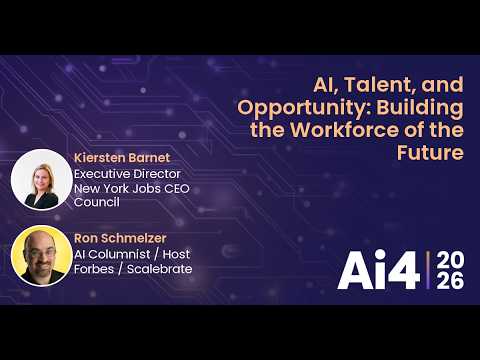
Dimon-Led NYC CEO Coalition Adds 17,500 Entry Roles Despite AI Fear
Ai4
Enterprise AI adoption is expanding entry-level hiring through workflow redesign rather than headcount cuts, but classroom bans and curriculum lags threaten to lock underserved students out of emerging jobs.
## Background
Published on YouTube by the channel Ai4 on August 21, 2026, this fireside chat features Kiersten Barnet, Executive Director of the New York Jobs CEO Council, in conversation with Forbes columnist and host Ron Schmelzer. The session examines how major employers are adopting AI while investing in partnerships and talent pipelines to connect underserved communities with high-quality, career-track jobs.
## TL;DR
Kiersten Barnet and Ron Schmelzer explore the intersection of artificial intelligence, workforce development, and economic mobility. Countering common doom narratives about automation wiping out entry-level opportunities, Barnet highlights how member firms of the New York Jobs CEO Council placed 65,000 low-income New Yorkers into living-wage jobs and continue to expand entry-level hiring by redesigning workflows and upskilling staff. Using practical examples from healthcare and finance, she underscores the need for baseline AI literacy paired with critical human judgment. Furthermore, Barnet warns against blanket AI bans in public schools, urging closer collaboration between corporate leaders and educators to prevent widening equity gaps.
## Atmosphere & style
The session carries an energetic, pragmatic, and reassuring tone, driven by Schmelzer's engaging moderation and Barnet's authoritative, data-backed perspective. The dynamic feels collaborative and candid, cutting through sensationalized headlines with operational realities from corporate boardrooms and hospital networks. The conversation strikes a balance between acknowledging rapid technological disruption and offering an empowering, constructive roadmap for equitable workforce development.
## Key takeaways
- [00:04](https://www.youtube.com/watch?v=40FPEN-O1Xs&t=4s) The New York Jobs CEO Council was formed in 2020 by JPMorgan Chase CEO Jamie Dimon and 25 major employers to connect low-income New Yorkers to high-quality corporate talent pipelines.
- [02:18](https://www.youtube.com/watch?v=40FPEN-O1Xs&t=138s) Council member companies have placed 65,000 low-income New Yorkers into career-track jobs averaging $65,000 starting salaries, serving as a scalable proof point for wider industry adoption.
- [02:18](https://www.youtube.com/watch?v=40FPEN-O1Xs&t=138s) Despite public fears that AI is eliminating entry-level stepping stones, member companies hired 17,500 entry-level workers in NYC over the past year, with entry-level positions increasing as a share of total hiring.
- [04:33](https://www.youtube.com/watch?v=40FPEN-O1Xs&t=273s) While daily entry-level tasks will evolve alongside AI, durable human competencies such as critical thinking, collaboration, and baseline AI literacy remain essential across all professions.
- [07:19](https://www.youtube.com/watch?v=40FPEN-O1Xs&t=439s) Progressive organizations pursue AI return on investment through workflow redesign and internal redeployment—such as upskilling administrative staff into high-demand clinical roles—rather than pure headcount reduction.
- [10:50](https://www.youtube.com/watch?v=40FPEN-O1Xs&t=650s) The United States lacks the tight feedback loops between industry and education found in countries like Switzerland, leaving academic curricula struggling to match rapidly shifting workplace skill demands.
- [14:07](https://www.youtube.com/watch?v=40FPEN-O1Xs&t=847s) A cultural gap exists between corporate boardrooms leveraging AI as standard operating procedure and school administrators remaining bogged down in debates over academic cheating.
- [16:04](https://www.youtube.com/watch?v=40FPEN-O1Xs&t=964s) Placing bans or moratoriums on AI in public schools risks compounding educational inequities by leaving underserved students behind while resourced peers gain AI literacy at home.
- [17:34](https://www.youtube.com/watch?v=40FPEN-O1Xs&t=1054s) Instituting practical, dual-sided acceptable use policies for both students and educators mirrors lessons learned from failed historical attempts to ban social media and smartphones.
- [18:35](https://www.youtube.com/watch?v=40FPEN-O1Xs&t=1115s) Healthcare and skilled trades represent highly resilient career pathways due to severe local labor shortages, mandatory in-person delivery, and institutional models built on continuous upskilling.
- [21:08](https://www.youtube.com/watch?v=40FPEN-O1Xs&t=1268s) Employers and HR leaders must dismantle silos and build direct partnerships with public colleges and training organizations to keep curricula dynamically aligned with modern job requirements.
## Detailed walkthrough
### [00:04](https://www.youtube.com/watch?v=40FPEN-O1Xs&t=4s) The Founding and Mission of the New York Jobs CEO Council
The session opens on an energetic, audience-engaging note as host Ron Schmelzer asks who wants to see more jobs and billionaire CEOs helping people land them. Introducing Kiersten Barnet, Executive Director of the New York Jobs CEO Council, Schmelzer points out how high-powered the coalition is. Barnet clarifies that while she directs the organization, JPMorgan Chase CEO Jamie Dimon is the true founder. In 2020, during the height of the COVID-19 pandemic, Dimon convened a group of peer chief executives across New York City's major private-sector industries. At that time, opportunity gaps across the city were worsening dramatically, and large companies that had anchored their global headquarters in New York recognized they urgently needed a sustainable local talent pipeline while simultaneously fostering economic mobility.
The fundamental thesis among the council's corporate leaders was straightforward: meaningful economic mobility requires direct access to high-quality jobs. New York City boasts an enormous talent base alongside the largest public education system in the country, encompassing both high schools and the City University of New York (CUNY) system with 250,000 degree-seeking students. Half of these students come from households earning under $30,000 annually. Historically, very few of those students ever secured positions within the city's largest corporate employers. The council was formed to bridge that gap, and Barnet notes that with technological disruption accelerating, that bridging mission has never been more urgent.
- **Council Membership**: Composed of 25 chief executives across finance, technology, healthcare, and professional services.
- **Combined Workforce**: The 25 member companies directly employ over 400,000 individuals within New York City alone.
- **Demographics & Target Group**: 250,000 degree-seeking public university students in NYC, 50% of whom come from families earning less than $30,000 per year.
[02:18](https://www.youtube.com/watch?v=40FPEN-O1Xs&t=138s) Scale, Proof Points, and Entry-Level Hiring Realities
Schmelzer highlights the sheer scale of the initiative, noting that the council brings together prominent industry titans—including Andy Jassy of Amazon, Sundar Pichai of Google, Arvind Krishna of IBM, Jamie Dimon of JPMorgan Chase, and the chief executives of New York’s largest hospital networks. Over the past five years, these member firms have directly connected 65,000 low-income New Yorkers to career-track, living-wage jobs with entry salaries averaging around $65,000. Barnet emphasizes that the council's goal extends beyond staffing their own enterprises: it serves as an industry proof point. If hiring, training, and credentialing pathways work at Google or JPMorgan Chase, they provide a tested blueprint for mid-sized regional banks and smaller tech firms.
```mermaid
flowchart TD
accTitle: Talent Pipeline Architecture
subgraph S1["Public Education & Talent"]
A["250,000+ CUNY & High School Students"] --> B["Equitable AI Literacy & Skills Training"]
end
subgraph S2["Industry Alignment"]
B --> C["New York Jobs CEO Council<br/>(25 Major Corporate Employers)"]
C --> D["Accelerated Pathways & Apprenticeships"]
end
subgraph S3["Career Outcomes"]
D --> E["65,000 Placed in Living-Wage Jobs<br/>(Avg. $65,000 Starting Salary)"]
D --> F["Broader Ecosystem Adoption<br/>(Mid-sized & Small Firms)"]
end
```
Addressing the widespread public anxiety that artificial intelligence is wiping out entry-level stepping stones—such as junior programmers, junior copywriters, and legal assistants—Schmelzer contrasts those fears with actual council data. Last year, council member companies hired 17,500 entry-level workers in New York City alone, with entry-level roles actually growing as a percentage of total corporate hiring. When asked why public headlines diverge so sharply from corporate hiring trends, Barnet explains that while some jobs will inevitably be displaced, macroeconomic factors over recent years have often been conflated with AI disruption.
- **Direct Impact**: 65,000 low-income New Yorkers placed into career-track jobs over 5 years.
- **Living Wage Benchmark**: Starting compensation averages approximately $65,000.
- **Recent Entry-Level Hiring**: 17,500 entry-level workers hired by council companies in NYC over the past year.
[04:33](https://www.youtube.com/watch?v=40FPEN-O1Xs&t=273s) Debunking the Doom Narrative and the Evolution of Entry-Level Roles
Barnet argues that entry-level on-ramps will always exist, but the daily tasks within those roles will evolve dramatically. She openly acknowledges the high degree of uncertainty felt even at the top, remarking that if you asked member CEOs what their workforce will look like in two years, they would respond, "I don't know... We're building the plane as we're flying it." Because of this rapid evolution, durable human competencies remain vital. Foundational capabilities like critical thinking, collaboration, teamwork, and leadership are just as prized today as ever. Alongside these soft skills, baseline AI literacy has become a non-negotiable prerequisite across all professions, whether someone is entering nursing, marketing, or software development.
Schmelzer notes that executive rhetoric often fuels public anxiety, referencing public comments by figures like Jensen Huang about the obsolescence of traditional coding or radiology. However, both agree that viewing AI merely as a labor-replacement mechanism fundamentally misses the historical trajectory of technology revolutions. Just as previous shifts automated narrow tasks, generative tools are meant to unlock new processes, enhance productivity, and spawn entire new business models. For forward-looking enterprises, AI is not treated as a glorified calculator or an automated dictionary; it is leveraged to fundamentally redesign organizational workflows, which still necessitates skilled human judgment.
[07:19](https://www.youtube.com/watch?v=40FPEN-O1Xs&t=439s) Headcount Reductions vs. Workflow Redesign: Lessons from Healthcare
To ground the discussion in practical operational reality, Barnet recounts a conversation with John D'Angelo, CEO of Northwell Health, the largest healthcare provider in New York State. Addressing high vacancy rates for radiology technologists and advanced imaging modalities, Northwell is designing accelerated workforce pathways. Rather than replacing technicians, AI-integrated medical equipment assists them by diagnosing equipment issues, taking human error out of routine calibrations, and letting technicians operate at the top of their licenses. Barnet stresses that D'Angelo still urgently needs "butts in seats, and he needs them to be people," but the curriculum used to train them must change in real time.
```
+-----------------------------+---------------------------------------+-----------------------------------------------+
| Domain / Role | Traditional Narrative / Concern | Practical Enterprise Reality |
+-----------------------------+---------------------------------------+-----------------------------------------------+
| Radiology Technicians | AI replaces imaging workers | Smart machines assist techs; high vacancies |
| | and diagnostic staff entirely. | require accelerated human training pipelines. |
+-----------------------------+---------------------------------------+-----------------------------------------------+
| Insurance Claims Dispute | Repetitive dispute processing | Algorithmic dispute handling frees workers to |
| Processing | consumes significant manual headcount.| be upskilled on-site into ultrasound techs. |
+-----------------------------+---------------------------------------+-----------------------------------------------+
| Entry-Level Office Roles | Junior coding and writing tasks | AI acts as workflow accelerator; baseline AI |
| | are automated out of existence. | literacy + critical thinking are expected. |
+-----------------------------+---------------------------------------+-----------------------------------------------+
```
When discussing the true return on investment (ROI) of enterprise AI, Barnet clarifies that thoughtful employers are not pursuing ROI purely through workforce reductions, but through internal redeployment. While routine tasks—such as back-office staff disputing insurance claims—may eventually shift toward automated agents, proactive organizations do not simply terminate staff. Instead, institutions like Northwell run on-site upskilling programs to transition administrative staff into high-demand clinical specialties, such as ultrasound and surgical technicians.
[10:50](https://www.youtube.com/watch?v=40FPEN-O1Xs&t=650s) The Disconnect Between Education and Industry
Turning to the broader talent pipeline, Schmelzer points out that the traditional American pipeline—progressing smoothly from K-12 to higher education to lifelong corporate employment—struggles to keep pace with changing skill demands. Barnet splits the educational AI opportunity into two distinct categories:
1. **Closing Fundamental Academic Gaps**: Deploying AI as an accessible, personalized tutor to remediate systemic historical inequities in reading, writing, and arithmetic across early education.
2. **Modernizing Secondary and Higher Education**: Aligning older high school and college curricula directly with rapidly evolving employer requirements.
Barnet points out a critical systemic flaw in the United States: unlike nations such as Switzerland—where industry associations collaborate directly with educational authorities to establish vocational and technical curriculum standards—the American educational ecosystem lacks a real-time feedback loop with industry. Because higher education institutions move slowly, the CEO Council actively collaborates with public universities and high school systems to ensure students are not taught obsolete skill sets. By offloading basic drills to AI tools, classroom hours can be repurposed toward complex problem solving and interpersonal development.
[14:07](https://www.youtube.com/watch?v=40FPEN-O1Xs&t=847s) From "Is It Cheating?" to Competitive Advantage in the Classroom
Schmelzer and Barnet explore the cultural friction emerging in schools over classroom AI usage. While younger students adopt AI intuitively, academic institutions and educators frequently get bogged down in debates over academic integrity. Barnet highlights the sharp contrast between the rooms she sits in: corporate boardrooms discuss workflow optimization, system redesign, and competitive advantage, whereas school administrators remain trapped asking, "Is it cheating?"
Barnet emphasizes that this deep disconnect harms students. In modern enterprises like JPMorgan Chase, using AI tools is standard operating procedure, and employees are evaluated on how effectively they leverage secure internal systems. Looking up a basic factual answer does not confer a competitive edge; the real value lies in knowing how to interrogate the output, apply critical thinking, and challenge machine assumptions. To address this mismatch, the New York City Public Schools system and the city council have engaged the schools chancellor to develop a structured, forward-looking AI framework across the district.
[16:04](https://www.youtube.com/watch?v=40FPEN-O1Xs&t=964s) AI Moratoria in Schools and the Risk of Compounding Equity Gaps
The conversation addresses the instinctive reaction of many school districts to place an outright ban or moratorium on generative AI tools in the classroom. Kiersten Barnet points out that these reactions largely stem from visceral fear and fundamental misunderstandings, evoking dystopian caricatures where people imagine "their kindergartener sitting in front of a robot teaching them." However, shutting out AI entirely risks aggravating existing educational and economic divides. Barnet warns that AI has the potential to serve as an "incredible tool for equity," but if students are only able to access and learn to use AI outside the school walls—such as a student whose parents can afford the time or tools to guide them through generative AI math drills for their times tables—those without outside support will fall drastically behind.
Addressing the policy stance initially taken by New York City Public Schools, Barnet emphasizes that a multi-year pause places public school students at a devastating disadvantage. In the fast-moving AI landscape, "two years is an eternity to have some people keep going and others pause." Ron Schmelzer agrees with a chuckle, remarking on the breakneck speed of model development where nobody can even remember whether the cutting edge two years prior was GPT-3.5 or GPT-2. While acknowledging that administrators have legitimate obligations around student data privacy and safety, the panelists stress that stakeholders must convene to establish safe, practical usage rather than enforcing a blanket freeze that will only leave underserved students playing catch-up.
```mermaid
flowchart TD
accTitle: The Equity Divide in Education AI Policies
subgraph Ban["Blanket School Moratorium"]
A["Outright AI Bans in Classrooms"] --> B["Disproportionate Outside-Classroom Access"]
B --> C["Compounding Disparities for Under-Resourced Students"]
end
subgraph Proactive["Inclusive Educational Integration"]
D["Multi-Stakeholder Dialogue"] --> E["Classroom AI Literacy & Ethics Instruction"]
E --> F["Equitable Talent Pipelines"]
end
```
- **Perpetuating Gaps:** Banning AI in classrooms ensures that only children with tech-literate, resourced parents gain early facility with generative tools.
- **The Speed of the AI Frontier:** Two years of educational moratoriums correspond to multiple entire generations of foundational frontier models.
---
[17:34](https://www.youtube.com/watch?v=40FPEN-O1Xs&t=1054s) Practical Classrooms: Acceptable Use and Lessons from Social Media Bans
Schmelzer highlights how school systems are beginning to move toward nuanced governance rather than blanket prohibition, citing his local experience in Howard County, Maryland. Walking into his high schooler’s classroom, he noticed posted signage detailing acceptable use policies for generative AI. Notably, the policy does not focus solely on students cheating on homework—it explicitly addresses faculty conduct, warning teachers that they cannot use generative AI to grade student assignments. Schmelzer jokes that just as students look for shortcuts, "the teachers are trying to get the advantage too."
Barnet draws a direct historical parallel between the early administrative panic over AI and how school systems previously handled the rise of smartphones and social media. The default administrative playbook was to ban social platforms in schools under the illusion that "then we won't have to deal with it... then we'll be fine." Instead, students used the platforms anyway without guidance. She contends that rather than enacting bans only to play catch-up years later, educators should introduce students to algorithmic bias, ethics, and responsible tool use early on, because students are guaranteed to interact with these systems throughout their adult working lives.
- **Dual-Sided Policy:** Howard County Public School System's signage holds both learners and educators accountable, prohibiting automated grading alongside unauthorized student submission.
- **The Social Media Parallel:** Outright bans failed to curb social media use and missed critical windows to teach digital citizenship, providing a cautionary roadmap for AI regulation in schools.
---
[18:35](https://www.youtube.com/watch?v=40FPEN-O1Xs&t=1115s) Differential Industry Impacts: Why Healthcare and Skilled Trades Stand Apart
Turning to the wider workforce, Schmelzer asks how artificial intelligence will differentially impact distinct industry sectors, contrasting vulnerable corporate verticals like finance, technology, accounting, and legal services with more resilient domains. Barnet identifies healthcare as the single most resilient, "future-proof career" available today. Unlike corporate knowledge sectors that face immediate displacement or restructuring risks, healthcare in almost every American metropolitan area suffers from chronic, severe vacancy rates where institutions simply cannot hire qualified personnel fast enough.
```mermaid
flowchart LR
accTitle: Healthcare Workforce Resilience Drivers
subgraph Resilience["Healthcare Resilience Factors"]
V["High Local Vacancy Rates"]
G["In-Person Geographic Requirement"]
R["Regulated Skill & Time Gates"]
end
subgraph Model["Structural Advantages"]
L["Built-in Learning Institution Models"]
C["Direct Clinical Education Feedback Loops"]
end
Resilience --> Model
```
Beyond sheer demand, healthcare possesses unique structural properties that insulate it from rapid tech-driven labor contractions. Because it is heavily regulated and involves physical patient care, positions cannot easily be automated away or outsourced to remote back offices in other cities. Furthermore, healthcare organizations have always operated as learning institutions structured around incremental upskilling—taking individuals with associate degrees or specialized certifications and advancing them along clinical career ladders through continuous professional development. Because clinical education requires hospital placements, real-time feedback loops between employers and educational institutions are already hardwired into the system. Beyond healthcare, Barnet points to skilled trades as an equally vital, promising career pathway that American high schools have historically neglected but are now actively re-evaluating.
- **Immunity to Remote Offshoring:** Unlike back-office corporate operations, bedside care and clinical healthcare roles inherently require local, physical delivery.
- **Apprenticeship Precedent:** Healthcare already embraces formal clinical rotations and stackable credentials, serving as an operational model for other industries striving to reskill workers.
- **Skilled Trades Revival:** Hands-on vocational trades offer durable employment that resists early generative AI displacement.
---
[21:08](https://www.youtube.com/watch?v=40FPEN-O1Xs&t=1268s) Call to Action: Bridging Employers and Local Education
Concluding the fireside chat, Schmelzer asks Barnet for a final takeaway and actionable guidance for the audience of corporate leaders, human resources executives, and talent strategists. Barnet invites organizations to connect directly with the New York Jobs CEO Council or reach out for introductions to peer CEO coalitions tackling regional workforce challenges in other metropolitan centers across the United States.
Her primary recommendation to HR leaders and corporate recruiters is to dismantle the silos separating corporate hiring from public education. She urges companies to build deep, direct relationships with local colleges, public educational institutions, and community workforce training providers. In an era where AI is shifting the specific skill requirements of entry-level jobs on an almost monthly basis, maintaining tightly coupled feedback loops with educators is essential to building an inclusive and sustainable talent pipeline.
- **Resource Access:** The New York Jobs CEO Council can be accessed directly at `nyjobsceo.org`.
- **Core Directive for HR:** Deepen formal partnerships with regional community colleges, vocational educators, and training nonprofits to guide dynamic curriculum design.
## Notable quotes
> [04:33](https://www.youtube.com/watch?v=40FPEN-O1Xs&t=273s) I don't know... We're building the plane as we're flying it. — Kiersten Barnet
> [07:19](https://www.youtube.com/watch?v=40FPEN-O1Xs&t=439s) butts in seats, and he needs them to be people — Kiersten Barnet
> [14:07](https://www.youtube.com/watch?v=40FPEN-O1Xs&t=847s) Is it cheating? — Kiersten Barnet
> [16:04](https://www.youtube.com/watch?v=40FPEN-O1Xs&t=964s) their kindergartener sitting in front of a robot teaching them — Kiersten Barnet
> [16:04](https://www.youtube.com/watch?v=40FPEN-O1Xs&t=964s) incredible tool for equity — Kiersten Barnet
> [16:04](https://www.youtube.com/watch?v=40FPEN-O1Xs&t=964s) two years is an eternity to have some people keep going and others pause. — Kiersten Barnet
> [17:34](https://www.youtube.com/watch?v=40FPEN-O1Xs&t=1054s) the teachers are trying to get the advantage too. — Ron Schmelzer
> [17:34](https://www.youtube.com/watch?v=40FPEN-O1Xs&t=1054s) then we won't have to deal with it... then we'll be fine. — Kiersten Barnet
> [18:35](https://www.youtube.com/watch?v=40FPEN-O1Xs&t=1115s) future-proof career — Kiersten Barnet
## Mentioned
Kiersten Barnet, Ron Schmelzer, Jamie Dimon, Andy Jassy, Sundar Pichai, Arvind Krishna, Jensen Huang, John D'Angelo, New York Jobs CEO Council, Ai4, Forbes, Scalebrate, JPMorgan Chase, City University of New York (CUNY), Amazon, Google, IBM, Northwell Health, New York City Public Schools, Howard County Public School System, GPT-2, GPT-3.5
## Video description
Kiersten Barnet - Executive Director, New York Jobs CEO Council
Ron Schmelzer - AI Columnist / Host, Forbes / Scalebrate
As AI reshapes jobs and hiring, employers face a critical challenge: ensuring technology expands opportunity rather than narrows it. In this fireside chat, Kiersten Barnet, Executive Director of the New York Jobs CEO Council, discusses how leading employers are using AI while investing in skills, partnerships, and new talent pipelines. She'll share lessons from bringing together major companies to connect underserved talent with career-track jobs and explore how AI can help organizations build more inclusive, resilient workforces.
尽管面临AI担忧,戴蒙牵头的纽约CEO联盟仍新增1.75万个初级岗位
企业对AI的应用正通过重塑工作流程而非裁员来扩大初级职位招聘,但课堂禁令与课程滞后可能会将弱势学生阻隔在新兴岗位之外。
Kiersten Barnet与Ron Schmelzer共同探讨了人工智能、劳动力发展与经济流动性的交汇点。针对自动化正在消除初级职位的普遍悲观论调,Barnet重点介绍了纽约就业CEO理事会(New York Jobs CEO Council)的成员企业如何帮助6.5万名低收入纽约人获得能维持生计的工作,并通过重构工作流程和提升员工技能来继续扩大初级岗位招聘。结合医疗与金融领域的实际案例,她强调了基础AI素养与人类批判性判断力相结合的必要性。此外,Barnet对公立学校全面禁用AI提出警告,呼吁企业高管与教育工作者紧密合作,以防止教育公平差距进一步扩大。
纽约就业CEO理事会于2020年由JPMorgan Chase首席执行官Jamie Dimon及25家主要雇主共同创立,旨在将低收入纽约人与高质量的企业人才管道连接起来。 (0:04)
理事会成员企业已帮助6.5万名低收入纽约人入职平均起薪达6.5万美元且具备职业发展前景的岗位,为更广泛的行业推行提供了可扩展的实践范式。 (2:18)
尽管公众担忧AI正在消除作为职业跳板的初级岗位,但成员企业过去一年在纽约市仍招聘了1.75万名初级员工,且初级岗位占总招聘人数的比例有所上升。 (2:18)
虽然日常初级工作任务会随着AI的发展而演变,但批判性思维、协作能力以及基础AI素养等持久的人类能力在各行各业中依然必不可少。 (4:33)
具有前瞻性的组织通过重新设计工作流程和内部岗位调配(例如提升行政人员技能以转入高需求的临床岗位)来追求AI投资回报,而非单纯裁减人员规模。 (7:19)
Reading summary
Speaking at Ai4, Kiersten Barnet, Executive Director of the New York Jobs CEO Council, argued that corporate collaboration with public education must replace hiring silos and blanket academic bans to build sustainable, AI-literate career pathways for underserved populations.
Corporate Scale and Entry-Level Hiring Trends (0:04)
Founded in 2020 by JPMorgan Chase CEO Jamie Dimon, the New York Jobs CEO Council unites 25 chief executives across technology, finance, and healthcare who collectively employ over 400,000 New Yorkers. The coalition focuses on bridging the opportunity gap for 250,000 degree-seeking students across the City University of New York (CUNY) and public schools, half of whom come from households earning under $30,000 annually. Over five years, member firms placed 65,000 low-income New Yorkers into career-track jobs averaging $65,000 entry salaries.
Workflow Redesign Over Job Displacement (2:18)
Addressing public fears that AI is eliminating entry-level roles, Barnet noted council members hired 17,500 entry-level workers in New York City over the past year, with entry roles growing as a share of overall hiring. She contended that public discourse often conflates macroeconomic shifts with AI disruption. While routine tasks are evolving, corporate leaders prioritize core competencies such as critical thinking, collaboration, and baseline AI literacy over workforce reduction.
Operational Realities in Healthcare and Trades (7:19)
Enterprise AI implementation often favors internal redeployment over layoffs. For example, Northwell Health, led by CEO John D'Angelo, is using AI-assisted diagnostic tools to support technicians rather than replace them, addressing high vacancy rates for radiology staff. Northwell also upskills administrative workers whose claims dispute tasks are automated into clinical roles like ultrasound and surgical technicians. Barnet highlighted healthcare and hands-on skilled trades as structurally insulated from tech disruption because they depend on local delivery, regulatory requirements, and built-in apprenticeship models.
Integrating AI Across Public Education (10:50)
Barnet cautioned that academic debates asking 'is it cheating?' diverge dangerously from corporate environments where using AI is standard practice. She warned that school district bans and moratoria risk compounding socioeconomic divides, leaving students without tech-literate or resourced parents at a major disadvantage. Instead of repeating past missteps with social media bans, Barnet urged educational institutions to implement structured frameworks that teach ethics and algorithmic bias while closing early academic gaps in foundational subjects.
Establishing Direct Employer Feedback Loops (14:07)
Unlike European models such as Switzerland's, where industry associations actively coordinate with educational authorities on vocational curricula, the United States lacks dynamic feedback loops between employers and schools. Because rapidly shifting AI tools alter job requirements almost monthly, Barnet urged corporate HR leaders to form direct partnerships with community colleges and public school systems to ensure curricula reflect real-time labor market needs.
Barnet acknowledged that even top corporate executives face uncertainty about the exact composition of their workforces over the next two years, underscoring that sustaining continuous, direct coordination between employers and regional educators remains an open operational challenge.
精炼阅读摘要
纽约就业首席执行官委员会(New York Jobs CEO Council)执行董事基尔斯滕·巴内特(Kiersten Barnet)指出,生成式人工智能的兴起并未消除初级就业岗位,而是推动着组织工作流程的深层重构;缓解公众对技术性失业的焦虑并促进经济流动性,关键在于打破企业与公共教育体系的脱节,建立动态的人才共育机制。
初级岗位招聘现状与雇主实践验证 (2:18)
针对人工智能正在彻底消灭初级程序员、初级文案和法律助理等入门阶梯的公众恐慌,巴内特依据实际用工数据提出了截然不同的现实图景。由摩根大通首席执行官杰米·戴蒙(Jamie Dimon)于2020年联合发起的纽约就业首席执行官委员会,汇集了金融、科技、医疗和专业服务领域的25位主要企业CEO,成员企业在纽约市雇佣了超过40万人。在过去五年中,该联盟直接帮助了6.5万名低收入背景的纽约居民进入具有职业晋升通道的岗位,平均起薪约为6.5万美元;仅在过去一年中,成员企业在纽约市就招聘了1.75万名初级员工,初级岗位在总招聘量中的占比甚至出现增长。巴内特解释称,近年来劳动力市场的收缩主要源于宏观经济波动,但在舆论讨论中往往被错误归咎于人工智能的破坏。
作为行业概念验证,亚马逊、谷歌、IBM和大型医疗集团的实践证明,行之有效的技能认证与学徒培养路径能够向中小型区域企业推广。委员会重点针对纽约市立大学(CUNY)系统和公立高中的25万名在读学位生建立对接通道,其中半数学生家庭年收入低于3万美元。面对技术迭代加速的现状,企业界通过吸纳本土弱势生源,旨在填补长期存在的人才断层并夯实自身人才梯队。
流程再造与岗位内部转岗实践 (7:19)
面对前沿技术的快速演进,巴内特坦言即便顶级企业高管目前也处于“边飞边造飞机”的高不确定状态,无法确切预测未来两年的劳动力结构。然而,成熟企业衡量人工智能投资回报率(ROI)的标准并非单纯裁减员工,而是根本性地重塑业务流程。以纽约州最大医疗提供商诺斯韦尔健康(Northwell Health)为例,其放射技术人员和先进影像领域长期面临极高的人员空缺;引入AI辅助医疗设备并非为了替代技术员,而是帮助诊断设备故障并减少校准中的人为误差,从而让专业人员能够专注于高水平临床操作。
此外,先进机构在推进自动化时更倾向于内部再培训与转岗。例如,虽然算法智能体逐渐接管了后台重复性的保险索赔争议处理,但机构并未直接裁员,而是通过内部职业提升项目,将行政员工培训转化为超声检查和手术技术员等紧缺专职岗位。巴内特与主持人施梅尔泽(Ron Schmelzer)一致认为,将AI视作替代劳动力的工具忽视了历次技术革命的本质演进,生成式工具的核心价值在于释放新生产力与催生新业务模式,批判性思维、团队协作与人际沟通等通用素养仍是组织不可或缺的基石。
教育脱节与校园AI禁令的公平陷阱 (16:04)
美国现有的人才输送管道存在结构性弊端,缺乏类似瑞士由行业协会与教育部门协同制定课程标准的实时反馈机制,导致中高等教育课程严重滞后于行业实际需求。巴内特指出,当前教育界与企业界存在明显的认知错位:当企业高管在董事会中探讨如何利用AI优化工作流与构筑竞争优势时,学校管理者却多困于“学生是否在作弊”的技术恐慌。在现代化企业中,合规调用内部安全AI工具已是日常操作规范,竞争优势已从检索既定事实转向审问机器输出与挑战算法假设的批判性能力。
由于对数据隐私和未知的本能恐惧,部分公立学区一度对生成式AI实施全面封禁或长期暂缓。巴内特警告这种“一刀切”的禁令将极度加剧社会不平等。生成式AI原本可作为个性化辅导工具填补弱势群体的课业短板,但若在校内封禁,唯有富裕家庭的学生能够在校外获得AI辅导与技术启蒙;鉴于前沿基础模型每两年的技术演变便堪称数代跨越,长期的教育停滞将使公立学校学生面临严峻的数字鸿沟。教育系统应吸取早期封禁智能手机与社交媒体的失败经验,转而制定明确的负责任使用规范,如马里兰州霍华德县等地已开始推行同时规范师生双方的AI使用守则。
医疗与技工韧性及产教融合行动 (18:35)
在各行业受AI冲击的分化趋势中,巴内特将医疗保健评估为最具防御力的行业。与面临较高自动化或离岸外包风险的金融、软件与法律等传统白领办公岗位相比,医疗领域在全美各大都会区均承受着结构性的人才短缺,且严重依赖现场床旁护理与严格的行业执业资质,短期内无法被算法或远程外包取代。更重要的是,医疗机构天然具备“学习型组织”的属性,长久以来通过临床轮转与分级资质晋升培养人才,与高校之间存在硬性内嵌的实时反馈机制。此外,曾被传统升学体系忽视的熟练蓝领技工,同样因实操属性而展现出极强的就业韧性。
在行动倡议中,巴内特呼吁企业人力资源负责人和用人单位主动打破组织孤岛,与本地社区学院、公立高职及公益培训机构建立紧密的课程共建机制。面对人工智能以月度为单位重写初级岗位技能要求的现实,企业界只有走出闭门招聘模式并深度融入公立教育生态,才能确立兼具包容性与适应力的未来劳动力供给。
该方案展示了大型雇主联盟与公立教育系统协同缓解AI失业焦虑的可行路径,但其成效高度依赖于龙头企业的资源聚合能力,以及医疗等强监管、高岗位缺口行业的特殊吸收力。对于中小型企业集中的区域,如何在企业自身尚无法预判中长期岗位需求(即“边飞边造飞机”)的不确定性下,常态化维持公共教育与市场技能的动态同步,仍是悬而未决的系统性难题。
Detailed notes — zh
## Background
该视频由 Ai4 于 2026 年 8 月 21 日发布在 YouTube 平台。页面简介显示,本期节目为福布斯 AI 专栏作家罗恩·施梅尔策(Ron Schmelzer)与纽约就业CEO委员会执行董事柯尔斯滕·巴尼特(Kiersten Barnet)的炉边对谈,重点探讨领军企业如何在引入 AI 的同时加大技能培训与合作投入,连接弱势背景人才并构建包容有韧性的未来劳动力生态。
## TL;DR
巴尼特用委员会旗下 25 家跨国巨头在纽约落实 65,000 个高薪岗位的实绩打破了“AI 正在消灭起步岗位”的媒体焦虑,指出去年初级岗位招聘数量与占比均逆势上升。对谈指出,顶尖企业应用 AI 的核心回报在于重构工作流和内部技能重塑(如将理赔人员转岗为紧缺的超声技术员),而非简单粗暴地裁员降本。针对教育体系因将 AI 视作“作弊”而采取封禁措施的现象,她呼吁及早推行 AI 素养与负责任使用规范,以弥合校企断层。此外,她高度看好医疗与技工等具备强本土履职需求与学徒制基因的“抗周期”职业,并呼吁 HR 团队主动下沉深耕本地高校与社区。
## Atmosphere & style
整场炉边对谈节奏明快且极具现场感染力,主持人的幽默调侃与嘉宾务实坦诚的行业洞察形成了默契的互动张力。巴尼特通过真实的一线用人数据和高管对话细节直面技术替代焦虑,将公众注意力从宏观恐慌拉回到具体的工作流赋能与岗位跃迁。对话在对教育端一刀切禁令的犀利反思中展开,洋溢着务实乐观的行动主义氛围,为雇主与求职者指明了清晰且富有希望的破局路径。
## Key takeaways
- [00:04](https://www.youtube.com/watch?v=40FPEN-O1Xs&t=4s) 纽约就业CEO委员会由摩根大通等25家顶级企业领袖发起,旨在打破机会不平等,直接连接纽约庞大的公立教育系统与高价值就业通道。
- [02:16](https://www.youtube.com/watch?v=40FPEN-O1Xs&t=136s) 数据击破了“AI正在消灭初级岗位”的悲观叙事:委员会成员企业去年在纽约招募了1.75万名初级员工,且过去五年已落实6.5万个平均起薪6.5万美元的宜居薪资岗位。
- [04:33](https://www.youtube.com/watch?v=40FPEN-O1Xs&t=273s) 在AI时代“边飞边造飞机”的不确定性中,批判性思维与跨部门协作等传统软实力依旧是护城河,而“AI素养(AI Literacy)”已成为跨行业的全新通用硬门槛。
- [07:19](https://www.youtube.com/watch?v=40FPEN-O1Xs&t=439s) 顶级企业引入AI的核心逻辑在于通过技术重构流程、降低人为差错并释放生产力,而非简单粗暴地将AI作为缩减人员编制的裁员工具。
- [09:38](https://www.youtube.com/watch?v=40FPEN-O1Xs&t=578s) 对于易被AI自动化的重复性岗位(如理赔审核),领军机构倾向于通过在职培训进行技能重塑(Upskilling),将既有人才定向转岗至高需求的专业技术缺口中。
- [10:50](https://www.youtube.com/watch?v=40FPEN-O1Xs&t=650s) AI在教育端带来双重机遇:既能作为个性化导师弥补基础教育资源不公,又能促使课程提效以腾出时间培养核心软技能,但目前高等教育与产业迭代仍缺乏高效的反馈闭环。
- [14:07](https://www.youtube.com/watch?v=40FPEN-O1Xs&t=847s) 企业界与教育界存在认知鸿沟:当企业利用专属AI考察员工的批判性检验能力时,学校往往仍停留在“AI是否算作弊”的争论中;对AI的一刀切禁令只会进一步加剧弱势学生的数字鸿沟。
- [17:14](https://www.youtube.com/watch?v=40FPEN-O1Xs&t=1034s) 应对AI浪潮不可重蹈社交媒体时代单纯封堵的覆辙,各方应及早制定“负责任使用(Responsible Use)”的透明规范,将技术伦理与边界意识融入教学体系。
- [18:58](https://www.youtube.com/watch?v=40FPEN-O1Xs&t=1138s) 医疗健康与技能类工种(Trades)具备强监管、本土不可外包、现场履职以及成熟的“学徒制”进阶通道,是AI冲击下最具抗周期韧性和“未来保障(Future-Proof)”的领域。
- [21:07](https://www.youtube.com/watch?v=40FPEN-O1Xs&t=1267s) 企业管理层与HR团队必须走出闭门造车模式,主动扎根社区并与本地高校及职业培训机构深度绑定,通过校企共建提前储备适配AI时代的人才梯队。
## Detailed walkthrough
### [00:04](https://www.youtube.com/watch?v=40FPEN-O1Xs&t=4s) 纽约就业CEO委员会的成立初衷与城市使命
对谈在主持人罗恩·施梅尔策(Ron Schmelzer)调动现场气氛的热烈互动中开场。他向台下观众发问:“谁想看到更多就业机会?谁想看到亿万富翁 CEO 们亲自下场帮大家找工作?”在引出本次对谈嘉宾——纽约就业CEO委员会(New York Jobs CEO Council)执行董事柯尔斯滕·巴尼特(Kiersten Barnet)时,施梅尔策感叹该委员会的阵容“高规格得令人难以置信”。巴尼特随即幽默地澄清,自己虽然负责主持委员会的日常工作,但真正的发起人是摩根大通(JPMorgan Chase)董事长兼首席执行官杰米·戴蒙(Jamie Dimon),“我可不敢抢他的功劳”。
```mermaid
flowchart TD
accTitle: 纽约就业CEO委员会人才对接机制
subgraph Talent["纽约本土人才储备"]
A["公立教育系统 CUNY 与公立高中<br/>250,000 名在校生"]
B["低收入家庭背景<br/>50% 家庭年收入低于 $30,000"]
end
subgraph Council["纽约就业CEO委员会"]
C["25 家顶级跨国与本土企业 CEO<br/>摩根大通、亚马逊、谷歌、IBM、各大医疗集团"]
D["搭建技能培训桥梁<br/>设计加速人才培养通道"]
end
subgraph Outcome["经济流动性与岗位落地"]
E["已落实 65,000 个高薪职业轨道岗位<br/>起薪约 $65,000 宜居薪资"]
F["向中小型企业辐射成功范式"]
end
Talent --> Council
Council --> Outcome
```
巴尼特回顾了委员会在 2020 年成立时的特殊背景。当时纽约正处于疫情冲击下的至暗时刻,原本就已存在的机会不平等差距被进一步撕裂。作为将纽约作为全球总部或核心阵地的领军企业,这群商业领袖深知企业若想在纽约长期繁荣,必须依靠源源不断的高质量本土人才,而推动城市整体的经济流动性(Economic Mobility)是维系商业生态活力的根本所在。
纽约拥有全美规模最大的公立教育系统(包括高中与以 CUNY 为代表的公立大学),每年有超过 25 万名攻读学位的学子,其中半数来自家庭年收入不足 30,000 美元的工薪家庭。长期以来,这批极具潜力的本土年轻人却极少能够进入顶级跨国大厂的核心职业通道。该委员会的使命,正是要在庞大的本土人才池与顶级雇主之间架设起直达通道。
- **委员会规模与雇佣实力**:由 25 位跨领域顶级企业 CEO 组成,仅在纽约市本地就拥有超过 40 万名员工。
- **代表性成员**:包括亚马逊首席执行官安迪·贾西(Andy Jassy)、谷歌首席执行官桑达尔·皮查伊(Sundar Pichai)、IBM 首席执行官阿文德·克里希纳(Arvind Krishna)以及纽约各大主要医疗系统的掌舵人。
---
### [02:16](https://www.youtube.com/watch?v=40FPEN-O1Xs&t=136s) 数据击破AI舆论泡沫:初级岗位不仅没消失反而逆势增长
施梅尔策指出,在过去五年中,该委员会已帮助 65,000 名纽约低收入背景的人才走上了具有长远职业前景的正轨岗位。巴尼特补充说明,这 65,000 个岗位全部属于“宜居薪资(living wage)”级别,平均起薪约为 65,000 美元。更重要的是,这套在摩根大通或谷歌行之有效的人才技能培训范式,正在被推广复制到广大中小型科技公司和地方银行,形成了强大的示范效应。
施梅尔策接着抛出了当下最受关注也最焦虑的议题:主流舆论与媒体头条普遍充斥着“AI 正在彻底消灭初级程序员、初级文案、初级法律助理等职场起步岗位”的悲观论调。然而现实数据却呈现出完全相反的图景——纽约就业CEO委员会旗下的成员企业在去年一共招募了约 17,500 名初级员工(Entry-level workers),初级岗位在整体招聘中的占比甚至出现了小幅上升。
面对这种现实与公众叙事之间的巨大撕裂,巴尼特直言“媒体头条并未完全反映全貌”。过去一两年来某些企业招聘放缓或岗位调整,往往是由宏观经济等多重因素叠加导致的,不能简单粗暴地全盘归咎于 AI。尽管某些机械重复的职能确实可能被淘汰,但职业生涯的“第一道入口(Entry on-ramp)”永远存在,只是具体的工作形态和技能要求正在发生剧变。
- **初级岗位招聘规模**:委员会成员企业去年在纽约本地招聘了 17,500 名初级员工,招聘数量与比例均略高于上一年。
- **薪酬水准**:所对接的初级正轨岗位起薪基准达到年薪约 65,000 美元。
---
### [04:33](https://www.youtube.com/watch?v=40FPEN-O1Xs&t=273s) 边飞边造飞机:AI 时代不可替代的人类技能与企业重塑
谈及未来两三年内初级岗位的具体形态,巴尼特坦言,即便是那些执掌万亿市值大厂的 CEO 们也会承认自己“不知道确切答案”,因为所有人目前都处于“边飞边造飞机(building the plane as we're flying it)”的实时探索阶段。正因如此,那些历经时间考验的根本性能力反而变得更加重要。
在技能矩阵中,诸如批判性思维(Critical Thinking)、跨部门协作(Collaboration)、领导力以及团队合作等传统软实力,依然是顶级雇主最看重的护城河;与此同时,一项全新的硬性门槛正在确立——那就是全行业的“AI 素养(AI Literacy)”。巴尼特强调,无论未来是做护士、做市场营销还是投身纯技术研发,求职者都必须在进入职场前理解 AI 是如何在自身所属行业落地的,而这恰恰是当前教育系统尚未完全跟上的薄弱环节。
施梅尔策也从媒体观察者的角度吐槽,一些科技领袖自身的极端言论往往加剧了这种焦虑,例如英伟达创始人黄仁勋(Jensen Huang)此前曾声称“未来大家不再需要学编程”或“放射科医生将消失”。然而历史上的技术革命早已证明,AI 绝非仅仅是一个替代人工的“高级计算器”或“词典”,它的核心价值在于释放新的工作流、系统与生产力,从而催生更多的商业模式与总体就业机会。企业真正追求的不是用 AI 简单省钱,而是如何利用 AI 获得颠覆性的竞争优势,而这必须依赖能够重构工作流程的人才。
---
### [07:19](https://www.youtube.com/watch?v=40FPEN-O1Xs&t=439s) 从医疗一线看本质:AI 辅助下的流程重构而非单纯裁员
针对公众普遍担忧的“CEO 们引入 AI 是否纯粹为了削减人力成本”这一疑问,施梅尔策询问巴尼特在与各大企业掌门人的日常高频沟通中,他们眼中的 AI 究竟是“压缩员工编制的减法”还是“重塑工作流、扩展业务能力的加法”。
巴尼特分享了一个当天刚刚发生的真实案例。她在酒店房间与纽约州最大医疗雇主 Northwell Health 的高管约翰·迪安杰洛(John D'Angelo)进行了 Zoom 视频会议。Northwell Health 当前在放射科技术员(Radiology Techs)和高阶影像检测岗位上面临严重的人员空缺。“癌症在短期内不会消失,放射检查永远被需要”,医疗系统迫切需要加速人才培养路径。
迪安杰洛向她解释,在设计新的培养通道时,他们发现新一代智能医疗设备已经具备人机交互与辅助判断功能,设备能够自动完成部分校准并给出提示,从而大幅剔除原本容易发生的“人为操作失误(human error)”。但这并不意味着机器可以取代人类,“他仍然需要有人坐在那个岗位上(He still needs those butts in seats)”。引入 AI 的目的绝非缩减编制,而是让放射技师从低效繁琐的操作中解放出来,从而为患者提供更高质量、更精准的诊疗服务。这种模式生动地诠释了顶级雇主的真实思路:AI 是通过重构培训机制与流程来赋能员工,而非简单的裁员断头台。
### [09:38](https://www.youtube.com/watch?v=40FPEN-O1Xs&t=578s) 岗位重塑与内部转岗:用优化代替裁员
在探讨企业引入 AI 的投资回报率(ROI)时,主持人 Ron Schmelzer 指出,许多人误以为 ROI 来自于缩减编制、用更少的人做同样的事,但 Kiersten Barnet 强调真正的逻辑在于“优化现有员工以创造更高价值”(optimizing the people you have to deliver more)。确实有一些传统工作岗位会被 AI 取代,例如医疗保险理赔争议处理(insurance claims dispute),未来完全可能变成 AI 智能体(agents)或机器人之间自动博弈与核对,不再需要数百名人工。
然而,像 Northwell Health 这样的先锋机构并没有直接裁掉这些员工,而是将他们重新定向。当时该机构的超声技术员(ultrasound techs)和手术技术员(surgical techs)存在极高的职位空缺,于是他们利用内部培训体系直接在工作现场为原岗位员工进行技能重塑(upskilling),帮他们考取专业资质并转入高需求岗位。Kiersten 认为,深谋远虑的 CEO 和优秀企业都清楚,公司的核心竞争力取决于现有人才队伍的实力,关键在于如何最大化发挥这些人才的潜能,实现岗位迁移而不是简单粗暴的“淘汰走人”。
```mermaid
flowchart LR
accTitle: 医疗行业人才技能重塑流程
subgraph S1["传统/易被替代岗位"]
A["保险理赔争议处理<br/>(Claims Dispute)"]
end
subgraph S2["技术替代与智能交互"]
B["AI 智能体自动对账<br/>(AI Agents)"]
end
subgraph S3["内部技能重塑通道"]
C["现场技能培训与认证<br/>(On-site Upskilling)"]
end
subgraph S4["高需求缺口岗位"]
D["超声/手术技术员<br/>(Ultrasound Techs)"]
end
A -->|AI 自动化| B
A -->|企业内部转岗| C
C -->|填补人才缺口| D
```
---
### [10:50](https://www.youtube.com/watch?v=40FPEN-O1Xs&t=650s) 教育链条与产业需求的脱节及双重机遇
现行的教育体系历来遵循从 K-12 到大学再到就业的线性路径,但面对飞速变化的技能需求,教育体系与用人单位之间的脱节日益凸显。Kiersten 将 AI 与教育的结合划分为两大核心机遇:
1. **利用 AI 填补基础素养缺口**:借助个性化 AI 导师(personalized tutor),帮助所有学生掌握读写算术等核心基础技能,弥补长期存在的教育资源不平等。
2. **重塑技能培训与建立反馈机制**:重新设计高中与高等教育课程以匹配新兴初级岗位(entry-level roles)和软技能(soft skills)的需求。
Kiersten 指出,美国教育体系与产业界之间长期缺乏反馈循环。相比之下,瑞士等国家由行业主体直接参与制定课程标准(例如各大银行共同商定金融学科的教学大纲)。而在美国,高等教育的调整节奏远远跟不上产业变化,尤其当很多 CEO 坦言“连我自己都不知道两年后行业会变成什么样”时,教育界必须与企业紧密协作,确保公立大学与高中系统传授的知识不会迅速过时,同时借助 AI 提高基础教学效率,从而腾出宝贵的课堂时间专门培养批判性思维与沟通等软技能。
---
### [14:07](https://www.youtube.com/watch?v=40FPEN-O1Xs&t=847s) 认知鸿沟:“这是作弊吗?”还是“如何用好工具?”
教育界与企业界在对待 AI 的态度上存在着巨大的认知错位(disconnect)。作为连接两端的协调组织负责人,Kiersten 观察到一个鲜明对比:企业端在深入探讨如何降低成本、优化系统架构以及赋能员工提升竞争力;而在许多教育工作者的语境中,核心讨论却依然停留在“学生用 AI 是不是作弊(is it cheating)”。
以摩根大通(JPMorgan Chase)等大型企业为例,员工进入职场后使用的是企业专属 AI 系统,考察的核心早已不是“能否直接搜出答案”,而是能否对 AI 生成的内容进行批判性反问与深度检验。如果学校一味视 AI 为作弊工具,学生将错失在真实职场中必备的竞争力训练。
- **纽约市公立学校的争议**:纽约市议会曾建议教育局总监对公立学校引入 AI 实施为期两年的禁令(two-year moratorium)。Kiersten 直言两年的停滞在 AI 发展史上堪比“一个世纪”(eternity),这种出于恐惧和误解的一刀切政策不仅无法真正阻断学生私下接触 AI,反而会进一步加剧教育鸿沟——有资源优势的家庭依然会在校外让孩子使用生成式 AI 练习辅导,而弱势学生则被彻底隔绝。
---
### [17:14](https://www.youtube.com/watch?v=40FPEN-O1Xs&t=1034s) 从防范封堵转向规则引导与负责任使用
主持人 Ron 分享了他在马里兰州霍华德县(Howard County)一所高中的见闻:教室内外张贴了明确的“AI 合理使用规范(acceptable use of AI)”海报,不仅明确限制学生,也明确规定“教师不得使用 AI 直接给学生打分”,防止教学双方在缺少透明度的情况下滥用技术。
Kiersten 指出,面对新技术,单纯封禁的策略早在社交媒体时代就已被证明是失败的。与其在校园内全面禁止、日后被迫被动追赶,不如及早将伦理道德、偏见识别和安全边界纳入教学,让各方坐到同一张谈判桌前共同制定负责任的使用标准(responsible use)。对话最后,Ron 将话题转回成年职场人,准备深入探讨 AI 对不同行业的差异化冲击与岗位替代风险。
### [18:58](https://www.youtube.com/watch?v=40FPEN-O1Xs&t=1138s) 医疗与技能工种:AI 浪潮下最抗周期的“未来保障”职业
主持人 Ron Schmelzer 抛出了一个许多求职者和雇主最为关切的问题:在 AI 技术重塑职场的大背景下,最具机遇的领域在哪里?为什么诸如医疗健康(Healthcare)这样具备极强韧性的行业,可能会走出一条与金融、科技、法律或会计等专业服务截然不同的路径?Kiersten Barnet 明确指出,医疗行业目前蕴含着巨大的机遇,甚至可以说是当下“最接近未来保障(future-proof)的职业领域”。虽然目前尚无法断言哪类岗位面临最大的替代冲击与风险,但她坚信这个风险绝不会落在医疗健康领域,而其他行业眼下则仍处于摸索应对的阵痛期。
医疗健康领域之所以独具优势,关键在于其不可替代的人才需求结构与制度基因。Kiersten Barnet 分析道,目前全美绝大多数城市都面临医疗岗位空缺率极高、职位招聘速度严重滞后的困境,这与委员会对接的其他多数行业有着天壤之别。一方面,医疗属于受强监管行业,从业人员需要完成严格的资质认证与培养周期;另一方面,这些岗位需要人员实地在场,根本无法像某些后台支持岗位那样外包到其他城市或海外。即便未来医疗领域同样会深受 AI 影响、从业者也必须掌握 AI 工具,但医疗机构自身天然就是一个“学习型组织”。
此外,医疗领域早已具备非常成熟的梯度进阶体系:求职者哪怕仅拥有副学士学位(associate degree)或初级证书即可先入行,再通过机构内部的持续在职培训与技能升级(upskill)步步进阶,这种模式天然契合“学徒制”。更重要的是,临床教学需要依托一线实践,使得医疗行业与院校教育之间始终保持着紧密的临床合作闭环。除了医疗,Kiersten Barnet 还特别强调了以技工为代表的技能类工种(Trades)同样前景广阔,美国社会目前正重新觉醒并认识到这类常被传统学校教育忽视的工种,其实是非常优质且可持续的职业道路。
```mermaid
flowchart TD
accTitle: 医疗健康行业抗AI周期的核心要素
subgraph Market["市场与用工特性"]
A["高空缺率与人才短缺"] --> C["岗位高度本土化<br/>(不可外包,需现场履职)"]
B["强监管与准入标准"] --> C
end
subgraph Growth["进阶与培育闭环"]
D["门槛灵活<br/>(初级证书/副学士即可入行)"] --> E["学徒制式在职深造与技能进阶"]
F["临床基地与院校实时联动"] --> E
end
C --> G["具备高韧性的“未来保障”型职业生态"]
E --> G
```
- **高空缺率与强本土属性**:与金融、科技或法律等行业不同,全美各大城市的医疗系统均存在大量无法填补的岗位,且这些岗位无法外包到其他地区,必须依托本地人才实地开展工作。
- **天然的学徒制与技能晋升通道**:医疗机构长期践行阶梯式技能培养,从业者可以从门槛较低的初级岗位切入,在机构内部边工作边提升资质。
- **教育与临床实操的无缝反馈**:临床阶段必须在医疗一线完成,使教育培训端与雇主用人端天生具备紧密的实时互动,这种闭环是多数行业所欠缺的。
### [21:07](https://www.youtube.com/watch?v=40FPEN-O1Xs&t=1267s) 结语与行动呼吁:深化雇主与本地院校的连接纽带
对谈临近尾声,Ron Schmelzer 遗憾地表示话题十分精彩,自己完全能再继续聊上 20 分钟,并请 Kiersten Barnet 为在场的企业领袖与人力资源同行留下最后的行动倡议(Call to Action)。针对参会人员如何付诸实践并推动自身组织变革,Kiersten Barnet 鼓励大家主动与纽约就业 CEO 委员会(New York Jobs CEO Council)建立联络。她风趣地调侃了委员会冗长的官方名称,建议大家直接通过网站 jobs.org 与团队对接。由于现场观众来自全美各地,她表示委员会也非常乐意帮助参会者对接其他城市类似的本地化企业组织。
在给现场众多人力资源(HR)及人才招聘专业人士的建议中,Kiersten Barnet 着重强调了跨界协作的极端重要性。她指出,当下企业比以往任何时候都更需要“紧密扎根于本地社区,与本地的社区大学、高等院校及各类职业培训机构建立深度捆绑的合作关系”。只有雇主主动走到教育一线,才能在 AI 技术深度重塑岗位技能要求的关键窗口期,抢先打通人才蓄水池。Ron Schmelzer 随后向观众致谢,并幽默地与 Kiersten Barnet 相约来年的主题演讲舞台上再会,为整场炉边谈话画上了圆满句号。
- **建立跨区域联动机制**:参会机构不仅可以直接访问 jobs.org 与纽约就业 CEO 委员会取得联系,还可以借助其网络引荐,与全美其他城市类似的雇主联盟协同发力。
- **HR 核心战略建议**:人力资源与人才管理团队切忌闭门造车,必须在当下主动贴近本地高校、教育体系及技能培训提供商,通过校企共建共同抵御 AI 带来的技能换代冲击。
## Notable quotes
> [00:04](https://www.youtube.com/watch?v=40FPEN-O1Xs&t=4s) 谁想看到更多就业机会?谁想看到亿万富翁 CEO 们亲自下场帮大家找工作? — 罗恩·施梅尔策
> [02:16](https://www.youtube.com/watch?v=40FPEN-O1Xs&t=136s) 媒体头条并未完全反映全貌。 — 柯尔斯滕·巴尼特
> [04:33](https://www.youtube.com/watch?v=40FPEN-O1Xs&t=273s) 不知道确切答案……边飞边造飞机(building the plane as we're flying it) — 柯尔斯滕·巴尼特
> [07:19](https://www.youtube.com/watch?v=40FPEN-O1Xs&t=439s) 癌症在短期内不会消失,放射检查永远被需要 — 柯尔斯滕·巴尼特
> [07:19](https://www.youtube.com/watch?v=40FPEN-O1Xs&t=439s) 他仍然需要有人坐在那个岗位上(He still needs those butts in seats) — 柯尔斯滕·巴尼特
> [09:38](https://www.youtube.com/watch?v=40FPEN-O1Xs&t=578s) 优化现有员工以创造更高价值(optimizing the people you have to deliver more) — 柯尔斯滕·巴尼特
> [14:07](https://www.youtube.com/watch?v=40FPEN-O1Xs&t=847s) 学生用 AI 是不是作弊(is it cheating) — 柯尔斯滕·巴尼特
> [18:58](https://www.youtube.com/watch?v=40FPEN-O1Xs&t=1138s) 最接近未来保障(future-proof)的职业领域 — 柯尔斯滕·巴尼特
> [21:07](https://www.youtube.com/watch?v=40FPEN-O1Xs&t=1267s) 紧密扎根于本地社区,与本地的社区大学、高等院校及各类职业培训机构建立深度捆绑的合作关系 — 柯尔斯滕·巴尼特
## Mentioned
New York Jobs CEO Council (纽约就业CEO委员会), Kiersten Barnet (柯尔斯滕·巴尼特), Ron Schmelzer (罗恩·施梅尔策), Jamie Dimon (杰米·戴蒙), JPMorgan Chase (摩根大通), Amazon (亚马逊), Andy Jassy (安迪·贾西), Google (谷歌), Sundar Pichai (桑达尔·皮查伊), IBM, Arvind Krishna (阿文德·克里希纳), CUNY (纽约市立大学), Northwell Health, John D'Angelo (约翰·迪安杰洛), Jensen Huang (黄仁勋), NVIDIA (英伟达), Forbes, Scalebrate, jobs.org
## Video description
Kiersten Barnet - Executive Director, New York Jobs CEO Council
Ron Schmelzer - AI Columnist / Host, Forbes / Scalebrate
As AI reshapes jobs and hiring, employers face a critical challenge: ensuring technology expands opportunity rather than narrows it. In this fireside chat, Kiersten Barnet, Executive Director of the New York Jobs CEO Council, discusses how leading employers are using AI while investing in skills, partnerships, and new talent pipelines. She'll share lessons from bringing together major companies to connect underserved talent with career-track jobs and explore how AI can help organizations build more inclusive, resilient workforces.
[Source](https://www.youtube.com/watch?v=40FPEN-O1Xs)
Source quotes
[0:04] 罗恩·施梅尔策: 谁想看到更多就业机会?谁想看到亿万富翁 CEO 们亲自下场帮大家找工作?
[2:16] 柯尔斯滕·巴尼特: 媒体头条并未完全反映全貌。
[4:33] 柯尔斯滕·巴尼特: 不知道确切答案……边飞边造飞机(building the plane as we're flying it)
[7:19] 柯尔斯滕·巴尼特: 癌症在短期内不会消失,放射检查永远被需要
[7:19] 柯尔斯滕·巴尼特: 他仍然需要有人坐在那个岗位上(He still needs those butts in seats)
[9:38] 柯尔斯滕·巴尼特: 优化现有员工以创造更高价值(optimizing the people you have to deliver more)
[14:07] 柯尔斯滕·巴尼特: 学生用 AI 是不是作弊(is it cheating)
[18:58] 柯尔斯滕·巴尼特: 最接近未来保障(future-proof)的职业领域
[21:07] 柯尔斯滕·巴尼特: 紧密扎根于本地社区,与本地的社区大学、高等院校及各类职业培训机构建立深度捆绑的合作关系
Source quotes
[4:33] Kiersten Barnet: I don't know... We're building the plane as we're flying it.
[7:19] Kiersten Barnet: butts in seats, and he needs them to be people
[14:07] Kiersten Barnet: Is it cheating?
[16:04] Kiersten Barnet: their kindergartener sitting in front of a robot teaching them
[16:04] Kiersten Barnet: incredible tool for equity
[16:04] Kiersten Barnet: two years is an eternity to have some people keep going and others pause.
[17:34] Ron Schmelzer: the teachers are trying to get the advantage too.
[17:34] Kiersten Barnet: then we won't have to deal with it... then we'll be fine.
[18:35] Kiersten Barnet: future-proof career
Original transcript
[0:04] Who wants to see more jobs? There you go. Who
wants to see uh billionaire CEOs helping people
[0:11] get more jobs? There you go. Who can do something
about that? That's what we do. There you go. Well,
[0:18] let's maybe without further ado, um we want
to thank you all. This is a fantastic panel.
[0:22] Um I'm here with Kirsten Barnett. She's the
uh CEO founder of uh NYC Jobs CEO Council and
[0:31] um some of you may know who they are, but
like when you read you're like, "Holy cow,
[0:35] this is amazingly highowered." So maybe without
further ado, I'll have you introduce yourself,
[0:39] talk a little bit about the the council, what
you're doing, who you're working with, and the
[0:44] impact that you're having in New York and beyond.
Absolutely. So So first, I do lead the council,
[0:50] but am not the founder. Jamie Diamond, the CEO of
JP Morgan, is the founder. would not want to take
[0:54] credit from him. Um, and in 2020, he got together
a group of his peers who are CEOs of large private
[1:00] sector employers in New York City across sectors.
In 2020, the city was not at its best. It's postco
[1:07] opportunity gaps had already been widening um and
that only perpetuated it. And these are employers
[1:13] that are all incredibly committed to New York
City. Many of them have a majority of them have
[1:17] made it their headquarters um and are they need
access to a talent pool to thrive long term. And
[1:23] they also want a city that's promoting economic
mobility so that you're in a city and thrive
[1:27] that also is thriving. And the discussion was,
well, if we're talking about economic mobility,
[1:32] we're talking about closing gaps, we're talking
about jobs. And we have a lot of jobs. New York
[1:37] is home to some of the largest employers in in
the country, if not the world. Uh the 25 CEOs
[1:43] that make up the council employ themselves
400,000 people just in New York City. Um and
[1:49] it's home to an incredibly large talent pool. We
have the largest public school system in America,
[1:53] both high school and college. 250,000 degree
seeeking students. Um, half of them come from
[2:00] families that earn less than $30,000 a year. And
historically, too few of them were getting those
[2:05] jobs at those large employers. And so what we do
is we connect those gaps and bridge those gaps.
[2:10] And uh, it started 5 years ago, but that work
has never been more important now when things are
[2:15] changing so quickly. Yeah. Well, we're going to
have a we're going to talk about the skills gap.
[2:20] We're going to talk about entry level jobs. We'll
talk about AI taking jobs or making jobs. We only
[2:26] have the easy stuff we're going to address, right?
So, uh, but we'll get into all that. So, for those
[2:30] of you that don't know, as as she mentioned, uh,
the New York Job CEO Council brings together 25
[2:35] of the city's largest employers across financial
services, technology, health care, professional
[2:41] services, and other industries, and uh, have
created or connected 65,000 lowincome New Yorkers
[2:49] with career track jobs. Yeah. So that's just at
their companies. Um, and just to give you again an
[2:53] example of some of the people on the council, it's
Andy Jasse from Amazon, it's Sundar from Google,
[2:57] Arvin from IBM, Jamie, um, and the CEO of the
largest hospitals in New York. So, you know,
[3:03] these are leaders within both their companies,
but also their sectors. And so they've hired
[3:08] 65,000 just at their firms over the past 5 years.
That's low-income New Yorkers into living wage
[3:13] jobs. That's about $65,000 right now. Um but that
the the premise was not just to help themselves
[3:20] get get job um uh employees. It's really meant to
set the example that if whatever these career are
[3:26] and the training and the skills are working for
a Google or a JP Morgan, they should work for a
[3:29] mid or small technology companyized bank as well.
Um so they've helped thousands of others get jobs
[3:36] um outside of their firms. But that's really meant
to help set the example um and be a proof point
[3:41] that that this is really great talent and they're
getting great skills. So, uh, you probably heard
[3:46] about this morning's keynote or maybe heard this
morning's keynote. There was a lot of conversation
[3:51] first about like whether or not Andrewing employee
Jeff Hinton. I'm not sure I understood what the
[3:55] heck that was all about. Something's going on
there. But, of course, the issue of job creation,
[4:00] job destruction. So, we are repeatedly told
that AI is eliminating entry-level jobs that
[4:06] have traditionally launched careers, entry- level
programmers, entry-level copywriters, entry- level
[4:11] legal assistant, all that sort of stuff. Yet your
members at the at the council have hired about
[4:15] 17,500 entry-level jobs, entry- level workers
last year. And entry- level roles have actually
[4:20] increased uh as a share of hiring. So, what do you
think the public narrative is getting wrong about
[4:27] entry- level jobs? And how do you see these jobs
changing instead of simply disappearing? Yeah.
[4:33] Well, so first, so so I think the headlines aren't
getting everything right. Um and again our our
[4:38] members hired 17,500 entry-level jobs or workers
in New York last year and that was a slightly more
[4:43] than the year before. Um that said there are going
to be jobs that go away but I think that some of
[4:49] it is that we have not seen that impact yet.
So I think sometimes when we see jobs leaving
[4:54] or in other places it can be attributed to other
things as well particularly over the past couple
[4:58] of years. That's not to mean that it won't happen.
Um, but I think the more important piece is that
[5:05] the sk there's always going to be an entry on-ramp
somewhere. It's always the first job, but that job
[5:09] might look different. Um, and those skills are
definitely changing. And I think if you ask any
[5:13] of our CEOs, so what exactly will that look like
in your workforce in two years? They would say,
[5:18] I I don't know. I mean, because everything is
happening real time. We're building the plane as
[5:21] we're flying it. But again, that's why it's really
important that some of the skills we know will not
[5:25] change um that employers have been looking for
for years, but increasingly are now as well. uh
[5:31] things like the critical thinking or collaboration
or leadership, teamwork. Um those are all things
[5:36] that are going to continue to be important. And
then some of the things that are changing like AI
[5:40] literacy regardless of what job you're doing,
whether you're going to be a nurse or work in
[5:44] marketing or work in tech. Um understanding what
what does that look like in your industry and
[5:50] understanding that before you get there because
that is going to be an expectation is already an
[5:54] expectation of employers and one that I don't
think our education system has has caught up
[5:58] to yet. And you know being a member of the press
and writing a lot about these articles and talking
[6:02] about the narrative it's it's in part kind of
maybe easy to focus on some of the nerves because
[6:08] some of the CEOs themselves are communicating the
story when when Jensen Wang you know when when
[6:13] when Jensen gets on his and he starts talking
about how we're going to get rid of all the
[6:19] programmers and radiologists will be disappearing.
He's not exactly helping the case with this whole
[6:24] you know uh part even though I think he's starting
to change his tune on that. Yeah. But, you know,
[6:28] I think that it's also kind of missing what's so
amazing about AI and what the opportunity is. This
[6:32] isn't just to it's not just a calculator. It's
not just meant to do something that now no one
[6:37] else has to do. It's it's how does that unlock
new processes, new systems, new productivity,
[6:43] you know, more more and ultimately that would
create more businesses, more jobs, other things,
[6:48] which is usually what we see in technological
revolutions. Some jobs do go away, but when you
[6:52] see the cycle filter out, you have more jobs if
you're doing it right. And I think that that also
[6:57] goes to what how employers are thinking about
AI is it's not they're not thinking about it as
[7:01] like yes it's great that it can be a dictionary it
can look up answers for you and and help you write
[7:05] better but they're thinking about is how do how
does that give me an competitive advantage over
[7:10] my competitors or my business and that's about
how can I redesign just the whole way that we
[7:14] are working in our processes and our systems and
you need people to do that. Um but yeah, you're in
[7:19] a unique position because you're actually talking
to some of these CEOs, right? And I think there's
[7:23] like a lot of this angst, right? Because people
feel like CEOs look at AI as costcutting primarily
[7:31] as sort of job constraining. Uh but you're
actually talking to them on a daily basis. So when
[7:37] you speak directly with these CEOs and uh hiring
leaders, do they primarily see AI as a way to
[7:44] reduce or optimize headcount and cost or as a way
to redesign work and expand capability? And maybe
[7:50] how are they expecting entry level candidates to
know or demonstrate perhaps some skills that maybe
[7:58] they were they're going to have to figure out? So
here's a great example. Um I met via Zoom earlier
[8:03] from my hotel room um with John D'Angelo who's
the CEO of Northwell Health. They're the largest
[8:07] healthcare employer in New York State. Um and
we were talking about this issue and one of the
[8:13] here's an example he gave which is you know they
have high vacancies in their um radiology techs
[8:19] and their advanced modalities within radiology.
Now radiology will always be needed. Cancer is
[8:23] not going away right now. And and again they have
vacancies. They need them faster. But he's saying
[8:27] as we're designing, we're talking about designing
some accelerated pathways. As we design those,
[8:31] he said, you know, we also need to keep in mind
that in some cases, some of the things we train
[8:35] them to do now with the equipment, the equipment
will be able to tell like talk to them back and
[8:39] not literally talk necessarily, but be able to
tell them things that they're not going to have
[8:42] to do so that they can do XYZ better. But so he
still needs those people. He still needs those
[8:48] butts and seats, and he needs them to be people.
But the changing job the the changing nature of
[8:54] what now you can take some human error out of
certain things enables them to do that better.
[8:58] And it but that means that you have to change
how you're training them. And I didn't say that
[9:01] in a very articulate way. Healthcare is probably
a poor example for me to use because it's very
[9:04] technical. But I think that's an example of how
they're thinking about it. It's not as a cost
[9:09] cutting measure but more of how can how can we do
our job as a radiologist even better for patients
[9:15] now that we have access to this if we train our
our X-ray techs correctly. Yeah. I think you know
[9:19] part of the part of the reason why maybe it's hard
to get the the narrative I guess the narrative is
[9:23] like a weird way of putting it but the narrative
right is because on the one hand we see all this
[9:28] expenditures going on with AI but the other hand
is all this hey is there an ROI are businesses
[9:33] getting a return then the question is like well
what exactly is that return and some businesses
[9:38] are pointing to changes in staffing as the return
but what you're talking about is no the ROI is not
[9:44] in doing more with less people it's optimizing
the people you have to deliver more. Yeah. And
[9:50] I I do don't get me wrong, there will be jobs
that change. I mean, here was another job we
[9:54] talked about was was, you know, the hundreds
of people that that dispute insurance claims,
[10:00] for example. Now, that's a job that probably can
go away at some point. I'm not quoting John here,
[10:04] but like I'm I'm just thinking that's probably a
job that could go away. And maybe you have like
[10:07] bots arguing with each other or something at at
some agents arguing with other instead of people,
[10:12] but it's not. So, Northwell doesn't need those
people. It's okay. So, we have high vacancy rates
[10:16] over here in our surgical text. So, how do we
actually this this is an example that they're
[10:20] using with a different group of employees, but
where they are upskilling them into ultrasound
[10:25] techs on site. They have the the ability to do
that there, getting them certified and moving them
[10:29] over. So, it's not like we don't need this job,
goodbye. It's but I do have a high need over here,
[10:35] so how can I get you over there? So, um jobs are
definitely changing, but I think thoughtful CEOs
[10:41] at least and and thoughtful companies recognize
that, you know, they're as strong as the talent
[10:45] under their roof. How do you make the best use
of that talent? So much is changing because uh
[10:50] the education system needs to keep up with
the job force to a certain extent. We have
[10:55] an education system that's based on an employment
system. There's like an expectation that you go to
[11:02] uh K through 12 and that leads you to college and
then that leads you to employment. But it with the
[11:07] need for skills changing and part of it is is the
hard skills versus the soft skills which is one of
[11:11] my questions I wanted to ask you about. So, how
are you seeing that whole educational pipeline
[11:18] changing and maybe what employers are starting to
rethink about their expectations for people coming
[11:26] into the workforce? Yeah. So, when I think about
the education factor, I think there's two real
[11:30] opportunities here to kind of separate them. So,
one is how do you get people these new skills? Um,
[11:36] so the new version of a rad tech or new whatever
might be new entry- level role. Um the other which
[11:43] I'll start with is how do you leverage AI to just
help people get those fundamental skills that
[11:48] we've always had big gaps in and that's really
exciting. So we're talking you know just learning
[11:52] reading, writing, arithmetic like you can have a
a personalized tutor if you if a computer things
[11:58] that um we've always had inequitable access in
so many aspects of our education system that
[12:03] by the time we're talking 12 in college there's
so many fundamental skills that everyone didn't
[12:07] get equally. And so I think one piece here that
isn't often separated is just that AI is a really
[12:13] amazing opportunity to help close those gaps
right now. Um secondly then when you are trying
[12:19] to teach them for how these jobs are changing as
you're looking at your older high schoolers and
[12:24] your higher ed historically our you said this our
education and and industry systems do not have a
[12:30] system there there's no feedback loop there's no
um you know in some countries like a Switzerland
[12:36] industry is responsible for setting curriculum
standards and so all the banks get together and
[12:39] say this is what you need to teach in finance
that doesn't happen here um and so like that's
[12:44] a problem especially Given that, as I just said,
if you have CEOs saying, "I don't know what it's
[12:48] going to look like in two years," then you kind
of need to stay close, right? You got to kind of
[12:52] kind of need to know. You also need a system that
can adapt faster than our higher ed is really set
[12:57] up to either embrace or make change. So a lot of
the work we do are is with public college system,
[13:02] public high school system to say how can we make
sure that these are aligned so that you're not
[13:07] teaching people skills that are going to be
obsolete and that you are making sure that
[13:11] the skills they're learning in the classroom are
those that employers will be demanding and that
[13:15] includes the softer skills. But you mentioned that
again historically you're not a huge part of our
[13:20] classroom. But I think we have the opportunity to
say, well, how can we leverage that first piece of
[13:24] AI of how students are learning to make better
use of the time in the classroom to also teach
[13:29] those other skills? Um, the softer skills. Yeah.
The whole idea of industry setting curriculum just
[13:36] throws my American educational brain like
for a happening here. I'm not saying that,
[13:42] but they should be involved. Yeah. I'm like,
look, wow. But I mean, in some ways it kind of
[13:47] makes sense. I mean uh my understanding actually
of like the current education system was based on
[13:52] the space race. I think we had this huge impetus
to like you know like we need to train our kids on
[13:57] science and math. Um and then of course the SATs
happened and I have a 16-year-old right now. So
[14:03] he's asking me for career advice. I'm like don't
ask me. But actually let's get into that on the
[14:07] educators because on the one hand we see the the
entry new entries into the workplace. They need to
[14:13] develop these new skills. I think actually my kids
are starting to pick up on AI pretty quick. It's
[14:18] the teachers that have to change their things. So
let's talk a little about that because there seems
[14:22] to be a growing disconnect as we mentioned between
education and employment and many schools are
[14:27] actually uh debating the use of AI in classrooms,
right? And so and of course employers are starting
[14:34] to expect increasingly the use of AI. So what
do you think needs to change in K through 12 and
[14:42] higher education? um and perhaps in the employment
relationship to say there's an expectation of use
[14:48] but there's sort of a an avoidance of use um that
seems to be a challenge. Yeah. I mean I think I
[14:53] think some of it is just having that dialogue.
There's so much miscommunication and so given
[14:58] that we we are an intermediary and we kind of see
both sides of the equation when I'm sitting in
[15:03] rooms with employers what we're talk hearing what
they're talking about with again like you know
[15:08] cost and who needs usage different tools and how
can you redesign systems and how they're thinking
[15:11] about it and then you're over with with in many
cases educators and it's is it cheating? These are
[15:17] two totally different conversations. just couldn't
be further dis you know from the disconnect and so
[15:22] I think the the the part of that is that educators
are in their realm and employers are over here so
[15:29] making sure that they're understanding what does
it look like when they get to JP Morgan well the
[15:33] conversation is no longer is it cheating and we're
working off their own system and and this is what
[15:37] it looks like and this is but this is what will
make them more competitive to be able to do this
[15:42] and because you're right you can just look up
an answer that's that's not what's making them
[15:46] competitive but here's what is and here's how
to you know be able challenge back and how to
[15:50] critically think and all the other things. Um, so
I think understanding what does it look like when
[15:54] you're actually using it is important and and then
right now actually New York City public schools
[15:58] is going through the city council had has asked
for uh encourage the chancellor to put a two-year
[16:04] moratorum on any AI in schools and this is one of
those things where it I think stems from fear and
[16:10] and misunderstanding and of course no one wants
their kindergarten or sitting in front of a robot
[16:14] teaching them but that's I think that's what many
people are envisioning if you if you again don't
[16:19] have the um everyone at the table who's involved
in every way to be able to say actually here's
[16:25] something that could really be helping you know
again close gaps and whatnot and what scares me
[16:29] about the education side is that AI we we are
at this moment where AI could be an incredible
[16:34] tool for equity but if it's something you always
still need to get outside of the classroom whether
[16:40] that's the skills you need for an employer
or whether that's because you have a parent
[16:43] who recognized you're having trouble with your
timetables so here's how you can do you know uh
[16:47] practice uh with with an an a gener of AI tool, um
then we're only going to keep perpetuating gaps.
[16:56] And so, you know, one of our encouragement with
New York City public schools was two years is an
[17:00] eternity to have some people keep going and others
pause. Um and I think that's just demonstrative of
[17:06] the mis miscommunication in many cases. Uh and
so I think the dialogue is probably the most
[17:11] important thing that could be happening. Two years
really is no trinity. Can you anybody remember two
[17:14] years ago what the model was it like 35 for GPT? I
can't even remember what was it two. I don't even
[17:20] know what what we're talking about. But then also
it just inference to New York City public schools
[17:23] at the same time things like student privacy and
safety are all really important too. So those are
[17:27] valid concerns but it's it's how can you have
everyone at the table to help understand where
[17:31] you know where you need to put that energy and and
how to use things responsibly. And I think for the
[17:34] first time so I have uh I have kids in high school
and for the first time and I walked into the uh to
[17:40] to the classroom there's actually now signs on the
on the classroom walls that talk about acceptable
[17:44] use of AI. So that's the way Howard County and
Maryland is dealing with it. And the interesting
[17:48] thing about these signs is that it's not just
acceptable use of AI for the students, but it's
[17:52] also acceptable use of AI for the teachers because
it says teachers, you may not use AI to grade your
[17:58] kids work because just like kids are cheating,
the teachers are trying to get the advantage too,
[18:04] right? So, well, you know, I think one thing also
we learned from social media was at least in many
[18:08] places was kind of a we're just not going to
allow it in schools and so then we won't have
[18:13] to deal with the like that then we'll be fine. And
of course, weren't fine. People are still going to
[18:16] use it and then it wouldn't you rather everybody
be learning about bias and ethics and how to use
[18:22] things any tools responsibly from the beginning
rather than be you know kind of just banning
[18:28] and then playing catch-up later because you know
they're going to be working with this technology
[18:32] no matter what whether it's in schools or not.
That's good. Well, let's get back to the adults
[18:35] now, [laughter] the people in the workforce.
Let's talk a little about the differential
[18:39] industry impacts because you're also seeing that
people talk about different industries are seeing
[18:43] different impacts with AI and you're talking
to all these fabulous CEOs who know more about
[18:47] what's happening in their own industry. So AI as
you know will not affect every industry the same
[18:51] way. So based on what you are hearing um where do
you see the greatest displacement risk and where
[18:58] do you see the greatest opportunity and why do you
think some sectors perhaps is healthcare which are
[19:04] very resilient may follow a different path than
say finance or technology or professional services
[19:10] legal accounting that sort of stuff yeah I mean
I think that healthcare is a huge opportunity I
[19:14] think it's probably the closest thing right now
to a future proof career just because to my point
[19:20] we I don't know where the greatest displacement
and risk is I don't think it's in healthcare is
[19:24] what I would say, but I think we're watching
other industries all figure it out. I think
[19:28] the interesting thing about healthcare and and
this is in most cities in America right now is
[19:32] that they have high vacancy rates. They cannot
fill seats fast enough. That is different than
[19:35] our other than our other industries we work with.
Um, and that it's a regulated industry, so it's a
[19:42] certain amount of time to get to seats. So that
these are challenges that they're solving for,
[19:46] but you also are always going to need those people
there in that city. So it's not a back office job
[19:50] you can outsource to to another city or another
place. So I think that in many ways healthcare is
[19:55] a really if you were a high school student right
now is a very exciting place to be. it will also
[20:01] be impacted by AI. You will still need to you know
be a literate and work with tools in some way but
[20:06] there's just it's also healthcare institutions in
themselves are built as learning institutions and
[20:12] it's much more it's always been common in that
industry to take you from this job to upskill
[20:16] you to this job and here's a job that you only
need an associates degree to do or certification
[20:20] and then skill up and that's not almost like
the apprenticeship model. Most industries are
[20:25] not like that. They may become more like that but
healthcare already is. Um the other interesting
[20:30] about healthcare is healthcare has always been
connected with education on the clinical side
[20:35] because that you need a clinical partner that's
where you're learning you're on the job skills. Um
[20:39] again unique to that industry but so that feedback
loop between education and employers already
[20:45] happens there. On the other side I really think
that you know we're just going to have to wait and
[20:49] figure it out. I also think trades are really and
obviously some of those are in healthcare, but is
[20:54] another really exciting opportunity and one that
I think America's just waking up to now is like,
[20:58] wow, these are really great career paths that
maybe many people hadn't been been putting on
[21:02] the table or talking about in schools as much as
we should have. Well, I sadly see that our time is
[21:08] out. I could have gone easily another 20 minutes.
So, um I think what's a final call to action? What
[21:15] do you What can the audience do? uh engage with
you, engage with the the the the council. What
[21:20] can they do to make a difference for themselves
um that they should take away from? Yes, anyone
[21:25] reach out to us. We're job jobs council. We have
an incredibly long name, York Jobs Coco Council,
[21:29] but just jobs.org um and you can find us that way.
Um we also are happy. There's many organizations
[21:35] like ours in other cities. I know everyone here
is from all over um to put you in touch with
[21:39] those that where you're from. And I will will say
I know we have a lot of HR professionals here but
[21:43] or or ed um talent professionals that being
close with your local colleges and education
[21:48] institutions and training providers is just so
critically important and especially especially
[21:53] right now. But so that's that would be my
advice. Excellent. Well, thank you all so
[21:56] much for joining us. Thank you for being awesome
and uh see you on the keynote stage next year.