NFL Overhauls Operating Model to Scale Generative AI Across 32 Clubs
Ai4
Layering artificial intelligence directly onto legacy marketing workflows fails without standardized metadata governance and disciplined operating models to prevent system drift.
AI-assisted summary of Fireside Chat with Chi Ogbuehi, National Football League (NFL) and Celeny Da Silva, MAKERS AI — original source. Check the original for full context.
Source published:
Detailed notes
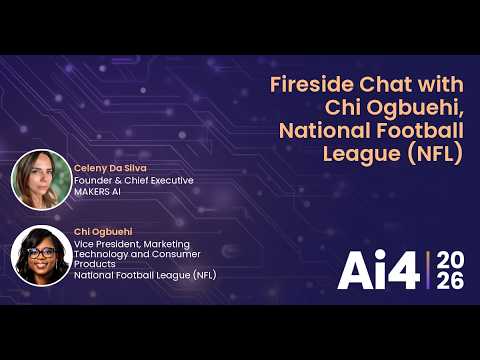
## Background Published on YouTube by the Ai4 conference channel on August 22, 2026, this video documents an enterprise fireside chat between Celeny Da Silva, Founder and Chief Executive of MAKERS AI, and Chi Ogbuehi, Vice President of Marketing Technology and Consumer Products at the National Football League (NFL). The session explores how the NFL operationalizes artificial intelligence to scale fan engagement across global markets.
## TL;DR Chi Ogbuehi outlines the NFL's overarching martech strategy, emphasizing that artificial intelligence cannot scale enterprise-wide without first modernizing organizational operating models and underlying workflows. Rather than automating broken processes, the league established a unified intake 'front door' and a universal metadata taxonomy across 32 clubs and 22 countries. Ogbuehi details the essential role of human-in-the-loop governance—highlighting how human reviewers caught quality degradation during the live 2026 NFL Draft—and explains how the league drives 'mass intimacy' for fans. Rather than fixating on token or compute costs, the NFL measures AI value through production cycle times, throughput scalability, and first-time-right asset quality.
## Atmosphere & style The conversation carries a polished, pragmatic, and candid tone, striking a balance between high-level executive strategy and unvarnished operational realities. Da Silva guides the discussion with an inquisitive, collegiate energy, while Ogbuehi provides grounded, experience-tested insights with refreshing candor about the limitations of raw AI models and past deployment hitches. It feels like an authentic insider briefing on enterprise transformation, replacing speculative generative AI hype with actionable architectural discipline.
## Key takeaways - [00:04](https://www.youtube.com/watch?v=DnzndoCPAes&t=4s) The NFL's massive global footprint of 32 clubs and over 200 million fans across 22 countries led to the foundational enterprise principle: 'AI doesn't scale, operating models do.' - [01:50](https://www.youtube.com/watch?v=DnzndoCPAes&t=110s) An 'always-on' year-round calendar and surging audience diversity pushed legacy creative production pipelines past capacity, driving the pragmatic need for AI automation. - [06:10](https://www.youtube.com/watch?v=DnzndoCPAes&t=370s) A disciplined, phased deployment pipeline (Concept to Pilot MVP to Real-World Execution) ensured the NFL only scaled workflows that demonstrated measurable viability. - [06:10](https://www.youtube.com/watch?v=DnzndoCPAes&t=370s) Scaling AI required a tailored talent strategy that blended creative designers with technologist practitioners to engineer modular, reusable visual assets. - [08:08](https://www.youtube.com/watch?v=DnzndoCPAes&t=488s) To avoid accelerating broken workflows, the NFL instituted a centralized 'front door' intake mechanism to govern all incoming campaign and content requests. - [08:08](https://www.youtube.com/watch?v=DnzndoCPAes&t=488s) A standardized enterprise metadata taxonomy established central consistency across the league while maintaining local autonomy for individual clubs and international regions. - [10:30](https://www.youtube.com/watch?v=DnzndoCPAes&t=630s) Human-in-the-loop review remains non-negotiable for enterprise AI governance, serving as an essential quality safety net while systems learn and mature. - [10:30](https://www.youtube.com/watch?v=DnzndoCPAes&t=630s) During the 2026 NFL Draft live test, AI output quality degraded on Day 2 after a successful Day 1, demonstrating why real-time generative pipelines require active human oversight before public distribution. - [12:34](https://www.youtube.com/watch?v=DnzndoCPAes&t=754s) The NFL leverages AI to deliver 'mass intimacy'—providing timely, deeply personalized fan interactions at scale based on the premise that 'everyone footballs differently.' - [13:53](https://www.youtube.com/watch?v=DnzndoCPAes&t=833s) AI ROI is evaluated through outcome-oriented metrics such as production cycle time, asset throughput, and 'first time right' quality rather than compute or token costs. - [15:26](https://www.youtube.com/watch?v=DnzndoCPAes&t=926s) Driving enterprise AI adoption requires embedding capabilities seamlessly into existing workflows rather than forcing teams to learn isolated standalone tools.
## Detailed walkthrough ### [00:04](https://www.youtube.com/watch?v=DnzndoCPAes&t=4s) Welcoming Chi Ogbuehi: The NFL's Massive Scale and the Operating Model Thesis
Opening the Ai4 session, Celeny Da Silva, Founder and CEO of MAKERS AI, frames football as far more than just athletic competition—it is an identity, a community, and an intense emotional bond. For the National Football League (NFL), supporting that relationship requires managing extraordinary operational breadth: a single league governing 32 individual clubs, engaging over 200 million fans across 22 countries. Every single week of the season, the organization faces the staggering task of transforming raw, on-field moments into hyper-relevant, localized content tailored for diverse international markets. Da Silva poses the central dilemma confronting enterprise technology leaders: what does it take to move artificial intelligence past mere experimentation into a trusted, enterprise-grade capability? She introduces the guiding philosophy articulated by the league itself: "AI doesn't scale, operating models do."
Da Silva welcomes Chi Ogbuehi, Vice President of Marketing Technology and Consumer Products at the NFL, greeting him warmly and noting with a laugh that he traveled all the way from Greece to join the discussion. Ogbuehi chuckles, clarifying that while he was indeed abroad, he returned over the weekend just in time for the conference. Da Silva quickly pivots into the day-to-day realities of league operations, asking Ogbuehi to pull back the curtain on what actually occurs across marketing and content teams between game days—specifically on a typical Tuesday during the active season—and where AI currently fits into that machinery.
- **League footprint:** 1 overarching league, 32 franchise clubs, over 200 million fans, spanning 22 countries. - **Core philosophy:** "AI doesn't scale, operating models do."
---
[01:50](https://www.youtube.com/watch?v=DnzndoCPAes&t=110s) The "Always-On" Fan Engine: From Global Diversity to Broken Workflows
Ogbuehi begins by clarifying his team's purview: leading marketing technology across emerging tech, operating architectures, and the digital platforms that drive fan engagement both domestically and globally. While casual viewers only see the three-hour spectacle on the field, an intricate, continuous operation hums behind the scenes to deliver varied content across disparate channels, languages, and time zones. As the NFL’s international presence has expanded into 22 countries, its audience profile has diversified dramatically, seeing explosive growth among female audiences and grassroots participants through initiatives like flag football. However, serving a deeply global audience brings immense operational friction, demanding varied formats, multi-language translations, and nuanced cultural localization, all while fans demand immediate, real-time personalization.
```mermaid flowchart TD accTitle: NFL Content Supply Chain and Operational Model subgraph Intake["Intake & Governance"] Req["Content Requests"] --> FD["Unified 'Front Door'"] FD --> Meta["Standardized Metadata Framework"] end
subgraph Generation["Production & Processing"] Meta --> AI["AI Content Generation & Automation"] AI --> RT["Real-Time Feeds (e.g. Draft / Live Games)"] end
subgraph Governance["Human-in-the-Loop Review"] RT --> HITL{"Quality & Brand Review"} HITL -->|"Approved"| Dist["Multi-Channel Distribution (Clubs, International, Social)"] HITL -->|"Degraded / Flagged"| Fix["Manual Remediation"] Fix --> Dist end ```
The sheer velocity and volume of fan expectations eventually pushed legacy production setups past their breaking point. Ogbuehi emphasizes that their pivot toward AI was never about chasing a flashy technical novelty or inserting an algorithm for its own sake; it was a pragmatic response to business demand overwhelming traditional creative capacity. He explains that fan engagement is fundamentally "always on." The narrative does not kick off on kickoff Sunday; it starts months earlier with the off-season draft, schedule releases, and training camp storylines. Once the regular season begins, production shifts into an unforgiving, real-time pace where timely reactions are mandatory. Facing this unrelenting velocity, the NFL recognized that traditional creative pipelines could no longer keep pace without rethinking the operational backbone.
- **Global reach:** Content localized across 22 countries with cultural adaptations. - **Audience demographics:** Surging engagement across women and international flag football communities. - **Year-round calendar:** Off-season milestones (NFL Draft, schedule drop, training camps) transition seamlessly into high-frequency, in-season real-time content.
---
[06:10](https://www.youtube.com/watch?v=DnzndoCPAes&t=370s) Why AI Doesn't Scale Without an Operating Model: MVP Lessons and People Strategy
Addressing his mantra that "AI doesn't scale, operating models do," Ogbuehi details the hard-earned lessons behind the phrase. Rather than leaping recklessly from a high-level concept directly to full enterprise-wide rollout, the NFL executed a measured, phased methodology: concept validation, pilot MVP (Minimum Viable Product), and controlled real-world deployment. Crucially, the organization did not attempt to scale every experiment; they deliberately scaled only what proved viable. The MVP phase served as an unvarnished audit, highlighting not just technical friction, but exposing gaps across people, processes, and technology.
On the organizational side, the technology team realized that tooling alone achieves nothing without internal alignment and cultural buy-in. They actively recruited champions across departments, empowered power users, and introduced a hybrid profile of talent—pairing creative designers with technologist practitioners capable of decomposing visual assets into flexible, modular content that could be dynamically adapted, reused, and scaled across campaigns.
> "AI doesn't scale, operating models do."
- **Deployment framework:** Structured pipeline progressing from Concept $\rightarrow$ Pilot MVP $\rightarrow$ Real-World Execution. - **Selective scaling:** Only operationalized workflows that demonstrated measurable efficiency and accuracy during the MVP phase. - **Talent strategy:** Embedded cross-functional champions and blended creative-technologist roles to build modular, re-usable design assets.
---
[08:08](https://www.youtube.com/watch?v=DnzndoCPAes&t=488s) Rebuilding the Foundation: The Intake Front Door and Unified Metadata Strategy
When Da Silva asks how AI reshaped the creative supply chain from initial concept to execution, Ogbuehi underscores their most critical architectural realization: teams cannot simply bolt modern AI on top of fragmented, broken workflows. Attempting to automate undisciplined processes only accelerates failure. The NFL had to take a deliberate step back to establish a clean operational foundation, defining exact standards for how marketing teams interact with the tech stack day to day.
To establish governance and eliminate ad-hoc fragmentation, the team instituted an operational "front door"—a centralized intake mechanism through which all content, campaign, and asset requests must flow. This structural gateway enforced repeatable patterns, consistency, and compliance before any automation occurred. Simultaneously, the NFL was forced to completely overhaul its metadata strategy. Scaling content across the central league office, 32 distinct club franchises, and diverse international territories proved impossible without a shared, universal taxonomy. The league had to carefully balance centralization and autonomy, establishing standardized metadata rules to maintain system consistency while allowing clubs the federation and localized flexibility needed to preserve their authentic local voice.
- **Intake mechanism:** Implemented a single "front door" request entry point to govern workflows, standardize inputs, and ensure repeatable output patterns. - **Foundational prerequisite:** Refused to automate flawed processes; established an enterprise-wide metadata taxonomy first. - **Federated balance:** Standardized data architecture at the league level while granting local autonomy for clubs and international regions to safeguard authentic tone.
---
[10:30](https://www.youtube.com/watch?v=DnzndoCPAes&t=630s) Trust, Governance, and Human-in-the-Loop: The 2026 NFL Draft Test Case
Turning to the question of institutional trust, Da Silva asks what benchmarks must be reached before an enterprise can confidently trust an automated capability at scale. Ogbuehi explains that trust is earned incrementally as models learn, making human-in-the-loop oversight non-negotiable across the NFL's production chain. Every AI-generated asset undergoes rigorous human validation before being distributed to the public. However, Ogbuehi cautions that oversight must be engineered strategically so that reviewers act as quality safeguards rather than operational bottlenecks.
To illustrate this dynamic, Ogbuehi shares a real-world example from the 2026 NFL Draft, where the league hooked generative AI pipelines into live, real-time data feeds for the very first time. As draft picks were announced from the podium, the AI engine instantly generated tailored social graphics and copy for immediate review and publication by the social team. During round one, the system performed flawlessly with high-fidelity output. But by day two of the draft, the content quality began noticeably degrading. Because human reviewers were actively embedded in the loop, the team caught the anomalies and remediated the assets prior to broadcast, averting public-facing errors. Ogbuehi concludes that while models cannot be blindly trusted out of the box, disciplined human-in-the-loop governance provides the safety net required while systems learn and mature.
- **Live trial:** First end-to-end integration of generative AI with real-time sports data feeds executed during the 2026 NFL Draft. - **Failure point caught:** Day 1 output produced high-quality content; by Day 2, automated output experienced noticeable quality degradation. - **Governance principle:** Maintained human reviewers to catch and fix pipeline drift before public distribution, avoiding operational bottlenecks while safeguarding brand trust.
[12:34](https://www.youtube.com/watch?v=DnzndoCPAes&t=754s) Achieving "Mass Intimacy" for Unique Fan Bases at Scale
When asked how fans perceive the difference in how the NFL communicates with them today, Chi Ogbuehi frames the effort around the organization's overarching mission: modern sports fans expect interactions that are timely, relevant, and deeply personalized. The core challenge for the league is delivering that level of personalization at immense scale. Ogbuehi articulates this ambition through the concept of "mass intimacy"—the capability to interact with fans in ways that feel custom-tailored to their personal affinity, acknowledging that "everyone footballs differently." Because individual fans connect with the sport, teams, and players across varied touchpoints, AI enables the league to simultaneously serve millions while preserving that distinct, one-on-one personal feel.
Celeny Da Silva reflects on this idea, emphasizing that the greatest power of sports and the NFL is enabling human connection and shared love for the game. However, building out this degree of bespoke global personalization requires significant technical and organizational investment, prompting the question of how the NFL measures tangible business returns.
```mermaid flowchart LR accTitle: NFL Mass Intimacy Engine subgraph FanUnderstanding["Fan Understanding"] A["Diverse Fan Base<br/>'Everyone footballs differently'"] end subgraph AIPlatform["AI & MarTech Platform"] B["Mass Intimacy Engine<br/>Personalization at Scale"] end subgraph Outcomes["Fan Experience"] C["Timely Delivery"] D["Relevant Content"] E["Deeply Personal Interactions"] end A --> B B --> C B --> D B --> E ```
[13:53](https://www.youtube.com/watch?v=DnzndoCPAes&t=833s) Measuring Business Value Beyond Cost and Token Credits
When evaluating the return on investment for AI, Ogbuehi explains that the NFL focuses squarely on outcomes and direct problem-solving rather than getting bogged down in micro-level consumption costs like compute credits and token pricing. The primary business metrics the NFL tracks include:
- **Production Cycle Time:** Tracking the total latency from the moment a content or campaign request is submitted until the finished asset reaches the fan. - **Throughput & Scalability:** Assessing whether the martech stack can generate sufficient variations and asset volumes to satisfy diverse global fan segments. - **Asset Quality & "First Time Right":** Measuring how frequently AI-generated or assisted deliverables meet production standards without requiring repetitive manual corrections.
While financial considerations naturally shape broader capital allocation decisions, Ogbuehi emphasizes that real business value drivers—speed, scale, quality, and fan base expansion across diverse languages and international markets—must guide whether and where the NFL continues to invest.
[15:26](https://www.youtube.com/watch?v=DnzndoCPAes&t=926s) Core Principles for Operationalizing AI Across MarTech
Closing the discussion, Da Silva asks for the top principles required to successfully operationalize AI across a large-scale marketing technology ecosystem. Ogbuehi highlights two foundational requirements:
1. **Operating Model Alignment:** The organizational operating model must harmonize people, processes, and technology. As Ogbuehi highlights, AI does not act as a standalone solution; rather, "once you do that, AI becomes an accelerator." 2. **Designing for Adoption Up Front:** Organizations must actively minimize barriers to entry. Instead of forcing teams to adopt isolated standalone applications, the NFL redesigned end-to-end workflows so AI capabilities integrate seamlessly into existing day-to-day operations, ensuring employees do not feel like they have to "learn yet another tool."
Da Silva wraps up the fireside chat by underscoring Ogbuehi's central thesis on deploying enterprise AI at the NFL: technology alone is insufficient—"AI doesn't scale. Operating models do."
## Notable quotes > [00:04](https://www.youtube.com/watch?v=DnzndoCPAes&t=4s) AI doesn't scale, operating models do. — Celeny Da Silva
> [06:10](https://www.youtube.com/watch?v=DnzndoCPAes&t=370s) AI doesn't scale, operating models do. — Chi Ogbuehi
> [12:34](https://www.youtube.com/watch?v=DnzndoCPAes&t=754s) everyone footballs differently — Chi Ogbuehi
> [15:26](https://www.youtube.com/watch?v=DnzndoCPAes&t=926s) once you do that, AI becomes an accelerator. — Chi Ogbuehi
> [15:26](https://www.youtube.com/watch?v=DnzndoCPAes&t=926s) learn yet another tool. — Chi Ogbuehi
> [15:26](https://www.youtube.com/watch?v=DnzndoCPAes&t=926s) AI doesn't scale. Operating models do. — Celeny Da Silva
## Mentioned Chi Ogbuehi, Celeny Da Silva, National Football League (NFL), MAKERS AI, Ai4, NFL Draft
## Video description Celeny Da Silva - Founder & Chief Executive, MAKERS AI Chi Ogbuehi - Vice President, Marketing Technology and Consumer Products, National Football League (NFL)
[Source](https://www.youtube.com/watch?v=DnzndoCPAes)