Google Cuts Chrome Ad Time 70% as AI Bottlenecks Shift to Compliance
Ai4
While generative AI accelerates performance ad creation cycles from 30 days to 10, overall time-to-market remains stalled because enterprise legal and approval workflows cannot match automated output volume.
AI-assisted summary of Applying AI in Performance Marketing: Practical Lessons from Operating at Scale — original source. Check the original for full context.
Source published:
Detailed notes
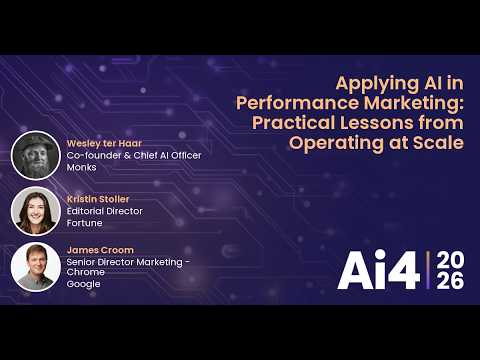
## Background Published on YouTube by Ai4 on September 4, 2026, this fireside chat features James Croom (Senior Director of Marketing for Google Chrome), Wesley ter Haar (Co-founder & Chief AI Officer at Monks), and moderator Kristin Stoller (Editorial Director at Fortune). The session focuses on practical operational lessons and organizational shifts required when integrating generative AI into global performance marketing workflows at scale.
## TL;DR While generative AI has dramatically collapsed asset production cycles—slashing Google Chrome's localization turnaround from thirty days to ten—enterprise go-to-market velocity remains bottlenecked by traditional legal and compliance review workflows. Navigating this shift requires organizations to evolve from chaotic, fragmented pilots toward standardized operational capabilities while maintaining human oversight for upstream strategic vision and emotional intuition. Additionally, the rise of AI-mediated discovery is forcing marketers to rethink digital strategy, treating brand websites as clean knowledge bases for autonomous agents and driving conversational relevance across open social platforms.
## Atmosphere & style The discussion is candid, grounded, and refreshingly sober, trading speculative industry hype for the unvarnished realities and organizational 'scar tissue' of enterprise implementation. The rapport between Croom and ter Haar is collegial and pragmatic, marked by sharp tactical anecdotes and lighthearted banter over competing AI tools. Listening in feels like sitting inside a frank, high-level debrief between seasoned marketing operators who are actively managing the friction between rapid machine generation and human-speed corporate governance.
## Key takeaways - [00:04](https://www.youtube.com/watch?v=b3PH5D4T3dI&t=4s) While AI has drastically accelerated creative asset generation, overall go-to-market speed remains constrained by traditional, slow-moving legal, risk, and enterprise compliance reviews. - [01:28](https://www.youtube.com/watch?v=b3PH5D4T3dI&t=88s) Beyond tech giants, early enterprise AI adoption is led by margin-compressed sectors like FMCG, CPG, and automotive, which need AI to manage the exponential explosion of channel-specific digital content demands. - [02:36](https://www.youtube.com/watch?v=b3PH5D4T3dI&t=156s) Google Chrome's localized performance marketing workflow reduced campaign turnaround time by nearly 70% (from 30 to 10 days) and cut direct production costs by roughly 27% across 40+ global locales. - [02:36](https://www.youtube.com/watch?v=b3PH5D4T3dI&t=156s) High-velocity AI production enables marketing teams to continuously 'daisy chain' the two-week novelty performance bump of fresh creative before audience ad fatigue sets in. - [06:06](https://www.youtube.com/watch?v=b3PH5D4T3dI&t=366s) Scaling AI in creative agencies requires fundamentally overhauling company culture from subjective personal preferences to structured, process-driven operations. - [06:06](https://www.youtube.com/watch?v=b3PH5D4T3dI&t=366s) Unlike startups that can risk brand damage with unvetted creative, large enterprises must implement strict governance and guardrails to prevent low-quality AI 'slop' from reaching markets. - [09:35](https://www.youtube.com/watch?v=b3PH5D4T3dI&t=575s) AI agents excel at absorbing vast briefing contexts and generating downstream creative variations, allowing human marketers to focus upstream on strategic ideation, emotional nuance, and creative intuition. - [09:35](https://www.youtube.com/watch?v=b3PH5D4T3dI&t=575s) AI tools can be deployed across large brand portfolios to audit and verify live creative against concurrent campaigns, preventing contradictory messaging or redundant visuals. - [11:52](https://www.youtube.com/watch?v=b3PH5D4T3dI&t=712s) To prevent 'death by a thousand pilots' and redundant internal tooling, organizations should consolidate around a standardized core of mission-critical AI capabilities while maintaining controlled room for specialized experimentation. - [14:13](https://www.youtube.com/watch?v=b3PH5D4T3dI&t=853s) Agency value is shifting from billing for raw production hours toward navigating complex enterprise approval workflows and providing seasoned domain judgment. - [14:13](https://www.youtube.com/watch?v=b3PH5D4T3dI&t=853s) The most effective AI marketing talent model pairs junior AI-native operators who master new tools with seasoned domain experts who supply strategic direction. - [16:55](https://www.youtube.com/watch?v=b3PH5D4T3dI&t=1015s) Marketing is expanding beyond human audiences to optimizing directly for large language models and autonomous agents acting as search and recommendation intermediaries. - [17:38](https://www.youtube.com/watch?v=b3PH5D4T3dI&t=1058s) Because LLMs rely on fresh discussions from open platforms like Reddit, X, and YouTube, brands in low-conversation categories face new hurdles in establishing algorithmic visibility. - [18:38](https://www.youtube.com/watch?v=b3PH5D4T3dI&t=1118s) Brand websites are transforming into structured knowledge bases for AI agents, making content pruning and knowledge base hygiene critical to prevent models from retrieving obsolete information. - [18:38](https://www.youtube.com/watch?v=b3PH5D4T3dI&t=1118s) As autonomous AI agents make purchasing decisions based on utility and economic logic rather than emotional persuasion, marketers must fundamentally rethink how brand equity functions.
## Detailed walkthrough ### [00:04](https://www.youtube.com/watch?v=b3PH5D4T3dI&t=4s) The Paradox of Speed: Creation vs. Enterprise Governance
The session opens with moderator Kristin Stoller setting the stage: after years of promises that artificial intelligence would completely revolutionize marketing, what is actually measurably faster in mid-2026, and what has stubbornly remained the same? James Croom points directly to content production as the clearest win—assets can now be produced at a vastly accelerated clip. However, overall go-to-market speed has not accelerated at anywhere near the same pace because traditional review cycles, such as legal and compliance sign-offs, have completely failed to keep up with the sheer volume of generated assets.
Wesley ter Haar reinforces this operational reality, describing a "quite paradoxical situation." While AI has successfully collapsed the manual labor required to transition from an initial insight to in-channel creative assets, the operational bottleneck has simply shifted down the line. Because sign-offs, risk assessments, and enterprise review workflows have not sped up proportionally, work can theoretically be done instantly, yet getting it out the door still stalls.
```mermaid flowchart LR accTitle: AI Content Generation Bottleneck Flow subgraph Accelerated ["AI-Accelerated Phase"] A["Raw Insights"] --> B["Asset Generation"] end subgraph Bottleneck ["Enterprise Bottleneck"] B --> C["Legal & Compliance Review"] C --> D["Stakeholder Sign-offs"] D --> E["In-Market Launch"] end ```
[01:28](https://www.youtube.com/watch?v=b3PH5D4T3dI&t=88s) Early Adopters and Post-Pilot Momentum Across Industries
When surveying the broader industry landscape, ter Haar highlights two distinct categories of businesses leading enterprise AI adoption. First are the technology giants who are practically obligated to adopt early—engaging in what he terms "a little bit of dog fooding or drinking your own champagne." Second are industries operating under intense margin compression and growth mandates, particularly Fast-Moving Consumer Goods (FMCG), Consumer Packaged Goods (CPG), and automotive brands.
These consumer goods and automotive categories have been heavily weighed down by the complexity of modern digital advertising. The exponential explosion of channel-specific content demands previously forced marketing organizations to spend their days "project managing instead of marketing." As a result, these sectors have rapidly moved past exploratory experiments into what ter Haar calls "post-pilot activities," deploying AI workflows at genuine enterprise scale.
[02:36](https://www.youtube.com/watch?v=b3PH5D4T3dI&t=156s) Case Study: Scaling Global Performance Ads for Google Chrome
Croom walks through a concrete implementation from his team at Google, working alongside Monks to market the Chrome browser and its new Gemini features across 50 to 60 global locales. Operating with a lean team primarily based in San Francisco, the challenge was to create hyper-targeted performance ads across dozens of languages—where certain individual countries require over 10 distinct local language variations.
```mermaid flowchart TD accTitle: Chrome Performance Ad Production Pipeline A["Gemini Feature Launch"] --> B["AI-Assisted Concepting\n(Personas, Use Cases, Prompts)"] B --> C["Human-Crafted Master Template"] C --> D["AI Variant Generation\n(Micro-segments e.g. US Racket Sports)"] D --> E["Automated Localization\n(40+ Locales with Cultural Nuance)"] E --> F["Performance Feedback Loop\n(Continuous Iteration)"] ```
The workflow utilizes AI during the early concepting phase to brainstorm personas, use cases, and prompt structures. The team then crafts an "ideal ad" master template with heavy human oversight. From this master template, AI generates vast variant matrices tailored to specific micro-segments (such as US-based racket sports enthusiasts). The system then localizes the creative across 40 locales, adjusting cultural references (such as recognizing where tennis lacks popularity) before pushing assets live and feeding performance data back into the loop.
- **Turnaround time reduction**: The production cycle shrank from approximately 30 business days (which involved tedious back-and-forth emails with overseas linguists, localized research, and manual proofreading) down to just 10 business days during the pilot—a nearly 70% decrease in turnaround time. - **Direct cost savings**: Production costs dropped by roughly 27%, though Croom notes financial savings are secondary to the massive advantage in deployment speed. - **Combatting ad fatigue**: Rather than relying purely on aggregate performance lift, the team uses production velocity to "daisy chain" the initial two-week novelty performance bump that new ads experience before audience ad blindness sets in.
[06:06](https://www.youtube.com/watch?v=b3PH5D4T3dI&t=366s) Transforming Agency Culture from Preferences to Processes
Reflecting on Monks' journey since early 2023, ter Haar acknowledges that adopting AI across a creative agency was far harder than simply distributing software licenses and conducting training sessions. The agency had to fundamentally overhaul its operating philosophy, pivoting from a culture driven by subjective creative preferences to one governed by rigorous, structured processes—a transition that produced significant "scar tissue" within a legacy creative business.
The strategic goal is delivering "work that people love and that machines prefer." While generative tools enable micro-targeting and hyper-personalization for consumers, the sheer volume and refresh rate satisfy algorithmic distribution engines. On the client side, Croom emphasizes that while zero-marketer startups can afford to move recklessly, enterprise giants face severe brand, compliance, and commercial risks. If a startup fails, "you just change a company's name and start again," whereas a flagship product like Chrome demands stringent enterprise safeguards to prevent low-quality "slop" from reaching audiences.
[09:35](https://www.youtube.com/watch?v=b3PH5D4T3dI&t=575s) Upstream Human Intuition Meets Downstream Agentic Context
When deciding where to inject AI into the creative lifecycle, ter Haar advocates for a non-nostalgic stance, noting that technology can assist across the entire workflow as long as skilled operators remain in the lead. A primary operational advantage is an AI agent's ability to maintain vast contextual awareness. While human creative teams notoriously overlook lengthy briefs and "never" read the accompanying 60-page background documents, AI systems digest full documentation instantly, allowing human creatives to apply their intuition, taste, and emotional instincts ("fingerspitzengefühl") on top of complete context.
Croom adds that Google maintains a clear division of labor:
- **Upstream strategic ideation**: Big brand platforms, core messaging, and creative concepts remain anchored in human intuition. - **Downstream production**: Generation, variant rendering, and asset resizing are heavily automated. - **Cross-campaign verification**: AI is deployed to audit live creative against roughly 20 other active Google brand campaigns, ensuring distinct products avoid conflicting messaging or redundant visual examples.
[11:52](https://www.youtube.com/watch?v=b3PH5D4T3dI&t=712s) Navigating "Death by a Thousand Pilots" and Organizational Chaos
Addressing the common trap of pilot proliferation, ter Haar notes that unbounded experimentation eventually hits diminishing returns because underlying AI models collapse disparate tasks into nearly identical workflows. Monks shifted from an uncoordinated explosion of pilots into a focused framework centered around five core operational capabilities. This consolidation avoids internal corporate politics, where competing teams develop duplicate tools and become protective over their specific pilots.
```mermaid flowchart TD accTitle: Evolution of Pilot Strategy subgraph Phase1 ["Early Stage: Fragmentation"] P1["Pilot A"] P2["Pilot B"] P3["Pilot C"] P4["Pilot D"] end subgraph Phase2 ["Current Operating Balance"] C1["Standardized Core\n(Top 5 Mission-Critical Capabilities)"] C2["Controlled Innovation Chaos\n(Use-Case Specific Experiments)"] end Phase1 --> Phase2 ```
Croom notes that managing this transition requires careful cultural handling. Forcing premature standardization can demoralize teams who have poured effort into specialized tooling just because an alternative is marginally faster or cheaper. For now, Google balances standardized production engines with a degree of "exciting innovative chaos," permitting multiple overlapping tools when tailored to specific team needs.
[14:13](https://www.youtube.com/watch?v=b3PH5D4T3dI&t=853s) The Evolution of Agency Value and the Rise of AI-Native Talent
Revisiting his past statement that 65% of agency tasks could be automated, ter Haar reflects on what clients actually pay for. Speed must not come at the expense of quality, but more importantly, agency fees often cover navigating enterprise complexity rather than raw production hours. He shares an anecdote where Monks compressed a 6-to-7-month global campaign into an astonishing 12-week sprint to inspire a client organization, only for the actual deployment to take the standard timeline because the client's internal approval infrastructure could not digest work at that velocity.
Croom concludes with an observation on marketing talent dynamics. Value is coalescing around two distinct profiles: younger, AI-native talent who intuitively manipulate modern tools, and seasoned domain experts who supply critical strategic judgment. While many enterprises attempt to in-house the raw technology and hire junior AI operators, pairing deep agency domain expertise with AI-accelerated execution creates an exponentially higher impact per person.
[16:55](https://www.youtube.com/watch?v=b3PH5D4T3dI&t=1015s) Marketing for Algorithms: From Human Consumers to LLMs
The panel touches on how domain expertise in brand management, creative vision, and messaging remains essential within marketing teams and agencies alike, before shifting focus to a fundamental industry change: marketing directly to algorithms rather than just human consumers. Kristin Stoller shares a personal anecdote from moving apartments over the weekend, recalling how she turned to Claude to ask for the fastest kitchen table delivery that could arrive in under three weeks. When she notes that the results were not particularly impressive, James Croom playfully interjects that she should have tried Gemini instead.
Kristin uses this experience to prompt a deeper question on how marketing strategies and creative workflows must evolve now that AI systems mediate consumer discovery. The shift forces marketers to reconsider how ads, content, and brand presence are structured when the immediate "audience" evaluating recommendations is a large language model.
```mermaid flowchart TD accTitle: Marketing Shift from Human Audiences to Agentic Discovery subgraph HumanInput["User Query & Discovery"] U["Consumer Prompt / Search"] end
subgraph LLMProcessing["AI / Agent Layer"] LLM["Large Language Model / AI Agent"] KB["Web Knowledge Bases & PR Archives"] SOC["Open Social Channels (Reddit, X, YouTube)"] end
subgraph BrandOutput["Brand Action & Delivery"] OUT["Synthesized Recommendation to User"] end
U --> LLM KB --> LLM SOC --> LLM LLM --> OUT ```
---
[17:38](https://www.youtube.com/watch?v=b3PH5D4T3dI&t=1058s) Social Freshness, LLM Retrieval, and Category Challenges
Addressing the mechanics of AI discovery, James Croom highlights that large language models rely heavily on fresh, real-time data, which is primarily harvested from open social channels and active public discussions. While clarifying that he is speaking from general industry observation rather than insider Google intelligence, he emphasizes that social presence across platforms like X, Reddit, and YouTube has become massively more important. Ensuring that consumers and creators are actively discussing a brand across these networks directly influences how models surface and cite products.
However, James points out a sharp disparity across product categories. While tech products like Google Chrome are naturally discussed, debated, and recommended across digital communities, non-conversational categories face a steeper hurdle. Consumers rarely go online to casually recommend everyday items or sensitive purchases, such as prescription medication, to their peers. For brands operating in industries with minimal organic social banter, the urgent mandate is determining creative ways to establish relevance and ignite genuine discussions in open forums where algorithms listen.
- **Primary Data Sources for AI Freshness:** Active discussions on open platforms like Reddit, X (formerly Twitter), and YouTube serve as key signals for LLMs needing up-to-date information. - **The Category Gap:** Tech products benefit from high organic discussion volume, whereas brands in low-chatter categories (e.g., healthcare, pharmaceuticals, standard utility goods) must engineer new strategies to remain relevant in AI-indexed spaces.
---
[18:38](https://www.youtube.com/watch?v=b3PH5D4T3dI&t=1118s) Websites as Agent Knowledge Bases and Brand Identity in an Agentic Landscape
Wesley ter Haar expands on how digital ecosystems must adapt, noting that brand websites are effectively transforming into "a knowledge base for agents." Historically, companies rarely purged legacy web pages, preserving old material indefinitely for posterity. Today, however, outdated PR announcements and deprecated messaging can be ingested by LLMs and reflected in generated answers. While many in the industry anticipated that content strategy and strategic copywriting would be among the first disciplines automated away, Wesley argues the exact opposite: the need to curate, prune, and structure accurate, agent-ready knowledge bases completely reframes and elevates the importance of content strategy.
Looking toward the broader future, Wesley reflects on how traditional brand real estate is collapsing directly into agentic interfaces. This raises profound questions about the nature of branding itself. As autonomous agents increasingly make decisions grounded in economic logic and utility rather than emotional persuasion, marketers must fundamentally rethink how a brand creates value when the consumer's emotional connection is mediated by a rational algorithm. Kristin Stoller closes the fireside session by thanking the panelists for their grounded, practical insights on operating AI at enterprise scale.
- **Knowledge Base Hygiene:** Brands must actively manage their web footprints to prevent LLMs from retrieving and hallucinating outdated PR messages or obsolete product information. - **Reframing Content Strategy:** Strategic copywriting and content architecture are shifting from one-off creative outputs to continuous knowledge base maintenance for autonomous agents. - **Rational Agents vs. Emotional Branding:** Traditional brand equity relies on emotional resonance, whereas AI agents prioritize "economically logical decisions," requiring a deep strategic pivot for brand marketers.
## Notable quotes > [00:04](https://www.youtube.com/watch?v=b3PH5D4T3dI&t=4s) quite paradoxical situation — Wesley ter Haar
> [01:28](https://www.youtube.com/watch?v=b3PH5D4T3dI&t=88s) a little bit of dog fooding or drinking your own champagne — Wesley ter Haar
> [01:28](https://www.youtube.com/watch?v=b3PH5D4T3dI&t=88s) project managing instead of marketing — Wesley ter Haar
> [01:28](https://www.youtube.com/watch?v=b3PH5D4T3dI&t=88s) post-pilot activities — Wesley ter Haar
> [06:06](https://www.youtube.com/watch?v=b3PH5D4T3dI&t=366s) work that people love and that machines prefer — Wesley ter Haar
> [06:06](https://www.youtube.com/watch?v=b3PH5D4T3dI&t=366s) you just change a company's name and start again — James Croom
> [09:35](https://www.youtube.com/watch?v=b3PH5D4T3dI&t=575s) fingerspitzengefühl — Wesley ter Haar
> [11:52](https://www.youtube.com/watch?v=b3PH5D4T3dI&t=712s) death by a thousand pilots — Wesley ter Haar
> [11:52](https://www.youtube.com/watch?v=b3PH5D4T3dI&t=712s) exciting innovative chaos — James Croom
> [18:38](https://www.youtube.com/watch?v=b3PH5D4T3dI&t=1118s) a knowledge base for agents — Wesley ter Haar
> [18:38](https://www.youtube.com/watch?v=b3PH5D4T3dI&t=1118s) economically logical decisions — Wesley ter Haar
## Mentioned Wesley ter Haar, James Croom, Kristin Stoller, Monks, Google, Chrome, Gemini, Fortune, Ai4, Claude, Reddit, X, YouTube
## Video description Wesley ter Haar - Co-founder & Chief AI Officer, Monks James Croom - Senior Director Marketing - Chrome, Google Kristin Stoller - Editorial Director, Fortune
In this fireside chat, James Croom and Wesley ter Haar will share practical perspectives on applying AI in performance marketing within a large, globally distributed marketing organization. The discussion will focus on operational learnings from working at scale across multiple markets, teams, and approval environments, with examples anchored in Chrome-specific work.
Topics will include how AI can support faster creative development, more efficient production workflows, and increased agility in refreshing marketing assets. The session will also examine the organizational side of adoption, including the investment required to build new capabilities and adapt ways of working as tools and processes continue to evolve.
Designed as a candid but practical conversation, the session will highlight what teams are learning as they integrate AI into modern marketing operations, while staying focused on grounded use cases and implementation realities rather than broad industry speculation.
[Source](https://www.youtube.com/watch?v=b3PH5D4T3dI)